




Abstract
What leads to the initial emergence of democracy? Many studies view democratization as the product of a class struggle over economic redistribution, pitting the landed elites against the masses or the bourgeoisie. This article, by contrast, argues that the initial emergence of democracy in South America stemmed from a struggle between elite parties or factions that pursued (or opposed) democratic reform to gain (or maintain) political power. Democratization occurred when a split within the ruling party or coalition led dissident factions to side with the opposition and push through reforms that expanded the franchise and leveled the electoral playing field. I explore these arguments by examining the origins of democracy in four Latin American countries: Argentina, Chile, Colombia, and Uruguay. Historical process tracing and a quantitative analysis of the vote on a key democratic reform measure in Argentina in 1912 provide support for these arguments.
Keywords
What leads to the emergence of democracy? How did democracy first arise in Latin America in the late 19th and early 20th century? And who were the central actors in the process of democratization during this period?
A prominent approach in the literature views democratization as the product of class struggle, pitting the landed elites against the masses. From this perspective, the fight for democracy is a struggle over wealth in which the main actors aim to defend the economic interests of their class. The main version of the class pressure model argues that the masses support democratization because they want to redistribute their countries’ wealth, and the landed elites resist it to block redistribution (Acemoglu & Robinson, 2006; Przeworski, 2009; Rueschemeyer, Stephens, & Stephens, 1992). In these accounts, the struggle for democracy is typically presented as taking place in the streets, and involves aggressive and even violent actions, including strikes, protests, and revolts. Democratization occurs when authoritarian rulers, who represent the landed elites, yield in the face of these threats.
By contrast, I argue that democracy often arises from a partisan struggle driven by political aims. As Table 1 indicates, the main actors in this struggle are elite political parties or factions that pursue their own interests, which are not derived from the interests of specific economic classes. The principal goal of these parties or factions is to gain or maintain political power. Consequently, they evaluate the impact of democratic reform on their political prospects before deciding whether to support or oppose it. Whereas political outsiders will typically support democratic reform because it will improve their chances of gaining power, political insiders will usually oppose it for the same reason. I define political insiders as leading members of the ruling political party, and political outsiders as members of opposition parties or ruling party dissidents.
Theoretical Approaches to Democratic Emergence.
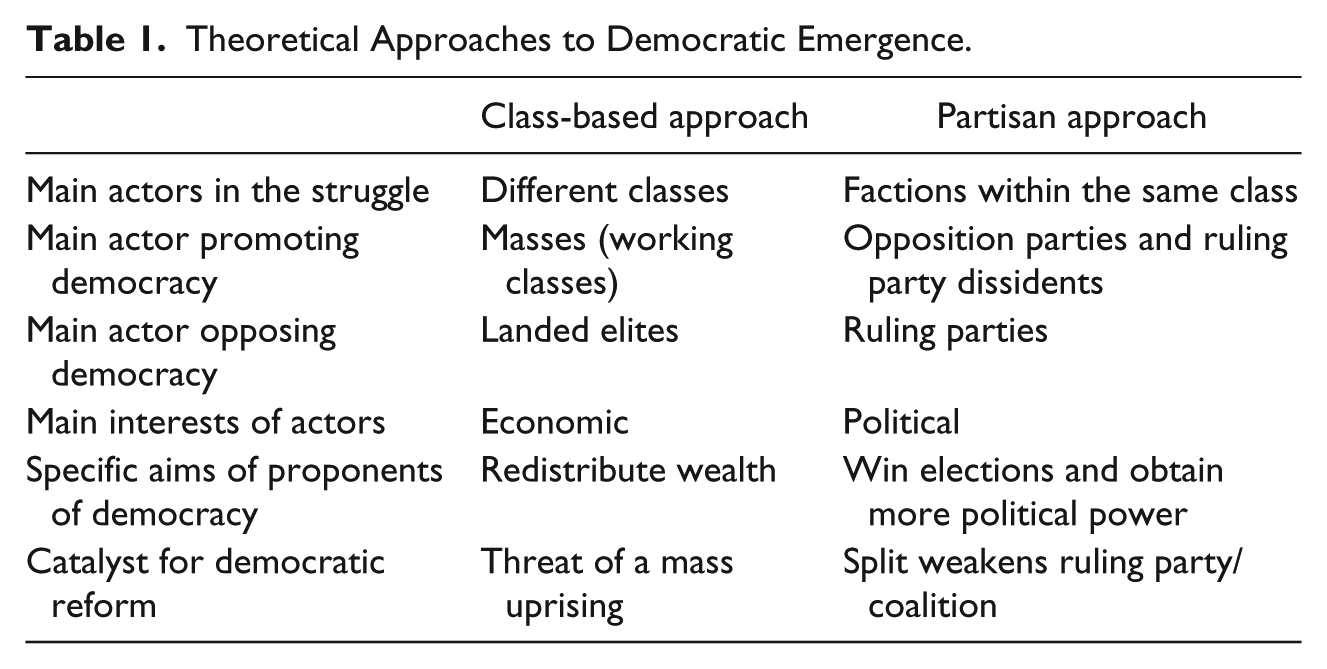
The partisan struggle for democracy takes place mostly inside the legislature. Democratization occurs when there is a split within the ruling party or coalition, which gives the political outsiders control of the legislature. Control of the legislature allows the political outsiders to pass laws that help bring about relatively fair and inclusive elections.
This partisan model is in some ways consistent with the approach to democratization developed by Ansell and Samuels (2014), building on the work of Moore (1967) and other democratic theorists. Ansell and Samuels similarly argue that democracy emerges from a split within the elite, but their approach differs from the partisan model outlined here in that it is class-based and economistic: The splits that they identify occur for economic reasons and take place along class lines. According to them, the rising bourgeoisie supports democratization to protect themselves against state taxation and confiscation, whereas the landed elites oppose democratization because it would challenge their traditional control of the state and peasantry. By contrast, the partisan model would expect the splits to take place for political reasons (i.e., the pursuit of power). According to this model, these divisions would occur along partisan, rather than economic lines, and members of the landed elite and the bourgeoisie would be found on both sides.
This article explores to what extent these different approaches can explain the emergence of democracy in South America, a region that has been the subject of few comparative studies by social scientists (see López-Alves, 2000, for a notable exception). 1 I follow the electoralist definition of democracy used by Mainwaring and Pérez-Liñán (2013, pp. 65-66), which requires (a) fair and competitive elections; (b) universal suffrage, although they relax this requirement for the first half of the 20th century; (c) the protection of civil and political rights; and (d) government control of major policy decisions. They classify countries with no significant violations of these criteria in any given year as democratic, and countries with only partial violations as semidemocratic. I examine Argentina, Chile, Colombia, and Uruguay because these were the only South American countries to have more than five consecutive years of democratic or semidemocratic rule prior to 1930, according to Mainwaring and Pérez-Liñán (2013, pp. 67-68). These countries, especially Chile and Colombia, retained some democratic shortcomings, but they all took important steps toward democracy in this period.
This article focuses mostly on Argentina, as it represents, perhaps, the hardest test case for a partisan approach. Political scientists have traditionally argued that democratization in Argentina stemmed from pressure from the working class or, more commonly, the middle classes (Acemoglu & Robinson, 2006; Collier, 1999; Smith, 1974). By contrast, I argue that democracy in Argentina originated in large part from an intraparty struggle among political elites. Specifically, a split within the traditional ruling party, the National Autonomist Party (Partido Autonomista Nacional; PAN), empowered ruling party dissidents who pushed through a democratizing electoral reform in 1912. As we shall see, similar splits within the ruling party or coalition led to the enactment of democratizing measures in Chile, Colombia, and Uruguay.
I explore these arguments using a combination of qualitative and quantitative data. I draw on archival sources, such as congressional debates and media reports, as well as the secondary literature to trace the process of reform in all four countries. I also test each of the potential explanations for the Argentine case, using a roll-call vote on the key reform measure. This intensive examination of a single crucial case provides greater data reliability and enables the evaluation of a range of explanations that cannot easily be tested in large-N cross-national studies (Mares, 2015; Ziblatt, 2008).
This article unfolds as follows. The section entitled “A Partisan Approach to Democratic Emergence” lays out the partisan approach to understanding democratic emergence. The section called “The Emergence of Democracy in Argentina” discusses the 1912 electoral law that brought democracy to Argentina and critiques traditional explanations for it. The section entitled “The Split Within the PAN” presents a detailed qualitative analysis of the democratization process in Argentina that highlights the role played by an intraparty split. The section entitled “A Statistical Analysis of Democratic Reform in Argentina” tests the various explanations through a statistical analysis of legislator support for the 1912 measure. The section called “The Origins of Democracy in Other South American Countries” examines to what extent this partisan approach can explain the emergence of democracy in Chile, Colombia, and Uruguay. The “Conclusion” discusses the theoretical implications of the arguments made herein.
A Partisan Approach to Democratic Emergence
Various scholars have stressed the role that partisan electoral competition for power can play in democratization (Collier, 1999; Lehoucq, 2000; Lehoucq & Molina, 2002; Lindberg, 2006, 2009; Miller, 2013; Rokkan, 1970; Schattschneider, 1942; Ziblatt, 2017). Collier (1999, pp. 54-55), for example, has argued that elite parties will sometimes extend the franchise for electoral support mobilization—that is, to win support among the newly enfranchised sectors of the population. She suggests elite-dominated transitions were particularly common during the first wave of democratization, whereas the later waves typically involved greater working-class participation (Collier, 1999, pp. 171-183). During the first wave, Latin American labor movements were relatively weak, and they were heavily influenced by anarcho-syndicalist tendencies. As a result, they had neither the capacity nor the desire to enact democratic reform.
This study echoes Collier in arguing that elites played the key role in the first wave of democratization. My analysis, however, differs from Collier and other partisan approaches in its focus on splits within the ruling party. These splits helped contribute to democratization by weakening the ruling party and empowering actors who had strong incentives to promote democratic reform. This focus on elite splits is consistent in some ways with the early literature on the Third Wave of democratization, which argued that democratization typically begins with a split in the authoritarian regime (O’Donnell & Schmitter, 1986; Przeworski, 1991). This early literature did not focus on splits within ruling parties per se, however, nor did it spell out the partisan electoral logic driving the splits and the subsequent democratic reforms.
I argue that democratization is especially likely to be a partisan struggle when it involves a transition from an electoral authoritarian regime. Electoral authoritarian regimes use elections to manage leadership turnover and to fill representative institutions (Schedler, 2013). Although the elections in such regimes are unfair, by making elections central to leadership transitions, they nevertheless encourage the opposition to focus on the electoral, rather than the violent, path to power. Such regimes create incentives for the opposition to push for democratic reforms that will increase their chances of winning such elections.
During the 19th century and early 20th century, most Latin American countries constituted a particular type of electoral authoritarian regime that I will refer to here as an electoral oligarchy (Drake, 2009). Electoral oligarchies have political parties that contest elections and legislatures that enact laws, but they maintain significant restrictions on the franchise and they lack electoral institutions, such as the secret ballot, that help prevent government manipulation of elections. Because electoral oligarchies have laws that prevent fair and inclusive elections, such laws must be reformed to enable democratic elections.
In electoral oligarchies, the existence of contested elections and functioning legislatures provides incentives to political outsiders, including ruling party dissidents and members of opposition parties, to work through the existing institutions. Rather than seeking to overthrow the regime violently, political outsiders in electoral oligarchies will often try to gain power through elections. Yet, as long as political insiders control the electoral process, political outsiders have little chance of winning.
Political outsiders will therefore advocate democratic electoral reforms. These reforms include taking control of the electoral authorities away from the executive and prohibiting the military and police from intervening in elections. Political outsiders may also call for the adoption of the secret ballot to make it more difficult for political insiders to buy votes, to discriminate against opposition supporters, and to compel state employees to vote for the ruling party. They may demand the adoption of electoral systems, such as proportional representation, that provide opposition parties with a larger share of seats in the legislature. Finally, political outsiders will often advocate compulsory voting and the elimination of suffrage restrictions to attract new voters, to shake up the political system, and to hinder efforts to block opposition supporters from voting.
In electoral oligarchies, political insiders will usually block democratic electoral reforms, however. Political insiders typically oppose democratic reform for the same reasons that political outsiders support it: They fear that reform will weaken their control of the political system. It is true that political insiders will advocate the extension of the franchise if they believe that the newly enfranchised voters will support them, but in most instances, political insiders are reluctant to risk a destabilizing influx of new voters with unclear party loyalties.
The ability of political insiders to manipulate elections enables them to elect large majorities of copartisans who can block reform proposals in the legislature. Splits within the ruling party, however, may weaken political insiders’ control and provide political outsiders with the opportunity to enact reforms. Once they defect, ruling party dissidents will embrace democratic reforms to weaken the ruling party’s control of the electoral process and improve their own chances of winning elections. These dissidents represent a serious threat to authoritarian regimes because they have the resources and political networks necessary to win elections. As Schedler (2009) argues, “if anyone is capable of defeating the incumbent [in competitive autocracies], it is someone from the inner ranks of the ruling elite” (p. 306). 2
A wide range of causes can lead to ruling party splits, but in electoral oligarchies, internal leadership competition is foremost among them. The literature on democratization via elections has argued that elections in authoritarian regimes promote democratization by diffusing democratic norms and strengthening democratic institutions, such as the media, opposition parties, and the judiciary (Lindberg, 2006, 2009; Miller, 2013). Yet, elections in authoritarian regimes may also bring about democratization by provoking divisions in the ruling party as elections create intense competition for key nominations. When prominent politicians do not earn their desired nominations, they sometimes decide that they have better political prospects with the opposition (Ibarra Rueda, 2013; Langston, 2006). Defections of minor politicians are unlikely to have much impact on the ruling party in electoral oligarchies, but the exit of major leaders can have significant repercussions because they frequently take many of their supporters and allies with them. Moreover, the defections of major leaders can have a snowball effect.
Of course, the major political figures in electoral authoritarian regimes are often reluctant to defect from the ruling party because they fear that they will not be able to win elections without the help of this party. This explains why defections of major leaders in electoral authoritarian regimes are relatively rare. It also explains why, after leaving the ruling party, erstwhile party leaders will push hard for democratic reforms to level the electoral playing field and provide them with a better chance of winning. Ruling party splits thus typically provide the key to democratization in electoral authoritarian regimes.
The Emergence of Democracy in Argentina
Argentina prior to 1912 was an electoral oligarchy. Elections took place at regular intervals and virtually all adult males were eligible to vote, but these contests were hardly democratic. Voter turnout was quite low, and fraud and intimidation were rife (Alonso, 2000; Botana, 2012; Sabato, 2001; Zimmermann, 2009). Presidents and governors as well as local officials intervened regularly in these elections to ensure that their preferred candidates won, although the degree of electoral manipulation varied across elections and locales.
The 1912 electoral law helped change this situation. This law, which went further than the typical reforms of its day, opened up the political system by establishing cleaner elections with greater voter turnout and guaranteed minority representation. 3 The 1912 law did not expand suffrage rights: The 1853 constitution in Argentina provided for universal male suffrage. Instead, the 1912 law boosted turnout by making voting compulsory. In the wake of this reform, the number of voters soared from approximately 191,000 people, or 21% of registered voters, in the 1910 legislative elections, to 640,852 people, or 68.5% of registered voters, in the 1912 legislative elections, and turnout remained high thereafter (Cantón, 1973, p. 45; Jones, Lauga, & León-Roesch, 2005, pp. 80-82).
The 1912 law ensured minority representation by stipulating the use of the incomplete list for the election of national deputies. Under the incomplete list, two thirds of the seats were awarded to the party or coalition that finished first in each district and one third of the seats were granted to the second-place party. Previously, Argentina had used the complete-list system in which all seats in each district were given to the party that finished first.
The single most important aspect of the 1912 reform, however, was the establishment of the secret ballot, which made it more difficult for political bosses to control voter behavior. In its wake, the opposition could and did win elections. 4 Indeed, the opposition Radical Party captured the presidency in 1916, the first time that presidential elections were held under the new law. Argentina did not become fully democratic during this period as women could not vote and politicians and political bosses continued to intervene in some elections, particularly in rural areas. Nevertheless, the regime that Argentina established after 1912 was considerably more democratic than the one that preceded it, and no less democratic than most European countries at that time.
Some scholars have attributed the 1912 electoral reform in part to pressure from the working classes. Rueschemeyer et al. (1992) claim that “the pressures from below for political reform and the fact that landowners ‘could afford’ to give explain a good part of why they did so in the cases of Argentina and Uruguay” (pp. 178-179). According to Smith (1974, pp. 9-10), Sáenz Peña and his colleagues were “alarmed by labor agitation and concurrent threats of violence” and “wanted to assure stability.” However, recent studies that have carefully examined primary source material, such as the legislative debates, and the participants’ speeches and correspondence, have found little evidence that the reformers were prompted by concerns about labor unrest or pressure from below (Castro, 2012, pp. 301-304; Devoto, 1996, pp. 96-97; Hora, 2001, pp. 141-146; Scherlis & López, 2005, p. 572). Although the working classes carried out numerous strikes and protests in the early 1900s (Botana, 2012, p. 188; Repetto, 1956, p. 50), the government responded to labor agitation with repression rather than political reform. As a result, by 1910, the labor movement had been decapitated and the threat of mass labor unrest had considerably lessened (Hora, 2001, pp. 142-143). Moreover, labor unions did not actively push for democratic reforms during this period. In the early 1900s, the Argentine labor movement was dominated by anarchist tendencies, which rejected electoral democracy and gradualist reforms (Godio, 2000; Suriano, 2012, pp. 99-103; Walter, 1977, pp. 54-55). The Socialist Party did support some (but not all) aspects of the 1912 reform, but it had no representation in the legislature and limited influence in the labor movement at the time of the reform (Adelman, 1992; Scherlis, 2005).
A more widely held view is that pressure from the middle classes led to the reform. Various scholars argue that the reform aimed to pacify the Radical Party or Unión Cívica Radical (UCR), which, they claim, represented the emerging middle classes (Cantón, 1973, p. 91; Collier, 1999, p. 46; Smith, 1974, p. 10). Pressure from the Radical Party clearly did play a role in the reform. The UCR had promoted electoral reform since its founding in 1891 and it carried out several uprisings to protest the corrupt political system. The Radicals also abstained from elections after 1898, stating that they would not participate until the elections were free and fair. After his election in 1910, the new President of Argentina, Roque Sáenz Peña, met twice with the Radical party leader, Hipólito Yrigoyen, to try to persuade the Radicals to abandon these tactics. At these meetings, Yrigoyen asked Sáenz Peña to intervene in the provinces to guarantee free elections there, but Sáenz Peña refused to do so. Yrigoyen, for his part, declined Sáenz Peña’s offer to join his government, stating that “the Radical Party is not looking for ministries. It is only asking for guarantees to vote freely at the polls” (M. A. Cárcano, 1986, p. 142; R. J. Cárcano, 1943, p. 302). Yrigoyen was more receptive to Sáenz Peña’s pledge to carry out electoral reform, however, declaring, “The Radical Party resorts to revolution because it finds the electoral path closed . . . if the government gives us guarantees, we will show up at the polls” (R. J. Cárcano, 1943, p. 298). These negotiations clearly indicate Sáenz Peña’s interest in obtaining the cooperation of the Radical Party and his willingness to use electoral reform to do so.
Argentine historians, however, have refuted the claim that the Radical Party represented the middle classes at the time of the reform (Alonso, 2000, p. 8; Gallo & Sigal, 1963, pp. 213-216; Míguez, 2012, pp. 15-16; Scherlis & López, 2005, p. 567). Míguez (2012), for example, points out that there is “today a sufficiently generalized consensus, that far from representing the means of access to politics of the middle classes (as a long historiographic tradition that culminates in the classic 1972 work of David Rock proposes), Radicalism was one more oligarchic faction, at least until its access to power” (pp. 15-16). As Alonso (2000) points out, “the discourse of the leaders of the Radical Party show[ed] no aspiration to represent a particular social class, and UCR congressmen of the 1890s manifested no particular concern for ‘the social question’ or for any particular social or economic sector” (p. 8). The Radical Party’s platform was notoriously vague and, aside from its harsh criticisms of the political system and its advocacy of electoral reform, it was hardly distinguishable from the traditional conservative parties of the period (Alonso, 2000, pp. 167-173; Rock, 1975, pp. 58-59). Only after the electoral reform law was passed in 1912, did the UCR begin to fare better in middle-class districts than in wealthy or working-class districts (Alonso, 1993, pp. 482-486; Cornblit, 1975, pp. 619-621; Walter, 1978, p. 610). Rock (1975) himself acknowledges that the Radical Party “had started in 1891 as very much an offshoot of the landowner factions; after 1905 it had penetrated the middle class groups in the cities; after 1912 it had become a fully-fledged cross-regional popular party. But the party was still largely dominated by land-based groups” (p. 58).
Previous generations of scholars may have attributed the reform to working-class or middle-class pressure in part because the reform did lead to the gradual political incorporation of these groups and the Radical Party did gradually become a middle-class dominated party. At the time of the reform, however, the working and middle classes were scarcely organized and they demonstrated little interest in electoral reform, presumably in part because both groups were already eligible to vote. The Radical Party did actively promote democratic reform, but in 1912, it was still an elite-dominated party that advocated reform not to enfranchise the middle classes or to protect their economic interests, but rather to eliminate electoral fraud and manipulation and improve the party’s chances of winning elections. The Sáenz Peña administration enacted the reform partly to pacify the Radicals and bring them into the political system, but this was only one of its goals. As we shall see, the reform was driven centrally by competition within the ruling PAN.
The Split Within the PAN
The 1912 reform was made possible by a series of splits within the ruling party, which stemmed in large part from competition for key political nominations. These splits eventually led to the rise of a new party headed by Roque Sáenz Peña. Once in power, Sáenz Peña and his allies implemented the 1912 reform largely to transform the corrupt Argentine political system and weaken the political machine of General Julio Roca, which had controlled Argentina for decades.
Roca, a renowned military leader, was first elected president in 1880 with the support of the PAN and a group of governors of the interior provinces. He served two terms as president, from 1880-1886 and again from 1898-1904, but even when he did not occupy the presidency, he played an important role behind the scenes. Roca and his allies won elections in large part through fraud and intimidation, which took place at all stages of the electoral process from the confection of the electoral registry to the receiving, counting, and certifying of the votes (Alonso, 2000, pp. 29-30; Botana, 2012, pp. 142-152). The president used his control of patronage and the threat of provincial intervention to maintain the support of governors who largely controlled the elections through their influence over the prefects, justices of the peace, and chiefs of police (Alonso, 2000, pp. 28-31; Botana, 2012, pp. 142-152; Castro, 2012, p. 39).
A series of splits within the PAN gradually undermined Roca’s control of the party, however. The first important split was that between Roca and his brother-in-law and successor as president, Miguel Juárez Celman, which ended in the latter’s resignation under pressure in 1890 (López, 2001, pp. 89-90). In the wake of Juárez Celman’s downfall, a number of the ousted president’s supporters formed a group that became known as the Modernists because of their commitment to a positivist ideology of progress (Rock, 2002, pp. 151-152). This group, which was hostile to Roca, sought to nominate Roque Sáenz Peña, who had served as Juárez Celman’s Minister of Foreign Relations, as the presidential candidate of the PAN in 1892, but Roca successfully blocked this move.
A more consequential split subsequently took place between Roca and Senator Carlos Pellegrini, the second most powerful figure within the PAN. Tensions had arisen between Roca and Pellegrini when the latter had unsuccessfully sought the party’s 1898 presidential nomination, but the final break between the two came in 1902 when President Roca withdrew his support for Senator Pellegrini’s debt conversion plan (Castro, 2012, pp. 62-69; Richmond, 1989, pp. 131-133; Waddell, 2005, pp. 128-134). In response, Pellegrini announced he would no longer support Roca and he thenceforth became one of the most prominent supporters of electoral reform (Rock, 2002, p. 177; Waddell, 2005, pp. 135-140).
Pellegrini had expected to be the PAN’s presidential candidate in 1904, but after their rupture, Roca was determined to block his candidacy. The two leaders agreed to allow a Convention of Notables to select the PAN’s presidential candidate, and at this convention, Roca successfully maneuvered to have Manuel Quintana, who was not even a member of the PAN, nominated as the party’s presidential candidate to block the nomination of Pellegrini (Richmond, 1989, p. 133; Sciarrotta, 2005, pp. 144-148; Waddell, 2005, pp. 137-138). Quintana then insisted on the nomination of José Figueroa Alcorta, a former supporter of Juárez Celman, as his vice presidential candidate (Castro, 2012, pp. 136-137; Sciarrotta, 2005, pp. 147-148).
Quintana was elected president in 1904, but he died only 16 months after he took office, leaving Figueroa Alcorta, an avowed enemy of Roca, at the helm. Figueroa Alcorta sought to dismantle Roca’s provincial bases of support by intervening in provinces and using his control of government spending and revenues to undermine the allies of Roca and bolster his own supporters (Botana, 2012, p. 105; Rock, 2002, p. 198; Sciarrotta, 2005, pp. 151-152). Roca fought back, however, using his alliances with provincial governors and his influence in the legislature to block Figueroa Alcorta’s policies. This led Figueroa Alcorta to briefly shut down the legislature in January 1908 and to intervene extensively in the 1908 legislative elections to win a narrow majority in the Chamber of Deputies for the first time. Nevertheless, Figueroa Alcorta fell short of a majority in the Senate whose members were elected by the provincial legislatures in which Roca and his allies still had influence (Botana, 2012, pp. 184-185; Castro, 2012, pp. 237-238; Rock, 2002, pp. 198-199; Sciarrotta, 2005, p. 156).
Figueroa Alcorta’s success in weakening Roca, however, paved the way for the election of an anti-Roca presidential candidate in 1910. Sáenz Peña was an obvious choice because of his long history of opposing Roca (Castro, 2012, p. 255; López, 2005a, p. 221). In 1909, various elite groups who were opposed to Roca formed a new party dubbed the Unión Nacional (UN) to promote Sáenz Peña’s candidacy for president (Castro, 2012, pp. 278-279; Rock, 2002, pp. 202-203). The Figueroa Alcorta administration and several provincial governors provided important political support to this movement, although the president never explicitly endorsed Sáenz Peña (Castro, 2012, pp. 249-250; Rock, 2002, p. 203). Sáenz Peña’s popularity discouraged potential challengers: Roca and his allies did not even put forward a candidate and the Radicals called on their supporters to abstain once again. On election day, the UN list triumphed, winning nearly all of the electoral votes and most of the seats in the legislature that were up for election (Botana, 2012, pp. 80, 192; López, 2005a, p. 234). For the first time in several decades, an anti-Roca faction was firmly in charge of the federal government.
Once in office, Sáenz Peña quickly introduced a pair of laws that sought to reduce fraud and manipulation by creating a new electoral registry based on registration for the military (Sáenz Peña, 1915, p. 100). The legislature approved these laws in mid-1911, but not without some changes and delays caused by Roquistas and others (López, 2005a, pp. 241-245). The president then introduced a more sweeping reform to the electoral law. 5
The principal aim of the electoral reforms was to dismantle the corrupt electoral machine that had enabled Roca to dominate Argentine politics (Castro, 2012, p. 300; Hora, 2001, p. 145; Scherlis & López, 2005, p. 572). As Hora (2001) argues, “the targets of the reform were corrupt political practices and bossism rather than potentially rebellious or insurgent masses” (p. 145). In a letter to a close friend and political ally in January 1908, Sáenz Peña depicted the reform as a machine composed of two pistons: one that ended fraud and cleaned up the polls and another that pushed citizens to vote, adding that “only in this way can we tone down the team of professional politicians that Roca has left us” (cited in Castro, 2012, p. 300).
Sáenz Peña believed that each component of the proposed reform would contribute to the renovation of the political system in a different way. Obligatory voting would help restore its legitimacy by boosting voter turnout. It would also help eliminate fraud and coercion, which would be difficult to carry out on the massive scale that obligatory voting would require (Sáenz Peña, 1915, p. 104). The secret ballot, meanwhile, was a powerful weapon against vote buying. In one speech, he likened vote buying with a secret ballot to purchasing an invisible ring: “One does not buy what one cannot see” (Sáenz Peña, 1915, p. 477). Sáenz Peña supported the incomplete list because it guaranteed the representation of minorities. In his inaugural speech to the legislature in 1910, the president (Sáenz Peña, 1915) declared, “It’s undoubtable that the majority should govern, but it’s no less true that the minorities should be listened to, collaborating with their thoughts and their actions in the growing evolution of the country” (p. 45). Indalecio Gómez, the Minister of Interior, argued that the incomplete list would reduce the influence of the political machines: “Since the problem is that the [electoral] machine controls all the congressional positions, and that is what we want to avoid, let’s ensure that it doesn’t control all but rather that it only controls a part.” 6 Gómez went on to argue that minority parties in the legislature were likely to press for fair elections to improve their own electoral chances.
Sáenz Peña and his allies believed that the reforms would serve their interests by dismantling a political system that had long excluded them from power. In a September 1908 letter to a friend, Sáenz Peña argued that ending Roca’s electoral control and establishing free suffrage would return to power a sector of the elite that had been marginalized by Roca (Castro, 2012, pp. 255-256). The electoral reforms, Sáenz Peña believed, would create institutional barriers to the reemergence of the caudillo politics that had long plagued Argentina. Although Sáenz Peña and his allies were in control of the federal government in 1912, Roca retained some powerful allies in the provinces and had demonstrated an ability to regain power in the past. In a 1908 letter to an ally, Sáenz Peña cautioned that “destroying Roca with his regime and its phalanxes is not an end but rather a means to redeem and rehabilitate the country” (cited in Castro, 2012, p. 234).
The administration’s reform proposal encountered significant opposition in the legislature. In the Chamber of Deputies, Roquistas led by Julio A. Roca Jr., the son of the former president, headed the opposition to the reform (Heaps-Nelson, 1978, p. 10; López, 2005b, p. 279). In the Senate, the opposition was led by Benito Villanueva, a traditional ally of Roca and the former leader of the PAN in the Federal Capital, along with some former governors (López, 2005b, p. 280). The incumbent Governor of Buenos Aires vacillated on the reform, but many of the deputies from the province voted against key aspects of the proposal. 7 According to Heaps-Nelson (1978, p. 18), politicians from the densely populated provinces, such as Buenos Aires, opposed the changes because they had the most developed political machines.
To secure approval of the reform, Sáenz Peña had to use his considerable influence over members of his UN coalition, many of whom were unenthusiastic about the reform because they feared it might jeopardize their chances at reelection (M. A. Cárcano, 1986, p. 167; Castro, 2012, p. 318; Devoto, 1996, pp. 106-107; Heaps-Nelson, 1978, p. 23; López, 2005b, pp. 288-289). In the midst of the debate, a journalist from the Crónica spoke to a deputy about the reform:
And for what reform proposal will you vote?
For the one that secures my reelection.
And which is that?
The one that is promoted by the people who have the most influence over my governor. 8
To put pressure on legislators to pass the electoral reform, the president’s allies even delayed the approval of the budget in the Chamber of Deputies (Devoto, 1996, p. 107). One legislator commented, “I believe that an Argentine deputy could resist an insinuation of Cleopatra, but I don’t know if he could resist the insinuation of the Argentine president” (Botana, 2012, p. 265).
In the end, the reform was approved with some modifications and entered into law on February 10, 1912. The reform achieved many of the aims that Sáenz Peña and his allies intended, putting an end to Roca’s political machine, expanding turnout, and reducing fraud and manipulation. It did not strengthen Sáenz Peña’s dissident faction, however. The Radical Party proved better able to take advantage of the new opportunities democratization provided, and in the years that followed, the Radicals repeatedly triumphed in elections.
A Statistical Analysis of Democratic Reform in Argentina
To test the various explanations, I carried out statistical analyses of the correlates of support for the 1912 reform in the Argentine Chamber of Deputies. I assigned deputies into three groups—reformists, undecided, and anti-reformists—based on López’s (2005b, pp. 280-283) classification. He coded deputies based on their participation in the debates as well as how they voted on the reform legislation. According to López (2005b, pp. 280-283), there were 50 supporters and 34 opponents of the reform as well as 33 deputies whom he could not classify.
The partisan model would expect the main legislative supporters of the reform to be ruling party dissidents—that is, members of UN—as the main opposition party supporting reform, the Radical Party, had abstained from the previous election and had no representation in the legislature. Unfortunately, no list of the members of the UN is available, but I included the year of election of the legislator as a proxy for UN membership. 9 As noted above, most legislators elected in 1910 were members of the UN, owing to its dominance of the 1910 elections and the use of the complete list electoral system (Botana, 2012, pp. 80, 192; López, 2005a, p. 234). Legislators elected in 1908 are assumed not to be members of UN, as this party did not even exist at the time of the 1908 elections. 10 Data on each legislator’s district and year of election come from the Secretaria Parlamentaria (1991).
By contrast, class pressure explanations would expect legislators to be more likely to support reform if they came from districts where industrial production was greater, strikes were more numerous, the urbanization rate was higher, and the urban working or middle classes represented a larger share of male Argentine citizens (i.e., the population eligible to vote). In Argentina, the legislative districts corresponded to the provinces and the Federal Capital. To test the class pressure hypothesis, I therefore gathered occupational data from the 1914 census on the proportion of Argentine men who belonged to the working and middle classes in each province (República Argentina, 1916b, pp. 201-397). 11 I also used data from the 1914 census to calculate the urbanization rate and the level of industrial production per capita in each province (República Argentina, 1916a, p. 400, 1916c, p. 45). Finally, I obtained data from Godio (2000, pp. 170-171) on the number of strikes in each district from 1906-1909 (in the case of the Federal Capital, the data are from 1907-1910).
As noted, some scholars have argued that Sáenz Peña enacted the 1912 reform to persuade the Radical Party to abandon its periodic uprisings and electoral boycotts. If fear of the Radical Party motivated the reform, we might expect deputies from districts where the Radical Party was stronger to be more likely to support the reform. I therefore included a variable measuring the district-level performance of the Radical Party in the 1916 presidential elections as a proxy for the strength of the Radical Party. These data came from Cantón (1968, p. 86).
I used a multinomial logit model to estimate the likelihood that a deputy would be a reformist rather than an anti-reformist (the base category). The standard errors are clustered by congressional district. As Table 2 indicates, the analysis provides no support for the class pressure arguments. Indeed, the share of the Argentine male population that belongs to the middle class or working classes, industrial production per capita, the number of strikes, and the urbanization rate all have a negative sign, which is the opposite of what the class pressure model would expect, although none of them is statistically significant at conventional levels. These variables were highly correlated with each other so they were not included in the same analyses.
Determinants of Legislator Support for the 1912 Electoral Reform in Argentina (Multinomial Logit Analyses of Supporting Reform Versus Opposing Reform).
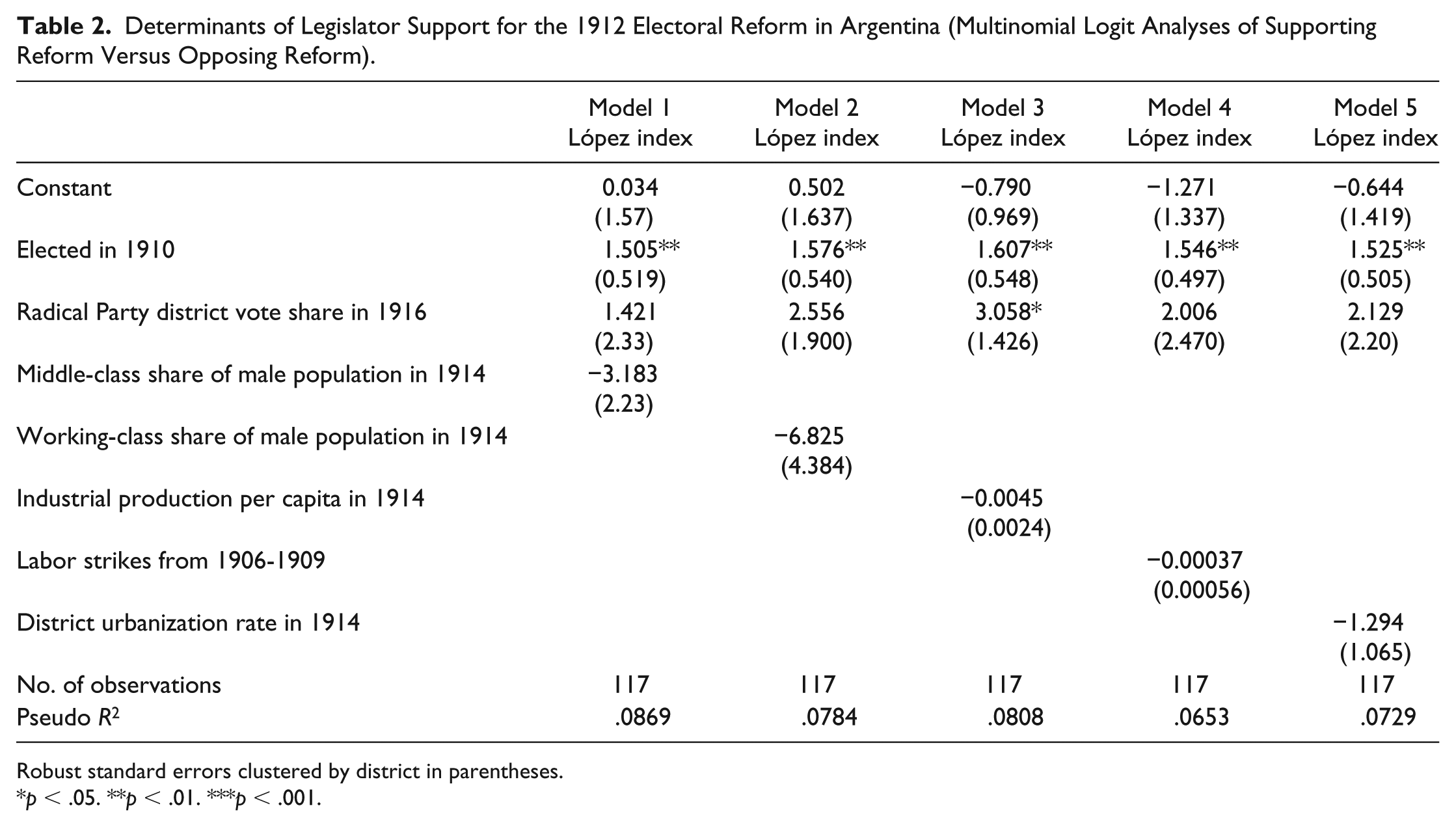
Robust standard errors clustered by district in parentheses.
*p < .05. **p < .01. ***p < .001.
The (weak) negative relationship between these variables and legislative support for the reform presumably reflects the fact that urban political machines had much to lose from the establishment of the secret ballot and other democratizing measures, and therefore opposed the reforms. Hora (2001, pp. 144-146) argues that many landowning elites welcomed Sáenz Peña’s reform efforts in part because they hoped to weaken the power of the urban political machines. In the same vein, Leiras and Figueroa (2016) find that legislators who were landowners were actually more likely to support the 1912 reform, although they have biographical data on only about half of the legislators. 12
The variable that measures the district-level strength of the Radical Party has the expected positive sign in all five models, but it only reaches statistical significance in Model 3. Thus, the statistical analysis does not clearly support the idea that pressure from the Radical Party played an important role in the reform. Using the vote share of the Radical Party in the 1912 legislative elections instead of the 1916 presidential elections does not appreciably change the results (see Table A1 in the appendix). 13
By contrast, the variable measuring whether a deputy was elected in 1910 had the expected sign and was highly statistically significant in all five models. This finding, which indicates that UN members were significantly more likely to be reformers, provides support for a partisan explanation for the reform. In short, it suggests partisanship and the split within the PAN played the key role in shaping votes on the reform, even though much of the existing literature would expect class rather than party to determine support for democratization. With other variables held at their means, a deputy elected in 1910 had a 55% probability of supporting the reform, whereas a deputy elected in 1908 had only a 29% probability of being a reformer. These results are based on Model 5.
These findings are not simply a result of how the dependent variable is measured. As Table A2 in the appendix indicates, the results are largely the same if I measure support for reform by each legislator’s vote on the incomplete list, rather than by López’s classifications. 14 Nor do the results change significantly if I use an Ordered Probit model with reformists categorized as 2, nonvoters as 1, and anti-reformists as 0, under the assumption that the legislators who did not vote or speak on the reform had weaker preferences on reform (see Table A3 in the appendix). 15
Thus, a statistical analysis of legislative support for the 1912 electoral reform in Argentina provides support for the partisan model of democratization. Divisions within the ruling party, rather than pressure from below, appear to have driven legislator support for the reform.
The Origins of Democracy in Other South American Countries
To what extent can the partisan model explain the origins of democracy in other Latin American countries? The following analysis examines the emergence of democracy in Chile, Colombia, and Uruguay, which, together with Argentina, represent the first four countries to democratize in South America. In none of these countries did the initial emergence of democracy stem from pressure from below. The working classes in these countries were only weakly organized at the time and did not actively push for democracy. Nor did democracy emerge as a result of pressure from the bourgeoisie. Although some members of the bourgeoisie supported democratic reform, others opposed it, and there was not a clear tendency one way or another. As Table 1 suggests, the emergence of democracy in Chile, Colombia, and Uruguay stemmed from partisan pressures, rather than class pressures. In all three countries, elite opposition parties pushed for democratic reform, but they only achieved it when the ruling party split and dissident members of the ruling party took up the cause of reform.
Chile
Chile held regular elections throughout the 19th century, but the executive branch largely controlled the outcomes of those elections. Opposition parties pushed for electoral reforms, but made little headway prior to the 1870s because of the ruling party’s control of the legislature. Thanks to a split within the ruling Liberal party, in 1874, the legislature expanded the suffrage somewhat, shifted legislative elections away from a majoritarian system, and sought to reduce the executive’s intervention in elections (Madrid, 2019; Valenzuela, 1985). The 1874 reform failed to bring free and fair elections to Chile, however.
The opposition Conservative Party, which had close ties to wealthy landowners and the Catholic Church, continued to promote democratic reform during the 1880s, but its proposals were blocked by the ruling coalition, which controlled the vast majority of seats in the legislature. As the decade wore on, however, President José Manuel Balmaceda managed to alienate many of his erstwhile supporters. Disenchantment with Balmaceda stemmed in part from his massive spending on infrastructure and his efforts to increase taxation of the largely foreign-owned nitrate industry, but the president’s efforts to perpetuate his influence by imposing his successor as president galvanized opposition to his administration (Blakemore, 1974; Zeitlin, 1984). By November 1889, the government controlled no more than 45 of the 123 seats in the legislature as a result of defections from the ruling coalition (Encina, 1952, pp. 178-179; Heise, 1982, p. 90; Terrie, 2014, pp. 188-189). Balmaceda aggravated the growing dissent by clamping down on the opposition and seeking to circumvent the legislature.
Balmaceda’s troubles emboldened the Conservatives. In a speech in the Senate on October 28, 1889, the Conservative Senator Manuel José Irarrázaval noted that his previous reform proposal had been rejected, but “the political change that has since occurred in the Chamber [of Deputies] has encouraged me to propose it again to the Senate.” 16 Balmaceda mobilized his supporters against the proposal, but the opposition pushed ahead. In a Senate speech, the Radical Party Senator Manuel Recabarren voiced his approval of the reforms, although he noted that “it should not be forgotten that when it was in power, [the Conservative Party] rejected [similar reforms] when the Liberal Party asked for them.” 17 The opposition elected Irarrázaval as president of the committee that drafted the proposal and submitted it to the legislature with the support of all of the opposition members (Cifuentes, 1936, p. 286; Salas Edwards, 1914, p. 234; Terrie, 2014, p. 193). The pro-Government Liberals on the committee refused to sign onto the proposal, but they could not block it as they represented a minority (Salas Edwards, 1914, p. 234). Balmaceda then sought to delay the reform by refusing to call an extraordinary session of congress to discuss the proposal. Nevertheless, when the legislature reconvened in June 1890 for its ordinary session, it quickly approved the electoral reform (Encina, 1952, p. 277).
The 1890 electoral reform law contained a large number of provisions designed to weaken the executive’s control of elections and ensure greater representation for minority parties. It required the use of cumulative voting for elections of senators, presidential electors, and municipal councilors, all of which had previously used the complete-list electoral system. It stipulated that voter registration would last indefinitely and it eliminated the voter registration cards that enabled the executive’s agents to disqualify opposition voters and control the votes of some state employees (Heise, 1982, p. 91; Valenzuela, 1998, p. 275). To ensure fair vote counting, the 1890 reform also specified that the opening of the ballot boxes and the counting of the votes would take place in the presence of the representatives of the candidates. Finally and most importantly, the reform established secret voting: The law stipulated that voters were to cast their ballots in rooms that would provide complete privacy (Anguita, 1912, pp. 128-129).
The conflict between Balmaceda and the congress culminated in the 1891 Chilean Civil War, which was won by the opposition forces. This paved the way for the implementation of the electoral law that helped democratize the Chilean political system. As Valenzuela (1998) argues, after 1890, “the Chilean political regime began to meet the minimum requirements of a democracy with incomplete suffrage” (pp. 268-269). Elections became quite competitive, and alternation in power occurred. Chilean presidents could no longer impose their successors, nor could they unilaterally determine the makeup of congress (Heise, 1982, p. 94). Indeed, the Minister of Interior ceased to compose official lists of candidates or intervene extensively in elections, although some local-level abuses continued (Heise, 1982, p. 93; Valenzuela, 1996, p. 249). According to Remmer (1977), “Whereas the intervention of the executive had previously deprived elections of all their meaning, their outcome was now largely determined by the number of votes counted” (p. 210). To be sure, Chile was an oligarchic democracy: Women could not vote until 1949 and illiterates did not gain the franchise until 1970. Nevertheless, the rapid spread of literacy in Chile gradually reduced the significance of the literacy restriction and the number of votes cast rose significantly during the first half of the 20th century.
Colombia
Democratic reform in Colombia also emerged as a result of partisan competition and splits within the ruling party, as Table 1 would suggest. Colombia, like Argentina and Chile, was an electoral authoritarian regime during the 19th century. The opposition Liberal Party pushed for electoral reform during the late 1800s, but it held only two seats in the legislature between 1886 and 1904 due to electoral fraud and intimidation, which prevented it from enacting these proposals. The political exclusion of Liberals helped lead to a bloody civil war, the War of a Thousand Days (1899-1902), in which an estimated 100,000 people died. This war, in turn, deepened a split within the ruling Conservative coalition, which stemmed partly from leadership competition.
The split ultimately led to the election of Rafael Reyes in 1904 as the presidential candidate of the dissident faction known as the Historical Conservatives. Reyes forged an alliance with the Liberal party, appointing prominent Liberals to his cabinet and other positions in executive branch (Bergquist, 1978, p. 226). The president also supported electoral reform to strengthen his alliance with the Liberals and ensure that there would not be another war. He therefore convened a Constituent Assembly dominated by Liberals and Historical Conservatives, which quickly passed a constitutional amendment mandating minority representation in legislative elections (Mazzuca & Robinson, 2009, pp. 298-307). In most respects, however, the Reyes administration represented a step backward for democracy. Reyes shut down Congress and declared a state of siege in 1905, governing for most of the rest of his term through a compliant Constituent Assembly, which rubber-stamped his decrees (Duque Daza, 2011, p. 195; Rios Penalosa, 1991). The Constituent Assembly granted Reyes extraordinary powers in economic and fiscal matters as well as a 10-year presidential term (Bushnell, 1993, p. 158).
Democratization only occurred after a subsequent split within the ruling coalition. The catalyst for Reyes’s downfall was an agreement that the government had signed with the United States recognizing Panamanian independence in exchange for an indemnity and the future use of the canal. 18 In the wake of this agreement, a wave of student-led protests broke out that led to the emergence of the Republican Union, a splinter group composed of both Conservatives and Liberals who were opposed to the Reyes’s administration. The Republican Union won a large share of seats in the May 1909 congressional elections, and in June 1909, Reyes resigned and fled Colombia (Bergquist, 1978, p. 245). In February 1910, new elections were held for a Constituent Assembly. The Republican Union won a majority of the seats, and it elected Carlos E. Restrepo, a Conservative leader of the Republican Union, as the new president (Bergquist, 1978, pp. 252-253; Rodríguez Piñeres, 1956, p. 269).
Under the leadership of the Republican Union, the Constituent Assembly drafted a constitutional reform that laid the groundwork for a more democratic Colombia. Article 45 of the reformed constitution reaffirmed minority representation (República de Colombia, 1939, p. 10). Other reforms weakened the president and strengthened horizontal accountability by expanding the powers and independence of congress and the judiciary (Acuña Rodríguez, 2017, pp. 107-108; Bergquist, 1978; Duque Daza, 2011, pp. 200-209; Melo, 1989). The reformed constitution stipulated that Congress was to meet every year and it was given new responsibilities, including electing the members of the Supreme Court and choosing the Designates who would replace the president in the event of his removal (República de Colombia, 1939, p. 6). Congress also gained the right to censure members of the executive branch as well as Supreme Court Justices (Article 20).
The reformed constitution helped bring about more democratic practices in Colombia. After its passage, bipartisanship became the norm. Minority parties not only won a significant share of seats in the legislature, they also formed alliances with the ruling parties and held ministerial positions. During the next four decades, elections took place in relative calm and political violence was the exception, rather than the rule (Bergquist, 1978, p. 247). Colombian governments began to respect constitutional procedures more frequently and generally allowed the exercise of civil and political liberties. The political opposition, meanwhile, eschewed armed revolts.
The extent of democracy in Colombia after 1910 should not be exaggerated, however. Some elections, notably those in 1922, were still marred by fraud and violence, and the opposition sometimes abstained, such as in the 1926 elections. In addition, the country maintained literacy, income, and property restrictions on the suffrage until 1936 and gender restrictions until 1954. Nevertheless, the 1910 reforms modestly reduced income and property restrictions, and the restrictions that remained became less significant over time because of gradual increases in income and literacy. As a result, the number of votes cast nearly tripled in the two decades after 1914 (Jaramillo & Franco-Cuervo, 2005, p. 307). Even more importantly, after 1910, no party monopolized the electoral authorities, and candidates supported by the government frequently lost local and regional elections (Posada-Carbó, 1997, pp. 262-263, 275). Turnover even occurred at the national level in 1914 and 1930. Thus, the 1910 constitutional reforms moved Colombia in a significantly more democratic direction, even if Colombia remained only semidemocratic. As Hartlyn (1988) puts it, “Between 1910 and 1949, Colombia had an oligarchical democracy, a political system, as Wilde has argued, ‘of notable stability, openness and competitiveness . . .’” (p. 27).
Uruguay
Prior to the enactment of its 1918 constitution, Uruguay, too, was an electoral oligarchy that had been dominated for decades by the Partido Colorado. The opposition party, the Partido Blanco, had long pushed for democratic reform, but it was only able to enact major reforms after a split within the ruling party (Castellanos & Pérez, 1981; Madrid, 2019). The principal cause of the split was President José Batlle’s efforts to create a collegial executive, which his rivals within the party believed was an effort to perpetuate his hold on power (Castellanos & Pérez, 1981, p. 212; Nahum, 1987, pp. 61-62; Vanger, 1980, pp. 218-219). In the wake of the split, the dissident Colorados, who were dubbed Riveristas, ran on a separate ticket in the 1916 elections for a constituent assembly that was to revise Uruguay’s constitution. Their defection led to an unprecedented electoral defeat for Battle’s wing of the Colorado Party.
Together, the Riveristas and the Blancos controlled a majority of seats in the constituent assembly and they joined forces to advance a proposal to mandate the secret ballot, universal male suffrage, and proportional representation in elections. The Batllistas, however, still controlled the country’s legislature and they submitted a bill that would have required the new constitution to be approved in a referendum in which a majority of registered voters participated. 19 The enactment of this bill would have enabled the Batllistas to block the new constitution by simply encouraging their supporters to boycott the referendum. With their constitutional reform project at risk, the Blancos were forced to compromise (Madrid, 2019; Vanger, 2010). In the end, the Blancos agreed to the Batllistas’ proposal for a collegial executive and the Batllistas agreed to accept the Blancos’ proposed democratic reforms. The new constitution was approved by overwhelming vote in a November 1917 referendum and took effect the following year.
The constitutional reforms led to significantly freer and fairer elections. The number of voters rose dramatically in the years that followed and elections became much more competitive. The Colorados continued to win most national-level elections, but their margin of victory shrank considerably and they even suffered a few significant defeats (Nahum, 2007; Nohlen, 2005). Uruguay did not become fully democratic in the wake of the reform because women could not yet vote and some fraud and manipulation continued, but the 1918 constitution nevertheless represented a major step toward democracy (Castellanos & Pérez, 1981, p. 249; Nahum, 1987, p. 98).
Conclusion
This article has argued that the initial emergence of democracy in Latin America stemmed from partisan divides among elites. More specifically, splits within the ruling party or coalition led dissident factions to side with the opposition and push through reforms that would expand the franchise and level the electoral playing field to improve their chances of winning elections. The reforms did not create full democracies, but they brought about significant democratic progress.
These findings have several important implications for the literature on democratic emergence. First, they suggest that the existing literature’s focus on pressure from below is misplaced, at least for the first wave of democratization in Latin America. Elites, rather than mass actors, played the key role in the initial emergence of democracy in the region. Second, they indicate that political motives, namely, competition for power, rather than economic motives, are the main impetus for democratization. Third, they suggest that democratization in the first wave typically began with a split within the authoritarian regime, just as the early literature on the third wave of democratization argued. Fourth and finally, these findings suggest that even unfair elections may help bring about democratization, as the literature on democratization via elections argues. Elections create incentives for the opposition to push for meaningful electoral reforms and often precipitate ruling party splits that lead to democratization.
Future research should examine to what extent these findings apply to countries in other regions and time periods. The partisan mode of democratization may well have dominated during the first wave of democratization, but it may not have prevailed in later periods. Future research should also examine under what circumstances the democratic reforms identified here are effective. To bring about democracy, it is necessary not just to pass reforms, but also to enforce them. Yet, we still know relatively little about the politics of enforcement.
Supplemental Material
Argentina_1912_vote_data_merged_with_1914_census_data – Supplemental material for The Partisan Path to Democracy: Argentina in Comparative Perspective
Supplemental material, Argentina_1912_vote_data_merged_with_1914_census_data for The Partisan Path to Democracy: Argentina in Comparative Perspective by Raúl L. Madrid in Comparative Political Studies
Supplemental Material
CPS_article_replication_guide_Dec._2018 – Supplemental material for The Partisan Path to Democracy: Argentina in Comparative Perspective
Supplemental material, CPS_article_replication_guide_Dec._2018 for The Partisan Path to Democracy: Argentina in Comparative Perspective by Raúl L. Madrid in Comparative Political Studies
Supplemental Material
CPS_article_STATA_log_Dec._2018 – Supplemental material for The Partisan Path to Democracy: Argentina in Comparative Perspective
Supplemental material, CPS_article_STATA_log_Dec._2018 for The Partisan Path to Democracy: Argentina in Comparative Perspective by Raúl L. Madrid in Comparative Political Studies
Footnotes
Appendix
Determinants of Legislator Support for the 1912 Electoral Reform in Argentina (Multinomial Logit Analyses of Not Voting on Reform Versus Opposing Reform).

| Model 1 |
Model 2 |
Model 3 |
Model 4 |
Model 5 |
|
|---|---|---|---|---|---|
| Constant | 2.301*
(0.992) |
2.245 (1.189) |
0.582 (0.934) |
0.251 (0.776) |
1.286 (0.923) |
| Elected in 1910 | 0.848 (0.543) |
0.969 (0.552) |
0.987 (0.544) |
0.907 (0.520) |
0.890 (0.532) |
| Radical Party district vote share in 1916 | −2.089 (1.132) |
−0.483 (1.729) |
−0.205 (1.947) |
−1.133 (1.496) |
−1.008 (1.459) |
| Middle-class share of male population in 1914 | −5.484**
(1.884) |
||||
| Working-class share of male population in 1914 | −8.197***
|
||||
| Industrial production per capita in 1914 | −0.0041**
|
||||
| Labor strikes from 1906-1909 | −0.0013**
|
||||
| District urbanization rate in 1914 | −2.318**
|
||||
| No. of observations | 117 | 117 | 117 | 117 | 117 |
| Pseudo R2 | .0869 | .0784 | .0808 | .0653 | .0729 |
Robust standard errors clustered by district in parentheses.
p < .05. **p < .01. ***p < .001.
Acknowledgements
The author would like to thank Dan Brinks, Zach Elkins, Mike Findley, John Gerring, Ken Greene, Wendy Hunter, Amy Liu, Xiaobo Lu, Zeynep Somer-Topçu, Kurt Weyland, and three anonymous reviewers for comments on previous versions of this article. The author is also grateful to Carlos Gervasoni and Sybil Rhodes for serving as his informal hosts in Argentina.
Declaration of Conflicting Interests
The author declared no potential conflicts of interest with respect to the research, authorship, and/or publication of this article.
Funding
The author disclosed receipt of the following financial support for the research, authorship, and/or publication of this article: Field research for this article was funded by a Mellon Faculty Research Grant from the Teresa Lozano Long Institute for Latin American Studies at University of Texas at Austin.
Supplemental Material

Notes
Author Biography
References
Supplementary Material
Please find the following supplemental material available below.
For Open Access articles published under a Creative Commons License, all supplemental material carries the same license as the article it is associated with.
For non-Open Access articles published, all supplemental material carries a non-exclusive license, and permission requests for re-use of supplemental material or any part of supplemental material shall be sent directly to the copyright owner as specified in the copyright notice associated with the article.
