



Abstract

This special issue demonstrates that authoritarian legislatures often matter for their countries’ policy processes in myriad ways, despite the fact that their influence is constrained by the nature of authoritarian politics. In all four of the special issue’s articles, the authors use novel, country-specific data to provide detailed analysis of legislature activity in authoritarian policy processes. First, as illustrated by Noble’s (2020) writing on Russia and Lü et al.’s (2020) writing on China, legislators may shape major policy decisions through their interactions with executive branch officials or their participation in elite coalitions, even when they remain relatively weak and broader outcomes are rarely in doubt. Second, as shown by Noble (2020), Lü et al. (2020), and Truex (2020), policy processes in these institutions are often defined by competing regime actors who hold divergent preferences, and as such, these processes can be messy and inefficient, contrary to popular notions of authoritarian policy making. And third, as demonstrated by Schuler (2020) through his study of Vietnam, legislatures may be permitted to engage in open debate on delegated policy issues, with the goal of holding government officials accountable and shaping the public’s attributions of blame for poor performance.
Understanding how policies are made in these contexts is important in its own right, and the authors’ efforts to open the blackbox of authoritarian policy making reflects a useful contribution of the articles. In this conclusion, we build on the authors’ insights to consider the special issue’s broader implications for the literature on authoritarian rule. We first note how the articles highlight the complexity of policy processes in these political systems, despite the capacity of most autocrats to dominate decision-making in many circumstances. Next, we discuss how the articles demonstrate the utility of legislatures for improving autocrats’ abilities to share power and control the public more effectively, thereby reinforcing the durability of authoritarian regimes. We then consider briefly which legislators and policy issues are more active in these legislatures, before concluding with a discussion of generalizability and suggestions for future research.
Politics and Policy Making in Authoritarian Regimes
The past two decades have seen an explosion of research on authoritarian regimes, much of which explores how institutions like elections, legislatures, and parties affect these political systems (e.g., Blaydes, 2011; Brancati, 2014; Gandhi & Lust-Okar, 2009; Geddes, 1999; Magaloni, 2006; Magaloni & Kricheli, 2010; Pepinsky, 2014; Wright, 2008). Scholars now know a lot about why these regimes are structured in certain ways and how these structures relate to a range of important political outcomes, such as regime durability and economic performance. Despite these advances, there remains less understanding of how policy is made under authoritarian rule, and how institutions and politics shape the policy process (Noble, 2020; Remington, 2019). As discussed by Gandhi et al. (2020) in the introduction to the special issue, this may occur in part because of the opacity of decision-making in authoritarian settings and the difficulty of acquiring relevant data in many of these countries. Whatever the case, discussions of the policy process typically reflect a simple model in which the autocrat dominates decision-making. Elites may provide the autocrat with information, and the autocrat may choose policies to minimize the likelihood of upsetting the public, but the basic model of decision-making is that the autocrat chooses a policy and that policy is then implemented if the autocrat remains in power (e.g., Boix & Svolik, 2013; Bueno de Mesquita et al. 2003; Gandhi, 2008; Gandhi & Przeworski, 2006; Magaloni, 2008; Truex, 2016). Although this approach generates a number of important insights, it also obscures many political dynamics of policy making in nondemocratic settings (Gallagher & Hanson, 2015).
The special issue’s articles share several common themes that highlight the complexities of authoritarian policy making in practice. First, they illustrate how elites in authoritarian regimes are not just purveyors of information to the autocrat or accumulators of corrupt wealth, but also political actors who care about policy outcomes. Furthermore, these preferences often diverge sharply on a range of issues, and these divisions can foster conflict between the autocrat and their elites allies, as well as between competing elite factions. For instance, Noble (2020) discusses differences between Russia’s Ministry of Finance and Ministry of Economic Development over a bill related to natural resource revenue, as well as intense disagreement between Putin and his government over changes to criminal procedures for tax crimes. Likewise, Lü et al. (2020) reveal varying preferences for education policies among China’s many state institutions, while Truex 2020, p. 1469 also notes the existence of “infighting and territorial behavior” among Chinese government bodies regarding the country’s food policies. These diverse elite preferences are often absent from theories of authoritarian rule, despite their relevance to decision-making in these contexts.
Second, the articles serve as an important reminder that autocrats do not, in fact, make all policy decisions themselves. There are too many complicated and potentially unpopular decisions for even the most personalistic autocrat to monopolize fully, and so they must delegate many policies to other elites and institutions within the regime. Schuler (2020) documents delegation of policy decisions by the Vietnamese Communist Party to nonaffiliated ministries, while Noble (2020) indicates the ability of Russia’s ministries to influence the direction of policies in their portfolios. Regarding China, both Truex (2020) and Lü et al. (2020) emphasize the fragmented nature of the country’s authoritarian state, which is defined by a plethora of government bodies making and implementing policy decisions. The need for autocrats to delegate raises questions about which issues are ceded to which actors within the regime, and at which point this delegation is more or less likely to occur.
Third, the special issue provides concrete examples of how public pressure can shape policy outcomes in authoritarian regimes, but also how this pressure ebbs and flows across issues and over time. As Schuler (2020) demonstrates with Google Trends in Vietnam, the public pays attention to a number of political topics, and this salience shapes which policies are addressed in the legislature. Relatedly, Truex (2020) argues that public attention in China can shift quickly, even for issues like food policy that would normally be less salient, and that such shifts impact the regime’s willingness and ability to resolve policy decisions decisively.
Altogether, these themes drive home the point that policy making in authoritarian regimes, as in democracies, is inherently messy and conflictual. The great powers of autocrats do not necessarily imply a quick and efficient process of selecting policies; rather, interest groups within the regime try to capture policy decisions, gridlock may occur with some regularity, and swings in public opinion can lead to sudden changes in decision-making and unstable policy outcomes. Developing a fuller picture of these dynamics not only matters for improving understanding of which policies are adopted in authoritarian regimes and why, but also has important implications for our knowledge of the challenges autocrats face in trying to maintain the loyalty of both elites and the public. In what follows, we discuss implications from the special issue for how legislative involvement in the policy process shapes the ability of autocrats to manage power sharing and public opinion as they try to hold onto their positions.
Authoritarian Legislatures, Policies, and Power Sharing
The challenge of developing stable power sharing arrangements between autocrats and elites constitutes one of the fundamental threats to authoritarian rule. Autocrats need elite allies to survive (Haber, 2008), but providing elites with credible incentives to remain loyal is difficult because of the opaque and violent nature of authoritarian politics (Magaloni, 2008; Svolik, 2012). How policy influence is distributed within the regime has direct relevance to this challenge (Gandhi, 2008). For instance, in defining power sharing, Svolik (2012, pp. 88–89) notes that spoils divided between the dictator and elites “may be monetary, such as tax or natural resource revenue, but . . . also . . . a compromise over personnel appointments or policy direction.” To date, however, most studies with microlevel evidence about how power sharing works in practice have focused on the distribution of financial rents and other material perks to elites in exchange for their loyalty (e.g., Blaydes, 2011; Lust-Okar, 2006; Magaloni, 2006; Reuter & Robertson, 2015; Reuter & Turovsky, 2014; Szakonyi, 2018; Truex, 2014). Much less evidence speaks to the dynamics of sharing power over policy decisions, although we note that Gandhi and Przeworski (2006) and Gandhi (2008) do highlight policy concessions as a central future of power sharing in authoritarian regimes.
This link between policy influence and power sharing probably deserves more attention than it has received. On the one hand, dictators have strong incentives to use policy influence as a lever to incentivize elite loyalty. As mentioned above, elites often have well-developed preferences over issues as diverse as education (Lü et al., 2020), taxes (Noble, 2020), and food policy (Truex, 2020). Thus, the ability to push policy toward their preferences constitutes a meaningful reward for remaining loyal to the autocrat. In some contexts, policy preferences may be even more important than financial payoffs as a motivating factor for authoritarian elites who choose to enter politics, since the latter can often be pursued through nonpolitical channels, while the former cannot. At the same time, autocrats need to delegate control over many policy decisions to other actors in the political system, since autocrats face “limitations of time, resources, and . . . expertise” like all leaders everywhere (Noble, 2020, p. 1421). In other words, power sharing arrangements involving policy influence are a standard feature of authoritarian regimes both by demand and out of necessity.
On the other hand, sharing power over policy poses particular challenges for the autocrat. For one, ceding control over policy decisions may be less credible than sharing access to rents, since policies can be reversed—particularly if the dictator takes an interest in them—while rents may be stashed in a foreign country outside of the autocrat’s reach. Ceding control over policy may also be more dangerous for the autocrat than allowing elites to accumulate wealth, since policy decisions should be more likely to strengthen elites in ways that can incentivize coup attempts. For instance, elites with substantial influence over domestic policy may be well positioned to claim credit for economic successes, thus raising their public reputations relative to the autocrat. Likewise, elites with influence over foreign policy may find external allies willing to back their play for power. This problem is especially apparent for domestic security, where autocrats who give too much control to the military or security apparatus risk finding themselves out of a job (Svolik, 2012).
The literature on authoritarian institutions could say more about how autocrats and elites leverage institutions like legislatures to navigate the complexities of sharing power over the policy process. However, regarding legislatures in particular, scholars have generally downplayed their ability to shape policy decisions. For instance, in her study of Jordan’s parliamentary elections, Lust-Okar (2006, p. 459) notes that “competition is not over policy making,” because “many . . . policy arenas are off-limits to parliamentarians . . .” Writing on China, Truex (2014, p. 237) describes the “relatively small policymaking role” of National People’s Congress (NPC) deputies, while Reuter and Robertson (2015, p. 236) argue about Russia that “elite spoil sharing, not policy concessions,” explains the co-optive function of Russia’s regional legislatures.
Data from Varieties of Democracy (V-Dem; Coppedge et al., 2018), displayed in Figure 1, provides more general support for this idea that authoritarian legislatures play a relatively weak role in the policy process. The sample reflects all authoritarian regime-years from the Geddes et al. (2014) data set in which a legislature was active between 1946 and 2010. 1 The first plot in the figure shows whether the legislature contained a committee system and the extent to which it was involved in policy making, while the second plot indicates how common it was for legislators in these bodies to have paid policy staff. In only a small percentage of regime-years did authoritarian legislatures possess strong committees that were active in shaping policies. In addition, paid staff were present in just under one third of regime-years, suggesting an absence of policy expertise in a large majority of these bodies.

Authoritarian legislatures and the policy process.
Yet, the V-Dem data also indicates that authoritarian legislatures have consistently held an important formal role in the policy process, constituting the expected institution through which policies become laws. The third plot in the figure shows the percentage of regime-years in which a vote by the legislature was required to implement legislation, and the fourth plot illustrates whether these legal requirements were followed in practice when implementing policies. Overwhelmingly, authoritarian legislatures are supposed to—and do—vote to make bills become laws: approval was required in more than 80% of regime-years, and this approval was adhered to “always” or “usually” in more than 90% of regime-years.
These patterns are consistent with most authoritarian legislatures possessing the mandate to approve policies but less ability to determine their contents, relative to the autocrat. This dynamic aligns well with theories about legislative institutions facilitating credible power sharing by enabling both elites and the dictator to monitor each other more effectively (Boix & Svolik, 2013; Svolik, 2012), insofar as autocrats seem to adhere to the requirement that legislatures review and vote on major policy decisions. The special issue articles make an important contribution here by demonstrating how this legislative monitoring functions in practice. For one, Noble (2020) argues that Russia’s most powerful political elites—specifically, President Putin, Prime Minister Medvedev, and the ministers in the government—can use the formal legislative process to ensure that their colleagues are not overstepping their powers. Because bills must wind their way through the committee process and then floor votes in the Duma before becoming law, executive branch officials have the opportunity to discover “hostile” policy proposals that contravene previous agreements or seek to push forward one actor’s preferences at the expense of others. As an example of this process, Noble discusses a bill that changed enforcement of tax crimes. The government was not in favor of the proposal and rejected it; however, President Putin then sent it to the legislature himself. At this point, the government became aware of Putin’s support for the policy. Although the bill eventually became law, its procession through the legislative process gave other executive officials the chance to discover, slow down, and then amend its contents, reflective of the legislature’s ability to facilitate intraexecutive monitoring.
Schuler’s (2020) article on the Communist Party regime in Vietnam also illustrates an important mechanism by which the legislature’s formal role in the policy process allows regime elites to monitor each other more effectively. By giving deputies the power to conduct public oversight hearings of government ministries, the regime can keep track of how those ministries are performing at their jobs. These hearings are especially likely to be targeted at ministries not controlled by the Communist Party—which are likely the ministries most difficult for the autocrat to monitor efficiently. If the hearings turn up misconduct, the officials in question may lose their jobs; as a result, they have incentives to adhere to the party’s objectives. This legislative oversight remains highly constrained by the regime, with oversight generally absent from issues controlled closely by the Communist Party. Nonetheless, the article suggests that it can generate information on issues where the autocrat has a particular need to observe the performance of other political elites.
The special issue also makes an important contribution in demonstrating how authoritarian legislatures can, in fact, be highly relevant to policy design, even when they remain weak bodies that are almost entirely subordinate to the autocrat. The dynamics identified by the articles do not so much reflect existing theories that have emphasized the policy role of authoritarian legislatures, in which these bodies co-opt potential opponents of the regime by granting them the power to extract policy concessions (Gandhi, 2008; Gandhi & Przeworski, 2006). Instead, the articles illustrate how legislatures serve as arenas of intraregime policy competition for the autocrat and other powerful elites in the executive branch and the bureaucracy. Because of the legislature’s identity as the institution in which laws are debated and approved, these bodies become an important space in which executive actors can push for their policy objectives using the formal powers of politically weaker legislators who are aligned with their interests. Thus, legislatures often become active arenas of policy making, but this activity reflects competition among the regime’s most powerful elites more than an attempt to appease the opposition.
Lü et al. (2020) demonstrate these dynamics through their study of legislative coalitions related to education policy in the NPC and the Chinese People’s Political Consultative Congress (CPPCC) in China. They show that powerful bureaucratic agencies use relatively weak legislators as “proxies” to push their own policy interests. The legislators form coalitions, draft policy proposals that reflect the objectives of their sponsors, and then formally submit these proposals to the legislature. Although the bodies remain “rubber stamps” in the sense that outcomes are closely controlled, this process of building coalitions and advocating for specific proposals can generate policy changes by signaling the strength of these elite preferences to the highest echelons of the Chinese Communist Party.
Noble’s (2020) article on the Russian Duma similarly indicates the importance of the legislature in shaping the country’s policies despite the legislators’ lack of capacity to determine policies independently. Amendments to proposed laws take place regularly during the committee process, and these amendments often appear to result in substantively meaningful changes to state policies. Yet, these changes are sponsored frequently by officials from the country’s executive branch, who use the legislature and its members as tools to work out their intraexecutive disagreements. Similar dynamics could be observed in Mexico, where the Institutional Revolutionary Party distributed policy influence to various groups within the ruling coalition by giving legislative seats to its different functional “sectors,” including the National Confederation of Peasants, the Confederation of Mexican Workers, and the National Confederation of Popular Organizations.
In other words, the formal rules and processes of policy design that are a common feature of legislatures—even in authoritarian regimes—provide executive actors with a regularized and more credible means of competing over policy outcomes. Authoritarian elites often hold divergent preferences, and the regime cannot give all of them what they want; as a result, elites are unlikely to win every policy battle. However, they can rely on their relationships with legislators to advocate for their interests and water down hostile proposals, and they can continue to do so in the future even if they lose a policy conflict at any given moment. In this sense, the article’s implications resemble the framework of competitive clientelism articulated by Lust-Okar (2006), Lust (2009) and Blaydes (2011), but with regularized competition in the legislature helping to reduce the dangers of policy disagreements rather than scarcity of rents.
To summarize, policy influence constitutes an important component of power sharing arrangements between autocrats and their elite allies, and the literature on authoritarian regimes would benefit from more evidence about how this policy power sharing occurs in practice. The special issue makes an important contribution using studies of Russia, China, and Vietnam to show the ways in which legislatures enable elites to monitor each other’s actions in the policy process and compete over policy specifics, even as the legislators themselves remain relatively weak political actors with little independent input on policy outcomes.
Authoritarian Legislatures, Policies, and the Public
Policy does not just relate to power sharing with elites but also matters for the ability of autocrats to control the public. Most individuals living in these political systems hold policy preferences over a range of political and economic issues, and mass opposition to authoritarian regimes is often rooted in major policy failures or divergences from the public’s preferences (e.g., Gandhi, 2008; Truex, 2016). For instance, major protests have been triggered by relatively minor tax increases in Jordan (Al-Sharif, 2018); by inconsistent payment of wages in Russia (Javeline, 2003); and by anger at the suspension of a treaty with the European Union (EU) in Ukraine (Wolczuk & Wolczuk, 2013). Many Arab Spring protesters in Egypt and Tunisia were motivated by frustration with corruption and poor economic prospects (Beissinger et al., 2015); likewise, Suharto was brought down by economic failures in Indonesia (Pepinsky, 2009). In other words, autocrats who fail to satisfy the public’s policy preferences risk confronting mass mobilizations in the streets.
The problem for autocrats is that it can be difficult to identify these preferences accurately, or at least to know when public disapproval may tip into mass unrest. Because the fear of repression exists to some degree in most of these political systems, individuals have powerful incentives to engage in preference falsification (Blaydes, 2018; Kuran, 1991; Wintrobe, 1998). As a result, opposition often seems to emerge out of nowhere (Kuran, 1991). To mitigate this challenge, autocrats need to develop strategies for acquiring information about what the public wants.
Existing research on authoritarian legislatures implies that these bodies have some role to play in addressing this informational problem. Truex (2016) and Manion (2014, 2015) argue that Chinese legislators help the Communist Party to remain in power by developing connections with their constituents and providing information about their preferences to high-level policy makers. Relatedly, Malesky and Schuler (2010) indicate that Vietnamese legislators will raise issues in the legislature that are important to their local constituencies. Although this information provision is likely important in some contexts, Lü et al. (2020) suggest in the special issue that legislatures, at least at the national level, are probably less efficient collectors and providers of information than other strategies at the disposal of most autocrats. In China, as in other authoritarian political systems, the regime has developed a mass surveillance state that monitors public and private communications (King et al., 2014), it relies on petitions to monitor public opinion about governance outcomes (Dimitrov, 2015), and minor protests are tolerated to identify sources of popular anger (Lorentzen, 2013). Elections also enable authoritarian regimes to gauge the public’s views and figure out who are part of the opposition (Magaloni, 2006; Malesky & Schuler, 2011; Miller, 2015).
The special issue articles imply other ways in which authoritarian legislatures help their regimes maintain control by limiting the dangers of not knowing the public’s policy preferences. Specifically, they indicate that legislatures may influence the public’s attributions of blame when policy outcomes become unpopular, which should limit the autocrat’s exposure to popular protests motivated by this disgruntlement (Javeline, 2003). Schuler’s (2020) argument is particularly relevant to this point. He claims that the Vietnamese Communist Party permits legislators to hold public hearings about policy domains that the party controls less tightly, with the goal of identifying poor performers within the government and directing the public’s discontent toward these officials. In other words, legislators are not just developing a better understanding of citizens’ preferences so that the autocrat can give them what they want, but they are also helping to redirect the citizens’ anger when the regime fails to give them what they want.
Another implication of the special issue is that legislatures themselves may provide useful scapegoats for autocrats looking to shift blame. In showing how authoritarian legislatures can become gridlocked bodies (Truex, 2020) that are influenced by interest groups (Lü et al., 2020), the articles suggest that legislatures may become defined by features of political life that are typically disliked by the public. In democracies, gridlocked legislatures often become deeply unpopular, as the public reacts negatively to the government’s inability to get things done (e.g., Cooper, 1999; Hibbing & Theiss-Morse, 1995; Saad, 2013). Likewise, people typically respond poorly to the perception that legislators are beholden to corrupt special interests looking out for themselves (e.g., Dugan, 2015; Hibbing & Theiss-Morse, 1995). To the extent that autocrats can position themselves as counterweights to the inefficiency and corruption of the legislature, like executives often try to do in democracies, they should be well situated to shift some of the public’s blame for policy failures away from themselves and onto their legislators.
Many autocrats appear to make efforts to position themselves in this way. Putin, for instance, has tried to distance himself from the ruling party that dominates the legislature, rejecting leadership of the organization and running for president as an independent in 2018 (Antonova, 2019). In Egypt, President Abdel Fattah El Sisi has criticized the parliament for not doing more to hold government officials accountable (Morsi, 2019). Meanwhile, in Kuwait, the regime has blamed political and economic dysfunction on the gridlocked parliament (Westall, 2014). Anecdotal evidence suggests this positioning can be reflected in popular attitudes. For example, in Jordan, the public is highly critical of the perceived corruption and ineffectiveness of parliament, while the royal court is often viewed as a more efficient and publicly minded institution.
We provide some opinion polling data from the Arab, Asian, and Afro Barometer surveys that is consistent with the ability of autocrats to deflect blame onto their legislatures. 2 Specifically, we look at data on the percentage of respondents in each country who claim to trust the legislature, which we compare to their self-reported trust in the executive. 3 These results are displayed in Figure 2.
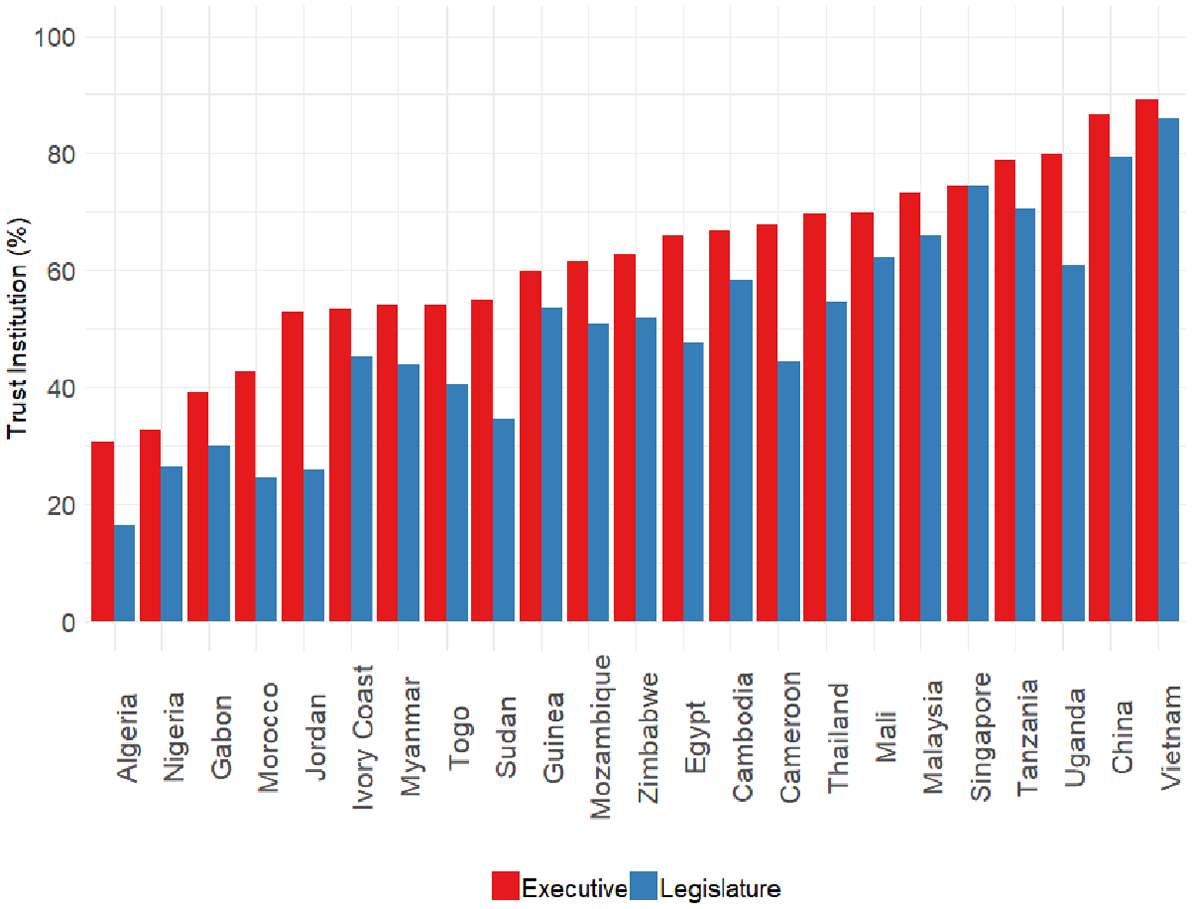
Trust in authoritarian legislatures and executives.
A clear pattern that emerges from this data is the fact that the legislature is rated as less trustworthy than the executive in every country except for Singapore, where they are equivalent. This divergence suggests that autocrats are often well positioned to use the legislature as a foil for the public’s anger at unpopular policy outcomes. It is also apparent, however, that these differences in trust vary significantly across the 23 countries in the figure. In Jordan, the difference is more than 25 percentage points, in Cameroon it is 23, and in Egypt it is nearly 20, but in countries like Nigeria and Malaysia, the gap is substantially smaller. These differences raise the question of whether certain authoritarian regime types or institutional configurations are more likely to improve the autocrat’s ability to avoid blame at the expense of the legislature.
In summary, the special issue articles illustrate how the involvement of authoritarian legislatures in the policy process can help autocrats to control their citizens more effectively. In particular, these bodies may reduce the autocrat’s exposure to blame, shielding them from the public’s anger and mitigating the risks of popular protests (Beazer & Reuter, 2019; Rosenfeld, 2018). On one hand, legislators can facilitate the acquisition of information about poorly performing government officials, shifting blame for bad policy outcomes away from the autocrat and toward these poor performers. On the other hand, the legislators may themselves become useful scapegoats for the autocrat, if they become associated with unpopular aspects of the policy process, such as gridlock and special interests.
Which Legislators Make Which Policies?
The special issue makes clear that authoritarian legislatures are more likely to address some policy issues than others, and that certain types of legislators are more likely to take an active role in shaping policy outcomes. First, legislatures appear to be more active in policy making when the regime is internally divided over the appropriate course of action. As Noble’s (2020) discussion of Russia shows, policy conflicts within the executive branch can spill over into the legislature, with amendments occurring more frequently for bills on these issues. Likewise, Lü et al.’s (2020) study of the NPC and the CPPCC implies that legislators will be more likely to advance policy proposals when coalitions of elites with different preferences are competing to advance their agendas.
Second, authoritarian legislatures also appear to be more active on policy issues that attract significant public attention. Schuler (2020) provides evidence that the Vietnamese National Assembly is more likely to hold public hearings on policy issues that have become salient, in part to facilitate the blame shifting role discussed above. In addition, Truex (2020) suggests that authoritarian legislatures are most likely to turn their efforts toward bills that address issues of major public concern, reducing gridlock for these policies.
However, this activity remains limited to issues that are less sensitive for the autocrat. For instance, Schuler (2020) shows that public attention on an issue only increases the likelihood of policy hearings in the legislature when that issue is not controlled directly by the autocrat. Otherwise, these hearings might direct blame toward the top of the regime. Notably, in discussing legislative involvement in the policy process, the articles are focused on technical policies that should be relatively less sensitive for the autocrat than issues that touch on coercion of foreign affairs. For instance, Noble (2020) discusses budgeting and tax policy, Lü et al. (2020) focus on education policy, and Truex (2020) studies food policy. This emphasis on less sensitive issues aligns with previous research on authoritarian legislatures, which suggests that autocrats try to delegate policy influence “within bounds” to make sure they maintain control over the most important policy decisions (Truex, 2016, p. 6).
When legislators do have leeway to influence the policy process, some are more likely to do so than others. In particular, Noble (2020) and Lü et al. (2020) indicate that legislators with strong ties to officials in the executive branch are more active participants in policy making. Lü et al. provide evidence that legislators with employment ties to the Ministry of Education are more frequently involved in policy coalitions focused on education policy. Similarly, Noble’s article implies that legislators more closely tied to elites in the executive branch should be more likely to submit amendments and take other legislative actions in the policy process. On the contrary, Schuler (2020) finds that Vietnamese delegates not tied to the central party and with stronger connections to their local communities are more likely to make speeches on salient issues during public hearings, a pattern that is consistent with results from earlier work by Malesky and Schuler (2010). One interpretation of these somewhat divergent findings is that legislators with close ties to the autocrat and other powerful elites in the executive branch are more likely to be involved in policy design, while legislators who are more independent from the regime are more likely to use their positions to engage in policy criticism and debate.
Conclusion
All four articles in the special issue develop compelling insights into authoritarian legislatures and their relationship to the policy process. As discussed in the introduction (Gandhi et al., 2020), an important contribution of the articles is their ability to identify precise mechanisms of legislative activity through their detailed analysis of specific cases. This approach contrasts with the extensive cross-national literature on authoritarian institutions that often struggles to adjudicate between competing theories that emphasize information, co-optation, monitoring, and constraint. Yet, single-country studies like those in the special issue still leave open the question of generalizability. Do legislative gridlock and policy coalitions exist in most of these political systems? Is spillover of executive policy conflict into the legislature a common feature of authoritarian policy making, and how often do legislators in these bodies have the opportunity to query government officials on salient issues?
Regime type may provide one source of variation relevant to these questions. Perhaps legislatures are more likely to become sites of policy coalition building and executive spillover in party regimes, where the body is safely controlled by the dominant party and policy involvement by the legislature is less likely to result in challenges to the regime. On the contrary, perhaps legislatures in monarchies and military regimes are more likely to question government officials and shift blame away from the autocrat, due to the ruling clique’s greater separation from the government and the legislature in these political systems. The personal power of the autocrat may contribute to variation as well, though the direction of this relationship could go in either direction. One possibility is that regimes with especially powerful autocrats are more likely to have active legislatures, since the ruler will be less threatened by delegating policy influence to these bodies (Opalo, 2019). On the contray, it is possible that powerful autocrats are more inclined to monopolize the decision-making process as much as possible. More generally, it is worth considering whether our knowledge of authoritarian legislatures is constrained by the extent to which single-country studies have focused on a handful of prominent cases: China and Russia especially, but also Vietnam, Egypt, Jordan, and a few others. As scholars have documented, legislatures have been present in the vast majority of authoritarian regimes in the modern period. This sample bias suggests a plethora of cases that remain underexplored, and where legislatures may be involved in the policy process in different ways.
As discussed above, theories of authoritarian institutions, including legislatures, discuss their importance in helping autocrats to manage pressure from the public. This emphasis pertains to the special issue, with Schuler (2020) and Truex (2020) pointing to the impact of public opinion on legislative activity. However, relatively few studies in the authoritarianism literature consider how individuals living in these political systems actually engage with and think about their legislative bodies. For example, how does the attainment of patronage from legislators impact support for the regime or willingness to participate in antigovernment protests? Why are legislatures more trusted in some authoritarian regimes than others, and how does this trust influence popular acceptance of the regime’s policies? Do individuals actually blame the legislature for unpopular political and economic outcomes, and do attributions directed at the legislature help to protect the autocrat’s reputation? The institutional literature on authoritarian regimes would benefit from further microlevel work exploring how parties, elections, and legislatures affect the attitudes and behaviors of the public.
Finally, we believe it is noteworthy that all four articles in the special issue echo theories or empirical patterns from the literature on legislatures in democracies, including coalition governments (Noble, 2020), delegation and accountability (Schuler, 2020), gridlock (Truex, 2020), and special interests (Lü et al., 2020). In taking this approach, the articles illustrate how certain patterns of legislative politics extend beyond regime type, even if the causes and consequences of these dynamics are rooted in unique aspects of authoritarian rule. As such, the special issue indicates the utility of considering how seminal theories of democratic politics apply to authoritarian contexts.
Footnotes
Declaration of Conflicting Interests
The authors declared no potential conflicts of interest with respect to the research, authorship, and/or publication of this article.
Funding
The authors received no financial support for the research, authorship, and/or publication of this article.
