



Abstract
Leadership succession is a perennial source of instability in autocratic regimes. Despite this, it has remained a curiously understudied phenomenon in political science. In this article, we compile a novel and comprehensive dataset on civil war in Europe and combine it with data on the fate of monarchs in 28 states over 800 years to investigate how autocratic succession affected the risk of civil war. Exploiting the natural deaths of monarchs to identify exogenous variation in successions, we find that successions substantially increased the risk of civil war. The risk of succession wars could, however, be mitigated by hereditary succession arrangements (i.e., primogeniture—the principle of letting the oldest son inherit the throne). When hereditary monarchies replaced elective monarchies in Europe, succession wars declined drastically. Our results point to the importance of the succession, and the institutions governing it, for political stability in autocratic regimes.
Keywords
The most plausible plea which hath ever been offered in favor of hereditary succession is, that it preserves a nation from civil wars; and were this true, it would be weighty; whereas it is the most bare-faced falsity ever imposed on mankind.
Seldom is an autocratic regime as fragile as when the autocrat has died, and there is uncertainty—or outright disagreement—over who his successor will be. Conflicting claims to power can easily deteriorate into violent conflict between members of the regime (Acharya & Lee, 2019; Brownlee, 2007; Frantz & Stein, 2017; Herz, 1952; Kurrild-Klitgaard, 2000; Svolik, 2012; Tullock, 1987; Wang, 2018), since violence is “the ultimate arbiter of political conflicts” in autocracies (Svolik, 2012, p. 20). The oppressed may exploit the power vacuum and revolt, and neighboring states can intervene in the succession process to further their own interests. Autocracies furthermore display considerable variation in how the succession is managed, from the communist monarchy of North Korea’s Kim dynasty, to the (hitherto) well-oiled mechanisms for cultivating leaders in China, to the uncertainty surrounding the future after Putin in Russia. Instances of autocratic succession has, despite these facts, received scant empirical attention in the civil war literature (though see Iqbal & Zorn, 2008; Jones & Olken, 2009). This is surprising given how many long and bloody succession wars history has seen; the War of the Roses, the Hundred Years War, and the Wars of the Spanish and Austrian Succession to name a few.
In this article, we address this lack of research by providing the first statistical test of how succession and succession arrangements affected the onset of civil war in Europe in the medieval and early modern period. First, we ask how royal succession affected the risk of civil war. It is often difficult to establish whether it was the succession per se or more profound political instability and power relations that triggered a certain war. We exploit monarchs’ natural deaths to get around this endogeneity problem and identify the causal effect of succession on civil war onset (cf. Besley, Montalvo, & Reynal-Querol, 2011; Jones & Olken, 2005).
Second, we ask how succession arrangements moderated the risk of succession wars. In modern research, scholars have claimed that succession wars disappeared over time because dynasticism decreased in importance (Luard, 1986; Pinker, 2012). Yet, this argument runs contrary to the fact that Europe long into the medieval period was dominated by elective monarchies, in which the death of a king created a period of dangerous uncertainty that ended only after the leading circles of society had assembled and elected a new king. It was not until relatively late in the period that a majority of European monarchies adopted a hereditary succession based on primogeniture, according to which the eldest son automatically inherited the throne at his father’s death (Acharya & Lee, 2019). We test whether this change from elective to hereditary succession arrangements—and the reduction in uncertainty about the succession it brought about—mitigated dynastic civil wars.
To answer our questions, we combine war data from several sources to create a novel robust measure of civil war and conflict in Europe between 1000 and 1799 AD, which we link to data on monarchs and their political fates. We find that successions that followed monarchs’ natural deaths increased the risk of civil war considerably throughout the period, and more so in elective monarchies than in monarchies practicing primogeniture. With primogeniture’s triumph over elective monarchy, succession wars declined in numbers but did not disappear entirely.
Our findings have implications both for how to understand the European state-building process and more general political dynamics in autocracies. They emphasize how crucial succession arrangements were for creating and holding together the Ancien Régimes that dominated Europe in the 18th century. Although the empirical cases in the article are historical, they also add evidence to a growing literature that highlights how important designated successors and mechanisms for appointing them are for stabilizing authoritarian regimes (Cox & Weingast, 2018; Frantz & Stein, 2017; Kokkonen & Sundell, 2014; Meng, 2017; Tullock, 1987).
Previous Research
There is a general consensus in the literature that the transfer of power from one leader to another is a cause of instability in autocracies (Acharya & Lee, 2019; Brownlee, 2007; Frantz & Stein, 2017; Herz, 1952; Kurrild-Klitgaard, 2000; Svolik, 2012; Tullock, 1987; Wang, 2018). Almost all of these studies have focused on how the shadow of the succession increases the risk of coups. Few studies have investigated whether instances of autocratic succession increase the risk of civil war, or how that risk can be moderated. This is somewhat surprising, given that a crucial assumption in the literature is that it is fears of a succession war that incentivize coups ahead of the succession (Tullock, 1987).
Geoffrey Blainey (1988) has noted that the death of monarchs often heralded interstate wars in the 18th century. Echoing Blainey, Kalevi J. Holsti (1991) shows that dynastic claims—which often were succession related—figured as motivations for 31% of the interstate wars in the 17th century and 22% of the interstate wars in the 18th century. The studies do, however, not discuss civil wars, and Holsti’s study does not differentiate between successions per se and more general dynastic claims. They are also more descriptive than explanatory in nature, and do not try to disentangle different explanations for war from each other statistically.
Blayney’s and Holsti’s studies are, however, supported by a number of more recent studies that show that both autocratic and democratic leaders are more prone to participate in international conflicts early in their tenure (Chiozza & Goemans, 2004; Gaubatz, 1991; Gelpi & Grieco, 2001). Although these studies prove a positive correlation between successions and interstate wars, they remain silent on civil wars. The studies are also afflicted by endogeneity problems, as leader change is not exogenous to factors that affect the risk of interstate war. 1 International tensions may, for example, result both in dovish leaders being replaced by hawkish leaders and an outbreak of war.
Endogeneity problems also afflict Zaryab Iqbal and Christopher Zorn’s study from 2008, which finds that assassinations of heads of state are associated with an increased risk of civil war (especially those with international involvement) in states lacking regulated succession arrangements. The fact that the study only finds a correlation in states without succession arrangements is interesting, but hard to interpret as succession arrangements are defined as to include everything from hereditary monarchies to full-fledged democracies.
Benjamin F. Jones and Benjamin A. Olken (2009) come closest to identifying a causal effect of successions on war by contrasting successful and unsuccessful assassination attempts of heads of state, finding that successful assassinations lead to an increase in the intensity of both civil and interstate small-scale conflicts relative to failed assassinations. However, the focus on assassinations makes it difficult to draw more general conclusions on how successions affect civil war risks. 2 In the following, we describe the mechanisms through which they do so and how different principles of succession may mitigate the risk.
The Coordination Problem
Power struggles in autocracies are risky. On one hand, a challenger might become the new leader and his supporters might improve their standing within the regime. On the other hand, a failed challenge to an authoritarian leader will likely result in the loss of rents, and possibly life (cf. Egorov & Sonin, 2015). Milan Svolik (2012, p. 95) notes that the latter risk is so great that “fear of joining the losing side outweights any substantive preferences over who prevails.” Such fears are hard to assauge when there is uncertainty in terms of how successful the challenge will be, which is normally the case. History is replete with both successful and failed assassination and coup attempts.
There is also another incumbency advantage that discourages challenges. According to selectorate theory (Bueno de Mesquita, Smith, Siverson, & Morrow, 2005), a challenger cannot credibly commit to rewarding backers, once in power. Members of the incumbent leader’s winning coalition are in contrast sure to remain in the leader’s good graces if they stay loyal.
Instances of succession where the old incumbent has died, leaving a power vacuum, offer both opportunity and risk for members of the elite, for the same reasons. Attempts to claim power amounts to challenging all other possible claimants, with the associated uncertainty about success. And backers of claimants cannot be sure that they will be rewarded—included in the winning coalition—even if their preferred candidate wins. However, sooner or later, the members of the regime have to act and appoint a new leader if the regime is to survive. Although they theoretically may re-establish order by peacefully negotiating a new leader among themselves, we argue that the inherent secrecy of autocracies make it difficult for them to do so.
Autocracies are characterized by secrecy about power relations to prevent members of the regime and outside actors from coordinating coups and rebellions. Sharing information about military strength and the security apparatus without the autocrat’s permission tends to be strictly forbidden, and regime members are usually given access only to the information they need for carrying out their tasks. Similarly, regime members are usually strongly discouraged to build alliance networks with each other, as such alliances may threaten the autocrat’s hold on power. Ideally, they should remain in doubt whether other regime members will remain loyal to them in conflicts. Members of the regime furthermore have an incentive to hide their true capabilities to not appear as a threat to the autocrat (cf. Egorov & Sonin, 2011). Most members of the regime will therefore only have vague and partial information about the distribution of power within the regime, including their own relative strength vis-à-vis other members of the regime, before the succession takes place. In short, autocracies are characterized by large information asymmetries about power relations.
The demise of the leader may also alter facts on the ground in ways that make the distribution of power even less transparent than in ordinary circumstances. For example, it may be difficult to know who actually controls the loyalty of military regiments and economic resources that were formerly under the direct personal control of the leader.
To add to the confusion, the incentives to misrepresent strength change in the wake of the succession. Members of the regime who aspire to become the new leader now have an incentive to appear stronger than they in fact are, to persuade possible contenders for the throne to back down and convince those regime members who are uncertain about whom to support to bandwagon behind them (Brownlee, 2007; Tullock, 1987). However, each actor knows that the others have an incentive to overstate their strength, to gain a more favorable deal in future bargains. In such circumstances, regime members may easily end up disagreeing about their relative strengths. Similar disagreements between international actors are among the most important causes for interstate wars (Fearon, 1995). We argue that they may also lead to civil war in autocracies.
Even if a violent succession struggle can be avoided, the regime may still need considerable time to negotiate a new successor. Meanwhile, the regime’s capacity to act will be impaired. If the process drags on, local elites and parts of the population may be tempted to exploit the regime’s temporary weakness and rebel. There is ample research that shows that state capacity lowers the risk of civil war (Fearon & Laitin, 2003; Sobek, 2010). Therefore, instances of succession risk leading to civil war even when members of the regime manage to retain the peace between themselves.
The existence of a designated successor changes the dynamic. The natural assumption is that the successor will inherit his predecessor’s power resources, so that power relations between the autocrat and the rest of the regime will remain essentially unaltered by the succession. Members of the existing winning coalition can expect to stay on and do not have to choose between different claimants, with a risk of ending up on the losing side. In short, regime members need only to accept the designated successor’s ascension to power to assure regime continuity and avoid civil war.
Autocrats are, however, often reluctant to appoint a successor, as no one is in a better position to overthrow the incumbent autocrat than a “crown prince” (Herz, 1952). Moreover, a successor who is picked by the incumbent leader may also be un-picked again, creating uncertainty about who the successor really is. Institutionalized and established procedures for leader selection are therefore conducive to stability.
However, some succession arrangements are more stabilizing than others. We argue that three criteria decide their stabilizing effect. The first is whether an arrangement provides the regime with a successor in advance of the succession. The second is whether the incumbent leader can replace his successor and create uncertainty about his legitimacy. The third is whether an arrangement—in theory—provides a peaceful method for resolving succession disputes if it allows for such disputes to occur. Below we discuss how succession arrangements in European monarchies have lived up to these criteria, with a special focus on primogeniture and elective monarchies.
Succession Arrangements
At the end of the 18th century, most European monarchies had adopted a succession based on the principle of agnatic (or male-preference) primogeniture—that is, the principle of letting the oldest legitimate son (and his descendants) inherit the throne in preference to younger sons and collateral relatives. This is visible in Figure 1, which shows the proportion of states in our sample that had adopted primogeniture at each point in time, averaged by decade. Primogeniture, in normal circumstances, manages all criteria discussed above well, by tying the succession to biology.
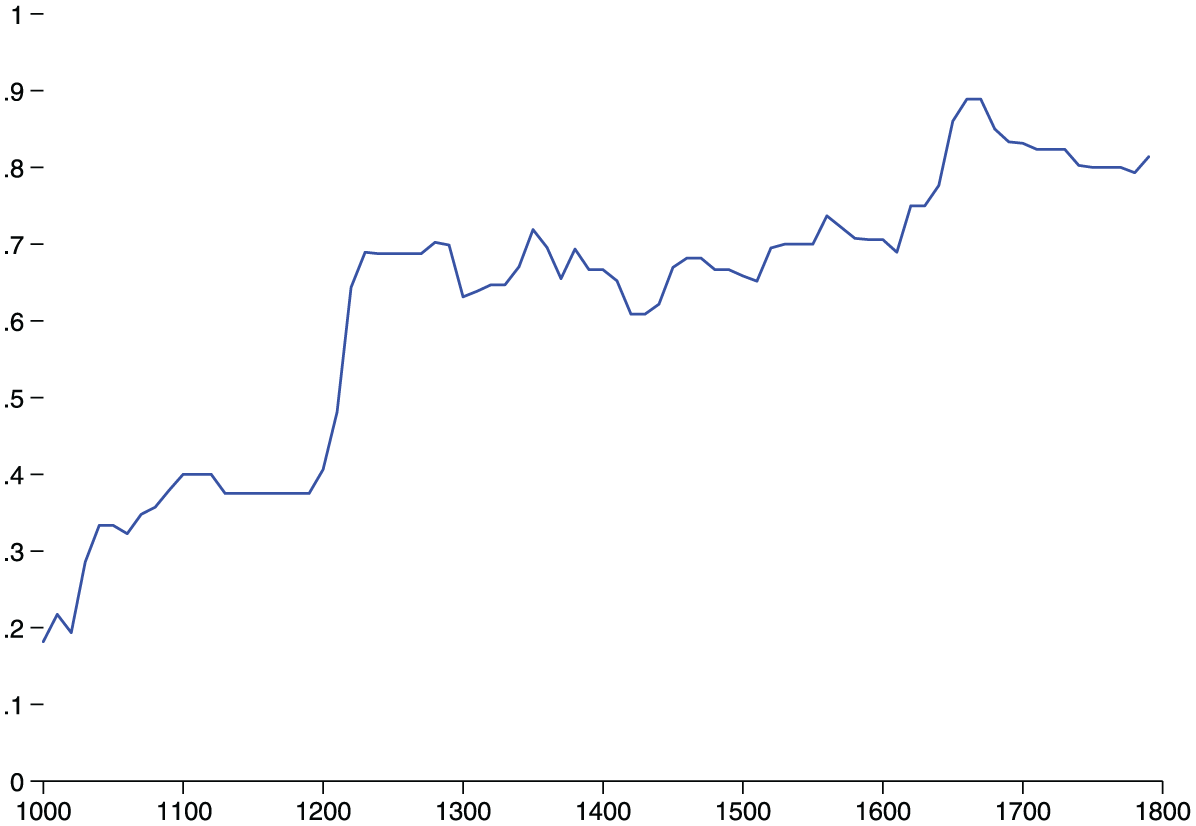
Proportion of states in the sample with primogeniture.
First, primogeniture automatically provides the regime with a successor in advance of the succession, as long as the leader manages to produce an eligible heir (Acharya & Lee, 2019; Wang, 2018). Primogeniture also often provides the regime with an heir in cases where the leader fails to produce an eligible heir, if he has other living relatives (as, for example, uncles, nephews, or more distant relatives), as the principle in its more advanced forms allows for inheritance via deceased predecessors. This fact is illustrated by the current list of heirs to the British throne, which includes more than 1,000 persons strictly ordered according to their place in the succession.
Second, primogeniture prevents the leader from tampering with the succession process, as everyone knows the line of succession and heirs cannot be disinherited in normal circumstances. Together these facts make the succession procedure virtually automatic. Everyone knows who will inherit in advance of the succession, and the elite can rally around the heir-apparent and coordinate its attempts to uphold the regime even before the incumbent leader’s death without any fears (Brownlee, 2007; Sabl, 2012; Tullock, 1987).
By fixing the succession procedure, primogeniture in normal circumstances also prevents succession disputes. Hence, the third criterion is usually not even applicable to states practicing primogeniture. To the extent conflicting claims exist, their validity is in normal circumstances easy to settle.
However, primogeniture does not guarantee a smooth succession. A leader may fail to produce an eligible heir in a situation where he has no other relatives who can inherit the throne. Or he can produce an heir who is inept at ruling. In such situations, the regime must rely on other conflict solving mechanisms to handle the succession, with elections being the most common default option.
Other hereditary principles of succession seemingly also handle the criteria relatively well, but there are important differences. Agnatic seniority—the principle of letting the oldest male relative of the leader (usually a brother) inherit the throne in preference to younger male relatives (sons)—which was competing with primogeniture at the turn of the Millennium, handles the second and the last criteria in the same way as primogeniture does. However, it does not handle the first criterion as well, because the heir is usually only a few years younger than the leader and therefore not certain to outlive him (especially not in a high mortality setting as medieval Europe). Planning for the succession in advance is thus more difficult for the regime in states practicing agnatic seniority than in states practicing primogeniture. Hence, agnatic seniority should be less efficient than primogeniture at preventing civil wars over the succession.
Elective succession arrangements, which were common before primogeniture came to dominate Europe, offer none of the guarantees primogeniture does. Most obviously, elections do not provide the regime with an heir in advance of the succession, as they usually take place after the death of the leader. Hence, the regime cannot prepare for the succession in advance by cultivating a successor. As a consequence, the second criterion is redundant (if there is no heir, it does not matter whether he can be replaced or not). The regime will, therefore, likely stand without a focal point when the incumbent leader dies.
In theory, elections provide a mechanism for the peaceful resolution of the succession disputes that may follow in such a situation. However, whether elections can solve the ensuing disputes depend on how well votes reflect more profound (perceived) power relations. If a faction of the regime believes that it will lose the upcoming elections, but may prevail in a violent struggle for the throne, it may be tempted to try its chances before the elections. If other factions deem otherwise due to private information about their relative strength, the situation may easily escalate into a succession war.
Absence of established rules of succession, or more obscure forms of succession that lead to a plethora of possible claimants, such as the “survival of the fittest, not eldest son” inheritance practiced in the Ottoman Empire (Quataert, 2005), similarly does not provide the single focal point that is necessary to avoid power struggles. Neither do they provide an accepted mechanism for solving disputes peacefully.
Our first hypothesis is thus that successions increase the risk of civil war in autocracies. Our second hypothesis is that the risk of civil war at the time of succession will be lower in states with a succession based on primogeniture than in states practicing agnatic seniority, states with elective succession arrangements, and states that lack succession arrangements altogether. We remain agnostic regarding the relative merits of agnatic seniority (which is more likely to provide the regime with an heir in advance of the succession) and elective succession arrangements (which provide a more established mechanism for solving succession disputes without violence), but contend that states lacking established succession mechanisms should be the most likely to experience succession wars.
An Illustration: The War of the Polish Succession
On February 1, 1733, the King of Poland and Elector of Saxony, Augustus II the Strong, died in Warsaw. He was immediately succeeded by his only legitimate son, also named Augustus, in Saxony, which practiced primogeniture. Poland, however, was an elective monarchy, and the throne was left vacant in anticipation of the pending king elections.
Two serious candidates soon crystallized. The first was Augustus II’s son, the new Elector of Saxony. His contender was Stanislaw I Leszcynski, who had actually been King of Poland between 1704, when he deposed Augustus II with Swedish help, and 1709, when Augustus II managed to retake his throne. Stanislaw now put forth his candidacy again (Phillips & Axelrod, 2005, pp. 899-900).
Both candidates were backed by large—and antagonistic—factions within the Polish nobility, who elected the king. They were also supported by foreign powers, which intervened in the elections with bribes and military threats. Stanislaw, who was the father-in-law of the French King Louis XV, was backed by France, while the young Augustus was supported by Russia and the Habsburg Emperor. The French ambassador to Warsaw summarized the uncertain and volatile situation brought about by the upcoming king elections (Sutton, 1980, p. 46): The confusion is going to be very great in the kingdom, especially during a time of the Diet, and the animosity among the families goes beyond any description. Everyone wants to be the general; everyone will seek to detach troops from the army and everything will be in disorder.
Stanislaw was eventually elected by a majority of the nobility at September 12 (more than 6 months after Augustus II’s death), but a substantial minority declared for the young Augustus. The minority took refuge with a Russian army in the eastern parts of country, where they elected Augustus King (Lukowski & Zawadzki, 2006, p. 110). Civil war soon raged in Poland, as the minority moved against Stanislaw with Russian support. Stanislaw was forced to flee the country, but his supporters continued to wage a guerilla war against Augustus and his allies. What was initially a civil war with foreign intervention quickly escalated into a major European conflict, as France, Spain, and Savoy-Sardinia intervened in support of Leszcynski and Austria joined Russia in backing Augustus. At the end of an indecisive war, young Augustus won the throne and became Augustus III of Poland, while Stanislaw was compensated with the Duchy of Lorraine (Phillips & Axelrod, 2005; Sutton, 1980).
The only legitimate son of the previous monarch thus succeeded to the throne in the end. However, it took two king elections and a war to assure young Augustus’ succession. The contrast with his smooth and automatic succession in Saxony, which practiced primogeniture, is stark. The root of the problem was Poland’s elective monarchy, which allowed for competing claims. As shown, the outcome of the king elections was by no means certain. The consequences of the lack of an obvious successor is illustrated by the British Ambassador to the Sejm, who wrote home that it was difficult to “make any judgement how the Poles are inclined as to an election, for all the wise people keep their thoughts very private and will have good reasons before they declare themselves” (Sutton, 1980, p. 46). Even after they had declared themselves, they obviously disagreed over who would prevail in an armed struggle. The result was a war that not only engulfed Poland but also large parts of Europe as the different fractions asked their allies to intervene. The War of the Polish Succession thus neatly illustrates the mechanisms we propose. Below we test our hypotheses more systematically.
Empirical Strategy and Data
Leaders who lose wars tend to resign or be deposed (Chiozza & Goemans, 2004, 2011; Croco, 2011). Earlier, leaders also ran the risk of dying in battle. Disentangling causality between leadership change and civil war is therefore problematic. In this article, we solve the problem by following the strategy of Jones and Olken (2005), who exploit deaths incurred by natural causes and accidents to gauge the causal effect of leader quality on economic growth. For the purpose of their paper, a natural death is plausibly exogenous, as it is unlikely to be connected to economic growth. We argue that the same holds true for the relationship between the natural deaths of monarchs and civil war onset in medieval and early modern Europe. Although civil wars can cause abdications, battle deaths, and depositions, they are unlikely to increase the risk of natural deaths significantly.
Natural deaths are more likely among old persons. Thus, the death of an old monarch can be expected, even though the exact timing may be unknown. We therefore control for age in all our models. However, early deaths from diseases and accidents were common before the advent of modern medicine. Figure 2 shows the distribution of ages at death for monarchs who died of natural causes in the sample used in this article, compared to death rates for the population in the United Kingdom in 2010 (in 5-year increments, starting at age 10 for the modern sample). Apart from being located further to the left, the age distribution in our monarch sample is more spread out than in the modern sample. Half of the monarchs that died from natural causes did so before turning 53. We show in the Supplemental Material that our results are not substantively altered by restricting our sample to these comparatively young monarchs, for which death should have come relatively unexpected. We also control for general time trends in life expectancy by including century dummies in our models.
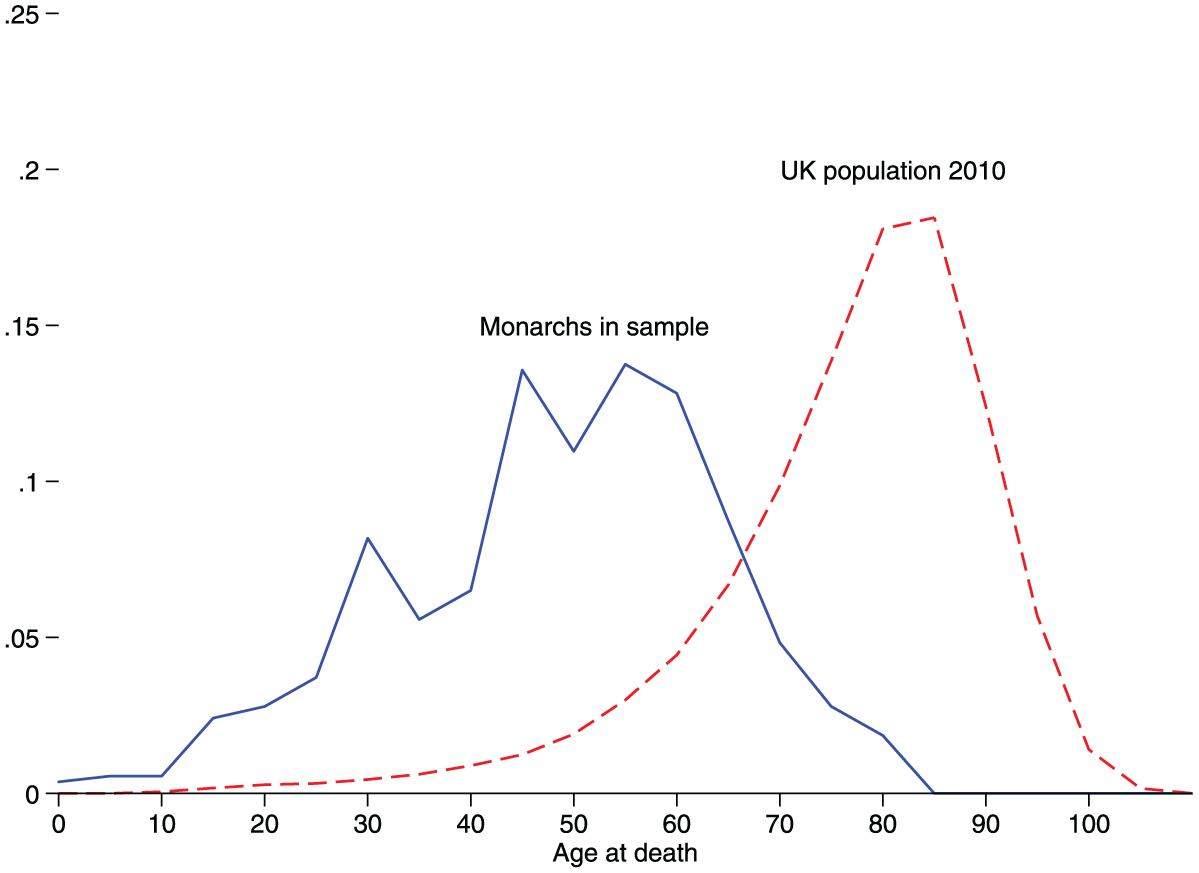
Distribution of age of death for monarchs in the sample and a modern reference population.
Another potential caveat is that natural deaths can be suspected to occur more often in politically stable autocracies than in politically unstable autocracies, as leaders risk being deposed or killed before they die of natural causes in the latter states. If the risk of succession wars is lower in stable autocracies, our results will therefore be biased downward. Given that natural deaths also were common among younger monarchs, we should however not expect drastic differences in natural death rates between stable and unstable monarchies, despite the fact that monarchs in the latter states were more likely to be deposed. A comparison between periods in which primogeniture and elective monarchy was practiced, presented in Table 1, confirms our expectation: Natural deaths were as common in states practicing primogeniture and elective monarchies, even though more monarchs were deposed in the latter states. A direct focus on stability does not change the conclusion: When we divide our sample in two groups depending on whether countries score above or below the mean number of depositions per year in the sample, there is no significant difference in natural deaths between the two groups of countries. 3
Mean Values of Key Variables.
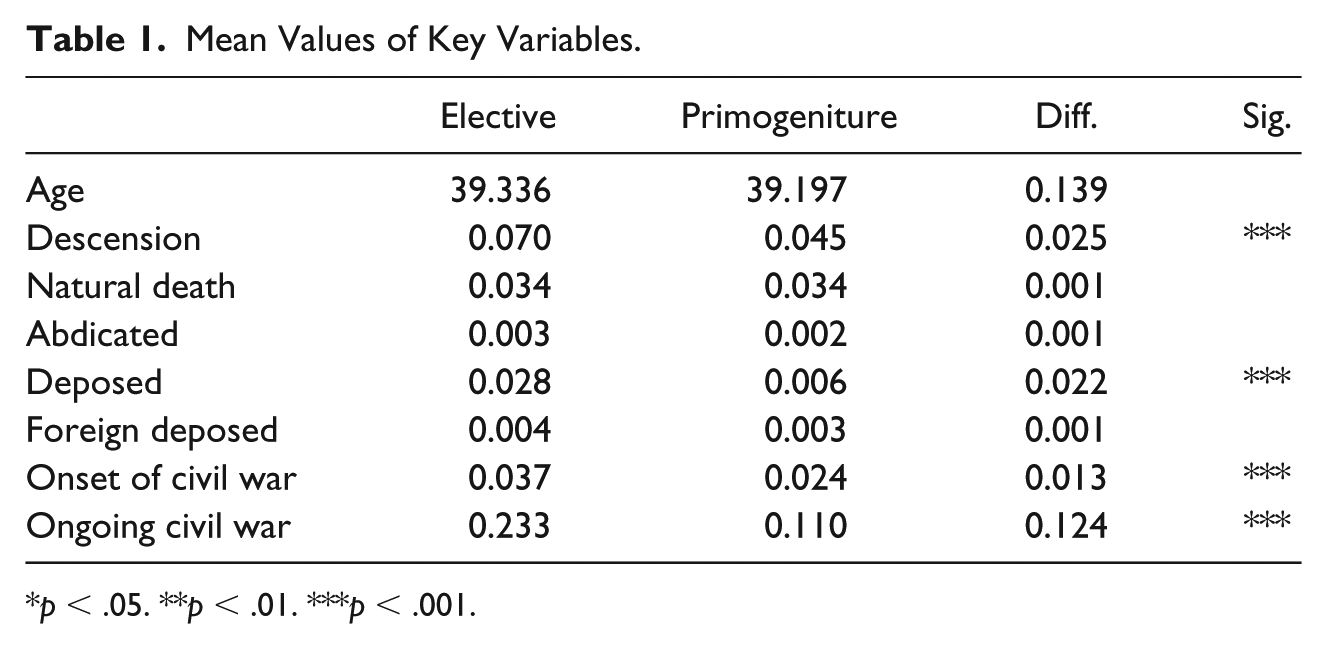
p < .05. **p < .01. ***p < .001.
We therefore focus on successions that took place after monarchs died in office for nonpolitical reasons, such as disease or accidents—hereafter referred to as “natural deaths.” We exclude successions that followed abdications, depositions, battle deaths, and deaths that occurred during military campaigns in foreign countries (as such campaigns increased the risk of infections and accidents).
Sample
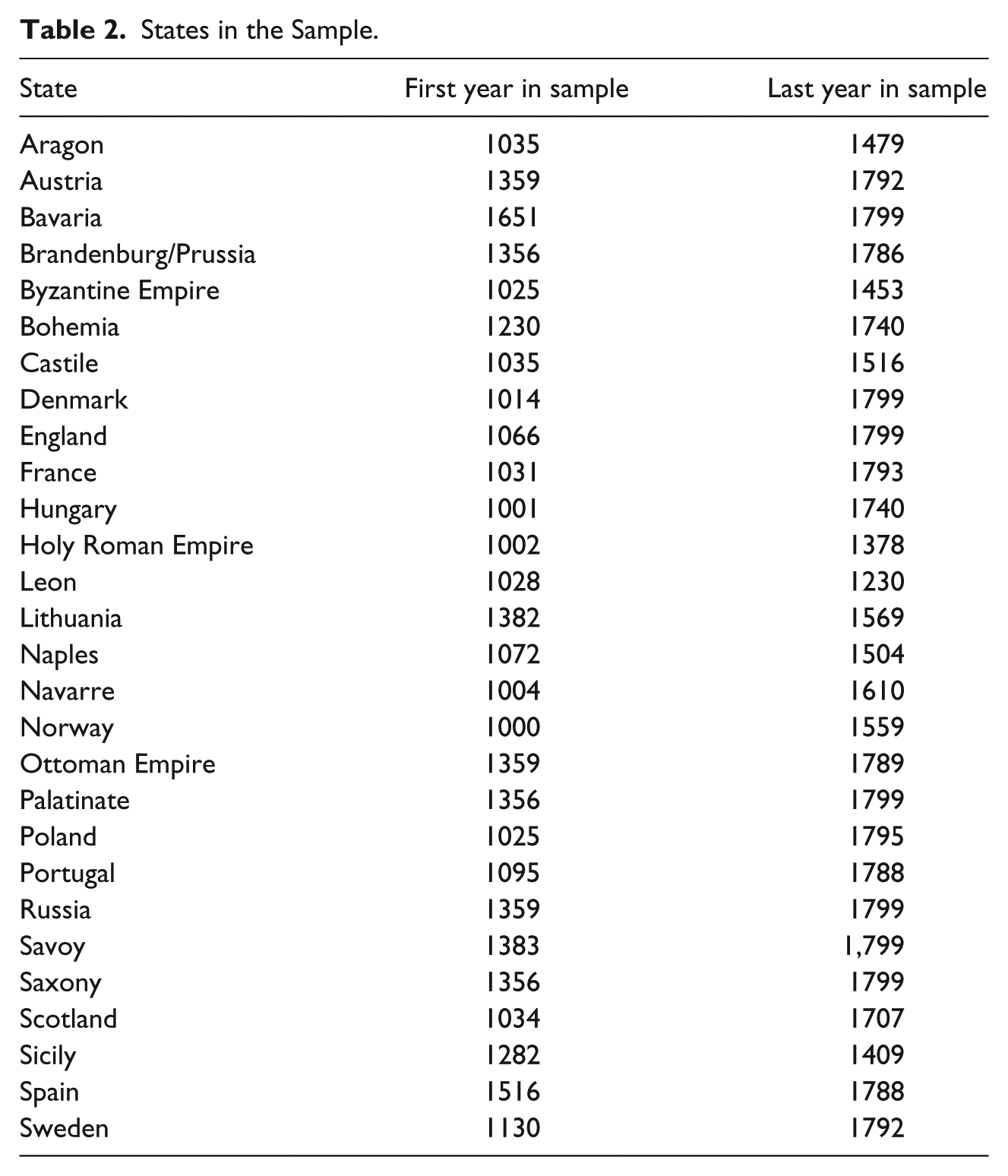
Our coding builds on a dataset collected by Andrej Kokkonen and Anders Sundell (2014), which provides detailed information on how monarchs from a number of European states between 1000 and 1800 AD left office, as well as the nature of their deaths. These data include the major kingdoms of Europe, as well as the most important major German and Italian principalities. We, however, found that the major compilations of war (for natural reasons) primarily focused on larger states, with limited information for smaller political units. Several smaller states have therefore been excluded from the original data. We have also added the Ottoman Empire, a major power player in early modern Europe, with well-documented wars, to the data. The states included in our sample are described in Table 2.
States in the Sample.
Our sample is not representative for the entire universe of political units that have existed throughout European history, where counties, dukedoms, and city states have competed with kingdoms and empires. It does, however, cover the states that ruled the largest territories and the majority of the population, and that eventually formed the basis of the modern nation-states. Figure 3 shows, shaded in green, the states included in 1300 and 1500. In 1500, we only include the secular electors of the Holy Roman Empire, meaning that many small states are excluded. However, the latter are in most of the war sources only described without discrimination, which means that coding for them would be unreliable if not outright impossible. While it would have been preferable to include all European states that existed throughout the period, more accurate war data would have been required in order to do so.
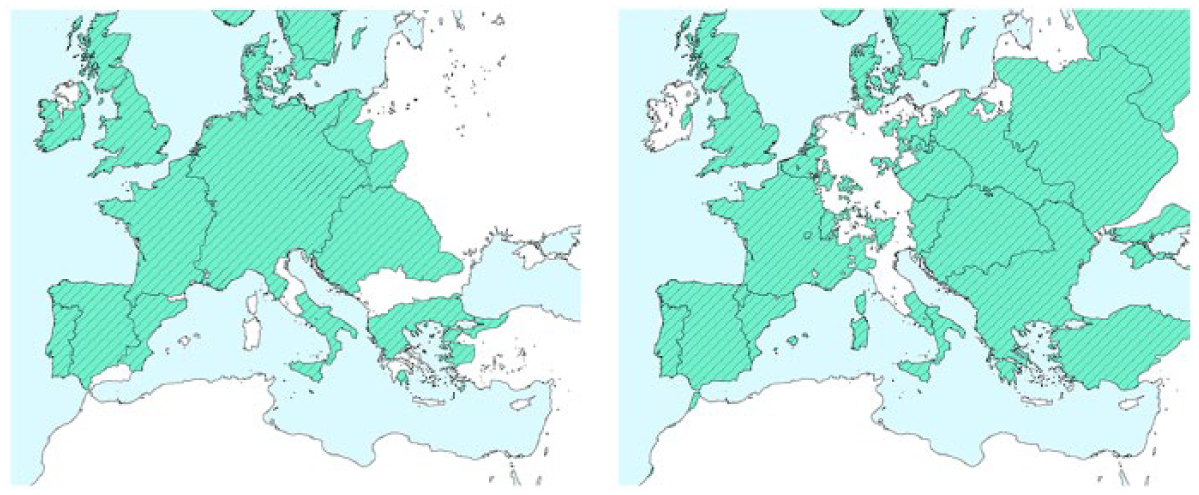
Territory covered by sample states in 1300 and 1500.
In total, our data include 455 country-years when a monarch died naturally (making up 62% of the 736 country-years in which a monarch left office). 4 We use this data to test whether there was a higher risk that civil war broke out in years when a monarch died naturally than in other years (including years when there were unnatural successions). 5
Succession Arrangements
To assess the moderating effect of succession arrangements, we use data from Kokkonen and Sundell (2014) and information on succession arrangements in the Ottoman Empire provided by Alderson (1956), Peirce (1993), and Quataert (2005) to construct a variable that distinguishes between country-years in which (1) primogeniture was practiced and (0) country-years in which elective monarchy (and other succession arrangements) was practiced. 6 The coding focuses on de jure succession arrangements. We have chosen to only distinguish between primogeniture and other succession arrangements (a category totally dominated by elective monarchies) due to the fact that our selection of countries result in very few observations when other succession arrangements than primogeniture and elective monarchy were practiced. Agnatic seniority was only practiced for about 100 years in Russia and 200 years in Hungary and Poland early in the period, whereas the Ottoman Empire had a succession based on “the survival of the fittest son” (Quataert, 2005) throughout the period. The lack of variation makes any test of the relative merits of other succession arrangements vis-à-vis each other unreliable (the effect of the Ottoman succession arrangements is, for example, entirely explained by country fixed effects).
Wars
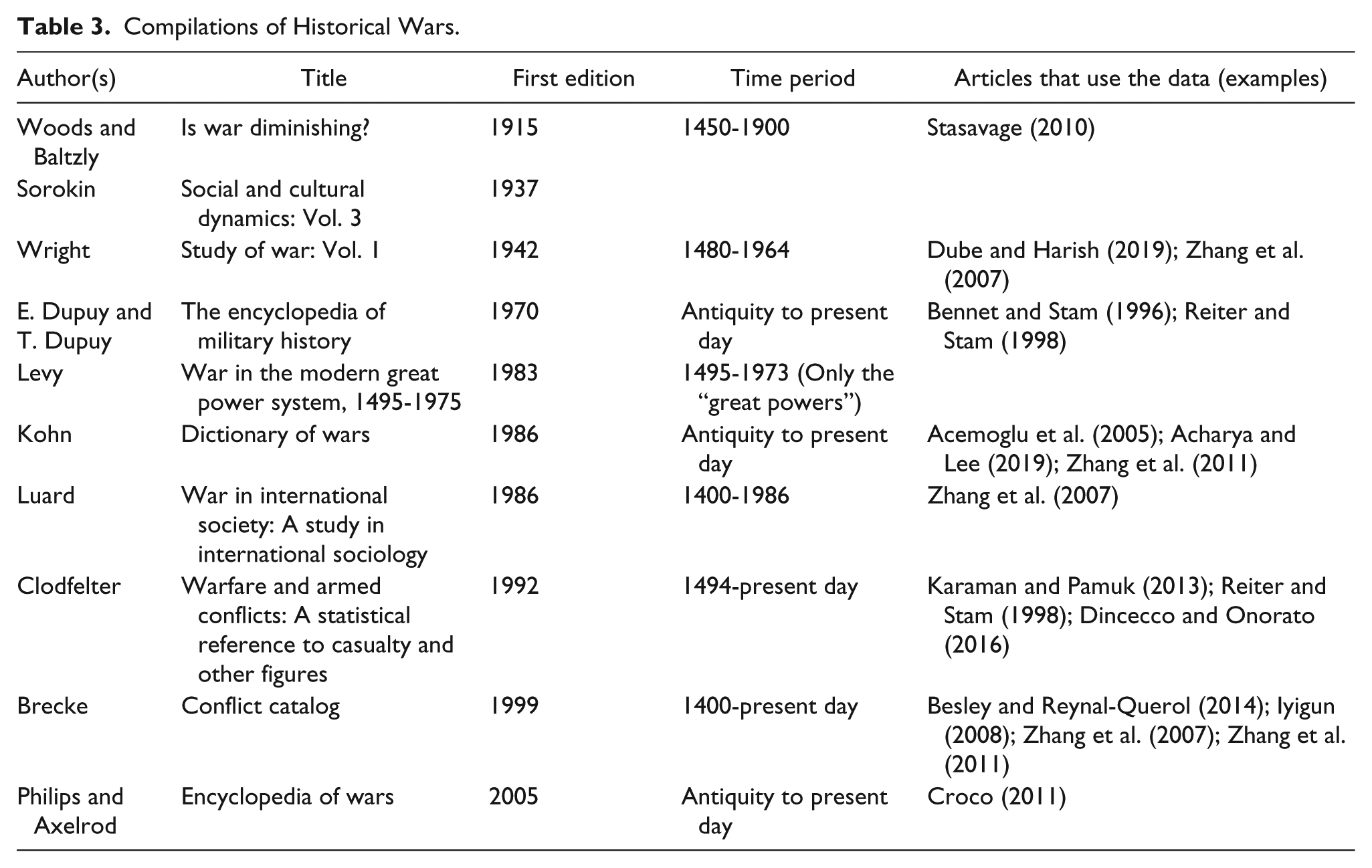
We define civil wars in the era of study as a military conflict in which the warring parties had the support of substantial armed factions within a country’s territory. Our definition does thus not require a specific motive and includes both outright wars and rebellions. For the period before 1800, data on such conflicts are scarcer and less structured than for the modern period. Studies on the topic have therefore relied on compilations by historians. Table 3 presents the compilations that include data on several European states we have been able to identify in previous research. In contrast to most previous studies, which generally rely on a single secondary source, our data are based on five different compilations of war, written by Charles Phillips and Alan Axelrod (2005), George Kohn (2013), Richard Ernest Dupuy and Trevor Dupuy (1970), Evan Luard (1986), and Michael Clodfelter (2002). 7 We use textual information in the compilations to identify unique wars and give each a common id number in all datasets. This allows us to distinguish between omissions of wars and simple disagreements over their exact dates (for a more detailed discussion of coding choices, see the Supplemental Material). Figure 4 shows the proportion of countries in the sample that were in civil war each year, averaged in 20-year increments.
Compilations of Historical Wars.
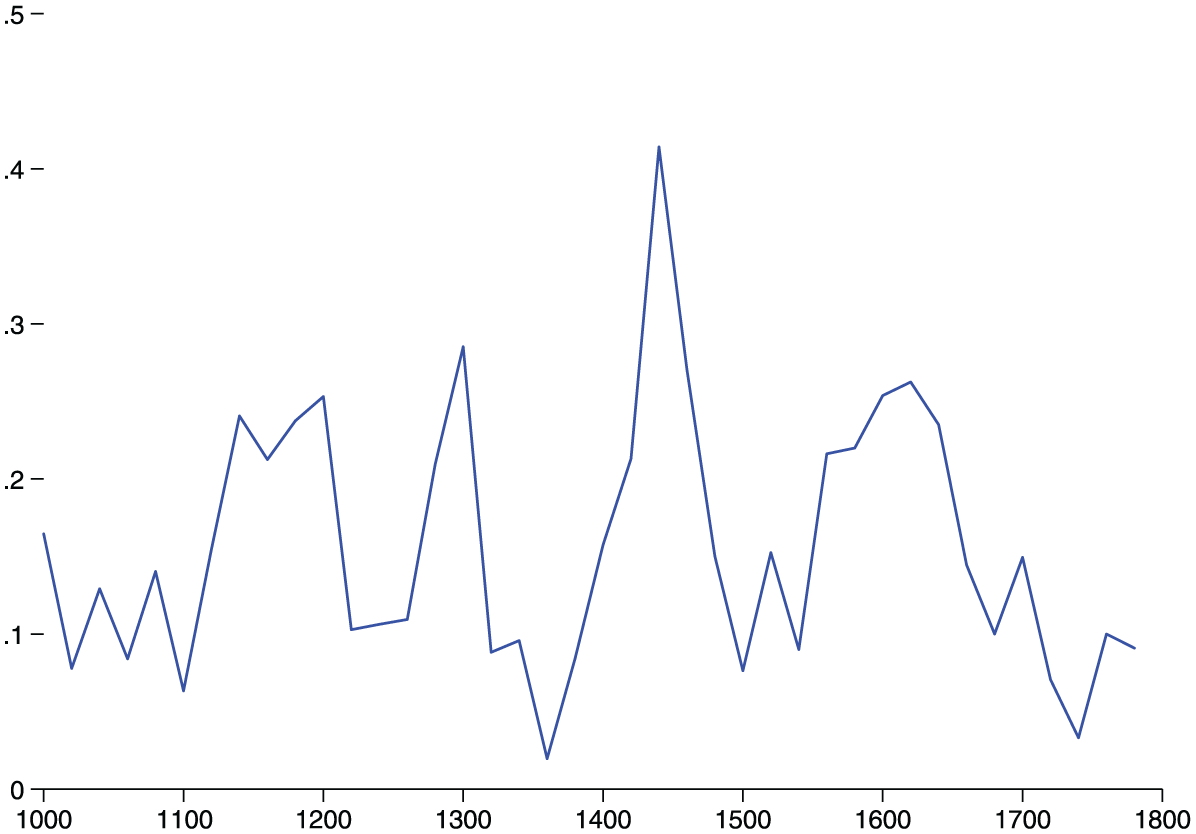
The proportion of countries that were involved in at least one civil war each year, averaged by decade.
Royal Children
To gauge whether the availability of male heirs reduced the risk of succession wars (e.g., Acharya & Lee, 2019), we have gathered information on monarchs’ children from two sources. The first is the “Medieval Lands” database, compiled by Charles Cawley (2006), which covers the period up until the 15th and 16th centuries. For the subsequent period, we use the 29-volume genealogical collection Europäische Stammtafeln (Isenburg & von Loringhoven, 1975; Schwennike, 1998). In a few instances, when our main sources lack information, we have augmented it with information from other secondary sources (detailed in the Supplemental Material). We use these sources to construct a dummy variable that for each year measures whether a monarch had a living son or not. We interact this variable with the dummy measuring monarchs’ natural deaths to test whether the availability of a living son reduced the risk of civil war. See the Supplemental Material for descriptive data on the children.
Control Variables
Although data are limited, we have constructed a reasonable set of control variables. First, we control for time periods with century dummies, as time is correlated both with leader tenures and modes of exit for monarchs (Blaydes & Chaney, 2013; Eisner, 2011) as well as with life expectancy and the availability of data (using decade dummies instead of century dummies does not change our results). As is standard in the literature on civil war onset, we control for peace spells between civil wars with variables that measure years and years squared since last civil war (e.g., Collier & Hoeffler, 2004). Using the alternative strategy of whether a country had an ongoing civil war the previous year (Fearon & Laitin, 2003) does not alter our results. We also control for the length of a monarchs’ tenure, as previous research has shown that leaders are more prone to engage in war early in their careers (Chiozza & Goemans, 2003, 2004; Gaubatz, 1991; Gelpi & Grieco, 2001). Scott Abramson and Carlos Velasco Rivera (2016) argue that monarchs accumulated power over time, which they could bestow on their successors. To control for how such power transfers affected war risks, we include a variable that measures how long tenure a monarch’s predecessor had. 8 We also control for a monarch’s age and age squared.
Following the literature on the importance of parliaments for leader-elite negotiations (e.g., Boucoyannis, 2015; Downing, 1992; Møller, 2017; Stasavage, 2010, 2016), we include a variable for parliamentary activity during the century, coded by Jan Luiten van Zanden, Eltjo Buring, and Maarten Bosker (2012). We control for interregnums (i.e., periods when a country did not have a monarch) with a dummy variable.
As larger countries are more exposed to local revolts, we control for the log of the geographical area, measured in 100-year intervals using data from Euratlas.net. Using the same data, we also include a variable for mountainous terrain, which could make it easier for rebel groups to evade capture (Blattman & Miguel, 2010; Collier & Hoeffler, 2004). Our variable is constructed as the percent age of the country located at an altitude of at least 500 m.
Model Specification
We code our dependent variable, onset of civil war, as 1 for all years in which a civil war broke out and 0 for all others. Years in which a war continues are coded as 0 and are included in the analysis, since new wars sometimes broke out while old wars still raged on (cf. Fearon & Laitin, 2003). Years in which more than one war broke out are treated similarly to years in which only one war broke out (i.e., as a year with one war onset). The results presented below are based on linear probability models with and without country fixed effects. We show in the Supplemental Material that our results are robust to using logit and conditional logit analyses instead, where the latter analyses control for country fixed effects (Besley & Persson, 2011; Buhaug & Gleditsch, 2008; Chamberlain, 1984). As the conclusions of the analysis are the same irrespective of estimation method, we in the main text present the linear probability models, for ease of interpretation. All standard errors are clustered at the country level.
Results
As a first display of how successions were related to civil war, we in Figure 5 plot the proportion of countries that were involved in at least one civil war the years before and after the natural death of a monarch (left graph) and the deposition of a monarch (right graph). Countries were involved in civil war in about 13% of the years before the natural death of a monarch, but this figure jumps to 20% in succession years. Years leading up to depositions were in contrast often marked by civil war; the proportion then drops after the deposition.
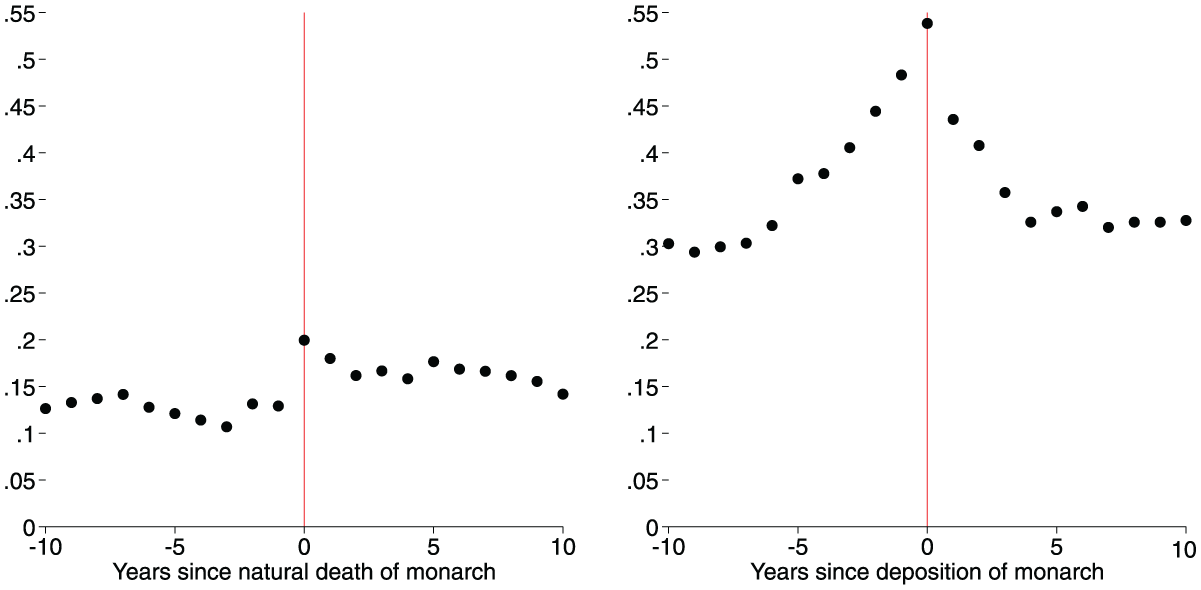
Proportion of countries involved in at least one civil war the years before and after a natural death of a monarch (left graph) and before and after a deposition (right graph).
The graphs suggest two different dynamics: natural deaths occur at the start of a period of conflict, and depositions at the peak. Depositions are probably in many cases caused by the conflict. As we are interested in the effects of successions on conflict, we focus on natural deaths in the remainder of the article.
Table 4 compares the observed risk of civil war in a country-year, depending on whether a monarch died a natural death that year and whether the country practiced primogeniture or not. The table shows that the risk of civil war onset was higher in years when a monarch died naturally, but the pattern is stronger in elective monarchies. In these countries, civil wars broke out in 3.2% of the normal country-years and in 17.1% of the country-years when a monarch died a natural death. In states practicing primogeniture, civil war broke out in 2.3% of normal years and in 5.1% of the years when a monarch died a natural death.
Percentage of Country-Years With Onset of Civil War.
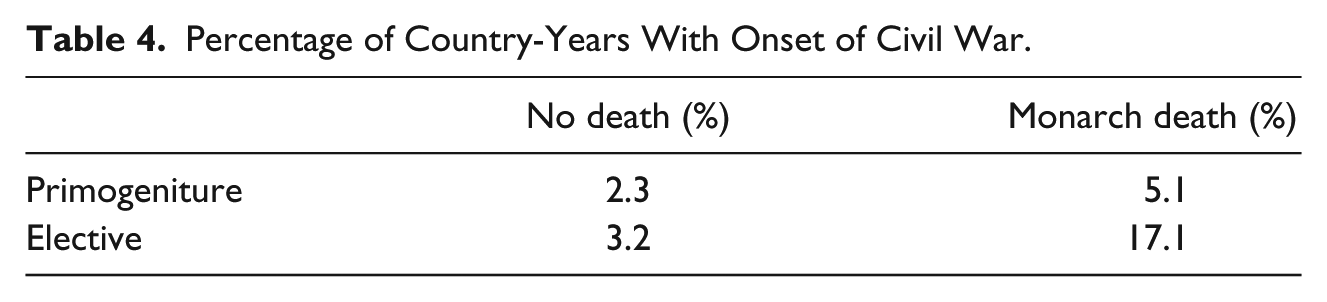
The risk of civil war in years when no monarch died was slightly (0.9 percentage points) lower in states practicing primogeniture. There is thus a possibility that the observed difference is due to primogeniture states being different in some other way. It is therefore necessary to control for other variables in a regression framework, which we now turn to, in Table 5. We first present simple models with only century and country fixed effects as controls, and then in models 5 to 8 add the control variables.
Determinants of Civil War Onset.
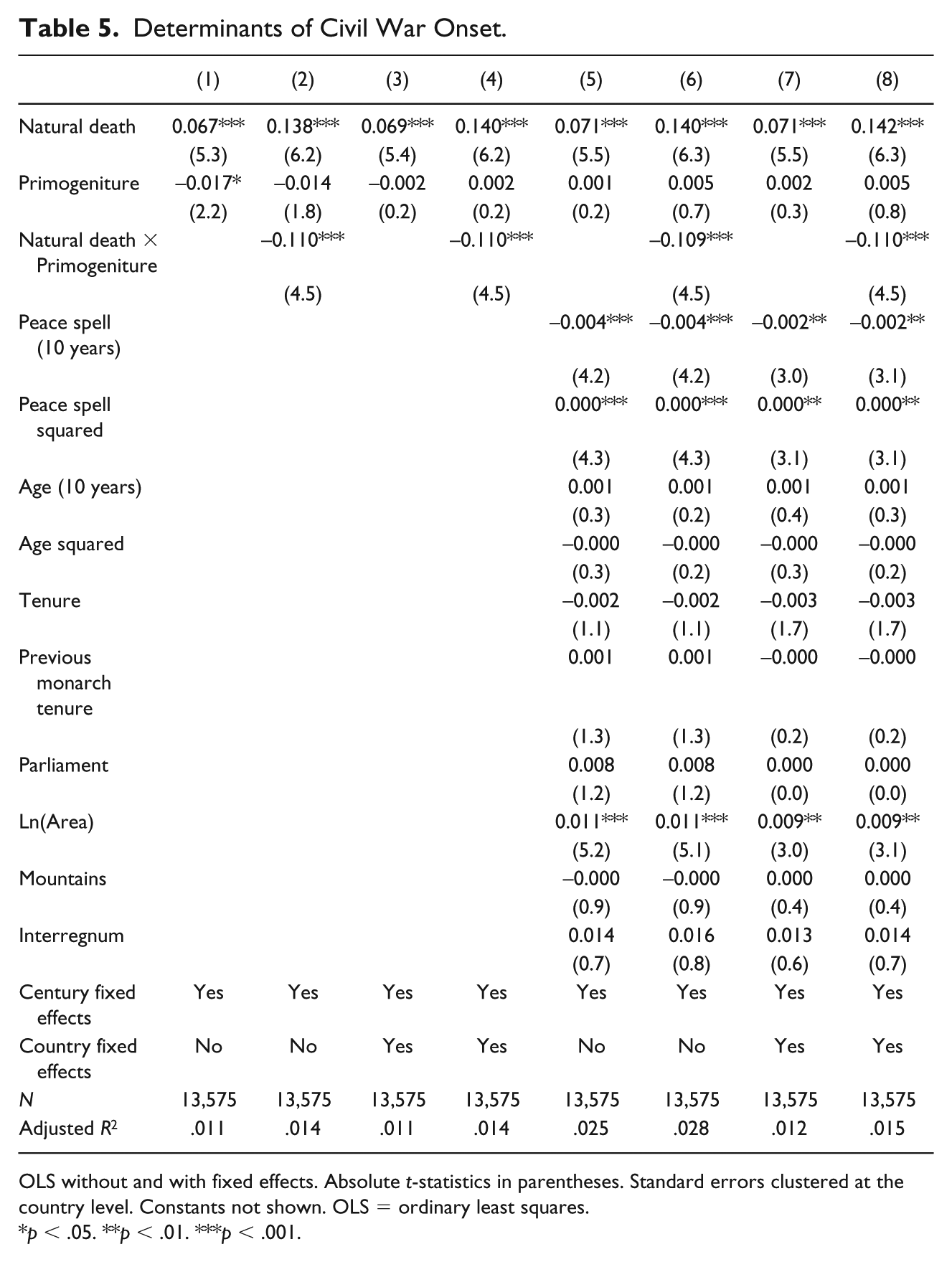
OLS without and with fixed effects. Absolute t-statistics in parentheses. Standard errors clustered at the country level. Constants not shown. OLS = ordinary least squares.
p < .05. **p < .01. ***p < .001.
The results strongly support our first hypothesis, regardless of specification: The natural death of a monarch increased the risk of civil war. However, as the interaction term between natural death and primogeniture shows, the increase was significantly weaker in states practicing primogeniture than in elective monarchies. These patterns remain when controlling for country fixed effects and a host of control variables. Thus, our second hypothesis is also confirmed: Primogeniture moderates the effect of autocratic succession on civil war.
Figure 6 illustrates the predicted probabilities of civil war onset calculated from the average marginal effects from models 6 and 8 in Table 5. It shows that a monarch’s natural death increased the risk of civil war from 2.8% to 6.0% in states practicing primogeniture and from 2.3% to 16.4% in elective monarchies (based on model 6, without fixed effects), indicating both that successions substantially increased the risk of civil war and that primogeniture sharply reduced the risk of such succession wars. The interaction terms in models 6 and 8 show that the difference in slopes is statistically significant. Of the 455 country-years in the sample in which a monarch died a natural death, at least one civil war or rebellion broke out in 43. Had all natural deaths occurred in primogeniture states, the expected number would be 27, compared with 75 had they all happened in elective monarchies. The models also show that civil wars were more common in larger countries and less common after extended periods of peace.
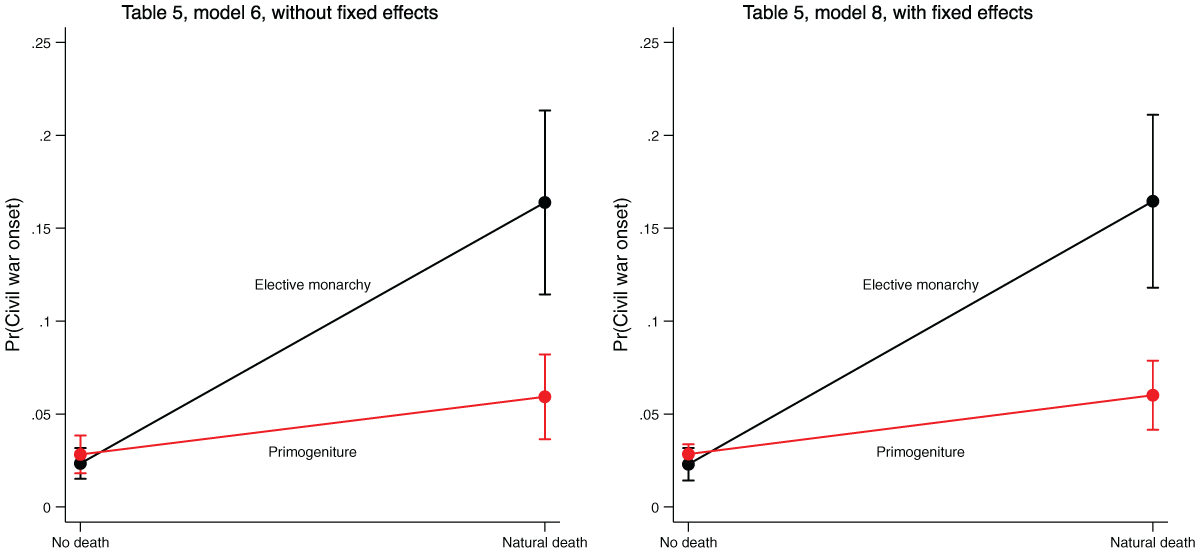
Predicted probabilities of civil war onset.
Royal Children and Succession Crises
Primogeniture solves the coordination problem by tying the succession to biological processes. But eligible heirs are also required, and reproduction was therefore a constant worry for monarchs. Henry VIII of England attempts to produce a male heir to avoid future civil strife illustrates the importance of the issue, as they eventually led to England breaking with the Catholic Church when the Pope refused to grant Henry a divorce. Avidit Acharya and Alexander Lee (2019) argue that most elective monarchies also operated under a norm that gave a monarch’s male children precedence in the order of succession, and that failure to reproduce male heirs was a universal source of succession disputes in European history regardless of de jure succession order (see also Wang, 2018). They substantiate their claim by showing that the absence of male heirs increased the likelihood that European regions were embroiled in civil wars. 9 Moreover, Oeindrila Dube and S. P. Harish (2019) argue that unmarried female monarchs were more susceptible to challenges than their male counterparts due to their perceived weakness. These findings raise the question of what role the availability of male heirs played for the risk that succession wars broke out.
Table 6 presents the observed frequency of war depending on whether the monarch had at least one son alive when he died and on whether the state practiced primogeniture or not.
Percentage of Country-Years With Onset of Civil War Depending on Monarch Death, Existence of at Least One Living Son, and Primogeniture.
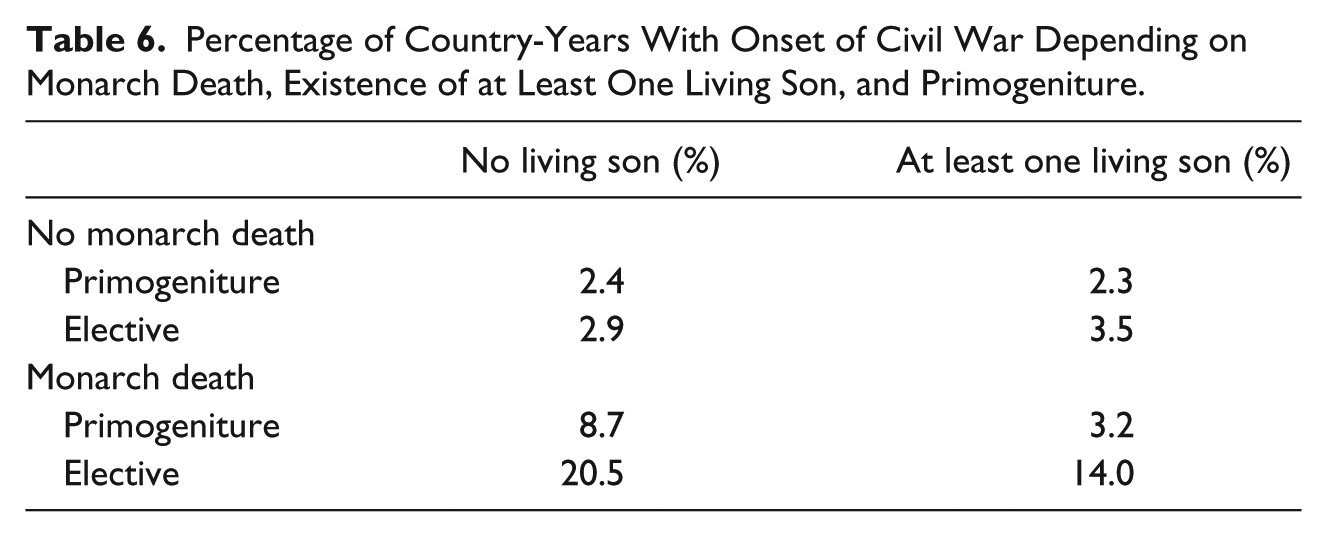
The table shows that the risk of civil war was considerably lower following a monarch’s death if the monarch was survived by one of his sons. In states practicing primogeniture, the risk of civil war was 3.2% if the monarch had a living son when he died and 8.7% if he did not. The corresponding risk for elective monarchies was 14.0% if the monarch had a living son and 20.5% if he did not. The patterns seemingly confirm that a monarch’s ability to produce sons was important for avoiding succession wars regardless of which succession arrangements that were practiced. However, it is necessary to control for other confounding factors. We therefore run models identical to those in Table 5, but with the addition of the full set of interactions between natural death, primogeniture, and the the dummy measuring whether a monarch had at least one living son. The full table can be found in the Supplemental Material, but we in Figure 7 present the estimated conditional coefficients and confidence intervals for natural death at the four combinations of primogeniture and having at least one son.
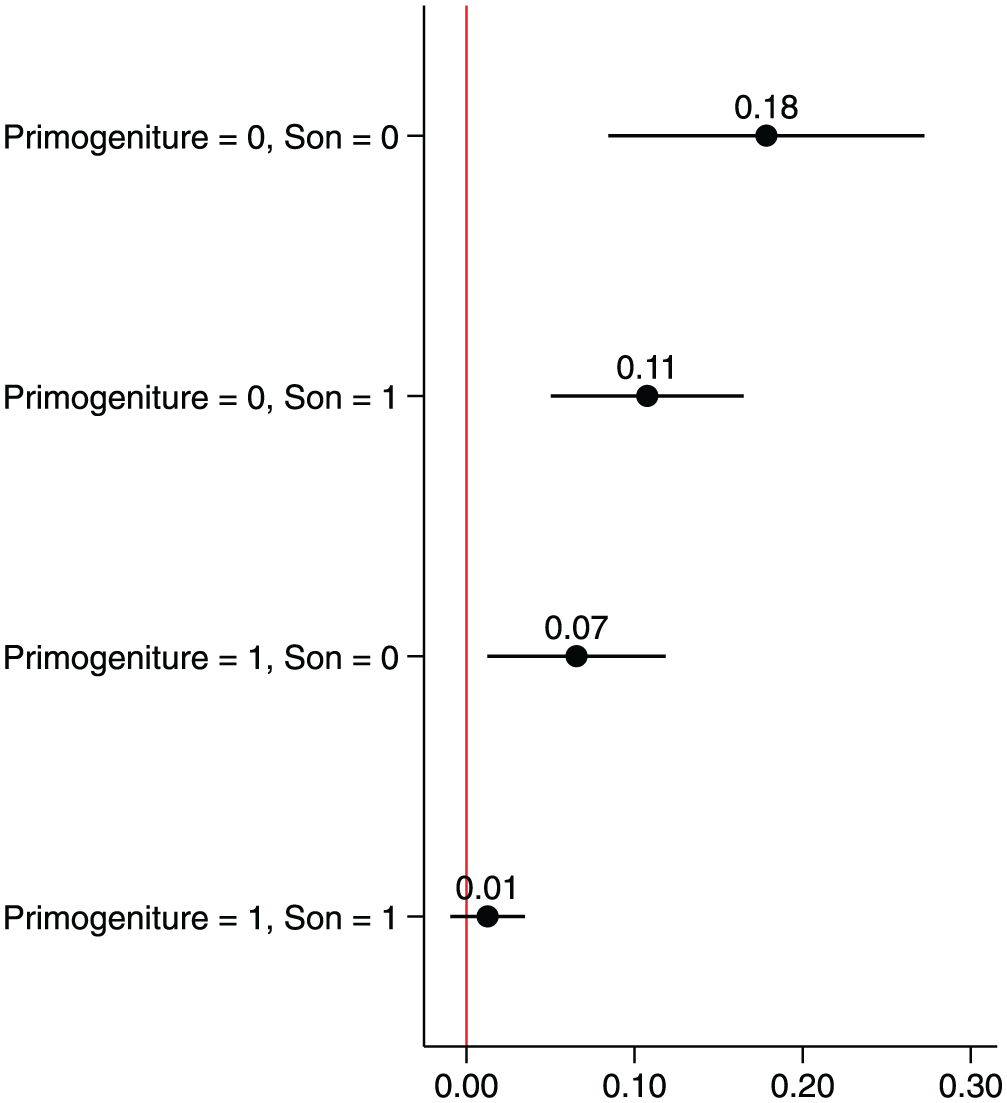
Conditional effect of natural death on probability of civil war onset, at different levels of primogeniture and at least one living son.
The figure shows that the natural death of a monarch increases the risk of civil war with 18 percentage points when there is neither primogeniture nor a son. Having at least one son reduces the increased risk to 11 percentage points, whereas having primogeniture reduces the increased risk to 7 percentage points. Having both a son and primogeniture reduces the increased risk to the extent that the coefficient for natural death is not significantly different from zero. 10
Even though the effect is less pronounced than that of primogeniture, Acharya and Lee (2019) thus seem correct in assuming that the availability of living sons made power transitions easier regardless of de jure succession arrangements—likely because it seemed natural for many contemporaries that the monarch’s eldest son should inherit the throne regardless of succession order. However, primogeniture’s independent effect indicates that the principle further reduced uncertainty about the succession, by legitimizing the eldest son’s claim. The fact that primogeniture delineates a clear line of succession also when the monarch lacks living sons, as long as he has other living relatives (such as grandsons, brothers, nephews, or daughters, if female inheritance is allowed), may explain why the principle had a positive effect on political stability also in the absence of living sons.
Robustness Checks
Natural Deaths
The perhaps most important objection to our analyses is that of reverse causality. Could the deaths of monarchs have been caused by the civil wars, instead of the other way around? Even though we exclude murders, depositions, and battle deaths, one could still imagine that war heightens the tensions on the monarch, which could induce a natural death. To determine whether that is the case, we take two approaches. First, we simply reverse our analysis and set natural leader death in a country-year as the dependent variable and a variable for ongoing civil war as our independent variable, together with all the previously used controls. We here exclude years in which a war started, since our main analyses already show that there is a positive correlation between a natural death and the outbreak of war, and it is impossible to determine the direction of causality relying only on statistics. However, if war-induced stress is a cause of natural deaths, we should observe an effect also in the years of war. The results are presented in Table 7.
Determinants of Natural Death of Monarchs.
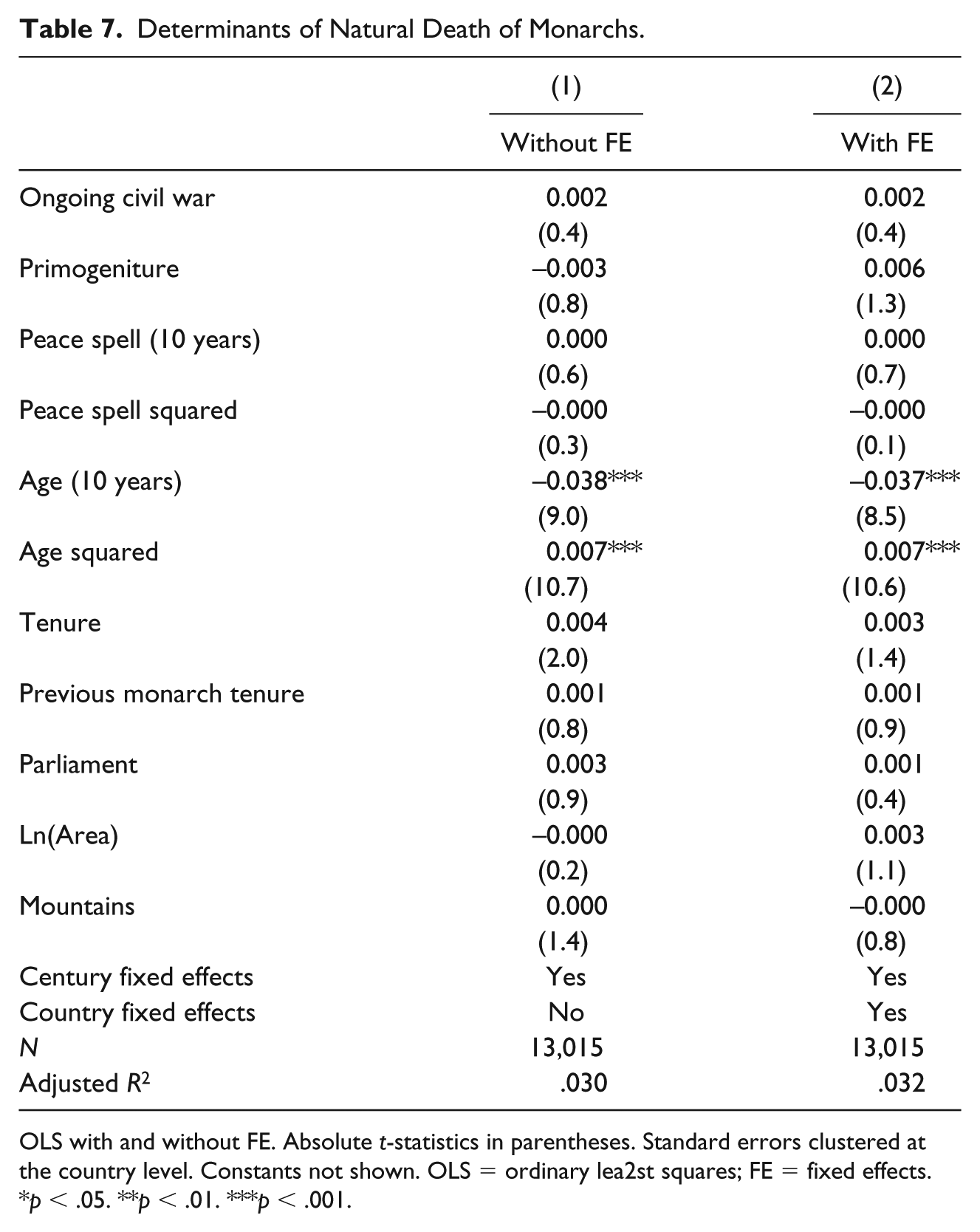
OLS with and without FE. Absolute t-statistics in parentheses. Standard errors clustered at the country level. Constants not shown. OLS = ordinary lea2st squares; FE = fixed effects.
p < .05. **p < .01. ***p < .001.
Models 1 and 2 show that the risk that a monarch died a natural death was not higher in years with civil war. In fact, the only consistent significant predictor of natural deaths is the age of the monarch. The relationship is curvilinear, with the risk of natural death increasing substantially around the age of 50.
However, one could speculate that the stress of war is highest at a war’s outbreak. We have therefore specifically studied the years in which monarchs died of natural reasons and war broke out. What was the order of events, and what do the descriptions of the wars in the sources tell us about their causes? Forty-three civil wars broke out in countries the same year as a monarch died of natural reasons. According to the sources, the vast majority were related to the succession or the death of the monarch. Only five of the wars were underway when the monarch died and hence completely unrelated to the death of the monarch. However, it is only natural that during these years, wars broke out that were unrelated to the succession. Removing conflicts that erupted before the death of the monarch from the analysis would make these years unnaturally peaceful. The expected number of wars in years in which a monarch died is 12, if the probability of conflict was identical to years in which no monarch died. Reverse causality does therefore not seem to be an issue. The full list of wars is available in the Supplemental Material.
Reverse causality is also not an issue for the association between the interaction between primogeniture and natural deaths on one side and war onset on the other, as years with natural deaths are assigned the established order of succession at the time of the monarch’s death. Changes in succession orders that followed a monarch’s death are counted as implemented at earliest from the year after the monarch died.
Endogeneity of Primogeniture
A question central to a causal interpretation of the results concerns the origins of different principles of succession. If, for example, weak monarchies were less likely to adopt primogeniture and more likely to experience civil war, an observed negative relationship between primogeniture and stability might be spurious. 11
Historical evidence suggests that many rulers wanted to transfer power to their offspring, even though there were exceptions (for instance, Peter the Great of Russia, who ordered his oldest son and heir to be tortured to death). But structural factors often limited the available options. In the early period, monarchs usually led armies into battle in person. In such circumstances, elections eliminated the risk of children or incompetents, who would be unable to fulfill their obligations, inheriting the throne (Kern, 1948). The nobility also often opposed making the throne hereditary. Scholars have therefore argued that powerful monarchs were more likely to be succeeded by their offspring (Abramson & Rivera, 2016). But why the eldest son? Before the era we study, the Merovingians and the Carolingians practiced partible inheritance, dividing the realm between the king’s sons at his death (Riché, 1993). The Ottomans instead let the sons of the Sultan fight over the succession among each other, favoring the “survival of the fittest, not eldest son” (Quataert, 2005).
We argue that the spread of Christianity and the associated requirement of monogamy in marriage helped promote primogeniture (cf. Møller, 2019). Several scholars have noted that the Christian Church in the early Middle Ages introduced a range of regulations on marriage and the family which promoted monogamy (Gies & Gies, 1987; Betzig, 1995; Goody, 1983; Herlihy, 1985). Polygamy, concubinage, and divorce were prohibited. As were consanguineous marriages, which were forbidden to the seventh degree of kinship in 747. Adoption was also discouraged and extramarital children were deprived of their inheritance rights.
Jack Goody (1983) argues that the motive for the regulations was to limit the nobility’s ability to produce heirs, so that its lands might more easily come into the possession of the Church through bequests. One of the consequences was that kings often only had one living male heir—who could inherit the realm intact—when they died. The resulting pattern of de facto primogeniture can partially explain why the Frankish realm remained intact under the Carolingians, from Charles Martel to Louis the Pious (Riché, 1993). We argue that this Carolingian “miracle,” and other similar events brought about by the Church’s regulations on marriage, illustrated the advantages of a succession based on primogeniture, and eventually inspired monarchs in states in which the Church was strong to adopt the principle also when they had many surviving offspring. In a similar vein, Max Weber (1963, p. 1137) writes that the “dominance of monogamy as the sole legitimate form of marriage has been one of the most important reasons for continuity of monarchic power,” as an abundance of potential heirs, to a number of different spouses, makes it harder to restrict the inheritance to a single line.
Weber also notes that “the belief in the hereditariness of charisma belongs to those conditions which account for the greatest historical ‘accidents’ with regard to the structure and persistence of polities” (Weber 1963, p. 1137), taking the fact that Mohammed died without male heirs as a reason for why hereditary succession did not take root in the Caliphate. It could be added that Islam also allowed polygamy, concubines, adoption, divorce, and re-marriage (Mitchell, 2007).
Germanic and Slavic non-Christian peoples also had much more lax attitudes than the Christian Church to polygamy, concubines, divorce, adoption, re-marriage, consanguineous marriages, and extramarital children’s inheritance rights (Goody, 1983).
Hence, we instrument primogeniture with the number of years a country has been Christian, meaning that monogamy is likely to be more prominent, and the tolerance for illegitimate offspring less accepted. The information used to construct our instrument is from Wickham (2016) and is presented in Table 2 in the Supplemental Material. The resulting IV-models are presented in Table 3 in the Supplemental Material. The results are in essence identical to the results in our ordinary models: Primogeniture does not have a main effect on civil wars, but the interaction between primogeniture and natural deaths is significant in all models and shows that primogeniture reduced the risk of succession wars.
Conclusion
Ever since the dawn of man’s rule over other men, prominent political thinkers have debated how to arrange leadership succession. In this article, we have shown that they have done so for good reason, by presenting evidence that successions, caused by largely exogenous factors such as the natural deaths of monarchs, severely increased the risk of civil war in medieval and early modern Europe. We have also brought evidence to the debate on the relative merits of hereditary and elective succession arrangements in autocracies, by showing that a succession based on primogeniture drastically reduced the risk of civil war in the wake of a monarch’s death. As primogeniture spread over Europe, the number of civil wars spurred by succession conflicts declined, ensuring the continuity of executive authority across generations. Thomas Paine was, thus, wrong in dismissing the argument that hereditary succession preserves a nation from civil wars as “the most bare-face falsity ever imposed on mankind.”
Our findings contribute to a state-building literature that has primarily focused on power-sharing institutions’, especially parliaments’, contribution to state-building efforts in European history (Ertman, 1997; Stasavage, 2016; Tilly, 1992). In Charles Tilly’s (1985) classic description of European state formation, “state making” is defined as the process of eliminating or neutralizing internal enemies. The most obvious example of elimination is a military campaign to suppress a rebellion or an assassination of a rival. But neutralization is equally important, and here we have added crucial evidence that institutions governing the succession were key in preventing conflict in European history.
Our work contributes to a growing body of evidence of hereditary succession arrangements’ historical importance for state making in autocracies. Kokkonen and Sundell (2014) have shown that the spread of primogeniture reduced the risk that monarchs were deposed in medieval and early modern Europe. Acharya and Lee (2019) have presented evidence that also the availability of male heirs reduced the risk that monarchs were deposed, as most polities tended to engage in de facto primogeniture if the monarch had a living son when he died. Recently, Yuhua Wang (2018) has extended the argument by showing that Chinese emperors ruled longer than their European counterparts due to their tradition of engaging in polygamy and concubinage which provided them with more male heirs than their European counterparts. The results in this article help explain previous findings, as the literature builds on the—previously untested—assumption that primogeniture and the availability of male heirs reduced the risk that monarchs were deposed, because both phenomena provided the regime with the means to avoid a succession war when the incumbent monarch died (Tullock, 1987). In short, our study provides the missing link that explains why hereditary succession arrangements increased monarchs’ chances of surviving in office, as bargaining over loyalty in autocracies always takes place in the shadow of the succession (Chiozza & Goemans, 2011, cf.).
Our findings may also be as close as we get to identifying the succession’s destabilizing effect on autocracies. The advent of modern medicine in combination with a trend toward shorter leader tenures make it difficult to use autocrats’ natural deaths to instrument successions in the modern world in a non-biased way, as only the strongest autocrats manage to survive to die of old age in office. Modern autocracies are moreover cautious of making hereditary succession arrangements, such as primogeniture, official even if they engage in them in practice. It would, therefore, be difficult to replicate our study today. This does, however, not mean that our study is unimportant for understanding dynamics in the contemporary world.
Moments of leader change are still among the most tumultuous and decisive in autocracies and are often even associated with regime collapse (Kendall-Taylor & Frantz, 2016; Svolik, 2012). Although the methods for managing the succession has varied throughout history—from royal elections, to inheritance, to party decisions—the transfer of power remains a problem. Some modern authoritarian countries have even seen the transfer of power from father to son, for instance, in Syria or North Korea (Brownlee, 2007). Our findings shed light on this continuity, showing how the predictability associated with hereditary succession may be conducive to political stability.
Supplemental Material
appendix – Supplemental material for Leader Succession and Civil War
Supplemental material, appendix for Leader Succession and Civil War by Andrej Kokkonen and Anders Sundell in Comparative Political Studies
Footnotes
Acknowledgements
The authors are grateful to Scott Abramson, Carl Dahlström, Oeindrila Dube, Jørgen Møller, Johannes Lindvall, Scott Gates, Bertel Teilfeldt Hansen, Jan Teorell, and seminar participants at Aarhus University, Copenhagen University, Gothenburg University, Linköping University, Oslo University, and the 2017 APSA meeting for comments on previous versions of the paper.
Declaration of Conflicting Interests
The authors declared no potential conflicts of interest with respect to the research, authorship, and/or publication of this article.
Funding
The authors disclosed receipt of the following financial support for the research, authorship, and/or publication of this article: This research was funded by the Swedish Research Council, grant number 2014-00604.

Notes
Author Biographies
References
Supplementary Material
Please find the following supplemental material available below.
For Open Access articles published under a Creative Commons License, all supplemental material carries the same license as the article it is associated with.
For non-Open Access articles published, all supplemental material carries a non-exclusive license, and permission requests for re-use of supplemental material or any part of supplemental material shall be sent directly to the copyright owner as specified in the copyright notice associated with the article.
