



Abstract
How do voters react to shocks that are outside the control of politicians? We address this question by studying the electoral impact of wildfires in Spain in the period 1983-2014. This context allows us to study (a) the effects of fires at different locations and times, as opposed to a specific disaster; (b) the heterogeneous effects by time relative to election day; and (c) the effects on elections for all levels of government. Using a difference-in-difference strategy, we find that an accidental fire up to 9 months ahead of a municipal election increases the incumbent party’s vote share by up to 8 percentage points, whereas a fire earlier in the term does not affect the election results. In addition, fires have no effect on regional or national elections. We discuss the possible mechanisms behind the results in light of the main theories on electoral accountability.
One of the central objects of study in political science is retrospective voting, that is, how citizens evaluate and act on their perceptions of government performance. As Healy and Malhotra (2013) put it, through retrospective behavior, citizens can incentivize politicians by sanctioning poor performance (Ferejohn, 1986) and selecting leaders who will govern competently and honestly (Fearon, 1999).
Inspired by this question, a growing amount of work studies how irrelevant events and, more prominently, natural disasters affect the incumbent’s fortunes. While understanding the impact of natural disasters is important in its own right, the main interest of these studies is that they can inform us about democratic accountability (Achen & Bartels, 2016). This issue has sparked a vivid debate in the literature. For example, Achen and Bartels (2016) argue that voters punish incumbents after negative exogenous shocks, and that this is evidence of the irrationality of voters, whereas Ashworth, De Mesquita, and Friedenberg (2017) reply that such voters’ response is consistent with rational voters. For an enlightened debate, it is crucial to have empirical evidence that can inform us about the response of voters in different contexts and types of elections.
In this article, we contribute to this literature by studying how wildfires affect the incumbent’s vote share in Spanish elections. This setting offers three important advantages. First, we study the effects of a considerable number of fires at different locations and times, as opposed to a specific disaster. When looking at one disaster, a particularly good or bad response by the incumbent or a concomitant shock (e.g., economic) could drive the electoral results. In other words, the next election’s results are a function not only of the disaster but also of other factors not necessarily related to it. When looking at a large number of wildfires, those other factors should average out. Hence, by performing a systematic analysis of disasters, we are able to estimate more consistently their average effect. Second, our context allows us to study the effects that natural disasters have at different times of the electoral cycle. Although there is abundant literature providing evidence that voters respond more to economic shocks (e.g., recessions) happening in the last months before the election, less is known regarding the timing of the response to natural disasters. 1 Third, we can estimate the effects on elections for all levels of government. Although the previous literature has mostly studied the effects of disasters on national (presidential) or state-level elections, in this article we study the response of voters in three types of elections: municipal, regional, and national.
We exploit a unique data set that contains data from all wildfires in Spain from 1983 to 2014. For each fire, we have information on the exact dates of detection and extinction and on the cause of the fire. Furthermore, we can know the surface burned by municipality, which allows us to have a precise measure of how much a fire affected any given municipality.
We follow a difference-in-difference estimation strategy and discuss in detail its validity. Identification relies on the assumption that in a given province-term, having a large accidental fire is not correlated with other factors that affect the incumbent’s vote share. We argue that our empirical strategy is likely to uncover the true ballot effects of fires for five reasons. First, we focus on accidental (as opposed to intentional) fires, caused by either negligence or thunderbolts. These fires have a large component of randomness and therefore are less likely to be correlated with other unobservable variables determining the incumbent political fortunes. Still, one might worry that, even though we focus on accidental fires, mayors could affect the probability of a fire in the municipality (e.g., through prevention policies). The remaining points address this possible concern. Second, we show that the results are robust to a battery of fixed effects, ranging from province-year to municipality dummies. This accounts for possible omitted variables that do not change within the province-term or within municipalities over time. Third, we show that accidental fires are not correlated with past vote shares—hence validating the parallel trend assumption—or with local economic conditions. Fourth, we note that any remaining bias is likely to be downward, that is, it would go against finding a positive effect of wildfires, because more able mayors are more likely to reduce the odds of a fire and to receive a larger vote share for reasons unrelated to fires. And fifth, we consider an alternative specification that relies on a milder identification assumption. Specifically, this assumption asserts that although mayors might affect the likelihood of an accidental fire happening, they cannot control their precise timing. We compare municipalities with a fire early in the term with those experiencing such an event in the months close to the next election. The results from this strategy reinforce the findings from the baseline. Hence, any remaining concern about identification is unlikely to explain the differential effects of fires by time relative to election day.
We study the effects of wildfires on the elections for the three levels of government in Spain: municipal, regional, and national. We find that a fire shortly before a municipal election (up to 9 months) has a sizable positive effect on the incumbent party’s vote share. For instance, a fire that burns at least 1% of the municipality’s surface area in the last 6 months before an election increases the incumbent party’s vote share by 4 percentage points (p.p.). 2 Larger fires have effects of up to 8 p.p. We also show that the impact increases as the election day approaches: The effect is zero for fires more than a year ahead of the election and steadily grows for fires closer to the polling day. By contrast, we find that fires have no effect on regional or national elections.
We discuss the possible mechanisms behind these results in light of the main theories on voter response to shocks: (a) blind retrospection (Achen & Bartels, 2016), which argues that voters punish the incumbent if their well-being decreased during the term; (b) voter gratitude, according to which voters reward the incumbent for the provision of aid in the aftermath of the disaster; (c) rational updating (Ashworth et al., 2017), which argues that the response to the shock may reveal (or mute) the quality of the incumbent, allowing voters to update their beliefs on the incumbent’s quality; (d) a rally effect, which leads voters to support the symbolic leader(s) of the affected area as a “psychological” or “patriotic reflex,” regardless of which party is in office and of the response of the government; (e) a partisan effect, with fires benefiting one party in particular and generating an indirect effect on incumbents; and (f) an alignment effect, with fires making voters prefer municipal governments politically aligned with upper-level governments, creating an indirect incumbency effect. We will argue that blind retrospection, voter gratitude, a partisan effect, and an alignment effect cannot explain our findings. A theory of rational updating could account for them under the assumption that voters underestimate the quality of municipal but not regional or national governments or, alternatively, that fires mute (as opposed to reveal) the quality of the incumbent. Finally, we will suggest that a rally effect is consistent with our results.
This article contributes to the growing literature on how voters react to natural disasters. Perhaps most papers find that natural disasters are harmful for the incumbent. Achen and Bartels (2004) argue that voters punish incumbents after shark attacks, droughts, and floods, as a result of blind retrospection. 3 Heersink, Peterson, and Jenkins (2017) find support for Achen and Bartels’s thesis, providing evidence that voters widely punished Herbert Hoover at the polls after a catastrophic flooding in the American South in 1927. Similarly, Cole, Healy, and Werker (2012) show that voters punish the incumbent in state elections after catastrophic rainfall in India. Healy and Malhotra (2010) find that voters punish the incumbent party in presidential elections for economic damage resulting from tornadoes, and they provide evidence that is consistent with voters rationally evaluating government’s response to the disaster: The incumbent party only loses votes when no disaster declaration takes place in response to the tornado. Similarly, Gasper and Reeves (2011) find that electorates punish presidents and governors for severe weather damage but that the effects are dwarfed by the response of attentive electorates to the actions of their officials.
Other papers, by contrast, find zero effects. Fair, Kuhn, Malhotra, and Shapiro (2017) find that the 2010-2011 floods in Pakistan increased turnout but did not have an effect on the incumbent’s vote share. 4 And, in one of the pioneer works of this literature, Abney and Hill (1966) study the effects of a hurricane that struck Louisiana in 1965 and find that it did not have an effect on the next election.
Finally, a few papers find that natural disasters are beneficial for the incumbent. Lazarev, Sobolev, Soboleva, and Sokolov (2014) show that support for incumbents, as measured in surveys, grew 1 year after a series of forest fires in Russia in 2010, and they attribute this, at least partially, to a “demonstration effect,” and Boittin, Mo, and Utych (2019) provide evidence that a major earthquake in Nepal in April 2015 induced a rally effect. Our article goes further by looking at the actual response of voters in elections, as opposed to survey responses. 5 Other papers have found that voter gratitude for aid resulted in a positive effect of a disaster on the incumbent’s vote share. Bechtel and Hainmueller (2011) find that the aid response to the Elbe flooding in 2002 increased vote shares for the incumbent in subsequent elections. Chen (2013) shows that hurricane disaster aid awards in Florida increased the incumbent party vote share. Healy and Malhotra (2009) find that voters reward the incumbent presidential party for delivering disaster relief spending in the United States.
Our article is also related to the work that studies the effects of random events on voting behavior. Perhaps the most studied aspect is the reaction of voters to exogenous changes in economic conditions. 6 Wolfers (2002), Leigh (2009), and Bagues and Esteve-Volart (2016) provide evidence that is consistent with a theory of blind voters, by showing that voters make governments accountable for economic shocks that the latter cannot control (oil prices, world growth, and lottery prizes, respectively). By contrast, Ebeid and Rodden (2006) and Kayser and Peress (2012) provide evidence suggesting that voters are able to discern what influence governments have on the economy.
Theoretical Predictions
In this section, we lay out the theoretical predictions. We will provide further discussion in section “Discussion of Possible Mechanisms,” where we will examine which of these theories can account for our empirical findings.
Blind Retrospection
According to this theory, voters evaluate how their well-being changed during the term (Achen & Bartels, 2004). If their well-being increased (decreased), they reward (punish) the incumbent. Voters behave this way even if the change in their well-being was due to events that are outside the control of the incumbent. Given that fires are negative shocks, this theory predicts that they should decrease the incumbent’s vote share.
If voters use their well-being change over the term to forecast their well-being in the next term, then it is optimal for voters to weigh equally all the years for which the incumbent is responsible (Achen, 2012). That is, fires should have a negative effect on the incumbent’s vote share independently of when they happened. Irrational (or myopic) voters, by contrast, may put more weight on most recent events, so fires closer to the next election may have a larger (more negative) effect on the incumbent’s vote share.
Rational Updating
According to this theory, it can be rational for voters to change their voting behavior after a disaster, even if it was outside the control of the incumbent, because the response of the government may allow voters to learn about the quality of the incumbent. 7
An important aspect of our work is that we do not study the response to a specific event, in which a particularly good or bad response of the government can drive the results. Rather, we study a considerable number of fires in different locations and times, and hence the quality of the responses should average out. Still, this does not preclude the possibility of rational updating, for two reasons. First, the quality of the responses will average out, but it may average out to be above or below the expectations (priors) of voters. In other words, it may be that voters have some expectations that are systematically above or below the true quality of the incumbent. If the response to the disaster reveals the true quality of the incumbent, which turns out to be, on average, above (below) voters’ expectations, this will result in an increase (decrease) in the incumbent’s vote share. And second, even with multiple disasters and nonsystematically biased priors, fires may have an impact on the incumbent’s vote share. Such possibility is modeled by Ashworth et al. (2017), who show that both positive and negative effects can be consistent with a theory of rational updating. 8 The predictions of the model depend on whether the challenger is “ahead or behind the incumbent” and on whether the shock “reveals or mutes” the quality of the incumbent. If the incumbent is ahead of the challenger and the shock reveals (mutes) the quality of the incumbent, then the shock will favor the challenger (incumbent). If the incumbent is behind the challenger, then the opposite is true. 9
Another aspect to consider is in what type of election we expect this mechanism to operate. As we discuss in section “Data and Institutional Framework,” competences on prevention and extinction regarding wildfires are mostly at the regional and national levels. Hence, we should expect that, according to this mechanism, fires mostly have an impact on regional and national elections. Still, we cannot rule out that there is an impact on municipal elections as well. First, as discussed below, the municipal government plays an important role in the aftermath of the disaster, acting as the symbolic leader of the municipality, for example, lobbying for aid. Hence, voters can arguably learn about the quality of municipal incumbents as well. Second, even if most substantial competences are at the regional or national level, we cannot rule out the presence of attribution errors (see, for example, Gelineau & Remmer, 2006, or, for the Spanish case, León, 2011). That is, voters’ perceptions of competences may not coincide with actual competences, so voters might think that municipal competence matters more than it does. Hence, this theory is consistent with fires having an effect on the three types of elections.
Finally, one would expect rational voters to learn the same about the quality of the incumbent no matter when the fire takes place. Hence, the impact of fires should not depend on the time to the next election. Still, there are some reasons why voters responding more to fires closer to the next election may be consistent with a theory of updating. First, governments may respond better, on average, when the fire is close to the next election. 10 Second, it may be that voters are myopic and, by election day, have forgotten the performance of governments at the beginning of the term. Third, some new issues may appear on the agenda after fires happening early in the term, making the response of governments to those fires matter less. Fourth, voters may want to use cumulative performance to judge the incumbent, but, as it is not as easily available to them, they substitute it with election-year performance, resulting in an “end-heuristic” (Healy & Lenz, 2014).
Voter Gratitude
Natural disasters can trigger a “voter gratitude” response. The most obvious trigger of a gratitude response is aid to the affected individuals. Some papers find that voters reward incumbents for delivering disaster relief (Bechtel & Hainmueller, 2011; Chen, 2013; Healy & Malhotra, 2009). Another possible reason is that, following a fire, municipal governments receive more transfers from upper-level governments, hence benefiting the citizens who live in the municipality. Finally, another possible trigger of voter gratitude, more specific to our context, is that the government rezones the status of the burnt land from “rural” to “developable.” Building is only allowed on nonrural land. Hence, if the government rezones rural land as developable after a fire, then the value of the land may increase, creating a positive wealth effect.
As under rational updating, the gratitude response of voters follows from the reaction of the government to the shock. However, under rational updating, voters learn about the quality of the government, whereas under voter gratitude, voters become better off due to some action of the government (e.g., aid or land rezoning), but do not necessarily learn about the government’s quality.
Given that, in Spain, aid is delivered by the regional or the national government, rather than by the municipal government, voter gratitude should lead to an increase in the incumbent’s vote share in regional and national elections, but not in municipal elections. Similarly, transfers from upper-level governments come from regional or national governments, so we would expect voter gratitude to operate at regional and national elections. By contrast, land rezoning is approved by municipal governments, so it should have an effect on municipal elections. Still, as discussed for the theory of rational updating, one cannot rule out the presence of attribution errors, for example, voters believing that the aid is given out by municipal governments.
According to this theory, voters will react to an increase in their well-being after the shock. But note that this increase in well-being may materialize with considerable delay, as aid may take long to be approved (an average of 200 days, as will be discussed in section “Discussion of Possible Mechanisms”). 11 Hence, fires (sufficiently) close to the next election, whose aid has not been approved by election day, should not have an impact on that election. 12
Rally Effect
An event generates a rally if it increases government popularity, regardless of which party is in office and of the response of the government. Hence, unlike in the previous theories, it is not the response that matters. Rather, voters rally behind the symbolic leader(s) of the affected area as a “psychological or patriotic reflex.” 13
Traditionally, the literature associated rallies with international crises, such as wars. More recently, however, Chowanietz (2011) has provided evidence of rallies after “domestic” terrorist attacks. 14 Relatedly, Lazarev et al. (2014) find that support for the government, as measured in surveys, increased 1 year after a series of forest fires in Russia in 2010 and attribute this effect, at least partially, to the fact that natural disasters create space for the expression of “symbolic power,” and Boittin et al. (2019) provide evidence that a major earthquake in Nepal in April 2015 induced a rally effect, by using a quasi-experimental propensity score matching design and a pre–post test in which the same individuals were interviewed immediately before and after the earthquake. 15
A key issue is who acts as the symbolic leader in the aftermath of the shock. During wars or after terrorist attacks, it is the whole nation that is in crisis, and the president or the prime minister usually exerts symbolic power. Hence, in these cases, citizens tend to rally behind national leaders (thus the expression “rally round the flag”). Fires, by contrast, affect one municipality in particular, not the whole nation. In Spain, the mayor is the head of the municipality and acts as its visible leader after a natural disaster. In particular, she demands an adequate response from the regional and national governments, lobbies for resources to be deployed and for an emergency declaration, and talks to the press. 16 By contrast, there is not necessarily a visible leader of the regional or national government in the aftermath of the fire. Hence, under a rally effect, we expect that a fire increases the incumbent’s vote share in municipal elections, whereas the effect on regional and national elections is uncertain.
Finally, regarding the timing of the effects, previous literature has documented that rallies may last for several months. For example, the duration of three rallies examined by Hetherington and Nelson (2003) was 8, 10, and 14 months. 17 Relatedly, the literature has found that psychological cues can have lasting effects. For example, a brief exposure to the American flag led to a shift toward Republican beliefs, attitudes, and voting behavior among both Republican and Democratic participants, with effects lasting up to 8 months (Carter, Ferguson, & Hassin, 2011). Hence, under a rally effect, we expect that fires have an electoral impact that is transitory but may last for several months.
Partisan Effect
The four previous theories consider how a shock affects voters’ attitudes toward the incumbent. The next two theories, by contrast, take into account the possibility that fires affect voters’ attitudes toward some characteristic that may, on average, be correlated with incumbency. Hence, under these theories, shocks may have an indirect effect on the vote share of the incumbent.
The first such possibility is that fires change the partisan preferences of voters. For example, fires may make voters more concerned about the environment and more likely to vote for left-wing parties. If most of the incumbents are left wing, then this will create an average gain on incumbents’ vote shares. If this mechanism is at play, we should observe that the identity of parties drives the effect—that is, we should see left-wing parties systematically gain votes after fires, irrespective of whether they are the incumbents.
Alignment Effect
After a fire, voters may arguably have a stronger preference for their municipal government to be aligned with the regional (or national) government. If most of the incumbents are aligned, then this will make municipal incumbents gain votes, on average. If this mechanism is at play, we should observe that it is the alignment status of parties that matters independent of incumbency—aligned parties should increase their vote share in municipal elections after a fire, irrespective of whether they are the incumbents.
Data and Institutional Framework
Wildfires in Spain
Dry hot weather conditions and strong winds make Spain, along with the rest of Southern Europe, prone to suffer from wildfires. For instance, in the period 1983-2014, there have been more than 8,000 wildfires affecting at least 100 ha in Spain, which have burned roughly 7% of the country’s total surface area. Moreover, at least 3,000 municipalities have endured a fire at least once.
In Spain, the competences on prevention and extinction of wildfires are shared by the three levels of government (municipal, regional, and national), the bulk of the responsibility falling onto the regional administration. Municipal governments are involved mainly on prevention tasks, such as controlling some activities prone to ignition, setting the reforestation policy, and authorizing scrub burning. Regarding extinction, municipal governments handle only small fires, mainly through volunteers. Large fires, which are the focus of our article, are dealt with by the regional government in cooperation with the national government, if the latter is required. 18
We exploit a data set containing micro data on all wildfires that happened in Spain during the period 1983-2014. These data, provided by the Ministry of Agriculture, Fishing, Food and Environment, stem from the reports that a specialist of the regional administration must fill in after every fire. There are four reasons why this data set is well suited to our purposes. First, it is made up from administrative records and it covers the population of events during a long period of time. Second, the day of each fire’s detection (and extinction) is precisely recorded. Third, it provides the surface area burned by every fire by municipality. Hence, we can have a measure of how much a municipality was affected by any given fire. Because we want to study the response of voters to sizable shocks, we focus on large fires. In our baseline specification, we study the effects of wildfires burning at least 1% of the municipality’s surface area—these fires burned approximately 200 ha on average. 19 And fourth, the reports provide the cause of each fire, which allows us to restrict the analysis to accidental wildfires. 20 A fire is coded as accidental in the official report if there was no intention to set the forest on fire. 21 In intentional fires, by contrast, it was the will of the perpetrator to set the forest on fire. 22 Given that in intentional fires it was intended to set the forest on fire, they are more likely to be endogenous, that is, obey motivations that could independently affect the electoral outcomes, such as economic conditions. 23 In fact, in Supplemental Appendix A we provide evidence that while accidental fires are not correlated with previous population and unemployment growth, intentional fires are, suggesting that they are endogenous to economic conditions. For this reason, we restrict the analysis to accidental fires.
Elections in Spain
Municipal elections are held simultaneously in all municipalities every 4 years. Mayors are chosen according to a “parliamentary” system: Voters elect a city council on election day and then the city council elects the mayor among its members in the first meeting after the election. The election for city council follows a proportional representation system, with a number of seats that is increasing in the population size of the municipality. 24 Elections are single-district, that is, the electoral district is the municipality. Our focus in on the electoral results of the party of the mayor in office, that is, the incumbent party. 25 Mayors in Spain are partisan, the majority belonging to the right-wing Partido Popular (PP) or to the left-wing Partido Socialista Obrero Español (PSOE). 26
We also study the effect of fires on regional and national elections. There are 17 regions in Spain, and each elects a regional parliament in elections held every 4 years. 27 Parliaments then elect the president of the region. 28 These elections are also proportional representation, and the electoral district is the province in the vast majority of cases. 29
Elections for the national Congress follow the same pattern. Congress is elected every 4 years (although the prime minister can call an early election), and it then elects the prime minister. The electoral system is also proportional representation, and the electoral district is the province.
For the three types of election—municipal, regional, and national—we study the effects at the municipality level. For municipal elections, as mentioned, we estimate the effect of fires on the vote share of the mayor’s party. For regional elections, we estimate how fires affect the vote share of the regional incumbent (the party of the regional president) in the municipality affected by the fire. Similarly, for national elections, we estimate how a fire affects the vote share of the national incumbent (the party of the prime minister) in the municipality affected by the fire. Note that this allows us to identify the response of voters at the specific municipality where the fire hit. Hence, the three analyses for municipal, regional, and national elections use the municipality as the unit of observation. 30
For municipal and national elections, the data are from the Ministry of Domestic Affairs. For regional elections, we have collected the data from the webpages of the regional government. 31 All the data are publicly available.
Empirical Strategy
Our goal is to estimate the effect of an accidental fire on the incumbent’s vote share in the following election. We consider this estimating equation:

where
The identification assumption is that, in a given province-year, having a large accidental fire is not correlated with other factors that affect the change in vote share for the incumbent. In particular, one may be concerned that the mayor’s ability is correlated with having a fire during the term and also with her votes in the next election. We now discuss in detail the validity of this assumption.
First, recall that we focus on accidental fires, which are due to negligence or thunderbolts. These fires therefore have a large component of randomness and are naturally less likely to be correlated with other factors that affect the incumbent’s votes. In particular, fires caused by property speculators trying to build on forest land or by ranchers aiming to create pasture areas, which may correlate with economic conditions, are excluded, as they are intentional. Still, even though we focus on accidental fires, one may still worry that mayors could affect the probability of an accidental fire happening in the municipality. For example, she could do awareness campaigns to prevent negligence, or she could put more resources into cleaning the forest so that fires cannot grow fast. The remaining points address this concern.
Second, we show that the results are robust to a battery of fixed effects, ranging from province-year to municipality dummies, as well as a combination of those. This accounts for possible omitted variables that do not change within province-term or within municipalities over time. For example, if municipalities with a drier weather have more fires and, for some reason, tend also to vote more for the incumbent, that is captured by the municipality fixed effects.
Third, we provide evidence that once the fixed effects are included, accidental fires do seem to be exogenous. In particular, we show that accidental fires are not correlated with economic conditions (unemployment rate, population size) or with past vote shares. For example, municipalities undergoing a reduction in their unemployment rate are not more or less likely to have a fire than those in which unemployment is increasing.
Fourth, we note that any remaining bias is likely to be downward, that is, it would go against finding a positive effect of wildfires. This is because more able mayors are more likely to reduce the odds of a fire and to receive a larger vote share for reasons unrelated to fires. One possible caveat is that if mayors “know” that experiencing a fire is good for them at the next election, then more able mayors could “attempt” to have more fires. Note, however, that there is no evidence that there are more fires in the last months before an election, when fires have an effect, as we explain below. 34
And fifth, we consider an alternative specification that relies on a milder identification assumption. This assumption asserts that although mayors might affect the likelihood of an accidental fire happening, they cannot control its precise timing during the term. Specifically, we estimate the following equation:

where

where
In Panel A of Table 1, we show the mean and standard deviation of the main variables used in the article, averaged by municipality. The first column considers the full sample, the second column only municipalities that have had at least one fire of size
Summary Statistics.
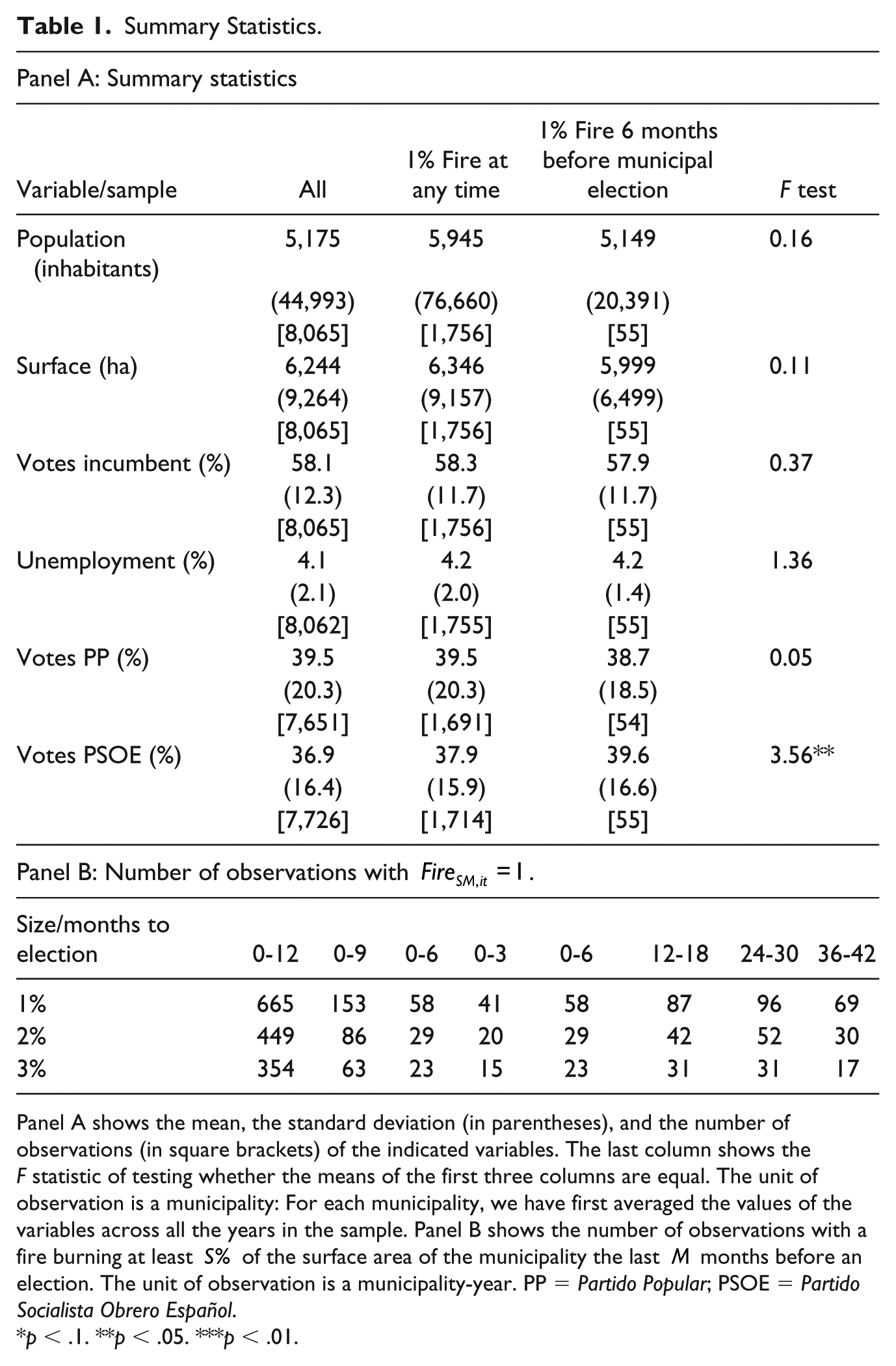
Panel A shows the mean, the standard deviation (in parentheses), and the number of observations (in square brackets) of the indicated variables. The last column shows the F statistic of testing whether the means of the first three columns are equal. The unit of observation is a municipality: For each municipality, we have first averaged the values of the variables across all the years in the sample. Panel B shows the number of observations with a fire burning at least
p < .1. **p < .05. ***p < .01.
In Panel B of Table 1, we show the number of observations with
Results
Main Results
We begin by studying the effect of fires on municipal elections. We estimate Equation 1 for different combinations of burnt surface area (
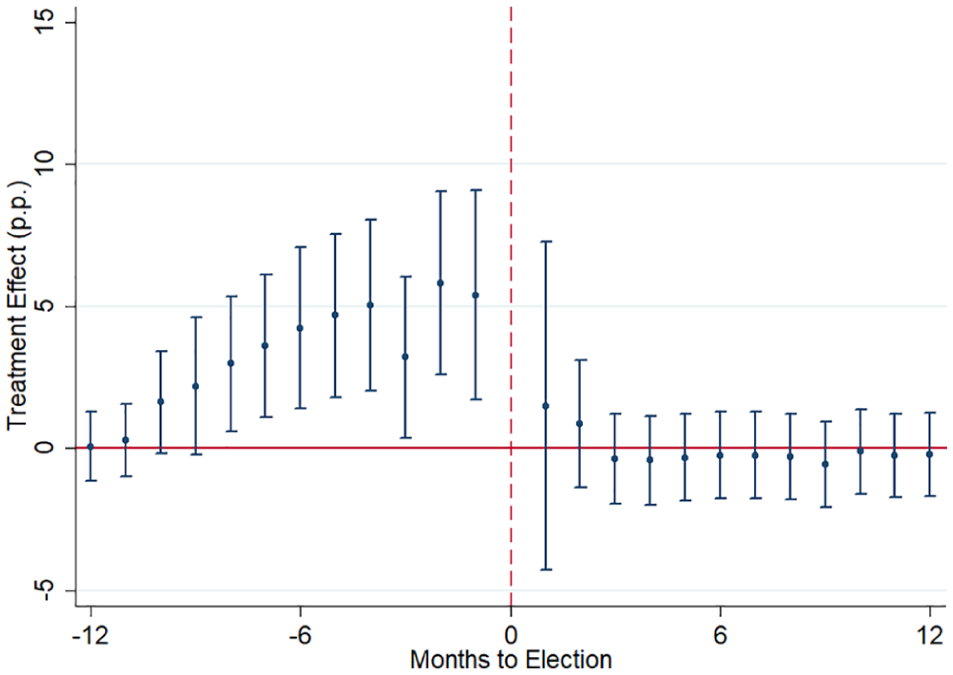
Effect of a fire on the incumbent’s vote share, by time to election day, fires of size
Effect of a Fire on the Incumbent’s Vote Share (Municipal Elections).
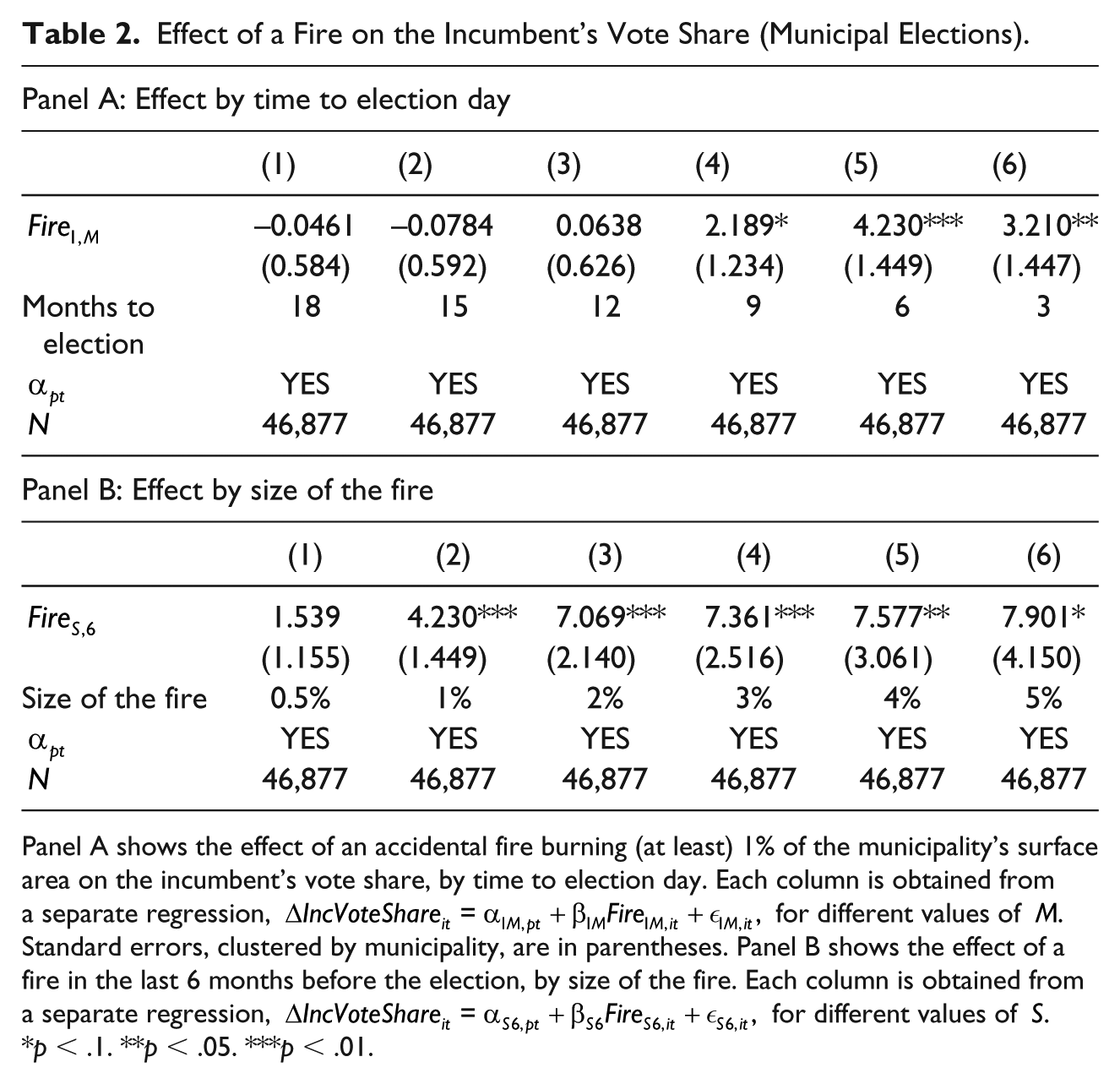
Panel A shows the effect of an accidental fire burning (at least) 1% of the municipality’s surface area on the incumbent’s vote share, by time to election day. Each column is obtained from a separate regression,
p < .1. **p < .05. ***p < .01.
Figure 2 does the opposite: It fixes the time to election day at M = months and considers different sizes of fires in the x axis. When smaller fires are included, there is little or no effect on the votes for the incumbent. The effect increases steadily up to fires burning at least 1.5% and then flattens out at an effect of approximately 8 p.p. Panel B of Table 1 displays the corresponding coefficients. The effects are significant at the 1% level for fires burning from at least 1% to at least 3% of the surface area. Significance decreases from that point due to larger standard errors: Fires burning at least 5% of the surface area are significant at the 10% level.
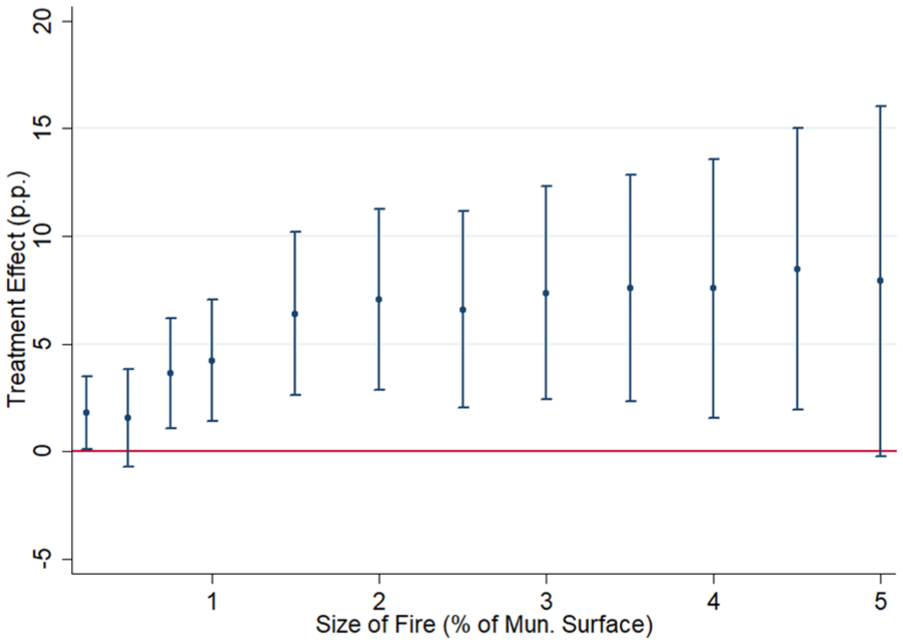
Effect of a fire on the incumbent’s vote share, by size of the fire (municipal elections).
Hence, our findings point to an effect of up to 8 p.p. (for larger fires). The magnitude of this effect is on the higher range of previous work on irrelevant events. For comparison, the effect of home wins of football teams is around 1.6 p.p. (Healy & Malhotra, 2010). Our magnitudes are in line, however, with those by Bechtel and Hainmueller (2011), who find that the 2002 Elbe flood increased vote shares for the incumbent party by 7 p.p. in affected areas.
Supplemental Table A1 looks more closely at the effects of small fires, those ranging from 0.01% to 0.25% of the municipality surface area. The results indicate that smaller fires have a weaker effect, which converges to zero as the size of the fire goes to zero. Hence, it seems that it is sizable shocks that matter.
We next study the effects of wildfires on regional and national elections, following the same empirical strategy. The results are displayed in Tables 3 and 4. Although the point estimates are positive, they are smaller than the ones for municipal elections, and not statistically significant. Hence, the evidence indicates that fires do not have an effect on regional or national elections.
Effect on Regional Elections.
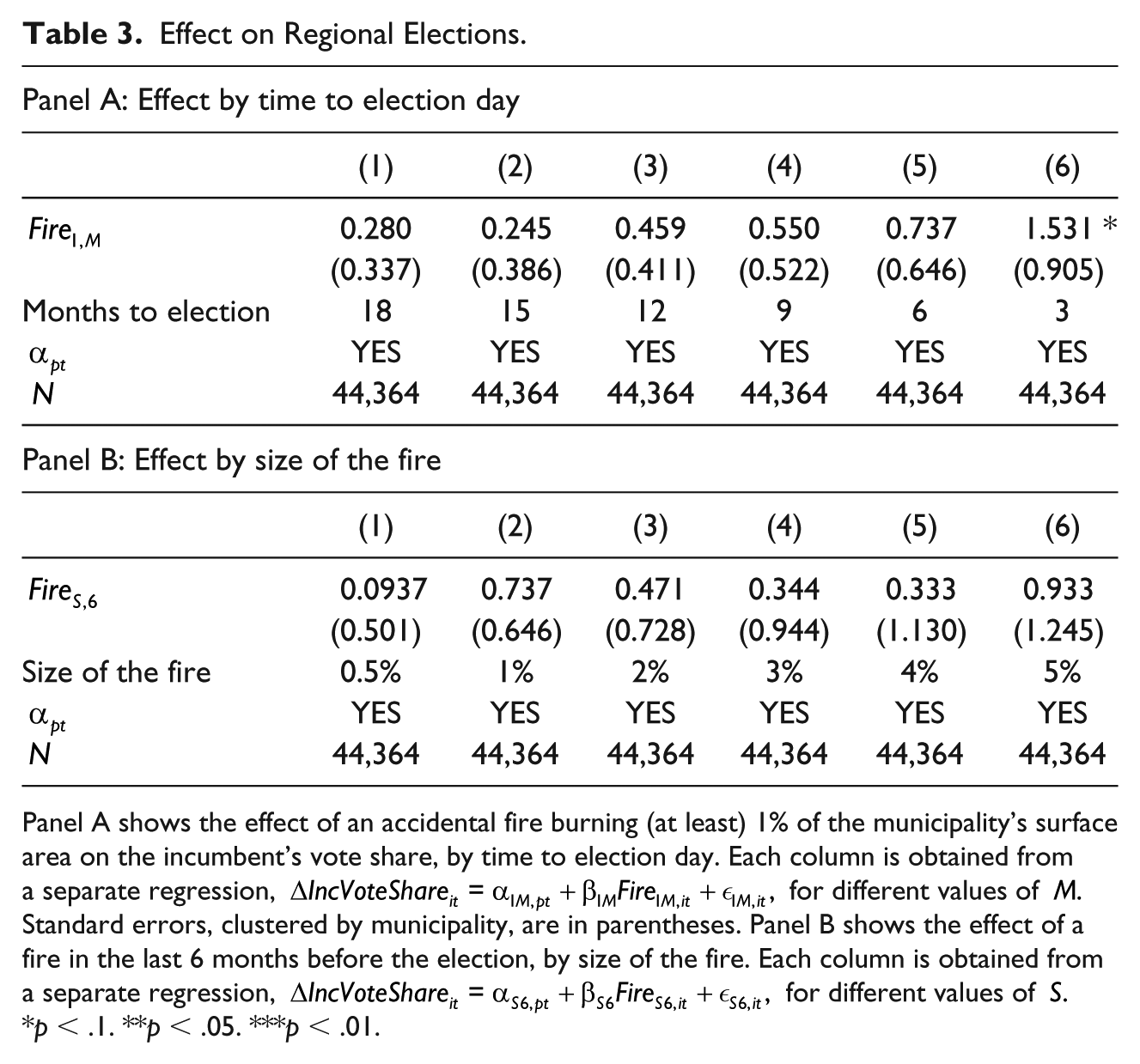
Panel A shows the effect of an accidental fire burning (at least) 1% of the municipality’s surface area on the incumbent’s vote share, by time to election day. Each column is obtained from a separate regression,
p < .1. **p < .05. ***p < .01.
Effect on National Elections.
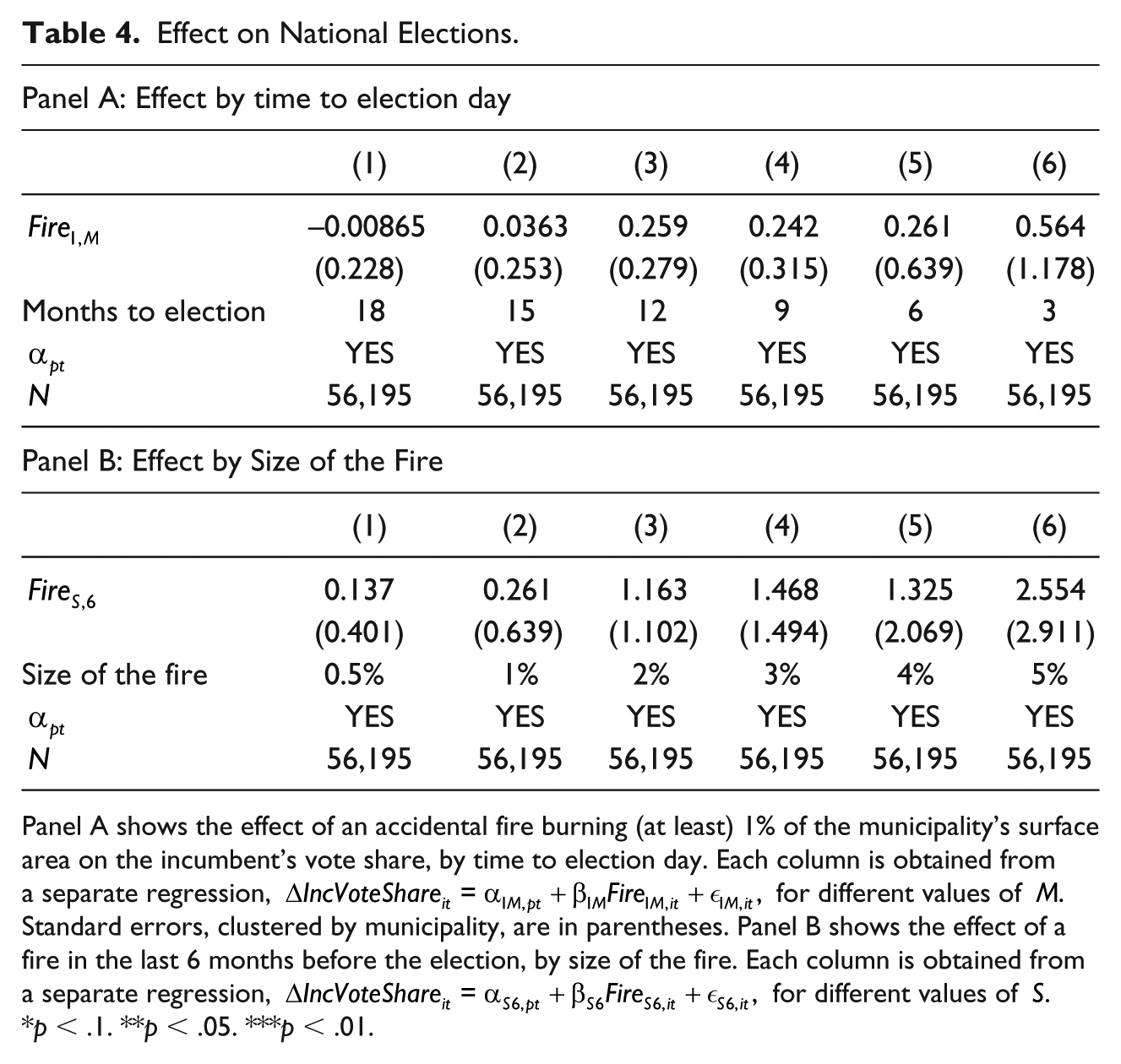
Panel A shows the effect of an accidental fire burning (at least) 1% of the municipality’s surface area on the incumbent’s vote share, by time to election day. Each column is obtained from a separate regression,
p < .1. **p < .05. ***p < .01.
Robustness
We assess the robustness of the finding that fires close to the next municipal election increase the incumbent’s vote share. We study whether the results are robust to other specifications with different fixed effects and controls, perform placebo tests to examine the exogeneity of accidental fires, consider the alternative specification given by Equation 2, discuss the possibility of false positives given multiple hypothesis testing, and perform permutation tests. These robustness checks are presented in Supplemental Appendix A. The results are reassuring about the validity of the empirical approach.
Discussion of Possible Mechanisms
In this section, we follow up on the theoretical predictions laid out in section “Theoretical Predictions” and discuss the possible mechanisms behind the findings of the article.
Blind Retrospection
This theory predicts that incumbents will lose votes after natural disasters. Given that we find that fires increase the incumbent’s vote share, it is unlikely to explain our findings.
Rational Updating
A theory of rational updating may account for a positive effect of fires on the incumbent’s vote share. In particular, our results are consistent with this theory if voters systematically underestimate the competence of governments. If the response to the disaster reveals the true quality of the incumbent, which turns out to be, on average, above voters’ expectations, this will result in an increase in the incumbent’s vote share. Alternatively, our findings can be explained by the model by Ashworth et al. (2017)—which does not require systematic bias in the expectations of voters—under the assumptions that the incumbent is ahead of the challenger and that fires mute the quality of the incumbent. 38
As discussed in section “Theoretical Predictions,” fires may arguably allow voters to learn about the quality of all levels of government: municipal, regional, and national. Hence, for this theory to account for our findings, it must be that voters underestimate the quality of municipal incumbents but not of regional or national incumbents. 39
Finally, if voters are rational, the impact of fires should not depend on time to the next election, but we find that it does. Still, as discussed in section “Theoretical Predictions,” several factors may make voters react more to fires closer to the next election: Governments may respond better, on average, when the fire is close to the next election, voters may be myopic, new issues may have appeared on the agenda after fires happening early in the term, or voters may use an “end-heuristic.”
In sum, rational updating may be an explanation to our empirical findings, but only under some specific assumptions, namely, that voters underestimate the quality of municipal but not regional or national governments, and that there is some additional factor that makes voters react more to fires at the end of the term.
Voter Gratitude
According to this theory, fires can increase the incumbent’s vote share by creating a voter gratitude response. We next explore several possible factors that could trigger such response.
Aid
There are three reasons why gratitude for aid provision is not the most natural explanations to our findings. 40 First, aid is not common: Only 7.5% of municipalities that suffered an accidental wildfire received aid. Such a small fraction is unlikely to generate a sizable effect on incumbents’ vote shares.
Second, the timing of the effects is not entirely consistent with this explanation. Aid takes considerable time to arrive: On average, it is approved 200 days after a fire. This implies that many of the fires that are close to the next election (i.e., the ones that benefit the incumbent) have not had any aid approved by the election day. Given that, as mentioned in the previous point, aid is not common, there cannot be a systematic expectation that, even if aid has not been approved by election day, it will be approved after the election. Furthermore, we test whether municipalities that have a fire in the last year of the term receive more aid than those having a fire earlier in the term. The results (see Supplemental Table A6) show that, if anything, municipalities with a fire at the end of the term receive less aid.
Third, given that aid is delivered by the regional or national government, it is natural to expect that voter gratitude should lead to an increase in the incumbent’s vote share in regional or national elections, but not in municipal elections. However, we find the opposite. 41
Transfers
In Spain, transfers from upper-level governments account for almost 50% of a municipality’s revenues. They include transfers to finance current and capital (infrastructure) expenditures—see Sanz (2019) for a description of public finances in Spanish municipalities. If, after a fire, upper-level governments decide to increase transfers to the affected municipality, this could benefit the local economy and trigger a voter gratitude response.
To study this possibility, we use data on public budgets from the Ministry of Finance. We estimate the following equation:

for different values of
Land rezoning
A third possibility is gratitude for land rezoning. Of course, this mechanism assumes that land rezoning is in fact performed after fires. However, we do not expect this to happen given that, since 2006, it is prohibited by national law to rezone land during 30 years after a fire. Before 2006, regulation was at the regional level, and most of it prohibited it as well. Still, it is possible that there was some noncompliance with the law, or that some regional laws did not prohibit rezoning until 2006. In Supplemental Appendix B, we test this possibility using data from the Spanish Land Registry Agency and find no evidence that municipal governments systematically rezone the land status after fires.
The economic effect of fires
In the last three subsections, we studied the three most obvious possible drivers of voter gratitude: aid, government transfers, and land rezoning. Still, it cannot be ruled out that there is some other factor that makes fires beneficial to voters, triggering a response of gratitude. As a final test to assess this possibility, we estimate the effect of fires on the economy of the affected municipality. We estimate

for different values of
Rally Effect
Arguably, this mechanism is consistent with the available evidence. First, it can explain why the effect of fires on the incumbent’s vote share is positive. Second, it can explain why fires have an effect on municipal but not on regional or national elections, as it is the head of the local government who is the leader of the municipality and exerts the symbolic power after natural disasters, as discussed in section “Theoretical Predictions.” And third, given the temporary nature of rallies, this mechanism can explain the differential effect of fires by time relative to the next election day. Moreover, the timing of effects that we find in our article, with effects lasting up to 9 months, is in line with the duration of conflict-related rally effects.
Partisan Effect
To study this possible mechanism, we perform two tests. First, we analyze how the main parties fare after a fire, independently of whether they are the incumbent or not. We focus on the two main parties in Spain, the PP and the PSOE. We run Equation 1, letting the outcome variable be the change in the PP or the PSOE vote shares, instead of the incumbent party’s vote share. The results (Panel A of Supplemental Table A10) show that neither party gains or loses votes, on average, after a fire. Second, we test whether the effect of a fire on the incumbent’s vote share differs by party. 42 The results (Panel B) indicate that both PP and PSOE incumbents gain votes after a fire. Hence, these two tests strongly suggest that the effect is not driven by fires affecting the partisan preferences of voters.
Preferences Over Alignment
To assess this possibility, we perform two tests that are parallel to the ones we carried out in the previous point. First, we estimate the effect of fires on the vote share of the party that is aligned with the regional (or national) government. The results (Panel A of Supplemental Table A11) show that aligned parties do not systematically gain (or lose) votes after a fire. Second, we test whether the effect of a fire on the incumbent’s vote share differs for aligned and nonaligned parties. The results (Panel B) show that both aligned and nonaligned incumbents increase their vote shares similarly after a fire. These findings go against the hypothesis that the effect is driven by the preferences of voters to align their municipal governments with the other levels of government.
Conclusion
Using a data set with detailed information on wildfires in Spain, we have shown that fires in the last 9 months before a municipal election increase the incumbent party’s vote share by up to 8 p.p. Fires have no effect on regional or national elections. We have discussed the possible mechanisms behind these results and suggested that evidence is consistent with an updating mechanism under certain assumptions and with a rally effect.
Our results are somewhat at odds with evidence from other settings, which have mostly found that natural disasters decrease the incumbent’s vote share or have a neutral effect. We can think of two explanations for the different findings: that the positive effect is found for fires close to the next election, and that it is found for municipal elections. Note that our results for the fires that happen at mid-term, or for the effect on regional or national elections, are zero, in line with previous work that found neutral effects.
Overall, our evidence suggests that it is important that future empirical work considers the heterogeneity of voter response in two fronts: the timing of the shock within the electoral cycle, and the type of election. Similarly, we believe that an interesting avenue for future research is to integrate rally effects into formal models of voter behavior.
Supplemental Material
ramos_sanz – Supplemental material for Backing the Incumbent in Difficult Times: The Electoral Impact of Wildfires
Supplemental material, ramos_sanz for Backing the Incumbent in Difficult Times: The Electoral Impact of Wildfires by Roberto Ramos and Carlos Sanz in Comparative Political Studies
Supplemental Material
ramos_sanz_aid – Supplemental material for Backing the Incumbent in Difficult Times: The Electoral Impact of Wildfires
Supplemental material, ramos_sanz_aid for Backing the Incumbent in Difficult Times: The Electoral Impact of Wildfires by Roberto Ramos and Carlos Sanz in Comparative Political Studies
Supplemental Material
ramos_sanz_budgets – Supplemental material for Backing the Incumbent in Difficult Times: The Electoral Impact of Wildfires
Supplemental material, ramos_sanz_budgets for Backing the Incumbent in Difficult Times: The Electoral Impact of Wildfires by Roberto Ramos and Carlos Sanz in Comparative Political Studies
Supplemental Material
ramos_sanz_land – Supplemental material for Backing the Incumbent in Difficult Times: The Electoral Impact of Wildfires
Supplemental material, ramos_sanz_land for Backing the Incumbent in Difficult Times: The Electoral Impact of Wildfires by Roberto Ramos and Carlos Sanz in Comparative Political Studies
Supplemental Material
ramos_sanz_multiple_1000 – Supplemental material for Backing the Incumbent in Difficult Times: The Electoral Impact of Wildfires
Supplemental material, ramos_sanz_multiple_1000 for Backing the Incumbent in Difficult Times: The Electoral Impact of Wildfires by Roberto Ramos and Carlos Sanz in Comparative Political Studies
Supplemental Material
ramos_sanz_mun – Supplemental material for Backing the Incumbent in Difficult Times: The Electoral Impact of Wildfires
Supplemental material, ramos_sanz_mun for Backing the Incumbent in Difficult Times: The Electoral Impact of Wildfires by Roberto Ramos and Carlos Sanz in Comparative Political Studies
Supplemental Material
ramos_sanz_nat – Supplemental material for Backing the Incumbent in Difficult Times: The Electoral Impact of Wildfires
Supplemental material, ramos_sanz_nat for Backing the Incumbent in Difficult Times: The Electoral Impact of Wildfires by Roberto Ramos and Carlos Sanz in Comparative Political Studies
Supplemental Material
ramos_sanz_Points – Supplemental material for Backing the Incumbent in Difficult Times: The Electoral Impact of Wildfires
Supplemental material, ramos_sanz_Points for Backing the Incumbent in Difficult Times: The Electoral Impact of Wildfires by Roberto Ramos and Carlos Sanz in Comparative Political Studies
Supplemental Material
ramos_sanz_Points_Canary_Islands – Supplemental material for Backing the Incumbent in Difficult Times: The Electoral Impact of Wildfires
Supplemental material, ramos_sanz_Points_Canary_Islands for Backing the Incumbent in Difficult Times: The Electoral Impact of Wildfires by Roberto Ramos and Carlos Sanz in Comparative Political Studies
Supplemental Material
ramos_sanz_pop – Supplemental material for Backing the Incumbent in Difficult Times: The Electoral Impact of Wildfires
Supplemental material, ramos_sanz_pop for Backing the Incumbent in Difficult Times: The Electoral Impact of Wildfires by Roberto Ramos and Carlos Sanz in Comparative Political Studies
Supplemental Material
ramos_sanz_provinces – Supplemental material for Backing the Incumbent in Difficult Times: The Electoral Impact of Wildfires
Supplemental material, ramos_sanz_provinces for Backing the Incumbent in Difficult Times: The Electoral Impact of Wildfires by Roberto Ramos and Carlos Sanz in Comparative Political Studies
Supplemental Material
ramos_sanz_provincescoord – Supplemental material for Backing the Incumbent in Difficult Times: The Electoral Impact of Wildfires
Supplemental material, ramos_sanz_provincescoord for Backing the Incumbent in Difficult Times: The Electoral Impact of Wildfires by Roberto Ramos and Carlos Sanz in Comparative Political Studies
Supplemental Material
ramos_sanz_provincescoord_No_Islands – Supplemental material for Backing the Incumbent in Difficult Times: The Electoral Impact of Wildfires
Supplemental material, ramos_sanz_provincescoord_No_Islands for Backing the Incumbent in Difficult Times: The Electoral Impact of Wildfires by Roberto Ramos and Carlos Sanz in Comparative Political Studies
Supplemental Material
ramos_sanz_provinces_Canary_Islands – Supplemental material for Backing the Incumbent in Difficult Times: The Electoral Impact of Wildfires
Supplemental material, ramos_sanz_provinces_Canary_Islands for Backing the Incumbent in Difficult Times: The Electoral Impact of Wildfires by Roberto Ramos and Carlos Sanz in Comparative Political Studies
Supplemental Material
ramos_sanz_reg – Supplemental material for Backing the Incumbent in Difficult Times: The Electoral Impact of Wildfires
Supplemental material, ramos_sanz_reg for Backing the Incumbent in Difficult Times: The Electoral Impact of Wildfires by Roberto Ramos and Carlos Sanz in Comparative Political Studies
Footnotes
Declaration of Conflicting Interests
The authors declared no potential conflicts of interest with respect to the research, authorship, and/or publication of this article.
Funding
The authors received no financial support for the research, authorship, and/or publication of this article.

Notes
Author Biographies
References
Supplementary Material
Please find the following supplemental material available below.
For Open Access articles published under a Creative Commons License, all supplemental material carries the same license as the article it is associated with.
For non-Open Access articles published, all supplemental material carries a non-exclusive license, and permission requests for re-use of supplemental material or any part of supplemental material shall be sent directly to the copyright owner as specified in the copyright notice associated with the article.
