



Abstract
This paper examines the political attributes of emigrants and how their departure affects the electoral outcomes in their home countries. I argue that emigrants are different from those who remain in their political preferences as well as economic attributes, such that large-scale emigration changes the distribution of voters in sending countries. Emigration can also directly affect the policy preferences of individuals who stay in their home countries. I test these arguments in seven Central and Eastern European countries, using individual-level surveys and region-level data on emigration and elections. To address potential endogeneity issues, I use instrumental variable analysis, leveraging the surge of Polish emigration to the United Kingdom after the EU enlargement. I find that emigrants from Central and Eastern Europe tend to be younger, highly educated, and politically more progressive and that the vote shares of far-right parties are larger in regions with higher emigration rates. Also, I find that exposure to large-scale emigration affects the vote choices of individuals who remain.
Introduction
While Western Europe and the United States are receiving a large influx of immigrants, many other countries and regions are experiencing net outflows of their population. Over the last two decades, Central and Eastern Europe have lost nearly 20 million people as a result of emigration, which is approximately 5.5 percent of their population (Atoyan et al., 2016). When emigration occurs on such a large scale, what are the electoral consequences in sending countries?
In this paper, I analyze the economic and political attributes of emigrants from Central and Eastern European countries and how their departure affects the electoral outcomes in their home countries. These two inquiries are closely connected. Depending on the characteristics of emigrants, their exit can have different effects on the remaining population. When emigrants are different from those who remain in their political preferences, emigration can change the distribution of voters in sending countries. Also, large-scale emigration can directly affect the policy preferences of individuals who remain behind. I argue that emigrants from Central and Eastern Europe are disproportionately more politically progressive, making the remaining voters more conservative and predisposed to supporting far-right parties. Thus, regions with a higher emigration rate will have greater support for far-right parties.
Far-right parties in Central and Eastern Europe share some similarities with far-right parties in Western Europe. Nativist populism is central to far-right parties in both regions (Minkenberg, 2002; Mudde, 2007; Golder, 2016). Like their counterparts in Western Europe, far-right parties in Central and Eastern Europe mobilize their voters against ethnic minorities and immigrants especially with non-EU backgrounds (Bustikova, 2018). They take extremely conservative positions in social and cultural issues, such as the rights of sexual minorities and ethnic and cultural minorities. 1
These characteristics correspond to the profiles of individuals who support far-right parties in Central and Eastern Europe. Voters with culturally more conservative and anti-immigrant attitudes are likely to support far-right parties (Allen, 2017). Thus, the emigration of socially and politically progressive voters, who would be less likely to support far-right parties if they stayed, will benefit the far-right parties in their home countries.
I test these expectations in seven Central and Eastern European countries that joined the EU in the 2000s: the Czech Republic, Poland, Slovakia, Slovenia, Latvia, Estonia, and Romania. 2 They provide useful cases for exploring the effects of emigration in sending countries. Previous studies show that both sending and receiving countries can design their migration policies and control migration volumes and flows based on their political interests (Shin, 2017; Miller & Peters, 2018). EU enlargement has removed such institutional constraints on labor mobility within the EU. This is an institutional shock at the individual level that lowers the cost of migration significantly. As a result, Central and Eastern European countries have been experiencing large-scale voluntary emigration (World Bank, 2010). Exploiting this institutional change, this paper assesses the electoral consequences of emigration based on the characteristics of emigrants.
To explore the emigrants’ characteristics, I use individual-level survey data from the 2010 European Bank for Reconstruction and Development (EBRD) Life in Transition Survey (LiTs) and the European Social Survey (ESS). Then, I estimate the total effects of emigration on electoral outcomes at the sub-national level, using regional emigration and electoral data from seven Central and Eastern European countries from 2004 to 2018. To address the potential endogeneity issues, I use instrumental variable analysis, leveraging the surge of Polish emigrants to the United Kingdom after the EU enlargement. Finally, to investigate the effect of emigration on individual policy preferences and vote choices, I use three waves of individual-level panel survey data in Poland (POLPAN). The results of the analyses provide supportive evidence for the argument of this manuscript. I find that (1) migrants from Central and Eastern European countries tend to be younger, more educated, and politically and socially more progressive, (2) regions with a large volume of emigration have higher levels of support for far-right parties, and that (3) regional emigration can affect individuals’ policy preferences and voting behavior. 3
These findings help us to improve our understanding of the implications of international migration from the perspective of sending countries (e.g., Kapur, 2014). This paper also speaks to a growing literature on geographical sorting, which focuses on the political division between rural and urban areas in domestic politics (Rodden, 2019; Maxwell, 2019). The findings of this paper suggest that migration can facilitate geographical sorting based on individuals’ political preferences even across borders.
Finally, this paper provides a new angle to examine the growth of far-right parties in Central and Eastern Europe. Whereas far-right parties in Western Europe have gathered burgeoning scholarly attention (Kitschelt & McGann, 1997; Golder, 2016; Norris & Inglehart, 2019; Milner, 2021), their counterparts in Central and Eastern Europe have received relatively less attention. The emigration of progressive voters is not the only explanation for the recent growth of far-right parties in this region (Mudde, 2005; Bustikova, 2014; Allen, 2017). However, the exit of voters who are least likely to support far-right populism certainly makes the distribution of voters more favorable for far-right parties.
Who Emigrates? Characteristics of Emigrants
In this section, I show that emigrants have different political preferences from individuals who stay. Using two different types of survey data, I compare the economic and political attributes of emigrants and stayers that affect their political support for far-right parties.
The canonical theories of migration suggest that people migrate to maximize their economic gains (Borjas, 1987, 1989). According to these theories, age and education are some of the strongest predictors of individuals’ economic gains from migration. Age is an important determinant of the costs of migration for individuals (Mayda, 2010), and the education (or skill) level of workers is a strong predictor of their expected income in destination countries. Young and highly educated workers in developing countries have more economic incentive to migrate to developed economies due to a wide wage gap in high-skilled jobs and lower costs of migration (Hunt, 2006; Mayda, 2010; Grogger & Hanson, 2011). Many studies find the fast growth in migration rates of young and high-skilled workers from developing or middle-income countries to developed economies (e.g., Docquier & Rapoport, 2012). 4
Although the main drivers of emigration are economic factors, emigrants also differ from those who stay in their political attitudes. Individuals’ economic attributes are often strongly associated with their political preferences. Education and age are strong predictors of individuals’ political preferences as well. Young and highly educated people are likely to be more pro-immigrant, and cosmopolitan (Hainmueller & Hiscox, 2007), which are salient cleavages that affect individuals’ political support, especially for far-right parties (Rydgren, 2008; Golder, 2016; Norris & Inglehart, 2019). 5 This suggests that the emigration of young and highly educated voters results in the exit of more cosmopolitan and pro-immigrant voters, who would be less likely to support far-right parties if they stayed.
Migrants also consider the political environments of the destination countries when making migration decisions (Fitzgerald et al., 2014; Holland & Peters, 2020). Particularly, the internal migration literature has demonstrated that individuals choose locations where political views are similar to their own (Rodden, 2019; Maxwell, 2019). Individuals whose preferences are strongly aligned with their home countries are more likely to stay while those who are open to different cultures are more likely to leave. Given that attachment to their home and attitudes toward different cultures are some of the strongest predictors of far-right support (Fitzgerald, 2018; Norris & Inglehart, 2019), emigrants are drawn more from people who would be less likely to vote for far-right parties if they stayed.
To examine the characteristics of emigrants, I use the European Bank for Reconstruction and Development (EBRD) 2010 Life in Transition survey (LiTs) and European Social Survey (ESS) data. LiTs allows us to explore the attributes of potential emigrants by asking their willingness to emigrate. One limitation with LiTs is that it does not capture if respondents actually emigrate. To complement this, I use the ESS, which captures a sample of emigrants from Central and Eastern Europe who currently live in Western Europe as well as a sample of people who remain in Central and Eastern Europe. 6 The limitation is that covariates of emigrants in ESS are measured after the respondents emigrated and therefore might have been affected by their migration experiences (post-treatment). Ideally, we would have longitudinal data that captures both pre- and post-emigration attitudes. Unfortunately, there is no data available that tracks international migrants across borders. My approach aims to address this issue by showing consistent patterns across pre- and post-emigration.
Using both LiTs and ESS, I compare the distribution of emigrants and individuals who remain across several dimensions. I compare their age and the level of education, which affect their political attitudes as well as migration decisions. 7 Then, I compare their attitudes toward immigrants, which is a strong predictor of support for far-right parties (Norris, 2005; Norris & Inglehart, 2019; Golder, 2016; Allen, 2017).
Figure 1 presents the different distributions of (potential) emigrants and people who remain. The red and gray color each represents (potential) emigrants and stayers. The first and second row of figures is based on LiTs, and ESS, respectively. The first column shows that emigrants are younger than individuals who stay across both datasets. While the bulk of emigrants are in their twenties to thirties, stayers are distributed evenly through their thirties to seventies. The second column shows that emigrants are relatively more educated. LiTs shows that emigrants have a higher proportion in tertiary education or higher, while ESS shows that the share of individuals with a higher degree than a tertiary education is larger in the emigrant sample. The third column shows how emigrants have different attitudes toward immigrants. In both datasets, emigrants are more pro-immigrant than individuals who stayed. 8
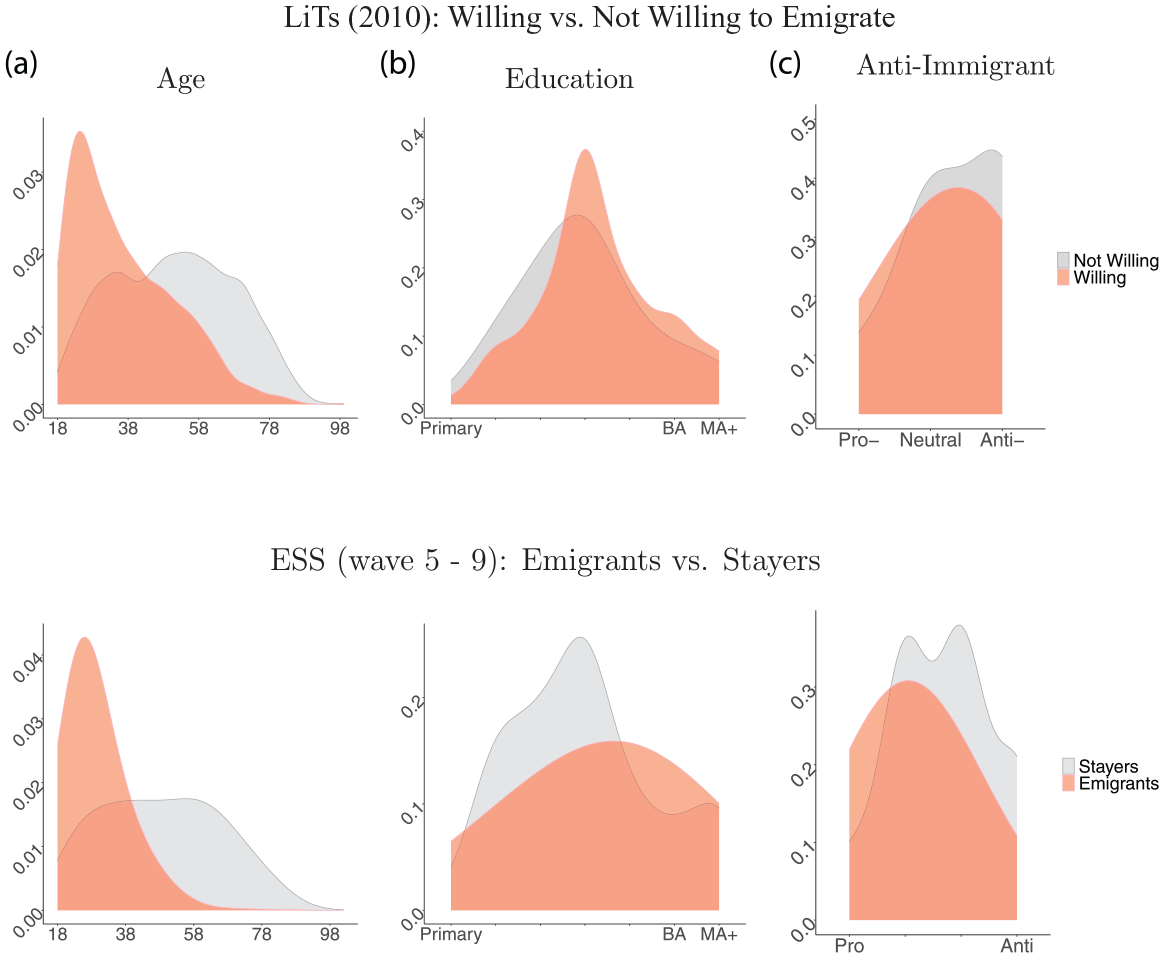
(Potential) Emigrant versus Stayers.
In sum, Figure 1 suggests that emigrants are younger, more highly educated, and pro-immigrant. LiTs and ESS do not directly ask (potential) emigrants’ vote choice, which prevents us from measuring emigrants’ support for far-right parties directly. 9 However, previous studies affirm that these attributes are a set of strong predictors of far-right support (e.g., Allen, 2017; Colantone & Stanig, 2018; Norris & Inglehart, 2019).
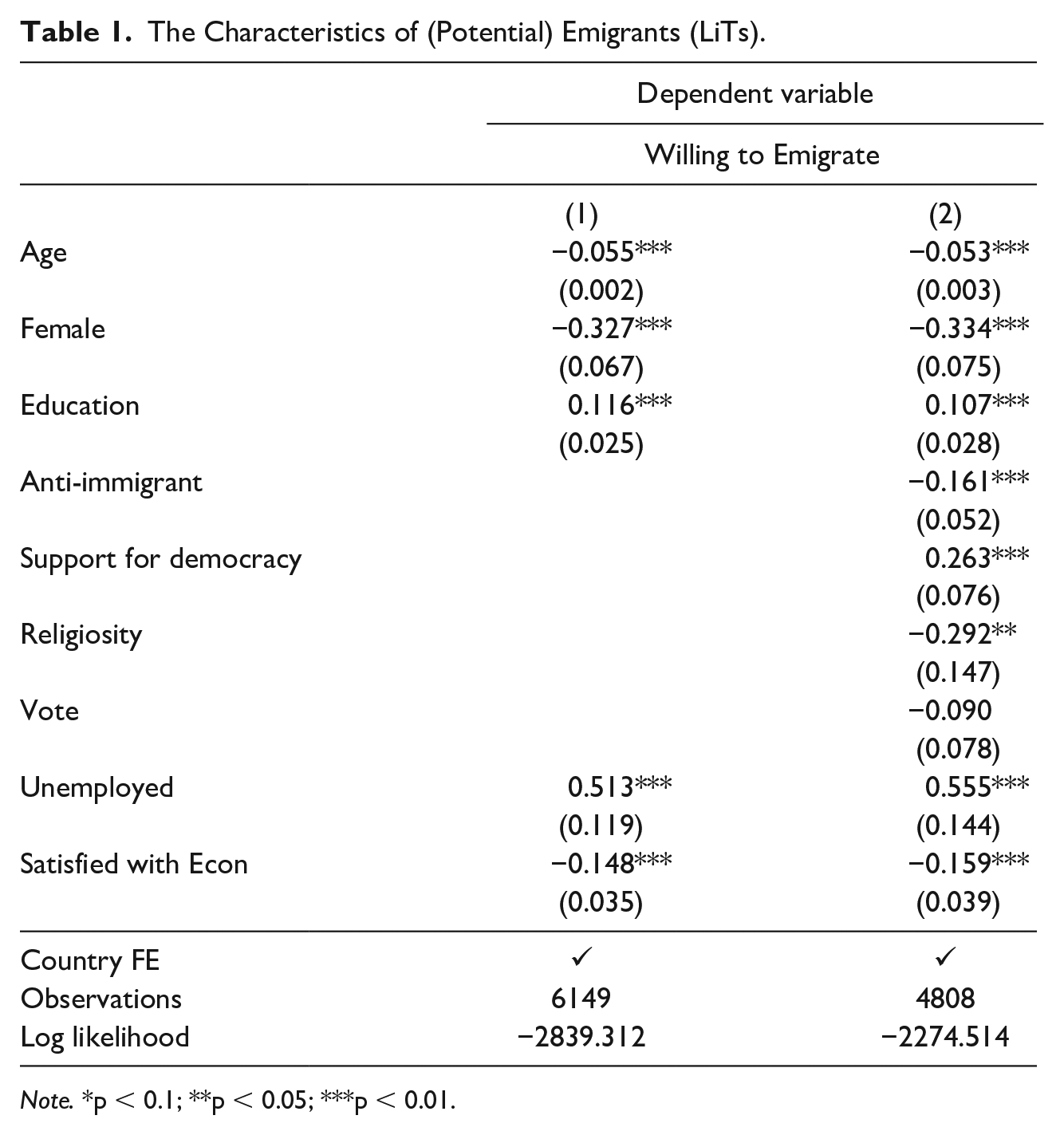
To analyze the profiles of emigrants more systematically, I estimate a logistic model of individuals’ willingness to emigrate on these attributes using the LiTs. The results in Table 1 shows consistent pattern with Figure 1. Both models 1 and 2 show that younger and more educated people are more willing to emigrate. In model 2, I include a vector of variables regarding individuals’ political attitudes. I include individuals’ attitude toward democracy, which remains one of the salient political cleavages in Central and Eastern Europe (Allen, 2017) and if respondents voted in the most recent election to control for whether (potential) emigrants are politically engaged more or less than (potential) stayers. 10 Model 2 shows that younger and more educated people are more willing to emigrate and have more positive views of immigrants and democracy as well.
The Characteristics of (Potential) Emigrants (LiTs).
Note. *p < 0.1; **p < 0.05; ***p < 0.01.
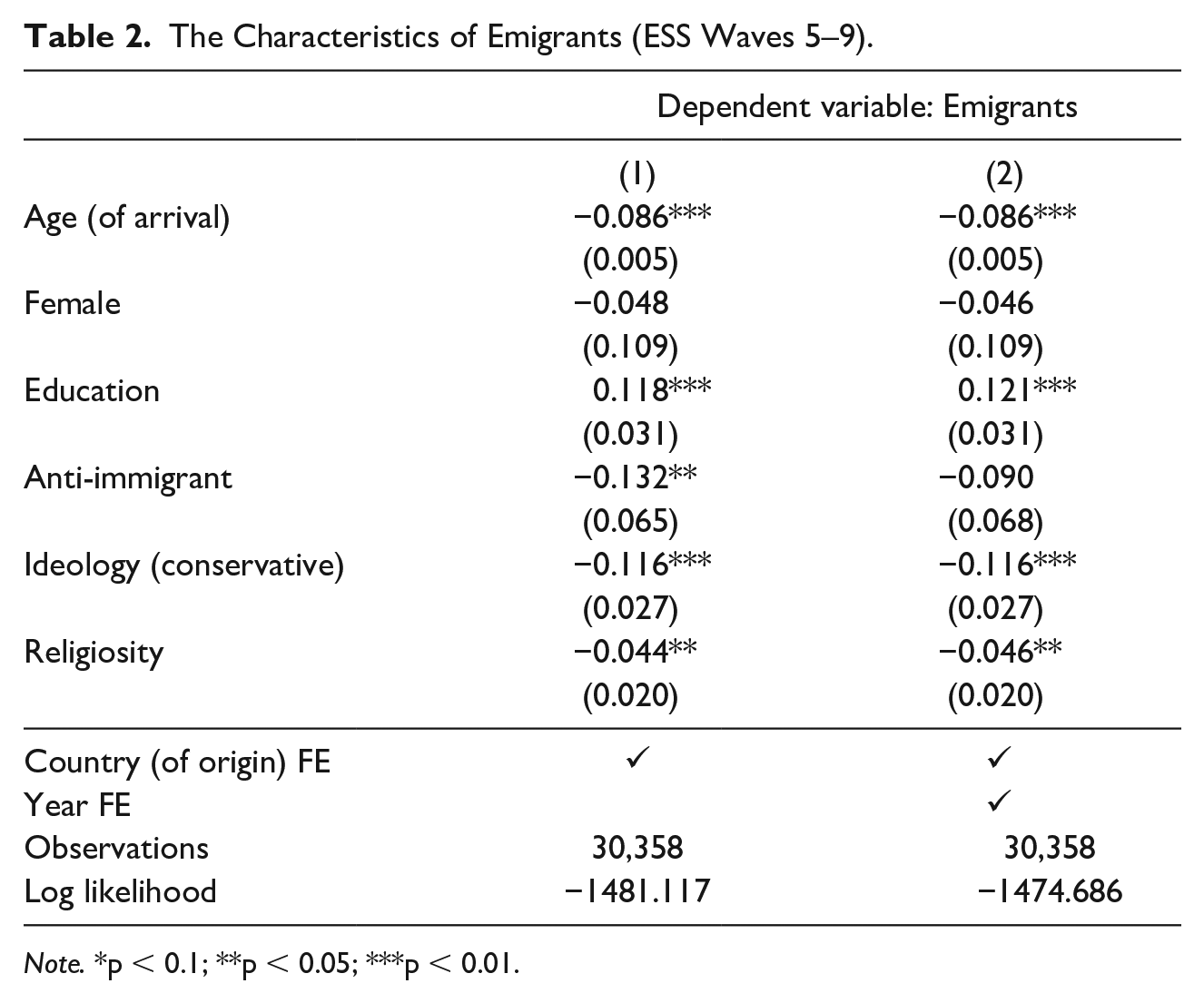
These results are consistent with the results from the ESS data reported in Table 2. 11 As in the previous analyses, I use logistic model with country and year fixed effect. The findings in Table 2 confirm that emigrants are likely to be younger, and more highly educated. Also, emigrants tend to be ideologically more progressive, and pro-immigrant.
The Characteristics of Emigrants (ESS Waves 5–9).
Note. *p < 0.1; **p < 0.05; ***p < 0.01.
Overall, across different sources of data, I find that emigrants are disproportionately drawn more from younger, more educated, and politically more progressive segments of the population. These findings raise a following question: how does the departure of these emigrants affect the electoral outcomes in sending countries? Would their emigration benefit far-right parties in their home countries?
Emigration and Electoral Outcomes
Emigration and Distribution of Remaining Electorates
I argue that emigration affects the electoral outcomes in their sending countries by changing the composition of the remaining voters. Whereas scholars acknowledge that there are various channels through which emigration affects politics (Kapur, 2014), existing literature on this subject heavily focuses on remittances.
Financial remittances increase the disposable income of the recipients and reduce their economic dependence on the domestic market. This, in turn, affects the recipients’ political attitudes and behavior. When individuals receive financial remittances from abroad, they have fewer economic grievances and are less likely to participate in politics or punish the incumbent for economic downturns (Germano, 2013; Ahmed, 2012; 2017; Tertytchnaya & De Vries, 2018). On the other hand, some studies argue that the financial remittances can make elections more competitive by reducing the recipients’ dependence on the domestic market, and thereby weakening their incentive to maintain clientelist transactions (Lu & Villarreal, 2021). Financial remittances can also have more direct influences on the survival of the political regime by funding the incumbent or the opposition directly (Pfutze, 2012; Escribà-Folch et al., 2018; Bearce & Park, 2019).
Another set of studies focuses more on the role of social or political remittances. Migrants not only transmit money but also transmit new ideas and information they learned or observed in their host countries (Levitt, 1998), which includes political information and norms such as the argument for human rights and democratic values. Many studies show that social or political remittances play important roles in diffusing norms and values to sending countries. When individuals have a family member or close friend who is an emigrant, they likely have politically or socially more aligned views with the host country of the emigrant (Pérez-Armendáriz & Crow, 2010; Barsbai et al., 2017; Karakoc et al., 2017), and this affects their voting behavior as well. For instance, Barsbai et al. (2017) suggest that political information and values transmitted from Western European countries to Moldova by emigrants contribute to the decline of the communist parties.
These studies show some important channels of influence from emigration to sending countries’ politics. However, emigration is not only a source of capital inflows or new ideas but also outflows of political actors. Thus, by looking at the influences through remittances only, we cannot capture the total effects of emigration.
The literature on brain drain looks into the effects of outflows of emigrants from the perspective of human capital loss. A wide gap in income, especially for high-skilled jobs, can draw many highly skilled workers from developing to developed countries. Scholars have been studying outflows of high-skilled laborers, focusing on its economic effects. They view emigrants primarily as economic actors, exploring the economic effects of emigration such as fiscal loss (Desai et al., 2009), economic growth (Kapur & McHale, 2005, 2009), and income distribution (Mishra, 2007).
Recently, some studies look into the political effects of emigration through economic channels. Using the case of Swedish emigration to the United States, Karadja and Prawitz (2019) show that labor shortages, induced by emigration, could empower workers and allow them to demand welfare expansion. Although these findings make valuable contributions to improving our understanding of the effects of emigration, the fact that emigrants are self-selected political actors, as well as economic actors, is still often overlooked in empirical research. 12
Emigration results in not only a loss of labor but also a loss of political actors. Especially when emigrants are disproportionately drawn more from people with certain political ideologies or preferences, their departure will have significant effects on electoral outcomes in sending countries. This argument is also relevant to the “safety valve” argument from the literature on emigration policies in authoritarian regimes (Hirschman, 1970; Miller & Castles, 2009). When politically disaffected people leave, the authoritarian regimes may benefit from their exit due to the decrease in (potential) domestic opposition. Thus, authoritarian governments can use emigration as a safety valve for their regime (e.g., Endoh, 2010; Miller & Peters, 2018). My argument shares a logic similar to this theory in that selective emigration can benefit certain political groups by changing the distribution of the political preferences in sending countries.
As shown in the previous section, emigrants from Central and Eastern Europe tend to be younger, more educated, and politically more progressive than those who stay. In other words, emigrants are drawn more from a segment of people who are less likely to vote for far-right parties if they stayed. Thus, their departure will benefit far-right parties by making the distribution of the electorate more conservative. Of course, the emigration of progressive voters is not the sole explanation for the recent growth of far-right parties in this region. However, it makes the distribution of voters more favorable for far-right parties.
It should be noted that emigration does not necessarily prevent emigrants from voting (Ahmadov & Sasse, 2016). Many countries provide de jure external voting. All the countries in the sample allow de jure external voting as of 2006. 13 However, the presence of de jure external voting system does not guarantee the same de facto chances of voting for migrants. Migration reduces individuals’ propensity to vote by increasing the cost of voting by a significant amount. Emigrants often need to visit polling stations to vote. Yet, there are only a few of them, and they are located only in a very few metropolitan areas, which are hardly accessible to many migrants (Highton, 2000).
Using the data from post-communist countries which include all seven countries in our sample, Kostelka (2017) found that turnouts for external voting are significantly lower than for domestic. While domestic turnout is on average 56.63 % across different countries and elections in Central Eastern European countries, external turnout is, on average, only 9.31 %. In some elections, the external turnout rate is only 1.1 % (Romania, 2008). A notable exception is Slovenia in the 2011 election. While most countries’ external turnout rates are below 10 %, the external turnout rate of Slovenia in 2011 was 27.1 %. Yet, domestic turnout rates (63 %) are still significantly higher than external turnout rates. These low external turnout rates indicate that emigration changes the distribution of the electorate in sending countries despite the presence of de jure external voting system. 14
Emigration and Individual Voting Behavior
The exit of politically progressive voters can affect electoral outcomes not only by changing the composition of voters, but also by directly affecting the policy preferences of people who are left behind. Large-scale emigration induces demographic changes that could have downstream effects on individuals’ voting behavior as well as direct impacts on the distribution of voters. This is another under-explored channel through which emigration affects politics in sending countries.
There are several reasons to believe that emigration influences the policy preference and voting behavior of people who remain behind. First, emigration can raise concerns regarding sustainability of traditional values and local communities among the people who are left behind. Emigration of family members or neighbors leaves psychological distress to those who remain behind. This includes feelings of abandonment and concerns about losing the cultural roots of their communities (Marchetti-Mercer, 2012). As younger and more educated segments of their populations leave, the remaining people may become more worried about the sustainability of their communities and traditional cultures. Given that the attachment to the traditional values and social capital of local communities are some of the strongest predictors of individual support for far-right parties (Fitzgerald, 2018; Bolet, 2021), regional emigration rates could affect the voting behavior of people who remain.
In the same vein, emigration also induces changes in the social networks that migrants leave behind (Marchetti-Mercer, 2012), which could affect the political attitudes of the remaining people. As politically more progressive people leave, the people who remain behind will have fewer chances to interact with more progressive political views, and their networks become more uniform in terms of political opinions. Previous studies in political behavior demonstrate that homogeneous networks lead people to be less tolerant of other political views and to be more radical by reducing their chances to be exposed to oppositional views (Mutz, 2002; Huckfeldt et al., 2004).
In sum, I argue that the emigration of young, highly educated, and politically progressive people benefits far-right parties in sending countries by (1) changing the distribution of electorates in sending countries more favorable to them and (2) directly affecting the policy preferences and vote choices of individuals who are left behind. This leads to the hypothesis that the vote share of far-right parties is greater in regions with higher emigration rates.
Research Design
To test the hypothesis, I start by exploring the relationship between emigration rates and vote share of far-right parties at the sub-national level, using the data on migration and electoral outcomes from seven Central and Eastern European countries.
For the sub-national unit analyses, I use NUTS 3, which is the most disaggregated regional unit that is comparable across EU countries. 15 I use data on emigration and parliamentary election outcomes at the NUTS 3 level, collected from the national statistics offices of each country. 16 To measure the level of regional emigration, I use the number of permanent or long-term migrants who spend longer than a year outside of their country of origin. A good portion of migrants from Central and Eastern Europe are short term or seasonal workers who return to home countries within a few months (e.g., Okólski & Salt, 2014). Whereas short-term migration may potentially affect politics in sending countries through different channels, it is unlikely to change the distribution of electorates since seasonal workers likely vote at their home. Therefore, in this paper, I focus on the long-term and permanent emigrants to estimate the effects of emigration on the electoral outcomes. 17
To code far-right parties, I use the Chapel Hill Expert Survey (CHES) data (Bakker et al., 2015, 2020). CHES provides an indicator for ideological positions of parties in Europe and specifies their party family based on the survey of experts of each country’s politics. 18 Using CHES’ classification for far-right parties, I code far-right parties in the sample. Table 3 reports the list of far-right parties in the sample since EU enlargement. Most of these parties are classified as far-right parties in other datasets (e.g., Comparative Manifesto Data) and previous studies except Law and Justice (PiS) in Poland. Whereas CHES classifies PiS as a far-right party from the early 2000s, some previous studies consider PiS as center-right until the mid-2000s, and instead consider League of Polish Families (LPR) to be a far-right party (e.g., Mudde, 2007; Bustikova, 2014). 19 In the appendix, I replicate the results using this alternative coding that classifying LPR as a far-right party in the mid-2000s. The results are consistent in terms of the direction of the coefficients and their statistical significance. 20
Far-Right Parties in Eastern Europe.

Source. Chapel Hill Expert Survey (2004–2019).
For the analysis, I estimate variants of the following model

where i indexes NUTS 3 regions, and t election years. Far-Right Vote i , t is the vote share of the far-right parties, whereas Emigrationi,t−1 is the emigrants’ proportion of the voters, 1 year lagged.
The term
Findings
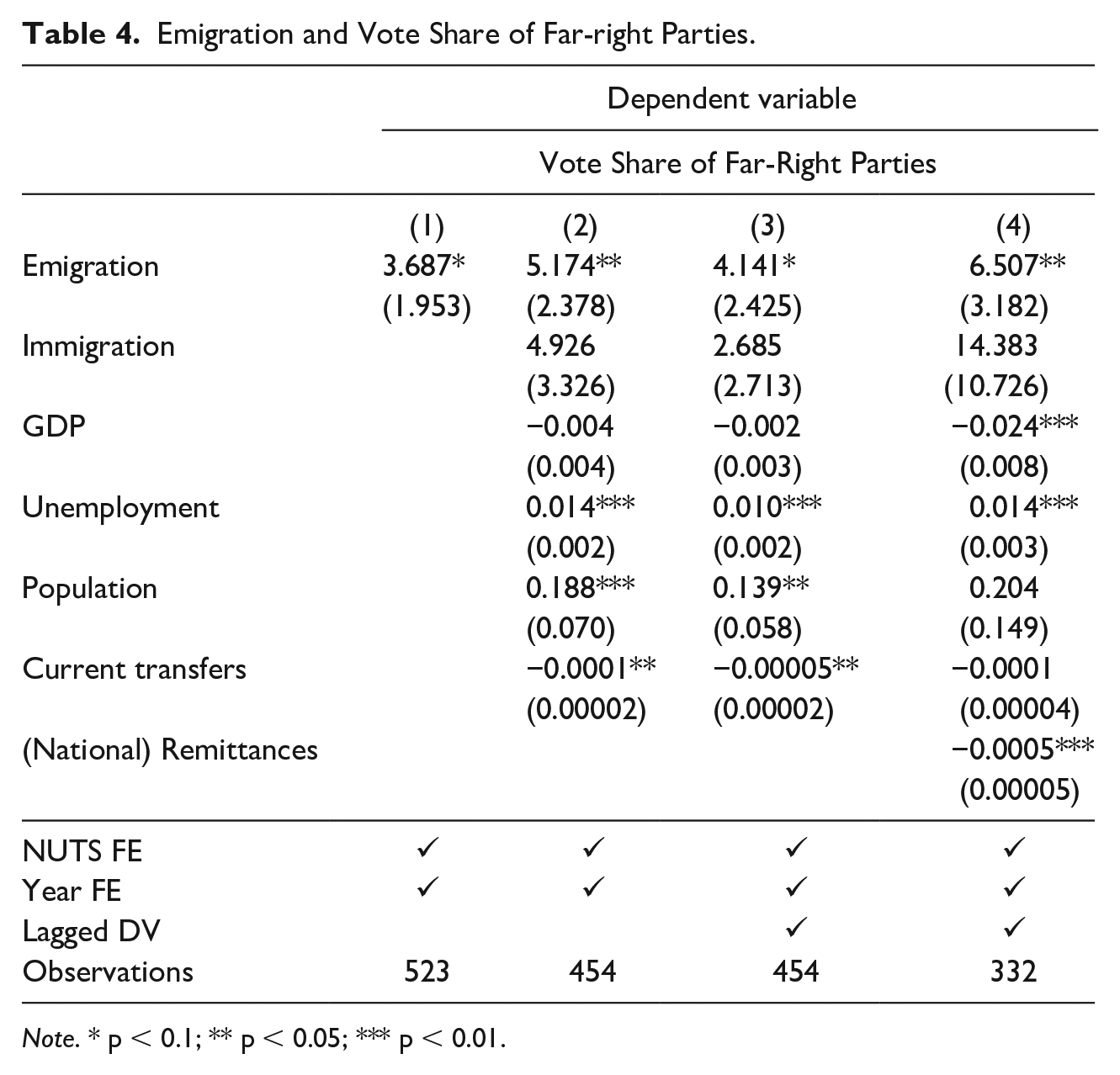
Table 4 reports the regression results of vote share of the far-right parties on the emigration share of the voters at t − 1 for seven countries. All results are based on OLS models with both year and region fixed effects. The coefficients of the explanatory variable are signed as expected. Emigration positively correlates with the votes for the far-right parties. This relationship is statistically significant and consistent with the argument that emigration benefits the growth of far-right parties across different models. The size of the coefficients from some model specifications is larger than one might expect solely from changes to the distribution of the electorates. It suggests that emigration may have effects on electoral outcomes through channels other than changing the distribution of voters, such as affecting the policy preferences of individuals who remain in their home countries. This is further investigated in the Emigration and Individual Voting Behavior section.
Emigration and Vote Share of Far-right Parties.
Note. * p < 0.1; ** p < 0.05; *** p < 0.01.
Whereas model 1 includes only the emigration share along with region and year fixed effects, models 2–4 include different regional confounders. In particular, in models 3 and 4, I include lagged dependent variable in addition to other regional covariates. Although I control for the regional-level economic confounders such as GDP and unemployment rate as well as region fixed effect that account for unobserved factors that are specific for each region, there still can be other sources of endogeneity that may bias our estimates. For instance, politically more progressive people may leave their home country because they expect far-right parties to grow in the future. To control for each region’s propensity to support for far-right parties, I use the vote share of far-right parties in the previous election (lagged dependent variable) as a proxy for the expected growth of far-right parties. Modeling the lagged dependent variable also address potential serial correlation in the dependent variable in the panel data.
Emigration and Electoral Outcomes in Poland
To test the robustness of the results and investigate the potential impacts of emigration on individuals’ vote choices, I conduct a more rigorous empirical test with the case of Poland.
Even when controlling for economic confounders and including lagged dependent variables across different model specifications, there can still be remaining unobservable variables that may affect emigration rates and vote share of far-right parties simultaneously. 22 This endogeneity can bias our estimates.
Also, migration may affect electoral outcomes through channels other than changing the distribution of electorates. Emigration may affect the policy preferences and vote choices of those who remain in their home countries. Large-scale emigration can induce societal and demographic changes that could have downstream effects on individuals’ voting behavior.
Poland provides a useful test case for investigating these possibilities. Historically, Poland has been one of the largest sending countries in Europe, and is a country where emigrants outnumber immigrants (Kaczmarczyk & Okólski, 2008). The volume of immigrants in Poland has been gradually increasing. Yet, the net migration of Poland has remained negative due to their even faster growth in emigration. Since Poland joined the EU in May 2004, their emigration to other EU countries has increased even more. Particularly, migration to the United Kingdom, which allowed Polish workers full access to their labor market immediately after the accession, was the main driver of post-EU growth in emigration rates (Okólski & Salt, 2014). As of 2006, the year in which the annual long-term/permanent emigration rate peaked, 47,000 Polish workers left Poland, which is more than twice the number of emigrants in pre-EU periods.
In addition to its substantive importance, focusing on the case of Poland allows us to adopt a few empirical strategies to address potential endogeneity issues and investigate the direct effects of emigration on individual policy preferences. First, I address endogeneity by using an instrumental variable approach, exploiting the fact that the growth of Polish emigration in the post-EU accession period has been driven mostly by an increase in emigration to a single destination country (United Kingdom). I leverage the exogeneity of economic conditions in the United Kingdom to construct an instrument.
Second, to identify the effects of emigration on policy preferences of individuals who remain, I use a panel survey of a nationally representative sample of Polish citizens between 2008 and 2013, the Poland Panel Survey (POLPAN). This panel survey data allows us to investigate the impacts of regional-level emigration on the remaining individuals’ political attitudes.
Endogeneity
An ideal instrument should be exogenous to regional voting outcomes but strongly correlated with emigration rates. Although it is challenging to find such instruments, previous studies in the migration literature use a shift-share logic to address this issue. They predict a country’s emigration rates using the economic condition of the destination country, interacted with the past emigration patterns in sending countries (e.g., Mishra, 2007; Pryymachenko et al., 2013; Anelli & Peri, 2017). This idea builds on the fact that the economic condition of the destination country exogenously affects the emigration rates from the sending country (treatment), but the intensity of this impact could vary across regions by their previous emigration patterns (intensity of treatment).
The economic condition of the destination country is a strong pull factor for migrants. It likely affects emigration rates, and yet is exogenous to regional voting outcomes in the sending country. While the economic condition of the destination predicts the emigration rates at the national level, the intensity of its impact should vary across regions. To capture the regional variation, previous studies have used the past emigration rate of each region (Mishra, 2007; Pryymachenko et al., 2013). The past emigration rate is a proxy for the presence of pre-existing social networks, which are some of the strongest predictors of emigration flows (e.g., Massey & Espinosa, 1997). By interacting the economic condition of the destination with the past emigration rates, previous studies were able to construct instruments for the region-specific emigration rates (Mishra, 2007; Pryymachenko et al., 2013; Škuflić & Vučković, 2018).
Following this approach, I construct the instrument for regional emigration rates in Poland by interacting the unemployment rates in the United Kingdom (the exogenous pull factor) and the past emigration rates of each region in Poland before the EU accession. A majority of Polish emigrants’ destinations have been Germany and the United Kingdom. Approximately 62 % of emigrants went to these two countries (2011 census) (Okólski & Salt, 2014). 23 Although historically Germany has been a more popular destination than the United Kingdom, the emigration rates to the United Kingdom have increased dramatically after the EU accession. Since the United Kingdom allowed full access to their labor market immediately after the EU enlargement in 2004, the emigration rates to the United Kingdom have increased 28 % compared to the pre-accession period, whereas the emigration rate to Germany has remained consistent. In the 2 years after the EU accession, the United Kingdom became the most popular destination country (receiving 33% of emigrants) for Polish emigrants post-EU accession (Okólski & Salt, 2014). 24 This allows me to leverage the economic condition of the United Kingdom as an exogenous pull factor that affects the emigration rates of Poland. Among other economic indicators, I use unemployment rates in the United Kingdom to measure the demand for labor inflow. 25
To capture the regional variation in tendency to migrate from Poland, I interact the unemployment rate of the United Kingdom with the regional emigration rates prior to the EU accession, following approaches similar to the previous studies (Mishra, 2007; Pryymachenko et al., 2013; Škuflić & Vučković, 2018). The higher past emigration (pre-EU) of a region is, the larger impacts the economic condition in the United Kingdom would have on the emigration rates in that region. I use the emigration rate in 2003, a year before the EU enlargement. 26 The equation below summarizes the IV strategy


where i indexes NUTS 3 regions and t indexed election years post EU accession. Emigrationi, preEU refers to the share of emigrants in the region i prior to the EU enlargement. Both equations include a vector of confounders such as GDP, unemployment rates, and immigration inflows, (
This IV approach relies on an assumption that there are no other ways that the economic condition of the United Kingdom affects the voting results differently across regions by their past emigration rates, except through the current emigration rates. One might argue that there are some unobserved differences between the regions with high past emigration rates and those with low past emigration rates that may also be correlated with voting results post EU accession. For instance, political conditions before EU accession might simultaneously affect the pre-EU emigration rates as well as the voting results in later years.
First, to address such potential issues, I control for the vote share of far-right party in the previous election, including the voting outcomes in pre-EU periods (2001 parliamentary election). Also, I include regional economic confounders such as GDP and unemployment rates as covariates, in addition to regional fixed effects, to account for potential economic conditions that push emigrants and affect voting results simultaneously. Finally, I would like to emphasize that the instrument does not only rely on the past emigration rates per se but also builds on the exogenous economic condition of the destination country. Even though there are unobserved differences across regions by their pre-EU emigration rates, it is hard to think of a channel where economic conditions in the United Kingdom affect the voting results differently by the past emigration rates, except through differences in post-EU emigration rates.
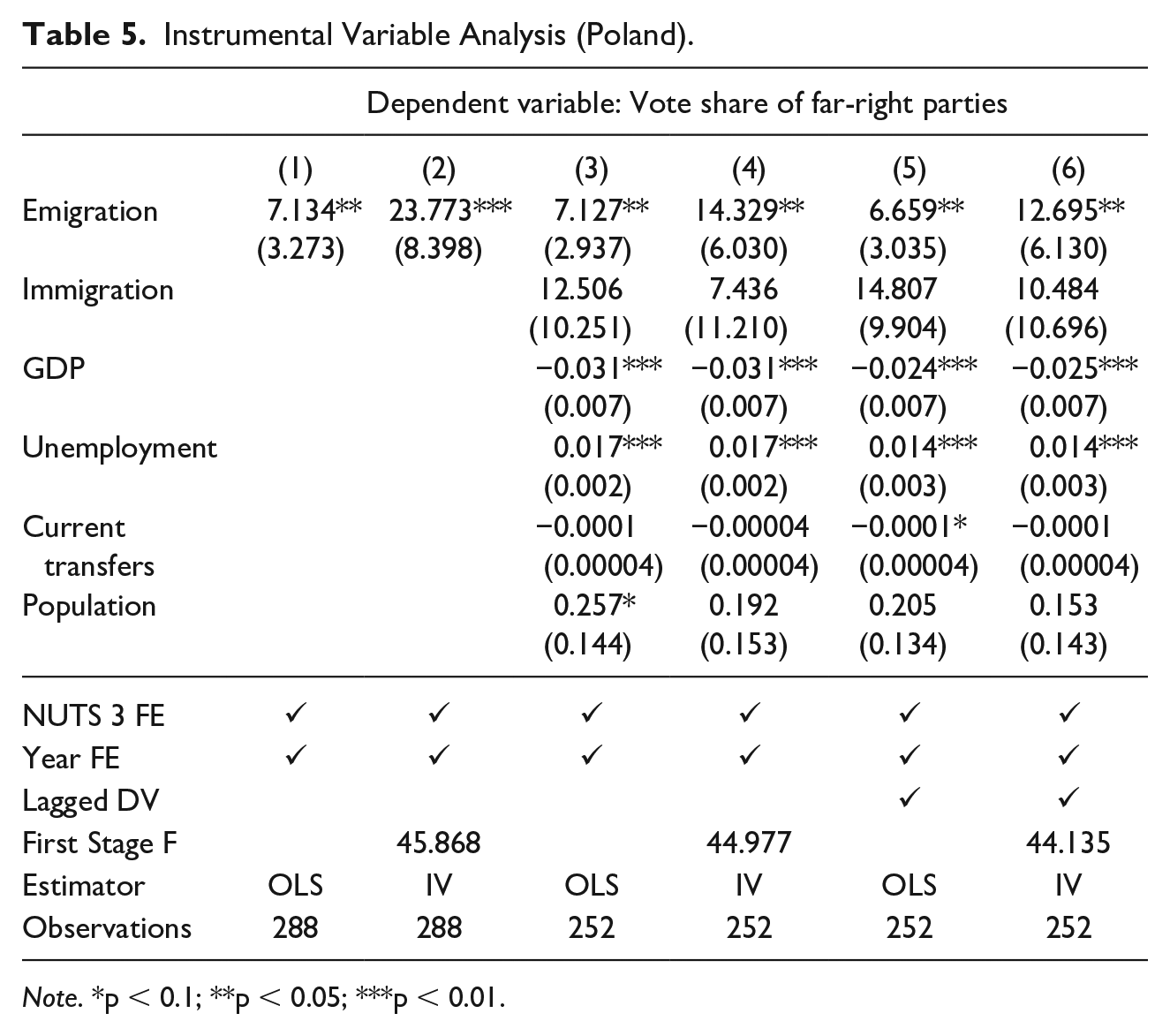
Table 5 reports the results of both OLS and IV estimates for Poland around the EU enlargement. Overall, the results from Table 5 are consistent with the previous analyses, suggesting that emigration benefits the electoral success of far-right parties at the regional level. As more emigrants leave, the far-right party gains more vote share at the regional level. These relationships are statistically significant across models. This is consistent when controlling the lagged dependent variable as well (models 5 and 6). Across all model specifications, the IV coefficient estimates are larger than the OLS estimates but their confidence intervals overlap. As in the previous analyses, the size of the coefficient suggests that the exit of politically progressive voters may have second-order effects on voting outcomes beyond the immediate direct effect from emigration on the distribution of voters.
Instrumental Variable Analysis (Poland).
Note. *p < 0.1; **p < 0.05; ***p < 0.01.
Emigration and Individual Voting Behavior
I aim to identify the effects of emigration on the policy preferences of individuals who remain. As noted in the previous section, there are potentially multiple ways that emigration can affect the policy preferences of individuals who remain behind. Large-scale emigration can affect the remaining individuals’ policy preferences by raising concerns regarding the sustainability of their traditional values and local communities, or by transforming their social network. These mechanisms are not mutually exclusive. Plausibly, voters could be affected through more than one mechanism at a time. In this paper, I do not aim to isolate the role of each potential mechanism that may drive the effects of regional emigration on individuals’ support for far-right parties. Instead, I aim to capture the overall impact of regional emigration share on individuals’ support for far-right parties, which shows that emigration not only changes the distribution of the electorates but also directly influences the voting behavior of people who are left behind.
To estimate the effect of regional emigration share on support for far-right parties at the individual level, I employ the individual-level data from the Polish Panel Study (POLPAN). POLPAN is carried out every 5 years, and I include the most recent three waves (from 2008 to 2018) that are conducted after Poland joined the EU. Each wave of the survey asks which party respondents support, as well as their demographic information and place of residence. Using the information regarding the place of residence of the respondents, I estimate the effects of regional emigration share on individual vote choice. 27
The three waves of the POLPAN covered the time after the EU accession, which allows us to estimate the effects of large-scale emigration on individuals’ policy preferences and behavior. As in the regional-level analysis, I control for regional economic variables including immigration, unemployment rate, GDP, and current transfers. In addition, I include a vector of individual-level variables, accounting for demographic characteristics such as age, the level of education, and employment status. The dependent variable is binary variable that takes value one if respondents are willing to vote for far-right party (PiS) in national elections.
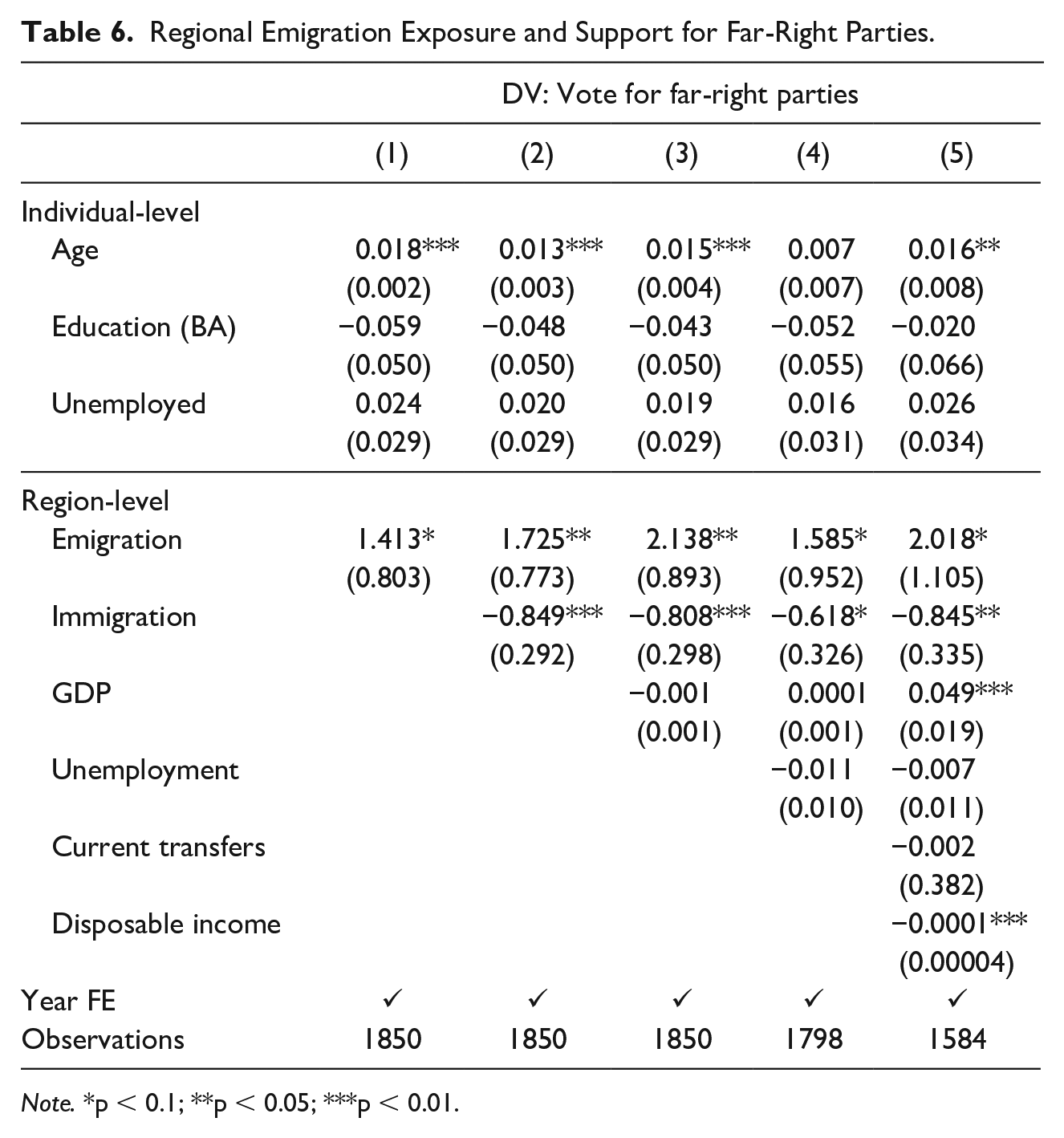
Table 6 reports the results of models with unit fixed effect to account for the time-invariant unobserved, time-invariant factors that are specific to each individual. 28 The effect of the regional share of emigration on the propensity to vote for far-right party is positive and statistically significant across different model specification. These results affirm that the emigration affects the electoral outcomes at the sub-national level not only by changing the distribution of electorates but also by directly affecting individual political preferences.
Regional Emigration Exposure and Support for Far-Right Parties.
Note. *p < 0.1; **p < 0.05; ***p < 0.01.
Conclusion
What are the electoral consequences of international migration in sending countries? This paper investigates the characteristics of emigrants and how their departure affects the electoral outcomes in sending countries. Using individual-level survey and regional (NUTS 3) migration data, I find that emigrants from Central and Eastern Europe are disproportionately more from politically progressive populations, and the level of support for far-right parties is higher in regions with large levels of emigration.
These findings have several implications for the literature. First, they suggest that international migration can affect sending and receiving countries differently. It is a common assumption that globalization makes the world more diverse. Yet, increased mobility can facilitate geographical sorting by individuals’ political preferences. Second, this paper provides one explanation for the recent growth of far-right parties in Central and Eastern Europe. Many previous studies look into the electoral success of far-right parties in Europe and point to Western European countries’ experiences with globalization as the main driver behind this. Central and Eastern Europe have had vastly different experiences with economic globalization from their Western counterparts, yet they also have experienced the rapid rise of far-right parties. This paper demonstrates the conditions where different experiences with globalization can result in similar political backlashes.
This paper has some limitations, and more needs to be done in future research. First, this paper’s empirical strategy focuses on capturing the total effect of emigration, not empirically testing potential mechanisms. As the results suggest, the effects from the exit of politically progressive voters on electoral outcomes likely go beyond its direct influences on the distribution of remaining voters. As Table 6 suggests, emigration could have more direct impacts on individual policy preferences and voting behavior. Future research should explore these potential paths by which emigration influences politics.
Also, this paper focuses on Central and Eastern Europe only, which raises the question of how generalizable the results are. The pattern of migrants’ selection and their characteristics can vary by region. However, this paper still provides an insight that large-scale emigration can induce changes in electorates depending on the attributes of emigrants. For a more comprehensive understanding of the political impacts of emigration, future research should expand on how different migration selection processes influence politics in sending countries differently.
Supplemental Material
sj-pdf-1-cps-10.1177_00104140221089646 – Supplemental material for The Electoral Consequences of International Migration in Sending Countries: Evidence from Central and Eastern Europe
Supplemental material, sj-pdf-1-cps-10.1177_00104140221089646 for The Electoral Consequences of International Migration in Sending Countries: Evidence from Central and Eastern Europe by Junghyun Lim in Comparative Political Studies
Footnotes
Declaration of Conflicting Interests
The author(s) declared no potential conflicts of interest with respect to the research, authorship, and/or publication of this article.
Funding
The author(s) received no financial support for the research, authorship, and/or publication of this article.

Supplemental Material
Supplemental material for this article is available online.
Notes
Author biography
References
Supplementary Material
Please find the following supplemental material available below.
For Open Access articles published under a Creative Commons License, all supplemental material carries the same license as the article it is associated with.
For non-Open Access articles published, all supplemental material carries a non-exclusive license, and permission requests for re-use of supplemental material or any part of supplemental material shall be sent directly to the copyright owner as specified in the copyright notice associated with the article.
