



Abstract
Since the end of the Cold War, international organizations (IOs) have engaged in unprecedented levels of democracy promotion, and research overwhelmingly links them to positive democratic outcomes. However, this increased emphasis on democracy has more recently been accompanied by rampant illiberalism and a sharp rise in cases of democratic backsliding in new democracies. What explains democratic backsliding in an age of unparalleled international support for democracy? Backsliding occurs when democratic institutions are weakened or eroded by elected officials, resulting in an illiberal or diminished form of democracy. I argue that IOs that support democracy unintentionally make backsliding more likely by neglecting to promote democratic institutions other than executives and elections, increasing executive power, and limiting states’ domestic policy options, which stunts institutional development. I find membership in IOs associated with democracy promotion makes backsliding more likely, decreases checks on executive power, and limits domestic policy options and party development in new democracies.
Introduction
Since the end of the Cold War, international democracy promotion has been on the rise, the percent of democracy supporting international organizations (IOs) has risen significantly, and research overwhelmingly finds IOs are positive forces for democracy (Donno, 2013; Mansfield & Pevehouse, 2008; Nygard, 2017; Pevehouse, 2005; Poast & Urpelainen, 2018). However, this increased emphasis on democracy has been accompanied by democratic backsliding in states where democratization was heavily influenced by the international community. For example, in 2004 Hungary joined the European Union (EU), an IO strongly associated with democracy promotion. However, beginning in 2011, the Hungarian Prime Minister, Viktor Orbán, eliminated constitutional checks on executive power, diminished judicial independence, limited media pluralism, and modified the electoral system—all by legal means—to consolidate his power. Orbán proclaimed liberal democracy has failed in Hungary, advocating instead illiberal democracy. Similar and more extreme trends have emerged in Bolivia, Malawi, Turkey, and other new democracies, despite their membership in IOs associated with democracy, such as the Organization of American States (OAS), the African Union, and the Council of Europe.
What explains democratic backsliding in an age of unparalleled international support for democracy? Democratic backsliding occurs when elected officials weaken or erode democratic institutions and results in an illiberal or diminished form of democracy, rather than autocracy. Although research has identified case-specific causes of backsliding (Berman, 2016; Hanley & Sikk, 2016; Hernandez & Kriesi, 2016; Krastev, 2016; Rupnik, 2016), no systematic theories of this phenomenon exist (Waldner & Lust, 2018). On the international side, authors have critiqued foreign aid and democracy assistance, suggesting they have limited and even deleterious effects (Bush, 2015; Carnegie & Marniov, 2017; Henderson, 2003; Knack, 2004; Savage, 2017; Wedel, 2001), while others have shown how regional powers engage in autocracy promotion (Finkel & Brudny, 2012). However, few have investigated the role of IOs in particular, and how they might contribute to backsliding.
Drawing on institutional theories of democracy, I argue that although IOs often serve as a critical impetus for democratic transitions, they also unintentionally sow the seeds for future democratic erosion and backsliding. They do this by both failing to support and even stunting democratic institutional development. Democratic success is contingent on the strength of institutions that organize mass participation in politics, aggregate societal interests, and enable the state to both govern effectively and, critically, limit itself (Huntington, 1968). These institutions include developed political parties, strong legislatures, independent judiciaries, and general state capacity. IOs commonly associated with democratic outcomes focus predominantly on elites and elections, but neglect other democratic institutions. This narrow focus makes states more susceptible to backsliding.
IOs also more directly contribute to democratic backsliding in new democracies, in two ways. First, due to how they interact with states, IOs increase relative executive power. IOs’ democracy support focuses in particular on elite incentives and resources, and executives serve as the primary intermediaries between their states and IOs. This shifts the domestic balance of power in favor of executives. As states join additional organizations, executives have further opportunities to increase their power.
Second, IO membership requirements constrain states’ domestic policy options; this impedes institutional development. Political parties and legislatures in new democracies develop by advocating and debating meaningful policy alternatives. However, when options are limited by external policy requirements, these institutions remain underdeveloped. Diminished policy options also constrain leaders’ ability to govern effectively and provide public goods. Unable to appeal to voters based on records of effective governance or policy alternatives, executives instead erode institutional checks on their power. This is easier when horizontal institutions of accountability, such as parties and legislatures, are weak. In short, IO membership simultaneously increases relative executive power, while membership requirements constrain domestic institutional development. In these ways, increased IO membership makes backsliding more likely in new democracies.
IOs are associated with overall higher levels of democracy when compared with autocracy (Mansfield & Pevehouse, 2006; Pevehouse, 2005; Poast & Urpelainen, 2018). Extending this existing research, I show that although these organizations promote transitions to minimalist democracy, they are more limited in their ability to promote ongoing democratic progress or consolidation among new democracies, and can even unintentionally contribute to backsliding, or negative changes in a state’s level of democracy. I find that increased membership in three groups of IOs associated with democratic success—democratically committed, political or economic, and structured or interventionist IOs—corresponds with subsequent backsliding. I also test and find support for the proposed mechanisms linking IOs and backsliding: increased relative executive power and domestic policy constraints.
International Democracy Promotion and Backsliding on the Rise
IOs are prominent in studies of international democracy promotion with research finding they can support democratic transitions and consolidation among their member states. They do this primarily by focusing on domestic executives’ behavior and incentives and providing election-related assistance (Donno, 2013; Pevehouse, 2005; Poast & Urpelainen, 2018).
Certain IOs in particular are associated with democracy. First, there are IOs explicitly committed to promoting and supporting democracy; this includes organizations that reference support for democracy, human rights, or rule of law in their official documents. Prominent examples include the EU, the OAS, and the African Union. Figure 1 traces the proportion of democratically committed IOs over time (von Borzyskowski & Vabulas, 2018).

The percentage of all IOs that either support or actively engage in democracy promotion has steadily increased.
IOs created to serve an explicitly political or economic function, such as the International Monetary Fund (IMF), have also been linked to democracy. Research argues these IOs increase newly democratic leaders’ technical capabilities and provision of public goods, and bolster elections and other developing democratic institutions (Poast & Urpelainen, 2018).
However, IOs vary in their capacity to influence domestic outcomes. At one extreme are minimalist IOs, which exist either exclusively on paper or have limited organizational structures. Minimalist IOs only make non-binding decisions, and thus cannot alter state behavior. At the intermediate level are structured IOs. Structured IOs have formal voting rules and codified procedures for member–state interactions, specified organizational operations, a bureaucracy for carrying out decisions, and can make binding decisions. If they do not have a bureaucracy, there is some concrete administrative body that operates independently of member states. Finally, at the highest level of institutionalization are interventionist IOs, which have clear mechanisms to coerce or influence state behavior. These organizations have codified rules that govern relations between the executive, legislative, and judicial structures of the organization, and they can sanction states (Boehmer et al., 2004). Examples of structured and interventionist IOs include Mercosur, the World Bank, and the European Bank for Reconstruction and Development. Structured and interventionist IOs are more likely to influence domestic-level outcomes by providing forums where state executives can make international-level decisions, and also by imposing policy requirements on their member states. 1
The growing emphasis on democracy promotion by IOs has been accompanied by an increase in cases of backsliding. Democratic backsliding occurs when elected officials weaken or erode institutional checks on government power (Bermeo, 2016), including the constitution, rule of law, civil and minority rights, the independence of the judiciary and the media, and separation of power within government (Maeda, 2010). Backsliding is a within-regime process (Waldner & Lust, 2018) distinct from autocratic reversion: The outcome is an illiberal or minimalist form of democracy, not autocracy.
I use the Liberal Democracy index from the Varieties of Democracy (V-Dem) dataset to capture backsliding. This variable measures the extent to which a country constitutionally protects individual and minority rights, exhibits strong rule of law, has an independent judiciary, and maintains institutional checks on executive power. As such, it measures subtle differences between democracies that emerge due to backsliding (Coppedge et al., 2018). Figure 2 shows the annual percentage of democracies on each continent that have experienced democratic backsliding. A case is coded as an instance of democratic backsliding if the change from year t – 5 to year t along the Liberal Democracy index is negative. I focus on 5-year periods because democratic backsliding is an incremental process (Waldner & Lust, 2018). Overall, backsliding has become more prevalent over time, especially since the end of the Cold War.
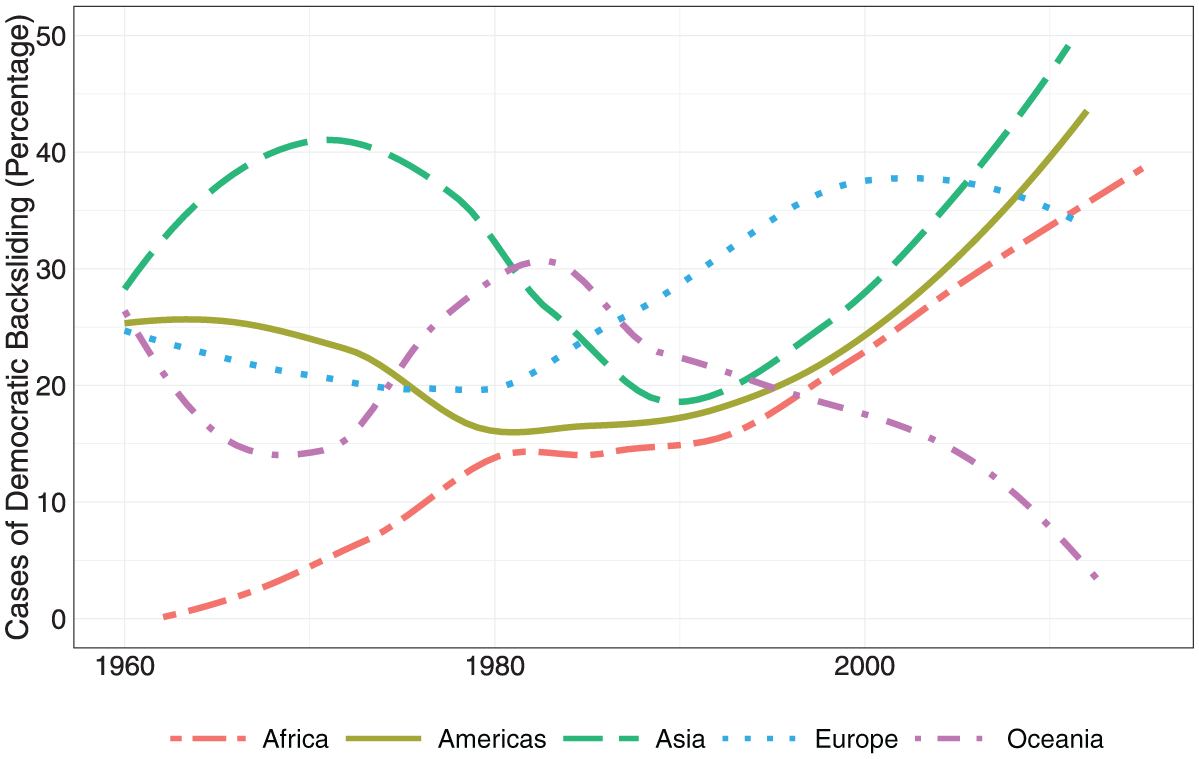
Democratic backsliding is a worldwide phenomenon that has become increasingly common.
These trends reflect the “third wave of autocratization,” or moves away from democracy in both democracies and autocracies, which began around 1993. Regime changes in this current wave are more gradual than in the past and have occurred in an unprecedented number of democracies (Luhrmann & Lindberg, 2019). The recent surge in cases of autocratization across regime types suggests the post–Cold War rise of democracy promotion is distinct from the simultaneous increase in cases of backsliding. Figure 3 illustrates prominent recent cases of backsliding.
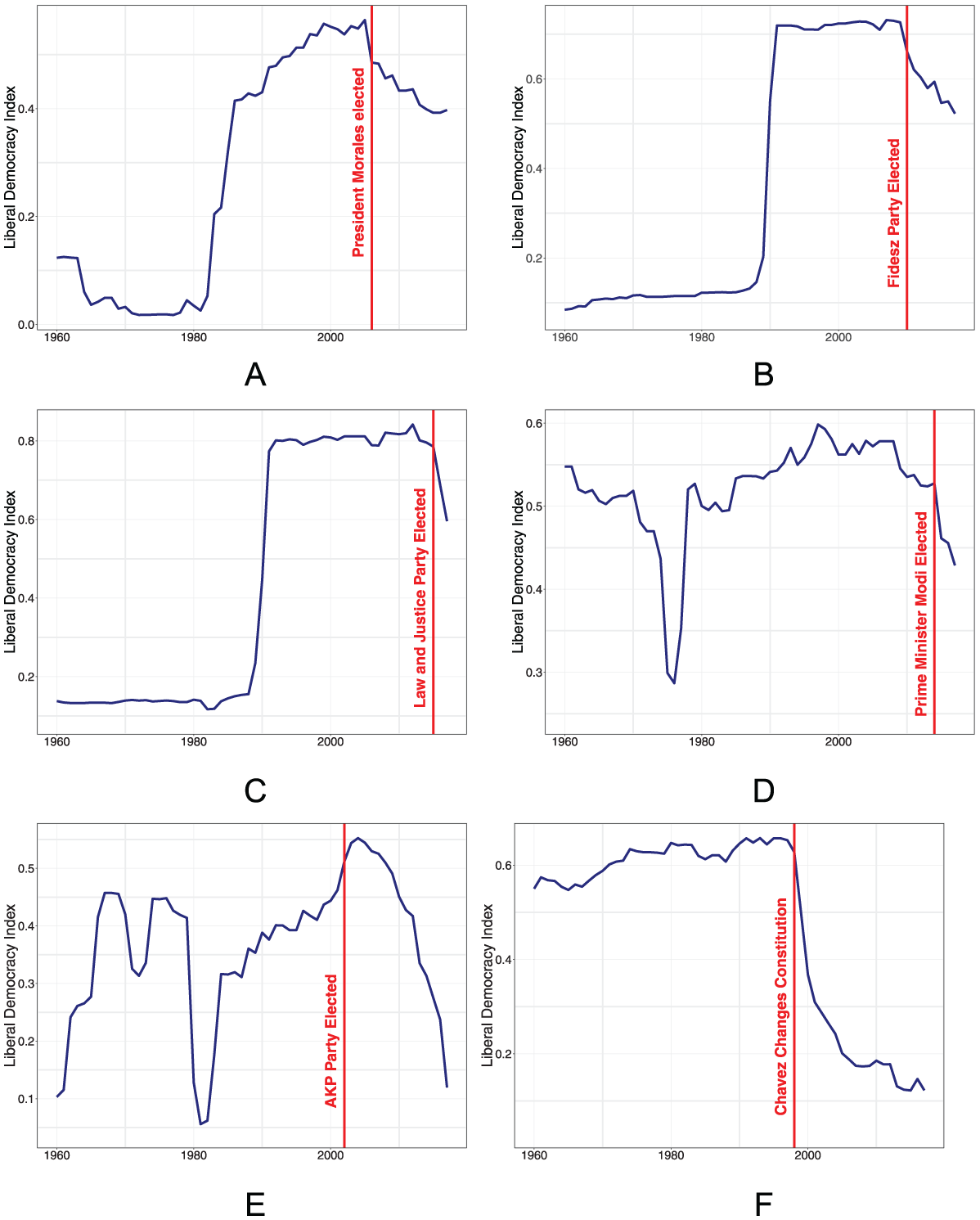
Prominent cases of democratic backsliding: (A) Bolivia, (B) Hungary, (C) Poland, (D) India, (E) Turkey, and (F) Venezuela.
Research on backsliding focuses on domestic-level causes, including the collapse of social–democratic and center–left parties (Fomina & Kucharczyk, 2016; Innes, 2014; Krastev, 2016), economic recession (Svolik, 2008), anti-immigrant sentiments (Rupnik, 2016), and domestic actors’ preferences (Mainwaring & Perez-Linan, 2013). Scholars have not yet investigated the role of international actors or the extent to which IOs contribute to domestic changes that precipitate backsliding. I argue these external factors are critical because young democracies today were heavily influenced by international actors during their democratization processes.
Linking IOs and Democratic Backsliding
I argue IO membership contributes to democratic backsliding in new democracies. First, I discuss how IOs most commonly associated with democracy, which heavily emphasize elites and elections, fail to support other critical democratic institutions. This makes states more susceptible to future backsliding. IOs also more directly contribute to backsliding by simultaneously increasing executive power and constraining the domestic policy space, which further impedes institutional development. I argue that the resulting combination of factors—a strong executive surrounded by weak institutions—makes backsliding more likely.
IOs and Democratic Outcomes
The literature linking IOs to democracy emphasizes these organizations’ impacts on elections and executives. Because executives serve as the main intermediaries between states and IOs (Moravcsik, 1994), democracy promotion by IOs is heavily concentrated on executives. Scholars find IOs support democracy via material incentives that induce incumbents to undertake institutional reforms (Donno, 2013). IOs use economic sanctions to disincentivize antidemocratic behavior and provide economic assistance to member states, which helps domestic leaders deter rebellions. IOs also socialize rulers into accepting democracy and influence their international status either by helping them build a reputation for being committed to democracy (Poast & Urpelainen, 2018) or by shaming those who violate electoral norms (Donno, 2013). Finally, IOs serve as commitment devices, helping democratic leaders gain domestic elites’ support and deterring political losers from overthrowing the new regime (Pevehouse, 2005).
Research on IOs and democracy also emphasizes elections. Approaches to international democracy promotion developed according to the transitions paradigm, which assumes any state moving away from authoritarianism is transitioning toward democracy, stresses the importance of elections as the first step toward eventual democratic consolidation, and largely disregards the impact of structural and institutional factors on a state’s democratic prospects (O’Donnell & Schmitter, 1986). As such, democracy promotion heavily emphasizes free and fair elections, viewing these as a critical prerequisite for long-term democratic success (Hadenius & Teorell, 2007; Howard & Roessler, 2006; Schedler, 2002), yet provides much less support for other institutions, such as political parties (Carothers, 2002).
This electoral focus has driven IOs to promote elections even in countries that lack other democratic institutions; electoral assistance is the most common type of democracy assistance from IOs. Initially, this assistance centered primarily on election monitoring, but it has more recently expanded to also include an emphasis on improving election laws, updating voter registries, and assisting with other electoral logistics (Donno, 2013; Johnstone & Snyder, 2016; Poast & Urpelainen, 2018).
The emphasis placed on executives and elections is evidenced by IOs’ democracy promoting strategies. For example, the OAS is largely limited to election monitoring and training and consultation for new democratic leaders (Cooper & Legler, 2006). Similarly, EU democracy promotion in post–communist central and eastern Europe favors executives and their bureaucracies over other democratic institutions and is undertaken in a top-down manner without support from political groups or civil society (Bugaric, 2015; Grabbe, 2001; Pridham, 2007).
Although elections and executive compliance with democratic institutions are important (Dahl, 1971; Huntington, 1991; Przeworski et al., 2000), they are insufficient to guarantee long-term democratic quality and survival. Election monitoring’s limits have been identified (Hyde, 2011; Simpser & Donno, 2012), and elections alone are insufficient to promote ongoing democratic progress (Flores & Nooruddin, 2016). Research finds organizations for managing mass participation in politics and performing key representative functions are equally, if not more important (Almond & Verba, 1963; Grzymala-Busse, 2007; Herman, 2015; Mainwaring, 1999; O’Donnell & Schmitter, 1986). Such institutions include political parties, which aggregate mass interests and serve as intermediaries between citizens and the state (Carothers, 2006; Huntington, 1968), and civil society organizations. Horizontal checks on government power and institutions that constrain elected officials’ power are also critical. This includes independent judiciaries, which can block executives seeking to increase their power (Gibler & Randazzo, 2011), and intragovernmental checks and balances, such as legislatures (Graham et al., 2017). IOs devote much less attention to these other critical institutions.
To summarize, IOs associated with democracy unintentionally make democratic backsliding more likely in new democracies by focusing on elites and elections at the expense of other democratic institutions. This makes new democracies more likely to experience negative changes in their levels of democracy.
IOs also more directly contribute to backsliding in two interrelated ways: by increasing relative executive power and constraining the domestic policy space, which further impedes democratic institutional development.
Increasing Executive Power
IOs promote democracy by altering elites’ incentives to comply with or maintain democratic institutions (Donno, 2013; Pevehouse, 2005; Poast & Urpelainen, 2018), or by providing technical assistance to leaders in new democracies (Poast & Urpelainen, 2018). Authors that approach this topic primarily from the domestic point of view also emphasize the importance of domestic elites, and especially executives, as the critical intermediaries or “gatekeepers” between international actors and states (Moravcsik, 1994; Tolstrup, 2013; Yilmaz, 2002). As such, IO membership can increase executive power relative to other domestic institutions.
I argue IOs provide both incentives and opportunities for executives, who are rational actors concerned with maintaining office, to manipulate institutions to their advantage; this in turn makes backsliding more likely. The intense emphasis international actors place on free and fair elections has rendered elections a condition for receiving international material benefits (Hyde, 2011). Therefore, executives have incentives to refrain from manipulating elections to maintain power; instead, they resort to more subtle tactics, such as “strategically manipulating” elections by interfering with nonelectoral institutions (Beaulieu & Hyde, 2009).
IOs facilitate this by increasing executives’ relative domestic power in several ways. First, IOs provide democracy-related financial assistance to states. However, this financial assistance, which is often received, controlled, and allocated by executives, increases government power over economic activity, which is found to be problematic for democracy (Friedman, 1958). Foreign aid also weakens governmental accountability and stunts civil society development. Democracy first developed when elites demanded increased rights and government accountability in return for taxes (North, 1990; Tilly, 1990). However, aid from international sources undermines this accountability mechanism, making rulers more responsive to international donors than to citizens (Brautigam, 1992; Karl, 1997; Moore, 1998). Executive control over incoming financial resources also increases recipient governments’ ability to use patronage to maintain power and garner electoral support (Ahmed, 2012; Jablonski, 2014), and has been linked to increased corruption (Knack, 2001).
Second, IO membership redistributes power between domestic governmental institutions, often to the executive’s advantage. As IO members, executives either represent their state within the organization or they have the power to directly appoint representatives. As a result, international cooperation increases executive power over domestic policy and allows them to influence or even ratify international decisions; this is often done “with relatively little ministerial, legislative, judicial, or public oversight” (Moravcsik, 1994, p. 7). The financial aid states receive from IOs further contributes to this power asymmetry. Foreign aid provides resources outside the national budget, allowing executives to pursue projects without legislative approval (Brautigam, 2000), which shifts “the balance of power within countries in ways that distort the constitutionally established system of checks and balances” (quoted in Knack, 2004, p. 253).
Finally, in certain IOs, membership conditionality requires countries to develop an extensive bureaucracy to facilitate preparations for membership. To this end, IOs offer technical assistance to states for constructing regulatory, economic, and other bureaucratic offices. A strong bureaucracy and state capable of providing public goods is important for democracy (Fortin, 2012; Grzymala-Busse, 2007). However, bureaucracies are unaccountable to voters and are often closely linked to, and thus serve as an additional resource for executives.
The more IOs a state is in, the more opportunities executives have to receive financial resources and make international-level decisions. However, the extent to which IO membership increases executive power depends on the IO’s type. While minimalist IOs have limited effects on domestic processes, structured and interventionist ones can alter state-level outcomes, and are more likely to have institutions that increase executives’ international decision-making powers. As such, membership in more institutionalized IOs is particularly likely to increase executive power by creating venues for executives to influence domestic policies. This is especially the case in political and economic IOs, which focus on substantive policy issues.
Although strong executives are not incompatible with democracy, they are problematic when institutional checks are underdeveloped. Below I discuss how the limits IOs place on states’ domestic policy options inadvertently stunt institutional development.
Limiting the Domestic Policy Space
The domestic policy space is the universe of policy alternatives political actors can feasibly debate, adopt varying positions on, and implement. A meaningful policy space is critical for institutional development, conditions the extent to which leaders can govern effectively, and influences the strategies politicians adopt to appeal to voters. In states with large policy spaces, institutions that aggregate mass interests and check executive power develop more fully, governments are better able to provide public goods, and, therefore, elections are contested along ideological lines. However, when the policy space is limited, institutions remain underdeveloped, and elections occur in an ideological void.
Scholars have studied how economic interdependence affects state policies, finding increased globalization, influence from international financial markets, and transnational capital induce economic policy convergence both across countries (Andrews, 1994; Cerny, 1994; Mosley, 2000; Pierson, 1995; Rodrik, 1997; F. Ross, 2000; Simmons & Elkins, 2004) and across parties within a country (Mishra, 1999). International financial pressures, which favor lower taxes, less economic regulation, and smaller governments, limit states’ abilities to determine domestic economic policy (Haggard & Maxfield, 1996).
IOs also often specify policy requirements for prospective and current member states. These conditions include policy changes and economic or monetary reforms (Pevehouse, 2005); the upper limit the EU imposes on members’ budget deficits is a salient example (Mosley, 2000). In addition to inducing cross-national economic policy convergence (Cao, 2009), IO membership has been shown to influence national science (Finnemore, 1993), mass education (Meyer et al., 1992), and environmental policies (Frank, 1997).
The domestic policy space is critical for developing representative institutions and institutional checks on executive power in new democracies. First, an expansive policy space creates opportunities for parties to develop. In developed systems, parties compete by situating themselves along salient, politicized cleavages that give voters options based on policy-relevant issues (Lipset & Rokkan, 1967). However, IO requirements limit policy alternatives for political parties to adopt and debate since advocating policies that conflict with IO requirements is not electorally viable. The inability to debate substantive policy and ideological alternatives stunts party system development in new democracies because these parties cannot develop coherent and distinct policy platforms to appeal to voters. This, in turn, impedes democratic quality and consolidation, which depends in part on the extent to which parties structure political conflict (Dix, 1992; Mainwaring, 1998).
Scholars find economic globalization has limited the range of economic policy appeals political actors can make. As voters are aware that governments’ economic options are constrained (Hellwig, 2014), it is difficult for parties to differentiate themselves based on economic appeals. Instead, they turn to populism or campaign on valence issues, or uncontroversial issues “on which all parties declare the same objective but dispute each other’s competence in achieving the desired policy” (Kitschelt et al., 1999, p. 137), such as support for anti-corruption, nationalism, or rule of law. This is true for all types of parties, not just new or niche ones (Ward et al., 2015).
The IMF’s impact on party development in Latin America illustrates these issues. In response to the economic recession in the 1970s and 1980s, many Latin American governments borrowed heavily from international financial actors, inducing a decade-long debt crisis. Unable to repay their debts, governments turned to the IMF for loans. The IMF heavily conditioned these loans, requiring states to cut regulatory, redistributive, and social welfare policies. These neoliberal reforms included labor market liberalization, which induced employment insecurity, as well as anti-inflationary and other austerity programs that decreased public spending. Ironically, historically labor-based parties were required to implement these reforms. As a result, voters became increasingly detached from political parties, creating opportunities for individual politicians to appeal directly to voters without parties as intermediaries. In other words, IMF conditionality severely weakened party systems in Latin America, which created a space for populism to emerge as a political alternative (Pastor, 1987; Roberts, 2007). Intense austerity policies imposed by the EU and the IMF in Greece more recently have had similar effects (Vasilopoulou et al., 2014).
External policy requirements also infringe on one of the primary roles of legislatures: proposing, drafting, and implementing legislation. This stunts the institutionalization of the legislature in new democracies and contributes to power asymmetries between the executive and the legislature, which further hinders democratic progress, in two ways. First, strong legislatures create an impetus for party system development. In states where legislatures are weak, parties lack a forum in which to develop and mature. Another consequence is that legislatures, which play a critical role in providing horizontal accountability, are unable to check executive power. Indeed, in addition to the judiciary, legislatures are the main institutional check on executive power (Fish, 2006).
Finally, the domestic policy space is linked to state fiscal capacity and, in particular, a state’s ability to govern effectively and provide public goods. State capacity, or a state’s ability to “maintain the rule of law, to protect the rights of citizens, and to regulate economic transactions” (Fortin, 2012, p. 904), is another important condition for long-term democratic success (Bäck & Hadenius, 2008). IOs restrict the economic and fiscal policy options available to states by limiting tariffs, public spending, and government deficits. These fiscal limits, in addition to restricting government control over economic policies, decrease government resources.
A state’s fiscal space, or its ability to collect revenue for public goods provision, affects politicians’ electoral strategies. When states have a large fiscal space, politicians campaign based on evidence of effective public goods provision. However, external policy requirements limit the range of policies governments can credibly advocate and diminish the state’s ability to collect revenue. When politicians are unable to use ideological positions and evidence of past economic success to appeal to voters, they turn instead to populism or clientelism; this style of politics impedes democratic progress in young democracies (Flores & Nooruddin, 2016).
The more IOs with policy requirements a state is a member of, the more policy constraints it faces. These policy requirements limit states’ policy space, which stunts institutional development and diminishes the government’s capacity to provide public goods; one consequence is that elections are contested in an ideological void. These effects are particularly pernicious in new democracies where institutions are often underdeveloped and have been neglected by democracy promoting IOs, and also where executives are already relatively strong due to IO membership. I argue this combination of strong executives surrounded by weak institutions makes democratic backsliding more likely.
To summarize, I predict increased membership in IOs relevant to democracy is associated with democratic backsliding or negative changes in levels of democracy among new democracies. The EU provides a useful illustration. The EU is a democratically committed, political and economic, interventionist IO widely viewed as unrivaled in its ability to promote democracy (Dimitrova & Pridham, 2004). Nevertheless, some of its newly democratic members, including Hungary, Poland, and the Czech Republic, have shown evidence of backsliding. To join the EU, these states had to meet a series of democratic criteria and undergo a lengthy accession process. This process favored executives and the bureaucracy over other domestic institutions (Follesdal & Hix, 2006; Grabbe, 2001), and created institutions from above without support from political groups or civil society (Bugaric, 2015). EU membership also increases domestic executive power by giving executives supranational decision-making power in the European Council (Tallberg, 2008). The EU also imposes significant policy constraints on its candidate and member states. For example, the EU’s direct influence over monetary policies gives it tremendous influence over national policies regarding budgetary issues (Katsanidou & Otjes, 2015). I argue this combination of factors exacerbated by the EU—strong executives surrounded by weak democratic institutions at the domestic level—has contributed to backsliding in its member states.
Alternative Explanations
Any observed relationship between IO membership and backsliding in new democracies could be due to a series of alternative explanations. First, globalization, which coincided with the post–Cold War proliferation of IOs, may be driving backsliding. Like IOs, economic integration constrains domestic policy options, for example, via free trade agreements. However, there are additional factors contributing to backsliding which are unique to IOs. While increased interactions between states may indirectly increase executives’ decision-making power, these effects are particularly likely to manifest in international fora, such as in the context of IOs. Nevertheless, I control for globalization in my analysis below.
Domestic characteristics may also explain backsliding. First, IO membership may simply proxy for the number of years since a state democratized. However, controlling for years since transition, I find IOs have an independent relationship with backsliding. Similarly, cultural explanations are prominent in theories of democracy (Almond & Verba, 1963; Putnam, 1993), yet are largely absent from my argument. Cultural theories are essentially structural ones: Culture consists of a set of societal norms, often inherited from past generations, that only change gradually. However, structural theories lack explanatory power with respect to the third wave of democracy (Haggard & Kaufman, 2016). Furthermore, a cultural explanation would imply that societies had democratic cultures during their historically recent transitions, yet now no longer do (Waldner & Lust, 2018). As culture changes gradually, this seems unlikely. Nevertheless, country fixed effects models, which control for time-invariant country characteristics, including culture, allow me to control for this possibility.
This discussion of culture and other country-specific characteristics highlights why some but not all developing democracies backslide. Ultimately, I argue the most immediate sources of backsliding are domestic: powerful elites surrounded by weak institutions. Because backsliding is a deliberate decision made by executives, we should not expect all executives to do so. Furthermore, even among those that do, there will be varying levels of success. States with more robust pre-democratic party competition and civil society engagement, for example, will be better equipped to guard against executive-led backsliding. In other words, not all new democracies start with the same institutional structure, even though most have been subject to IO membership and international democracy promotion. As such, I argue IOs are one of several possible sources of backsliding.
Research Design
I use data on IO membership and regime outcomes to test Hypothesis 1 predicting increased membership in democratically relevant IOs makes subsequent backsliding more likely in new democracies. I exclude mature democracies, which democratized prior to the recent surge in democracy promotion by IOs. I also exclude autocracies since backsliding is unique to democracies. Flores and Nooruddin (2016) define developing democracies as states “for whom a democratic system was not a certainty in 1946 or in the year of its birth as a sovereign country, whichever came second” (p. 85). This excludes Australia, Austria, Belgium, Canada, Denmark, Finland, France, Germany, Iceland, Ireland, Japan, Luxembourg, the Netherlands, New Zealand, Norway, Sweden Switzerland, the United Kingdom, and the United States from my analysis. Of the remaining states, I define democracies as country-years with a Polity score greater than 5 (Marshall et al., 2016).
Dependent Variable
I use the Liberal Democracy index from V-Dem to construct the dependent variable. I depart from existing work that focuses on the relationship between IOs and levels of democracy and consider instead the changes in levels of democracy. This choice is driven by my theory: I predict IOs make subsequent backsliding, which is conceptually a decrease in a state’s level of democracy, more likely. I do not argue IOs are negatively associated with overall levels of democracy; more democratic states are undoubtedly more likely to be in the IOs I consider. Rather, I argue these IOs make new democracies more susceptible to democratic erosion.
As backsliding is an incremental process (Waldner & Lust, 2018), 1-year changes are unlikely to capture this phenomenon. Therefore, the dependent variable is the 5-year change in a state’s democracy index. A negative value on the dependent variable indicates a state has experienced backsliding between times t – 5 and t, while positive values indicate democratic progress.
Independent Variables
The main independent variables are counts of state membership in certain types of IOs. Broadly, I focus on three groups of IOs linked to democratic outcomes: democratically committed, political and economic, and structured and interventionist IOs.
Democratically committed IOs “reference democracy, human rights, or the rule of law in their constitutive documents” (von Borzyskowski & Vabulas, 2018, p. 5); there are 56 IOs that meet these criteria. 2 Because democratically committed IOs with near or entirely universal membership are less likely to actively require member states to maintain democratic standards, I create a second group that includes only democratically committed IOs with non-universal membership. 3
Next, political and economic organizations are theorized to promote democratic consolidation by providing newly democratic leaders with technical assistance for public goods provision (Poast & Urpelainen, 2015). Poast and Urpelainen (2015) create a classification of 494 organizations that expands Ingram et al.’s (2005) categorization of IO functionality from four groups to six mutually exclusive groups—Political, General-Economic, Commodity-Economic, Resource-Economic, Technical, and Unclassified—and covers the years 1946 to 2000. Using Version 3.0 of the IO membership dataset (Pevehouse et al., 2016), I use Poast and Urpelainen’s (2015) coding strategy to categorize the functionality of democratically committed IOs created after 2000.
Finally, only certain types of IOs influence state behavior. Therefore, I consider structured and interventionist IOs, which are particularly likely to affect domestic outcomes. To identify these, I use Boehmer et al.’s (2004) three-level coding scheme. 4
These groups are not mutually exclusive. Some democratically committed IOs, such as the European Bank for Reconstruction and Development, are interventionist, while others, such as the Francophone Agency, are minimalist. Similarly, certain political or economic organizations, such as the International Labor Organization, are explicitly committed to democracy, whereas others, such as the IMF, are not. Table 1 provides additional examples to summarize these groups.
Categories of International Organizations.
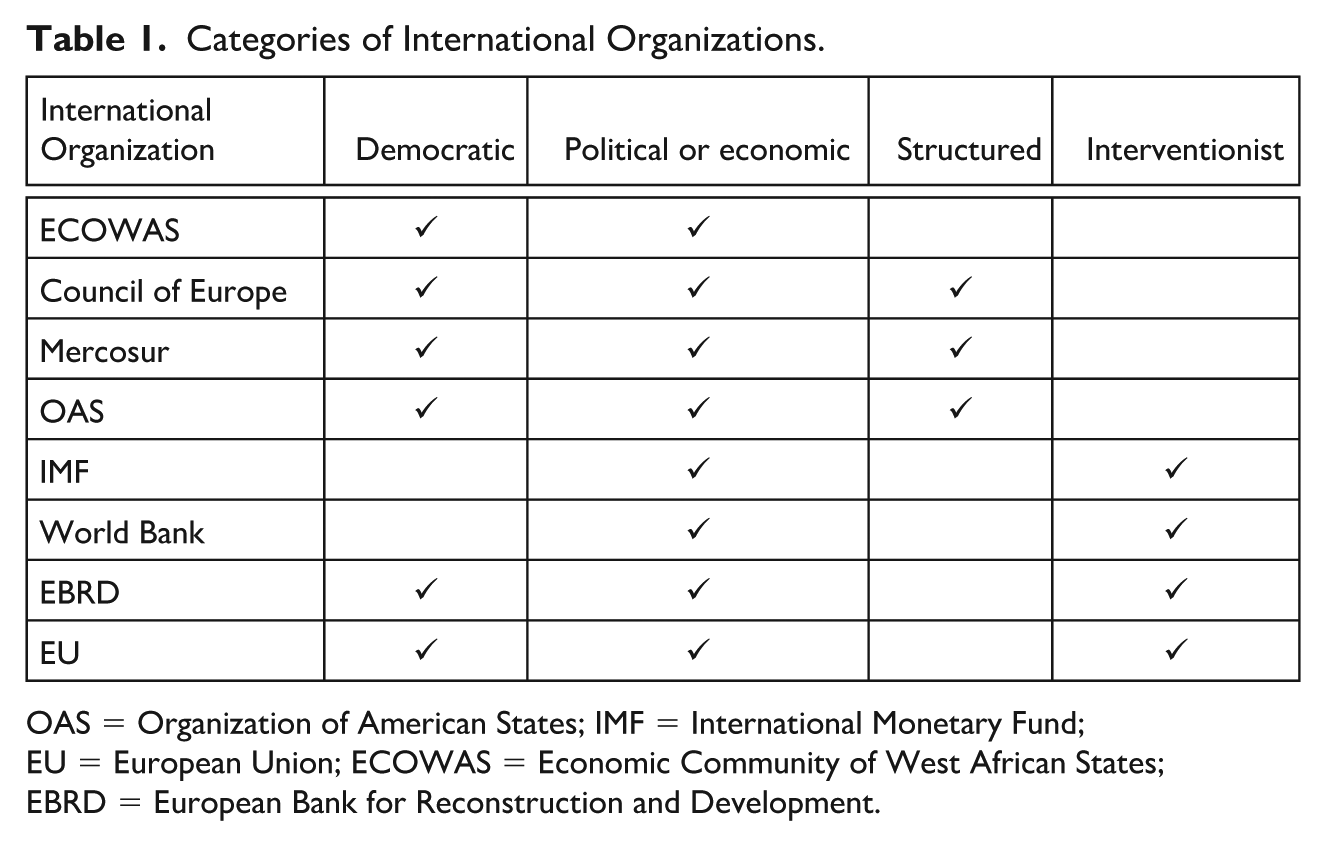
OAS = Organization of American States; IMF = International Monetary Fund; EU = European Union; ECOWAS = Economic Community of West African States; EBRD = European Bank for Reconstruction and Development.
IO membership entails ongoing policy commitments states must meet and opportunities for executives to increase their power; these commitments and opportunities continue beyond the accession date. Therefore, the main independent variables are states’ membership counts in different types of IOs. I create a series of variables measuring the number of democratically committed IOs with universal membership, democratically committed IOs with non-universal membership, democratically committed political or economic IOs, political or economic IOs, and structured or interventionist IOs a state is a member of each year. 5 As the dependent variable is the 5-year change in a state’s democracy level, I lag these counts by 5 years. Therefore, an observation consists of the number of IOs a state was a member of 5 years prior, and the subsequent 5-year change in its democracy level.
Control Variables
I control for state and regional characteristics relevant to democratic outcomes, including GDP (gross domestic product) per capita and GDP growth per capita (Feenstra et al., 2015), because development and democracy are highly correlated (Lipset, 1959). I also include a measure of the effective number of political parties (Cruz et al., 2016), predicting higher levels will be associated with democratic progress (Mainwaring & Scully, 1995). I control for state age, logged to account for diminishing returns (Correlates of War Project, 2016), and the number of years since a state transitioned to democracy to ensure that the number of IO memberships is not simply a proxy for time as a democracy (Boix et al., 2012). To control for diffusion effects, I include the average change in a region’s liberal democracy scores over the relevant time period (K. S. Gleditsch & Ward, 2006; Simmons et al., 2006). 6
Drawing on theories of democracy, I include an indicator for internal conflict, which can negatively affect democracy (Hegre, 2014). 7 Although the relationship between oil and democracy is debated (Brooks & Kurtz, 2016; M. L. Ross, 2015), research suggests the two are related; therefore, I control for a country’s annual oil income per capita (M. L. Ross & Mahdavi, 2015). I also control for ethnic fractionalization, which is often linked to regime outcomes (Alesina et al., 2003). 8
As the dependent variable is the change in a state’s level of democracy, I account for a state’s democracy level at the beginning of the observation. Any observed relationship between IOs and subsequent backsliding may result from states artificially increasing their levels of democracy prior to joining an IO, and then regressing to the mean following accession. Alternatively, states struggling with democracy may join additional IOs to safeguard democracy, yet continue backsliding. Therefore, I include a variable measuring changes in the liberal democracy index in the 5 years prior to an observation.
Each independent variable is lagged by 5 years to guard against endogeneity, and all observations are at the country-year level and include data on new democracies from 1946 to 2015. 9 All variables are standardized to facilitate interpretation.
Results
I estimate multilevel models with varying intercepts by country and region. These models capture unmeasured factors at the country and regional levels that might influence a state’s propensity to backslide, and also leverage information from neighboring states, many of which are likely in the same IOs (Shanks et al., 1996). This region-level information is important because my dataset is relatively small: The maximum number of observations per state is 69. The standard alternative approach, fixed effects models, produces coefficient estimates with high error levels when there are a small number of observations per unit (Clark & Linzer, 2015; Gelman & Hill, 2007). 10
The results in Table 2 lend support to Hypothesis 1: Increased IO membership is associated with subsequent backsliding. The coefficients on the main independent variables are all negative and statistically significant. As these are linear ordinary least squares (OLS) models, this coefficient can be interpreted as the amount of movement along the liberal democracy index over 5 years associated with joining one additional IO. To illustrate, consider Hungary. Between 2009, the year before Orbán came to power, and 2017, Hungary’s liberal democracy score dropped by 0.2. The coefficients on the main independent variables in Table 2 are between –0.31 and –0.2. In other words, by joining one additional IO, a state’s level of democracy decreases by up to 1.5 times the amount of decline Hungary experienced between 2009 and 2017.
Number of IO Memberships and Democratic Backsliding, Varying Intercepts by Country and Region.
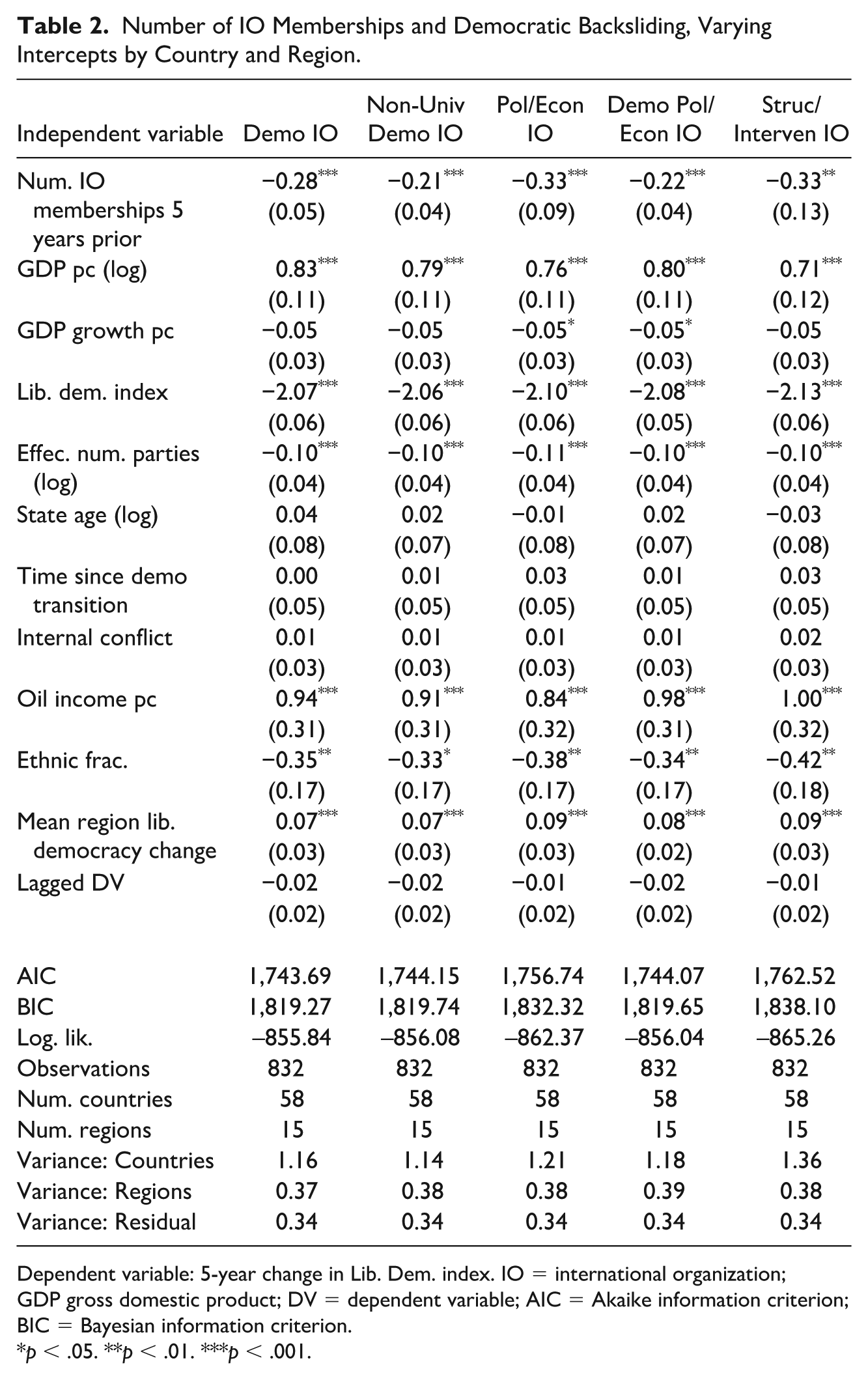
Dependent variable: 5-year change in Lib. Dem. index. IO = international organization; GDP gross domestic product; DV = dependent variable; AIC = Akaike information criterion; BIC = Bayesian information criterion.
p < .05. **p < .01. ***p < .001.
Robustness Checks
These results are robust to alternative specifications. First, since the time over which backsliding occurs can vary, I estimate models that consider the 3-, 7-, and 10-year changes in a state’s level of democracy, finding similar results. 11
The main models include observations from the Cold War period to capture the third wave of democratization. However, democracy promotion expanded significantly after the end of the Cold War, and the third wave of autocratization began around 1993 (Luhrmann & Lindberg, 2019). As such, the theory is particularly relevant to the post–Cold War era. I account for this in several ways. First, the fixed effects models I estimate 12 include fixed effects by year. I also re-estimate the main models on two subsets of the data: one for observations from 1946 to 1989, and another for 1990 to 2015. 13 Some but not all of the coefficients on the main independent variables in the 1945–1989 models are statistically significant. Although this is likely due in part to missing data, the dampened results are unsurprising because international democracy promotion became much more common after the Cold War. This is reflected in the results for the 1990–2015 models, which are consistent with those from Table 2.
Globalization and increased international interactions in general, rather than IOs specifically, may contribute to backsliding. I test for this by controlling for two proxies for globalization: trade openness and foreign direct investment inflow (World Bank, 2017). I also subset the data to just consider the post–Cold War period, which marks a significant shift in the extent to which international actors influence domestic democratic outcomes, and find similar results. 14
Although my focus is on backsliding in democracies specifically, anocracies, or states between democracy and autocracy, may experience similar processes. Therefore, I re-estimate the main models using data on both developing democracies and anocracies, defined as country-years with a Polity score between –5 and 5. The results of these models are similar to those in Table 2. 15
There is also the possibility of reverse causality: Are certain new democracies joining IOs to guard against future democratic erosion, but backsliding nonetheless? I contend that this is unlikely. First, research finds that all new democracies join IOs at high rates (Mansfield & Pevehouse, 2008). Furthermore, it is unlikely that current executives, who strongly influence whether or not a state joins an IO, can accurately anticipate if future executives will induce backsliding. Nevertheless, to test for this and any other selection bias, I estimate two-stage selection models (Heckman, 1979) and still find evidence linking democratically committed and political and economic IOs to backsliding. 16
Finally, there may be an unobservable third variable predicting both IO membership and backsliding. An ideal experiment would include cases that received treatment (IO membership) and ones that are similar on all dimensions except for treatment status. Unfortunately, this scenario is not observable: All new democracies are members of IOs associated with democracy. Therefore, I use the generalized synthetic control (GSC) method. This method combines the synthetic control method (Abadie et al., 2015) and interactive fixed effects models (Bai, 2009), both of which have been used to estimate average treatment effects in time-series cross-sectional data. The GSC method uses pre-treatment characteristics of treated units to construct synthetic counterfactuals and then estimates an average treatment effect. The GSC method allows for heterogeneous treatment effects across units, and accounts for variations in treatment time (Xu, 2017).
As virtually all new democracies are IO members, it is difficult to identify a binary treatment for groups of IOs. Therefore, I focus on a specific organization: the EU. The EU is a democratically committed, political and economic, and interventionist IO, and is widely viewed as unparalleled in its democracy promoting abilities; therefore, it is a particularly hard test for the theory. Using the GSC method, I find EU accession has a negative and significant treatment effect on states’ democratic trajectories. 17 Although encouraging, this test raises an additional question: Are organizations like the EU driving the results in Table 2? Although this is unlikely because the main models include varying intercepts for region, I re-estimate the main models, excluding the EU altogether, and find similar results. 18
Testing the Mechanisms
I argue IOs contribute to backsliding by augmenting relative executive power and limiting the domestic policy space, which stunts institutional development. In this section, I test and find support for these mechanisms.
Executive Power
I measure executive power using the horizontal accountability index from the V-Dem dataset. This variable measures institutional checks that prevent abuses of executive power, including the legislature, judiciary, ombudsmen, and prosecutors and comptrollers general (Coppedge et al., 2018). Lower values indicate less institutional constraints on the executive, or higher relative executive power. Because I am interested in how IOs change executive power in democracies, the dependent variable is the 5-year change along this index. My theory predicts increased IO membership corresponds with a negative change along this index, or increased executive power.
IOs increase executive power by giving executives control over domestic outcomes decided within an IO. International opportunities for executives to make decisions unilaterally are most likely within IOs that are sufficiently institutionalized to influence domestic policy, and these opportunities increase as states join more organizations. Therefore, I estimate models where the main independent variables indicate the number of structured or interventionist IOs a state was a member of 5 years prior. In addition, I consider political and economic IOs, which are more likely to make decisions that affect substantive domestic policy outcomes. Finally, I combine these two characteristics and consider structured or interventionist, economic or political organizations.
I account for domestic institutional characteristics that influence executive power. I control for the number of years the chief executive has been in office, whether the executive’s party has an absolute majority in houses with lawmaking powers (Cruz et al., 2016), and a state’s level of executive power at t – 5 using the horizontal accountability index. I also include an indicator for whether or not a state was involved in either an internal or external conflict, as executives often use conflict as a justification for increasing their own power (Allansson et al., 2017; N. P. Gleditsch et al., 2002). Next, I control for oil income per capita. One of the proposed mechanisms linking natural resources to autocracy is increased incentives for politicians to dismantle state institutions to extract rents; as such, oil income may be associated with less institutional checks on the executive (M. L. Ross, 2015; M. L. Ross & Mahdavi, 2015). I also control for GDP per capita and GDP growth per capita (Feenstra et al., 2015), a state’s democracy level (Coppedge et al., 2018), and state age (Correlates of War Project, 2016). Finally, I include the lagged dependent variable as a predictor. 19 The universe of cases is new democracies from 1946 to 2015, and I estimate multilevel models with varying intercepts by country and region; the results are reported in Table 3.
Number of IO Memberships and Checks on Executive Power.
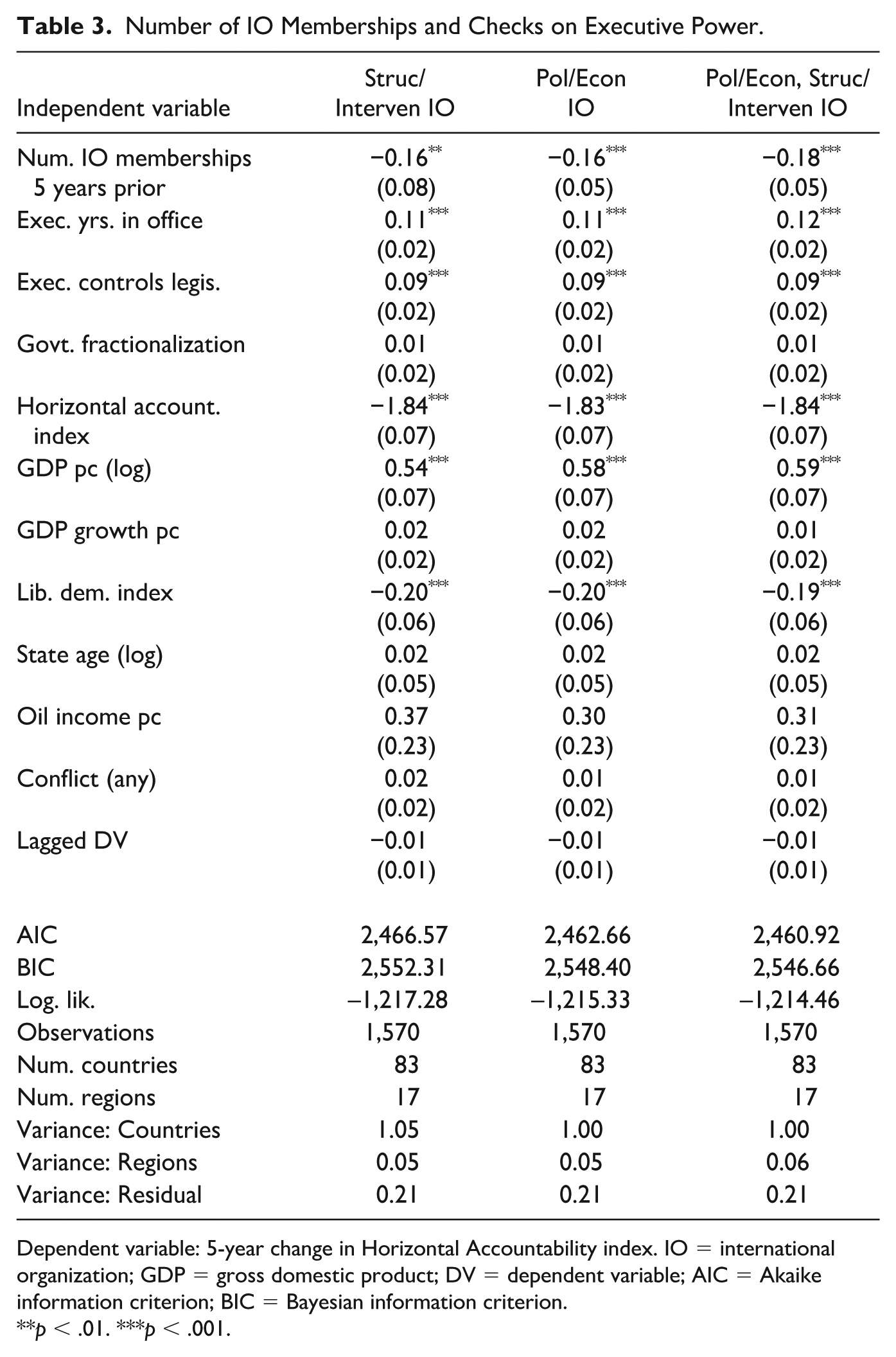
Dependent variable: 5-year change in Horizontal Accountability index. IO = international organization; GDP = gross domestic product; DV = dependent variable; AIC = Akaike information criterion; BIC = Bayesian information criterion.
p < .01. ***p < .001.
I find support for Hypothesis 2: IO membership is linked to subsequent decreased checks on executive power. These results are robust to models that control for globalization and ones that use 3-, 7-, and 10-year changes in executive power as the outcome. As these are linear OLS models, the coefficient on the main independent variable is the movement along the horizontal accountability index over 5 years associated with joining one additional IO.
Domestic Policy Space
The domestic policy space is the range of possible policies political actors can adopt and implement. As we only observe implemented policies, it is difficult to directly measure the policy space; therefore, I rely on an observable implication. In mature democracies, parties distinguish themselves by taking distinct policy positions (Lipset & Rokkan, 1967). However, this is more difficult when the policy space is constrained. Instead in these cases, parties define themselves in terms of populism or broad-based appeals, such as support for anti-corruption, nationalism, or rule of law (Kitschelt et al., 1999; Ward et al., 2015). Thus, one observable implication of a limited policy space is ideological convergence across parties.
The dependent variable is the 5-year change in the distinctness of party platforms in a country, which captures the extent to which publicly available party manifestos are distinct in terms of content or ideology across parties within the same country. In other words, it measures ideological convergence across parties within a state. This variable is coded on a 5-point scale, where 0 indicates few, if any, parties have platforms and/or none have platforms distinct from other parties, and 5 indicates all or nearly all have publicly available and distinct manifestos (Coppedge et al., 2018). I argue higher values indicate states where parties have a more expansive domestic policy space. Therefore, a negative change along this index indicates convergence across parties over time, or a diminished policy space.
For the main independent variables, I consider structured and interventionist IOs, which are especially likely to require and have the tools to enforce policy changes within their member states, and political and economic organizations, which are more likely to impose requirements with substantive policy implications for their member states. I also combine these two and consider structured or interventionist, political and economic IOs.
I control for factors likely to influence party platforms and ideological development, including GDP and GDP growth per capita (Feenstra et al., 2015), a state’s electoral system type and government structure (Cruz et al., 2016), urban population as a percentage of the total population (World Bank, 2017), state age (Correlates of War Project, 2016), and democracy level (Coppedge et al., 2018). I also include the party distinctness variable and the lagged dependent variable as controls. 20 I estimate multilevel models with varying intercepts by country and region, focusing on new democracies between 1946 and 2015. The results can be found in Table 4.
Number of IO Memberships and Domestic Policy Space, Distinct Party Platforms.
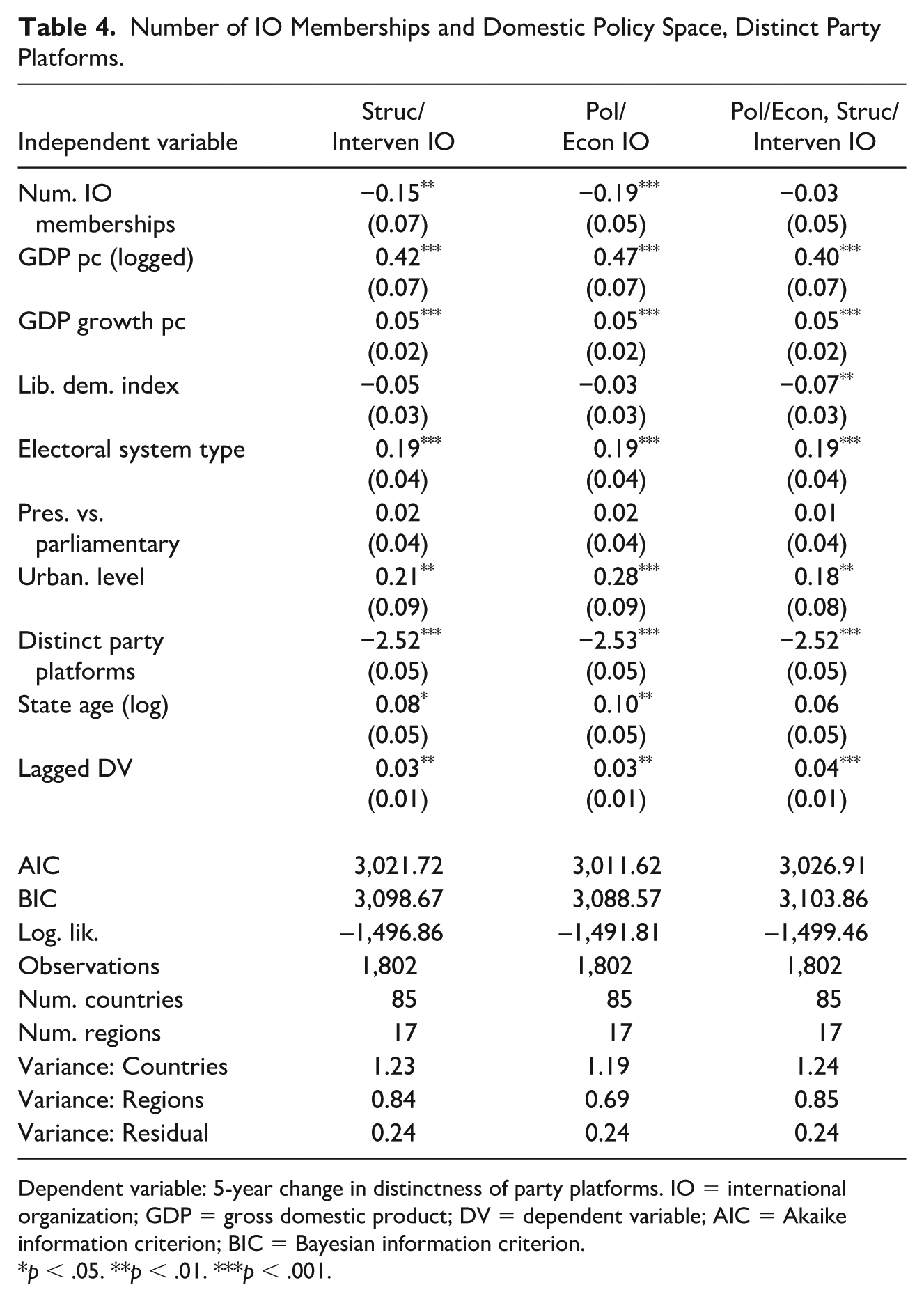
Dependent variable: 5-year change in distinctness of party platforms. IO = international organization; GDP = gross domestic product; DV = dependent variable; AIC = Akaike information criterion; BIC = Bayesian information criterion.
p < .05. **p < .01. ***p < .001.
I find evidence that IOs limit states’ domestic policy space: Membership in structured or interventionist and political or economic IOs is associated with subsequent decreases in the dependent variable, or party platform convergence. As with previous models, the coefficients can be interpreted as changes in the distinctness of party platforms for each additional IO membership. This suggests these externally imposed policies are meaningfully limiting the domestic policy space and restricting the ideological options available to political parties in emerging democracies.
Conclusion
Existing research links IOs and democracy, but tells us less about how these organizations affect domestic democratic institutions outside elections. Building on this work, this article asks the following question: Why are an increasing number of new democracies backsliding despite support from and membership in these IOs? I argue and find that, although IOs are associated with democracy in the aggregate, they are ill-equipped to promote ongoing democratic progress, and they can even unintentionally contribute to backsliding in new democracies. Successful democracies require institutions that organize mass participation in politics, increase government effectiveness, and limit state power (Huntington, 1968). However, IOs shift the domestic balance of power in favor of executives and impede the development of critical institutions via policy requirements; this makes democratic backsliding more likely. Although additional research is needed as trends develop, contemporary examples suggest the outcome of backsliding, at least in the medium term, is a sort of illiberal democracy, rather than authoritarianism (Luhrmann & Lindberg, 2019).
Future research is also needed to develop a more nuanced cross-national measure of state interactions with IOs to clarify how and which IOs are driving the findings reported here. A measure of the percentage of national budget spent on individual IO contributions, or alternatively the specific type and amount of resources IOs devote to individual states, would better capture the intensity of IO–state interactions. These fine-grained data would also help distinguish the effects of aid alone from the impact of IOs more broadly on domestic democratic outcomes.
Democratization and institution building are gradual processes fraught with instability; however, they are ultimately critical for long-term democratic survival. Particularly since the 1980s, the international community has emphasized elections and elite compliance, regardless of the domestic institutional context, to promote and support democracy (Carothers, 2002). However, elections without strong institutions have limited democratizing potential (Flores & Nooruddin, 2016). This article suggests ongoing efforts at international democracy promotion by IOs should be altered. Attempts to accelerate democratization processes risk creating states where citizens participate in politics, but institutions are unable to represent mass interests or govern effectively. The result is a procedurally democratic state, yet one where human and minority rights, judicial independence, media freedom, and other liberal aspects of society are weak and susceptible to manipulation by elected officials.
Widespread international support for universal suffrage and basic human rights precludes encouraging slow transitions to democracy that approximate the long and often violent processes that characterized earlier waves of democracy. Furthermore, globalization makes it difficult for states to gradually modernize and build institutions in isolation from external influence. Instead, IOs should devote more resources to institutional design in new democracies. This requires international democracy advocates to diversify their democracy promoting portfolios and reallocate efforts currently devoted to elections and executive empowerment to other democratic institutions. Rather than treating elections as the first stage of democracy, international actors should instead view elections, which will become increasingly free and fair as institutions develop to regulate them, as the culmination of the democratization process. IOs should also gradually impose policy requirements, rather than requiring states to adhere to an extensive list of conditions during the early years of institutional development. By both directly and indirectly supporting institutional development outside of elections, IOs could offset the challenges faced by young democracies.
Research Data
cps_final_data for The Unintended Consequences of Democracy Promotion: International Organizations and Democratic Backsliding
cps_final_data for The Unintended Consequences of Democracy Promotion: International Organizations and Democratic Backsliding by Anna M. Meyerrose in Comparative Political Studies
Research Data
cps_final_data_excluding_eu for The Unintended Consequences of Democracy Promotion: International Organizations and Democratic Backsliding
cps_final_data_excluding_eu for The Unintended Consequences of Democracy Promotion: International Organizations and Democratic Backsliding by Anna M. Meyerrose in Comparative Political Studies
Supplemental Material
Final_Appendix – Supplemental material for The Unintended Consequences of Democracy Promotion: International Organizations and Democratic Backsliding
Supplemental material, Final_Appendix for The Unintended Consequences of Democracy Promotion: International Organizations and Democratic Backsliding by Anna M. Meyerrose in Comparative Political Studies
Research Data
io_charac for The Unintended Consequences of Democracy Promotion: International Organizations and Democratic Backsliding
io_charac for The Unintended Consequences of Democracy Promotion: International Organizations and Democratic Backsliding by Anna M. Meyerrose in Comparative Political Studies
Research Data
Replication_file_Meyerrose for The Unintended Consequences of Democracy Promotion: International Organizations and Democratic Backsliding
Replication_file_Meyerrose for The Unintended Consequences of Democracy Promotion: International Organizations and Democratic Backsliding by Anna M. Meyerrose in Comparative Political Studies
Footnotes
Acknowledgements
I would like to thank Sarah Bush, Marcus Kurtz, William Minozzi, Irfan Nooruddin, Paul Poast, Alexander Thompson, Sara Watson, and Natasha Wunsch, and three anonymous reviewers for helpful comments. I am also grateful to audiences and participants at the 2017 American Political Science Association Conference, the 2018 Midwest Political Science Association Conference, and the Comparative Politics and International Relations workshops at the Ohio State University.
Declaration of Conflicting Interests
The author declared no potential conflicts of interest with respect to the research, authorship, and/or publication of this article.
Funding
The author received no financial support for the research, authorship, and/or publication of this article.

Notes
Author Biography
References
Supplementary Material
Please find the following supplemental material available below.
For Open Access articles published under a Creative Commons License, all supplemental material carries the same license as the article it is associated with.
For non-Open Access articles published, all supplemental material carries a non-exclusive license, and permission requests for re-use of supplemental material or any part of supplemental material shall be sent directly to the copyright owner as specified in the copyright notice associated with the article.
