




Abstract
This article presents and tests an original theory that truth commissions (TCs) inspire democratic behaviors, but have little discernible impact on democratic institutions. Using quantitative analyses of countries undergoing transitions between 1970 and 2015, and accounting for endogeneity of TCs, we find that these temporary bodies are associated with greater democratic participation and state agent observance of physical integrity rights. However, they have no measurable effect on institutions like fair elections, rules regulating political association, liberal checks on the executive, or judicial independence. This contradicts a key argument in the transitional justice literature that TCs catalyze institutional reform through investigation and extensive recommendations. This article’s findings might encourage those who intend to use these bodies as a tool to promote citizen activism or police restraint. However, the findings might discourage those who hope TCs could jump-start judicial reforms or create a firewall against executive overreach.
Introduction
Do truth commissions (TCs) improve democracy? In the late 1990s, transitional justice (TJ) advocates began to claim that official truth-telling about past political violence is necessary for democratic consolidation (Borer, 2006; Gairdner, 1999; Gutmann & Thompson, 2000). These claims reflected a pervasive enthusiasm for TCs among international donors, human rights NGOs, and diplomats at the turn of the 21st century. Promotion of the right to truth was part of the Zeitgeist immediately prior to the global War on Terror. In 2001, the New York Times published an article noting that “TCs have proliferated, and now every nation emerging from dictatorship or war wants one” (Rosenberg, 2001). The next year, reflecting on the formation of the International Center for Transitional Justice in Manhattan, Jonathan Tepperman (2002, p. 129) wrote: “The truth business…is booming.”
These accounts were right. Between 1970 and 2000, 45 TCs had operated in 34 countries. And these bodies would only get more popular. Between 2001 and 2020, 45 new commissions were mandated in 40 countries, of which 43 were established and ten were ongoing in 2020. 1 Altogether, in the last half-century, TCs have operated for about 300 total years in nearly one-third of the world’s states. Donors like Global Affairs Canada and the UK’s Department for International Development continue to field numerous funding requests for truth-telling programming. At the very least, one could say with certainty that TCs consume a great deal of time and energy.
What one cannot say with any certainty is that TCs actually promote democracy. In fact, there remains very little concrete evidence of a link, and few researchers have taken stock of how early predictions bear out in data. Can it be shown that these temporary bodies, which operate on average for just over three years, exert any sort of independent impact on democratic governance?
Comparativists have good reason to be skeptical. First, empirical research on democratic consolidation finds that the formal rules constituting a regime—for instance, presidentialism versus parliamentarism—are far less crucial to democratic survival than structural economic factors like wealth, inequality, and avoidance of recession (Alexander, 2001; Gasiorowski & Power, 1998; Svolik, 2008). If more permanent political rules do not measurably contribute all that much to consolidation, it would be a stretch to argue that temporary, quasi-judicial bodies like TCs are a significant contributor. Second, the concept of “democratic consolidation” itself may not be all that helpful. As Schedler (1998) argued during the heyday of democratization studies, people mean too many different things when they use the term “consolidation,” making operationalization difficult. Third, as recent events have shown, even the most stable, developed, and powerful states, such as the US and the UK, are subject to autocratic backsliding, which could imply that there is no such thing as steady-state, consolidated democracy (Foa & Mounk, 2016; Levitsky & Ziblatt, 2018; Mechkova et al., 2017).
This article avoids theorizing about consolidation. Instead, following the Varieties of Democracy (V-Dem) Project, we disaggregate the concept of democracy into several component parts and analyze whether TCs are associated with improvements in those components. In so doing, we test a new theory that TCs in transitional states cannot generate more effective democratic institutions, but can possibly encourage democratic behaviors. More specifically, TCs do not improve liberal institutions, nor strengthen judicial accountability, but they might bolster citizen participation in elections and civil society mobilization as well as caution state agents against the use of repressive violence.
Before presenting the results of the analysis, we must address two issues in the current literature on TC impacts. The first is methodological inconsistency. Transitional justice studies analyze widely different cases, include disparate sets of TCs, elide discussion of process, and under-specify the dependent variable, employing many different off-the-shelf measures of democracy, rule of law, or human rights. In short, every study is very different from all of the others. To compound these problems, scholars have still not satisfactorily handled the issue of endogeneity. It is highly probable that the same factors affecting democratic governance also affect the design and implementation of TCs. To study impact, then, one must account for selection effects. The second and more critical issue is theoretical. While researchers propose various linkages between TCs and democratic practices, these are not often grounded in rich conceptual work from the field of comparative democratization. Furthermore, the logic underlying the causal mechanisms is rarely clearly presented. Unanswered is the question of what kinds of democratic practices TCs might alter, and how.
In what follows, we will address these problems and show that TCs, on average, inspire citizen participation and state agent restraint without contributing in any measurable way to liberal institutional reform. One implication is that these TJ mechanisms politically activate certain segments of the population, while also preventing future political repression. Therefore, if practitioners want to mobilize the public and enhance rights protections, then TCs could fit the bill. But the other implication is that TCs are seemingly unable to alter formal institutions of democratic governance. So, if one’s concern is how to beat back the rise of elected executives with expanding or unbridled power (Levitsky & Ziblatt, 2018), these mechanisms will be of less use.
Assessing Truth Commission Impacts
Truth commissions are temporary, officially sanctioned bodies with mandates to investigate specific periods of past state abuses (Dancy et al., 2010). They signal an official determination, genuine or not, to establish the truth about past abuses and to avoid their recurrence. 2 Subject to the creativity of their designers, TCs are able to: provide official acknowledgment of abuses and rewrite history; focus on institutional and structural factors that permitted such abuses; make recommendations for legal and institutional reforms; provide information that is useful for subsequent prosecutions and vetting of abusive public officials; and create a basis for victim reparations and memorialization (Hayner, 2011; Kritz, 1996; Méndez, 1997; Minow, 1998).
The first wave of research on TCs was primarily pragmatic. Practitioners, mostly from Latin America, wrote about these bodies to explain difficult choices they made in transitional states like Argentina, Chile, El Salvador, and Guatemala. The first goal of this early descriptive work was to share experiences across contexts, cataloguing commissions, describing their mandates, and identifying lessons learned (Enalasco, 1994; Hayner, 1994). The second goal was to justify why, in some cases, TCs substituted for a more comprehensive program of criminal accountability. The reason, according to one Chilean practitioner, was that they are rooted in an “ethic of responsibility,” rather than an “ethic of conviction” (Zalaquett, 1992, p. 1430). Because TCs were often framed as a failure to satisfy victims’ need for acknowledgment and right to retributive justice (Benomar, 1993; Mamdani, 2002; Wilson, 2001), proponents were forced to reassure human rights activists that experiments in truth were worth the effort. Amid demands from powerful leaders for a blanket amnesty, the argument went, criminal prosecutions would be imprudent. Instead, the state would provide a second-best option: a commission to provide a record of the truth.
By the end of the 1990s, though, no more justification was needed. Truth commissions’ public image changed. Advocates started to champion truth as a desirable “third way” between vengeance and forgiveness (Boraine, 2000; Minow, 1998). This second-best option became a moral end in itself, and settling for the truth became upholding a right to truth (Dimitrijević, 2006). Partly behind this shift from TC apology to TC promotion was the global popularity of the South African Truth and Reconciliation Commission (TRC) and its key supporter, Bishop Desmond Tutu. He convinced outside observers that TCs did not sidestep justice, but provided a different, “restorative” solution (Chapman & Ball, 2001). With this, TCs became a far more popular way to do TJ (Dancy et al., 2010).
Tutu was instrumental, but a second wave of social science research on TCs may have also played a role in shifting perceptions. In this second wave, which began around the end of the 1990s, TJ scholars theorized that TCs possessed the power to promote “reconciliation” and advance democratic consolidation. 3 Minow (1998, p. 88) wrote that one of the “aspirations” of TCs was to “forge the basis for a domestic democratic order that respects and enforces human rights,” and a 1999 Canadian report stated that “TCs are increasingly being used as one mechanism in a broader strategy to consolidate democratic governance following a period of authoritarian rule” (Gairdner, 1999, p. iii). Others made similar claims over the following decade (Borer, 2006; Freeman & Hayner, 2003; Gutmann & Thompson, 2000).
To their credit, many scholars were careful to issue notes of caution regarding the potential impacts of TCs, especially regarding their democratizing effects (Gibson, 2009; Hayner, 2011, p. 5–6; Minow, 1998, p. 83; Popkin & Roht-Arriaza, 1995, p. 115–116). And some sounded alarms about the surprising lack of evidence for the supposed TC-democracy nexus (de Brito et al., 2001; Mendeloff, 2004). This healthy skepticism invited a third, empirical wave of TJ research. There is now a growing scholarly literature that assesses causal claims, examining the correlation between TJ mechanisms and political violence, respect for human rights, rule of law, and indicators of democracy (Dancy et al., 2019; Kim & Sikkink, 2010; Olsen et al., 2010; Wiebelhaus-Brahm, 2010).
Given the relative youth of this empirical turn in TJ scholarship—now just over a decade old—it is not surprising that controlled comparisons frequently produce contradictory results. For instance, while some studies find no systematic associations between TCs and the extent of democracy, democratization, or trust in democratic institutions (Ishiyama & Laoye, 2016; Wiebelhaus-Brahm, 2010), others find positive associations with democratization (Kenney & Spears, 2005; Taylor & Dukalskis, 2012). And while one large-sample quantitative study finds a positive relationship between TCs and the protection of personal integrity rights (Kim & Sikkink, 2010), others find that the presence of TCs is, on average, associated with less subsequent respect for these human rights (Olsen et al., 2010, p. 147; Wiebelhaus-Brahm, 2010, p. 139). In sum, the question of TCs impacts is still very much unresolved.
Methodological Problems
Thus far, there is still little agreement that TCs exert strong positive or negative effects on democracy, respect for human rights, or the rule of law. In general, many proposed state-level impacts of TJ policies remain in dispute due to lack of convincing cross-national evidence (Stewart & Wiebelhaus-Brahm, 2017; Thoms et al., 2010). The reason for this is partly methodological. Discrepancies in statistical findings on TCs impact likely result from research design issues.
First, studies disagree on the relevant universe of cases to analyze. Some consider only cases that have had TCs (Taylor & Dukalskis, 2012), others consider all democratic or post-conflict transitions (Kim & Sikkink, 2010; Olsen et al., 2010), and yet others include global samples, given available data (Wiebelhaus-Brahm, 2010). Studies also work with different definitions of TCs, and as a result, they compare different numbers (Bakiner, 2014, p. 6; Dancy et al., 2010). Some analyses are very inclusive, incorporating any and all TCs or commissions of inquiry that operated in various contexts (Olsen et al., 2010). Others are quite restrictive, pruning away certain commissions from their samples if: they are not established in an arbitrarily defined time window following a political transition (Bakiner, 2014); they do not produce certain outputs like a final report (Hayner, 2011); or they do not occur at the “state level” (Taylor & Dukalskis, 2012, p. 676). When combined with case selection and modeling choices, the result is widely divergent observations for analysis (see Online Appendix Supplemental Table 3).
Second, with some exceptions (Taylor & Dukalskis, 2012), there is too little analysis of variation in TC outputs. Impact studies have almost always treated TCs as uniform, binary treatments. While scholars often acknowledge that TCs differ greatly in their mandates, composition, resources, procedures, and performance records (Bakiner, 2014; Brahm, 2007; Chapman & Ball, 2001; Hayner, 2011; Kochanski, 2020), this variation has rarely been taken into account in statistical studies.
A third concern is the thorny problem of endogeneity. Scholars argue that TCs can strengthen democratization if they help discredit previously unaccountable institutions, but this seems only to occur if TCs are established in countries where democratization is already well underway (de Brito et al., 2001; Wiebelhaus-Brahm, 2010). These findings suggest that only already democratic states can generate the stability needed for TCs to be instituted properly, and thereby accepted as a legitimate form of justice (Arenhövel, 2008, p. 581). In other words, existing studies cannot determine whether TCs have an independent effect on democratization, or are a symptom of the democratization process.
Fourth and finally, there are significant data limitations of large-sample quantitative studies, not just with respect to TJ mechanisms, but also with respect to outcome measures. This problem is particularly acute in relation to democratization. Large-sample studies of the effects of TCs on democratic governance or democratization invariably employ one or both of two leading measures of democracy, Freedom House and Polity scores, which also have significant conceptual and measurement problems. While the Polity dataset fulfills important scholarly requirements of transparent methodology and reproducibility, the Freedom House dataset does not, raising doubts about its validity and internal consistency over time (Munck & Verkuilen, 2002). More importantly, though, most studies do not precisely specify how TCs would affect the various state characteristics—like openness of elections, political participation, and executive checks—that are lumped together in umbrella indicators such as Polity. This is a problem to be sorted out by theory.
Causal mechanisms
Questions about the impacts of TCs on democracy call out for more theoretical work focused on causal mechanisms. As one review rightly points out, “In reality, the causal links between any form of TJ and the aspects of democracy measured by these datasets [Polity and Freedom House] are likely to involve one or more intervening variables” (Stewart & Wiebelhaus-Brahm, 2017, p. 114). Better mid-range theory would isolate these intervening variables while addressing many of the methodological problems present in the current literature.
Transitional justice scholars have, sometimes only implicitly, provided mid-range theories on which we can draw. One set is focused on attitudes. Some surmise that TCs contribute to individual healing, reconciliation, or a change in collective values (Kim, 2014; Llewellyn, 2011; Minow, 1998), all notions that rely on altered perceptions in response to TC operations. Influential case studies claim that truth-seeking processes can shine a light on previous injustice, break “the cycle of revenge and hatred between former enemies” (Hayner, 2011, p. 182), help societies restore a condition of “political morality” (Du Toit, 2000, p. 125), or bolster “the core values of democracy” (Kim, 2014, p. 167). Skeptics challenge that there is little generalizable evidence for these claims (Graybill & Lanegran, 2004; Mendeloff, 2004; Millar, 2011). While in some cases they may have positive impacts, in other cases TCs could actually sharpen societal divisions, provoke backlash from spoilers, or undermine democratic transitions because establishing a record of past abuses actually generates resentment among both victims and perpetrator groups (Snyder & Vinjamuri, 2003; Subotic, 2009). For instance, observing that South Africa witnessed few moves toward "consensus across communities" (van der Merwe and Chapman, 2008, p. 277), and in fact experienced an overall decline in perceptions of fairness in the years following the completion of the TRC's work, some case experts contend that the country's social bargain--amnesty in exchange for truth recovery--actually "unraveled" over time (Backer, 2010).
Even if they diverge over whether TCs ameliorate or inflame social tensions, theorists tacitly agree that their operations attract attention and changes minds—more so if TCs’ proceedings and reports are publicized (Taylor & Dukalskis, 2012). Still, it may be unreasonable to expect TCs to improve democracy through uniform, positive shifts in public attitudes. Truth-seeking processes leave some groups exultant and others exasperated, which could lead to opposing shifts in aggregate support for transitional democratic regimes as a whole. Even though some internally valid case studies argue that TCs promote democratic values, empirical studies find few externally valid relationships between TCs and greater public satisfaction and trust in institutions (Backer, 2010; Ishiyama & Laoye, 2016; van der Merwe and Chapman, 2008). More fundamentally, it remains unclear in comparative research whether pro-democracy attitudes or trust are necessary conditions for the proper functioning of democratic society in the first place (van der Meer, 2017). In fact, a paradox of modern democracy is that many citizens in the oldest and more stable democratic countries “possess little confidence in some key democratic institutions” (Dahl, 2000, p. 35). In short, TCs may have little effect on attitudes, which in turn may have little effect on the health and longevity of democratic regimes.
Another set of theories brackets public attitudes, accepting that they are context-dependent and volatile, in favor of greater focus on democratic institutions and practices. One of the most common expectations in the literature is that TCs generate pro-democratic institutional reforms. For instance, Teitel (2000, p. 88) writes, “When the ‘truth’ becomes known …the shared knowledge often sets in motion other legal responses, such as sanctions against perpetrators, reparations for victims, and institutional changes.” This kind of claim is cited in numerous other works as well (Freeman & Hayner, 2003; Olsen et al., 2010; Skaar et al., 2015; Wiebelhaus-Brahm, 2010). In a nuanced treatment, Bakiner “process-traces” the causal mechanisms linking TCs’ operations and outputs to institutional reforms. He argues that commissions exert influence by forging follow-up bodies meant to monitor implementation, or by encouraging judicial accountability for human rights violations. Similarly, Kim and Sikkink (2010, p. 954) offer a positive assessment of TC impacts, finding that they are associated with declines in political repression because they “provide information and communicate norms.”
We build on this second set of theories, which at a minimum converge on the idea that TCs serve an expressivist function, sending signals to attentive political actors and groups (Bakiner, 2014). However, two questions remain: who receives the signals, and how do these signals deepen democracy? Bakiner (2014, p. 30) writes that “the normative impact of TCs on politics and society is undeniable,” but “future research should devise innovative and precise data collection and analysis tools to assess the magnitude, direction and specific causal mechanism.” The reason for this statement is that, despite a high level of systematicity, most in-depth theory on TCs only assumes the causal mechanism: that leaders produce institutional changes, or state actors change their practices, in direct response to TC outputs. In what follows, we subject these assumptions to a series of empirical tests. But first, we present an integrated theory of TCs and democracy that combines insights from previous research and generates new expectations.
Theory: TCs and Components of Democracy
Our theory is that TCs are institutionally embedded. These temporary bodies, more often than not, are created, resourced, and staffed by the very regimes and governments they are meant to reform (Wilson, 2001). Given this, TCs are unlikely to have an independent or external impact on formal democratic institutions; however, it is quite plausible that they alter some democratic behaviors. This theory requires that one carefully define democracy, which is a regime type that prioritizes the regular alternation of power in accordance with the will of the majority. But democracy has many constitutive components. Minimally, in the formulation by Robert Dahl (1971), an electoral democracy must have competitive elections in which people participate. Maximally, a liberal democracy must also include checks on the executive, rule of law, and minority rights protections.
Democracy Conceptualized.
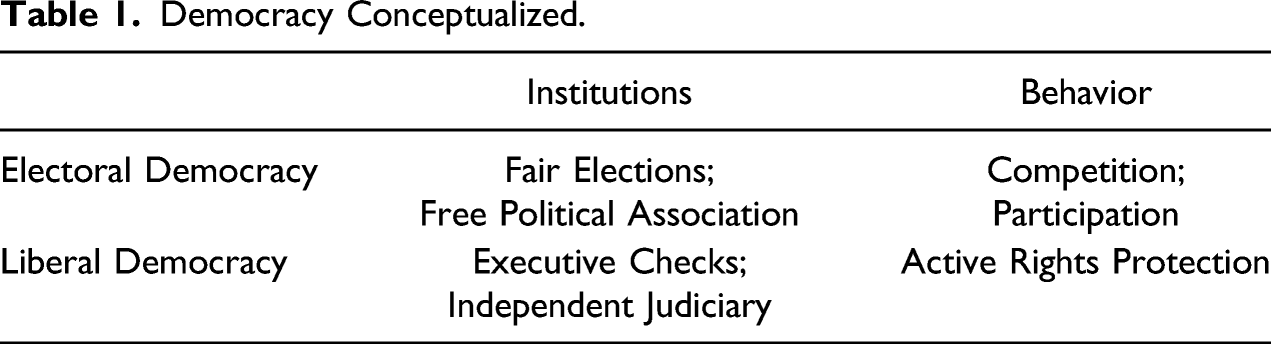
Democratic Institutions
The causal logic linking truth-seeking to institutional reform is rarely explained in detail. To exert an impact on democratic institutions, especially those measured by indicators like Polity and Freedom House, TCs would either have to affect the operation of fair and contested elections, or empower legal institutions to constrain majority or executive power. The question is, through what mechanism could TCs influence such institutional change? One possibility is that they publicly demonstrate procedural fairness and even-handedness in their own operations, thereby setting an example for rule of law institutions (Gibson, 2009). Generalizing based on the South African TRC, Taylor and Dukalskis (2012, p. 673) write, “breaking with a past of confidential decisions and inaccessible governance, TCs can bring the public into their proceedings. Procedural openness in the form of public hearings allows for this possibility.”
For most theorists, though, the catalyst for institutional reform is not just procedure, but the substantive outputs of a TC report. These reports usually present a history of political violence, while also issuing concrete recommendations to current and future governments. Llewellyn (2011, p. 352) writes about this feature as a strength of these bodies: “TCs were able to look beyond individual instances of abuse—the focus of trials—to identify broader patterns…and to recommend legal and institutional reforms…” The mandate of TCs to make written recommendations for reform is repeatedly emphasized as a source of positive change (Bakiner, 2014; Hayner, 2011; Minow, 1998). For instance, El Salvador’s (1993) TC report recommended that security forces be purged of rights violators. The report plainly states, “the Commission recommends that [implicated officers] be dismissed from their posts and discharged from the armed forces” (Comisión de la Verdad para El Salvador, 1993, section V). This and other proposals are sometimes credited for later attempts to de-militarize Salvadoran security forces (Brahm, 2007, p. 28).
It is correct that “TCs make recommendations for political, judicial, and educational reforms that are intended to set the new transitioning state on a better path toward a stable and properly functioning democracy” (Ben-Josef Hirsch et al., 2012, p. 387, our emphasis). It might also be true that in some limited cases TCs set an example for public-facing democratic and deliberative processes. However, it is hard to imagine that these features, though well-intended, have an independent impact on those electoral or judicial institutions captured in most quantitative measures of democracy.
First, altering electoral institutions requires political will and powers of enforcement. Most TCs do not make recommendations concerning election management or the regulation of electoral manipulation. But even if they did, they would likely fail because “they do not raise the likelihood that electoral manipulation will be discovered and punished” (Greenstein & Harvey, 2016, p. 7). Truth commissions are simply not mighty enough, nor do they operate long enough, to have an impact on the way elections are practiced. Nevertheless, and crucial to our concerns, this has not stopped many researchers from using elections-heavy measures of democracy like Polity or Freedom House to gauge the effects of TCs.
It seems more plausible that TC recommendations would have an impact on judicial reform because legal actors might be more responsive to proposed organizational or procedural changes based on sound guidance. However, this raises a second reason that TC recommendations are unlikely to produce measurable effects. They are regularly ignored. Case-study research finds that TC recommendations are rarely implemented (Hayner, 2011), and thus have only limited impacts on reform (Wiebelhaus-Brahm, 2010). Bakiner (2014) discovers that TCs have some impacts on courts, as a small number of legal cases incorporated TC findings as contextual information. But the author concludes: “The design of TCs, which curtails their judicial powers, accounts for their relative insignificance in judicial processes. Evidence also suggests that even when commissions make full use of their capacity to facilitate prosecutions, courts still neglect their findings” (Bakiner, 2014, p. 22). Even though theorists still find promise in TCs’ power to recommend, case research suggests that impacts on judicial institutions are circumscribed at best.
A third reason that TCs might have limited effect on institutional change is that they are products of the ruling government. TCs are sometimes used by culpable state agents as public relations “smoke screens” to mask continuing abuses (Mendeloff, 2004; Snyder & Vinjamuri, 2003). Because they direct attention to institutional and structural causes of abuses, they tend to neglect individual responsibility for crimes and the importance of judicial processes (Tepperman, 2002; Weiffen, 2012). Perversely, this could deflect away from judicial reform and perpetuate impunity. Because they are public spectacles, TCs may absorb attention away from corrupt institutions, leaving those problematic institutions untouched and intact. Wilson (2001, p. 18–19) writes that the South African TRC functioned as a “liminal institution” that sought to legitimate the post-apartheid regime, not by engaging in a much-need technocratic reform of the judiciary, but by creating a kind of theatre that sidestepped the regular operation of the courts. In short, TCs and their recommendations are unable to exert an independent and lasting effect because they are captured by, reliant on, or instruments of governments they are supposedly trying to change. This is perhaps why Snyder and Vinjamuri (2003, p. 20) suggest that TCs “contribute to democratic consolidation only when a pro-democracy coalition holds power in a fairly well institutionalized state.”
Our theory is thus suspicious that TCs have observable, independent effects on democratic institutional change. Nevertheless, it remains possible that TCs transcend the constraints of the circumstances in which they are created, exerting influence through various channels. For instance, it could be that transnational activists use written recommendations to generate outside pressure on government officials to pursue electoral or judicial reforms (Keck & Sikkink, 1998). Yet this possibility has not been sufficiently tested using disaggregated measures of democratic institutions. Therefore, to be systematic, we formalize two positive predictions common in the literature, though they do not extend from our theory. Each hypothesis is conditioned on the publication of a report with various recommendations. If TCs were to inspire institutional change, a necessary minimum condition would be the publication of a report. Without accessible report texts, local or transnational reformers possess no list of suggestions or written commitments for framing follow-up demands on government. Electoral Reform Hypothesis: When they produce a public report, TCs will be associated with improvements to electoral institutions. Liberal Reform Hypothesis: When they produce a public report, TCs will be associated with improvements to liberal democratic institutions, including positive judicial reforms.
Democratic Behaviors
Many analyses of democracy focus exclusively on the arrangement of formal institutions, including standing legal and constitutional provisions. Often neglected are democratic behaviors. Elections are cheap if citizens do not meaningfully participate. And constitutionally declared civil and political rights are empty if military, police and security forces routinely capture, torture, and kill rights-bearers. Regardless of their supposed relationship to democratic institutions, is it possible that TCs influence democratic behaviors?
One straightforward answer is that TCs alter behavior by sending signals. After all, these bodies can be highly publicized affairs, attracting attention in national, and sometimes global, news media. More recent TCs, particularly those since the late 1990s, have also made common practice of conducting hearings that can be attended by lay members of the public, journalists, and foreign visitors (Freeman, 2009). The messages that TCs transmit through their public relations could alter collective behavior, much as high-profile trials or congressional hearings can serve an expressivist social function. The message being sent, however honest or dishonest, is that the government means to recognize yesterday’s political violence, establish accountability, and offer reforms to remove remaining enclaves of lawless power (Gairdner, 1999). In short, the new regime intends to distance itself from the country’s violent or authoritarian past (Minow, 1998; Teitel, 2000).
Who receives this message? In one formulation, the audience is citizens, or civil society actors, who for years have mobilized for recognition and political change (Crocker, 2000; Kim, 2014). With the establishment and operation of a TC, these groups are provided a forum for engaging politically, with little fear of reprisal. The effect is that TCs bring “the views of different groups into a single realm of comprehensibility” (Taylor & Dukalskis, 2012, p. 674). In so doing, these bodies encourage societal actors to engage in broader democratic politics and respect the rule of law (Arenhövel, 2008; Brahm, 2007; Weiffen, 2012).
Some may argue that a theory based on signaling is too abstract. The symbolism of TCs can seem far removed from the cynical political realities of transitional periods. However, it is worth noting that any theories connecting TCs to macro-social outcomes must rely on signaling in some form. Otherwise, why would one assume TC recommendations to be important? The reason is that, if implemented by parliamentarians or presidents in a transitional country, those recommendations could strengthen liberal rule of law. This causal story relies on government officials getting a message from TC reports that certain reforms are critical. In this version, as in theories linking TCs to political participation, messaging is still important. The only difference is the audience. For the institutional reform expectation, the TC is communicating recommendations directly to the ruling government itself. For the participatory democracy expectation, the TC’s primary audience is citizens.
But one more audience exists. In some accounts, TCs may deter repression. For this to happen, the state’s agents of violence must receive the message that change is afoot. In authoritarian and civil war countries, these agents are provided a great deal of latitude to enforce order however they see fit. And in states with weak governments, central officials sometimes have a difficult time controlling their agents in the field. In either case, the result is violent repression carried out by police, security forces, and pro-government militias.
Mounting research finds that these agents of violence are deterred by criminal prosecutions (Dancy et al., 2019; Jo & Simmons, 2016; Kim & Sikkink, 2010). However, this is not just because of the potential material costs of punishments, which include prison time. It is also because of “normative costs” (Kim & Sikkink, 2010, p. 957). TCs, like trials, serve a powerful communicative function. They can spread stigma. The desire to avoid being called a rights violator in truth-telling processes, or to be associated with the violence of the past, might be enough to alter an agent’s willingness to commit repressive acts.
The theory that TCs influence change by transmitting democratic norms to citizens and state agents generates the following hypotheses: Participation Hypothesis: TC operation will be associated with higher levels of democratic participation. This effect will be amplified if the TC produces a public report. Repression Hypothesis: TCs operation will be associated with a decrease in state repression. This effect will be amplified if the TC produces a public report.
Unlike the first two hypotheses, these do not strictly rely on TCs producing public reports. TCs could send signals even in the absence of concrete recommendations, simply by inviting state agents, rebels, or victims into the truth-telling process and holding public proceedings. However, we expect the behavioral effects of TCs to be magnified by a public report. Having previous abuses acknowledged in an official report lends credibility to pro-justice movements who might respond by further mobilizing. And if the publication of a report recommending prosecutions or judicial reforms successfully creates the perception that state agents will be held accountable in the future, it might feasibly deter those agents from committing violent acts.
Finally, a caveat about attitudes. While all four of our hypotheses linking TCs to democracy might imply changing attitudes, they do not rely on actors in society holding a positive view of TJ or the new democratic regime. Nor do these expectations require the promotion of healing, trust, or reconciliation. Citizens may exhibit negative attitudes toward others in society, or toward TCs themselves. Even so, the public discussion surrounding TCs could still serve as a jumping-off point for engaging in political contestation. Regardless of its positive or negative valence, such engagement would involve participating in the new democracy. Additionally, agents of violence probably begrudge commissioners for conducting oversight into their business. However, these agents could still change behavior to avoid spotlight. In this sense, it might be more accurate to think of TCs in relation to agonistic, or highly contested, modes of democratic engagement, rather than deliberative or harmonious forms of involvement (Mouffe, 2013). The bottom line is this: TCs could excite feelings of justice or injustice, but where those feelings are expressed in public, and resolved short of violence, they nevertheless contribute to democracy.
Data and Methods
We now shift to our strategy for testing the theory that TCs have an impact on democratic behaviors, but not institutions. The Methodological Problems section outlined four methodological shortcomings of previous studies: (1) case selection, (2) lack of data on variation in TCs outputs, (3) choice of outcome measures, and (4) endogeneity. In this section, we start by explaining how we confront these challenges.
Sample
Our sample incorporates all relevant cases for analyzing TC impact on transitional democracies. The sample is not so general as to include all cases—such as TCs that occur under authoritarian or stable democratic regimes—but it is also not so specific that it unnecessarily narrows the number of informative observations. Our sample incorporates all democratic transition countries, in three senses of the concept. First, we include any country that has had a democratic transition since 1970, from the year of transition. To determine transitions, we use only the baseline electoral contestation criterion applied by Boix et al. (2012) in version 3 of their democracy dataset. Where they code a change from non-democracy to democracy from one year to the next, we include this case as a democratic transition. Second, we incorporate new states established or reestablished since 1970 if they are democratic in the first year of their existence. Third and finally, we include any democracies that experience internal conflict, because TCs are often established to confront periods of political violence (Loyle & Davenport, 2016). To determine these cases, we rely on the Uppsala Conflict Data Programme (UCDP; see the Methodology section). Once a country enters the sample, it remains, even if it experiences autocratic reversion. 4 We end the period of analysis in 2016, because there is insufficient information for coding the TC variables thereafter (see the next section).
Truth Commission Variables
To capture the richest information on TCs, we use variables constructed from the Transitional Justice Research Collaborative Database (TJRC), 5 which codes qualitative and quantitative differences in TJ mechanisms used globally (Dancy et al., 2019). It includes over 10,000 event records, and it contains dozens of disaggregated variables related to prosecutions, truth-telling procedures, and amnesties. The TJRC allows us to code measures that go beyond previous studies in two ways.
Operationalization of TC Variables (1970–2015, Country-Years in Sample).
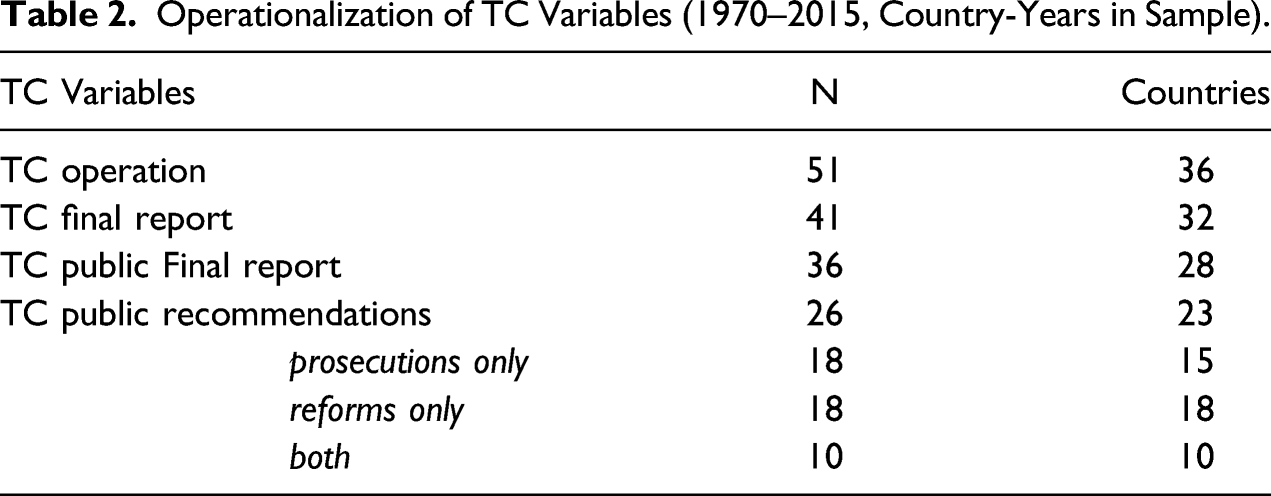
TC = truth commission.
A second advantage to using the TJRC data is that it allows us to operationalize measures more nuanced than whether a TC existed or did not. As depicted in Table 2, 7 we make use of four dichotomous indicators coded from the TJRC, all of which capture in stepwise fashion increasingly robust TCs outputs. The first variable includes all TCs that operated at all, including those that did not officially complete their work or disbanded without producing observable output. The second variable covers all TCs that produced a final report. The third variable is restricted to those whose final report was made reasonably accessible to the public, meaning that it is available for borrowing or purchase in print or is available as a digital download. The fourth variable further requires that the public final report includes specific official recommendations for either institutional reforms or prosecutions. Because these kinds of recommendations often overlap, we include the union of these recommendations in the main results rather than examining them separately, a decision which does not change the direction or magnitude of our findings. The binary variables are coded “0” when the conditions are not met, and “1” for the first year that the conditions are fulfilled and for all subsequent years. For countries with multiple TCs, we adjust the coding to reflect the most recent experience to date. 8 All but the first variable consider only TCs that have completed their work by producing a final report and do not include ongoing commissions. Like previous studies, the models employ binary TC variables, but taken together, these variables capture a range in the quality of commission outputs.
Dependent Variables
We use the V-Dem dataset to measure different dimensions of democracy. This data collection project is a large-scale effort using Bayesian item response theory measurement models to produce democracy indices and sub-component variables. These models aggregate ordinal ratings on a given question by multiple subject-specific country experts and provide estimates of uncertainty due to disagreement and systematic measurement errors (Coppedge et al., 2020). Higher values of V-Dem measures always indicate “better” outcomes.
Rather than testing our hypotheses on the broader democracy indices, which all use electoral democracy as the minimum criterion, 9 we employ several component measures addressing institutional and behavioral aspects separately. Doing so allows for greater precision in testing our hypotheses. To test the Electoral Reform Hypothesis, we use V-Dem’s clean elections and freedom of association indices. To test the Liberal Reform Hypothesis, we use the liberal component index; this combines variables measuring equality before the law and individual liberties, judicial constraints on the executive, and legislative constraints on the executive. The index is intended to capture the extent to which individual and minority rights are protected “against the tyranny of the state and the tyranny of the majority” (Coppedge et al., 2020, p. 48). We also use the V-Dem judicial reform measure as an outcome because, as discussed in the Democratic Institutions section, the TJ literature often claims that TCs help prevent future abuses by encouraging institutional reforms that improve judicial accountability. This measure answers the question: “Were the judiciary’s formal powers altered this year in ways that affect its ability to control the arbitrary use of state authority?” The original expert ratings range from reducing to enhancing the judiciary’s ability to control arbitrary power.
To address democratic behaviors, we turn to measures distinct from the first batch. The Participation Hypothesis is tested with V-Dem’s participatory component index, which emphasizes active participation by citizens in electoral and non-electoral political processes (Coppedge et al., 2020, p. 49). This variable combines indices measuring civil society participation, direct popular vote, and the power of sub-national elected governments. To examine the effect of TCs on repression, we shift away from V-Dem and use the third version of the latent physical integrity (LPI) measure created by Schnakenberg and Fariss (2014). A key inferential issue in human rights research is measurement bias due to information effects and changing standards of human rights accountability (Clark & Sikkink, 2013, p. 175–77; Fariss, 2014; Keck & Sikkink, 1998, p. 195). The LPI measure is one of the most sophisticated efforts to date to deal with these concerns. While the LPI measure primarily addresses the dynamic standard of accountability, it is also useful in addressing concerns about information effects, since it combines information from a variety of different human rights measures, several of which are based on different source materials (Fariss, 2014). For robustness checks, we also run the models on several V-Dem measures of repression (see Online Appendix Supplemental Figure 6).
The V-Dem democracy component indices are on a zero-to-one scale, while the LPI, judicial reform, and repression measures are on a standardized interval scale similar to a normal Z-score. For easier comparison between results for the different outcome variables, we convert these to a zero-to-one scale.
Methodology
As in other social science research fields, selection effects are a thorny inferential problem in TJ impact studies (Thoms et al., 2010). A common approach in econometrics is instrumental variable regression, whereby an instrument is used to isolate exogenous variation in an otherwise endogenous variable. While this technique is well established, valid instruments are notoriously difficult to find because they must fulfill the exclusion restriction. This assumption, that the instrument only influences the outcome variable through the mediating endogenous variable, cannot be empirically tested, but must be theoretically supported (Sovey & Green, 2011). We contend that the regional incidence of TCs is a reasonable instrument, because TCs are regionally clustered, suggesting diffusion processes (Kim, 2019). However, there is no obvious reason why a country should alter its democratic institutions or practices because neighboring countries established TCs. Our regional diffusion variable is based on how many countries within the geographic region have had experience with transitional TCs regardless of the quality of their outputs. 10
As all outcome variables are continuous, we employ linear regression. The country-year structure of the data entails dependence of observations within countries over time. Due to unobserved, time-constant country heterogeneity (or unit effects), a standard linear regression model can lead to poor fit and misleading estimates because of omitted variable bias (Clark & Linzer, 2015). To address this, we implement both fixed-effects and random-effects models for each model specification. In many cases, both lead to the same substantive conclusions, despite their difference in interpretation: the fixed-effects models average only the within-country effects of variables, while the random-effects models estimate the combination of within and between-country effects.
The analyses include several covariates to account for alternative explanations. All variables, including the TC measures, are lagged one year to ensure against reverse causation. Descriptive statistics are provided in Online Appendix Supplemental Table 6.
First are controls for overall levels of state violence in a country. All models not using repression as the dependent variable include Schnakenberg and Fariss’s LPI to account for recent human rights practices. Every model also includes the LPI cumulative mean for a given country from 1949, to account for historical legacies of repression, because countries that experienced longer or more severe periods of human rights violations are more likely to establish TCs and face greater challenges in altering institutions and practices.
Second are controls for civil society. A robust civil society is likely a key driver of both the establishment of TCs and outcomes like democratic participation and institutional reform (Crocker, 2000; Zvobgo, 2020). Accounting for the effect of civil society in our models is challenging because existing V-Dem variables measuring government protections for civil society or civil society practices are, by construction, endogenous to some of our measures of institutional and behavioral democratic outcomes, respectively. Thus, depending on the outcome being modeled, we incorporate one or both of two V-Dem variables to account for the role of civil society organizations (CSOs). Entry and exit measures the extent to which the government achieves control over CSO access to public life. Participatory environment measures the extent of popular involvement, referring both to the diversity of CSOs and the tendency of people to be active in them. The models employing institutional dependent variables exclude the CSO entry and exit variable because it is a sub-component of V-Dem’s institution-based liberal component index. Models with behavioral dependent variables exclude CSO participatory environment, which is a sub-component of V-Dem’s behavioral participatory component index. In short, when constructing the models, we are careful not to include civil society covariates that are endogenous to the outcomes of interest.
Third are controls accounting for time and context. A variable indicating years since the last democratic transition accounts for two possible theoretical claims. One is that TCs may be more likely to be established soon after a transition. Another is that, if democracy is slowly consolidated over time, more robust democratic institutions and practices should be observed later, regardless of the presence of a TC. We also include indicators of the type of the last democratic transition by distinguishing negotiated or pacted transitions from those following ruptures, in order to address the possibility that certain types of transitions are more likely to involve TCs and to influence democratic outcomes (Dancy et al., 2019; Olsen et al., 2010). The reference category for these indicators is transitions due to a new state or no transition in the case of established democracies experiencing conflict. Like the TC variables, unless a new transition occurs, this variable is carried forward to subsequent country-years.
Fourth are covariates for structural features like wealth, population, and violent conflict. The natural log of real gross domestic product (GDP) per capita (in constant US dollars) controls for a country’s level of national wealth, because democracy and human rights protection are often found to be strongly correlated with economic wealth. Population size, also logged, accounts for possible challenges posed by larger countries to democratic governance and the greater opportunity to violate human rights in larger populations. These data are from the World Development Indicators database (World Bank, 2018). An indicator for internal (including internationalized) armed conflict, coded from the UCDP/PRIO Armed Conflict Dataset, controls for threats to national security, which may undermine both democratic institutions and human rights protection. This variable distinguishes between lower-level conflict, with at least 25 battle-related deaths, and war, which has at least 1000 battle-related deaths per year (Pettersson et al., 2019).
Finally, in some models we include the value of the dependent variable in the first year that each country is included in the sample, in order to account for possible ceiling effects. Because fixed-effects models cannot control for time-invariant variables, this variable is only included in the random-effects models.
A few variables are subject to a small fraction of missing data (see Online Appendix Supplemental Table 6). To address these missing data, to use as much of the available information in other variables as possible, and importantly, to incorporate the estimated uncertainty of the latent V-Dem and LPI measures, we employ multiple imputation. For imputing missing values, this approach assumes a multivariate normal distribution of measurement error in predicting missing from existing data to produce multiple datasets. Further, for the latent variables based on measurement models, we use the estimated means and standard deviations provided by their authors to draw their values from the normal distribution for each dataset (Coppedge et al., 2020; Fariss, 2014). Statistical estimates and standard errors from analyses of each resulting dataset are then aggregated to incorporate the additional uncertainty due to the imputations and measurement models. 11
Results
The main results from the instrumental variable models are reported in Figure 1, which features statistical associations between four different TC variables and six outcome variables. In any given sub-figure, the left-hand estimate is the fixed-effects (or within) estimate while the right-hand estimate is from the random-effects model. Estimates are shown with 95% confidence intervals; where they do not touch the zero-line, the effects are statistically significant. Since higher values of the outcome variables indicate higher or “better” levels of democratic components, judicial reforms, or respect for rights, a positive estimate indicates improvement, and a negative estimate indicates decline. With some exceptions, the fixed-effects and random-effects models often lead to similar conclusions. Complete regression tables for all results are provided in the Supplemental Appendix. Effects of truth commissions.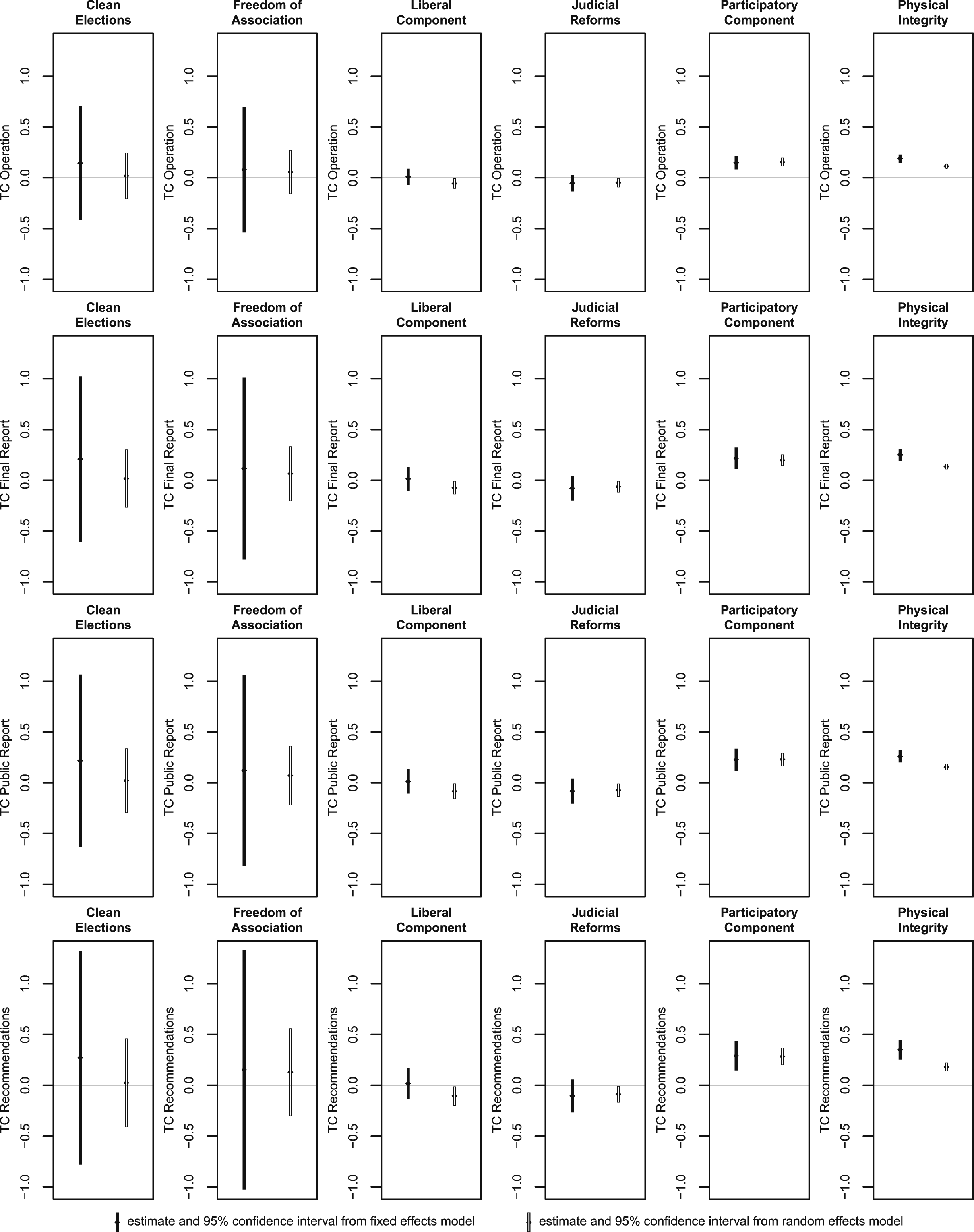
The first thing to note is that the Electoral and Liberal Reform Hypotheses are not supported. We cannot reject the null hypothesis that TCs have no discernible effects on fair elections or freedom of association, key minimal conditions for electoral democracy. This echoes previous cross-national studies that have failed to demonstrate a relationship between TCs and election-heavy indices like the Polity score (Olsen et al., 2010, p. 147). Moreover, estimates for effects of TCs on the liberal democracy component are statistically indistinguishable from zero in the fixed-effects models, but are negative in the random-effects models. The null hypothesis stands, just as in prior studies that analyze the relationship between TCs and aggregate indices of civil and political liberties (Wiebelhaus-Brahm, 2010, p. 140).
The findings for the judicial reform variable (column 4 in Figure 1) are even less reassuring: regardless of the TC variable and of the estimator employed, TCs are associated with an apparent reduction in the judiciary’s ability to provide accountability for the arbitrary use of state power, and the random-effects estimates are again statistically significant. Prospects for reforms are not raised by public reports; TCs with public reports appear little different from those commissions that meet the minimum qualification of having merely operated at some point.
Lack of support for the institutional hypotheses is consistent with the theory, but we urge caution in interpreting these findings. Some of the institutional models account for relatively little of the total variation, as indicated by the average R2 of the regressions (2–4% for clean elections and freedom of association, and 1–14% for judicial reform, versus the more substantial 37–42% for the liberal democracy component). This suggests that other factors not accounted for in these models are more important in determining the strength of basic democratic institutions, which is consistent with our theory. Still, at the very least, the negative association with judicial reform is an important finding because it casts serious doubt on the key claim in the TJ literature that TCs contribute to strengthened rule of law institutions. Yet again, we find no evidence that allows us to reject the null hypothesis that no such association is present.
However, the results presented in the remaining two columns in Figure 1 offer consistent and strong support for the claim that TCs have beneficial impacts on democratic behaviors. In support of the Participation Hypothesis, TCs are associated with statistically significant improvements to the participatory dimension of democracy, regardless of the estimator. The substantive significance of this finding is larger than Figure 1 may let on. Because all the outcome variables are on a zero-to-one scale, one can interpret the coefficients for the binary TC variables in terms of percentage-point changes. The existence of a TC is associated with a 15 percentage-point increase in the participatory aspect of democracy. One interpretation is that TCs send signals to democratic constituencies merely by conducting their business. However, as expected, this relationship strengthens in magnitude with a public report (23 percentage-points). This is suggestive evidence that TCs that reach a wider audience have a greater effect on the demos, encouraging more local engagement and activism.
Additionally, in strong support of the Repression Hypothesis, LPI improves in the wake of TCs operation. Contrary to previous studies, which have presented mixed findings concerning TCs and the behavior of police and security forces, the models report a robust association between these commissions and fewer violations of physical integrity. Though the participatory democracy component and LPI are not highly correlated, the substantive effect of TCs on each is remarkably similar. Truth commission operation is associated with a 19 percentage-point improvement in repression in the fixed-effect model, and TCs with public recommendations are associated with a 35-percentage point improvement. These findings are not sensitive to the operationalization of the repression variable. In additional analyses (see Online Appendix Supplemental Figure 6), we also find consistent beneficial effects on human rights protection when we substitute V-Dem measures of specific acts of state violence—torture and political killings—and CSO repression as the outcome variables. Overall, the findings from these 24 models provide a good deal of evidence in support of the expectation that TCs catalyze pro-democratic behaviors.
A third finding is that, for each outcome measure, the conclusions remain the same regardless of whether the final report is made public or whether they make recommendations, providing no support for the argument that variation in TC outputs accounts for variation in their effects (see Brahm, 2007; Kochanski, 2020). This is surprising. After all, some regimes set up TCs to fail because they seek to dodge accountability. These TCs are not provided the funding, staff, or resources to carry out their tasks and thus cannot accomplish as much as those backed by political will. Could it really be the case that such weak TCs generate impacts similar to serious and robust ones?
One possibility is that the constancy of the results across different TC outputs is merely a byproduct of the research design. Due to the instrumental variable approach, each TC treatment is effectively considered to be independent of the others. For instance, in the third row of Figure 1, the effect of TCs with public reports is isolated from all other cases—including those with no TCs at all and those that had TCs without public reports. But this might be too strict a test for the effects of various outputs. To further investigate, we restrict the sample to include only those observations with any TC experience, however minimal; this means we drop all country-years for which the first TC variable is coded as zero. We then test whether TC outputs are associated with improvements in outcomes in comparison to the common TC baseline. Moreover, we disaggregate the recommendations variable. If various outputs such as reports with certain recommendations add value over the mere existence of a TC, then one should observe positive and statistically significant coefficients on some TC output variables.
However, as Figure 2 demonstrates, this is not the case. As before, in no models are variations in outputs associated with improvements in democratic institutions. Across the four variables, TC outputs are negatively associated with judicial reforms and physical integrity repression in the fixed-effects models, and recommendations for prosecutions also have a negative effect on repression in the random-effects model. Moreover, public reports and prosecution recommendations also have negative effects on the participatory component in the random-effects models. All other models contain results that are statistically insignificant. It does not appear that the publicity of the report, nor the extensiveness of its recommendations, adds benefit in terms of these democratic outcomes. While these findings are not enough to conclude that variations in outputs are inconsequential, the evidence lends no cross-national support to the claim that more public or more productive TCs will generate greater influence on the trajectory of institutional democracy. If anything, in these analyses, more robust outputs are sometimes associated with worse outcomes. Effects of truth commission outputs in restricted sample.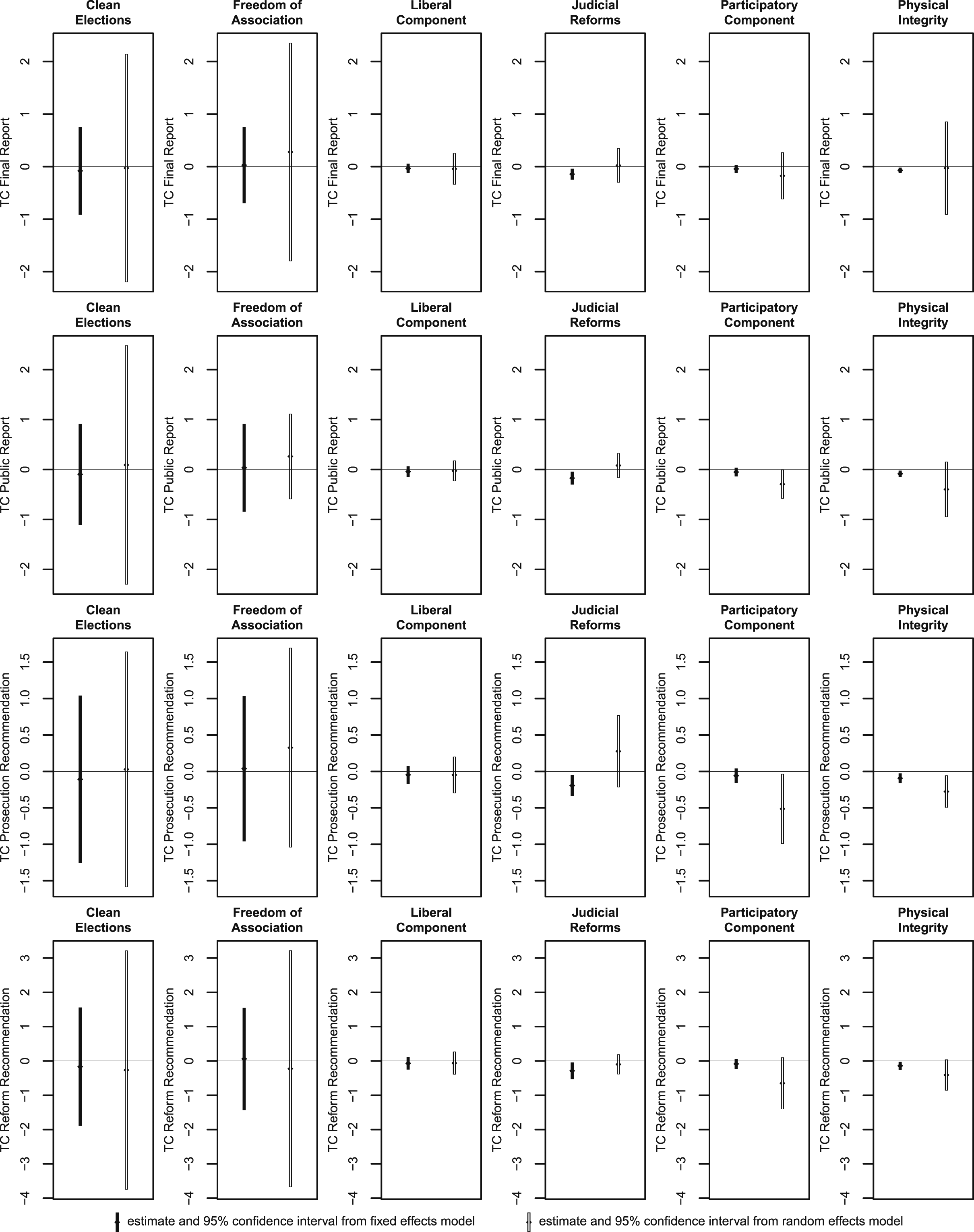
Discussion
Using the most inclusive sample and the most fine-grained dataset to date, and correcting for a number of methodological shortcomings of prior studies, this article replicates two previous findings from the cross-national literature: (1) TCs are not correlated with improvements to electoral democracy (Olsen et al., 2010; Wiebelhaus-Brahm, 2010), and (2) TCs are correlated with a decline in repression (Kim & Sikkink, 2010). But it also produces two major new discoveries (1) that TCs are not correlated with judicial reforms and (2) that TCs are associated with greater democratic participation. In this sense, this study achieves integrative cumulation, presenting a new theory that at once reaffirms previous findings and generates novel expectations.
Specifically, our theory argues that TCs are institutionally embedded, or endogenous. As a result, these bodies will struggle to exert an observable, independent effect on governing institutions, but they could have a considerable impact on democratic behaviors through signaling. In short, this theory holds that TCs cannot change the rules of the democratic game, but they can encourage more people to play. As expected, we do not find any support for the first set of hypotheses devoted to institutions, but we do find strong support for the hypotheses about behaviors. Scholars often assume that TJ mechanisms produce a direct effect on governing institutions, which then mediates political attitudes and behaviors. If anything, it appears more likely that TCs alter democracy indirectly, by attracting the attention of citizens and state agents and encouraging each group to change its behavior.
These claims come with three corollaries. First, when studying the impact of TJ mechanisms, we should be cautious about employing democracy indices that heavily weigh formal electoral components. There is very little theory and evidence that trials, TCs, or other mechanisms are associated with modifications to electoral institutions or rules pertaining to political association.
Second, TJ advocates may find it dismaying that TC recommendations are not associated with significant liberal or judicial reforms. However, our inability to detect a relationship in cross-national data should not be taken to mean that TCs fail to encourage reforms in every instance. Failing to reject a null hypothesis is not the same as confirming non-causality. With regard to judicial reform, for example, it could be that TCs have countervailing effects. In some countries, commission investigations may support greater efforts at judicial accountability; in others, they may inspire opponents to pass amnesty laws or further disempower courts. If both causal pathways co-exist, the average effect of TCs on judicial reforms tells only part of that story. Yet, in light of our findings, policy practitioners and researchers should reflect on the fact that more often than not, TCs coexist with diminishing judicial capacity to provide accountability.
Third, we find minimal evidence that the quality of TCs matters to the outcomes we consider. However, we only consider variation in outputs: whether final reports are made public or whether they contain certain recommendations. Analyses of other variation in TC quality—such as their stated objectives, procedural powers, or record of post-report implementation (Kochanski, 2020)—may come to different conclusions. Moreover, there is still more room for methodological innovation in empirical TJ impacts studies. The instrumental variable modeling in this article is a sensible approach to the key issue of TJ endogeneity, leading to new discoveries in light of the existing literature. However, good instruments are difficult to find, and we would welcome other plausible instrumental variables or other research designs to address the issue of endogeneity. The negative association with judicial institutions, in particular, may be due to selection effects rather than actual impacts, and should be examined further.
Conclusion
Twenty years ago, TJ proponents argued that TCs might promote democratic consolidation in states that recently overcame autocracy and civil war. How well does this aging claim stand up to nearly a half-century of evidence?
The answer depends on what one means by democracy. Our findings expose a critical distinction between democratic institutions—meant to secure elections and check executive powers—and democratic behaviors such as citizen participation in political life.
This is important because, in the last decade, the world has witnessed a rise in illiberal democracies (Plattner, 2019). This phenomenon has different labels. Some call it democratic “de-consolidation” (Foa & Mounk, 2016), some call it democratic backsliding (Mechkova et al., 2017), and others call it the “challenge of populism” (Galston, 2018). In each case, the worry is the same: that strong-willed, elected leaders use the support of a faithful and democratically active majority to erode institutional constraints on their power and ultimately undermine civil rights. One might say that what we are witnessing is not a contraction of democracy, or popular sovereignty, but of liberal institutions designed to protect against executive overreach.
A recent report funded by UK Aid offers TCs as a partial solution to this problem, arguing, for instance, that they might reinforce judicial checks on the executive (Auschwitz Institute, 2020, p. 18–19). However, our study could locate no such relationship. Despite their promise of reform, TCs do not appear measurably correlated with improvements to liberal institutions such as independent judiciaries or rule of law protections. At the same time, they are in fact associated with greater participation in democratic elections and government at the national and local levels. And where there are TCs, that participation is accompanied by less state repression. Countries where TCs have operated feature more bottom-up democracy, though not necessarily with the assurances provided by improving institutional protections.
On the one hand, this is a positive discovery. Greater democratic participation and less state repression are welcome achievements. Before this study, we had only suggestive evidence that TCs are associated with any such improvements. Furthermore, that TCs might inspire democratic behaviors—by expressing and signaling certain social transformations rather than doing so through institutional reforms—resonates with recent calls by American rights activists for a TC to address structural racism and police brutality (Souli, 2020). Insofar as these calls are centered around the potential for a TC to attract attention to a salient issue and send signals to citizens and state agents alike, they dovetail with the findings of this article.
On the other hand, the evidence in this study suggests that the role of TCs is not what many expected years ago. That they may actually limit institutional change or function as “distractions” from reform is an important possibility that demands further attention by other researchers. While examination of the design and outputs of TCs is important, the next research frontier is implementation. TCs do not necessarily shake the foundations of the state, or usher in institutional reform. Leaders do not eagerly heed their recommendations, and they may even try to minimize their contributions. Indeed, if it is permanent protection that motivates citizens, activists and policymakers, then they need to continue their march beyond the TC and the voting booth. They need to set their sights on the constitution and the courts.
Supplemental Material
sj-pdf-1-cps-10.1177_00104140211024305 – Supplemental Material for Do Truth Commissions Really Improve Democracy?
Supplemental Material, sj-pdf-1-cps-10.1177_00104140211024305 for Do Truth Commissions Really Improve Democracy? by Geoff Dancy and Oskar Timo Thoms in Comparative Political Studies
Footnotes
Acknowledgments
We thank Genevieve Bates, Shauna Gillooly, Cyanne Loyle, Daniel Solomon, Eric Wiebelhaus-Brahm, Kelebogile Zvobgo, and three anonymous reviewers for helpful comments on previous iterations of this research. Thoms is grateful for postdoctoral financial support from the Simons Foundation in 2019.

Declaration of Conflicting Interests
The authors declared no potential conflicts of interest with respect to the research, authorship, and/or publication of this article.
Funding
The authors disclosed receipt of the following financial support for the research, authorship, and/or publication of this article: This work was supported by the National Science Foundation grant nos. SES-0961226 and SES-1228519 and the Arts and Humanities Research Council grant nos. AH/1500030/1 and AH/K502856/1.
Supplemental Material
Supplemental material for this article is available online.
Notes
Author Biographies
References
Supplementary Material
Please find the following supplemental material available below.
For Open Access articles published under a Creative Commons License, all supplemental material carries the same license as the article it is associated with.
For non-Open Access articles published, all supplemental material carries a non-exclusive license, and permission requests for re-use of supplemental material or any part of supplemental material shall be sent directly to the copyright owner as specified in the copyright notice associated with the article.
