



Abstract
Using discursive institutionalism as an analytical framework, this article addresses how national actors build, coordinate and communicate discourses on EU defence policy (CSDP) at home. The empirical analysis is based on a comparative study of substantive and interactive discourses in France and Ireland, two contrasted cases. It demonstrates that France and Ireland frame and interpret elements of CSDP that best fit their needs, use them to promote their defence agenda in a legitimate and ‘European’ way and present CSDP as a natural continuation of their preferences. These defence agendas revolve around the preservation of France’s exceptionalism and Ireland’s neutrality. Discursive institutionalism, which methodologically sheds light on agents and institutional contexts, helps to understand the dynamics of constructive ambiguity, a discursive strategy often applied to CSDP and illustrated by these two cases.
Keywords
We need to operate skilfully between red lines to reach a result that does not alter the original target. To move forward, we often need to rely on semantic subterfuges, very broad and hazy expressions. Eventually, everyone is happy to have ‘won the case’ or ‘put his argument forth’. Actually, everyone can have a very different interpretation of the same text.
1
Introduction
In this excerpt from an article entitled ‘Constructive Ambiguity and the Shock of Reality’, published in France’s journal of strategic studies, Revue défense nationale, a high-ranking military officer describes what Henry Kissinger defined as ‘the deliberate use of ambiguous language in a sensitive issue in order to advance some political purpose’ (Berridge and James, 2003). The European Union’s Common Security and Defence Policy (CSDP) 2 is one such sensitive issue where constructive ambiguity plays an important role. In 2008–2009, constructive ambiguity helped two countries, France and Ireland, which share opposing views about security policy, join forces to conduct a European Union (EU) military operation in the heart of the Chadian desert (operation EUFOR Chad/CAR). With a strong military and imperial tradition, France has historically been a driver of CSDP, while Ireland, which sees itself as a pacifist and neutral country, is a reluctant follower. Also, French public opinion is pro-CSDP, while Ireland’s is more likely to evoke the spectre of a militarised Europe. According to a 2012 Eurobarometer survey, 80% of the French people support CSDP, while only 50% of the Irish do so. 3
France and Ireland offer an interesting comparison to assess the power of ideas and discourse in two different institutional contexts. This article asks how French and Irish actors coordinate and communicate a CSDP discourse that both fits their national preferences and allows for the implementation of a common European policy. I argue that constructive ambiguity is a useful notion to address this puzzle, as it allows EU member states to pursue their national policies while incrementally giving them a European flavour.
The article addresses constructive ambiguity through Vivien Schmidt’s discursive institutionalism (DI) (2008). DI is a method of discourse analysis that sheds lights on both the substantive content of discourse, i.e. ideas, and the process of coordinating and communicating these ideas within the policy and the political spheres. It stresses the role of specific institutional configurations to understand how and why discourses are a powerful element of change or continuity in national interest and national policies. The first section of this article shows why DI is a relevant approach to study constructive ambiguity and the evolution of national discourses with regard to CSDP. The second section addresses methodological challenges and presents the empirical material that will be studied. Sections three and four analyse the substantive and interactive discourses of France and Ireland on CSDP. The fifth and final section compares and discusses the results. The empirical analysis demonstrates that France and Ireland view CSDP differently regarding its level of autonomy, capabilities and international partnerships. These concerns correspond to radically different national preferences – the preservation of France’s exceptionalism and Ireland’s neutrality. With the development of CSDP, however, both exceptionalism and neutrality have adapted to a changing, ‘Europeanised’ context.
Constructive ambiguity and DI
Constructive ambiguity is a common-sense notion, but an analytically unexplored one. In an article originally published in 1966, Stanley Hoffmann claims that:
There has always been most progress when the Europeans were able to preserve a penumbra of ambiguity around their enterprise, so as to keep each one hoping that the final shape would be closest to its own ideal, and to permit broad coalitions to support the next moves. And yet there always comes a moment when a terrible clarifier [e.g. a statesman, an event] calls for a lifting of ambiguities, at which point deadlock is more likely than resolution (1995: 131).
Constructive ambiguity is mostly called upon in situations where national preferences are heterogeneous and the EU’s legal basis is weak, e.g. defence or energy policies (Jegen and Mérand, 2013). Hoffmann himself did not originally apply the concept to European defence, but he later argued that France and the UK gave different meanings to ‘autonomy’ during the 1998 bilateral Saint-Malo summit which gave birth to the EU’s security and defence policy (Hoffmann, 2000: 197). Howorth explicitly refers to constructive ambiguity when elaborating Hoffmann’s point that the Franco-British agreement rested on the misunderstanding that for the UK, CSDP ‘was an Alliance project involving European instruments. For France, it was a European project embracing Alliance capabilities’ (2004b: 175).
François Heisbourg (2000) stressed the role of constructive ambiguity as an unavoidable strategy to allow for limited but genuine progress in CSDP, as exemplified by the lack of a clear strategic purpose in the so-called ‘Headline Goal’, (the creation of an EU rapid reaction force) or diverging national interpretations of the ‘Petersberg tasks’ attributed to CSDP, from humanitarian interventions to more robust peace enforcement missions. The 2003 European Security Strategy (ESS) has also been taken as an illustration of constructive ambiguity (Toje, 2008: 125). Key ESS concepts such as ‘preventive engagement’ or ‘effective multilateralism’, i.e. the strengthening of multilateral partnerships for the conduct of EU foreign policies, are poorly defined regarding objectives, means and instruments, which leaves room for interpretation. As the empirical part of this article will later demonstrate, France and Ireland have ascribed a very different meaning to three core concepts of the EU strategy: ‘autonomy’, ‘Petersberg tasks’, and ‘effective multilateralism’.
Theoretically, Vivien Schmidt’s DI (2008) is a useful framework to address constructive ambiguity and the way that national actors speak about CSDP. DI offers a middle-ground perspective that emphasises several elements: 1) the substantive content of discourse (ideas, i.e. what is said), but also the interactive process of coordinating and communicating these ideas; 2) the contextual dimension of discourse (where, when, how and why it is said), not just the textual one; and 3) the role played by individual agents within discursive processes and practices (who said what). DI shares with other discourse analytical perspectives a constructivist ontology whereby norms and interests are intersubjective and dynamic constructs in which discourse plays a central part (see Carta and Morin, 2013). DI’s added value, however, ‘resides in the endeavour to connect the role of discourse to specific institutional settings’ (Crespy, 2013). On this aspect, DI is not very different from the critical discourse analysis’ focus on the ‘history’ of texts, that is, the contingent background of social and political events in which discourses take place (see Aydin-Düzgit, 2013).
DI offers two useful analytical distinctions. The first one concerns ‘background ideational abilities’ vs. ‘foreground discursive abilities’ (Schmidt, 2008: 313–317). An agent’s background ideational abilities allow him to make sense of a given institutional context. It refers to the set of ideational rules that are specific to this context, which contribute to create and maintain institutions. Institutions, broadly defined as a set of rules, norms, expectations and traditions (March and Olsen, 1989: 5), have a constraining effect on discourses. But Schmidt claims that they are also dynamic and contingent. Through their foreground discursive abilities, agents have the ability to either change or maintain their institutions, as they can deliberately or strategically communicate, think, speak and act outside them. Thus, institutions have a constitutive role, but not a deterministic one (see also Lynggaard, 2012).
In terms of security and defence policies, background ideational abilities can be traced back to national security cultures, a set of normative and cognitive standards collectively attributed to a state’s identity and which shape national security interests and policies (Katzenstein, 1996; see also Schmidt, 2008: 307). For European states, this national ‘we-ness’ is increasingly enmeshed with a ‘European’ dimension (or layer) that contributes to redefining national discourses of foreign and security policies (Gariup, 2009; Milzow, 2012; Rogers, 2009; Waever, 2005; and Larsen, 2013). While post-structuralist discourse analysts focus on these layered structures of discourse, the DI framework begs for an empirical focus on national agents and how their discourse evolves within this changing context. Although DI is not much concerned with the normative and critical dimensions of discourse analytical theory (see Aydin-Düzgit, 2013; Carta, 2013), methodologically, it is congruent with the latter’s acknowledgement that we need to look beyond structures (see also Diez’s (2013) notion of ‘discursive struggles’ in this volume).
The second useful analytical distinction offered by DI has to do with coordinative vs. communicative aspects of discourse (Schmidt, 2008: 309–313). Both refer to the interactive process of conveying ideas, respectively within the policy and the political sphere. The coordinative discourse concerns the policy actors – e.g. civil servants, elected officials, experts – who elaborate a discourse on policy priorities. They often join together in coalitions, networks and epistemic communities that help to circulate and coordinate ideas. For its part, the communicative discourse deals with the political sphere and the process of informing and persuading the public with regard to these policy ideas. It concerns those same policy actors, but also the media, activists or public opinion in general. An early attempt at applying these notions to European security and defence policies is Jolyon Howorth’s work (2004a) on the role played by British, French and German epistemic communities in the construction and communication of a new CSDP discourse and paradigm in the 1990s and early 2000s. According to him, discourse had a mixed effect on policy change, since the connection between coordinative and communicative discourses on CSDP succeeded in the French and German case, but failed in the British one, where discourse lacked a communicative dimension congruent with the public opinion. Howorth’s analysis shows that communication is an important feature to be taken into consideration in order to assess how nation-states speak about CSDP.
Methods and case selection
Following Katzenstein, many scholars (e.g. Mérand, 2008; Meyer, 2006) have stressed the importance of domestic socio-historical and institutional contexts in explaining national approaches to security and defence policy in Europe. In the present analysis, France’s traditional image as a foreign policy and security actor is based on several well-known features: a permanent seat at the UN Security Council, the possession of nuclear weapons, a love-hate relationship with NATO, significant involvements in UN diplomacy and peace operations since the 1990s, and the endurance of a large network of alliances with former colonies. These features contribute to a French sense of grandeur and its will to remain an important and autonomous world power (Irondelle and Besancenot, 2010). Ireland, for its part, is a small power located at the periphery of Europe, bereft of strong resources and important economic or political interests to be defended. Its main security issue has long been an ‘internal’ one, i.e. Northern Ireland. Externally, Ireland’s defence policy is structured around the concepts of idealist and active neutrality, which translate into an active engagement within UN peacekeeping operations since the 1960s, the promotion of disarmament, non-proliferation and anti-colonialism, and a significant contribution to overseas development aid (Doherty, 2002).
Both countries’ attitudes towards European integration also stand on opposite sides of the spectrum. The French strategy for Europe is based on three elements: make the EU a powerful world actor, led by a strong political leadership (favouring intergovernmentalism), and endowed with a distinct socio-economic identity (Drake, 2010). This strong ambition is a translation at the EU level from the French politics of grandeur (see also Schmidt, 2007). Historically, Ireland also has a positive attitude towards the EU, but one that is deeply practical and reactive, even ‘mercenary’ to some extent (Holmes, 2005). Ireland mainly sees the EU as a practical benefit, most notably in terms of economic development (regarding agriculture or structural funds). In a nutshell, France has a principled and proactive approach to Europe; Ireland has a pragmatic and reactive one.
Table 1 lists the primary documents analysed to address the CSDP discourses in France and Ireland. Contributions from political authorities, members of parliament, military officers and experts in epistemic communities are scrutinised. This large choice of actors is meant to provide an encompassing view of actors and their discourses (‘who speaks?’). For example, Milzow (2012) focuses only on national political leaders (Blair, Chirac and Schröder from 1998 to 2003). Larsen (2013) has a broader view, which includes public discourses, parliamentary minutes and official publications, but he does not look at the military. Other scholars (e.g. Davis Cross, 2011; Howorth, 2012) have studied national actors within European epistemic communities, but their focus is on socialisation in Brussels rather than on what happens at home.
Discourses under study.
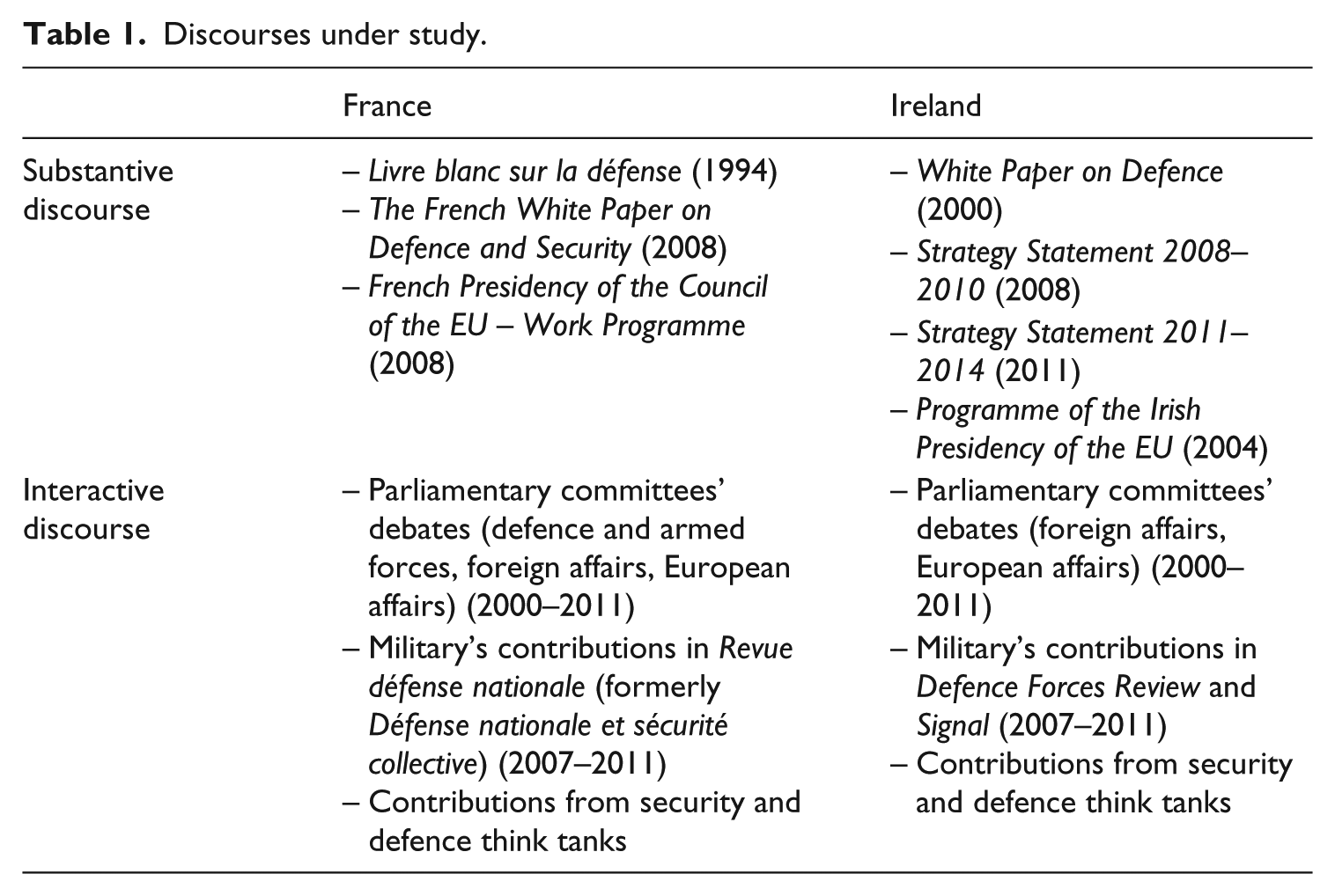
The substantive discourse of French and Irish ideas on CSDP is examined through official releases such as white papers, strategy statements or EU work programmes. In terms of coordinative discourse, looking at different kinds of actors at the same time (elected officials, military officers, experts) allows for the analysis of whether and how these actors assign meaning and interpret actions in a similar way despite their own personal or professional backgrounds and priorities. Also, the research is focused on discourses that have a communicative dimension directed towards wider audiences. Minutes of parliamentary debates are usually seen as a way to fuel public discussions. Think tanks mostly proceed through the publication of working papers online, as well as the organisation of conferences; and contributions of military officers in the specialised press have by nature a communicative dimension as well. This communicative dimension is what makes this paper’s methodological approach different from that of scholars such as Davis Cross or Howorth, who mainly proceed through qualitative interviews.
Before we move on to the empirical analysis, several caveats are in order. First, Ireland published its last White Paper on defence in 2000, while France published one in 2008. But Ireland has also published strategic statements for the periods 2008–2010 and 2011–2014, which updated that White Paper. 4 Second, the French Assemblée nationale has a committee specifically dedicated to defence and armed forces, which is not the case with the Irish Dáil Éireann, where defence is handled by the committee on foreign affairs. Third, the analysis of specialised defence journals is limited to the years 2007–2011, since the online archives of the Irish Defence Forces Review are not available prior to 2007. Also, the journal, Signal, has been added in the Irish case, since the Defence Forces Review is an official publication of the Department of Defence, which could be seen as having a less independent view. Finally, it should be noted that the empirical research was concluded in 2012, and does not include the latest Irish presidency of the EU in early 2013, as well as the release of a new White paper in France in 2013.
Substantive discourse
This first empirical section looks at the main substantive elements of French and Irish discourse towards CSDP. Two observations stand out. On the one side, French and Irish ideas are totally congruent with their respective view on both security policy and European integration. France has strong political ambitions for CSDP, while Ireland has a more pragmatic and reactive approach towards it. On the other side, constructive ambiguity works, insofar as each country succeeds in presenting CSDP as a natural continuation of its traditional priorities.
France: CSDP as a means for national and European power
Since the late 1990s, France has been at the forefront of EU security and defence projects (Blunden, 2001). A consensual national discourse presents CSDP as a way for France to carry on its power policy at a global level. Since its inception, CSDP has been portrayed as a power multiplier for France, allowing it to pursue strategic objectives it could no longer sustain on its own (Treacher, 2003).
The Europeanisation of the French security discourse actually preceded the build-up of CSDP, as the content of the French White Paper on defence from 1994 reveals (Irondelle, 2003). In this White Paper, Prime Minister Edouard Balladur already establishes a ‘common European defence’ as the top priority, not only to comfort the EU’s political identity, but also to facilitate France’s defence policy in a new environment characterised by the need for force projection and overseas crisis management (France, 1994: i–ii). From 1991 to 1996 the dominant paradigm of the French defence establishment shifted from the concept of ‘national sanctuary’ to that of ‘European commitment’ (Irondelle, 2003: 215).
The French discourse contains an ambitious agenda for CSDP: autonomy of decision making and command structures (EU-led operations conducted without the support of NATO), strong military capabilities and common defence. Key CSDP documents – the ESS in 2003, the Headline Goal in 2004 – found strong support among French decision makers. The White Paper on Defence and National Security, published in 2008, further develops ‘France’s ambition for Europe’ (France, 2008b: 75–92), which prioritises the strengthening of crisis prevention and management capabilities, the reform of funding procedures for EU operations, the development of interoperability, the Europeanisation of education and training of military forces, and the promotion of a European armaments industry. Some of these priorities were put forward during the French EU presidency in 2008, whose work programme’s chapter on CSDP starts with the following sentence: ‘The French Presidency’s main focus with regard to defence is strengthening the military capabilities available in Europe’ (France, 2008a: 23).
This emphasis on military capabilities echoes the paragraphs entitled ‘a more capable Europe’ in the ESS, notably the issue of pooling resources (European Union, 2003: 12). However, the French position goes further. The White Paper criticises the fact that EU Battle Groups (1500-strong standby forces for rapid reaction to crises), developed after 2004, seem to have replaced the initial Headline Goal (60,000-strong intervention capacity including air and naval components, deployable for a year). In the French perspective, ‘such Battle Groups do not account for all of the Union’s operational needs. […] It is clearly not enough to possess these forces and make them coherent’ (France, 2008b: 83).
Ireland: CSDP as a tool for peace operations
Although reluctant when it joined the EU in 1973, Ireland came round to take an active part in European Political Cooperation and its normative foreign policies dealing with development cooperation or sanctions against discriminatory regimes, which allowed the country to voice its concerns more openly, and to gain political influence through the common EU channel (Tonra, 2001). Ireland’s attitude towards CSDP is cautious and ambiguous, though not hostile. Along with membership of the NATO Partnership for Peace in 1999, adherence to CSDP has contributed to restrict the definition of neutrality to non-participation in a military alliance through a common defence clause (Doherty, 2002; Ferreira-Pereira, 2007). As stated in the first Irish White Paper on Defence released in 2000, ‘participation in Petersberg tasks [i.e. EU crisis management operations] will not affect our longstanding policy of neutrality’ (Ireland, 2000: 20).
Irish defence documents stress that the future of Ireland’s overseas peace support operations – the core activity of the armed forces – is likely to be undertaken partly under the regional CSDP framework. One of the strategy statements recalls that Ireland’s principal goal is ‘to participate in multinational peace support, crisis management and humanitarian relief operations in support of the United Nations and under UN mandate, including regional security missions authorised by the UN’ (Ireland, 2008: 7). The acknowledged and reasserted primacy of the UN Charter echoes the content of the ESS according to which ‘the United Nations Security Council has the primary responsibility for the maintenance of peace and security’ (European Union, 2003: 9).
It was during the Irish EU presidency in 2004 that the most significant EU document about this issue – ‘EU-UN cooperation in military crisis management operations’ – was adopted. Looking at the Irish presidency work programme confirms national preferences: CSDP and military issues are treated under the wider issue of external relations (also including trade, humanitarian and development policies), and Ireland states that ‘it will focus in particular on effective multilateralism and EU-UN relations’ (Ireland, 2004: 25). Ireland also stresses that ‘the development of civilian capabilities will be a particular priority. If the Union’s operations are to contribute to long-term stability and security, it needs to look beyond solely military interventions’ (Ireland, 2004: 30).
Following the same trend, Ireland permanently commits 850 soldiers – 10 per cent of its available armed forces – to a UN standby arrangement system whose purpose is to have available troops ready for peace support operations. National commitment to the EU’s Headline Goal is met under this arrangement. Also, the country has taken an active stance in the development of the EU Battle Groups concept, in particular with ‘like-minded states’ in the Nordic Battle Group and the German-Austrian Battle Group (Ireland, 2011: 14). In the Irish view, these Battle Groups could be made available for UN rapid reaction needs.
Interactive discourse
The substantive discourse surveyed in the last section forms the set of ideas that national actors aim to promote. This section now looks at the coordinative and communicative discursive practices of these actors. In each case, these practices are shaped by specific institutional contexts that can be summed up by two notions: exceptionalism in the French case, neutrality in the Irish one.
France and the challenge of exceptionalism
What the scholarly literature often refers to as ‘French exceptionalism’ has progressively been eroded over the last two decades, but it still prevails (Drake, 2010; Irondelle and Besancenot, 2010). This exceptionalism largely permeates policy circles and public opinion, and it is an important aspect to be considered when studying the French interactive discourse.
The French defence epistemic community is well structured around a network of independent or institutional think tanks and research centres (Howorth, 2004a). Generalist and well-known think tanks such as the Institut français des relations internationales, the Institut des relations internationales et stratégiques or the Fondation pour la recherche stratégique employ researchers that specialise on Europe (some of them former military officers), and house research units devoted to European and transatlantic security. The case of the Ministry of Defence’s Délégation pour les affaires stratégiques (DAS) is instructive. Not only does the DAS regularly commission research projects to the aforementioned think tanks; it also has several institutional partners that help to foster intellectual convergence about France’s strategy. Among them is the Institut de recherche stratégique de l’Ecole militaire (IRSEM, the research centre of the French military academy), which is closely related to the French military staff. One of its research units deals with ‘European and transatlantic security’. Once headed by General Jean-Paul Perruche, previously director general of the EU Military Staff, it is now led by General Maurice de Langlois, a former deputy military representative of France to the EU Military Committee. CSDP is one important focus of IRSEM’s research and publications (see e.g. Kandel and Perruche, 2011). Also important is the Institut des hautes études de défense nationale (IHEDN), whose purpose is to train civilian and military officials and to promote defence-related knowledge, with an increasingly international and European focus. IHEDN is one of the founding members of the European Security and Defence College, a virtual CSDP training school for officials. The French institute is in charge of the ‘high-level’ course, the college’s most important programme.
Thus, the defence epistemic community has an important focus on CSDP. But that says little about the coordinative and communicative features of the French discourse. To do so, a first category of actors to look at is elected officials and their debates held within parliamentary committees in the French National Assembly. In France, CSDP is a topic discussed in three different committees: defence and armed forces, foreign affairs and European affairs. Discussions cover a broad range of issues, as demonstrated by the variety of hearings: civil servants, ministers, experts, representatives of defence industrial firms, chiefs of staff from different armed services. The most frequent topics raised by members of parliament (MPs) are the fear of decreasing defence budget and capabilities, the state of the defence industry, and the evolution of the professional army. 5
Analysis of the debates from 2000 to 2011 shows that MPs express a growing dissatisfaction with CSDP. From 2000 to 2007, the dominant discourse is rather enthusiastic and ambitious: discussions stress the progress made by CSDP and the potential to balance NATO, despite reluctance from other states. The emphasis is placed on the need for a powerful Europe endowed with significant military capabilities. For example:
The construction of a Europe of defence rests upon the principle of a certain autonomy vis-à-vis NATO and the American ally. […But] we should not impose the vision of a ‘Europe puissance’. Europe provides proof that it will, in a near future, be able to defend itself. (MP Anne-Marie Comparini in Assemblée nationale, 2005)
However, during 2008–2009 the discourse progressively turns more critical: the first CSDP interventions overseas lack ambition, industrial defence cooperation mostly happens at a bilateral level, and French MPs also lament the fact that CSDP deals exclusively with overseas operations, not the defence of Europe:
When you speak of European defence, Mr. Danjean [chair of the subcommittee on security and defence at the European Parliament], it seems to me like you think above all […] about overseas operations. Will you someday be interested in the defence of Europe properly speaking? […Danjean:] Those who want to move in this direction too quickly will face opposition from those who are not ready. […] I must acknowledge that the notion of defence of the European territory is still at an embryonic stage. (Assemblée nationale, 2009a)
Several debates even suggest that the existence of a European defence should be called into question, with France’s return to NATO command structures and the absence of new operations, cooperation and European identity. Statements from 2009 to 2011 set the tone, such as:
Europe of defence has broken down, and its achievements are particularly poor. […] And regarding European states’ reactions, let’s face it: defence is a priority for none of them.
Besides parliamentary debates, another way to scrutinise coordinative and communicative discourses is to look at contributions in the specialised journal Revue défense nationale (previously Défense nationale et sécurité collective). The Revue défense nationale is a monthly publication whose purpose is to address political, economic and scientific issues from the perspective of defence. The journal welcomes contributions from the military, diplomats, politicians, journalists and experts, and its editorial board aims at ‘hosting the revitalised strategic thinking, which foremost applies to the Europe of defence, or even the defence of Europe when time will come’. The chairman of the journal’s board is the Admiral Alain Coldefy, who is also a vice-president of the pan-European defence company EADS and an expert at the French think tank IRIS.
Many contributions confirm this editorial commitment: from 2007 to 2009, there is hardly an issue that does not evoke CSDP, and two issues per year are specifically dedicated to Europe with dossiers entitled ‘CSDP [ESDP] strategic watch’. In total, out of 664 articles published during these three years, 139 (roughly one in five) deal directly with CSDP. The most recurring EU topics include capabilities, the role of the European Defence Agency, the defence industry and the European dimension of the 2008 White Paper. Contributions from military officers strongly lean towards the ambition for a strong ‘Europe puissance’ (power Europe), and the criticism of those who refuse to endorse it:
Europe is in search of itself. […] An ESDP worthy of what the EU represents would require that we stop playing games and show a determination that would be neither ephemeral nor merely verbal. (Lieutenant-colonel Magnuszewki, 2008: 100)
As in parliament, disenchantment and criticisms have grown since 2009. For example:
We need to establish the political, strategic and security bases of a real political and strategic Union, unless we wish to maintain the Union in its status of intermediate normative power subject to the constraints of NATO’s pre-eminence on the European soil.
This disenchantment is also symbolised by a significant fall in the number of contributions devoted to Europe, and a growing indifference: the journal only dedicated 36 articles out of 442 (less than one in ten) to CSDP during 2010–2011. To sum up the French case, there is no doubt that national actors put a strong emphasis on an ambitious CSDP. They are also endowed with numerous resources in terms of expertise, publications and networks that help with both the coordinative and communicative discourses. However, it seems that the former receives much more attention than the latter, as there are many actors involved in European security, and many issues at play: crisis management operations, and also the relationship with NATO, the defence budget and the defence industry.
Ireland and the challenge of neutrality
While the official Irish definition of neutrality is minimalist – military non-alliance – it also has a richer political and cultural definition, which emphasises domestic values and translates into preferences for active peace promotion, UN primacy and national pride and independence (Agius and Devine, 2011). As the analyses of the Irish ‘No’ votes to the treaties of Nice in 2001 and Lisbon in 2008 demonstrate, there is a strong and enduring popular attachment to this identity-related view of neutrality (O’Brennan, 2009; Rees, 2005).
By contrast with the French, the Irish defence epistemic community is very small, with only few sites where decision makers and experts have the possibility to exchange their ideas. A strong UN focus remains, for example, with the UN training school of the Irish Military College (UNTSI), which trains Irish soldiers about to participate in peace support operations. UNTSI also includes an international military observer and staff officers’ course, which is designed for international students and officers, and whose programme is built in coordination with the UN Department for Peacekeeping Operations. There is, however, no teaching institution similar to the French IHEDN to train officials on CSDP issues. Ireland has no institution that is a member of the European Security and Defence College.
One influential think tank deserves mention: The independent Institute of International and European Affairs (IIEA), with a branch devoted to security and defence policy, chaired by Irish scholars Patrick Keatinge and Ben Tonra, as well as by HE Marie Cross, former Irish ambassador to the EU Political and Security Committee. This branch is dedicated to analysing ‘the implications for Ireland of developments in the EU’s Foreign, Security and Defence Policy’, through regular monitoring of EU treaties and policy evolutions. The IIEA self-acknowledges a pro-EU fondness (it was initially created as an Institute of European Affairs in the early 1990s), and it has been proactive in raising awareness and public debates about CSDP and Irish neutrality. It published two reports in 2009, prior to the second referendum on the Lisbon treaty: ‘Making sense of European Security and Defence Policy: Ireland and the Lisbon treaty’, and ‘European Security and Defence Policy and the Lisbon treaty’. Their content is clearly pedagogical and aimed at clarifying what CSDP is about – ‘to deal with the challenges of international crisis management’ (Keatinge and Tonra, 2009) – explaining the EU legal guarantees obtained by Ireland, and ‘dispelling some myths about EU defence’ (Keohane, 2009). This communicative effort developed to counter a strong mobilisation that emerged before the first referendum, carried by civil society movements such as the Peace and Neutrality Alliance (PANA) or Action from Ireland (AFRI), opposed to CSDP.
Also in contrast with France, the Irish parliament plays an important role in defence policy and overseas military interventions. The Irish legal system functions according to a logic of ‘triple lock’: any deployment of more than 12 soldiers must be UN-mandated, decided by the government, and approved by parliament. 6 Given that there is no standing committee on defence, the prevalent topics discussed in parliament concern foreign affairs: overseas development aid and development cooperation come first, followed by humanitarian crises, and the role of Irish non-governmental organizations (NGOs). Hearings very often welcome NGO representatives and members of Irish Aid, which is the governmental aid and development agency.
This humanitarian focus consistently shows through discussions that deal with CSDP. For example, MPs often criticise the non-use of the EU Battle Groups as a rapid response during humanitarian crises:
There is always the idea of how one can have a reserve peace corps which would be available to do some practical work. […] It is something the EU is developing in terms of civilian crisis management functions. For example, the unfortunately named Battle Group, involves having 1,500 military personnel available to go into a situation at the behest of the UN Secretary General if something happens. I believe there are tremendous possibilities in using the Battle Groups that are currently training. […] There is tremendous potential for civilian corps.
Regarding CSDP, it is also noteworthy that, over time, neutrality has become a non-issue. Debates in the early 2000s showed a significant concern in this regard:
The insertion of an optional Article 5 clause in an attempt to create a mutual defence union in the European Union is not what the EU is about. […] This country is not sitting back and allowing developments to take place which are inimical to our interests or inconsistent with our foreign policy tradition.
However, such debates have almost disappeared since then, and neutrality was even not much discussed during the Lisbon treaty negotiations. Irish political parties, apart from Sinn Féin, all share a minimalist view of military neutrality (Devine, 2009).
If we keep looking at the coordinative and communicative discourse in Ireland, there is no equivalent to the French Revue défense nationale, in terms of content, scope and influence. However, both the official Defence Forces Review and the independent Signal (journal of the Representative Association of Commissioned Officers) offer interesting clues with regard to the main concerns of the Irish military. The Defence Forces Review is an annual publication, edited by the public relations service of the armed forces, and circulated within Irish defence forces, universities and libraries, and embassies. According to its editorial board, it serves to ‘provide a forum for contributors to raise current issues, provoke thought and generate discussion across the wider Defence Community’. Signal is bi-annual and serves a very similar purpose, also welcoming contributions from both political authorities, military, experts, etc. However, it resembles more a magazine and is less academic in content and spirit.
From 2007 to 2011, out of 63 articles published in the Defence Forces Review, only one deals with CSDP, and does so in the larger framework of non-UN peacekeeping operations, whereas 16 articles out of a total of 90 (almost one in five) address EU issues in Signal. In the latter, two topics stand out: the military intervention EUFOR Chad/CAR (where Ireland was significantly involved), and the Lisbon treaty. In both journals, the military foremost focuses on the evolutions of UN peace operations and the difficult compatibility between military peacekeeping and aid policy (e.g. Commandant McCarthy, 2009). For instance, an article on regional peacekeeping operations claims that:
Until it evolves further the organization [the EU] will not be in the position to truly undertake the role of a global player in conflict resolution. […] Many parties to conflict in Africa and Asia view the EU as an agent of colonialism and are sceptical about its true intentions in conflict intervention. It is this point of legitimacy that underlines the preference for a UN security presence.
In Signal most concerns also revolve around the challenges facing the regionalisation of peacekeeping and UN reforms. Participation to EU missions (e.g. in Chad) is often addressed in such perspective:
The fact that Irish troops are operating under a NATO flag in Kosovo and under an EU flag on a United Nations Chapter 7 peace enforcement mission in Chad is quite a radical change from the more static large scale deployments of the past.
Irish actors tend to regard CSDP as one framework among several (UN, NATO, OSCE, etc.) where traditional peacekeeping policies are pursued. To sum up the Irish case, CSDP occupies a much less central place in the actors’ discourse. When it is mentioned, it also has a more pragmatic dimension than in the French case. As there are not many actors involved in European security, the stakes are few, and mostly have to do with peacekeeping operations. The coordinative discourse occupies a less central place, whereas the communicative discourse is more important than in France, given that both MPs and the public opinion have a big say in security and European issues, through parliamentary votes or referenda.
Discussion and comparative analysis
Table 2 summarises the main findings of the French and Irish discourses:
Constructive ambiguity and the national discourse.
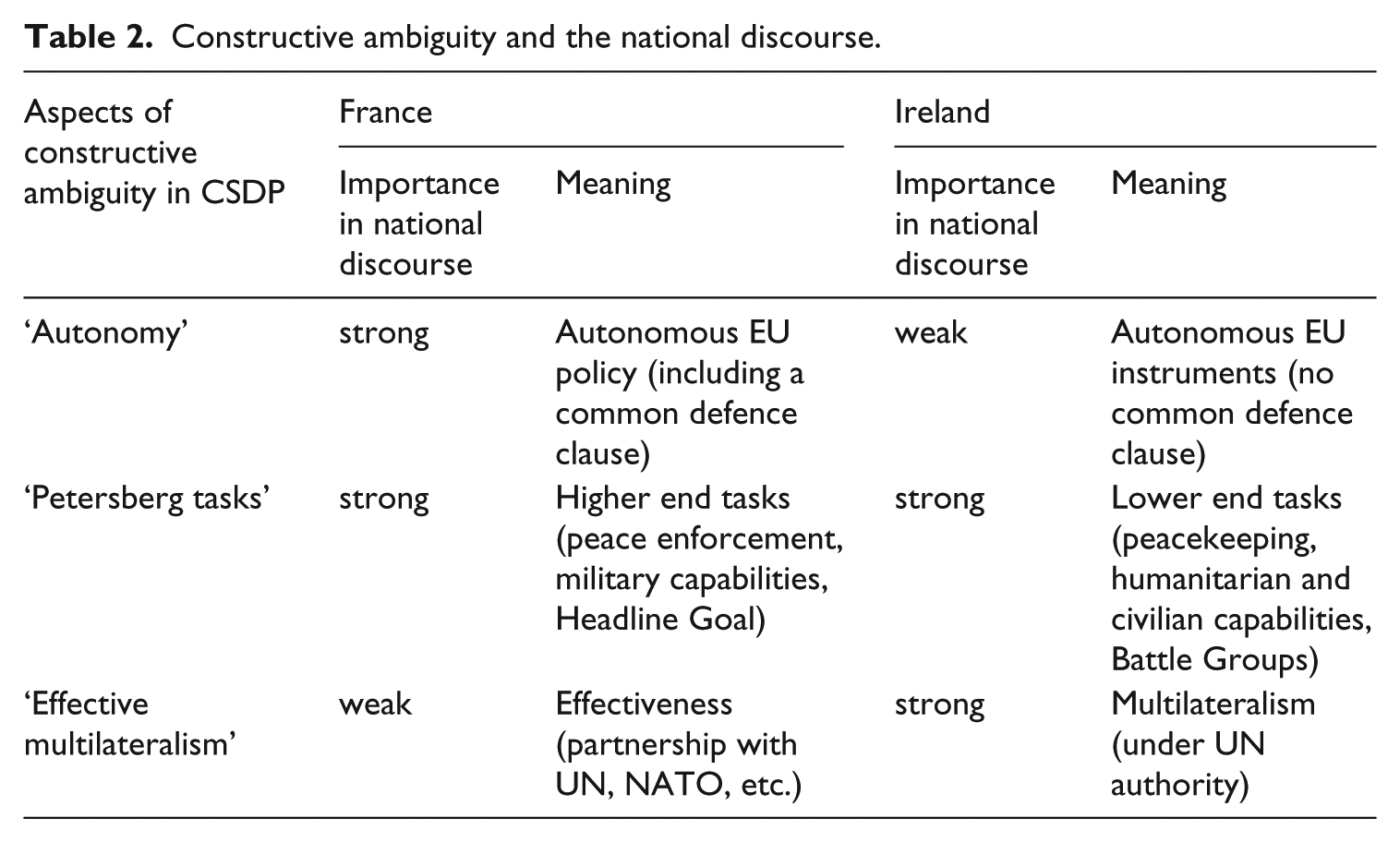
France and Ireland offer a very different interpretation of the three elements of CSDP selected for analysis: autonomy, Petersberg tasks and effective multilateralism. For French actors, autonomy refers to the political ambition for an autonomous security and defence policy – what the French often refer to as ‘Europe de la défense’ – meaning that Europe should take care of its own defence, including a common defence clause similar to that of NATO. For Irish actors, autonomy refers to the development of EU capabilities and common command structures (to a limited degree) for the conduct of peacekeeping operations. Ireland opposes the concept of a common defence clause. In terms of crisis management operations, Irish actors tend to stress the lower end of Petersberg tasks, which refer to peacekeeping in a humanitarian perspective, although with more robust capabilities than under a UN framework. French actors, conversely, aim at developing the whole range of crisis management capabilities, including ambitious military goals. Finally, both countries share the strategy of effective multilateralism, as it stands at the top of the EU security strategy. However, the French rather look at it in terms of equal partnership with other organisations, whereas the Irish frequently reassert the primacy of the UN.
Seen from that perspective, there is little doubt that constructive ambiguity succeeds in the way that both France and Ireland are able to frame and interpret elements of CSDP that best fit their preferences, to use them to promote their defence agenda in a legitimate and ‘European’ way, and to present CSDP as a natural continuation of their preferences. The findings echo those of Larsen (2013), who demonstrates how the national ‘we’ is strategically articulated with an EU dimension to build ‘actorness’ and state identity in foreign policy. How does DI help us to grasp this comparison between France and Ireland? Two observations can be made here.
The first concerns the agents’ background ideational and foreground discursive abilities. The analysis demonstrates that each national discourse is consistent, endowed with clearly observable core features, despite the professional or organizational preferences of the actors involved (see Table 2). This is congruent with Schmidt’s idea that agents’ practical and taken-for-granted social dispositions and meanings remain central. These deeply rooted features still revolve around neutrality for Irish actors and exceptionalism for French ones. The interesting added value of DI rests within the notion of agents’ foreground discursive abilities. It is only through this second notion that one may understand how constructive ambiguity works; that is, how national actors are able to pursue their national policies while incrementally and strategically giving them a European flavour. France and Ireland provide a robust confirmation of this analytical distinction, as they both include ‘Europe’ in their discourses, but in a different way.
The second observation concerns coordinative and communicative discourses. Here, the empirical analysis shows that France and Ireland follow different paths. The challenges of coordination are higher in France, and those of communication more central in Ireland. In France, many actors are involved – e.g. three parliamentary commissions, companies and industrial lobbies, a wide range of think tanks, etc. – a majority of whom have been Europeanised since the late 1990s (Irondelle, 2003). Also, the French military is not uniform: some officers remain nostalgic of Gaullism and French independence, while others are openly pro-EU or pro-NATO. This may partly explain why there are more criticisms voiced by French officers than Irish ones towards CSDP. As a consequence, most of the discourse centres on the coordinative dimension, where specialised policy actors (public officials, military officers, experts) speak with each other in different settings – think tanks or the Revue défense nationale. In Ireland, there are fewer issues, actors and interests at play, and coordination is easier. However, on the communicative side, the discourse faces more challenges, since the issue of neutrality remains very sensitive in the public opinion. Efforts to communicate what CSDP is about – often in an explicitly pedagogical way – feature prominently. In that sense, it is not surprising that the magazine, Signal, talks more about Europe than does the more academic Defence Forces Review. For example, a 2009 issue of Signal on the Lisbon treaty includes interviews with scholars Keohane and Tonra, and also publishes a copy of the protocol annexed to the treaty in which Ireland obtained the legal guarantee to safeguard its neutral status. 7 Irish actors self-consciously communicate a minimalist EU discourse with a low transformative impact on Ireland’s traditional policy, which is based on active neutrality and UN primacy.
Here, the comparison between France and Ireland confirms DI’s claim that it is necessary to take the institutional context into consideration in order to understand how the national discourse is built, coordinated and communicated. On the one hand, the formal institutional context matters: in Ireland, the fact that the constitution requires a parliamentary vote on overseas military operations, and a popular referendum on EU treaty changes, necessitates a greater communication effort on the part of foreign policy decision makers. In France, there are fewer such concerns, as the executive branch has much more latitude with regard to security and European policies. On the other hand, informal institutional structures, norms and rules also matter, as evidenced by the ongoing pre-eminence of France and Ireland’s security cultures: exceptionalism and neutrality.
Conclusion: constructive ambiguity and change
This article has relied on Vivien Schmidt’s DIs to study French and Irish discourses on the CSDP of the EU. A key element of the puzzle rests within the notion of constructive ambiguity of CSDP: the EU develops an ambiguous set of priorities and strategic objectives, which allows member states to claim at the national level that their security discourse and preferences are congruent with CSDP. A focus on institutional contexts and national actors’ coordinative and communicative efforts at speaking about CSDP demonstrates how these national discourses are successfully constructed at home.
The combination of constructive ambiguity and DI also generates insights regarding the issue of change in security discourse and policies. It offers an interesting alternative to the classical view that there is either no change at all or progressive convergence towards a common model (Gross, 2009). The case of France and Ireland’s discourse on CSDP demonstrates that there is indeed an incremental change at the national level, in the sense that both countries adapt their thinking to Europe, but that this change tends to reaffirm national specificities more than it erases them.
When CSDP ambiguities are lifted, these national contentions show up more clearly. For example, recent years have witnessed a significant lack of European enthusiasm for robust CSDP military interventions in international crises such as the Democratic Republic of Congo in 2008, Libya in 2011 or Mali in 2012. Also, budgetary cuts have forced most countries to be more selective in their overseas commitments. In France, these evolutions have contributed to a disenchantment experienced by many security actors towards CSDP, and some renunciation of Europe puissance, in favour of a more pragmatic and balanced approach (Irondelle, 2008). Another ambiguity that could be lifted sooner or later is the implementation of an EU common defence clause, which was introduced in the Lisbon treaty (article 42.7). Member states now have an obligation of aid and assistance if one of them is a victim of armed aggression. This obligation does not refer to the use of military force, as does the NATO equivalent (article 5), but it is a considerable move towards common defence. If further steps were to be taken in that direction, that could prove a central challenge for Ireland’s neutrality.
Footnotes
Acknowledgements
Earlier versions of this article have been presented at the GREEN/WIRE workshop in Brussels (February 2012) and the Nineteenth Conference of Europeanists in Boston (March 2012). For helpful comments, I thank participants to the workshop, in particular Birgit Poopuu and Caterina Carta. I also thank Amandine Crespy, Frédéric Mérand, Kolja Raube and Ben Tonra.
Funding
This research received no specific grant from any funding agency in the public, commercial, or not-for-profit sectors.