




Abstract
This forum opens up a dialogue between two subfields of International Relations (IR) that have so far talked past, rather than with, each other: international political economy (IPE) and foreign policy analysis (FPA). Many scholars of IPE or FPA would welcome more cross-pollination in principle but remain reluctant to embrace specific concepts, theories or issues from each other. Our forum seeks to address the underlying structural and conceptual barriers by initiating eclectic conversations between different perspectives on individual or collective agency, bottom-up preference formation versus top-down decision-making, or domestic political and international systemic drivers. Six contributions written by IPE or FPA experts address two guiding questions: First, how could tried-and-tested theoretical perspectives and methodologies in both fields interact with each other? Second, what are the key conceptual and empirical next steps in moving the proposed IPE-FPA research agenda forward and leveraging its impact on wider IR scholarship? The contributions tackle both questions by discussing existing or illustrative novel research, and proposing new conjectures and avenues for future integrative studies. Altogether, the forum highlights how transcending compartmentalized boundaries can move IR towards more refined theories and deeper understandings of contemporary issues, ranging from geo-economic crises to the political economy of climate change.
Keywords
Introduction: a pluralist meeting place for international political economy and foreign policy analysis (Stephan Fouquet and R. Melis Baydag)
In the spirit of Cooperation and Conflict (CoCo), this forum provides a ‘pluralist meeting place’ (De Carvalho et al., 2024: 132) for two subfields of International Relations (IR) that have so far talked past, rather than with, each other: international political economy (IPE) and foreign policy analysis (FPA). IPE studies the inextricable interplay of political and economic factors across borders and in the context of domestic–international interactions, focusing on cases where ‘international economic factors are important cause or consequence’ (Frieden and Martin, 2003: 118). FPA, in turn, has ‘foreign policy processes or behaviors as the explicit explanandum and domestic and decision-making factors as the starting place for explanations’ (Kaarbo, 2015: 191).
FPA dates back to the 1950s when IR scholars started to open the ‘black box’ of the state. IPE has emerged since the late 1960s to foreground the inherently political character of increasingly salient linkages between national economies and global economic relations. As domestic politics mattered to both FPA and a growing number of IPE scholars, the 1980s and 1990s presented a window of opportunity for mutual dialogue. However, just as prominent IPE representatives, including Robert Keohane, Lisa Martin and Stephen Krasner, began shaping key debates in IR, FPA scholars around Margaret Hermann, Stephen Walker or Richard Herrmann rather advanced political psychology through intensified cross-pollination with psychologists. As IPE assumptions subscribed primarily to the economics paradigm of rational choice, FPA research questioned the rationality assumptions embedded in mainstream IR theories. Both subfields seemed to lack common ground. Even after the end of the Cold War, much of FPA continued to focus on military crisis decision-making and show little interest in the economic pressures or distributional consequences of foreign policy. The ‘inward-looking’ FPA community (Kaarbo, 2015: 193) thus largely overlooked vibrant new research agendas on domestic institutions and societal ideas. Their main IPE proponents, in turn, found little use in fine-grained psychological decision-making theories. While FPA was prioritizing psychology, IPE was emphasizing politics (Garrison et al., 2003; Kaarbo, 2015; Milner, 2002; Pevehouse and Seabrooke, 2025; Vertzberger, 2002). As a result, ‘the “culture” of IPE and the “culture” of FPA did not mix well’ (Hudson, 2005: 13).
After this missed opportunity for dialogue, the trajectories of both subfields have somewhat shifted. In the past 20 years, FPA tried to reposition itself in IR by pointing out ‘blind spots’ in the dominant theoretical approaches of other subfields, including IPE (Hudson, 2005; Kaarbo, 2015; Kaarbo and Thies, 2024). Simultaneously, IPE has grown broader, developing into schools of thought with different concepts, methods and analytical or normative orientations. These include international systemic versus domestic politics approaches, as well as adherents to mainstream and critical perspectives. This diversity has generated productive debates pointing out ‘blind spots’ within IPE, while at other times resulting in what has been described as ‘alienated pluralism’, respectively ‘constructive non-engagement’ (Best et al., 2021; LeBaron et al., 2021; Pevehouse and Seabrooke, 2025; Phillips and Weaver, 2010; Young, 2021). Rather than reaching out to other subfields of IR, ‘navel gazing’ became ‘a cottage industry’ in IPE (Pevehouse and Seabrooke, 2025: 2). In comparison, the ‘large tent’ of FPA (Kaarbo, 2015: 191) has undergone less critical self-assessment, even as dominant hesitancies to analyse economic non-state actors and to scrutinize the welfare implications of foreign policy decisions ‘on the ground’ continue to persist (Baumann and Stengel, 2014; Brummer, 2021). Tellingly, the most notable exception to the last point is the research programme on economic sanctions – one of the few truly integrative literatures across IPE and FPA. This scholarship not only asks how effective sanctions are in reaching their stated goals but also scrutinizes how vulnerable citizens, such as those working in informal economies, are affected by those external decisions (Early and Peksen, 2019; Kaarbo and Thies, 2024: 8; LeBaron et al., 2021: 289; Vlaskamp, 2019).
The relatively outward-/inward-looking nature of IPE and FPA may have changed, but due to persistent mutual neglect, similar theoretical approaches develop in parallel without learning from each other. For example, there is little dialogue between IPE’s domestic politics theories (e.g. Baydag, 2025; Milner, 1997; Schirm, 2020) and the less leader-centred FPA approaches stressing similar notions of societal interests, ideas (or identities) and institutions (e.g. Blavoukos and Bourantonis, 2014; Boucher, 2024; Vlaskamp, 2019; exceptions include Da Conceição-Heldt and Mello, 2018; Milner and Tingley, 2015). Even particular literatures such as those focusing on party and coalition politics do not systematically accumulate knowledge across subfields (e.g. Heldt and Mahrenbach, 2020; Oktay, 2022). This segmentation is reinforced by conceptual barriers. For instance, when bureaucratic politics models are used to conceptualize either ‘the process of government preference formation’ (James, 2016: 190), or rather ‘foreign policy decision-making as a bargaining process’ (Brummer, 2013: 1), is the difference a semantic or substantive one? Diverging understandings of ‘actor-specific’ research also prevent fruitful dialogue between emerging leader-centred IPE studies (Hall and Woods, 2018) and FPA’s established psychological leadership profiling (Schafer and Walker, 2006b). Even focusing on the same group of decision-makers, such as central bankers, is no guarantee for integrative research agendas (Thies, 2004; Verdun, 2017; but see Brummer’s contribution). More generally, it is one step for FPA researchers to expand their empirical portfolio to foreign economic policy (e.g. Oktay, 2022; Oppermann, 2014), or for IPE scholars to give nods to foreign policy decision-making theories (e.g. James, 2016; Weinhardt, 2017). Another step involves leapfrogging over structural barriers, such as separate academic networks, word limits and specialized journal mandates, towards a truly integrative two-way dialogue (promising examples include Calvert and Kaarbo, 2025; Skonieczny, 2018; Spielberger, 2025; Swinkels, 2020; Thies and Wehner, 2019).
Overall, we have experienced that many IPE or FPA scholars would welcome more mutual dialogue in principle but remain reluctant to embrace specific concepts, theories or issues from each other. This raises the question whether the promises of investing in a more pluralistic research agenda at the crossroads of FPA and IPE outweigh potential sacrifices in theoretical parsimony or within-field specialization. The founders of CoCo (Andrén, 1965) and subsequent generations of IPE and FPA scholars would answer this question affirmatively (Blavoukos and Bourantonis, 2014; Lake, 2013; Sil and Katzenstein, 2010; Verdun, 2000; Vertzberger, 2002; Young, 2021). We argue that bridging two established research traditions within IR aligns closely with those authors’ emphasis on analytic pluralism and eclecticism.
Research questions of IPE and FPA revolve around complex policy processes across levels of analysis, which are studied from diverse methodological approaches. To the extent that each subfield stresses different factors, actors and issue areas, connecting them may very well enhance our understanding of world politics (Lake, 2013) – provided we remain sufficiently coherent to accommodate a broad range of questions, concepts, causal arguments and methods (Sil and Katzenstein, 2010: 412). Rather than posing contradictions, the core features of IPE and FPA allow us to enrich IR with distinct, complementary and eclectic insights into the politics of individual leadership, preference formation and decision-making at the domestic-foreign nexus of economic exchange.
We recognize that parsimony often entails setting aside elements that do not fit within the framework or treating them as peripheral to the core analysis. But this may also limit the scope and depth of inquiry, which is particularly problematic when the aim is to explain specific policy processes rather than macro-patterns (Hall, 2006; Lake, 2013). We thus advocate for refining our inquiries to address distinct puzzles and engage in problem-oriented, practically relevant questions about policymaking – an approach aligned with eclecticism’s integrative logic. We do not claim that everything matters. Rather, we argue that bridging IPE and FPA offers a productive way to identify ‘the most important factors’ (Sil and Katzenstein, 2010: 412) shaping both political economy and foreign policy processes. For instance, when explaining different variants of statistical manipulation (Aragão and Linsi, 2022), should we foreground societal forces (e.g. sectoral interests, electoral demands, institutional settings), social psychological interactions (e.g. role conceptions, narratives, groupthink) or cognitive and personality psychology? (e.g. mental shortcuts, belief in historical/political control, conceptual complexity). While different research programmes may continue to emphasize either individual or collective agency, bottom-up preference formation or top-down decision-making, and domestic political or international systemic drivers, they will nonetheless profit from more nuanced perspectives on co-constitutive, contingent agent–structure relationships (Blavoukos and Bourantonis, 2014; Kaarbo, 2015; see also Moro and Moschella’s as well as Thies and Wehner’s contributions). This shift from alienated to engaged pluralism (Young, 2021) would enhance the diversity of both traditions with more analytical refinement and knowledge synthesis.
The synergies can be illustrated with the largely complementary perspectives on domestic institutions and public opinion. IPE tends to emphasize structural, path-dependent differences in long-term societal attitudes, which are mediated and aggregated through national varieties of capitalism and democracy. These large-scale domestic political forces constitute powerful incentives and constraints for governmental preference formation (Fioretos, 2001; Moravcsik, 1997; Schirm, 2020; see also Schirm’s contribution). FPA leans towards elucidating legislative, bureaucratic and advisory system set-ups for deliberation and bargaining. These small-scale institutional constellations, as well as situational contingencies and psychological factors, are assumed to shape decision-makers’ variation in responsiveness to issue-specific public opinion (Garrison et al., 2003; Kaarbo, 2015; Mintz, 2004; see also Oktay’s contribution). Unpacking two sides of the same ‘black box’, IPE and FPA can create synergies for making IR more than the sum of its sub-areas. Bringing their distinct strengths into dialogue thus promises significant analytic value added (e.g. Calvert and Kaarbo, 2025; Gustavsson, 1999; James, 2016).
In this spirit, the following contributions are guided by two questions: First, how could tried-and-tested theoretical perspectives and methodologies in both subfields interact with each other? Second, what are the key conceptual and empirical next steps in moving the proposed IPE-FPA research agenda forward and leveraging its impact on wider IR scholarship? Our pieces have been gathered to bring IPE and FPA perspectives on individual leadership, domestic politics and international structural dynamics into dialogue with each other. While strict separations between those levels of analyses are neither feasible nor intended, Klaus Brummer’s contribution focuses primarily on individuals; the pieces by Stefan A. Schirm and Sibel Oktay put more premium on domestic political factors; and the discussions co-authored by Francesco Niccolò Moro and Manuela Moschella as well as Cameron G. Thies and Leslie E. Wehner bring international dynamics into the discussion. Altogether, our contributions highlight what the fundamentals of each subfield could contribute to pluralistic IPE-FPA research avenues. While maintaining their primary area of expertise, all authors theorize and illustrate how transcending compartmentalized boundaries can move IR towards more refined theories and deeper understandings of contemporary challenges.
The dialogue initiated in this forum ultimately seeks to catalyse more systematic and sustained conversations between FPA and IPE in the future. While a range of specific suggestions is elaborated in the following pieces, fully spelling out some other areas for bridge building remains beyond the scope of this forum. One of these additional avenues should lead towards more refined cross-pollination between IPE and FPA perspectives on the broader societal drivers of foreign economic policy (e.g. Baydag, forthcoming; Blavoukos and Bourantonis, 2014), including specialized research programmes on public opinion (e.g. Guisinger and Kleinberg, 2023; McDowell et al., 2024). Scholars concerned with the limited embrace of critical scholarship in FPA could draw inspiration from the ‘blind spot’ debates in IPE (e.g. Best et al., 2021; Brummer, 2021). Relatedly, efforts in FPA and IPE to de-centralize and think globally about the production of knowledge offer suggestions for enhancing the inclusiveness of an integrative IPE-FPA research agenda (e.g. Bilgin and Smith, 2024; El Bernoussi et al., 2025). Along these lines, grasping the interplay of key drivers in issues ranging from geo-economic crises and the populist politicization of a globalized economy to the political economy of climate change (e.g. Fouquet, 2024; Hoeffler et al., 2024; Paterson, 2021) certainly makes intensified dialogue between FPA and IPE more urgent and worthwhile than ever before.
Leaders’ beliefs as a bridge between FPA and IPE (Klaus Brummer)
Taking up the first guiding question of this forum, this contribution introduces a tried-and-tested FPA tool as a promising method for addressing pertinent IPE questions that evolve around the roles and effects of individuals, for instance with regard to the latter’s effect on the continuity and change of international institutions. While focusing more on institutions, ideas and interests (Moravcsik, 1997) than on individuals, there is of course also IPE scholarship on decision-makers (Hall and Woods, 2018; Heldt et al., 2022). FPA could further advance this leader-centred IPE scholarship by systematically uncovering the individual micro-foundations rooted in personality traits (Calvert and Kaarbo, 2025) and leaders’ political beliefs.
To discern political beliefs, the contribution draws on operational code analysis (OCA), which represents a tried-and-tested tool of leadership profiling from the field of FPA (e.g. George, 1969; Schafer and Walker, 2006b). The following paragraphs will first introduce core tenets of OCA, then discuss how OCA can speak to several leader-focused questions in IPE, and finally illustrate the value added of such conversations by an empirical vignette on the socializing effects of international financial institutions (IFIs) on their top leaders. OCA assumes that leaders’ beliefs are issue- or context-specific. Beliefs, which are transmitted through verbal statements, are conceived ‘as causal mechanisms with steering effects’ (Schafer and Walker, 2006a: 5) for leaders’ behaviour. More specifically, OCA groups leaders’ beliefs into two categories. Philosophical beliefs (‘P’) provide information on how leaders diagnose the environment in which they are operating (e.g. whether it is conflictual or cooperative). In turn, instrumental beliefs (‘I’) zoom in on the strategies and instruments that leaders choose to pursue and attain their goals. Each category is operationalized along five distinct dimensions (Table 1). An automated OCA coding scheme called ‘verbs in context system’ (VICS) is used to ascertain how leaders fare along those dimensions. 1 The coding scheme creates index scores for each of the dimensions (see Schafer and Walker, 2006a). Pursuing ‘at-a-distance’ profiling, the individual speech act serves as unit of analysis. In so doing, OCA complements other strands of IPE research that analyses public speeches, such as discursive institutionalism (e.g. Schmidt, 2017) or critical discourse analysis (e.g. Shilliam, 2021). Specifically, OCA puts forward several requirements on speech acts, including that each statement should contain at least 1500 words (see Brummer et al., 2020).
The construction of operational code indices.
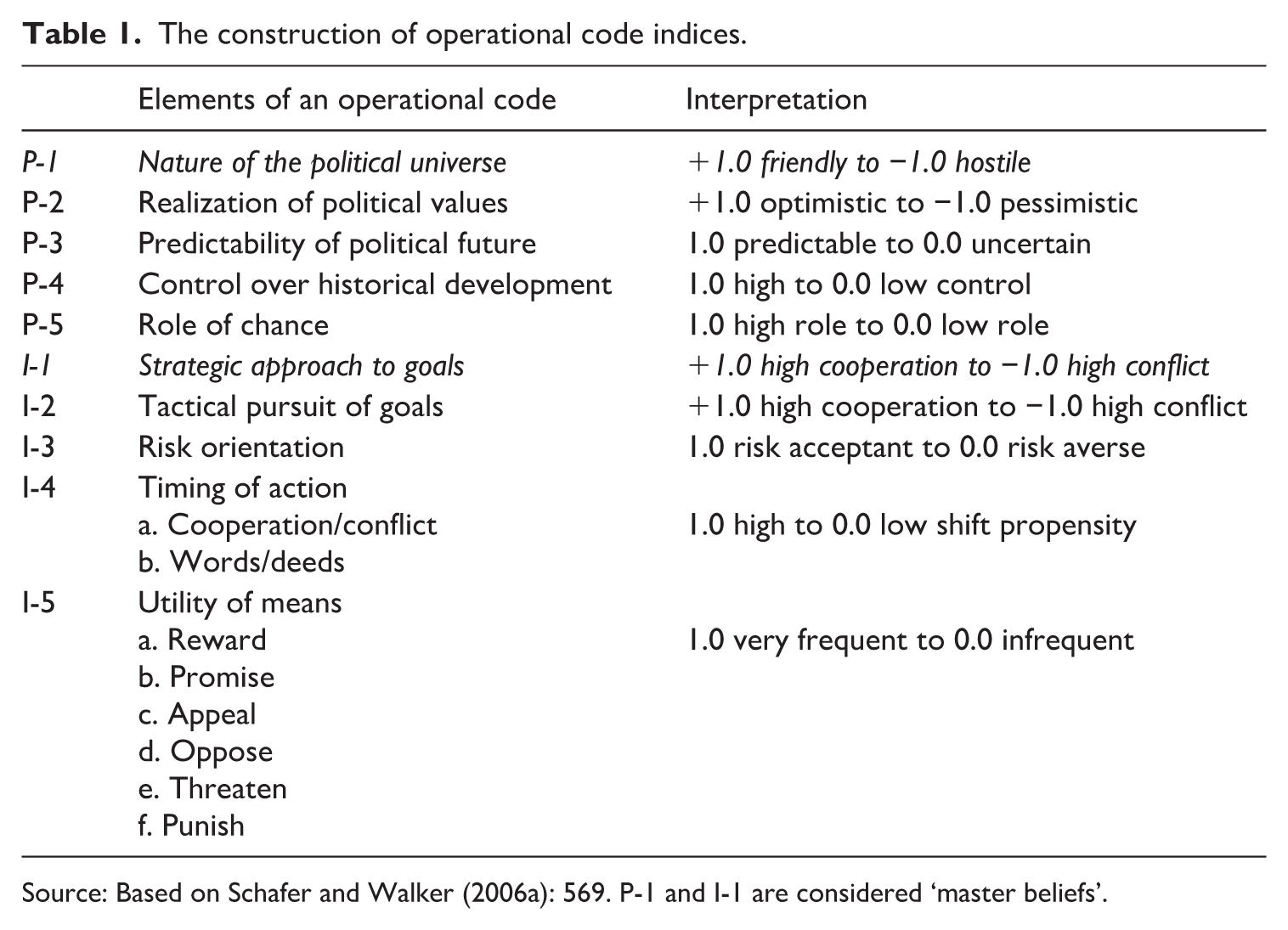
Source: Based on Schafer and Walker (2006a): 569. P-1 and I-1 are considered ‘master beliefs’.
The main claim of this contribution is that OCA can be fruitfully employed to explore a range of pertinent IPE questions, thereby placing greater emphasis on the importance of differences among individuals in IPE more generally. The following paragraphs point to three such questions: bilateral investment treaties (BITs); sanctions; and, moving beyond states’ foreign economic policies, leadership in IFIs. For reasons of space, and with the exception of the last point, the discussion will only highlight issues and questions where the use of OCA has the potential to contribute to IPE scholarship. It will be up to future research to empirically explore those avenues.
States adopt preferential agreements to deepen and expand their economic relations. BITs represent one instrument in this regard. There has been extensive scholarship on the causes, contents and consequences of BITs (e.g. Allee and Peinhardt, 2010; Bodea and et al., 2024). Yet while, for example, scholarship on the causes explores who the signatories of BITs are, discussions tend to be confined to the level of either states (Which states sign BITs?) or domestic institutions (Which kinds of states sign BITs?). Conversely, the role of individual leaders in bringing about (and terminating) BITs has so far received little attention.
There are multiple ways in which the beliefs of individual leaders could impact BITs. It starts with leaders’ propensity to pursue such treaties in the first place, which could be conceived of as being tied to both their diagnosis of the political environment concerning the potential partner and the international economic context more broadly (as per OCA’s philosophical beliefs), and to their preferences regarding the pursuit of more or less cooperative tactics and instruments (as per OCA’s instrumental beliefs). Similarly, the role of individuals could extend to the specific design and contents of BITs, which vary not least in terms of including dispute-settlement mechanisms (DSMs). While, for example, Allee and Peinhardt (2010) tie this variation to institutionally shaped preferences of governments, it seems worthwhile exploring whether the idiosyncratic beliefs of key decision-makers have a similar, or maybe even greater, effect on their willingness to accept legal delegation through DSMs.
A similar argument can be made for the broad literature in IPE about various aspects of sanctions, such as adoption, design and implications (e.g. McDowell, 2020; Newman and Zhang, 2024). Also here, IPE scholarship tends to focus on the actions and motives of ‘states’ or the impact that domestic institutions have on various types of sanctions. Conversely, the role of decision-makers’ beliefs as alternative or complementary drivers for the adoption and design of sanctions (e.g. Boogaerts, 2018) is largely ignored.
A final question concerns the socializing effect of international economic institutions, thus treating beliefs not as independent but as dependent or intervening variable. Socialization can be understood ‘as a process of inducting actors into the norms and rules of a given community’, with actors adopting to and complying with the community’s norms or rules as a result (Checkel, 2005: 804). From a micro-perspective, the socialization of individuals into certain normative environments like those provided by international institutions can be analysed (e.g. Murdoch et al., 2019). OCA could be used, for example, to address potential socializing effects, with different combinations of changes, or lack thereof, in philosophical and instrumental beliefs, respectively, being indicative of socialization being at play (or not) (He and Feng, 2015).
The latter question will now be illustrated by the case of Christine Lagarde and her transition from the post of Managing Director of the International Monetary Fund (IMF) (2011–2019) to the post of President of the European Central Bank (ECB) (since 2019). Given the significant structural differences between the IMF and ECB in terms of mandates, powers, membership and so on (Blackmon, 2025), and provided that socialization processes do unfold, one can reasonably expect to see at least some changes in Lagarde’s beliefs following her transition between both institutions. To examine this question, multiple speech acts of Lagarde totalling some 375,000 words have been compiled from the websites of the IMF 2 and the ECB 3 (Table 2) in order to establish her ‘IMF belief set’ and ‘ECB belief set’, respectively.
Overview of speech acts.
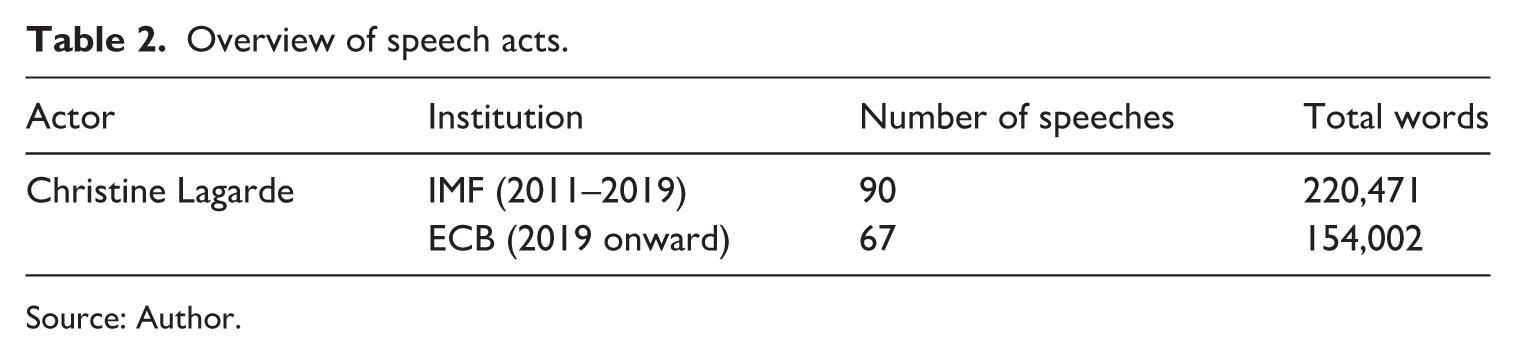
Source: Author.
Figure 1 depicts the OCA results of Lagarde’s speeches. It shows that multiple beliefs have experienced meaningful changes. This not only concerns both master beliefs P-1 (nature of political universe) and I-1 (strategic approach to goals) but also systematically, for example, the utility ascribed to certain instruments. Lagarde’s ‘ECB belief set’ places much greater emphasis on more coercive ones and much less on more cooperative ones (I-5) than her ‘IMF belief set’. In short, then, with fundamental changes in both philosophical and instrumental beliefs, the results suggest that ‘fundamental socialization’ (He and Feng, 2015) has occurred. The fact that Lagarde spent meaningful years at both institutions and that her profile was constructed on an extensive set of speeches increases confidence in this finding. These results lend support to the assumption that leaders are indeed socialized into new institutional environments.

Lagarde’s political beliefs.
This line of research is relevant for IPE scholarship, for instance, because it could help explain policy continuity within international economic institutions despite leadership turnover, with leaders who are socialized into the respective organizational environments being less likely to engage in major reorientations, all else being equal. In turn, if fundamental reversals were to occur, we should expect to see them early on in a leader’s tenure when the effects of socialization have not yet taken hold. These considerations speak to research into the conditions and timing of institutional stability or change in global economic governance (e.g. Heldt, 2019). Focusing on actors’ beliefs could thus provide a leader-centred empirical reflection of institutional explanations ‘in action’. Besides, the discussion also has implications for appointments to international economic institutions’ top posts which often times amount to highly political and politicized decisions. The occurrence of socialization suggests that on top of contemplating factors such as gender or nationality those in charge of such decisions should pay at least as much attention to the candidate’s general personality traits (agreeableness, extraversion etc.) as to their political beliefs, since the latter are much more likely to change or adapt over time than the former.
Overall, as per this forum’s first guiding question, this contribution discusses how FPA scholarship can contribute to IPE. It does so by pointing to several avenues along which one of FPA’s analytical tools to profile leaders can be employed to explore the role of individual actors in various issue areas of relevance for IPE, thus placing greater emphasis on individuals in IPE more generally. For example, the contribution suggests that contextually socialized individual beliefs may constitute the ‘missing’ (or black-boxed) link between institutional settings and IFI decisions. Future research on the IPE/FPA nexus should explore how a combination of different methods to probe into the agency of leaders can be fruitfully combined. Finally, turning to the second guiding question, future integrative research into leaders could further explore the extent to which the presented discussion on individual beliefs connects not only to institutions but also to ideas and interests, for example, with respect to how beliefs feed into ideas, or vice versa, and how beliefs inform interests. This would represent another hook for connecting discussions in IPE and FPA to debates in wider IR scholarship (e.g. Goldstein and Keohane, 1993).
Societal influence and leaders’ autonomy in governmental decision-making processes (Stefan A. Schirm)
Analytical political science theories conceptualize causal claims while maintaining parsimony and a rigorous focus to reach a clear argument and a selection between instances which might matter for core claims and others which might not matter. Otherwise, all-encompassing approaches would emerge that might end up in an ‘everything matters’ view with weak explanatory power. Therefore, it is argued here that connecting IPE and FPA theories should focus on how core strengths of the theories can complement each other. Since both IPE and FPA represent large theoretical traditions with a plurality of approaches, a dialogue must also be clear regarding the specific concepts within the two camps selected. This contribution focuses on the arguments on the influence of societal ideas and interests on governmental preferences provided by the societal approach to IPE and on the arguments on elected leaders’ autonomy (‘agency’) in decision-making processes provided by FPA approaches. Since my expertise centres on the societal approach, this article’s novel contribution will be informed more by IPE’s perspective than by FPA’s.
The societal approach to IPE conceptualizes voters’ ideational attitudes, lobby groups’ material interests and domestic institutions to explain governmental preference formation (Schirm, 2013, 2016, 2020, 2022). It focuses on societal actors, domestic distributional consequences of IR and electoral politics and draws on other domestic politics theories of IPE/IR such as the liberal theory (Milner, 1997: 9; Moravcsik, 1997: 519) as well as the domestic dimension of historical institutionalism and ideational theories (Fioretos, 2001, 2011; Goldstein and Keohane, 1993). It maintains that governmental and opposition politicians strive for electoral success and will, therefore, be responsive to voters’ and lobby groups’ demands and institutions, particularly in democratic systems. Considering all three variables, it suggests hypotheses for their prevalence in informing governmental preferences (Schirm, 2020: 404–405). It argues that material interests matter when policy initiatives affect well-organized and economically important groups whose material considerations about costs and benefits will induce lobbying. Ideational expectations of voters matter when fundamental and salient questions about the role of the government in steering the economy are concerned. Economic and political institutions influence governmental preferences if a policy initiative concerns previous domestic regulations. Institutions are left for further research here in favour of ideas, interests and framings, as explained below and because institutions have been well considered by FPA (Da Conceição-Heldt and Mello, 2018).
Furthermore, the societal approach also conceptualizes ideational-material alignments (Schirm, 2020, 2024). Given the plurality of ideas and interests in societies, both forces can not only compete but also politically reinforce each other in de facto aligning in informing governmental preferences in the same policy direction. Ideational-material alignments can compete with other alignments that demand a different policy. The government, however, is not only the recipient of societal demands but can also influence societal ideas and interests through framings and incentives (Schirm, 2024: 1133). For instance, it can frame policies as mandatory (‘without alternative’) or as linked to a superior issue and influence societal actors through subsidies and regulations. Thus, governmental framings and incentives can raise public support for its policies and augment politicians’ leeway vis-à-vis societal ideas and interests that favour different policies. Following the societal approach’s line of thought, governmental politicians’ motivation for framings and incentives does not derive from leaders’ insular personality traits but instead from other (societal) ideas and interests, which compete with those ideas and interests to be influenced by framings and incentives.
FPA theories constitute a significant field of IR, particularly regarding the conceptualization and examination of decision-making processes of governments and bureaucracies, especially on foreign and security matters, but also economic policy and IOs (see Fouquet and Baydag’s and Brummer’s contributions). The following thoughts can only draw on exemplary literature and do not attempt to encompass the extensive variation of FPA theories. Compared to IPE’s domestic politics theories, FPA theory grants governmental politicians considerable decision-making autonomy and ‘agency’ (Da Conceição-Heldt and Mello, 2018; Kaarbo and Thies, 2024). Most FPA theories do not share the central argument of IPE/IR’s liberalism and societal approach that elected political decision-makers’ (and executive officials appointed by them) preferences are primarily shaped by domestic-societal factors to secure electoral success (and (re-)appointment). Governmental responsiveness to societal forces, public opinion and domestic structures are considered by several FPA authors (e.g. Blavoukos and Bourantonis, 2014; Boucher, 2024; Mintz, 2004; see also Oktay’s contribution) but do not occupy a primary role in most of FPA theorizing. Instead, elected decision-makers’ preferences are mostly seen as shaped by their socialization and personality, elite psychological factors, leaders’ beliefs of ‘national interest’ and a state’s ‘role’ in world politics (e.g. Brummer et al., 2020; Kaarbo, 2015: 191; see also Thies and Wehner’s contribution).
While IPE’s domestic politics theories take a bottom-up perspective in arguing that societal influences matter analytically prior to other influences such as personal and international constraints for governmental preferences (Moravcsik, 1997: 516; Schirm, 2020: 410), most FPA theories see the forces of societal pressures as mediated by decision-maker agency and argues for the primary causal relevance of the leaders’ personality and individual perception (Calvert and Kaarbo, 2025). Through the analytical lens of IPE’s domestic politics theories, however, this FPA concept seems possibly circular because decision-makers’ personalities are taken as cause of decision-makers’ preferences. On the other hand, from an FPA viewpoint, the domestic politics IPE theories’ core argument of responsiveness of elected decision-makers towards societal material interests and ideational expectations seems simplistic because it would sideline the possibility of decision-maker autonomy/agency: ‘In particular, assumptions about (. . .) states as mere transmission belts for domestic interests, and constraints on government policy by interest groups and the public (. . .) are antithetical to an FPA approach’ (Kaarbo, 2015: 196). Milner and Tingley (2011: 38) acknowledge that ‘in democracies, governments have to build domestic support for the use of foreign policy tools’ but focus on legislators as constraint for governments, not on direct interactions between government and electorate/lobby groups.
At this point, I argue that society-centred IPE and leader-centred FPA theories can benefit from each other’s strongholds by combining selected core aspects through conceptualizing societal conditions of leaders’ autonomy (on FPA and liberalism see Hadfield, 2024). Thus, this endeavour builds upon the domestic-societal approach to IPE and those FPA works that also consider the societal perspective (e.g. Boucher, 2024), on the one hand, and FPA’s core arguments on leader’s decision-making agency/autonomy (see Kaarbo, 2015) on the other. In the following, I elaborate on possible conditions (independent variable) for elected decision-maker autonomy (dependent variable) from specific societal influences without ignoring that other societal ideas and interests might have motivated the leaders’ wish for autonomy from the former. This conceptualization develops further the societal approach’s claim of governmental responsiveness, incorporates the societal arguments of FPA authors (such as Mintz (2004: 7) stating that ‘domestic political audience costs are an integral part of foreign policy decision-making’) and complements FPA’s concept of leaders’ agency. Five causal conjectures are proposed and illustrated as possible scenarios.
In the first scenario, the policy issue at stake bears only low salience among voters and significant lobby groups. Here, elected governmental decision-makers can more likely follow personal preferences that were informed by other societal ideas and/or interests or by elite lobby groups. Security policy was often seen as a policy area quite independent from voters’ ideational or material demands because the latter two would not have been articulated strongly (Boucher, 2024: 254–259; Oppermann, 2014). This notion, however, might not hold any more to previous degrees due to the politicization of security issues such as military support for Ukraine after Russia’s invasion and for Israel after Hamas’ attack.
In the second scenario, opposed material (e.g. economic sectors) or ideational (e.g. non-governmental organizations (NGOs)) lobby groups balance each other’s influence and thus neutralize their impact on governmental decision-making. In this situation, leaders likely attain autonomy to follow their previously shaped preferences. For instance, leaders might follow a compromise or a third way if equally strong liberalization-friendly and protectionist economic lobbies try to influence trade policy. A similar scenario is conceivable regarding ideational NGO influence, for instance, when climate protection NGO’s desire for more energy production through wind turbines clashes with local environmentalist groups’ desire to protect the forests and animals endangered by wind turbine farms.
Third, suppose governmental framings (through media or direct campaigning) succeed in shaping public opinion in favour of desired policies, governmental decision-makers can obtain autonomy vis-à-vis some societal forces to follow preferences shaped by other societal ideas and/or interests, elite groups, socialization, without fearing electoral losses. In the Eurozone crisis, for instance, the German government successfully framed rescuing indebted countries and German banks’ assets as ‘necessary for the survival of Europe’. This framing largely balanced the widespread opposition to large bail-outs for debtors and banks (costly for taxpayers) due to the framed link of the issue with the ‘survival’ of European integration, which is firmly supported by most German voters (Schirm, 2024).
In the fourth scenario, governmental incentives (e.g. subsidies or rules) succeed in changing the material interests of economic lobbies and/or voters’ ideas. This would likely contribute to the governments’ preferences (shaped by other societal ideas/interests, elites, socialization) being implemented without electoral punishment by voters or resistance by lobby groups. In Germany, for instance, large subsidies as well as regulatory measures for investment in wind turbines and solar panels motivated major energy firms (such as E.ON and Siemens) to abandon their previous support of nuclear energy and embrace the benefits of state incentives for renewables (Schirm, 2024). Thus, subsidies and regulations nudged the direction of corporate lobbying into line with government policies.
Fifth, in multiparty coalition governments, politicians primarily need to secure the support of their party to achieve/remain in office because party delegates decide on candidates (on coalition governments in FPA see Oktay, 2022). This implies a certain autonomy because ministers can decide against a majority of voters if acting in harmony with their party and if the party does not need to attain support from a majority of voters. Again, an example from Germany, where in 2023 the responsible decision-maker, a minister from the Green Party, decided to switch off the remaining nuclear power plants amid an energy crisis and was still elected to be the candidate for chancellorship by delegates of his party, even though a majority of Germany’s electorate opposed switching off the nuclear power plants. Furthermore, following their party’s position but against the general electorate’s desire to continue nuclear energy in the crisis, the three Green Party Ministers of Economy and Climate, Environment, and Foreign Affairs tried (unsuccessfully) to prevent the European Commission from including nuclear energy in its climate protection Taxonomy in 2022. In addition, they refused Germany’s participation in the multilateral ‘Nuclear Pledge’ to triple nuclear energy capacity by 2050, initiated in 2023 by US Special Presidential Envoy for Climate John Kerry.
These five scenarios on possible societal conditions for elected decision-makers’ autonomy must be further developed and empirically tested in future research. They serve as a blueprint for how core elements of IPE and FPA theories can complement each other and augment their explanatory power regarding the nexus between societal influences on governmental preferences and leaders’ autonomy in decision-making processes. Combined, the societal approach’s focus on domestic influences and FPA’s theorizing on leaders’ agency offer novel conceptualizations of the interaction between society and government as well as a more profound analysis of both theories’ core question on the causes of foreign (economic) policies.
National explanations for global challenges? Why we need a closer dialogue between FPA and IPE – Now (Sibel Oktay)
The calls for greater synergy between FPA and IPE are not new (Kaarbo, 2015). Today, synergy is necessary to better explain international politics. I pose a two-part assertion to that end: first, I argue that the most pressing challenges we will face in the next decades – climate change, competition for critical minerals and other natural resources, global health crises and contestation over emerging technologies and the cyberspace, to name a few – are both economic in nature and orthogonal to traditional security and defence issues, requiring a more focused foreign policy lens to understand and explain them. Second, the determinants of policy in these areas will be increasingly located at the national level, partly due to rising polarization and the politicization of foreign policy.
I argue, therefore, that while these issue areas will draw us closer to IPE, our explanations for why and how they are contested, coordinated and resolved will benefit from greater engagement with FPA. In the remainder of this contribution, I overview the major streams of work in FPA, showcase some recent studies on climate politics traditionally covered in IPE and discuss why greater engagement between the two subfields would shed new light on them.
It is broadly accepted that foreign policy does not stop at the water’s edge (Wagner et al., 2018). FPA scholarship has demonstrated how domestic factors ranging from political institutions (Oktay, 2018, 2022) to processes (Garrison et al., 2003), individual leaders (Kesgin and Wehner, 2022) and role conceptualizations (Cantir and Kaarbo, 2012) shape foreign policy.
Much of this research in FPA has remained static, however, focusing almost solely on traditional security and defence issues. Meanwhile, issue areas such as climate, environment, energy, global health and emerging technologies – long regarded as ‘techno-scientific problems’ (Fawad et al., 2023: 819) – are fast entering conversations on foreign policy and national security. Increasingly, they are being contested at the domestic level due to deepening politicization (Cadier, 2024), polarization (Friedrichs and Tama, 2022) and populism (Kaltwasser et al., 2017). In the case of climate policy, for example, these dynamics are compounded by nationally determined contributions (NDCs) for countries to tailor their climate adaptation plans in accordance with their own constraints and resources (Iacobuta et al., 2018). In these areas, it is now more important than ever to focus on the domestic political factors and processes that shape policymaking and influence policy choices.
These issues, though new to FPA, are frequently covered in IPE. Recently, Hendrix (2025) discusses the limits of multilateral climate cooperation, while Farrell and Newman (2019) highlight how global information networks can be weaponized by states to induce cooperation. Echoing LeBaron et al.’s (2021) call to highlight IPE’s ‘blind spots’, Tilsted and Newell (2025) argue why petrochemicals are central to understanding the global capitalist order. These contributions among others, however, seldom problematize the people and processes behind these distinct policy outcomes, which are FPA’s bread-and-butter puzzles. For instance, why and how has ‘economic nationalism’ come to impede climate cooperation (Hendrix, 2025)? Which actors, within what types of political processes, choose to weaponize information technology against foreign rivals? Often, IPE scholarship would focus on the global movements of money, technology, people and institutions with an interest in explaining their distributional consequences. But which actors decide these movements (while others do not), when do they do so, and in what political contexts, might go overlooked.
Surely, exceptions exist. The domestic-societal approach to IPE (see Schirm’s contribution) elucidates the relationship between social preferences (voters and organized interest groups) and the government’s economic and climate policies (e.g. Baydag, 2024; Heldt and Mahrenbach, 2020). Meanwhile, the ‘two-level game’ framework helps answer how domestic forces shape national leaders’ ability to negotiate policy at the international level (Da Conceição-Heldt and Mello, 2018; Frieden and Martin, 2003: 123). Against the backdrop of increasing polarization, populism and politicization of foreign policy, however, questions like why some governments commit to climate mitigation efforts while others do not, or when and under what conditions they choose to seek energy independence, remain under-explained.
With its multi-factorial approach to investigating foreign policy by situating political actors in both their domestic contexts and the broader international system (Hudson, 2005), FPA is well-positioned to start this dialogue with IPE. In effect, we can better identify the domestic political and process-related dynamics that facilitate, impede and steer policymaking in these issue areas. To illustrate, I turn to climate politics next.
IPE has made significant inroads into studying climate politics and policymaking (e.g. Paterson, 2021). Bernauer (2013: 436) observes, however, that more work needs ‘to explore how domestic and international factors interact to influence policy choices’. This is a timely call given the 2015 Paris Agreement’s introduction of NDCs – national climate action pledges for mitigation and adaptation – to serve as the basis of global climate cooperation (Boasson et al., 2023). NDCs constitute an inside-out approach to global climate governance at a time of growing populism and politicization of foreign policy, turbo-charging the influence of domestic politics on climate policy (e.g. Keohane and Oppenheimer, 2016). A dialogue between FPA and IPE would bear fruit here. Below, I offer some snapshots from two streams of work to discuss what this dialogue might look like.
The first stream asks whether domestic political institutions influence the development of national climate mitigation and adaptation policies. Bättig and Bernauer (2009) find that democracies engage in stronger climate mitigation commitments than non-democracies. Subsequent research investigates the categorical effects of party politics, ideology and national legislatures on climate policy (Iacobuta et al., 2018; Knill et al., 2010).
The FPA literature would take us further in questioning how the variation in climate policy can be explained within the broader category of democracies, across different political parties that exist within specific executive-legislative power arrangements. For instance, while democracies might be, on average, more committed climate champions, their institutional designs would introduce more nuanced effects on their climate commitments: majoritarian regimes might be more likely to isolate the effects of anti-climate opposition groups in the legislature and commit to more rigorous NDCs, whereas pro-climate governments in non-majoritarian regimes might need to co-opt their sceptical opposition counterparts, generating less ambitious climate policies (cf. Elman, 2000). An FPA approach to climate policymaking would analyse the specific institutional setup and how it empowers some political actors (government or opposition) over others, shaping climate policy decision-making and outputs.
A closer look at the domestic institutional setup would also yield more precise insights on the effect of party ideology on climate policy. Knill et al. (2010: 328) find that veto players in government impede climate policymaking. This relationship assumes veto players to always be against pro-climate policies, however. Would pro-climate parties with veto power supercharge the government’s climate ambition? An interesting future project that brings the so far segmented IPE and FPA literatures on party politics and veto players (e.g. Heldt and Mahrenbach, 2020; Oktay, 2022) into dialogue would investigate the effect of party ideology on climate policymaking, conditional on the structure of the government.
The second stream looks at factors pertaining to domestic leadership and national roles. Sosa-Núñez (2015) explains the variation in Mexico’s climate policy by tracing the shift from President Calderón to Peña Nieto. Bailey (2019) focuses on President Obama to overview the climate record of the United States. Still others invoke norms, values and roles. Roettereng (2016) highlights the tension between normative expectations and material interests in shaping Norway’s carbon capture storage policy.
An FPA approach would extend these findings. Kesgin (2023) uses OCA to account for leader beliefs about climate change. Going forward, we can investigate whether leaders from certain regions of the world share similar belief systems about the climate crisis and whether these shared systems influence their international negotiation behaviour. As climate policy becomes increasingly politicized, research on the leadership styles of populist leaders (Fouquet and Brummer, 2025) would also inform subsequent research on whether and how populist versus non-populist leaders approach climate issues differently. Furthermore, FPA demystifies the influence of leaders by grounding them in their bureaucratic structures, further disentangling their decision-making processes. Below (2008) uses Poliheuristic Theory to trace how four US presidents arrived at their respective decisions on key climate agreements. Future studies can contextualize climate policymaking further by situating leaders in their advisory groups and the broader bureaucratic process.
Climate politics opens new avenues in role theory (RT) research too. Existing work on role conflict can help explain the tension in Norwegian climate policy (Roettereng, 2016). Research on Indian climate policy suggests that the country has been undergoing a role change, from ‘heroic victim’ to a ‘responsible role’ (Plagemann and Prys-Hansen, 2020: 288). Through a greater integration of FPA approaches, future studies can explore, for instance, how much of this role change is explained by domestic role contestation (Cantir and Kaarbo, 2012) or by the leadership style of Prime Minister Modi (Kesgin and Wehner, 2022).
Bringing external factors back in: IPE, FPA and the making of the EU economic security policy agenda (Francesco Niccolò Moro and Manuela Moschella)
What drives the making of the EU Economic Security Policy Agenda? In the midst of a lively debate on the so-called geo-economic turn, this contribution brings together insights from FPA and IPE to provide a first cut analysis of the emergence of such policy agenda. As Kaarbo and Thies (2024: 2) put it, FPA’s distinctive contribution has been that of exploring the ‘black-box’ of the state by examining the actors, institutions, cultures, identities, interests and perceptions that shape foreign policy. While the analysis of within-state factors is not exclusive to FPA – as IPE also explores domestic political dynamics (see Schirm’s contribution) – one of IPE’s major strengths is to highlight the recursive relationship between international and domestic politics (Gourevitch, 1978). Here, we incorporate IPE’s perspectives on how global political and economic dynamics deeply affect the domestic level. A large space for agency remains, and domestic factors, starting with leaders (Brummer, 2024) and coalition politics (Oktay, 2022), clearly play a key role in shaping decisions. Yet, as we show in briefly reconstructing the process leading to the new EU Economic Security Policy, integrating IPE insights on external pressures can be an important addition.
IPE’s rich tradition in explaining the impact of globalization on domestic decision-making, dating back to foundational thinkers like Susan Strange, provides a critical framework for this theoretical pursuit. Strange’s seminal works emphasize how the structural power of globalized markets reshapes state capacities and constrains domestic political choices (Strange, 1996). This intellectual legacy has been expanded in the IPE community through scholarly debates on the evolution of domestic capitalist systems under globalization. Central to these debates are issues of convergence and divergence among the policies and institutions of capitalist economies (Barta and Johnston, 2023; Mosley, 2000), and the attention to the complex interplay between global economic pressures and domestic institutional contexts (Hay, 2004). More recently, scholars have added to this body of work by illustrating how globalization-induced rule overlaps and the interdependence of regulatory frameworks create opportunities for domestic actors to influence policymaking and fundamentally reshape domestic political choices. This scholarship demonstrates how overlapping global rules disrupt domestic institutional equilibria, empowering some actors while disempowering others, enabling new coalitions to form and fostering the development of alternative policy agendas (Moschella, 2016; Newman and Posner, 2018). These dynamics highlight how the international dimension operates as a source of power that penetrates domestic political systems, catalysing institutional change and redefining policy priorities.
Here, we bring this tradition to the fore, emphasizing how external developments can disrupt the domestic policy status quo. At its core, IPE is concerned with the distribution of power resources and the mechanisms through which power operates across levels of analysis (for a recent overview, see Moschella et al., 2024). This focus on ‘who wins and who loses’ makes IPE uniquely equipped to analyse the effects of global political economy developments on domestic politics. In particular, it provides an essential lens for examining how global dynamics influence domestic policymaking through at least three interrelated mechanisms: empowering or disempowering political actors, fostering new coalitions and challenging and reshaping established narratives.
Exploring the systemic pressures that constrain but also reshape domestic structures and decision-making processes is a promising avenue to explore pressing contemporary issues, starting from the so-called geo-economic turn and its impact on economic policymaking (Herranz-Surrallés et al., 2024). To this end, we examine the EU’s first adoption of a new foreign economic policy framework, the Economic and Security Strategy, in June 2023. 4 By tracing the interaction between global developments and domestic policymaking within the EU, the essay underscores the broader theoretical contribution of IPE to FPA: external developments can destabilize the domestic policy equilibrium by reshaping power dynamics among key actors, reconfiguring coalitional alignments and shifting dominant narratives.
The development of the new EU economic security policy reflects a profound interplay between global developments and domestic politics. A key question is how the EU progressively came to recognize the inextricable link between economic policy and security concerns. This process can be understood through three major turning points, each highlighting how global shifts translated into domestic political dynamics and drove the adoption of a new economic security policy framework. At each of these turning points, we also draw attention to how key decision-makers within the EU – such as the President of the Commission and leaders of influential member states – navigated trade-offs, interpreted external challenges. We thus highlight that not only structural shifts but also elite agency and incentives matter.
The first turning point is associated with the evolution of the EU Common Foreign and Security Policy (CFSP) during the years 2013–2016. This period marked a growing cognitive awareness among EU political leaders of the rapidly evolving and increasingly precarious global strategic environment. As the European Council (2013) noted, ‘Europe’s strategic and geopolitical environment is evolving rapidly’ in ways that expose the EU’s limitations in responding to external threats.
In response to this shifting global context, EU leaders introduced the concept of strategic autonomy to galvanize efforts towards a ‘more integrated, sustainable, innovative and competitive defense technological and industrial base’ (European Council, 2013). This vision was further articulated in the 2016 EU Global Strategy, which emphasized the need for a stronger European defence industry to safeguard not only the security of EU citizens but also the Union’s principles and values (European Commission, 2016). Importantly, the evolving global context proved crucial in enabling this policy shift by empowering some domestic actors while weakening others. For example, one of the persistent obstacles to advancing EU security integration has been resistance from member states that viewed such developments as a potential threat to North Atlantic Treaty Organization’s (NATO) role and transatlantic security arrangements. However, the changing context diminished the influence of these voices, instead amplifying the arguments of those advocating for urgent action. This reshaping of discursive power in domestic debates became even more evident following Russia’s war against Ukraine, which created a ‘rally-around-the-flag’ effect and strengthened the case for strategic autonomy (Hoeffler et al., 2024).
The second turning point (2017–2020) saw the expansion of the EU’s strategic autonomy from defence to economic policy, driven by rising geopolitical competition with China and the US. Donald Trump’s 2016 election strained transatlantic ties, as his administration weakened or withdrew from multilateral institutions and agreements. China, in the meanwhile, played and increasingly assertive role in the global political economic arena, advancing the Belt and Road initiative and becoming a key foreign direct investment (FDI) actor in several European countries and business sectors perceived as strategic (from manufacturing to logistics). Furthermore, the COVID-19 pandemic starkly revealed the vulnerabilities of Europe’s economy to global supply chain disruptions and its overreliance on non-EU suppliers for critical raw materials and technologies (European Commission, 2020).
In this context, EU decision-makers began to redefine their economic policy agenda to ‘defend [European] interests in an increasingly geopolitically competitive environment’ (Bauerle Danzman and Meunier, 2023). Restrictions to FDI and industrial policy emerged as central policies to secure greater European sovereignty and a more independent EU role in global affairs (McNamara, 2023). Importantly, these developments reflect a shift not only in global circumstances but also in coalitional alignments within the EU both among member states and societal actors like business groups (Schmitz and Seidl, 2022). IPE’s domestic politics scholarship suggests, for instance, that governments were influenced by concerns over sovereignty, national competitiveness and exposure to geopolitical risk (Calcara and Simón, 2025). Member States such as France, Germany and Italy openly stressed the need for more instruments to reciprocate the policy of investment screening, also reflecting increased domestic interest group pressures to safeguard ‘strategic sectors’ (Chan and Meunier, 2022).
The third turning point in the EU’s economic security agenda was Russia’s 2022 invasion of Ukraine and the ensuing energy crisis. The war exposed Europe’s dependence on external suppliers, with Russia supplying 30% of its crude oil and 40% of its natural gas in 2020. Energy price shocks revealed vulnerabilities in the EU’s open markets, driving efforts to diversify supplies and strengthen resilience. Simultaneously, US subsidies for green tech intensified transatlantic economic competition and spurred fears of EU deindustrialization.
These external shocks induced belief changes that reshaped EU policy narratives, shifting the focus towards resilience and autonomy. The convergence of crises challenged free-market views, fuelling ‘new market activism’ (McNamara, 2023) and reframing policy around resilience, sustainability and geopolitics. The energy crisis and war in Ukraine heightened urgency, weakening narratives of market efficiency. Global shifts reinforced domestic calls for intervention, often justified by sovereignty concerns in key sectors like technology (Seidl and Schmitz, 2024). This culminated in the EU’s first Economic Security Strategy in June 2023, which explicitly linked economic and security interests, prioritizing competitiveness, resilience and industrial policy.
In sum, external global developments have provided the conditions to disrupt the EU’s policy status quo (Lavery, 2023). These developments exposed vulnerabilities and empowered new actors, facilitated the formation of new coalitions and contributed to challenging well-established narratives, thus contributing to redefining EU policy priorities around resilience, sovereignty and the strategic alignment of economic and security goals. This policy shift demonstrates the critical interplay between international pressures and domestic politics, offering a compelling example of how global forces help shape domestic policy transformations.
Our stylized case study sketches the influence of external developments on collective organizational actors. Yet, to fully grasp how and why the observed transformations occurred, it is equally important to examine how individual decision-makers – operating within institutional settings and responding to evolving public preferences – shaped the course of change. Combining FPA’s micro- and meso-level analysis with IPE’s macro-structural focus allows for a richer, multi-causal account of EU economic security policymaking. To further integrate IPE and FPA in the study of foreign policy change (Gustavsson, 1999), future research could conduct a time-sensitive OCA (see Brummer’s contribution) of the worldviews expressed by key policy entrepreneurs before and after externally induced windows for programmatic shifts. The interplay between such individual belief changes and internationally driven reconfigurations of the societal ideas and organized interests stressed by IPE’s domestic politics theories (Milner and Tingley, 2015) would be another step, which may be operationalized with (the cognitive and strategic variants of) narrative analysis (Skonieczny, 2018). FPA and IPE scholars could also use bureaucratic politics models for tracing how newly formed coalitions reshape bargaining and decision-making processes in various national and EU-level institutional settings (Brummer, 2013; James and Quaglia, 2021). Finally, the policy change resulting from externally catalysed individual, societal and domestic political transformations would translate into adjusted foreign economic and security roles (see Thies and Wehner’s contribution) performed by the European Commission, respectively, its policy makers (Aggestam and Johansson, 2017).
This discussion exemplifies the broader theoretical contribution of IPE to FPA. Where FPA traditionally focuses on domestic processes shaping foreign policy, IPE enriches this perspective by showing how global political and economic dynamics penetrate domestic systems, altering power distributions, affecting coalitional dynamics and challenging existing ideas and narratives, thus reshaping key factors that drive policymaking. The EU’s economic security agenda vividly illustrates IPE’s attention to power as a mechanism that empowers certain individual and institutional actors, fosters new identity-based or interest-led coalitions, and reframes dominant perceptions. By integrating IPE’s insights into FPA, scholars can better understand the recursive relationship between domestic and international politics, offering a more comprehensive framework for analysing the complexities of foreign policymaking.
Role Theory as a bridge between FPA and IPE (Cameron G. Thies and Leslie E. Wehner)
FPA and IPE have largely developed in silos despite sharing analytical similarities like attention to domestic decision-making actors and processes that affect international dynamics. This recognition opens up the possibility of investigating diverse topics that cross both subfields, including decision-making to adopt free trade agreements or institute tariffs, the effect of economic crisis on sovereign debt renegotiation with IOs, the uses of foreign aid and the imposition of economic sanctions, among many others.
While potential synergies between IPE and FPA are obvious upon reflection, we lack a road map for advancing fruitful interaction between them. Thus, we offer RT as a bridge. Symbolic interactionist RT is an important approach in FPA, with limited use in IPE despite the potential to inform economic processes of states, non-state actors and IOs. We contend that roles have always had a home in IPE, not just in FPA (Spielberger, 2025; Thies and Wehner, 2019). Roles add agency to international institutions and regimes in terms of their origins, dynamics and provision of goods in IPE. This article presents some key concepts of RT as used in FPA but so far only marginally discussed in IPE. We then propose a research agenda to start a fruitful dialogue between the subfields.
Roles reflect patterns of behaviour of an actor and the type of actor is possible to be within an organized group (Harnisch, 2011; Thies 2010). Roles are relational as there are not debtors without creditors, including lenders of last resort (Thies and Wehner, 2019). Role conceptions encompass a self-definition of an actor within a context and the expectations of others (alter) about what role the self (ego) should play. Role enactment is the behaviour of an actor, including transnational actors and IOs such as the IMF, The World Bank and the Organisation for Economic Co-operation and Development (OECD). The roles of states and non-state actors in the international economy are contested as part of the political process, reflecting power dynamics within the bureaucracy of IOs or vested interests of domestic and transnational actors (Cantir and Kaarbo, 2012; Wehner and Thies, 2014). Contestations can turn into role conflicts involving domestic actors, the state and external actors who have varying expectations on the different roles available for an interaction (interrole conflict) or on how a selected role is being enacted (intrarole conflict). Furthermore, role expectations can even be expressed with the purpose of putting the targeted states, transnational actors or IOs (alter) into a desired role and in this way also locate and validate a specific role for ego, that is, role altercasting (Oppermann, 2024).
The conceptual apparatus of RT has a relational element that allows us to unpack the ideas and vested interests of domestic groups advocating for freer trade or protection, for a specific type of trade relationship to the state and for resisting or accepting certain notions of economic governance that are promoted by external others. This set of concepts can be applied to the plethora of actors in the international economic system and its subcomponents and thus help scholars elucidate agency–structure dynamics. While RT stresses the capacity of actors to adopt and create certain performative scripts in the world of economic relations, actors casting a role relationally also need to make sense of structural constraints when selecting roles to perform. Not all roles are possible as they need to resonate within the actor and audience observing the role performance to endure and thus follow the type of cultural milieu, set of interests and material aspects of the actor (see Moro and Moschella’s contribution).
RT has proliferated in FPA since its re-emergence in the 2010s. RT contributes agency to the study of IPE for all actors of an economic system and across its different levels of analysis. While Thies and Wehner (2019) have shown the value of RT to study the different actors, forces, relationships and set of ideas and interests in economic crises, there are other themes to be explored in IPE from a RT approach. These are only suggestive and thus not exhaustive of the international economic world.
Role contestation and role conflict can help unpack the different dynamics of coalitions of domestic actors along with external ones to either resist or adopt different sets of protective or pro-free trade policies. This may help to explain why governments at times prioritize external demands of other states over their domestic demands. The external and internal dynamics of monetary policies and autonomy or political dependence of central banks may also be viewed as a role interactionist process. For instance, a role approach can shed light on empirical puzzles such as how leaders and bureaucracies of central banks have started to develop management strategies to cope with populist leaders’ pressures for changes on interest rates and monetary policies.
We might also examine the influence of IOs in promoting a specific set of role expectations for states or altercasting states into a specific role, which is consistent with recent calls in RT to study IOs as foreign policy actors (Breuning, 2024; Panke and Friedrichs, 2024). While RT has only started viewing IOs as foreign policy actors, the broader subfields of FPA and IPE have advanced these linkages through the study of leaders and bureaucracies in IOs (Kille, 2024). Leaders or representatives can enact existing roles differently and at times select new roles for very specific interactions (Wehner and Thies, 2021). Representatives of IFIs can even attribute roles and altercast a state into role models or the example role for others to emulate, which the audience of states may resist. A focus on roles can also illuminate research questions on how leaders of IOs enact roles to facilitate and bring together conflicting parties in trade disputes at the World Trade Organisation (WTO) level or push states to adopt concrete policies and thus roles. Even NATO as a security institution has experienced pressures from Donald Trump regarding political economy matters on budget spending and resource allocation, but it remains a pending task to analyse how the representatives of such institutions react and manage national leaders’ pressures and demands. IOs of the magnitude of the UN, WTO, IMF and World Bank also have their own bureaucratic apparatuses that may create role contestation processes between sub-agencies that may affect the role-play of the institution.
At the systemic level, IOs sometimes act using their overlapping mandates and functions as joint ventures and adopt similar roles that create positive synergies but at other times adopt competitive role dynamics that can be detrimental to the governance of the economic system, as Thies (2020) discusses in terms of the formation of the Asian Infrastructure Investment Bank. This latter suggestive topic directly brings together RT with IPE scholarship on regime complexity and institutional overlapping, thus adding agency to a systemic feature of the international economic world (e.g. Alter and Meunier, 2009; Busch, 2007).
IPE can also bring analytical value to FPA through RT. The power dimension in RT is rather implicit in FPA and thus IPE and its toolkit is better equipped to flesh out the power aspect of role interactions. Likewise, IPE brings a notion of hierarchy of interests, actors and type of institutional cooperation or conflict that is selected and advanced as part of the governance of the economic system. IOs when attributing roles and functions to their member states create social hierarchies in a rather top-down way, while actors may in a bottom-up manner reinforce or resist and thus seek to change such hierarchies. Role relationships always involve a hierarchical social interaction; something which IPE as a field has explored systematically from its mainstream to its critical approaches (Alami et al., 2022; Cooley, 2003). This richness of IPE can shed light on the different actors involved across different levels of the global economic system, and on how role relationships in foreign policy create patterns of synergy among actors and at times structural dependencies. These economic dependencies are not necessarily deterministic of the possible patterns of behaviour of an actor, as they may adopt agential contestations, which can be analysed in the study of foreign economic policies of states.
This contribution has highlighted potential synergies and a set of topics in which IPE and FPA using an RT perspective can amplify their analytical leverage. Both subfields show a vocation to understand how the domestic shapes the international and vice versa. While FPA has usually focused on a broader set of research themes, IPE has in its repertoire of topics to be considered those with an international economic dimension. However, both fields have developed in silos with sporadic interactions. Thus, RT can enrich each field of study independently but, above all, serve as a bridge to provide more robust understandings of economic and political phenomena that require moving back and forth between agency and structure, which are at the core of RT in symbolic interactionism.
Footnotes
ORCID iDs

Funding
The authors received no financial support for the research, authorship and/or publication of this article.
Declaration of conflicting interests
The authors declared no potential conflicts of interest with respect to the research, authorship and/or publication of this article.