



Abstract
The purpose of this study was to investigate the impact of dating violence on adolescent girls’ educational experiences and relationships with peers, family members, and school personnel. We used a constructivist–interpretivist research paradigm and conducted semistructured interviews with 19 adolescent female participants who experienced abuse from a dating partner during the past year. Using grounded theory analytical methods, findings included identification of specific types of abuse girls experienced in different contexts, what strategies girls used to cope with the abuse, how girls made meaning of their abuse experiences, and the subsequent consequences of the abuse on girls’ health, relationships, self-concepts, and school experiences. Implications for school- and family-based interventions and dating violence research are provided.
Older adolescents and young adults, ages 16 to 25 years, are currently at greatest risk for nonfatal partner violence (Arriaga & Foshee, 2004; Capaldi, Shortt, & Crosby, 2003; Kim & Capaldi, 2004; Renzetti, Edleson, & Bergen, 2001). Dating violence among adolescents is conceptualized as a continuum of abuse that includes physical, sexual, or psychological (i.e., verbal and emotional abuse) violence in a dating relationship (Center for Disease Control and Prevention, 2003). National data show that nearly 1 out of 10 adolescents reported physical violence from a dating partner in the previous year, and nearly 3 out of every 10 adolescents reported psychological abuse victimization in the previous year (Center for Disease Control and Prevention, 2003; Eaton, Davis, Barrios, Brener, & Noonan, 2007; Halpern, Young, Waller, Martin, & Kupper, 2004; Roberts & Klein, 2003). Divergent conclusions regarding gender symmetry or asymmetry of partner violence perpetration and victimization, particularly in the adolescent dating violence literature, have led researchers to call for more comprehensive, contextual assessments of partner violence that measure the entire range of violence experiences (Hamby, 2009). Contextual assessments of dating violence capture perpetration and victimization along a spectrum of abuse and help to uncover the range of abuse consequences for adolescents.
The consequences of dating violence are far reaching and enduring. Research findings show that dating violence increases adolescents’ risk for drug use, antisocial behavior, psychopathology, trauma symptoms, suicidality, eating disorders, health-related problems, and risky sexual behavior throughout adolescence (Ackard, Eisenberg, & Neumark-Sztainer, 2007; Banyard & Cross, 2008; Jouriles, McDonald, Garrido, Rosenfield, & Brown, 2005; Kim-Godwin, Clements, McCuiston, & Fox, 2009; Silverman, Raj, Mucci, & Hathaway, 2001; Wekerle et al., 2001). As at-risk adolescents transition to early adulthood, they continue to be at greater risk for partner violence, drug use, poorer mental health, chronic antisocial behavior, early pregnancy, and poor vocational outcomes (Capaldi et al., 2003; Dishion, Nelson, & Kavanagh, 2003). Although dating violence has become increasingly well studied during the past two decades, it remains, relative to other forms of violence, an understudied phenomenon (Hickman, Jaycox, & Aronoff, 2004; Lewis & Fremouw, 2001).
The school context is central to exploring and addressing dating violence as it has been found that between 42% and 87% of dating violence occurs in a school building or on school grounds, with significantly increased occurrence in rural schools (Jennings, Higgins, Tewksbury, Gover, & Piquero, 2010; Spencer & Bryant, 2000). These estimates illuminate the potential role that peers and educators may have at identifying and intervening with youth involved in violent relationships. Despite the evidence of the relationship between dating violence and school contexts, there have been only a few studies on dating violence and school-related outcomes. Kennedy (2007) examined the relationship between violence exposure, school participation, attitude toward school, and homelessness for adolescent mothers. Kennedy found that a lack of perceived school safety, low school success, and association with antisocial peers increased the likelihood of dating violence. Arriaga and Foshee’s (2004) research in high schools revealed that having friends in violent relationships was a strong predictor for being in a violent dating partnership. Other scholars have focused on testing the effectiveness of dating violence prevention programs developed for school settings (Jouriles, Platt, & McDonald, 2009; Noonan & Charles, 2009).
Scholarly attention has focused on family and peer dynamics that predict dating violence victimization and perpetration (Capaldi, Dishion, Stoolmiller, & Yoerger, 2001; Foshee et al., 2004; Herrenkohl, Catalano, Abbott, Hemphill, & Toumbourou, 2007; Schnurr & Lohman, 2008; Swahn et al., 2008) and the role of peers in dating violence disclosure (Molidor & Tolman, 1998; Wolfe, Scott, & Crooks, 2005). However, important gaps in the literature remain. First, there is a dearth of research on how dating violence is perpetrated in the school context (Jackson, Cram, & Seymour, 2000) and the influence of this violence on adolescents’ educational and work experiences. Second, little research attention has been devoted to how being in a violent dating relationship affects adolescents’ relationships with school personnel, peers, and subsequent dating partners. This gap remains despite evidence that peers and school personnel form adolescents’ primary ecologies and can provide support critical to intervening and preventing dating violence.
The purpose of this study was to use a constructivist–interpretivist research paradigm and grounded theory analytical methods to examine how adolescent girls’ experiences of dating violence influenced their educational experiences and key relationships with school personnel, peers, and family. A constructivist approach maintains that there are multiple and valid realities to human experience that are uncovered through intense reflection (Schwandt, 1994). A distinct feature of the constructivist–interpretivist approach is that such reflection is fostered through participant–researcher interaction and dialogue; and so, it is acknowledged that the researcher and participant co-construct findings and interpretations from their dialogue (Hansen, 2004; Ponterotto, 2005; Schwandt, 1994). The use of a constructivist–interpretivist research paradigm allowed us to be active during the interview process and probe deeper into the information that girls shared initially when interview questions were asked.
Method
Participants
A purposive sample of 19 female adolescents participated. Participants were recruited from suburban and rural communities located in the Pacific Northwest. Participants ranged in age from 13 to 18 years (M = 16.32, SD = 1.29) and self-identified racially/ethnically as follows: 13 White/European American, 1 Asian American and White, 1 Native American and White, 1 Latina and Native American, 2 Latina and White, and 1 Other (Jewish and White). Girls’ grade levels at the time of study participation ranged from seventh grade to 1-year post–high school graduation (M = 10.95, SD = 1.43). Girls’ academic grades were measured on a 5-point scale ranging from 1 = mostly As to 5 = mostly Fs. Self-reports of grades ranged from 1 to 4 (M = 2.26, SD = 0.99), with no participant endorsing that they were receiving mostly failing grades. The duration of girls’ unhealthy dating relationship ranged from 1 to 42 months (M = 10.89, SD = 10.03). Girls reported their partners’ ages as ranging from 13 to 20 years (M = 1.37, SD = 1.74).
Procedures
On receiving institutional review board approval, participants were recruited by posting study flyers in schools and prevention-oriented social service agencies (e.g., Young Women’s Christian Association) that serve adolescent girls as well as emailing study flyers to staff in these schools and social service agencies. Study inclusion criteria were presented to participants in writing (i.e., study flyers) and verbally (i.e., brief phone screening interview) as the following (wording of flyer and screening interview script is indicated by quotation marks): (a) “you are female between the ages of 13-18 years,” (b) “you have been in an ‘unhealthy dating relationship’ during the past 12 months, but are no longer in the unhealthy relationship,” (c) “you are able to read, write, and speak English,” and (d) “you receive parent/guardian consent to participate in this study.” We used the phrasing “unhealthy dating relationship” to reduce the risk of stigmatization that is often associated with identifying oneself as someone who has experienced “dating violence and abusive relationships” and to encourage a diversity of dating abuse experiences that participants might present with. An unhealthy dating relationship was defined by participants’ self-reported experiences of psychological, physical, or sexual abuse in a dating relationship. All 19 girls who completed the phone screening interview met inclusion criteria. Once the girl’s eligibility to participate was confirmed via the phone screening interview, the first author mailed to the girl study information, assent and consent forms, and a postage-paid return envelope. On receipt of the signed assent and consent forms, participants were scheduled to complete a 1 to 1.5 hr semistructured, in-person interview with two female research team members, one of whom was a faculty member and the second was a graduate student. We included this combination of interviewers (a) to have a broader age range represented in the room with adolescent participants (i.e., both graduate students were closer in age to participants than the faculty member) and (b) so that one interviewer could serve a primary role and the other a secondary role as needed (e.g. take notes, turn tapes off and on). Participants chose pseudonyms and received US$30 cash for completing an interview.
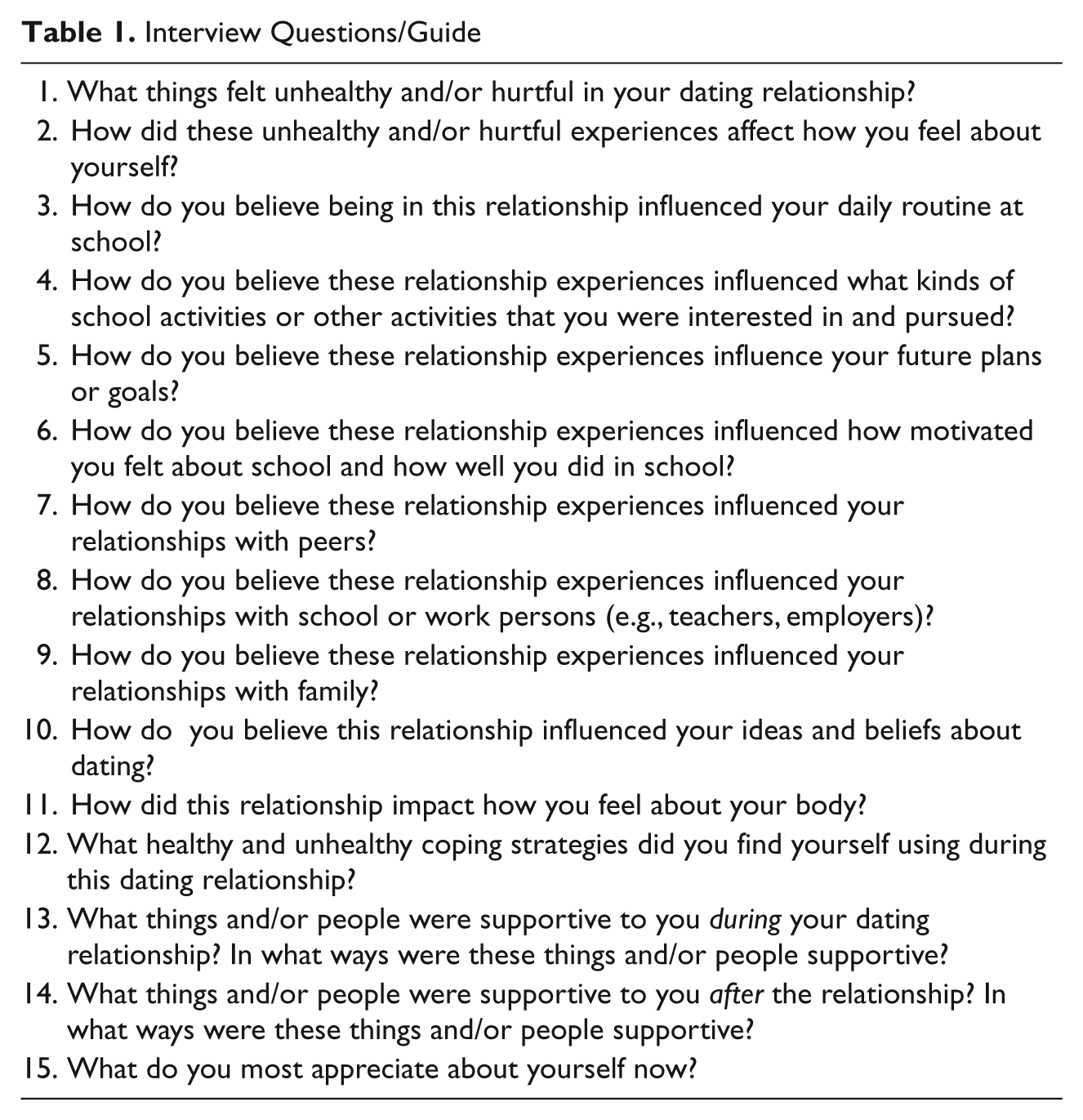
We used a constructivist–interpretivist research paradigm to conceptualize study research questions and select data collection methods. Research questions were written to elicit the following information: (a) experiences of dating violence in girls’ most recent, abusive dating relationship; and how dating violence influenced (b) girls’ educational experiences; (c) relationships with school personnel, peers, and family; (d) self development; and (e) strategies that girls used to cope with dating violence consequences. The first, second, and fourth authors conducted the participant interviews. A semistructured interview guide was used to ask all participants the same 15 questions (Table 1).
Interview Questions/Guide
Measures
Participants completed a demographic questionnaire created specifically for this study. We asked participants for their age, school grades, parent/guardian highest level of education, participants’ highest level of education desired, and demographic information about their dating partner. Congruent with a constructivist–interpretivist research paradigm, participants defined their relationship as “unhealthy” or not.
Data Analysis
Grounded theory analytic methods were used to illuminate details about girls’ experiences and develop a theory about the influence of dating violence on girls’ educational experiences and key relationships. All interview transcripts were analyzed for content using grounded theory methods (Strauss & Corbin, 1990), which included the following steps. First, team members debriefed after each interview to discuss reactions, thoughts, and emerging themes. Second, all four team members (i.e., all authors) participated in initial data analyses, which involved thematic analysis and building using an open-coding technique (Glaser, 1978). Each team member open coded independently and then met as a group to reach group consensus on discrepancies found during this initial coding process. Likewise, each team member participated independently in axial coding procedures to identify and make connections between thematic categories and subcategories, but met an additional 3 times to reach consensus when differences occurred in interpretation during this analysis phase (Creswell, 2008).
Trustworthiness Measures
The following steps were completed to ensure data fidelity. First, we used semistructured interviews, which permitted our team to identify and construct the various individual and contextual factors that may have contributed to girls’ experiences of dating violence and the consequent effects on their educational experiences and key relationships. Second, all research team members completed code cross-checking of thematic findings, which allowed us to cross-validate each other’s data interpretations and enhance our awareness of diverse meanings of participants’ stories. Third, during the axial coding phase of the analysis, we examined emerging themes across all transcripts and explored alternatives, which allowed us to fully identify data properties and dimensions. Fourth, we created an audit trail or a step-by-step process of data collection and analysis procedures (Anfara, Brown, & Mangione, 2002).
Our personal and professional experiences informed our approach to this research study. All four research team members identify as feminist and multicultural scholars. We have focused clinical and scholarly interests in intimate partner violence and have conducted research and/or published previously on this topic. The first author is an associate professor of counseling psychology and has spent the past 15 years conducting community-based research with adult partner violence survivors and providing individual and group counseling services to this population. The second and fourth authors are doctoral candidates in counseling psychology who have completed extensive clinical work with adult women and families affected by partner violence. They also have conducted their own doctoral research on related topics, including mother–daughter communication about healthy dating relationships and the influence of experiential trauma on adolescent girls’ health outcomes. The third author has conducted several investigations on partner violence, including evaluation of interventions for couples experiencing partner violence. She is an associate professor in couples and family therapy. She has completed formal coursework and training in qualitative research paradigms and analyses and has spent 15 years conducting research using qualitative methods. The third author also was the auditor.
Based on these personal and professional experiences, we chose a research paradigm that we believed to be most inclusive of girls’ broad dating experiences and allowed girls to use their words to describe the influence of relationship dynamics on their well-being and academic development. We believe that this paradigm allowed us to ensure that the conceptualization of dating violence was coming from not only the researchers’ experiences with partner violence but also from the participants. Our biases influenced our choice of a research paradigm that enabled each participant to define her dating experience as “unhealthy or not,” ask probing questions that allowed girls to share their unique stories, and allowed for interviewer–participant interactions that could facilitate critical consciousness and healing.
Finally, as a fifth trustworthiness measure, we used member checking to allow participants to comment on our study findings and clarify aspects of their stories (Sprenkle & Moon, 1996). All 19 participants were mailed a letter requesting their assistance with member checking. Of the 19 letters sent, 4 letters were returned because the girl moved and we did not have a forwarding address and 11 girls never responded to our letters. A total of 4 participants completed member checks via phone and received a US$10 gift certificate. Participants who completed member checks stated that the themes our team identified represented their experiences accurately and none recommended thematic changes.
Results
Emerging Theoretical Model From Data
Results showed that girls experienced a broad range of abuse in their dating relationships, including emotional, psychological, physical, and sexual abuse. Participants used numerous strategies to cope with the abuse. Their coping and understanding of the abuse influenced the nature and extent of the abuse consequences on their health, relationships, self-concept, and self-efficacy. In turn, changes in girls’ health, relationships, and self-concept had direct effects on their school engagement, academic performance, and future vocational orientation. The relationship between the abuse consequences and girls’ school experiences also was influenced by how they coped and made meaning of the abuse. From these results, a theory emerged about the influence of dating abuse on adolescent girls’ school experiences (see Figure 1). Results are organized by primary and secondary themes that informed our theoretical model.
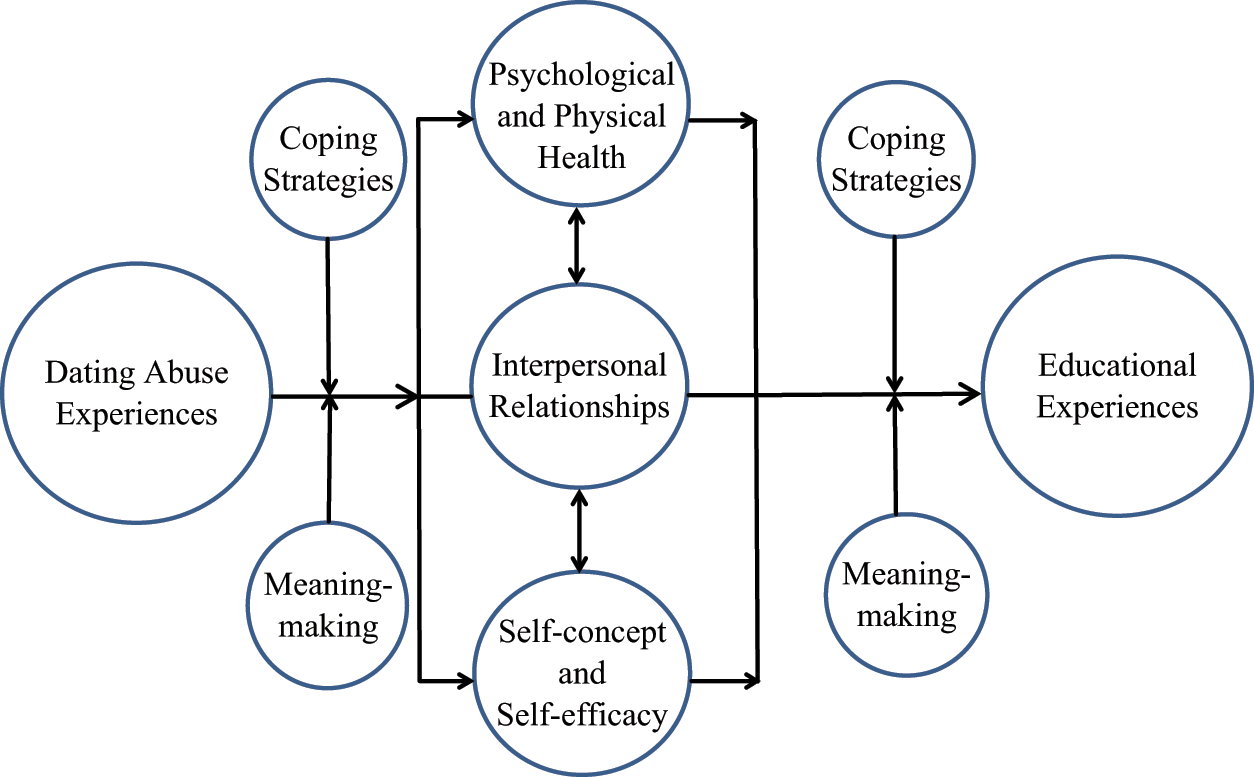
Influences affecting the educational experiences of adolescent girls in abusive dating relationships
Abuse Experienced
Participants reported a broad range of dating abuse experiences that included isolation from family and peers, interference with school and work, verbal abuse, threat of/physical violence, and coerced/sexual activity. Abuse occurred across diverse contexts.
Isolation from family and peers
All girls experienced isolation from family and peers either as a direct result of partners’ emotional/verbal and physical abuse or participants isolated themselves. Girls shared multiple reasons for self-isolation, including that they wanted to hide signs of the abuse, spend time only with their partners, were too ashamed to face loved ones, and wanted to avoid others’ expressions of concern. Moreover, all participants shared that their partners used various tactics to destroy their reputation or credibility with key people, which served to isolate the girls even more.
I think it was more he was kind of just watching me. He was a little protective, like not protective as in caring, protective as in almost jealous, cause I have a lot of guy friends, so when I was around them he would come up behind me and kind of hang out until they left, or um just kind of kept an eye on me I guess. (CeCe, age 17, European American, partner age 16, 6-month relationship) If I even thought about like talking to him about breaking up with him or something like that, he would make me feel bad, and he’d talk to my best friends about it, and then like, he even went to my sister . . . and my sister guilted me into continuing to date him. (Kate, age 16, European American, partner age 14, 1-month relationship) I ran away . . . he would say, “if you go back to your parents I am going to tell them what you’ve been doing” . . . and even though I knew I hadn’t really done anything wrong and that they would still be there for me . . . he made me think I didn’t have anyone. His way of getting me back [for going out with my friends] was telling his mom that I was the one giving him drugs and so the cops came to my house . . . and arrested me . . . I was in to drugs at the time and I ran away from my parents and stuff, and like he used that as . . . if you go back to your parents I am going to tell them what you’ve been doing . . . and even though I knew . . . that they would still be there for me . . . he made me think that I didn’t have anyone who cared and that he was the only one there for me. (Carly, age 17, European American, partner age 17, 11-month relationship)
Interference with school and work
All but two participants shared that their partners sabotaged their school, employment, and/or service activities by harassing them at their school and employment settings and using emotional and physical abuse tactics that made it difficult for girls to successfully pursue their school and work activities.
But, then I went to school [and] he’d meet me . . . he’d have to see me at my breaks to make sure that I wasn’t talking to anyone . . . He wanted me to skip my study hall, which I did most of the time skip my study hall . . . I was late to most of my classes. Between classes and lunches I was late like every day . . . and if I had a class with a guy, um, he’d be like “So, you were hitting on this guy in your class.” So, I just quit going to school altogether . . . because like he’d constantly show up at school and cause a scene in front of my friends and then my teachers would talk to me and be like “you can’t do that on school property,” and so I finally I was just so embarrassed I quit school. (Debbie, age 18, Native American and Latina, partner age 18, 24-month relationship) After the first month or so I started skipping a lot to like go get drunk with him . . . and he woke up at like five o’clock in the morning to go to work, and he’d make me like walk him to work, or not to work, but halfway to work every morning . . . I just didn’t really study that much cause there’d be a lot of people at my house all the time, so I’d just like drink all the time. (Flosie, age 16, Asian and European American, partner age 20, 6-month relationship) Like he would kinda like sabotage me and be like well I already called them [employer/work] and told them that you quit and that you couldn’t come in today and he would get me thinking that he called them and made a big scene and then I’d be embarrassed. And so instead of me calling and being like, cuz I didn’t want to call and look like an idiot and be like, “Did my boyfriend call and tell you I quit?” Ya know so I was just like . . . it’s not worth it like I don’t want to go there and have my boss ask to talk to me and then be like, your boyfriend is calling her and saying stuff, is it true? (Carly, age 17, European American, partner age 17, 11-month relationship)
Verbal abuse
All participants experienced verbal abuse from their dating partners, which included partners humiliating and shaming girls and engaging in angry and violent outbursts meant to intimidate and control girls.
I didn’t feel like going out, because he just said so much stuff that made me feel like crap and I didn’t want to show my face in public and even if I wanted to do something if he found out I left . . . he’d start yelling at me he’d make me cry. (Jordan, age 17, European American, partner age 17, 6-month relationship) It’s hard to go from something that’s like so good, like you’re having a good time at first, you know, and all of a sudden you can’t make sense of what’s going on later . . . like we’ll be driving or something and I will just lean forward or something and he’ll be like scoot back you f****** ugly bitch. (Raina, age 16, European American, partner age 15, 3-month relationship) In the beginning of the relationship I kinda didn’t think anything of it . . . that’s how a boyfriend’s supposed to act . . . so it didn’t really bother me, but as it got further into the relationship it kinda got to the point where I was like well ya know I guess you’re right, ya know, we’re supposed to look good together . . . he was very dominant . . . I could say things but he would have to OK them or he would have to say “well that’s OK, but you should wear, you know, you should act like that.” (CeCe, age 17, European American, partner age 16, 6-month relationship)
Threat of physical violence
All but two participants shared that their partners were physically violent and/or used threats of physical violence toward them. Some girls’ partners used physical violence or threats from the very beginning of their relationships and other partners were not physically violent until after dating for some time. Physical violence included partners pushing and hitting girls, throwing objects and using weapons at girls, and violating girls’ personal physical space.
He pushed me a couple times . . . he slammed me up against a wall . . . he slapped me once, and then one time just punched me and I had a big black eye . . . my face was swollen for a couple weeks. And he actually hit me . . . left a couple of bruises on my arms, legs. And I actually have a scar on my leg . . . because he cut me with a knife. (Jill, age 16, European American, partner age 14, 42-month relationship) We would just be like messing around or something and he would just like go too far until I was like crying and I would tell him to stop and he just wouldn’t. (Lauren, age 18, Native American and European American, partner age 18, 4-month relationship) We would get into a fight at work and he would like push me around or whatever and I left on my break and went to go smoke cigarettes and bummed it from a guy and he got furious and like ripped the lighter out of my hand and um ripped my necklace off and my shirt off and I had a cell phone in the back of my pants, he didn’t want me calling anybody so he tried to rip the cell phone off and ended up ripping my pants and that was at work, like right in front of work and everybody saw it and he got fired . . . then because I defended myself, for insurance purposes I had to get terminated as well . . . (i.e., Rebecca was fired by her employer for fighting back on the work premises). (Rebecca, age 17, European American, partner age 17, 18-month relationship)
Coerced/forced sexual activity
Nearly half of all participants reported that their partners coerced and/or forced them to engage in sexual activity, and many girls experienced this coercion and/or force regularly.
There was a couple times when we were staying over at his friend’s house and he [the friend] would leave the room so we could be alone, and whether or not I’d want to do anything he’d pretty much make me. I’d wake up sometimes with him on top of me. (Jordan, age 17, European American, partner age 17, 6-month relationship) He would get really violent when he wanted to have sex . . . if I didn’t want to do it he would shove me down and stuff like that. (Carly, age 17, European American, partner age 17, 11-month relationship)
Consequences of Abuse
The consequences of the abuse that girls experienced were far reaching and enduring, including (a) loss of positive self-image, (b) changes in eating and body image/weight, (c) drug use, (d) mental health decline, and (e) loss of ability to trust self and others.
Loss of positive self-image
All participants identified losing any positive self-image, self-worth, and self-efficacy they had prior to the abuse or might have developed in a healthier dating relationship. This loss of positive self-image included girls feeling as though they were “damaged” or “broken” because of the abuse and feeling like they did not deserve better treatment.
[In reference to feeling pressured by abusive partner to have sex.] Well, I don’t know, after having sex and stuff, when I’m fifteen, it makes me feel kind of like a slut, you know? And so, now that I know I’ll never get my virginity back, it just kind of sucks. (Julia, age 16, European American, partner age 14, 10-month relationship) Before I felt like I could do anything and I felt I really respected who I was and I liked who I was. And then you know I kind of lost that motivation and I kind of lost that image of who I was. (Heather, age 17, European American, partner age 17, 18-month relationship) He wouldn’t want to be near me, he would always comment on my stomach, said he couldn’t wait for me to not be pregnant anymore because he was tired of my stomach. . . . I met him when I was just starting to show, like I had this little Buddha belly, and I actually started wrapping my stomach in ace bandages to try and not let people see and I’d wear baggy shirts. (Jordan, age 17, European American, partner age 17 [father of child mentioned in quote], 6-month relationship)
Changes in eating and body image/weight
More than half of the girls shared that they restricted or increased their food intake and that their body image and weight changed significantly in response to criticism from their abusive partners.
When he’d call me fat, he’d not let me eat when we were together, and that was ridiculous and so I’d stop eating for a really long time. And it got really unhealthy. And I thought it was okay ‘cause I was trying to make him happy. I just didn’t want to talk about it. People would be like “let’s go eat” during lunch, but I couldn’t hang out at the same time ’cause of my boyfriend, so I’d be like “no, I have to go see my boyfriend” . . . I’d use that as an excuse not to eat, and so it’d work, I guess. (Julia, age 16, European American, partner age 14, 10-month relationship) I just was so disgusted with everything about me. Like I thought I was ugly, I thought I was fat. Like something was wrong with my hair, like my hair was dumb . . . I always wanted something to be better . . . I just thought I was an ugly person altogether . . . like nothing was ok about me . . . I kind of thought I was this ugly closet monster. . . . Well I mean someone telling you stuff like, “You’re huge, you’re fat, I don’t want to do this with you . . . I don’t want to do anything with you.” It made me feel like I was worthless, like I couldn’t do any better than to have someone who was like that [abusive]. I don’t understand how he could say those kinds of things to me, because, I have had eating disorders in the past and it definitely didn’t help it [eating disorder] stop. (Jill, age 16, European American, partner age 14, 42-month relationship)
Drug use
For the majority of participants, drug use was frequent, intense, and played a significant role in their dating relationship dynamics. Girls reported using alcohol and other drugs for a variety of reasons, in addition to coping with emotional stress, during and after the relationship ended. Almost half of participants (n = 8) reported they used drugs for the first time or increased their drug use as a result of being in the abusive relationship. Other girls identified their drug use as escape, a control tactic by their abuser, or act of defiance toward their partners.
We smoked a lot of marijuana . . . I think that’s what kind of made us, made him calm. When he didn’t have his weed he, he went crazy. (Rebecca, age 17, European American, partner age 17, 18-month relationship) I thought beer was disgusting, I was never going to drink it, and then just one day I was just so upset . . . I just took two [beers] . . . and I started getting a tolerance to drinking and I needed so much or I think I did and I would be hammered all the time. (Jill, age 16, European American, partner age 14, 42-month relationship) I had smoked pot and drank before that, nothing more than that. And so when I met him, it was just like we did everything: methamphetamine, heroin, ecstasy, cocaine, mushrooms, acid, marijuana, alcohol, pretty much everything, besides crack . . . he would buy it, and I was like, “oh, okay.” (Brittany, age 17, European American, partner age 15, 24-month relationship)
Mental health decline
All girls shared that their mental health declined regardless of the relationship duration and intensity, the severity of abuse, and the coping strategies they used. Girls’ mental health decline included experiences of depression, anxiety, and self-harm.
All the fighting. We would fight a lot and it would just like, mostly just the anger level that I would get to was just unhealthy in its own. And like I’m pretty sure that I became clinically depressed in like throughout the relationship as like an effect from it and like yeah. We would just fight and I was like really clingy and we weren’t independent anymore. We like the only reason we were together was because we relied on each other for emotional stability and even then like it didn’t happen. (Heather, age 17, European American, partner age 17, 18-month relationship) I always, I don’t know, I had no clue. I couldn’t, I was always just worried or nervous or something was just wrong with me at school, I could just never, ever focus, you know, it was just really, really weird, I don’t know how to explain it that good, but I could never focus, it was just, I was just worried or something, you know. And when I would leave school, I was like, I would be like, like, where’s he at, you know. (Raina, age 16, European American, partner age 15, 3-month relationship) It would help me out with what I thought or um, I didn’t really do anything healthy to help myself cope. I was always upset and depressed and crying um, confused about everything. Just always thinking um so, it wasn’t until later that I started trying to do other things to keep my mind off of um the relationship and things that were going on, things that he would say. (Cindy, age 18, European American, partner age 17, 12-month relationship)
Loss of ability to trust self and others
All but two girls explained that experiences of dating abuse led them to doubt their judgment of future dating partners and other people. Their abuse experiences, and lack of understanding how and why the abuse happened, led them to mistrust men and others who tried to get close to them as well as their desire to depend on others.
I just thought every guy was going to hurt me after that. I didn’t trust anybody. I had guy friends . . . but when guys tried to build a relationship with me I’d just stop talking to them. (Kate, age 16, European American, partner age 14, 1-month relationship) [He] just told me “oh you’re so great da da da” . . . it was just all talk, and so that was really hurtful, and you just got to realize that you can’t depend on people. (Brittany, age 17, European American, partner age 15, 24-month relationship)
Interpersonal Relationships and Support
All participants shared that dating abuse, and the ways in which they chose to cope with the violence, significantly affected their relationships with family, peers, and school personnel. Girls shared how partners’ abuse and their own coping affected various aspects of their relationships, for better and for worse.
Family
Changes in girls’ family relationships were diverse and ranged from family members not noticing or ignoring the changes in girls’ appearance, behavior, and overall health to family members talking directly to girls or attempting to intervene in other ways.
My mom and me would fight a lot cuz I was depressed and she didn’t understand why I would cry all the time. She’s really like tough and like go go go. And like I was just like out of it and didn’t want to do anything. And I was just sad and she didn’t know what to do with me. And then Ben [friend] when he found out that I was cutting myself he said, “I think you should tell your parents. You need to see a counselor.” And I was like, “Ok. I don’t really want to tell them. Will you?” And so he told them for me and then they were like, “Ok. We’ll get you a counselor.” But my mom just still didn’t really know what to do. She just didn’t like how unmotivated I was. (Heather, age 17, European American, partner age 17, 18-month relationship) She’d [my mom] always be, “Why do you have bruises on your wrists?” And I’d be like, “I don’t know.” And I’d always make up stupid lies . . . But, she’d always be like “you need to leave him. He’s bad news.” Stuff like that, but I don’t know . . . I stuck with him. (Rebecca, age 17, European American, partner age 17, 18-month relationship) I think that my brother just feels bad for me, I don’t think he understands the extent of it, I couldn’t really explain it all. And my mom just feels like she has just failed me. I mean, because I think that like bad things happened to her when she was my age. And now, she is seeing that exact thing happen to me. I think that it is just really hard for her. (Lauren, age 18, Native American and European American, partner age 18, 4-month relationship)
Peers
Changes in girls’ peer networks were dramatic and varied. Girls had peers who were loyal and rejected them, tried to help, or did not know about or ignored the dating abuse.
Only two friends knew and they didn’t like it at all. They were like, I’m going to tell, and I was like please don’t, oh my God, I’ll change, I’ll make him change . . . [Friend] She was completely behind me through everything, like she knew what was going on but didn’t yell at him or make a scene because she didn’t want him to know that she knew . . . but behind closed doors she was like you really need to get away from him. (Carly, age 17, European American, partner age 17, 11-month relationship) They thought that we were madly in love. It wasn’t like they thought I was being isolated by him, they just thought we liked each other so much that we were alone all the time. It was the opposite of what was really happening . . . it changed how they thought about me. (Julia, age 16, European American, partner age 14, 10-month relationship) I would hang out with my girlfriends at lunch or whatever but I couldn’t hang out with them after school, couldn’t go to their friends’ houses, couldn’t have them come over . . . I don’t really have many friends because of that. His friends did become my friends. I’d been hanging out with them a lot . . . They felt sorry for me, but on the other hand they wouldn’t do anything [about the abuse]. (Debbie, age 18, Native American and Latina, partner age 18, 24-month relationship)
School personnel
Girls’ relationships with school personnel also changed substantially. It was obvious from girls’ stories that school personnel had good intentions and wanted to help, but may not always have known how to be helpful.
I had a couple of teachers pull me aside sometimes, you know, trying to get me to tell them what was wrong, what was going on. The security people at my high school would actually see him up in my face and they’d have to break us up and they’d send him to class and send me to the counselor or Ms. G, my vice principal . . . they had me talk to her cause it was just getting so crazy and they just had bad feelings about it and she told me “if anything’s going on, if he’s putting his hands on you, you need to tell me now.” But I wouldn’t tell her . . . everyone was worried and scared and mad at me . . . at the same time. (Jill, age 16, European American, partner age 14, 42-month relationship) I really liked science . . . and she [science teacher] asked me one day why I was all down and depressed . . . and I told her, because I just felt like finally telling someone that would listen and I was excited that someone would actually listen to me for once, and she sat me down . . . and she said “okay,” since you’re in this relationship and since this guy is doing all this stuff, can you show proof, and . . . I pulled up my arm and she saw I had bruises from my shoulder all the way down, and she was like wow, so we came up with this plan. (Elizabeth, age 13, Latina and European American, partner age 13, 5-month relationship) I was really close to all my teachers before I started dating him. And I did a lot of extra credit activities on my own time. And all of a sudden, it all quit and they were all talking to me about it [decline in activity involvement and academic performance] and they didn’t understand either. I told them that I was just busy and I couldn’t do it anymore. It [talking about the abuse] actually brought me closer to my teachers. Because I was able to you know, at least have someone I know who cared, even if I didn’t talk to them that much about it. I at least knew that there was someone who cared about me. (Jane, age 17, European American, partner age 17, 6-month relationship)
Impact of Abuse on Educational Experiences
A study focus was the impact of dating abuse on girls’ educational experience, and data revealed that the impact was far reaching with short- and long-term academic and vocational consequences. Consequences that girls identified included a decline in academic performance, school transfers, and changes in their extracurricular activities and future orientation.
Decline in academic performance
All participants except one shared that their academic performance immediately and dramatically declined once the dating abuse started. The remaining participant shared that she prioritized keeping her grades the same in order to not alert her parents to a problem. Academic performance decline included falling grades, school absences, incomplete schoolwork, and inability to pay attention in class and learn.
There were some nights I had to do homework he would get pissed off cause he didn’t have homework so he would get pissed off if I had to study . . . he would be like “oh that stuff’s more important than me?” (Brittany, age 17, European American, partner age 15, 24-month relationship) He woke up at five o’clock in the morning to go to work and he’d make me walk him to work or half way to work every morning. I skipped [school] a couple of times, I started skipping like a lot at the end, cause I went there for two months, and like after the first month or so I started skipping a lot to like go get drunk with him. (Flosie, age 16, Asian and European American, partner age 20, 6-month relationship) They [people at school] thought of me as Jake’s bitch. And I was just kind of like, there, I was just his sidekick kind of. I served him, like, I will admit it. And, I don’t know, I just wasn’t really my own person anymore . . . being with him, actually led to um, this like page on Facebook, basically, telling everyone that I was a horrible person. Some seniors made it from my school because those were the girls who wanted to date him, and I got him I guess. So they made a Facebook page and sent it out to the whole school. And it was like, this whole rhyming poem about like what an ugly slut I was, and so, that was, just absolutely horrible. And so like, having him there, went to that. And then my grades were just done with. (Lauren, age 18, Native American and European American, partner age 18, 4-month relationship)
School transfers
Of the total sample, four girls shared that they transferred schools for reasons related to their abuse experiences and to improve their academic performance. School transfers were initiated primarily to distance girls from their abusive partners and increase their safety.
During the relationship I did get expelled from one of the schools I was at. It was a charter school, and they are supposedly impossible to get expelled from. I freaked out on the teacher. Just started cussing him out. Like yelling and screaming at the top of my lungs at him. I think it was just an outlet to what was happening. (Flosie, age 16, Asian and European American, partner age 20, 6-month relationship) Well, when we started dating I wasn’t even into drugs, he’s the one who got me into drugs. And my whole life changed because I’ve done drugs. I got kicked out of my house for doing drugs, because of him. So now I have to go to alternative school cause my freshman year I was always getting high I failed all my classes. So now I’m not going to be able to graduate until I’m a “super senior.” So like pretty much everything changed. (Julia, age 15, identified as “Other,” partner age 18, 10-month relationship)
Activities
All participants reported that their partners were involved in decisions related to their outside activities, that is, influenced girls’ decisions to stay engaged in activities that were important to them. The majority of girls shared that their abuse experiences seriously affected their ability and motivation to participate in school-related activities.
I didn’t take part in any extracurricular activities that year when we started going downhill I had switched schools . . . and it was hard because I didn’t really know that many people. And, I wanted to put myself out there so I could meet more people but then after school I would go hang out with him or go to sleep or something so that was a hard year too cuz we had lots of homework . . . he was my extra-curricular activity. (Heather, age 17, European American, partner age 17, 18-month relationship) Yeah, I wanted to be a cheerleader freshman year when we were dating. But I couldn’t be a cheerleader because I’d be up in front of everyone in a skirt and he wouldn’t allow that. At the time I was volunteering at [pet store] . . . but um I stopped going because he thought that I was using that as an excuse to get away from him. So he wouldn’t let me out of the house on the days that I would volunteer, so I just stopped going to that too. (Carly, age 17, European American, partner age 17, 11-month relationship) He’s a pretty motivated guy, so he kind of wanted me to be like him. And so he would urge me to do things . . . it didn’t really affect my motivation to do things outside of school, because if I didn’t, he would make me feel bad about it. So I guess in that aspect, he did push me, but just not in the right way . . . he would just make me feel bad about myself all the time. (Lauren, age 18, Native American and European American, partner age 18, 4-month relationship)
Future orientation
The impact of dating abuse on girls’ hopefulness about their futures and plans was significant. Girls reported forgetting about their interests and what they wanted to do with their futures because they felt so confused, degraded, and hurt by the abuse. Girls also shared that they changed or let go of their future vocational goals because of the abuse consequences.
I had planned to do certain things before I had a boyfriend, and I had goals. . . . And when he came along they kind of just got put on the shelf, just moved aside for everything else. (CeCe, age 17, European American, partner age 16, 6-month relationship) At one point I was talking to him about going down to California and going to a community college that I wanted to go to since I was little. . . . He would always get mad at me, “you’re not gonna go down there, you’re gonna have a kid . . . you’re not gonna be able to do anything with your life, you’re just gonna be a housewife.” (Jordan, age 17, European American, partner age 17, 6-month relationship) At first I just was like, whatever, I’m still gonna go to college, and then he just fought with me over it so much . . . then he put me up against the wall and was like in my face and yelling at me and he’s like “you’re not going to go to college, you’re not going to be anything” . . . he told me I wasn’t good enough for school and that even if I tried I was gonna fail at it and I kind of just believed him and so I just kind of gave up on it. And so I didn’t take some classes that I could’ve and I just kind of passed up the opportunity. (Jill, age 16, European American, partner age 14, 42-month relationship) I want my child to grow up and be a strong independent woman. . . . If I keep on going how I am, I am not going to be able to be that mother to show her the way to go . . . I need to look at reality, you know, and I think reality I am just going to end up as a stripper, you know. My dream is to be a nurse, but reality is, I am just going to be a stripper. (Raina, age 16, European American, partner age 15, 3-month relationship) After I broke up with him, I was like “ok I’m going to watch out for people like him because he was just like my dad and I don’t want to end up in a relationship like that again” . . . so afterwards I didn’t date for like, well I haven’t dated since. Now I pay close attention to peoples’ actions, the way they talk the way they influence other people and their attitudes. If they have a good attitude and they are nice to other girls, if they’re honest and they don’t just like lie about every single thing, then they are a good person. But if they are exactly the opposite then stay away from them. (Elizabeth, age 13, Latina and European American, partner age 13, 5-month relationship)
Meaning Making of Abuse
A theme that emerged from the data was that girls tried very hard to make sense of, or understand, their abuse experiences. Girls’ perceptions and understanding of the abuse were diverse. Participants shared feeling surprised and confused by their partners’ abusive behavior and identified their own reactions and feelings to the abuse. Moreover, girls shared insights about why and how the abuse and relationships persisted, ended, and what they learned.
I honestly thought I was in love with this guy. Yeah he would be an asshole to me but then he would be so sweet, until I found out that he wanted to break up with me for my friends. And I just got back with him because I wanted a long relationship. But I think the reason why he was so much of a jerk, was because he had a lot of problems. I mean he had a girlfriend that died when she was young, she killed herself. And he was in a car accident when he was like seven, and his dad died in that, so he has a lot of issues. (Jane, age 17, European American, partner age 17, 6-month relationship) I think having him as a boyfriend, I don’t know, it made me feel more wanted . . . sexier I guess. I think having a boyfriend made me feel beautiful, because it meant someone took interest in me . . . it’s just hard to believe I was thinking that. (Kate, age 16, European American, partner age 14, 1-month relationship) I was doing reports on how women are not as strong as men about that time too so I was like I am never going to get out of this [abuse] because women just aren’t as strong. (Debbie, age 18, Native American and Latina, partner age 18, 24-month relationship) He would say he was having suicidal thoughts . . . and I’d be like, oh my god, if I ever break up with him then he’s going to off himself . . . I think I partly stayed in the relationship so that didn’t happen. (Kate, age 16, European American, partner age 14, 1-month relationship) At the time that’s what I thought . . . it was kind of girlfriends are supposed to be there for their guys and they’re supposed to be what their boyfriend wants them to be . . . I definitely learned that if someone really does love you and cares about you . . . they’ll respect you and be behind you instead of trying to push you down. (CeCe, age 17, European American, partner age 16, 6-month relationship) I didn’t realize what the relationship was and that it was abusive until, like a few months ago. And still, I think to myself, are you sure, like can I actually call him an abusive person, like I feel bad saying it. Like I feel horrible being here and saying he was a bad person because like part of me still loves him so much. (Lauren, age 18, Native American and European American, partner age 18, 4-month relationship) Cuz all those guys do, they just want you for f******, you know, that’s all of them want. And, I dunno. It’s pretty weird, because that’s all I have seen throughout my life, you know, it’s girls just being abused. I mean that’s what I think love is . . . (Raina, age 16, European American, partner age 15, 3-month relationship)
Coping
We also learned from the study interviews that girls used a number of strategies to cope with the abuse, while they were dating their partners and after the relationship ended. Strategies that girls used included writing, talking to friends and family, exercising, drawing, listening to or playing music, counseling, exercising excessively, eating less or more, cutting, changing their appearance, self-blame, substance use, and self-isolation.
I sang a lot and wrote poetry a lot . . . and it would make me feel a lot better to hear it [music] and know the world is hearing this song so it’s like OK I’m not the only one that knows this song and not feel so isolated. (CeCe, 17 years old, European American, partner age 16, 6-month relationship) Talking helped, and writing music, which is one of my favorite things to do . . . I used to draw pictures with trees and everything and birds and stuff. (Elizabeth, age 13, Latina and European American, partner age 13, 5-month relationship) I used to go mushroom hunting. I mean, that is honestly my favorite thing to do and I would always go out and just kind of be outside with nature . . . but he was getting pissed . . . because he was like “you should just spend more time with me.” (Brittany, age 17, European American, partner age 15, 24-month relationship) I actually resorted to cutting myself. I started cutting my wrists . . . it’s kind of sad like “wow, I can’t believe I actually did that.” (Jill, age 16, European American, partner age 14, 42-month relationship) Definitely like drinking and smoking and like using a lot of like different drugs . . . I did ecstasy and I did any like pills like anything I could find. (Flosie, age 16, Asian and European American, partner age 20, 6-month relationship) One of the most unhealthiest things I’ve done was blame myself for the relationship, and how it ended, and stuff like that. I think I feel like if I take all the blame for something, other people will feel better. And then it actually took one of my sisters to tell me it wasn’t your fault, and it took a lot of friends and my family, and my neighbor . . . it was the support from my family that helped me get out of my slump. (Kate, age 16, European American, partner age 14, 1-month relationship)
Discussion
The study purpose was to examine adolescent girls’ experiences of dating abuse and the impact of this abuse on their educational experiences. The central phenomenon of “influences on the educational experiences of adolescent girls in abusive dating relationships” emerged from the data. Our theoretical model shows that participants experienced emotional, verbal, physical, and/or sexual abuse from male dating partners and used an array of strategies to cope with, escape from, and avoid the abuse as well as make meaning of the abuse. Furthermore, the model shows that the consequences of such abuse were far reaching, immediate, and enduring with regard to participants’ health, interpersonal relationships, and self-concept or self-efficacy.
The scope of participants’ abuse experiences is congruent with existing adolescent dating violence research (Banyard & Cross, 2008; Close, 2005; Rennison & Rand, 2003; Wolfe et al., 2005). The age at which girls experienced the abuse, its severity, and the far-reaching health consequences were particularly alarming given that early dating violence experiences increase risk for poor health outcomes and intimate partner violence in adulthood (Ackard & Neumark-Sztainer, 2002; Jouriles et al., 2005). These findings support the current scholarly focus on developing preventive interventions for children who are younger than 13 years old and that are implemented before children start dating.
The far-reaching impact of the abuse also reinforces the need for implementation of preventive interventions across all levels of the ecology. Girls experienced abuse in their own homes, their dating partners’ homes, in front of peers, at school, at work, and so on. Each context can be a target for preventive intervention, identifying those contextual factors that increase and decrease risk for dating violence. In particular, there are numerous empirically supported, school-based dating violence prevention curricula that focus on adolescents’ development of caring and supportive relationship skills and that promote safe peer and school contexts (Foshee et al., 1998; Jaffe, Wolfe, Crooks, Hughes, & Baker, 2004). Present study findings suggest that current school-based preventive intervention efforts may be enhanced if school personnel and peers are more informed about how abuse is enacted in the school context and interferes with adolescents’ key relationships and education. Such information may increase school personnel’s and peers’ understanding of girls’ isolation, and in turn foster their longer term support of girls.
Most participants used multiple and varied coping strategies during and after the abusive relationship, and how they attempted to cope directly influenced the ultimate abuse consequences and influence on their educational experiences. Banyard and Cross (2008) found that adolescents’ mental health outcomes mediated the relationship between their abuse experiences and educational outcomes (e.g., grade point average [GPA], school attachment). Present study findings suggest that intervention might target relationship skill and coping skill development to reduce the negative impact of those relationships that are abusive and prevent adolescents from engaging in more abusive relationships in the future.
A significant, but not surprising, study finding was the inextricable link between adolescents’ substance abuse and dating violence experiences. This link has been empirically supported with adults as well (Gorney, 1989; Kantor & Straus, 1990; Pernanen, 1991). There is a dearth of clinical attention and published research, however, on the role of adolescent substance use on the initiation and maintenance of unhealthy dating relationship dynamics and adolescents’ coping. Present study findings show that some participants were involved, for example, first in deviant peer networks and used drugs, contexts that increased the likelihood of finding an abusive partner (e.g., assortative pairing; Capaldi & Owen, 2001). In contrast, other participants initiated substance use after dating their abusive partners. It seems critical for clinicians to assess the role of substance use in adolescents’ dating violence experiences, ability to end those abusive relationships, and risk for future abusive relationships. Similarly, it seems important for scholars to investigate further the temporal sequencing of substance use and dating violence over time and how each influences the other to identify specific targets for prevention and intervention.
There is a substantial amount of research on the role of peer relationships on dating violence perpetration (Capaldi et al., 2001; Dishion & Patterson, 2006), but significantly less is known about peers’ contributions and responses to dating violence, including siblings. Although we interviewed several adolescent girls who identified as racial/ethnic minorities and who were involved in interracial dating relationships, the role of race and ethnicity was mentioned by only one participant. An area for further research includes examining how cultural factors, such as race and ethnicity, influence peer dynamics and adolescent abuse disclosure. African American adolescents, for example, experience more severe dating violence (Rennison & Planty, 2003) and may be less likely to disclose because of racial loyalties, cultural beliefs about family privacy, and so on (El-Khoury et al., 2004; Hampton, LaTaillade, Dacey, & Marghi, 2008; Noonan & Charles, 2009; Walton et al., 2009). Relying less on adults for advice or support, and more on peers, is consistent with the developmental shift of seeking support as a coping strategy (Zimmer-Gembeck & Skinner, 2008). It seems useful for scholars to assess the influence of various support networks across adolescents’ contexts, and in turn develop and implement interventions within each relational context.
Although adolescents begin to rely more heavily on peers, parents and adults still play an important supporting role. Teachers and parents are perhaps the most visible adults in an adolescent’s life. We were most surprised about how girls’ descriptions of school personnel members’ assistance seemed to focus exclusively on the girls rather than on both dating partners, which often relayed a message that corroborated the girls’ experiences of the need to resolve the situation by themselves. This finding also may be the result of us interviewing girls only and focusing on their experiences. It was also surprising how little information girls shared about how families could have intervened more effectively. These data underscore the importance of learning what kinds of support may facilitate girls disclosing the abuse and seeking help.
Study Strengths and Limitations
There are several study limitations to address with future research. Future research may be improved by designing research questions that solicit more information about race and ethnicity in ways that are appropriate for this age group. Similarly, all participants were involved in abusive dating relationships with males. Only one participant referred to another, nonabusive relationship with a female and described herself as “bisexual.” It is often very difficult and unsafe for adolescents to disclose involvement in same-sex dating relationships, especially to a research team of strangers and for a research study that required parent consent. It is essential, however, for researchers to build trusting relationships with adolescents involved in same-sex relationships to learn more about their dating violence and school experiences. We also interviewed only girls, and yet there is empirical support for greater gender symmetry in adolescent dating violence (Hamby, 2009). It is important that future research include the experiences of males and how violence perpetration interferes with educational outcomes.
A particular strength of this study is the use of qualitative methods and grounded theory analytical methods to examine in-depth girls’ experiences of abuse and provide a theoretical model of how these abuse experiences are related to their coping and various health and developmental outcomes. In addition, the focus on abuse in school contexts and its impact on educational outcomes and school/work engagement is a strength of this study.
Conclusion
To our knowledge, no studies have been published that examine the influence of dating violence on such a broad array of school experiences and outcomes. It is our hope that these study findings provide a deeper understanding of adolescent girls’ dating violence experiences, particularly how dating violence is perpetrated in the school environment, how girls attempt to cope with such abuse, and informs intervention and prevention efforts across contexts.
Footnotes
Declaration of Conflicting Interests
The authors declared no potential conflicts of interest with respect to the research, authorship, and/or publication of this article.
Funding
The authors disclosed receipt of the following financial support for the research and/or authorship of this article: University of Oregon College of Education Baney Faculty Funds were used to pay participants.