




Abstract
Although previous research has examined factors related to gang membership and offending, research on the relationship between gangs and victimization is limited. The present study builds on previous research and examines gang membership, victimization, and self-control among 2,414 jail inmates. Results from self-report surveys indicate that gang members are more likely than nonmembers to be victimized by property and personal crimes. Among nongang members, those with lower self-control are more likely to be victimized by property and personal crime. Among gang members, lower self-control is associated with personal crime victimization whereas higher self-control is related to property crime victimization. Overall, gang members are victimized more than nongang members, and self-control is an important factor for victimization among gang and nongang members.
Although a substantial amount of research on gangs has established the link between gang membership and criminal offending, prior research has largely overlooked the extent to which gang members are victims of crime. Gang members may be more likely than nongang members to be victimized because of their risky lifestyles (Taylor, Peterson, Esbensen, & Freng, 2007). Furthermore, offending is related to being victimized, not only in victim-precipitated crimes but also more generally (Lauritsen, Sampson, & Laub, 1991). The findings from the few studies that have focused on the gang–victimization link suggest that gang members are significantly more likely than nongang members to be victimized (Decker, Katz, & Webb, 2008; Melde, Taylor, & Esbensen, 2009; Peterson, Taylor, & Esbensen, 2004). However, theoretical explanations for the relationship between gang membership and victimization remain largely unexplored. 1 The current study builds on prior research and examines the extent to which Gottfredson and Hirschi’s (1990) concept of self-control can explain gang membership and victimization. The following provides the foundation for the current study by describing relationships among self-control, gang membership, and victimization.
Self-Control
The concept of self-control is derived from Gottfredson and Hirschi’s (1990) general theory of crime and assumes that, presented with an opportunity, individuals with lower self-control are more likely than those with higher self-control to commit crime. Gottfredson and Hirschi argued that self-control is established during childhood and that this trait remains stable throughout the life course. 2 Gottfredson and Hirschi presented their general theory of crime as an explanation of offending, and research has examined this relationship in a variety of ways. In one of the first and most well-known empirical tests of self-control theory, Grasmick, Tittle, Bursick, and Arneklev (1993) developed a survey to measure the six dimensions of self-control outlined by Gottfredson and Hirschi, including impulsivity, insensitivity, risk seeking, shortsightedness, nonverbal tendencies, and a preference for physical activities. Although this scale examines attitudinal measures of self-control, others also found support for the theory using behavioral measures (Turner & Piquero, 2002). Regardless of the use of attitudinal versus behavioral measures, the relationship between low self-control and crime is well established (Chapple, 2005; Pratt & Cullen, 2000; Tittle, Ward, & Grasmick, 2003). Prior research has found links between low self-control and a variety of property and personal crimes (Longshore, Stein, & Turner, 1998). More specifically, self-control is associated with intimate partner violence (Avakame, 1998), binge drinking and alcohol-related behaviors (Gibson, Schreck, & Miller, 2004), fraudulent behavior (Holtfreter, Reisig, Piquero, & Piquero, 2010), courtship aggression (Sellers, 1999), and driving under the influence of alcohol (Keane, Maxim, & Teevan, 1993). Although much of the prior literature has examined the effects of self-control on crime and analogous behavior (Pratt & Cullen, 2000), some research focuses specifically on the relationship between self-control and gang membership and self-control and crime victimization.
Self-Control and Gang Membership
Given the well-established relationship between crime and gang membership (Esbensen & Huizinga, 1993; Hagedorn, 1988; Huff, 1998; Klein, 1971; Maxson & Klein, 1990; Miller, 1966; Spergel, 1964; Thornberry, Krohn, Lizotte, & Chard-Wierschem, 1993; Thrasher, 1927), some researchers have recently begun to extend Gottfredson and Hirschi’s (1990) work by arguing that their general theory of crime may explain why some individuals become involved with gangs whereas others do not. For example, Peterson-Lynskey, Winfree, Esbensen, and Clason (2000) extended Gottfredson and Hirschi’s concept of analogous behavior to include gang membership. Essentially, Peterson-Lynskey et al. (2000) argued that self-control theory may explain why some individuals become involved with gangs whereas others do not. Using data from evaluations of the Gang Resistance Education and Training (G.R.E.A.T.) program, the researchers found a relationship between self-control and gang involvement. Eighth grade elementary students with lower self-control were more likely to become involved with gangs than those with higher self-control (Peterson-Lynskey et al., 2000).
Some research indirectly supports the relationship between gang membership and self-control in at least two important ways. First, when compared with nongang members, more gang members come from single-parent families (Esbensen, Huizinga, & Weiher, 1993; Esbensen & Winfree, 1998), with little parental warmth (Walker-Barnes & Mason, 2001) and low supervision (Esbensen & Weerman, 2005; Gatti, Tremblay, Vitaro, & McDuff, 2005; Klein & Maxson, 2006; Thornberry, Krohn, Lizotte, Smith, & Tobin, 2003). These findings provide support for Gottfredson and Hirschi’s (1990) assumption that self-control is established early in life and that low self-control is the result of a lack of parental monitoring and punishment of children’s deviant behavior. Second, some of the characteristics of low self-control (impulsivity, risk seeking, shortsightedness, etc.) identified by Gottfredson and Hirschi have been linked to the characteristics of gang members. For example, joining a gang may be considered a risky behavior given the dangers associated with initiation practices within the gang and violence with rival gangs (Taylor et al., 2007). Peterson-Lynskey et al. (2000) suggested that joining a gang may be a function of impulsivity and shortsightedness, given that membership may occur spontaneously or without carefully considering the long-term costs of becoming a gang member. Therefore, low levels of self-control may be a predictor of joining a gang as well as commission of crime.
Very little research has directly tested the relationship between gang membership and self-control. Analyses of the G.R.E.A.T. program indicates that eighth-grade students with lower self-control were more likely than those with higher self-control to report gang membership (Esbensen & Weerman, 2005). The link between gang membership and self-control has also been established in another sample of junior high and high school students (Hope & Damphousse, 2002). Most recently, Kissner and Pyrooz (2009) examined this relationship using an incarcerated sample of adults and found that current gang members were significantly more likely to have lower self-control. Collectively, the evidence warrants further examination of the link between gang membership and self-control among jail inmates.
Self-Control and Crime Victimization
Explaining crime victimization is vital to understanding the factors that increase one’s risk of experiencing the physical, financial, and psychological effects of crime (Karmen, 2009). Researchers have recently provided evidence that low self-control may not only be able to account for variations in criminal behavior but may also be an important factor related to crime victimization (Holtfreter, Reisig, & Pratt, 2008; Kerley, Hochstetler, & Copes, 2009; Piquero, MacDonald, Dobrin, Daigle, & Cullen, 2005; Reisig, Pratt, & Holtfreter, 2009; Schreck, 1999; Schreck, Stewart, & Fisher, 2006; Schreck, Wright, & Miller, 2002; Stewart, Elifson, & Sterk, 2004). For example, individuals who exhibit some of the characteristics identified by Gottfredson and Hirschi (1990) as dimensions of low self-control, such as being impulsive, shortsighted, physical, and risk seeking, may be more likely to engage in adventurous or dangerous behavior without considering any but immediate negative consequences (Schreck, 1999; Stewart et al., 2004). Aside from self-control, more general research suggests that offenders are often themselves crime victims and that the correlates of crime for offending and victimization overlap (Lauritsen et al., 1991; Lauritsen & Laub, 2007; Lauritsen, Laub, & Sampson, 1992; Schreck, Stewart, & Osgood, 2008). For example, prior research indicates that involvement in crime increases the risk of personal and property victimization (Lauritsen et al., 1991). General theories of individual-level crime, such as Gottfredson and Hirschi’s general theory of crime, then, should be able to shed light on victimization.
Although other research demonstrated an indirect link between self-control and victimization (Peterson-Lynskey et al., 2000), Schreck (1999) was the first to examine this relationship directly, and his analyses, based on a large sample of college students, revealed that property and personal crime victims reported significantly lower levels of self-control than nonvictims. Low self-control has also been linked to homicide victimization (Piquero et al., 2005), fraud victimization (Holtfreter et al., 2008), and perceived risk of Internet theft (Reisig et al., 2009). Prior research has recently begun to examine the relationship between self-control and crime victimization using samples of offenders. Among a sample of female drug offenders, Stewart et al. (2004) determined that low self-control was associated with being physically attacked to the point of receiving bruises, cuts, or broken bones. Kerley et al. (2009) also found that low self-control was associated with prison victimization among parolees (e.g., another inmate had stolen something, scammed, or threatened respondents with violence). Regardless of the notion that all offenders should exhibit low self-control, recent research suggests that self-control can also explain victimization among inmates.
Gang Membership and Crime Victimization
Gang members may be more likely to be victimized compared with nongang members for several reasons. First, some research suggests that gang members may join gangs for protection from violence (Peterson et al., 2004). This violence may occur within their neighborhood or within their home. For example, interviews with juvenile gang members by Joe and Chesney-Lind (1995) indicated that gang members often experienced physical and sexual victimization at the hands of their family members. Second, gang members are known to engage in risky activities (e.g., drug use, drug sales, and crime), which may also put them at an increased risk of victimization. Third, gang members may be victimized by members of rival gangs and may be at risk of being victimized by drive-by shootings and assault. 3 Finally, gang members may be victimized by their own gang, especially as a result of gang initiation rites or punishment for misbehavior (Taylor et al., 2007).
In light of the evidence obtained through qualitative methods, a handful of quantitative studies have more recently examined the relationship between gang membership and crime victimization among samples of adolescents. Using data from the G.R.E.A.T. program, which includes measures of three types of violent victimization (assault with a weapon, assault without a weapon, and robbery), two studies employed different statistical methods and revealed conflicting results. For example, ordinary least squares regression of the G.R.E.A.T. data suggested that gang members were more likely than nongang members to be victims of violent crime (Peterson et al., 2004), whereas propensity score matching analysis suggested no meaningful relationship between gang membership and violent victimization (Gibson, Miller, Swatt, Jennings, & Gover, 2009). Analysis of other data shows support for the gang–victimization link with the same three measures of violent victimization (Taylor et al., 2007), and being threatened with a gun, threatened with another weapon, shot at, shot, and injured with another weapon (Decker et al., 2008; Melde et al., 2009). Although prior research has begun to examine and establish a link between gang membership and crime victimization among samples of adolescents, more research is needed to understand these complex relationships.
Contributions of the Current Study
Using self-control as the theoretical backdrop, the current study examines the differences in victimization among gang and nongang members. Although the concept of self-control was not originally intended as a theoretical explanation specifically for jail inmates or gang versus nongang members, recent research provides the foundation for exploring this line of research (Hope & Damphousse, 2002; Kissner & Pyrooz, 2009; Peterson-Lynskey et al., 2000). For example, Hope and Damphousse (2002) argued that gang members are expected to have lower self-control compared with nongang members given their elevated levels of involvement with crime and delinquent behaviors. This argument was extended by Kissner and Pyrooz (2009), who contended that the general theory of crime suggests that gangs are “constellations of self-interested, untrustworthy, poorly self-controlled individuals who are not ‘tightly knit’ with one another and hence cannot be expected to exhibit strong friendship ties” (p. 479). Although Hope and Damphousee and Peterson-Lynskey et al. (2000) found a relationship between low self-control and gang membership, Kissner and Pyrooz did not. The current study expands on prior literature in several important ways.
First, this is the first quantitative study to examine the gang–victimization link among a large sample of adult offenders. Although prior research has established a relationship between gang membership and victimization among juveniles, the extent to which this link exists among a sample of adults is unknown (Decker et al., 2008; Melde et al., 2009; Peterson et al., 2004; Taylor et al., 2007). Second, this study is the first to measure a wide variety of victimization types that gang members are likely to have experienced. Prior research has examined a limited number of victimization types (e.g., assault with and without a weapon, robbery). The current study assesses violent victimization as well as property crimes among a sample of gang and nongang members. Third, the current study is the first to examine the gang–victimization relationship among a sample of jail inmates. In fact, very little is known about jail populations, particularly with regard to gangs (Ruddell, Decker, & Egley, 2006). Finally, the theoretical understanding of gang victimization is underdeveloped, and the current research is among the first to examine relationships between self-control, gang membership, and crime victimization. In this regard, the current study builds on recent research that examined self-control and gang membership by expanding the theoretical test to include crime victimization and by incorporating additional measures of self-control.
Current Study
The data for this study come from jail inmates who completed an on-site survey regarding their experiences with gangs, crime, and victimization (see also Fox, Lane, & Akers, 2010). Jails in the 20 largest Florida counties were selected to participate in the current study, and permission to conduct the research was obtained from 14 of the 20 jails that represented 70% of the target population of facilities. Given that gang members (National Youth Gang Center [NYGC], 2009) and crime (Duhart, 2000) are more prevalent in urban areas, the sample was derived from the largest counties within the state in an attempt to obtain a higher rate of gang members and victimization. Inmates deemed ineligible to participate included those in units for severe psychiatric disorders, solitary disciplinary confinement, or communicable diseases. In addition, four jails excluded high security inmates and three jails excluded federal inmates. The sample was comprised of 2,414 male and female inmates who volunteered, without compensation, to complete the survey anonymously. Although the response rate for each pod within each jail varied (0%-93%), the average rate of participation was 25%, which was consistent with some other research targeting incarcerated individuals (Struckman-Johnson, Struckman-Johnson, Rucker, Bumby, & Donaldson, 1996).
Measures
Gang membership
Consistent with prior research, gang membership was assessed using a self-report measure (Curry, 2000; Decker et al., 2008; Melde et al., 2009; Peterson et al., 2004; Taylor et al., 2007; Webb, Katz, & Decker, 2006). Gang membership was measured by asking respondents the following question: “Are you currently or have you ever been in a gang?” Given the low prevalence rate of inmates who admitted being current or former gang members (15%), gang membership was recoded into a dichotomous measure, which included no gang membership (coded as 0) and gang membership (coded as 1). Given that very few gang members (n = 7) reported that their gang was only inside the jail (four of whom were ex-gang members at the time of the survey), these respondents were included in the analysis as gang members.
Crime victimization
Crime victimization was operationalized by asking respondents whether they had ever been victimized by 11 personal crimes (threatened with a weapon, assaulted without a weapon, assaulted with a weapon, robbed, carjacked, witness intimidation, home invasion, drive-by shooting, stabbed, shot at, and shot) and two property crimes (theft and vandalism). Although response options allowed respondents to indicate whether each of the items happened to them (yes or no), analyses were based on follow-up survey questions that asked respondents to provide the number of times each item occurred. Analyses using the count data allowed for a greater understanding of the extent to which jail inmates were victimized by crime. Respondents who indicated that they had not been victimized by specific crimes were assigned a zero for those particular items. Data indicating a range of times for specific items (e.g., “5-10 times”) were coded conservatively with the lowest number provided in an effort to avoid overinflation.
The count data for each of the victimization items were summed to create two indexes, including a property crime victimization index (Cronbach’s α = .591) that included an additive measure of theft and vandalism and a personal crime victimization index (Cronbach’s α = .693) comprised of an additive measure that included being threatened with a weapon, assaulted without a weapon, assaulted with a weapon, robbed, carjacked, witness intimidation, home invasion, drive-by shooting, stabbed, shot at, and shot. Although these reliability coefficients are moderate, the indexes, rather than individual items, were retained in the analyses for greater clarity of presentation of findings. Although using count data is beneficial for determining the level of participation in victimization, the skewness from outliers is problematic for data analysis. For example, a handful of respondents entered large numbers that substantially skewed the distribution (e.g., “400,” “1,000,” or “1 million”). In an attempt to eliminate the methodological issues associated with outliers while preserving maximum variation, the victimization indexes were truncated at the 99th percentile (see Nagin & Smith, 1990). Truncation affected only 23 cases for the property crime victimization index and 24 cases for the personal crime victimization index.
Self-control
Self-control was measured with a series of 23 modified items from Grasmick et al.’s (1993) well-established scale. The current study slightly modified the original survey questions based on suggestions by clients from the local drug court who volunteered to pilot test the survey. The 4-point Likert-type scale response options for the questions ranged from “strongly agree” (coded as 1) to “strongly disagree” (coded as 4). The self-control items were summed and divided by 23, which resulted in scale scores ranging from (1 = low self-control) to (4 = higher self-control), and the scale yielded high reliability (Cronbach’s α = .902). 4
Demographic variables
Sex (0 = female, 1 = male), race (0 = non-White, 1 = White), Hispanic ethnicity (0 = non-Hispanic, 1 = Hispanic), and age (continuous) were included as controls.
Results
Descriptive Statistics
As shown in Table 1, the majority of the sample of 2,414 Florida county jail inmates was male (n = 1,746; 75%), non-White (n = 1,338; 57%), and non-Hispanic (n = 1,839; 79%). Although respondents’ ages ranged from 18 to 84, the majority of the sample was young (mean age was 32, median age was 29, and mode age was 21). A total of 15% of the sample (n = 370) admitted being current (n = 145; 6%) or former (n = 225; 9%) gang members. Although very little research has examined gangs within jails (Fleisher & Decker, 2006), some research suggests that jail administrators believe that male gang members comprise an average of 5% of the jail population (Knox, 1993). Knox (1993) also reported that administrators from 20% of the surveyed jails estimated that more than 10% of the inmates were gang members. Consistent with prior research, the majority of gang members were male (n = 315 [85%]; 17% of the male respondents and 9% of the female respondents reported gang membership) and young (mean age was 28, median age was 25, and mode age was 22; Decker & Van Winkle, 1996). Gang members were 37% (n = 137) White and 63% (n = 233) non-White. Twenty-nine percent of gang members were Hispanic (n = 103).
Descriptive Statistics for the Full Sample, Nongang Sample, and Gang Sample.

Note: Asterisks notate significant differences among gang members versus nongang members.
p < .05. **p < .01. ***p < .001.
Although Gottfredson and Hirschi (1990) hypothesized that all offenders exhibit low self-control (although not necessarily exactly the same low level of self-control), prior research suggests that offenders report various levels of self-control (Kerley et al., 2009; Kissner & Pyrooz, 2009; Longshore, Turner, & Stein, 1996; Mitchell & MacKenzie, 2006; Stewart et al., 2004). Consistent with prior research, the current study also found a considerable amount of variation in self-control levels of jail inmates. Table 1 includes average self-control means for the full sample (2.72), for the nongang member subsample (2.76), and for the gang member subsample (2.49).
Jail inmates reported being victimized by property and personal crimes. Gang and nongang members reported somewhat similar experiences with property crimes. For example, 62% of gang members (n = 226) and nongang members (n = 1,230) reported being victims of theft, and 52% of gang members (n = 188) and 47% of nongang members (n = 938) indicated that they had been victimized by vandalism. However, gang members reported more personal crime victimization than nongang members. With the exception of witness intimidation, gang members reported being victimized by each type of personal crime significantly more often than nongang members. Table 1 displays the prevalence of each victimization item for ease of presentation and because the most common response among inmates who admitted being victimized was that it occurred on a single occasion (with the exception of theft, which most commonly occurred twice).
Predicting Gang Membership
Table 2 reveals that all demographic variables were significantly related to gang membership. Males, non-Whites, Hispanics, and younger inmates were significantly more likely to be gang members compared with females, Whites, non-Hispanics, and older inmates. Results also indicated that low self-control was related to gang membership, which is consistent with Gottfredson and Hirschi’s (1990) general theory of crime as well as prior research (Esbensen & Weerman, 2005; Hope & Damphousse, 2002; Kissner & Pyrooz, 2009; Peterson-Lynskey et al., 2000).
Logistic Regression Predicting Gang Membership (Full Sample).
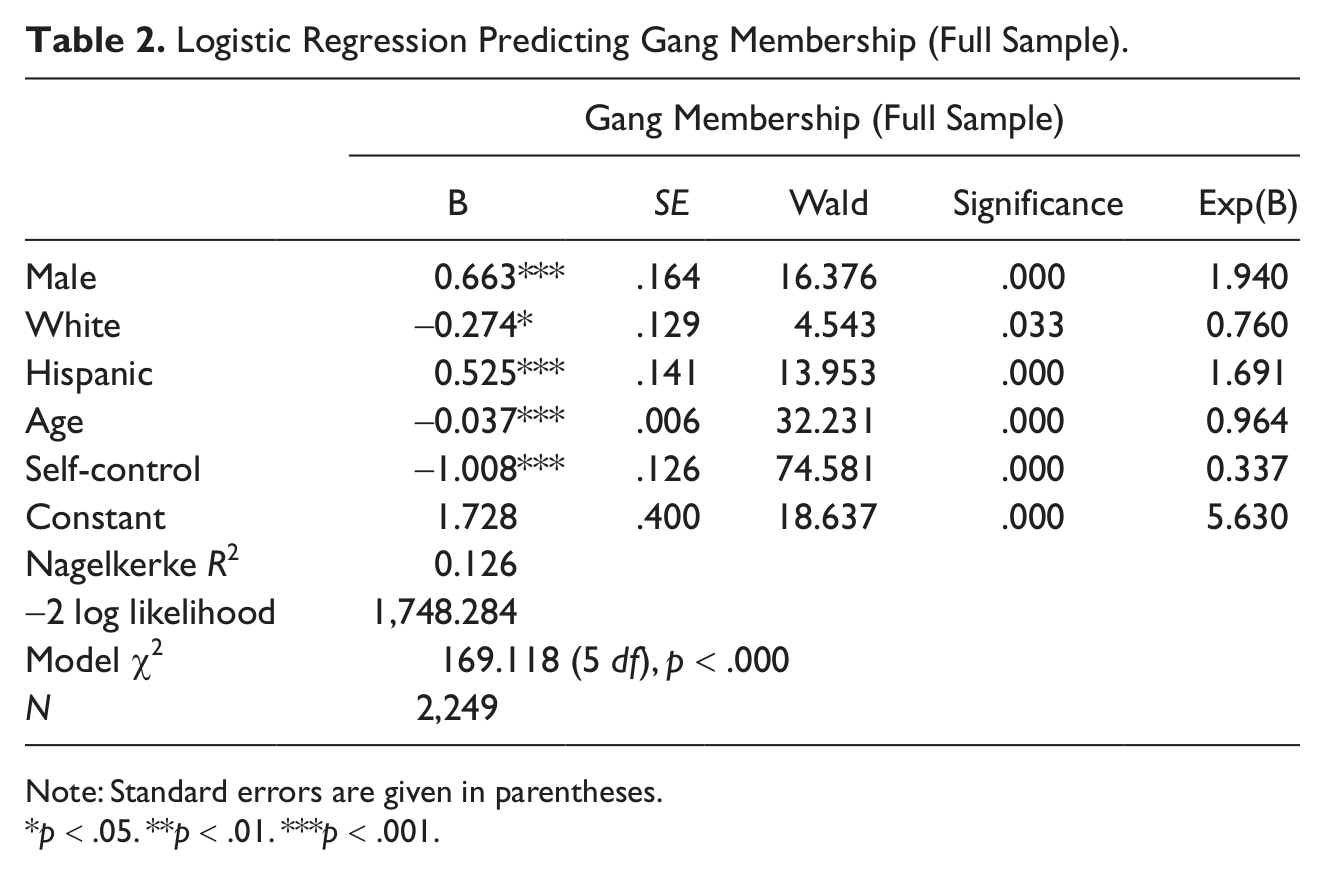
Note: Standard errors are given in parentheses.
p < .05. **p < .01. ***p < .001.
Predicting Property Crime Victimization
Negative binomial regression models were estimated for the crime victimization analyses given that the dependent variables were comprised of count data (Hilbe, 2007). 5 Table 3 presents the results of the negative binomial regression analysis for property victimization. The findings among the full sample (Model 1) indicated that Whites, non-Hispanics, and older inmates were significantly more likely to be victimized by property crime, but there were substantial differences in these effects on victimization among gang members versus nongang members. For example, none of the demographic variables had significant net effects among gang members, whereas nongang members who were White, non-Hispanic, and older were more likely to have been victims of property crimes. Thus, the differences in victimization by these demographic variables in the full sample were driven by the nongang members who comprised the vast majority of the full sample. The differences in the effects of race, ethnicity, and age on property crime victimization remained in Model 2 (for the full sample) and Model 3 (for the gang and nongang subsamples). The findings indicate that gang members were significantly more likely than nongang members to be victimized by property crime.
Results of Negative Binomial Regression Models Predicting Property and Personal Crime Victimization.

Note: Standard errors are given in parentheses.
p < .05. **p < .01. ***p < .001.
The findings on the net effects of the independent and control variables for Model 3 suggest that the effect of self-control on victimization by property crimes was significant among both gang and nongang members, but in opposite ways. Although self-control was negatively associated with property crime victimization for nongang members, indicating that those with lower self-control were at higher risk of victimization (in the direction expected and consistent with Schreck, 1999), victimization was positively related to self-control among gang members indicating that gang members with higher self-control were more likely to report property crime victimization. 6 This finding is inconsistent with Gottfredson and Hirschi’s (1990) general theory of crime and prior research (Holtfreter et al., 2008; Kerley et al., 2009; Piquero et al., 2005; Reisig et al., 2009; Schreck, 1999; Schreck et al., 2002, 2006). This opposite effect of self-control in the two subsamples shows up as a nonsignificant effect of self-control on property victimization in the full sample, again not as expected either from prior research or from self-control theory.
Predicting Personal Crime Victimization
Table 3 also reports the results of the multivariate analyses for personal crime victimization. Model 4 reveals that for the full sample, males, Whites, and younger inmates were significantly more likely to report having been victims of crime against persons. Examining the demographic differences between gang and nongang members indicates that being male and non-Hispanic was significantly related to victimization for gang members whereas being male, White, and younger was significant for nongang members. These demographic findings remain consistent across all models, except that non-Hispanics were more likely to report personal crime victimization for the full sample when gang membership was introduced in Model 5. Although gender was significant for both the gang and nongang subsamples, a z test (Paternoster, Brame, Mazerolle, & Piquero, 1998) indicates no significant differences between the groups (z = .783). The effect of gender on personal crime victimization was not more pronounced for gang members compared with nongang members.
Similar to property crime victimization, gang membership was associated with personal crime victimization for the full sample (Model 5). This gang membership effect remained when self-control was included in the analysis, which indicated that self-control did not mediate, nor render spurious, the relationship between personal crime victimization and gang membership. In other words, gang members were significantly more likely than nongang members to be victims of personal crimes at some point in their lives, even when controlling for self-control. 7 Findings from Model 6 revealed that self-control was negatively and significantly related to personal crime victimization for the full sample and gang and nongang subsamples. Both gang and nongang members with lower self-control were significantly more likely than inmates with higher self-control to report being victims of personal crime, and a z test revealed no significant differences between gang and nongang members (z = −.193). These findings, which are expected from theory and prior research (Gottfredson & Hirschi, 1990), contrast with the findings reported above on property crime victimization that did not support predictions derived from applying the self-control theory of crime to property crime victimization among gang members. 8
Discussion and Conclusions
This research examined the relationships between gang membership, crime victimization, and self-control using self-report survey data from jail inmates. Before turning to a discussion of the findings, we acknowledge several limitations that may hamper the generalizability of the results. First, examining the lifetime victimization of offenders using retrospective self-report data may have resulted in memory decay, especially with regard to the specific number of times particular items occurred. Although this is a limitation of the data, some research indicates that respondents can recall salient life events with a substantial degree of accuracy, although recalling specific details of those events is less accurate (Smith & Ellsworth, 1985). Second, the response rate was low and may have resulted in a biased selection effect. Although the average participation rate (25%) is consistent with some research on inmates (Struckman-Johnson et al., 1996), our measurement represents an extremely conservative assessment given the incarcerated sample (e.g., many inmates did not listen to the invitation to participate due to their involvement in other activities, such as listening to music through headphones, exercising, or sleeping). Although the actual response rate was substantially higher than 25%, we were unable to systematically record the number of inmates who acknowledged the invitation to participate due to the environment of the jails and the procedures of the research (Fox, Zambrana, & Lane, 2011). Similar to much of the existing research testing self-control (Pratt & Cullen, 2000), the current study uses a convenience sample of inmates, which may limit the generalizability of the findings. Third, the current study did not include other potentially relevant measures that may explain gang membership and/or victimization (e.g., peer associations and environmental factors). Other theoretical explanations for victimization among gang and nongang members also may be at work.
Finally, the cross-sectional data prevent an examination of the temporal order of relationships. Although Gottfredson and Hirschi (1990) claimed that self-control is established during childhood and remains stable over the life course, some evidence indicates variability over time (Turner & Piquero, 2002). Although self-control may be related to gang membership and crime victimization, the data do not permit analyses that disentangle the cause and effect among these relationships. Related to the issue of causality, the measure of gang membership does not permit an examination of the temporal ordering of factors associated with various stages of gang membership (e.g., current vs. former gang membership). The current study examines current and former gang members collectively, similar to other well-established gang research (Esbensen & Winfree, 1998), which can be viewed as a contribution to the gang–victimization literature that generally omits a measure of former gang membership (Delisi et al., 2009; Gibson et al., 2009; Spano et al., 2008). Given that Gottfredson and Hirschi argued that self-control is stable over time, the theory would suggest that self-control is similar during periods of gang membership and after leaving the gang. However, the causal relationship between gang membership and victimization is unknown. It is possible that respondents’ initial victimization experience was a motivating factor for joining a gang, which may have, in turn, exposed them to further victimization (e.g., see Peterson et al., 2004, who find support for an enhancement effect for victimization on gang membership). Alternatively, gang membership may have preceded exposure to victimization. Future research that is able to examine these causal relationships would contribute to the gang–victimization link.
The analyses indicate several statistically significant relationships among the variables of interest. Consistent with prior research (NYGC, 2009), gang members were primarily male (85%); however, fewer female gang members (9%) were observed in comparison with prior research on juvenile gangs (Esbensen & Winfree, 1998). Gang members were significantly more likely than nongang members to have lower self-control, which supports the extension of Gottfredson and Hirschi’s (1990) general theory of crime as well as other recent work (Esbensen & Weerman, 2005; Hope & Damphousse, 2002; Kissner & Pyrooz, 2009; Peterson-Lynskey et al., 2000).
Analyses predicting property and personal crime victimization also indicated several important relationships. Although sex differences were not observed for property crime victimization, findings indicated that men (both gang and nongang members) were significantly more likely than women to be victims of personal crime (Craven, 1997; Rand, 2008). Older inmates were generally more likely to report property crime victimization, whereas younger inmates were more likely to report personal crime victimization. This finding may reflect a generational shift toward increasing exposure and involvement in violence among the younger generation. Whites were more likely to be victimized by property and personal crime in the full sample and nongang member subsample but not among gang members (Rand, 2008; Rennison, 2001). Non-Hispanics were more likely than Hispanics to be victims of property crime (for the full sample and nongang member subsample) and personal crime (for gang members only). Gang members were significantly more likely to be victimized by crime, which is in line with most (Peterson et al., 2004; Taylor et al., 2007) but not all prior research (Gibson et al., 2009). This finding sheds light on the experiences of gang members and contributes important information that may be helpful for understanding the nature of gangs.
The findings on the effects of self-control on victimization were partially supportive of extending the logic of Gottfredson and Hirschi’s (1990) general theory to victimization, as suggested by Schreck (1999). Specifically, low self-control was significantly related to personal crime victimization in the expected direction for both gang and nongang members and to property crime victimization for nongang members. However, there were some findings contradictory to, or at least inconsistent with, extending self-control explanations beyond criminal behavior to crime victimization. The theory would predict that both gang membership and criminal involvement in both property and violent crimes are functions of low self-control, and therefore, any relationship between gang membership and criminal behavior is spurious. By extension, we would expect that gang membership and crime victimization are functions of low self-control and that controlling for self-control should reduce other potential explanations of victimization (i.e., gang membership) to insignificance. Gottfredson and Hirschi suggested that self-control is the cause of crime (and, we argue, victimization), not gang membership. However, our findings indicate that gang membership increases the risk of both property and personal crime victimization even when the effects of self-control on victimization are controlled. In addition, the findings for property crime victimization experienced by gang members contradict the theoretically expected negative relationship of victimization with self-control. That is, we found a positive relationship; gang members with higher self-control were more likely, not less likely, to have been victims of property crime. However, gang members with lower self-control were significantly more likely to be victims of personal crime.
Given that Gottfredson and Hirschi (1990) proposed that the propensity for crime results in criminal behavior in the presence of opportunity, one possible explanation consistent with the general theory of crime is that gang membership is somehow related to “opportunities” for victimization. Assuming that gang membership produces a difference in the vulnerability of property to criminal theft or damage, future research incorporating measures of opportunities would substantially contribute to the theoretical and victimization literatures. Future research may also benefit from examining the causal relationships between self-control, gang membership, and crime victimization. For example, some gang members who leave the gang may have developed higher levels of self-control, even though Gottfredson and Hirschi would argue that self control should remain stable. Future research may also examine the effect of offending on the relationships between victimization, gang membership, and self-control. Given the link between self-control and crime, offending may influence the effects of self-control on victimization. Furthermore, examining the ways in which fear of crime and/or perceptions of the likelihood of victimization affects gang membership, victimization, and self-control would be worthwhile for future inquiry.
Overall, the current study sheds light on several underresearched issues. This study reveals that gang members are significantly more likely than nongang members to be victimized by crime. In fact, gang members reported victimization more often than nongang members by being threatened with a weapon, assaulted without a weapon, assaulted with a weapon, robbed, carjacked, stabbed, shot at, shot, and experiencing home invasion and drive-by shooting. When holding other factors constant, gang members are victimized significantly more often by both property crimes and personal crimes. Furthermore, among nongang members, those with low self-control are significantly more likely to be victimized by property and personal crimes. This lends support for extending Gottfredson and Hirschi’s (1990) theory to explain victimization among offenders. Interestingly, the current study suggests that self-control operates differently among gang members. Although low self-control was associated with personal crime victimization, high self-control was associated with property crime victimization among gang members. Although some specific suggestions have been offered, when considered more broadly, this finding emphasizes that gang members are unique and should be examined independent from nongang members. Ultimately, this study provides some foundational work that future researchers may build on to enhance our understanding of the gang–victimization link.
Footnotes
Acknowledgements
The authors wish to thank the jail administrators and inmates who participated in this research, Kathy Zambrana and Jen Klein for their invaluable research assistance, and our colleagues Marv Krohn and Richard Schneider for their insightful comments on earlier drafts.
Authors’ Note
Viewpoints expressed in this article are those of the authors and do not necessarily represent those of the funding agency.
Declaration of Conflicting Interests
The author(s) declared no potential conflicts of interest with respect to the research, authorship, and/or publication of this article.
Funding
The author(s) disclosed receipt of the following financial support for the research, authorship, and/or publication of this article: This research was supported by a grant from the Society for the Psychological Study of Social Issues.