



Abstract
Beginning in November 2012, New Haven, Connecticut, served as the pilot site for Project Longevity, a statewide focused deterrence gun violence reduction strategy. The intervention brings law enforcement, social services, and community members together to meet with members of violent street groups at program call-ins. Using autoregressive integrated moving average models and controlling for the possibility of a non-New Haven–specific decline in gun violence, a decrease in group offending patterns, and the limitations of police-defined group member involved (GMI) categorization of shootings and homicides, the results of our analysis show that Longevity is associated with a reduction of almost five GMI incidents per month. These findings bolster research confirming the efficacy of focused deterrence approaches to reducing gun violence.
Introduction
In 1991, New Haven, Connecticut, recorded a 30-year high of 36 homicides, mirroring the rates of violent crime that affected many American cities during the rise of the “crack epidemic” (Blumstein & Rosenfeld, 1998; Cook & Laub, 1998; Tonry & Moore, 1998). Following one of the largest and longest running crime declines in American history (Zimring, 2007), the homicide count in New Haven plummeted by 78% from 1991 to 2003. Shortly after 2003, however, homicides in New Haven began to buck the national crime decline and began trending upward. In 2011, New Haven came just shy of its 1991 high with 34 homicides. With a murder rate of 26.2 per 100,000 in 2011, New Haven’s murder rate outpaced Washington, D.C., and Chicago, and was on par with Oakland, California. 1
In response to the mounting death toll, in 2011, state and local officials partnered with the New Haven Police Department, social service providers, and New Haven community members to implement a data-driven gun violence reduction strategy. With the formation of this partnership, New Haven became the pilot site for a statewide gun violence reduction project that had shown success in cities such as Boston and Chicago (Braga, Kennedy, Waring, & Piehl, 2001; Papachristos, Meares, & Fagan, 2007). Drawing on the successful efforts of these and other cities in reducing gun violence, New Haven’s Project Longevity began in 2012, its strategy focused on targeting the small population of high-risk, repeat offenders, often gang- or street group-involved, who account for the majority of gun violence (Kennedy, 1997; Kennedy, Braga, & Piehl, 1997).
This article examines the efficacy of Project Longevity in reducing gun violence in New Haven after its first 3 years of continuous operation. Specifically, we analyze whether or not the timing of Longevity affected the levels of group member involved (GMI) shootings and homicides. Our results suggest that the initiation of Project Longevity is associated with a significant decrease in GMI shootings and homicides during the observation period. Using Hartford, Connecticut, as a comparative case, we find that the observed decrease of GMI gun violence in New Haven is not part of a general decline in gun violence, nor a New Haven–specific decline in group crime. In addition, we test for the possibility that the police-defined category of “group member involved” biases our results and find no such bias. In short, our findings provide evidence that the observed decline in GMI shootings and homicides in New Haven is strongly associated with the implementation of Longevity.
Background
Two parallel developments in American policing set the stage for the focused deterrence strategies that Project Longevity is modeled upon: problem-oriented policing and community policing. Moving away from the professionalization, bureaucratization, and the “means over ends” emphasis that characterized the “reform era” of policing (Goldstein, 1979; Kelling & Moore, 1988), problem-oriented policing posits that police are better served by addressing problems through a process of “identification, analysis, response, evaluation, and adjustment of the response” (Braga, Kennedy, Waring, et al., 2001, p. 196). In conjunction with problem-oriented policing, community policing gained popularity in the 1980s and 1990s as a way for police to mend the relationships strained by the social upheaval of the 1960s and 1970s. Central to community policing are the principles of “proactive problem-solving strategies” (Rosenbaum, 1988) and the inclusion of community residents in the problem-solving process (Skogan, 1990).
Drawing from these developments, the group violence intervention (GVI) pioneered in Boston in the 1990s is a focused deterrence strategy aimed at reducing shootings and homicides driven by criminally active street groups (Braga, Kennedy, Piehl, & Waring, 2001; Braga, Kennedy, Waring, et al., 2001). 2 Although deterrence is still integral to GVI—the strategy still uses the promise and use of certain, swift, and severe punishment to dissuade undesired behavior (Akers, 1999; Gibbs, 1975; Stafford & Warr, 1997; Zimring & Hawkins, 1973)—the GVI approach departs markedly from traditional deterrence techniques such as increasing police presence in a general area or engaging in mass police “crackdowns” (Weisburd, Telep, Hinkle, & Eck, 2010). Instead, GVI focuses on the small number of individuals, often involved in street gangs or groups, who account for the vast majority of gun violence in cities, and makes use of a wide variety of legal “levers” on individuals who are often under state supervision, for example, probation or parole (Braga, Hureau, & Winship, 2008; Kennedy, Piehl, & Braga, 1996). 3 Rather than casting its net broadly and increasing penalties across large parts of the population, the GVI approach identifies specific problems (e.g., street group gun violence) and mobilizes law enforcement, social service, and community resources to address those problems and the individuals most likely to be involved as perpetrators and victims.
Project Longevity—New Haven, Connecticut
The GVI strategy in Connecticut, branded as Project Longevity, began in New Haven in August 2012. To ascertain the nature of the gun violence and street group issue and guide future programmatic decisions, New Haven began with a problem analysis composed of two parts: a group audit and an incident review. The group audit is a focus group style meeting in which law enforcement practitioners are guided through a mapping and survey exercise to collect detailed information on street groups in a given municipality (Sierra-Arevalo & Papachristos, 2015a). 4 During the audit, information is collected on the active street groups in the city, harnessing the unique “experiential assets” of law enforcement to better understand the geographic location of street groups, who is in them, and what activities members are engaged in (Kennedy et al., 1997). In addition, because much of the violence perpetrated by street groups is part of a reciprocal process of intergroup conflict (Papachristos, 2009; Papachristos, Hureau, & Braga, 2013; Tita & Radil, 2011), a key part of the audit is the collection of relational data detailing the system of feuds and alliances between street groups (Kennedy et al., 1997; Sierra-Arevalo & Papachristos, 2015a).
The incident review also leverages the experience of law enforcement officers but is tailored to gather information on shootings and homicides. Specifically, the incident review aims to assess which groups are most actively involved in gun violence and the circumstances surrounding each shooting. Officers are presented with information about past shootings and homicides, including victim and offender information, location, and any other information about the circumstances of the event. Officers are then tasked with identifying whether the event was GMI based on whether the victim or the perpetrator is a member of a group identified during the group audit process. 5
The initial problem analysis in New Haven showed the existence of 52 unique groups at the time of the audit, with 440 identified street group members. Longevity’s focused approach meant that only those groups involved in gun violence would be part of the intervention—less than 60% (n = 30) of the 52 identified groups were involved in shootings or homicides. Similarly, not all identified groups were involved in active feuds with other street groups, with only 42% (n = 22) of the groups engaged in conflict at the time of the audit.
Using the intergroup conflict and shooting data in conjunction with data on group membership, location, and violent activity gathered during the group audit and incident review, Longevity personnel were able to identify the most violent groups in the city and select group members to take part in the intervention.
The Intervention: Group Call-Ins
Guided by data gathered during the group audit and incident review, Project Longevity staff chose members from the two most violent street groups to be invited to a call-in. Call-ins are meetings between street group members and law enforcement, social service providers, and community members, functioning as an information dissemination tool for the law enforcement–community partnership to deliver three key points to attendees. These points are (a) a community moral message against violence, (b) a credible law enforcement message about the consequences of further violence, and (c) a genuine offer of help for those who want it (National Network for Safe Communities [NNSC], 2013).
New Haven’s first call-in took place in November 2012, shortly after the initial problem analysis. On the day of the call-in, members from the two most violent groups were called into the aldermanic chambers housed in New Haven’s City Hall. Attendees listened to the Longevity message over the course of an hour, hearing from law enforcement, social service providers, and community members. Representatives from law enforcement spoke to attendees first, making sure to articulate the “new rules” (NNSC, 2013, p. 76) being implemented, and reiterated that those who continued to engage in gun violence (and their group) would meet with focused law enforcement attention. Next, social service providers showed call-in attendees that there is help available to those who want it. Services offered in the New Haven call-ins included housing assistance, high school diploma or general education development (GED) classes, job training, and drug or alcohol recovery. Last, community representatives acted as “moral voices” known to and respected by the call-in attendees, articulating to attendees the anti-violence message of the program and drawing on their unique positions within the community to help attendees connect with the message. For example, a formerly incarcerated speaker offered testimony that change and a life away from guns and the street life is possible, while the mother of a victim of gun violence spoke as a “voice of pain,” her words concentrating on the tragic costs of street violence. 6
Subsequent call-ins continued to reach out to the other violent groups in the city between November 2012 and June 2014, with a total of six call-ins. The format of the call-ins remained consistent across this time. 7 If and when there was a law enforcement action against a violent group that had attended a previous call-in, that law enforcement action was showcased to call-in attendees as proof positive that the message they received was real, and that continuing to engage in violence would have swift and certain consequences.
Evaluation Design
The ideal implementation of Longevity would have allowed for a quasi-experimental design that compared the rates of shooting incidents between a treatment group and some comparison group (Braga, Hureau, & Papachristos, 2014; Papachristos & Kirk, 2015). However, Project Longevity was never designed as a quasi-experiment. Because of the concentration of gun violence within a small number of active street groups and within a small number of neighborhoods, Longevity was designed as a non-randomized and highly focused effort that selected groups based on their involvement in gun violence. This left the project staff with little choice but to “treat” nearly all of the groups identified in the group audit. As a result, within the first year of implementation, virtually all of the identified groups in New Haven participated in at least one call-in, thereby leaving no comparison groups.
The inability to have a true experimental design is a common limitation in gun violence programs, including other GVI evaluations (Braga et al., 2014; Engel, Corsaro, & Tillyer, 2010; Engel, Tillyer, & Corsaro, 2013). To analyze crime trends within New Haven before and after the start of Longevity, we use a series of interrupted time series regression models (Braga, Kennedy, Waring, et al., 2001) designed to address three possible confounding factors that, in light of our design, might bias our results: (a) a generalized decline in gun violence, (b) a New Haven–specific decline in group-related criminality, and (c) bias in the GMI identification process used by police.
Data
Data used in the present study were derived from fatal and non-fatal shooting records collected by the New Haven and Hartford Police Departments between January 2011 and April 2014. Data were aggregated to monthly counts, creating a 40-month time series for both cities. Project Longevity was active in New Haven during the last 18 months of the observation period, starting November 2012 and continuing through April 2014. Given the specific focus of Longevity on gun violence driven by the small population of criminally active street group members, the project aimed at addressing shootings and homicides that were GMI—that is, fatal and non-fatal shootings police identified during shooting reviews as involving a street group member as a victim or offender. All analyses are therefore conducted on total, GMI, and non-GMI shootings.
Analytic Strategy
Taking into account the temporal nature of the data, we use a series of AutoRegressive Integrated Moving Average (ARIMA) models, which account for temporal dependencies of time series data. In our analysis, the main dependent variable is the number of GMI shootings as a function of the treatment period. 8 Our models include an autoregressive parameter (Ar1 [ARIMA(1,0,0)]) to account for temporal autocorrelation found between consecutive months. When the number of shootings is regressed on itself with a time lag of 1 month, no stationarity issues are observed, confirming a key assumption required for the use of ARIMA models. 9
As we have discussed, Longevity’s lack of experimental design makes it difficult to discern whether any observed decrease in GMI incidents during the treatment period is directly attributable to Longevity, or whether it is the result of (a) a generalized decrease in shootings and homicides that extends beyond New Haven, (b) a decrease in group-based criminality in New Haven, or (c) bias in the categorization of fatal and non-fatal shootings as GMI or non-GMI.
To address the first issue, we compare shootings and homicides in New Haven with those in Hartford, Connecticut, a nearby city that did not receive treatment, to account for general trends that might be occurring within the same state. 10 Because Longevity was active in New Haven but not Hartford during the observation period, a Longevity-specific effect should manifest in a greater reduction in GMI shootings in New Haven as compared with Hartford over this time period.
A second series of analyses addresses the possibility that a decrease in GMI shootings in New Haven is due to a decline in group-based criminality, such as criminal activity of street groups (Braga, Papachristos, & Hureau, 2009). To account for this possibility, we aggregate the number of offenses in New Haven at the month level using only those offenses for which police records show more than one offender, and then compare trends in co-offending, that is, group crime, with GMI trends over the observation period. If the reduction in GMI incidents is linked to Longevity’s implementation, we expect any reduction in GMI shootings to be independent of trends in co-offending.
Finally, because the identification of GMI incidents is necessarily imperfect by nature of the incomplete information patrol officers and investigators have at their disposal during investigations, it is not uncommon for the shooter(s) to be unknown, even when a victim is known to not be involved with an identified street group. Without this information, police cannot conclusively say that a shooting incident is GMI, and must conservatively list them as non-GMI, which could bias our measure of GMI incidents in such a way that excludes shootings and homicides that could likely be GMI. To address this potential problem, we construct a more lenient possible-GMI category using logistic regression, predicting shooting as non-GMI or possible-GMI based on a victim’s age, gender, and race, whether the shooting was fatal or non-fatal, whether the suspect was identified, and in which police district the event happened. Based on this model, incidents that closely approximate events that police categorized as GMI but were not officially labeled as such are included in the category of possible-GMI. If a decrease in the number of incidents related to this broader measure of GMI is still observed during the time of the intervention, this decrease is not likely due to imperfections in the GMI identification process.
A final set of analyses considers all of these possible issues simultaneously. If a decrease in GMI incidents during the treatment period can still be observed after controlling for the trend in shootings in nearby Hartford, the level of group criminality in New Haven, and variation in the identification process of GMI incidents, then we can much more confidently claim that the observed decrease in GMI shootings in New Haven is due to Project Longevity.
Results
Trends in Shootings and Homicides in New Haven
Figure 1 shows the monthly distribution of shootings and homicides in New Haven before and after the start of Project Longevity. In the 22 months leading up to the start of Longevity, there were 11.64 total shootings per month (SD = 4.17), 19.2% of which were homicides (M = 2.23, SD = 1.63). Importantly, total shootings were trending downward in New Haven even prior to implementation of Longevity: In the 22 months before the first call-in, total shootings decreased 55.9% and fell to an average monthly total of 7.3 shootings per month (SD = 3.34) after the first call-in. This decline in total shootings—approximately four fewer incidents per month—is reflected in both decreased homicides (before: M = 2.23, SD = 1.63; after: M = 1.61, SD = 1.20, t(38) = 1.34, p = .190), and non-fatal shootings (before: M = 9.41, SD = 3.43; after: M = 5.72, SD = 2.74, t(38) = 3.69, p = .001).
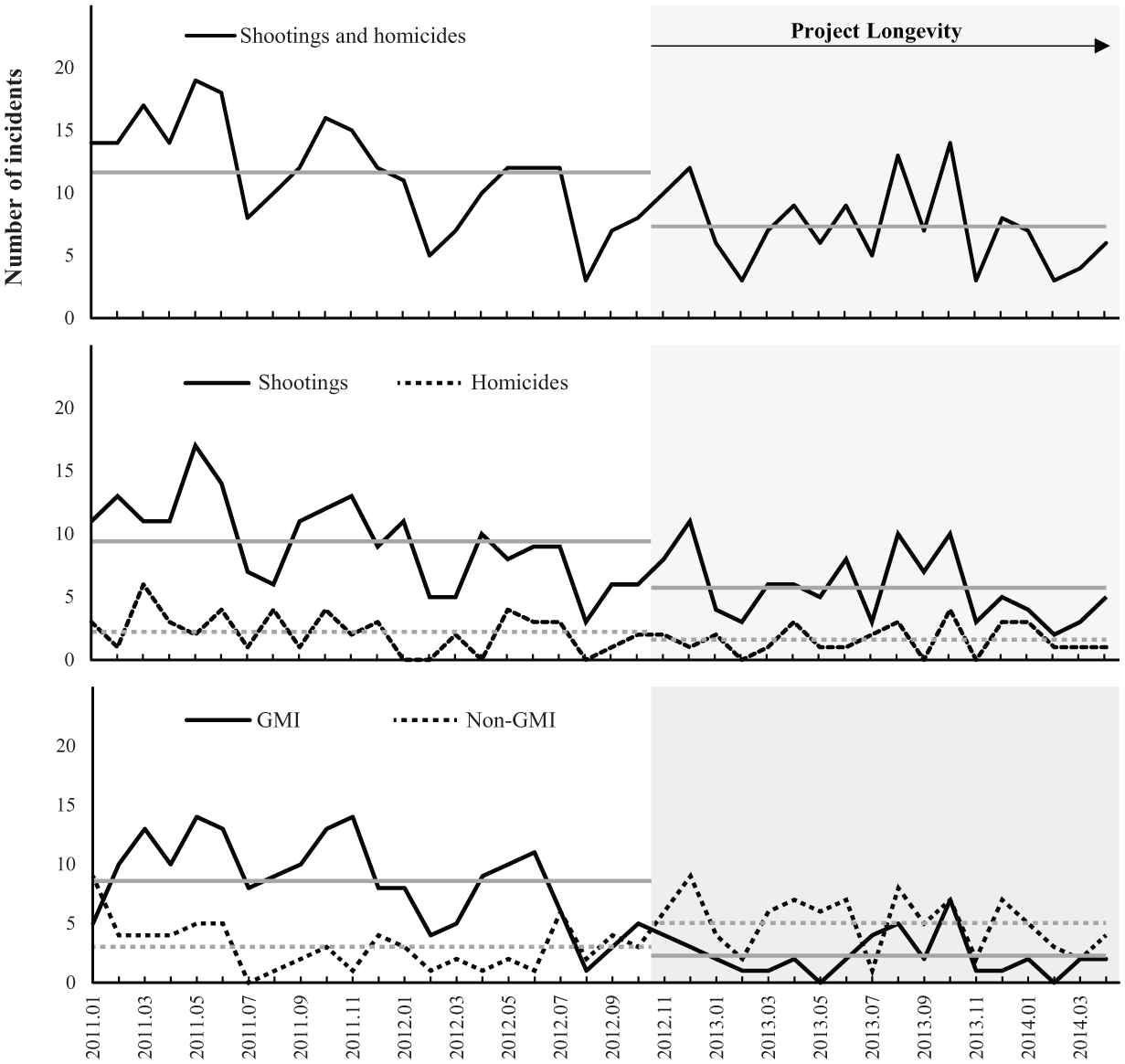
Monthly distribution of total incidents, shootings and homicides, and GMI/non-GMI incidents in New Haven, Connecticut.
The third panel of Figure 1 plots the monthly number of GMI incidents before and after the start of Longevity. Approximately 59% (n = 230) of all recorded shootings between January 2011 and April 2014 involved a member of a street group as either victim or offender (GMI). Like non-GMI shootings, GMI shootings have, overall, trended downward despite some peaks during various months. Prior to Longevity, there were an average of 8.59 GMI shootings per month (SD = 1.78); this figure dropped to 2.28 GMI shootings per month after Longevity’s first call-in (SD = 1.78), an almost 73% drop in average monthly GMI shootings, (t(38) = 6.63, p < .001). At the same time that GMI shootings decreased, however, non-GMI shootings increased approximately 66%. Before Longevity, there were approximately 3.05 non-GMI shootings per month (SD = 2.08), increasing to approximately 5.06 shootings per month (SD = 2.34) after the first call-in. The marked decline in GMI shootings after the start of Longevity suggests a negative programmatic effect. However, because the GMI shootings and homicides were decreasing before Longevity’s implementation, we must investigate whether the decrease in GMI incidents after the first call-in is attributable to the intervention, or whether it is simply a continuation of a broader trend. To address this potential issue, we use interrupted time series regressions that predict the total number of GMI shootings as a function of the treatment period.
Table 1 presents the results of interrupted time series regressions predicting the effect of Longevity on total and GMI shootings and homicides. Results from these regressions show that the number of total shootings and homicides decreased by just more than four during the intervention period. By comparison, GMI shootings and homicides decreased by 5.33 during months in which a call-in was performed.
Regression Model Predicting the Effect of Project Longevity on Number of Incidents Per Month in New Haven.

Note. GMI = group member involved; Ar1 = autoregressive parameter.
Although these results are suggestive of a programmatic effect, it is difficult to ascertain whether the observed post-Longevity decline is directly related to programmatic efforts without a true experimental design. In addition, there are at least three alternative explanations or potential issues that might undermine the association between Longevity and the observed post-Longevity decline: generalized downward shooting trends that extend beyond New Haven, a decline in New Haven–specific group criminality, and bias in which incidents are classified as “Group Member Involved” shootings. We address each of these in turn.
Possible Issue 1: Generalized Decline in Shootings and Homicides
Knowing that the lack of treatment and comparison groups within New Haven makes it difficult to pinpoint programmatic effects within the same city, an alternative approach to explore whether the post-Longevity decline in GMI incidents is related to program implementation is to compare the trend in New Haven with the trend of comparable cities that did not participate in Longevity. One likely candidate for such a comparison is nearby Hartford, Connecticut.
Hartford is approximately the same size as New Haven with a population of 125,017, and is 39 miles away. More importantly, prior to Longevity, both Hartford and New Haven had similar levels of fatal and non-fatal shootings and were both experiencing a downward trend. Figure 2 shows the number of total monthly shootings in both cities before and after the start of Longevity in New Haven. Prior to Longevity, both cities had a comparable number of monthly shootings, although New Haven’s rate began trending below Hartford’s as early as November 2011—a trend that accelerated after Longevity began. Still, Figure 2 shows the trend of shootings in Hartford is correlated with the trend in New Haven (r = .44, p = .004).
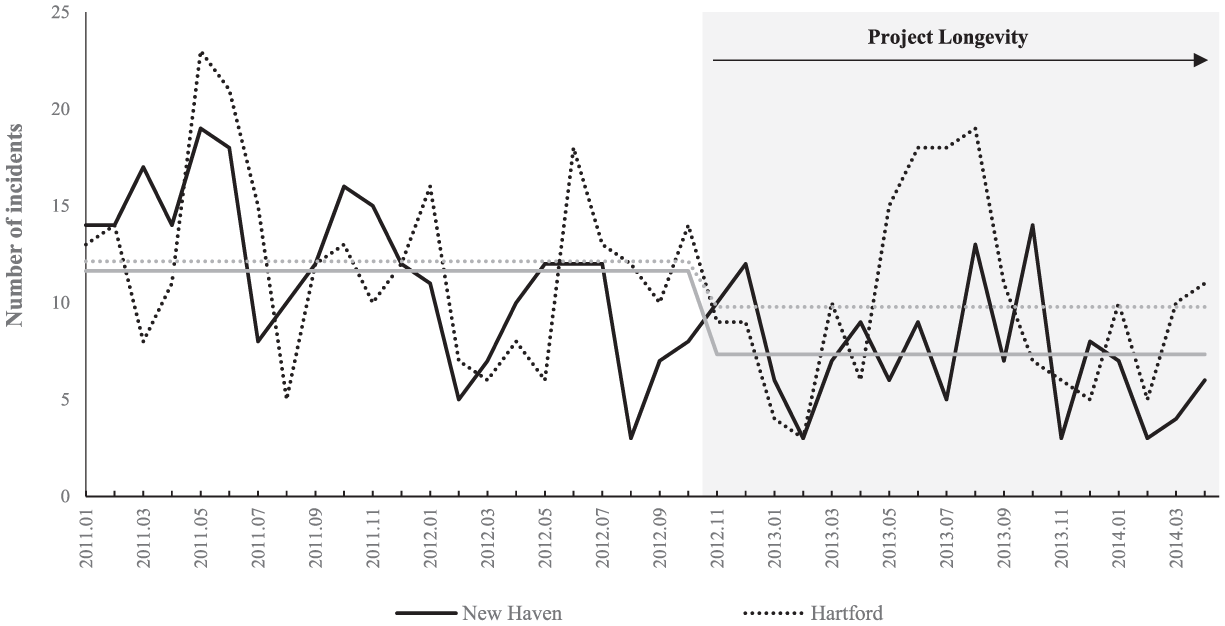
Monthly distribution of the shootings and homicides in New Haven and in Hartford before and during Project Longevity.
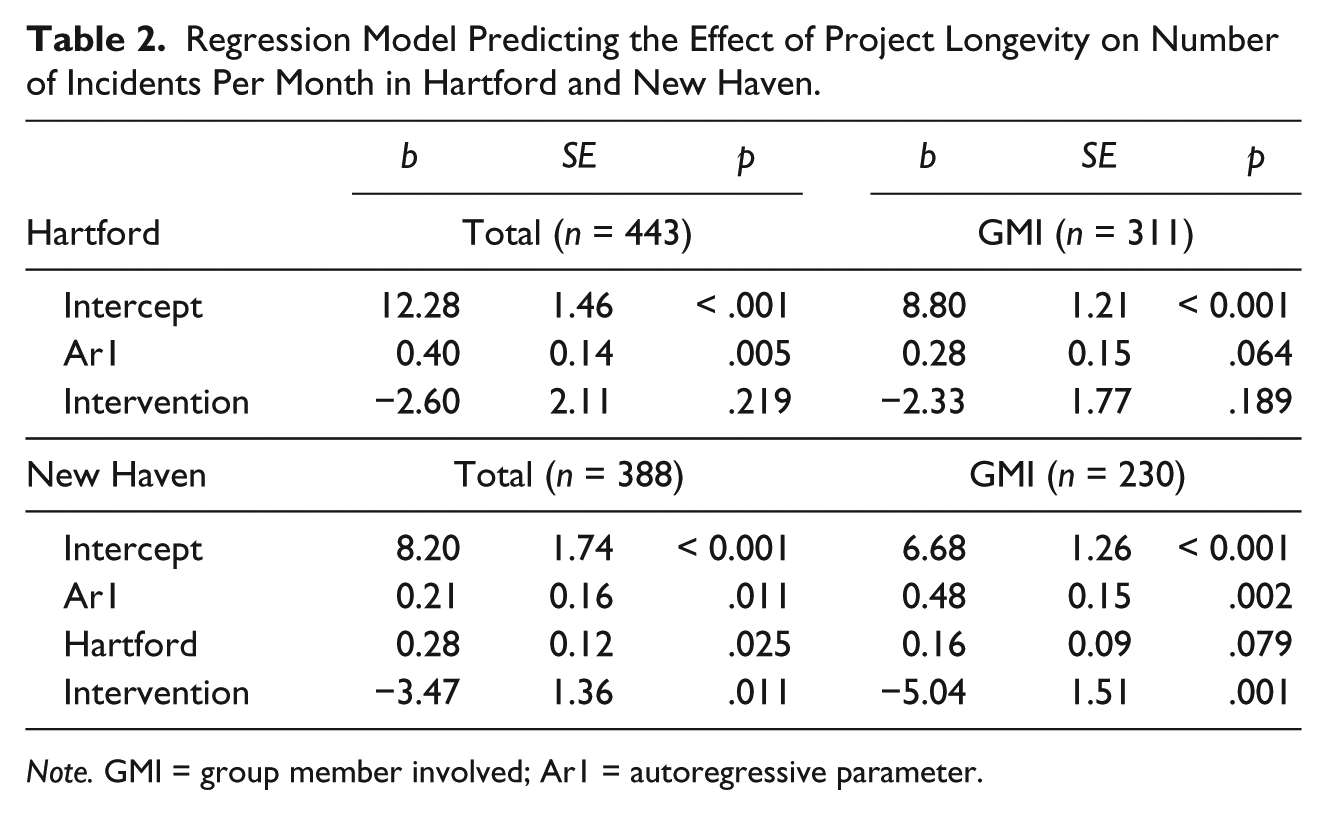
Table 2 shows the same regression model presented in the previous analysis, but this time predicting shootings and homicides that occurred in Hartford. We can observe that during Longevity’s intervention period, the decrease in GMI incidents observed in New Haven is not seen in Hartford, suggesting the intervention period is unrelated to incidents in Hartford.
Regression Model Predicting the Effect of Project Longevity on Number of Incidents Per Month in Hartford and New Haven.
Note. GMI = group member involved; Ar1 = autoregressive parameter.
Next, we predict the overall level of shootings and homicides in New Haven, as well as GMI incidents specifically, while accounting for fatal and non-fatal shooting trends in Hartford. The results of interrupted time series regressions predicting total shootings and homicides and GMI incidents in New Haven, while controlling for shootings and homicides in Hartford, are displayed in the bottom half of Table 2. After controlling for shootings and homicides (b = 0.28, SE = 0.12, p = .025) and GMI incidents in Hartford (b = 0.16, SE = 0.09, p = .079), a significant decrease in GMI shootings and homicides is still found in New Haven during the intervention period (total: b = −3.47, SE = 1.36, p = .011; GMI: b = −5.04, SE = 1.51, p = .001), suggesting that reduction in GMI incidents in New Haven are independent of trends in Hartford.
Possible Issue 2: Decline in Group Offending
The number of shootings and homicides in a city is closely tied to the criminal activity of street groups (Braga et al., 2009). If street group activity generally decreased in New Haven, the observed decrease in GMI incidents might not be related to the implementation of Project Longevity, but instead to a reduction in criminal activity that is unrelated to violence reduction efforts.
As a robustness check, we operationalize New Haven’s level of street group criminality using police arrest data listing multiple offenders for a single incident—namely, co-arrests. Although a crude measure of street group criminality, the group nature of gangs and their activities is well documented (Decker, 1996; Klein & Crawford, 1967; Reiss, 1988), and, as such, the number of co-arrest incidents provides an indicator of New Haven’s group crime patterns. In particular, the leveraging of data on the underlying group processes of crime in New Haven matches up well with the group focus of Longevity, as well as the relatively fluid nature of New Haven street groups (see Sierra-Arevalo & Papachristos, 2015a).
Over the observation period, the individual arrest rate is stable (b = −1.00, SE = 1.43, p = .491), suggesting that the overall level of “criminality” in New Haven (or police enforcement) showed little change over the observation period. In contrast, there is a slight but statistically significant decrease in the level of co-offending for each month (b = −0.72, SE = 0.20, p = .001). Prior to Longevity, there were approximately 110.82 (SD = 13.84) co-offending arrests per month, but this figure dropped 14.4% after the start of the program to approximately 94.00 (SD = 15.89) co-offending arrests per month.
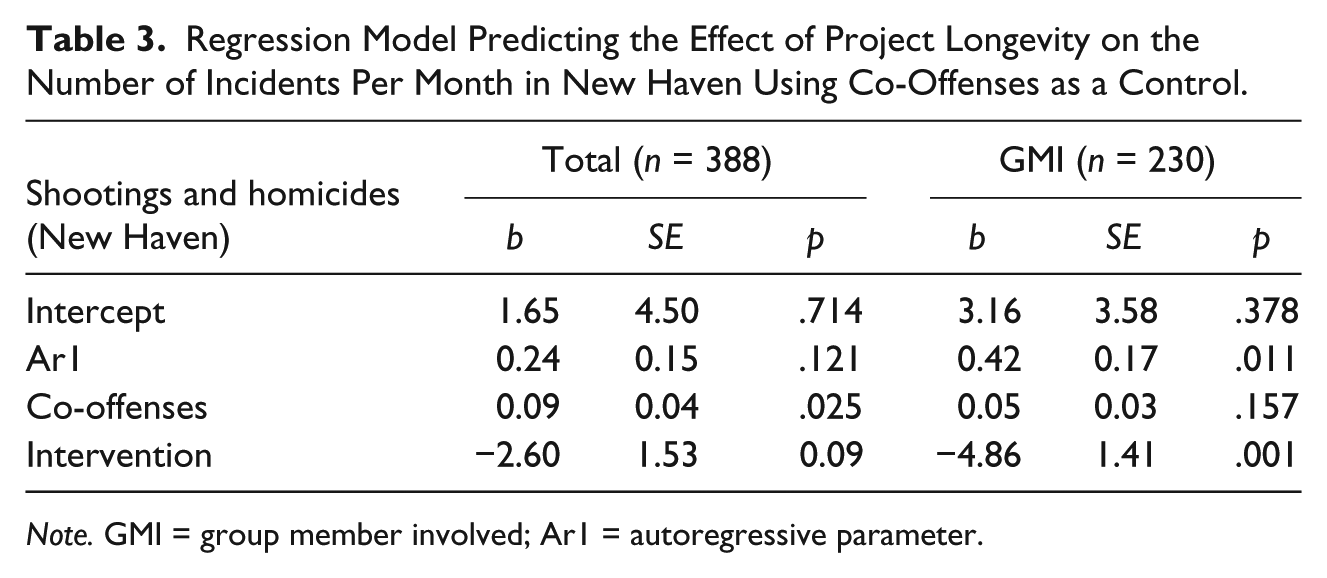
The number of monthly shootings and homicides in New Haven is not related to individual arrest rates (r = .20, p = .217) but is correlated with the number of recoded co-offenses (r = .52, p = .001); the relationship is even stronger for GMI incidents (r = .59, p < .001). To parse out the relationship between co-offending and GMI shootings, we estimate a model predicting shootings and homicides in New Haven, controlling for co-offending. The results shown in Table 3 suggest that the overall level of co-offending in New Haven has a statistically significant effect on the total number of shootings: An increase of 100 recorded co-offenses is related to an increase of nine shootings. However, Table 3 also shows a statistically significant intervention effect of Longevity on GMI shootings and homicides, even when controlling for the effect of co-offending. This further suggests that the observed decrease in the number of GMI incidents observed during Project Longevity cannot be completely explained by a decrease in group offending.
Regression Model Predicting the Effect of Project Longevity on the Number of Incidents Per Month in New Haven Using Co-Offenses as a Control.
Note. GMI = group member involved; Ar1 = autoregressive parameter.
Possible Issue 3: Bias in GMI Identification
Another threat to the validity of our findings stems from the possibility that our dependent variable undercounts the total number of GMI incidents in New Haven. For example, the incomplete information inherent to ongoing investigations might prevent some shooting from being conclusively identified as GMI during shooting reviews, ultimately resulting in an artificially low number of GMI shootings. Under such a condition, a significant decrease in GMI incidents might only be observed because the larger, total number of GMI incidents is not taken into account.
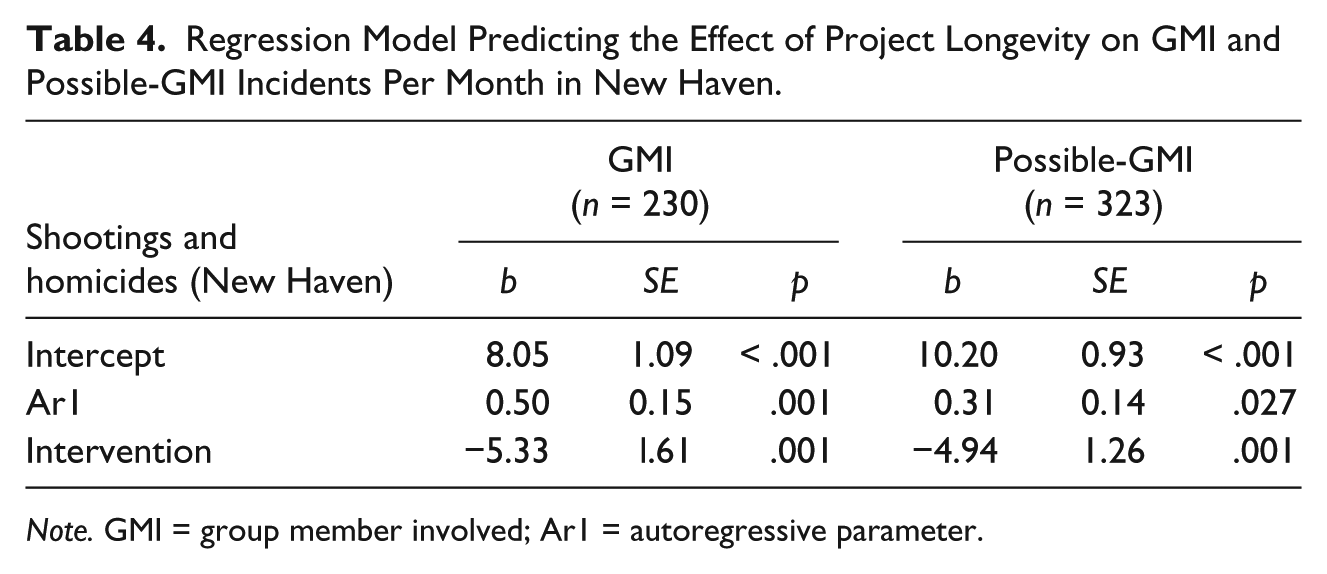
We examine this concern using a logistic regression that identifies possible-GMI shootings based not on shooting review classification, but instead on the demographic characteristics of the victim (race, age, gender), the identification of the suspect, whether the shooting was fatal or non-fatal, and the location of the shooting. 11 This strategy identified 323 possible-GMI incidents—93 more than were identified as GMI by police during the shooting review process.
Next, we subject the police-defined GMI and possible-GMI trend to the same time series regression models described above to determine the effect of Longevity on these two GMI formulations. Table 4 shows that, after including the 93 additional cases of possible-GMI incidents with the police-identified cases, there is still a statistically significant decrease in the number of incidents after the start of Longevity. Even with a more lenient identification of GMI, there is a significant negative programmatic effect of Longevity on GMI shootings and homicides.
Regression Model Predicting the Effect of Project Longevity on GMI and Possible-GMI Incidents Per Month in New Haven.
Note. GMI = group member involved; Ar1 = autoregressive parameter.
Multiple Explanations and Summary Model
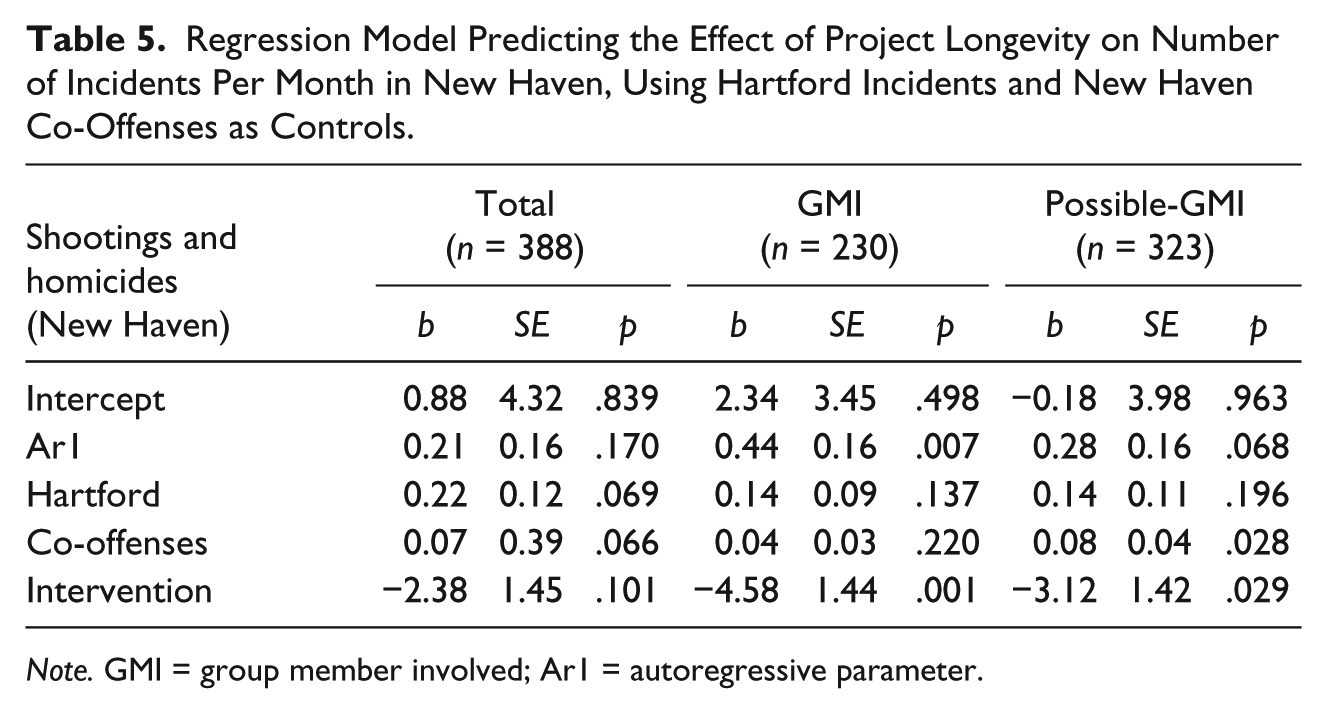
As a final robustness check, we take into account the three threats to validity we have discussed and control for them in a single model. Table 5 presents the results from a series of models predicting total shootings and homicides, GMI (as defined by police), and possible-GMI shootings that use the shooting trends in Hartford and the level of co-offending in New Haven as statistical controls. The results find a continued, but somewhat reduced, Longevity effect when controlling for these additional parameters. As seen in the last row in Table 5, even after controlling for these additional parameters, the implementation of Project Longevity is associated with 2.4 total shootings (fatal and non-fatal) per month, 4.6 fewer GMI incidents, and 3.1 fewer possible-GMI incidents after the start of the program. Although such an analysis still lacks true causal power, the robustness of the observed intervention effect to different statistical conditions and parameters strongly suggests that the observed decline in GMI shootings and homicides in New Haven can be attributed to the enactment of Project Longevity.
Regression Model Predicting the Effect of Project Longevity on Number of Incidents Per Month in New Haven, Using Hartford Incidents and New Haven Co-Offenses as Controls.
Note. GMI = group member involved; Ar1 = autoregressive parameter.
Conclusion
Project Longevity is a focused deterrence effort aimed at reducing gun violence in New Haven, Connecticut. Emulating previously evaluated programs from other cities (e.g., Braga, Apel, & Welsh, 2013; Braga, Kennedy, & Waring, et al., 2001; Corsaro & Engel 2015; Engel et al., 2013; Papachristos & Kirk 2015; Papachristos et al., 2007), Longevity performed call-ins with street group members between November 2012 and April 2014 to leverage group dynamics and curb the violence on New Haven streets. In these call-ins, a combination of law enforcement, social service providers, and community members spoke with street group members to deliver a unified message to group members that the gun violence must stop, there is help for those who want it, and those who choose to continue committing acts of violence will meet with swift legal consequences (Crandall & Wong, 2012; NNSC, 2013).
To test whether Project Longevity had a significant, negative effect on GMI shootings and homicides in New Haven, we examined data on lethal and non-lethal shootings in the city from January 2011 until April 2014 using a series of ARIMA models. The results of our analysis suggest that, even accounting for a variety of alternative explanations, the implementation of Project Longevity in New Haven, Connecticut, was associated with a reduction of nearly five GMI shootings and homicides per month. These results support a growing body of empirical research that confirms the efficacy of focused deterrence strategies for reducing gun violence in American cities (Braga & Weisburd, 2012, 2015). Moving away from traditional deterrence and broken windows approaches that privilege broadly applied police sweeps or enforcement of minor offenses, New Haven’s Project Longevity is one more instance of how targeting specific offenders, in this case members of violent street groups, can significantly enhance public safety.
To be sure, the design of Project Longevity is not ideal for programmatic evaluation. As we have described, the pressing nature of the gun violence problem and the relatively small number of actively violent street groups identified during New Haven’s group audit led to nearly all of the groups being invited to a call-in during the intervention period. Because of this, we are unable to compare the effect of the Longevity intervention on a set of treatment and control groups or neighborhoods as is more common in quasi-experimental designs. Despite this issue with the design of the intervention, we account for three alterative explanations for the observed decrease in GMI shootings and homicides in New Haven: (a) a general decrease in gun violence that extends beyond New Haven, (b) a reduction in group offending patterns in New Haven, and (c) bias resulting from an imperfect police-defined GMI measure. Even after accounting for these alternative explanations, a significant decrease in GMI incidents after the implementation of Project Longevity in New Haven is observed.
Even accounting for these plausible alternative explanations, we cannot be unequivocally sure that the effects we attribute to the implementation of Longevity are not caused by unobserved changes during the intervention period, such as in activities by pre-existing social service programs. Before and during the implementation of Longevity, New Haven had dozens of local social service organizations providing job training, drug and alcohol counseling, mental health services, and adult education. In fact, the existing network of social service providers was an integral part of the Longevity strategy, with several local agencies and programs partnering with Longevity. Although previous work finds that provision of social services is not responsible for the observed declines in gun violence attributed to focused deterrence initiatives (Engel et al., 2013), we cannot conclude that the observed Longevity effect does not overlap with other unmeasured programs, policies, or services.
We believe that our results bolster an already strong case for future implementations of focused deterrence strategies in cities across the United States, especially similar medium-sized cities that are less likely to have their gun violence problems discussed in the same breath as metro areas such as Chicago, Los Angeles, or Indianapolis (McGarrell, Chermak, Wilson, & Corsaro, 2006; Papachristos & Kirk, 2015; Tita, Riley, Ridgeway, Grammich, & Abrahamse, 2010). Similar to other smaller cities such as Rockford, Illinois (Corsaro, Brunson, & McGarrell, 2013), and Lowell, Massachusetts (Braga, McDevitt, & Pierce, 2006), the results of New Haven’s Project Longevity indicate that focused deterrence strategies can effectively bolster public safety outside big city contexts, and suggest that the underlying street group dynamics that drive gun violence are not unique to major cities.
However, as discussed in previous evaluations of focused deterrence initiatives (e.g., Braga, Kennedy, Waring, et al., 2001), each city in which such a strategy is implemented faces a unique set of challenges. Although the underlying logic of the focused deterrence strategy is relatively stable between sites, the implementation of the strategy is necessarily adapted to the unique constellation of street groups in each city. Knowing that the structure of street groups is not consistent across cities (McGloin, 2005; Sierra-Arevalo & Papachristos, 2015b), we echo calls by other scholars (Braga & Weisburd, 2015) and suggest that the success of Project Longevity in New Haven, Connecticut, should spur the adoption of focused deterrence into the public safety repertoires of other cities, but also a deeper exploration of the underlying mechanisms and group processes that generate the “spillover effects” of focused deterrence strategies (Braga et al., 2013).
With New Haven as only the first of three cities that are part of the statewide Longevity plan, Connecticut is a promising place to continue the study of focused deterrence strategies’ effects on gun violence, as well as their implementation. Although Hartford and Bridgeport are 20 and 39 miles from New Haven, respectively, and each city has gun violence in need of attention, each city also has a unique collection of law enforcement, service providers, community members, and street groups. How the differences in the context of where a focused deterrence strategy is carried out affects program implementation presents an exciting area for future research to explore, with such research providing useful information for law enforcement, communities, and policy makers alike as they work together to reduce urban gun violence.
Keeping these future avenues of research in mind, our findings provide evidence that focused deterrence strategies such as Project Longevity are a viable and efficacious step away from overly broad policies and policing practices such as stop and frisk or police sweeps. With public, academic, and policy-making attention firmly trained on the need for change in how the criminal justice system acts on the lives of community residents, an approach that funnels limited resources toward those most likely to be involved in gun violence as victims and offenders provides a promising way forward. Although such programs are not panaceas for the underlying issues that engender gun violence—ineffectual schools, broken homes, unemployment, poverty—they are at the very least an effective way to address the gun violence that is symptomatic of these broader social ills, while also minimizing the number of community members caught up in the criminal justice system.
Footnotes
Declaration of Conflicting Interests
The author(s) declared no potential conflicts of interest with respect to the research, authorship, and/or publication of this article.
Funding
The author(s) disclosed receipt of the following financial support for the research, authorship, and/or publication of this article: This project was supported by Cooperative Agreement Number 2012CKWXK039 awarded by the Office of Community Oriented Policing Services, U.S. Department of Justice. The opinions contained herein are those of the author(s) and do not necessarily represent the official position or policies of the U.S. Department of Justice. References to specific agencies, companies, products, or services should not be considered an endorsement by the author(s) or the U.S. Department of Justice. Rather, the references are illustrations to supplement discussion of the issues.