



Abstract
The study examines the longitudinal relationship between religious involvement and substance use within emerging adulthood, accounting for changes in religious involvement over time and exploring variations across age, sex, race/ethnicity, and substance (i.e., alcohol, marijuana, and hard drugs). To this end, random effects models are used focusing on 11 waves of the National Longitudinal Survey of Youth, 1997. The findings demonstrate that increases in religious attendance are associated with reduced odds of all forms of substance use. In addition, the religious attendance–substance use relationship becomes weaker with age. Overall, religious attendance has a similar relationship with substance use among males and females, as well as Whites and non-Whites, with a few notable exceptions.
Introduction
Recent studies have called attention to the importance of religion within a life course and developmental perspective of delinquency. From the standpoint of Sampson and Laub’s (1993) age-graded theory of informal social control, religion can be understood as an institution or form of social capital that deters “the individual from realizing his/her natural proclivities to criminal activity” (Chu, 2007; Giordano, Longmore, Schroeder, & Seffrin, 2008, p. 101). Stated differently, religion becomes an additional element of the social bond to which individuals feel an attachment and commitment, and thus has the potential to influence behavior (Desmond, Kikuchi, & Budd, 2010; Jang & Johnson, 2001; Miller & Vuolo, 2018). As such, scholars have argued that involvement in religious activities can keep individuals from delinquency because it occupies otherwise free time to become involved in deviant activities and imposes standards and guidelines of moral and righteous behavior (Desmond et al., 2010; Miller & Vuolo, 2018; Petts, 2009a).
Within this context, the relationship between religion and substance use has been of particular interest. It is recognized, however, that few studies actually consider this relationship within a life course approach, accounting for both stability and change in religious involvement and substance use over time, and even fewer assess these changes over more than a few time points (Desmond et al., 2010; Jang & Johnson, 2001; Ulmer, Desmond, Jang, & Johnson, 2012). The dynamic nature of religion, in particular, has received limited attention, especially in emerging adulthood, focusing on the consequences of gaining or losing religion in this critical time period (Petts, 2009b; Thomson, 2016; Ulmer et al., 2012). In addition, existing evidence, although not expansive, reveals that the relationship between religion and substance use may vary across age, sex, and race/ethnicity (Chu & Sung, 2009; Giordano et al., 2008; Jang & Johnson, 2001; Jang & Johnson, 2005; Steinman & Zimmerman, 2004) and depends on the type of substance considered, whether it is alcohol use or the illicit use of soft and hard drugs (Bakken, DeCamp, & Visher, 2013; Hill & Pollock, 2015; Nonnemaker, McNeely, & Blum, 2003). These variations, however, are still not well understood.
Expanding upon the existing research, the present study uses 11 waves of the National Longitudinal Survey of Youth, 1997 (NLSY97), to further examine the relationship between religious involvement and substance use over time. In this way, both within- and between-individual variation can be assessed and both stability and change can be captured. It is also determined whether this relationship varies across age, sex, and race/ethnicity, as well as the type of substance used—alcohol, marijuana, or hard drugs. The findings are considered within the context of informal social control theory, examining religion as an institution that can potentially prevent substance use throughout the life course and may do so differentially for those with varying backgrounds.
Theorizing Religious Involvement and Substance Use Over Time
Within a life course framework, it is acknowledged that there is a large amount of continuity in behavior, but there is also the possibility of change. The basic premise is that life events and transitions can alter or modify initial behavioral trajectories (Elder, 1985). This approach is advocated by Sampson and Laub (1993) in their age-graded theory of informal social control. As a control theory, they focus on bonds that connect members of society to one another and to various social institutions, like family, school, and employment, and prevent deviant or antisocial behavior. They argue that the relevance of these institutions change as people age, with childhood institutions setting people on a particular trajectory of deviance. However, later life events in adulthood can serve as turning points in a deviant trajectory, modifying initial propensities and contributing to a process of desistance (Laub & Sampson, 2003; Sampson & Laub 1993). In this way, emphasis is placed on the importance of social bonds, and changes in these bonds, throughout the life course, not just in early childhood and adolescence. Also proposed in their theory is that the quality or strength of the social bonds matters more than just the presence or absence of the bonds in an individual’s life.
Religion can be seen as one of these relevant institutions or bonds. Giordano et al. (2008) recognize that Laub and Sampson (2003) largely ignore religion in their original research, mostly because only a few of the men in the Glueck and Glueck (1950) data benefited from religious involvement. Despite this, recent studies acknowledge that religious participation from a young age can provide social support and control (Jang, Bader, & Johnson, 2008; Petts, 2009a). Relevant to the present study is the potential for religious involvement to control substance use. Sampson and Laub (1993) define delinquent behavior rather broadly, including substance use as an outcome of interest. In their research, alcohol and drug use are part of their summary measure of unofficial delinquency, and they recognize the relevance of certain social controls in predicting smoking and drinking specifically (e.g., Sampson & Laub 1993). Also, they argue that involvement in more serious forms of offending at younger ages can have consequences for various life domains, including the potential for alcohol abuse in adulthood. In line with their theory, the bond to religion can continue to keep adolescents away from antisocial activities, including substance use, as they age (Desmond et al., 2010). In addition, increased ties to religion can potentially break the continuity in antisocial behavior from adolescence to adulthood (Chu, 2007; Petts, 2009a; Ulmer et al., 2012).
From a theoretical standpoint, there is reason to consider that the influence of religion as an informal social control may depend on the substance considered and vary across several dimensions, including (a) age, (b) sex, and (c) race. In particular, religion may have a greater moral influence over minor legal transgressions, including the use of certain substances (Miller & Vuolo, 2018). The early research of Middleton and Putney (1962) suggests that society differentially condemns certain behaviors. They argue that there is a normative consensus against violent and other criminal behaviors that are uniformly prohibited by society but no consensus regarding ascetic behaviors, especially those socially approved but explicitly condemned by religious norms. This antiasceticism hypothesis proposes that the influence of religion on antiascetic behaviors is likely to be greater than in situations where behaviors are universally disapproved by secular institutions. In this context, religion may serve more as a social control against those substances explicitly proscribed by religious norms, including alcohol and marijuana, as opposed to hard drug use, which is more socially condemned by both religious and secular norms.
In considering the moderating effects of age, Sampson and Laub (1993) indicate that individuals’ relations with family, school, peers, and employment, as well as their attitudes on delinquent behavior, change over time, and the relevancy of certain bonds in affecting behavior also change as people age. In a similar fashion, individuals’ relations with religion are dynamic and may grow, stagnate, and decline over the life course (Fowler & Dell, 2006; Hagberg & Guelich, 2005; Petts, 2009b), and these changes may have more influence at certain ages. On the one hand, it can be argued that individuals attend religious services due to the influence of family members or significant others and less because of a personal commitment to religious beliefs in adolescence (Hadaway, Elifson, & Petersen, 1984; Rhodes & Reiss, 1970). Transitioning from adolescence into adulthood, individuals are given more freedom to make the choice to attend church (Koenig, McGue, & Iacono, 2008) and religious involvement could carry more impact on behavior when it is freely chosen (Yonker, Schnabelrauch, & DeHaan, 2012). On the other hand, it is possible that religion has more of a control orientation at younger ages, even if participation is forced by parents, because it limits opportunities for deviant activities and could positively influence adolescent peer groups (Hoffmann, 2014; Jang et al., 2008; Thomson, 2016). Alternative social bonds, like marriage and employment, may be more relevant to behavior than religion at later ages (Laub & Sampson, 2003).
Pertaining to the conditioning influence of sex and race/ethnicity, the fundamental assumption underlying the social control perspective is that individuals have natural tendencies to engage in delinquency or deviance irrespective of sex and race/ethnicity (De Li & MacKenzie, 2003; Matsueda & Heimer, 1987). However, the research to date focusing on social bonds indicates that the mechanisms of social control may not be experienced uniformly across sex or racial groups (Alarid, Burton, & Cullen, 2000; Booth, Farrell, & Varano, 2008; De Li & MacKenzie, 2003; Matsueda & Heimer, 1987). For instance, research finds that females are more religious than males, in that they are more likely to express a greater interest in or need for religion, have a stronger personal religious commitment, and attend church/religious activities more frequently (Donelson, 1999; Lenski, 1953; Ozorak, 1996; Smith & Denton, 2009). Some even suggest that females tend to place a higher value on being in a personal relationship with God and others within a religious context (Milot & Ludden, 2009; Ozorak, 1996). Given this proclivity toward religious commitments and values, religion may play a greater role in the lives of females, having more of an influence on their behavior than males. Thus, religious involvement would explain more of the variation in substance use among females.
With regard to race/ethnicity, Blacks demonstrate a higher degree of religious involvement, which is reflected in greater participation in religious activities, higher rates of church membership, stronger commitment to religion, and frequent attendance at religious services (Beeghley, Velsor, & Bock, 1981; Chatters, Taylor, & Lincoln, 1999; Jacobson, Heaton, & Dennis, 1990). Among Blacks, it is acknowledged that churches serve as a symbolic center of their communities (Sherkat & Ellison, 1999), given that it is one of the few institutions that provide support from the various social problems that plague some of their neighborhoods (Chu & Sung, 2009). Although much less is known about the religious involvement of Hispanic adolescents, some studies indicate that they also report greater involvement and commitment to religion than non-Hispanic White adolescents (Benson, 1993; Fitchett et al., 2007; Regnerus & Uecker, 2006). In this context, Jang and Johnson (2010) suggest that religion may serve as a more important social control for non-Whites than Whites. Given the greater meaning and significance attributed to religious institutions among non-Whites, an absence of religion may have greater negative consequences on their behavior and can explain more of the variation in substance use for this subgroup.
Prior Research Focusing on the Religion–Substance Use Relationship
The increased focus over the years on religion and victimless crimes, like substance use, can be attributed to Hirschi and Stark’s (1969) initial research reporting a lack of a relationship between religion and overall delinquency (Hill & Pollock, 2015). In general, cross-sectional research since then shows that religious involvement serves as a significant protective factor against drinking alcohol and using marijuana or other hard drugs (Bahr & Hoffmann, 2008; Benda & Corwyn, 1997; Burkett & White, 1974; Chitwood, Weiss, & Leukefeld, 2008; Cochran, Wood, & Arneklev, 1994). However, the longitudinal nature of the religion–substance use relationship is studied far less extensively, with limited incorporation of a life course approach to understand the relationship further.
Some of the existing longitudinal research concentrates on desistance from substance use by grouping individuals into categories of nonuse, persistence, and desistance using a few waves of data. These studies find that frequent participation in religious activities is associated with nonuse, as well as desistant and nonpersistent marijuana and hard drug use (Chu, 2007; Ulmer et al., 2012). In addition to this group-based approach, some have adopted other multivariate strategies to explore the longitudinal nature of the relationship. The majority of this research finds that religious involvement has a negative impact on both marijuana and hard drug use over time (Desmond et al., 2010; Jang & Johnson, 2001; Miller & Vuolo, 2018; Thomson, 2016). Jang (2013) has also identified religious involvement as a significant turning point and insulator from binge drinking. Of these studies, only two consider the influence of changes in religious involvement. Ulmer et al. (2012) recognize that religious involvement is more likely to decrease than increase as adolescents move into adulthood. However, individuals who keep religiously involved as they transition into adulthood may be less prone to substance use. For instance, Desmond et al. (2010) identified that adolescents who maintained their high levels of religiosity were less likely to engage in marijuana use over time. Ulmer et al. (2012) found that adolescents who decrease their religious involvement over time, as opposed to remaining stable in their involvement, are more likely to initiate marijuana use and persistently use marijuana than never use.
While there is consistent support for the negative effect of religion on substance use, there is mixed evidence as to whether this relationship is stronger for certain substances and varies across demographic characteristics (Adlaf & Smart, 1985; Benda & Corwyn, 2000; Cochran & Akers, 1989). Pertaining to the latter, some of the existing empirical evidence supports an age-varying association between religion and substance use over the life course. For instance, Jang and Johnson (2001) found that the effect of religion on marijuana use becomes stronger between early and late adolescence, peaks, and then declines, whereas the effect of religion on hard drug use becomes continuously stronger as adolescents grow older. In addition, Button, Hewitt, Rhee, Corley, and Stallings (2010) indicated that the protective effect of religion on problem alcohol use may be greater among adolescents than young adults. Yet, in a recent meta-analysis, Yonker et al. (2012) found that religion had a greater association with decreasing use of substances among emerging adults than adolescents. Hill and Pollock (2015) suggest the effects of religion at various ages depends on the substance, such that religious service attendance had a significant negative impact on tobacco and marijuana use for adults in their study, as opposed to just alcohol use for adolescents.
Variation across sex has also been considered with often inconsistent findings. Some studies indicate a similar effect of religion on substance use among both males and females (Adlaf & Smart, 1985; Bahr, Maughan, Marcos, & Li, 1998; Benda & Corwyn, 2000; Forthun, Bell, Peek, & Sun, 1999; Giordano et al., 2008; Milot & Ludden, 2009). Others suggest religion has a stronger relationship with substance use among male adolescents (Dunn, 2005; Piko & Fitzpatrick, 2004; Steinman & Zimmerman, 2004; Van Den Bree, Whitmer, & Pickworth, 2004), although there are a few cross-sectional studies that have reported the effect of religion on substance use is actually stronger among female adolescents than among male adolescents (Brown, Parks, Zimmerman, & Phillips, 2001; Oman et al., 2004). Jang and Johnson (2005) further indicated that African American women are less likely to resort to aggressive behaviors in response to strain than African American men, partly because religiosity protects them from the harmful influence of distress.
In addition, the moderating effect of race/ethnicity has been evaluated in a number of instances (Steinman, Ferketich, & Sahr, 2008). A recent meta-analysis indicated a stronger negative relationship between religion and substance use in White versus non-White individuals (Yonker et al., 2012). In line with this finding, some suggest Blacks are more likely to abstain from substance use and are more religious than Whites, but the effects of religion on substance use among Blacks are smaller than among Whites (Amey, Albrecht, & Miller, 1996; Wallace, Brown, Bachman, & Laveist, 2003; Wallace et al., 2007). Others continue to find that religious behavior has more of an impact on substance use for Blacks than Whites (Brown et al., 2001; Chu & Sung, 2009; Jang & Johnson, 2010).
The Current Study
Using data from the NLSY97, the current study focuses specifically on the relationship between religious involvement and substance use in emerging adulthood. From a life course perspective, and particularly in line with the age-graded theory of informal social control, we anticipate that religious involvement throughout the life course can potentially serve as a mechanism of social support and control, limiting engagement in substance use among individuals more religiously involved (Desmond et al., 2010; Petts, 2009; Sampson & Laub, 1993). Also, given evidence that individuals can alter their levels of religious involvement over time (Desmond et al., 2010; Ulmer et al., 2012), we expect increases in religious involvement as individuals age to be associated with decreasing substance use. We consider whether these relationships depend on the type of substance and are moderated by age, sex, and race/ethnicity. We focus on the following research questions:
The study expands upon the existing research in a number of ways. We incorporate 11 waves of data to further examine patterns of religious involvement and substance use across a more expansive time period, including emerging adulthood. Religious involvement is modeled as both a time-varying and time-invariant component, accounting for both the stability and change in religious involvement over time. We focus on three different substances simultaneously to determine whether the impact of religious involvement is consistent across various substances (Hill & Pollock, 2015). Finally, given inconsistencies in prior research, we explore possible variation across demographic characteristics.
Data
The NLSY97 is comprised of survey data from a nationally representative sample of 8,984 individuals born between 1980 and 1984 who were surveyed annually beginning in 1997. The data consist of a cross-sectional sample of respondents and a supplemental oversample of Hispanic and Black respondents. For the purposes of the study, we use Waves 5 to 15. In the fifth wave, a total of 7,882 individuals were surveyed, representing a retention rate of 87.9% and in the fifteenth wave, a total of 7,423 individuals were surveyed, representing a retention rate of 82.6%. These retention rates are not atypical of longitudinal studies coming from the Bureau of Labor Statistics (Sweeten, Bushway, & Paternoster, 2009). We begin with Wave 5 because it is the first time respondents were asked about their religious involvement. By starting at Wave 5, we recognize that we are unable to fully capture adolescence for a subset of the respondents who are already in their 20s. We retain only those respondents who have at least two complete waves of data for purposes of the analyses, resulting in a final sample of 6,787 individuals with a total of 63,148 observations/waves. 1 Respondents are 17 to 21 years of age at the first wave of the study and 27 to 31 years of age at the last wave of the study.
Dependent Variables
As a means of evaluating substance use, we focus on Alcohol Use, 2 Marijuana Use, 3 and Hard Drug Use. Specifically, respondents were asked the following questions: (a) “Have you had a drink of an alcoholic beverage since the last interview? (By a drink we mean a can or bottle of beer, a glass of wine, a mixed drink, or a shot of liquor.)” (b) “Since the date of last interview, have you used marijuana, even if only once, for example, grass or pot?” and (c) “Excluding marijuana and alcohol, since the date of last interview, have you used any drugs like cocaine or crack or heroin, or any other substance not prescribed by a doctor, to get high or achieve an altered state?” The measures are dichotomous, such that the variable is coded 1 for observation periods in which the respondent used alcohol, marijuana, or hard drugs, respectively, and 0 otherwise. This dichotomous strategy was adopted largely because questions pertaining to whether the respondents used any of these three substances were consistently asked across waves and in reference to the entire period since the date of last interview. Frequency measures that repeated across waves only pertained to the last 30 days and would not appropriately link to religious involvement, which was asked for the entire year (see description of religion measure below). As Table 1 indicates, Alcohol Use is reported in a majority of the observations/waves (74.3%), while 20.4% and 4.8% of all observations report Marijuana Use and Hard Drug Use, respectively.
Descriptive Statistics.

Note. The means represent the averages across all observations before the time-varying variables were transformed into between- and within-individual components. Values in parentheses represent standard deviations from the mean.
Key Independent Variable
Religious involvement is captured through a time-varying measure of attendance at religious services. Starting at Wave 5 and continuing thereafter, respondents were asked “How often did you attend worship service in the past 12 months?” Responses ranged from never (coded as 1) to everyday (coded as 8), with higher values indicating greater Religious Attendance. We restricted our analyses to Religious Attendance because it was the only measure of religious involvement asked of respondents across all 11 waves. As found in prior studies, Table 1 shows that females attend religious services more often than males, and non-Whites attend religious services more often than Whites. 4
The decision to focus on Religious Attendance is consistent with prior work on the religious involvement–substance use link that often designates religious attendance as a separate component from religious importance and spirituality (Giordano et al., 2008; Hill & Pollock, 2015; Jang, 2013; Johnson, Larson, De Li, & Jang, 2000). In their initial study, Sampson and Laub (1993) identify work quality as the stability of the most recent employment, or the length of time respondents worked in their most recent job. Working a greater length of time at a particular job implies a commitment to that job. The Religious Attendance measure assesses a similar level of stability by asking respondents how often they attend worship services, with more time spent at these services suggesting a stronger commitment to a religious institution. Just as time invested in a job varies with age, we expect that religious commitment will vary over time, with prior research suggesting a decrease in attendance at religious services as people get older (Ulmer et al., 2012).
Control Variables
Several time-variant and time-invariant variables were controlled within the analyses. Pertaining to the time-varying measures, we included variables reflecting involvement in other institutions noted by Sampson and Laub (1993) to serve as controls against deviant behavior at the point of the life course considered in the study (ages 17 to 31), including education, employment, marriage, and parenthood. In each observation period, respondents indicated their highest degree received, ranging from none (0) to a professional degree (7) (i.e., DDS, JD, MD). Responses were left on a continuous scale to represent Educational Achievement with higher values representing greater educational attainment. Respondents also noted their enrollment status in school. Observation periods where the respondent indicated he or she was enrolled in Grades 1 to 12, a 2-year college, a 4-year college, or a graduate program were coded 1, while all other responses were coded 0, reflecting School Enrollment Status.
The number of weeks where a respondent worked at any job was used to capture the respondent’s employment status at a given observation period. This variable is designated Weeks Employed. Respondents were asked about marriage and cohabitation as well. Three categories were created to represent marital status: Married, Single (including those divorced, widowed, and separated), and Cohabitating. Single was used as the reference category. Finally, at each wave, respondents reported the number of biological children born and residing in the household and the number of biological children born and not residing in the household. These two questions were combined to form a dichotomous measure of Parental Status, where 1 indicates respondents had at least one biological child in each wave.
In addition to these institutional measures, respondents reported how many times during the observation period they had been arrested. Using this information, we created a measure reflecting the respondent’s Arrest Status in each observation period, coded 1 if the respondent had been arrested. Respondents reported being arrested in only about 4% of the observations. For the alcohol use models, we considered whether the respondent was of legal age at each wave to drink alcohol. This measure, designated Legal Drinking Age, was coded 1 if the respondent was of legal drinking age. Finally, we included a control for the Age of the respondent in years, as well as Age-Squared to account for a potential nonlinear effect of age (Jang & Johnson, 2001).
The time-invariant measures were all taken from Wave 1 of the survey, and reflect both time-stable characteristics, as well as characteristics of the respondents that were only captured at this wave. These indicators represent factors shown by prior research to have an effect on delinquent propensities and/or initial religious attendance. We first derived measures pertaining to family and parenting. Respondents were asked questions about their family structure when they first entered the survey. Three categories were created to reflect respondents with varying family dynamics: respondents who lived with both biological parents, respondents who lived with two parents but both are not the biological parents (i.e., one is a stepparent, foster parents, etc.), and respondents who lived in a single-parent household. These designations are noted as Biological-Parent Family, Mixed-Parent Family, and Single-Parent Family, respectively. About 54% of the observations show both biological parents were present in the household at the start of the study. Single-Parent Family is used as the reference category.
Several measures were also derived from the parent interviews in the first wave. According to the mother’s age at the birth of her first child, respondents were designated as having a Teen Mother (coded 1) if the mother was 18 years or younger. About 27% of the observations report a teenage mother. The highest level of Parental Educational Achievement, reported as the higher of either the mother or father, was included as a proxy for parental socioeconomic status. Responses ranged from none (0) to eighth year of college or more (20), with higher values indicating higher parental educational attainment. Interviewed parents were also asked to report how often they attended worship services during the past 12 months, with responses ranging from 1 (never) to 8 (everyday). This variable was used to capture Parental Religious Attendance. 5
In addition to these family and parenting measures, a Peer Delinquency variety score was created based on youth reports of the number of antisocial behaviors participated in by at least half of their peers. These behaviors included smoking, drinking, drug use, gang involvement, and truancy. The resultant variable ranges from 0 to 5, with higher values indicating greater peer delinquency. There was also a Delinquency Score Index available for the respondents in the survey, with scores ranging from 0 to 10, such that higher scores indicate more incidents of delinquency. This measure was designed to capture the overall delinquent propensity of respondents. The substance use measures detailed above were included as controls when that substance was not the dependent variable of interest. For example, in the models predicting the likelihood of Alcohol Use, the two other substances—Marijuana Use and Hard Drug Use—were controlled. In addition, a dichotomous measure of Cigarette Smoking was also controlled, such that the variable is coded 1 for observation periods in which the respondent used cigarettes, and 0 otherwise. Finally, the sex (male = 1) and race/ethnicity (White = 1, non-White = 0) 6 of the respondents was included. Table 1 shows that about 49% of the observations include male respondents while about 55% include female respondents.
Analytic Strategy
Because of the time-variant, dichotomous dependent variables, we use random effects logistic regression to model the relationship between religious involvement and alcohol use, marijuana use, and hard drug use. Random effects models are recognized as particularly suitable when using unbalanced data and allow for the consideration of time-stable characteristics, including sex and race/ethnicity, which are of particular interest in the current study. These models also account for the nested structure of the data, such that each individual has at least two waves of data. While random-effects models are often identified as more efficient than fixed-effects models, the model assumes that the independent variables are uncorrelated with the random error term designed to capture unobserved heterogeneity within the model. Because of this assumption, random-effects models may suffer from omitted variable bias (Ousey & Wilcox, 2007; Paternoster, Bushway, Brame, & Apel, 2003; Sweeten et al., 2009).
To address these concerns, Bryk and Raudenbush (1992) suggest separating the time-varying independent variables into within-individual and between-individual components, sometimes recognized as a “hybrid” version of the random effects model (Allison, 2005; Ousey & Wilcox, 2007). The between-individual component represents the mean of the time-varying independent variable for each individual across all waves (

where
For each of the dependent variables, we begin by analyzing the associations with religious involvement for the total sample, including controls for all variables noted above. We also report additional models with interaction terms between Religious Attendance and Age, Religious Attendance and Age-Squared, Religious Attendance and Male, and Religious Attendance and White to determine whether the relationship between religious involvement and substance use is moderated by age, sex, and race/ethnicity. 7 Because interactions in logistic models are not as straightforward in interpretation as linear regression models, we use predictive margins to further explicate the interaction effects noted and include figures of the predicted margins where relevant. While all of the models control for the variables noted above, the tables with the models including interactions show only the variables of interest for ease of interpretation.
Results
Before conducting the full models, we first considered the unconditional models to provide justification for the use of random effects analyses. The results (not reported) demonstrate that variation in the propensity to drink alcohol, use marijuana, and use hard drugs can be attributed to both between- and within-individual differences. The majority of the variation in these outcomes can be explained by differences between individuals, but 32.9% (alcohol use), 27.5% (marijuana use), and 35.6% (hard drug use) of the variation can still be explained by differences within individuals.
Table 2 reports the results showing the relationship between religious involvement and substance use, including the controls. The findings demonstrate that those who attend more religious services, on average, throughout the waves of the study have a lower likelihood of using any of the three substances. The odds of drinking, using marijuana, and using hard drugs reduce by about 24.9%, 23.0%, and 16.7%, respectively. Considering the within-individual effect of religious involvement, the results also indicate that those who increased their religious attendance over the waves studied were more likely to stay away from alcohol use, marijuana use, and hard drug use. Increasing religious involvement was linked to a decrease in the odds of alcohol use by about 8.1%, marijuana use by about 11.8%, and hard drug use by about 6.2%. Addressing our first two research questions, the results seem to suggest that being more religiously involved throughout the life course can serve as a mechanism of control against the engagement in substance use (Research Question 1). Also, increases in religious involvement as individuals age are significantly related to lower likelihoods of substance use, or vice versa (Research Question 2). Specific to our third research question, the findings are fairly consistent, at least thus far, across each of the substances studied.
Random-Effects Logistic Regression Estimates for the Total Sample.

Note. There are 63,148 person-waves nested within 6,787 individuals for each of the models. The coefficients for Parental Religious Attendance → Alcohol Use and Weeks Employed → Marijuana Use were multiplied by 10 to obtain a non-zero value. b = unstandardized coefficient.
p ≤ .05. **p ≤ .01. ***p ≤ .001 (two-tailed).
Table 3 reports the results with the interaction between Religious Attendance (within) and Age (within), as well as Religious Attendance (within) and Age-Squared (within), included in the models. For alcohol use, the interaction term with age is positive and significant, whereas the interaction term with age-squared is negative and significant. This pattern suggests that the relationship between religious attendance and alcohol use weakens as individuals age. Marijuana use follows a similar pattern, although the interaction term with age-squared is not significant. Figure 1 illustrates this finding. As noted above, Age (within) represents deviations from the mean age, so negative values suggest a younger Age, whereas positive values suggest an older Age. The plots show the slopes for religious attendance and substance use at different ages. Increases in religious attendance are tied to lower likelihoods of alcohol and marijuana use at younger ages and have a minimal association with the use of these substances at later ages.
Random-Effects Logistic Regression Estimates With Age Interactions.

Note. There are 63,148 person-waves nested within 6,787 individuals for each of the models. All models reported include controls for the time-variant and time-invariant variables noted in Table 1. b = unstandardized coefficient.
p ≤ .05. **p ≤ .01. ***p ≤ .001 (two-tailed).

Predictive margins of age.
Further addressing the third research question, the findings with the sex interaction terms can be found in Table 4. The interaction terms suggest that attending more religious services, on average, is associated with hard drug use more so for females than males. The predictive margins plot in Figure 2 depicts the slope differences for males and females. Females with a lower average religious involvement throughout the waves have a higher probability of hard drug use than males, whereas females with a higher average religious involvement throughout the waves have a lower probability of hard drug use than males. With regard to hard drug use, it appears females are benefiting more from religious attendance than males. Overall, though, the relationship between religious attendance and substance use is largely consistent across males and females.
Random-Effects Logistic Regression Estimates With Sex Interactions.

Note. There are 63,148 person-waves nested within 6,787 individuals for each of the models. All models reported include controls for the time-variant and time-invariant variables noted in Table 1. b = unstandardized coefficient.
p ≤ .05. **p ≤ .01. ***p ≤ .001 (two-tailed).
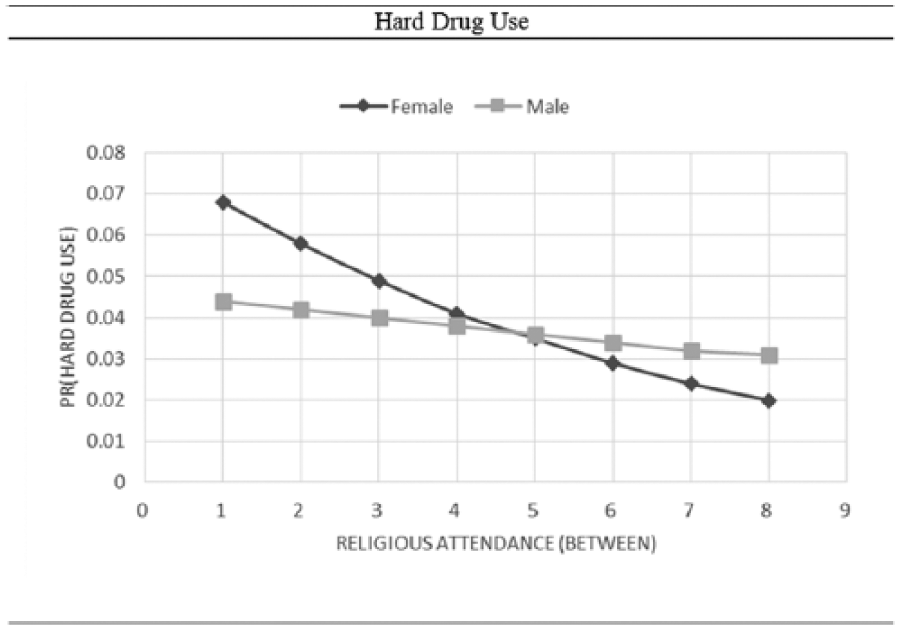
Predictive margins of sex.
Finally, Table 5 reports the findings for the race/ethnicity interactions. There are no significant interaction effects for hard drug use. The significant negative interactions for alcohol and marijuana use suggest that religious involvement has a stronger relationship with the use of these substances among Whites than non-Whites. Again, predictive margins can further explain the nuances of these interactions. As seen in Figure 3, changes in Religious Attendance (within) are associated with reductions in the likelihood of alcohol use slightly more for Whites than non-Whites. Whites and non-Whites have fairly similar probabilities of alcohol use when they increase their levels of religious involvement but have significantly different probabilities of alcohol use when they decrease their levels of religious involvement over time. In the latter circumstance, Whites have higher probabilities of alcohol use than non-Whites. Unlike alcohol use, within-individual changes in religious attendance have a relatively similar relationship with marijuana use and hard drug use among Whites and non-Whites.
Random-Effects Logistic Regression Estimates With Race/Ethnicity Interactions.

Note. There are 63,148 person-waves nested within 6,787 individuals for each of the models. All models reported include controls for the time-variant and time-invariant variables noted in Table 1. b = unstandardized coefficient.
p ≤ .05. **p ≤ .01. ***p ≤ .001 (two-tailed).
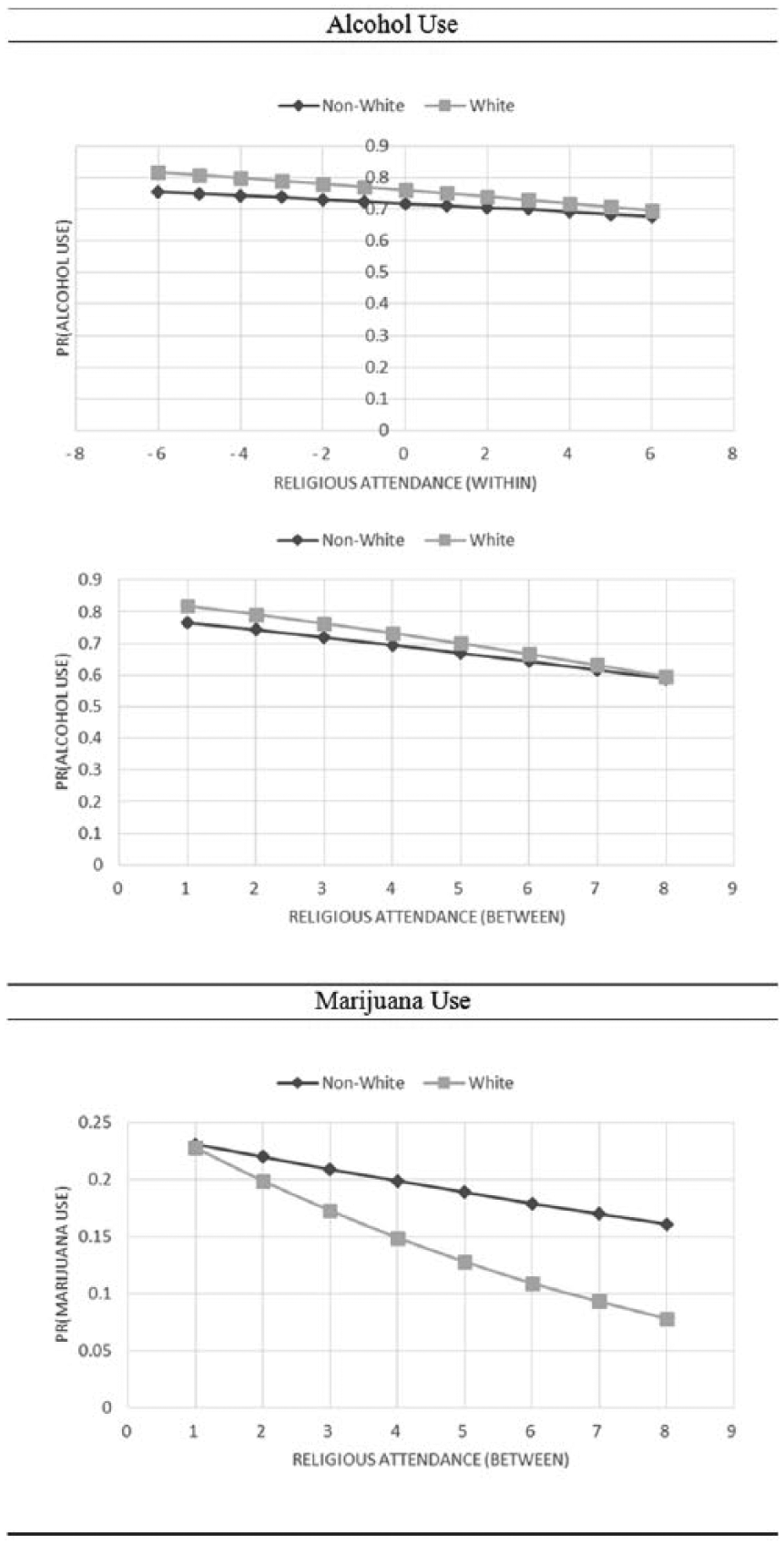
Predictive margins of race/ethnicity.
The interactions of Religious Attendance (between) and race/ethnicity are significant for alcohol and marijuana use as well, suggesting again that attending more religious services, on average, is negatively associated with alcohol and marijuana use more so among Whites than non-Whites. The predictive margins in Figure 3 demonstrate that there are slightly greater reductions in the likelihood of alcohol use among Whites with higher average religious involvement throughout the waves than non-Whites with higher average religious involvement. The plot shows larger differences in probabilities of alcohol use at lower average levels of religious involvement, with Whites having a higher probability of alcohol use at these lower levels than non-Whites. Figure 3 also confirms the interaction term results suggesting that Religious Attendance (between) is associated with marijuana use more so for Whites than non-Whites. Unlike alcohol use, the predictive margins plot demonstrates similar probabilities in marijuana use between Whites and non-Whites with lower average levels of religious attendance over time, and significantly greater probabilities of marijuana use among non-Whites than Whites at higher average levels of religious attendance. Ultimately, Whites are benefiting more so than non-Whites from higher average levels of religious attendance when it comes to alcohol and marijuana use but have similar benefits when it comes to hard drug use.
It should be recognized that the dependent variable represents at least one instance since the date of last interview in which the respondent used a particular substance. For alcohol use, drinking one drink or more after the age of 21 can be fairly normative in certain social circles. As noted earlier, we adopted the dichotomous versions of the dependent variables to align with the same time frame as the independent variables. The frequency measures only apply to the last 30 days, as opposed to the past year. Even still, the models were reanalyzed using the frequency measures. The results are substantively similar, except there are a few inconsistencies in the interactions tested worth noting. The age interaction term loses significance for marijuana use. There is also some evidence to suggest females and non-Whites benefit more from religious attendance in reducing alcohol use.
Also, the analyses presented are based on a single item measure of religious attendance. We recognize this measure only captures a small part of the complex, multidimensional concept of religious involvement. Unfortunately, additional measures of religiosity were only available in four of the waves (2002, 2005, 2008, and 2011). Supplementary analyses were conducted using these waves, although this represents a selective sample and captures change across longer time intervals. Religiosity is measured by an index composed of true/false questions asking respondents about the role of religion and God in their lives, with higher values indicating greater commitment to religious values. These questions included (a) respondent does not need religion for good values (reverse coded), (b) respondent believes religious teachings are to be obeyed exactly as written, (c) respondent asks God for help in making decisions, (d) God has nothing to do with what happens to respondent (reverse coded), and (e) respondent prays more than once a day. Religiosity remains an important factor in decreasing substance use, but there are a few inconsistencies worth noting. The results demonstrated that within-individual changes in religiosity were no longer significantly related to hard drug use. The relationship between changes in religiosity and use of each of the substances did not vary by age. While Whites still benefited more from religiosity in terms of limiting alcohol and marijuana use, non-Whites seemed to benefit more from religiosity in terms of limiting hard drug use.
Discussion and Conclusion
Extending the existing research, the present study examined the relationship between religious involvement and substance use in emerging adulthood using 11 waves of the NLSY97 data. Specifically, we focused on whether the bond to religious institutions, in the form of increased involvement in church services, both on average and within-individuals, is related to the likelihood of substance use over time. On average, those respondents who attended more religious services throughout the waves studied were less likely to use the three substances. In addition, individual increases in religious involvement over the waves was related to decreased odds of substance use, whereas decreases in religious involvement was related to increased odds of substance use. These findings are consistent with the existing literature (Desmond et al., 2010; Jang & Johnson, 2001; Ulmer et al., 2012) and suggest that religion can serve as an informal social control over time. However, there are some variations, or lack of variations, across substance, age, sex, and race/ethnicity worth noting.
Religious involvement appeared to be quite effective in reducing the likelihood of all three of the substances considered, such that the association between religious involvement, both between- and within-individuals, and the use of alcohol, marijuana, and hard drugs was consistently significant and negative. Prior longitudinal research has shown a similar connection between religious behavior and these substances (Chu, 2007; Desmond et al., 2010; Hill & Pollock, 2015). A further look at the odds ratios indicates that religious involvement is related to a decrease in the odds of hard drug use at a smaller percentage than alcohol and marijuana use, but unfortunately, we cannot speak to the statistical significance of this substantive difference. It is possible the role of religion as an agent of social control may be more salient when few other constraining societal influences are at work. Therefore, the strongest influences on discouraging hard drug use can come more from family, school, community, and social factors other than religious involvement. In this study, we found, for instance, that marriage, cohabitation, and arrest status had a stronger association with hard drug use than religion. Also, this finding aligns with the antiasceticism hypothesis, suggesting that the relationship between religious involvement and deviant activities is greater for those substances explicitly proscribed by religious norms, like alcohol and marijuana, but weaker among those condemned by secular norms (e.g., Jensen & Erickson, 1979; McLuckie, Zahn, & Wilson, 1975; Middleton & Putney 1962).
Our study supported some age-varying effects of religious attendance on substance use, showing that the link between religious involvement and alcohol and marijuana use, in particular, is slightly weaker as individuals age into adulthood. This finding is consistent with some prior work that identifies a weaker effect of religion on alcohol and marijuana use at later ages (Button et al., 2010; Jang & Johnson, 2001). It may be explained by the nature of religious attendance at different periods of the life course. Specifically, adolescents or young adults often participate in religious activities because of parental coercion, as opposed to their own willingness (Rhodes & Reiss, 1970). Nevertheless, spending time with family and friends involved in religious activities may serve to provide a control and influence over their behavior, which to a certain extent reduces the use of substances at these younger ages (Button et al., 2010; Evans et al., 1996). As adolescents make the transition to young adulthood, parental influences begin to attenuate, presumably because of the increased behavioral autonomy and independence achieved by young adults (Arnett & Jensen, 2002). At these later ages, then, religious attendance may have less of a control orientation on these status offenses (Button et al., 2010) than other social factors.
Females in the current study had higher levels of religious attendance than males, which is consistent with previous research (Donelson, 1999; Ozorak, 1996; Smith & Denton, 2009). However, we found minimal evidence of variation across sex, with only the between-individual association of religious involvement and substance use stronger for females than for males in discouraging hard drug use. The relative lack of variation is consistent within a social control perspective where similar effects are anticipated across groups. The results also revealed that compared with Whites, non-Whites demonstrate a greater frequency of attendance at religious services. Although attendance at religious services was more prevalent among non-Whites, religious involvement was related to a decrease in the likelihood of alcohol and marijuana use more so for Whites than non-Whites. These results replicate the findings of past research (Amey et al., 1996; Ellison, Trinitapoli, Anderson, & Johnson, 2007; Wallace et al., 2003; Wallace et al., 2007) but do not support theoretical propositions suggesting a greater significance of religion among Blacks (Johnson et al., 2000). Ultimately, though, there was minimal variation across sex and race/ethnicity, suggesting religious attendance has a similar impact on individuals despite demographic characteristics.
Although the findings extend previous research in many ways, there are several limitations worth noting. Prior research adopting a social learning framework highlights the relevance of peer associations as a mediator between religion and substance use, such that religion often fosters prosocial peer arrangements that protect adolescents and young adults from deviance (Hoffmann, 2014; Jang et al., 2008; Thomson, 2016). Unfortunately, peer delinquency was only captured in the first wave of the study. In keeping with the longitudinal focus, we were unable to adapt this social learning approach to consider the role of changing peer influences as it relates to religion and substance use. In addition, a measure of self-control was unavailable in the data. Evidence has supported the mediating role of self-control, in which less religious involvement is related to lower self-control, and in turn is associated with higher involvement in substance use (Desmond, Ulmer, & Bader, 2013; Walker, Ainette, Wills, & Mendoza, 2007). It is possible the effect of religious attendance may be more salient in the current analyses due to the inability to account for self-control.
Furthermore, although this study is conducted within a longitudinal design, it emphasizes the contemporaneous effects of religious involvement on substance use at each time point. This study is limited in its ability to make a causal inference regarding the effect of religious involvement on substance use. Recent studies highlight important reciprocal effects and the necessity of considering reverse causality, or the impact of substance use on religious involvement (Hoffmann, 2014; Miller & Vuolo, 2018). Unfortunately, these studies only rely on a few waves of data. Future research is needed to explore the direction of the effect of religious involvement on substance use over a more expansive time period. Finally, although random effects models can capture within-individual effects of religious involvement over one’s life course, the approach assumes that individuals within the population follow the same general pattern of religious development (e.g., a general pattern of decrease or increase in religious involvement), which often overlooks groups of individuals who may have distinct patterns of religious changes. Studies of the development of religious involvement have shown that there is typically a great deal of variability in individual-level trajectories, such that for some individuals religious involvement remains stable or increases at the beginning of the life course but declines later (Koenig et al., 2008; Pearce & Denton, 2011; Regnerus & Uecker, 2006; Willits & Crider, 1989). Therefore, the relationship between changes in religious involvement and substance use may be brought into greater clarity by studying discrete courses of religious development within a given population.
Despite these limitations, the study consistently demonstrates the importance of religious involvement in reducing substance use despite race/ethnicity and sex, and that even increases in religious attendance over time can be beneficial. The findings align with faith-based initiatives that focus on reducing risky behavior by increasing religious involvement, especially among adolescents (Steinman et al., 2008). It seems that encouraging greater participation at religious services is a promising strategy for adolescent substance use prevention, especially with regard to alcohol and marijuana use. However, it is not clear what forms of encouragement would be most effective, such as congregational outreach programs, parental insistence, or even youth group initiatives. Also, the protective effects of religious attendance on alcohol and marijuana use may decline as individuals age into adulthood. Practitioners working with faith-based organizations on substance use prevention might anticipate greater success in delaying heavy substance use among adolescents/young adults than adults. In other words, religious intervention at these younger ages may be more effective. It is also possible that faith-based efforts predominantly benefit females and Whites, although there was some evidence to suggest equal benefits across sex and race/ethnicity. Still, further research is needed exploring the appropriate mechanisms for increasing involvement, as well as additional aspects of religious involvement that would be most relevant to preventing deviant and risky behavior among certain subgroups.
Footnotes
Declaration of Conflicting Interests
The author(s) declared no potential conflicts of interest with respect to the research, authorship, and/or publication of this article.
Funding
The author(s) received no financial support for the research, authorship, and/or publication of this article.
