




Abstract
This study used data from the Multicultural Adolescents Panel Study (MAPS) to apply propositions found in target congruence theory (TCT) to self-reported bullying victimization experienced by multicultural family youth living in South Korea. Results from a sample of 1,443 multicultural family youth show that indicators of target vulnerability (e.g., depression and acculturative stress) and target antagonism (e.g., Korean ability and perceptions toward South Korea) significantly predict school bullying victimization in the theoretically expected directions. Directly, our results highlight the importance of considering variables specific to children with multicultural backgrounds when developing anti-bullying campaigns. Broadly, our results suggest that propositions outlined in TCT may be useful when implementing programs intended to prevent victimization.
Introduction
Criminologists have started to become more interested in exploring the relationship between immigration/multiculturalism and victimization (Choi et al., 2020; Jiang & Peterson, 2012; Koo et al., 2012b; Peguero, 2009, 2013; Sulkowski et al., 2014). However, most studies on peer victimization among immigrant/multicultural adolescents have been conducted in the context of the United States (U.S.), and scholars have reported conflicting findings regarding the link between victimization and immigrant/multicultural status (Forster et al., 2013; Jiang & Peterson, 2012; Koo et al., 2012b; Peguero, 2009, 2013; Sulkowski et al., 2014; Zavala & Peguero, 2019; Zavala & Whitney, 2019). While this research is important, the victimization experiences of multicultural persons living in other parts of the world has been relatively underexplored. Further, the U.S. is considered to be a “melting pot,” with foreign-born immigrants accounting for approximately 13.7% (about 44.8 million) of the U.S. population (Budiman, 2020) and U.S.-born children of immigrants (second-generation Americans) representing approximately 12% of the U.S. population (Budiman et al., 2020). In other words, in terms of diversity, the U.S. fosters a unique heterogeneous setting compared to other countries.
Recently, researchers have begun to explore the victimization experiences of multicultural persons living in more ethnically homogenous countries (Choi et al., 2020), such as South Korea, where the number of multicultural adolescents—defined as adolescents between the age of 9 and 24 from multiethnic marriage between a native-born South Korean and a person of other lineage or those who are born to foreign ethnic migrants who have obtained Korean nationality following the Nationality Act—represent about 1.9% of the entire adolesecent population in South Korea (Joung & Chung, 2020). 1 Of particular importance to this study is the work of Choi et al. (2020), who applied Target Congruence Theory (TCT) to serious violent victimization experiences of youth living in South Korea. Their work found children with multicultural backgrounds to be at a higher odds of victimization than children of native-born South Koreans, and that certain mechanisms of target congruence, such as target vulnerability (i.e., depression and perceived stress) and target gratifiability (i.e., sex and economic status) could help explain differences in victimization experiences. While their work made an important contribution to the extant literature in this area, it suffered from serious methodological limitations related to operationalization and measurement error (see below) that make findings presented by the authors difficult to interpret. Thus, the goal of the current project was to help extend this line of inquiry and build on the work of Choi et al. (2020) by using TCT to explore the predictors of self-reported bullying victimization unique to multicultural children living in South Korea (N = 1,443) in an attempt to see what, if any, variables defined by the theory make multicultural youth attractive to potential offenders.
Literature Review
Target Congruence Theory
Target Congruence Theory (TCT) is a theoretical perspective that can be used to explain disproportionate victimization experiences, especially among children with multicultural backgrounds (Zavala & Whitney, 2019). An extension of lifestyle-routine activities theory (LRAT; Cohen & Felson, 1979; Hindelang et al., 1978), TCT focuses on individual characteristics and attributes of individuals that increase their risk for victimization through three key concepts: (1) target vulnerability, (2) target gratifiability, and (3) target antagonism (Finkelhor & Asdigian, 1996). Target vulnerability refers to a person being at an increased risk for victimization due to an individual characteristic or state of mind, resulting in offenders perceiving them as unable to adequately defend themselves or their possessions, such as being physically weak or intoxicated. Target gratifiability refers to certain persons being at an elevated risk for victimization due to personal possessions or attributes seen as desirable to potential offenders. These possessions, or attributes, include, but are not limited to, material objects, power, and social status that a potential offender desires to manipulate or own. Target antagonism refers to an individual being at a heightened risk for victimization due to possession of a characteristic or attribute (e.g., minority status) that triggers negative emotions, such as anger, jealousy, or resentment, in potential offenders. Essentially, target congruence is the process through which offenders can be drawn to certain types of victims (Sween & Reyns, 2017). The theory assumes that offenders, typically, target those who have triggered a negative emotion or who have something that the offender desires and are perceived as unable to defend themselves adequately.
TCT has started to receive empirical attention. In one of the first tests of TCT, Finkelhor and Asdigian (1996) examined the relationship between the three concepts outlined in TCT and an adolescent’s risk for sexual assault, parental assault, and nonfamily assault, while controlling for measures of exposure and proximity defined in LRAT. They found that the measures of TCT independently increased a child’s risk for all three types of victimization considered. Similarly, researchers have applied propositions outlined in TCT to intimate partner violence victimization (IPV). Specifically, using data collected from more than 74,000 college students from 129 universities located across the United States, Elvey and McNeeley (2019) found measures of target antagonism (e.g., sexual orientation), target gratifiability (e.g., sex), and target vulnerability (e.g., psychological distress and GPA) to be significantly associated with increased risk of physical and sexual IPV. Their work helps to confirm previous findings suggesting measures of target gratifiability (Sween & Reyns, 2017; Zavala, 2020) and target vulnerability (Zavala, 2020) to be significantly and positively related to an individual’s risk of IPV. Relatedly, the concepts defined in TCT have also been found to be linked to sexual assault (Elvey, 2016; Livingston et al., 2007; Tyler & Beal, 2010), bullying (Kahle & Peguero, 2017), school-based violent and property victimization (Augustine et al., 2002), and prison assault victimization (Wooldredge & Steiner, 2013).
More recently, Choi et al. (2020) applied TCT to the victimization experiences of children living in South Korea to explore the relationship between ethnicity and victimization. Using students’ self-reported lineage as a measure of target antagonism, the researchers found that students with multicultural backgrounds were at an elevated risk of serious violent victimization requiring hospitalization. They also found measures of target vulnerability (i.e., depression and perceived stress) and target gratifiability (i.e., sex and economic status) to be significantly and positively related to odds that a child reported a violent victimization experience that required hospitalization in the previous year, controlling for relevant predictors of victimization (e.g., deviant lifestyle, age, city size). Although their work has helped to pioneer research in this area, their study is limited in several ways. Notably, their work focused on differences in victimization rates between children of ethnic minorities and children of native-born persons living in South Korea. That is, they used multicultural background as a measure of target antagonism rather than exploring tenets of TCT within a sample of multicultural youth. Second, the relationship between offenders and victims in their dependent measure (i.e., violent victimization) was unclear. Accordingly, there is a need for more work in this area before comprehensive conclusions can be drawn pertaining to the relationship between concepts defined in TCT and victimization experiences of multicultural persons.
Target Congruence and Multicultural Backgrounds
Two of the concepts defined in TCT, target vulnerability and target antagonism, can be particularly useful for understanding the victimization experiences of multicultural family adolescents living in South Korea. Regarding target vulnerability, children of multicultural families experience mental health problems, such as depression, at higher rates than native-born children (Chun & Chung, 2011; Lee et al., 2019). In the context of South Korea, prior research has found the prevalence and severity of these conditions to be higher in youth with multicultural backgrounds than in youth with native familial lineage (Kim & Kim, 2011). A great deal of empirical research conducted in South Korea has established a link between having a multicultural background and internalizing problems, such as depression (Cho, 2016; Choi, 2012; Kang & Kim, 2013; Kim & Hong, 2017; Song et al., 2020). Notably, research has found youth with multicultural backgrounds in South Korea often report discrimination and social rejection by friends, teachers, family members, and strangers, and this social discrimination is further linked to depressive moods, anxiety, or social withdrawal (Kim & Hong, 2017; Park et al., 2016; Song & Park, 2018). Additionally, the cultural adjustment that children of multicultural families go through presents a challenge to their mental health. Many youths with multicultural backgrounds feel that they are marginalized by both Korean culture and the culture of their foreign parents, resulting in internalizing problems, such as depression (Jiang & Bae, 2018; Song et al., 2020).
Previous studies have shown that children with depression are more likely to experience victimization by their peers than those without depression (Krygsman & Vaillancourt, 2017; Sweeting et al., 2006; Troy & Sroufe, 1987). Researchers have outlined three justifications for why this is: First, depressed youth are more likely to exhibit social deficits that may provoke their peers’ dislike (Kochel et al., 2012). Second, depressed youth may be perceived as vulnerable targets because of the behavioral cues associated with depression, including withdrawal, passivity, and fear (Krygsman & Vaillancourt, 2017; Troy & Sroufe, 1987). Third, depression is often adversely associated with interpersonal and social functions that can help resolve relationship difficulties effectively (Chen et al., 2020; Kochel et al., 2012). In short, depression can influence the risk of peer victimization because of its impact on peer relations and behaviors observed by other peers. Depression as an antecedent to victimization has also been documented in the literature on target congruence theory (Zavala, 2020; Zavala & Whitney, 2019). As such, it is reasonable to assume that these youth may be at a greater risk for victimization due to perceptions of greater vulnerability by potential offenders. Prior research has helped to confirm this stipulation by showing that South Korean children with greater stress and depressive symptoms are at higher odds of victimization (Choi et al., 2020).
Some multicultural youth living in South Korea may also be at an increased risk for victimization through acculturation and academic maladjustment. Acculturation refers to the process of cultural and psychological change that ensues when individuals from one culture move to a different and unfamiliar culture (Sam & Berry, 2010). South Korea has traditionally been a homogenous society, with many nationals pushing for Danil Minjok—or a “one-blood, one-language, and one-culture” society (Kim, 2010; Moon, 2010; Watson et al., 2011). Multiculturalism may be seen by many “traditionalists” as a direct threat to Danil Minjok, and thus a threat to South Korean culture. As such, multicultural persons who have difficulties in cultural adjustments, and continue to conform to their own cultural beliefs, may be met with resistance at the hands of native-born South Koreans. Prior research provides support for this assumption by showing an inverse relationship between acculturative stress—a proxy measure for acculturation—and various types of victimization (Forster et al., 2013). Moreover, South Korean culture is one that emphasizes academic success—and a person’s perceived social “worth” is, perceived by some as being partially a product of their educational success (Garrison et al., 2017). Empirical studies using samples of Korean youth support the relationship between academic performance and peer victimization (Schwartz et al., 2002; Yang et al., 2013). For example, Yang et al. (2013) analyzed data from a sample of 1,344 Korean youth and found that children with poor academic performance were more likely to be targets of bullying than those with higher academic performance. The relationship between academic performance and peer victimization observed among children of native-born South Koreans can be applied to children with multicultural backgrounds. Many multicultural family adolescents in South Korea report difficulties adjusting to the South Korean educational structure and the culture that values excessive competition in educational institutions (Lee, 2018; Yoon et al., 2017). Thus, their performance in South Korean classrooms can be, and often is, less than that of native-born youth. Indeed, prior research has suggested a potential relationship between immigration status and academic maladjustment (Farley & Alba, 2002; Kao et al., 2013; Portes & Rumbaut, 2001). As such, multicultural youth who “underperform” in the classroom can be seen as less socially desirable by traditional South Korean nationalists than those who have achieved greater success in the classroom and subsequently, subjected to bullying because of their perceived lack of social worth.
Some multicultural children living in South Korea may also be at an increased risk for victimization through target antagonism. As noted above, prior research has used multicultural status as a measure of “target antagonism” and found multicultural children living in South Korea to be at a higher odds of victimization than native-born children (Choi et al., 2020). While multicultural status is an acceptable measure of target antagonism, a better measure would be one that is consistent across a person’s innate status, as multicultural status alone can be “visible” (in appearance or dialect) or invisible. In short, just because one comes from a multicultural background does not necessarily mean that that status will be known in social interactions, nor does it mean that it will automatically—and alone—instill negative feelings. Theoretically, a better measure of target antagonism related to multicultural status is one that captures a visible (known) attribute or characteristic that can instill negative feelings in social interactions, such as Korean language fluency. Children from multicultural backgrounds may experience greater difficulties in speaking, writing, and interpreting Korean in social interactions. As language can be seen as a measure of cultural distance (Berry et al., 2006), this language barrier may arouse anger or jealousy among other South Korean adolescents who view multicultural persons as “outsiders.” 2 Thus, language fluency related to the cultural background may place multicultural children at a higher risk of victimization than native-born South Koreans. However, the relationships between these variables and bullying victimization among multicultural family youth have not yet been tested.
Bullying in South Korea
The primary outcome of interest in this study was bullying victimization. Bullying, defined as the intentional and continual use of direct or indirect social mechanisms to harm others (Payne & Hutzell, 2017), has been a long-standing problem for youth worldwide (Olweus, 1993; Payne & Hutzell, 2017). Direct bullying acts include hitting, pushing, biting, and name-calling (Farrington & Ttofi, 2009). Indirect bullying, typically, involves intentional and repeated acts of harassment in which the victim is not directly present, such as rumor spreading (Greeff & Grobler, 2008). Bullying is a severe problem faced by youth living in South Korea (Choi & Kruis, 2019; Jang et al., 2014). This is partly a product of the structure of the South Korean educational system that requires students to be in school for 12 or more hours per day (Shim, 2015) and exceptionally high rates of internet use among adolescents living in South Korea (Heo et al., 2014). Because of these cultural realities, youth living in this part of the world are placed in situations where there is a great opportunity for them to become the victims of bullying—both at school or in school-related functions, and through the internet (i.e., cyberbullying). Thus, it should come as no surprise that youth living in this region report high bullying victimization rates, with nearly a quarter of youth reporting being the victims of bullying in the previous 6 months (Yun & Kim, 2016). Thus, given the prevalence of bullying victimization experienced by youth, immigration patterns, and unique cultural structure, South Korea provides good context to use TCT to explore multicultural family adolescents’ victimization experiences. As such, the following explains our attempt to do so.
Current Study
The present study examined the validity of TCT by applying it to bullying victimization reported by multicultural family adolescents living in South Korea. In many ways, our study is an extension of Choi et al.’s (2020) work by providing a comprehensive test of TCT and further investigating the variables that make multicultural children susceptible to disproportionate victimization indicated in that study. While most studies on the victimization of immigrant family adolescents have been conducted within the context of Western societies characterized by individualism, little is known regarding the patterns of victimization among multicultural family adolescents in a society marked by strong collectivism (Chang & Wallace, 2016). We speculate that multicultural family adolescents may be exposed to greater risk for bullying victimization due to the collectivist culture in South Korea that has historically viewed multicultural persons as “outsiders.” Our study extends and contributes to the literature by exploring the relationships between variables unique to multicultural family adolescents and their bullying victimization by peers. Specifically, the overarching research question guiding this project was: Are measures of target vulnerability, target gratifiability, and target antagonism associated with multicultural youth bullying victimization experiences?
Method
To examine our hypotheses, we used data from the Multicultural Adolescents Panel Study (MAPS), a longitudinal panel survey study of multicultural family adolescents collected by the National Youth Policy Institute (NYPI) in South Korea. In an effort to obtain a nationally representative of multicultural family adolescents who live in South Korea, participants for the MAPS were selected using a stratified sampling technique with probability estimates proportional to population representation. As a result, 1,625 multicultural households were selected across 16 cities and provinces in South Korea. In 2011, there was a total of 4,452 multicultural fourth-grade children in South Korea, and about 35% of them (n = 1,635) participated in the first survey. Trained interviewers surveyed multicultural fourth-grade children in elementary schools. The same subjects were followed and surveyed every year for 7 years, from 2011 to 2017. The questionnaires were available in 10 different languages (e.g., English, Chinese traditional, Vietnamese, and Russian). More information regarding recruitment procedures and a detailed description of the full sample may be found in the report by the National Youth Policy Institute (2013). We obtained approval from the NYPI to use the original dataset of the MAPS. No personally identifiable information was contained in the dataset provided by the NYPI. For purposes of the current study, we used the third wave of the MAPS because this particular wave contained all the variables needed to explore the relationship between target congruence theory (e.g., depression) and bullying victimization experiences. Thus, our final sample consisted of 1,443 multicultural family children aged 12 years old who participated in the third wave of MAPS.
Measures
Dependent variable
The dependent variable of interest for this study was bullying victimization. Bullying victimization was measured using six items. Participants were asked to rate the frequency with which they experienced bullying victimization by other students in the past year. Specifically, participants were asked how frequently they were: (a) treated as an outcast, (b) severely teased and bantered, (c) purposefully left out of activities, (d) beaten and threatened, (e) had rumors and lies being spread about them, and (f) were made fun or ridiculed for their appearance. 3 Responses followed a four-point Likert scale: 1 = never, 2 = once or twice a month, 3 = once or twice a week, and 4 = almost every day. Each item was dichotomized to signify whether the multicultural family adolescent ever experienced a specific type of victimization. Then, all items were summed and dichotomized to create a comprehensive measure indicating whether the respondent ever experienced any type of bullying victimization in the previous year.
Independent variables
Target vulnerability was the first measure of TCT considered. Target vulnerability concerns features of potential victims that can diminish their ability to resist or deter victimization, making them more attractive targets for offenders to exploit (Finkelhor & Asdigian, 1996). In this study, target vulnerability was measured using three concepts: depression, acculturative stress, and academic maladjustment. The ten items for depression symptoms were developed and validated by Kim et al. (1992). Respondents were asked to think back on their last 12 months and rate their level of agreement with the following statements: (a) I do not have much energy, (b) I feel unhappy or sad and depressed, (c) I have many worries, (d) I want to die, (e) I cry frequently, (f) I often think that something is wrong because of me, (g) I feel lonely, (h) I am not interested in everything, (i) I do not think the future is hopeful, and (j) I have a hard time. Response options ranged from 1 = “strongly disagree” to 4 = “strongly agree.” Items were summed and averaged to create a scale measure capturing respondents’ level of depression (α = .92). Acculturative stress was measured using ten items adapted from the instruments developed by Hovey and King (1996). The scale was designed to capture acculturative stress across various domains, as well as perceived discrimination and majority group stereotypes against multicultural families. Three examples of measures included the following: (1) I feel uncomfortable when others make jokes about the culture of my foreign parent’s country, (2) I am stressed out when people ask me to act like a Korean, and (3) I am ignored because my parent is a foreigner. Response options range from 1 = “strongly disagree” to 4 = “strongly agree.” Items were summed and averaged to create a scale measure capturing respondents’ self-reported acculturative stress (α = .78). Academic maladjustment was measured using four items: (1) I enjoy my classes, (2) I do not miss any school assignments, (3) I remember what I have learned from my classes, and (4) I ask questions when I do not understand something (e.g., teachers). Responses also followed a 4-point Likert scale ranging from 1 = “strongly disagree” to 4 = “strongly agree.” All items were recoded, summed, and averaged to create a scale measure of academic maladjustment with higher numbers indicative of greater maladjustment (α = .78).
Target gratifibility was the second measure of TCT considered. As noted above, target gratifability concerns a quality, skill, or attribute that potential offenders want to use, access, or control (Finkelhor & Asdigian, 1996). Consistent with prior literature (see., Choi et al., 2020), we used sex as a measure of target gratifailbity, as “maleness” can be seen as more threatening to South Korean culture by nationalists, and it has historically been more appropriate for nationals to target males than females. In many ways, these nationalists seek to “control” males from gaining social, political, and economic power because they perceive them as the more dominant sex, and the one that is more willing and capable of disrupting their ethnically homogenous culture. Indeed, prior research has found “maleness,” or masculinity, of minorities and immigrants to be associated with perceptions of symbolic threats (i.e., threats to one’s values, beliefs, and worldviews) and social dominance orientation (i.e., favoring “in-group” dominance over “out-groups”) (Bollwerk et al., 2020; Connell, 1995; Herz, 2019). As such, we would anticipate those who support Korean nationalism to target multicultural males more than females. Sex was coded as 0 = “girl,” 1 = “boy.”
The third and final measure of TCT considered was target antagonism. Target antagonism concerns characteristics that may arouse negative emotions, such as jealousy, anger, or hostility in potential offenders. We used two measures specific to multicultural backgrounds that may trigger potential offenders’ negative reactions: Korean language ability and perceptions of South Korea. Korean language ability was measured using four items designed to assess participants’ self-perceived Korean language fluency in speaking, writing, reading, and listening. The response options ranged from 1 = “not good at all” to 4 = “very good.” We recoded these responses, summed them, and averaged the total to create a scale measure of “Korean ability” with higher scores indicative of lower levels of Korean language fluency (α = .95). Perceptions of South Korea capture respondents’ identifiability with South Korean culture. This scale was adopted from Seong (2001) and modified specifically for multicultural family youth. Items included: (1) When someone compliments about Korea, I feel complimented, (2) I am very interested in how foreigners think about Korea, (3) The success of Korea is my success, and (4) I feel upset when someone talks bad about Korea. Response options range from 1 = “strongly disagree” to 4 = “strongly agree.” Responses were recoded, summed, and averaged to create a scale measure with higher scores reflective of lower levels of identity as a South Korean (α = .86).
Covariates for this current study included parental education level and involvement in delinquency. 4 For parents’ education level, a mean of both parents’ education attainment was used. Responses included five choices ranging from “less than middle school” up to “attendance in graduate school.” Delinquency was measured using a 10-item index. Specifically, participants were asked if they had engaged in the following ten delinquent behaviors during the past year: (1) smoking, (2) drinking, (3) running away, (4) unexcused absence, (5) using an adult website, (6) stealing, (7) assault, (8) robbing, (9) joining a violent circle, and (10) group fighting. The response options were 0 = “no,” 1 = “yes.” We summated the responses to create a delinquency index. Methodologically, variety indexes, such as this one, are more likely to exhibit stronger convergent validity and be stable across time (Bendixen et al., 2003; Hindelang et al., 1981), and researchers have noted that variety indexes are more suitable for capturing a general propensity to engage in criminal behavior (Wright et al., 2001). We did not compute the Cronbach’s alpha because this reliability estimation is not appropriate for an index measure.
Analytical techniques
Our data analysis proceeded in three key stages. First, we conducted univariate analyses to describe the characteristics of the overall sample. Second, we used bivariate analyses to examine the strength and direction of the relationships between variables of interest. Finally, we estimated a series of logistic regression models to examine the relationships between elements of target congruence theory and bullying victimization. Missing data were observed only from parents’ education level, but they were minimal (<5%; n = 68 out of 1443).
Results
Table 1 presents sample information and descriptive statistics for the variables used in this study. Of the 1,443 participants, 48.9% of the participants were boys, and 51.1% were girls. About 14.62% of the respondents reported that bullying victimization at the hands of other students in the previous year. The mean score for depression was 1.607 (SD = 0.526, range 1–4), and acculturative stress was 1.457 (SD = 0.371, range 1–4). Participants reported mean scores of 2.015 (SD = 0.535, range 1–4) for academic maladjustment, 1.341 (SD = 0.491, range 1–4) for Korean ability, 2.208 (SD = 0.639, range 1–4) for perceptions of South Korea. The average parental education level was 2.252 (SD = 0.753, range 1–5), and the mean score of the delinquency variety index was 0.151 (SD = 0.499, range 0–10).
Study Sample Descriptive Statistics (n = 1,443).
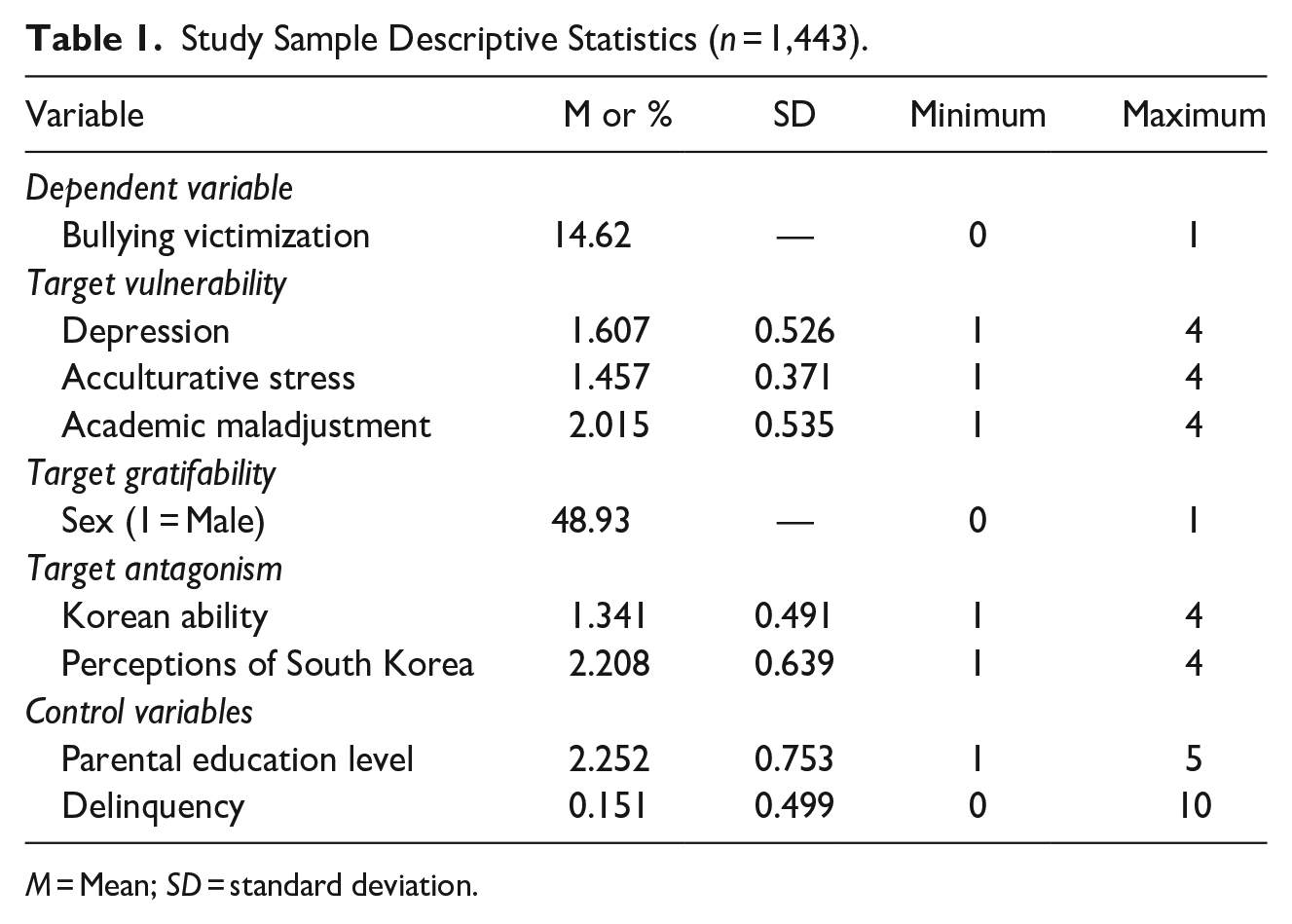
M = Mean; SD = standard deviation.
Table 2 shows the results from bivariate correlation analyses among the variables used in the current study. Many variables derived from target congruence theory were positively and significantly associated with bullying victimization, as predicted. Notably, depression (r = .316, p < .05), acculturative stress (r = .234, p < .05), academic maladjustment (r = .206, p < .05), Korean ability (r = .146, p < .05) and perceptions of South Korea (r = .113, p < .05), were all significantly and positively correlated with bullying victimization. These findings suggest that as target vulnerability increased, so too did the risk for bullying victimization. They also show that an increase in target antagonism is associated with bullying victimization at the bivariate level. Of all our measures of TCT, only target gratifability (i.e., sex) was not significantly related to bullying victimization. We also examined the tolerance and VIF for each independent variable that was to be included in our logistic regression model. All variables indicated a value of less than 2, suggesting little concern over multicollinearity in multivariable modeling.
Correlation Matrix for Bullying Victimization, Target Congruence Variables, and Control Variables.
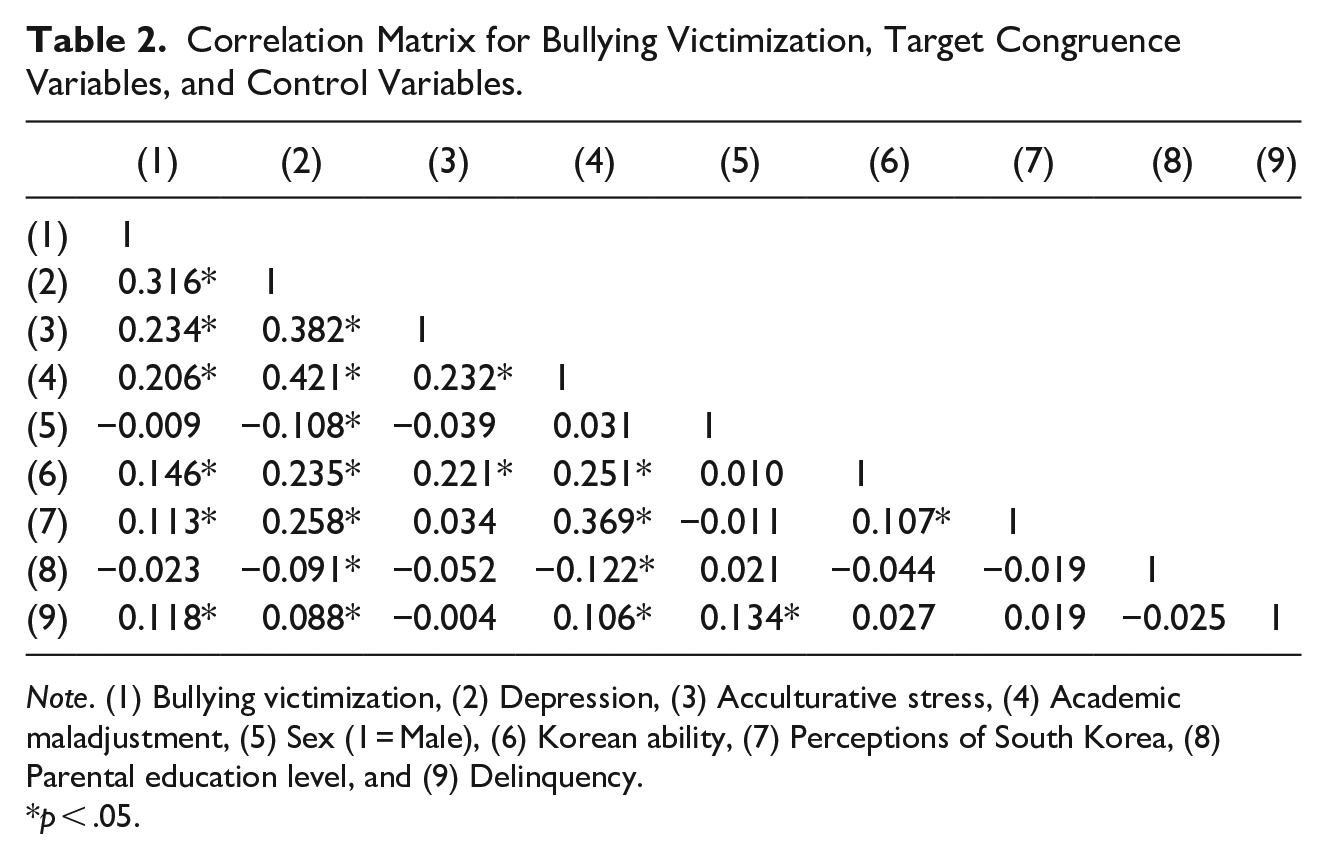
Note. (1) Bullying victimization, (2) Depression, (3) Acculturative stress, (4) Academic maladjustment, (5) Sex (1 = Male), (6) Korean ability, (7) Perceptions of South Korea, (8) Parental education level, and (9) Delinquency.
p < .05.
Table 3 presents the results from our logistic regression model predicting bullying victimization. The results indicated that, on average, those with higher levels of depression were more likely to experience bullying victimization compared to their counterparts. Notably, depression was the strongest predictor of bullying victimization in the model (OR = 3.225, p < .001). Relatedly, multicultural family adolescents who exhibited greater acculturative stress were exposed to heightened risks for bullying victimization than their peers with less acculturative stress (OR = 2.336, p < .001). Academic maladjustment was also significantly and positively associated with bullying victimization (OR = 1.499, p < .05). Regarding target antagonism, a low level of Korean ability was positively and significantly related to bullying victimization of multicultural family adolescents (OR = 1.390, p < .001). Surprisingly, perceptions of South Korea was not a significant predictor of bullying victimization, nor was sex. Finally, involvement in delinquency was predictive of a higher odds of bullying victimization (OR = 1.489, p < .01)—with results showing that youth who engaged in more delinquent acts, were more likely to be the victims of bullying than youth who reported engaging in less delinquency.
Logistic Regression Model Predicting Bullying Victimization.

Note. N = 1,375. SE = standard error; OR = Odds Ratio.
p < .05.
p < .01.
p < .001 (two-tailed tests).
Discussion
Informed by target congruence theory, the purpose of the current study was to help identify certain characteristics associated with bullying victimization among multicultural family adolescents in South Korea. Although a fair amount of research has been conducted with respect to minority adolescents in the U.S. (Jiang & Peterson, 2012; Koo et al., 2012b; Zavala & Whitney, 2019), considering its disproportionately high number of immigrants, the patterns of victimization observed in the U.S. may not be applicable to other environments where multiculturalism is still in its nascent stage (Choi et al., 2020). South Korea has historically been an ethnically homogenous country (Choi et al., 2019; Park et al., 2018), and multicultural family adolescents in South Korea may be exposed to greater discrimination and victimization compared to children living in other regions. Although one recent study by Choi et al. (2020) examined the victimization risk of students from multicultural backgrounds, this study was limited because it focused on variations in victimization between students from different ethnic backgrounds and could not specify the relationship between offenders and victims. Accordingly, an extension of that research, the current study addressed these issues and improved upon several limitations in previous research that has explored the factors associated with peer victimization among multicultural family adolescents. Specifically, we drew on data from a large sample of multicultural family adolescents in South Korea to test the efficacy of target congruence theory in explaining victimization experienced by other children among multicultural family adolescents. There are several findings that emerged from the current study that merit further discussion.
First, target vulnerability was found to be a very useful concept to understand the variations in victimization among multicultural family adolescents in South Korea. Depression was a key predictor of bullying victimization in our multivariable model. This finding is consistent with several of the previous studies that applied target congruence theory to other types of victimization (Choi et al., 2020; Elvey & McNeeley, 2019; Zavala, 2020; Zavala & Whitney, 2019). Further, this finding is critical, considering that a growing body of empirical research has reported that multicultural family adolescents may exhibit greater depression and psychological distress because of cultural differences and difficulties adjusting to new social norms (Park et al., 2018; Sirin et al., 2015). Accordingly, efforts need to be made to help prevent depression from manifesting and better monitor multicultural adolescents who exhibit psychological distress symptoms in interactions with other students, as they are at a higher odds of being victimized.
Another component of target vulnerability, acculturative stress, was also positively and significantly associated with the odds for bullying victimization—as target congruence theory would predict. Other scholars have focused on immigrant generational status when examining victimization among minority adolescents (Koo et al., 2012a; Peguero, 2009; Zavala & Whitney, 2019). Although immigrant generational status can serve as a proxy measure to evaluate the degree to which respondents are assimilated to mainstream culture, it does not effectively capture assimilation, as different persons can assimilate to mainstream society more easily than others (Portes & Rumbaut, 2001; Zhou, 1997). Generational status alone tells us little about cultural assimilation. Our self-reported measure of acculturative stress can help overcome this limitation by considering various types of acculturative strains in different life domains and perceived discrimination (Berry, 1997; Berry et al., 2006; Hovey & King, 1996). Those reporting less acculturative stress can be assumed to be more assimilated, as it captures whether a respondent identifies as a foreigner. Our results show that acculturative stress is positively and significantly related to the odds of bullying victimization by peers. This suggests that those who innately identify as a “foreigner” or who have a strong ethnic identity, are at a higher odds of victimization. We suggest that this finding shows that students who are less assimilated to South Korean culture experience higher rates of bullying victimization by other students—suggesting that prejudice against foreigners could result in disproportionate victimization experiences, and that one’s foreign status, or adherence to their ethnic identity, could place them at a higher odds of being victimized by other students in South Korea.
Related to this finding, when examining target antagonism, we found low levels of Korean language fluency were positively and significantly associated with bullying victimization. Target antagonism involves characteristics that evoke negative emotions, such as anger from potential offenders (Finkelhor & Asdigian, 1996). When multicultural family adolescents are not good at the Korean language, other Korean students may feel destructive impulses because they may be viewed as not one of them, inducing tribalism (Haidt, 2012; Pietraszewski et al., 2015). Despite its potential importance in the language fluency of the society, we know of no other study that has examined the relationship between language fluency and bullying victimization among immigrant youth. Indeed, our finding revealed that a lack of Korean language fluency can be a risk factor for bullying victimization among multicultural family adolescents. Together, these findings suggest that Danil Minjok may be as prevalent today as it was in the recent past.
Third, academic maladjustment was also predictive of a heightened risk of bullying victimization. Some researchers have considered school grade or school performance as proxy measures to tap the underlying psychological distress because low grade or school performance can be related to a low sense of achievement and competence (Elvey & McNeeley, 2019; Zavala & Whitney, 2019). We used the measure of academic maladjustment because multicultural family adolescents in South Korea often report that they are frustrated due to their difficulties in adjusting to the South Korean educational structure and the culture that values excessive competition in educational institutions (Lee, 2018; Yoon et al., 2017). Additionally, potential offenders may perceive multicultural family adolescents as attractive targets if they are not doing well in their schools because a poor academic adjustment in schools may render these potential victims as a less valued group by “traditional” South Korean standards. In line with TCT, those who had more difficulty in academic adjustment were more likely to experience bullying victimization by peers. As such, we speculate that efforts to increase academic performance levels of multicultural adolescents may, in turn, reduce victimization rates by increasing their perceived social “worth.”
Turning to the concept of target gratifiabilty, we found that sex was not significantly associated with bullying victimization by peers. This is an unexpected finding because much research has found that male students are more likely to report victimization compared to female students (Koo et al., 2012b; Popp & Peguero, 2012), and this sex disparity was observed in several empirical studies using Korean student samples (Choi et al., 2020; Han et al., 2008). This unexpected finding suggests that multicultural family adolescents could be exposed to a higher risk of bullying victimization independent of sex, and merely because of nationalists’ emphasis on Korean nationalism and purebred ethnicity (Moon, 2010; Watson et al., 2011). That is, we speculate that the effects of sex are non-significant because being a “male” may no longer be associated with perceptions of dominance, and subsequently, perceived “social threat” to traditional South Korean culture. Future research should examine this possibility. We recommend that reserachers include measures of “hyper-masculinity” to thoroughly explore this hypothesis, and use additional variables as estimates of target gratifiability to further examine the effects of sex, dominance, and social threat on victimization experiences.
Finally, involvement in delinquency was associated with a higher odds of bullying victimization. This relationship may be accounted for by a lifestyle-routine activities framework (Cohen & Felson, 1979; Hindelang et al., 1978). Those who were involved in risky lifestyles, namely delinquency, can be more exposed to the risk for violent victimization, and previous empirical research has provided strong support for this link (Choi et al., 2020; Choi & Wentling, 2021; Turanovic & Pratt, 2014). Taken together, our results provide a profile for multicultural family adolescents who are particularly vulnerable to bullying victimization by peers in the South Korean context (e.g., students who suffer from depression, those with high acculturative stress, youth who are having a hard time adjusting to school, those with low Korean language ability). These findings suggest that efforts to identify multicultural family students with these risk factors and develop school-based programs that tackle these specific issues may hold the potential to prevent bullying victimization among multicultural family adolescents. The Korean Ministry of Education, Science, and Technology has implemented a few major programs since 2012, such as the Korean as a Second Language program, transitory schools for multicultural family children to help them to become more familiarized with Korean culture, and more opportunities to learn foreign languages other than English (Cho, 2016). Although these efforts are critical in helping multicultural family adolescents to adapt to Korean society, other services, such as mental health services and educational assistance, can be provided for this student population. For example, a more rigorous assessment of mental health issues among multicultural family adolescents can be undertaken along with psychological services to prevent bullying victimization.
Additionally, if more research replicates our findings, it may be important for school administrators to incorporate attempts to disseminate information regarding a profile of multicultural family adolescents who may be particularly vulnerable to bullying victimization so that teachers, parents, and counselors can identify signs of various stress and offer help to these students. Although various evidence-based strategies have been discussed to reduce bullying victimization (Bradshaw et al., 2010; Gaffney et al., 2019), most of the attention has been centered on general student populations. Yet, it may be critical to consider the unique challenges and difficulties for students from multicultural family backgrounds to develop prevention and intervention efforts for bullying victimization not only because our study highlights that multicultural family adolescents exhibit unique risk factors for bullying victimization but also because this student population is rapidly growing in South Korea and other countries as well. Of course, the burden of preventing bullying victimization cannot be only placed on potential victims. More diversity-promoting policies can reduce prejudice and discrimination against this marginalized population. Instead of focusing on assimilation, it is important to pursue efforts to integrate multicultural family adolescents in our society by promoting the value of cultural diversity and acceptance of plural society (Berry, 1997).
Limitations
Although our findings address some important research needs that have been neglected with respect to bullying victimization, they are not without limitations. First, we did not consider the specific ethnic backgrounds of multicultural family adolescents in our model due to the data limitation. It has been well documented that there is significant in-group heterogeneity between different immigrant groups, which can influence their parenting styles and children’s development (MacPhee et al., 1996; Seo et al., 2018; Varela et al., 2004). Future research may identify significant differences within multicultural family adolescents by considering their immigrant parents’ national origins. Second, our findings have temporal ordering constraints as our dependent and independent measures were taken at the same time. For example, both depression and bullying victimization were measured based on the last 12 months, and it is unclear whether depression precedes bullying victimization. As such, we cannot conclude that depression is a “cause” of bullying victimization any more than it is an “effect” of it. Third, although we considered a range of correlates unique to multicultural family adolescents, other correlates may be considered in subsequent research. For example, race and ethnicity can be critical regarding discrimination experiences within an ethnically homogenous society. Some research indicates that Koreans may exhibit dual ethnic bias when they interact with foreigners; they may be more friendly to those who are Whites, but they may be more hostile toward those who are from South East Asian countries (Kang, 2010; Kim et al., 2018). Although this information was not collected in the current study, subsequent research may want to consider these factors when exploring bullying victimization among multicultural family adolescents.
Conclusion
The research on bullying victimization should be expanded to consider the unique challenges and difficulties that multicultural family adolescents face in their adjustment to school. Our efforts to promote these students’ success in educational institutions is essential not only because they are valued members of society, but also because they may be the future that is awaiting us. Bullying victimization brings about adverse consequences throughout victims’ lives, and it may further hinder multicultural family adolescents’ success. Therefore, further understanding of the factors that heighten the risk for bullying victimization among multicultural family adolescents is imperative.
Footnotes
Declaration of Conflicting Interests
The author(s) declared no potential conflicts of interest with respect to the research, authorship, and/or publication of this article.
Funding
The author(s) disclosed receipt of the following financial support for the research, authorship, and/or publication of this article: This research was supported by the Chung-Ang University Research Grants in 2020.
