



Abstract
Individuals’ perceptions of law enforcement officers and their actions are important for understanding personal criminality, police legitimacy, and legal cynicism. Race and ethnicity play a role in shaping these perceptions, however little work has been done to understand American Indian perceptions. We employ the General Social Survey to assess how American Indians compare to individuals of other races regarding their approval of police use of force. American Indians are less supportive of police use of force than whites. However, when compared to other people of color, American Indians are more supportive of use of force across five different police-citizen types of encounters. We conclude by examining the importance of considering different racial and ethnic views on legal authority.
Introduction
American Indians are underrepresented in criminal justice research, including studies that examine police use of force. 1 This oversight is especially glaring as communities of color have long decried excessive use of force practices (Hawkins & Thomas, 1991). Consequently, few scholars have investigated American Indian contact with the police or the ways American Indians might be impacted by police use of force. Both scholars and government agencies (the CDC) have demonstrated that American Indians had the highest population-adjusted rates of fatal encounters with law enforcement of any minority group (Hansen, 2017; Males, 2014). This statistic makes it even more concerning that American Indians are typically left out of the national discourse regarding race, ethnicity, and the police use of force, even in high-profile circumstances that spotlight injustice and mistreatment of people of color by law enforcement officers (e.g., recent incidents of unarmed citizens who were fatally shot) (Schroedel & Chin, 2020). While there is ample research on race, ethnicity, and police use of force, individuals researching and reporting in this area rarely acknowledge how American Indians might also be disproportionately impacted by police use of force, or even more simply, how American Indians may feel about the police and use of force more broadly.
Scholars examining race and police use of force tend to focus on the experiences of Black individuals and Black communities, which is justified given that Blacks make-up a higher concentration of the population, and the racism, discrimination, and overt police use of force against Blacks has been well documented. The experience of Latinos and how they interact with and view the police has also be documented. Although some scholars have explored the links between race and police use of force on nontraditional racial and ethnic groups, such as Asians, Arabs, and American Indians, (see Perry, 2006, 2009a, 2009b; Redner-Vera & Galeste, 2015; Sun & Wu, 2015; Wu, 2014), additional research is needed to understand the full experience of these groups and their attitudes toward the police and use of force.
In this paper, we make a much-needed contribution to the extant literature by investigating American Indians’ attitudes toward the appropriateness of use of force by the police across different situations and levels of reasonableness. We also assess whether American Indians are statically different in their rates of support for use of force from both Whites and other people of color, specifically Blacks, Latinos, and people of other races. Investigating American Indians’ attitudes toward police use of force widens our overall understanding of how race and ethnicity impacts perceptions of and attitudes toward the police. In this study, we give a comprehensive depiction of how non-whites, including American Indians, perceive police use of force and how those perceptions compare across races, as well as discuss broader implications of those perceptions for police legitimacy and legal cynicism. Shining light on any potential differences that American Indians might have creates space to theorize about their unique treatment and to implement policies and practices suitable for American Indian communities.
Literature Review
American Indians and the Police
American Indians hold a unique position in the United States regarding social, political, and legal standing, much of which stems from the ongoing colonization and paternal treatment by the federal government (Cook-Lynn, 2007; Perry, 2006; Poupart, 2002; Snipp, 1986, 1992; Steinman, 2012). 2 Research shows that American Indians have a general mistrust of government agencies stemming from federal control and historical maltreatment (e.g., forced removal, relocation to reservations, assimilation efforts, boarding schools, and banning traditional cultural practices) (Stannard, 1992). Perry (2006) highlights the scholarship of Canadian and Australian scholars to illustrate that social control and policing of the First Nations and Aboriginal peoples “is inextricably bound up with the legacy of colonization” (Perry, 2006, p. 417; see also Hylton, 2002; Neugebauer, 1999; Royal Commission on Deaths in Custody; Royal Commission on Aboriginal People, 1996). Both historically and currently, law enforcement has been at the forefront of employing colonial tactics and exercising mandates at the state and federal level. Perry (2006, p. 417) asserts that American Indians view the police as representatives of the state and as such, an extension of “white culture and white domination.” Thus, it is no surprise that American Indians hold negative perceptions of law enforcement and have little confidence in them, largely believing that the state and federal governments are racist and discriminatory (Cockerham & Forslum, 1975; Findling et al., 2019; Perry, 2006, 2009a, 2009b; Redner-Vera & Galeste, 2015; South Dakota Advisory Committee to the United States Commission on Civil Rights, 2000).
Keeping the above in mind, it is important to give some historical context to the policing practices toward American Indians in the US, their communities, and Indian Country more broadly. 3 Previously, scholars explored the role of law enforcement engagement across Indian Country (the 1800s), suggesting that the primary goal of early police presence was to promote the interests of non-Indian settlers over Indigenous peoples. Federal troops (e.g., US Army and the Department of War, Bureau of Indian Affairs and the Department of the Interior) were designated as law enforcement and were given authority to uphold colonial tactics and preestablished laws that adversely impacted American Indians (e.g., restrict mobility and relocation, dependency on food rations and supplies, reduce economic opportunities, decrease cultural practices) (Wakeling et al., 2001; see also Bureau of Indian Affairs, 1995; Gilman & Schneider, 1987; Peak, 1989). To be very clear, the policing of Indian Country and for American Indian communities has been characterized as dissimilar, largely discriminatory, and uniquely varied compared to other racial groups (Perry, 2009b). Since first contact, American Indians have experienced harsh treatment meant to regulate, control, restrict, and reinforce colonial efforts (Perry, 2007, 2009a, 2009b; Stannard, 1992; Wakeling et al., 2001). Scholars have found that that contemporary law enforcement practices, deep-rooted in colonial policing, are systematically prejudicial and inequitable toward American Indians; these practices are present in communities that are considered majority Native, whether located on tribal lands (e.g., reservations, pueblos, village), off tribal lands, in urban areas, or rural locations (Perry, 2009b). Thus, given the legacy of colonization and racism directed toward American Indians and carried out by the police, scholars suggest that American Indians are likely to view the police negatively, and in similar ways as the Black community (Hamilton & Sinclair, 1991; Skoog, 1996; Skoog et al., 1980; Skoog & Barker, 1989). Consequently, the police are viewed as an extension of an oppressive system designed to discriminate and subjugate (Guillemin, 1989).
There are only a handful of scholars who have examined the experiences or perceptions of American Indians and policing. First, Perry’s (2009b) qualitative work gives insight into the nuanced experiences of American Indians, in general and in police-citizen encounters. She examined 278 American Indians across 12 federal reservations in seven states and found that American Indians are over-represented in terms of police-citizen encounters. Additionally, interactions with non-Native police resulted in feelings of hostility, distrust, and reinforced sentiments of marginality for American Indians. In contrast, a qualitative study done around the same time found that compared to whites, Alaska Natives held more positive views and were more satisfied with the police (Giblin & Dillon, 2009). The authors surmise that more positive views and overall satisfaction with police may be due to the remote living style of most Alaska Natives (e.g., rural villages) and contact is relatively limited, making contact with the police more likely about emergencies, rather than police-initiated contact, which has a history of being steeped in racial bias (Knowles et al. (2001).
Next, Redner-Vera and Galeste (2015) examined American Indian, Latino, Black, Asian, and white youth perceptions of law enforcement using data acquired in the mid-90s from the GREAT program across 11 cities using 42 schools. They found that Native and Latino youth held stronger negative views of the police compared to their white and Black counterparts. After controlling for socioeconomic status (SES), they also found that American Indian youth with higher SES viewed the police more negatively than American Indian youth with lower SES. This finding is interesting and confirms research conjecture that American Indians in general are distrustful of institutions, especially those associated with the criminal justice system. Their findings echo prior research done by Cockerham and Forslum (1975) examining the views of American Indian youth and their perceptions of the police at the state and federal level.
More recently, very similar findings were reported by Findling et al. (2019) concerning discrimination against American Indians and how it might contribute to negative health outcomes. Using data from a telephone survey, the authors report that regardless of geographic or neighborhood location, American Indians experience disproportionately high levels of discrimination and unfair treatment by institutions such as the police compared to whites. In particular, they highlight that “more than one in five [American Indians] reported avoiding interactions with the legal system because they fear unfair treatment, further perpetuating distrust and increasing racial disparities in interactions with law enforcement” (p. 1439). These sentiments have been echoed across tribal communities, expressing frustration, skepticism, and negative views toward criminal justice practices at the tribal, state, and federal level dating back to 1999 and as recently as 2016 (see South Dakota Advisory Committee on Civil Rights and a report from the Senate Committee on Indian Affairs).
Use of Force and Its Impact on American Indians
Attitudes toward police use of force has garnered considerable attention in recent years. Two consistent findings emerge from this scholarship. First, race is a significant predictor in whether individuals approve of police use of force (Barkan & Cohn, 1998; Elicker, 2008; Halim & Stiles, 2001; Johnson & Kuhns, 2009; Mourtgos & Adams, 2020; Silver & Pickett, 2015; Thompson & Lee, 2004). Scholars consistently shows that Blacks and whites do not share the same views—whites are more likely to approve of use of force, and Blacks are more likely to interpret police encounters where force is used as unnecessary and inappropriate (Cullen et al., 1996; Flanagan & Vaughn, 1996; Weitzer, 2000; Weitzer & Tuch, 1999). Second, the context surrounding the situation where police force occurs matters. Generally, research shows that support for use of force is lowest in circumstances when forced seemed disproportionate or non-reasonable (i.e., mouthing off), and highest in circumstances where the use of force seemed warranted, such as when an officer is being attacked (Cullen et al., 1996; Flanagan & Vaughn, 1996; Halim & Stiles, 2001; Thompson & Lee, 2004).
Research indicates that American Indians are subject to police brutality, over-policing, and gratuitous police-initiated harassment at much the same rate as their racial and ethnic counterparts (Perry, 2009a, 2009b). In fact, Perry (2006) examined seven states including eight tribal nations and reported that even in instances when use of force is not used, law enforcement officers are likely to use derogatory language or racial slurs toward American Indians. However, because American Indians make-up a smaller portion of the population and because access to the American Indian population can be complex, the negative treatment they receive is given less attention and scrutiny by the media and academics alike (see Hansen, 2017; Schroedel & Chin, 2020). This fact is alarming considering that recent data from the Centers for Disease Control (CDC) show that between 1995 and 2015, American Indians had the highest population-adjusted rates of fatal encounters with law enforcement of any minority group (Hansen, 2017), a finding echoed elsewhere (Males, 2014). Inspired by the Black Lives Matter movement, these startling facts have propelled American Indian activists to spur the Native Lives Matter movement, though it is dwarfed in size and coverage compared to its predecessor (Hansen, 2017).
A recent comprehensive study of fatal encounters between police and American Indians revealed staggering findings. Harvey (2020) analyzed the Ninth Federal Reserve District which includes Minnesota, Montana, North Dakota, South Dakota, northwestern Wisconsin, and the Upper Peninsula of Michigan, against American Indians across the country. He found that American Indian males had 14 times as many fatal encounters compared to females who had 38 times as many in relation to their white counterparts. Important to note, compared to whites, American Indians—both male and female—have more fatal encounters than other populations. Moreover, in areas that fall under Public Law 280, 4 fatal encounters for American Indians remained higher. Harvey (2020) emphasizes that the numbers of fatal shootings by the police of American Indians far exceed those of other minorities.
Current Study
There is a critical gap in research on how American Indians interact with and are impacted by the criminal justice system, leaving scholars with little information on how American Indians’ views shape their personal criminality, as well as attitudes toward police legitimacy and legal cynicism. In this study, we aim to correct the underrepresentation of American Indians in criminal justice research by focusing on police use of force. To do this, we ask two questions:
What are the approval rates of American Indians for police use of force in general and the approval of use of force in specific situations?
Are American Indians statically different in their approval rates of use of force, and if so, in what ways?
We expand on other studies of police use of force though the General Social Survey (GSS) by first examining the views of American Indians rather than collapsing them into an “other race” category. American Indians are not simply another race in the US; many American Indian tribes are federally recognized as independent sovereign nations, allowing American Indians self-governance while remaining citizens of the US. In short, American Indians hold a unique legal position within the US, but also, are categorized as a race within the US. To collapse American Indians into the “other race” category does not acknowledge their unique position in the US as a distinct racial group, and also ignores the experiences of non-American Indian people of color in the other category. Second, we also expand on previous GSS use of force studies by comparing the views of all races, statistically, to the views of other races on police use of force. Here, rather than comparing racial categories to Whites, we also compare American Indians to Blacks, Latinos, and people of other races. Given that the results of the few previous studies that do examine American Indians and police use of force suggest that discrimination, harassment, and biased treatment toward American Indians is extensive, we anticipate that American Indians are likely to hold similar views as other racial groups—namely Blacks and Latinos—regarding the appropriateness of police use of force. The result of our investigation will be the most comprehensive examination of the way race and ethnicity shapes individuals’ approval of police use of force in the US when using the GSS.
Methods
Data
In this study, we use data from multiple years of the General Social Survey (GSS), collected by the National Opinion Research Center. Collected every 2 years, the GSS is the foremost means of assessing a variety of attitudes and perspectives of Americans, including those surrounding police use of force. The GSS is a national, full probability sample of US households with multi-stage sampling that includes non-respondent and sub-sampling designs to adjust for non-response, the partial completion of interviews and out of scope cases (Smith et al., 2019). Additionally, when administered, the GSS has multiple versions, or “ballots,” which enable the survey to introduce different modules and question sets. For our study, we collapse the samples from 2010, 2012, 2014, 2016, 2018.
For our analytic sample, we began with 11,771 cases across five administrations (i.e., administrations for the years of 2010, 2012, 2014, 2016, 2018) of the GSS. To maximize the number of questions the GSS can field, administrations have multiple survey “ballots” where different sets are questions are randomly given to respondents, assuring that there are no differences in respondent characteristics by which ballot they received. This increases the number of questions the GSS can field while maximizing the survey design. The use of force questions employed here were part of a ballot and thus not given to all respondents, making the respondents who did not receive the use of force ballot ineligible for the study. Therefore, we restricted our analytic sample to respondents who received use of force questions; the result was a sample of 7,921 respondents eligible to be a part of our analysis. Lastly, approximately 1,839 cases were lost to missing data on our variables; missingness was generally equivalent across years and was mostly due to non-response on the commonly sensitive questions of occupational prestige and income. Our final analytical sample is 6,082. Lastly, to be sure that our final analytical sample was not significantly different from the full sample of the GSS before we restrict it to only eligible respondents without missing data, we compared the means and standard deviations for all variables, with the exception of the use of force outcomes (because they were not given to all respondents), in these two samples. We find no significant differences these two samples. As such, we are assured that our final analytic sample is not significantly different from the full sample of the GSS or the restricted sample of only eligible respondents.
Dependent Variables
Our dependent variables come from five police use of force questions, where the respondent was asked if they agreed (1 = Yes to 0 = No) with the circumstances detailed in the question. The questions include:
Are there any situations you can imagine in which you would approve of a policeman striking an adult male citizen?
Would you approve of a policeman striking a citizen who had said vulgar and obscene things to the policeman?
Would you approve of a policeman striking a citizen who was being questioned as a suspect in a murder case?
Would you approve of a policeman striking a citizen who was attempting to escape from custody?
Would you approve of a policeman striking a citizen who was attacking the policeman with his fists?
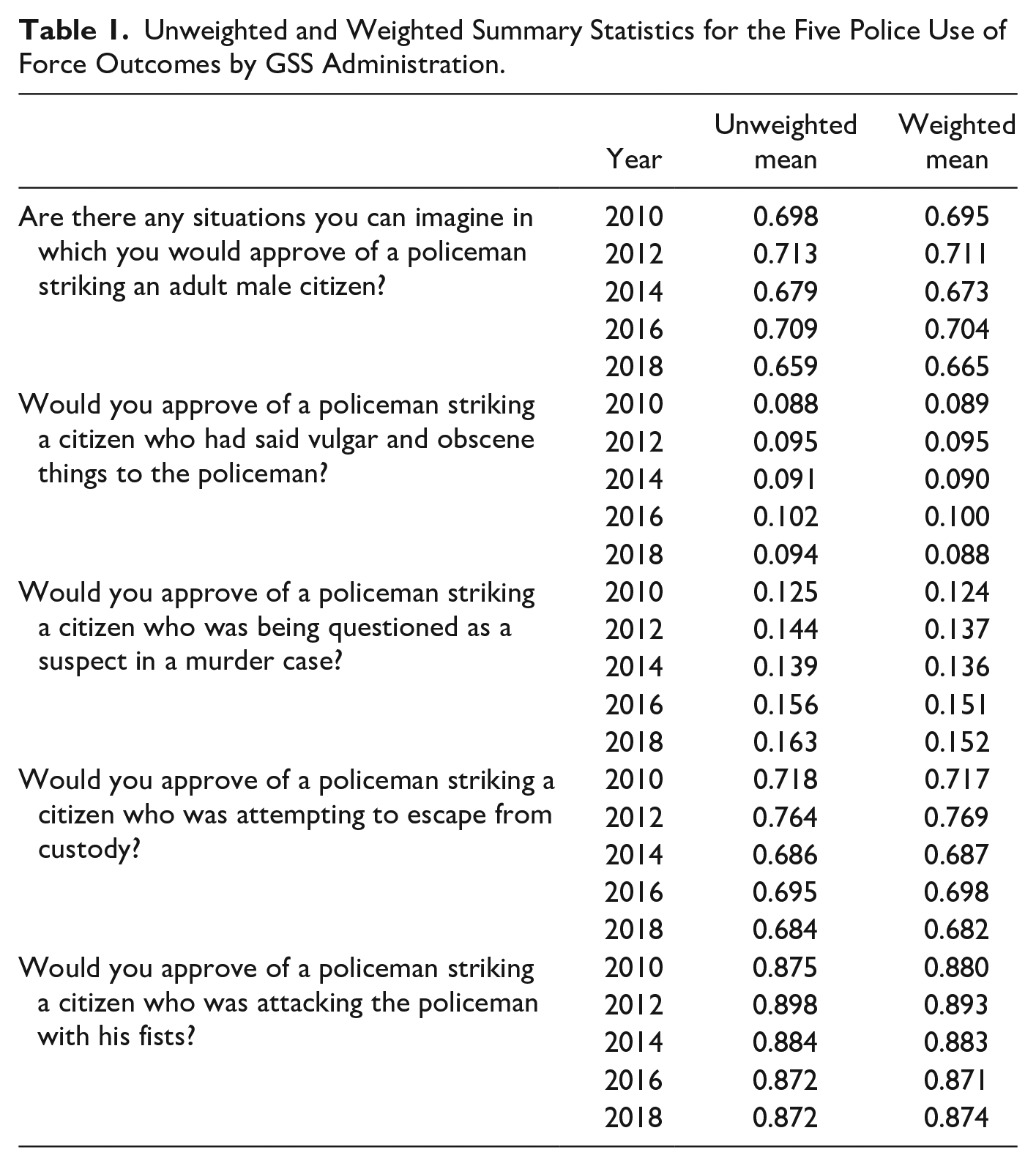
Note that questions 2 and 3 about vulgar speech and use of force against a murder suspect are questionable as far as “legal reasonableness” is concerned, whereas questions 4 and 5 about a citizen trying to escape or the officer being attacked are more reasonable circumstances for the use of force (Mourtgos & Adams, 2020). As such, we expect respondents—regardless of race or ethnicity—to be more supportive of use of force under more legally reasonable circumstances. Table 1 shows the percent of respondents—both unweighted and weighted—who approve of the circumstances surrounding use of force across administrations of the GSS.
Unweighted and Weighted Summary Statistics for the Five Police Use of Force Outcomes by GSS Administration.
Independent and Control Variables
The main independent variable is race and ethnicity, measured as a series of dummy variables, including Black, Latino, American Indian, and Other Race; White is the reference category. In addition, we control for a number of variables, including female, children, age, marital status, born in the US, education level, socioeconomic status, and population area.
Female is a dummy variable signaling that the respondent is female (Female = 1; Male = 0). We include a dummy variable designating whether the respondent has children (has children = 1, has not had children = 0). The respondent’s age is measured in years and is mean centered. Marital status is measured through several dummy variables, including Divorced, Separated or Widowed, and Never Married; being currently Married is the reference category. Whether the respondent reports being born in the US is also included as a dummy variable (0 = not born in the US; 1 = born in the US). The respondent’s education level is also controlled for through a dummy variable that designates the respondent has an education level of a high school graduate (or equivalent) or higher (i.e., post-secondary education). The respondent’s socioeconomic status is also controlled for using two variables: occupational prestige and income. Occupational prestige is measured as a respondent’s occupational prestige score in 2010. The GSS classified respondents’ occupations using the 2010 Census, then estimated the prestige associated with the occupation through an external sample and rating system (see Hout et al., n.d. for details on the construction of prestige scores). Income is measured linearly and is represented in 1986 dollars; we chose to keep income in 1986 dollars given that we used five different administrations of the GSS over a decade. Population area is included as a control to account for where a respondent lives, focusing on differences in rurality and urbanicity, measured in 1,000s. For example, a city of 6 million is denoted as 6,000 in the data. Lastly, we also include in the analysis a set of dummy variables for each year of the GSS used—2010, 2012, 2014, 2016, 2018. Table 2 contains the unweighted (analysis sample of N = 6,082) and weighted summary statistics (analysis sample weighted to the full sample of N = 11,771) for all variables to demonstrate how weighting impacts the summary statistics.
Unweighted and Weighted Summary Statistics for all Variables.

Analysis Plan
We use weighted logistic regressions to predict the five police use of force variables. The data is survey set to account for the sampling design in Stata 15 using the following commands: “svyset vpsu [pweight=wtss], strat(vstrat) singleunit(scale).” The “vpsu” variable designates the primary sampling unit, while the “wtss” variable is the sampling weights, or the inverse probability that a respondent is included in the analysis due to the sampling design. By weighting, this allows the analysis to be representative of the population of US households while accounting for the unique sampling frames used for sub-sampling of non-respondents in each GSS administration (Smith et al., 2019). Next, we also include “vstrat” which identifies which strata were used in the sampling design, and finally, the command “singleunit(scaled)” accounts for circumstances where there is one respondent in a strata (for more information, see StataCorp, 2017). The results of these models are shown in Table 3.
Results From Weighted Logistic Regression Predicting Circumstances Behind Use of Force.
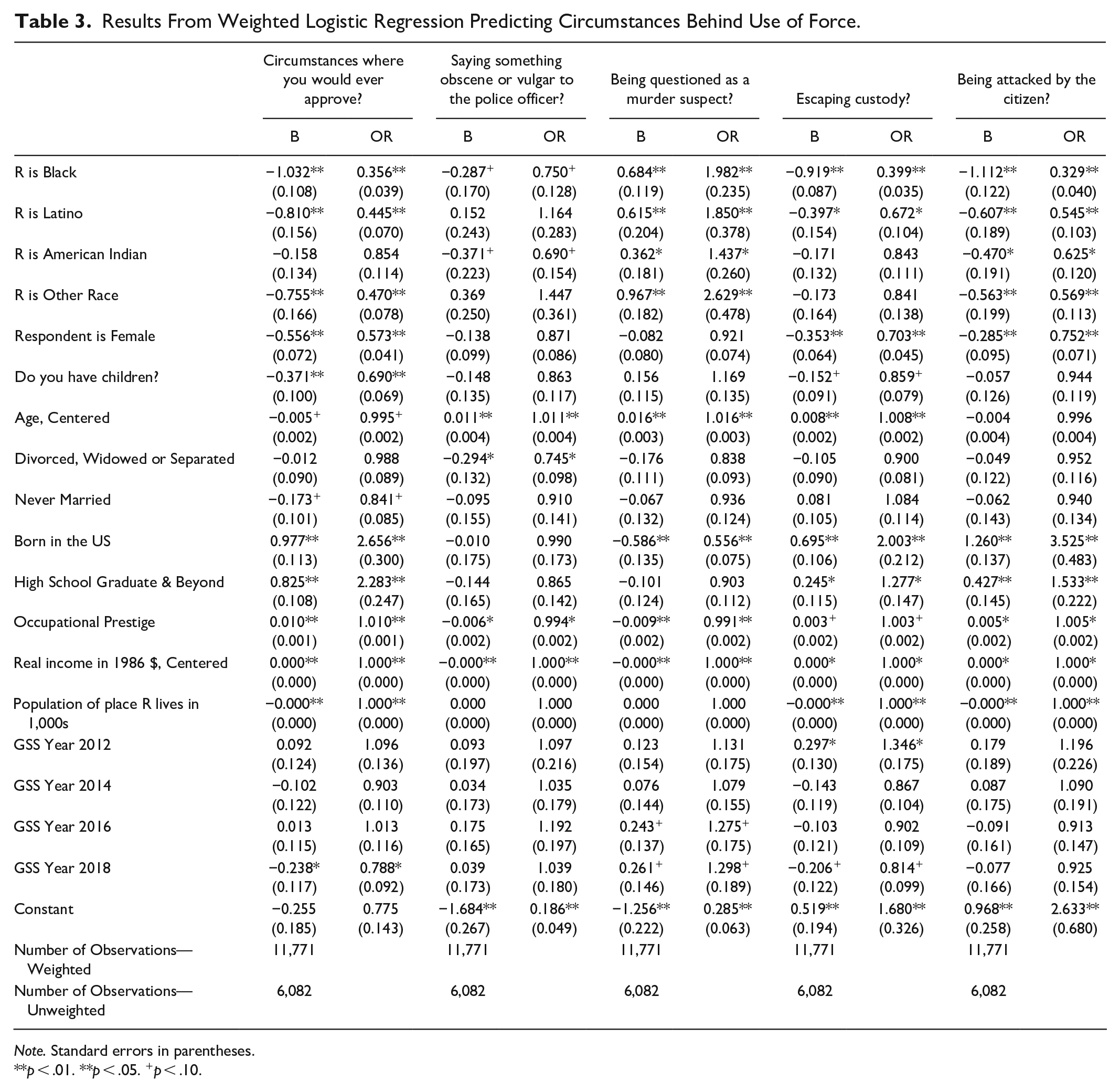
Note. Standard errors in parentheses.
p < .01. **p < .05. +p < .10.
The police use of force variables in the GSS have been examined by many scholars (Barkan & Cohn, 1998; Elicker, 2008; Halim & Stiles, 2001; Johnson & Kuhns, 2009; Mourtgos & Adams, 2020; Silver & Pickett, 2015; Thompson & Lee, 2004), however, only a few authors (Johnson & Kuhns, 2009; Silver & Pickett, 2015) report using weights to account for the sampling design of the GSS. Not using weights is problematic and calls results into question for two reasons. First, weighting allows the results from probability samples to be representative of the larger population from which the sample was drawn; without weighting, the results are only generalizable to the sample itself (Lohr, 2009). Not deploying weights, then, severely limits the generalizability and usefulness of the results. Second, weighting alters the calculation of standard errors in the analyses (Lohr, 2009). Weighting allows for more conservative estimates of statistical significance; in short, without weighting, standard errors used in significance tests may be too small, leading to results that may be overly significant, and ultimately, misleading (Lohr, 2009); this is especially problematic in large samples.
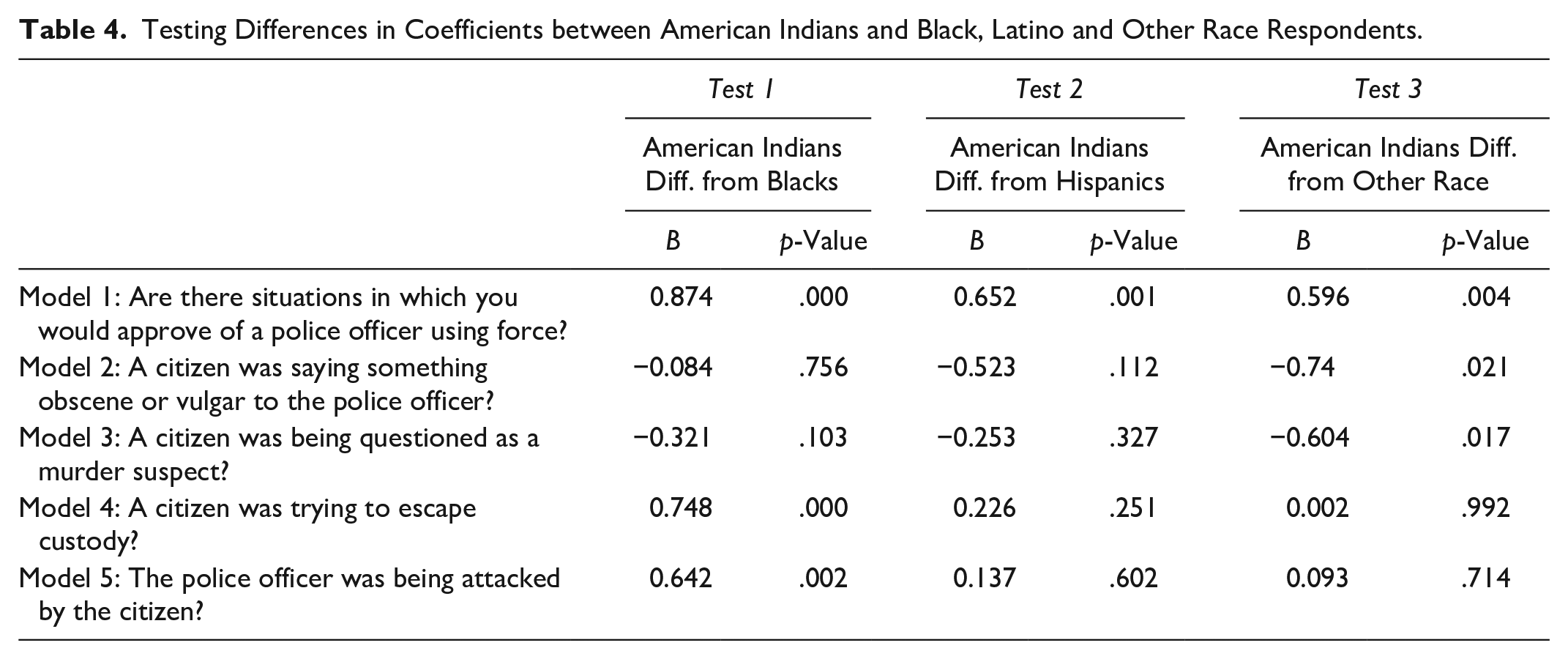
Lastly, our research questions surround whether American Indians’ attitudes of toward circumstances of police use of force are different from the attitudes of people of other races. If the coefficient for the American Indian variable is significant, it shows that American Indians’ attitudes toward the police use of force are significantly different than Whites. To compare American Indians to people of other races, to do this, after each model we conduct three statistical tests to assess whether the coefficient for American Indians is different from the coefficients for Blacks, Latinos, and respondents of other races. The statistics tests are conducted using the “lincom” command in Stata 15, which computes point estimates and p-values for combinations of statistics. We report these results in Table 4.
Testing Differences in Coefficients between American Indians and Black, Latino and Other Race Respondents.
Results
Table 3 contains the results from the weighted logistic regression models; both coefficients and odds ratios are reported. First, we begin with Model 1, which predicts respondents’ agreement with the statement, “Are there any situations you can imagine in which you would approve of a policeman striking an adult male citizen?” We begin by quickly discussing the control variables, then turn to the discussion of our independent variables of race. Women, respondents with children, respondents living in more populous areas, and respondents from the 2018 GSS administration report a lower ability to imagine situations where they would approve a police officer striking a citizen than their counterparts. Conversely, respondents who were born in the US, have at least a high school education level, those with higher levels of occupational prestige and income report a higher ability to imagine situations where they would approve a police officer striking a citizen than their counterparts. Next, when compared to Whites, Black, Latino, and Other race respondents have a lower odds of approving of police use of force. However, the coefficient for American Indians is not statistically significant, suggesting that American Indian and Whites respondents are similar in whether they can envision situations where they would approve police use of force. This result does not suggest both Whites and American Indians support police use of force, but rather, that whatever support they do have is likely contingent upon the type of police-citizen interaction.
Next, while in the first model, American Indians are not different than Whites, we ask: are American Indians statistically different from Black, Latino, and Other race respondents in whether there are situations in which they would approve of police use of force? Table 4 shows the results from the statistical tests assessing whether the coefficients for difference races are different than the coefficient for American Indians for this model, as well as all other models (the models are in the rows with the statistical tests in the columns). The first test (test 1) associated with this model (Model 1) examines the difference in coefficients between American Indians and Blacks. Test results show that American Indians are not only significantly different from Blacks, their approval rate of use of force is higher. These findings are replicated in tests 2 and 3, where that American Indians are not only are significantly different from Latinos and Other race respondents, but their approval rate is higher than both.
Models 2 thru 5 tests whether respondents would approve of use of force in specific situations. Model 2 tests whether respondents would approve of police use of force in circumstances where the citizen is saying obscene things to the officer, and our results show that there are several racial differences in approval of use of force surrounding this situation. First, Blacks and American Indians are less likely to approve of use of force under these circumstances, however, these differences are significant only at p < .10. Conversely, Latinos and Other race respondents are not statistically different than Whites. When testing whether American Indians have an approval rate that is statistically different than the other races (Model 2, Table 4), American Indians appear to have significantly lower approval rates for police use of force when the citizen says obscene or vulgar things to the police office from respondents from Other races (p < .01). American Indians are not statistically different from Blacks or Latinos.
The third model tests whether respondents would approve of police use of force in circumstances where the citizen is being questioned as a suspect in a murder case. Interestingly, when compared to Whites, all races report higher approval of police use of force under these circumstances. Remember that this circumstance, where the citizen is being questioned as a suspect in a murder case, as well as when the citizen says obscene or vulgar things, are both seen as situations where the legal reasonableness surrounding use of force is questionable (Mourtgos & Adams, 2020). More specifically, Blacks have an odds of approval of use of force that is 1.98 times higher than that of whites, Latinos have an odds of approval of use of force 1.85 that of whites, and Other race respondents have an odds of approval of use of force that is 2.63 times higher than that of whites. American Indians have the smallest odds ratio of all the races, with an odds of approval of use of force in these circumstances that are 1.44 times higher than that of whites. However, when testing whether American Indians are statistically different than respondents of other races (see Table 4), they report significantly lower than Other race respondents (p < .01) for use of force in circumstances where the citizen was being questioned as a murder suspect. American Indians are not different than Black and Latino respondents in their approval of force when the citizen is being questioned as a suspect in a murder case.
The last two circumstances surrounding police use of forced in the GSS include situations where it is legally reasonable to use force: a citizen escaping custody and when an officer is being attacked. The fourth model tests whether respondents would approve of police use of force in circumstances where the citizen is attempting to escape from custody. Black and Latino respondents had lower rates of approval of use of force than Whites. The coefficient for American Indians is not statistically significant, suggesting that while their approval rates of use of force when a citizen was trying to escape custody are lower than whites, it is not a statistically significant different. When testing whether American Indians are significantly different in their approval of use of force when the citizen is attempting to escape custody from the other non-White race respondents, results show (Model 4, Table 4) that American Indians have significantly higher approval rates than Blacks (p < .01).
Lastly, the fifth and final model tests whether respondents would approve of police use of force in circumstances where the citizen is attacking the policeman. All non-White respondents have lower approval rates surrounding use of force when a citizen is attacking a police officer, with Black respondents having the lowest odds of approval at 0.329 times lower than whites. American Indian respondent’s odds of approval of use of force under these circumstances was 0.625 times lower than whites. When compared to the other non-White respondents in the model, however, American Indians have significantly higher rates of approval than Blacks (p < .01; model 5, Table 4).
Discussion and Conclusion
American Indians’ perceptions and attitudes toward the criminal justice system are rarely studied, leaving a gap in research surrounding the relationship between American Indians and the various sectors of the criminal justice system, particularly policing. Not understanding American Indians’ attitudes toward focal issues in American society surrounding policing—such as their perceptions about police use of force—has created an inability for researchers, policy makers, and local American Indian governments, including tribal police forces, to build trust of the police in American Indian communities. Our goal was to avoid grouping American Indians into the “other race” category and pointedly examine how their attitudes toward police use of force were different than whites as well as other people of color. We discuss our three central findings below.
First, our results suggest that both whites and American Indians report there are situations in which they would support police use of force at rates much higher than other racial groups. That said, their support is dependent on the situation and should not be considered unilateral support for police use of force. This finding is consistent with those found by other scholars showing that context of the situation is particularly salient for support of police use of force (Cullen et al., 1996), yet run counter to previous scholarship showing how individuals in other non-white racial groups perceive police use of force (Halim & Stiles, 2001; Peck, 2015). Multiple scholars show that under certain circumstances, non-whites are likely to view the police more favorably (Frank et al., 1996; Peck, 2015; Sun & Wu, 2015). Our findings support research by Giblin and Dillon (2009) who maintain that Alaska Natives expressed satisfaction with the police and held more positive views, which may be because their contact with law enforcement is limited (Indigenous communities in this region tend to live in rural villages), reducing exposure to potentially discriminatory practices, and when exposure does happen, it is likely during emergencies when police help is needed. Thus, Alaska Natives may see all police, even those in nearby larger cities (e.g., Anchorage), as more favorable. This research elevates the importance of incorporating American Indians’ and Alaska Natives’ perceptions of the police and criminal justice institutions in criminological research, especially those that explore contextual situations among various tribes, in different regions, and ultimately, to view American Indians and similarly, Alaska Natives, as separate and distinct groups as opposed to homogenously.
Second, non-Whites, including American Indians, are more likely to approve of police use of force in circumstances where the legal reasonableness for using force is questionable (Mourtgos & Adams, 2020). Specifically, in situations where the individual is saying obscene or vulgar things to the police, Latinos and individuals of other race are no different than whites in their support for use of force. In circumstances include when the citizen is being questioned as a suspect in a murder case, there are no racial differences in support of use of force. These findings run counter to what we know about the perceptions of use of force by non-Whites. We hypothesize a few reasons for why this may be the case. Interpretations of police officers and police work are heavily influenced by media representations, and individuals’ perceptions of police use of force may be shaded by these representations. Scholars have demonstrated that television portrayals of police are typically in a positive manner and responses are seen as justified even in situations where the police officer acted aggressively (Eschholz et al., 2002); in this study, however, media portrayals of police were viewed as more positive by whites than Blacks. Much of this research is derived from a Black-white dichotomy and excludes other racial groups from the analyses, including American Indians. We are not aware of any studies that examine how media portrayals of police officers and police work might impact American Indians and their views about the police in general, and use of force specifically. Alternatively, there are several studies that examine racial stereotyping of American Indians in the media, their exclusion from media coverage, and their overall erasure from the mainstream (Eason et al., 2018; Lacroix, 2011; Miller & Ross, 2004). It may be that American Indian perceptions of police use of force decline based on media exposure along the same continuum as they do among Blacks regarding perceptions of and satisfaction with the police. Next, group culture may impact perceptions of use of force. Many cultures of people of color place a heavy weight on respecting one’s elders and people in a position of authority (North & Fiske, 2015; Sung, 2004). Disrespecting the police by cussing or speaking in a vulgar way may go against cultural norms, and subsequently been seen as a situation befitting punishment for the violation of those norms. Lastly, Latinos, Blacks, and American Indians and other people of color disproportionally live in disadvantaged and high crime communities (Sampson, 2012). Perhaps in these circumstances, given the high levels violence these communities experience, non-whites are less concerned about police use of force used against murder suspects if it helps reduce crime. More research is needed to test these speculations.
Third, for situations where police use of force is more reasonable for the type of police interaction, namely when a citizen is trying to escape custody or is attacking the officer, all non-White respondents had lower rates of approval of use of force than whites, though the coefficient for American Indians is not always statistically significant (significant in the case of attacking a police officer and not for escaping custody). Similar to the aforementioned suggestions, more meaningful research is needed that includes American Indian voices and American Indian communities to ascertain how they perceive the police more broadly, and in a variety of situations. Our findings here seem to suggest, akin to other racial groups, American Indians are concerned about racial bias in the criminal justice system and the application of use of force. Research has shown that American Indians have also experienced police brutality and unjust treatment, which is believed to be the impetus for the American Indian Movement in the 1960s (Wilkins & Stark, 2011). Thus, it may be that American Indians do not support use of force, even when a situation calls for it; still, variability in the significant of the American Indian coefficient reinforces the need for researchers to intentionally research American Indians and the police.
There are three limitations of our study worth mentioning. First, the GSS is a probability sample of households in the US population; therefore, because American Indians are not a large portion of the US population, they do not consist of a large part of our sample. In order to have enough power for our analyses, we collapsed multiple years of the GSS. That said, future research should do more to include American Indians into survey research, perhaps including American Indian oversamples into sampling frames so that American Indians are more adequately represented in samples. Second, relatedly and as noted earlier, the GSS has a ballot structure which allows for multiple modules with a number of different questions. This allows the GSS and other researchers to collect nationally representative data on a changing set of questions. There are a number of police-specific modules that would be excellent to ascertain how American Indians perceive police and governmental authority differently than individuals of other races; however, because so few American Indians are in the GSS and these questions are not asked repeatedly, understanding these dynamics are rather difficult. Third, and most importantly, few studies have examined within-American Indian differences, including reporting whether American Indians live on tribal lands or in majority Native areas/neighborhoods compared to individuals living on non-tribal lands and in non-Native areas/neighborhoods. Recent scholarship has explored these potential differences, indicating that for American Indians living in predominately Native areas/neighborhoods, their perceptions of use of force and discriminatory treatment differed considerably from their American Indian counterparts. In fact, one study found that 48% of American Indians living in majority Native areas/neighborhoods suggest their local police are more likely to use unnecessary force on a Native person (than a similarly situated white person) compared to 25% of respondents residing in non-Native majority locations (Robert Wood Johnson Foundation, 2017). To be clear, tribal land—reservations in particular—are separate government entities within the US; thus, in terms of contact with the police, the culture on tribal lands may be different for resident American Indians than individuals living off tribal land (e.g., sparse interaction, tribal officers, cultural approaches to justice and law enforcement styles). Also, important to consider, nearly 78% of American Indians and Alaska Natives live away from tribal lands, with 60% living in urban and suburban environments (U.S. Census Bureau, 2010). American Indians living in densely populated areas are likely to come in contact with the police under similar circumstances as Blacks and Latinos, and American Indians specifically living on tribal lands are subject to unique policing practices. Therefore, it is probable that American Indians living on tribal lands and in majority Native areas/neighborhoods are less accepting of police use of force than is suggested by the results of our study. Unfortunately, the GSS does not capture information on whether the individual is currently living on tribal land, or whether respondents are enrolled members of a federally recognized tribe for those claiming to be American Indian or Alaska Native. A report by the Bureau of Indian Affairs (2016) maintains, according to the 2010 Census, there is a significant difference between American citizens claiming to be American Indian and Alaska Native and those who are enrolled members of a federally recognized tribal nation; less than half who claim to have Native heritage and/or identity are actually enrolled members of a tribal nation. Given that experiences and treatment may differ between tribal and non-tribal members, on or off tribal lands, additional research is needed to parse out this distinction.
In conclusion, American Indians are both similar and dissimilar from other people of color and whites regarding their attitudes toward police use of force. American Indians are more likely to report having circumstances where they would support use of force than other people of color (i.e., here they are similar to whites), yet, their attitudes toward police use of force are rather similar to other people of color once situations surrounding use of force are detailed. This work supports not lumping American Indians into the “other race” category as their views are more nuanced and varied than Blacks and Latinos surrounding police use of force. We encourage future researchers to thoughtfully examine how American Indians interact with and are impacted by the criminal justice system as their views and experiences are complex due to their unique position in American society. Future research should investigate within-group differences for American Indians by examining, in addition to the usual socio-demographic factors (e.g., age, race, gender, marital status), region, tribal affiliation, political leanings, cultural experiences, and the rural versus urban experience, to name a few.
Footnotes
Acknowledgements
We would like to thank Eric Hedberg for his advice on weighting.
Declaration of Conflicting Interests
The author(s) declared no potential conflicts of interest with respect to the research, authorship, and/or publication of this article.
Funding
The author(s) received no financial support for the research, authorship, and/or publication of this article.
