




Abstract
Recent high-profile uses of deadly force by police in the United States and elsewhere have been the subject of extensive media coverage and social unrest. In turn, researchers have exhibited nascent interest in the factors that influence the use of deadly force by police, as well as vignette-driven studies of circumstances in which deadly force is believed to be acceptable. Less attention has been paid to perceptions of the frequency with which deadly force is used, proportion that is legal and necessary, to what extent its use varies by race, or how these beliefs are shaped by media consumption. Using survey methodology, we examine the perceptions of 458 respondents from the Southeastern United States in relation to the frequency with which deadly force is used, proportion that is legal and necessary, to what extent its use varies by race, and how these beliefs are shaped by social media consumption net of the effects of personal demographics and experiences. Our findings indicate the majority of respondents drastically overestimate both the frequency with which police use deadly force and the proportion of incidents involving suspects who are people of color, while underestimating the proportion of incidents that are legally justified and necessary. These perceptions are influenced, in part, by social media consumption but the effects vary in direction and significance by social media platform.
Keywords
Introduction
The murder of George Floyd by Minneapolis Police Officer Derek Chauvin sparked public outrage and protestation across the United States. The incident occurred in broad daylight and video of the event quickly went viral, attracting heavy attention from news outlets and politicians. Contextually, Floyd’s murder occurred at a time when many highly publicized examples of police misuse of deadly force in the United States were circulating. Generally, criminal convictions and internal punishment of police officers are both rare and difficult (Zimring, 2020). This is true in cases of misuse of force as well as complaints related to general misconduct, especially when complainants are Black or Latinx (Faber & Kalbfeld, 2019). Cases such as Derek Chauvin, who had amassed 17 misconduct complaints before murdering George Floyd, indicate misconduct complaints may be ignored and often go unpunished.
While police use of deadly force is a highly discussed aspect of policing, data indicate that it is relatively rare. For instance, while there are over 60 million interactions between police and civilians in the United States each year, approximately 3% involve use of force, including nonfatal threats (Harrell & Davis, 2020). When force is used, it is most likely to involve non-lethal and weaponless tactics (Garner et al., 2018; Reno et al., 1999). Although there are notable issues defining what constitutes police use of force, as not all agencies report verbal force, threats of force, or restraint (see Garner et al., 2018), reports have consistently included firearms as a measure of use of force (Alpert & MacDonald, 2001; Harrell & Davis, 2020; B. Taylor et al., 2011). Cases that involve a service weapon being drawn and pointed at a civilian account for less than 1% of all police-citizen interactions (Harrell & Davis, 2020). Yet, while data has long been collected on use of force, its accuracy has been considered suspect—especially with regard to extreme cases of excessive and deadly force. After the shooting of Michael Brown, it was determined the FBI misreported fatal police shootings by more than half (Lowery, 2014). Thus, in 2015, The Washington Post began collecting data from the news, posts on social media, and police reports to track on-duty deadly shootings by police officers (The Washington Post, 2022). Their data indicate fatal police shootings have remained relatively consistent, with approximately 1,000 citizens killed in the United States annually.
While most individuals shot by the police are White, data indicate Black, and Hispanic Americans are killed by the police at a disproportionate rate. Black Americans are fatally shot by police at a rate of 40 per million and Hispanic Americans at a rate of 29 per million, compared to the rate of 16 per million for White Americans (The Washington Post, 2022). Although most instances of fatal police shootings, regardless of race, involve suspects who are armed or actively attacking the police (Nix et al., 2017; Worrall et al., 2018), Black Americans are two times more likely to be shot while unarmed (Nix et al., 2017). As a response to criticisms, the FBI (2020) began collecting data on use of force to provide more accurate information on police use of force involving serious bodily injury or death. Preliminary data indicate over 5,000 federal, state, local, and tribal agencies submitted reports for 2019, representing about 40% of officers (FBI, 2020).
Despite the low frequency of violent police-citizen interactions, the perception that police regularly commit excessive and deadly force has increased over the last decade (Mourtgos & Adams, 2020), and some have argued exchanges between police and the public have grown increasingly hostile (Nalla et al., 2018). The extent to which public perceptions align with reality may be a result of multiple factors, including exposure to social media, where stories about police misconduct and violence often seem ubiquitous. Data from the PEW Research Center indicate just over a quarter of police officers have ever fired a weapon in the field. Despite this reality, over 80% of adults believe the average officer has fired their service weapon at least once in their career (Morin & Mercer, 2017). These findings are in line with early studies indicating consumption of media increases the perception that police officers draw their weapons more often (Gerbner & Gross, 1976; Gerbner et al., 1977). Subsequent research has linked media consumption to various criminal justice related outcomes, including fear of crime (Intravia et al., 2017; Rosenberger et al., 2023; Weitzer & Kubrin, 2004), confidence in the police (Callanan & Rosenberger, 2011), and punitive attitudes (Callanan & Rosenberger, 2011; Dowler, 2003; Roche et al., 2016; Rosenberger & Callanan, 2011). However, research testing media consumption and perceptions of police use of force, particularly deadly force, is rare (Donovan & Klahm, 2015; Jefferis et al., 1997). The current study seeks to address this gap in the literature by testing the impact of social media consumption on perceptions of police use of deadly force among college students in the United States. Specifically, this study examines how specific social media platforms influence perceptions of the use of deadly force and if these perceptions vary by student demographics, experiences, and perceptions of procedural justice used by police.
Disclaimer
The authors of this article feel compelled to discuss frankly the goal of this research. In no way are we attempting to suggest that police misuse of violence and deadly force is not a serious issue. In fact, the paper demonstrates the exact opposite, as the impact in fostering negative attitudes toward the police is discussed throughout. We are simply attempting to determine how use of media, especially social media, correlates with misperceptions related to these events. Our sample perceives deadly force encounters to be much more common and racially driven than data seem to indicate. This is an important finding with implications for research and policy. The article should be read with the understanding that we are attempting to understand attitudes, not minimize abhorrent examples of police misconduct, or reject the harm and pain caused by misuse of deadly force. Identifying these misconceptions does not mean that that systematic racism does not exist in the criminal justice system or policing.
Literature Review
Police Legitimacy and Public Interactions
Perceived legitimacy is delineated by public attitudes regarding confidence and trust in police as well as support for the institution of policing. Simply put, those who perceive the police as biased do not consider the police to be legitimate (Fine et al., 2021), while those who perceive the police as procedurally just are more supportive of police (Tyler & Wakslak, 2004). Studies have found race and ethnicity to be strong predictors of perceptions of legitimacy. While Whites, in general, hold favorable attitudes toward the police, racial and ethnic minorities have been shown to perceive the police as biased (Jefferis et al., 1997; Mbuba, 2010; Verga et al., 2016; Weitzer, 2010). Specifically, people of color tend to express less confidence in the police, an increased disapproval of police use of force, and a belief that police misconduct occurs regularly (Callanan & Rosenberger, 2011; Intravia et al., 2020; Mourtgos & Adams, 2020; Rosenberger & Dierenfeldt, 2021; Senreich & Williams-Gray, 2021; Sethuraju et al., 2019; Wozniak et al., 2021). Additionally, negative perceptions of police and their involvement in police misconduct are more common among young people (Fine et al., 2021), especially minority youth (Romain & Hassell, 2014; Sethuraju et al., 2019). For instance, Black university students demonstrate significantly lower levels of confidence in police than Whites (Senreich & Williams-Gray, 2021). In one study, only 11.7% of White respondents agreed with the 41.5% of non-White respondents who felt that police use force excessively (Jefferis et al., 1997).
Demographic variables such as age and race are key variables in determining perceptions of the police. Not surprisingly, respondents who identify as older, male, Republican, and are from a higher socio-economic status tend to report more positive perceptions of the police (Mourtgos & Adams, 2020). Nevertheless, perception of police as procedurally just is also influenced, in part, by personal experiences such as interactions with police (Miller & Davis, 2007; Verga et al., 2016). According to the Bureau of Justice Statistics’ (BJS) 2018 Police-Public Contact Survey (PPCS), White Americans are more likely than non-White Americans to have had any contact with the police (Harrell & Davis, 2020). However, Black and Hispanic Americans are more likely to have adverse encounters (e.g., threats or use of force and being handcuffed) with police (Harrell & Davis, 2020). Positive and procedurally just experiences with police foster confidence and legitimacy (R. B. Taylor & Lawton, 2012); however, negative encounters with police, such as racial profiling and driving while Black, foster unfavorable attitudes and reduce confidence in the police (Burgason, 2017; Mbuba, 2010; Sunshine & Tyler, 2003; Tyler & Wakslak, 2004). As confidence in police weakens with the perception of a police officer’s behavior as overly aggressive, and this perception may be more likely among racial minorities, producing negative attitudes toward police, this may explain why minority groups are less likely to support legally justifiable instances of police use of force (Fischer et al., 2008; Mourtgos & Adams, 2020).
An increase in legal cynicism and distrust toward police detrimentally affects crime reporting behaviors and cooperation with the police (Kwak et al., 2019). Moreover, this may further facilitate experiences that lead to negative attitudes toward law enforcement, such as activism. Although activism itself is not inherently problematic, continuous media coverage and inaccurate and often inflammatory social media depictions may have aided in the increase in negative perceptions (Intravia et al., 2020; Senreich & Williams-Gray, 2021). Reny and Newman (2021) reported those who participated in protests following the murder of George Floyd expressed diminished confidence in police, which the authors attributed to a sociological effect that intensified political and racial perceptions of police and their activities. While the protests were warranted, historically, respondents with left-leaning political views are more likely to criticize use of force, regardless of whether it is legally justified (Mourtgos & Adams, 2020). Protests in response to highly publicized incidents of police use of deadly and/or excessive force may provoke tension between activists and the police officers on patrol during the protest. Thus, participation in activist functions coupled with the increased coverage on traditional and social media outlets may facilitate negative interactions with police, reinforcing protesters’ perceptions of the police as corrupt and procedurally unjust.
Cultivation Theory
Gerbner’s “mean and scary world hypothesis” was prompted by observations made by him and his research associates as they developed and refined cultivation theory in the 60s and 70s (Gerbner, 1998; Gerbner & Gross, 1976; Gerbner et al., 1977). This initial research found increased media consumption led individuals to develop a view of the world as violent place, grossly overestimating both violent crime and the frequency with which police draw their service weapons (Gerbner & Gross, 1976; Gerbner et al., 1977). The media’s reliance on depictions of violence, which are easy to produce and consume, cultivates the audience’s perceptions of the world and the people in it as dangerous and untrustworthy (Gerbner & Gross, 1976).
Television feeds its viewers facts and ideas about the world through representational realism, which is characteristic of Western narrative art (Gerbner & Gross, 1976). Viewers know that TV dramas such as Grey’s Anatomy and Law and Order are fictitious but assume nonetheless the shows provide accurate reflections of medical practice and detective work.
Gerbner and Gross (1976) found that those who watched at least 4 hr of TV a day were consistently more likely to select the “television answer” than those who watched 2 hr or less of TV a day. The “television answer” skewed toward a distorted reality consistent with the one depicted in the world of television. For example, people who watched more hours of TV a day were more likely to overestimate the chances of experiencing violence than those who watched fewer hours of TV (Gerbner & Gross, 1976).
Over the years, Cultivation Theory has been revised, adapted and expanded upon. One of the earliest critiques of the theory was it failed to account for audience characteristics, as not all individuals experience and interpret media the same way (Callanan & Rosenberger, 2016; Rosenberger & Dierenfeldt, 2021). Cultivation research has since adapted the practice of accounting for demographic and experiential differences across consumers (Callanan & Rosenberger, 2011; Chiricos et al., 1997; Eschholz et al., 2002; Intravia & Pickett, 2019; Rosenberger & Dierenfeldt, 2021). Additionally, building from cultivation, Selective Exposure Theory argues that individuals are more likely to select content that is most aligned with their individual perspectives and beliefs (Knobloch-Westerwick & Alter, 2007). This is particularly important when considering the impact of social media consumption, as it is unlikely these sources exclusively promote homogeneous perspectives of the criminal justice system and police use of force.
Social Media and the Influence on Perceptions of Excessive and Deadly Force
The public’s understanding of the criminal justice system is largely informed by the media (Marsh & Melville, 2019: Surette, 2007). Misperceptions of police use of deadly force have become standardized and legitimized through social media, as the world of social media is equally if not more distorted than the world of television. While neither Weitzer and Kubrin (2004) nor Intravia et al. (2017) found a significant relationship between internet consumption and fear of crime, Intravia et al. (2017) found social media consumption was significantly related to fear of crime. Social media platforms can be highly selective about the messages users are exposed to by creating curated feeds based on user data, potentially reinforcing existing beliefs by protecting each user from content that challenges his/her perception of a certain issue (Bakshy et al., 2015; Gil de Zúñiga et al., 2022). While platforms such as Instagram and Twitter have replaced traditional news sources for many people, with 53% of U.S. adults getting their news from social media (Shearer, 2021), less is known about the influence of new age media on public attitudes toward police. Limited research suggests contemporary media facilitates negative attitudes toward police among users through the dissemination of reports related to police misconduct and violence (Intravia et al., 2018; Rosenberger & Dierenfeldt, 2021). However, Grimmelikhuijsen and Meijer (2015) found police departments may foster public trust by establishing social media presence on Twitter, which facilitates transparency. This practice increased during COVID according to recent research (Hu et al., 2022). This aligns with the expectation that the influence of social media varies by platform while highlighting the potential for further variation within each platform depending on the user and their level of activity and engagement (Rosenberger & Dierenfeldt, 2021).
As social media users are heavily exposed to news reports, videos, commentary, and discourse surrounding police use of force, the framing of a single event may indirectly influence general perceptions of policing, especially when examining racism (Fridkin et al., 2017). For example, the use of the term “police violence” reinforces perceptions that the use of deadly force is frequent and unjustified because the term is generally defined as any death that occurs in police custody or as a direct result of police intervention (Nix, 2020). Jefferis et al. (1997) concluded that a single, highly publicized video of a controversial arrest had a negative effect on how the public feels about police use of force, regardless of race. This effect, however, was substantially stronger among non-Whites (Jefferis et al., 1997).
Rosenberger and Dierenfeldt (2021) compared the relationship between media consumption and confidence in police across race/ethnicity. The use of Facebook as a primary news resource was positively associated with confidence in police, and this relationship was stronger for Hispanic respondents than Black respondents. Those who identified FOX News as their daily news source were more confident in the police, while those who listed PBS were less confident. Rosenberger and Dierenfeldt (2021) found internet consumption and television news affect confidence in police, with more daily internet consumption corresponding with reduced confidence in police. This may be explained by increased awareness of highly publicized incidents of police misconduct through more time spent on the internet. Campbell and Valera (2020) found that 85% of their respondents learned about police violence through social media, and all respondents agreed that race/ethnicity is a determinant in police use of force. Thus, social media may facilitate secondhand victimization, as individuals in one’s network share stories related to their own experiences with crime or the criminal justice system (Pryce et al., 2021).
The Current Study
Prior works have established a robust framework for understanding the relationships between media consumption, individual characteristics, personal experiences, and perceptions of police and their activities. Interestingly, attempts to extend this line of inquiry to perceptions of the frequency of police use of deadly force are limited. Further, despite the prominence of social media in society and its importance in circulating stories about police violence and brutality, tests of its impact are largely absent in deadly force research. Cultivation Theory and Selective Exposure Theory suggest that these messages have a significant potential for impact and that this impact may be different depending on individual beliefs. The current study addresses this gap in the literature through application of survey methodology at a university in the Southeastern United States. In particular, we explore the extent social media consumption, net of respondent demographics and individual experiences, influences perceptions of the frequency with which police use deadly force, the proportion of these incidents that are legal and/or justified, and the extent to which these outcomes vary by suspect race.
Data, Measures, and Methods
Data
The data used in this study were collected from undergraduate students enrolled in a mid-sized university in the southeastern United States during the Spring 2022 semester. Study protocols were approved by the university’s IRB prior to survey distribution (IRB# 22-004). Although university students certainly represent a unique population, prior works have clearly demonstrated that their attitudes toward criminal justice issues closely align with those held by the general public (Dierenfeldt et al., 2021; Payne & Chappell, 2008; Wiecko, 2010), reducing concerns of generalizability.
At the time of the study, the university enrolled 11,728 students, the majority of whom were White (75.2%) and female (57.48%). We initially attempted to utilize a stratified random sampling technique whereby the sampling frame would be defined by department and course level, and classes would be selected from within the strata. Non-responses from professors of selected courses forced the adoption of an alternative approach in the form of convenience sampling. The survey was administered in 20 classes, almost exclusively in the social sciences (e.g., anthropology, sociology, and criminal justice). These included six 1,000-level, three 2,000-level, eight 3,000-level, and three 4,000-level courses. Several of these courses satisfied general education or elective requirements for a variety of academic programs, evidenced by the fact that our sample included students from approximately 50 majors. Members of the research team met with students during their scheduled class times, explained the purpose and voluntary nature of the study, and provided consent forms with each survey. A total of 894 pen-and-paper survey instruments were distributed within the selected courses, based on enrollment records maintained by the university. Of this number, 423 did not participate as a result of absenteeism, refusal, or prior completion of the survey. 1 A total of 471 surveys were completed. Of these, 13 were not usable because of missing responses, resulting in a final sample of 458 (51.23% response rate). As response rates are often below 25% for survey research addressing sensitive issues (Garland et al., 2017; Krebs et al., 2011; Tourangeau et al., 2000), the response rate for the sample was respectable.
Dependent Variables
Nine dependent variables are included in the analyses (see Table 1). The first was operationalized through the question “If you had to guess, how many instances of the use of deadly force by police occur in the United States annually?” Eleven possible responses were included, ranging from “Less than 1,000” to “More than 10,000.” The second was operationalized through the question “If you had to guess, what percentage of police use of deadly force in the United States is legally justified?” Given that respondents might distinguish between “legal” and “necessary,” the third outcome measure asked, “If you had to guess, what percentage of police use of deadly force in the United States is necessary?” Ten possible responses were included for outcome measures 2 and 3, ranging from “0% to 10%” to “91% to 100%.” 2
Descriptive Statistics for Variables in Analysis (n = 458).
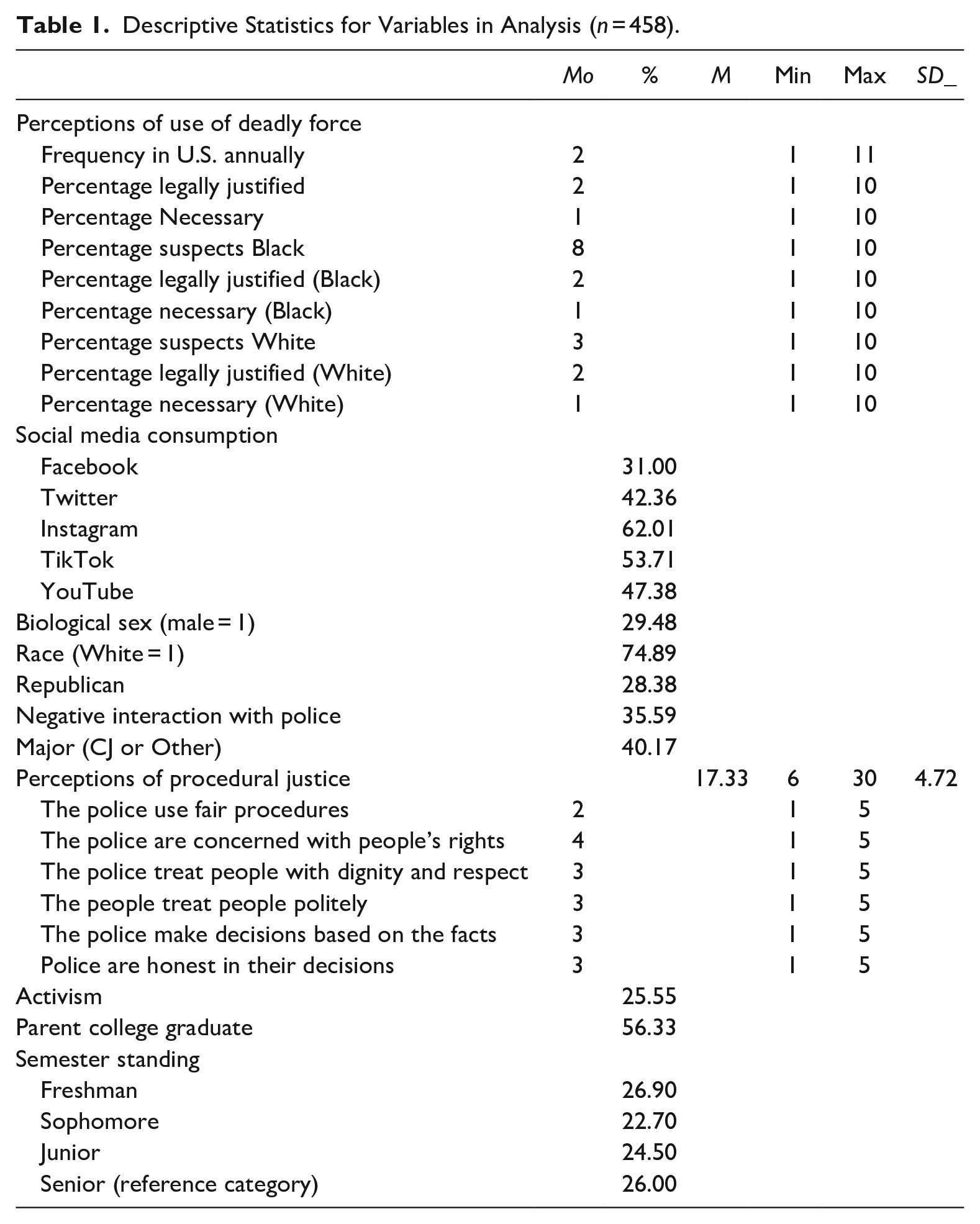
We also endeavored to determine the extent to which respondent perceptions of these issues might vary by suspect race, which prompted the development of several race-specific items. The fourth outcome measure was operationalized through the question “If you had to guess, what percentage of police use of deadly force in the United States involves suspects who are people of color?” The fifth dependent variable asked, “If you had to guess, what percentage of police use of deadly force involving suspects who are people of color in the United States is legally justified?” The sixth outcome measure asked the question “If you had to guess, what percentage of police use of deadly force involving suspects who are people of color in the United States is necessary?” Dependent variables 7 through 9 mirrored 4 through 6, but asked about suspects who were “White” rather than “people of color.” Ten possible responses were included for outcome measures 4 through 9, ranging from “0% to 10%” to “91% to 100%.”
Independent Variables
As was discussed above, social media consumption often plays a significant role in shaping perceptions of social issues, including those related to police (e.g., Intravia et al., 2017). Moreover, the work of Rosenberger and Dierenfeldt (2021) suggests the effects of social media consumption may vary by platform. Consistent with this logic, we asked respondents to indicate all social media platforms they used as regular news sources from a dichotomized list that included Facebook, Twitter, Instagram, TikTok, and YouTube. As was also noted, respondent characteristics (e.g., Mourtgos & Adams, 2020) and experiences (e.g., Reny & Newman, 2021) have been linked with perceptions of police use of force. In terms of respondent characteristics, biological sex (1 = male, 0 = female), race (1 = White, 0 = non-White), political affiliation (1 = Republican, 0 = other), college major (1 = Criminal Justice, 0 = other), and parents’ highest level of education (1 = bachelor’s degree or higher, 0 = other) were operationalized as dichotomous measures. Semester standing was measured by asking respondents to indicate whether they were a Freshman (1), Sophomore (2), Junior (3), or Senior (reference category). 3
Respondents were asked if they had experienced a negative interaction with a police officer in the past 12 months (1 = yes, 0 = no). They were also asked if they had a family member or close friend who had experience a negative interaction with police during the same period. Given the association between direct and vicarious experience, especially in terms of interactions with police, these measures were combined into a single dichotomous measure of negative interaction with police. We also advanced a block of six Likert-style statements related to perceptions of procedural justice by police, including “The police use fair procedures”; “The police are concerned with people’s rights”; “The police treat people with dignity and respect”; “The police treat people politely”; “The police make decisions based on the facts”; and “The police are honest in their decisions.” Each was a 5-point statement ranging from “Strongly Disagree” to “Strongly Agree.” These measures were combined into a single additive index (α = .906) with a range of 5 to 30. 4 Finally, respondents were asked if they had participated in any activist functions related to policing issues (e.g., marches, protests, demonstrations, sit-ins, etc.) since the killing of George Floyd (1 = yes, 0 = no).
Analytic Strategy and Primary Question
A growing body of literature has described the influence of social consumption on perceptions of police and use of force (e.g., Campbell & Valera, 2020; Intravia et al., 2020; Rosenberger & Dierenfeldt, 2021). The relationship between social media consumption and perceptions of the nature and frequency of police use of deadly force, and extent to which this relationship varies by social media platform remain unexplored. These gaps prompted the current study to ask the Primary Question: How does social media consumption relate to perceptions of the use of deadly force by police? Each of the outcome measures created to explore this issue represented a fully-ordered ordinal variable. Considered in conjunction with the purpose of the study, ordinal regression was selected as the most appropriate statistical approach.
Results
Descriptive Statistics
Descriptive statistics are displayed in Table 1. The modal response to the question “If you had to guess, how many instances of the use of deadly force by police occur in the United States annually” was 2, which corresponded with “1,000 to 2,000.” Nearly half (45%) of respondents believed there were more than 5,000 cases per year, and 8.1% believed police used deadly force more than 10,000 times annually. Almost a quarter of the sample believed people of color comprised “71% to 80%” of all suspects in deadly force encounters (modal response), and 75% believed more than half of all applications of deadly force by police involved suspects who were people of color.
The modal response to the question “If you had to guess, what percentage of police use of deadly force in the United States is legally justified?” was 2, which corresponded with “11% to 20%.” More than half of our respondents (51.5%) believe that 50% or less of applications of deadly force by police were legally justified. When delineated by suspect race, the modal response remained 2, but approximately 62% of respondents believed that 50% or less of applications of deadly force used against people of color were legally justified. Comparatively, approximately 54% of respondents indicated they perceived 50% or less of applications of deadly force involving White suspects to be legally justified.
Similarly, the modal response to the question “If you had to guess what percentage of police use of deadly force in the United States is necessary?” was 1, which corresponded with “0% to 10%.” More than three-quarters of our respondents (77.7%) believed that 50% or less of cases of deadly force were necessary, and more than half (60.7%) believed that 30% or less were necessary. The modal response was the same in response to items delineated by suspect race, with 80% of respondents indicating that half or less of cases involving suspects of color were necessary, compared to 67% who felt this way about cases involving White suspects.
Each of the social media platforms included in our analyses were frequently used by respondents as a regular news source. Facebook was least used, with less than a third of respondents (31%) indicating they used it as a regular news source, followed by Twitter (42.36%), YouTube (47.38%), TikTok (53.71%), and Instagram (62.01%). Nearly a third (29.48%) of the respondents were male and 74.89% were White, which was consistent with enrollment demographics of classes in which the survey was distributed. There was also a relatively uniform distribution in terms of semester standing, as 26.9% of the students were freshmen, 22.7% were sophomores, 24.5% were juniors, and 26.0% were seniors. In terms of political orientation, 28.38% of the respondents identified as Republican, 40.17% were criminal justice majors, and more than half (56.33%) came from homes in which at least one parent had earned a bachelor’s degree or higher. The sample exhibited moderate perceptions of procedural justice by police, with an average 17.33 on a 30-point scale. More than a third of the respondents (35.59%) reported experiencing a negative interaction with police, either directly or vicariously, in the 12 months prior to the survey, while 25.55% had participated in an activist activity (e.g., march, protest, demonstration, sit-in, etc.) since the killing of George Floyd.
Ordinal Regression Analyses
Results of the nine ordinal regression models included in our analyses are displayed in Tables 2 through 4. In each instance, model fit statistics were appropriate, and −2 Log Likelihood became smaller than the constant-only model with the inclusion of additional variables, indicating model improvement. Models 1 through 3 examine general perceptions of the frequency, legality, and necessity of deadly force used by police. As can be seen in Table 2, the influence of social media consumption varied by platform. Of the social media variables, effects related to the use of Twitter were the most consistent. On average, respondents who reported using Twitter as a regular news source perceived use of deadly force by police occurred more frequently (b = 0.297, p ≤ .10) and that a lower proportion of these instances were either legally justified (b = −0.428, p ≤ .05) or necessary (b = −0.420, p < 0.05). In contrast, those who used YouTube as a regular news source perceived a higher proportion of uses of deadly force were legally justified (b = 0.308, p ≤ .10), while those who relied on Facebook perceived that a higher proportion were necessary (b = 0.391, p ≤ .10). The effects of using TikTok and Instagram as a regular news source failed to achieve statistical significance.
Ordinal Regression Perceptions of Frequency, Legality, Necessity of Deadly Force.
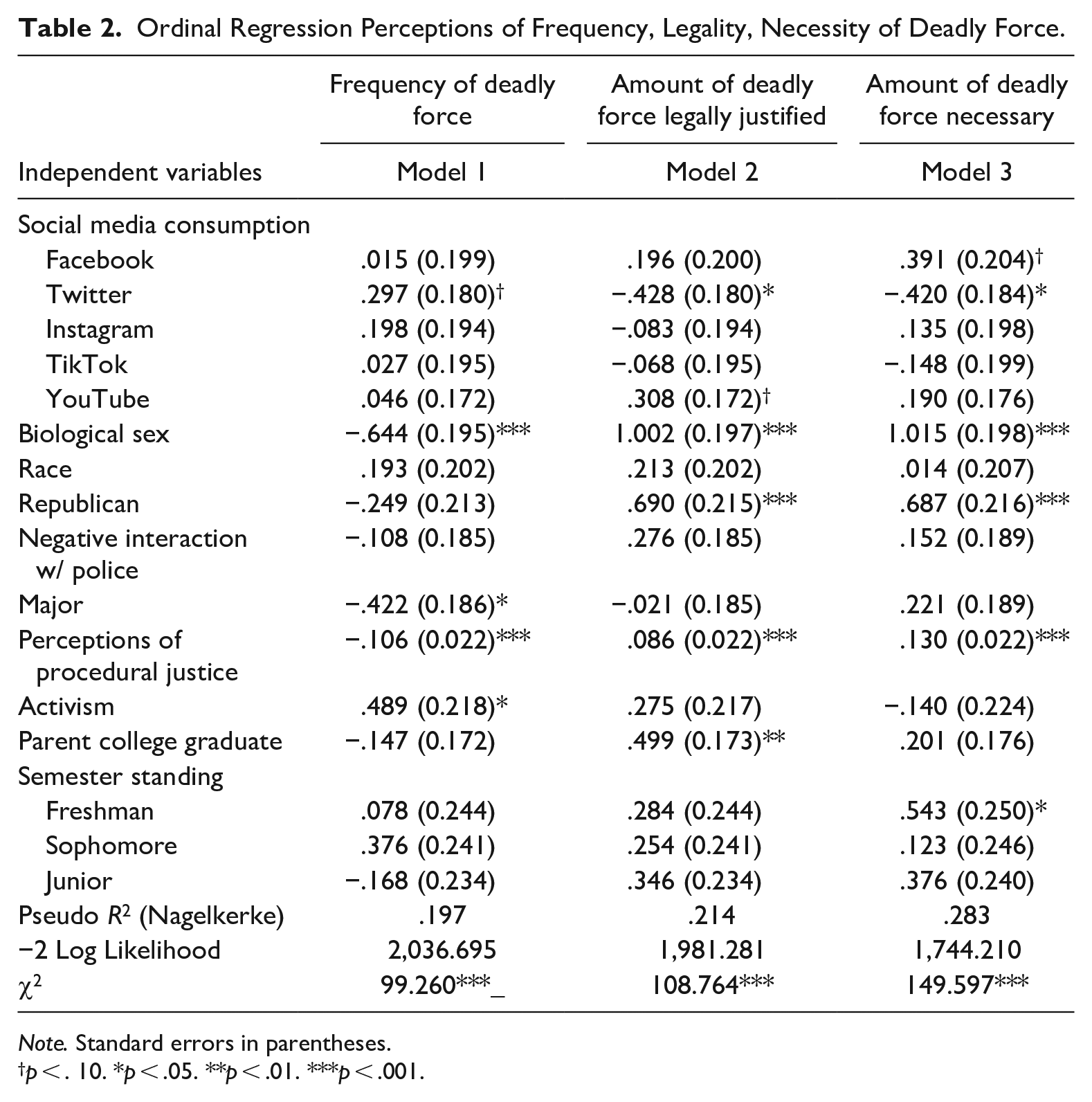
Note. Standard errors in parentheses.
p < . 10. *p < .05. **p < .01. ***p < .001.
Perceptions of Proportion, Legality, Necessity of Deadly Force Black Suspects.
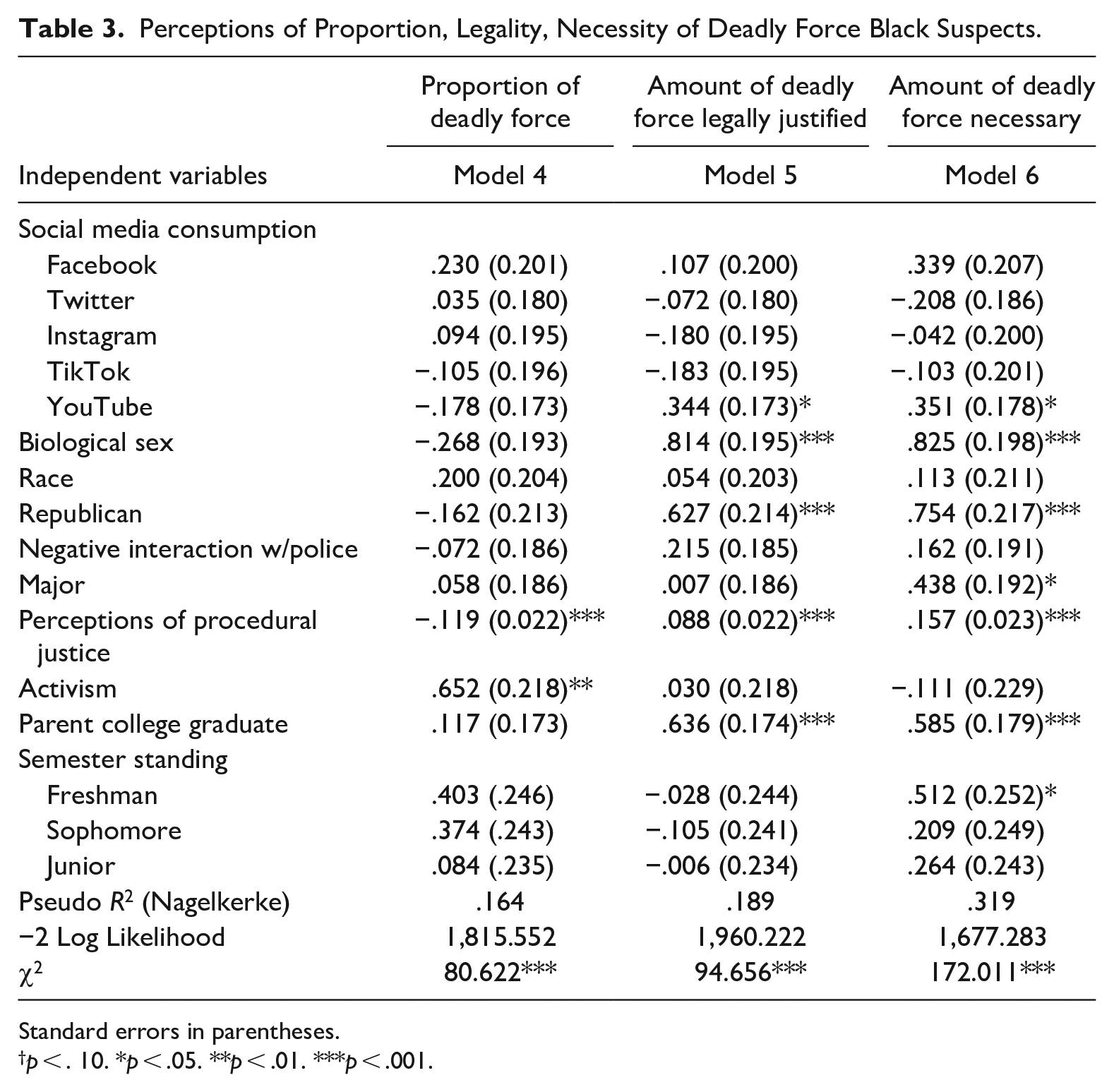
Standard errors in parentheses.
p < . 10. *p < .05. **p < .01. ***p < .001.
Perceptions of Proportion, Legality, Necessity of Deadly Force White Suspects.
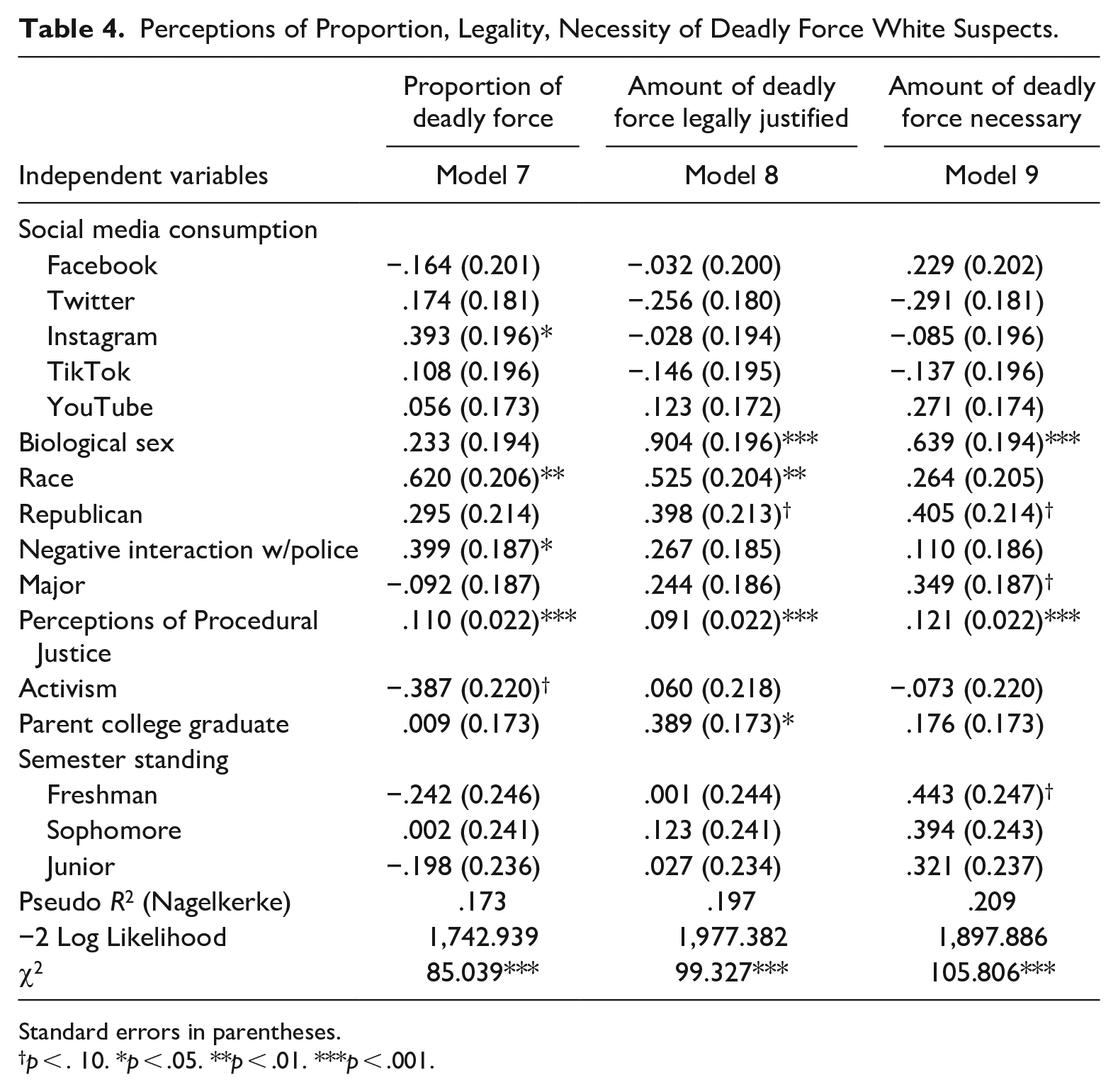
Standard errors in parentheses.
p < . 10. *p < .05. **p < .01. ***p < .001.
Yet, the impact of social media consumption appeared to vary by suspect race. The influence of using Twitter as a regular news source, which had a rather consistent effect on general perceptions of the frequency, legality, and necessity of deadly force was reduced to statistical non-significance in all race-specific models. The use of Facebook as a regular news source, which correlated with the perception that a larger proportion of applications of deadly force was necessary, also failed to exhibit a statistically significant influence on perceptions of deadly force when asking respondents to consider suspect race. In terms of perceptions of the proportion, legality, and necessity of deadly force among suspects who were people of color, the use of YouTube as a regular news source was the only social media consumption variable that achieved statistical significance. Specifically, respondents who reported using YouTube as a regular news source tended to perceive a larger proportion of the use of deadly force involving people of color was both legally justified and necessary (b = 0.351, p ≤ .05). In contrast, the use of Instagram as a regular news source shared a statistically significant relationship with perceptions of the use of deadly force involving White suspects, with consumers of this platform perceiving a larger proportion of deadly force encounters involved White suspects (b = 0.393, p ≤ .05).
More consistent were the effects of respondent sex, political affiliation, and perceptions of procedural justice. On average, respondents who were male (b = 1.002, p ≤ .001; b = 1.015, p ≤ .001), Republican (b = 0.690, p ≤ .001; b = 0.687, p ≤ .001), and perceived higher levels of procedural justice by police (b = 0.086, p ≤ .001; b = 0.130, p ≤ .001) perceived that a larger proportion of the application of deadly force was legally justified and necessary—relationships that retained statistical significance regardless of suspect race. Furthermore, higher scores on the perceptions of procedural justice scale were associated with the perception that a larger proportion of deadly force encounters involved White suspects (b = 0.110, p ≤ .001) and fewer involved suspects who were people of color (b = −0.119, p ≤ .001), as well as a decrease in the perceived frequency in the use of deadly force by police (b = −0.106, p ≤ .001).
The effects of the remaining respondent characteristics were either null or highly inconsistent. Identifying as White (b = 0.620, p < .01) and reporting a negative interaction with police in the last year (b = 0.399, p < .05) were each associated with the perception that a larger proportion of applications of deadly force involved White suspects. Further, identifying as White corresponded with the perception that a larger percentage of deadly force encounters involving White suspects were legally justified (b = 0.525, p < .01). The influence of respondent race and negative experiences with police failed to achieve statistical significance in the remaining models. The effects of participating in activism, although limited, were consistent with expectations. Participating in a march, demonstration, or protest in response to the killing of George Floyd corresponded with the perception that deadly force was used by police more frequently, that a larger proportion involved suspects of color (b = 0.652, p ≤ .01), and fewer cases involved White suspects (b = −0.387, p ≤ .10). The influence of participating in activist activities did not, however, extend to perceptions of the legality or necessity of use of deadly force by police. In contrast, majoring in criminal justice was associated with a decrease in the perceived frequency of deadly force used by police (b = −.422, p ≤ .05), as well as the perception that a larger proportion of uses of deadly force involving people of color (b = 0.438, p ≤ .05) and Whites (b = 0.349, p ≤ .10) were necessary. This influence did not achieve statistical significance in terms of the perceived percentage of police uses of deadly force that were legally justified. The impact of parental level of education, our proxy for socio-economic status, was similarly sporadic. Respondents whose parent(s) had earned at least a bachelor’s degree perceived that a larger proportion of deadly force encounters, regardless of suspect race, were legally justified. This effect extended to the perceived percentage of deadly force involving suspects of color that were necessary. Finally, the influence of semester standing was generally null. Freshmen, in comparison to seniors, perceived a larger percentage of the applications of deadly force as necessary—an effect that was present in the general and race-specific models.
Discussion and Conclusions
The current study fills a gap in the extant literature addressing perceptions of police use of deadly force. Specifically, we explored the extent to which individual characteristics and experiences and consumption of various social media platforms correspond with perceptions of the frequency with which police use deadly force, the proportion of these events that are necessary or legally justified, and the degree to which these outcomes vary by suspect race. As noted in our review of the literature, curated feeds used by social media platforms restrict the content to which users are exposed, effectively insulating them against information that might challenge their perceptions. This is important in light of the recent work of Shearer (2021), which suggests more than half of all U.S. adults get their news from social media platforms. Given social media users experience frequent exposure to content surrounding police use of force, the framing of even a single event maintains the potential to influence general perceptions of policing (Fridkin et al., 2017; Jefferis et al., 1997). Furthermore, use of terms like “police violence” reinforces perceptions of police use of deadly force as frequent and unjustified (Nix, 2020). Our descriptive analyses lend support to these arguments.
A majority of our respondents greatly overestimate the frequency of police use of deadly force and the proportion of these encounters that involve suspects who are people of color, while severely underestimating that the proportion that are legally justified and necessary—particularly those incidents involving suspects of color. Considered together, these findings have implications for general perceptions of police in relation to issues of race and justice. They also affirm the need to further investigate how such perceptions are shaped. It is worth noting that the findings related to the questions about the proportion of deadly force incidents that are legally justified and necessary may indicate that individuals in our sample think differently about what should be considered justifiable and necessary. At the very least, it may suggest that our sample has a heavy degree of skepticism related to the ability of our justice system to objectively evaluate the legality and necessity of police of use of deadly force. As noted earlier, criminal convictions and internal punishment of police officers accused of misuse of deadly force is extremely rare (Zimring, 2020). This would mean that our results are capturing a preference for non-lethal tactics in situations where the officer’s life or wellbeing may be threatened and/or disbelief in the necessity of lethal force. These are important possibilities that should be considered in future research assessing attitudes related to police use of deadly force.
Consistent with other recent studies of the impact of social media consumption on perceptions of police (e.g., Intravia et al., 2017; Rosenberger & Dierenfeldt, 2021), the results of our ordinal regression analysis suggest social media consumption does influence perceptions of police use of deadly force. These relationships were significant net of controls for respondent characteristics and personal experiences—the effects of which were very much in line with previous studies (e.g., Mourtgos & Adams, 2020; Wozniak et al., 2021). However, the significance and direction of this relationship varies by social media platform. On average, respondents who reported using Twitter as a regular news source perceived the use of deadly force occurred more frequently and that a lower proportion of those incidents were either legally justified or necessary. In contrast, respondents who reported using YouTube as a regular news source perceived a higher proportion of deadly force incidents were legally justified, and a higher proportion of deadly force incidents involving Black suspects were both legally justified and necessary. The effects of the remaining social media platforms were comparatively limited.
Although this degree of divergence may be a consequence of the nature of each platform (e.g., text- vs. video-based, caps on characters and video length, etc.), we are also moved to suggest that unexplored interactive effects are at work. As we noted in our review of the literature, social media consumption may directly shape (mis)perceptions of police and their activities (e.g., Campbell & Valera, 2020), but just as curated feeds are based on user data, platform selection depends on user preference/characteristics. Simply stated, the use of specific social media platforms and, in turn, the content observed may depend to some extent on individual characteristics and pre-existing perceptions. We encourage future researchers to explore the potential confluence produced by interactions between social media platform and individual characteristics including sex, political orientation, socioeconomic status, and race.
Although this study substantively adds to the literature on the influence of social media on perceptions of police use of deadly force, there are several issues that merit further discussion. First, our use of a dichotomous indicator of use of individual social media platforms as regular news sources, while frequently utilized (see Dierenfeldt et al., 2023; Rosenberger et al., 2021, 2023), fails to capture potentially important nuance and complexity of social media consumption and its impact on perceptions of police use of deadly force. This shortcoming moves us to strongly encourage future works to explore such issues as hours spent on individual social media platforms and the type of content viewed on each. In particular, future works should explore the average time spent viewing content related to police and use of force on each platform, as well as type of media content consumed (e.g., text vs. video) and the extent to which each potentially impacts perceptions of police use of deadly force. Moreover, efforts to engage longitudinal designs may shed light on the possible recursive relationship between social media consumption and beliefs revolving around the use of deadly force by police.
Second, the use of nonprobability-based sampling techniques often found in exploratory research results in certain limitations. Specifically, the inherent nature of the sampling technique opens the sample up to bias. There was an overrepresentation of criminal justice majors and the courses sampled were primarily those in the social sciences where discussion of police use of deadly force might be more common—possibly introducing a priming effect. These concerns are, however, partially allayed by the fact that many of courses from which respondents were drawn were designated as “general education” classes or electives in which a variety of students across majors were enrolled. As noted above, over 50 academic majors were represented within the sample. Further, while education has been shown to matter, social media consumption and individual characteristics ranging from sex to political orientation appear to be independently correlated with perceptions of police use of deadly force (see Dierenfeldt et al., 2023). Finally, past research has consistently found that college student perceptions of criminal justice issues, including those surrounding police and their activities, tend to mirror those held by the general population (Dierenfeldt et al., 2020; Senreich & Williams-Gray, 2021; Wiecko, 2010). We believe it worthwhile, however, to test these assertions through replication using a broader sample of the general population, as well as distribution across multiple college campuses.
It is difficult to argue that policing in the United States is not facing a crisis of legitimacy, and one largely driven by perceptions of police use of deadly force. Unfortunately, conversations surrounding this issue have become antagonistic rather than constructive, which limits our ability as a society to address important problems in a healthy way. Our findings are, to some extent, an indication of the gap between perception and reality. Correcting this concern will require awareness and transparency from both the media and criminal justice professionals, not only in relation to high-profile incidents but also aggregate data. Misperceptions surrounding the nature and frequency of police use of deadly force will only slow the process of change and meaningful reforms. In the wake of abuses and unlawful police-involved killings, outrage is understandable. Our findings in no way dismiss police misconduct, mistreatment of disenfranchised populations, or the lives lost as a result of the unjustified use of lethal force. Yet, focus must be maintained on the development of data-driven solutions centered on prevention. As argued by Zimring (2020): The peculiarities of the distribution of power in the U.S. federal system and the focus of reformers on the criminal prosecution of police officers rather than administrative restrictions on police shooting have made the always difficult task of effective reforms of police shootings impossibly complicated (p. 115).
To do so will first require an accurate understanding of the nature and frequency of police use of deadly force in the United States.
Footnotes
Declaration of Conflicting Interests
The author(s) declared no potential conflicts of interest with respect to the research, authorship, and/or publication of this article.
Funding
The author(s) received no financial support for the research, authorship, and/or publication of this article.
