




Abstract
Prison-based programs have been shown to reduce recidivism and aid successful reentry. Participation in prison programs has also been linked to reduced misconduct within prisons. And yet, programs are not always readily available and, even when they are available, some inmates may not be motivated or interested in participating in them. Using data collected from a private Southern prison, this study examined barriers and motivational factors related to participation in prison programing among a sample of 212 male inmates. Our results indicate that two of the barriers assessed, lack of space in the programs and programs not offered often enough, limited participation. Higher perceptions of prison legitimacy, interest in programs, and higher self-esteem were associated with higher levels of participation.
In 2020, there were over 2 million persons incarcerated in the United States (Kluckow & Zeng, 2022). For those incarcerated, participation in prison-based programs may be associated with several positive outcomes, including lowering recidivism and reductions in prison misconduct while incarcerated and increases in employment upon release (e.g., Davis et al., 2013; Kim & Clark, 2013; Nally et al., 2012). Research has suggested that participation in educational programs may also enhance inmates’ sense of agency, self-esteem, and create the potential for transformation and change (e.g., Behan, 2014; Erisman & Contardo, 2005). Research has even shown that participation in sports programs while incarcerated may be linked to reductions in stress, depression, and anxiety of inmates as well as improved psychological functioning (Cooper & Berwick, 2001; Gallant et al., 2015).
These figures underscore the importance of offering and delivering evidence-based programing during institutionalization. Of course, ensuring that such programs are available is one thing, but equally important is for inmates to recognize the positive aspects of these programs and that they participate in them as to the extent that they develop job, cognitive, social, and educational skills and attainment that are an integral part of the re-entry process that begins well before their release to society (see, e.g., Blomberg et al., 2011; Landenberger & Lipsey, 2005). And yet, despite these positive outcomes, participation in prison programs is low (A. Q. Bosma et al., 2017). Manger et al. (2019) found that while 73% of inmates expressed a desire to participate in education programs, only 43% did so. These results were echoed by Kaiser et al. (2021), which found that 50% to 74% of inmates reported being very interested in prelease, culinary, restorative justice, literacy, and gardening programs, while less than 10% had done so. It is therefore important to assess what individual, institutional, and program-related factors impact inmate participation in prison-based programs.
Given the importance of this issue, it is unfortunate that there remains a small (albeit growing) line of research that has studied what factors are related to participation in prison programing. To build upon earlier research, the current study has two aims. The first aim is to examine the effects of program- and institution-related barriers to inmate program participation at a large southern prison. The second aim is to assess the role of program readiness and other potential motivational factors for program participation. Before we present the results of our investigation, we provide an overview of the literature assessing the motivations and barriers to prison program participation.
Motivations and Barriers to Prison Program Participation
There has been ample evidence to suggest that inmates who participate in prison programs are less likely to have compliance problems in prison and to have reduced recidivism upon release (Duwe & Clark, 2014; Gaes et al., 1999; Kim & Clark, 2013; Nally et al., 2012). Yet not all inmates participate in prison programs and, very often, access and opportunities for prison programs is limited, which can hinder readiness for a successful re-entry into society and desistance from subsequent offending. It is, therefore, important to identify what factors motivate inmates to want to participate in prison programs, as well as what potential barriers may hinder access for those who seek to better themselves while incarcerated.
There are two underlying questions that have formed the foundation of this body of research. The first question is: why do prisoners engage in prison programs? Research guided by this question seeks to understand the motivations behind the decision to participate in efforts to identify those individuals who have the motivation to succeed or internal drive necessary to successfully complete these programs. Additionally, this research works to identify the sources of motivation, whether internal or external, and works to understand why some individuals self-select into program opportunities—should they be available. The second question is: why don’t prisoners engage in prison programs? We know that individuals are likely to vary in their level of motivation to participate in prison programs. Research also shows that even among those who report high levels of interest in prison programs many choose not to participate or may face barriers that prevent them from participating (Kaiser et al., 2021). These two lines of research form the foundation for this present study.
Motivation to Participate in Programs
Research on why prisoners choose to participate in prison programs has largely evolved in two directions: (1) readiness for treatment and (2) motivations for educational programing. First, is in the area of treatment readiness (A. Bosma et al., 2016; Joe et al., 1998), where the body of work suggests that individuals are more likely to participate in, stay longer, and be more successful in completing drug treatment programs if they are internally motivated to do so (Halimi et al., 2017; Zhao et al., 2019). While most research on treatment readiness has examined readiness for community-based correctional treatment programing, there has been some research conducted on inmate populations, which has found that inmates who are less ready to participate in prison-based treatment programs are more likely to not enter or to not complete treatment within the prison (Bosma et al., 2016, 2017; Nunes & Cortoni, 2006; Wormith & Olver, 2002).
The second body of work has focused on inmate motivations to participate in prison-based educational programs (Meyer et al., 2014). Research in this domain has largely been undertaken by researchers in the Nordic region (Eikeland et al., 2009; Manger et al., 2019; Westrheim & Manger, 2014). More recently, Halimi et al. (2017) examined prisoner motivation to participate in educational programs among a sample of prisoners in a remand prison, where most prisoners were detained while awaiting trial. In this study, researchers examined several categories of motivation orientations, including (a) goals, (b) learning, (c) activity, (d) continuation learning process, and (e) recommendation orientations to ascertain which type of motivation was most prevalent among inmates. The researchers found that learning, because of intrinsic motivation, was most common. Inmates indicated that they were motivated to participate in prison education programs to help them realize personal goals. The researchers also found that not all inmates had the same level of motivation to participate in educational programs. Overall, this research has demonstrated that various factors influence inmate motivations to participate in prison educational programs, including goal orientation or future outlook, for social reasons and escapism, and for competence building (e.g., Halimi et al., 2017; Manger et al., 2013).
Barriers to Participation
More recently, scholars have turned their attention to examine the structural, institutional, and psychological barriers to program participation (e.g., Brosens et al., 2017; Manger et al., 2019). Recent research by Kaiser et al. (2021) found interest in prison programing to be generally high among inmates at a southern private prison. And yet, even among those with a high interest or motivation to engage in programs while in prison, very few reported having the opportunity to do so given the limited space and access to available programs (see also Meyer et al., 2014).
Research that has examined barriers to treatment participation has identified two levels of barriers: (1) person-related and (2) treatment-related (Meyer et al., 2014; Saunders et al., 2006).Click or tap here to enter text. Person-related barriers are cognitive and emotional factors, such as feelings of stigma, denial, and embarrassment, and emotional distress, depression, or anxiety that can prevent them from seeking treatment (Corrigan, 2004; Green-Hennessy, 2002). According to extant research, these factors may pose barriers during the early stages of treatment-seeking (Saunders et al., 2006). Treatment-related barriers, such as inadequate availability of services, the cost or format of treatment, or other access issues have been shown to be important barriers during later stages of seeking treatment (Escarce & Goodell, 2007; Tucker et al., 2004).Click or tap here to enter text.
Barriers to participation in educational programs bas been similarly categorized into internal and external barriers. According to Brosens et al. (2015), barriers to educational programs can be further classified as dispositional, situational, and institutional factors. Dispositional factors are internalized psychological barriers, such as lack of interest, lack of enjoyment, and feeling too old for school, that can obstruct participation (Flynn et al., 2011). Situational barriers can include factors that are related to a person’s unique life circumstances, including familial support, financial limitations, and other barriers. In a prison context, situational barriers may include factors such as uncertainty of being able to complete a course due to transfers to another prison or having a short prison sentence (Brosens et al., 2019; O’Keeffe et al., 2007).
Finally, people can experience institutional barriers to educational programs, which are typically defined as practices and procedures that are linked to the program or institution itself. Institutional barriers can include scheduling problems, transportation, lack of relevant courses, procedural problems, time requirements, and lack of information about available programs (Cross, 1981). Research on barriers to education in a prison context has identified several institutional-level factors that can reduce participation in prison-based educational programs. For example, as the number of prisoners increase and funding for programing has remained fixed, fewer prisoners have access to these programs (Giles et al., 2016).Click or tap here to enter text. Lack of educational materials and limited curriculum have also been noted as institutional barriers (Rose, 2004). Most prior studies that examine institutional barriers to educational programing have focused primarily on barriers related to the program, such as those described above. Few studies have examined the impact(s) of broader institutional level barriers, such as staffing issues, lack of trust or belief in legitimacy of the institution, or prison conditions. Toward this end, preliminary research by Kaiser et al. (2021) found that these broader institutional factors were the most commonly reported barrier to prison program participation, with over 60% of inmates reporting that prison conditions, such as lack of staff and frequent institutional lockdowns, were either a moderate (22.22%) or significant (40%) barrier to program participation.
Current Focus
This study seeks to extend the literature on motivation and barriers to participation beyond treatment and educational programs to all prison programs more broadly. Toward this end, we examine the influences of several institutional- and program-related barriers to participation in prison programs. To assess the potential for a more general application of a program readiness measure, this study reconceptualizes treatment readiness to more holistically represent internalized motivation or readiness to participate in a broad range of available prison-based programs.
Data and Methods
In this study, a paper-pencil survey was conducted in a private Southern prison between February and March of 2019. The prison facility has a population of approximately 800 male inmates eligible to participate in prison programs. Inmates in restrictive custody, such as administrative segregation, were not included in this study as they would not be eligible for programing within the facility. The facility houses medium and maximum-security inmates. Two days prior to administering the survey, researchers went to each prison unit and read an oral recruitment script outlining the intent and purpose of the study and distributed consent forms to all interested inmates. The consent form described that participation was voluntary and inmates could withdraw at any time. Inmates were assured that their responses would only be available to the researchers and their individual responses would remain confidential and would not be disclosed to prison administration or staff.
The survey was administered in two stages. First, interested inmates from each unit of the prison were brought to the large visitation area to complete surveys. During this process, researchers read the informed consent form and described the purpose of this study. 1 During this initial data collection stage, researchers read each question on the survey aloud in order to increase accessibility. Additional research personnel were available to inmates to answer any questions or provide clarification. All facility staff were asked to sit or stand along the outside of the room so that they were unable to view inmates’ responses. In this initial stage of data collection, 164 surveys were collected. For the second stage of data collection, additional surveys were left in each unit at the facility along with blank envelopes. Inmates who were unable to attend the in-person sessions were then able to complete the survey on their own time. Inmates then sealed their responses in a blank envelope and placed it in a locked box only accessible to the research staff. An additional 48 surveys were collected for a final sample size of 212 surveys and estimated response rate of approximately 26%. 2 No significant differences between the two groups of respondents were noted, with the only exception of a slight difference in age, with the mean age of the initial sample about 4 months older than the subsequent group. Demographic characteristics of the sample are presented in Table 1. These characteristics closely resemble those of the inmate population at the facility and those of the region in which the facility is located.
Demographic Characteristics of the Inmate Sample (n = 212).

Sentences capped at 960 months or 80 years.
Measures
Program Participation
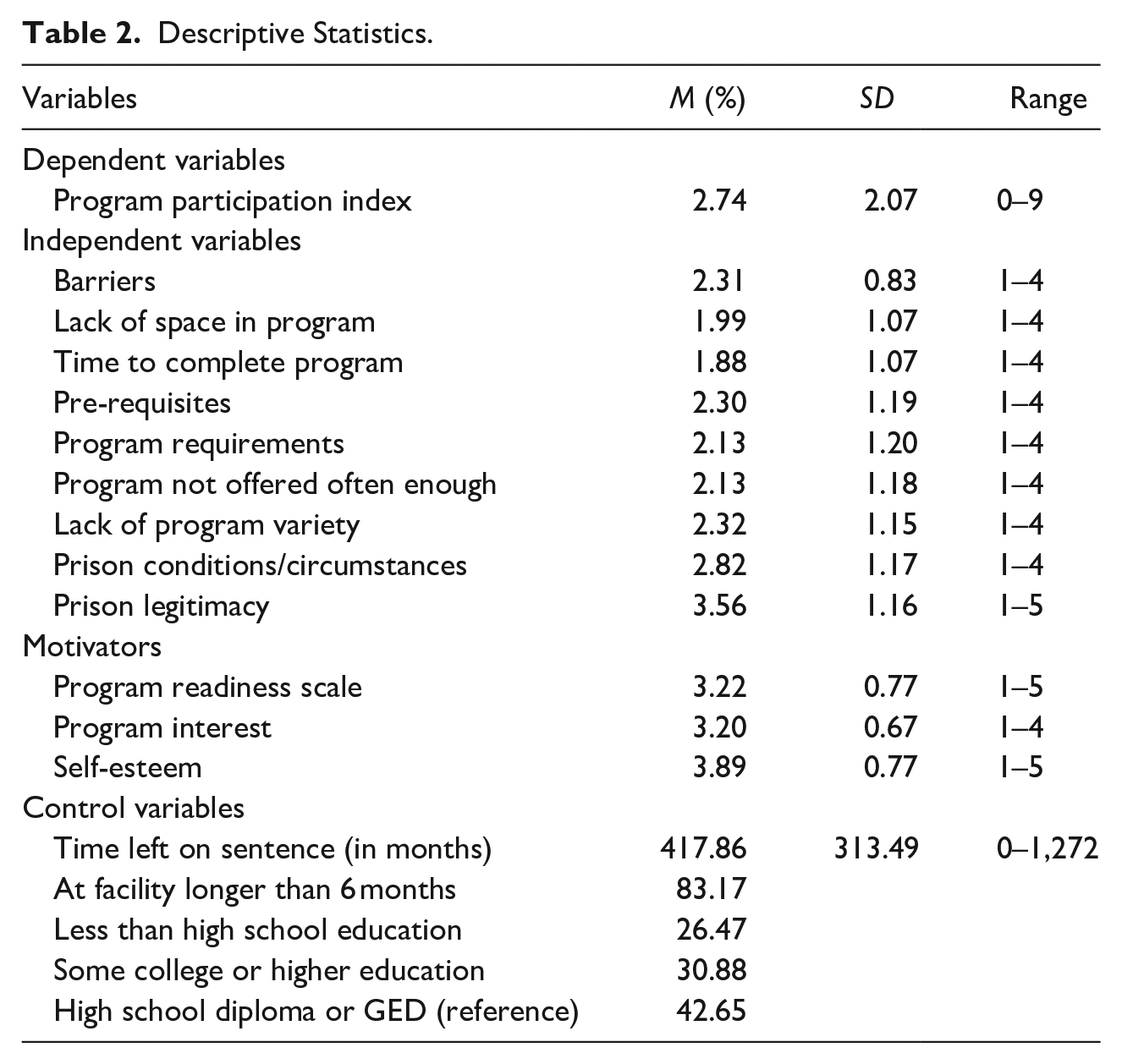
The descriptive statistics for all variables are presented in Table 2. The dependent variable of interest in this study is program participation. Inmates were asked to report whether they had participated in any of the programs offered by the facility. Specifically, participants were asked to indicate whether they had participated in types of programs that the facility reported they offered 3 (yes = 1 and no = 0) as well as an option to add any additional programs that they participated in that were not listed. These dichotomous items were then added into an index of program participation, with scores ranging from 0 to 9. On average, inmates in the study participated in an average of 2.74 program types (SD = 2.07).
Descriptive Statistics.
Independent Variables
Barriers
We include seven measures representing various types of institutional and programmatic barriers to program participation that inmates might experience: (1) lack of space in the program; (2) length of time to complete program; (3) pre-requisites needed to get into the program; (4) program requirements or expectations; (5) programs not offered often enough; (6) lack of program variety; and (7) prison conditions or circumstances. For each barrier, respondents were asked to indicate “to what extent, if any, the following factors have been a barrier to participating in [facility] programs” with response options including 1 = not a barrier; 2 = somewhat a barrier; 3 = moderate barrier; and 4 = extreme barrier. The barrier for time to complete the program had the lowest average score (1.88; SD = 1.07) indicating less of a barrier and prison conditions or circumstances had the highest average at 2.82 (SD = 1.17) indicating more of a barrier. Finally, a combined measure of the average score across all seven barriers was created with an average score of 2.31 (SD = 0.83, Cronbach’s alpha = .80).
A measure of prison legitimacy was also included as a potential barrier to program participation as it is hypothesized that lower beliefs in the legitimacy of the prison institution may reduce inmates’ trust in programs being offered by the prison administration. Three questions were included that asked inmates to respond to the following statements on a 5-point Likert scale (1 = strongly disagree; 5 = strongly agree): “I should accept the guards’ decisions even if I think they are wrong,” “I should do what the guards tell me even if I disagree” and “You should do what the guards tell you even if you do not like the way you are treated” (Reisig & Mesko, 2009; Cronbach’s alpha = .79).
Motivations
Several measures were included to capture inmate’s motivation to participate in prison programing. First, a 7-item scale was created to represent an inmate’s desire or self-perceived need for prison programing to assess internalized motivation or program readiness. These items asked inmates to respond using a 5-point Likert scale (1 = strongly disagree; 5 = strongly agree) to the following statements: (1) “I need help with my problems;” (2) “My life is out of control;” (3) “Programs and classes give me a chance to solve my problems;” (4) “I need help with my emotional troubles;” (5) “I need counseling sessions;” (6) “I need educational or vocational training”; and (7) “I need medical care and services.” These items were adapted from the validated CJ Client Evaluation of Self and Treatment scales created by the Texas Christian University (TCU CJ CEST). The TCU CJ CEST instrument was created to specifically assess an individual’s readiness for drug treatment. We adapted these items to more broadly encompass program need or readiness for more general treatment-based programs as well as vocational and educational programing. Results of the confirmatory factor analysis showed acceptable model fit (χ2 = 13.49, p = .49; RSMEA = 0.0; CFI = 1.00) and a Cronbach’s alpha of .68.
Second, a 12-item measure of program interest was included to capture an inmate’s reported interest in participating in prison programs. Inmates were asked to report on a 4-point scale (1 = not at all interested, 2 = minimally interested, 3 = somewhat interested, and 4 = very interested) their level of interest in participating in any of the program types offered by the facility (Cronbach’s alpha = .83). Responses reported an average interested of 3.20 out of 4 (SD = 0.67), suggesting moderate to strong interest in programing.
Third, inmates’ level of self-esteem was captured using a 6-item scale adapted from the TCU Psychological functioning scale (Cronbach’s alpha = .68). Inmates were asked to report on a 5-point Likert scale (1 = strongly disagree, 2 = disagree, 3 = either, 4 = agree, and 5 = strongly agree) to questions such as “I have much to be proud of” and “I feel like a failure” (reverse coded). Inmates scored an average of 3.89 on the self-esteem scale (SD = 0.67).
Additional variables were included in the final stage of analysis only. These measures include a 12-item measure of procedural justice (Cronbach’s alpha = .92), which included questions such as “staff members at the correctional facility treat me with respect” and “staff members at this correctional facility apply the rules accurately.” A 3-item measure of prison effectiveness (Cronbach’s alpha = .85) was also included which asked inmates to respond whether they agreed on a 5-point Likert scale to the following questions: “The guards are doing well in controlling violent crime,” “I feel safe in community spaces in the prison,” and “The guards are doing a good job of preventing crime in the prison.” Measures for grit (10-items, Cronbach’s alpha = .69), self-control (13-items, Cronbach’s alpha = .80), and decision-making (9-items, Cronbach’s alpha = .73) were included to represent personality traits. Additional measures were included to assess differences in emotional and mental state, including anxiety (7-items, Cronbach’s alpha = .78), depression (6-items, Cronbach’s alpha = .73), and anger (5-items, Cronbach’s alpha = .81). 4
Several control variables were included. First, a variable for the amount of time left on the inmate’s sentence, reported in months was included. Inmates had an average of almost 35 years left on their sentence (SD = 313 months; range = 0–106 years remaining on sentence). 5 We also included dichotomous variables for whether the inmate had been at the facility for 6 months or more as well as whether they had less than a high school education or some college or more (high school diploma or GED as the reference group). Finally, we assessed for differences in age and race as well.
Analytic Strategy
Analyses were completed in three stages. 6 First, bivariate correlations were estimated to determine whether the independent variables were correlated with program participation. Prior to the estimation of the multivariate model, we conducted various model diagnostics to assess for the potential of collinearity. Variance inflation factors were all well below the conservative cut-off of 4.0 (J. Fox, 1991) and the condition indices were at 35, which is slightly above the recommended threshold of 30 (Belsley et al., 1980). Second, we conduct a series of Poisson regression models with robust standard errors to estimate the effects of barriers and motivators on the prevalence of inmate program participation. 7 We used multiple imputation to address potential bias caused by item-response missing data (Allison, 2000). Using Stata, 15.1 we generated 20 imputed data sets in a process that included all variables in the present study. 8 Finally, a multivariate analysis of variance (MANOVA) was performed to examine the differences in inmate characteristics across groups of inmates who reported on the prison conditions as a barrier to program participation.
Results
The correlation matrix presented in Table 3 provides an initial assessment of the associations between the relevant variables of interest and inmate program participation. Of the seven barriers to participation measures, three were statistically significant at the bivariate level. The lack of space in the program (r = −.20, p < .05) and the program not being offered often enough (r = −.14, p < .10) were both negatively associated with program participation. Prison conditions or circumstance barriers (r = .14, p < .10) as well as prison legitimacy (r = .23, p < .01) were all positively and significantly associated with program participation.
Correlation Matrix.
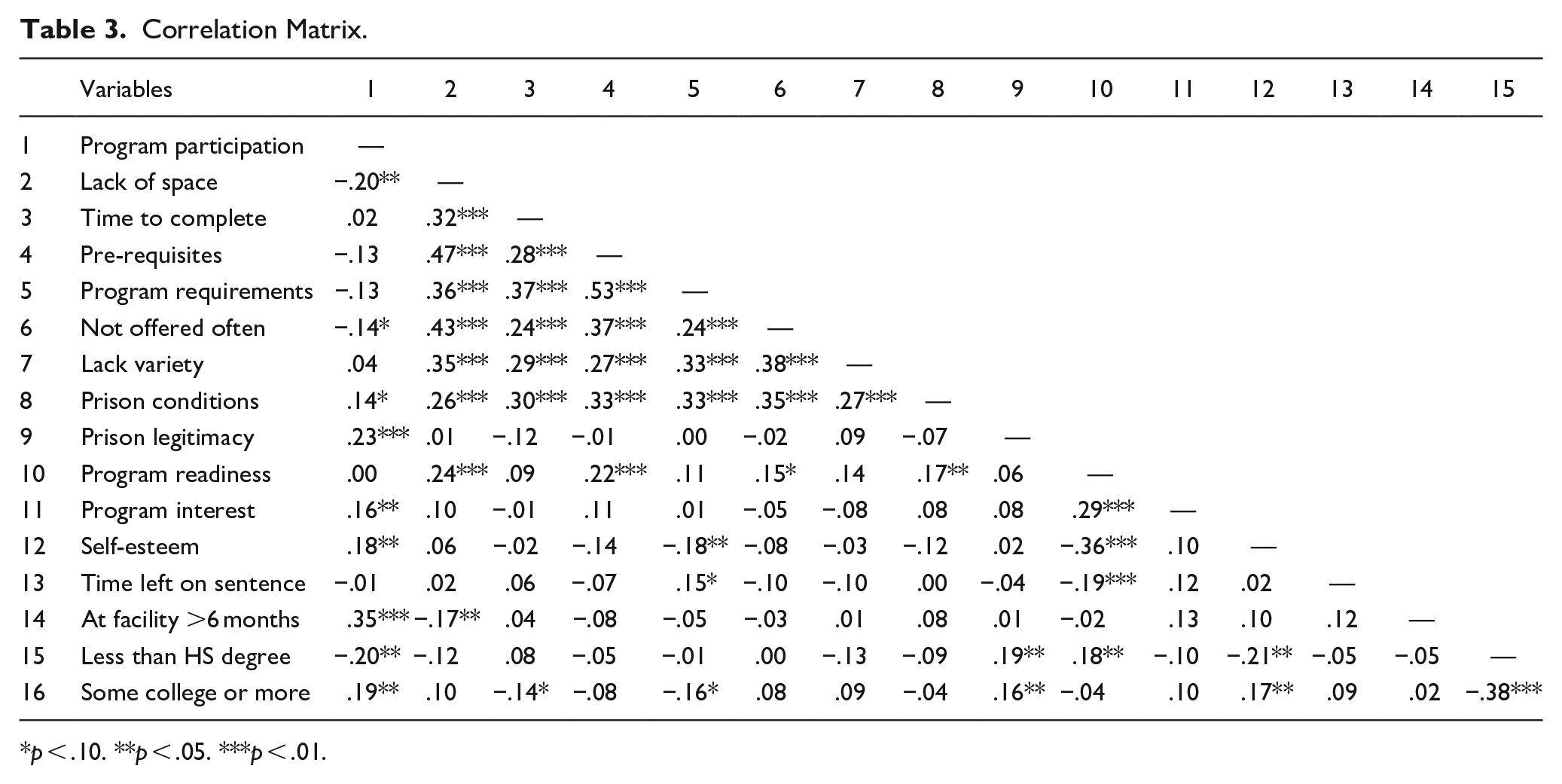
p < .10. **p < .05. ***p < .01.
Moving to the multivariate analysis, Table 4 shows the Poisson regression model assessing the effects of barriers on program participation in a multivariate context. Model 1 presents the effects of a barriers model without the motivation measures included. In this model, four of the barriers showed statistically significant effects. Inmates who reported lack of space in a program (b = −0.13, p = .04) were 12% less likely to participate in prison programs, while inmates who reported prison conditions as a barrier were about 14% more likely to participate in prison programs (b = 0.13, p = .01). Prison legitimacy was also positively associated with program participation in this model (b = 0.11, p = .01).
Poisson Regression Model for Program Participation: Barriers Model and Motivators Model.

Note. n = 206. Incident Rate Ratios (IRR) are presented for estimates with a p < .10. CI = confidence interval; SE = robust standard errors.
p < .001.
Model 2 on Table 4 presents the results of inmate motivation on program participation without the inclusion of the barriers measures. In this model, two of the motivation measures were found to be statistically significantly related to program participation. First, inmates who reported higher levels of interest in prison programs were about 24% more likely to report program participation (b = 0.22, p = .01). Second, inmate’s reported level of self-esteem was also positively associated with program participation, providing a modest significant effect (b = 0.16, p = .02).
Next, Table 5 presents the full estimated Poisson regression model of prison program participation. Model presents the effects of barriers and motivation measures regressed onto prison program participation. In this model, all measures that were found significant in prior models remain statistically significant. The significance of the barriers model changed only slightly once the measures of motivation were included in the model. In this final model, inmates who reported a lack of space in the program were about 15% less likely to report participation in programs (b = −0.15, p = .01), compared to 12% in the barriers-only model. Inmates who reported prison conditions or circumstances as a barrier to participation were about 12% more likely to report participation in programs (b = 0.13, p = .01) compared to 13% in the prior barriers-only model. Additionally, while the effects of prison legitimacy reduced slightly as well, it was still the case that inmates who reported higher beliefs in the legitimacy of the prison were significantly more likely to participate in prison programs (b = 0.09, p = .02). The motivation measures of program interest and self-esteem remain significant in this model as well. In this fully estimated model, the effects of program interest saw a percent change in program participation of about -5%, with inmates who report higher levels of program interest 1.19 times more likely to report program participation. The effect of self-esteem did not change (b = 0.16, p = .00).
Poisson Regression Model for Program Participation: Full Models.
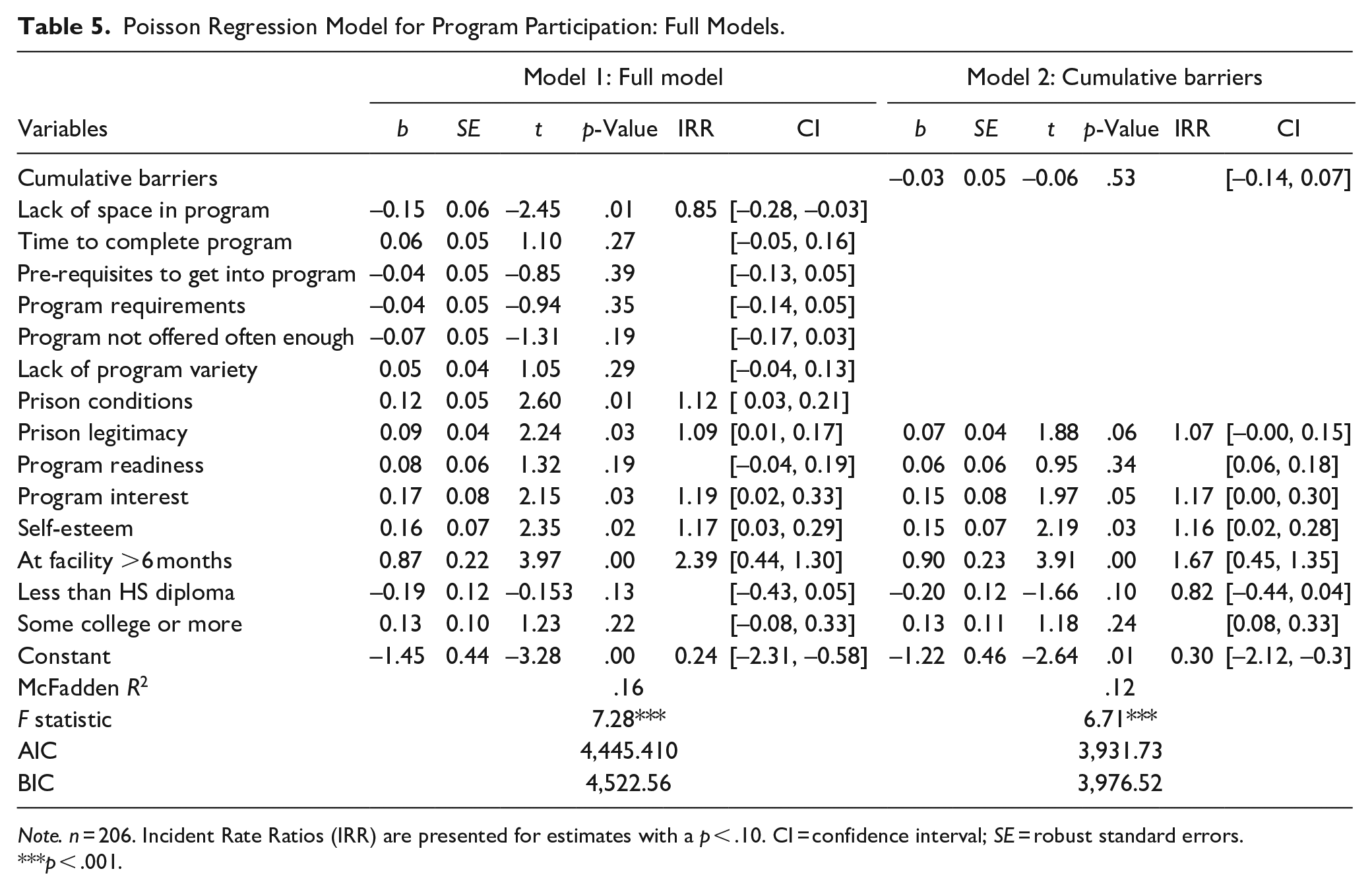
Note. n = 206. Incident Rate Ratios (IRR) are presented for estimates with a p < .10. CI = confidence interval; SE = robust standard errors.
p < .001.
To examine for possible cumulative effects of barriers on program participation, we estimated the effects of total barriers (excluding prison legitimacy) on prison participation with all additional covariates (not including the individual barrier measures) in Model 2 on Table 5. The total barriers measure was not significant. All other covariates that were significant in the previous model retained significance with the addition of less than high school diploma becoming significant in this model. In this model, inmates who had less than a high school diploma were about 18% less likely to participate in prison programs than those with a high school diploma.
Supplemental Analyses
The finding that inmates who reported prison conditions as a stronger barrier were more likely to report participating in prison programs was contradictory to the hypothesized outcome as we had anticipated reported barriers to hinder program participation. To delve more deeply into this finding, we performed a subsequent MANOVA analysis to assess differences among inmate characteristics and how they responded to the question on prison condition barriers to see whether variations in certain inmate characteristics would emerge. The results of the MANOVA are presented in Table 6.
Relationship Between Inmate Characteristics and Responses to Prison Conditions as A Barrier.

p < .10. **p < .05. ***p < .01.
In the MANOVA model, we included several theoretically informed inmate characteristics that we thought may partially explain the differences in inmates reporting prison conditions as a barrier. We used the Pillai-Bartlett trace for the omnibus test statistic, which has been found to be more robust (Olson, 1976). The MANOVA omnibus test statistic was statistically significant (F = 1.31, p = .08), rejecting the null hypothesis that none of the inmate characteristics differ across the inmate subgroups.
Of note, significant differences were noted in procedural justice and perceptions of prison effectiveness. The univariate F-tests reveal that those who reported prison conditions to be an extreme barrier had lower average scores on procedural justice (F = 6.81, p < .01) and prison effectiveness (F = 2.61, p < .10) than inmates who did not report prison conditions as an extreme barrier. Additionally, inmates who reported prison conditions as an extreme barrier to program participation had statistically significantly higher levels of anxiety (F = 2.32, p < .10). Conversely, inmate who reported prison conditions as “not a barrier” had the lowest average levels of anxiety, depression, and anger compared to all other responses. 9
Discussion
Addressing and lowering the likelihood of recidivism is one of the most daunting criminal justice problems. This is the case because more than half of prison inmates released each year will recidivate in the ensuing 36 months, and well over 80% will do so 9 years later (Alpert & Durose, 2018). Finding ways to stop the cycling in and out of prison is, therefore, a critical policy issue in need of attention. Thus far, evidence has consistently documented the risk factors for crime that need to be addressed when prisoners are institutionalized, many of which involve cognitive skills, job training, and educational attainment. Participation in prison programs may also lower rates of prison misconduct and increase compliance within a prison setting. The extent to which these programs are available, staffed, and scaled-up is one matter, but so too is the inmate’s motivation to participate in them and the extent to which they perceived barriers to doing so.
This study explored the barriers and individual characteristics associated with program participation in one private prison in the southern United States. Our study led to three key findings. First, we found that inmates’ perceived lack of space in program as well as their perception that programs were not offered often enough limited their participation in prison programs. These are important barriers that stand in the way of inmates gaining skill sets and/or having their needs attended to that could thwart a successful re-entry. Other program-related barriers, such as the length of time to complete the program and program requirements, were not found to significantly impact inmate participation. Second, we found several inmate characteristics to be associated with higher program participation, including a higher perception of prison legitimacy, an interest in programs, higher self-esteem, and being at the facility longer than 6 months. Two of these, legitimacy and self-esteem, have been found to be associated with lower offending and lower recidivism (e.g., Fagan & Piquero, 2007; Trzesniewski et al., 2006). The other, having been at the facility over 6 months, is likely reflective of either the inmate having the time to participate in programing and/or recognizing the importance of program participation for the development of important skills. Still, having programs available for all inmates is important because the programs that seek to support re-entry efforts and lessen the risk of recidivism could also be applicable to reducing prison misconduct and other criminal activity within prisons that places inmates, staff, and visitors at great risk.
Lastly, when we further explored the relationships between inmate characteristics and responses to prison conditions as a barrier, we detected some unique nuances. Specifically, we observed the strongest differences at the tails of the perceived barrier measure (i.e., not a barrier vs. extreme barrier) such that those with more positive individual characteristics, such as greater self-control, less anxiety, less depression, less anger, and greater perceptions of procedural justice, were more likely to report no barriers to extreme barriers. This is decidedly interesting pattern of results as it may be reflective that individual characteristics influence how individuals see and interpret situations and contexts around them (e.g., Piquero et al., 2004). Therefore, attending to these individual characteristics, aside from potentially reducing the likelihood of recidivism, may also help increase program participation.
Readers must be aware our work has some limitations that need to be recognized. First, although we were able to assess program participation with some types of programs, our measure of program participation is limited as we are unable to assess the quality or frequency of that participation. Second, as noted earlier, we had a low response rate and while we found few differences between our sample and the characteristics of the general prison population, we cannot definitively rule out any selection effects. Third, this study was conducted at a private prison that housed only male inmates, the results may not be generalizable to public prison facilities, which may differ in programing, barriers, and inmate populations. Fourth, many of the inmates included in this study had longer sentences than may be representative of other prisons, with over 40% of inmates serving life sentences, which is substantially higher than the national average of 14%. Although conducting surveys with inmates is difficult and low response rates are to be expected (K. Fox et al., 2011; Lane & Fox, 2013), we must temper our results accordingly. Lastly, although not a primary purpose of this study, we did not conduct a follow-up to examine whether program participation was related to recidivism. Future research seeking to build upon this work should consider this type of longitudinal study to assess how programs are available, delivered, and targeted to inmates and then whether program participation has any influence on offender re-entry. Additionally, researchers should further study capacity constraints with respect to program participation and re-entry.
Our results show that a mixture of prison-specific and individual-specific factors are related to inmates’ perceptions of barriers to program participation. Addressing both of these needs is important in order to increase prison programing aimed at not just reducing recidivism and easing the re-entry process back into society so that ex-inmates can find a pathway toward a more prosocial life, but also for those inmates who will be incarcerated for a lengthy period of time in order to reduce the chances of prison misconduct. As efforts ramp up with respect to the First and Second Chance Acts, it is imperative that prisons provide the organizational, structural, and institutional reforms necessary in order for evidence-based practices are put into place in order for offenders to seek their participation. As well, efforts should be made by prison personnel to encourage or create conditions that encourage offenders to seek out these programmatic activities. This dual approach, of creating the environment and spurring interest, is the best approach to get the services to the individuals before they are released—as well as when the transition back into society—in order to increase the chances of a successful re-entry.
Footnotes
Declaration of Conflicting Interests
The author(s) declared no potential conflicts of interest with respect to the research, authorship, and/or publication of this article.
Funding
The author(s) received no financial support for the research, authorship, and/or publication of this article.
