




Abstract
As cities across the country experience an influx of White and middle- to upper-class residents, new opportunities for the integration of urban schools emerge. Yet crucial challenges persist even when equity and inclusion are a focus for new stakeholders. This article explores the story of a largely White group of parents committed to investing in and reforming their gentrifying neighborhood’s elementary school. Given the numerous tensions that ensued, fostering leadership, equity, and intercultural awareness remains vital to ensuring that the new urban diversity also produces just and inclusive schools.
After decades of explosive suburban expansion and corresponding urban decline, cities in America’s large metros began outpacing growth in their surrounding suburbs between 2010 and 2013 (Frey, 2014). Regardless of whether this trend signals a long-term resurgence of cities or a short-term by-product of the Great Recession keeping young adults and families in place (Frey, 2015), it carries potentially significant ramifications for urban school systems. If the Millennials, graduates, and young professionals who make up a substantial portion of today’s urban growth (Frey, 2013) choose to reinvest in city schools, they could ease the stark isolation and resource inequity that defines most urban districts (Anyon, 1997; Noguera, 2003; Orfield & Frankenberg, 2014). And because racial and economic segregation continues to be linked to a variety of educational harms (see, for example, Linn & Welner, 2007), even as well-designed diverse schools are associated with numerous academic, social, and civic benefits (Hawley, 2007; Mickelson & Nkomo, 2012), encouraging such reinvestment may be seen as a worthy policy goal.
There is some early indication that young, largely White, and middle- to upper-class families are engaging with urban school districts. Indeed, a small but growing number of studies—largely from the field of sociology—have begun to document the different processes related to gentrification and schools (Cucchiara & Horvat, 2009; Kimelberg & Billingham, 2012; Posey, 2012; Reay et al., 2007; Stillman, 2012). Numerous gaps remain in this nascent research strand, however. These include a clear understanding of how school gentrification processes are perceived by multiple stakeholders, including leadership in the surrounding community, and how earlier school desegregation theory and research applies to 21st-century urban school reinvestment.
This study examines these issues in a midsized southern city undergoing substantial demographic shifts. Focusing on a rapidly gentrifying neighborhood and school in the eastern section of the city, an area historically defined by highly concentrated poverty, we examine the following research questions:
The answers to these questions shed important light on complex and interrelated processes related to urban school reinvestment.
Literature Review
In the past decade or so, as renewed interest in city living has mounted among the Millennials and the “creative class,” or young educated workers and professionals engaged in innovation (Florida, 2003), a corresponding area of research has emerged. It examines how and why middle-class, largely White families have begun choosing urban schools after many decades of retreat to private schools or surrounding suburban systems. Three significant areas of that research helped inform the following analysis: (a) the values driving middle-class, largely White parents to choose urban schools, (b) the anxieties experienced by those parents, and (c) the tensions that often ensue when they engage with urban schools. This work is considered alongside an existing body of social-psychology research documenting the conditions under which contact between different groups results in positive outcomes (see, for example, Pettigrew & Tropp, 2006) and sociological theory regarding the intergenerational impact of segregation (Wells & Crain, 1994). Below, we weave an exploration of what recent literature says about each of these areas with what earlier research and theory tells us about the dynamics of school desegregation.
Values Driving Middle-Class, Largely White Parents’ Choice of Urban Schools
Qualitative research has linked White, middle-class reinvestment in urban schools to progressive ideology and a desire to promote social justice. Parents felt committed to investing in their local public schools as part of “walking the walk” with regard to a professed commitment to egalitarian principles (Posey, 2012; Stillman, 2012). More concretely, they viewed the time and energy that they brought with their reinvestment as an important resource for improving educational opportunities for all children attending the school (Cucchiara & Horvat, 2009; Posey-Maddox, 2014).
Past studies also have shown that middle-class families saw diversity as an important component of education, one that would help prepare their children for the “real world” later in life (Devine, Savage, & Ingram, 2012; Kimelberg & Billingham, 2012). International literature finds similar themes emerging from parents in Paris and London, though Paris families were more likely to emphasize the importance of redressing social ills like segregation and inequality while London families valued the diversity found in urban public schools (Raveaud & van Zanten, 2007).
For many of these families, a preference for urban living undergirded an appreciation for diversity. One team of researchers termed reinvesting parents “urban seeking” (Devine et al., 2012), noting that their choice of an urban school reflected a desire to see the rich diversity of the city reflected in the educational environment of their children. This urban ethos was often accompanied by a commitment to exposing their children to a more heterogeneous schooling environment than the one they grew up in. For instance, New York area parents interviewed about the decision to send their children to urban schools talked about a desire to shed their own privilege and to be unique “pioneers” in their urban community (Stillman, 2012).
The pioneer mentality in some ways goes against perpetuation theory, a framework that suggests segregation has an intergenerational effect—such that attending a racially homogeneous school environment as a child makes one more likely to seek out similar settings for offspring (Wells & Crain, 1994; Wells, Duran, & White, 2011). The reverse is also true; children who experience diverse schools at an early age are more intent upon living in a diverse neighborhood and sending children to a diverse school (Mickelson, 2011). However, the seminal, 1990s-era article regarding this theory reviewed litearture on the effects of school desegregation on the long-term choices of Black students with regard to colleges, workplaces, and neighborhoods (Wells & Crain, 1994). Newer research showing that some White, middle-class families are choosing urban schools because they provide something different for their children has been conducted with a different population and generation, and may offer a window into how ongoing and dramatic demographic change will shape future values about education.
What Worries Middle-Class, Largely White Parents About Choosing Urban Schools
Despite their strong convictions about the value of diversity and the importance of helping to right social wrongs, existing studies have uncovered numerous anxieties among middle-class, largely White parents who choose urban schools for their children. Many wrestled with serious doubts about their decision. Recent research conducted in Philadelphia, for example, found that families viewed neighborhood public schools as risky and unsafe, in addition to worrying about how their children would fare as a racial minority (Cucchiara, 2013). Middle-class, largely White families also spoke of concerns about the school leadership, the quality of teaching, and the rigor of classwork (Cucchiara, 2013; Stillman, 2012). Those beliefs were pervasive even in the face of disconfirming evidence, indicating that the stigma associated with urban schools and systems was difficult to counteract.
Given those anxieties, largely White and middle-class families reevaluated their decision to send children to urban schools with some frequency. Some spoke dubiously about committing to secondary urban public schools, preferring instead to take things one grade at a time (Cucchiara, 2013; Kimelberg, 2014). These attitudes, and the anxieties that lay beneath them, gave rise to a sense of moral ambiguity—a dilemma between what parents believed to be just and important in principle versus what they saw as best for their children (Crozier, Reay, & James, 2011). A widely popular sociological framework examining social and cultural reproduction in education (Bourdieu, 1986) helps explain such tensions. It posits that middle-class parents—even those who are committed to egalitarian principles—seek to ensure that the education of their children will help reproduce their own cultural and social standing. In other words, advantaged parents want to make sure that education helps maintain advantage for their children.
What Mitigates the Worry
At the same time, research indicates that many reinvesting families have found ways to navigate tensions and anxieties. Middle-class parents who remain committed to urban schools have often defined themselves in opposition to parents making different choices. They viewed the families who did not remain in such schools—or who failed to choose them in the first places—as overprotective (Cucchiara, 2013). The trend toward “helicopter parenting” helped cement those convictions, as parents who did choose urban schools reassured themselves that their children will be more prepared for the realities of life beyond a sheltered childhood.
When it comes to a perceived lack of academic challenge in urban schools, middle-class, largely White families choosing such settings often believed that they could provide enough support and enrichment at home to supplement what is offered at school (Kimelberg, 2014). These parents felt confident that their own educational, cultural, and social capital would translate into achievement for their children. They also tended to view schools (particularly elementary schools) as settings that offer more than just academic instruction—indeed, they saw them as places where important social and democratic values were learned (Kimelberg, 2014).
Middle-class anxiety also tended to be mitigated or managed by the presence of a group support system. Existing research finds that middle-class, largely White families who chose urban schools valued the idea of a “critical mass” of families and children like their own who will simultaneously make the same choices (Cucchiara, 2013; Kimelberg & Billingham, 2012; Posey-Maddox, 2014). Finding and extending that critical mass allowed families to stay true to their social justice principles, while ensuring that a certain number of community members had similar backgrounds and privileges (Devine et al., 2012).
Yet, the sudden presence of a growing group of middle-class, largely White families in schools or school systems that have long struggled with the fallout linked to White and middle-class flight from the same schools and systems decades ago is often linked to tension. Struggles over clustering, resources, leadership, and reform and marketing efforts have all surfaced in the prior literature.
Tensions That Ensue When White, Middle-Class Parents Reinvest in Urban Schools
Perhaps as a result of the desire to develop and maintain a critical mass of middle-class, largely White families and students in otherwise segregated urban school systems, research indicates that such families are often clustered in a handful of schools (Kimelberg & Billingham, 2012; Siegel-Hawley, 2013). One study of an urban district in the South found two elementary schools reporting that White students accounted for more than 60% of the enrollment in a city school system that is just 10% White (Siegel-Hawley, 2013). This kind of “overclustering” (Kimelberg & Billingham, 2012) is related to the fact that White and middle-class families often make school and housing decisions based on informal information from networks of friends and acquaintances (Holme, 2002; Petrilli, 2012; Roda & Wells, 2013). If those networks only view one or two schools in an urban district as desirable—a trait connected at least in part to the desire for a critical mass—then White and middle-class reinvestment can exacerbate system-wide segregation.
White and middle-class families choosing urban schools have also been likely to view school reform or transformation efforts as critical to the reinvestment process. Yet in channeling their resources and energy into making the school a “viable” option for other families like them, they have in some cases disempowered or marginalized low-income families of color (Posey-Maddox, 2013; Posey-Maddox, Kimelberg, & Cucchiara, 2014). For instance, middle-class and White families have often undertaken major fundraising, event planning, and marketing efforts to make improvements and raise the school’s profile (Posey-Maddox, 2013); actions that may invite tension with school leadership and families who have long been committed to the school. Research out of New York also has indicated that reinvesting families viewed longstanding school principals as not being able to navigate the politics of diversity after many years of intense racial and socioeconomic isolation (Stillman, 2012). The same study found that reinvesting parents defined themselves in stark contrast with existing families—with perceived differences in attitudes and priorities around what makes for quality schools (Stillman, 2012). Adding fuel to the fire, within-school inequities (e.g., which classes have access to field trips and how children are assigned to teachers) can also mount when middle-class parents reinvest. Those families have often worked to ensure that their active participation and financial investments benefit their children (Cucchiara, 2013).
Gordon Allport’s (1954) intergroup contact theory offers one lens through which to view the tensions and inequities that have arisen from recent White and middle-class reinvestment in urban schools. His book, The Nature of Prejudice, suggested that four conditions were necessary for contact between different groups to reduce prejudice. These included ensuring that all group members had came into frequent contact with equal status, were working cooperatively toward common goals and experienced strong leadership supportive of those conditions (Allport, 1954). Allport’s theory has been affirmed across hundreds of national and international studies (see, for example, Pettigrew & Tropp, 2006). If one or more of his conditions are not met, the benefits related to contact between groups—reduced prejudice, less willingness to stereotype, and more friendship across racial lines—may not surface as readily.
In short, a slowly growing body of national and international literature exists on White and middle-class reinvestment in urban schools. Contemporary U.S. studies dealing with reengagement in urban schools, nearly all of which are qualitative in nature, focus on northeastern cities like Philadelphia, New York, and Boston. They examine various aspects of the reasons for reengagement (Kimelberg & Billingham, 2012; Posey, 2012; Reay et al., 2007), as well as the consequences of it (Cucchiara & Horvat, 2009; Posey-Maddox, 2013; Stillman, 2012)—largely from the perspective of White and middle- to upper-class parents. This newer work stands alongside a robust research and theory base related to school desegregation (see, for example, Braddock, 2009; Linn & Welner, 2007; Pettigrew & Tropp, 2006; Schofield, 1995; Wells & Crain, 1994). The following study will link and extend upon these two bodies of literature by digging deeply into the motivations and tensions surrounding the initial reinvestment of a group of majority White, middle-class families in the formerly de jure segregated South. Innovative mapping technology adds an important sociospatial element to this study of gentrification and schools.
Research Design
This largely qualitative case study explored the various ways in which parents and community leaders conceptualized of White and middle-class reinvestment in an urban school, and how participants’ own experiences, in schools and elsewhere, influenced what they wanted in terms of their child or student’s education. Quantitative and spatial methods also allowed us to examine demographic change in the community and school over time. Case studies are well suited for the exploration of questions dealing with the “whys” and “hows” of a particular issue (Miles & Huberman, 1994).
Site Selection
Based on school attendance zone data and prior involvement in the community, we identified an urban elementary school on the eastern side of a midsized southern city for study. East Side Elementary is located in a neighborhood that has experienced dramatic demographic shifts over the past decade. In the midst of those changes, a grassroots movement, largely spearheaded by the initial group of reinvesting parents, supported the creation of a whole-school International Baccalaureate (IB) program. East Side was fully certified as IB in winter 2015. At the same time, it has struggled to remain fully accredited under the statewide accountability system. For the past 3 years, East Side has been accredited with warning. More than 90% of the students in the school identify as African American, and about 68% of students qualify for free and reduced-price lunch, according to the most recent year of data available. Further details on the school and neighborhood context are provided below.
Data Collection and Methods
Community outreach connected the research team with key members of the parent task force dedicated to transforming the school into an IB setting. From there, study participants were identified through snowball sampling. The research team conducted interviews between April 2014 and March 2015. Most interviews took place at either the participants’ home or a coffee shop located about a block from the school. Each lasted about an hour to an hour and a half, and focused on questions related to participants’ own educational experiences, desires for the educational experiences of their children, attitudes toward recent changes in the east end neighborhood and school and areas of hope and challenges related to those changes. All interviews were recorded and transcribed verbatim with the permission of our participants. We carefully analyzed all interviews to establish emerging themes based on codes found in sociological, social-psychological, and education literature. In addition, we examined primary documents, such as newspaper articles and community announcements, related to the reinvestment process. Findings were checked and rechecked for consistency and authenticity (Miles & Huberman, 1994). This iterative data analysis made for an inductive and open-ended process (Miles & Huberman, 1994).
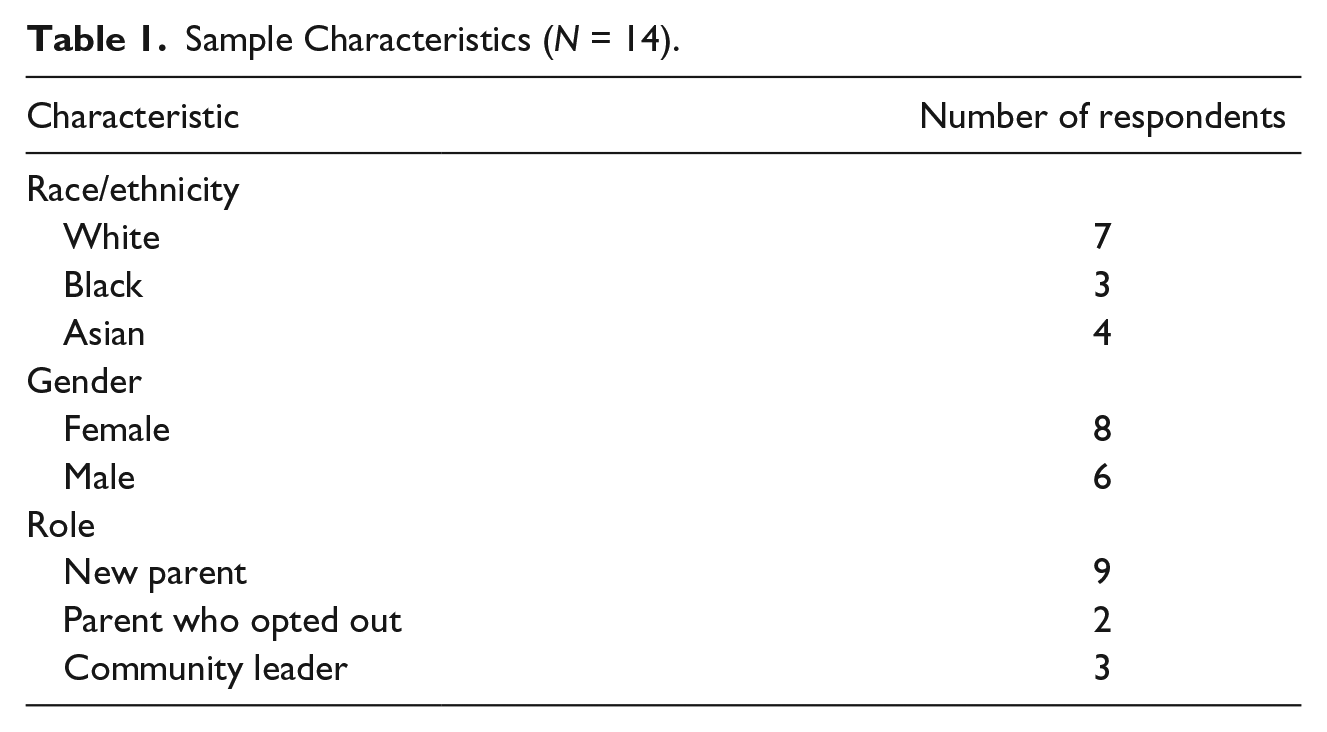
Our initial sample involved 14 participants, half of whom identified as White females and parents new to the east end school (Table 1). Three of our participants identified as Black and four identified as Asian. In addition to interviewing new parents, we spoke with three community leaders.
Sample Characteristics (N = 14).
In addition to the qualitative interviews, we drew upon data from the U.S. Census (1990, 2000, 2010), the National Center for Education Statistics (1992, 1999, and 2009), and a state Department of Education (2005-2014) to create a series of maps and figures illustrating the demographic changes taking place in the east end neighborhood and school. The analysis of these data offered a detailed understanding of the context that shaped participants’ views of the transformation of their community.
Context
In the aftermath of World War II, the eastern side of this midsized southern city became an area associated with deeply entrenched poverty. The deliberate clustering of several public housing projects contributed greatly to the concentration of poverty and residents of color. By 1990, however, a small historic area in the eastern portion of the city was largely White (Figure 1). Alongside that trend, one of the eastern elementary schools reported that White students accounted for roughly 10% of the student enrollment.
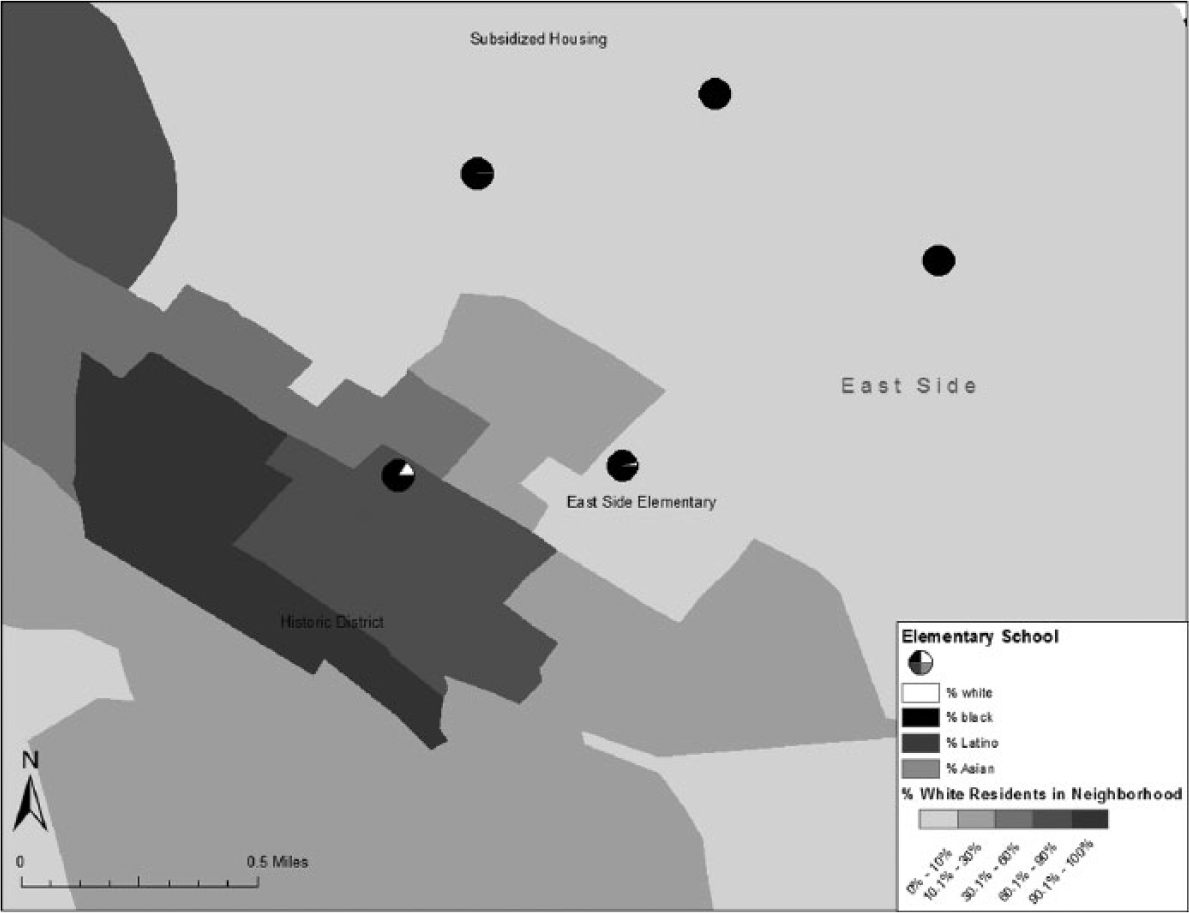
Elementary school racial composition and White population, east side, 1990.
Ten years later, in 2000, a growing share of White residents had fanned northward into other parts of the east side (Figure 2). Corresponding changes were not observed at area elementary schools, however. At the time, Black students accounted for almost 100% of the enrollment at each of the eastern schools. Similar school and housing trends continued into 2010, indicating that gentrification had taken a stronger hold in the northern areas of the east side but that White residents were not using the nearby schools (Figure 3).
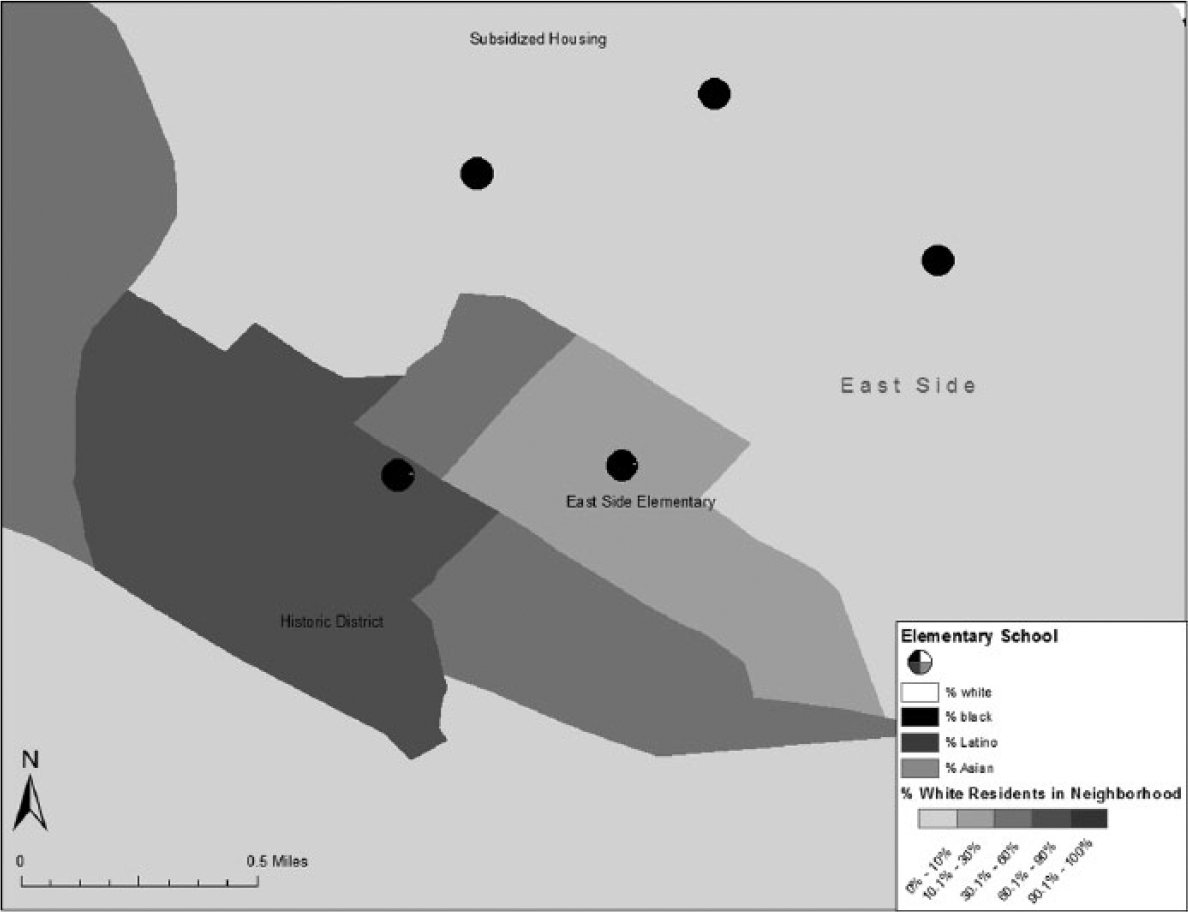
Elementary school racial composition and White population, east side, 2000.
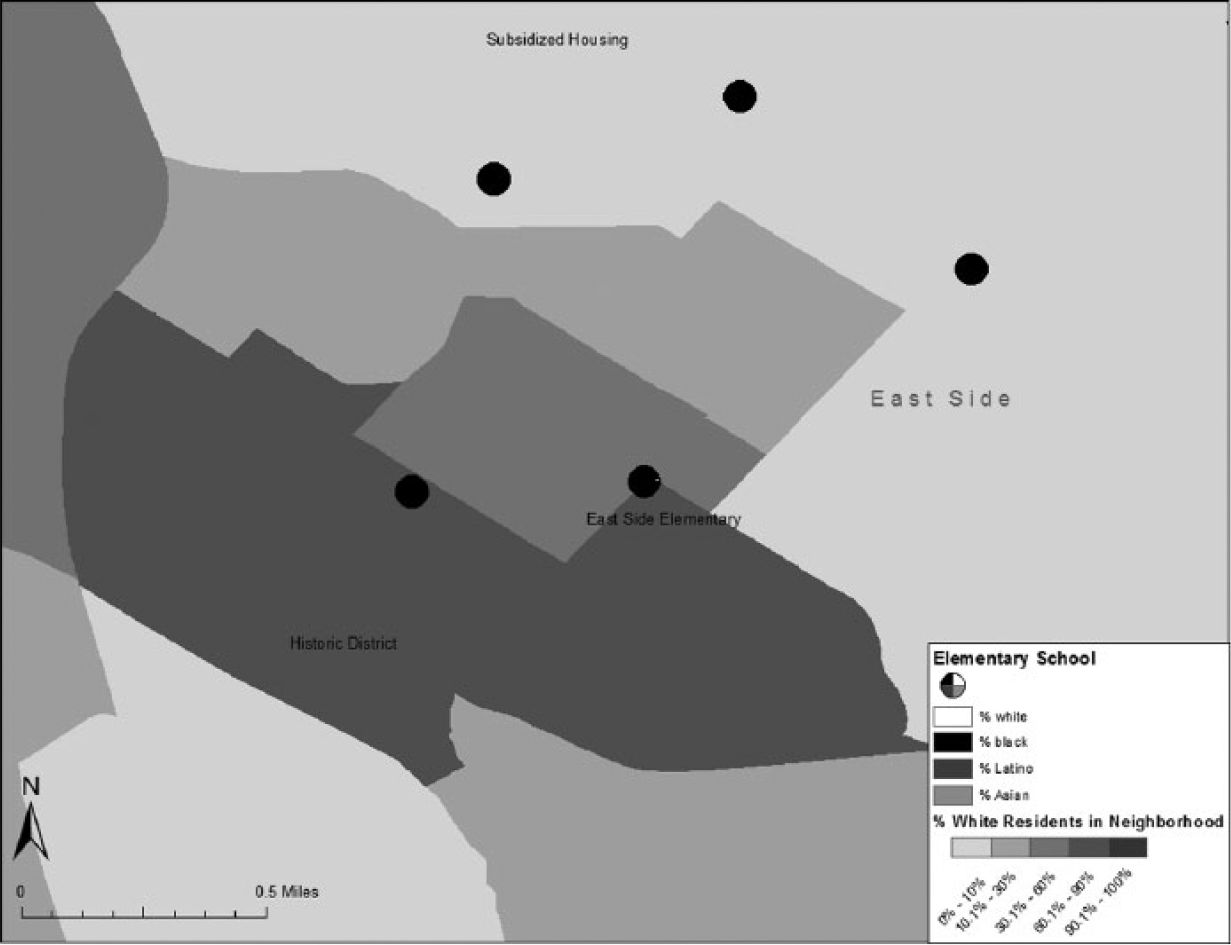
Elementary school racial composition and White population, east side, 2010.
More recent enrollment figures supplement the map from 2010. Beginning in 2011, East Side Elementary reported a small downturn in the share of Black students attending the school. A corresponding increase in White students and students who identified as a race other than White or Black (which included Asian, Latino, American Indian, and two or more races) was also reported. A further analysis of the data, not shown here but available upon request, indicated that White students and students identified with other racial backgrounds were concentrated in the lower grades. Nevertheless, Black students accounted for the overwhelming majority (roughly 95%) of the East Side Elementary enrollment in the latest school year (see Figure 4).
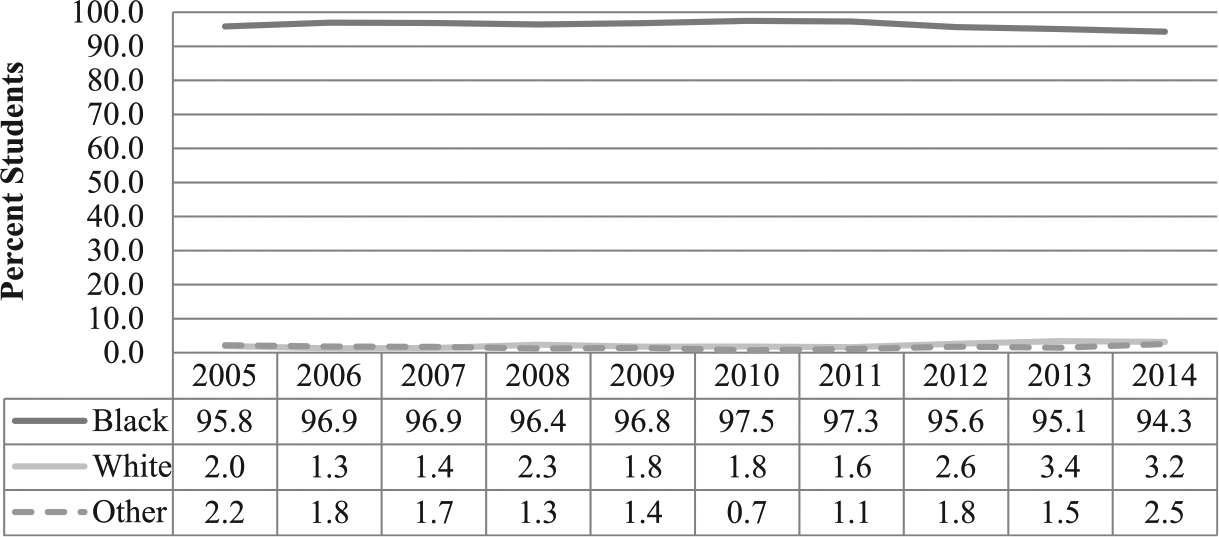
Enrollment by race, East Side Elementary, 2005-2014.
Findings
Three major themes emerged from our interviews. First, almost all of our participants expressed a strong desire to provide their children with an education uniquely different from their own privileged experiences. That desire was connected to communally oriented principles and an intentional commitment to fostering social and racial justice, a second theme that emerged from the interviews. Finally—and perhaps also related to participants’ relative lack of experience navigating diverse educational contexts—a number of different tensions emerged between the school leadership and the core group of advantaged families seeking to reinvest and reform.
A Study in Contrasts: Parent and Child Educational Experiences
As part of our exploration into the motivations behind middle-class reinvestment in the east side school community, we asked participants to share their own educational experiences. These varied widely, from homeschooling to boarding school to public school. Despite the different types of schooling backgrounds, most participants from the initial group of about five reinvesting families saw their own experience as a positive and privileged. One participant said her educational experience was “everything you dream an education should be” as she reflected on a boarding school that was nicer than most colleges. Another commented that he
had a great [educational] experience . . . and for the most part I kind of bought into the culture of all my friends and the people I was with that the public schools were not good places. Kids didn’t learn anything there, so I liked my private school where I was learning a lot.
For our participants, awareness of educational privilege or school quality was often heightened by a transition from one school setting to another. As one participant talked about switching from a public school to a private day school, she said,
I certainly know now that my parents made a choice to say I’m comfortable with this [public schools] when we were young and it was a very homogeneous population anyway in elementary school, but as we got older, private education I think was the absolute only choice for my parents.
Study participants who did attend public school often went to more affluent schools by virtue of residential segregation by race and socioeconomic status. Recent research has referred to these types of schools as “private public schools” due to their exclusivity and student population (Petrilli & Scull, 2010). As one White participant explained,
So it was a town of about 25,000 people, probably one family of color. Very safe, very kind of Pleasantville, but um, extremely elite, exclusionary, and not at all a community where a person of color or a person from a subdominant community would feel comfortable . . . and my school environment reflected that.
Another participant offered,
You probably have a picture already of my experience . . . suburban public school, White, majority White, middle- to upper-middle class. Yeah and how that’s informed where I am today is that I’ve built a real commitment to the public school system.
So while the public school experience of this participant was far more racially and economically homogeneous than what she would ultimately seek out for her children, it did foster strong support for the ideals embedded in public education.
Those ideals prompted most participants to choose a radically different type of schooling experience for their children. One participant described how a quality education was the most important thing to his immigrant parents, yet,
we have chosen to go a very different route, partly because of um, just kind of the priorities that we feel like are true about our life. I mean I grew up in a fairly middle-upper class, highly motivated, important, education’s the most important thing and uh, while I’m thankful for that and feel I have benefited a lot from that I think our faith has informed a different set of priorities for us. We saw this school is the kind of um, I mean this connection point for everybody. It’s like this great equalizer . . .
As in prior studies, equity, diversity, and exposure to the real world were critical components of the education these parents wanted for their children (Devine et al., 2012; Kimelberg & Billingham, 2012; Raveaud & van Zanten, 2007). One participant described being moved by meeting another set of White parents who had sent their kids through the school system earlier and who now served as role models to the group:
. . . they gave us intense stories . . . [it] was the first time I had . . . a different concept for a rich education. Growing up, I, you know had a very privileged education, but it was lacking in a lot of ways and I still think I am not as full of a person as I could be because I didn’t learn how to relate to and um, be in school with people who were really different than I was . . . I really think that’s the ideal for schooling.
Those later role models stood on the shoulders of others who had inspired the group in college. All members of the initial group of reinvesting parents spoke thoughtfully about a shared alternative spring break experience that opened their eyes to the ongoing intersections between race, place, and inequality. That common lens—and the faith-based leadership that helped foster it—is illuminated in the following narrative:
During our college experience we spent an alternative spring break in Mississippi and we got to know a Christian community development guy . . . [who was] really committed to the 3 R’s, um, reconciliation among races, redistribution of resources kind of across class lines and community lines, and relocation. So the relocation piece I think was probably first that the idea of relocating as White middle-class people to a community outside of the White middle-class community was . . . a key idea that came to us through our experience.
In short, the different educational directions that many in the initial group pursued for their children were motivated not just by the principles of equity and diversity but also by the principle of community.
Communal Orientation
During a period of education policy dominated by competitive, market-based reforms often associated with individualistic values (Carter & Welner, 2013), families and stakeholders committing to the east side neighborhood and elementary school articulated a strong, communally centered ethos. One young White mother summarized the group’s ideals as follows:
Not in my backyard was something that we wanted to fight very dramatically against. Like we wanted to put it in our backyard. We wanted to be the people that, um, were willing to give up gated communities and, you know, country clubs in order to seek equity in all areas. And just being neighbors and knowing people that weren’t given all the amazing things that I was given just by my birthright.
For the group, that communal ethos was based on progressive religious convictions and a belief in the principles of inclusiveness and social justice. The same mother went on to say,
My . . . faith and my beginning for social justice energy were very linked . . . I was exploring what my faith was at the same time that I was being exposed to racial injustice in the South.
Study participants expressed an earnest desire to put their beliefs into practice through daily actions. One local White leader summed it up by simply saying, “You have to do your best to live right. It doesn’t mean you do live right, but you have to [try to] live your ideals.” Many of the initial group of majority White, economically advantaged families also spoke of the intentionality behind their decision to live in the racially and socioeconomically segregated east side community. As one couple said, “We came in with a mission. We came in with a purpose. We came in with intentionality.” With those discussions of intentionality also came the recognition that persistent patterns of racial and socioeconomic segregation would not change on their own.
For the initial group of families, the idea of committing intentionally to their neighborhood also meant committing to their local school. Sending their children to the nearby school, they felt, would signal to longtime residents that they were serious about their investment in the community. The group also believed that pouring their middle-class resources and time into the school would contribute to the long-term health and vitality of the neighborhood. One mixed-race couple described those two convictions in this way:
. . . the thing that has connected us the most to our community is sending our kids to school with our neighbors . . . our decision to be invested in our local elementary school is a part of a more macro vision to be really invested in a local community . . . some of that is the intellectual idea that schools are crucial to the growth and development of a neighborhood.
Believing that the use of the local school was a critical part of contributing to and becoming part of the community often won out over other characteristics parents may have been seeking in an educational environment. As one White mother in the reinvesting group explained, “My desire to invest in the neighborhood kind of trumped what would have been on my list of ‘this is what I ideally want [in a school].’”
Importance of the Group
Within a framework of progressive, faith-based ideology that valued commitment to a broadly diverse community, many of our study participants found comfort and support in their smaller group of like-minded families. One interviewee put it bluntly: “All of us decided we weren’t just going to do this alone. If we were going to do this, we needed to do this together as a group, not just singular.” Community leaders who served as role models for many of the study participants affirmed that strategy both personally and objectively. One of those leaders described his own experience choosing a neighborhood school in the late 1970s: “We moved into the neighborhood. We found another bunch of parents who were moving into the neighborhood at the same time we were who were willing to put their kids in the local public school.” These attitudes reflect similar ones found among parents in Boston, Philadelphia, and elsewhere (Cucchiara, 2013; Kimmelberg & Billingham, 2012; Posey-Maddox, 2014).
Many members of the initial group of families in our study were also committed to growing the number of middle-class students and families in the local school. They did so in part by holding informal information sessions about the new IB educational programming, as well as tours of the facility. In the words of one of the members of the core group of parents, “IB gives us a reason to have yard signs and have people know about [the school], it’s something to latch onto for folks we want to attract resource wise.” These kinds of marketing efforts have been detailed in other cities (Cucchiara, 2013) as part of an effort to influence the social networking that occurs around the school choice process for middle-class families (Roda & Wells, 2013). While the newer middle-class families moving into what is now a rapidly gentrifying neighborhood may not have the same progressive, faith-based convictions as the initial group, they may be drawn in by ongoing efforts to improve the school.
IB as a Model of Whole-School Reform
Based on the idea that time and resources could be instrumental to the local school, members of the initial group of parents sought ways to become involved in the process of school reform. For many of the families, engagement began before their children were of school age. The initial group met on a number of occasions with district and school leaders in search of an academic improvement model. The whole-school IB program that eventually grew out of those conversations resulted from the interplay between school division leadership committed to making sure that whatever model was adopted benefited all the kids in the school, and a desire for reform on the part of the largely White, middle-class parents interested in investing in the school. One area leader explained,
It just so happens when they [the parents] began to explore other programs, International Baccalaureate Primary Years Program had already made the commitment that you can only do the entire school . . . which to me was a big deal because again a majority of the parents involved in this movement were White and the school was predominantly African American and we just had to navigate east side’s history and if anything was being done, it wasn’t just being done to help the White kids.
Members of the initial group agreed, viewing IB as something that
wasn’t just sectioned off to a group of kids. It was school wide so it would benefit all the kids at the school . . . we just thought it sounded really awesome and so we went to the principal to talk about it and she was very enthusiastic and the doors just kept opening.
The IB Primary Years Program is a curriculum framework that focuses on inquiry-based/real-world learning. To receive approval from the authorizing body, interviewees noted school buy-in of the concept as a key to success. We learned that a teacher survey identified significant support among staff but heard little discussion regarding the input of existing school families. In fact, there was acknowledgment of a level of satisfaction with the school among most parents prior to the IB efforts. As one participant observed,
I would say within the African American community, East Side is seen as the great school. I’ve heard some people have even relocated to put their children into the school. I feel like it has a very positive reputation among the residents here . . . those are mostly high poverty . . . There are people who don’t tell them about their change of address because they want to stay here and they don’t want to go to the other schools.
Despite this largely unexplored difference between the desire for reform among the new families and the satisfaction level of existing families, beginning in 2010 the IB reform efforts proceeded in earnest. Those efforts culminated in the 2014-2015 school year with the news of the school’s approval as an IB site. The announcement came as the school experienced administrative turnover and the appointment of an interim principal, a culmination of tensions that had built between the investing families and the school leadership.
Tensions in a Changing School Environment
A prevalent theme among interview participants was the acknowledgment of tension between reinvesting parents and school leadership. Despite the principal’s initial welcome of the new parents choosing to invest in their neighborhood school, strains between the two rose as the new parents spent more time in the school and with the establishment of an IB task force that was largely populated by reinvesting families.
Leadership Skills for High-Poverty Versus Diversifying Schools
Community leaders with historical knowledge of the school noted the principal’s years of work focused on improving a school in a high-poverty neighborhood. The principal was credited with selecting not only teachers but also staff members based on a demonstrated commitment to the students and a willingness to see their work as a calling. In the words of one leader,
She rolled up her sleeves and was in that building from sun up to sun down, would walk home through the neighborhoods, would walk to work weekends, had little festivals. You had to be willing to embrace the kids as if they were your own and to work with them in that fashion as well. Even down to her custodians, I mean you can go into that school and eat off the floor because she kept rotating custodians in and out till she got a group that would clean that school like they would clean their own home . . .
Another community leader noted that her skillset worked in the years prior to the demographic shifts. The principal was described as a “warrior” at a time and place when the skills of a warrior were needed. In the words of the participant, her
style was the old style of Black leadership in the school system which was very top-down and occasionally demeaning . . . she was also a dedicated visionary person who was a warrior in an inner-city zone and in her generation did what she could do.
The newly involved parents also seemed to recognize the value of such attributes for the school prior to their investment. As one said,
. . . I think when you’re trying to turn a school around, the skills needed to turn a school from a high, high needs school to what it is now so it can then take the next step are very different from what is needed now.
Added another,
[You] needed to almost be like a dictator like where the school was 15 years ago. You almost just had to make decisions like this is how it’s going to be and I’m going to set rules . . .
Nearly all study participants also assessed the principal as a strong salesperson who was adept at acquiring extra resources for the school. The principal’s boosterism of the school was an attribute recognized as essential to improving the school early on, yet this same attribute became a negative to the new parents, one of whom stated,
My experience is when organizations run well you hear both. Here is where we are doing well and here’s what we’re not doing so well at. And when I, I sit at tables with people . . . and what I hear is only ‘what we’re doing is great’ I’m like red flag, red flag . . .
Changing Expectations of School Leadership
Despite the acknowledgment of the principal’s strengths and recognition that her skills were necessary for the work of improving a high-poverty school, a consensus emerged among the reinvesting group that these skills no longer sufficed. This conclusion presented internal conflicts for some parents who realized that they were pushing the leader and that this was a stressor. As one commented, “. . . all of a sudden you start having people come in who, because you brought the school to a point, a certain place you now have people who want to provide ideas, which is complicated.”
For some new parents, the warrior approach that had served the school well now engendered a negative response: “It was a fear-based culture at the school, primarily informed by the principal’s personality, so none of the teachers, the ones who maybe wanted to support [us]—like you had to pick sides in the way she structured life,” said one. Many from the initial group began to wonder if their ideas and input had a genuine place at the school. One participant noted the gap between what the principal said and her behavior, saying,
The administrator liked that things were changing and like that the new families were coming in and all that, but took a lot of credit for that and had been there kind of a long time and really seemed to um just welcome or say that she’d welcome changes, but it was just a lot of face rather than truly doing things that empowered the teachers and empowered the families that wanted to make some changes.
Pressures surrounding the leadership’s ability to navigate the old and the new have been noted in other literature (see, for example, Stillman, 2012). On the east side, growing tension between the new parents and the school leader was acknowledged by both the reinvesting parents and community observers.
Requests for special treatment, some involving placement in specific classrooms, may have strained the initially positive relationship. One of the White mothers in the initial group we interviewed stated,
I was looking around and I thought, “You know what, there’s one teacher in every grade level I could be comfortable with” . . . my kind of baseline was if the principal will let us request the teacher and we can get that teacher that I’m comfortable with at every grade level than I think we could do this, you know?
The group also recognized the potential for fallout from those requests (which, according to the families, were honored):
You’d have in these different grade levels these small clusters of White and [racially mixed] kids that were in one class and then the rest of the classes were almost entirely African American. And so, you know, there’s a clear perception issue there and a danger to that.
Outside observers agreed that such requests placed the principal in the difficult position of trying to appear accommodating to the new families on one hand, but fair and balanced to the teachers and existing families on the other. A community leader observed,
I . . . have heard the stories about people [from the reinvesting group] coming in and asking can I get this certain kindergarten teacher and things of that sort. Yeah, if it’s an honest, genuine conversation or is at the expense of somebody else, the principal kind of has to navigate that.
Perhaps relatedly, as time went on, communication between the school leader and reinvesting families became less amicable. Another participant reported, “Some of the people who . . . she welcomed . . . changed the focus from collaboration to takeover. In collaboration there’s a give and take—that’s compromise—and takeover is when the trust started to gradually erode.” In the end, the principal made an abrupt decision to retire in the summer before the school’s IB approval.
Skills Sought by Reinvesting Parents
The search for leadership which empowered families and focused on collaboration was a thread throughout the interviews. In particular, the initial group of reinvesting parents discussed notions of effective school leadership in their strong desire to “be heard.” One said,
I think East Side Elementary is going to have an increasing percentage of its parents who want to be engaged with the school. And for . . . a leader to work in that reality, um, they’re going to have to learn to receive ideas without being offended . . . thinking about the school as not my school, the principal’s school, but the community’s school has to become, has to sort of be the fundamental way to understand it.
Another desired leadership attribute cited was an ability to assess both the strengths and weaknesses of the school and of the leader herself. One parent thought a leader meant, “. . . having willingness to understand your own strengths and weaknesses and look for help.” She went on to say, “unfortunately, few leaders do that well . . . it’s just, it’s vulnerable right?” The shared interest in having the principal acknowledge strengths and weaknesses seemed to have a two-pronged purpose. First, a leader who recognizes his or her own weaknesses would ask for help, and these parents expressed a strong desire to help. Second, acknowledging weakness created opportunities for improvement and change within the school. One reinvesting parent indicated that having a principal who was “regularly asking teachers and parents, inviting ideas from teachers and parents about how we can improve and what-not is going to be key.” A leader who asks for help, who sees areas of weakness, who empowers others in the school community—many of these perceived limitations of the former principal have been cited in other studies of gentrifying schools (Stillman, 2012). But behind each of these leadership attributes is an expectation of the type of parental involvement sought by the new families.
Differing Expectations of Parental Engagement
A desire for “deep engagement”—effecting large-scale change and providing input in many areas of school operations—on the part of the new families can prompt disengagement from other families at the school. As one community leader noted,
So, when you and I talk about if we have a PTA which is not only composed of 15 White families and you know 200 African American families . . . those 15 White families are going to control it. Period. The only control the others will have is nonparticipation and that is basically the thing we’re stepping into here and the White families don’t understand it.
One of the reinvesting parents acknowledged this impression of parental takeover when she stated, “[I] do feel like we have been sometimes misunderstood by a few parents, not many, but a few parents have felt . . . the White parents are taking over the school or something.” The new group was also cognizant of the socioeconomic differences between high-poverty (existing) and new (middle-class) parents and how those distinctions can drive differing levels of parental involvement. As one participant put it,
They just don’t have time to like deeply invest in the schools. They don’t have the bandwidth, and they also highly honor the principal, the administration. [In] communities of poverty and African American communities, there’s high, high honor placed in principals and administration. You don’t question it.
The initial group of reinvesting parents readily acknowledged the racial, socioeconomic, and cultural differences surrounding the tensions between reinvesting families and existing families, as well as the tensions between reinvesting families and the school leadership. And the divide between what the reinvesting group experienced in their privileged educations and upbringing and the culture of the east side school to which they were committing their families may have played a role in another, more personal tension: whether or not their children would remain at the school.
Reevaluating the Choice of an Urban School Despite Communal Orientation
Even though the core group of reinvesting parents remained deeply committed to the principles that led them to make the decision to send their children to the east end school, many reexamined that decision on numerous occasions. Some did choose to pull at least one of their children out of the east end school in favor of either a private school or a predominately White public school on the other side of the city.
The constant reevaluation of their school choice was in part related to a sense that reform was taking too long. As one parent with two children in the east end side said,
We thought with the IB—change happens a lot slower than you think it will when you’re talking about an institution . . . I had to come to this realization that I need to accept our school as it is.
Another parent who pulled a child out of the east school concurred, “It’s hard when you get people’s children involved . . . the frustration levels rise a lot faster when you’re watching your child struggle . . . It doesn’t feel like you have time.”
There was also a feeling among families who both chose and did not choose the east side school that it was not fair to ask children to live out the values of their parents. These sentiments in some cases were connected to the concern that reform was occurring too slowly. One parent who seriously considered the east end school but who ultimately decided against it explained,
I didn’t feel like the change was quick enough that I, I did not want to subject my children to be part of that change and we really wrestled with that, because part of me felt like things don’t change unless families invest and send their kids, but then the flip side of that is then do you subject your kids who don’t have a choice in the matter really to go through that.
A member of the core group of parents echoed those sentiments saying,
You want to feel like you’re in it for the long haul, but I’m watching my child for whatever reason not get what I think they need to get . . . how much does it feel like you’re sacrificing your child at some level?
Prior research and theory has indicated that middle-class parents choosing urban schools often wrestle with their commitment to social justice and a fear that their children will not get what they need to be successful in a high-poverty school environment (Bourdieu, 1986; Devine et al., 2012). It is important to note, however, that not all parents struggled with their decision to choose the east end school. In fact, they defined themselves in opposition to the families who did. As one of the initial group members stated clearly,
We haven’t ever been in a place of like, “Will we be there, will we not be there?” Like we’re just going to be there. I think about how over time we are going to keep moving in a good direction and not really what are they [the school] doing right and what are they doing wrong. It’s not going to affect for us, which is just different than a lot of our friends who made a choice to be there who are kind of constantly evaluating that choice.
Discussion
This study explores the early stages of an ongoing school reinvestment process. The eastern side of this midsized southern city is experiencing rapid gentrification, even as its elementary school student demographics lag far behind changing neighborhood demographics. Still, preliminary signs of increasing school diversity reflect the commitment of an initial group of largely White, middle-class parents—guided by their shared faith and communal orientation—to send their children to a high-poverty, minority segregated neighborhood school. Their engagement efforts, centered on converting the school to a whole-school IB program, will likely bring increasing participation of additional middle-class and/or White families moving into the area. The data presented in this article supplement contemporary research findings on urban school reinvestment even as it presents new areas of consideration for furthering the school integration alongside equity.
Our study adds to and extends the research findings on the motivating force of communally oriented principles—grounded in faith for this group but documented in other studies as part of more general progressive ideology (see, for example, Devine et al., 2012; Kimelberg & Billingham, 2012). Parent interviews revealed a variety of promising preconditions for the transition from a high-poverty, racially and economically segregated neighborhood school to one of racial and socioeconomic diversity: a group of families intentional about seeking out and using their nearby school, a faith-based calling to community values and commitment to social justice, an attention to and understanding of historical issues of race and class, and a desire to avoid neighborhood and school gentrification that would negatively affect equity.
The group’s explicit and intentional commitment to a historically segregated neighborhood and school may indicate a 21st-century reframing of the “neighborhood school” concept. For many decades, support for neighborhood schools helped mask political resistance to school desegregation efforts that often required transportation to break the link between segregated schools and neighborhoods (Orfield & Eaton, 1996). But for this group—and others, according to recent research from Boston (Kimelberg & Billingham, 2012)—the emphasis on proximity to home may signal the opposite: a commitment to help integrate racially and socioeconomically isolated urban schools.
Also distinguished in these findings is the pursuit of a school reform solution with equitable intent. The reinvesting parents, guided by school- and district-level leadership, bought into a whole-school reform concept rather than smaller programmatic initiatives (Cucchiara, 2013; Kimmelberg & Billingham, 2012) that can exacerbate within-school segregation. They also chose not to pursue a charter school model, which could have exacerbated within-district segregation (Gumis-Dawes, Luce, & Orfield, 2013).
Yet despite evident support for creating a diverse and equitable school environment, the school’s reinvestment process has faced challenges similar to what has previously been identified in the urban school gentrification literature. Interviewees revealed many of the same anxieties noted in both national and international studies, including moral ambiguity stemming from the conflict between parents’ values and their concerns for the educational and development experiences of their own children (Devine et al., 2012), the need for a support system of similarly situated families (Cucchiara, 2013; Kimelberg, 2014), and a push for clustering their own students (Siegel-Hawley, 2013; Kimelberg & Billingham, 2012) through requested assignments to teachers identified as acceptable to those within their group. These internal tensions (and the external ones noted below) suggest a relationship between many of the parents’ admitted lack of experience navigating minority segregated, high-poverty schools themselves and their struggle to do so on behalf of their children.
Indeed, the fact that most of the initial group of reinvesting families came from privileged backgrounds and did not experience diverse school experiences themselves contradicts perpetuation theory (Wells & Crain, 1994). In this case, participants’ own elite and exclusive school backgrounds helped shape their choice to live in—and send their children to public school in—a very different urban environment. Although most had not experienced such settings in their own youth, they saw engaging with the local school as a means of increasing diversity and interaction with families from backgrounds very much unlike their own. But while these parents broke the perpetuating cycle of segregation by intentionally seeking to diversify their neighborhood and school, their relative unfamiliarity with cross-racial relationships may have contributed to the tense environment in the school.
Perhaps most crucially, our findings advance the research on how to balance the desires of White and/or middle-class families with the needs of school staff and leadership even in the early stages of a demographic transition process. As reinvesting participants and community leaders explored the tensions around middle-class investment in the neighborhood school, much of their discussion centered on the failure to meaningfully cooperate on a long-term basis with the principal and the perception of a lack of supportive leadership from her. Both were notable elements missing from the conditions necessary for achieving full integration according to Gordon Allport’s (1954) intergroup contact theory.
Allport’s work also points to the importance of shared goals and equal status among different groups. Expectations of differential treatment for the children of the initial group (e.g., assignment to a teacher of the parents’—not the leader’s—choosing), as well as the principal’s acquiescence to those requests, put the principal in an awkward position and produced unequal status between existing and reinvesting families and students early on in the process.
Our findings also yielded little evidence of extensive contact between the new parents and existing parents in the school. Multiple participants from the initial group of reinvesting parents expressed a strong desire to “be heard” and a realization that they could employ their collective power and resources to effect change. But these newer parents often contrasted their actions with those of the schools’ current parents and staff, whom they described as disempowered or lacking the capacity to effect change. Most of the new parents noted either satisfaction with the school from existing parents (and thus a lack of shared reform goals with the new parents) or empathy with current parents’ inability to be present in the school. As a result of one or both of these observations about current school families, they worked primarily with school staff and the principal.
In short, few if any of Allport’s four conditions for positive outcomes from intergroup contact have been fulfilled during the school reinvestment process—to date. We offer recommendations for future research, practice, and policy efforts below.
Directions for Research and Policy
Although the research base on urban school gentrification is growing steadily, much work remains. A key area of further interest would involve the perspectives of still more stakeholders, including how schoolteachers and staff view the demographic and programmatic changes at East Side Elementary. Because most existing research in the field is qualitative in nature, more studies, across more cities, need to be conducted to draw robust conclusions about general processes related to urban school gentrification. The current study, among others, also points to a need to further understand how perpetuation theory may or may not apply to a rising generation of White families committed to urban neighborhoods and schools. In addition, research findings indicate that a study of urban middle and high school choice processes would add an important contribution to the existing literature as some interviewees seemed hesitant to commit to secondary reinvestment (Kimelberg & Billingham, 2012).
Although many of the parents in this study broke through the perpetuating cycle of segregation later in life, policies that encourage more systemic societal integration for younger children—inclusionary zoning policies or voluntary school integration plans that reach across city-suburban lines, for instance—would provide important early experiences navigating racial and socioeconomic divisions. In essence, more wide-scale opportunities for children of all backgrounds to meaningfully come into contact with different groups before stereotypes and misunderstandings harden (Killen, Crystal, & Ruck, 2007) could alleviate the need for extensive adult training in such skills.
Successful efforts to integrate primarily White, middle-class families into challenged high-poverty schools must include policies, practices, and leadership to ensure that Allport’s four conditions for positive intergroup contact are in place. This study highlights the importance of leadership and policies that can adapt to changing parental expectations without sacrificing the needs of existing families and students. Although the reinvesting group benefited from the “brokering” skills of a community leader who served both as a pastor to the faith-based coalition and as a school board member, our findings suggest that resources dedicated to more personnel who can act as such brokers, based upon the principles of intergroup contact, are much needed.
School principals in diversifying schools need to have the capacity to broaden the leadership skills that may have brought success in a high-poverty environment (Orfield, 1981). They should receive support in developing a new skillset for working with new groups of parents, as well as current parents, as few can navigate the thorny politics and impacts of demographic transition without training and capacity building. Efforts to ensure that all students and families in the school are given equal status and coalesce around common goals are also critical in rapidly shifting environments.
Relatedly, all levels of government—federal, state, and local—are needed to help support teachers, principals, and families in the midst of the rapid demographic transformations taking place in schools across the country. During the desegregation era, a relatively small federal grant called the Emergency School Aid Act (ESAA) provided funding for training school personnel to work with and teach diverse student populations. This kind of intercultural training can raise awareness about the basic conditions for positive intergroup contact and provide teachers and leaders with tools to make sure the conditions are met. Given the rapid shifts occurring in metropolitan schools today, a similar, but greatly expanded, effort seems wise.
Conclusion
As cities across the country experience an influx of largely White and middle- to upper-class residents, new opportunities for the integration of urban schools emerge. Yet crucial challenges persist even when equity and inclusion are a focus for new stakeholders. This article explores the story of a largely White group of parents committed to investing in their gentrifying neighborhood’s elementary school. With their investment came educational reform through the development of a whole-school International Baccalaureate program. Given the numerous tensions that ensued, fostering leadership, equity, and intercultural awareness and training remains vital to ensuring that the new urban diversity also produces just and inclusive schools.
Footnotes
Declaration of Conflicting Interests
The author(s) declared no potential conflicts of interest with respect to the research, authorship, and/or publication of this article.
Funding
The author(s) received no financial support for the research, authorship, and/or publication of this article.