



Abstract
This quantitative correlational study was designed to investigate whether the core and enrichment college readiness program needs within high-poverty urban schools significantly varied with respect to grade level and stakeholder perceptions. Statistically significant differences were discovered in parent, student, and faculty perceptions in core and enrichment programs related to high-poverty urban school needs. The findings provide valuable information about how to design student academic and counseling services strategically and effectively to increase college and career readiness for low-income, urban students. Findings also provide effective strategies for school leaders, educators, and counselors regarding urban school college and career readiness program needs so that resources can be intentionally distributed in areas of greatest importance.
Russo and Cooper (1999) indicated that the majority of urban city schools serve the nation’s neediest children; however, they lack resources and a systemic approach to make real differences and build social, cultural, and financial capitals. Therefore, growing numbers of low-income, urban students in the United States are exhibiting limited college and career readiness (American College Testing [ACT], 2015; College Board, 2015). For instance, approximately 40% of high school graduates are not adequately prepared to meet the rigor of college coursework (College Board, 2015; U.S. Department of Education, 2010). Besides lack of academic readiness, there also exists a significant equity gap in higher education access (Ross et al., 2012). In particular, low-income students, students of color, students with disabilities, and students in high-poverty urban schools are less likely to get into college and successfully graduate from college (American School Counselor Association [ASCA], 2012; College Board National Office for School Counselor Advocacy, 2010; Swail, 2003). For the purposes of this study, researchers will refer to low-income urban students as low-income students.
The federal government has been focusing on effective school reform and leadership to ensure that every student graduating from high school is ready for college or a career, regardless of their income, race, ethnicity or language background, or disability status (U.S. Department of Education, 2010). Consistent with these efforts, it is important to understand what matters to urban student’s success and acknowledge what support programs urban students need to be prepared for college and life after high school. In the interest of formulating policies and practices to address these gaps, researchers sought to extend school leader, educator, and counselor knowledge about designing and leading effective programs that will improve low-income student outcomes. Researchers also explored effective partnership strategies among school leaders and key stakeholders aimed at the improvement of college and career readiness among low-income urban students.
Particularly, this correlational quantitative study analyzed survey data from a comprehensive needs assessment to identify patterns to improve current student services in urban schools. As such, the following research questions were central:
With compiled results from the needs assessments, school leaders, educators, and counselors can apply findings to practice and policy associated with low-income student success. Ultimately, results of the comprehensive need assessment will help urban school leaders develop a systemic approach to increase attitudes, behaviors, and skills that lead to academic achievement and college readiness for all students.
Although the main focus of this study is to address the research questions, a secondary focus is to help urban school leaders and key stakeholders understand how well they are supporting their students’ college and career readiness. Sharing results and structured discussions is intended to increase the capacity of urban schools to better prepare low-income students in college and career readiness. As this study focuses on exploring student, faculty, and parent perceptions of program needs within high-poverty urban schools, the multilevel theoretical framework and findings will inform school leaders of developmentally appropriate and individually tailored intervention and prevention programs (ASCA, 2012, 2014).
Multilevel Theoretical Framework for Promoting College Access and Success for All
Given the large expanse of ideas and research related to improving postsecondary success of urban students, this literature review provides school leaders, educators, and counselors with effective strategies to foster college and career readiness for low-income students by utilizing a multilevel capital framework. Capital is presented within professional education literature as a concept that perpetuates inequality between social classes and contributes to the achievement gap (Bourdieu, 1986; Ovink & Veazey, 2011). Particularly, developing capital within urban education is presented as a concept that contributes to improved student success (Bourdieu, 1986; Granger & Noguera, 2015). As the majority of urban high school students have limited access to the proper capital necessary for college readiness and school success, helping underrepresented urban students gain access to capitals is crucial in assisting them to fulfill their academic and college goals (Ovink & Veazey, 2011). Aligned with the goal of developing an informed perspective on policies, programs, and practices that can make a difference to improve urban student outcomes, researchers utilized a multilevel theoretical perspective which included social, academic, cultural, and financial capitals.
Developing Social Capital for K-12 Urban Students
Building social capital refers to the development of a social support system and the many resources available to individuals in and through personal, social, family, and business networks (Baker, 2003; Bourdieu, 1986). These support systems and resources include beneficial information, advising, ideas, trust, consultation, partnership opportunities, and emotional support. As the recent studies indicate, the concept of social capital has become more important to develop in urban schools to improve upward mobility and success of low-income students (Ovink & Veazey, 2011; Yavuz, 2014).
When applying the social capital approach to urban education, it can be argued that urban schools can develop social capital to improve college readiness for low-income students through (a) building caring relationships, (b) establishing social networks, and (c) providing college and career resources. Given the importance of establishing social capital, school leaders and educators can use a systemic approach and framework to understand the required conditions of building a social capital system that is crucial for urban students’ success.
First, social capital can be supported by building caring relationships with each student regardless of their gender, race, ethnicity, or socioeconomic status (ACT, 2005; Cates & Schaefle, 2011). As an ongoing, caring relationship plays a vital role in improving college readiness among low-income students, this foundation should be built early. Starting at the elementary level, schools are encouraged to offer K-12 personalized college and career counseling sessions for every student (ASCA, 2012; College Board National Office for School Counselor Advocacy, 2010; Yavuz, 2014). Systemic individual counseling sessions provide urban students with direct access to supportive personnel so they can successfully navigate their college preparation, selection, and application process (Perna & Titus, 2005). In addition to offering personalized college and career counseling sessions, urban schools can conduct small group counseling sessions to develop caring relationships with students. Particularly, small group counseling sessions are conducted with a focus on helping college-bound low-income urban students to reach their college and career goals. For instance, an intervention might include the creation of a college readiness timeline for the year and the identification of majors, careers, and schools of interest (ASCA, 2012).
The second dimension of social capital for improving the success of low-income students is the establishment of a social network within the school setting. As Tinto (1993) indicated, a positive social integration that includes nurturing peer-to-peer and faculty–student interactions leads to greater school commitment, and thus a greater likelihood of persistence to school success and graduation. Urban schools are encouraged to improve students’ relationships with faculty, staff, and peers as well as family, friends, community members, and mentors to help them reach their college and career goals (Dahir & Stone, 2012; T. T. Williams & Sanchez, 2011). For example, to improve students’ social network, recent studies recommend schools offer comprehensive mentoring and advising programs (Bettinger, Boatman, & Long, 2013; Le, Mariano, Faxon-Mills, 2016). Moreover, as a part of developing social capital, many schools regularly invite college and career speakers and conduct systemic internship and job shadowing programs (College Board National Office for School Counselor Advocacy, 2010; Pascarella & Terenzini, 2005; Yavuz, 2014).
Particularly, the student internships and job shadowing programs have potential to help school leaders to build social capital to improve student success. For instance, school administrators can view the partnerships with community businesses for the student internships and shadowing programs as an opportunity to build mentoring and career exploration opportunities. This is a win–win situation. Although community businesses help to inform and shape the interest of future employees, administrators have a chance to build public relations with community stakeholders. This working partnership highlights the positive activities going on in a school. As the key stakeholders are aware of the effectiveness of the partnership, they are more likely to support school administrators’ initiatives.
Finally, because evidence from previous studies strongly indicated that students who are enrolled in high-poverty schools have limited access to adequate resources and support, it is crucial to provide them with proper college and career resources to improve their outcomes (Granger & Noguera, 2015). In other words, when urban students gain access to institutional resources and support, they are more likely to be prepared for postsecondary education and beyond (ASCA, 2012). Therefore, urban schools are encouraged to maintain active college and career centers and counseling offices. These resources help students realize their potential through career exploration and successful transition to postsecondary education (Knight, 2015). Because these school counseling offices provide comprehensive college, career, and financial aid resources, it is equally imperative that these resources are easily accessible for every student in each grade level (ASCA, 2012; College Board National Office for School Counselor Advocacy, 2010; Yavuz, 2014).
Developing Financial Capital for K-12 Urban Students
The affordability of a college degree is another significant concern for urban students who come from low-income families, as many families have no or very limited allocated funds to support their children’s college-related expenses (College Board National Office for School Counselor Advocacy, 2010). College tuition and fees have been rising faster than family income. For this reason, the majority of low-income students are unable to imagine college attendance (Kuh, Kinzie, Buckley, Bridges, & Hayek, 2006). Therefore, financial capital is considered as another barrier to college readiness success among high-poverty urban students (Cabrera, Burkum, & La Nasa, 2005; Grodsky & Jones, 2004; Holcomb-McCoy, 2010; Ishitani & DesJardins, 2002; Paulsen & St. John, 2002).
Consistent with findings from previous studies, some researchers argue that urban schools can develop financial capital to improve student college readiness through subsidizing college entrance test preparation. Although participating in the Student Aptitude Test (SAT) and ACT support programs demonstrates improved student standardized test scores, low-income and minority students are less likely to participate in these programs because of financial constraints (ASCA, 2012; Bryant, 2015). Therefore, it is important to offer free or subsidized college entrance examination preparation programs to help low-income students get higher SAT and ACT scores, an admissions requirement for selective colleges (Le et al., 2016).
In addition to subsidizing college entrance test preparation, urban schools can offer fee waivers to help low-income urban students pay college application and test registration fees (College Board National Office for School Counselor Advocacy, 2010; Yavuz, 2014). As urban students are less knowledgeable about the college scholarship and financial aid process, urban schools can conduct financial aid counseling sessions to help students to successfully complete applications (Hope, 2015). Moreover, it is important to prepare individualized college affordability plans for urban students so they better understand the college costs, financial aid, grant, and loan availability (College Board National Office for School Counselor Advocacy, 2010).
Finally, as a part of developing financial capital, urban schools are encouraged to provide financial aid workshops to inform parents and students about the short- and long-term advantages of higher education including better employee benefits packages, better health care, increased social status, longer vacations, and better work conditions (A. Williams & Swail, 2005). If urban parents are well aware of the benefits of higher education, they are more likely to make financial investments in higher education so that their children can earn greater economic and social status (Carnevale, Rose, & Cheah, 2011). Therefore, consistent with the findings of current research, it is crucial to offer financial aid counseling for the purpose of providing equity and access for all (Dahir & Stone, 2012).
Developing Academic Capital for K-12 Urban Students
Similar to social and financial capitals, facilitating academic capital among low-income students also plays an important role in improving school success and college readiness (Greene & Forster, 2003). The concept of academic capital translates to college readiness in the sense that students must possess the academic knowledge and skills to be best prepared to persist in their postsecondary plans and achieve their career goals (Winkler & Sriram, 2015). Aligned with this focus on academic preparedness for college readiness, traditional and widely accepted indicators of academic capital for college readiness have been identified as rigorous coursework, grade point average (GPA), and SAT, ACT, or Advance Placement scores (Lombardi, Seburn, & Conley, 2011).
In other words, after high school graduation, whether urban students are headed for 4-year universities, community colleges, or vocational and technical schools, it is necessary they possess the academic foundation and knowledge for earning a degree. Although academic achievement and academic preparation have a significant influence on college readiness, research shows that urban students begin college less academically prepared than their counterparts, who attend suburban schools (Perna & Titus, 2005). For instance, College Board’s (2015) most recent report indicated 61.3% Asian students met the benchmark and were identified as college ready, compared with 52.8% White, 32.7% Native American, 22.7% Hispanic, and 16.1% African American students. In addition to earning low SAT scores, urban students who attended in high-poverty schools are more likely to require enrollment in remedial, noncredit bearing college classes (NCES, 2010).
As almost 50% of high school graduates are not adequately prepared by their high schools to meet the rigor of college coursework, the quality of the academic experience and intensity of the high school curriculum plays a significant role in improving college readiness for low-income students (U.S. Department of Education, 2010). As Long (2006) indicated, to improve college readiness and success, schools are encouraged to improve their students’ academic preparedness. Particularly, to develop academic capital for low-income students, the previous studies suggest urban schools (a) offer rigorous college-preparatory courses and curriculum, (b) build academic skills and behaviors, (c) help students prepare for college entrance exams, and (d) prepare individual learning and graduation plans (Conley, 2007).
Building academic capital is considered to be one of the major contributing factors for improving college readiness for low-income students; therefore, urban school leaders are encouraged to plan and act strategically to conduct creative academic and counseling programs (Carey & Dimmitt, 2012; Lapan, 2012). Besides offering rigorous curriculum such as Advanced Placement (AP) and honors courses, Conley (2007) recommended urban schools focus on improving student academic knowledge and skills that are necessary for college success. In addition to making every student proficient in core academic subjects, urban schools are also held accountable for improving research and writing skills in students. Finally, to develop academic capital, school leaders are encouraged to task counselors and teachers to help low-income students gain academic behaviors that include self-awareness, self-monitoring, self-control, and self-studying (Conley, 2007). Therefore, the literature concludes that urban schools have the capacity to develop academic capital by being creative to provide the necessary resources, guidance, and supports to students.
Developing Cultural Capital for K-12 Urban Students
Consistent with social, academic, and financial capitals, Tinto and Pusser (2006) examined the role that institutional policies, practices, and climate play on student success and college readiness. Particularly, they reviewed previous studies to determine what conditions within institutions are associated with student success. Tinto and Pusser (2006) found that vital conditions include a positive climate established by faculty, staff, and administrators; various systemic supports offered to students; and activities that involve students as valued members of the school community. It is suggested that each of these conditions are associated with developing cultural capital.
Particularly, cultural capital which includes the encouragement, vision, motivations, beliefs, and values of parents, teachers, counselors, and community stakeholders, is considered valuable for preparing urban students for college and career (Bourdieu, 1986; Perna & Titus, 2005). Cultural capital can be understood as building shared norms, high expectations, aspirations, beliefs, and values regarding the necessity and importance of postsecondary education (Swail, 2003; Tinto, 2012).
Even though there is agreement among researchers that building cultural capital plays a significant role in improving student success and college readiness, there is little consensus regarding how to design and lead comprehensive programs to foster college readiness for low-income students through building cultural capital. It seems that insufficient attention has been paid by school leaders and policy makers regarding how cultural capital can be generated in urban schools. The results of this study contribute to the literature by conceptualizing the development of cultural capital in low-income urban schools by (a) setting high expectations, (b) encouraging and engaging students in college and career activities, and (c) establishing norms and aspirations for college and career readiness for all.
To generate cultural capital in urban schools, schools are encouraged to start offering college and career activities to students (College Board National Office for School Counselor Advocacy, 2010). Whole-school faculty and staff are also urged to communicate clear expectations and build norms for college readiness for all by preparing and maintaining culturally engaged college-related activities and practices (ASCA, 2012; Bourdieu, 1986; Ovink & Veazey, 2011). If urban students believe that earning advanced training beyond high school is important and necessary, that belief tends to increase their engagement in college and career readiness–related activities. Therefore, it is important that faculty, staff, and administrators are strongly encouraged to be interested in student college readiness and academic success (ASCA, 2012). If low-income urban students perceive and believe in the importance of higher aspirations for their academic achievement and college success, they are more likely to gain the cultural capital (Gale, Parker, Rodd, Stratton, & Sealey, 2013; Swail, 2003; Thompson, 2001).
Conceptual Framework for Building Capitals for K-12 Urban Education
As this review demonstrates, there are multiple factors that facilitate and inhibit college and career readiness for low-income students. No one single capital approach or theoretical perspective is comprehensive enough to account for the factors that influence urban student school success and college readiness. Therefore, a multilevel theoretical approach that combines social, cultural, financial, and academic capitals was utilized to help school leaders and educators better understand what works in improving opportunities for college and career readiness. The multilevel approach encourages urban school leaders to build collaborative efforts to make these capitals available for students so that they can develop the coping and readiness skills to get into college and succeed.
Particularly, as it is shown in Figure 1, building social capital is associated with (a) building caring relationships, (b) establishing social network, and (c) providing college and career resources. Second, building financial capital is associated with (a) subsidizing college entrance test preparation, (b) offering fee waivers, (c) helping financial aid and scholarship applications, and (d) preparing individualized college affordability plans. Third, building academic capital is associated with (a) offering rigorous college-preparatory courses and curriculum, (b) building academic skills and behaviors, (c) helping students prepare for college entrance examinations, and (d) preparing individual learning and graduation plans. Fourth, building cultural capital is associated with (a) setting high expectations, (b) encouraging and engaging in college and career activities, and (c) building norms and values for postsecondary education. Although this review suggests building collaborative efforts to establish these four capitals, it also concludes that these four perspectives are not mutually exclusive, but rather are complementary.
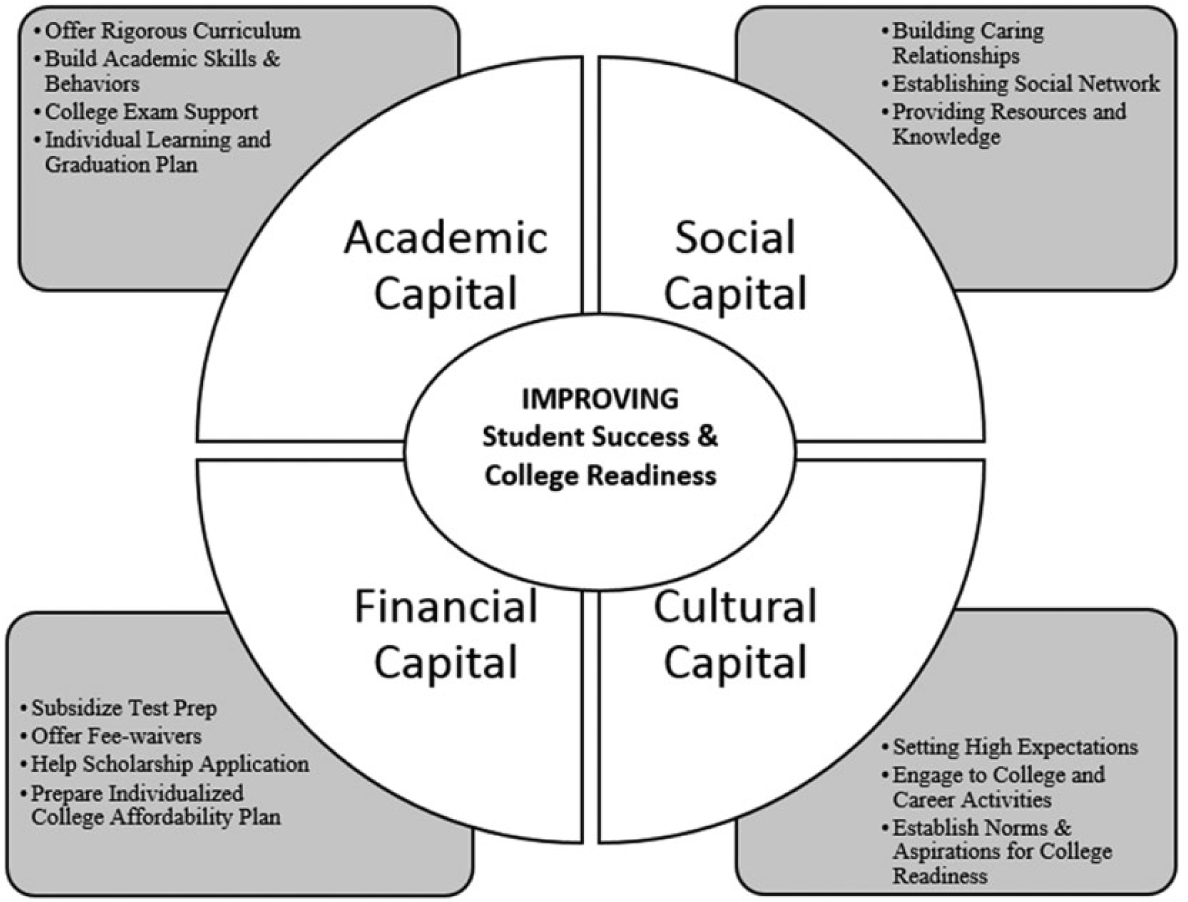
The conceptual framework for developing social, financial, academic, and cultural capitals.
Research on the Delivery and Impact of School Counseling Services
The four-level capital-based theoretical framework for the study serves as a rationale to explore the efficacy of various programs. Aligned with these four capitals, this section offers an account of what we know about the nature and extent of various college and career-focused programs and interventions about students’ access to these interventions. In this section, the authors also briefly describe a review of empirical work that has probed the efficacy of various interventions. Particularly, in the College Board’s (2011) School Counselor Landscape and Literature Review, the labor market skills gap is highlighted. This includes an estimated need of “97 million middle and highly skilled workers in American businesses, yet only 45 million Americans currently possess the necessary education and skills to qualify for these positions” (College Board, 2011, p. 1). A critical component of the national agenda in education includes a concentrated focus on postsecondary readiness, evidenced in the reauthorization of the Elementary and Secondary Education Act (ESEA) with the Every Student Succeeds Act (ESSA) of 2015 (U.S. Department of Education, n.d.).
School counselors are well positioned to deliver a program that includes an emphasis on college and career readiness, as they are trained to provide career development education for all students. The ASCA (2012) has provided counselors with a national model and framework to build their comprehensive program. However, school counselors face several challenges to effective implementation of a comprehensive program which includes an emphasis on college and career readiness. For instance, in the latest report from the National Center for Educational Statistics (NCES), the average student to school counselor ratio is 1:491; this is an increase over the 2011 NCES report of 1:469 (NCES, 2013). The ASCA recommended ratio is 1:250 (ASCA, 2012). The previous empirical studies indicate that because of increasingly high caseloads, it is very difficult to implement the individual planning and responsive services (Lapan, Whitcomb, & Aleman, 2012).
The second biggest challenge to effective implementation of a comprehensive school counseling programs is noncounseling assignments. Particularly, Lapan et al. (2012) reported that 15% to 50% of school counselors’ work time was spent performing noncounseling-related job tasks. For instance, school counselors are often tasked with noncounseling duties (i.e., coordination of districtwide assessments, serving as school registrar, substitute teaching for an absent teacher), which ultimately encourages a program model that is more reactive in nature (Hines, Lemons, & Crews, 2011). The ASCA model is proactive and encourages accountability for effective programming delivered to all students, including equity-based postsecondary planning interventions across K-12 grade levels (ASCA, 2012).
The previous empirical studies consistently suggested that implementing a comprehensive school counseling program has certain benefits for students’ academic development, college, and career readiness (Lapan, 2012; Lapan, Gysbers, & Kayson, 2006). However, the previous research also indicated that most high school students are not receiving the benefit of fully implemented comprehensive school counseling programs because of uneven implementation of student counseling services (Lapan et al., 2012). To assimilate the skills needed for college and career readiness, the National Office of School Counselor Advocacy (NOSCA) from The College Board has identified eight components of college and career readiness counseling. These include the following:
College aspirations: building a college-going culture based on early college awareness by nurturing in students the confidence to aspire to college and the resilience to overcome challenges along the way. Maintain high expectations by providing adequate supports, building social capital, and conveying the conviction that all students can succeed in college;
Academic planning for college and career readiness: to advance students’ planning, preparation, participation, and performance in a rigorous academic program that connects to their college and career aspirations and goals;
Enrichment and extracurricular engagement: ensuring equitable exposure to a wide range of extracurricular and enrichment opportunities that build leadership, nurture talents and interests, and increase engagement with school;
College and career exploration and selection process: to provide early and ongoing exposure to experiences and information necessary to make informed decisions when selecting a college or career that connects to academic preparation and future aspirations;
College and career assessments: to promote preparation, participation, and performance in college and career assessments by all students;
College affordability planning: providing students and families with comprehensive information about college costs, options for paying for college, financial aid and scholarship processes, and eligibility requirements, so they are able to plan for and afford a college education;
College and career admission process: to ensure that students and families have an early and ongoing understanding of the college and career application and admission processes so they can find the postsecondary options that are the best fit with their aspirations and interests.
Transition from high school graduation to college enrollment: connecting students to school and community resources to help the students overcome barriers and ensure the successful transition from high school to college (College Board National Office for School Counselor Advocacy, 2010, p. 3).
Method
Sampling
Because this study was designed to explore college and career readiness program needs of low-income students, researchers utilized a purposive sampling technique to identify four high-poverty urban schools. The four urban schools in the United States were selected because of their significantly lower socioeconomic status as compared with schools nationally. Pseudonyms are to be used for research sites included in this analyses. They have significantly higher need levels and higher rates of minority students than other districts in their states. Their median family income is significantly lower than other school districts. In these urban research sites, more than 85% of students were enrolled in the free and reduced lunch programs, and more than 80% of the student population identified as African American or Hispanic. These four research sites also have a higher rate of English Language Learners (ELL) compared with other school districts in their states.
In total, out of the four invited urban schools, 1,032 participants (231 parents, 580 students, and 221 faculty members) completed the survey. Students in this study were diverse in terms of school level (30% middle school, 70% high school), race (24% White, 33% African American, and 43% Hispanic), gender (53% female, 47% male), education status (16% ELL, 17% special education), low socioeconomic status with 83% free and reduced lunch, and family background (63% first-generation college-bound students, 63% from divorced families). Aligned with the District Reference Groups (DRGs) classification system, used by the Connecticut State Department of Education (CSDE), the demographics of the participants with 83% free and reduced lunch seems very similar to urban districts that have high socioeconomic needs.
Data Collection Procedures
The research project and consent forms were approved by the Institutional Review Board for the Protection of Human Subjects at Southern Connecticut State University. At each research site, the authors described the project to school leaders and directors who assisted in getting permission to conduct the online survey. The survey was administered in the beginning of 2016 calendar year. Procedures were put in place to provide participants with the least amount of risk possible, while maintaining their comfort throughout the completion of the survey. It was participants’ decision whether or not they would like to take part in this study. If they chose to participate, they were able to withdraw from the study at any time during the research process. Even though the survey did not pose any psychological, legal, social, or physical harm toward the participants, an electronic letter of consent was attached to the survey, and survey participants were required to electronically indicate they had read and consented to participate prior to responding to any further questions.
During the data collection process, online surveys were used for this investigation. Survey items were finalized based on the pilot study and peer reviews; the survey was prepared in the online Select Survey system. With the approval of school administrators, emails including the survey link were sent to students, parents, and faculty members requesting their completion of the online college and career readiness need assessment survey. Completed surveys were automatically collected through the online Select Survey Software. Surveys were collected and coded, and they were uploaded to the SPSS program. All responses in the survey were recorded anonymously.
Instrumentation
Comprehensive College and Career Program Need Assessment (CCCPNA) was developed to assist schools to design, lead, and evaluate their academic and counseling programs. Regardless of what currently exists in their schools, this instrument was designed to help schools in exploring student support needs. Results from this survey instrument can assist schools in planning beneficial and effective counseling programs for student college readiness as well as academic, career, social, and emotional development. The survey takes 5 to 10 min to complete. CCCPNA mirrors the three domains of the ASCA National Model of school counseling (ASCA, 2012): (a) Academic Development Program Needs, (b) College and Career Readiness Program Needs, and (c) Social and Emotional Development Program Needs. In each section, participants were asked to rate the level of student perceived need for from 1 (lowest need) through 5 (highest need).
Specifically, this study focuses on exploring college and career readiness program-related needs of urban schools. For example, participants were asked to rate the level of need for the following programs, including College and Career Lessons, Financial Aid Counseling, Career and College Fairs, Mentoring Programs, Personalized Counseling, Parent Meetings, College Trips, Instant Decision Day, Summer Enrichment Programs, Internship Programs, and so on.
In the fourth section, participants were asked to check how much they agree with the statements about the “Student and Counselor Relationship” by using the following statements: 1 = strongly disagree, 2 = disagree, 3 = neutral, 4 = agree, 5 = strongly agree. For instance, students were asked to rate the level of their agreements on the following statements: My counselor meets individually with me at least once per year to help me improve my academic planning and school success. I know who my counselor is. I feel comfortable going to see my counselor to get help with my school and personal concerns. Finally, the last part of survey instructs participants to complete background and demographic information such as gender, race/ethnicity, grade level, education status, free and reduced lunch status.
Internal consistency was assessed by Cronbach’s alpha coefficient, and it was determined that internal consistency was in an acceptable range with a lowest .69 to the highest .94. The instrument was found to be highly reliable (17 items; α = .892). To validate the assertion that the 17 items can be classified as one whole category that represents college and career readiness–related activities, researchers solicited the opinions of a panel of school counseling professionals who were familiar with college and career readiness standards and the roles of school counselors. The panel of counseling professionals included five experienced practicing school counselors, two counseling coordinators, and three counselor educators at state universities. The panel of school counseling professionals confirmed that each of the 17 items was aligned with college and career readiness–related programs.
In this study, researchers used and analyzed the second part of the survey which included 17 college and career readiness–related programs. To validate the survey instruments and determine the reliability of these 17 items, a pilot study of the survey instruments was conducted on a small scale. The survey questions were administered to 24 selected participants. After the participants completed the survey, they were asked to share their experiences regarding the length of the survey, content, and clarity of questions, as well as the format of the survey.
Pilot respondents indicated they were satisfied with the quality of the questions. In particular, participants responded that survey questions were associated with their college counseling experiences. However, they pointed out that the length of time (15-20 min) it took to complete the survey was not appropriate. Participants found the initial survey too long and wordy. Researchers reviewed survey items to identify repeating questions. Then, repetitive and similar questions were eliminated from the survey. While reviewing the survey items, participants also indicated that some questions were not clear to them. Therefore, the wording of these questions was changed to improve readability.
Following pilot study and revisions of the instrument, 1,032 participants successfully completed the revised version. Finally, the factor structure of CCCPNA scale was investigated. As all factors were believed to correlate with one another, principal axis factoring method with direct oblimin rotation technique to CCCPNA was used. Kaiser–Meyer–Olkin (KMO) was higher than .90 and Bartlett’s test of sphericity was significant, meaning that a factor structure existed. Exploratory factor analysis yielded a two-factor structure. Items that focused on Career Fair, College Fair, College Trip, College Representative Visits, College and Career Portfolio Job Shadowing Program, Instant Decision Day, Summer Enrichment Program, Internship Program loaded to Factor 1, and the others (College and Career Lessons, Individual College Career Counseling, Small Group College Career Counseling, Fee Waiver, Financial Aid Counseling, Mentoring Program, Alumni Support Center, and Parent Meeting) loaded to Factor 2.
These two factors explained 65% of variance in total. Cronbach’s alpha coefficient was .84 for Factor 1. Factor analysis results were presented in Table 1 for items evaluated through CCCPNA. The first factor has been named “Enrichment Programs” as items reflect the enrichment activities associated with improving college and career readiness. The Cronbach’s alpha coefficient was found to be .81 for Factor 2. This second factor has been named “Core Programs” because items reflect the core counseling activities associated with college and career programs. Factor analysis results were presented in Table 1 for items evaluated through CCCPNA.
Factor Analysis in CCCPNA (N = 1,032).
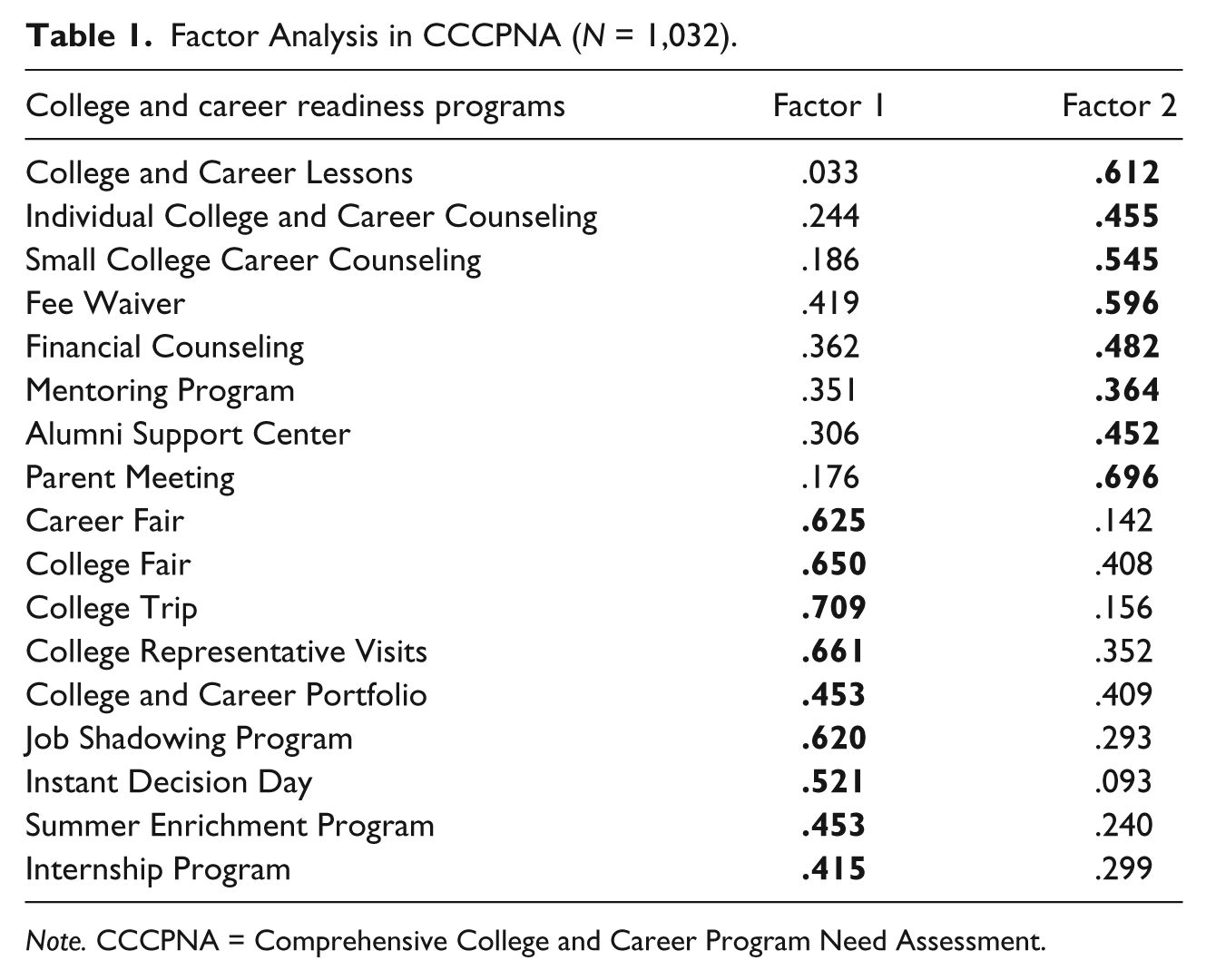
Note. CCCPNA = Comprehensive College and Career Program Need Assessment.
Data Analyses
An analysis of the second section of the survey was done, which included 17 college and career readiness program-related items measured on a 5-point Likert-type scale ranging from lowest need to highest need response format. To analyze the perceptions of parents, students, and teachers as the highest and lowest program needs of urban schools to prepare college and career ready students, descriptive statistics were used and ranked the total mean scores and standard deviation of each 17 program from highest need to lowest need. Second, to explore how core and enrichment college and career program needs vary with respect to the grade level and perceptions of parents, faculty members, and students, a 2 × 3 MANOVA was conducted. Based on the significance of results, follow-up tests were conducted, including the MANOVA interaction contrast test. To calculate the difference between the college and career readiness program needs, the total mean scores of core and enrichment program needs were used as dependent variables. Independent variable included school level (middle and high schools) and type of participants (i.e., student, parent, faculty). Finally, descriptive statistics and total mean scores were used to rank participant perceptions about counselor and student relationships.
Results
To explore what parents, students, and teachers perceive as the highest and lowest program needs of urban middle and high schools to prepare college and career ready students, researchers asked 1,032 participants (580 students, 231 parents, and 221 faculty members) to rate the level of program needs from 1 (lowest need) through 5 (highest need). As shown in Table 2, the following core program total mean scores were ranked from highest to lowest; all mean scores higher than 3.50 were considered as high need: (a) Individual College and Career Counseling (M = 4.22, SD = 1.124), (b) Financial Aid Counseling (M = 4.10, SD = 1.143), (c) Mentoring Program (M = 3.91, SD = 1.001), (d) College and Career Lessons (M = 3.93, SD = 1.183), (e) Fee Waiver (M = 3.80, SD = 1.264), (f) Small Group College and Career Counseling (M = 3.63, SD = 1.125), (g) Alumni Support Program (M = 3.51, SD = 1.147), and (h) Parent Meeting (M = 3.50, SD = 1.134).
Mean and Standard Deviation of Each Core and Enrichment Program Needs (N = 1,032).
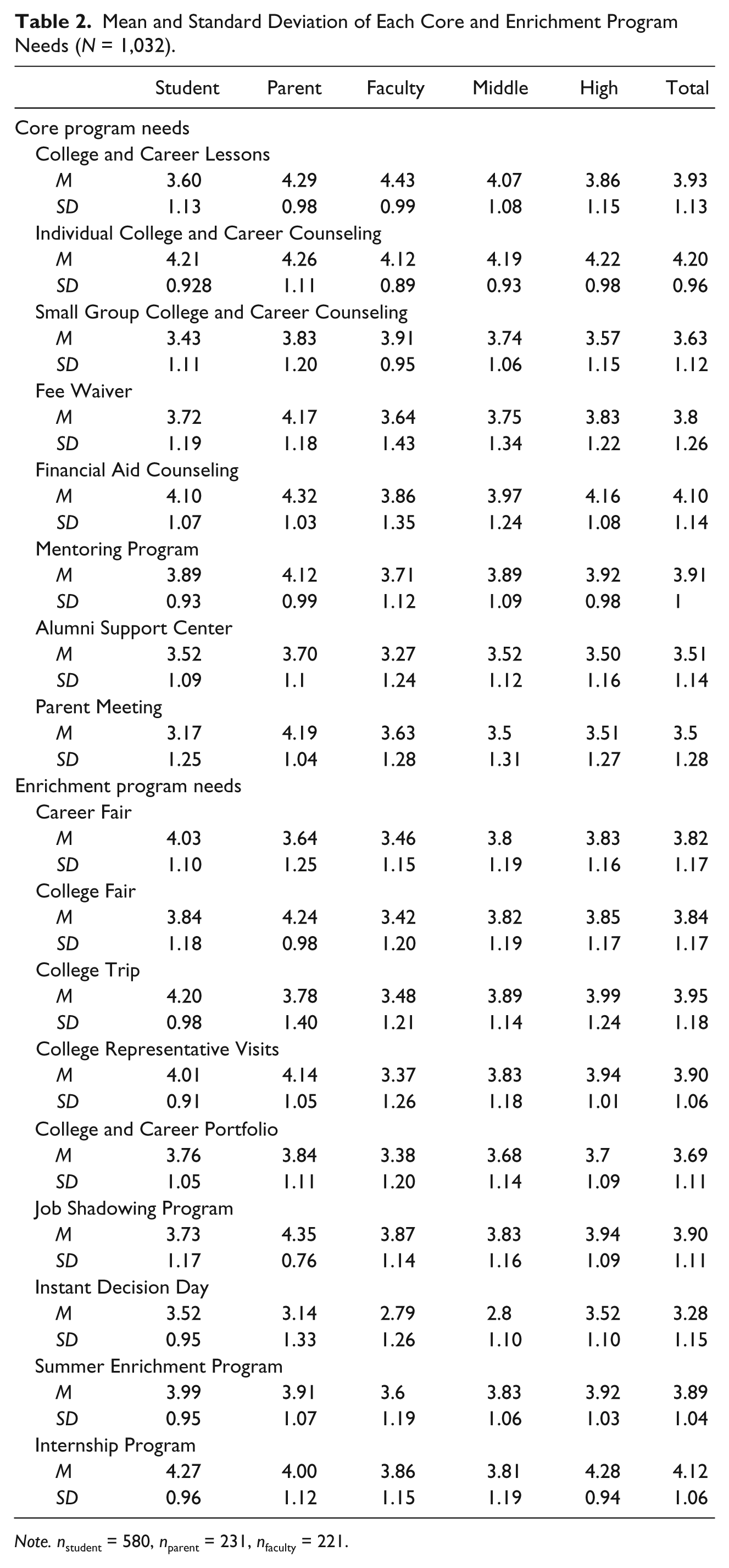
Note. nstudent = 580, nparent = 231, nfaculty = 221.
Similarly, the following college readiness enrichment program total mean scores were ranked from highest to lowest (a) Internship Program (M = 4.12, SD = 1.060), (b) College Trip (M = 3.95, SD = 1.182), (c) College Representative Visits (M = 3.90, SD = 1.102), (d) Job Shadowing Program (M = 3.90, SD = 1.110), (e) Summer Enrichment Programs (M = 3.89, SD = 1.048), (f) College Fair (M = 3.84, SD = 1.182), (g) Career Fair (M = 3.82, SD = 1.175), (h) College Career Portfolio (M = 3.69, SD = 1.114). As noted, the total mean scores of these 10 enrichment programs are higher than 3.50, which are considered as high need because they are relatively close to 4 and 5 that are rated as the highest needs. Only one program had less than 3.5 mean scores, (i) The Instant Decision Day (M = 3.28, SD = 1.159). However, the Instant Decision Day Program was still considered as high need for high schools, with its mean score of 3.28 considered to be relatively close to 3.5.
A 2 × 3 MANOVA was conducted to investigate whether core and enrichment college readiness program needs in high-poverty urban schools significantly varied with respect to grade level (middle and high school) and type of stakeholder (student, faculty, and parent). Particularly, the main effects of the independent variables and the possibility of interactions between the grade levels and type of stakeholders, if any, were investigated. The results revealed a significant interaction between stakeholders and grade level, F(4, 2052) = 6.273, p < .001; V = 0.024, η2 = 0.13.
When comparing stakeholder total core and enrichment program need mean scores by grade level, researchers found the stakeholder core and enrichment program needs changed by grade level (see Table 2). However, in the MANOVA test, it was not noticeable if parent, student, and faculty member program needs changed significantly because the MANOVA test revealed a significant interaction between stakeholder and grade level. Therefore, in the next step, the MANOVA interaction contrast test was conducted, and pairwise comparisons by grade level and stakeholder were analyzed.
At the middle school grade level, a significant difference existed between student, parent, and faculty member perceptions of college and career program needs. Particularly, as it is indicated in Table 2, parents expressed significantly more core needs than both students and faculty at the middle school level (p < .05). No significant difference was observed between students and faculty member needs at the middle school level (p > .05). However, the core college readiness program needs show a different pattern in the high school level. For instance, students express significantly less core needs than both parents and faculty members at the high school level (p < .05). There is no significant difference between parent and faculty member core program needs at the high school level (p > .05).
In addition to core program needs, researchers investigated whether the stakeholder college readiness enrichment program needs significantly vary with respect to grade level. As it is shown in Table 2, similar to the findings of core program needs, parents expressed significantly more enrichment needs than both students and faculty members at the middle school level (p < .05). In addition, at the middle school grade level, there was a significant difference between students’ and faculty members’ perceptions of needs. In other words, students expressed significantly higher enrichment needs than faculty at the middle school grade level (p < .05). Finally, stakeholders’ college readiness enrichment program needs in the high school level was investigated. Students express significantly more enrichment needs than both parents and faculty members at the high school level. A significant difference also existed between faculty member and parent needs (p < .05). Particularly, parents expressed significantly higher enrichment needs than faculty members at the high school level.
Finally, to investigate urban student perceptions of their relationships with school counselors, the survey instructed students to rate the degree to which they agreed with selected statements, using a 5-point Likert-type scale. The overall mean of each of the five statements was calculated to rank the student perceptions. Table 3 presents the mean and standard deviations of student ratings regarding relationship with school counselors. Particularly, the total mean score of these five statements was 3.36.
Means and Standard Deviations of Urban Students’ Ratings of Counselor and Student Relationship Activities.
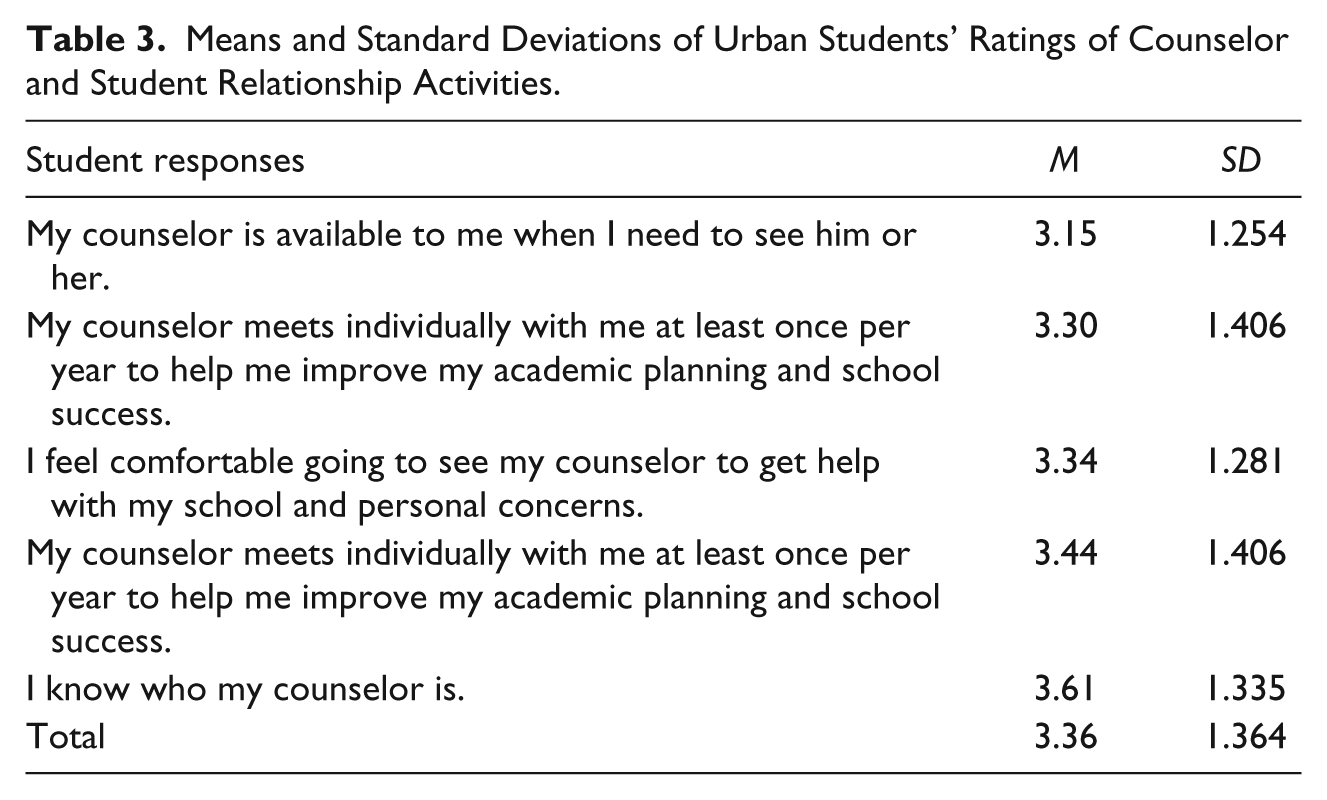
In detail, students rated the five statements in the following order from least mean score to highest mean score: My counselor is available to me when I need to see him or her (M = 3.15, SD = 1.254); my counselor meets individually with me at least once per year to help me improve my academic planning and school success (M = 3.30, SD = 1.406); I feel comfortable going to see my counselor to get help with my school and personal concerns (M = 3.34, SD = 1.281); my counselor meets individually with me at least once per year to help me improve my academic planning and school success (M = 3.44, SD = 1.406); and I know who my counselor is (M = 3.61, SD = 1.335).
Limitations of Study
Because of the nature of quantitative research, contextual factors can only be hypothesized by researchers. In addition to quantitative results, low-income students, parents, and faculty members could have been interviewed to obtain qualitative information about their perceptions of urban school needs, including academic and counseling services. A mixed methods approach could yield further information that clarifies or qualifies given responses based on participant experiences with services provided.
Overall, 1,032 participants completed surveys from four urban school districts across the United States. As the participating schools were not selected randomly, we cannot extrapolate the findings to represent an entire population. District- and building-level administrators agreed to share the survey widely with their parents, students, and faculty, and given the nature of the relationship, it is possible that participants experienced a power difference compelling their participation one way or the other. It is also possible that respondents self-selected their participation in this survey, skewing results. Participants may have completed the survey based on preexisting values and experience related to college and career readiness.
Discussion: Implication for Leadership, Policy, and Practice to Provide College and Career Readiness for All
As recent studies indicate, growing numbers of low-income urban students in the United States are exhibiting a lack of college and career readiness (ACT, 2015; ASCA, 2012). This college access and graduation gap among underrepresented urban students is a social justice issue that needs to be addressed (Stone & Dahir, 2015; Yavuz, 2014). Therefore, it is critical for K-12 school administrators, counselors, and other stakeholders to seek understanding and interpret the complex needs of urban schools for practical and policy implications. This section moves beyond results to describe their implications for practice and policy. The findings of this study highlighted five major issues about designing student services strategically and effectively to increase college and career readiness for low-income urban students.
First, as it is noted, the total mean scores of 16 programs out of 17 were higher than 3.50, which are considered as high need. This is consistent with the literature reviewed and confirms the perceived need for college and career readiness programming by parents, students, and faculty in low-income urban schools. Both core programming (i.e., College and Career Lessons, Individual College & Career Counseling, Small College Career Counseling, Fee Waiver, Financial Counseling, Mentoring Program, Alumni Support Center, and Parent Meeting) and enrichment programming (i.e., Career Fair, College Fair, College Trip, College Representative Visits, College and Career Portfolio, Job Shadowing Program, Instant Decision Day, Summer Enrichment Program, and Internship Programs) were perceived as highly necessary.
It is possible that participants became aware of such college and career readiness programming as a result of taking the comprehensive need assessment, and therefore rated items higher than average because of interest and intrigue. This hypothesis supports the need for increased awareness for parents, students, and faculty regarding the breadth of services needed to support student college and career readiness (ASCA, 2012). It is also possible that the means tended toward high need because of inadequate access to such programming. Moreover, as the majority of programs were rated as high need, this can be explained by the high capital needs of both urban students and parents. Regardless, a heightened awareness of best practices is needed for students in high-poverty urban settings and essential for the planning, implementation, and evaluation of school counseling programming (Morgan, Sinatra, & Eschenauer, 2015).
Particularly, findings revealed that out of 17 college and career readiness–related programs, there are three programs with higher than 4.00 averages, considered highest priority. These three programs are Individual College and Career Counseling (M = 4.22, SD = 1.124), Financial Aid Counseling (M = 4.10, SD = 1.143), and Internship Program (M = 4.12, SD = 1.060). The findings of this study support previous research evidence, indicating urban students may lack academic, social, cultural, and financial capital and therefore seek personalized support to navigate the complex college admission process (ASCA, 2012; Bourdieu, 1986; College Board, 2015; Ovink & Veazey, 2011; Stone & Dahir, 2015; Yavuz, 2014). Because financial aid counseling was rated as the second highest priority, this discovery may illustrate the financial concerns of parents and key stakeholders to prepare students for college and career (ACT, 2015; Paulsen & St. John, 2002). The internship program that enables students to gain valuable understanding of their career and major field was rated as the third highest priority. Therefore, findings encourage school leaders and key change agents to pay special attention to developing a system for offering personalized counseling, financial aid support, and internship opportunities in urban schools.
The second important finding was that urban parents expressed statistically significantly more core needs than both students and faculty at the middle school level. This finding may illustrate the high academic, social, cultural, and financial capital needs of parents in making postsecondary options accessible for their children (Holcomb-McCoy, 2010; T. T. Williams & Sanchez, 2011). Believing in higher education yet realizing the high costs associated with it are sources of significant worry for parents in high-poverty schools. The higher mean scores for program core needs perceived by parents are commensurate with literature (Ellis & Geller, 2016; Granger & Noguera, 2015; Morgan et al., 2015).
No significant differences were observed between students and faculty member core needs at the middle school level. This finding may be rooted in an emphasis on academic skills-building at the middle level to prepare students for high school, rather than a middle school culture that recognizes college and career readiness as a process that begins at the elementary level (ACT, 2004; Keddie, 2015). Because middle school leaders, teachers, and counselors focus more on academic success and high school transition of students, early comprehensive college awareness and planning activities could have been ignored. Therefore, findings provide effective strategies for school leaders, educators, and counselors regarding urban middle school college and career readiness program needs so that resources can be intentionally distributed in areas of greatest importance (ASCA, 2012).
Findings also revealed that the core college readiness program needs show a different pattern at the high school level. For instance, students expressed significantly less core needs than parents and faculty members at the high school level (p < .05). Given the core needs focus on individual counseling, financial aid, mentoring, and support, it follows logically that adults (teachers and parents) participating in the study perceived greater needs than did students. It is questioned whether students at the high school level doubt their ability to make postsecondary preparations a reality. As with middle school core needs findings discussed earlier, one may question whether a college-going culture has been fostered in the urban high schools participating, and whether the results suggest effectiveness of such efforts. Parents and faculty at the high school level perceive greater core program needs. Perhaps, this can be interpreted that parents and faculty are less aware of the implementation of the core needs programming being implemented at the high school level (ASCA, 2012; Stone & Dahir, 2015). Therefore, findings encourage school leaders and counselors to spend additional time and make a concerted effort to inform faculty and parents regarding core counseling services offered in urban schools.
Third, similar to findings of core program needs, parents expressed significantly more enrichment needs than students and faculty members at the middle school level (p < .05). Moreover, students expressed significantly higher enrichment needs than faculty at the middle school grade level (p < .05). Again, similar to the core program needs, parent and student perceived enrichment needs may be higher because of a newfound exposure to the possibilities of activities that could enhance their exploration and opportunities toward postsecondary interests. In response to the current culture in American urban public schools, faculty may view such enrichment needs as diverting from the delivery of their subject area curriculum (Zeichner & Pena-Sandoval, 2015). Because teachers and school leaders are being held strongly accountable for improving student academic success, delivering college and career readiness programs might not be their first priority among their duties.
Fourth, students expressed significantly more enrichment needs than parents and faculty members at the high school level. Once again, a factor influencing lower mean scores of faculty perceived enrichment needs may be the emphasis on achievement, curriculum compliance, and meeting core standards. Given the faculty commitment to subject area expertise, time spent on college and career readiness enrichment needs may be viewed as extraneous, detracting from time spent in academic learning. Student responses indicate a higher level of perceived need in program enrichment such as college and career fairs, job shadowing, and postsecondary planning. Moreover, this could be the result of the exposure to enrichment programming options they deem helpful (College Board National Office for School Counselor Advocacy, 2010). As urban high school students consider college and career readiness enrichment activities as high priority compared with faculty and parents, findings encourage urban school administrators and counseling office to provide students and families with comprehensive college and career information. Consistent with these efforts, if urban schools focus on ensuring equitable exposure to a wide range of college readiness enrichment opportunities, underrepresented urban students are more likely to engage in college and career exploration and selection processes (College Board, 2015)
In the final section of the need assessments, students were asked to rate statements about their relationships with their school counselors. The findings revealed that the total mean score of five counselor and student relationship statements is 3.36. On the 5-point Likert-type scale, a rating of 3 indicates a neutral acceptance of the statement as true, neither strong agreement nor strong disagreement. In other words, consistent with previous studies, findings indicate that the majority of low-income students do not agree with the survey statements about school counselors and counseling services (Holland, 2015; Vega, Moore, & Miranda, 2015).
Specifically, compared with others, the following statements have the lowest mean scores: My counselor is available to me when I need to see him or her (M = 3.15, SD = 1.25); my counselor meets individually with me at least once per year to help me improve my academic planning and school success (M = 3.30, SD = 1.40); and I feel comfortable going to see my counselor to get help with my school and personal concerns (M = 3.34, SD = 1.28). An area of particular concern is the findings related to the student and counselor relationship, with the lowest mean scores. The results may indicate limited availability affected by large counselor caseloads, more frequent reactive student services (as compared with preventive services), and noncounseling assignments, all of which distract from the delivery of a comprehensive school counseling program (ASCA, 2012).
These findings contribute to the existing literature related to student college and career readiness. School leaders, educators, and counselors are tasked with identifying student needs, developing programs to meet these needs, and evaluating success of such programs. Recent literature emphasizes the importance of parent involvement for low-income student college and career readiness and success (Holcomb-McCoy, 2010). It follows that perceived needs of parents, students, and faculty within high-poverty urban schools should be strongly considered when planning and evaluating these programs because urban schools need a systemic approach to compensate for poverty, prejudice, and negative living conditions (Russo & Cooper, 1999). These findings will assist urban school leaders to develop comprehensive school counseling services that will help students become college and career ready.
With compiled results from the needs assessments, school leaders, educators, and counselors can apply the findings to practice and policy associated with low-income student success. As urban schools will likely have significantly limited academic, cultural, social, and/or financial capitals, it is crucial to consider redefining school counseling programming based on need (ASCA, 2012). Particularly, school leaders could find results helpful to look at time allocation in prevention/education versus reactive/responsive services. Moreover, aligned with the identified needs of urban students, school administrators and key change agents might consider developing a multilevel theoretical framework approach to improve college and career readiness for all.
Implication for Future Research
The assessment of college and career readiness needs is a critical first step in the development of an intentional comprehensive school counseling program. Action research can be utilized as a means of continued evaluation following the implementation of identified high need core and enrichment programs. Therefore, follow-up studies with participating urban schools to measure the effect of comprehensive counseling programs on student outcomes are a logical next step. Continuous evaluation and adjustments will ensure program effectiveness.
The current study is well-suited for replication, including expansion to varying levels of socioeconomic status. In comparing results of college and career readiness program needs between socioeconomic reference groups, school leaders, and counselors will further understand the universal effectiveness and the unique needs of student populations across American schools. In addition to the socioeconomic reference groups, the global component can also be developed by conducting international comparative studies to explore the comprehensive academic, career, social, and emotional needs of students from various countries in Europe, Asia, Africa, and South and North America.
Conclusion
The research team sought to identify school counseling program needs that support urban student college and career readiness in Grades 6 through 12. Through correlation analysis of completed survey data from urban parents, students, and faculty perceptions, the findings identified (a) highest and lowest program needs, (b) variance of program needs with respect to grade level (middle and high school) and stakeholder perceptions, and (c) student and counselor relationships.
Each stakeholder involved (parents, students, faculty) brings their unique perspective and lived experiences to the perception of college and career readiness needs. School counseling programming that includes both core and enrichment interventions are necessary to support stakeholder perceived needs. School leaders and counselors are in the unique position to work with students in developing their academic, social-emotional, college, and career needs. By identifying perceived needs of urban parents, students, and faculty, school leaders, educators, and counselors are better equipped to design and deliver an intentional program that effectively prepares each student for access and opportunity following high school graduation.
Footnotes
Declaration of Conflicting Interests
The author(s) declared no potential conflicts of interest with respect to the research, authorship, and/or publication of this article.
Funding
The author(s) received no financial support for the research, authorship, and/or publication of this article.