



Abstract
The purpose of this study was to identify the strengths and challenges that emerged from the first year of a district and university partnership focused on improving a high needs urban elementary school. This research utilizes an instrumental case study design. The elementary school and the university involved in this study are both public serving institutions located in south central Texas in the United States. This paper examines the partnership after the first year of implementation. Feedback was solicited from district, campus, and university personnel regarding the successes and challenges they encountered. Three themes emerged: administrative support, challenges presented by a change in principal, and a focus on mutual self-interest and common goals. Implications are discussed.
Introduction
Recently, the Commissioner of Education in Texas issued a call to action to all Colleges of Education within the state, asking that each of them partner with a low-performing elementary school in their region to improve student outcomes (University of Texas News Center [UTNC], 2018). Specifically, the Commissioner requested higher education partners for schools that received a rating of Improvement Required (IR). Although the exact cut-off moves slightly from 1 year to the next, IR schools are generally in the bottom 5% as measured by student performance on state exams. This study examines one partnership that was formed in response to this call. As we will explore in this study, there are many factors that can contribute to or detract from the effectiveness of University partnerships with high-needs schools. The overarching research question examined in this study is: What are the strengths and challenges related to a university and district collaboration supporting a high needs urban elementary school? The study begins by presenting a conceptual framework of University-School collaboration along with a review of the extant literature. Next, a methodological design for this research and background information on the partnership design are presented, followed by a discussion of findings including both challenges and successes.
Conceptual Framework
University-school partnerships are collaborative arrangements between institutions. Collaborative partnerships between school districts and universities provide unique opportunities for sharing knowledge and instituting educational reform. “Although implementing these partnerships requires significant time and effort, successful resolution of challenges can pave the way for both systemic change in the school district and important developments in practice, theory, and research at the university” (Walsh & Backe, 2013, p. 595). Certain features are crucial to ensuring the success of such partnerships over time, including the focus and scope of the project, institutional support, availability of external funding, and willingness to collaborate among key stakeholders (McCaughtry et al., 2012). Many researchers have asserted that collaboration is the most important factor in facilitating a successful partnership (Butcher et al., 2011; Hunter & Botchwey, 2017; Officer et al., 2013).
Thorkildsen and Stein (1996) provide a framework with fundamental characteristics of successful university-school partnerships that we considered in this study as foundational in guiding this examination of building effective partnerships. They identify 11 factors which are fundamental to the development and sustainability of university-school partnerships: (1) a well-defined administrative structure; (2) common goals that are in both parties’ mutual self interest; (3) participant time commitment; (4) mutual trust and respect; (5) external support; (6) shared decision making; (7) a clear focus; (8) information sharing; (9) manageable agendas; (10) flexibility; and (11) an ongoing process of evaluation.
Literature Review
District and University Partnerships
University-school partnerships encompass collaborations grounded in shared knowledge shaping educational practices. These include efforts that can mutually benefit inter-institutional relationships (Kearney & Valdez, 2015). Officer et al. (2013) write that “urban universities have a responsibility to work with urban public schools and enhance professional preparation” (p. 575). They mark a dual responsibility—to the urban public schools in need of assistance, but also to their own students and the professional preparation they stand to gain. Similarly, Hunter and Botchwey (2017) specify that, “while there are different types of higher education-K-12 partnerships, those formed as collaborative partnerships are specifically designed to offer mutually beneficial learning experiences for these students” (p. 78). The students here include both the elementary and secondary students aiming to improve their scores, as well as the university students and student teachers who are well-served by such valuable experience (Dorel et al., 2016). Walsh and Backe (2013) assert, “the level and depth of university teaching is significantly enhanced as a result of relationships with schools” (p. 605). University-school partnerships provide unique avenues for teacher training and field placement, as well as knowledge sharing and pedagogical implementation (Michael et al., 2018; Singh, 2017).
In collaborative partnerships, the initial motivation of benefit to each individual partner is complemented and even superseded by shared objectives. Lofthouse and Thomas (2017) stipulate, “the most straightforward definition of collaboration is the sense that individuals work together and not just work with one another. . . When individuals collaborate they work toward a common goal, they pool knowledge and problem-solve together; they may even achieve the elusive co-construction” (p. 52). Nonetheless, Dyson (1999) considers that, “. . .university-school partnership takes place at the intersection of two cultures with differing aims and values” (p. 412), adding that such partnerships are initially motivated to seek outcomes that benefit both partners.
The success of university-school partnerships is often assessed in terms of the advantages gained by each distinct partner, rather than in terms of collective achievement. Walsh and Backe (2013) explain that university-school partnerships are often driven primarily by the needs of universities and the limited resources of school districts rather than the mutual benefit and achievement of both parties. The result of such an approach may be mutual dissatisfaction, in which teachers fail to receive the instructional knowledge they need and university faculty fail to comprehend the challenging realities of educational reform (Parker et al., 2012).
Poverty in the United States
When focusing on high-need schools, scholars emphasize the role of education and the importance of providing equitable access to educational services (Tilak, 2002). Within this idea, education is not only seen as an end, but also a means to fulfill people’s basic needs (Tilak, 2002). Of significance is the economic vulnerability of families. Berger et al. (2018) reported that in the U.S., the poverty rate around 1960’s fluctuated between 11 and 15%. More recently, in 2015, the Official Poverty Measure (OPM) shows that about 14% of the U.S. population remains in poverty (Proctor et al., 2016). Even though population increased, and changed, similarities in poverty indexes may be indicating that the war on poverty policy initiated by Johnson in 1964 to improve education and health may still be of current concern.
In relation to education in high need areas, Tilak (2002) generated a connection between education and poverty, reflecting that, “poverty of education is a principal factor responsible for income poverty; and income poverty, in turn, does not allow the people to overcome poverty of education” (p. 198). Breaking cycles of poverty requires more than basic needs to be met, with a system-level intent to further improve the conditions of schooling. Tilak (2002) indicates the importance of avoiding faulty assumptions that are non-conducive to school improvement, such as beliefs that the State or Nation should transfer the responsibility of educating its citizens, or that qualified and trained teachers are not necessarily important in basic education.
Collaborative Efforts toward High Need Schools
Reyes and Garcia (2014) question the practice of assessing demographically different schools according to identical criteria and with the same consequences for unsatisfactory performance. Low-income urban minority schools have far fewer resources than affluent middle class suburban schools and performance-based interventions often do not consider these differences or their impact upon student achievement.
Low income is of concern in the U.S., where Berger et al. (2018) indicated that, “segments of the population are vulnerable to poverty and its effects” (p. 5). The low-wage labor market has shown little growth, and at the same time, “young adults with low levels of education have increasingly transitioned into parenthood in the context of unmarried romantic partnerships that often dissolve shortly after their child’s birth” (Berger et al., p. 5). Hansen (2012) similarly draws attention to the effects of dynamic changes in school population over time and the effects that trends such as gentrification can have on apparent student achievement. Despite these issues, effective turnaround is possible. According to a 2011 study by the US Department of Education, approximately 15% of chronically low-performing schools in three states achieved turnaround (Herman, 2012). Although the majority of schools in need of turnaround do not succeed, a significant number do.
In Texas, the Texas Education Agency (TEA) rates a campus as Improvement Required (IR) when the school fails to meet the performance targets for one or more achievement indices according to the TEA performance framework. The district is then required to develop a “turnaround plan” for each campus designated IR. IR campuses thus represent schools where the student population is underperforming on standardized tests at an unacceptable rate according to state standards. Of special concern is that in 2017 alone, 369 schools in the state of Texas were identified as being in IR status (Texas Education Agency [TEA], 2017).
Following an IR designation, the subsequent district interventions, or “turnaround plans,” often strive for quick and dramatic transformation by implementing drastic changes in school management, teaching staff and school operations over a limited period of time. These changes may involve the removal or replacement of administrative and/or teaching staff, intensive training and oversight programs, and the introduction of new curriculum (Herman, 2012). Describing the positive results of a 2-year turnaround program in Ohio, Player and Katz (2016) explain that “[f]rom a policy perspective, the source of the improvement is perhaps secondary to the fact that these schools, with focused attention and an external partner, were able to make dramatic improvement in a relatively short period of time. This is promising evidence that schools can improve with changes in the ways that leaders operate” (p. 692). Reyes and Garcia (2014), summarizing the effective turnaround of a low-income urban minority school, write that “[t]he school was a candidate for school closure but using some unorthodox management skills and (a) culturally/linguistic/professional school leadership model, the principal was able to remove toxic staff and change the existing teaching staff” (p. 368). These models of intervention clearly demonstrate the problematic tendency to treat school administrators and teachers as objects to be changed rather than as agents of change (Cucchiara et al., 2015).
Student Support in High Need Schools
A number of studies have emphasized the importance of empirical data in both accurately identifying and addressing student achievement in turnaround schools (Hansen, 2012; Herman, 2012; Player & Katz, 2016). University-school partnerships are not a new phenomenon, and turnaround schools, or chronically low-performing schools, are common candidates for new partnerships. Officer et al. (2013) assert that “[b]ecause colleges and universities are often underutilized anchors of resources in communities, coordinated alignment of K-12 and higher education goals can create a seamless pipeline of educational attainment for communities challenged by a host of barriers – most often poverty – to produce increased academic achievement for everyone in the community” (p. 565). Darling-Hammond and Bransford (2005) further maintain that systemic reform will be accomplished only if partnerships between schools and universities work to transform schooling and teaching. Crucially, however, collaborative partnerships between school districts and universities not only benefit the schools involved and the K-12 students served, but also the universities and university students participating (Hunter & Botchwey, 2017; Michael et al., 2018; Parker et al., 2012; Singh, 2017).
Teacher Support in High Need Schools
A 5-year longitudinal study of elementary schools in Texas found that elementary campuses with the highest percentages of economically disadvantaged and at-risk students also had the highest percentage of new teachers (Martinez-Garcia & Slate, 2012). In an investigation of this trend, Cucchiara et al. (2015) examined the school climate at high needs schools and found that working conditions are crucial to teacher support for school turnaround. Not surprisingly, where the school culture supports the efforts of teachers, teachers more readily support the turnaround interventions and student achievement rates improve. Developing an appropriate school culture is a primary feature of effective schools (Kearney et al., 2013; Reyes & Garcia, 2014). Reyes and Garcia (2014) identified school leadership with relevant cultural and linguistic knowledge to be essential to establishing a school culture of high achievement. Duke and Salmonowicz (2010) show that a principal must focus on multiple areas when leading schools in need of improvement. These include but are not limited to: (a) school system issues (i.e., district and campus support); (b) programs and organizational structures (i.e., curriculum alignment, instructional interventions, materials, facilities, teacher/staff/leaders’ support, school culture, and professional development); (c) student achievement and student behavior; as well as (d) concerns related to parents and the community (i.e., participation, engagement, language support). Their research shows a need to address these areas and share how these were priorities indicated by first-year principals in turnaround campuses.
It is important to establish trust between partners. The development of trust requires honesty, reciprocity and respect, which in turn allows both partners to adjust their views toward their own roles and objectives, further fostering the expansion of a project and the generation of collective goals (Butcher et al., 2011). Parker et al. (2012) claim that “[l]ike any relationship, cooperation is the key as people come together for a shared purpose. . . Along the way, teachers, administrators, university faculty, and most importantly students profit from this relationship” (p. 32). Trust and collaboration not only ensure an equitable partnership, but also promote the success of the project by encouraging greater, more meaningful and longer-lasting participation from all parties.
Collaborative university-school partnerships emphasize the importance of trust between partners and therefore foster the adoption of new perspectives on the roles of teachers and student teachers, and the means by which they could accomplish their collective objectives (Butcher et al., 2011). Lofthouse and Thomas (2017) find that collaborative partnerships foster the development of teaching practices in both practicing teachers and student teachers. “Collaboration for the development of their own teaching practices allows participants to engage in more informed decision-making and to construct a shared understanding of the nature of the desired learning outcomes and how they might be achieved in their own contexts” (Lofthouse & Thomas, 2017, p. 55). According to one recent study, student teachers who served in an elementary classroom as part of their teacher training and in order to mediate the shortage of qualified early childhood teachers had a higher motivation to learn and finish their degree, as demonstrated by their higher retention rate (Gelfer et al., 2015). Upon completion, these teachers also had a better understanding of young children and their families, as well as a better understanding of a unified curriculum of inclusive education. Although many studies assert the significant advantages of university-school partnerships to university students and student teachers in particular, very little research has been conducted on the relative benefits to student teachers of field placements in low-performing or high-need schools versus field placements in high-performing schools.
Methods
In order to gain an in-depth understanding of the nature of the collaborative effort between a school district and a University to support a low performing campus, a qualitative, single-site case study research design (Merriam, 2007) was employed. The design of the case study is instrumental (Flyvbjerg, 2012), bringing about insight and lessons about the strengths and challenges emerging from the first year in the university-school partnership. Flyvbjerg (2012) highlights the values of instrumental cases in the selection of an a priori selected site, and thick description of the complexities within the case. It is also expected that an instrumental case study, while facilitating an understanding of a site, will accentuate richness over generalizability. The data gathered will serve to analyze the process of district university partnership as well as provide for an instrument to learn about the nature of the IR campus to provide knowledge and resources for organizational improvement of one high-need Elementary school selected by the school district and university.
Site Selection and Participants
Located on the Southeast side of a large metropolitan area, PSE Elementary (pseudonym) is in a community that has experienced generations of poverty and a lack of educational opportunity. PSE Elementary is part of a large inner-city school district in a metropolitan area in South Texas serving 53,000 students in 90 schools. Most significantly, 78.6% of the students at PSE Elementary have been identified as at risk of dropping out of school for reasons such as: having been retained, having a low GPA, and having failed to meet minimum academic standards on state standardized tests (Texas Education Agency [TEA], 2019).
The district sought out a partnership with a university with a mission to serve the needs of the local area, including a teacher preparation program named “Ready from Day One”—developed to assign pre-service teachers for three semesters of field residency with the same mentor teacher, and supervisor, attending designated courses in the school district instead of the university campus. The university also offers other forms of field residency.
Approval was obtained from the University’s Internal Review Board before any data were collected. In order to gather the data, maximum variation sampling was used (Patton, 2002), from district level personnel, university professors, coordinators and teachers as follows: District cabinet: 1 superintendent, 1 assistant superintendent, 1 other administrator. University personnel: 2 professors/coordinators for field residency and 3 teacher education instructors. PSE Elementary Campus: 2 principals, 1 counselor, 1 social worker, 1 parent liaison, 2 parents, 14 teachers, 8 clinical teachers, and 8 field residents. These participants were approached based on their involvement in the district-university partnership.
Procedures
A needs assessment was conducted in the beginning of the partnership to determine areas of action. The needs-assessment was developed through the use of open-ended questions to the campus leadership team (principal, counselor and social worker), and teachers on campus. The district cabinet, university personnel, and campus personnel were interviewed in focus groups. The interviews were audiotaped and transcribed verbatim. Field notes, and documents were also analyzed in order to record the interventions and progress at the elementary campus. Interviews were examined using open-coding analysis providing deductive insights to the implemented initiatives. The analysis was developed based on the conceptual framework model and the findings were organized following suggested areas in the conceptual framework as guiding the collaboration between the district and university.
Partnership Design
The superintendent of one urban inner-city school district reached out to a public university in its region to request assistance in working with an IR campus, identified here as PSE Elementary. PSE Elementary has 560 students between pre-Kindergarten and fifth grade, who are served by 35 teachers, a principal and assistant principal, as well as seven support personnel. 98% of the students are economically disadvantaged, and 84% of students are Hispanic (TEA, 2019). The majority of teachers are Hispanic (66%) and most teachers have between 1 and 5 years of experience (TEA, 2019). At the time of the initiation of this partnership, Twenty-five Elementary schools around the state were identified as being in IR status for 4 consecutive years. PSE Elementary was one of these schools (TEA, 2017).
Faculty at the University were invited to visit the campus and attend informational meetings about the proposed partnership and faculty who expressed an interest submitted proposals of projects or initiatives to the Dean in the college of education. These requests were reviewed by college administrators and consolidated into one application submitted for the school district’s consideration. In all, there were 12 action steps identified to assist this campus. The district approved the University’s proposal in its entirety (see Table 1).
University Partnership Proposed Interventions.
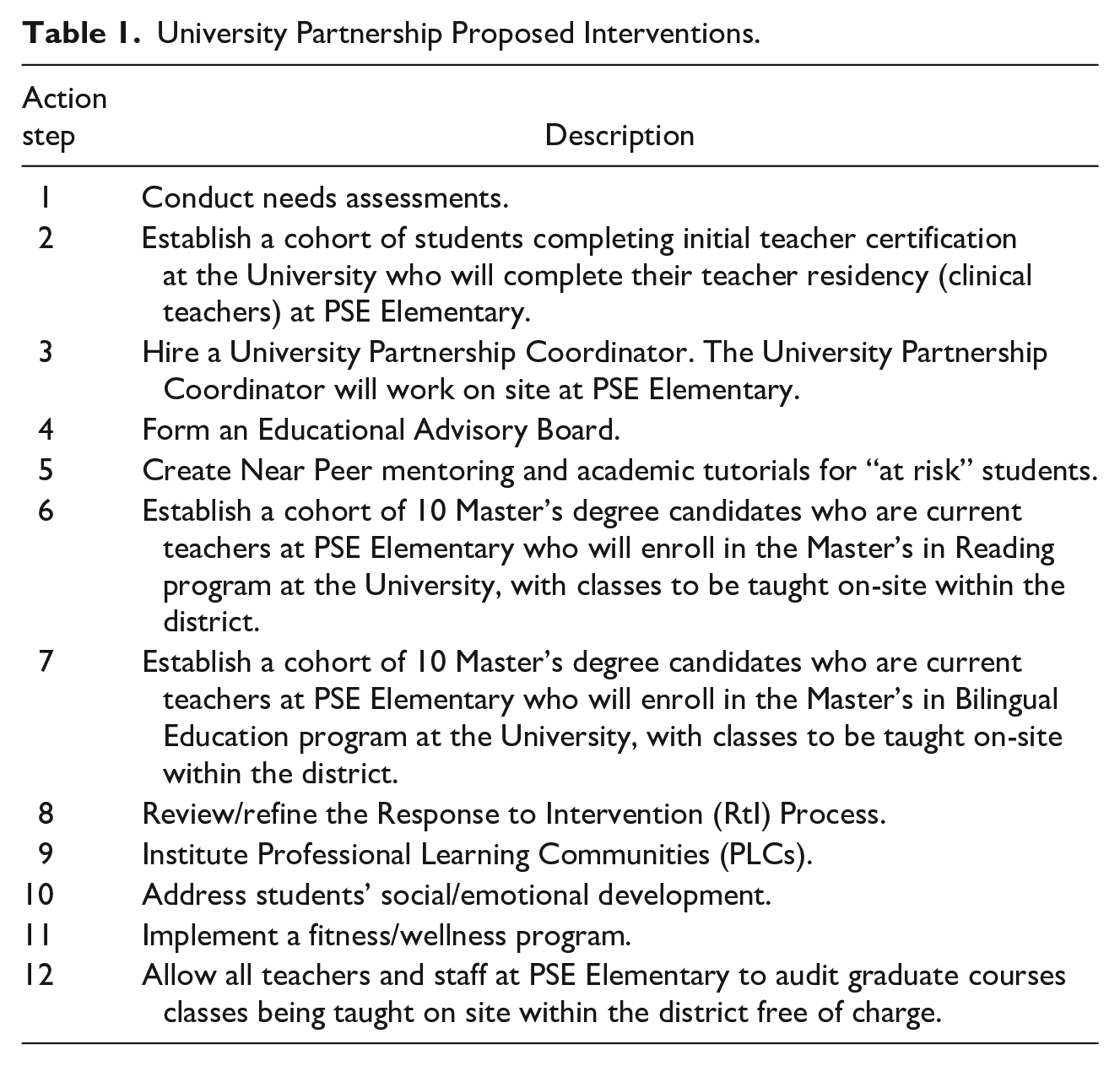
In year 1, action steps 1-5 were implemented. Steps 6-12 were planned to be implemented beginning in year 2 of the partnership. This study includes steps taken in the adoption of steps 1-5 and findings related to interviews and observations at the end of year 1.
Findings
The findings follow a chronological development of events, observing the development of the district-university partnership, coupled with this study’s conceptual framework in its analysis. Three themes emerged endemically from the data: (1) Support Structures; (2) Challenges presented by a change in principal; and (3) Mutual self-interest and common goals.
Support Structures
A number of support structures were identified as contributing to the success of this initiative. These include school district support at the superintendent and cabinet level, university support, and external funding. The superintendent and his cabinet were strong advocates for this partnership. The superintendent said: We have always looked at the University as key holders for our district support. We were interested in the university’s unique model of field residency. One of the challenges we face in the district, is the competition for teacher talent, which creates instability in schools when teachers leave for students in better income areas or better salaries. We do not attract enough student teachers for our schools and at the same time, teachers do not feel necessarily ready to lead challenging schools.
University faculty began having conversations about the involvement of the university prior to the implementation of partnering activities in year 1. It was agreed that involvement in this school was further supporting University programs, since the institution already had several connections and initiatives with the district and their schools. For example, a college of education reading program was already in place at PSE Elementary. The district commitment to the school was evident from the number of programs already in place at PSE including a restorative discipline program, parental involvement initiatives, neighborhood visits, and attendance.
Two professors in school administration led a group of 17 teachers from different districts in the area to examine issues that could be addressed in the improvement of PSE Elementary. The needs assessment revealed the importance of supporting teachers who had limited experience in the classroom; specifically, these teachers needed support in engaging students in learning that is applicable for the age, grade, and interest of students in an interactive technology era. Concurrently, teachers needed support in developing authentic discussions related to instruction in professional learning community opportunities.
The needs assessment also included a meeting with university faculty, the dean of the college of education, ean, the district assistant superintendent, and the school principal to explore areas of support. The principal shared the importance of supporting teachers in their instructional and classroom management skills. Later, the superintendent expressed his perspective about the uniqueness of this partnership: Knowing that this university is interested in partnering at this deep level in supporting PSE Elementary is unique. Usually universities train personnel, or research our schools, but rarely are part of the day to day operations of schools, especially in the induction of teachers. We believe that schools do not only struggle because of the students or specific parts of the city, but also because teachers are not prepared or do not stay. We agreed that if we exposed teachers early on in struggling schools, we believed that teachers would be equipped and prepared to serve districts like ours.
As a result of initial conversations, the school examined suggested initiatives provided by the college of education professors and instructors. Twelve major initiatives were seen as possible strategies to improve the campus. The following priorities were agreed upon as delineating the administrative structure needed for this partnership: (a) establish a cohort of university students completing initial teacher certification at the University to complete their teacher residency at PSE Elementary; (b) hire a University Partnership Coordinator to support the principal on-site and supervise agreed initiatives implemented by the university; (c) form an Educational Advisory Board, and (d) create Near Peer mentoring and academic tutorials for “at risk” students.
This partnership was supported by a U.S. Department of Education Teacher Incentive Fund grant. This grant was awarded to the school district to assist with improving IR campuses. A portion of these funds were allocated to the University in support of this partnership. Specifically, grant funding was utilized to fund paid teacher residencies for aspiring teachers completing their clinical teaching assignments at PSE elementary and for tuition assistance for teachers wishing to pursue graduate studies in Reading and Bilingual Education.
The university provided in-kind support through the hiring of a coordinator to oversee the university partnership. The needs assessment guided the creation of preliminary goals, which were adapted to meet the grant requirements to support the school. The grant allowed for a paid contract for the university clinical teachers to work directly with students and have access to any data related to student performance. Pre-employment contracts were drafted guaranteeing most of the clinical teachers a position with the district after they graduated.
Challenges Presented by a Change in Principal
The partnership and subsequent grant implementation phases did not anticipate a change of school principal when year 1 began. The district had replaced the principal, resulting in a snowball of vacancies, not only among members of the leadership team, such as counselor and assistant principals, but among teachers. By the first year of implementation, only nine teachers out of 68 remained.
The new principal, who was brought out of retirement, was not fully aware of any of the university partnerships or grants the school had received due to its status. Hence, in its first year of implementation, the partnership’s implementing was faced with resistance. The principal had extensive experience with inner-city schools and those in need of improvement, also showing experience in being part of large grants such as ones stemming from United Way. The principal explained her concerns: I had to come in and generate consistent process into place. People who know me in the district knows that the first thing I will do is focus on instruction. I found there are about 10 concurrent initiatives for this campus. I was not aware of all these initiatives going on.
However, the University Partnership Coordinator shared that the principal was not open to all the initiatives while a culture of learning needed to be set to start the year. Most notably the principal refused to allow her to serve on the school’s educational advisory board, and limited her ability to observe classroom instruction. The university partnership coordinator said: From a list of activities when I first started, in the first meeting, the principal reviewed the list and scratched through everything except 4 items. One of the approved items included the ability to talk to teachers in pre-k, kindergarten, grades 1 and 2 during the weekly Professional Learning Community meetings. I have been told leave grades 3, 4, 5 alone, limiting the supervision of clinical teachers and field students without on-site support.
The interventions planned for year 1 were adjusted based on the decision-making processes of new personnel at the campus level. Teachers hired that year were not brand new teachers, but showed a spirit of commitment according to the principal. Teachers were involved in teamwork to develop lesson plans every morning in the initial 9 weeks. Of concern was how students were perceived at the school, and the intent to change the engagement of students. The principal shared, “From the previous year, I found three binders with 450 referrals from the previous year. So I knew I would have to work with teachers to improve the focus toward learning.”
“Putting consistent structures toward processes and procedures was necessary to set expectations for teachers and students,” according to the principal. She wanted to build “grit” among teachers “where they do not give up or feel depleted.” Nonetheless, she was concerned with the preparation of student-teachers on a challenging campus, as not being necessarily conducive to their preparation. The principal was not involved in the selection of clinical teachers, and questioned: “The first day I was here the principal did not agree that preparing teachers in a campus like this was a good idea. Why on earth would you put brand new teachers to be trained on an IR campus?” The principal’s perspective definitively impacted the interventions and decision-making processes for year 1.
In summary, for the first year, the principal’s commitment to the partnership was more focused on the immediate needs of students, without being necessarily committed to partnerships that she felt were not focused on immediately impacting student achievement on standardized tests.
Mutual Self-Interest and Common Goals
Both University and district administration focused on approaching change through areas of mutual self-interest and common goals. On the university side, the hiring of a coordinator to oversee grant operations and organize university students and their engagement in school activities was a way to organize both faculty and strategies as aligned with the grant. Two supervising instructors were teaching university classes on-site (one to supervise clinical teachers, and the other to supervise field residents), while these university interns were active in the classrooms. Even though about 300 clinical teachers and field residents were placed in different schools, the ones serving PSE elementary were interviewed by the university and district in order to assess their interest and readiness.
From the district perspective, both the assistant superintendent and school principal were involved in the selection and placement of clinical teachers to maximize impact on student achievement as measured by performance on standardized tests. As one of the coordinators explained, “The clinical teachers signed contracts where they would get compensation and a 3-year employment if the district chose to employ them based on their performance.” Such configuration was the strength of the teacher support model, according to the superintendent: I believe the first experience when starting a career and the opportunity to foster growth solidifies if you want to stay and seek growth in that career. We would like to promote teachers to see that their commitment to the community is building their careers at our district.
The placement of clinical teachers at an IR campus was perceived as an impactful move toward changing the culture of the school. As one of the supervising instructors said: We really wanted to build a strong district-university relationship. I chimed in with the aspiring teachers because I felt that sometimes you have to get muddy and roll up your sleeves and get in there and see what it’s like to not have resources to see struggling students–to really understand the teaching field. It would be a challenge but an eye-opener for these pre service teachers. We found them eager to get to know the students and to make a difference.
However, there are unique challenges associated with working at a high needs school. As one of the field residency students who had grown up in a more affluent neighborhood reflected: I see the difference in relation to a lack of resources. I see what students lack just by them living on this side of town. An affluent neighborhood school has double the special education teachers for fewer special needs students. You know, it’s like going up an uphill battle with no funds for the same learning outcome requirements.
It was clear to all parties that social promotion would not be acceptable on this campus. As one clinical teacher serving in 5th grade said: When I first started we talked about feeling bad about retaining students. But if we don’t (retain them) this means that all the students who were promoted will struggle again in the next grade. That is how we get 5th graders with a really low level in Reading or not being up to speed in Math.
It was also clear that building relationships with students was a priority to many. As one of the field resident students reflected: I taught a 4th grader how to set her cell phone alarm so she could get up by herself in the morning. I think she has 5 siblings. Her attendance and learning time improved and I am really happy when she comes in in the morning.
Another important initiative that all parties agreed was in their mutual interest was the establishment of a Near Peer mentoring model. The university applied for and was awarded funds from an area foundation in support of this program. This after school tutorial program provided assistance to students in grades 3-5. Aspiring teachers from the university who had demonstrated subject matter expertise were recruited to serve as mentors to students from PSE Elementary who had been identified as needing additional assistance. Each mentor remained with their mentee throughout the entire year, establishing a near peer relationship. One of the mentors reflected on their decision to participate in this model, saying: I tend to gravitate to the students that need more help and (are) struggling and they’re really trying. I gravitate to them, but when I was sitting with my teacher and we were talking about pass or fail I see that these students slip through the crack(s). No wonder we’re in the situation we’re in. I wonder we can’t give every student exactly what they need. If we’re going to let them keep slipping through the cracks they will never get that help.
Clinical teachers and field residents shared what they had learned by getting their internships at PSE. They counted on feedback to learn whether they were growing. The 8 clinical teachers in residency at PSE Elementary learned that both successes and challenges were closely tied, where student success was directly dependent on both academic and relational support. As one of the field residency students reflected: We must provide positive feedback throughout the day: I find students who are happy and then when we come back from lunch they are sad. It is important to build a relationship with students, so just giving them encouragement and getting them to realize that we care beyond their home problems help students connect back to focusing on the academics.
By focusing on areas of mutual self-interest and common goals, the university and district were able to achieve some success. By mid-year, the principal shared the morale was up and teachers were feeling confident that the students would be improving by the end of the year. The student referrals were reduced dramatically, and teachers were more highly invested.
Evaluation at the End of Year 1
Student achievement on standardized tests improved dramatically by the end of the school year. In fact, this campus demonstrated the largest growth of any of the 90 campuses within this school district. As a result, the school is no longer classified by the state as being Improvement Required (IR).
Student teachers who completed their field residency and clinical teaching experiences were unanimous in stating that they were better prepared to serve on high needs campuses as a result of their participation in this program. They also identified growth related to becoming teachers beyond the academic experiences. As one of the clinical teachers shared: “Taking college courses, you learn what you need to learn, but when you get to the field it’s a whole other ball game!” Similarly, one of the instructors shared that the clinical teachers’ direct experience with PSE had been enriching: I think this experience better prepared the as teachers for the classroom and better solidified in themselves a career path they wanted to take. I firmly believe and our preliminary data shows that they made an impact on the kids on a personal and academic level.
A new concern also emerged. The school district made the decision to transfer the school’s administration to a charter company. Principals and teachers, including clinical teachers were uncertain of the following year’s re-configuration, including hiring renewals. One of the coordinators reflected, “The intent (is) to provide experience in public school related to state examination and certification of teachers.” She was concerned that student teachers would no longer be able to be placed on this campus, “once this school is changed into a charter school.”
The move to a charter school may present a challenge to the University partnership as charter schools in Texas are not required to hire certified teachers, but the Texas Education Agency requires that clinical teachers are supervised by experienced certified teachers.
Discussion
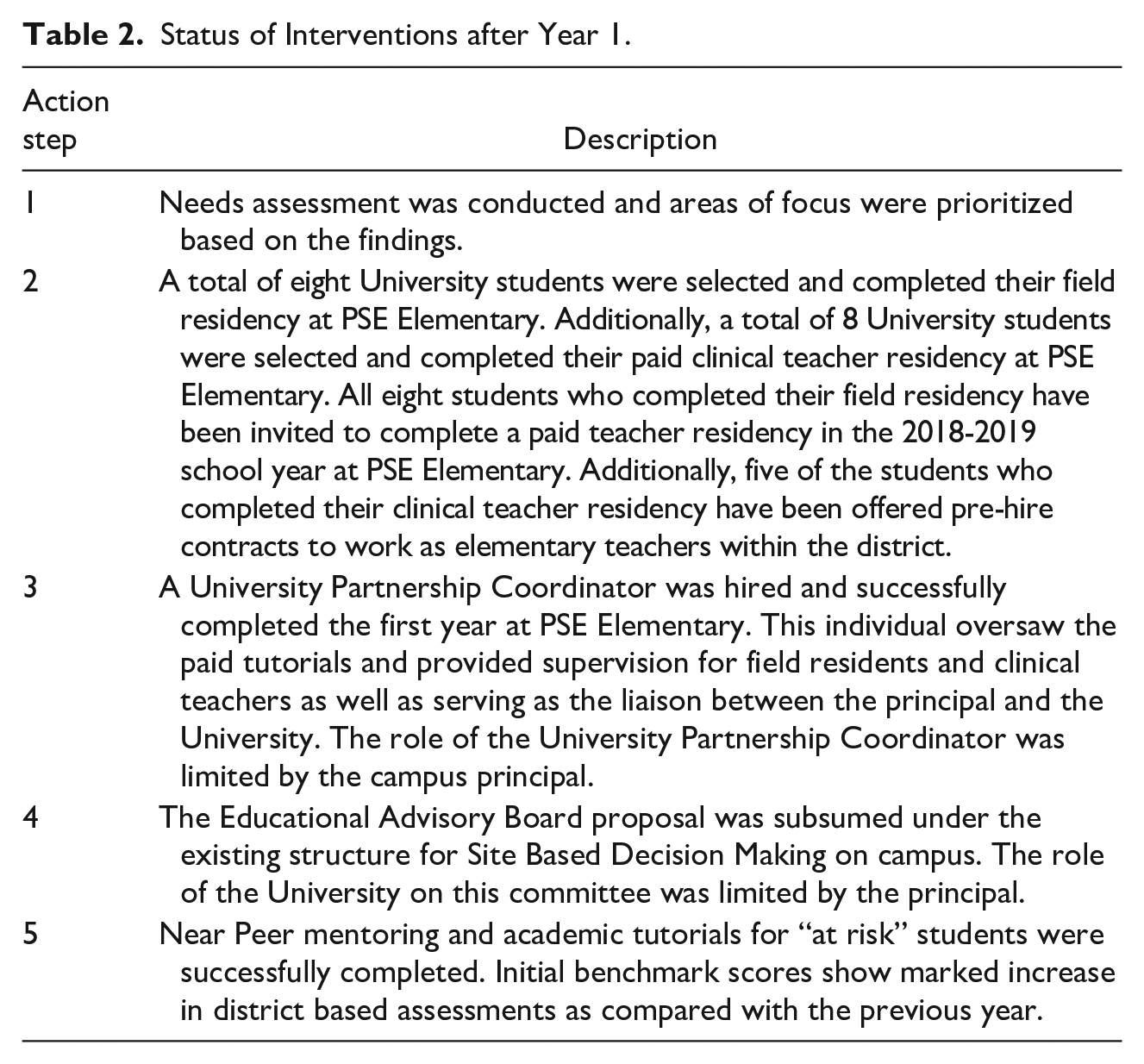
There are parallels between the findings of this study and those conceptualized by Thorkildsen and Stein (1996), including district support, university support, external support, mutual self-interest and common goals. There were also some areas that were ill-defined within this study and presented challenges to this partnership, including shared decision making, the selected school’s principal, and changing procedures. Responses taken from the interviews revealed both successes and challenges associated with each of the five action steps undertaken in year 1 (see Table 2). Importantly, there were challenges associated with trust. Butcher et al. (2011) discuss the importance of trust in any university-district partnership. The lack of trust was particularly evident with the hiring of the new principal. This may be reflective of the intersection of two cultures with differing aims and values.
Status of Interventions after Year 1.
Walsh and Backe (2013) warn that many university-district partnerships are primarily focused on their own unique goals—in this study, the new principal was clear that she was focused on turnaround in the first year as measured by student achievement on standardized tests. The University had a broader vision to positively impact instruction and the community long-term, with a focus on teacher training. Hunter and Botchwey (2017) argue that the most successful university-district partnerships are those which are formed as true collaborations, and we believe there were points of true collaboration within this study as well, such as the placement of students in field residency/student teaching and the near peer mentoring program.
The field residency students were present at PSE Elementary for 164 hours. The student teachers were present at PSE Elementary full time for one entire school year. Traditional student teaching in Texas lasts for 16 weeks, and student teachers are generally paired with highly successful mentor teachers on highly successful campuses. By being placed at a low performing campus whose mentor teachers had not achieved high student test results, these aspiring teachers received real world experience working at a school in need of improvement. School district leaders, university faculty, and most importantly the aspiring teachers themselves reflected on this as one of the great successes of the model—they were no longer afraid of being placed at a low performing campus, it was something they were trained to do. Additionally, both field residency and clinical teaching students participated in after school “near peer” tutoring. The peer tutoring appears to be a major success of the first year partnership. Achievement scores on district benchmark exams in reading, math, and science, all indicated marked improvement from beginning of year to end of year exams. Student achievement on state standardized tests showed sufficient growth such that the Texas Education Agency removed the campus’ designation as Improvement Required (IR).
Limitations/Implications
This study is limited both in its scope and design. In scope, this study has limitations due to its regionality, since all respondents are from one school in one region, from one state in the United States. The study is also limited in its design. As a single site case study, it was the intent of the researchers to examine the strengths and challenges unique to this particular partnership. It would be of great interest to replicate this study on different campuses, in a different region of the United States or in an international setting to see what similarities and differences may emerge.
While no single model can apply to all University-district partnerships, there are components of this study that may be useful for others who are considering a similar partnership to consider. The first is near-peer tutoring. Within this partnership, all parties agreed that there was great benefit in utilizing university students as near-peer tutors. These students were closer in age and experience to the students they were tutoring, and achievement results indicate that this was a highly successful strategy at improving test scores for struggling students. A very interesting question for educator preparation programs and district partners to consider is what the best placement is for field residency/student teachers. Traditionally, aspiring teachers have been placed with the highest performing mentor teachers at the highest performing campuses. The question raised in this partnership is whether it was truly in the best interest of aspiring teachers to complete their field residency and clinical teaching experiences at a high needs low-performing campus. The answer to this question has potential implications for educator preparation programs who may be considering similar partnerships. The superintendent, university faculty, and student teachers involved in this study all expressed their belief that after receiving training at an IR campus, they would be ready to be successful at any campus. It is the authors’ intent to follow these students’ careers longitudinally to identify whether there is a difference in career longevity of individuals who were trained in this project as compared with individuals who were trained at non-IR campuses.
Conclusion
This study was conducted in order to identify the strengths and challenges related to a university- district collaboration supporting a high needs urban elementary school. This study examined the experiences of district level personnel, university professors, coordinators, campus leadership, teachers, and aspiring teachers. The major themes that emerged from this study were: the importance of having support structures in place; challenges presented by a change in principal; and the confluence of mutual self-interest and common goals. We agree with Officer et al. (2013) that Universities are uniquely well positioned to partner with K-12 schools to create a pipeline of opportunity, particularly in high poverty areas. We further agree with Darling-Hammond and Bransford (2005) that deep change in community opportunities requires sustained partnerships that impact both schooling and teaching. These findings add to the small but growing body of literature regarding university-district partnerships in high-needs schools. We hope this study’s findings may prove valuable to other educator preparation programs and school districts that may be considering similar partnerships.
Footnotes
Declaration of Conflicting Interests
The author(s) declared no potential conflicts of interest with respect to the research, authorship, and/or publication of this article.
Funding
The author(s) received no financial support for the research, authorship, and/or publication of this article.

Author Biographies
Elizabeth Murakami is a professor and Mike Moses Endowed Chair in Educational Leadership at the University of North Texas. She is a Latin-American born and she earned her master’s in Curriculum and Teaching and doctoral degree in Educational Administration from Michigan State University. Dr. Murakami’s research has been dedicated to school improvement and the academic success of Latin@ populations—from P-20 to advanced leadership professions in education—generating research and pedagogy in prestigious journals such as Academe, Journal of Studies in Higher Education; and the International Journal of Qualitative Studies in Education; Journal of School Leadership, Educational Management Administration and Leadership (EMAL), and the Journal of School Administration and Supervision. Her latest book is entitled: Beyond Marginality: Understanding the Intersection of Race, Ethnicity, Gender and Difference in Educational Leadership Research.