



Abstract
How do backcountry travelers respond to losing their way? To address this question, deer hunters were surveyed in regard to their attitudes toward various methods of recovering one’s spatial orientation. Ratings of the likelihood of adopting each of nine reorientation strategies—or advice on what to do on becoming “lost” in the woods—revealed that “climbing a tree or hill for a better view” was rated highest among alternatives. One strategy, “try to travel a straight line out of the woods,” was positively correlated with respondents’ self-reports of having been lost while hunting. Principal components analysis of reorientation strategies yielded four components, labeled “skill based” (e.g., using environmental cues to travel a straight line), “downhill” (e.g., following a stream), “perception based” (improving visual access), and “wandering” (e.g., traveling the path of least resistance). The importance of spatial reorientation to general wayfinding skill was discussed.
“Did you ever get lost in the woods?” I once asked a company of twenty campers. Some answered, “Yes; once or twice.” Others said, “Many a time.” Only two said “No, never.” Then I said, turning to the two, “I know that all the others here have had plenty of experience, and that you two are the tenderfeet, and never lived in the woods.”
A much-neglected topic in the substantial literature on spatial cognition is the manner in which people negotiate large-scale rural or wilderness areas where wayfinding cues are scarce and opportunities for getting “turned around” are plentiful. Indeed, there has been very little research on how backcountry navigators successfully find their way and less still about how they respond to losing their way and becoming spatially disoriented. Nevertheless, these are topics of considerable interest to the outdoor enthusiast, if the sheer number of books and articles from the popular press pertaining to “getting lost” is indicative (Ellard, 2009; Gonzales, 2001; Gorman, 2005; Grekin, 2003). In this article, we shall review the scant research on wilderness wayfinding, including studies of spatially disoriented or lost people. A survey of Nova Scotia deer hunters will be described, in which hypotheses regarding wayfinding skills and strategies were tested.
How do people successfully navigate large, relatively homogeneous wilderness areas, such as forest, desert, tundra, or sea? Moreover, how do wilderness navigators respond to losing their bearings and becoming disoriented in their travels? We propose that much can be learned about real-world navigation from the ethnographic data of anthropologists who have studied the wayfinding behavior of tribal societies in which technological aids are unavailable or, in the case of the magnetic compass in the Arctic north, virtually useless. Although a review of this research is beyond the scope of this article, it seems fair to summarize the wayfinding skills of the people of these cultures as highly variable, depending on the particular characteristics and requirements of the respective environments that must be navigated. Where long-range travel is required, such as with the Salteaux Indians of northern Manitoba (Hallowell, 1955) or the Puluwat islanders of the south Pacific (Gladwin, 1970), the emphasis seems to be on route knowledge, with numerous named landmarks and celestial cues used for piloting and route checking. Where travel involves hunting or foraging excursions in various directions away from a stationary camp or village, such as the Inuit hunters of Arctic Canada (Aporta & Higgs, 2005; Berry, 1966) and northern Alaska (Nelson, 1969) or the Ngatatjara hunter-gatherers of the massive Gibson desert of Australia (Gould, 1969), wayfinders seem to rely on survey-type knowledge, involving a somewhat metric grasp of distances and directions between known landmarks. However, the cognitive maps of these travelers seem to be highly “skeletal” and incomplete (Kuipers, Tecuci, & Stankiewicz, 2003). The northern Inuit, for example, have many cues for direction (mostly related to prevailing winds and snow patterns), but distance estimations are necessarily approximate (Aporta & Higgs, 2005; Nelson, 1969) if not unreliable (Parry, 1969/1924). In the face of inexact spatial knowledge of the potentially hazardous environments that must be navigated, travelers in all these cultures use various wayfinding strategies for dealing with temporary disorientation and for ensuring safe arrival at and return from their distant destinations. For example, Inuit walrus hunters may need to travel long distances in their boats to locations where landmarks and other reference points are not visible. Because chasing walrus may require traveling in circles around floating ice, the hunter may not necessarily be spatially oriented at any given moment. However, when the time comes to return to camp they use the wind direction to navigate to known geographical features such as a lake shore, even when a blizzard causes whiteout conditions (Aporta & Higgs, 2005). In this example, the shoreline provides a navigational handrail (a linear environmental feature that can guide the traveler to a destination), leading the hunter back to home, similar to the manner in which handrails are used in the sport of orienteering (Andresen, 1977).
Spatial Disorientation and Reorientation
Despite the substantial research literature on spatial cognition, it has been only relatively recently that researchers have actually investigated the phenomenon of being spatially disoriented, especially in real-world (i.e., nonlaboratory) environments (Cornell & Hill, 2006; Heth & Cornell, 1998; Hill, 1992; Koester, 2008; Montello, 1998). Although the topic of being spatially disoriented had been discussed very early in psychological writings (Binet, 1894; Forde, 1873), the first actual study of lost people was apparently conducted by Syrotuck (1977) and published in a monograph intended primarily for search and rescue (SAR) responders. A lost person in this context is someone who is the target of a rural or wilderness search conducted by SAR personnel in an official police action. Hill (1997) defined spatial disorientation as “being unable to identify one’s present location with respect to locations that one knows, and having no effective means or methods for reorienting oneself (p. 1).” Montello (1998), who preferred the phrase “geographical disorientation” to “lost”; to wit: Disoriented people are “uncertain about where they are or where they need to go to get to some destination (p. 3).” For this study, as described in the following, lost was operationally defined as being “turned around such that it took you [the respondent] at least 30 minutes to regain your bearings.”
A major goal of this research was to investigate the manner in which spatially disoriented individuals attempt to recover their orientation in a forested environment, that is, to become “found,” without using navigation aids such as map, compass, or global positioning system (GPS). Unfortunately, although there are a number of personal anecdotes reported in the popular literature by people who had survived the experience of being lost (Fendler, 1978; Gonzales, 2001; Jonsson, 2002), there has been very little research published on the manner in which lost persons attempt to recover their orientation. Most of the studies to date have focused on the distances lost persons of various categories (e.g., hikers, hunters, anglers) had traveled from the place where they were last known to be (Hill, 1992; Koester, 2008; Syrotuck, 1977), whether the person had traveled uphill or downhill (Syrotuck, 1977), or the angle of dispersion between the lost person’s intended goal of travel and the location where they were actually found (Heth & Cornell, 1998). In his archival study of lost person reports submitted by various SAR agencies around the world, Koester (2008) reported that the three most common lost person behaviors are staying put; walking on a road, trail, or other “travel aid”; or simply wandering, respectively. Although these may be important considerations for SAR responders tasked with locating lost people, they do not address the specific motivations and other psychological factors that contribute to how lost persons end up where they do. One exception is the survey study conducted by Montello (1998), who asked respondents to consider “the one episode in your entire life when you were the most severely lost that you can remember (p. 5).” He found a wide range of responses to the experience, such as to continue moving, asking someone for directions, backtracking, and merely staying put. Unfortunately, he did not elaborate on the reorientation attempts made by his respondents in reaction to specific types of disorientation experiences, including the environments where such experiences occurred. As stated earlier, the present study focused on the reorientation attempts made by individuals who were severely disoriented in the forest.
A Multimethod Approach
Research on spatial disorientation poses special challenges to the behavioral scientist, as a kind of Heisenberg uncertainty principle applies whenever we attempt to study a truly lost person. For example, we cannot proceed to disorient our experimental participants in the woods and secretly follow them around while observing their behavior, even if that were ethically acceptable. For a study to be ecologically valid, a lost person must be seriously disoriented and concerned for his or her safety, unaccompanied by a clipboard-toting researcher. Rather, the study of lost person behavior would seem to require what Campbell and Fiske (1959) described as a “multimethod” approach, converging on the phenomenon from various research directions. Toward this end, the research directions taken in this research included (a) a summary review of advice by purported wayfinding experts on how best to reorient oneself on becoming lost and (b) analysis of self-reports of individuals who engage in challenging navigational tasks in the wild, including a look at how well their own reorientation strategies compare with those prescribed by experts. We examine first the advice on spatial reorientation and then turn to a discussion of the wayfinding behavior of one particular forest navigator, the recreational deer hunter.
Reorientation Strategies
To develop hypotheses about how lost people will try to reorient themselves, we reviewed the popular literature directed at wilderness hikers, orienteers, anglers, hunters, trackers, and other backcountry enthusiasts, authored by apparently knowledgeable outdoor leaders, guides, and survival instructors. Indeed, we discovered no shortage of advice on how best to react to becoming lost. Most authors recommended several tactics, depending on the specifics of the lost person’s situation, and we found a considerable lack of agreement among authors regarding the best method of refinding the way. Following is a compilation of the various reorientation strategies this literature provided. In an attempt to make the list more exhaustive, we have included those strategies that the experts claim (from their experience) do not work.
Try to retrace your steps
Many authors recommend, usually as a first attempt to become reoriented, that the lost persons make an effort to return to the location where they were last oriented (Andresen, 1977; Fleming, 1994; Kjellstrom, 1955; Merrill, 1972; Roberts, 1988; Sell, 1964; Touche, 2004; Wood, 1982). These authors suggested attempting to recollect the landmarks the person has recently encountered and/or following their own tracks back to safety.
Travel a straight line
The authors recommending this tactic usually claim that it is difficult even in the wild to travel very far in one direction before striking on a trail or road. However, to avoid walking in circles, one must be sure to travel in a straight line. The popular outdoor writer, Bradford Angier (1956), for example, wrote,
Hiking in a straight line in any direction would bring [the lost person] out, and this he could do even without a compass by continuing to line up two objects ahead of him. These might be two trees. When he had almost reached the nearer of these, he would select another sight in line further ahead (p. 209).
This strategy is also recommended by survival instructor Tom Brown, (1983).
Climb a hill or tree for a better view
Many authors suggest that the lost person might recover his or her orientation by climbing to higher ground to get a view of the surrounding area (Angier, 1956; Brown, 1983; Fleming, 1994; Merrill, 1972; Touche, 2004).
Follow a stream to civilization
Only a few experts recommend following a stream to safety, the most notable being the founder of the American Boy Scouts, Ernest Thompson Seton, in his “Woodlore” chapter in the first edition of the Boy Scouts Handbook. This advice was repeated more recently by Merrill (1972) and Sell (1964). However, Fleming (1994) advised that the lost person not try to follow a stream, as many streams travel away from civilization rather than toward it.
Travel generally downhill
In addition to following a stream to civilization, Merrill (1972) also advised traveling downhill when possible, as this “will usually lead you to a road or trail.” In this context, traveling downhill represents a reorientation strategy with a specific purpose, rather than due to mere ease of travel. Indeed, traveling downhill may not necessarily be the easiest option, as vegetation and terrain could possibly discourage it. In fact, the SAR research reviewed by Koester (2008) suggested that, in some cases, as many as 50% of lost persons travel uphill.
Use directional indicators to determine the best direction to travel to safety
Gatty (1958/1983) described numerous environmental cues that can be used for finding one’s way in practically any type of terrain, such as examining patterns made by shifting sand or snow to determine prevailing wind direction, and in the forest, by examining the shapes of softwood trees. However, most authors limit their wayfinding advice in using the sun and other stars for estimating the cardinal directions of north and south (Brown, 1983; Touche, 2004; Wood, 1982).
Sample various directions from a landmark
Brown (1983) recommended a tactic, which he called “probing,” in which an identifiable place (such as one’s shelter) becomes the hub of an imaginary circle or wheel, from where the disoriented person travels a specific number of steps while looking for familiar places, trails, or highways. If nothing is found, the person returns to the hub and probes or samples a different direction. Each probe then becomes a spoke in the wheel. “Chances are,” wrote Brown, “you will come upon a thoroughfare somewhere along the first few lines you walk (p. 269).” Similar strategies are also recommended by Angier (1956), Fleming (1994), and Manning (1973).
Follow the path of least resistance
Most of the experts warn against the apparently common response by lost people to walk in whatever direction seems to afford the least resistance and therefore the fastest travel speed, thereby depleting energy by wandering aimlessly (e.g., Merrill, 1972).
Travel any direction that seems best at the time
Not to be confused with the “direction sampling” or probing strategy listed previously, this nonrecommended tactic simply refers to the observation that lost people tend to move purposelessly, traveling in one direction for a while (not necessarily the path of least resistance) and then changing their minds and attempting to go another direction. Some authors specifically recommend against it (e.g., Angier, 1956). Fleming (1994) urged that the lost person should travel only in a known direction to a known location.
Stay put
Virtually all the experts recommended staying in one place, making some sort of shelter from the elements, and preparing to signal aircraft or SAR responders. This advice was normally provided in the event in which attempts to become reoriented were unsuccessful.
The Deer Hunter
Outdoor travel by people of the non-Aboriginal societies of the world will rarely be as challenging as that described earlier. One activity that does require considerable navigation skill is recreational hunting, which continues to be popular in North America, especially in the midwestern United States (U.S. Fish and Wildlife Service, 2004) and all Canadian provinces (DuWors et al., 1999). Deer hunting in particular has received some attention by researchers who were interested in the behavior of persons who are spatially disoriented or lost, as actuarial data reveal that approximately 40% of police searches for persons missing in forested or wilderness areas involve lost deer hunters (almost all of whom are men; Hill, 1992; Syrotuck, 1977). It has been proposed that the act of pursuing deer, which tend to inhabit relatively dense forested areas, requires hunters to simultaneously engage in two effortful cognitive processes, that is, continuously updating their spatial location while moving around in the forest and searching for subtle traces of game (Hill, 1992). Contributing to these difficult wayfinding conditions is the fact that hunting normally occurs away from trails and other navigational aids (Heth & Cornell, 1998). As with the walrus hunters of Baffin Island, deer hunters will inevitably experience moments in which they lose track of their current position, requiring some method of reorientation, such as relying on one’s sense of direction, knowledge of the surrounding landscape, memory of travel (Cornell & Heth, 2003), or simple reliance on technological devices, such as map, compass, and/or GPS. Although the percentage of deer hunters who actually become spatially disoriented is not known, the relatively high number of those who become subjects of missing person searches suggests that hunters may vary considerably in their mastery of navigation skills.
The Current Research
In this study, we asked Nova Scotia deer hunters to indicate their preferences for various methods of spatial reorientation that have been recommended by the authors of popular literature on backcountry navigation. A simple tally of the recommendations revealed that the most common advice was simply to “stay put,” followed by “try to retrace your steps,” and “climb a hill or tree for a better view,” respectively. Therefore, we hypothesized that hunters in our sample would express reorientation preferences in that order. We also expected that the less frequently recommended (and sometimes specifically not recommended) options, such as “travel downhill” or “follow the path of least resistance” would be similarly less favored by our sample.
Regarding our review of this literature, we noted a wide variation in the types of advice rendered. Some recommendations seem to appeal to the individual’s navigational skill (e.g., use directional indicators to become reoriented), whereas others seem to provide relatively simple heuristics for finding one’s way to safety (e.g., follow a stream to civilization). We expected from this variation and apparent clustering of types of strategies that there would be some underlying dimensional structure in our respondents’ preferences for the various strategies, which could be revealed by a factor analysis.
Finally, we asked our respondents to indicate the number of times that they had actually been lost while hunting, toward investigating whether such experiences had any association with any of the various reorientation strategies. We made no predictions in this exploratory part of the study.
Method
Participants
Participants were recruited from local outdoor recreation clubs and societies, through solicitation at club meetings and advertisements posted in society newsletters (with permissions from club officers). Prospective participants were told only that the study would involve answering questions about hunting practices and forest navigation. In response, 118 men agreed to participate in this study. They received no compensation for their participation, although the researcher had agreed to present the results of this study at a club meeting and to mail a description of the results to those participants who had responded to newsletter ads.
The ages of the participants ranged from 20 to 72 years, with a mean of 46 years (SD = 11.5 years). All were White males with current deer hunting licenses. The mean level of education was 11.8 years, ranging from Grade 8 to PhD.
Materials
“Lost in the Woods” Questionnaire
This one-page questionnaire (online appendix available at www.eab.sagepub.com) required the respondent to imagine a scenario in which they become disoriented in the forest while hunting deer. In total, 10 “possible actions” were listed, derived from the spatial reorientation advice discussed previously. Respondents were asked to rate, on a 7-point scale from 1 (highly probable) to 7 (highly improbable), the likelihood that they would attempt each of the 10 strategies in response to the imagined scenario.
Procedure
Participants completed the surveys individually or in small groups during or following the society meetings, under the supervision of a researcher. In addition to providing basic information regarding the current age, the educational level, and the number of years that they had been hunting deer, respondents were asked to estimate the number of times they had been lost, such that it took them at least 30 min to reorient themselves. Subsequently, the Lost in the Woods scenario was read aloud to participants by the researcher, who attempted to ensure that the scenario was understood before participants proceeded to rate the individual “possible actions.” The procedure was normally completed in less than 30 min.
Results
History of being lost
The range of times that respondents claimed to have been spatially disoriented while hunting varied from 0 to 56, with a mean of 2.7 (SD = 5.7) and a median of 2. Of the 118 participants (mean age = 44 years), 33 reported never having been lost, by our criterion (at least 30 min of disorientation). To compute correlation coefficients using this variable, logarithmic transformations were made to the highly skewed distribution. Not surprisingly, there was a significant positive correlation between the transformed variable, history of being lost, and the number of years hunting, r = .21, p = .022. Correlations between history of being lost and preferred reorientation strategies yielded one significant, though unpredicted, correlation with “travel a straight line,” r = .26, p = .005.
Reorientation strategies
A repeated-measures, one-way ANOVA was conducted on the 10 reorientation strategies listed in the Lost in the Woods questionnaire (including the “stay put” option). This analysis yielded a highly significant result, F(9, 1017) = 235.51, p < .001,
Summary of Ms, SDs, and Post Hoc Comparisons for Items in the Lost in the Woods Questionnaire
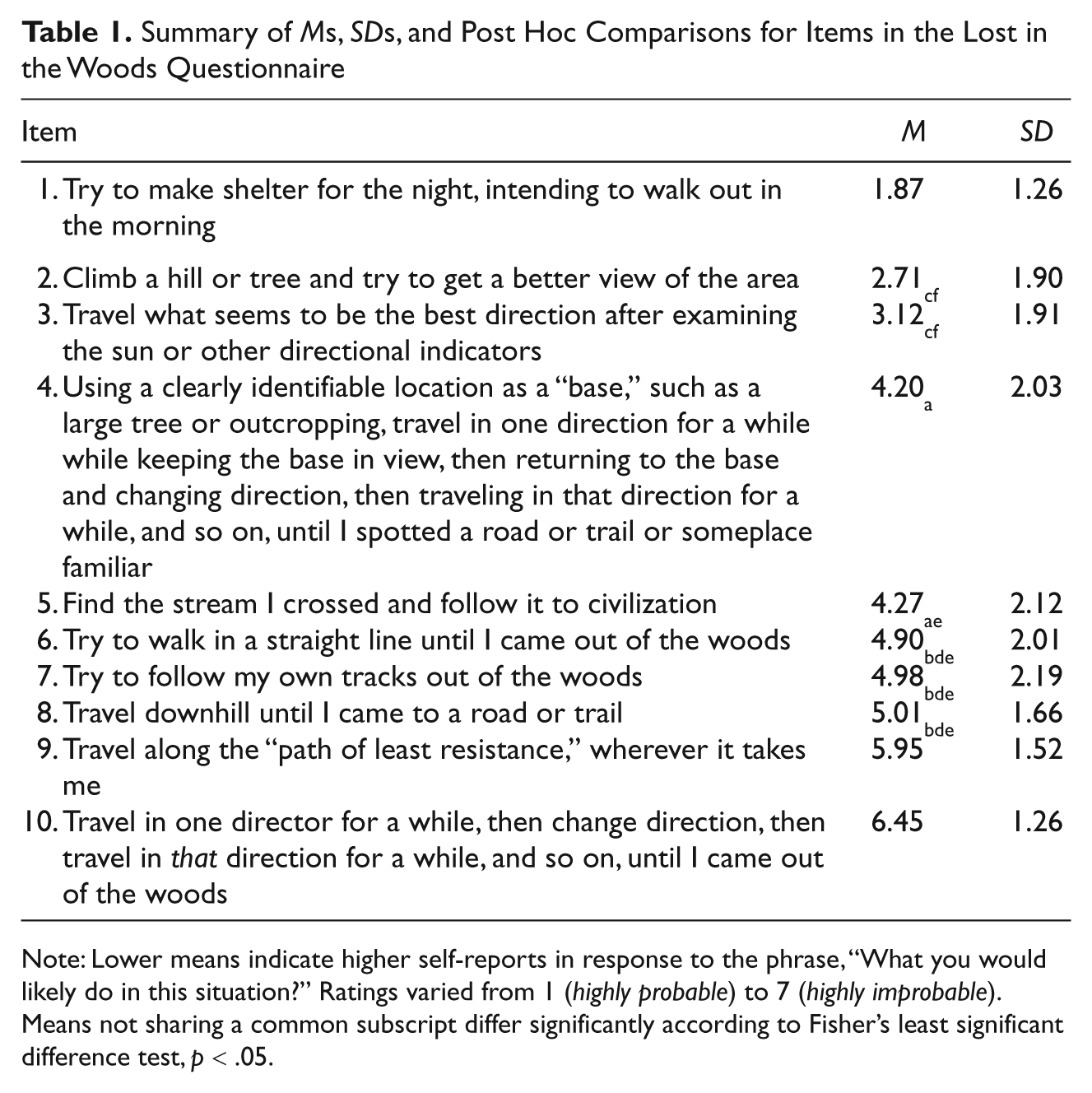
Note: Lower means indicate higher self-reports in response to the phrase, “What you would likely do in this situation?” Ratings varied from 1 (highly probable) to 7 (highly improbable). Means not sharing a common subscript differ significantly according to Fisher’s least significant difference test, p < .05.
To determine whether the various strategies contained in the Lost in the Woods questionnaire had an underlying factor structure, we conducted a principal components analysis on nine of the strategies, omitting the “stay put” option (which was rated highly by all participants as a last resort), using a varimax rotation. The Kaiser–Meyer–Olkin measure of sampling adequacy was .613, indicating that factorability of the data was at least adequate (Kaiser, 1958). Four factors with eigenvalues greater than 1.0 were found, accounting for 66% of the total variance (see Table 2). Factor 1 had loadings above .40 for “travel a straight line,” “backtrack,” and “travel best direction.” Because these strategies would seem to require the application of wayfinding knowledge beyond a novice level, we labeled it as “skill based.” Factor 2 had loadings for “travel least resistance” and “travel random directions”; we labeled it accordingly as “wandering.” Factor 3 had loadings for “follow stream” and “travel downhill,” so a label of “downhill” seemed appropriate. Finally, Factor 4 had loadings for “climb up” and “direction sampling.” We labeled this factor “perception based,” as these tactics seem to involve an attempt to reestablish one’s orientation by improving visual access (Lynch, 1960).
Factor Loadings for Principal Components Analysis With Varimax Rotation of the Lost in the Woods Questionnaire

Note: Full descriptions of items are contained in Table 1 and in the online appendix. Factor loadings > .40 are in boldface.
Discussion
We began this investigation with questions about how backcountry travelers manage to find their way under difficult navigational conditions and how they might respond to becoming spatially disoriented. We selected recreational deer hunters as our participants because of the wayfinding challenge their activity poses. In our survey of hunters in Nova Scotia, a heavily forested Canadian province that has been described as “the lost person capitol of North America” (Beeby, 2001; Clugston, 2002), we found indeed that a large majority of the hunters had experienced spatial disorientation while pursuing their sport, some in fact many times. Similar to the Inuit walrus hunters of the Arctic, becoming temporarily disoriented while hunting deer cannot always be avoided. More important, the hunter—as with any outdoor enthusiast who enters the backcountry—requires an effective plan or strategy for recovering his or her orientation and not becoming even more seriously lost.
What is the source of the strategies that hunters intend to use for reorientation? We surmised that one likely source is the popular literature directed specifically at the backcountry traveler. In our review of the advice proffered by the authors of books and magazine articles on wilderness travel, we found that the most frequent recommendation on becoming turned around was simply to “stay put,” followed by “try to retrace your steps” and “climb a hill or tree for a better view of the land.” Our hypothesis that our sample of hunters would favor the same strategies was only partially supported, in that “try to retrace your steps” was rated significantly lower than the relatively popular strategy of using directional indicators (such as the sun) to find one’s way to safety. However, our sample agreed with the experts that traveling random directions is definitely not a good idea; this option was rated much lower than all other strategies.
It is interesting to compare these results with those of Koester’s (2008) analysis of the outcome of SAR incidents, in which “stayed put” was the subject behavior most frequently recorded, but “wandered” was also common. (Unfortunately, there is no way of knowing from Koester’s data how many lost people first wandered—or indeed tried other strategies—before deciding to stay put.) The types of outdoor activities that these lost persons had been pursuing is not specified by Koester, but it is appropriate to wonder how much disconnect there may be between what our deer hunters report they would do if they become disoriented in the woods and how they would actually respond to becoming seriously lost, having to resort to their own devices for getting found. This question of course is relevant to our earlier discussion of the difficulties we encounter when attempting to study lost person behavior.
Our finding that history of being lost was positively correlated with just one of the reorientation strategies, “try to travel a straight line out of the woods,” raises the question of the relative effectiveness of the various reorientation methods—a question that this study was not designed to address. Direction of causality, of course, is an issue with correlations, but it is interesting to wonder whether the hunters who have been lost in the past have learned through their own experience that walking a straight line is an effective way to become “unlost” or, conversely, that these unlucky wayfinders have attempted to use an ineffective reorientation method, perhaps one that contributed to their becoming significantly turned around in the first place. However, the overall popularity of the “walk a straight line” option—even by hunters reporting few or no occasions of ever having been lost—leads us to favor the first interpretation. On the other hand, we hesitate to recommend this option as an “all-purpose” strategy on becoming disoriented in the wild. Environmental factors will be critical in determining how effective traveling a straight line will be—as indeed is the case for all the recommended strategies. For example, trying to travel a straight line in a large and remote wilderness area, many miles from roads or signs of civilization, can be disastrous for the lost person. Future research on the relative effectiveness of various methods of reorientation will need to consider as well possible mediating effects of environmental variables, such as terrain, topography, vegetation, climate, and relative isolation.
Principal components analysis of the 10 reorientation strategies led to four interpretable factors, labeled “skill based,” “wandering,” “downhill,” and “perception based.” The two strategies loading on the latter factor—“Climb a hill or tree for a better view” and “Sample various directions away from a specific, identifiable location, while looking for something familiar”—were highly recommended by several of the experts whom we reviewed. We labeled the factor as perception based because both strategies seem to involve a visual search for reorientation by improving visual access to distal stimuli useful for wayfinding (Lynch, 1960). This perception-based approach seems similar to that used by the master Puluwat navigators described by Gladwin (1970), when their canoes are blown miles off-route by the daily summer storms. Under these circumstances, the spatially disoriented navigator’s training prescribes sailing in one direction while looking for any of the hundreds of high reefs or mountainous islands that he or she can visibly recognize from a distance. Once recognition occurs, the navigator is able to reestablish his position and continue his journey. Indeed, as Gladwin observed, the navigator’s training provides solutions for every possible contingency, including emergency procedures. Perhaps a lesson we can learn from such cultures in which long-range travel under challenging wayfinding conditions is necessary is that the ability to spatially reorient oneself is just as important as “knowing the way”—that spatial reorientation is just one component of wayfinding skill.
Footnotes
Declaration of Conflicting Interests
The authors declared no potential conflicts of interest with respect to the research, authorship, and/or publication of this article.
Funding
The authors received no financial support for the research, authorship, and/or publication of this article.
Bio
References
Supplementary Material
Please find the following supplemental material available below.
For Open Access articles published under a Creative Commons License, all supplemental material carries the same license as the article it is associated with.
For non-Open Access articles published, all supplemental material carries a non-exclusive license, and permission requests for re-use of supplemental material or any part of supplemental material shall be sent directly to the copyright owner as specified in the copyright notice associated with the article.
