




Abstract
How do cluttered, chaotic environments—such as messy kitchens—influence snacking behavior? How does one’s mind-set help prevent unwanted snacking from occurring? One hundred one female undergraduate students participated under standard-kitchen conditions or in a chaotic-kitchen condition. Participants were also asked to recall and write about a time when they felt particularly in control or particularly out of control. Finally, participants were given cookies, crackers, and carrots to taste and rate. Participants in the chaotic-kitchen condition and the out-of-control mind-set condition consumed more cookies (103 kcal) than did participants who were in the in-control mind-set condition (38 kcal). The chaotic environment had no impact on consumption of crackers or carrots. Although a chaotic environment can create a vulnerability to making unhealthy food choices, one’s mind-set in that environment can either trigger or buffer against that vulnerability.
Introduction
Stressful experiences can impact health-related behaviors, such as risky sexual behaviors, smoking, and drug use, and each of these behaviors in turn has implications for individuals’ health (Baum & Posluszny, 1999; Carver, 2007). Stress can also have an important impact on food intake, particularly among women (Greeno & Wing, 1994). Stress generally leads to increased consumption of sweets for women, but typically does not influence the consumption of salty or bland foods (Grunberg & Straub, 1992; Kandiah, Yake, Jones, & Meyer, 2006). Furthermore, recent research has found that daily hassles (including interpersonal and work-related hassles) are directly related to increased intake of high-fat and high-sugar snack foods (O’Connor, Jones, Conner, McMillan, & Ferguson, 2008). Stress might impact eating behavior (and other health behaviors) by interfering with people’s ability to exercise self-control (Baumeister, Muraven, & Tice, 2000). The stress–eating relationship can be particularly important in light of growing concerns about the negative health consequences associated with unhealthy eating and excess weight.
The question posed in the present study is whether one particular source of stress—namely, a chaotic (e.g., noisy, disruptive, and disorganized) environment—can also impact individuals’ eating behavior. Consider, for example, a parent coming home from a long day at work and trying to manage a busy household, or a college student contending with hectic course schedule and noisy roommates. Past research indicates that environmental chaos is related to increased parental stress (Dumas et al., 2005), and that it negatively impacts parenting behavior (Corapci & Wachs, 2002) and children’s problem behaviors (Coldwell, Pike, & Dunn, 2006). Furthermore, housing quality (which includes privacy and cleanliness/clutter) is associated with psychological distress as well as decreased persistence at a behavioral task among children (Evans, Saltzman, & Cooperman, 2001). These types of everyday situations or environments can also make it difficult for individuals to regulate their food intake (cf. O’Connor et al., 2008). Because of this, modifying these situations can have important consequences for long-term health and well-being (Wansink & Chandon, 2014). In this preliminary study, we experimentally manipulated the level of environmental chaos to examine its impact on eating behavior. We predicted that a chaotic environment would lead to increased intake, particularly of sweet foods.
An important consideration in understanding an individual’s reactions to stressful situations is the individual’s frame of mind, or mind-set. One’s mind-set can influence coping responses to stressful situations (Scheier, Weintraub, & Carver, 1986), as well as behavioral, affective, and physiological responses (Crum & Langer, 2007). For example, Gardner, Wansink, Kim, and Park (2014) found that simply having people mention one event that had happened earlier in the day that they were grateful for led them to eat healthier at a subsequent snack. Furthermore, Twenge et al. (2007) found that thinking about one’s social connections buffers again the effects of social exclusion on aggressive behavior. Modeled after the Twenge et al. study, we examined the potential moderating effect of an “in-control” versus “out-of-control” mind-set. We predicted that the environmental chaos would lead to increased intake only among those who were oriented to feeling “out-of-control.” In contrast, it was predicted that being oriented to feeling “in control” would buffer against the effects of the chaotic environment.
Method
Participants
One hundred one female students participated in exchange for course credit or a chance to win an MP3 player. Three participants were excluded from the analyses: two because they were outliers in terms of age and one because she was talking on her mobile phone during part of the experiment. This left 98 participants for the analyses described below. The mean age was 19.40 years (SD = 1.40 years, range = 17-27 years), and mean body mass index (kg/m2) was 22.33 (SD = 2.78, range = 17-30).
Materials and Procedure
Participants were recruited for a study “examining the link between personality and taste preference,” and took part in groups of one to three individuals in our laboratory kitchen. Each group of participants was randomly assigned to a standard-kitchen condition (i.e., an organized, quiet room with no disruptions) or to a “chaotic” kitchen. In the chaotic-kitchen condition, participants arrived to a room that was extremely disorganized (e.g., tables out of place, papers piled on tables, pots and dishes scattered around), and were greeted by a female experimenter who was ostensibly running late. While participants completed the consent form, some filler questionnaires that we did not intend to analyze (a measure of personality to bolster the cover story, as well as a perceptual task) and the writing task (see below), the experimenter proceeded to tidy up the room in a loud and disruptive manner by moving tables, banging pots, and so forth. There was also a planned interruption during which a confederate entered the kitchen persistently inquiring as to the whereabouts of a professor with whom she or he had an appointment.
Participants were also randomly assigned to one of three writing tasks during which they wrote for 5 min about (a) a time in their lives when they felt particularly chaotic and out of control, (b) a time when they felt particularly organized and in control, or (c) the last lecture that they attended (a neutral condition). Participants in the chaotic-kitchen condition completed the writing task while being exposed to the chaotic environment.
After being exposed to either the standard or chaotic environment (and completing the writing task), participants took part in a “taste-rating task.” They were provided with three large bowls that were pre-weighed and copiously filled with bite-size cookies (700 g), crackers (550 g), and baby carrots (1,050 g), and were left alone for 10 min to taste and rate the foods on a number of characteristics (e.g., sweet, salty). Participants were required to try each type of food, but were then told, “Feel free to eat as much as you want because we have tons of this food.” After the session, the bowls of food were reweighed to determine participants’ intake. This study was approved by the University Committee on Human Subjects.
Results
Data from participants whose intake was more than 3 SD above or below the mean for a particular food were removed from the analyses (n = 2). A one-way between-subjects ANOVA showed that, across conditions, participants consumed more cookies (M = 60.74 kcal, SD = 52.07) and crackers (M = 58.92 kcal, SD = 53.44) than they did carrots (M = 11.80 kcal, SD = 8.45), ps < .001; intake of cookies and crackers did not differ from one another, p = .72. Mean intake for each food, separately by condition, is presented in Table 1.
The Impact of Cluttered and Chaotic Conditions on Snack Intake Is Moderated by Mind-Set.
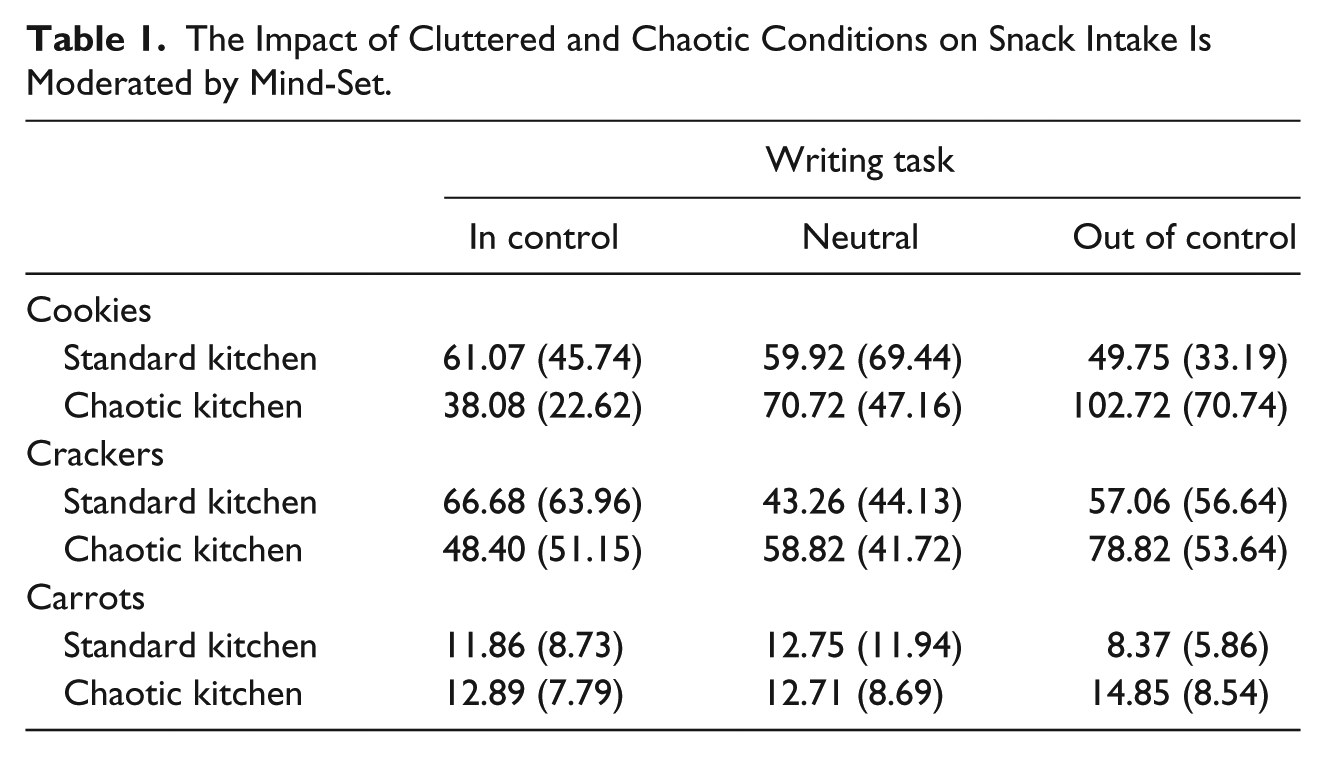
For cookie consumption, a 2 (kitchen condition) × 3 (writing task) ANOVA revealed a significant kitchen condition by writing task interaction, F(2, 90) = 4.56, p = .01, partial η2 = .09. A subsequent post hoc simple effects analysis comparison of means revealed that, in the chaotic-kitchen condition, participants ate the most when they wrote about being out of control, ate the least when they wrote about being in control, and ate a moderate amount when they wrote about their last lecture (out-of-control vs. in-control, p < .01; out-of-control vs. lecture, p = .10; in-control vs. lecture, p = .09; Figure 1). The writing task had no impact on cookie consumption in the standard-kitchen condition, F = 0.28, p = .76. Neither the main effect of kitchen condition nor the main effect of writing task was significant for cookie consumption. There were also no significant main effects or interactions involving either cracker or carrot consumption.
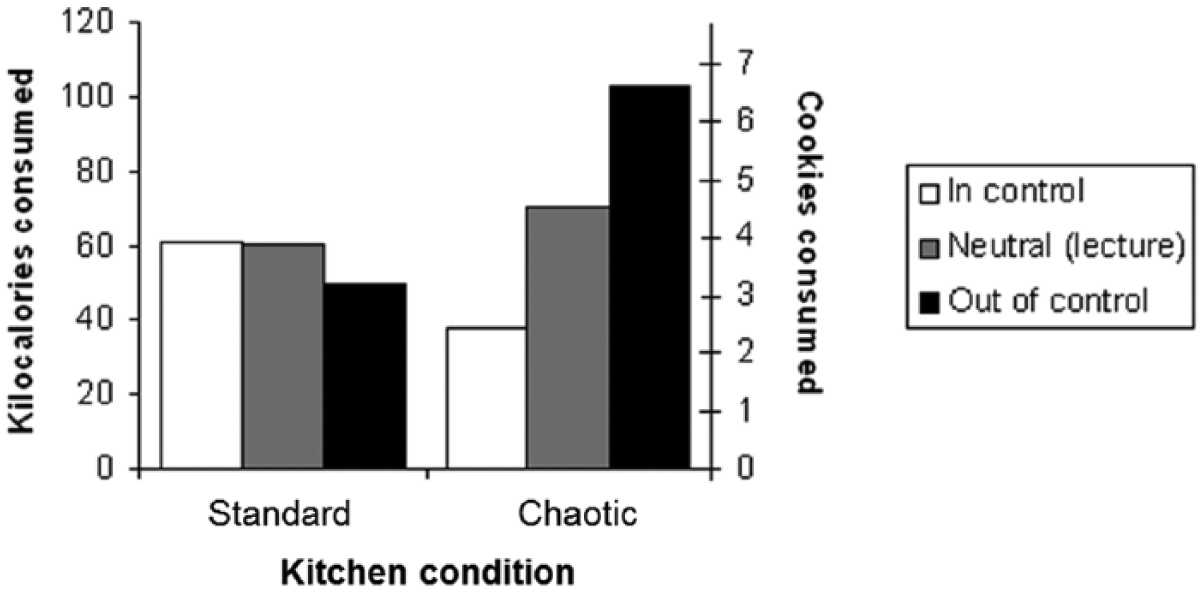
The impact of cluttered and chaotic conditions on snack intake is moderated by mind-set.
Discussion
Disruptive, chaotic, and stressful environments are associated with psychological distress and behavioral outcomes (Coldwell et al., 2006; Corapci & Wachs, 2002; Dumas et al., 2005; Evans et al., 2001). This study extends past research by examining the impact of an experimentally manipulated chaotic environment and mind-set on young women’s food intake. Results suggest that an individual’s mind-set can moderate the impact of a chaotic environment on food intake, particularly for sweet foods. Although a chaotic environment may be a risk factor for making unhealthy choices, one’s mind-set in that environment can either trigger or buffer against that risk factor. Specifically, we found that, when in a chaotic environment, orienting one’s mind-set to times of personal control decreased intake of cookies, whereas orienting to lack of personal control increased intake of cookies. These preliminary findings highlight the potential power of both the environment and one’s mind-set in influencing food intake, and therefore warrant further investigation.
Note that increased intake was only observed for sweet foods (i.e., cookies). This finding is in line with research indicating that women increase their consumption of sweet foods when stressed (Grunberg & Straub, 1992; Kandiah et al., 2006), and that daily hassles are related to increased intake of high-sugar snack foods (O’Connor et al., 2008). This finding is also consistent with research showing that women generally prefer sweet foods as “comfort foods” (Wansink, Cheney, & Chan, 2003).
The results of the present study can possibly be explained in terms of a model of self-regulatory strength (Muraven & Baumeister, 2000). According to this model, self-control attempts rely on a common limited resource; attempts at self-regulation use up this limited resource, leaving less strength available for subsequent acts of self-control. It has been suggested that such a model can help explain why people are typically less likely to exercise self-control when they are tired and stressed than when they are well rested and relaxed (Baumeister et al., 2000). Because sweet foods are generally seen as being “forbidden” foods (King, Herman, & Polivy, 1987; Knight & Boland, 1989), some degree of effort was perhaps needed to resist eating too many cookies. In the context of the chaotic environment combined with an out-of-control mind-set, increased cookie consumption might have been the result of depleted self-regulatory strength from managing one’s emotions under such conditions. Of course, future research is needed to directly test this hypothesis.
A limitation of this study is that there was no direct assessment of the perceived stressfulness of the chaotic environment, or of the mind-set produced by the writing task. Manipulation checks were not included out of concern that such assessments would influence participants’ subsequent behavior. It will therefore be important for future research to determine the specific emotional or cognitive mechanisms through which these conditions can impact people’s food intake. Another limitation of the present study is that, to maximize the effectiveness of the “chaotic” environment, our manipulation included multiple different components (e.g., clutter, noise, interruption). It is therefore unknown which component (or components) was responsible for the effects of the environment on participants’ food intake. Future research could examine each of these components separately (or in combination) to determine their individual and joint impact on food intake. Furthermore, in the present study, the eating took place after the “chaos” had ended, which might not be the case in many real-world situations. It is possible that eating behavior that takes place in the midst of a chaotic environment differs from eating behavior that takes place once the individual is removed from that chaotic environment. An important avenue for future research, therefore, would be to examine the time course of the chaotic-environment/food-intake association.
Finally, it would be worthwhile for future research to examine individual differences in reactivity to these types of conditions, and this is an emerging priority in this area of environmental drivers of overeating (van Ittersum & Wansink, 2016). For example, previous research has shown that dieters (Polivy & Herman, 1999), emotional eaters (Oliver, Wardle, & Gibson, 2000), and individuals with high cortisol reactivity (Epel, Lapidus, McEwen, & Brownell, 2001) are particularly likely to increase their intake (especially of sweet foods) in stressful situations. Examining such characteristics could help to determine which individuals are mostly likely to be vulnerable to the negative impact that stressful situations can have on food intake, and which individuals are mostly likely to benefit from learning to modify their mind-set in such situations.
Conclusion
The notion that places—such as cluttered offices or disorganized homes—can be modified to help us control our food intake is becoming an important solution in helping us become more “slim by design” (Wansink, 2014). This study has two key findings that are relevant to health care providers, clinical workers, and dieters. First, it underscores that less cluttered, less distracting, and less chaotic environments may lead people to snack less than they would in a more cluttered and chaotic workplace. Second, even if one must be in a chaotic environment, taking time to recall a more controlled time in one’s life can help one resist the pressure to overeat.
Footnotes
Declaration of Conflicting Interests
The author(s) declared no potential conflicts of interest with respect to the research, authorship, and/or publication of this article.
Funding
The author(s) received no financial support for the research, authorship, and/or publication of this article.