




Abstract
Despite popular articles and books, researchers have failed to examine how office clutter emerges and potential mediators underlying clutter in personal workspaces. We hypothesized that workers whose jobs require them to deal with a heavy volume of work at a rapid pace would be more likely to experience job strain (i.e., emotional exhaustion), which, in turn, depletes their energy and makes workers more likely to delay decisions. Decisional procrastination (indecision) was expected to increase office clutter, which itself is a physical stressor. Data from an Internet survey with 290 U.S. office workers recruited through Prolific Academic supported the hypotheses. This study is the first to examine clutter as a physical stressor in the workplace. A greater understanding of the factors that promote office clutter might help organizations and workers address sources of workspace conditions and personal habits that impede productivity and well-being.
Numerous articles and books in the popular press offer advice on how to deal with “office clutter,” characterized as scattered stacks of paper, files, and other disorderly assortments of objects that distract, impede movement, or, otherwise, reduce a person’s ability to perform effectively in personal workspaces (www.merriam-webster.com). In the business press, office clutter is frequently linked to time pressures, stress, and, consequently, performance deficiencies (e.g., Belkin, 2004; Hemphill, 2005; Heydlauff, 2009; Passoff, 1998; Walcutt, 2017). A 2008 survey of 400 U.S. consumers conducted by the National Association of Professional Organizers (NAPO) found that 27% of consumers reported feeling disorganized at work and estimated that they would save over an hour a day in lost productivity if their workspaces were better organized (NAPO, 2009). In a 2011 Workspace Survey of more than 1,000 U.S. adults conducted by Kelton Research for OfficeMax, 46% of respondents reported they struggle with decisions about what to keep and what to throw away, 53% claimed that disorganization at work affected their motivation, 20% believed clutter impacted their relationships with others, and over half (53%) admitted to having negative impressions of their coworkers with messy desks (News.Officedepot.com, 2011). Despite evidence that office clutter is a significant source of stress and lost productivity for many workers, empirical research has remained relatively silent on the topic of clutter in workspaces.
Part of the reason for this neglect may be clutter’s close association with hoarding disorder (Frost & Hartl, 1996), characterized by the acquisition of and failure to discard a large number of possessions that collectively interfere with one’s ability to use spaces in the way in which they are intended and impede quality of life. Clutter research has focused on excessive clutter in home environments, in which individuals exercise greater control over the procurement and disposal of possessions, especially those that harbor strong attachments and ties to self-identity (Frost, Hartl, Christian, & Williams, 1995). This is not necessarily the case in work environments, where individuals have limited opportunities to procure or display personal objects, and may feel greater responsibility and stewardship toward objects associated with their work tasks. Furthermore, clutter is a ubiquitous part of consumers’ everyday experience and is not necessarily in and of itself indicative of an underlying mental disorder. Epidemiology studies aside, common themes emerging from studies conducted with people with excessive clutter in their homes indicate that these individuals have either currently or in the past experienced significant stress in their life (Tolin, Meunier, Frost, & Steketee, 2010), are indecisive (Burgess, Frost, Marani, & Gabrielson, 2018; Ferrari & Roster, 2018; Ferrari, Roster, & Crum, 2018), and feel less “at home” in their environments and experience diminished levels of well-being as a result of the clutter (Roster, Ferrari, & Jurkat, 2016).
Few, if any, academic studies have investigated clutter in office spaces, the exception being studies that have explored the use of objects to personalize work spaces and its role in reflecting and reinforcing self-identity. For instance, office personalization has been shown to enhance workers’ well-being (Wells, 2000) and mitigate emotional exhaustion arising from low levels of privacy (Laurence, 2013) by allowing workers to express their identities. Wells (2000) linked personalization of workspaces to feelings of comfort and belonging, and found evidence that workers, especially women, who were allowed to decorate or modify their workspaces with self-reflecting objects, reported more positive associations and satisfaction with the work environment and higher levels of morale, creativity, productivity, and psychological well-being. Similarly, Laurence (2013) found that the calming effect of personal objects helped to mitigate environmental stress and emotional exhaustion in office settings with low levels of experienced privacy. Marking personal spaces with objects that reflect self-identity is a primary means for creating a sense of “psychological home,” but collectively, an overabundance of personal objects has been shown to decrease an individual’s sense of well-being in home environments (Roster et al., 2016). When considered individually, objects with highly self-reflective properties are rarely seen as troublesome, even among individuals with hoarding disorder who often harbor strong personal attachments to many possessions (Frost et al., 1995). It is only when the collective presence of a disorganized array of objects starts to detract from a person’s well-being or impedes the individual’s use of spaces as intended that objects are perceived as “clutter” in the mind of an individual (Frost & Hartl, 1996).
Office clutter may also become a problem for the well-being of a person when it shapes the way others perceive them. Gosling, Ko, Mannarelli, and Morris (2002) conducted studies in which outside trained observers rated others’ personalities using the standard “Big Five” traits of openness, conscientiousness, extroversion, agreeableness, and emotional stability after observing physical cues present in occupants’ personal environments (office or bedroom). Observers in the office environment study examined 94 offices belonging to employees from five different businesses. In that study, observers associated the trait of “conscientiousness” with occupants of offices that were organized, efficiently arranged, and uncluttered. Furthermore, the impressions formed by observers were remarkably consistent with those of both self- and peer-ratings. Gosling et al. (2002) noted that a limitation of their study was that observers only viewed environmental cues at a single point in time. Co-workers, with access to such cues on a regular basis, like a consistent failure to throw away used paper coffee cups or a messy desk that never seems to get organized, may form generalized impressions of office occupants. This may help to explain why 40% of respondents in the 2011 study of 1,000 office workers conducted by Kelton Research cited earlier (News.Officedepot.com, 2011) assumed that co-workers with a messy desk must be lacking in other aspects of their work.
In the present study, we define “office clutter” as a collective body of physical objects, whether personal or work-related, that create disorganized and chaotic workspaces. We proposed, based on prior literature, that office clutter is an external manifestation of internally experienced work stress that may create its own unique and self-generating source of stress, created in part by workload stress and strains that deplete energy resources (Maslach & Jackson, 1984) and diminish workers’ capacity for self-control (Diestel & Schmidt, 2009), which further perpetrates workplace stress (Alarcon, Eschleman, & Bowling, 2009; Schmidt, Hupke, & Diestel, 2012). Viewing office clutter as “stress-generating” corresponds to Vischer’s (2005, 2007) theoretical model of environmental comfort, which proposes that functionally uncomfortable workspaces draw energy out of workers that would otherwise be directed toward performing work tasks or addressing adverse environmental conditions.
Studies dealing with workspace stress often draw upon two distinct theoretical approaches to understand how work environments create stress. The first approach is the traditional job-related stressors and strains framework (Ivancevich & Matteson, 1980; Jex & Beehr, 1991; Karasek, 1979). This approach examines how stressful psychosocial aspects of work environments (e.g., heavy workloads, role conflict, lack of autonomy, and lack of social support), through repeated exposure, can lead to job strains, which are characterized as harmful psychological or physiological responses to such stimuli, including increased levels of anxiety, emotional exhaustion, depression, social withdrawal, and poor health (Beehr, Jex, & Ghosh, 2001; Karasek & Theorell, 1990; Kożusznik, Peiró, Soriano, & Navarro Escudero, 2018; Nixon, Mazzola, Bauer, Krueger, & Spector, 2011). The second approach draws upon environmental psychology examining how proper “fits” between workers and their physical environment enhance performance, as well as how “misfits” lead to adverse psychological or physiological responses to environmental stimuli (Alexander, 1970; Lazarus & Cohen, 1977). According to the environmental perspective, when elements of the physical environment interfere with workers’ ability to perform tasks effectively or place undue demands on workers, they not only impede performance but also induce stress (McCoy & Evans, 2005). Research adopting this perspective has examined a number of environmental stressors in physical work environments, including high noise levels (Mak & Luy, 2012), poor lighting (Frontczak & Wargocki, 2011), poor air quality (Hedge, 2000), and lack of privacy (Klitzman & Stellman, 1989; Laurence, 2013).
While studies such as the above have advanced our understanding of the environmental psychology of workspaces, major gaps remain in our knowledge of worker–workspace interactions, especially in regard to how workers respond to physical elements present in workspaces within their control. We posit that dysfunctional physical elements in workspaces not only are experienced but are also sometimes created by workers themselves in response to job stressors and strains. This study explored factors that contribute to office clutter and the process through which office clutter problems unfold. Our empirical model adopts elements of the traditional Demand/Control model (Karasek, 1979, 1998), the job-related stressors and strains framework (Ivancevich & Matteson, 1980; Jex & Beehr, 1991), and Vischer’s (2005, 2007) theoretical model of “environmental comfort,” which illustrates how workers’ ineffective coping responses to “daily hassles” arising from their physical work environments (Lazarus, 1984; Lazarus & Cohen, 1977; McCoy & Evans, 2005) create a sense of discomfort that perpetuates workspace stress.
We view office clutter as an emotional response to environmental stressors and strains that can spark a chain of events that further undermine a person’s productivity and well-being in personal work spaces. The theories cited above, coupled with studies that have investigated how clutter problems emerge and are perpetuated, provide support for this view. In work environments, heavy workloads sometimes force workers to neglect certain aspects of the job or their personal lives. Job stressors and psychological strains sap workers’ mental and physical energy, and increase their likelihood of engaging in avoidance behaviors as a means of coping with job-related fatigue (DeArmond, Matthews, & Bunk, 2014). Essentially, clutter is postponed decisions. Research has demonstrated that clutter problems are often associated with patterns of behavioral avoidance rooted in anxiety or fears about making the wrong decision regarding the value of an object (Frost & Hartl, 1996; Frost et al., 1995). In an office setting, the value of objects is often informational or utilitarian as opposed to sentimental, including objects such as paper files, books, reports, or excess office supplies, but involves similar (or perhaps even higher) elements of risk should a wrong decision be made or an important object become misplaced. Fatigue-related avoidance may promote decisional procrastination, as workers find it more challenging to make otherwise ordinary decisions regarding which objects in workplace environments should be kept and which can be discarded.
This pattern of emotional responses can create a sequence of stress–fatigue–avoidance–delay reactions that enable clutter to escalate because it reinforces maladaptive behaviors workers create to avoid situations associated with uncertainty, fear of doing the wrong thing, or tackling tasks they find unpleasant. In studies involving clutter in home environments, one of the most common emotions associated with clutter is that of feeling “overwhelmed” (Roster et al., 2016). As clutter escalates, it becomes even more difficult to find time to organize workspaces; workers’ physical, functional, and psychological comfort with their environment decreases (Vischer, 2005); and the potential for these disorganized elements of the workspace environment to interfere with the attainment of work objectives increases (Vischer, 2007). Over time, McCoy and Evans (2005) emphasized that an environmental element that was once temporarily annoying can become a “daily hassle” that has a sustained impact on performance. Furthermore, office clutter serves as a constant visual reminder of work left undone, making it more difficult to locate information quickly and potentially engendering feelings of guilt and embarrassment, especially when it casts a negative impression of one’s capabilities in the minds of co-workers or unexpected office visitors.
Conceptually, we propose that office clutter emerges when workers who are already energy-depleted respond in a way that serves to further increase their work stress by failing to take control over growing piles of papers, files, and other physical distractions in workspaces that threaten their well-being and productivity. We propose and empirically test hypotheses embedded within a serial mediation model in which workspace stress arising from office clutter is hypothesized to result from both direct and indirect paths created by interplays between three predictor variables: job stressors (i.e., quantitative workload), job strain (i.e., emotional exhaustion), and workers’ behavioral response to job stressors and strains in the form of indecision, referred to by scholars as “decisional procrastination” (Ferrari, 2010; Ferrari & Tibbett, 2017). While it is often presumed that office clutter arises from workers who are too busy and time-pressured to take charge of their workspace, this assumption has not been empirically tested. Nor does it explain the mechanisms through which problems with office clutter emerge. A greater understanding of the factors that promote office clutter might help organizations and workers address sources of workspace conditions and personal habits that impede productivity, personal effectiveness, and well-being.
In summary, we hypothesized that workers whose jobs require them to deal with a heavy volume of work at a quick pace are more likely to experience job strain in the form of emotional exhaustion (Hypothesis 1), which, in turn, depletes their energy and makes it more likely that they will delay making decisions (Hypothesis 2). Decisional procrastination is expected to increase problems with office clutter (Hypothesis 3), as piles of paperwork and other unattended tasks create disorganization and distractions that produce additional sources of work stress in the form of office clutter. Finally, we hypothesized that the relationship between high workload and office clutter is partially mediated by the indirect sequential effects of emotional exhaustion and its consequential impact on individual workers’ likelihood to delay activities associated with objects cluttering their space (Hypothesis 4). Figure 1 summarizes the hypothesized two-step mediation model.
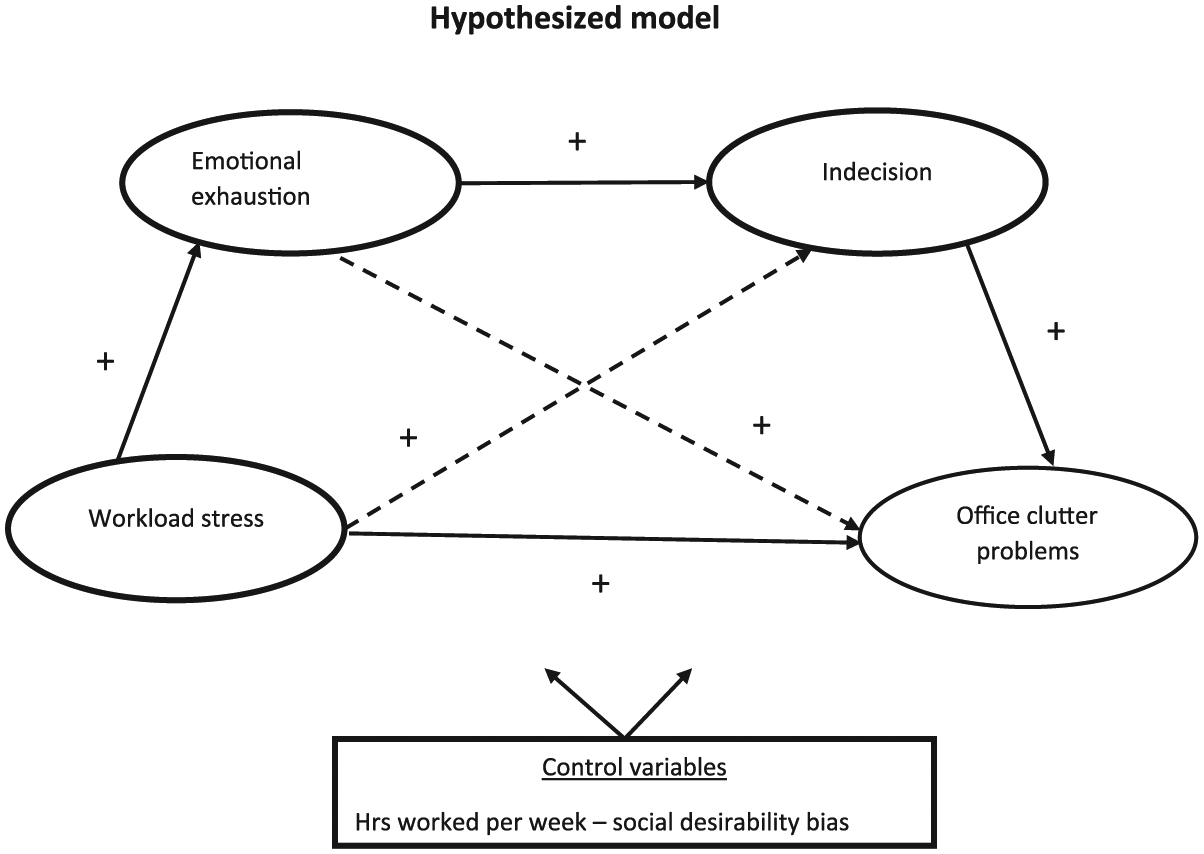
Theoretical model linking workload stress and office clutter problems.
Method
Participants and Procedure
We collected data through an Internet survey created with Qualtrics (www.qualtrics.com) survey software and hosted on their servers. Respondents were recruited using Prolific Academic (www.prolific.ac). Prolific is a crowdsourcing platform that works in a manner similar to Amazon’s Mechanical Turk, but allows researchers greater control over characteristics of the target population (Peer, Brandimarte, Samat, & Acquisti, 2017). Prolific prescreen individuals registered with them based on eligibility requirements requested by the researcher. Eligibility requirements for the present study included (a) being a resident of the United States, (b) being between the ages of 21 and 75, (c) being employed more than 20 hr per week, and (d) performing one’s duties in a “traditional workspace designated for their personal use including at least a desk and chair.” Respondents who met these three study criteria and volunteered to participate clicked on a “Start Now” link that directed them to the survey. Respondents who failed to meet the fourth requirement (i.e., working in a traditional setting) were ineligible using post-screening based on responses to a survey question in the introduction of the survey.
Each eligible respondent who completed the survey was compensated US$2.60 for his or her participation. On average, respondents took 20 min to complete the survey. In all, 305 respondents started the survey. Ten respondents were deleted for failure to properly answer an attention trap question (i.e., “Please select agree to respond to this question”) embedded in the survey, three failed to meet the study requirement of working 20 hr or more per week in a traditional office setting as described above, and two respondents failed to provide complete data. Thus, our final sample consisted of 290 individuals. Most participants were male (61%), between the ages of 25 and 35 (52%), had at least some college or a bachelor’s degree (61%), worked on average 41.19 hr per week (SD = 9.83), earned between US$35,000 and US$75,000 annually (49%), and were White, non-Hispanic (78%). Participants held jobs spanning a variety of levels: 9% held a position in top management, 16% were middle managers, 20% were lower level managers or supervisors, 28% were staff/administrative support, and 26% were individual contributors.
Measures
Workload stress
We measured workload stress with the five-item Quantitative Workload Inventory (QWI) developed by Spector and Jex (1998). The QWI assesses the amount of work and work pace. Responses were given on a 5-point scale, ranging from “less than once per month or never” (1) to “several times per day” (5). Sample questions include “How often does your job require you to work very fast?” and “How often does your job require you to work very hard?”
Emotional exhaustion
We measured job strain in the form of emotional exhaustion with the eight-item Emotional Exhaustion subscale from the Maslach Burnout Inventory (MBI) developed by Maslach and Jackson (1981). Responses were given on a 7-point scale, ranging from “strongly disagree” (1) to “strongly agree” (7). Sample item is “I feel emotionally drained from my work.”
Indecision
We measured indecision using the five-item decisional Procrastination scale developed by Mann (1982) and reported by Ferrari, Johnson, and McCown (1995). Decisional procrastination is a stable, maladaptive pattern of postponing decisions, especially when choices involve conflict (Janis & Mann, 1977) or require cognitive effort (Ferrari & Pychyl, 2007; Ferrari, Crum, & Pardo, 2018). Responses were given on a 5-point scale, ranging from “false for me” (1) to “true for me” (5). Sample item is “I delay making decisions until it’s too late.”
Office clutter problems
Before asking respondents to rate the degree to which office clutter presented problems for them, we included two questions to help us gauge their perceptions of the extent and nature of clutter in their workspace. The first question was a self-report rating of the extent of clutter in their personal workspace. For this question, we asked, “How cluttered is your primary workspace? By ‘cluttered,’ we mean untidy or disorganized due to an overabundance of physical (not digital) objects in your workspace?” This item was measured on an 11-point scale, where 0 = “not at all cluttered” and 10 = “extremely cluttered.” The mean was 4.20 (SD = 2.62, minimum = 0, maximum = 10), indicating that on average respondents judged the extent of clutter in their workspace as being somewhat moderate. Next, to get a better sense of what type of objects in the workspace our respondents regarded as “clutter,” we first asked them in an open-ended question, “What types of physical (non-digital) objects create clutter in your primary workspace?” Nearly 50% of respondents listed “papers” or similar types of objects (e.g., files, invoices, envelopes, newspapers, sticky notes). Fifteen percent of respondents listed excess office equipment or furniture (e.g., computers, computer accessories, cables, bookcases, filing cabinets). Another 10% reported office supplies cluttered their workspace (e.g., pens, pencils, paper clips, staplers); 7% listed books, manuals, or binders; and the remaining 18% reported a variety of miscellaneous objects, such as coffee mugs, used paper cups, empty boxes, and other miscellaneous items.
For our primary dependent variable, we measured negative consequences associated with office clutter using the 11-item Clutter Quality of Life Scale (CQLS) developed by the Institute for Challenging Disorganization (https://challengingdisorganization.org) and reported by Roster et al. (2016). This unidimensional scale is designed to assess emotional, functional, and social consequences of clutter in one’s home. We adapted the scale for use in an office context as opposed to home environments by replacing the word “in my home” with “in my office,” and “my family/friends” with “my colleagues,” where applicable. Responses were given on a 7-point scale, ranging from “strongly disagree” (1) to “strongly agree” (7). Sample items include “I can’t find things when I need them because of clutter”; “My relations with my colleagues have suffered as a result of the clutter in my office”; and “I feel overwhelmed by the clutter in my office.”
Control variables
We controlled for two variables that were not of theoretical interest but might impact relationships between variables we tested in our model. First, we controlled for number of hours worked per week, which was fashioned as an open-ended question (“How many hours do you spend at your job in a typical week?”). Hours worked has been associated with emotional exhaustion (Van der Hulst & Geurts, 2001) and procrastination (DeArmond et al., 2014). Second, we controlled for social desirability response bias using the 13-item short version (Form C) of the Marlowe-Crowne Social Desirability Scale (Reynolds, 1982). Social desirability bias has been associated with both procrastination and clutter problems (Ferrari et al., 2018), and its inclusion serves to control for self-report biases (Fisher & Katz, 2000). Responses were provided to a dichotomous scale, either “false” (0) or “true” (1). Sample item is “I’m always courteous, even to people who are disagreeable.”
Data Analysis
Prior to testing our hypotheses, we examined the factorial structure of our measures using SPSS AMOS v24. The proposed four-factor model, including workload stress, emotional exhaustion, decisional procrastination, and office clutter problems as separate factors, demonstrated acceptable fit with the data—comparative fit index (CFI) = .97; root mean square error approximation (RMSEA) = .06. Moreover, the four-factor model fit the data significantly better than all possible alternative models (single factor, CFI = .49; RMSEA = .18; two-factor model, CFI = .70; RMSEA = .14; three-factor model, CFI = .78; RMSEA = .12). To test our hypotheses, we conducted hierarchical multiple regression analyses using PROCESS v3.0 Model 6 for serial mediation analysis (Hayes, 2013). We estimated three independent models, one for each of the three office clutter indicators. To analyze indirect effects, we calculated 95% percentile bootstrap confidence intervals (CIs) with 5,000 repetitions.
Results
Table 1 presents descriptive statistics and Cronbach’s alphas for all measures included in our model. Intercorrelates among variables were in line with our expectations. That is, workload stress was significantly and positively correlated with office clutter problems (r = .28, p < .001). Moreover, workload stress correlated positively with job strain represented in the form of emotional exhaustion (r = .41, p < .001), but not with decisional procrastination (r = .09, p = .12). Emotional exhaustion was significantly and positively correlated with office clutter problems (r = .39, p < .001) and with decisional procrastination (r = .32, p < .001). Decisional procrastination was significantly and positively correlated with office clutter problems (r = .51, p < .001).
Means, Standard Deviations, Alpha Values, and Correlations Between Model Variables.

Note. N = 290 (listwise). Cronbach’s alpha values are presented in parentheses on the diagonal. Hours worked was a continuous measure. Social desirability was dichotomously scored. Scores on workload stress and decisional procrastination ranged from 1 to 5. Scores for emotional exhaustion and office clutter problems ranged from 1 to 7.
p < .05. **p < .01. ***p < .001.
Table 2 represents the detailed results of our hypotheses tests; unstandardized coefficients are reported. The upper part of the table presents results from tests of direct effects. We first computed the model for the first mediator (M1), emotional exhaustion. In support of our first hypothesis, workload stress was significantly and positively related to emotional exhaustion (b = 0.58, p < .001). We then computed the model for the second mediator (M2), decisional procrastination. Consistent with our second hypothesis, emotional exhaustion was significantly and positively associated with decisional procrastination (b = 0.16, p < .001). Finally, in line with our third hypothesis, decisional procrastination was positively related to problems with office clutter (b = 0.62, p < .001).
Direct and Indirect Effects of Workload Stress on Office Clutter Problems.

Note. N = 290 (listwise). EE = emotional exhaustion; MI = first mediator; DP = decisional procastiation; M2 = second mediator; OCL = office clutter problems; Y = dependent variable; X = independent variable; CI = confidence interval. CI of indirect effects are based on 5,000 percentile bootstrap samples. Unstandardized coefficients are reported.
0 = false; 1 = true.
p < .05. **p < .01. ***p < .001.
Next, we computed the indirect effects and related bootstrap analyses. These results appear in the lower part of Table 2. In support of our fourth hypothesis, the sequential indirect effect of workload stress on problems with office clutter in serial via both mediators (emotional exhaustion and decisional procrastination) was significant (b = 0.057, 95% CI = [0.023, 0.100]). The indirect effect of emotional exhaustion alone as a mediator was significantly positive (b = 0.114, 95% CI = [0.051, 0.186]), but the indirect effect of decisional procrastination alone as a mediator cannot be claimed as definitively different from zero because the bootstrap CI straddled zero [–0.059, 0.094]. These findings lend further support to our hypothesized model, as the effect of decisional procrastination as a mediator emerges only through the energy depletion mechanism created by emotional exhaustion, as hypothesized in our two-step serial model. Furthermore, the total indirect effect, estimated as the sum of all the specific indirect effects, was 0.187 (as opposed to 0.114 for emotional exhaustion alone as a mediator) and can be interpreted as significantly positive because the bootstrap CI was entirely above zero [0.080, 0.303].
Following recommendations by Becker (2005), we repeated our analyses without the control variables to assess if their exclusion altered our results. When results from this procedure do not differ, it increases researchers’ ability to rule out the controls as a potential explanation for the findings; when they do differ, it suggests further investigation of the role of the controls as a phenomenon of interest. The pattern of our results remained unchanged.
We also tested our hypothesized model against several alternative models: (a) a model that links decisional procrastination with office clutter problems via the mediating steps of workload stress and emotional exhaustion, (b) a model that links decisional procrastination with office clutter problems via the mediating steps of emotional exhaustion and workload stress, (c) a model that links emotional exhaustion to office clutter problems via the mediating steps of decisional procrastination and workload stress, and (d) a model that links emotional exhaustion to office clutter problems via the mediating steps of workload stress and decisional procrastination. Models 1 and 2 both fit the data, but the sequential indirect effects from decisional procrastination to office clutter problems through either workload stress to emotional exhaustion or vice versa were much smaller than the hypothesized model (0.009 for alternative Model 1, 0.032 for alternative Model 2). Also, the total indirect effects for these alternative models (0.109 for both Model 1 and Model 2) were lower than the total indirect effects for the hypothesized model (0.187). Neither alternative Model 3 nor 4, which linked emotional exhaustion to office clutter problems as transmitted through either workload stress to decisional procrastination or vice versa, fit the data as a serial mediation model. Altogether, these results indicate that the hypothesized model had the best fit with the data when all four variables are included in the model.
Discussion
Academic research has not focused on problems with office clutter, despite its ubiquitous presence and potential negative consequences for office workers. Drawing upon Vischer’s (2007) theoretical model of worker–workspace relationships and workspace stress, we proposed a process model to describe how office clutter problems emerge. We hypothesized that problems with office clutter might arise when job stressors and strains foster neglect and indecision; consequently, these factors may contribute to growing piles of clutter that potentially impede workers’ effectiveness in close physical environments within which work is performed. We tested the hypothesis that workload stress relates to increased problems with office clutter through two consecutive mediating steps, specifically via emotional exhaustion that, in turn, leads to decisional procrastination. Results of our study provide support for our hypothesized model.
Given that this study is the first to examine factors that create conditions for office clutter, the present study should be regarded as an initial exploration that naturally has limitations and requires further research designed to replicate and extend our findings. Our choice to rely upon a general population sample of workers recruited using Prolific Academic could have introduced unique characteristics commonly associated with crowdsourced samples, such as their being less ethnically diverse, younger, and more highly educated than national probability samples and some commercial Internet-based panel samples. However, crowdsourced samples have also been shown to be more professionally diverse, similar in geographic dispersion to U.S. general population samples, and often demonstrate higher data quality and greater comfort in disclosing sensitive information than probability samples, community samples, or college students (Goodman & Paolacci, 2017).
We acknowledge that a primary limitation of our study is that we relied upon cross-sectional survey-based data collection methods. Although our four-variable model examining sequential mediation via emotional exhaustion and decisional procrastination performed better than alternative models using these particular variables, studies employing a behavioral and/or longitudinal design are needed to verify the true direction of hypothesized links. For instance, behavioral lab experiments might place participants in varied workspace conditions ranging from low to high clutter and measure not only their productivity and performance on a set of assigned tasks to be completed within a period of time but also their perceived levels of stress and propensity to postpone decisions when given options for prioritizing tasks. This would help to verify the sequential relationship between psychological processes related to clutter and decision delay. Another limitation of our cross-sectional survey design was that it failed to capture how multiple acts, or failures to act, culminate over time to create clutter in the first place. Similarly, Gosling et al. (2002) pointed out when discussing limitations of their observation study that cues reflecting an organized/disorganized office that might be observed at one point in time may not reflect the typical state of affairs. Longitudinal studies, with observations collected from either the occupant or a third-party observer at various points in time (and preferably in an unannounced or “disguised” format in which the occupant is not aware that an observation is forthcoming) could more reliably assess how an individual’s physical environment is typically maintained, as opposed to how it appears at any single point in time.
This raises another important issue for future research, which is, how do objects collectively come to be viewed as “problematic clutter,” within the broader ambiance of physical elements in workspaces, and how might these perceptions differ across individuals? Do people’s thresholds for problematic clutter differ? It is quite possible that the same degree of clutter might be perceived by one person as distracting or “problematic” and by another person as comforting or “normal.” People’s perceptions of clutter may also vary depending on the specific nature of objects. For instance, Wells (2000) found that women placed more importance on personalization of spaces than did men. In her study, males and females differed not only in their extent of personalization but also in the type of objects they used to personalize their workspaces. Women tended to personalize their spaces with objects that expressed their personality, whereas men tended to display objects that demonstrated their personal achievements or social status within the company. Future research might explore individual differences in people’s perceptions of clutter as it relates to self-identity or self-representation goals. For instance, are men less bothered by messy desks because they believe it projects their importance, busyness, and productivity? Do women believe a messy desk signals a lack of self-discipline, lapses in personal responsibility, or reduced authority in the workplace?
Future research might also explore the relationship between personality types and clutter thresholds. Similar to Wells (2000), Gosling et al. (2002) found that individuals use objects to create active constructions of their personalities and lifestyles in physical workspaces. However, their study also demonstrated that outside observers used these same cues in a global manner (i.e., neatness, organization) to form impressions of occupants’ personality traits, including Conscientiousness, which is a personality trait associated with order, efficiency, and self-discipline. These findings reinforce Vischer’s (2007) assertion that dysfunctional elements in physical work environments can have psychosocial repercussions, including harm to employee–employer relations, loss of social support, and negative influence on advancement opportunities. Workers who display evidence of cluttered, disorganized spaces may project to supervisors and colleagues undesirable traits that make them unsuitable for promotion opportunities and additional responsibilities in the workplace. Furthermore, although our study did not examine office clutter in shared spaces, open or shared workspaces are becoming increasingly common in the workplace. To the extent that one person’s clutter impacts a co-occupant’s productivity or stress levels, clutter can become a workplace issue that disrupts the comfort of multiple workers, regardless of whether it bothers the individual responsible for creating the problem.
An interesting topic for future research is digital clutter. We restricted the scope of our study to physical clutter, because digital clutter may differ from physical clutter in important ways. For instance, digital clutter is easier to ignore, and may therefore not become problematic in the same manner as physical clutter. Furthermore, digital clutter may not create the same negative consequences, especially social consequences, because it can remain hidden more easily and therefore is less likely to attract negative attention. In one of the first published studies of digital hoarding, Sweeten, Sillence, and Neave (2018) surveyed a small sample (n = 46) of male and females workers using mostly open-ended questions to explore motives and negative consequences of digital hoarding behavior. Their findings revealed that participants were often reluctant to deal with large accumulations of digital data because they were unsure of its current or future value and because they lacked time or motivation to purge. This suggests that procrastination may also play a significant role in accumulation of digital clutter, as it did in our study involving physical office clutter. However, Sweeten et al. (2018) found that respondents did not feel an immediate connection to digital data accumulation and personal spaces in the same way as physical clutter, because digital files were perceived as capable of being stored in seemingly endless cloud space managed by their employer. Nevertheless, respondents in their study admitted that digital clutter lowered their productivity levels by making it harder to locate information and more difficult for them to concentrate. Future research is needed to understand the difference between physical clutter and digital clutter in office spaces, including ways in which motivations and consequences differ or remain similar.
Last, future research is needed to investigate more directly how office clutter impacts important work outcomes such as job performance, productivity, and role effectiveness. While our self-report measure captured negative emotional, functional, and interpersonal consequences of clutter, it is not clear how these impacted actual job performance or productivity. Both self-report and objective measures of work performance are needed to substantiate the relationship between performance and office clutter. Furthermore, because clutter can impact various types of behavior (e.g., efficiency, productivity, proficiency) at different levels of the firm (i.e., individual, team, and organization), multiple measures of performance are needed to fully explore this association, such as those proposed by Griffin, Neal, and Parker (2007) in their work role performance model. Performance studies could be conducted in the field with companies representing industries in which effective workspaces play an important role in the firm’s success, such as sales, banking, consultancy, medical or legal services, or human resources.
We hope that our investigation spurs researchers to construct alternative models and even alternative ways of collecting data. For example, qualitative studies involving focus groups or personal interviews could explore more deeply how clutter impacts the general ambiance and perceptions of workplaces and workspaces, not only among workers but also customers or clients. Digitizing observation procedures could alleviate some of the challenges involved in gathering longitudinal field observations from either office occupants or third-party observers. For instance, occupants or third-party observers might be asked to upload office photos to a research website at regular intervals. Photo-elicitation techniques might be a way to explore more deeply perceptions associated with office clutter. For instance, researchers could show participants pictures of tidy versus cluttered office spaces and ask them to describe the characteristics, traits, abilities, and promotability of each office’s fictional occupant. Conversely, researchers could ask volunteers to take pictures of their own office space in different states of (dis)organization, then discuss with them later how the condition of their workspace either reflected their emotions at that time or impacted their work performance.
Different methodological approaches could also help to address potential self-report bias. Self-report bias is a factor in any survey-based design, but especially so for studies like ours that deal with potentially embarrassing behaviors like office clutter and procrastination. However, we did attempt to mathematically control for this factor by including social desirability as a control variable. Finally, future research might examine the prevalence of clutter problems within particular occupations, especially those most likely to foster job stress and strain, and expand factors contributing to decisional procrastination in the workplace (Lonergan & Maher, 2000).
Despite these limitations, we believe that the current study establishes empirical evidence based on hypotheses designed to test unproven assumptions based on theories rooted in workspace stress from which researchers can begin to examine more closely the factors and mechanisms that promote office clutter problems. Furthermore, our office clutter study broadens an understanding of workspace stress to include clutter as a response to elements arising from both the psychosocial and the physical environment that serve to perpetuate stress in workspace environments.
Managerial Implications
A greater understanding of the mechanisms underlying office clutter could assist organizations in developing more effective ways to help employees manage work stress and gain control over workspace conditions that impact their productivity and well-being. Many Fortune 500 companies, for example, Audi and UPS, require employees to adhere to a clean desk policy (CDP) because it encourages employees to strive for orderly spaces and signals to outsiders a firm’s professionalism and their employees’ competence (Adelia Associates, LLC, 2018). Modern office buildings with smaller private offices, common workspaces, and shared storage areas are not designed to accommodate burgeoning stacks of paper and overfilled bookshelves, and some workers struggle with downsizing (Rich, 2002). Potentially, office clutter problems may be reduced by helping office workers to learn how to make decisions about what objects need to be kept near, stored until needed, or safely and responsibly destroyed. A greater understanding of the stress that office clutter creates and how it comes into being could be helpful in encouraging office workers to let go of unnecessary objects that burden them and embrace modern work environments designed to improve their personal effectiveness and overall well-being.
Footnotes
Declaration of Conflicting Interests
The author(s) declared no potential conflicts of interest with respect to the research, authorship, and/or publication of this article.
Funding
The author(s) received no financial support for the research, authorship, and/or publication of this article.