



Abstract
We compared the experience with nature of today’s children with data from the beginning of the 20th century to determine whether we can confirm a loss of experience and contribute to the description of changes in children’s relationship with nature. We used a questionnaire originally published in 1900 for this survey. Results from contemporary participants tested by ANOVA showed no difference in level of experience according to the age of the respondents. Comparing historical data with current data by a Z-test for proportions and Cohen’s h, we found a significant increase in contemporary children’s summary experiences. Although children of the 21st century have less experience with traditional extensive farming activities and biotechnologies, they have much more experience with nature, apparently connected with recreational and field-trip activities. We cannot confirm a decrease in experience among generations, on the contrary, we found a summary increase in experience.
Keywords
Lack of experience and connection with nature is regarded as a cause of many problems, especially environmental ones, and it is therefore proposed that enriching this connection can help to transform human action toward sustainability (Ives et al., 2017). The “Human-Nature Connection” (HNC) debate is mostly linked to the development of culture and human civilization, and consequently the definition of HNC reflects the time in which it was considered. The major causes of changes in HNC can be attributed to technological progress, agricultural practices, and urbanization, mainly in correlation with population growth and overexploitation of natural resources. However, one should be aware of an overgeneralization of the findings stemming from single-case studies, knowing that even recently humans have been living in very diverse conditions, from hunter-gatherers communities in some parts of the world to megalopolises in their very neighborhood. The same is true of a romanticized view of the past regarding the way that people were connected to nature. It is quite possible that children who spent most of the day outdoors in some suburbs of industrial towns of the 19th or 20th centuries had less experience with nature, when compared to some contemporary children who while confined during the week to their daily routes from their apartments to their schools and back, spend weekends and holidays with their parents in the countryside.
Specific terms such as “out-door” or “out-of-doors” education have begun to be used since that time (Quay & Seaman, 2013, p. 16), and scholars began to discover their importance and benefits for education. Nowadays, we understand HNC as a resource of prior knowledge or “funds of knowledge” (Moll et al., 1992) that are presumptions for culturally responsive teaching (Warren, 2018).
A common belief about HNC is that younger generations are losing interest in, and experience with, nature and that HNC is significantly decreasing. An introductory paper by Miller (2005) draws attention to the idea that humans are losing touch with nature, particularly in the urban environment. Miller (2005), following Robert M. Pyle (1993), called this phenomenon the “extinction of experience.” This assumption of decreasing HNC has led to the development of whole industries – academic, practitioner and media – around the steps that might be taken to (re)connect people with nature (Kraftl et al., 2018).
Because the historical data for HNC are essentially inaccessible, most HNC research follows auxiliary symptoms that hopefully correlate with the changes in experience with nature, and assums that cultural products such as books, magazines and digital media carry the footprint of the social context in which they were created (Kesebir & Kesebir, 2017), allowing us to judge the level of HNC.
We used little known data describing the level of children’s experience with nature at the beginning of the 20th century and the purpose of the research is to compare the data of today’s children with this historical research as a unique way of contradicting the existing evidence about the loss of experience with nature on a quantitative longitudinal scale.
Background
The relation between people and nature has attracted wide interest among scholars, leading to many terms describing different facets of such a universal relationship. An umbrella term “Human-Nature Connection” (HNC), covering many dimensions of the issue, was reviewed by Ives et al. (2017). They clustered the published research into three subgroups of interest/approach: 1) HNC as mind, characterized by an emphasis on the use of psychometric scales; 2) HNC as experience, tied to observation and qualitative analysis; and 3) HNC as place, emphasizing place attachment and nature reserve visitation. In a subsequent paper, five different types of connections to nature were identified: material, experiential, cognitive, emotional, and philosophical (Ives et al., 2018). However, the experience of nature (EoN), on which this paper focuses, remains well defined in both classifications.
Current technology offers many means to augment, mediate, and simulate the natural world in a virtual, vicarious way (Kahn Jr et al., 2009). This mediated experience complements and expands real experience (Fletcher, 2017b; Virtič & Šorgo, 2016), and has a positive effect on children’s affective attitudes and willingness to conserve biodiversity in a manner similar to the effect of real experience (Soga et al., 2016). According to Kahn Jr et al. (2009), mediated nature might even partially satiate the need for contact with nature or be a “promising way to counteract the extinction of experience” (Klein & Hilbig, 2018). To understand the experience structure of today’s generation, it is necessary to work with mediated experience and analyze its significance regarding how it influences the building of the relationship to nature and the phenomena around us.
The EoN varies widely across populations, but this variation is poorly understood (Cox et al., 2017). Its specificity is embedded in social and cultural contexts, side by side with possible transformation or a new EoN emerging, in combination with societal changes in our lives (Clayton et al., 2017). While exploring children’s direct engagement with neighborhood nature, Soga et al. (2018) found that this engagement (as a premise of gaining experience and creating a relationship) is shaped by multiple opportunity- and orientation-related factors and there can be no simple, straightforward way to promote children’s nature experiences; in short, the HNC/EoN is a complex concept which must be studied with due care.
Whether it is appropriate to talk about disconnection from nature is discussed by Clarke and Mcphie (2014), who conclude that we cannot mourn the loss of a connection to nature as “we are so deeply attached to it—we are it.” Such argumentation is possibly a quibble, reflected already by Pyle (2003): “. . .people and nature are not different things. . . the problem is we haven’t yet figured that out. . . .” Fletcher (2017a) states, the “use of the very term nature to alert people to their alienation and need for reconnection paradoxically reinforces their sense of separation from the thing with which they seek to reconnect.” This idea resonates with the observed workload of biodiversity conservation, where two strategies have become dominant: separating people and nature (to protect nature) and reconnecting people with nature (for human well-being and willingness to support conservation), as described by Sandbrook (2015). Researchers studying HNC are dealing with a tricky task: First, to define nature as an extremely comprehensive and multi-faceted term (Ives et al., 2017), and Second, not to raise the subject of research spontaneously just by using an inadequate phrase, and thus becoming caught in a tautology.
The next traps of thinking about HNC and the possibility of disconnecting from nature are two intermingling syndromes, both having an impact upon HNC research. The first is “romanticized amnesia” or the “when-I-was-young” syndrome (Dickinson, 2013; Malone, 2015) as a belief that “the past was always ‘good’ and ‘virtuous’ particularly in terms of the child-nature relationship and that there is a desire to come back to the historical state of affairs as an idealized state”. The second is the “shifting baseline” syndrome (Pauly, 1995), transformed in the context of HNC to “environmental generational amnesia” (Kahn Jr, 2002). Shifting baseline syndrome results in a continual lowering of expectations regarding environmental quality, along with a lowering of HNC. We call these syndromes potential traps although both are often used as a part of supporting argumentation in studies documenting HNC decrease – because in our opinion, under the influence of these syndromes, researchers tend to neglect research directions, which could, in turn, lead to opposite or rather non-conforming results.
The logical consequence of the unavailability of historical data is the authors’ efforts to detect HNC change from cultural products that carry the footprint of the social context in which they were created (Kesebir & Kesebir, 2017). Prévot-Julliard et al. (2015) do this via an examination of the representation of natural settings in 70 years of Disney animated films. Babb et al. (2018) or Kesebir and Kesebir (2017) track the experience of the environment in literature.
Some authors adopt the cliché, “the modern way of life in Western-like societies promotes a growing separation of humans from nature” (Truong et al., 2018) without a closer inspection of the evidence supporting this widespread premise. From our point of view, it is quite wrong to prove some variable affecting the HNC of contemporary children and try to apply this dependence to intergenerational changes of HNC, or even to collect data from different generations at the same time, and then apply the collected results to a description of intergenerational changes (where confusion or the otherwise unavoidable influence of “misremembering” one’s own childhood occurs) as some studies do (e.g., Muslim et al., 2017; Skår & Krogh, 2009; Soga & Gaston, 2016; Soga et al., 2018).
As far as we know, only Imai et al. (2018, 2019) confirmed a decline in children’s connection with nature with a quantitative longitudinal analysis.
Historical Data from the 19th Century
In 1900, as part of his work on reform efforts in German education, Otto Schmeil (1860–1943) published his research on pupils’ experiences with nature (Schmeil, 1900). He conducted the survey in a school in Magdeburg (Germany) and stated that the pupils’ experience with nature was very poor compared to his expectations. These results have not yet been compared with newer surveys; the aim of this study is to fill this gap.
Based on the described state of knowledge, it seemed as if there was no doubt about the gradual decline of EoN, so we asked the following research questions:
RQ 1: Is there a difference between the experience with nature of children from 1900 and from 2015?
RQ 2: Does the experience mediated by television and computers significantly enrich real experience with nature?
We find that contemporary children’s overall amount of EoN is significantly higher than in 1900 and want to point out the importance of the baseline used for comparison in contemporary changes in EoN research.
Hypothesis
For the purposes of this article, we understand the experience of nature as the set of real observations/experiences that were chosen in the Schmeil questionnaire as commonly anticipated to occur to children in Central Europe.
We propose the following hypotheses:
(1) Statistically significant differences will appear in the amount of real experience with nature between children from 1900 and from 2015.
(2) Mediated experience significantly enriches the real nature experience among today’s children.
Methods
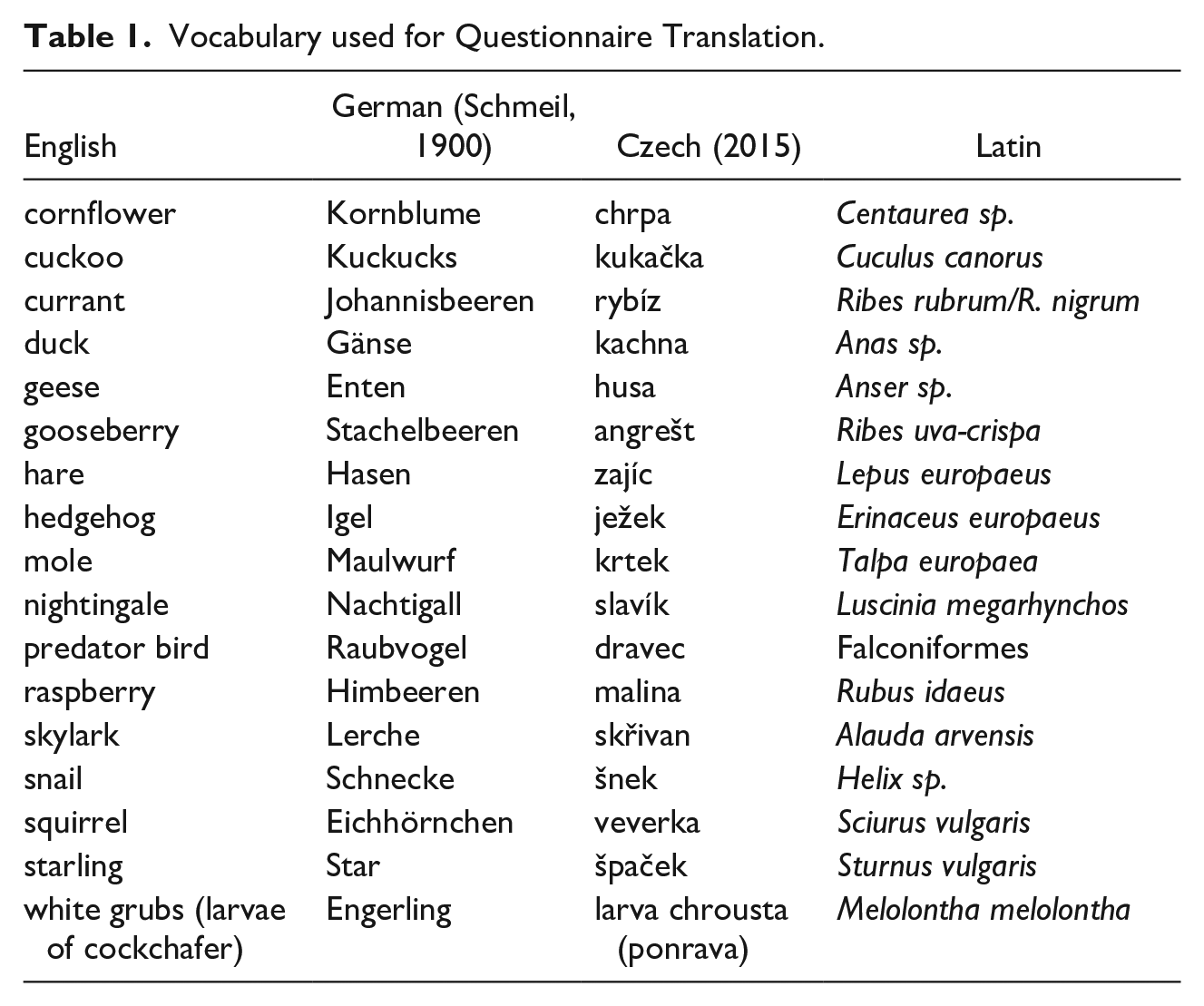
The reference historical dataset to which our comparison relates comes from Schmeil (1900), collected in the city of Magdeburg from 150 children aged 12–14 years. For this research, we used Schmeil’s original text and order of questions (using a Czech translation of Schmeil’s work (Schmeil, 1903)) with minor language adaptations to modern Czech usage. A translation of the common names of species mentioned in the questionnaire is shown in Table 1.
Vocabulary used for Questionnaire Translation.
Sampling
EoN is described not only by its real content but also by its immediate social context, shaped by the larger society and culture (Clayton et al., 2017), or by the frequency of occurrence of observed phenomena. Recent data collection was based on the assumption of the proximity in Central Europe between Magdeburg (Germany) and the Czech Republic, both sharing many common animal and plant species; the two locations are also similar in landscape and cultural character. For this reason, Schmeil’s chosen questions are clearly applicable and relevant to residents of the Czech Republic as well. The natural elements that were common in observations in Schmeil’s time and place are also common in Czech nature today. In the case of predator birds (Question no. 24), observation is easier nowadays, since predators (hunted violently throughout European history) have been protected by law since 1992 in the Czech Republic.
The choice of schools was as follows: we chose urban areas with more than 5,000 inhabitants, and selected four schools using random numbers from the list of schools that provide student-teaching for students of the Faculty of Education, Charles University, Prague.
The questionnaires were distributed in printed form along with instructions for completing them, to the senior teachers at the schools where the student-teachers had their student-teaching. The questionnaires were then assigned by the teachers in all classes at their schools that included the designated age category (aged 12–14 years).
The instructions included: the maximum time for completing the questionnaire (20 minutes); the choice of town/village as an option to self-report if a pupil is studying at an urban school but commuting from a smaller area; an explanation of how to respond when students lack real experience but know the phenomenon from media (TV, ca computer) or another mediated form.
The questionnaires were processed anonymously and given this method; we did not need special permission from an ethical body. Incomplete questionnaires were excluded from further processing.
Sources of sampling bias were as follows: it would have been ideal to collect data directly in Magdeburg but this was not logistically possible; the selection was not carried out from all schools in the Czech Republic but only from roughly 200 schools that participate in student-teaching programs; self-reported place of residence is not a completely reliable indicator of the opportunities to gain experience with nature around residents’ homes.
Sample
For the historical data of Schmeil (1900), we have only a short description. This data was collected most likely by Schmeil himself during his time at a primary school in Magdeburg-Wilhelmstadt, from 150 children aged 12–14 years in the sixth (and final) grade of school. In Schmeil’s time, Magdeburg was the sixteenth largest city in the German Empire, with a population of over 200,000 (Digizeitschriften, 1880, p. 6). We have no more detailed information about these historical research respondents; their social status can only be guessed from the Wilhelmstadt city district which was neither wealthy area, nor a slum; at that time it was made up of half-timbered houses in the vicinity of the city fort. This poor context of the historical data limits the possibility of comparison with recently collected data.
The recent data were collected by the second author when writing a thesis during the 2015 school year, and consisted of 405 lower secondary school students who volunteered to participate and whose reported age interval fit the 12–14-year range in Schmeil’s sample. A self-reported demographic identification to the city (331; 82%) and village (74; 18%) place of residence was used to deal with the respondents’ possible commuting. When linking this self-reported residency identification with the schools’ locations, there are students from a big town—more than 100,000 citizens (19; 5%), towns from 5,000 to 100,000 citizens (312; 77%) and from villages (74; 18%).
Instrument Description
There are 31 questions that are asked in a manner allowing only yes/no answers in Schmeil’s original questionnaire. The questions focus on activities and observations that Schmeil considered as meaningful and foreseeable in his time, according to his long-term experience as a biology teacher and with the authority of an acclaimed textbook author who deeply influenced the development of biology instruction in the Central European region (Heinrich & Schandera, 2002). There was no ambition to measure the frequency of these experiences in the original study, nor was there quantification of these experiences or of the connectedness of respondents to the listed phenomena. Items on the questionnaire were not sorted; for clarity within this paper, we tagged them with an abbreviation (see Table 2) and classified them according to the type of experience/activity into the following groups:
activities (e.g., picking fruit, visiting a forest) (A)
observatio ○ of activities connected with biotechnology and agriculture (e.g. milking a cow) (O-T) ○ of natural elements (e.g. skylark, cuckoo) (O-E)
Abbreviation and Classification of Questionnaire Items.
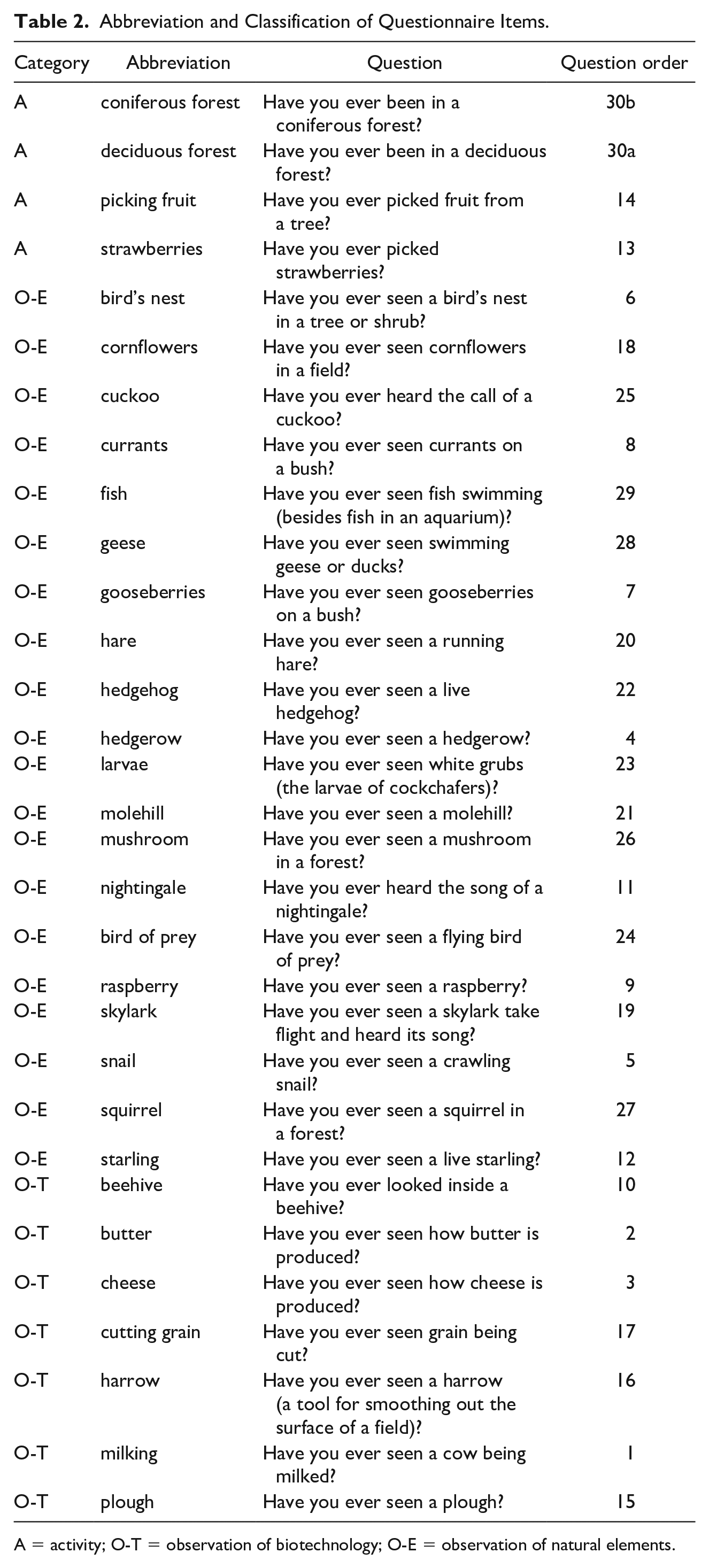
A = activity; O-T = observation of biotechnology; O-E = observation of natural elements.
Schmeil asked students only about real experience, there is no questioning about any meditated experience, for example, book reading which could have occurred in Schmeil’s time. In contemporary society, mediated experience widely complements and expands real experience (Fletcher, 2017b) and according to Kahn Jr et al. (2009) can even partially satiate the need for contact with nature. We felt it obligatory to collect current data also for mediated experience. Therefore, we modified the questionnaire by adding a third option: “No, I’ve only seen it on TV/a computer”.
The internal reliability of the questionnaire was possible to assess only on the Czech sample, for which a Cronbach’s alpha of 0.78 was measured.
Statistical Procedures
Prior to further analysis, questionnaires were checked for missing data. Cases with any missing data were excluded. The dependence of experience on the age of our respondents was tested by ANOVA and dependence of self-reported place of residence was confirmed by a t-test (p < .001), both on the entire sample (n = 405).
Therefore, for comparing Schmeil’s data (collected in the city), we used only a subset (n = 331) of city respondents. We applied a Z-test for proportions at a 0.05 significance level, and effect sizes were calculated according to the formula for Cohen’s h (Cohen, 2013) when comparing Schmeil’s data to our own. To determine the linkage between experiences we analyzed data using mean linkage hierarchical clustering done in R software v. 3.5.1 (R Core Team, 2018); the rest of the statistical analyses were conducted using Excel 2016.
Results
Dependence of the 2015 Respondents’ EoN on Age and Place of Residence
According to the ANOVA results (p = .390), children regardless of their age have the same amount of experience in the 2015 sample.
We found a significant difference related to the respondents’ self-reported place of residence by a t-test (p < .001) supporting the general assumption of greater contact with natural phenomena among countryside children.
Changes in Real EoN Between 1900 and 2015
The overall amount of EoN is higher in the 2015 respondents, as shown in Table 3. There are 9 (29%) questions with a significant experience decrease, only one of them with an effect size lower than 0.5. However, almost double this number, 16 (52%) questions, show an increase of EoN, with five of them with an effect size lower than 0.5. No significant change was found in 6 (19%) questions.
Results of Schmeil (1900) and Collected Data (2015) for Amount of Experiences.
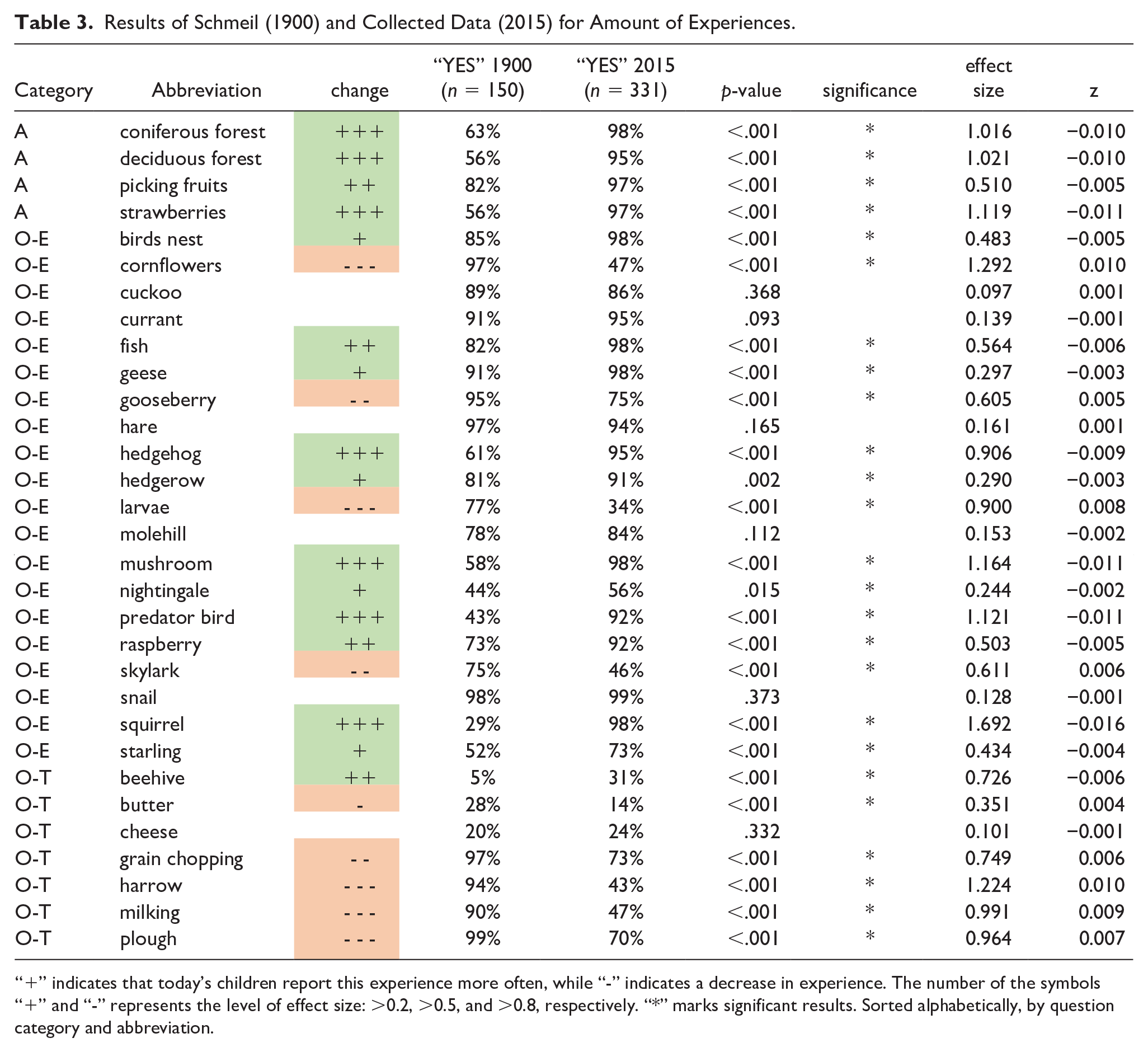
“+” indicates that today’s children report this experience more often, while “-” indicates a decrease in experience. The number of the symbols “+” and “-” represents the level of effect size: >0.2, >0.5, and >0.8, respectively. “*” marks significant results. Sorted alphabetically, by question category and abbreviation.
Partial decrease in experience is fundamentally based on the biotechnology-related items in the questionnaire; except for cheese (production), all O-T items significantly decreased. Even though cornflowers, larvae, and skylark are pure natural elements as defined above, the occasion of observing them is combined with the agricultural landscape and agricultural activities. The last item that decreased, gooseberries, is in our opinion an outlier, not connected with biotechnology.
Experience Structure in the 2015 Results
The hierarchical clustering in Figure 1 shows the structure of contemporary children’s EoN. Items connected with biotechnology (except cutting grain and plough) form a cohesive cluster where EoN is fading away. Inside the biotechnology cluster, there are two subgroups highlighted by red and green branches in Figure 1. These subgroups seem to differ by the availability of the observation—skylark, cornflowers and harrow can easily be seen from a car driving through the Czech countryside; on the contrary milking, and other items from this subcluster, require immediate contact with reality.
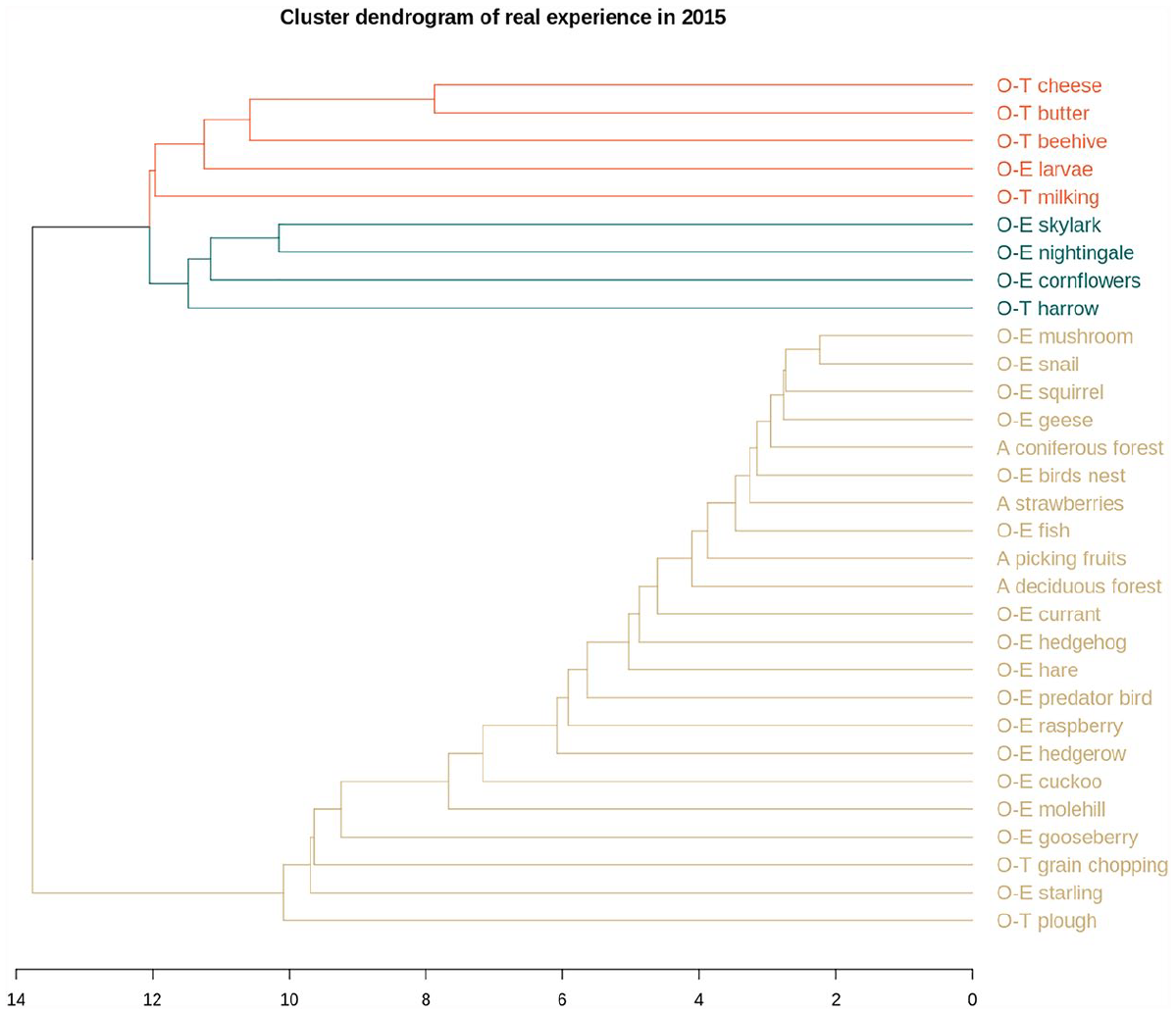
Clustering of experiences in 2015 results. The side color box represents a decrease (red), increase (green), no significance (grey) change to Schmeil’s data as reported in Table 3.
Mediated experience shows a significant effect size in 5 (16%) questions, all classified as biotechnology, see Table 4. An increase in experience due to mediated complement was observed in 4 (13%) more questions but without a significant effect size.
Results of 2015 Real Experience Compared to 2015 Real AND Mediated Experience.
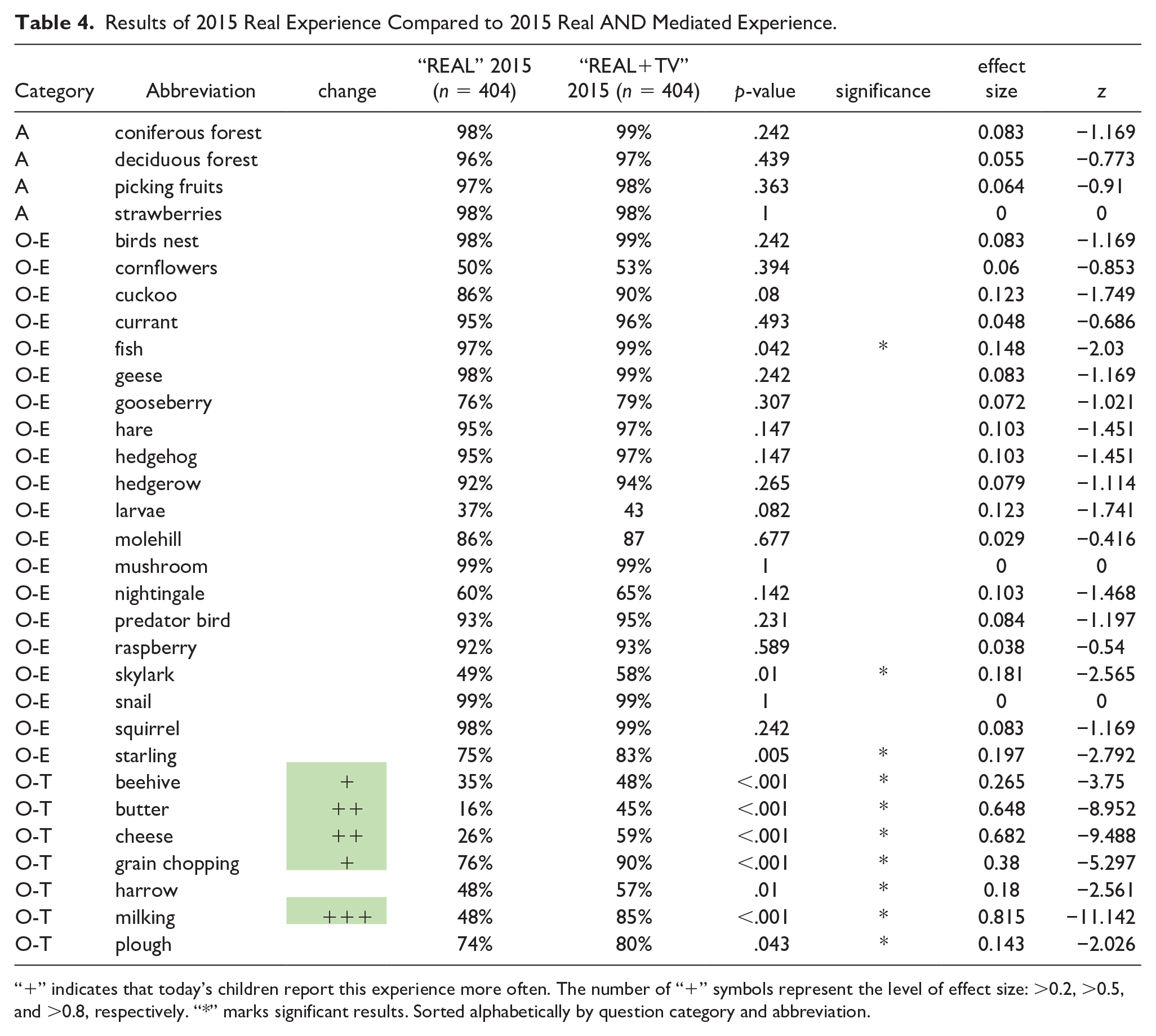
“+” indicates that today’s children report this experience more often. The number of “+” symbols represent the level of effect size: >0.2, >0.5, and >0.8, respectively. “*” marks significant results. Sorted alphabetically by question category and abbreviation.
Discussion
This study is one of the few cases where exact data comparisons are used to document EoN change between generations. For our first hypothesis on the change in EoN, results that support it were found, but in the opposite direction to the majority discourse. The data presented here show a rise in experience with nature among contemporary children compared to the children of the early 20th century. We have also shown that mediated experience plays an important part in contemporary children’s experience, and according to Clayton et al. (2017), conservation scholars and practitioners should examine the ways in which novel technology-based interactions help to construct people’s attitudes and behaviors toward nature.
The results indicate that there has been a positive change in EoN; and here lies a possible bias of this work: the Schmeil questionnaire uses a binary response format that made it easy for respondents to answer, but which reduced the complexity (Chan, 2014). Therefore, what is missing is the depth of experience, its quantification, and the intensity of experience; our insight into the reality is limited and the total change in experiences should not be overvalued.
The structure of the collected data indicates a transformation of nature in the lives of children today. In the past, people used nature, spending their time in the natural world simply because it was necessary to earn their livelihoods. Nowadays, nature has somehow become a place to visit; today’s children interact with the natural world not because they must, but because they want to. They go on field trips and even if they do not live in the countryside they visit it, for various chosen activities. The structure of experiences with nature in 1900 and 2015 is based on different consequences, needs and possibilities; since the conditions (Clayton et al., 2017) – global urbanization and the development of technology, in combination with new ways of working, and seeing the world are too different today, they do not allow the experience of earlier generations to be replicated. If we summarize all the factors that influence the measuring of experience with nature, there are many challenges with the quantitative measurement approach.
The core of decreasing experiences according to our study is formed by those activities we call “biotechnology.” Are these experiences connected with nature at all? Caillon et al. (2017) explained, how we perceive nature often as separate from culture, which results in ours overlooking the interplay between the two. Milking a cow was a fairly common activity at the beginning of the 20th century and can be used as an indicator of the amount of time spent taking care of animals, for example; but this is not true in the context of today’s Central Europe. Such questions compare, more likely, changes in culture, not the amount of EoN; the “same” experience with nature has varying content over history defined by a cultural context.
Conclusion
As our research has demonstrated, there are sporadic literary sources that make it possible to compare the current experience of nature with the historical state. When processing the comparison of Schmeil’s historical questionnaire we encountered several problems that limit the interpretation of the results.
In the case of Schmeil’s data, the absolute minimum of information about the social background of respondents is known, except that they were urban children. The questions on this questionnaire are strictly binary and, therefore, flatten the description of the reality being investigated. The questionnaire is oriented on EoN; does not assess the attitudes to the observed elements or other aspects of HNC and only informs about the level of attention paid to the natural environment, for respondents whose amount of opportunity to spend time in nature is unknown.
From today’s perspective, the questions used appear to be strongly oriented towards the rural context of nature, but this aspect does not mean that they are irrelevant to today’s context. On the contrary, they show very aptly how both concepts “nature” and “experience of nature” undergo culturally-driven transformations that must be taken into account with great care.
Analysis of contemporary results confirmed that there is a difference between the children’s place of residence and their experience with nature; children living in a village have a higher level of experience with nature than children from cities; mediated experience is important nowadays, important especially in the case of biotechnology.
By comparing the experience with nature of children from 1900 and from 2015, we have concluded that there is a difference between children in the 1900s and 2015: contemporary children’s overall amount of EoN is significantly higher than in 1900. A partial decrease in the EoN of contemporary children is closely connected with the decline of extensive farming and taking care of fields or animals (biotechnology activities like milking, butter/cheese production, and organisms such as skylarks or cornflowers). An increase in the EoN of contemporary children is exhibited in connection with the ecosystems of gardens and forests (mushrooms, squirrels, hedgerows, molehills, birds’ nests), as these ecosystems are experienced by contemporary children during their time off from school.
Most authors detect the loss of EoN, and we believe that this research is not necessarily inconsistent, even when it produces the opposite results. It serves to remind us that a baseline is essential for every comparison, and when comparing today with the time of the First Industrial Revolution we realize how much progress has been made not only in terms of technical progress but also in the quality of life. These results hold out the promise that EoN naturally changes during human history, just as it does nowadays, and when the trend is reported to be declining, it is not a new or ultimate drift.
Supplemental Material
primary_data_1 – Supplemental material for Are Children Actually Losing Contact with Nature, or Is It That Their Experiences Differ from Those of 120 years Ago?
Supplemental material, primary_data_1 for Are Children Actually Losing Contact with Nature, or Is It That Their Experiences Differ from Those of 120 years Ago? by Petr Novotný, Eliška Zimová, Aneta Mazouchová and Andrej Šorgo in Environment and Behavior
Footnotes
Author’s note
Aneta Mazouchová is now affiliated with University of Economics, Prague, Czech Republic.
Declaration of Conflicting Interests
The author(s) declared no potential conflicts of interest with respect to the research, authorship, and/or publication of this article.
Funding
The author(s) disclosed receipt of the following financial support for the research, authorship, and/or publication of this article: The research was financially supported by the project of the Charles University UNCE/HUM/024 “Centrum didaktického výzkumu v přírodních vědách, matematice a jejich mezioborových souvislostech”.
Supplemental Material
Supplemental material for this article is available online.
Author Biographies
References
Supplementary Material
Please find the following supplemental material available below.
For Open Access articles published under a Creative Commons License, all supplemental material carries the same license as the article it is associated with.
For non-Open Access articles published, all supplemental material carries a non-exclusive license, and permission requests for re-use of supplemental material or any part of supplemental material shall be sent directly to the copyright owner as specified in the copyright notice associated with the article.
