



Abstract
This article focuses on the emergence of a dystopian imagery of Rome in Fellini’s Toby Dammit and Roma and in Pasolini’s Petrolio. In these films and novel, the cohabitation of vernacular and modern elements that had characterized Fellini’s and Pasolini’s works in the 1960s (Ragazzi di vita and Accattone, Le notti di Cabiria and La dolce vita) suddenly fades away. What surfaces instead is a dissociated and chaotic cityscape that tends toward a state of maximum disorder and to the incorporation of diversity into sameness. I propose an interpretation of this paradigm shift of Rome’s imagery through the concept of ‘entropy,’ which in thermodynamics and information theory refers to a process of gradual decline of a self-enclosed system. I will first discuss the material mutations of Rome’s 1960s map through an examination of urban analyses by Benevolo, Cederna, and Insolera, before moving to a close reading of Rome’s image in Toby Dammit, Roma, and Petrolio. What I argue is that the process of dissociation and fragmentation of Rome’s map theorized in urban studies is replicated at the aesthetic level by the sense of entropic confusion and the loss of spatial coordinates that mark Fellini’s and Pasolini’s 1970s engagements with Rome.
Introduction
It is a commonplace in discussions of Rome’s cinematic representations to refer to Federico Fellini and Pier Paolo Pasolini as two directors who provided a complementary and at the same time oppositional depiction of the Italian capital. Fellini is generally interpreted as the internal observer of the bourgeois malaise of Rome at the peak of its postwar modernization – the one who lingers his camera on glamorous and decadent images of the city center such as Via Veneto, the Trevi Fountain, or the Caracalla Baths. Pasolini, on the other hand, is the epic poet of what lies outside the limits of the city center. He is the cantor of Rome’s slums and of the sub-proletariat inhabiting the very margins of the ‘Eternal City.’
This binarism holds if we look at these writers’ movies of the late 1950s and early 1960s – namely, Fellini’s La dolce vita (1960) and Pasolini’s Accattone (1961) and Mamma Roma (1962). While Fellini’s gaze fluctuates anarchically around Rome’s fast-expanding cityscape, Pasolini’s camera is more ideological and aims to capture the city’s most marginal and peripheral interstices. However, as this article will demonstrate, the opposition between these seemingly distinct strategies of observation recedes in their work after 1968. Fellini’s return to Rome in films such as Toby Dammit (1968) and Roma (1972), and Pasolini’s final engagement with Rome in his novel Petrolio (1972–1975, published posthumously in 1992) appear indeed to converge in the depiction of a disordered cityscape, in which the dichotomy between center and periphery – between an inside and an outside of the postmodern city – is progressively disappearing. Here, the multi-layered and porous city of the early 1960s appears to fade away, mutating into a dystopian territory characterized by chaos and disorder.
In this article, I will shed light on the cinematic and literary emergence of Rome’s dystopian cityscape through the concept of ‘entropic aesthetics.’ In my discussion, I will draw on the notion of entropy, which in thermodynamics and information theory refers to a state of gradual transformation from order to disorder, and to the process through which the elements contained in this self-enclosed system become increasingly uniform. The reason for my interest in entropy is two-fold. Not only is ‘entropia’ the term used by Pasolini himself in order to describe the process of incorporation of subaltern forms of life within the bourgeois social body in post-modernized Italy, 1 but it is also a crucial notion for other artists who tried to represent the process of the extinguishing of the expansive dynamics of Western modernity in the 1960s and 1970s. In this context, we might consider the work of the American novelist Thomas Pynchon, 2 who in V. (1963) and The Crying of Lot 49 (1966) portrayed postmodernity as a process of an emptying of individual subjectivities and of an increasing social disorder, 3 as well as the work of the land artist Robert Smithson, who interpreted the sense of crisis characterizing the American 1970s as a form of entropy. 4 As I will show, a similar process of transformation characterizes Fellini’s and Pasolini’s 1970s aesthetic engagements with Rome.
Methodologically, I read aesthetic artworks as co-dependent on the material conditions of the spatial contexts from which they stem. I will thus firstly engage with a corpus of studies that described Rome’s postwar modernization from an urban perspective. The aim of the first section is to shed light on Rome’s postwar expansion, which is characterized, I argue, by a process of urban sprawling and spatial shattering that severs the city from its traditional form. In my second section, I then examine the way in which Rome’s material changes are absorbed and worked through cinematographically in Fellini’s Toby Dammit and Roma, before moving, in the third section, to an analysis of Pasolini’s Petrolio. An inquiry into Fellini’s and Pasolini’s late engagements with Rome seems essential, as it can provide us with a more complex understanding of these author’s representations of Rome, which until now has been mainly focused on the ‘stupendous and miserable city’ of the postwar period.
The years spanning the early 1960s and the mid-1970s represented a moment of significant redefinition for Rome. As an urban entity, the city kept growing at a fast rate (the statistics show a growth of 27% in the decade 1961–1971), and its population reached 2,781,993, overtaking for the first time in centuries that of Paris and thus making Rome the third most populous European city after London and Berlin (Vidotto, 2006). This extended growth was the subject of various discussions among intellectuals and urban historians, who decried the loss of Rome’s traditional structure and denounced the corruption characterizing its construction politics.
Two works that helped to shed light on these processes are Italo Insolera’s Roma moderna (1962) and Antonio Cederna’s Mirabilia Urbis (1965), which framed the process of Rome’s urban development in terms of its chaotic disorder, emphasizing the ongoing destruction of the traditional structure of the city. In his preface to the 1971 edition of his book, Insolera foregrounded the ‘unknowability’ of 1970s Rome, noting the lack of technical tools able to capture the city’s new urban territory, as a consequence of its uncontrolled expansion. In his words, ‘Ignoriamo Roma, la vita degli uomini che vi abitano, il rapporto di questi con l’ambiente’ (Insolera, 1971: 31). Cederna, on the other hand, highlighted the fact that 1960s Rome had become an urban entity which had nothing to do with the traditional meaning evoked by its name – that of the ‘Eternal City.’ It was, instead, an enormous metropolis characterized by a decrepit city center and by a squalid and enormous periphery: Roma presenta oggi un centro storico degradato e impraticabile, incrostato in mezzo a un’immensa, informe agglomerazione, squallida e sterminata periferia, sorta nel segno della violenza privata e della complicità pubblica, che tutto si può chiamare fuor che città. La stessa configurazione fisica di Roma è stata distrutta: un unico tavoliere di cemento, uno stomachevole, soffocante magma di ‘palazzine’ e ‘intensivo’, colma le valli, ricopre le colline, sommerge la campagna, grazie allo sfruttamento dell’ultimo metro quadrato disponibile, quasi ci si fosse proposti di impedire a chiunque di dire: questa era Roma. (Cederna, 1965: viii)
Many of the changes that led to the creation of this decayed and unknowable urban form emerged in relation to the failure of the city’s new master plan. Approved in 1962, this was the first comprehensive project since the one approved by Mussolini in 1931 during Italy’s fascist dictatorship. The main aim of the project was to rebalance Rome’s expansion toward the south-east and to regulate the phenomenon of the unauthorized construction of entire residential areas. However, as the urban historian Leonardo Benevolo has argued, many of the legal urban settlements approved by the 1962 plan failed to be built while, simultaneously, illegal squatting developed in an uncontrolled way, thus compromising the general scheme proposed by the urban plan (Benevolo, 1992: 160). We could therefore say that it was precisely this inability to follow the guidelines of the master plan during a period of such furious and frenzied growth that led to the definitive fracture of Rome’s urban map. As the 1960s progressed, Rome’s periphery could no longer be seen as complementary to the central town; rather it became an urban block of its own – open, swarming and at the same time set in opposition to the occluded and congested city center. The former continued to grow at an exceptional pace while the latter crystallized into its own simulacrum. In Benevolo’s own words: in questo periodo avviene la rottura della forma urbana unitaria: lo sviluppo irregolare dal dopoguerra in poi forma ormai una cintura omogenea, in senso fisico e in senso sociale, contrapposta al nucleo regolare. La cintura cresce con un dinamismo eccezionale, mentre il nucleo è quasi fermo e piuttosto si consolida aumentando la densità. (Benevolo, 1992: 140)
Benevolo described Rome’s post-unification history as a process of collision between the hyper-stratified pre-1870 city and modern attempts to rationalize and expand it. His central point is that Rome’s historical city represented an ‘illegible hieroglyphic’ for its modernizers at the end of the 19th century, and that this inability to read the city led, during the 20th century, to the complete detachment between the stratified ancient city, on the one hand, and the incoherent and dissociated modern city, on the other. For Benevolo, the point of fracture of Rome’s cityscape occurred precisely between the 1960s and the 1970s, when ‘la città si spezza in due parti, separate e complementari’ (Benevolo, 1992: 161). The two sides of Rome are clearly the city center, which has remained virtually untouched in the postwar period, and the city’s periphery, which grew largely unplanned and in a disproportionate manner in the three decades following World War II. The break-up between the two sides can be understood in terms of a broken dialectic between the compact and stable shape of the center and the open shape of the periphery, which explodes into debris and swarms around the perimeter of the Roman ring road. In the end, the possibility of grasping this process in terms of the center–periphery dichotomy fades away. While the center remains a very well definable urban territory, the periphery seems a more difficult concept to grasp as a result of this centrifugal process of expansion which brings it to shatter and dilate. As I will delineate in the next section, it is precisely the attempt to grasp some fleeting traces of this uncontrolled expansion – the cypher of Rome’s 1970s unknowable space – that characterizes the chaotic movement of Fellini’s camera in Toby Dammit and Roma.
Fellini’s Toby Dammit and Roma
Fellini’s revisiting of Rome’s cityscape in the 1970s reproduces aesthetically the process of detachment between tradition and modernity that Insolera, Cederna, and Benevolo analyze from an urban perspective. It is precisely from this ‘materialist’ engagement with Rome’s fractured cityscape that, I argue, the ‘entropic aesthetics’ characterizing Fellini’s 1970s cinematography stem. In order to trace the way in which entropy triggered an indexical mutation of Fellini’s gaze, this section provides a close reading of some scenes of Toby Dammit and Roma which reveal the deranged immensity and the sense of unknowability that characterize Rome’s 1970s spatiality. To be clear, the ‘reality’ that I am addressing here does not have anything to do with the use of ‘real’ locations, in that the vast majority of the scenography in Toby Dammit and Roma is recreated in-studio in Cinecittà. What I am arguing is rather that Fellini’s modernism is coterminous with his realism, in that his capacity to capture scattered snapshots of a crumbling reality is strictly rooted within the empirical and historically contingent materiality of Rome’s cityscape.
Toby Dammit is a segment of the omnibus Histoires extraordinaires (1968), which also included Roger Vadim’s Metzengerstein and Louis Malle’s William Wilson, all of which are free adaptations of Edgar Allan Poe’s stories. Toby Dammit is based on Poe’s 1841 story, ‘Never Bet the Devil Your Head’; instead of taking place in mid-19th-century America as in Poe’s story, however, the movie is set in Rome around 1968. The decision to move the story to contemporary Rome allowed Fellini to revisit some locations and situations of La dolce vita, which was filmed eight years earlier. However, the sense of cynicism, dissatisfaction, and feebleness which distinguished the characters of La dolce vita mutates into the self-destructiveness of Toby Dammit, a British actor interpreted by Terence Stamp who arrives in Rome in order to film the first Catholic Western movie.
There are two scenes that are particularly interesting for the discourse that I am developing here, both of which relate to the shattered fabric of Rome’s cityscape. The first scene captures Toby Dammit in a car journey from Rome’s new Leonardo da Vinci airport to the city center, which recalls Sylvia’s journey from the older Ciampino airport to Rome in La dolce vita. Fellini’s re-filming of this scene in Toby Dammit underlines the tremendous changes that have affected Rome in only eight years. In this respect, the gap between the two scenes can help us to frame better what is aesthetically at stake in Rome’s modern fracture. While Sylvia’s journey in La dolce vita emphasized the oxymoronic cohabitation between different temporalities characterizing Rome’s 1950s urban structure, Toby Dammit’s journey points toward its fractured materiality. The clash between modern and traditional features – the arrival of a glamorous Hollywood star chased by paparazzi among relics of ancient building and flocks of sheep (Figure 1) – is in Toby Dammit replaced by smoky construction sites and unfinished high-rise buildings.
Shot capturing the ‘palimpsestial’ character of 1960s Rome, in which pre-modern pastoralism cohabits with the rise of gossip culture. La dolce vita (1960).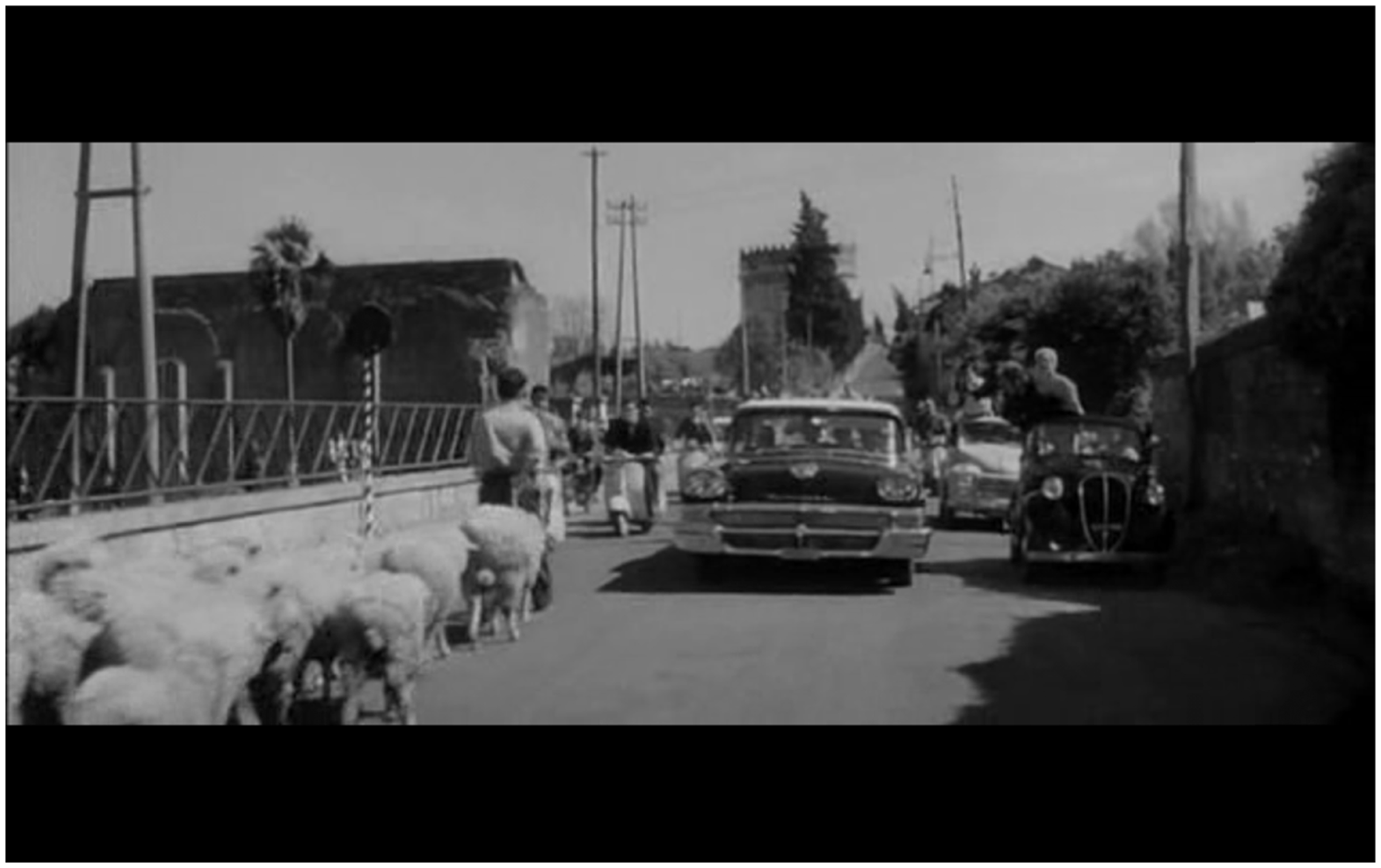
At the profilmic level this materializes in the chaotic overlapping of random visual elements. This visual confusion produces a state of disorientation of the camera, which is unable to capture objects and figures in a plain and definite way. Shots are never transparent and glass surfaces such as shop and car windows refract and re-project random images: after capturing the back of a truck transporting a butchered cow the camera rapidly turns left toward a big furniture shop selling glass chandeliers. Then, after a very quick shot-reverse-shot from Toby’s face to the highway we get a partial and disturbed image of a smoky constructing site, with concrete mixers and smoothing machines operating alongside a photographic set, and the skeleton of a big building under construction in the background (Figures 2 and 3). In order to produce this haptic sense of visual anarchy Fellini adopts very rapid shifts and cut shots, which offer us only oblique planes of what we can see. The sense of spatial confusion is moreover made more disturbing by the acoustic overlapping between the Italian voice of the film’s producer, the English voice of the actor’s translator, and the dazzling soundtrack composed by Nino Rota. This aesthetic potpourri makes it very difficult for the spectator to know and to penetrate the essence of what she hears or sees. In fact, while La dolce vita was based on the potential of interpreting a crumbling reality, Toby Dammit is characterized by the loss of a signifying syntax: reality here has already crumbled, and meaning cannot even be projected as a condition of possibility as the objects that enter the profilmic keep contradicting each other.
Shot capturing the sense of visual confusion characterizing the aesthetics of Toby Dammit (1968). The cohabitation of real and surreal elements and the sense of chaos marking the profilmic in Toby Dammit (1968).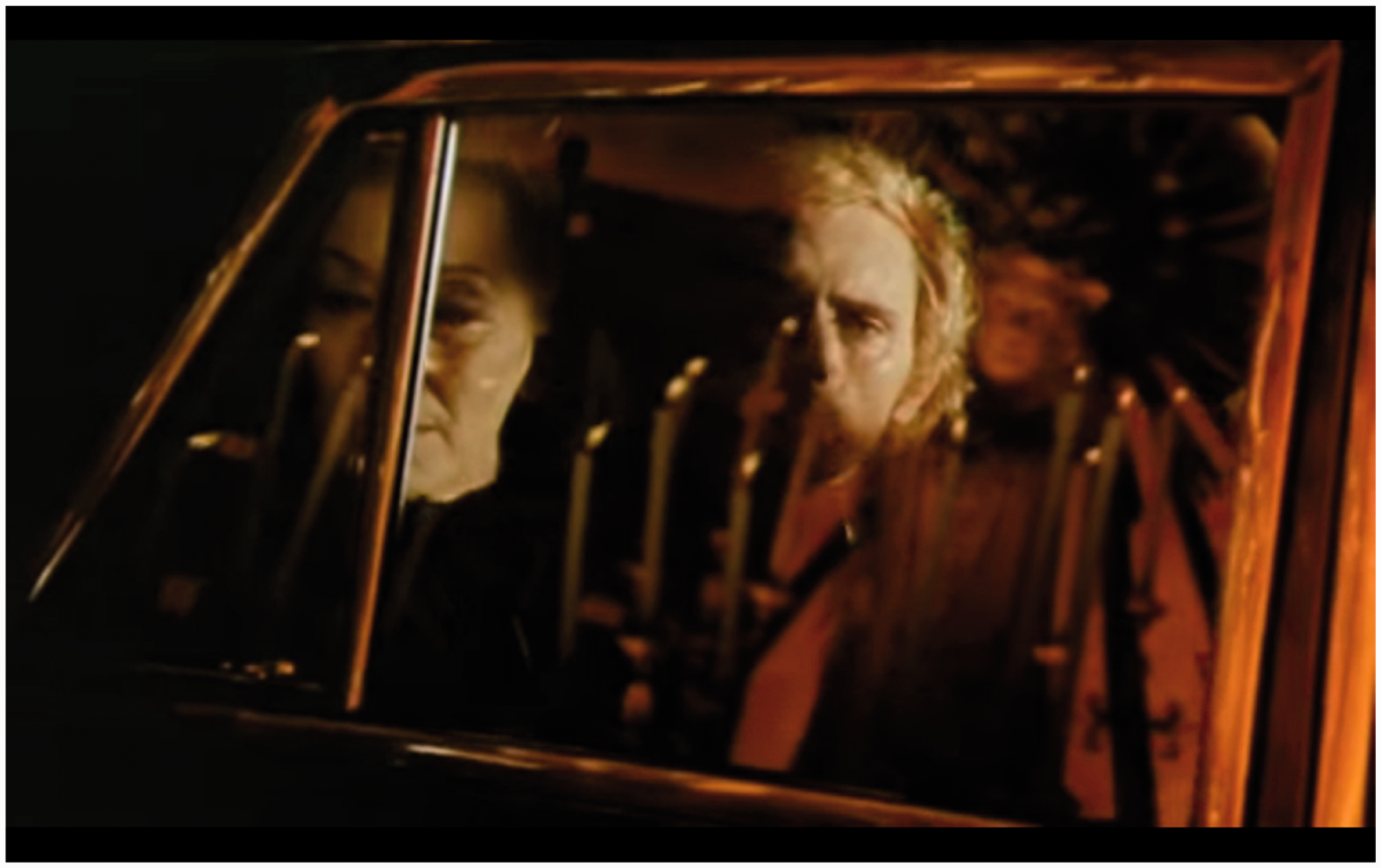

The feeling of occlusion and disorder that determines this sequence – which is echoed and intensified through perverse camerawork – finds its apogee in the actor’s arrival in Rome’s most symbolic location, the Coliseum. Here, unexpectedly, the camera lingers on the monument for a few seconds, framing it from the left side – the neatest one, the one restored by Giuseppe Valadier at the beginning of the 19th century – which seems to create a perfect quadretto con paesaggio with the pine trees emerging from the Palatine hill in the background. However, the geometry of these ancient architectural elements is paradoxically contrasted with the deranged shape of the modern ring road surrounding the Coliseum, which is congested with honking cars and trucks (Figure 4). What this contrast suggests is the impossibility, in the modernized Rome of the late 1960s, to reconcile traditional and modern elements. In a crucial move that will become even more evident in Roma, Rome’s anachronism – the cohabitation of different temporalities – fades away in favor of entropy – a closed system that evolves toward a state of maximum disorder.
Traffic jam in front of the Coliseum that captures the disorder of 1970s Rome. Toby Dammit (1968).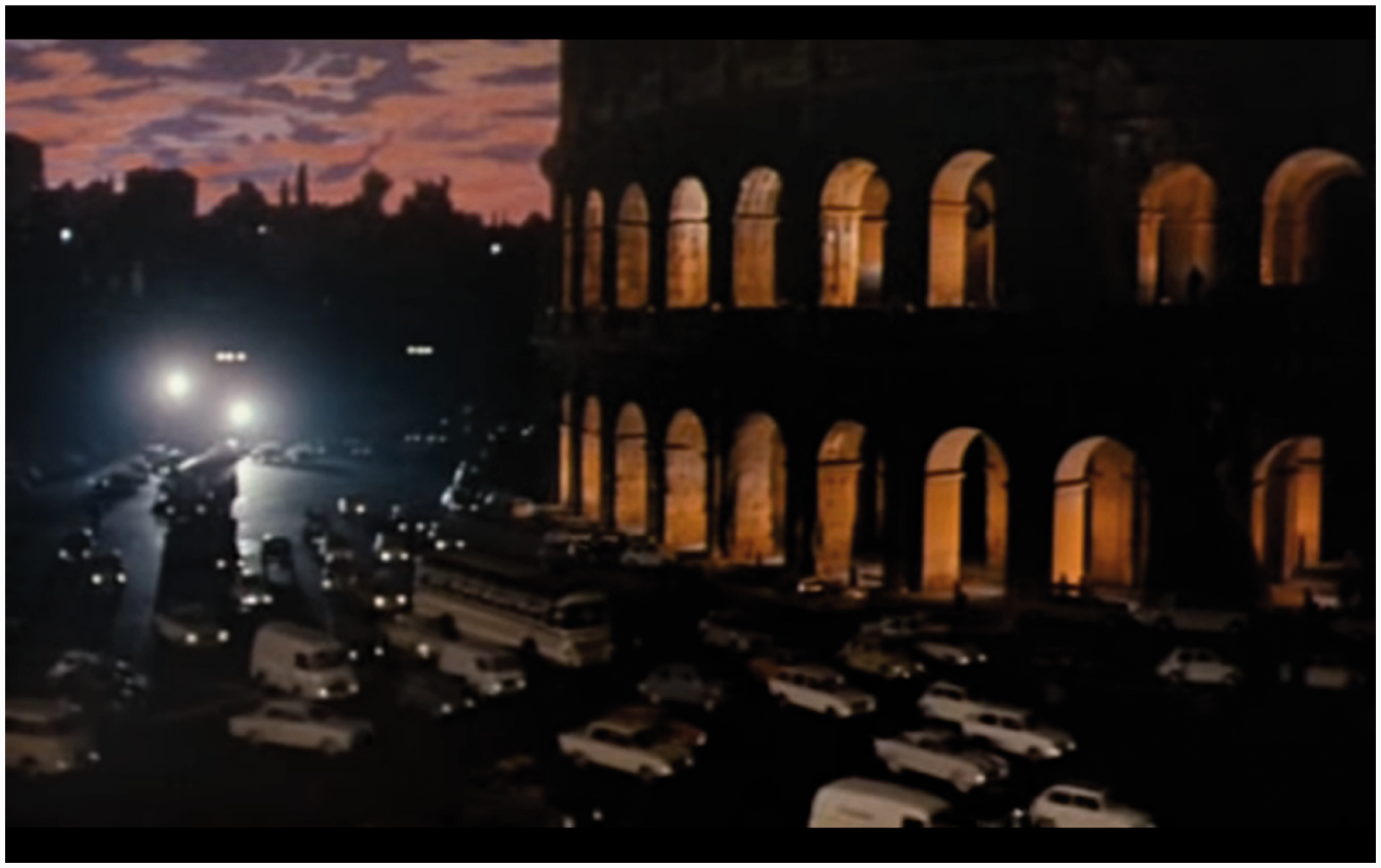
The second important scene is the film’s final sequence, in which Toby is desperately trying to reach Rome from a small and ancient village located in the countryside. The frenzied drive begins with Toby asking a local man, ‘Hey how do I get out of here? How do I get to Rome?’, which receives no answer other than a sardonic smile. Then, for the remaining seven minutes of the film we follow Toby while he daringly drives through an intricate and tortuous series of small alleys, which, like in a maze, seem to lead nowhere. Commenting on this scene, Fabio Benincasa (2013: 52) has rightly noted how Rome here appears as a ‘Kafkaesque hell … a secluded place that is impossible to enter or to exit.’ As in Cederna’s urban analysis, Rome in Toby Dammit is an anti-linear urban entity which escapes the possibility of knowing it. The negation of linearity materializes very strikingly when Toby seems able for a moment to find his way back to Rome via an autostrada. However, this straight run does not last long as he quickly hits a line of barriers indicating roadworks in progress, before crushing his car against some metal sheets. As a consequence of this accident, he gets out of the car in order to try to understand what has occurred. At that point, a man who witnessed the scene from afar tells Toby that the road is closed because a bridge has collapsed. Then, when Toby looks at the other side of the road’s crater he sees the demonic figure of a little girl dressed in Victorian white clothes with a white ball in her hands. Attracted by the corrupted look of this demonic image and at the same time driven by self-destruction, Toby returns to his car and attempts to drive across onto the other side of the crater. When the camera glides onto the other side of the road the only things that we see are a horizontal metal stick splashed with blood, and the white ball bouncing toward Toby’s decapitated head. Then, in the final shot of the film, the camera dissolves on the interrupted highway, which seems to recede endlessly beyond the horizon (Figure 5).
Shot that captures the fracture of Rome’s modernized urban fabric, here symbolized by a straight highway. Toby Dammit (1968).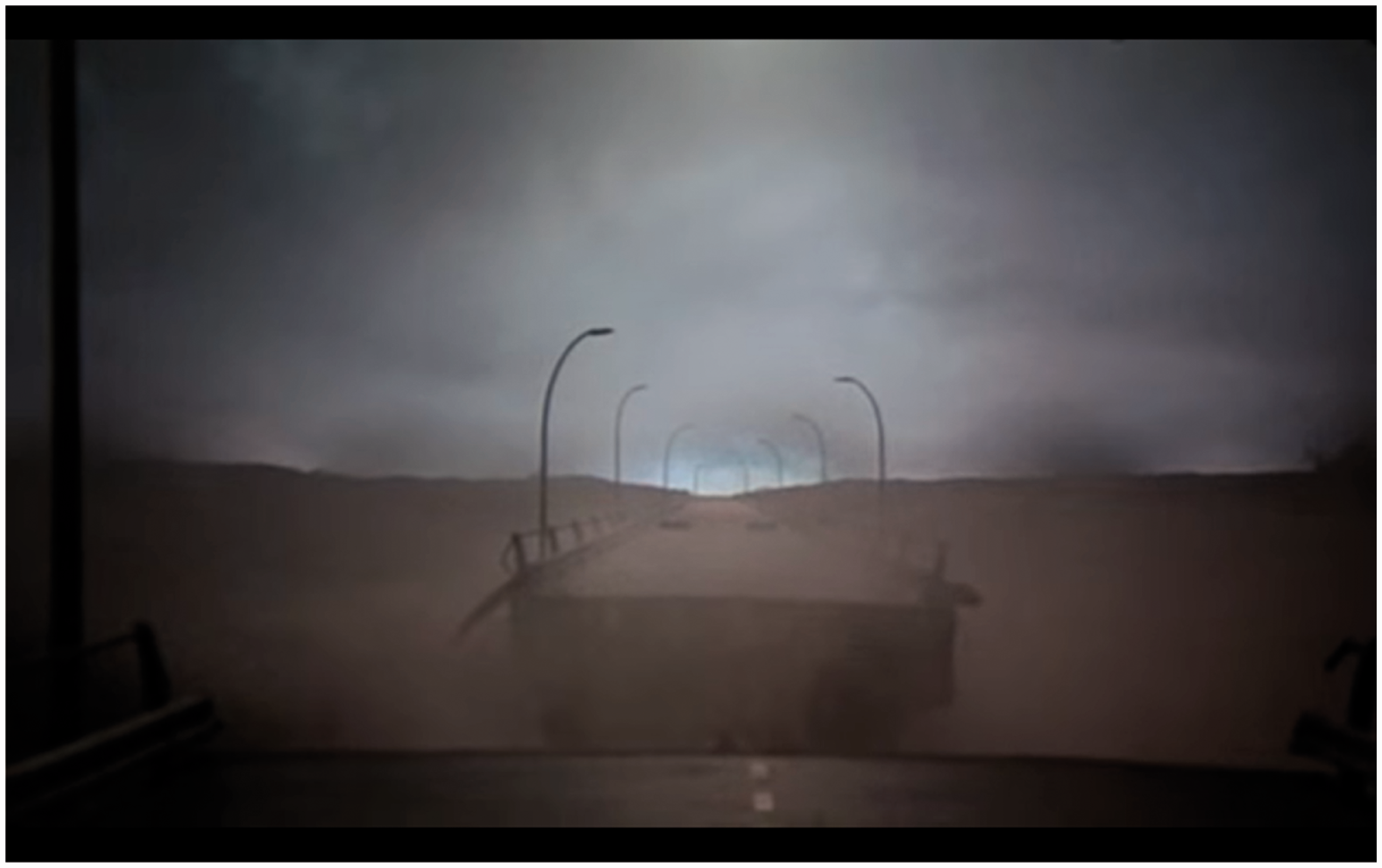
Toby’s final drive develops then in two distinct parts, which testify to an unresolved dialectic between tradition and modernity in Rome’s urban surface. As we saw, at the beginning of his drive he is lost in the maze of an ancient town located in Rome’s outskirts, which signals the co-presence of a circular and pre-modern spatio-temporal structure. Then, after a break in which Toby shows signs of desperation with his incapacity to find a way out of this town, the scene immediately moves to the straight and wide autostrada which will lead him to his death. In an interesting article, George Porcari reads Toby’s decapitation and the falling of his body into the void as an ‘event horizon,’ which testifies to an unresolved dialectic between the human and nature, ‘a Nature that remains enigmatic, dangerous and ultimately unknowable’ (Porcari, 2007: 10). While I would follow Porcari in his reading of Toby Dammit as a film about the ‘unknown,’ I would also underline its immanent essence rather than its transcendental one. In this respect, I interpret the interrupted road that causes Toby’s decapitation as a symbol of the fracture between tradition and modernity that marks Rome’s cityscape in the late 1960s.
The fragmented and disorienting nature of 1970s Rome is further represented in Roma. The film’s diegesis does not follow a linear pattern and keeps floating from sequences capturing 1970s Rome to sequences depicting the city in the 1930s or 1940s, that of the author’s youth. The vaudeville theater, the brothel, and smoky theaters typical of 1930s and 1940s Rome are counterposed against grotesque traffic jams, the geological perforation of the underground for the construction of metro tunnels, or the hippies’ peaceful occupation of Piazza di Spagna. While the film never adopts a melancholic tone toward a lost past, nor does it complain about the ‘decay’ of Rome’s present; the way in which it reproduces aesthetically this process of opposition between past and present signals the perception of an occurred historical disjunction.
This aspect becomes evident in the contrast between the film’s first two sequences. In a sort of further re-elaboration of the disparative technique adopted in La dolce vita, the first shots of Roma emerge from the author’s mnemonic evocation of Rome during his school years, and proceeds through imaginative association until his arrival in Rome as a young man during the 1930s. The final shot of this sequence provides us with a vernacular image of Rome at night, tracking a flock of sheep passing in front of the Church of Saint John in the Lateran before dissolving into a deserted park along the via Appia. The balanced urban form of 1930s Rome is here aesthetically mediated by the camera’s movements, which are agile and sequential. However, the simplicity of this first sequence clashes with the sense of derangement that defines the following one, which captures Rome’s immense rail-road, the so-called GRA. The profound difference between these two scenes is immediately made clear by the voice-over, who introduces the scene saying: ‘e la Roma di oggi? Che effetto fa a chi arriva per la prima volta? Proviamo a entrarci in macchina dall’autostrada, attraverso l’inevitabile grande raccordo anulare, questo raccordo che circonda la città come un cerchio di Saturno.’
This scene captures the dissociation and chaotic disorder that characterize 1970s Rome. In about 12 minutes the camera engages in a hectic effort to track a series of images, situations, and unexpected obstacles that exhaust its capacity to focus on any specific object or individual. Shops, warehouses, small factories, and smoky construction sites cohabit with surreal images such as that of two men playing cards on the back of a truck with no hold doors. In a desperate attempt to capture this whimsical picture the camera keeps shifting views, adopting almost all the possible cinematic techniques: dolly shots, deep focus, close-ups, and medium shots keep alternating with each other, increasing the sense of disorder and confusion in the spectator. The perspective shifts from high to low, and the image is often obfuscated by smog or smoke. The sense of visual confusion is further enhanced by the image of a group of men hitching rides for Naples (located south of Rome) and Florence (located north of Rome) next to each other, which emphasizes the loss of linear spatial coordinates (Figure 6).
The loss of linear spatial coordinates: hitchhikers in Roma (1972).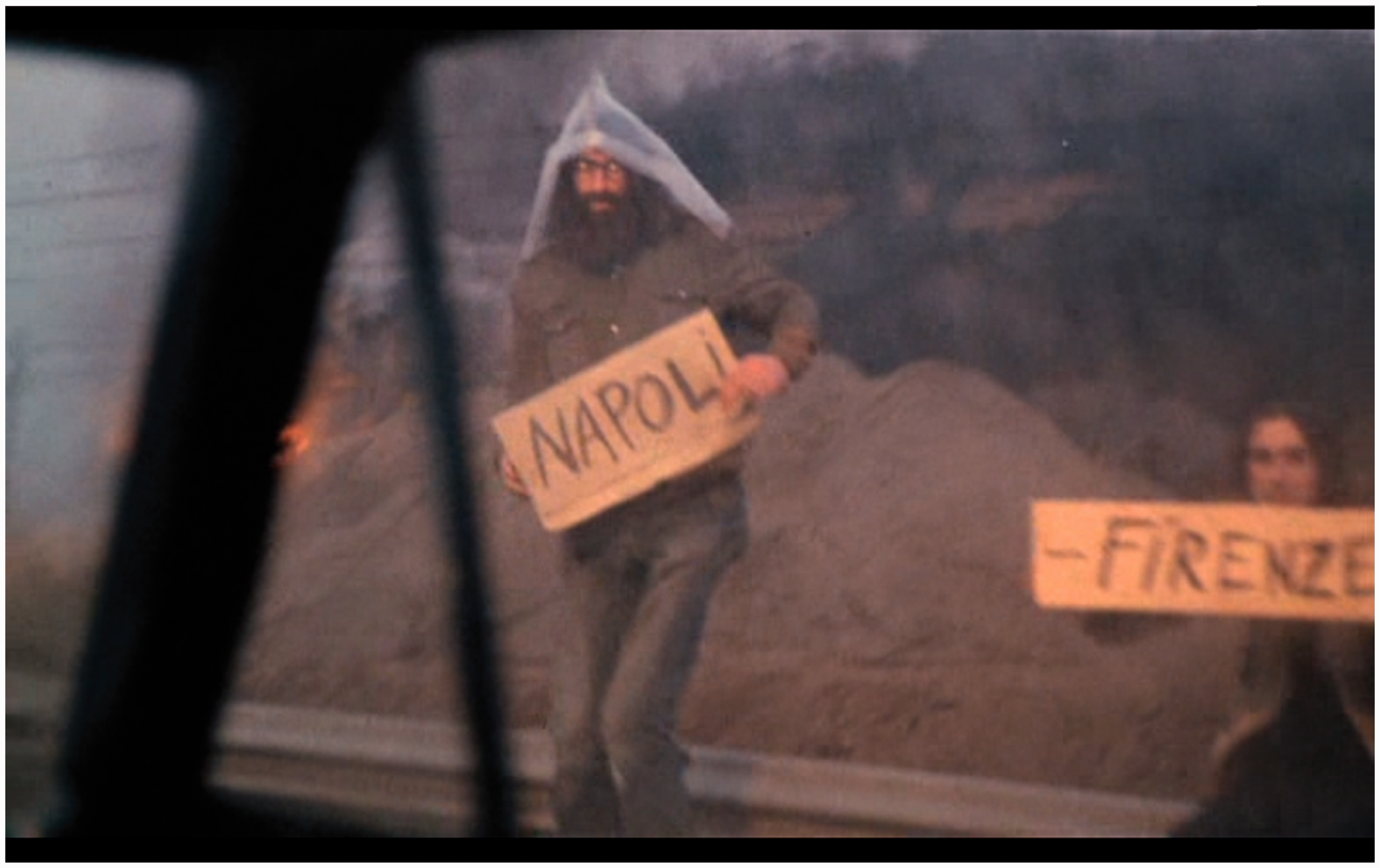
As the sequence continues, the lack of coherence of the profilmic is accompanied by an apocalyptic tone: the light darkens while the sense of chaotic disorder and destruction enhances, materializing in images of dead animals lying on the road, and by burning workshops surrounded by smoke and fire. The sequence moreover revisits two locations that had already been captured by the camera in Toby Dammit, which are the chandelier shop Fiorentino and the Coliseum. Both these shots underline the rapid changes affecting Rome’s urbanscape. The shop, which in Toby Dammit was relatively small, has now become a multi-level mega-store, and the traffic jam around the Coliseum, which in Toby Dammit was still slowly moving, is in Roma completely stuck. The long shot is taken from a crane positioned on the right-hand side of the Constantine Arch, but both the Arch and the Coliseum appear just as obstacles for the circulation of the cars, trucks, and mopeds that surround it.
However, it is not just the pressure of traffic that keeps pushing the limits of Roma’s aesthetics, in that the violent political fights which characterize Rome during the ‘anni di piombo’ also enter the profilmic. This occurs when the camera approaches Rome’s city center: two-tracking shots, the first one right-to-left while the second one left-to-right, wearily capture the image of a big group of political demonstrators facing riot police. Then, in a highly symbolic moment, this second tracking shot is interrupted by a demonstrator, who stops the camera in front of a group of protesters before getting lost in the city’s traffic. What is particularly interesting in this sequence is the clash between Fellini’s deranged use of the camera, which appears to follow his sense of amazement at the chaos and the spatial anarchy which marks Rome’s cityscape, and the demonstrator’s decision to block the random errancy of the camera, which seems to signal his request for a more ‘politically engaged’ use of cinema (Figure 7). The following shots testify to Fellini’s attempt to penetrate politics through its representational content: they are blurred close-ups of left-wing political demonstrators carrying posters and chanting hymns against the bourgeoisie state. However, the camera’s interest for the protests is just momentary and the sequence ends with a still shot of the traffic jam around the Coliseum (Figure 8).
A political demonstrator stops the fluctuations of Fellini’s camera. Roma (1972). Sense of congestion and chaos in front of the Coliseum. Roma (1972).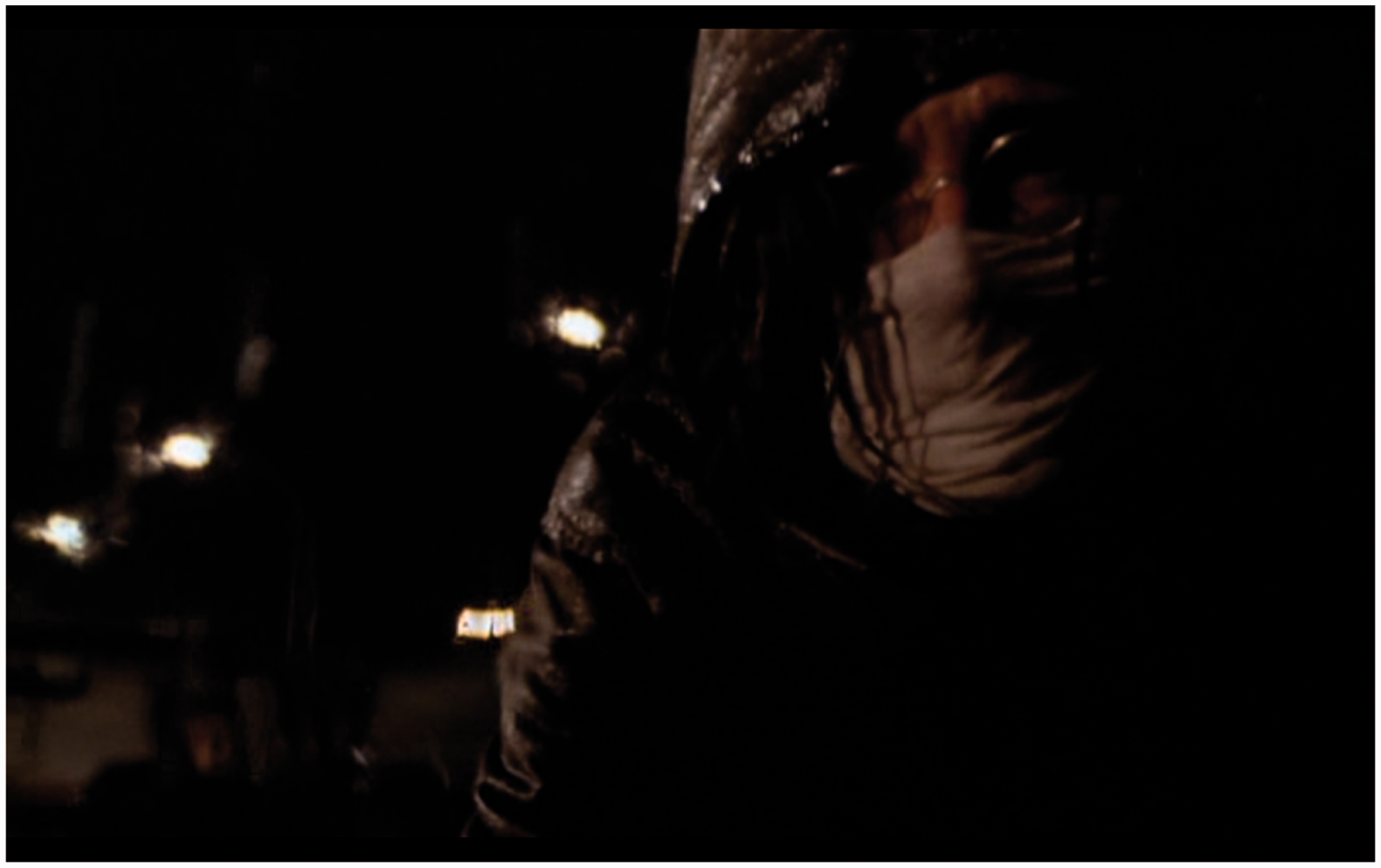

This scene stages Fellini’s troubled relationship with politically engaged cinema, signaling his faith in the autonomy of art from explicit political obligations. This is a theme which returns in the following scene, when Fellini is confronted by a group of politically engaged students who say: volevamo parlare con lei, domandarle se in questo film il ritratto che lei ha intenzione di fare di Roma avrà un punto di vista obiettivo, riferito ai problemi drammatici e eternamente irrisolti della società attuale. Naturalmente non ci riferiamo soltanto ai problemi della scuola. Il mondo del lavoro per esempio, con i problemi delle fabbriche, delle borgate.
While these last scenes seem to confirm Fellini’s apolitical attitude, I would like to suggest something slightly different which should allow us to grasp the political relevance of the aesthetics of Roma (and Toby Dammit), and their capacity to engage with the materiality of Rome’s dissociated urban surface. 5 As we saw, the most striking stylistic characteristic of Roma is the unstable use of the camera, which is pushed to perform a vertiginous array of spinning movements in order to film the exploded reality of modernized Rome. It is precisely in this perverse use of the objective that the political value of Fellini’s Roma lies: the frenzied, almost psychotic restlessness of the camera is indeed strictly dependent on the city’s dismembered materiality. It is through Fellini’s immanent adherence to the unstable disposition of the visible that we are able to perceive the entropic and corrupted politics of the contemporary city, its sense of unknowability, and the temporal fracture between tradition and modernity. In this regard, the common view of Fellini as a director rooted in the a-historicity of his own unconscious asks to be revised. Rather than representing the free artist who invents a-temporal, oneiric worlds, what Roma suggests to us is that Fellini’s aesthetics are deeply mediated by the material and political conditions of 1970s Rome.
Pasolini’s Petrolio
Petrolio is an unfinished novel that Pasolini wrote between 1972 and 1975 and that was only published posthumously in 1992. My starting point in this analysis is that the open and fragmented form of Petrolio represents a further example of the entropic imagery that characterizes Rome’s aesthetic representations during the 1970s. Like Fellini’s Roma, this novel is not structured through the linear development of a plot with an entrance at the beginning and an exit at the end, but is rather a fragmented text with innumerable points of entrance and exit that reflect the material changes that Rome has undergone since the postwar period. Paolo Matteucci and Karen Pinkus have underlined how Petrolio should be studied in relation to the city’s modernized structure, in that it ‘offers a rather unique opportunity … for thinking postwar Rome in all its complexities, its impossibility’ (Matteucci and Pinkus, 2010: 298). The two scholars highlight how Pasolini’s book does not merely represent Rome’s architecture or social life, but also captures the city ‘as a living poetic organism,’ allowing us to glimpse flashes and visions of the process of modernization that the city has undergone since the end of the war.
Contextualizing Matteucci’s and Pinkus’s insights within the analysis proposed here, we could say that Petrolio, this ‘living poetic organism’ that mirrors Rome’s modernized urban map, operates as osmotic literary machinery, which incorporates the process of the shattering of the city’s traditional form. Read in this light, Petrolio’s structure appears the product of a mediation with the city’s materiality, which around 1975 was characterized, as we saw, by the explosion of the unitary shape of the traditional city and by the proliferation of unauthorized building. The construction of new peripheral areas such as the Magliana or Tor Bella Monaca, which often lacked the most basic services of electricity or water, the imprudent utopia of a project such as Corviale – an enormous building one kilometer long and 200 meters wide placed on a hill in the south-west periphery of the city – are just some examples of the complexity, the disorganization, and the confusion that characterize Rome’s urbanscape in the 1970s.
Like in Benevolo’s urban description of modernized Rome, Pasolini’s depiction of Rome’s fabric in Petrolio has much to do with the theme of fragmentation. Splits, doubles, dissociations, and schizoid elements are features that characterize the identity of Carlo Valletti – who we can somehow consider the book’s protagonist – as well as Rome’s urban form.
6
Both Carlo and Rome are depicted as fractured, schizoid, and dissociated characters, having lost their unity as a consequence of the process of modernization. While Carlo’s loss of identity materializes in his identity split and later in his sexual mutations, Rome’s representation is suspended between its dialectical postwar image and its early 1970s entropic image. The progressive tearing apart of the identitarian unity of Carlo appears quite vividly in the ‘Appunto 4’ of Petrolio, which underlines the opposition between the author’s father’s identity and Carlo’s own: [Carlo], come ho detto, è un ingegnere: se, cioè, è abbastanza intellettuale per vivere le contraddizioni sociali e politiche del nostro tempo, non lo è abbastanza per viverle attraverso quella coscienza che assicura l’unità dell’individuo, facendo dello stato schizoide uno stato naturale dell’ambiguità, un modo di essere … Come mio padre non avrebbe mai accettato di spaccarsi in due, capace anche di ammazzare – come ammazzavano i fascisti – per difendere la sua unità – così egli, al contrario, non avrebbe mai accettato di fingere di essere uno se in realtà era spaccato in due. (Pasolini, 1998: 1192)
Moving from Carlo’s individual split to Rome’s urban and spatial split, similar symptoms can be noted in the ‘Appunto 3d,’ in which we follow Carlo di Tetis through a journey within and outside Rome. In this chapter, Carlo is looking for a writer to whom he intends to reveal a secret. In his search, he travels from north to central Rome, and then from Rome to Syracuse, where he finally finds the writer. This chapter seems particularly interesting for our argument because it covers, in just eight pages, a temporal arc which goes from the 1960s to the early 1970s. Once the train reaches Rome’s outskirts the narrator engages in a description of the superficial appearance and of the smell of Rome’s periphery, which appears as a vast suburban territory characterized by empty and full spaces, wrecked walls, and unfinished buildings: Le case nuove non erano che misere palazzine o piccoli dadi bianchi. Piano piano, preannunciata da un caos di muraglioni scrostati, fogne scoperte, catapecchie, fabbriche appena costruite e ormai in disuso – scoperchiate – con gli scheletri di ferro contorti xxx contro la luce sempre più intensa e accecante – resti di borgatelle medioevali tra palazzoni senza un filo di verde, scoloriti e macchiati come da una divorante umidità tropicale – apparve una città sconfinata. In fondo brillava il mare. L’aria era greve di un fetore inafferrabile: merda, gas, cloache, ma anche terra concimata di orti, limoni, zolfo, e qualcosa di perduto, soffocante, xxx che non era altro che la polvere della povertà. (Pasolini, 1998: 1184)
The scenery changes quite suddenly towards the end of the same ‘Appunto,’ in which we skip abruptly to the Rome of the early 1970s. Here we find Carlo di Tetis still following the mysterious writer, who has in the meantime moved to a less central neighborhood: ‘essa andò ad abitare in un bianco quartiere ai margini della città, cominciato a costruire al tempo del fascismo’ (Pasolini, 1998: 1189). The description of this area, which recalls the EUR district of southern Rome, constitutes a definitive departure from the synergetic and partially modernized city of the 1960s: La sua casa era proprio accanto a una enorme chiesa – una specie di falso San Pietro tutto bianco. Davanti si stendeva la depressione su cui scorreva il giallo e sporco fiume pieno di urinali. C’era una borgata lontana, dall’altra parte, su certe alture spelacchiate, e qualche capannone, sotto, nel verde che cresceva, probabilmente sporco e polveroso, presso il fiume. Poi pian piano la città cominciò ad avvicinarsi e a incombere con lunghe, terribili fila di palazzoni, con la costruzione di nuove fabbriche tra cui una grande xxx di un’industria automobilistica del Nord, con l’invasione di macchine e di gente sempre meglio vestita e più delicata di abitudini, anche se, nel tempo stesso, sempre più volgare e quasi odiosa e ripugnante. (Pasolini, 1998: 1189)
What seems important to underline at this point is that while Pasolini’s earlier films and novels such as Ragazzi di vita and Accattone portrayed Rome’s periphery as a contradictory and complex site of both marginalization and resistance, in Petrolio the ability to resist the centripetal force generated by the center appears to vanish, and every space of the city, including its more marginalized zones, is incorporated within Rome’s urbanscape. As written in ‘Appunto 36e,’ ‘Verrà il momento che lo spazio del sogno e del viaggio sarà saturo – Ci sarà solo lo spazio del viaggio – Noi forse siamo gli ultimi, e infatti il nostro luogo è molto vicino alla realtà: alla banale mappizzazione di ogni luogo’ (Pasolini, 1998: 1131). The space of 1970s Rome is indeed a saturated space where the voids that had characterized the city’s modern urbanscape progressively disappear in favor of an entropic spatiality characterized by sameness and homogeneity. Rome’s space is now characterized by a dynamics of a progressive filling of those spaces previously left out from the process of modernization, which Pasolini interprets as a process of destruction through uniformity: la macchina lasciò la Tiburtina, e si addentrò per una strada di qua e di là della quale si stendevano grandi appezzamenti di terreno coi resti di case appena distrutte, di cui si intravedevano le forme tutte uguali … Poco dopo ricominciavano le case, anch’esse tutte uguali, ancora rimaste in piedi; la strada aveva una piccola salita e una piccola discesa, svoltava a sinistra tra quelle miserabili case sopravvissute alla borgata distrutta. (Pasolini, 1998: 1523)
What this surface reading of Petrolio appears thus to suggest is that while in the postwar period the organic degradation of Rome’s margins constituted for Pasolini a space of potential resistance against the normative center, in the 1970s the city’s periphery had lost its potential for subversion. The recognition of the progressive disappearance of an ontological difference between center and periphery is surely related to Pasolini’s lament for the disappearance of alternative ways of living to those proposed by the bourgeoisie, of which his ‘articolo delle lucciole’ represents the most debated example within Pasolini’s scholarship (see Didi-Huberman, 2009). However, what I would like to emphasize at this point is that once we suspend prescriptive adjectives such as apocalyptic and nostalgic (which are usually mobilized to critically frame Pasolini’s late work), a theoretically and politically more compelling image of the Italian author then emerges.
A less prescriptive reading of Petrolio might indeed reveal that, by detecting the progressive dissolution of a dichotomic relationship between center and periphery, Pasolini provided us with a literary representation of that ‘spatial shift’ of power which Henri Lefebvre and Michel Foucault underlined in these same years. 8 In particular, we are reminded of their argument about the impossibility of escaping power in late capitalist societies, in that global and local – center and periphery – are concepts indissolubly bound by the same dynamic of power. Pasolini’s recognition of the impossibility of escaping a unilateral model of biopower which thus ends up normalizing the corporal and subjective life of the individual finds an echo in Lefebvre’s argument that ‘power has extended its domain right into the interior of each individual, to the roots of consciousness, to the “topias” hidden in the folds of subjectivity’ (Lefebvre, 1976: 86–87), as well as Foucault’s concept of ‘heterotopia’ (Foucault, 1986) and his claim that ‘power is everywhere’ (Foucault, 1990: 93).
As in Lefebvre’s and Foucault’s understanding that since ‘power’ is everywhere the sites from which resisting power are also everywhere, the incorporation of Rome’s historical dissociation in the aesthetic structure of Petrolio could be seen as a potentially revolutionary move based in the acceptance of chaos and dispersion. As Petrolio’s narrator states in what is probably the darkest point in the book, ‘Benché io sia ormai “contento del deserto,” provo, a pensarci, uno di quegli spasimi che solitamente impediscono di esprimersi’ (Pasolini, 1998: 1628). What I am suggesting is that it is precisely in this ‘joy for the desert’ that the other pole of Pasolini’s apocalypticism seems to lie. What we have been calling ‘entropic aesthetics’ seems indeed to represent the actualization of this ‘joy for the desert,’ which takes shape in the vision of a cityscape characterized by a tremulous light: Ora, in fondo al mare, come su un’isola, o su una penisola unita da un sottile e invisibile istmo alla terra (era Ostia? o Fiumicino? o Anzio? …) si intravedevano delle file di luci. Ma la lontananza era tale ch’esse sembravano un’unica luce, fatta di un infinito tremolare, in fondo al mare o in fondo al cielo. E strano, benché l’aria fosse tutta biancastra di umidità, quel piccolo grumo di luce era di color rossiccio, o rosato. Come filtrato da un’atmosfera di crepuscolo. Ora, benché ci fosse un lontanissimo, e forse solo sognato, presagio dell’alba, la notte era ancora fonda, proprio nel suo mezzo, perduta in se stessa e nel suo silenzio. Quel tremolio di luci remoto era l’unico segno di vita in tutto il mondo: laggiù si viveva, c’erano case, strade, silenzi di sonni e passaggi di macchine, forse musiche, amori: tutto senza rilievo, tutto grigio, tutto malinconico, tutto già accaduto, certo. Eppure quei lumi raggrumati e rossicci in fondo all’oscurità, testimoniavano che tutto questo era esistenza. (Pasolini, 1998: 1530)
In this regard, Petrolio’s aesthetic replication of Rome’s progressive disorder recalls Rudolf Arnheim’s conceptualization of entropy in Entropy and Art, in which the German philosopher reinterpreted entropy through the lens of Gestalt philosophy. As he writes: Physicists speak of entropy as a tendency towards disorder when they have their minds set on the catabolic destruction of form. Gestalt theorists, on the other hand, concentrate on situations in which a disorderly or relatively less orderly constellation of forces is free and indeed compelled to become more orderly. (Arnheim, 1971: 30)
In the light of Arnheim’s discourse, what we can argue at this point is that Fellini’s and Pasolini’s 1970s works could be read as attempts to generate a structure of containment of Rome’s shattered spatiality. This, as I showed, replicates at the aesthetic level the dissociated cityscape of Rome at the crossroad between modernity and postmodernity. The intricacies, the entanglements, and the deranged urban surface of modernized Rome are architectural elements of the cinematography of both Toby Dammit and Roma, as well as of the narrative of Petrolio, and materialize in the chaotic accumulation of visual and textual fragments. In this regard, they move beyond the purely apocalyptic lament for the disappearance of the traditional city that characterizes urban analyses of 1970s Rome, at the same time providing us with a potential imagery through which to interpret that ‘illegible hieroglyph’ that late 20th Rome had become.
Footnotes
Acknowledgements
I would like to express my gratitude to Pearl Brilmyer, Dom Holdaway, Robert Gordon and Loredana Polezzi for their helpful comments and feedback on previous drafts of this article. A special thanks also goes to Lesley Caldwell and Fabio Camilletti as investigators of the AHRC Research Network ‘Roman Modernities,’ which provided intellectual support for conceptualizing this research.
Funding
This research received no specific grant from any funding agency in the public, commercial or not-for-profit sectors.