




Abstract
Not only literary students, but also well-known scholars share the idea that the reconstruction of a text is a routine job which leaves little room for creativity. After some 40 years during which I have edited or prepared the edition of works of Machiavelli (Discorso intorno alla nostra lingua), Pietro Aretino (Cortegiana) and Torquato Tasso (Aminta), and 17 years devoted to the textual transmission and the text of Dante’s Commedia, I think that, except for the first phases of the job, textual editing requires almost constant critical thought and interpretation. I shall present a little series of examples, mostly from Dante’s Commedia, with cases ranging from decisions in the realm of accidentals to rather complicated choices among competing substantial readings and to the risky enterprise of emendation against all the witnesses of the work. While these examples can give an idea of the novelty of some solutions of my forthcoming edition (the introduction and Inferno will appear in the summer of 2021), in my view, they seem to confirm the opinion of the great classical philologist Giorgio Pasquali, for whom textual criticism isn’t mechanical; it is methodical.
Keywords
I am well aware that, as an Italian, I can be suspected of maintaining a preconceived position. In fact, there is no doubt that at least since 1945 we Italians have made a reputation for ourselves as unshakable believers in neo-Lachmannism. Due to this reputation, the majority of our foreign colleagues consider us incurable madmen insofar as we follow an abstract and irrational form of fundamentalism; however, sometimes those same scholars also give us a benefit comparable to that enjoyed by the followers of an alien religion, namely: the suspicion that we might well be correct. (Varvaro, 2004: 613–614)
Anyone who speaks about philology today must be aware that it has become, for many, a pejorative term, even a term of abuse; at the very least, an adverse relation seems to be implied: philology and … literary criticism or theory. Such a contrast – I am thinking especially, though not exclusively, of Greek and Latin literature –, is not only futile, it is subversive; for philology is the basis of literary criticism. (Clausen, 1990: 13)
I was kindly asked to contribute to this issue of Forum Italicum with a few pages of presentation of my forthcoming edition of Dante’s Commedia. 1 Due to the fact that the tasks and even the skills required of a scholar can be quite different owing to the culture and traditions of the country where she or he lives and works, I decided to devote some of these pages to explain the assumptions and the rationale of my edition to North American readers. I apologize for almost always choosing examples from my own research. Unfortunately, at my age even remembering what you are doing can be difficult, to say nothing of remembering what others have done.
First of all, I have a confession to make, a sort of outing. I have spent many years of my working life addressing problems that many colleagues could judge unimportant or outdated. I switched from contributing to the history of the Italian language, studying Petrarch’s style or the first examples of the Greek word dialect in Italian, to mere editing. For the last 20 years I have concentrated almost all my efforts on editions and theories and best practices for producing editions. I edited works of Machiavelli, Aretino and Tasso. I helped younger scholars to edit works of Machiavelli, Ariosto and other authors. Recently, I wrote a sort of handbook of textual criticism and, one year ago, I authored a chapter in a comprehensive open access collection, the Handbook of Stemmatology (Roelli, 2020; Trovato, 2017). Probably it wasn’t a very savvy career move.
In 2015, one of the most authoritative American scholars of Dante, Teodolinda Barolini, wrote a brilliant attack against the arrogance (perhaps better, the hybris) of philologists trying to provide an interpretation. Barolini underlined the risk of our insufficient critical vigilance and transparency in monitoring the porous boundaries between philology and interpretation: ‘These boundaries are necessarily porous, since interpretation and subjectivity are present in all forms of human cognition, nor am I suggesting that philologists be held to an impossible standard of inhabiting an interpretation-free zone. However, since philology lays claim to a more rigorously empirical and scientific foundation than that of literary interpretation, it is especially important that philologists be transparent about the discursive spectrum that they inhabit, and in particular that they signpost and acknowledge the point at which their arguments morph from philological arguments to interpretive ones. Along the path of my scholarly life, I found that I had to learn not to take on faith the statements of philologists. I learned that ecdotics must be scrutinized by hermeneutics, that philology must be accountable to philosophy. Although we tend to think that it is hermeneutics that must be certified by philology, in practical terms I have found myself, a literary critic, all too frequently in the position of verifying the claims of various philologists and finding them wanting, not because they were philologically incorrect, but because they were not philological. Rather, they were hermeneutic arguments masquerading as, and claiming the authority of, philological arguments. The framework that I have outlined above is the common denominator of the case studies I have looked at, including the one that is the focus of this article.’ (Barolini, 2015: 92)
Barolini also took care of gathering some examples of working hypotheses she considers wrong, some of which seem to have little to do with textual philology (the so-called missing original ending of the Vita Nuova; the real target of Cavalcanti’s Donna mi prega; the label ‘estravaganti’ used for some of Dante’s Rime, which – if we don’t indulge in deconstructionist approaches – looks simply to be a way of saying in a few words ‘all the rhymes not included in the Vita Nuova, neither in the Convivio’; Barolini, 2015: 92–95).
Indeed, nowadays, it is commonplace to think that the texts, at least the major ones (the Bible, Homer, Dante), are okay. If we want or need to read Homer or Dante, we can buy them in a bookshop and when we are back at home the only thing to do is understanding, that is, interpreting.
My point of view is different. Reconstructing the texts of the past is a terribly difficult task and we are never over with it. As a rule, provided that we know what an original could be for multi-layered texts such as Homer or the Bible, we don’t have the original. We only have handwritten copies produced by mostly unknown scribes which offer a number of important differences from each other. At least a little part of these differences are serious mistakes. The target is producing texts which are, at least a little bit, better founded than the available ones, closer to what the author likely wanted to write. Please note that between the texts as we read them in the surviving copies and a text closer to what likely the author wanted to write there is an enormous gap. The only way of filling the gap is to play a sort of ‘connect-the-dots’ puzzle, that is, to learn a good deal of things about the language, the style, the favourite books of the author and to make parsimonious hypotheses to connect in a consistent way the surviving dots. No need to say that, in order to meet the requirements of the scientific community, it is necessary to distinguish very clearly between the data and the hypotheses.
So, Barolini is absolutely right if she means that a critic must learn quickly not to take on faith the statements of any scholar whatsoever, but she is deeply wrong if she thinks that, except for a few very simple cases, the statements of philologists depend exclusively on objective data. Independent of what each of us may think about the focus of her essay (the authorship of the collection of Dante’s ‘rime distese’), in my humble opinion textual criticism does not work and cannot work like that.
If the woman or the man who decides to provide the edition of a work isn’t a hurried dilettante, but a professional, she or he must spend some years of precious life comparing all the extant textual versions of the work. (In the pages which follow, I will use less ambiguous terms such as copies or witnesses of the work). Then, if possible, the textual critic must draw a genealogical tree in order to clarify the relationship between the different copies. After that, the time comes to discard a large part of the copies (those more crowded with obvious innovations) and to start working only with the witnesses less far removed from the origin of the tradition. 2 Normally we can number these selected witnesses with figures comprising between three and 10. At this point, one starts editing, that is, checking the meaning and the position of any word from the beginning to the end of the work, and deciding what fits better according to our knowledge. Every time the witnesses bear different readings, one must choose between them, possibly explaining the reasons why. And even if, in a great number of passages, all the witnesses bear the same substantive reading, one must always consider whether this reading is correct and acceptable or whether there is an obvious innovation (something against the grammar or the common sense or the culture and the ideology of the author).
If this is the situation, no textual scholar can think that his or her edition perfectly hits the target. Still, it is very encouraging that any subsequent generation can find and suggest significant improvements to the methods or produce important editing tools. I give just one example of a recent most precious tool. No paper dictionary could teach us how common or rare a word or a formulaic expression of a Gospel or of Homer was. For no more than 30 years we have had plenty of textual corpora (e.g. of Greek, Latin, old Spanish, old French, old Italian texts, old Italian commentaries on Dante). We can easily access them through our PCs, which inform us very rapidly about the high frequency or the rarity of words or combinations of words. This is an enormous help for a scholarly assessment of the variant readings of any text of the past and produces quite new working conditions, out of reach even for excellent scholars working before, let’s say, 1985.
My preaching on these very general points ends here, but if anyone is curious and wants to know more, I can refer to the overall works in English I quoted before: my book Everything etc. and the above-mentioned Handbook of Stemmatology.
With these premises it follows that no one can be smart enough to warrant that one’s decisions are always right, but it is difficult to deny that the textual critic, i.e. that very disgraceful person, has performed a multi-fold reading of the work, more frequent and closer than many a literary critic. With a bit of luck, it can also happen that this strenuous hand-to-hand fight between the textual scholar and the author can produce in the weaker fighter some not so ill-founded overall ideas on the technique, the syntax, the library and the style of his unbeatable opponent, that is, the author.
Just to give you some examples, I remember here, oversimplifying, little but not negligible progress that I made in the interpretation of a couple of works owing to the mere fact that, in order to edit them, I collated the copies for the third or the fourth time, so that I was in a condition to understand rather clearly many details. In his brilliant book Una giarda fiorentina, Mario Martelli (1978) claimed that Machiavelli’s Discorso intorno alla nostra lingua (a lively refutation of Trissino’s linguistic ideas on the lingua cortigiana or italiana) could not be attributed to Machiavelli, because it was quite inconsistent even in the merging of two literary genres, that is discourse and dialogue. The theses of his book, which for a couple of years created a certain suspense, were finally rejected by the great Carlo Dionisotti (1980), Ornella Castellani Pollidori (1981) and the present writer (Trovato, 1981). While working on the main manuscripts of the work, I could notice a very simple, but curiously ignored fact. The alleged ‘discorso o dialogo’ perfectly reflected in all its parts the features of a classical oratio deliberativa in the wake of Cicero, that is a discorso (Trovato, 2015 [1982], 2014). By the way, this was a most powerful blow against the bold deconstruction of Martelli, who claimed also that the remaking of the assumed second author created continuous lacks in consistency and the work was a little freak (a ‘mostriciattolo’; Martelli, 1978: 97).
A most debated long passage of Tasso’s Aminta is the so-called ‘episodio di Mopso’ (ll. 552–648), which is witnessed only by a little part of the copies of the pastoral drama. Both Solerti (1895, vol. I: 166–167), who edited the play in 1885 and Sozzi (1957: 45–47), who authored a new edition in 1957, discussed the identity of that unpleasant character, supposing that Tasso repeatedly added and removed the passage depending on his varying relationship with the Paduan critic Sperone Speroni. But it is unlikely that Mopso was somebody out of the Este court in Ferrara and neither critic was able to realize that the core of that passage (ll. 617–643) is an extraordinary eulogy of the duke, of his court and of his castle. So, we must consider impossible both that the passage, which is found in the early ‘ferrarese’ copies, was missing from the Ferrara premiere in 1573 and that outside of Ferrara (that is, since the Urbino performance of 1574 onwards) any other ruler could spend his money on a play so openly meant to exalt the duke of Ferrara (Trovato, 2003: 165–172; 2021: 262–268).
Let’s turn to Dante’s Commedia. In order to survive to the enormously time-consuming phase of the collatio we decided not to collate the whole Commedia, but only 630 loci critici (630 lines out of 14,233 lines). Notwithstanding this shortcut, collating all the 580 witnesses in 630 different places of variation took almost 10 years. Only in 2017 could we draw the following stemma (Figure 1) (I use here the sigla established by Petrocchi). This is only the top floor, that is, the manuscripts which (according to us) are closer to the archetype. Laur. Strozz. 155 and Par. 533 and their lost ancestor bolpl are written between Arezzo, Città di Castello and Perugia. The rest of these manuscripts are very likely written in Bononia, except Mad, which is copied in Genoa, but descends from a Bononia witness. Even bolpl depends probably by a Northern manuscript. The rest of the extant tradition – hundreds of Tuscan and mostly Florentine manuscripts, including the well-known Ash (ante august 1335) and Triv (1337) – belongs to the highly contaminated family α, which, in my opinion, has little genealogical value. 3
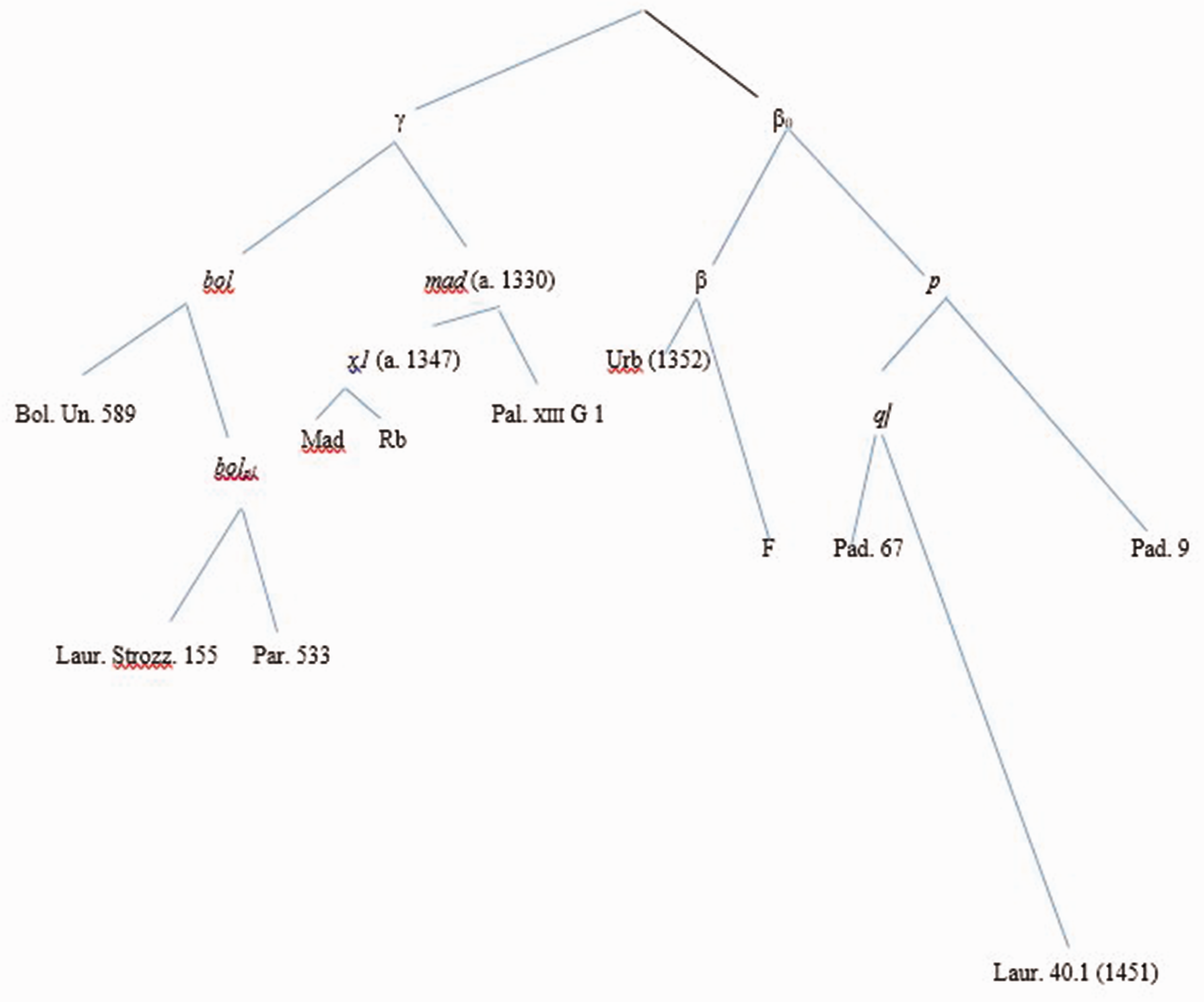
Luckily, in many cases, all the witnesses or a qualified majority of them agree in a fully satisfactory unique reading, so that the decisions to take are very simple.
This is true, for instance, in cases such as:
e di Maremma e di Sardigna i mali
(If 29.48)
This is the apparatus of the variants:
di Maremma e di Sardigna ω (- β)] di Sardigna e di Maremma β
You can see that three subsets of witnesses out of four (p bol and mad) agree with the word order Maremma-Sardigna. If you look at the graph above, you realize that this agreement is worth 75% of the stemma, so we don’t mind if in this case we ignore the order of β, which very often contains correct readings. But this is a simple case in which, so to speak, the facts speak for themselves. In the Inferno alone, there are hundreds of cases in which the choice isn’t as easy, both for substantial readings and for accidentals.
I will give a few other examples. First, I will quote the text according to the authoritative edition of Giorgio Petrocchi. The readings which I refute are in bold. The variants which I will put in my edition follow the sign > (= ‘becomes’). Under each quotation you will find the variants of the 11 MSS which are included in the stemma (the most reliable ones, according to my research group), as well as the initial of the edition of Witte Casella Vandelli Petrocchi and Sanguineti (
Let’s start with two variant readings, which belong to the field of accidentals:
Non ti rimembra di quelle parole
con le quai la tua Etica pertratta
81 le tre disposizion’ che ’l ciel non vole,
incontinenza, malizia e la matta
84 men Dio offende e men biasmo accatta?
(If 11.83)
83 bestilitade bolpl Pal] bestialità β0 Non fu tremuoto già tanto rubesto,
che scotesse una torre così forte,
108 come Fialte a scuotersi fu presto.
Allor temett’io più che mai la morte,
e non v’era mestier più che la dotta,
111 s’io non avesse viste le
(If 31.111)
111 litorte β Bol Mad1 Laur. Strozz2
The examples which follow are more complex. Both regard the substance of the text:
Di sùbito drizzato gridò: «Come?
dicesti `egli ebbe´! non viv’egli ancora?
69
(If XIII 69)
69 non fer (fier) negli occhi β0 Bol Una medesma lingua pria mi morse,
sì che mi tinse l’una e l’altra guancia,
3e poi la medicina mi riporse:
così
d’Achille e del suo padre esser cagione
6 prima di trista e poi di buona mancia.
(If 31.4)
4 odo io β Rb] od’io p bolpl Urb2
Drawing from the notes of my critical edition, I try now to explain briefly the reasons for my choices.
In (2), Bestilita(de) is a rare Tuscan variant of the more common bestialita(de). We find it also in the Convivio and it is preserved by several witnesses of Petrocchi’s ‘antica vulgata’, including the ‘antichissimo’ Ash. The most reliable textual corpus of early Italian texts (Corpus OVI dell’italiano antico (Gattoweb, n.d.a)) allows us to add to the four examples listed by Ageno (1990: 5–6) a passage from the Esposizioni by Boccaccio: Se alcune genti furono che intorno a questa bestilità peccassero, i Romani più che altri vi peccarono. The fact that our top manuscripts are all linked to Bononia reflects the historical datum that Dante died in Ravenna (79 km from Bononia) and not in Florence. This peculiar situation suggests referring to a criterion already exploited by Barbi for the Vita Nuova and Contini for the lyrics of the Siciliani. The criterion, which recalls, to some extent, contrastive linguistics, could be stated like this: if some independent non-Florentine manuscript bears a reading that is rare and typically Florentine, we must infer that the rare Florentine variant was in the ancestor of the tradition. Thus, bestilitade isn’t merely a lectio difficilior, as noticed by Franca Ageno, but it also meets the requirement of being preserved by witnesses of another linguistic area.
The same remarks apply to example (3). Only three MSS and the reviser of Ls (Ls2) bear litorte, which is a rare, dissimilated Tuscan form of the common ritorte, ‘ropes’. Also, in another passage where the Petrocchi edition has ritorte (If 19.27), the tradition bifurcates or perhaps better trifurcates. Most MSS read litorte e strambe, p bears ritorte e s. (which is the form in the editions
At present, the litorte:ritorte ratio in the Corpus OVI is one to 10 (our edition will slightly modify it: five occurrences of litorte against 33 of ritorte. Again, litorte is both a lectio difficilior and a typically Tuscan form preserved in non-Tuscan copies.
In (4), Ferire ne o in is a typically Dantean wording (e.g. Feremi ne lo cor sempre tua luce, la Sapienza, nella quale questo amore fère…, feriami il sole in su l’omero destro), easy to be substituted by the more common ferire + Object (Trovato, 2007: 690).
Considering example (5), according to Petrocchi, the variant which he considers correct (solea far la lancia) ‘s’è dileguata da vari rami della tradizione antica per incomprensione di far pleonastico o fraseologico’ (‘has vanished in various branches of the old MS tradition through the misunderstanding of a pleonastic far’). In my opinion, the variant with far is a scribal innovation. Some copyists react, here as in many other cases, to Dante’s use of the hyperbaton, which in this passage strongly modifies the common word order SVO and inserts too many words between elements which should be contiguous (
The last case is a good example of something which is relatively common in Neo-Lachmannian reconstructive textual criticism, but is considered with great diffidence by many philological schools and by many scholars, that is, a conjecture. Needless to say, a conjecture is a kind of scientific hypothesis. If you clearly explain the reason of your hypothesis, other scholars can falsify it, as Popper would say. They can reject it or (if some of your arguments hold water) find a better, more powerful conjecture:
E come a gracidar si sta la rana
col muso fòr de l’acqua, quando sogna
33 di spigolar sovente la villana,
livide, insin là dove appar vergogna,
eran l’ombre dolenti nella ghiaccia,
36
(If 32.36)
36 mettendo ω
As you see, in (6) all the 11 MSS that are at the top of the stemma (and almost all the MSS which it is possible to check using the apparatuses of Moore, Campi, Petrocchi) read mettendo i denti. I suppose that mettendo i denti (i.e. teething) is an acoustic error of the archetype for battendo i denti (i.e. teeth chattering), similar to many other errors of the same kind (suffice it to remember presente for serpente at Pg 32.32: in the apparatus of Petrocchi presente is found in Ash Eg2 Ga La Lau Parm Pr Vat). Within the Corpus TLIO (Gattoweb, n.d.b) we don’t find any example of mettere i denti in the assumed Dantean acceptation, but only occurrences referring to teething or to the act of biting, which Dante expresses with his usual richness of synonyms (in quel che s’appiattò miser li denti, se l’altro non ti ficchi / li denti a dosso, fan d’i denti succhio, così il sopran li denti a l’altro pose…). All the old commentaries – for which we can thankfully refer to the important data bank the Dartmouth Dante Project – explain this passage saying that the stork batte (Lana, Ottimo, Anonimo Fiorentino, Barzizza, Daniello…) o percuote (Buti, Landino) o dibatte (Vellutello) its beak. The same is true both for other French or Italian literary texts (in Brunetto’s Tresor Cicoigne… bat son bec et fait grant tumulte; in the anonimous Arrighetto: Batte drieto al mio dosso il becco la grande cicogna) and for the classical and medieval works cited by Ledda (2013: 147–149). Obviously, all the texts link the act of battere i denti to fear or freezing cold (e.g. tuti trema e bate li denti: Anonimo Genovese; il topo tremava e batteva dente a dente: Esopo tosc.; Dante himself renders the stridor dentium of the Bible with dibattero i denti). A passage of the Decameron (VIII 7: lo scolar cattivello, quasi cicogna divenuto, sì forte batteva i denti) seems especially noteworthy (mainly because the copies of the Commedia copied by Boccaccio, To, Ri and Chig, read mettendo i denti as the Dantean vulgate). The necessity of conjecturing was already noticed by a few copyists: two MSS collated by Campi (1888–1893)
5
read movendo i denti, while three others, unfortunately unidentified, bear battendo i denti. To sum up, we think that the acoustic exchange between battendo and mettendo was favoured by the frequency of the sequence mettere i denti (lat. mittere dentes) and that the verse only works conjecturing, as we did above,
In conclusion, cases 2-6 all show a choice against a stemma which took 10 years of work. In all of them I simply produced arguments to explain why, out of the general rationale, I went against the stemma. As an evergreen, as Giorgio Pasquali used to say, textual criticism isn’t mechanical; it is methodical. The collation, the outcome of the recension and even the drawing of the stemma etc. do not end the game; on the contrary, they are a gigantic and most powerful heuristic machine for approaching more easily what we can grasp of the author’s work. But when the relatively simple phase of the collation is over, almost any thought, any operation, any choice of the textual scholar requires interpretation, or, rather, belongs to interpretation.
To put it in other words, textual criticism is a form of literary criticism, neither the most popular one nor the easiest, yet it can hardly seem completely useless.