




Abstract
This article revisits Kemp’s and Tran-Nam’s incorporation into trade theory the Gossenian theme that consumption takes time. We show how the substitutability between time-intensive household-produced consumption goods and time-saving commercially produced consumption goods (which save households’ consumption and production time) together with capital accumulation can lead to an increase in trash and international trade in trash. The applicability of the standard gains from trade theorems is shown to be compromised by the externalities associated with international trade in trash between North and South. Under some parameter values, South is better off under autarky than under free trade in trash and the gains from trade by North is not sufficient to compensate South’s loss from trade.
Keywords
Introduction
Everyone knows that consumption takes time and that different consumption goods take different amounts of time to consume. However, standard microeconomic analysis of households’ demand typically ignores the fact that consumption is time-consuming. A major exception was the paper by Becker (1965), in which he argued that ‘the allocation and efficiency of non-working time may now be more important to economic welfare than that of working time’. While Becker cited the earlier work of Mincer (1962, 1963) on this subject, he did not mention the pioneering work of Gossen (1854, 1983) who not only pointed out that consumption takes time but also emphasised the importance of consumption time allocation across goods by individual consumers. Recently, in an interesting article published in the Economics Letters, Kemp (2008) argued that, even in models with just two consumption goods, if one takes account of the Gossenian time constraint in addition to the usual budget constraint, then propositions using the Lerner–Samuelson model of international trade (which assumes that neither good is inferior) must be treated with reserve. Specifically, Kemp (2008) showed that if both the financial budget constraint and the time budget constraint are binding, then local inferiority must be accommodated even when household preferences are homothetic. 1 Kemp’s idea was further elaborated in Kemp (2009, 2018) where the normative trade theory was re-examined under the Gossenian assumptions. These recent papers by Kemp have inspired some authors to further explore the implications of the time budget constraint for trade theory, see Tran-Nam (2012, 2017), and for general equilibrium theory (Le-Van et al., 2018).
In this article, combining the idea that consumption takes time with Becker’s idea that household production takes time, I explore some implications of consumers’ desire to save household’s production-cum-consumption time on the generation of trash and on the exportation of trash from northern economies to southern economies. Pointing out that free trade in trash involves externalities, I cast doubt on the applicability of the standard proposition that free trade is mutually gainful. Using a simple model of North-South trade in trash, I show that there exist parameter values such that South’s welfare under autarky is greater than under free trade in trash, and North’s gains from trade in trash is insufficient to compensate for South’s losses.
Some Empirical Motivation
For many goods, the act of consumption involves both preparation time and consumption time. To enjoy a freshly made cup of coffee at home, a consumer must carefully grind the coffee beans (purchased from a store), making sure that the desired level of coarseness is attained, brew the coffee at the right water temperature (not at 100° C) and finally savour it slowly. Similarly, to eat fish, a traditional household in Asia would buy from the market a fish that is still alive, take it home, get rid of its scales and internal organs, slowly fry it, adding condiments and spices in a systematic order and finally consume it leisurely with family members. To consume a pineapple, the traditional consumer must carefully choose a good pineapple from the seller’s basket, take it home to peel the skin and remove the pineapple eyes and so on. A similar time-consuming process applies when the traditional consumers want to consume the fresh coconut juice from a freshly harvested coconut. The time involved in the household’s joint act of food preparation and consumption may be called household production-cum-consumption time. It involves hard work, but also provides a sort of epicurean and possibly artistic pleasure.
In modern societies, increasingly many households decide to forego this sort of epicurean pleasure, because the opportunity cost of time is becoming too high. To save time, many modern consumers would now choose to buy a cup of coffee from a coffee shop, usually in a foam or disposable plastic container. Supermarkets offer frozen battered fish filets wrapped in plastic and inserted in disposable paper boxes. Ready-to-eat pieces of pineapple come in plastic containers. Similarly, other time-saving products like disposable razors and baby diapers were invented to save household time. The modern consumers save time by switching from household-produced goods to commercially produced goods and sell the saved time in the labour market to generate additional income.
Unfortunately, this consumption switching leads to an increase in trash and the disposable foam, plastic, paper, disposable razors are typically disposed of in an environmentally unfriendly way. A large quantity of this trash is destined to domestic recycling firms that outsource the so-called recycling activities to firms located in poorer countries, which I call southern economies for short. The southern trash-importing firms do not recycle the trash but dispose of them in irresponsible ways. Consequently, mountains of imported trash can be observed in these southern economies, creating health hazards to residents as well as marine species. Today, there are shocking scenes of imported plastic refuse piled high in poor neighbourhoods of South and Southeast Asia, especially in India, the Philippines, Malaysia and Indonesia. Eastern European countries also suffer from the growing problem of illegal waste exported from Western European economies. There is also extensive documentation of large quantities of waste being exported or simply dumped into the ocean (Cassing & Kuhn, 2003a, 2003b).
Recently, some governments of trash-importing southern economies came under pressure from organisations such as Green Peace to send back shiploads of trash to northern trash exporting economies.
Despite the adverse press coverage of the harmful effects of trade in trash on the residents of poor neighbourhoods in trash-importing economies, some economists have argued that trade in trash is beneficial to both trash importing and trash exporting nations. For example, Larry Summer, when he was Chief Economist at the World Bank, issued a memorandum to his staff to praise the gains from trade in trash. As reported in the magazine The Economist (1992), Summer stated that ‘I think the economic logic behind dumping a load of toxic waste in the lowest wage country is impeccable and we should face up to that (…). I’ve always thought that the under-polluted countries in Africa are vastly under-polluted.’ These economists base their conclusion on the theory of voluntary exchange. If two parties enter into a voluntary agreement to exchange, by definition, they gain from such trade. This theory, however, assumes that there is no third party that is affected by the externalities generated by such exchange. In practice, in the case of international trade in trash, hundreds of thousands of metric tons of imported plastic waste are regularly burned by illegal operators, releasing toxic fumes around poor villages in trash importing countries such as Malaysia, Vietnam, Thailand, Indonesia and India that have stepped in to replace China after Beijing announced in July 2017 that it would reduce its imports of global plastic and paper waste.
A Simple Model of Waste Generation in a Closed Economy
Consider a northern economy in which consumers consider as imperfect substitutes a household-produced consumption good (which involves a lot of production-cum-consumption time) and a commercially produced consumption good (which involves less consumption time). These are denoted by good 1 and good 2 respectively. To consume one unit of good 1 (e.g. a household-produced cup of coffee), the consumer needs to buy one unit of intermediate input (e.g. coffee beans) from the market and to spend x units of her own time for the associated production-cum-consumption activity. In contrast, if she buys a unit of the ready-to-consume good 2, it takes her only
units of time to consume it, where
Borrowing from the recent literature on trade policies (Grossman & Helpman, 1994; Melitz & Ottaviano, 2008), we assume the existence of a numeraire good, good 0, which is produced under constant returns to scale, using labour alone. One unit of labour time produces
units of good 0. We call
the wage rate. For simplicity, we assume that the consumption of good 0 involves only a negligible amount of time.
Technology, Unit Costs and Prices in the Closed Economy
The intermediate input that must be purchased by the consumer for the household production of the final good 1 is produced by perfectly competitive firms employing labour: one unit of labour time produces one unit of the intermediate input. Thus, to a consumer, the effective per unit cost of the final good 1 is
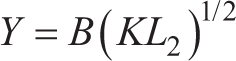
Good 2 is produced by the commercial sector using capital and labour. Let
where
is the employment level in sector 2 (measured in units of labour hours) and
Under perfect competition, sector 2 firms take as given the wage rate
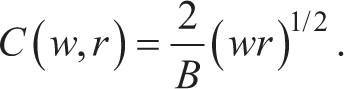
Since the production of good 2 involves a joint product (trash) that gives rise to a harmful externality, the government may impose a per unit production tax
Consumers
We assume that in this closed economy there are

where
Consumers do not like to see trash in their country. Let

We assume that since the number of consumers is large, individuals do not take this externality into account in their consumption decision.
Each period, the consumer has a fixed endowment of

Note that in our model
Let

Her income,
The consumer’s optimisation problem consists of choosing the variables

There is also an inequality constraint,
Re-write the second equality constraint as follows

Substituting for

and an inequality constraint,

Let

The necessary conditions are
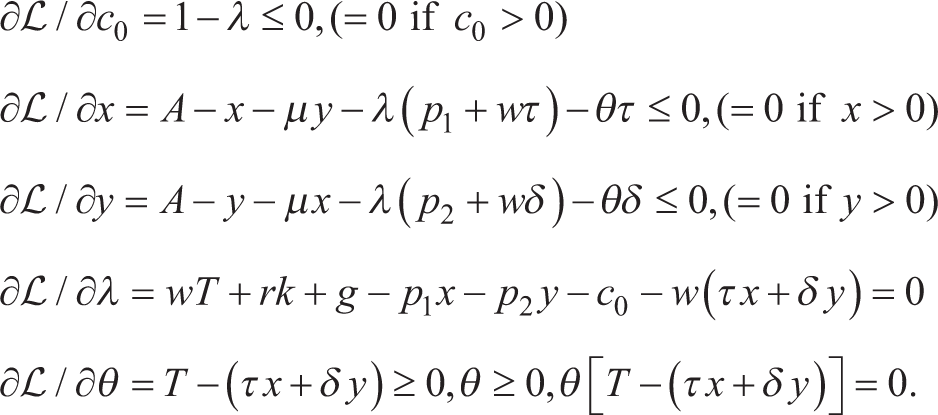
Assuming that

where
Competitive Equilibrium under Laisser-faire in the Closed Economy
Suppose the government adopts a laisser-faire regime and sets the pollution tax rate at zero, so that the consumer’s prices are equal to production costs and there is no lump sum transfer. Our task is then to determine the equilibrium rental rate as a function of the parameters such as the capital stock per person, the productivity of labour in the numeraire good sector and so on. Since the wage rate is the productivity parameter in the production of the numeraire good, once the rental rate is determined, the consumer’s price for good 2 is determined by the unit cost function and the consumer’s price of good 1 is equal to the wage rate.
To determine the rental rate, we use the condition that the demand for the numeraire good per person (which depends partly on rental income) equals the supply of the numeraire good per person. Since the tax rate is zero and there is no lump sum transfer, the former is given by

The supply of the numeraire good per person is equal to the product of the labour productivity parameter
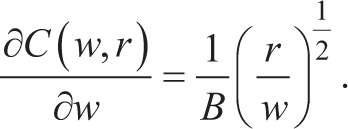
Thus, the supply of the numeraire good per person is
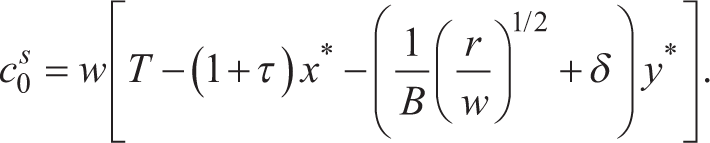
Then equilibrium in the numeraire good market gives us the equation
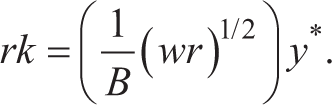
That is,
Then

That is,

Thus, we obtain the following proposition:
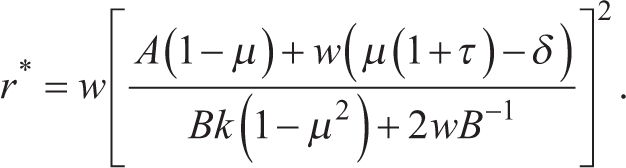
It follows that the equilibrium rental is a decreasing function of the capital stock and of the per unit consumption time of good 2; in contrast, it is an increasing function of the per unit consumption time of good 1.
Note that the output of good 2 is positive if


An increase in the capital stock will increase the quantity of trash in the economy and this rate of response is higher, the smaller is
Let us now turn to the case where the tax rate on good 2 is positive and the government distributes the tax revenue to consumers in a lump-sum fashion.
Competitive Equilibrium in the Closed Economy under a Regime of Positive Tax on Good 2 with Lump-sum Redistribution of Tax Revenue
When there is a tax rate
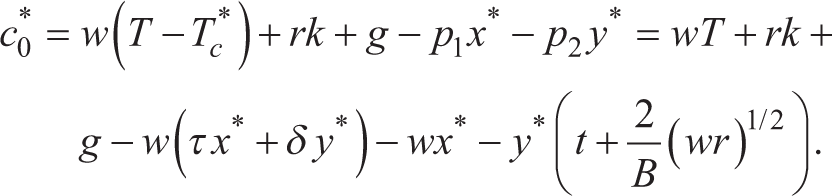
The supply of the numeraire good per person is

When the government’s budget is balanced, that is,
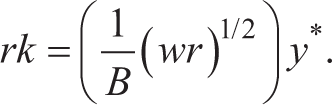
Solving for
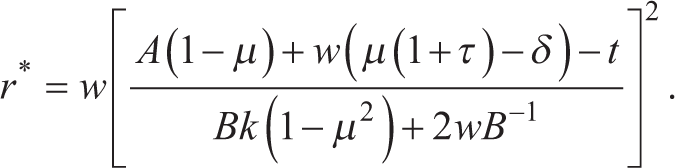
Thus, the tax reduces the equilibrium rental rate, if the tax revenue is redistributed to all consumers in equal lump-sum amounts. The tax also impacts negatively on the quantity of good 2:

Note that the consumer’s price of good 2 is
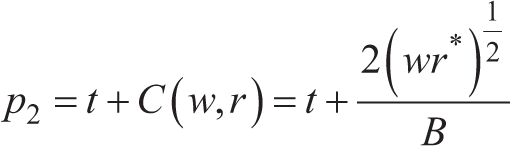
and
As for good 1, the consumption per person is

Thus, the tax
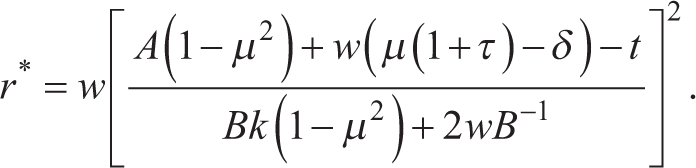
Thus, an increase in the tax rate on good 2 will reduce the rental rate, increase the consumption of good 1 and decrease the consumption of good 2.

Thus, an increase in the tax rate leads to a fall in the equilibrium quantity of trash:
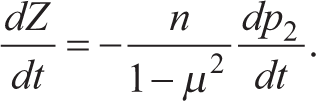
The absolute value of the fall in trash is larger, the higher is the substitutability parameter
Let us now turn to the case of a central planner with full power of control and command.
The Social Planner’s Optimisation Problem for the Closed Economy
Let us now turn to the problem of social welfare maximisation for the closed economy, assuming that recycling is not feasible. First, we show how a social planner that has full power of control and command would allocate resources in this economy. Next, we show how the social optimum can be achieved in a decentralised fashion, by setting a consumption tax
The planner, taking the productivity parameters

and the resource constraint that each person’s total labour used in production and consumption equals her time endowment

The welfare of the representative individual, net of her discomfort from seeing trash lying around her country, is
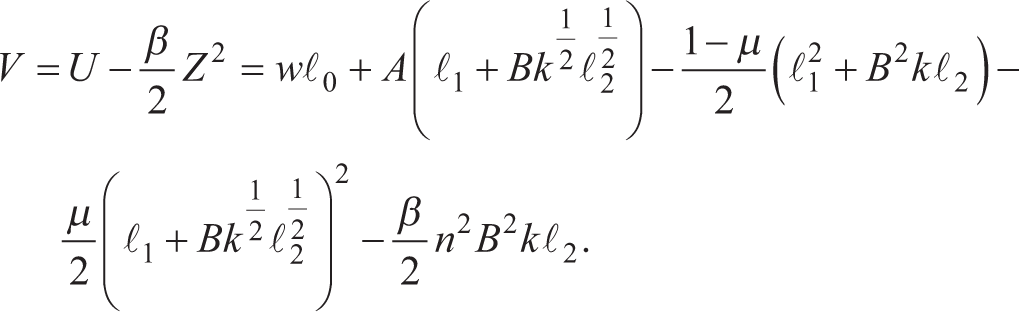
Form the Lagrangian function, where

The first order conditions are, assuming an interior maximum,

Using


Using these two equations, we can solve for the socially optimal consumption of goods 1 and 2:
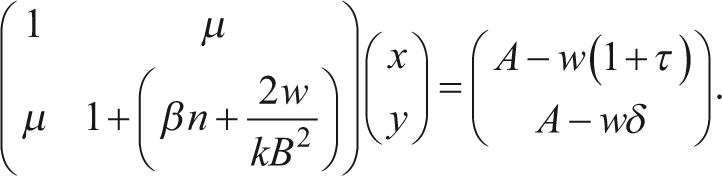
The determinant of the matrix is positive and is equal to

The socially optimal consumption levels of goods 1 and 2 are



Assuming that
Let us now show how the control and command optimum can be achieved by a competitive market supplemented with a tax on trash. Under the control and command scenario, we have at the social optimum:


Suppose that a tax rate


Clearly,
It remains to verify that, under this optimal tax, it holds that
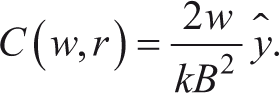
The verification is completed by using the fact that

This tax results in the equilibrium rental rate
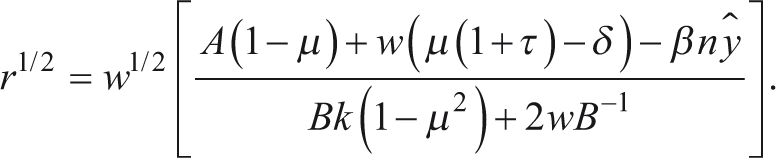
The unit cost of producing good 2 is then

Waste Generation and North’s Import Demand for South’s Trash Disposal Services
Let us now suppose that the representative northern economy that we considered above can access an international market in which it can buy trash disposal services from the southern economies. For simplicity, we assume that goods 1 and 2 are non-tradable. Then the northern economy must pay for its importation of trash disposal services by exporting the numeraire good. Let
Under such trade, the welfare of the representative individual in North, net of her discomfort from seeing trash lying around her country, is

The social planner of the northern economy chooses the vector

Let

Assuming an interior maximum, the first order conditions are
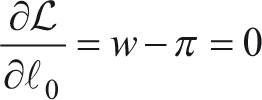

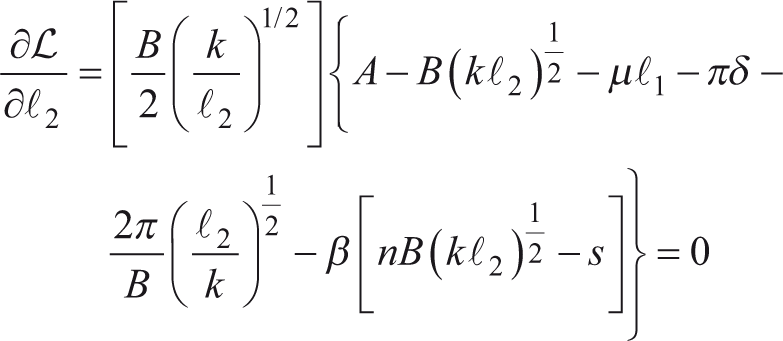

Thus, we end up with two equations to determine


Assuming that

It is easy to show that under trade, the northern economy will produce more trash than under autarky. The trash generated under trade is denoted by


Under the assumption that

Therefore,

The northern economy’s trash exports (i.e. its imports of South’s trash disposal services) is

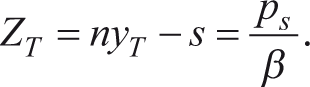
The Northern economy’s demand for South’s trash disposal services is decreasing in

South’s Supply of Trash Disposal Services
In this section, we provide a simple model of South’s export of trash disposal services. We show that this export supply function is distorted by externalities: each person’s supply of trash disposal services inflicts harms on his neighbours.
We assume that each southern economy consists of

where
Each villager chooses his level of incineration of the imported northern trash to maximise his utility, which is the sum of the subsistence output he produces and the payment
Let

In a symmetric Nash equilibrium of this game among the
villagers, we have
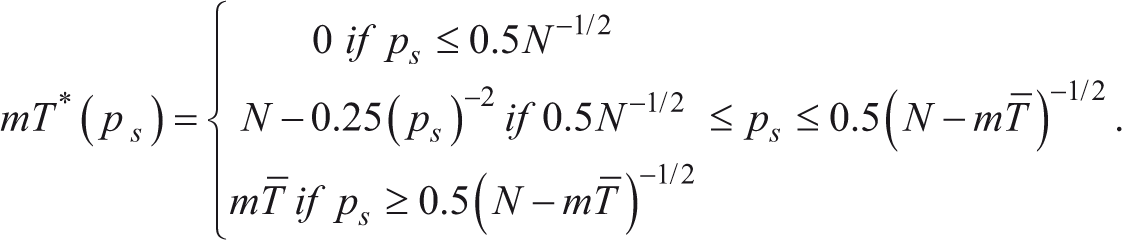
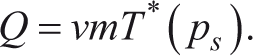
Thus, each village has an upward sloping supply curve for incineration services. Summing over all villages, the southern country’s supply of trash disposal services is
South’s Loss from Trade
The free trade equilibrium price of trash disposal services, denoted by

If

If, instead, trade in trash is banned, then the welfare the representative resident of South under autarky is
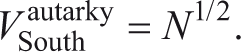
Numerical examples can be constructed such that South’s welfare under autarky is higher than under free trade. For example, suppose that free trade in trash results in a corner solution where each villager’s privately optimal level of incineration is equal to the capacity level

This inequality is satisfied if
Notes on Related Literature
Our model is related to three streams of literature. First, consumption takes time. Second, private incentives for trade in trash. Third, loss from trade due to externalities. The first stream of literature began with the work by the German economist, Gossen (1854) whose work (written in German) has recently been brought to international attention by economists such as Georgescu-Roegen (1983), Kemp (2008, 2009, 2018), Le-Van et al. (2018), Niehans (1990), Steedman (2001), Tran-Nam (2011, 2012, 2017, 2018) and Winston (1982). The related papers by Becker (1965) and Mincer (1962, 1963) did not refer to Gossen’s pioneering work.
The second stream of literature specifically deals with trade in trash. It includes, among others, the papers by Baggs (2009), Cassing & Kuhn (2003a, 2003b), Kaza et al. (2018), Rauscher (2001, 2005) and Shogren and Crocker (1991). Shogren and Crocker (1991) showed that if self-protection implies transferring the externalities to another country, this will lead to over-protection. Rauscher (2001) considered a model of exporting toxic waste. He pointed out that in a first-best world, trade is beneficial to all parties even when the object of trade consists of dangerous substances. However, he also noted that when account is taken of imperfections such as regulatory and enforcement failures, international trade may be harmful. Using the political economy paradigm (see, e.g. Hillman, 2019), Cassing and Long (2021) provided a solid theoretical foundation for North’s incentives to export trash, by extending the model of Grossman and Helpman (1994) to the case of heterogeneous preferences for environmental quality, in which there are brown consumers as well as green consumers of the NIMBY (not in my backyard) variety. They did not consider the case in which there are Super-Greens, that is, those who have global concerns about environmental quality. Refer to Hillman and Ursprung (1992, 1994) for a political economy model where there are both Greens (of the NIMBY type) as well as Super-Greens.
The third stream of literature deals with possible loss from trade when there are externalities in general. It includes the works of Antweiler et al. (2001), Brander and Taylor (1998), Chichilnisky (1994), Copeland and Taylor (2004), among others. Specifically, Chichilnisky (1994) pointed out that, due to South’s lack of well-defined property rights, South’s comparative advantage in resource goods is apparent rather than real and therefore trade between North and South can be harmful to South. This theme was explored further by Brander and Taylor (1998) in a Ricardian trade model.
Concluding Remarks
Using a simple model where consumption takes time, I have been able to show that capital accumulation and increased productivities in North give rise to a process of consumers’ substitution of time-saving commercially produced goods for the traditional time-intensive household-produced goods, leading to the harmful consequence that the environmental quality in both North and South deteriorate. Trade in trash is increasing with North’s capital accumulation and such trade is harmful to South’s welfare if in South there is a lack of well-defined property rights.
In our model, we suppose that in the representative northern economy, its government imposes a pollution tax that is equal to the marginal damage that the pollution stock in that country inflicts on its residents. The government does not try to influence the terms of trade between North and South. This assumption may be justified if there are many similar northern economies. The pollution is local rather than global. The government does not care about the pollution that the country exports to South. Thus, the Northern government is Green in the NIMBY (not in my backyard) sense.
Footnotes
Acknowledgements
I thank Murray C. Kemp and Binh Tran-Nam for discussion on the topic of time constraint on consumption; Arye Hillman and James Cassing on trade in trash.
Declaration of Conflicting Interests
The author declared no potential conflicts of interest with respect to the research, authorship and/or publication of this article.
Funding
The author received no financial support for the research, authorship and/or publication of this article.