



Abstract
The story of South Korea’s post-armistice economic ascendance has been well documented, but its parallel rise as an influential international actor is just beginning to receive the scholarly attention it deserves. Moreover, in the work that has been produced thus far, scholars have assumed that it was its remarkable economic growth that drove South Korea’s rise to international influence. This assumption misses the important fact that South Korea was elevating itself internationally while it was still a poor nation. As we demonstrate in this paper, what is missing in existing work is that it was the diplomatic efforts of South Korean presidents early in the post-armistice period that put the country on the path to its current international influence both directly and indirectly. They did this directly by removing it from the diplomatic isolation it inherited after the Korean War, and they accomplished this indirectly by using the tools of diplomacy to expand South Korea’s trading relations, without which it would not have enjoyed the remarkable economic growth it experienced.
The story of Northeast Asia from the end of the Pacific War to the beginning of the 21st century is the well-known drama of nations experiencing rapid economic growth, dramatic increases in domestic prosperity, and, for South Korea and Taiwan, successful transitions into consolidated democracies. 1 What is less well known is exactly how one of these nations, South Korea, managed to remake its place in the world from a poverty-stricken and isolated nation to the truly influential international actor it is today, leading on such important global problems as sustainable and balanced economic development and more effective Official Development Assistance (ODA) distribution policies. 2
After the armistice of 1953, 3 the Republic of Korea entered the Cold War world as a poor, divided, and diplomatically isolated nation. Indeed, in the 1950s, South Korea was utterly dependent on the United States (US) for its security needs, economic aid, and diplomatic support, 4 but several decades later, South Korea faced the new century as a very different country. It not only experienced rapid economic development, leading it to become the 12th largest economy in the world that exported high-quality finished goods and capital, it had also evolved into one of the world’s most diplomatically connected and important international actors with missions in over 180 nations and territories, including numerous erstwhile adversaries. 5
How this previously poor and dependent nation removed itself from the poverty and international isolation it experienced in the early post-armistice years, ultimately, to play a significant role in the world as an influential diplomatic power is the focus of this paper. In our discussion, we will provide a more complete, less time-bound, explanation for South Korea’s rise to international influence than currently exists, because we include the neglected relationship that exists between South Korea’s diplomatic efforts and its rapid economic growth. In this effort, we will first provide a brief discussion of South Korea’s diplomatic ascendance, which will include a mapping of the changes that occurred in its international status and ranking among the nations of the world in the post-armistice period. We will provide this mapping by using the Correlates of War (COW) Diplomatic Exchange data set. 6
After this discussion, we will introduce our more complete explanation for South Korea’s post-armistice rise that includes the efforts of South Korea’s leaders to remove their country from the diplomatic isolation it faced immediately after the Korean War and put it on the path to the level of international influence it currently enjoys. In this discussion, we will be clear as to how existing explanations are for the most part based on the assumption that it was South Korea’s rapid economic growth and resultant prosperity that drove its rise to international influence. We acknowledge that South Korea’s economic development was an important factor in its rise to the level of international influence it enjoys today. The influence of its rapid economic growth, however, has been witnessed much more in the last three decades than earlier in the post-armistice period when South Korea was still a very poor country. What this means is that explanations that emphasize the influence of South Korea’s rapid economic development cannot account for the country’s international achievements in the earlier part of the post-armistice period and, thus, ignore a crucial piece of the explanation for South Korea’s rise to international influence.
What we have identified in existing explanations is a problem of temporal mismatch, which means that South Korea’s leaders engaged in international efforts that put the country on the path to the influence it enjoys today long before it earned its well-deserved reputation as the world’s quintessential model of successful economic development. The important but often missed point is that, well before South Korea became the prosperous nation it is today, able to employ significant economic resources in support of its leaders’ international efforts, its early post-armistice presidents successfully removed it from the diplomatic isolation it faced when the armistice was promulgated in 1953. Moreover, it was at this time that South Korea’s leaders put the country on the path not just to rapid economic growth but also to the international influence it enjoys today.
To deal with this temporal mismatch problem, we employ what is known in the international political economy literature as the “trade follows the flag” perspective, which notes that international trade is more prevalent between international dyad members that have established and maintained formal diplomatic relations. This means that we use the growth of South Korea’s formal international connections as our primary explanatory variable in the statistical analysis we conduct to show the importance of diplomacy in South Korea’s international rise. Specifically, we show how it was most importantly the diplomatic connections established by the Republic of Korea’s post-armistice leaders, especially at a time when the country was still poor, as well as other factors that scholars normally emphasize in such explanations, that helped elevate South Korea’s international status.
The reason for this is that, as South Korea’s leaders helped remove the country from the diplomatic isolation it faced early in the post-armistice period, the diplomatic connections they established allowed South Korea to expand its trading relations around the globe, which was essential for its export-led development strategy to be successful. In other words, without the efforts of South Korean leaders to establish formal diplomatic connections, the export-led development strategy, that has become symbolic of this nation’s economic transformation, would have been far less successful or, at best, significantly delayed. This in turn would have resulted in less economic wherewithal and, thus, a stunted rise to the international influence it enjoys today. To begin this effort, we first discuss South Korea’s diplomacy and the changes it brought to this nation’s international status. While this discussion will provide a historical perspective, it will emphasize developments in the post-armistice period.
South Korean diplomacy in historical perspective
While the diplomatic histories of China and Japan have been the subject of extensive scholarly attention, the same cannot be said for the diplomatic history of Korea. As Hong (2016) noted, not only has the history of Korean diplomacy been largely ignored, but also the lack of scholarly attention to it has led to a distortion of Korea’s place in Asian international relations. 7 Perhaps the most important reason for this lack of scholarly attention is Korea’s unique geography of being situated between two large and powerful neighbors, China and Japan, and how relations between Korea and each of these two countries, as well as relations between these two large neighbors themselves, affected the ability of Korea’s leaders to maintain its independence and protect its cultural uniqueness. In fact, as Gu (1995) has noted, Koreans have captured this dilemma by using a simile to describe their country’s position in the Northeast Asian region. Specifically, Koreans have likened their country to being a “shrimp among whales” (Gu, 1995: 184).
While Korea’s geography has placed it in an internationally challenging position, it was nonetheless able to enjoy relative independence from the mid-17th century when it became part of the Chinese tribute system. 8 While being part of this system guaranteed Korea’s territorial integrity and relative independence, this lasted only until the late 18th and early 19th centuries, when imperialist powers from Europe and the US encroached more and more on Japan and China. Imperialist challenges against China threatened it’s very territorial integrity and sovereignty, which over time rendered it less and less able to protect itself let alone its vassal state of Korea. Japan’s sovereignty was also subjected to similar imperialist encroachments, but, instead of following China’s path of denial combined with token resistance (Fairbank, 1992). Japanese leaders allowed their country’s sovereignty to be compromised under the international system of unequal treaties. In doing so, however, Japan’s leaders designed and implemented policies that swept away all remnants of its traditional society and state and commenced building Japan into a modern nation state that would ultimately free itself from the unequal treaty system and restore its sovereignty (Reischauer, 1970).
With the increasing subjugation of China and with Japanese leaders reforming their country into a modern nation state, Japan increasingly filled the power vacuum left by a deteriorating China in Asia. This meant more encroachments on Korean sovereignty, and these encroachments reached a high point in 1876 when Koreans attacked a Japanese naval vessel in an effort to protect their country’s independence. Japan sent its fleet in response and pressured Korea into signing a treaty of commerce, ending its status as a vassal state of China and formally establishing it as an independent nation.
It was at this time in the late 1880s that Korea began receiving diplomatic missions and establishing its own embassies and legations abroad, and, as a result, it is at this time that Korea first appears in the COW Diplomatic Exchange data set. From its first appearance until the beginning of the 20th century, Korea was in the bottom five of nations receiving scores on measures of diplomatic activity. 9 Its ranking during these years was just below those of Colombia, Siam, and Morocco, but just above those of Haiti and the Dominican Republic. This ranking did change somewhat over the next few years as Korea moved up a few positions but still remained in the bottom 10 of nations sending and receiving diplomatic missions and other foreign emissaries. While this upward movement may have continued, Korea disappeared from the diplomatic exchange data after 1910. This is because it lost its independence when it was absorbed by Japan’s expanding colonial empire, where Korea would remain until Japan’s defeat in the Pacific War.
In August of 1945, Japan accepted the terms of the Potsdam Declaration and agreed to unconditional surrender. Japan’s surrender did end its colonization of Korea, but it did not result in Korea regaining its sovereignty right away. 10 In the immediate aftermath of Japan’s surrender, the southern portion of Korea was ruled by the US through a military government. This continued until August 1948, after which South Korea became an independent republic. 11 It was at this time that South Korea began establishing diplomatic relations with selected nations, 12 even though the efforts of its leadership were cut short by the invasion by North Korea in June 1950. This war ended three years later in a stalemate that was enshrined in the armistice of 1953. This armistice did not lead to a reunification of the country, and, as a result, Korea was forced to enter the Cold War as a sovereign but divided nation.
When the armistice that led to the cessation of hostilities on the Korean Peninsula was negotiated, Korea was not just divided, poor, and ravaged from the destruction of the North’s invasion, it was also isolated diplomatically from the rest of the world. 13 In many ways, Korea’s division reflected the Cold War world that was sectioned off into Western (NATO) and communist (Warsaw Pact) camps. Because of this international division, South Korea was thoroughly dependent on the US for its security protection and for economic aid and, as a result, it was left with little diplomatic flexibility. The COW Diplomatic Exchange data revealed that South Korea not only had official relations with very few nations in 1955, it also ranked dead last in this data set’s measures of diplomatic importance. 14
Over the next several decades, however, South Korea’s place in the world changed dramatically. Specifically, South Korea’s leaders dramatically increased the number of nations with which it had formal diplomatic connections. The data presented in Figure 1 are a count of the number of embassies South Korea set up in various countries throughout the world. 15 As the data in the figure indicate, from 1955 to the end of the decade, South Korea more than doubled the number of embassies it established, but it also sent a half dozen consuls abroad as well as two representatives to international organizations. In the 1960s, South Korea’s diplomatic presence in the world grew even more dramatically. It nearly tripled the number of embassies it established and maintained in foreign capitals, and it doubled the number of consuls it sent abroad. Moreover, as the data in Figure 1 make clear, after a very short stall, growth in Korea’s formal diplomatic contacts continued, albeit at a slower pace. By the end of the 1980s, however, South Korea maintained embassies in over 90 nations, a growth of nearly 3000% from the time the armistice went into effect.
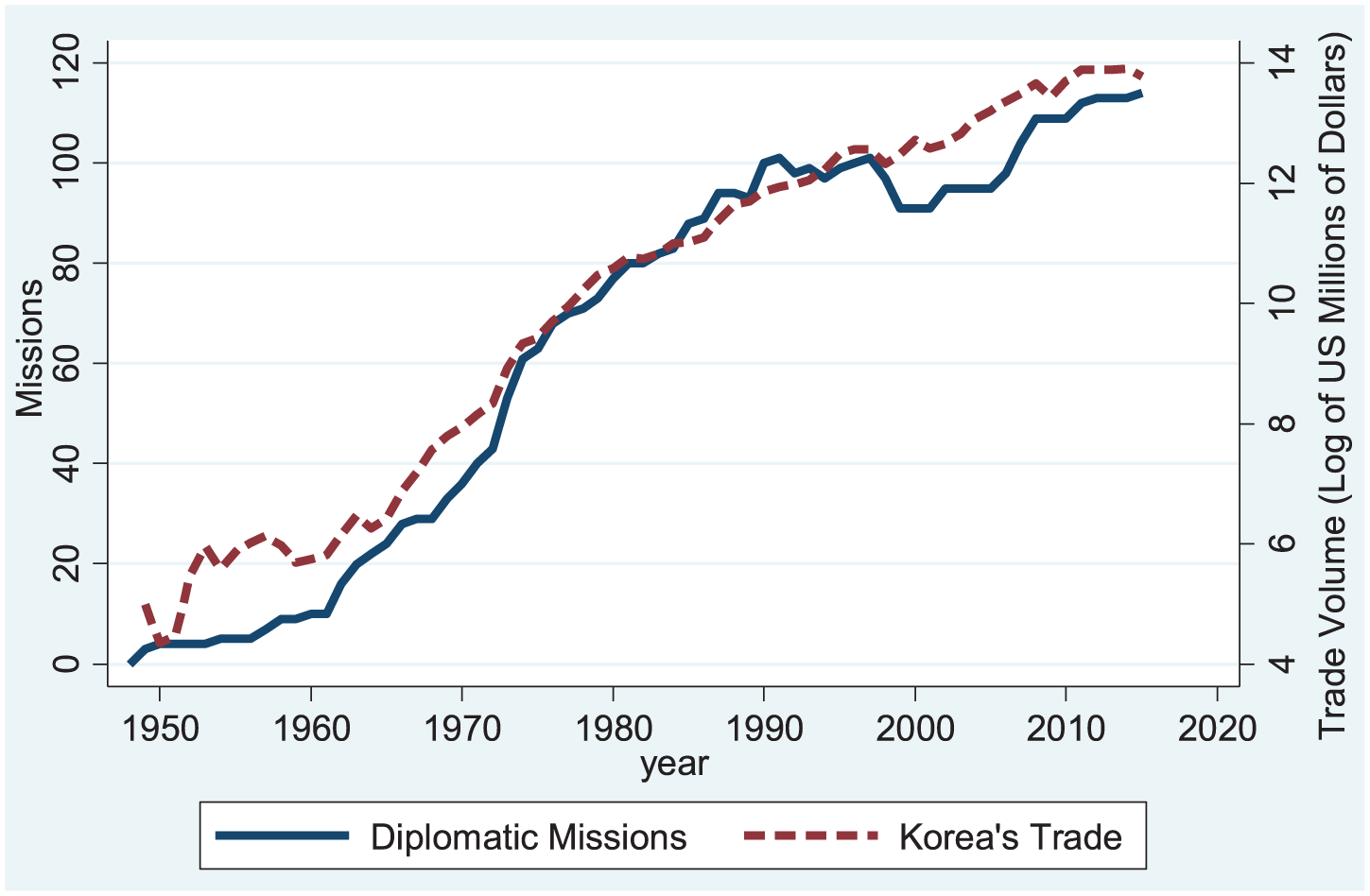
Korea’s diplomatic missions and trade, 1948–2015.
The diplomatic successes of South Korea’s presidents are listed in Table 1 and are divided into two periods, the period prior to its democratic transition and the period after this transition occurred. 16 The data in the table tell us that South Korea’s presidents experienced different levels of success when it came to establishing formal diplomatic relations with the nations of the world. In the pre-transition period, Park Chung-Hee was the most successful of South Korea’s presidents in reconnecting his country to the world diplomatically. 17 Chun Doo-Hwan continued this effort as did his successor Roh Tae-Woo, so that by the time South Korea’s democratic transition occurred—a period that corresponded to the winding down of the Cold War—the country had achieved over 80% of the diplomatic contacts it currently maintains. The end of the Cold War offered opportunities for South Korea’s democratically elected leaders to continue connecting to nations with which it had yet to establish diplomatic relations. 18 As the data in Table 1 indicate, most of South Korea’s new diplomatic contacts in the post-transition period came under the leadership of opposition presidents, Kim Dae-Jung, and Roh Moo-Hyun. In fact, nearly three-quarters of the country’s post-transition diplomatic relations occurred under these two presidents.
Diplomatic successes of Korea’s presidents in the pre- and post-transition periods.

Source: Compiled by the authors from the diplomatic missions established by year (Ministry of Foreign Affairs and Trade, 2013).
To be sure, South Korea dramatically increased the number of its formal diplomatic missions, especially during the Cold War years, but this did not necessarily mean that its international status also increased. This is because if South Korea’s diplomatic successes were matched by other countries at the same time, its relative international status would not have changed. The COW Exchange data have created a measure of a country’s international status by comparing how close its diplomatic achievements match those of the country with the most diplomatic missions in its capital. 19 These data are presented in Figure 2, and they tell us that, by 1960, South Korea had only 10% of the number of embassies in Seoul that the US had in Washington, DC. This changed dramatically over the next 10 years as South Korea’s ranking grew by 60 percentage points. There was a drop in the mid- to late-1970s, 20 but the data in the figure tell us that South Korea’s international status continued to increase, reaching over 90% of the world’s number one diplomatic power by the early 1990s.

Changes in Korea’s international status, 1955–2005.
That its international status rose dramatically throughout the post-armistice period is important to be sure, but our purpose is to make it clear that this international rise occurred when South Korea was still a poor country. To this end, we have listed the number of embassies established by different presidents during the Cold War and compared these successes to the county’s levels of per capita gross domestic product (GDP). These data are presented in Table 2, and we see that over 70% of the country’s formal diplomatic connections were made during the administrations of the first three presidents. We also see that South Korea’s per capita GDP levels were also quite low at this time. In fact, at the end of the decade of the 1960s, South Korea’s per capita GDP ($279.31) was still below that of such countries as Ecuador and Colombia and just a few dollars ahead of Bolivia. In fact, even when Park Chung-Hee was assassinated in 1979, South Korea’s per capita GDP of $1773.47 was still lower than that of Ecuador. 21 These data tell us not only that South Korea experienced a rapid increase in its international status when it was still a very poor country but also that it is not correct to assume that South Korea’s rapid economic growth was the most important factor explaining its international rise.
Embassy establishment and per capita GDP in South Korea during the Cold War.

Source: Compiled by the authors from the Correlates of War (COW) Diplomatic Exchange data set (2006) and the World Bank (2013).
Clearly, the diplomatic efforts of South Korea’s leaders directly raised the country’s international status, but diplomacy was also very important because of how it connects to the efforts of South Korea’s leaders to grow the domestic economy. Scholarly treatments of South Korea’s rapid economic development have emphasized how policymakers pursued an export-led economic development strategy. 22 What the scholarly literature has not made known is that this export-led development strategy was possible only because of the diplomatic efforts of South Korea’s leaders in the early post-armistice period. The data in Figure 1 also show how the rise in South Korea’s levels of international trade paralleled that increase that occurred in the country’s diplomatic relations. In other words, it was the establishment of formal diplomatic relations that allowed the country to expand its trading relations, which then made the export-led domestic economic development strategy possible.
Our purpose in the remainder of this paper is to make this connection more clearly. To accomplish this, we develop and test the theoretical perspective that allows us to show that it was the diplomatic efforts of South Korea’s post-armistice presidents that not only put the country directly on the path to international influence but also made the expansion of trading relations possible in the implementation of its export-led economic development strategy. We will accomplish this by using the COW Diplomatic Exchange data set in combination with trade statistics that are organized as dyads. We will begin this effort with a summary discussion of the economic explanation for South Korea’s post-armistice international rise.
Explaining Korea’s international rise
Given South Korea’s dramatic diplomatic transformation into a prosperous and internationally influential “middle power,” the topic of this country’s post-armistice rise has become increasingly attractive to scholars. 23 To date, investigations have clearly advanced our understanding but, as stated above, remain incomplete. Scholarly works that focus on the diplomatic aspects of South Korea’s post-armistice ascendance are incomplete as explanations for its international rise because most have been limited in terms of the scope of diplomatic efforts and periods of time they covered. Moreover, they are also incomplete because they have not given proper weight to the role played by diplomacy in South Korea’s international rise. These works have focused on such topics as inter-Korean relations, 24 South Korea’s bilateral relations with the US and other nations of the non-communist world, 25 and South Korea’s reconnection with currently communist and post-communist nations (see e.g., Ahn, 1980; Kihl, 1991; Kim, 1997). Taken together, they have discussed diplomacy but they have connected South Korea’s diplomatic successes to either its domestic economic development or to its rise to international influence.
This is also true for scholarly works that were intentionally focused on how South Korea’s diplomatic efforts connect to its international rise. Consider the volume of Ikenberry and Mo (2013), which contains excellent discussions of South Korea’s achievements with respect to gaining memberships in and having influence on the practices of a number of international organizations during the presidency of Lee Myung-Bak. 26 These scholars discuss in detail such developments as South Korea’s role in the evolution of the G20 and how South Korean influence helped make the economic aid policies of Development Assistance Committee (DAC) member nations more likely to promote economic growth that is balanced and sustainable. This volume also discussed the efforts of South Korea’s leaders in the area of international peace and security.
Such discussions are indispensable for understanding South Korea’s growing influence in these and other international policy areas, but, because they were focused on recent developments that occurred when South Korea was already a prosperous nation, they implicitly suggest that South Korea’s rapid economic development was the primary driver of its growing international influence. South Korea’s growing prosperity was clearly an important factor for the international developments that the Ikenberry and Mo (2013) volume covered. However, the essays in this collection imply that South Korea’s international achievements would not have occurred with its rapid economic growth, ignoring how the country’s diplomatic successes early on put it on the path to economic prosperity.
Because of this volume’s intentionally limited time focus on the period after South Korea had become a prosperous nation, elevating the importance of South Korea’s rapid economic growth as the principal factor in its growing international influence is understandable. The same cannot be said for scholarly works that cover broader swaths of the post-armistice period. The more recent volume by Heo and Roehrig (2014) was focused on the entire post-armistice period, but it nonetheless singled out South Korea’s rapid economic development as the principal factor driving its international rise. Clearly, economic development affects the direction and content of a nation’s foreign policy, and this is true for the very reasons that Heo and Roehrig (2014) have noted. 27 It is also true that South Korea would not have become as influential as it did in the evolution of the G20 or in becoming an influential member of the DAC of the Organisation for Economic Co-operation and Development (OECD) without it having achieved the high level of economic development it achieved. As mentioned above, the problem rather is that South Korea registered a number of international gains long before its rapid economic development pulled it out of the poverty that defined it in the early post-armistice period. Indeed, so many of the international successes achieved by South Korea’s leaders that Heo and Roehrig (2014) discuss in detail in their book were accomplished before the country became the economically prosperous nation it is today.
It is understandable that South Korea’s economic transformation has been given so much attention by scholars and weighted so heavily as a factor in its international rise. The truth is that South Korea’s rapid economic development in the post-armistice period is an incredibly important problem that has deserved the significant scholarly attention it received. It is also true that South Korean prosperity is an essential component of certain aspects of the country’s rise to its current position of international influence. However, even scholarly work that has attempted to explain South Korea’s rapid economic development has missed an essential part of what led to the “miracle on the Han.” 28 While too extensive to discuss in detail here, we can say that virtually all explanations for South Korea’s rapid economic development agree that it was the export-led strategy of its leaders, particularly President Park Chung-Hee, who were responsible for its rapid economic growth. 29 What these explanations do not tell us is how this strategy could have been successfully implemented if South Korea remained as diplomatically isolated as it was when the armistice was first promulgated.
Policies that promote selected companies so that they can become internationally competitive exporters is an essential part of an export-led development strategy. However, this policy effort alone will not necessarily lead to an expansion of exports unless there is an available set of nations that will import the goods that a country produces. This is an issue that must be addressed in the South Korean case because, when the armistice was first promulgated in 1953, South Korea was in a state of nearly complete international isolation. Indeed, at this time, South Korea was utterly reliant on the US for its security and economic aid, and it had virtually no formal relations with nations other than the US and a very small number of other developed nations. Consequently, while the domestic policies of Park Chung-Hee would provide incentives for South Korean producers to think in terms of international markets, their options in terms of the number of countries that would accept South Korea exports were quite limited. Thus, to implement an export-led economic development strategy, South Korean leaders would need to remove their country from the international isolation that defined its international relations in the early post-armistice years.
In light of this, our task is to show how the post-armistice leaders of South Korea accomplished exactly this by using the tools of diplomacy to connect with those nations with which trading relations would be established and expanded.
Diplomacy and international trade
Establishing and maintaining formal diplomatic connections is a process that involves significant costs to the nation that seeks to establish and maintain such relations (Rose, 2007). Rose (2007) has noted that the US spent $42 bn in 2004 on its diplomatic and consular missions, and, in addition to this, the maintenance of foreign offices requires other expenses such as providing security to all a nation’s diplomatic and consular officials. Clearly, nations are willing to absorb these costs because establishing and maintaining diplomatic relations returns benefits to the sending nation, and they also allow sending nations to become connected to global affairs, elevating their respective standing among the nations of the world. These are important benefits to be sure, but establishing and maintaining diplomatic formal relations is partner to another set of payoffs.
The extensive network of today’s diplomatic relations, composed of many different nations, suggests that the benefits of formal diplomatic relationships go beyond the reputational payoffs and communication and information advantages naturally associated with nations’ international efforts. Existing research has shown that the diplomatic activities of nations also come with economic benefits, and this is why nations such as the US also include economic motivations in their statements about why they expend the significant sums they do to establish and maintain diplomatic and consular missions throughout the world. Rose (2007) noted that the US Department of State includes such activities as “opening markets” and assisting US businesses as being among the activities in which embassy officials will engage. This should not be surprising as the US Department of Commerce officials, whose mission is, inter alia, to promote US business interests, work out of embassy and consular offices abroad. Rose (2007) also provides quotes from several other foreign ministries that assert that promoting their respective countries’ business interests was among the missions of their respective offices. 30
The idea that nations use the tools of diplomacy for economic reasons, specifically, to establish and expand trading relations is well known in the international political economy literature. Pollins (1989a, 1989b) identified and measured how changes in “state-to-state diplomatic relations” affected trade flows between these nations. The empirical connections that he identified were very strong, allowing him to conclude that diplomacy significantly boosted trade between nations with formally established diplomatic relations and that this was true even when controlling for all the standard economic factors that traditionally go into explaining levels of international trade. Pollins (1989a) referred to this as the “trade follows the flag” idea, and he also noted that there are a number of reasons that diplomacy is such an important factor in determining the flow of goods between nations.
When considering the establishment of trading relations, there is no doubt that the nature of the goods to be exported or imported as well as their quality and price are all important factors to be considered. However, such economic and product-specific factors are not the only ones that nations take into consideration. Nations entering into a trading relationship will want some assurance that they are establishing a relationship with a country that will be economically reliable and politically stable in the long term. Having such assurances will minimize risk and help guarantee that its business interests are protected. The best method to provide assurances is to keep lines of communication open, and there is no better way for this to occur than to establish and maintain formal diplomatic relations.
We are not saying that diplomacy is the only factor determining the direction and level of trade that occurs between pairs of nations. To be sure, the direction and level of trade between nations will also depend on certain geopolitical factors, whether or not a nation is a member of a free trade area or whether there is a common language between the traders such as the role played by English in the economic relations of the commonwealth nations or other languages shared by nations with a similar colonial past. 31 There is also the impact of a nation belonging to a currency union, and perhaps the most important example would be that of Europe where transactions take place in Euros. 32 Finally, there is distance, which affects the costs associated with moving goods and services across borders. Rather, our point is that having diplomatic relations is not simply a very important factor but perhaps the principal force behind what helps initiate trading relations between two nations and leads to increased volumes where trade relations already exist. 33 Along these lines, Rose (2007) showed that the establishment of an embassy led to trade increasing by 120%, and the creation of additional consular offices within a country increased bilateral trade by 6% to 10% for each office established. 34
In addition to this, we expect the impact of diplomacy on international trade to have been even more important in the case of post-armistice South Korea. As noted above, this is true not simply because leaders from Park Chung-Hee and after promoted the development and expansion of exports as crucial for the country’s economic development, but more importantly because this export-led economic development strategy had to be preceded by a government effort to reconnect an internationally isolated South Korea with the rest of the world. Again, the Korean War left South Korea a poor, isolated, and utterly dependent nation, which meant that ending its isolation by rebuilding its international connections was a prerequisite for an export-led development strategy. Consequently the diplomatic efforts of post-armistice leaders to establish formal relations with selected nations was a necessary first step in putting South Korea on the path to prosperity and international influence.
South Korean diplomacy and trade: An empirical analysis
To overcome the poverty and isolation that South Korea experienced early in the post-armistice period, its leaders have to reconnect it to the world and implement an effective economic development policy. While President Rhee began re-establishing South Korea’s diplomatic connections, he was less successful with respect to domestic economic development. This changed under President Park who implemented a plan to orient selected domestic producers for export markets. At the same time, he also accelerated efforts to remove South Korea from its international isolation, because doing so would make connections with nations that could serve as potential importers of South Korean products. We see from the data presented above that Park Chung-Hee established more formal international relationships than any other post-armistice president. The “trade follows the flag” perspective discussed above tells us that the diplomatic efforts of President Park and other presidents should have led to South Korea boosting its trade levels, particularly with these nations. To show that this is in fact what occurred, we must connect the rise that occurred in South Korea’s trade levels to the efforts of its leaders to establish formal diplomatic relations. While we have evidence that trade and diplomatic connections rise in tandem, we confirmed this by conducting a statistical analysis using dyadic data from the COW Diplomatic Exchange data set, the International Monetary Fund’s (IMF) Direction of Trade Statistics, and other sources of data that allowed us to control for the impact of those factors shown in extant research to have affected trade levels. The data from the various sources we used in our analysis covered the period 1960 to 2013.
Specifying the models we used in our empirical analysis begins with us defining the variable to be explained. Given that we were interested in the extent to which entering into a formal diplomatic relationship with a nation boosted South Korea’s level of trade in that dyad, the dependent variable we used in this analysis was the level of trade in a dyad. The level of dyadic trade is calculated by combining the values of South Korea’s imports and exports to a partner country for each year covered by the series. This value was entered into our model for estimation as the natural log of this sum. Data on the dollar value of exports and imports between South Korea and other nations were obtained from the COW project. 35
As we have argued above, there are many factors that affect the level of trade between pairs of nations, but our principal concern here was the extent to which South Korean trade was increased by the establishment and maintenance of formal diplomatic relations. To measure whether or not a bilateral diplomatic relationship existed, we used the information concerning South Korea’s establishment and continuation of an embassy in a partner country. If South Korea established and maintained an embassy in a nation, that dyad was coded 1 for each year for which that embassy was maintained. All other years were coded 0 in that dyad. 36 We expected that South Korea would establish an embassy in a nation as a signal that it was confident that the two nations would maintain stable political and prosperous economic relations in the long term. As a result, our expectation was that dyads coded 1 would manifest higher levels of bilateral trade with South Korea than those that were not.
We included other political, economic, and geographic factors in our analysis that existing studies have shown affect the level of trade that exists between pairs of nations. Perhaps the most important are economic factors, particularly the level of economic development, both of South Korea and of its potential trading partners. We measured South Korea’s level of economic development as per capita GDP, which was entered into the models we estimated below as the natural log of that value. 37 Our expectation was that South Korea’s bilateral trade would increase as the size of its economy grew, but we also expected that its bilateral trade would grow as the size of a recipient nation’s increased as well. The reason for this concerns the fact that South Korea began exporting more and more finished goods as the post-armistice period progressed. Given this, we have to assume that an importing nation must have an economy of a certain size, with sufficient earned foreign exchange, to be able to import the goods that South Korea increasingly exported.
While the size of an importing nation’s economy is a measure of its potential economic importance, we also wanted to be certain that we controlled for other ways that potential trading partners would be likely to begin economic exchanges with South Korea. We measured this potential in two different ways. First, we included the measure of a potential trading partner’s geographic distance would be from South Korea. The idea was simply that distance should be inversely proportional to the level of trade that exists between South Korea and another country. 38 We also measured a country’s potential to trade with South Korea as that country’s level of democracy. Measuring a nation’s level of democracy was obtained first by using Polity IV data and then the Freedom House Index.
Our expectation was that a country’s level of democracy should be positively related to the amount of trade with South Korea. The most important reason for this is simply that South Korea’s initial diplomatic contacts and, thus, trading partners during the early years of the post-armistice period were the US and, as time went on, Japan and other democratic nations. Moreover, for a good part of the time period under consideration, South Korea had neither diplomatic nor economic contacts with nations that had communist (non-democratic) governments. For these reasons, we expected a nation’s level of democracy would be positively related to the amount that it traded with South Korea. 39
Finally, we included the natural log of South Korea’s population as well as that of all other potential trading partners. We certainly expected there to be a positive relationship between the size of South Korea’s population and the amount it traded in general, and we also expected that this relationship would be positive with respect to the population of other nations, albeit somewhat weaker. This is because, while there were potential trading partners with South Korea that had very large populations, such as the US and, later in the post-armistice period, China, there were also other nations with smaller populations that had evolved significant trading relations with South Korea. 40
With our dependent variable defined, and those factors that would determine the level of trade between South Korea and other dyads specified, we note that the model for specification is as follows:

where Yit is a continuously valued, unobserved variable estimating the logged volume of trade that exists in a dyad in a particular year for the period under consideration, and
Descriptive statistics of variables.

We knew that the data we used to explain the level of trade South Korea would have with a country in a dyad would involve significant heteroscedasticity, and, as a result, we would have to address this in our estimation of the above model. One method involves using heteroscedasticity-robust statistics after estimating the model with ordinary least squares (OLS) (see Wooldridge (2013), specifically Chapter 8). While this is the recommended method when using generalized least squares, we must point out that it can lead to problems in the panel-specific AR(1) processes and, thus, over confidence in our estimates. We did estimate our models with OLS using panel-corrected standard errors, and the differences did exist in some of our coefficients but not on our principal variable of interest. 42 For our purposes, this estimation method is more efficient when one knows the form that heteroscedasticity takes, and since we were not sure of the exact form the heteroscedasticity would take in our models, we modeled its form using an estimation technique that produces more efficient results. Specifically, we began by specifying the form of the heteroscedasticity and then estimating our models model using weighted least squares. The specific method we used is known as feasible generalized least squares (FGLS), which allowed us to us to generate the best estimate of the impact that the factors in our model would have on the level of trade between South Korea and a nation in a dyad. 43
The results of estimating models using this procedure are presented in Table 2, and we first note that the coefficient estimates in the table were obtainable by using the FGLS method noted above, which produces estimates by panel-specific AR(1) (the first-order autoregressive) process and heteroscedastic but uncorrelated error structures. We estimated our parameters using three slightly different models because of our concern about the existence of a high level of correlation between the two variables, GDP and population. 44 This is because of the well-known positive correlation between the size of a nation’s economy and, thus, its GDP and the size of its population. Consequently, in the first model, both variables were included and in models two and three, the natural log of population was excluded, first, for South Korea (Model 2) and second for a trading partner (Model 3).
Our results are presented in Table 2, and, except for conflicting values on the democracy and freedom variables, the explanatory variables are statistically significant and the sizes and signs of the estimated parameters are consistent across all three models. Concerning our principal variable of interest, the results in the table tell us that it is positive and statistically significant in all three models. This variable is defined by South Korea’s establishment and its maintenance of an embassy in a partner country, and parameter estimates tell us clearly that our theoretical argument is correct in that the establishment and maintenance of an embassy in a dyad is associated with higher volumes of trade with that country. This finding is consistent with the well-established finding that “trade follows the flag” (Pollins, 1989a, 1989b), and it is also consistent with the arguments in Rose (2007) that nations absorb the costs of establishing and maintaining diplomatic relations for the economic benefits that are partner to these formal relations. These results are particularly important for South Korea not simply because the establishment and maintenance of formal diplomatic relations between South Korea and other nations resulted in higher volumes of trade. It is also important because these higher volumes of trade with nations became a key factor in helping South Korean leaders remove their country from international isolation, finding nations that could serve as trading partners and, thus, allowing them to be ultimately effective in implementing a successful export-led development strategy.
What is also important with respect to the influence of our variable of interest is that its impact on the level of trade between South Korea and other nations was positive and significant despite controlling for other factors that are known to be associated with levels of international trade. Specifically, coefficients on the GDPs of South Korea and its trading partners were positive and statistically significant, showing that as South Korea and its trading partners grew, their own economies’ trade between them increased. Our results also tell us that a partner country’s level of democracy also played a role in determining the level of trade between South Korea and that country.
The coefficients on a partner country’s level of freedom and democracy were different depending on which measure we examined. The Polity IV (2014) measure produced a small but positive and statistically significant coefficient in Model 3 but the Freedom House Index (2014) in Model 2 resulted in a small but negative impact. These conflicting results are due to these two measures picking up on different aspects of a nation’s freedom and democracy. Specifically, we believe that the Polity IV measure reflects the fact that from early on in the post-armistice period, South Korea’s principal trading partners were democratic countries such as the US, Japan, and the nations of Western Europe, while the Freedom House Index is reflective of the fact that South Korea did not have established trading relations with communist countries until the Cold War ended and many had abandoned their communist political systems and registered as countries with higher levels of political freedom.
Dyad trade between South Korea and partner countries (FGLS).

Note: The dependent variable is a dyadic trade between South Korea and each partner country, which is calculated by combining South Korea’s imports from and exports to each partner country.
Standard errors in parentheses.
Significance Level: * p < 0.05, ** p < 0.01, *** p < 0.001.
As we expected, the impact of a trading partner’s distance from South Korea was also statistically significant and possessed a sign in the expected direction. Specifically, in all three of our models, the distance of a nation from South Korea was negatively related to the level of trade between them. This is a finding that confirms the expected impact of geography, but, in the South Korean case, it also reflects the fact that its trade has manifested a distinct regional bias, that is, a preference for trading with the nations of East and Southeast Asia.
Finally, there is the relationship between trade and the population of both South Korea and its trading partners. As expected, the natural log of South Korea’s population revealed a positive and statistically significant relationship with the level of trade carried out between South Korea and other nations in the two models in which it was included. 45 This was an expected finding because the size of a nation’s population is positively related to the volume of its international trade. The coefficient on a trading partner’s population was also statistically significant but negative and very small in impact. This very small impact may be due to the fact that, while South Korea trades with large population countries, such as the US—and more recently China—its international trade portfolio consists of numerous smaller-population countries.
Our finding in this research that the levels of international trade in which South Korea engaged were higher with nations with which it had established and maintained formal diplomatic relations confirms a finding that is well established in the scholarly literature. However, calibrating this relationship in the South Korean case is important for a much more significant reason, one related to how scholars have explained South Korea’s rise to a position of international influence in the post-armistice period. In the wake of the Korean War, South Korea was a poor, dependent, and internationally isolated nation, but today it is a truly prosperous and influential international actor. Most explanations for this dramatic transformation focus on the rapid economic growth that South Korea experienced. This was an important factor to be sure, especially in the last two to three decades when South Korea had already became a prosperous nation. This focus, however, misses the manner in which South Korea implemented its export-led economic development strategy that helped spark its rapid economic development. It was the efforts of early post-armistice presidents, especially Park Chung-Hee, who used tools of diplomacy to reconnect South Korea with the nations of the world, and this in turn paved the way for its international trade to grow, leading ultimately to its rapid economic growth and the prosperity and influence it now enjoys.
We are aware that diplomacy is useful for more than just helping a nation expand its international trade, and this is true for all nations and not simply the case for South Korea. Exploring these and other impacts associated with diplomacy for both South Korea and more generally, will have to be the product of future research. Nonetheless, we hope that the findings in this paper have helped establish a basis on which this future research can take place.
Footnotes
Author’s note
An earlier version of this paper was presented at the South Korea’s Rise in the Era of Globalization conference, 6–8 April 2016 at the University of Wisconsin, Milwaukee.
Funding
The author(s) disclosed receipt of the following financial support for the research, authorship, and/or publication of this article: This research was supported by a grant from the Academy of Korean studies (KSPS) funded by the Korean Government (MEST) (grant number AKS-2012-AAZ-2101).