




Abstract
Objectives:
Patients with Type A aortic dissections are often overwhelmed by the influx of new information and changes necessary to adjust to life with an aortic disease. This article uses psychoeducation about life after dissection to dispel common myths about aortic disease and empower patients to live full lives. It is written in clear and easy-to-understand language to maximise patient comprehension and knowledge of their condition to help them feel more confident after Type A aortic dissection.
Design:
An interdisciplinary group of professionals (including cardiothoracic surgeons, a clinical cardiac psychologist, clinical cardiac psychology trainees, and genetic counsellors) were asked about their interest in creating an article written for patients who have undergone Type A aortic dissection repair. Those who agreed were then asked to report some of the myths commonly heard in practice about the procedure and its ramifications.
Setting:
The myths confronted in this article come from professionals working for a comprehensive heart care institute, the East Carolina Heart Institute in Greenville, NC, USA and Johns Hopkins Hospital in Baltimore, MD, USA.
Methods:
A multi-disciplinary group of professionals focused on aortic disease contributed myths commonly reported by patients seen in practice.
Results:
Common myths are presented and include safety fears about physical activity, diet, and recurrence of aortic dissection. By educating yourself about the facts of your diagnosis, you can feel as though you have more control over your health and your life.
Conclusion:
The takedown of common myths about life post-dissection can be helpful for patients with aortic disease and their families. Understanding the facts about a loved one’s new diagnosis can help partners and caregivers to be more fully involved in the patient’s care and feel confident. An important limitation of the present work is the lack of prior research on patient quality of life and mental health following Type A aortic dissection. Future work should explore the unique mental health needs of patients with aortic disease to create interventions that target mental health symptomatology to help patients live longer, healthier and richer lives.
Introduction
The necessity for this type of paper, written specifically for patients, was realised through years of clinical work by cardiothoracic surgeons and cardiac psychologists. In practice, patients often report false beliefs about their condition that hindered them from living their best and healthiest lives. For example, after aortic dissection, patients often report having a fear of exercise.
Through psychoeducation in lay language, patients can learn more about their disease and feel more confident to engage in their lives. The common reporting of myths also demonstrates the need for psychological care to be integrated into cardiovascular services at large. Cardiac psychologists can create and tailor behavioural interventions to help patients conquer their cardiac-related fears and live more full lives after dissection.
It is the hope of the authors that cardiac healthcare providers disseminate this paper to patients post-operatively to combat the development of myths about how they should behave after dissection.
What is a patient page?
The purpose of this paper is to help aortic dissection patients and their families distinguish between fact and fiction. Type A aortic dissection is a life-threatening medical emergency that requires immediate surgical intervention and, as such, can be a traumatic experience for those affected. Consequently, many patients with aortic disease wish to avoid information that reminds them of the medical event in effort to steer clear of uncomfortable emotions associated with it.
In the event that a patient does want to learn more about their condition, there are many online educational resources that can be helpful. However, some online resources are unreliable and do not provide accurate information, leading to further confusion. Although other resources do provide correct information, they often fail to provide this information in a manner that is clear and easy to understand. Accordingly, another purpose of this article is to provide accurate, succinct, evidence-based information written in language that is more easily understood.
This information serves to help educate yourself about the nature of your disease to help you feel more in control over your health and empower you to feel confident in making informed decisions about the ways in which you live your life after aortic dissection surgery. In this article, you will learn about the purpose of the aorta, what happens to the aorta when it dissects and reasons why aortic dissection may occur. In addition, common myths about life after aortic dissection will be debunked.
What, where, and why?
Type A aortic dissection occurs when the tissues that make up the ascending aorta begin to tear and rupture. The aorta is extremely important as it is responsible for transporting oxygenated blood from the heart to the rest of the body. The ascending aorta is the first segment of the largest artery in the body (Komutrattananont et al., 2019).
An aortic dissection can occur for many reasons. Some may have a genetic predisposition to aortic dissection, such as those who have Marfan syndrome or other connective tissue disorders (de Beaufort et al., 2017). However, other factors can increase the likelihood of experiencing an aortic dissection, some of which can be prevented through healthy lifestyle changes. Some of these factors include hypertension (or high blood pressure), smoking, the buildup of plaque in the artery walls or an enlarged aorta also known as an aneurysm (Levy et al., 2023). The most important of these risk factors is hypertension; by keeping blood pressure within healthy limits (<120/80) through medication adherence and healthy lifestyle choices, the risk of aortic dissection (or re-dissection!) can be reduced (Fukui, 2018).
Mythbusting: distinguishing fact from fiction
Exercise – myth #1: I cannot exercise if I have had my aorta repaired
Facts
Most forms of exercise are safe and healthy to engage in after experiencing an aortic dissection. The major exception is very heavy weightlifting and contact sports, such as football. Current recommendations for weightlifting after aortic dissection include lifting low weights and stopping several repetitions before you are unable to lift any more (Isselbacher et al., 2022). However, most other forms of exercise are safe. You should always talk with your doctor regarding what exercises are or are not safe for you.
Cardiovascular exercise can help to lower blood pressure, which reduces the strain placed on your aorta (Corone et al., 2009). Examples of cardiovascular exercise include running or walking, swimming, cycling, playing tennis, and playing pickleball. Not only do these cardiovascular exercises help to improve your cardiovascular health by lowering blood pressure, but cardiovascular exercise has also been shown to have a positive impact on your mood and mental fitness, as well.
Recommendations for taking action
What you should do? You should do exercises that moderately increase your heart rate. There are many ways to increase your heart rate, so find an activity that you enjoy because then you are more likely to keep doing it! One way to help you stay active is to exercise with your family and friends. Inviting others to join you on your journey to cardiovascular fitness may help keep you going regularly. Adults should engage in approximately 150 minutes (or 30 minutes five times per week) of moderate to vigorous activity each week (U.S. Department of Health and Human Services, 2018). This goes for patients with aortic disease, too!
What you shouldn’t do? Lifting very heavy weights should be avoided as the strain of lifting may be dangerous to the health of your aorta after dissection. Contact sports should be avoided as well. Caution should be exercised when participating in activities that require extreme exertion, such as sprinting at full speed, to avoid potentially dangerous spikes in blood pressure, which may place more strain on your aorta (Chaddha et al., 2014). You may be tempted to jump right back into physical activity after aortic repair. Unfortunately, this may increase soreness and pain immediately after exercising, leading to a longer recovery time overall. You can avoid this by alternating activity with rest. Try creating a time limit for the activity and then stop and rest. By pacing activity, you can steadily increase your strength and stamina, while avoiding potential discomfort and pain.
Sexual activity – myth #2: it is unsafe for me to have sex after aortic dissection repair
Facts
A common sense approach should be taken to engaging in sexual activity. As with exercise, you should take care to not exert yourself to your limit in order to keep blood pressure within safe limits. The ‘dangerous’ aspects of physical activity after aortic dissection repair concern these rapid, extreme elevations in blood pressure and heart rate.
Sexual activity raises heart rate and blood pressure only a moderate amount, posing little danger. The largest spike in heart rate and blood pressure during sexual activity happens at the time of climax; however, these elevations normalise within 2 minutes of orgasm (Chaddha et al., 2014). Avoidance of sexual activity has been linked to decreased physical and mental quality of life after aortic dissection repair (Pasadyn et al., 2021).
Recommendations for taking action
Dance and romance! However, if you are concerned, talk with your doctor about your fears of engaging in sexual activity.
Diet – myth #3: I can only eat heart-healthy foods after aortic dissection repair
Facts
Eating healthy and nourishing foods helps you remain healthy and keep your weight controlled; however, all foods can be enjoyed in moderation. Consider nutritious ingredients that could be added to the foods that you are already eating instead of eliminating entire groups of food. If you are concerned about your nutritional needs, your doctor can refer you to a nutritionist who can help tailor a diet specific to your needs.
Recommendations for taking action
Current dietary recommendations include eating fruit, vegetables, whole grains and healthy protein sources (such as chicken or seafood) daily (U.S. Department of Health and Human Services, 2020). If you have diabetes, good blood sugar control is also very important. It is also important to make sure that alcohol is consumed in moderation as drinking too much alcohol can cause unhealthy rises in blood pressure, which put your aorta at risk (American Heart Association, 2023).
Recurrence – myth #4: since my aorta has dissected before, it will likely dissect again
Facts
Rates of recurring aortic dissection are low. In a study looking at aortic dissection recurrence, of the approximately 4,000 patients who had experienced Type A or B aortic dissection over a 20-year span, only 5% had experienced a previous aortic dissection of any type (Isselbacher et al., 2016). However, between 15% and 30% of patients who undergo Type A aortic dissection repair may require a second operation due to chronic problems of the remaining aorta. Patients with connective tissue disorders and those who have unmanaged blood pressure are at greater risk of needing a second operation (Concistrè et al., 2012; Suzuki et al., 2018). In addition, approximately 4% of patients suffer a Type A aortic dissection after a Type B aortic dissection (Charlton-Ouw et al., 2018). Monitoring the size of your aorta after dissection for the subsequent years is very important, so you should prioritise attending regularly scheduled follow-up appointments with your cardiac care team.
Recommendations for taking action
Follow the advice given by your medical team on proper nutrition, physical activity, medication use and mental wellness in order to reduce the likelihood of experiencing a re-tear. Regular follow-up appointments with your cardiac care team will continue after surgery to assist with blood pressure management and to monitor the health of your aorta through radiographic imaging (Concistrè et al., 2012; Suzuki et al., 2018).
Quality of life – myth #5: no one lives well after aortic dissection
Facts
Very few studies examine quality of life in post-aortic dissections patients, and the studies that exist have several limitations. Conclusions from these studies should be evaluated cautiously, but both physical and mental quality of life were found to be improved at 5 years after aortic repair surgery when compared to quality-of-life outcomes at 1 year after operation (Sbarouni et al., 2021). Living with uncertainty about your condition can be stressful, and surveys suggest that the top 10 ranked uncertainties included patient information and care continuity, quality of life impacts, rehabilitation, psychological consequences, self-care and long-term prognosis (Acosta et al., 2019). In fact, the psychological aspects of recovery are sometimes overlooked and may be an important aspect of your own recovery (Ilonzo et al., 2022).
Recommendations for taking action
Values are principles that govern how you want to live your life. They help guide our choices and decisions and give us a life with meaning. Consider your own values in life. What is most important to you? Perhaps you value time with your family, the health of yourself and your loved ones and creativity. Doing activities that are consistent with your values can help you to feel content. Some examples of activities that are consistent with the values listed previously could be prioritising evening meals with your family, growing fresh vegetables in a garden and taking time to explore new creative hobbies such as painting. If you would like help identifying your own values and exploring ways to enjoy your life after dissection, consider finding a therapist who can provide tips and support.
Medical follow-up/monitoring – myth #6: since I feel fine, I don’t need medical follow-up
Facts
Even if you feel fine, it is recommended that post-operative imaging be completed 1, 6 and 12 months after aortic dissection repair; after which point, if you are considered stable by your physician, imaging will take place annually (Hiratzka et al., 2010). Imaging allows you and your physician to understand the current status of your aorta and discuss future plans and goals to consider as you return to living your normal life.
Recommendations for taking action
Attend all scheduled follow-up appointments and monitor blood pressure regularly at home. Before appointments, prepare a list of questions that you would like to ask your doctor, and put the most important questions at the top of the list to make sure they get answered.
Family participation – myth #7: my family activities are limited by my diagnosis
Facts
Participation in family activities does not have to suffer after aortic dissection. Unless an activity requires very heavy lifting (Chaddha et al., 2014), such as picking up young children or large pets, it is safe to interact as you normally would with your family.
Recommendations for taking action
Find activities to do with your family that do not involve unsafe activities such as heavy lifting or maximal exertion. Some safe activities include preparing a meal, going for a walk or trying a new restaurant together.
Work – myth #8: I am not able to return to work
Facts
Unless your job requires you to lift very heavy objects or maximally exert yourself, it is usually safe to work (Chaddha et al., 2014). The medications prescribed by your doctor work to keep blood pressure within safe, healthy limits (Chaddha et al., 2018). Returning to your normal routine can help you to feel a sense of accomplishment and normalcy. Although it may take longer for you to return to all pre-dissection activities, living a life that feels normal is possible and encouraged.
Recommendations for taking action
If you feel comfortable, educate your employer about the nature of your disease to make sure that you will not be required to do activities that could put you at risk. Remind yourself that work provides many benefits beyond financial recompense, including a sense of accomplishment and increased opportunities to engage with others to reach a common goal.
Longevity – myth #9: I am running out of time
Facts
In a study of 102 men and 52 women who had surgical repair of a Type A aortic dissection, 51% of men and 48% of women were still alive 10 years after surgery (Di Marco et al., 2014). Other studies have shown even better long-term survival; 95% at 1 year, 90% at 5 years and 85% at 8 years (Olsson et al., 2017). Understandably, the experience of a serious medical condition can be very frightening and threaten your sense of safety and expectations of living a long life. The facts are often more reassuring than anxiety will let you feel. Talking about your fears and learning the facts can help you to feel like you have power and control over your health.
Recommendations for taking action
Be proactive in your care. Attend all scheduled follow-up appointments, take all medications as prescribed and monitor your blood pressure regularly at home.
Family planning – myth #10: I should not have children because I don’t want to pass the risk of aortic dissection onto them
Facts
While certain genetic conditions are associated with a higher risk of aortic dissection, many aortic dissections are likely random and isolated events due to modifiable risk factors. Genetic testing is recommended for individuals with possible signs and symptoms, family history of thoracic aortic aneurysm and early age of aortic disease diagnosis.
Thoracic aortic imaging is recommended for first-degree relatives of all patients who have experienced aortic dissection regardless of age when dissection occurred, to detect aneurysms that may not be causing noticeable symptoms (Milewicz et al., 2021). The most common imaging technique used to diagnose aortic dissection is a computerised tomography angiography scan (Moore et al., 2002). Positive results would be followed up with additional genetic testing, cardiovascular imaging and medical management.
Recommendations for taking action
Knowledge is power! Review familial risk of aortic dissection with your cardiologist and/or cardiac surgeon in order to get family members appropriate medical care if necessary. Further evaluation by a genetic counsellor should occur when necessary.
Summary
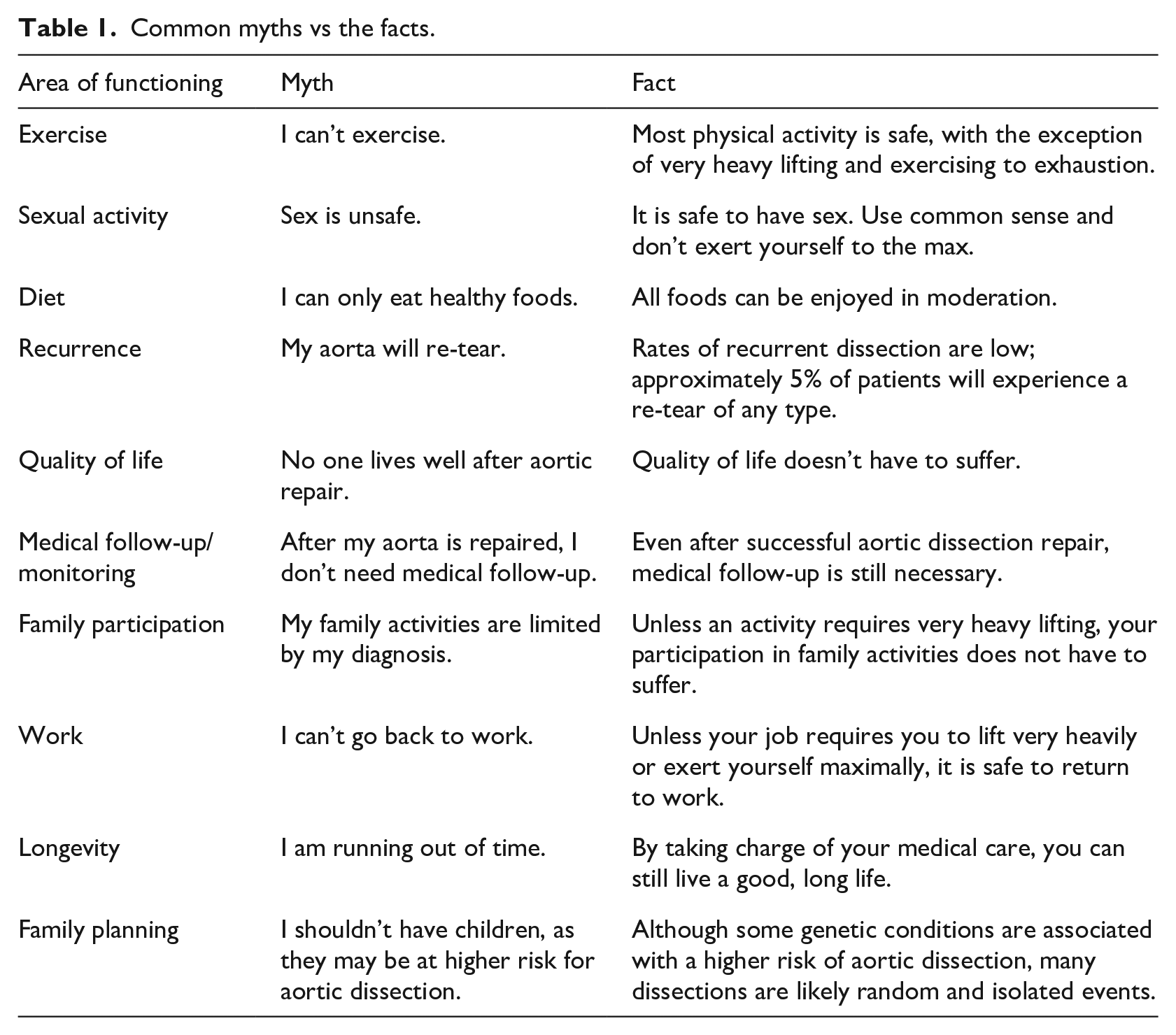
In summary, myths about life after aortic dissection can lead patients with aortic disease to feel uncertain and afraid. Some of these myths include safety fears about physical activity, diet and recurrence of aortic dissection. By educating yourself on the facts of your diagnosis, you can feel as though you have more control over your health and your life. Although Type A aortic dissection can be a life-changing experience, many survivors go on to live full lives (Table 1).
Common myths vs the facts.
Footnotes
Declaration of conflicting interests
The author(s) declared the following potential conflicts of interest with respect to the research, authorship, and/or publication of this article: S.F.S. serves as a consultant to Medtronic and Abbott. He has received honoraria from Medtronic, Biotronik and Zoll Medical in the past 12 months. All the other authors have no conflicts of interest or disclosures to declare regarding financial activities, relationships or affiliations to report.
Funding
The author(s) received no financial support for the research, authorship, and/or publication of this article.
