



Abstract
We examined whether and how work centrality and family centrality interact to moderate the relationships between family-to-work conflict and family and job satisfaction. In a field sample from Sweden, we found a three-way interaction between work centrality, family centrality, and family-to-work conflict on job and family satisfaction. Specifically, when work centrality was high, family-to-work conflict was related to job and family satisfaction regardless of the level of family centrality. However, when work centrality was low, the relationships between family-to-work conflict and job and family satisfaction were moderated by family centrality. Theoretical and practical implications of the results are discussed.
Keywords
Introduction
Researchers have found that although involvement in both the family and the work domains generates positive outcomes, such as the accruement of psychological resources and skills (Greenhaus and Powell, 2006; Ruderman et al., 2002), it may also create conflict as individuals are torn between performing their job duties at work and meeting their responsibilities as a spouse or a parent at home (Greenhaus and Beutell, 1985). For many people, the dream of maintaining work-life balance has become increasingly elusive as a result of both spouses’ participation in the workforce and the constant pressure to keep pace with an around-the-clock economy (Kalleberg, 2008).
The challenge associated with managing work and family responsibilities has spawned a great deal of research on work-family conflict, defined as the participation in one domain (e.g. work) being made more difficult as a result of one’s involvement in another domain (e.g. family) (Allen et al., 2000; Eby et al., 2005; Frone, 2003; Powell and Greenhaus, 2010a). Past research has suggested that to achieve a better understanding of the nomological network of work-family conflict, it is important to distinguish work-to-family conflict (WFC) from family-to-work conflict (FWC) (Frone et al., 1992; Gutek et al., 1991). WFC refers to conflict caused by demands from the work domain that limits one’s abilities to meet responsibilities in the family, whereas FWC refers to conflict caused by demands from the family domain that limits one’s abilities to meet responsibilities at work.
In the present study we chose to focus on FWC for three reasons. First, past research has suggested that FWC has important implications for work-related outcomes (Frone, 2003), which are related to the performance of organizations and hence the primary interest of management scholars. Second, as WFC is considered to be more prevalent and has more deleterious impact than FWC, it has attracted more research attention compared to FWC (in their meta-analysis, Amstad et al., 2011, located 261 correlations for WFC and 166 for FWC). Therefore, we follow recent investigations and focus on FWC, which is the less researched direction of the two (Bagger et al., 2008). Third, our decision to focus on FWC is influenced by the nature of the sample used in the present study. We used a sample of working adults from Sweden, a country known for its commitment for work-life integration (Haas et al., 2002). For example, Sweden is leading among developed countries in maternity/paternity leave provision (parents can take 100%-paid leave for a whole year before they return to a guaranteed job and they only need to work for six hours a day until their children enter school). As such, Swedes’ family responsibilities may take precedence over their work and may potentially leave them vulnerable to the impact of FWC. As one top manager in an IT company pointed out in an interview published in the New York Times, employees’ family involvement ‘can be disruptive – for career and companies’ (Bennhold, 2010).
FWC is a common experience for many working adults. For example, an employee is late for work because she has to drop off her children at a daycare center. Similarly, an employee is not able to complete his project on time because he has to take time off work to care for his sick child. Past research has shown that such conflict is related to many negative outcomes, including lower job and family satisfaction, lower work performance, higher levels of stress, and an increased desire to seek alternative employment (Amstad et al., 2011; Ford et al., 2007; Kossek and Ozeki, 1998). Out of all the outcome variables associated with FWC, the ones that have received the most research attention are job and family satisfaction (Amstad et al., 2011).
Job satisfaction is defined as positive feelings and attitudes towards one’s job, whereas family satisfaction is defined as positive feelings and attitudes towards one’s family. In their seminal study, Frone and colleagues (1992) proposed a cross-domain model of work-family conflict. According to the model (1992, 1997), the impact of FWC will be felt at the conflict receiving role (i.e. work). Specifically, family demands for resources may tax individuals’ abilities to meet their responsibilities at work and compromise their work performance. As such, individuals may not be able to enjoy their job to the same extent as they can when they focus on their work without distractions from the family domain. This argument suggests that FWC will be negatively related to job satisfaction. Other researchers, however, propose an alternative perspective – the source attribution perspective (Shockley and Singla, 2011). The source attribution perspective posits that when individuals experience negative work outcomes (e.g. a lower level of performance at work or decreased productivity), they tend to attribute the source of the problem to the family domain (i.e. family as the conflict initiating role). As such, they may experience a lower level of family satisfaction because they attribute the conflict to the family. This argument suggests that FWC will be negatively related to family satisfaction. It’s important to note that as our focus in this study is on the effect of FWC, we use examples demonstrating family as the conflict initiating role and work as the conflict receiving role. It’s certainly possible that these roles may switch such that work may become the conflict initiating role whereas family is the conflict receiving role.
Empirically, support for the cross-domain model and the source attribution perspective has not been conclusive (e.g. Aryee et al., 1999a; Bruck et al., 2002; Carlson and Kacmar, 2000; Judge et al., 1994). For example, while Thompson and Prottas (2006) found that FWC was significantly related to job satisfaction, Stephens et al. (1997) reported a non-significant relationship between these two variables. Similarly, while Wayne et al. (2004) found a significant relationship between FWC and family satisfaction, Parasuraman et al. (1996) reported a non-significant relationship between them. Indeed, two meta-analyses show that these relationships were modest at best (FWC – job satisfaction: -.14; Ford et al., 2007; FWC – family satisfaction: -.22; Shockley and Singla, 2011; see also Kossek and Ozeki, 1998; Michel et al., 2009).
These equivocal findings have prompted empirical investigations into mechanisms that moderate the FWC – job and family satisfaction relationships. While past research tends to focus on factors such as social support and coping strategies as potential moderating mechanisms (e.g. Aryee et al., 1999b; Md-Sidin et al., 2010), recent research has shifted the focus towards work and family centralities (e.g. Bagger et al., 2008; Carr et al., 2008), defined as importance ascribed to the work and family roles (Fournier et al., 2009; Graves et al., 2007). Individuals who are high on work centrality tend to believe that work plays a significant role in their life. For these individuals, the most important goals in life are work-oriented and they tend to allow work to dictate the allocation of important resources, such as time and energy. In contrast, individuals who are high on family centrality derive life meaning from their family. They tend to prioritize daily activities and long-term goals based on the implications for their family. For example, these individuals may be willing to give up an important promotion if accepting the promotion reduces the time that they could spend with their family.
Carlson and Kacmar (2000) suggested that the consideration of work and family centralities may provide new insights into how individuals cope with the conflict they experience. In response, Bagger et al. (2008) found that FWC was less significantly related to turnover intentions and job satisfaction when family centrality was high than it was when family centrality was low. Similarly, Luchetta (1995) found that family role salience suppressed the negative effects of stressors on psychological distress, such that the relationship between stressors and psychological stress was lower when family role salience was high. These findings suggest that centrality functions as a buffer. That is, centrality suppresses the effects of conflict arising from a higher-centrality role on a lower-centrality role.
One limitation of past research is the narrow focus on the moderating effects of work centrality or family centrality. The assumption appears to be that a low level of family centrality implies a correspondingly high level of work centrality, or vice versa. To illustrate, Carlson and Kacmar (2000) asked participants to distribute 100 points into life and work domains, with greater numbers of points in a certain domain representing a higher level of centrality. That is, when individuals allocated more points to one domain, they had fewer points available for other domains. Similarly, Carr and colleagues (2008) used a measure of work centrality in their study, but they interpreted low values on this measure as being equivalent to being ‘family-centered’ (p. 257). We are not aware of any empirical studies on the joint effects of work and family centralities on the relationship between conflict and satisfaction. This oversight is surprising, as both theoretical and empirical research has suggested that work and family centralities are not mutually exclusive (Cinamon and Rich, 2002a, 2002b; Marks, 1977).
Given this, the first contribution of the present study is to examine whether work centrality and family centrality jointly influence the relationship between FWC and job and family satisfaction. Our study intends to demonstrate that the joint consideration of both centralities may provide a greater level of precision in the prediction of job and family satisfaction than considering one role centrality in isolation. In addition, our study demonstrates that not only may individuals identify with multiple life roles, the specific pattern of role identifications may also have important implications. To this end, we distinguish the conflict initiating role from the conflict receiving role and examine how the identifications with these two different roles may interact with each other to moderate the FWC-satisfaction relationship. Additionally, past research comparing the two competing perspectives (cross-domain model and source attribution perspective) tends to focus on their applicability for theorizing the direct relationship between conflict and outcome variables (e.g. does FWC influence job satisfaction or family satisfaction?). In the present study, we intend to demonstrate that these two models have applicability not only for theorizing the direct relationships between conflict and outcome variables, but also for theorizing how centralities may moderate these relationships.
A secondary contribution of the present study is to evaluate two different scales of FWC: a global scale and a strain-based scale. Past research has used either a global scale of FWC, which measures the overall perceptions of the extent to which family responsibilities have increased the difficulties to meet work requirements (Gutek et al., 1991), or a dimensional scale, which focuses on one of the three types of pressures (time, strain, and behavior) contributing to the experience of FWC (Carlson et al., 2000). There is little empirical evidence suggesting that results based on one scale can be generalized when a different type of scale is utilized. Therefore, we examine whether the moderating effects of work and family centralities on the relationship between FWC and job and family satisfaction may differ as a function of the type of FWC measure used.
Identity theory
Our research employs identity theory as the theoretical framework (Stryker, 1980, 1987; Stryker and Serpe, 1982). According to identity theory, individuals play various roles in their interactions with others in the social environment. The self can be considered a collection of discrete roles that a person occupies in a complexly differentiated but also interdependent society. For example, a person may occupy the role of a worker, spouse, parent, volunteer, or social activist. Each role is associated with a set of behavioral expectations. In other words, if a person knows what role s/he plays, s/he then knows the right behaviors to exhibit in response to certain situations (Thoits, 1991).
A central concept of this theory is the notion of identity, which is the answer to the never-ceasing but ever-important philosophical question: Who am I? When an individual answers the question in reference to the specific role that s/he is involved in, s/he is believed to have acquired an identity (Stryker and Serpe, 1982; Thoits, 1991, 1992). In essence, an identity is the self-perception based on a social role and the accompanying behavioral expectations defining the role. Identities provide meaning for existence and guidance for behavior. Just as there are many roles that a person can play, there are many identities that a person can hold. This point is particularly important because although a complete self is made up of many identities, not all of them are equally important (Ashforth and Johnson, 2002; Stryker and Serpe, 1982; Thoits, 1983). When particular identities are considered more important, they occupy a more central position in the definition of the self (Thoits, 1992). According to identity theory, individuals organize the various identities that comprise the self into a hierarchy based on their importance. Roles that are more strongly identified with are more salient and, as such, are more likely to be evoked across various situations. In the present study, we focus on two roles that most people primarily identify with: work and family. Work centrality refers to the importance that is ascribed to the work role, whereas family centrality refers to the importance ascribed to the family role. It is important to note that past research has used terms such as role salience, role commitment and role importance (Bagger et al., 2008; Bielby and Bielby, 1989; Rosenberg, 1979). Powell and Greenhaus (2010b) argued that all these terms refer to the psychological importance an individual ascribes to a role and his/her psychological identification with the role, making them interchangeable with the term role centrality.
There are at least two implications associated with work and family centralities. First, as most people wish to maintain a positive self-perception, they may strive to achieve a high level of performance in the various social roles they occupy, particularly those roles that are central to their self-definition (Greenhaus and Powell, 2003; Thoits, 1991). Successful performance in a role central to one’s self-definition will greatly increase the individual’s self-esteem, whereas low performance in the same role may be distressing and depressing (Simon, 1992; Stryker, 1987). In contrast, a lack of high performance in a role that is peripheral to one’s self-definition can be more easily dismissed. Second, work and family centralities may also dictate the distribution of resources (Aryee and Tan, 1992; Burke and Reitzes, 1991; Fox and Dwyer, 1999). Individuals may allocate more resources to roles that are central to their self-definition than to roles that are marginal, as success in the highly-identified roles is more gratifying than success in less-identified roles. For example, when work centrality is high, individuals may commit more resources to work, leaving potentially fewer resources to roles that are less central to the self (Greenhaus and Beutell, 1985).
As we have already observed, extant research tends to focus on the effects of work centrality or family centrality. This singular focus assumes that a high level of importance ascribed to one role implies less importance ascribed to the other role (Bagger et al., 2008; Carr et al., 2008). This assumption has its roots in the scarcity perspective, which posits that human beings only have a limited amount of resources to consume (Goode, 1960). In order to maximize the return on their investment of resources, individuals trade off identification with one role against other roles. In contrast to this scarcity view, the multiplicity view proposes that individuals have enough resources to identify with multiple roles, such that difficult tradeoff decisions among life roles are not necessary (Marks, 1977; Ruderman et al., 2002). This view is echoed by Cinamon and Rich (2002a, 2002b), who argued that individuals can consider multiple life roles, such as family and work, to be important. These authors argued that there are four profiles based on the importance assigned to work and family roles: 1) Dual profile (high work centrality and high family centrality); 2) low importance profile (low work centrality and low family centrality); 3) work profile (high work centrality and low family centrality); and 4) family profile (low work centrality and high family centrality) (see also Fournier et al., 2009; Friedman and Greenhaus, 2000). Similarly, Bielby and Bielby (1989) found that men’s family centrality was independent from work centrality, suggesting that men could concurrently identify with both family and work roles (although they found that for women, strongly identifying with one role tended to mean lower identification with a different role). Together, these findings suggest that it is important to take into account both work and family centralities when attempting to understand their effects on the relationship between FWC and outcome variables.
Moderating effects of work and family centralities
When work centrality is high, individuals may strive to achieve excellence at work because of the importance ascribed to the work role (Simon, 1992; Thoits, 1991). As they identify strongly with their work role, individuals may experience considerable psychological distress if they fail to meet the demands at work owing to disruptions from the family role. When individuals fail to meet responsibilities in the important work role, they may experience a reduction of perceived work role quality, leading to a lower level of job satisfaction (Frone et al., 1992). Consistent with this argument, past research has suggested that individuals respond negatively to stressors occurring in an important role (Simon, 1992). When work is the target of FWC (work is the receiving role of the conflict), individuals high on work centrality may react negatively by experiencing a low level of job satisfaction, irrespective of the level of family centrality. This argument suggests that the strength of the relationship between FWC and job satisfaction should not vary as a function of family centrality, when work centrality is high.
However, when work centrality is low, the relationship between FWC and job satisfaction may be moderated by family centrality. We argue that the effects of FWC on job satisfaction will be weaker when family centrality is high. This is consistent with the notion of family centrality as a buffer that softens the effects of FWC (Bagger et al., 2008; Carr et al., 2008). Individuals may believe that low performance in the less important role (i.e. work) is not as threatening to their self-definition (Rothbard and Edwards, 2003). In contrast, they may be more concerned with their performance in their family role, which they strongly identify with (Thoits, 1991). For this reason, individuals are more likely to dismiss the impact of conflict that arises from a more valued domain (family) on a less valued domain (work) (Bagger et al., 2008). These arguments suggest that a high level of family centrality serves as a buffer against the effects of FWC.
When family centrality is low, it opens the door for conflict arising from the family domain to spill over to the work domain and to negatively impact the level of job satisfaction. That is, if family is not highly valued, family demands are perceived as a nuisance. Even though the work role itself is also not highly salient, family interference nevertheless compromises one’s abilities to meet work requirements (for example, one may have to spend more time at work to fulfill task requirements because of childcare-related emergencies at home), resulting in a higher level of psychological strain. As individuals process and evaluate information in a manner consistent with their affective states, more psychological strain as a result of FWC may lead to less favorable evaluations of one’s job (Forgas and George, 2001; Graves et al., 2007). Based on these arguments, we hypothesize:
Hypothesis 1: The negative relationship between FWC and job satisfaction is moderated by work and family centralities. Specifically: Hypothesis 1a: When work centrality is high, family centrality does not moderate the relationship between FWC and job satisfaction. Hypothesis 1b: When work centrality is low, family centrality moderates the relationship between FWC and job satisfaction, such that the relationship between FWC and job satisfaction will be stronger when family centrality is low than when family centrality is high.
We make similar predictions about the interactive effects of work and family centralities on the relationship between FWC and family satisfaction. According to the source attribution perspective, individuals may experience a lower level of family satisfaction as a result of FWC, because they tend to attribute the struggle they experience in the work domain to the family domain (i.e. family is the culprit). As they identify strongly with their work role, these individuals may be sensitive to – and resentful of – factors that may compromise their work performance. That is, when work centrality is high, individuals may respond negatively to interference from family. This results in a lower level of family satisfaction as family is the source of the conflict on the more valued work role. This argument suggests that family centrality should not influence the strength of the relationship between FWC and family satisfaction when work centrality is high.
When work centrality is low, however, we predict that the relationship between FWC and family satisfaction will be moderated by family centrality. A high level of family centrality may buffer the effects of FWC on family satisfaction (Bagger et al., 2008; Carr et al., 2008). Individuals may attribute the cause of their problems to a less important role (Carr et al., 2008). When less importance is ascribed to the work role while greater importance is ascribed to the family role, individuals may be less likely to hold the family responsible for the FWC they experience. As such, they are less likely to experience a low level of family satisfaction as they simply do not see family, the valued role, as the cause of the problem. In fact, they may see the interference as a necessary price to pay to attain success in the valued family role (see a similar argument made by Day and Chamberlain, 2006). This argument suggests that individuals are less likely to react negatively to FWC with a low level of family satisfaction. In contrast, a low level of family centrality may allow conflict arising from the family domain to spill over to the work domain. When individuals are struggling to meet work requirements because of FWC, they lay the blame on the family (the source) of the problem, leading to a lower level of family satisfaction. Based on this, we hypothesize:
Hypothesis 2: The negative relationship between FWC and family satisfaction is moderated by work and family centralities. Specifically: Hypothesis 2a: When work centrality is high, family centrality does not moderate the relationship between FWC and family satisfaction. Hypothesis 2b: When work centrality is low, family centrality moderates the relationship between FWC and family satisfaction, such that the relationship between FWC and family satisfaction will be stronger when family centrality is low than when family centrality is high.
Although we predict that work and family centralities have the same moderating effects on the relationship between FWC and job satisfaction as the effects they have on the relationship between FWC and family satisfaction, the predictions are predicated based on two different theoretical perspectives (cross-domain model and source attribution perspectives). Thus, the inclusion of both centralities allows us to investigate both theoretical perspectives simultaneously.
Measurement
As stated previously, a secondary contribution of the present study is to compare the results based on a dimensional measure of FWC with the results based on a global measure of FWC. Earlier research has conceptualized FWC as a unidimensional construct (Bruck et al., 2002; Gutek et al., 1991; Matthews et al., 2010b; Mesmer-Magnus and Viswesvaran, 2005). Subsequent refinement of the literature conceptualized work-family conflict as a three-dimensional construct with time-based, strain-based, and behavior-based conflicts (Carlson et al., 2000; Greenhaus and Beutell, 1985). Researchers have developed multidimensional measures to capture each of the three dimensions of work-family conflict (Carlson et al., 2000). Global measures of work-family conflict, in contrast, reflect the general demands of one domain on the other domain without assessing the ‘theoretically distinguishable subdimensions of the work-family conflict construct space’ (Matthews et al., 2010b: 88). Either global (e.g. Gutek et al., 1991; Netemeyer et al., 1996) or multidimensional (e.g. Carlson et al., 2000) measures of work-family conflict have been used in the prior literature. Researchers suggest that it is important to match the dimension of the conflict with theoretically relevant outcome variables, as these effects may sometimes be masked by the global measure of conflict (Ford et al., 2007; Matthews et al., 2010b). In the present study, in addition to the global measure, we used the strain-based FWC measure. We chose the strain-based FWC measure for two reasons. First, many studies have shown that strain-based conflict tends to have a greater impact than either the time-based or behavior-based conflicts (e.g. Bruck and Allen, 2003; Lambert et al., 2010; Matthews et al., 2010b). Second, as the outcome variables examined in the present study (job and family satisfaction) reflect psychological and affective responses within a stressor-strain framework, we use a strain-based (FWC-S) measure as their predictor. Given the void of research examining whether these measures (global versus dimensional) produce convergent results, we approach this issue in an exploratory manner. Specifically, we ask:
Research Question: Does FWC-S, like FWC, interact with work centrality and family centrality to predict job and family satisfaction?
Method
Participants and procedure
To ensure that all participants were reasonably comparable in family responsibilities and to increase heterogeneity in occupational background, we invited working parents who used one of nine daycare centers in Eastern Sweden to participate in our study. At our request, the supervisor responsible for each local daycare branch placed a survey in each child’s locker. To increase the response rate, we offered a monetary gift (US$20 for each 10 returned surveys) to each daycare center. Only those parents who were employed at the time of the study were eligible for this study. A total of 250 surveys were distributed and 149 of them were returned, representing a response rate of 60 percent. Of these participants, 115 were women (78%). The vast majority of the participants (97%) were white, consistent with the national demographics of Sweden. Age ranged from 23 to 52 with a mean of 34.94 (SD = 4.89). Participants had an average of two children (M = 2.16, SD = .85). Participants held many different occupations, including project manager, medical doctor, salesperson, and economist.
Measures
The survey was in written in Swedish, the official language of Sweden. As all measures were originally developed in English, we translated them into Swedish and then back-translated them into English (Brislin, 1986). We asked local residents who speak both languages (English and Swedish) to comment on the Swedish version of the survey. Based on their comments, we revised the wording of a few survey questions. A five-point Likert-type scale (1 = strongly disagree and 5 = strongly agree) was used for all measures except for work and family centrality, which used a scale ranging from 1 to 9 (1 = strongly disagree and 9 = strongly agree).
We measured global FWC with Gutek et al.’s (1991, α = .70) four-item scale and FWC-Strain (FWC-S) with a three-item scale from Carlson et al. (2000, α = .87). A sample item of the FWC measure is: ‘I am often too tired at work because of the things I have to do at home.’ A sample item of the FWC-S is: ‘Due to stress at home, I am often preoccupied with family matters at work.’ Work centrality was assessed using 12 items from Hirschfeld and Field (2000, α = .78). A sample item is: ‘Work should only be a small part of one’s life (R).’ The same scale was used to measure family centrality (α = .84), except that the word ‘work’ was replaced with ‘family’. However, two of the items from the work centrality scale could not be applied in the family domain (‘I would probably keep working even if I didn’t need the money,’ and ‘If the unemployment benefit was really high, I would still prefer to work’), and were therefore excluded. Thus, family centrality was measured with 10 items. Job satisfaction was measured with a three-item measure (Camman et al., 1983, α =.87). A sample item of the measure is: ‘All in all, I am satisfied with my job.’ Family satisfaction was measured with three items from Kopelman et al. (1983, α = .76). A sample item of the measure is: ‘Generally speaking, I am very satisfied with my family.’
Five control variables were included in this study. Past research has reported mixed findings on the effects of age on the work-family conflict that individuals experience (Grandey and Cropanzano, 1999; for a more thorough discussion of this issue, see Matthews et al., 2010a). As such, we included age (in years) as a control variable. Past research has also produced mixed results on the relationship between the number of children and work-family conflict that employees experience and their identification with the family role (e.g. Bielby and Bielby, 1989; Campbell et al., 1994; Casper et al., 2002; Karasek et al., 1987; Li and Bagger, forthcoming; Mastekaasa, 2000). We also controlled for gender (0 = female and 1 = male), because the traditional gender role perspective prescribes the primacy of the family role for women and the work role for men, which may influence their response to conflict arising from the family domain on the work domain (Bagger et al., 2008). We also controlled for the number of work hours because more hours spent at work may signal one’s identification with the work role (Wayne et al., 2004). Additionally, more hours at work may reduce available time for family activities, further fueling the conflict between work and family domains (Gutek et al., 1991). Finally, we also controlled for managerial/professional status as individuals who occupy these types of positions may identify more strongly with their work role owing to their income level and the training they have received (Bielby and Bielby, 1989). Specifically, we asked participants to self report their occupation. We then followed the occupation classification scheme proposed by Barrick and Mount (1991) to classify participants into two categories: Managerial/Professionals and others. While Barrick and Mount’s classification scheme includes five categories (manager, professional, police, sales, and skilled/semi-skilled), given the few study participants in police, sales and skilled/semi-skilled occupations, we placed individuals belonging to the first two categories into one group and the remaining participants into a second group. One author and a research assistant independently coded the occupations and the resulting inter-rater agreement was 94.3 percent. The difference was reconciled through discussion.
Results
We conducted a Confirmatory Factor Analysis on the distinction between the work centrality and family centrality measures used in the present study. The two-factor structure (X2 = 375.57, d.f. = 203, CFI = .98, NFI = .96, RMSEA = .076) provided a significantly better fit to the data than the one-factor structure (X2 = 464.06, d.f. = 204, CFI = .97, NFI = .95, RMSEA = .093,
We then conducted a second confirmatory factor analysis on the distinction between the six constructs in our model: FWC, FWC-S, work centrality, family centrality, job satisfaction, and family satisfaction, given that all of them were self-report measures. The six-factor structure (X2 = 893.58, d.f. = 552, CFI = .98, NFI = .94, RMSEA = .065) provided a significantly better fit to the data than the one-factor structure (X2 = 1670.04, d.f. = 555, CFI = .92, NFI = .89, RMSEA = .117,
Means, standard deviations, and reliability coefficients are reported in Table 1. Both FWC and FWC-S were significantly related to job and family satisfaction. Work centrality was negatively related to family centrality. Family centrality was negatively related to FWC but not to FWC-S, whereas work centrality was related to neither FWC nor FWC-S. Family centrality was positively related to family satisfaction but was not significantly related to job satisfaction. In contrast, work centrality was negatively related to family satisfaction but positively related to job satisfaction.
Inter-correlations among studied variables
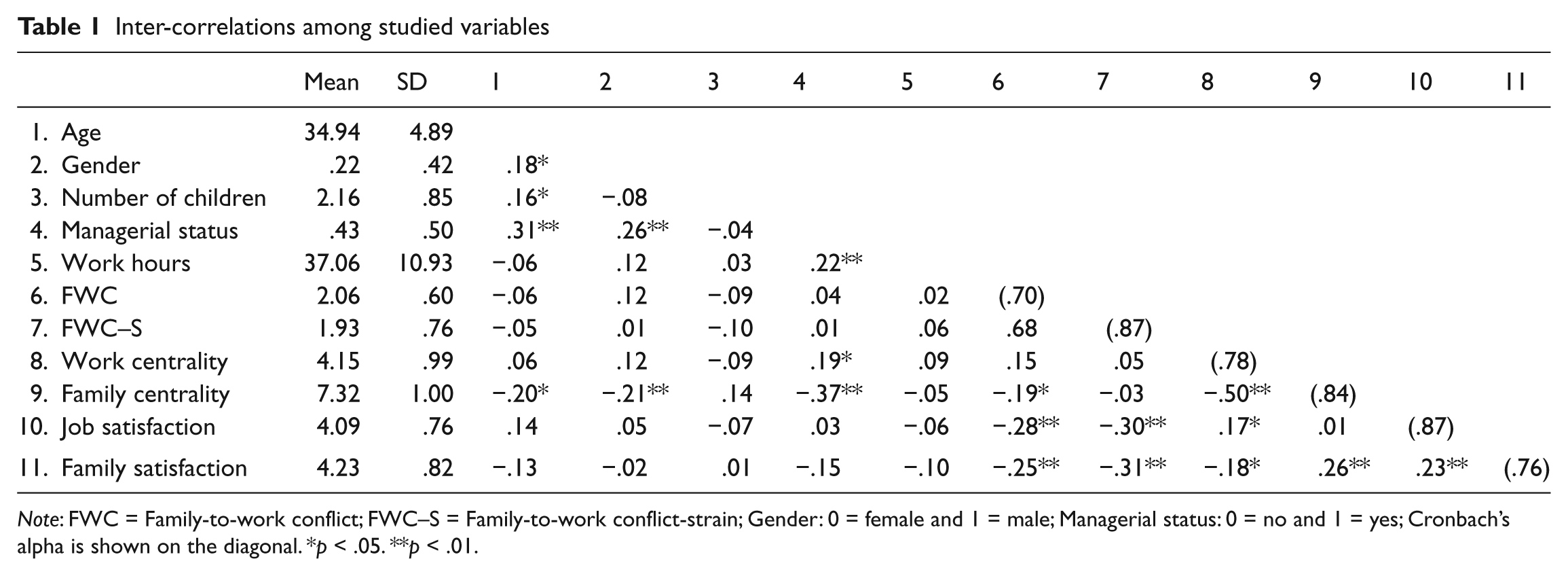
Note: FWC = Family-to-work conflict; FWC–S = Family-to-work conflict-strain; Gender: 0 = female and 1 = male; Managerial status: 0 = no and 1 = yes; Cronbach’s alpha is shown on the diagonal. *p < .05. **p < .01.
Hierarchical regression was used to test the hypotheses. Following Cohen et al. (2003), we standardized all the variables (except for the dependent variables) before entering them into the regression equation. Control variables were entered in the first step, followed by the simple effects. We then entered the three two-way interactions. In the last step, the three-way interaction term was entered into the equation. FWC and FWC-S were examined separately.
Results of the regression analyses are reported in Tables 2 and 3. Hypothesis 1 states that there is a three-way interaction between FWC, work centrality, and family centrality on job satisfaction. The three-way interaction of work centrality, family centrality, and FWC on job satisfaction was significant (β = −.20, p < .05, ΔR2 = .03, Table 2). More specifically, Hypothesis 1a states that when work centrality is high, family centrality does not moderate the relationship between FWC and job satisfaction. As can be seen in Figure 1a, the relationship between FWC and job satisfaction did not vary as a function of family centrality when work centrality was high. Results of the simple slope analysis indicated that the two slopes were not significantly different from each other (t = −.19, ns). These findings provide support for our first hypothesis.
Summary of hierarchical regression analysis for the interactive effects (family-to-work conflict on job satisfaction)
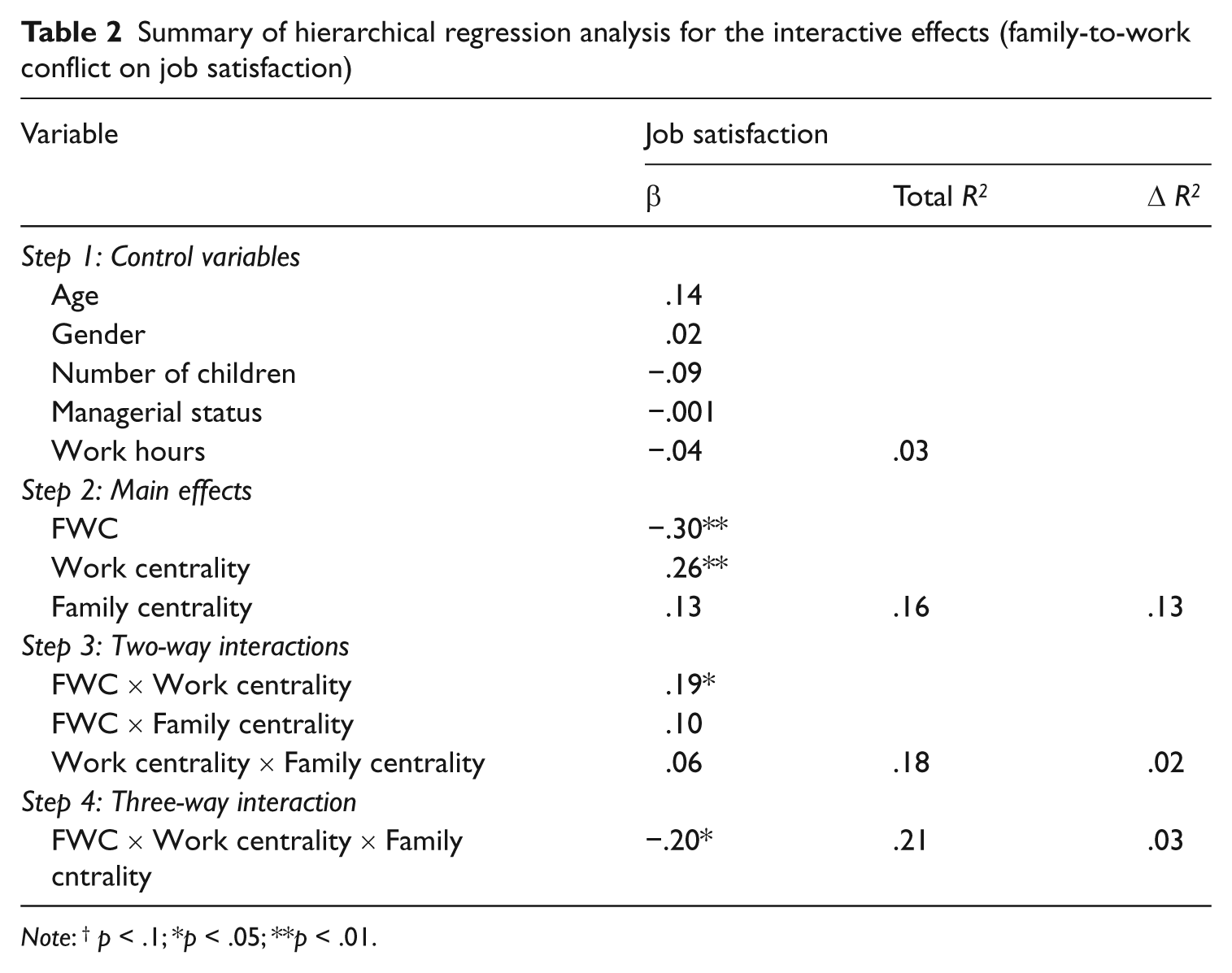
Note: † p < .1; *p < .05; **p < .01.
Summary of hierarchical regression analysis for the interactive effects (family-to-work conflict on family satisfaction)
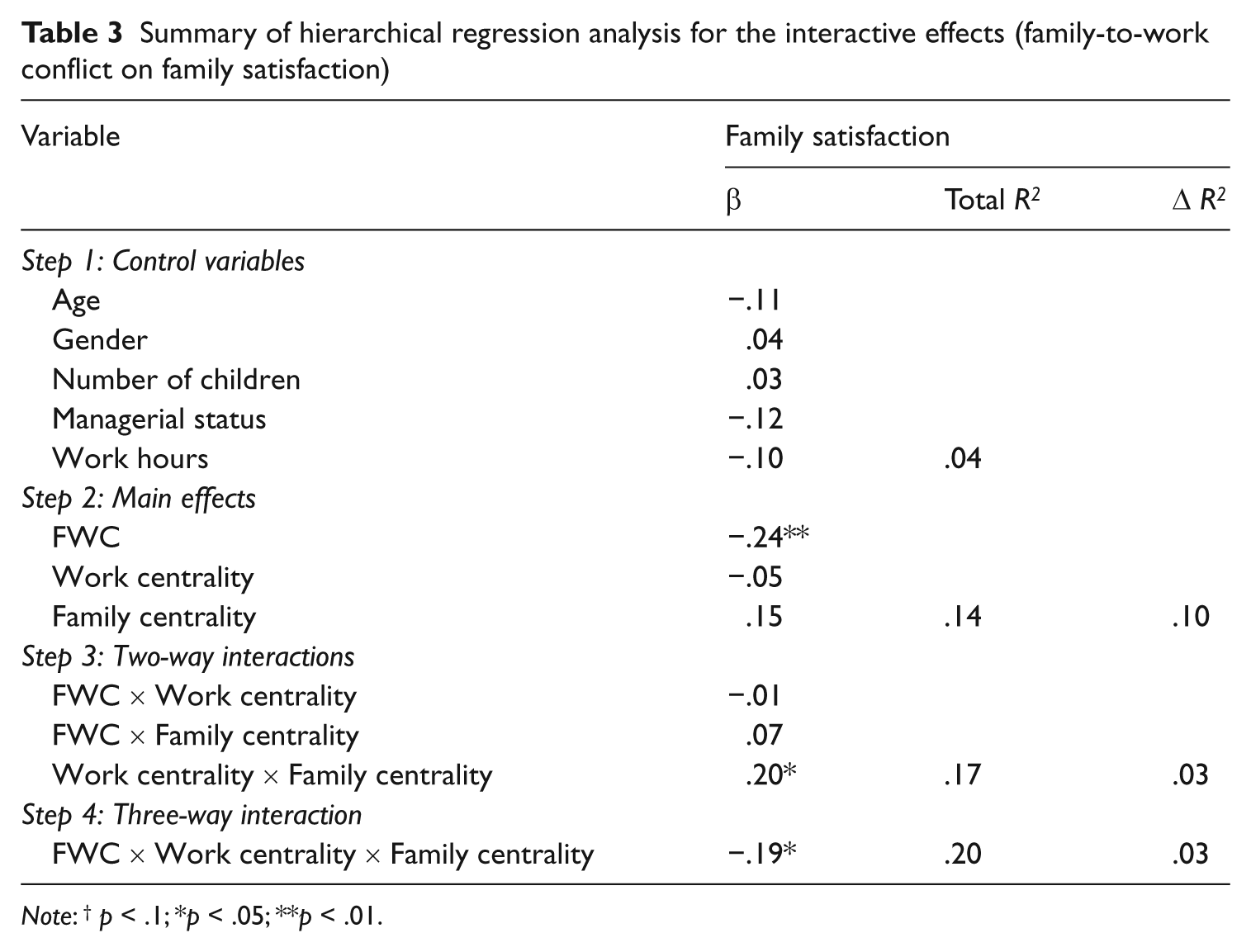
Note: † p < .1; *p < .05; **p < .01.
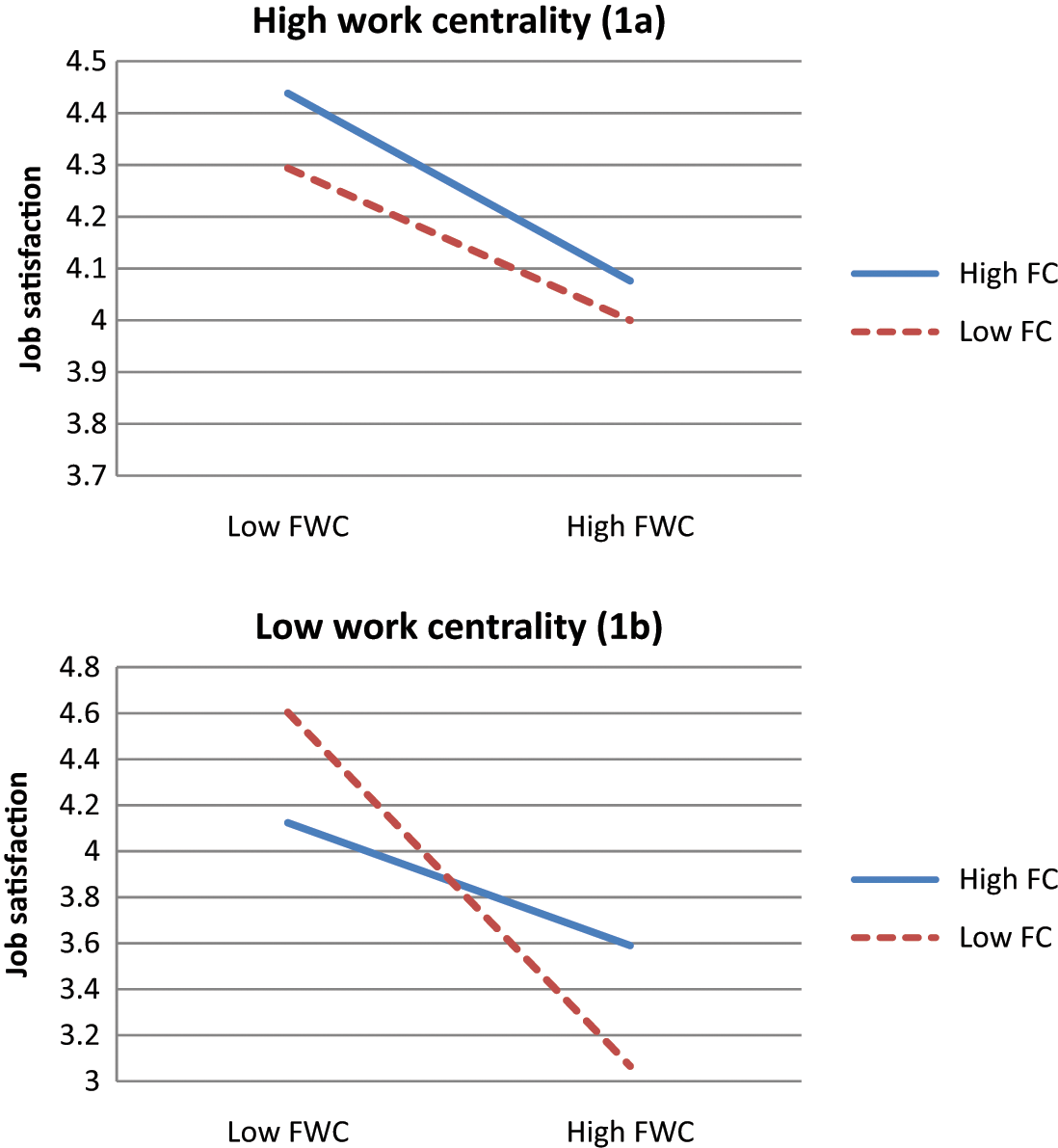
Interaction between family-to-work conflict, work centrality, and family centrality on job satisfaction.
Hypothesis 1b states that when work centrality is low, family centrality moderates the relationship between FWC and job satisfaction, such that the relationship between FWC and job satisfaction will be stronger when family centrality is low than when family centrality is high. As can be seen in Figure 1b, when work centrality was low, FWC was more strongly related to job satisfaction when family centrality was low than when family centrality was high. The two slopes were significantly different from each other (t = 2.29, p < .05). These results support Hypothesis 1b.
Hypothesis 2 states that there is a three-way interaction between FWC, work centrality, and family centrality on family satisfaction. The three-way interaction of work centrality, family centrality, and FWC was significant (β = −.19, p < .05, ΔR2 = .03, Table 3). More specifically, Hypothesis 2a states that when work centrality is high, family centrality does not moderate the relationship between FWC and family satisfaction. As can be seen in Figure 2a, the relationship between FWC and family satisfaction did not vary as a function of family centrality, when work centrality was high. Results of the simple slope analysis indicated that the two slopes were not significantly different from each other (t = −.34, ns). Thus, Hypothesis 2a was supported. Hypothesis 2b states that when work centrality is low, family centrality moderates the relationship between FWC and family satisfaction, such that the relationship between FWC and family satisfaction will be stronger when family centrality is low than when family centrality is high. As can be seen in Figure 2b, when work centrality was low, FWC was more strongly related to family satisfaction when family centrality was low than when family centrality was high. The two slopes were significantly different from each other (t = 2.06, p < .05). These findings provide support for Hypothesis 2b.
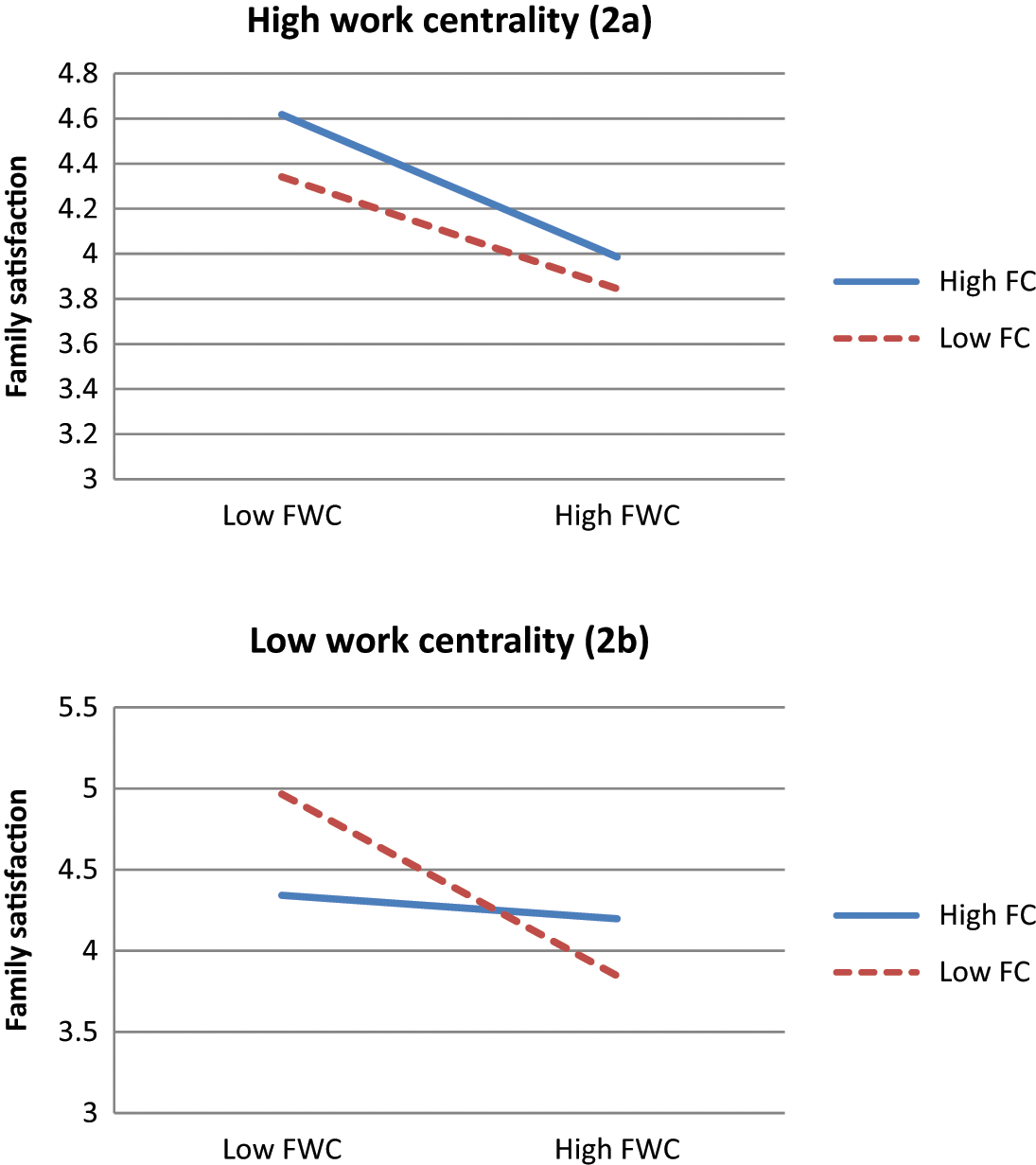
Interaction between family-to-work conflict, work centrality, and family centrality on family satisfaction.
Our research question addresses the issue of whether FWC and FWC-S produce convergent results. Results of these regression analyses are reported in Tables 4 and 5. We repeated the above mentioned analyses (Hypotheses 1a, 1b, 2a, 2b) while replacing FWC with FWC-S. The three-way interaction of work centrality, family centrality, and FWC-S on job satisfaction was significant (β = −.19, p < .05, one-tailed, ΔR2 = .01). Supporting Hypothesis 1a, when work centrality was high, family centrality did not moderate the relationship between FWC-S and job satisfaction (t = −.61, ns, Figure 3a). Although the moderating effect of family centrality on the relationship between FWC-S and job satisfaction did not reach statistical significance (t = 1.33, ns) when work centrality was low, it was nevertheless consistent with the direction we predicted (Figure 3b). However, these results did not support Hypothesis 1b.
Summary of hierarchical regression analysis for the interactive effects (family-to-work conflict strain on job satisfaction)
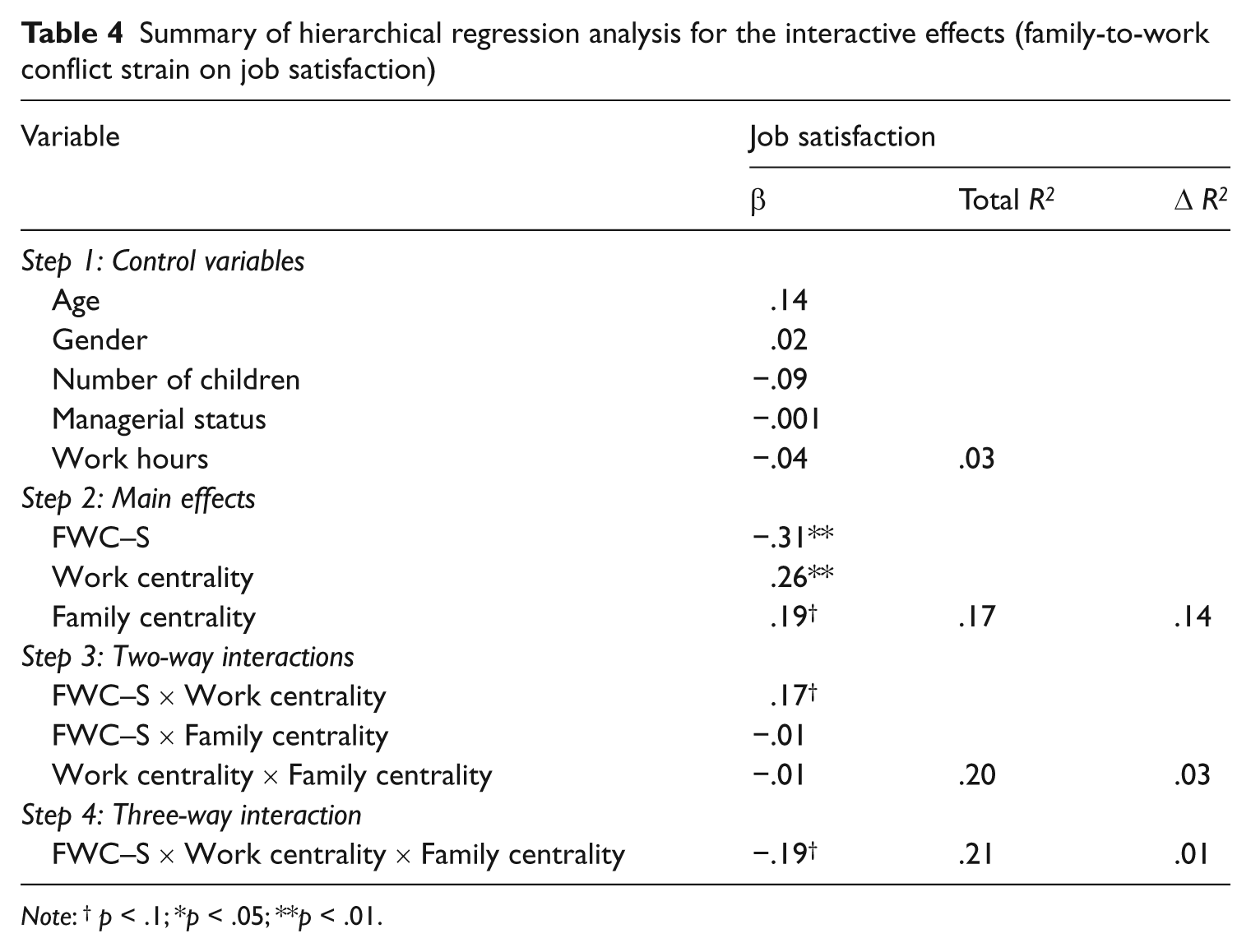
Note: † p < .1; *p < .05; **p < .01.
Summary of hierarchical regression analysis for the interactive effects (family-to-work conflict strain on family satisfaction)
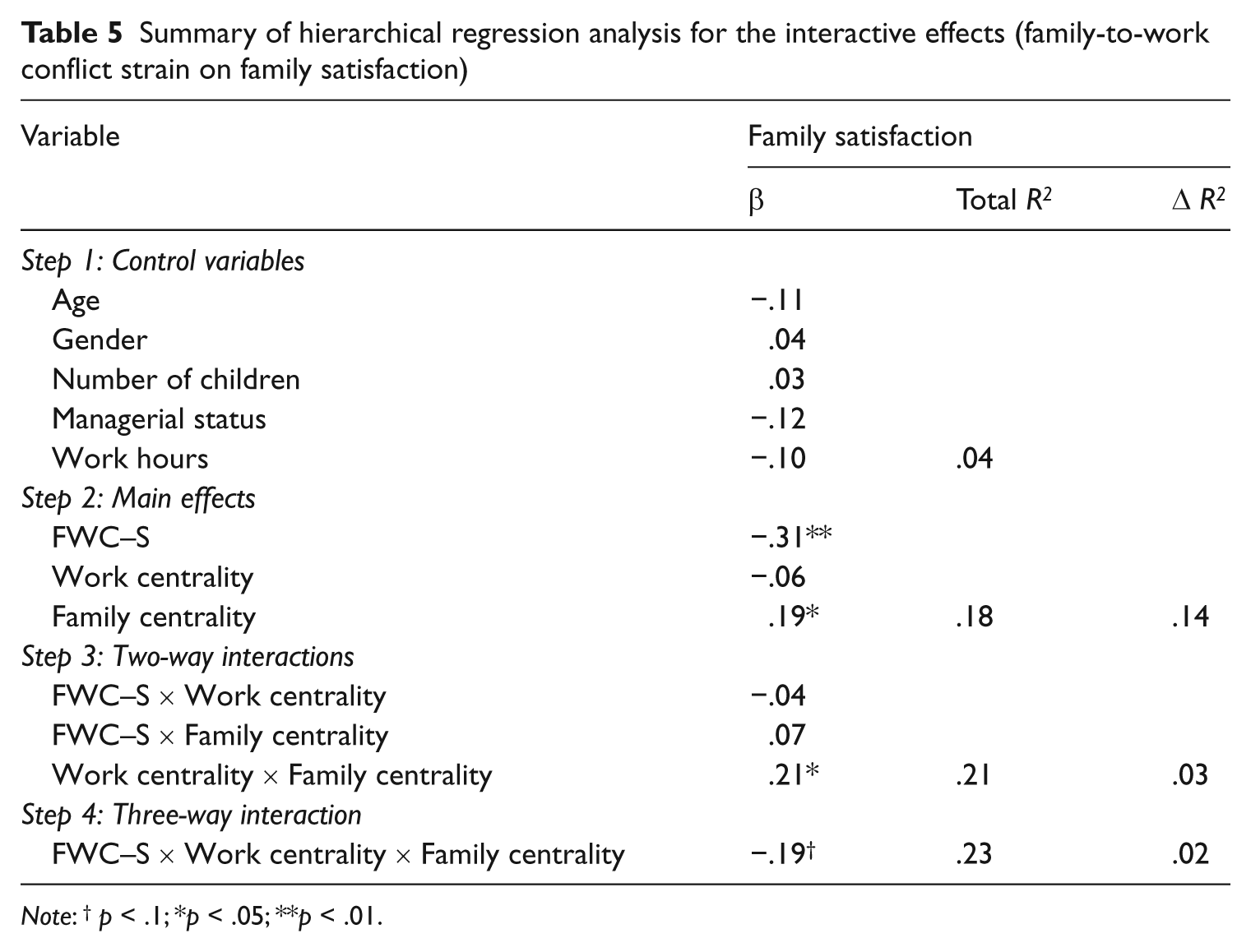
Note: † p < .1; *p < .05; **p < .01.
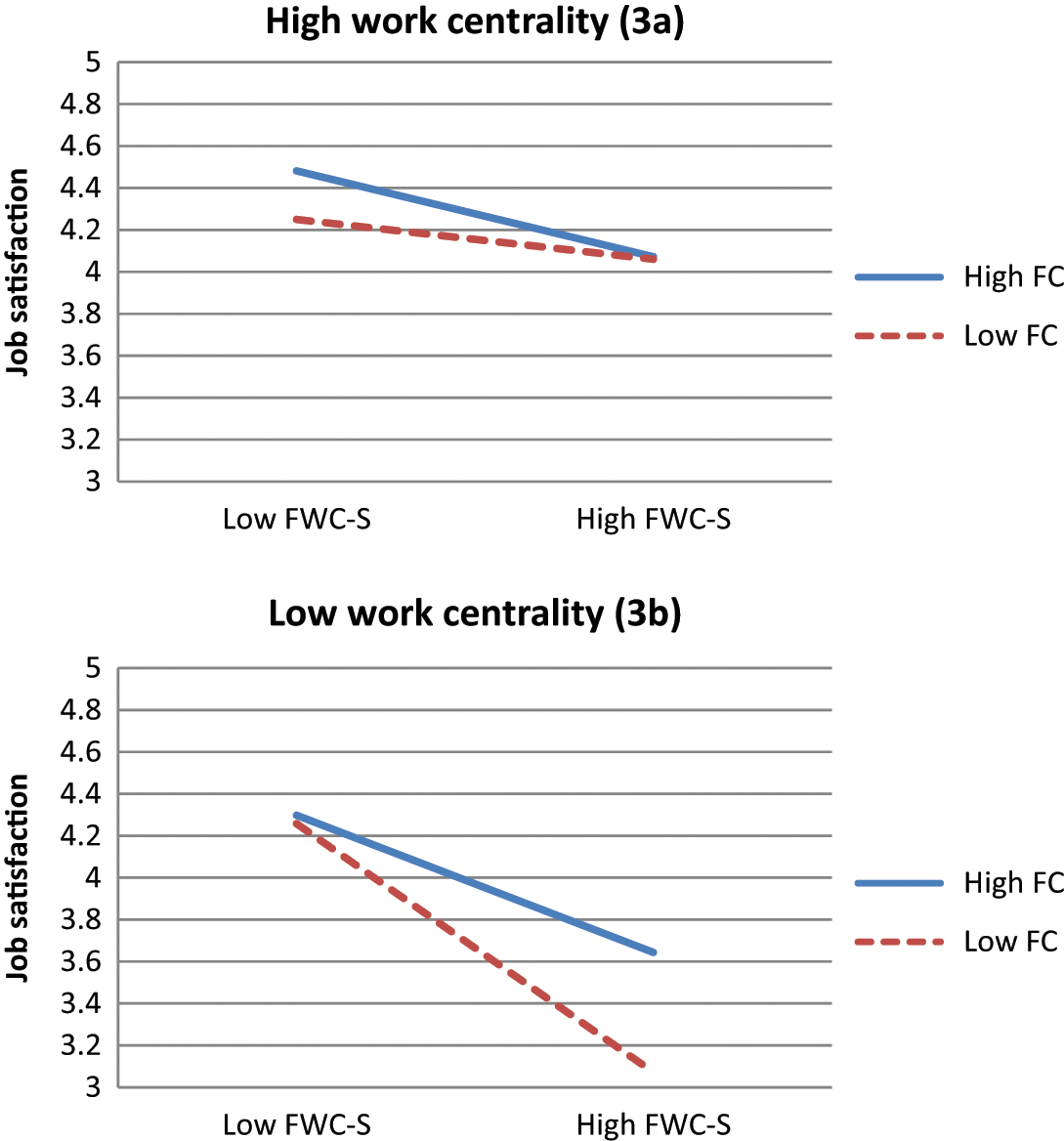
Interaction between family-to-work conflict-strain, work centrality, and family centrality on job satisfaction.
The three-way interaction of work centrality, family centrality, and FWC-S on family satisfaction was significant (β = −.19, p < .05, one-tailed, ΔR2 = .02). In support of Hypothesis 2a, when work centrality was high, family centrality did not moderate the relationship between FWC-S and family satisfaction (t = .01, ns, Figure 4a). However, when work centrality was low, family centrality did moderate the relationship between FWC-S and family satisfaction, such that the relationship was stronger when family centrality was low than when family centrality was high (Figure 4b). The two slopes were significantly different from each other (t = 1.72, p < .05, one-tailed). These findings support Hypothesis 2b.

Interaction between family-to-work conflict-strain, work centrality, and family centrality on family satisfaction.
Discussion
In the present study, we investigated the moderating effects of work and family centralities on the relationship between FWC and job and family satisfaction. Based on a sample of 149 working adults from Sweden, we found that the relationships between FWC and job and family satisfaction were moderated jointly by work and family centralities. Specifically, we found that when work centrality was high, family centrality did not moderate the relationships between FWC and job and family satisfaction. However, when work centrality was low, the relationships between FWC and job and family satisfaction were moderated by family centrality, such that the relationships were stronger when family centrality was low rather than high. We found somewhat similar effects with the use of two different measures of FWC (a global FWC measure and a dimensional FWC-Strain measure). The theoretical and practical implications of our findings are discussed in the following sections, followed by a discussion of the study limitations and paths for future research.
Theoretical implications
The present study makes a number of theoretical contributions. First, our study demonstrates that the understanding of the moderating effects of centrality is incomplete without the concurrent consideration of various life roles. Although a number of past studies have examined how centrality may moderate the relationship between work-family conflict and outcome variables, all of them restricted their investigation to the centrality of one role domain at the exclusion of the other (e.g. Bagger et al., 2008). This research tradition proceeded from the premise that work and family centralities are inversely related to each other. As past research and the present study have demonstrated, work and family centralities are distinct from each other, prompting the question of how they interact with each other to moderate the relationships between work-family conflict and job and family satisfaction. By simultaneously investigating both work and family centralities within one study, our results demonstrate the importance of distinguishing the conflict initiating role from the conflict receiving role and evaluating individuals’ pattern of identification with these roles. Specifically, we found that when individuals strongly identified with the conflict receiving role (work role in the present study) that was negatively influenced by the conflict initiating role (family role in the present study), they responded negatively, regardless of the level of their identification with the initiating role. Our finding that a high level of family identification did not offset the negative effects of FWC on satisfaction when work centrality was high is particularly intriguing. One potential explanation is that these individuals derived their overall satisfaction from fulfillments in both domains that they strongly identified with (Carlson and Kacmar, 2000). As such, individuals became sensitive to the negative influence on these domains and reacted to them with a lower level of job and family satisfaction. Therefore, our results resonate with research showing that strain in a more salient role tends to be associated with greater impact than is strain occurring in a less important domain (Cinamon and Rich, 2002a; Simon, 1992). If corroborated by additional research, these findings suggest that instead of focusing on which role centrality (e.g. family or work) may have a greater impact, future research should identify the role domain that is influenced by conflict and examine the level of centrality of that role.
In addition, we found that when centrality of the conflict receiving role (work) was low, individuals responded less negatively to conflict initiating from a domain that they strongly identified with. These findings suggest that individuals use their central identity as a resource to neutralize the negative impact of conflict. As such, our study reconciles past research on the role that centrality plays. Specifically, while some scholars (e.g. Carlson and Kacmar, 2000; Day and Chamberlain, 2006) argued that role centrality may accentuate the impact of conflict on outcome variables, others (Bagger et al., 2008) have found that role centrality buffered the negative impact of conflict on outcome variables. As we demonstrated here, the nature of the moderating relationship depends on whether the role individuals strongly identify with is the conflict initiating role or the conflict receiving role. Although we focused on job and family satisfaction in the present study, future studies should examine whether other outcome variables, such as stress and performance, may exhibit a similar pattern of effects.
Second, our study also contributes to the debate between the cross-domain model and the source attribution perspective. As we found, when work centrality was high, FWC was related to both job and family satisfaction regardless of the level of family centrality. This finding can be accounted for by both perspectives. In other words, a threat on the work role that is strongly identified with, may lead to lower levels of family satisfaction as the negative outcome is attributed to the family role (the source attribution perspective). Individuals may also experience a discrepancy between the current state and a desired state whereby they can enjoy their job without family distractions, which may reduce their job satisfaction (the cross-domain model). These arguments suggest that to the extent that both models may account for the effects of FWC on outcome variables, they should be mediated through divergent psychological mechanisms: one through attribution (Weiner, 1985) and the other through cognitive discrepancy (Carver and Scheier, 1981). We believe that these two psychological mechanisms may also account for the relationship between FWC and job and family satisfaction when work centrality is low. Specifically, when work centrality is low and family centrality is high, individuals are less likely to blame the family for the conflict, thus reducing the relationship between FWC and family satisfaction. Similarly, when work centrality is low and family centrality is high, individuals may marshal cognitive and emotional resources to overcome the negative impact of FWC, potentially reducing the discrepancy between the current state and a desired state. These arguments suggest that future research should include attribution and cognitive discrepancy as mediating mechanisms when they evaluate the two competing perspectives.
Third, our study also advances research on identity theory in two ways. First, although the multiplicity view of centrality represents a significant theoretical development over the scarcity view, empirical investigation of its implications for work-family conflict is still in its infancy (the only studies we are aware of focus primarily on whether individuals belonging to different profiles as a result of the importance ascribed to different life roles experience different levels of work-family conflict; Cinamon and Rich, 2002a, 2002b; Fournier et al., 2009). As we demonstrate in this study, knowing employees’ profiles of identifications with various life roles will also allow researchers and practitioners to understand and predict how employees may respond to the strains on those roles. Second, although identity theory posits that individuals may identify strongly with multiple roles, it is relatively silent on how the various central identities may interact with each other. By distinguishing the conflict initiating role from the receiving role, our study represents the first attempt to unveil how these strongly identified roles interact with each other to influence individuals’ attitudes and behaviors.
In the present study, we also examined a global measure and a dimensional measure of FWC (i.e. strain). Past research has suggested that the relationships between these measures and other variables may not be convergent (Bruck et al., 2002). We found mixed support for this argument. In terms of the results of the correlation analyses, although we found somewhat similar patterns of the correlations involving the two measures of FWC and other variables, in several instances the effect sizes varied substantially. With respect to the results of the moderating analysis, we found somewhat similar effects for FWC and for FWC-S (although the effects were stronger for FWC than for FWC-S). Of course, it is important not to overstate the implications of our findings, given that we only examined one dimension of the FWC measure. Future research should re-examine our findings using all three individual dimensions of FWC (time, strain, and behavior).
Practical implications
The findings from the present study, if corroborated by future research, may have significant implications for employers, managers, and employees. First, as we demonstrated in the current study, strain on the receiving role (here, work) that individuals strongly identified with was associated with negative outcomes, regardless of their level of identification with the initiating role (here, family). These findings suggest that individuals who strongly identify with their work role may be particularly vulnerable to conflict originating from their family domain and they are not shielded from the effect even when they identify strongly with the family domain. Therefore, organizations should develop strategies that may reduce the level of negative spillover from family to work without undermining employees’ work performance. One strategy is to encourage employees to use policies such as flexible work schedules or telecommuting, while providing assurance that using these benefits will not jeopardize their career prospects. Employees who build their identification on their work and who believe that their family responsibilities have overwhelmed their abilities to perform adequately at work would benefit from seeking support from their family members and supervisors, given that FWC may have negative impact on not only their satisfaction with their job, but also their family satisfaction.
We also found that when the identification with the receiving work role was low, identification with the initiating family role buffered the negative impact of FWC on outcome variables. Specifically, FWC was less strongly related to outcome variables when family centrality was high. Our finding reinforces other scholars’ observation that family centrality should be viewed as a resource that may temper the negative effects of work-family conflict rather than a liability that may undermine work performance (Bagger et al., 2008; Carr et al., 2008). As such, organizations should recognize the importance of the family role for their employees by cultivating a family-friendly work environment. Organizations can also help their employees affirm their family centrality by allowing or even encouraging their employees to take time off work to meet family obligations, and by creating facilities such as on-site daycare centers that allow employees to connect with their children at work.
Our field study took place in Sweden, a country well-known for its very generous and progressive family-friendly social policies. Considerable resources have been invested in an effort to facilitate work-life balance among employed parents. From that perspective, the sample used in the present study represents a stronger test of our theory as the family-centered culture in Sweden may potentially reduce the impact of work centrality on the relationship between FWC and job and family satisfaction. However, we found that a high level of work centrality was negatively related to family satisfaction. In addition, when participants experienced conflict on the work domain, which they strongly identified with, they reacted negatively even if they also strongly identified with their family. These findings are consistent with recent research showing that despite a favorable social and regulatory environment, Swedes experience less work-family balance compared with other European nations (Van der Lippe et al., 2006). One potential explanation for these findings may be that a strong corporate culture emphasizing career success over family success may dilute the effects of a family-friendly culture at the societal level (Allen, 2001; O’Driscoll et al., 2003). This argument is consistent with a recent study showing that a large proportion of Swedes worked extended overtime, which fueled their perceptions of work-family conflict, despite legislation discouraging overtime at work (Allard et al., 2007). In a similar vein, we found that a high level of work centrality undercut the effects of family centrality despite the government’s effort to embrace a family-friendly culture. Therefore, one practical implication based on our study is that government initiatives promoting work-life balance should be complemented by similar efforts at the corporate level. When a ‘work-comes-first and family-comes-second’ culture is replaced by one emphasizing the integration of work and family, and acknowledging the significance of family for career success, employees will be less likely to experience FWC and be better equipped to weather its negative impact on work and family outcomes.
Limitations and future research directions
A number of limitations should be noted. First, the use of self-report measures may raise concerns with common method bias (Podsakoff et al., 2003). While this limitation is not in and of itself considered a fatal flaw (e.g. Kline et al., 2000), it should be even less of a concern given that our main findings are three-way interaction effects. As Pierce et al. (1993) pointed out, common method effects are partialled out with the main effects in the regression, thus removing their effects from the interaction term. Nevertheless, future research should re-examine our findings using non-self report measures. For example, job performance can be used as an outcome of FWC.
Second, the use of a cross-sectional design also limits our abilities to make strong inferences on the causal direction of the relationships investigated in the present study. While our theoretical arguments (and past longitudinal research, e.g. Grandey et al., 2005) suggest that satisfaction with work or family may result from the spillover effects from family to work, it is also possible that satisfaction (or the lack thereof) with the family role may instigate negative spillovers into other roles. Therefore, future research should re-examine our findings using a longitudinal design.
Third, as most children were dropped off in the daycare centers by their mother rather than their father, our sample consists mainly of women. This demographic distribution of our sample is consistent with research showing that although women have increased their participation in the workforce, they still take on the lion’s share of the household responsibilities, such as picking up and dropping off their children (Hochschild, 1989). Women’s greater involvement in household activities, relative to their spouse, may also influence their identification with their family role versus the work role. Indeed, our sample reported a higher level of family centrality (M = 7.32) than work centrality (M = 4.15). This finding is consistent with past research showing that men and women were distributed differently in the four profiles based on their identifications with the work and family roles, with a higher concentration of women in the family profile and a higher concentration of men in the work profile (Cinamon and Rich, 2002b). While much of the early work-family research intentionally sought out women as research participants, more recent scientific inquiries have broadened the participant pools to include men, given the fact that the experience of work-family conflict is not unique to women (Gilbert et al., 1981). Nevertheless, it is important that future research re-examine our findings using a more gender-balanced sample. We also echo recent calls for future research to focus on other strands of diversity beyond gender (Casper et al., 2007; Ozbilgin et al., 2011).
Fourth, our response rate was 60 percent, which can be considered low but also respectable, given that a field sample was used (the average response rate using an organizational sample is 52.7%, Baruch and Holtom, 2008). It is certainly possible that individuals who were higher on their identification with the work role chose not to respond to our survey (thus, artificially depressing the level of work centrality observed in this sample). We, however, submit that this scenario is not quite plausible given that almost half of the participants held managerial/professional positions and most of them worked full time – traits commonly characterizing individuals who assign significant importance to their work roles (Bielby and Bielby, 1989). Nevertheless, the question of whether sample bias might have influenced our findings should be addressed in future research.
Future research should further examine specific roles that individuals identify with, such as the roles as spouse, parent, or volunteer. This recommendation dovetails with research showing that each specific role is associated with unique challenges as well as benefits (Day and Chamberlain, 2006; Graves et al., 2007; Rothbard and Edwards, 2003). Additionally, future research should also examine whether the relationship between work-family enrichment and outcome variables is moderated by work and family centralities (Greenhaus and Powell, 2006). It is possible that individuals who strongly identify with a certain role may be more likely to seek out and acquire resources generated in other role domains (Weer et al., 2010). Finally, while in general we found support for the interactive effects of work and family centralities on the relationship between FWC and outcome variables, it is unclear whether we may find the same effects with the relationship between WFC and outcome variables. While we see no reason to believe that such effects may not be replicated, it is important that scholars examine them empirically in future research.
Conclusion
Overall, our results indicate the relationships between FWC and job and family satisfaction were jointly influenced by work and family centralities. Although we replicated past research by finding that a high level of family centrality reduced the negative impact of FWC on family and job satisfaction, we also found that these effects occurred only when individuals’ work centrality was low. Given the implications of work-family conflict for work and family related outcomes, the investigation of moderating effects – inclusive of, but not limited to, individuals’ identification with their various role domains – should continue to be a top priority for future scholarship.
Footnotes
Acknowledgements
We would like to thank Wesley Friske for commenting on earlier drafts of this article. We are also grateful for several helpful comments and suggestions from Sam Aryee, Associate Editor, and from three anonymous reviewers.
This research received no specific grant from any funding agency in the public, commercial, or not-for-profit sectors.