



Abstract
BACKGROUND:
This paper explored the factors that constitute work-life balance, i.e. work-family conflict, family-work conflict, job satisfaction, family satisfaction, life satisfaction, work autonomy, work overload and its impact on psychological distress.
OBJECTIVE:
The current study aimed to understand the relationship between work-life balance and psychological distress.
METHODS:
Current study has adopted a quantitative approach, and cross-sectional research design has been used with snowball sampling technique. The sample size consists of 400 employees from the banking sector. SmartPLS3.1 has been used for structural equation modeling to give empirical findings from the responses collected.
RESULTS:
The current study has checked the direct relationship between work-life balance (WLB) factors and psychological distress. Out of seven variables, psychological distress was explained by three variables, namely; family satisfaction, family-work conflict and work overload.
CONCLUSION:
The study contributes to the existing literature by analyzing the impact factors of work-life balance on psychological distress among banking Sector employees. It also provides empirical evidence to the HR managers in formulating effective HR policy to sustain employees and make their personal and professional lives better.
Keywords




Introduction
Work and Family both are the most important spheres of an individual’s life [1]. Nevertheless, the role expectations from work and family are not always synchronized, and this creates an imbalance between work and family life [2]. When any conflict or incompatibility arises between work and family life, it affects negatively, and it is having an impact on one another. The work-life balance term can be understood as the growing concerns by individuals and organizations alike that work can impinge upon the quality of family life and vice-versa, thus giving rise to the concepts of “Work-family conflict” and “Family- work conflict”. Various past researchers focused on work-family conflict, and family-work conflict affects job satisfaction, life satisfaction, burnout, stress and turnover [3–6]. The increased competition on the job front, complexities in personal lives, changing socio-cultural environment, eroding family systems and an ageing workforce were critical challenges to work-life balance. Organizations had now realized that their employees find that demands of work get in the way of their non-work commitments, thereby resulting in negative fallouts in the work environment [7, 8]. They also recognize that they need to address work-life balance issues proactively. An imbalance on social and personal life was observed due to the over-emphasis on the work-life and the inability of the individual to find time to perform other roles of life. Failure to strike the chord between work and family may lead to fatigue, poor performance and poor quality of life [9–11]. Work-life balance can be studied from many perspectives. The majority of past research emphasizes work-family conflict and family-work conflict, work schedule, synergy, etc. For example [12], reported that the work schedule is related to work-family conflict but not related to the family-work conflict. Another study conducted by [13] revealed that an employee work schedule control fit was related to work-family conflict and family-work conflict and work-family synergy. Whereas [14], focused on married women especially, independently self-employed and who owned business with employees. It was reported that higher work-family conflict and working hours were more likely to attend work demands than the family demands. For independently self-employed, schedule fit, work hours and depression were significant, whereas, for owners, life satisfaction was significant. In the Indian context, a study conducted by Monster.com on the understanding work-life balance among 2000 working professions revealed that 60 per cent of the respondents’ rate that their work-life balance average to terrible [15, 16]. Has compared the situation and person-based predictors of work-family conflict among married working professionals in India and results revealed that personality was affecting higher to family-work conflict than work-family conflict and situation factors affecting higher to work-family conflict than family-work conflict.
The current research focuses on the banking sector as the Indian banking sector has seen so many transformations. Two decades back, banking was a fixed time job. But, after liberalization the concept of fixed timings has vanished [17]. Found that like the information technology sector, banking sector jobs are also characterized by long working hours, excessive work pressure and handling customers. Hence, there were very few studies which address the work-life balance in the banking sector. Past studies on work-life balance in the Indian banking sector were studied from the lances of issues and challenges in the implementation of work-life balance policies, but there is a lacuna of understanding factors which affect work-life balance and how it is associated with psychological distress. To address this phenomenon, the current research has been conducted with the objective to study the impact of the impact of work-family conflict, family-work conflict, job satisfaction, life satisfaction, family satisfaction, work overload and work autonomy on psychological distress among the employees of the banking sector.
Literature review
Work-family conflict, family-work conflict & psychological distress
[18] defined work-life balance as “juggling competing demands was tiring if not stressful and brings lower productivity, sickness, and absenteeism, so work/life balance was an issue for all employees and all organizations.” There are many factors which contribute to the work-life balance of an individual. The current study tried to explore those factors and its relationship with psychological distress.
Work-family conflict or work influence on family is a type of inter-role conflict that negatively affects both the spheres work and family [19–22]. Argued that work-family conflict occurs when an individual gives more time to work and not able to give time to his/her family. Therefore it contributes to stress because work and family are contrary to one another; fulfilling one role may create conflict for another role or demand. The conflicts between two are inevitable because both have different demands, priorities, goals, norms and expectations [23, 24]. Work-family conflict is not always considered either work or life; both the demands coexist in harmony, leading to conflict [25, 26]. Opined that an individual needs to balance work and life because as the work starts interfering in family life, it generates stress and reduces productivity. It also leads to negative consequences like negative spillover, interruption and high imbalance between efforts and rewards [27]. Work-family conflict is not only harm the employees but also harmful for employers. Work-family conflict is characterized by bi-dimensional effect; one work affecting family and second family affecting work [28, 29]. To understand the work-family conflict, it is imperative to understand family-work conflict [19]. Work-family conflict and family-work conflict are different in nature and lead to different treatment to be given [30]. Both have different antecedents and attitude in terms of work and non-work activities [31]. Therefore, analyzing work-family conflict and family-work conflict need close observation of various aspects of one’s life like work and non-work activities performed by an individual, satisfaction and psychological involvement in those activities [32]. Managing work-life conflict will lead to reduced stress and foster employee well-being [33].
Work-family conflict is having a high association with psychological strain [34], poor physical well-being [35], higher fatigue [36] and depression and fretfulness [37]. Psychological stress can be defined as, “an umbrella term that encompasses stress, burnout, depression, anxiety and other related mental health problems” [38]. At the workplace, psychological distress originated from unhappiness, depression, anxiety, workload, the primary dimension [39], and [40] reported as mental illness generation from occupational stress [41]. Found that psychological stress is a result of work-family conflict, job pressure work experiences among Australia’s construction professionals. In past studies, work-family conflict and family-work conflict have been considered as predictors of burnout and stress [35, 43]. Previous studies have mentioned that work-family conflict is having a strong association with psychological distress than family-work conflict [44, 45]. To confirm the past research revelations among the banking sector employees in the Indian context, researchers hypothesized that;
H1: Work-family conflict contributes to psychological distress among banking employees
H2: Family-work conflict contributes to psychological distress among banking employees
Job satisfaction, family satisfaction, life satisfaction & psychological distress
Job satisfaction is described as one of the most studied topics as most of the literature on organiza-tional and industrial psychology, social psychology, organizational behaviour and human resource management includes this concept [46, 47]. Job satisfaction is defined as “a pleasurable emotional state that results from an individual appraisal of one’s job” [48]. Family Satisfaction can be defined as, “the extent to which an individual is satisfied with his or her family life or situation” [49]. Life satisfaction can be understood as a cognitive appraisal of the overall degree of satisfaction an individual has with his/her life [50]. Life satisfaction leads to many advantages, like a person feel good about his/her life. It also affects the well-being of an individual. Life-satisfaction leads to happy and healthy life, and such individuals treat others better [51]. It was pointed out by [52], “When people are happier, they tend to be more open-minded and creative in their thinking. In contrast, people who are unhappy, stressed, or dissatisfied tend to exhibit ‘tunnel vision’ and rigid thinking” [p. 32]. Work itself can be the source of stress or lead to psychological distress, “conditions that place excessive/unusual demands on a person and are capable of engendering psychological discomfort [that is, stress, physiological pathology, and/or social disability]” [53]. Majority of the past research focuses on the relationship between work-family conflict and family-work conflict and job satisfaction, family satisfaction and life satisfaction. For example [2] conducted a study on sales people. It was found that high family-work conflict lead to lower job satisfaction [54]. Conducted a study on Malaysian employees of diverse industries found that family-work conflict decreased job satisfaction while the work-family conflict was having no relation with job satisfaction [55]. Conducted a study on frontline employees of hotel industry in the US. It was revealed that work-family conflict is having a negative impact on job satisfaction while the work-family conflict was having positive impact on job satisfaction [56]. Found that there is negative relationship between work-family conflict and life satisfaction, whereas [57], found that there is negative association between family-work conflict and life satisfaction as well [58]. Also found negative relationship between family-work conflict and life satisfaction. Very few studies directly checked the relationship of job satisfaction, family satisfaction and life satisfaction with psychological distress [59]. Found that high psychological distress prevalent among Chinese nurses and job satisfaction was affected by psychological distress felt by nurses [60]. Found that highly satisfied teachers have low psychological distress. Relationship between stress and life satisfaction have been explored in past studies [19, 61]. Proposed that role stressors lead to fatigue and it affects the life satisfaction of an individual. There is a negative association between stress and life satisfaction [62, 63]. The researchers found that none of the studies have tried to explain holistically that there is an association between job satisfaction, family satisfaction and life satisfaction with psychological distress. To address this lacuna in the previous studies researchers hypnotized that;
H3: Job satisfaction contributes to psychological distress among banking employees
H4: Family satisfaction contributes to psychological distress among banking employees
H5: Life satisfaction contributes to psychological distress among banking employees
Work overload, work autonomy & psychological distress
“Work overload is described as more number of assignments or work given to the employees as compare to his/her capability and resources”. It is also characterized by strict deadlines and huge workload [64, 65]. The critical outcome of work overload is stress [66, 67]. found that work overload and psychological distress are positively correlated whereas [68], found that work overload and psychological distress are negatively related [69]. Found an insignificant association between work overload and psychological distress, whereas [70] found a significant relationship between work overload and psychological distress [71]. Found that work overload leads to psychological distress and also affected the poor concentration, poor decision making and mental block [68]. Found a significant positive relationship between work overload and psychological distress among employees of the banking sector in Pakistan. High performers perceived workload also lead to stress and exhaustion [72].
Work autonomy is defined as, “designing jobs in ways which give employees wide scope to enact work” [73]. [74] explained autonomy as a part job characteristics model. It replicates the degree to which job permits self-determination and freedom to take decisions at work. Autonomy enables flexibility in terms of arranging individual work [75]. The excessive high amount of autonomy can lead to strain [19]. Work autonomy gives control over the task carried out by an individual [76] which lead to stress. [77] explored that the mismatch between demand placed on individuals and the ability to control those demands is crucial to psychological distress. As higher, the control lowers the psychological distress. [78] explored that autonomy was having a reducing effect on role stress. [79] discovered that work autonomy was crucial contextual factor in decreasing the effect of job demand on psychological distress. In the Indian context, the relationship between work overload, work autonomy and psychological distress is remaining unexplored. Therefore, the current study proposes the following hypotheses:
H6: Work overload contributes to psychological distress among banking employees
H7: Work autonomy contributes to psychological distress among banking employees
Research design & sampling
This study has adopted descriptive research. The descriptive research assessed the underlying relationships amongst the variables understudy. The researchers have administered a structured questionnaire. The present study has adopted the non-probability snowball sampling. The researchers visited the organizations and collected the data from 400 employees of the banking sector. Out of 400 respondents, it was found that the professions of the spouse of respondents, the maximum, i.e. 45.5% were housewives. 38 % of the respondents had completed 5–10 years of service in banks, followed by 35 % of respondents completed less than 5 years. 41.8 % respondents were having monthly income in between Rs. 16000 to 25000 followed by 30.3 % respondents having monthly income less than Rs. 16000. 68% of the respondents were married, and 55% of the respondents were in the age group of less than 31 years followed by 38.3% respondents in the age group of 31 to 50 years, and only 6.8% were having age above 50 years. Out of 400 respondents, 60 % were having the graduation as their educational qualification. 76.8 % respondents were male, whereas 23.3 % were female respondents. With the help of SPSS and SMARTPLS3.1, the structural equation modelling [SEM] was performed to assess the relationships amongst the variables.
Measures
Work-Family Conflict and Family-Work Conflict were measured using [2] scales. Both the work-family conflict and family-work conflict scales are composed of five items each. Work role overload was measured using a five-item subscale of the Organizational Role Stress Scale developed by [80]. Work autonomy and job satisfaction were measured using [81] Job Diagnostic Survey of three and five items, respectively. Family satisfaction was measured using a modified version of the 10 item general family satisfaction scale developed by [82]. Because the scale was developed as a measure of satisfaction with one’s family of origin, items were reworded to measure satisfaction with one’s family of procreation. Life satisfaction was measured using a five-item satisfaction with life scale developed by [83].
To measure the psychological distress, we re-viewed the extant literature and found that Center for Epidemiological Studies’ Depression Scale [CES-D] is not only used for depression, but it can also be used for the psychological distress [84, 85]. in their seminal work emphasized that the CES-D scale is not solely used to measure depression but is also the best measure of psychological distress. Hence, psychological distress was measured using the CES-D scale developed by the National Institute on Mental Health [86].
Data analysis
Reliability & validity
Reliability was assessed using Cronbach’s alpha. Table 1 depicts that all the variables under study demonstrate values above 0.7, and hence it is admissible [87]. We examined the convergent and discriminant validity. Bootstrapping was done to estimate the outer loadings and level of significance, and it was found that all the outer loadings were more than 0.5 [except WA1,2, PD1,2,4, WF1, LS4,5, FS3,4,5,7,8] and significant at p < 0.001 [Refer Fig. 1]. As per [88], AVE’s values should be more than 0.5, which explains that beyond 50 per cent of the variance of respective constructs compared with the errors explained. Discriminant validity can be checked using the Forner-Larcker Criterion [89]. According to the Forner-Larcker measure, ‘the AVE of each construct should be higher than the construct’s highest squared correlation with any other latent construct’, and in cross-loadings’ represented in Table 1. Based on the diagonal elements [a], discriminant validity is established.
Construct Reliability and Validity
Construct Reliability and Validity
Note: CR-Composite Reliability, AVE- Average Variance Extracted, diagonal [a] refers to the Discriminant validity.

Result of first run through SMARTPLS3.1.
To check the issue of multicollinearity, the variance inflation factor [VIF] among constructs was examined. The outer VIF values show the collinearity among the items in constructs, and inner VIF shows the collinearity among the latent variable [89] suggested that the value of VIF should be less than five. Table 2 shows the collinearity statistics of all the constructs [inner VIF] and all the values of VIF are less than five. Similarly, for the outer VIF refer to Table 2. This implies that there are no collinearity problems existing among the constructs.
Inner & Outer VIF
Inner & Outer VIF
In the PLS-SEM context, the common method bias (CMB) occurs because of the measurement model’s errors rather than the cause and effect in the structural model [90]. As the data was collected from a single instrument, Harman’s single factor test was conducted to check that data was free from common bias, and single factor was accounted for 14.48 per cent of the variance. Hence, the data was free from common method bias [91]. Further, nonresponse bias is found as no difference was seen between the early and late respondents in the survey [92].
Structural model
After checking the measurement model’s compatibility, the structural model [refer to Fig. 2] is analyzed to verify the proposed hypothesis and predict the model. In PLS-SEM, the model can be predicted by estimating R2 and Q2. R2 is accurately predicting the variance explained by the construct, and Q2 proposes predictive relevance by using the sample reusing method where part of the data matrix is being omitted and results are used to predict the omitted part [93]. Stated that the higher the R2 [ranging from 0 to 1], the higher the predictive accuracy. The R2 of the exogenous variables psychological distress was 0.267, which was higher than 10 per cent, as recommended by [94] and considered to be good, as suggested by [95]. Hence, it signifies a robust explanatory power of the model, which infers that work-family conflict, family-work conflict, work overload, family satisfaction and life satisfaction contribute 26.7 per cent of the total variance in psychological distress. The significance of the model fit was checked using SRMR [standardized root mean square residual] values. R-square of the model is 0.265, so it can be said that 26 per cent of the variation in psychological distress among banking sector employees can be explained through work-family conflict, family-work conflict, job satisfaction, life satisfaction, family satisfaction, work overload, work autonomy [Table 3]. SRMR is a badness-of-fit index [larger values signal worse fit], and it ranges from 0.0 to 1.0.value below. Models obtaining values less than 0.05 is said to be a very good fit [96, 97]. However, a model with SRMR value less than 0.08 is generally considered as a good fit model. [98]. SRMR value for the current model under study is 0.065, which is below 0.8 threshold limit and hence it can be said that model is significant and good fit.
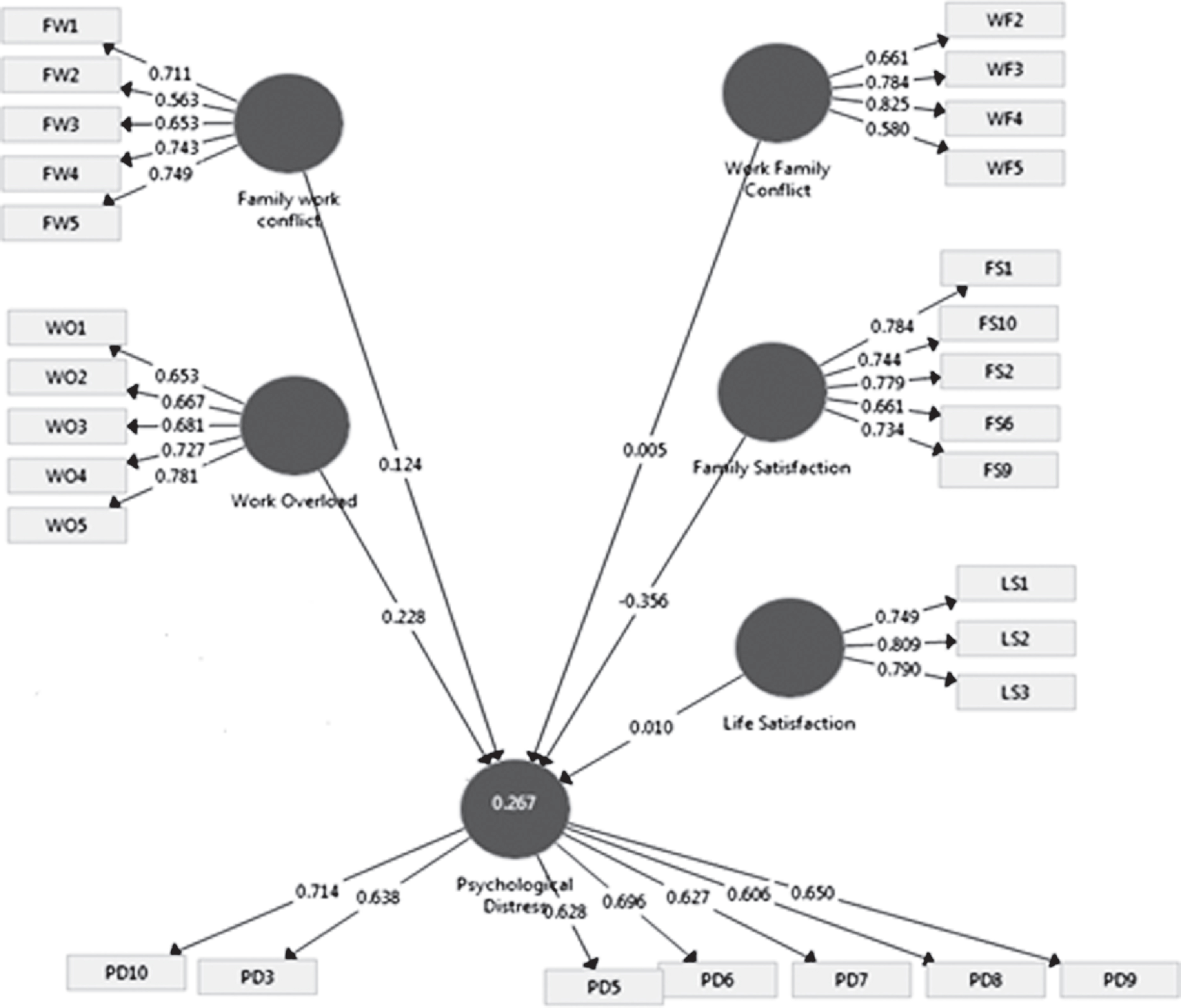
Results of second run from SMARTPLS3.1.
F2, Q2, R2effects
To verify the predictive orientation of the model, the Stone-Geisser’s Q2 is used [95, 99]. The assessment of Q2 proposes predictive relevance by using sample reusing method where part of the data matrix is being omitted, and results are used to predict the omitted part. Hence, this blindfolding technique assesses the model’s predictive accuracy. The higher value of Q2 implies less deviation in estimated and original values. Hence, Q2 should be more significant than 0 [refer to Table 3] [89]. Recommended that the values of Q2, that is, the predictive indices 0.02, 0.15, and 0.35, are regarded as small, medium and large effects, respectively. Here, Q2 value of the family satisfaction was 0.05, and work overload was 0.024; it infers that family satisfaction and work overload has a low effect in predicting variance in psychological distress. Whereas, the other variables were having no effect [Table 3].
F2 is calculated to estimate the effect size [100]. Suggested that the values of f2 as 0.02, 0.15 and 0.35 are considered to have small, medium and large effects, respectively. Table 3 reflects the f2 effect size. Family-work conflict and work overload were having 0.027 and 0.048, i.e. small effect size. Whereas, family satisfaction was having 0.157 medium effect size.
To verify the postulated hypothesis and check the relationship among the constructs, the path coefficients are calculated by using the bootstrapping, t values and P values. From Table 4, it is revealed that the bootstrapping results of resampling technique [5,000 subsamples] examine the influence of work-family conflict, family-work conflict, work overload, family satisfaction and life satisfaction on psychological distress. Table 4 depicts the path coefficients, t values and P values of the proposed hypothesis. It can be seen from Fig. 3 and Table 4 that out of 5 variables, only 3 variables have t values greater than 1.96, namely family-work conflict, family satisfaction and work overload are statistically significant and positively correlated with dependent variable psychological distress. The Beta values of path coefficient help to find out the type of relation and magnitude of the relationship of independent variable with the dependent variable. Family satisfaction [–0.356] has the highest value of coefficient among all the variables followed by work overload [0.228], and family-work conflict [0.124].
Path coefficients and T statistics after Bootstrapping
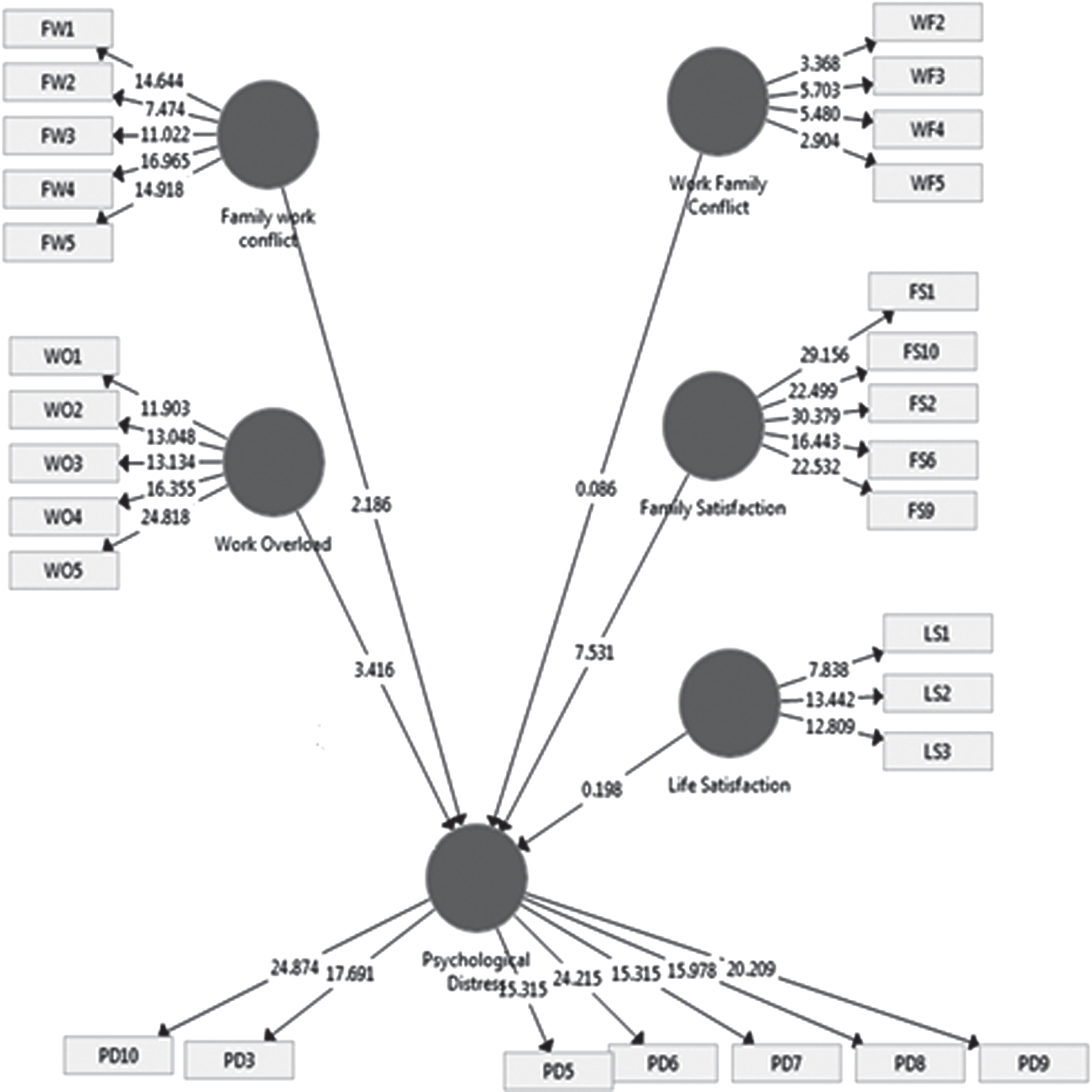
Bootstrapping results obtained through SMARTPLS3.1.
The previous section has provided empirical evidence in support of factors affecting work-life balance and its impact on psychological distress. The present section compares and contrasts the key findings with those reported in the literature.
The current study confirms that out of seven factors of work-life balance, i.e. work-family conflict, family-work conflict, job satisfaction, family satisfaction, life satisfaction, work overload and work autonomy only three factors, i.e. family-work conflict, family satisfaction and work overload were explaining psychological distress among the banking sector employees. Hence, the current study confirmed the H2, H3, and H4 only. The current study results are not confirming the past studies fully as this is a sector-specific study. Surprisingly, the current study found that work-family conflict does not impact psychological distress, whereas family-work conflict impacts psychological distress. Past three decades, the relationship between work-family conflict and stress has been studied [42, 102]. conducted a meta-analysis of 33 longitudinal studies explaining the relationship between family-work conflict/ work-family conflict with stress and strain and gave the common conclusion that family-work conflict/work-family conflict is positively associated with stress. [103] found that work-family conflict and family-work conflict were positively related to emotional exhaustion [104]. Explored that family-work conflict significantly related to stress and satisfaction among correctional officers of Southern State. Contrary to that [105] found that work demand produces less stress than family stress among Chinese employees. Another significant finding of the current study was family satisfaction is negatively associated with psychological distress. Recently [106], found that rather than only focusing on work-family conflict and its impact on outcome variables, now the researchers’ focus should be on family-work conflict as family demands are also important in achieving one’s overall well-being. The past studies confirm that as compared to work-family conflict, family-work conflict can predict psychological distress higher. As family-work conflict can be raised when there is a mismatch in demand placed by family and unable to respond to those demands, it may be negative emotional and physiological response [107]. For example, if an employee has long working hours, he cannot concentrate on housework [108], which increases negative psychological reaction to family demands [105]. Hence, it leads to the condition that an individual cannot give time to work if he/she is pre-occupied with family responsibility or demands, which leads to psychological distress.
The results of the current study seem logical when family-work conflict is affecting psychological distress along with that there is the negative impact of family satisfaction on psychological distress. It was empirically proven by [109] who tested the work-life balance model proposed by [110] that work-family conflict leads to lower job satisfaction and family satisfaction and consequently affects life satisfaction. Work-family conflict was an important concern for an individual and the organizations alike. It has negative consequences on job satisfaction and family satisfaction and leads to reduced life satisfaction. The current study found that when there is no association between work-family conflict and psychological distress, then there is also no impact of job satisfaction on psychological distress because [111] tested a mediation model consisting of job satisfaction as the dependent variable, locus of control as the independent variable and work-family conflict as the mediator. Results revealed that locus of control was related to work-family conflict and job satisfaction and work-family conflict was related to job satisfaction. Results also indicated that work-family conflict partially mediates the relationship between locus of control and job satisfaction. If there is an absence of work-family conflict, there should also be an absence of job satisfaction and life satisfaction. Another interesting finding of the current study was work overload was affecting psychological distress. It has been proven that work overload is considered as one of the organizational stressor [112–117]. In the current study, banking sector employees are having high workload irrespective of whether they belong to the public or private sectors. Long working hours, constant usage of technology, handling of customers with patience etc. are the routine processes for bankers and create psychological distress. In case of work autonomy, the nature of the banking system does not require to work with much autonomy. The current study has included employees from a low level to a middle level only where the standard procedure of the banking system is followed, and less discretion or decision-making power is devoted. Hence, work autonomy is not affecting psychological distress in the context of current research. Hence, it can be concluded that family satisfaction, family-work conflict and work overload contributed to psychological distress among banking employees.
Contributions to research and implications
The study contributes to the literature on the factors of work-life balance & stress in the banking sector. The study provides empirical support that will reduce the stress level among the banking industry employees because of the imbalance of work and life, which was supported and contrasted by other previous research in general. The study specifically provides empirical support for the relative importance of reliability of the stress management techniques for the employees in the Banking Industry. The case for work-life balance tends to be made on two counts. First, that work-life balance improves individuals’ health, well-being and job satisfaction. Second, that business can benefit from work-life balance because these policies: improve productivity and worker commitment, reduce sickness absence, increase retention rates for talented workers and reduce replacement costs, allow organizations to recruit from a wider pool of talent, enable organizations to offer services beyond usual business hours by employing workers on different shifts that fit in with caring responsibilities. The study also gives highlights to HR manager in formulating work-life balance policies and programmes for employees which will help them to retain and sustain employees in the organization.
Limitations and future research
This study has a number of limitations that need to be addressed in further studies. First, the study is limited to the banking sector only. In future research, the other industry can be taken into consideration to understand the relationship between factors affecting work-life balance and psychological distress. Second, there are many factors that affect the work-life balance. This study has included only seven factors: work-family conflict, family-work conflict, job satisfaction, life satisfaction, family satisfaction, work overload, and work autonomy. In future, other industry-specific variables can be taken to understand work-life balance. Third, the study is primarily to understand the direct relationship between factors of work-life balance and psychological distress. Hence, in the future, mediation/moderation variables can be studied to understand the direct and indirect impact of work-life balance and psychological distress factors. Fourth, the study has taken into consideration only one outcome or dependent variable, i.e. psychological distress. In future studies, other outcome variables can be taken into consideration which can be affected by factors of work-life balance. Factors such as job satisfaction also impact career satisfaction [118] and performance [119]. Fifth, the researchers have adopted a cross-sectional design. Work-life balance factors may affect long-term behaviour domains, whereas stress can be short term or time or situation-specific. In the future, the longitudinal study could explore different time effects on psychological distress, and it can make results stronger and justifiable.
Author contributions
CONCEPTION: Anushree Karani and Revati Deshpande
METHODOLOGY: Anushree Karani and Mitesh Jayswal
DATA COLLECTION: Revati Deshpande and Rasananda Panda
INTERPRETATION OR ANALYSIS OF DATA: Anushree Karani, Revati Deshpande and Rasananda Panda
PREPARATION OF THE MANUSCRIPT: All authors
REVISION FOR IMPORTANT INTELLECTUAL CONTENT: Anushree Karani
SUPERVISION: Mitesh Jayswal
Footnotes
Acknowledgments
We thank the editor, anonymous reviewers and respondents for their unprecedented support. This research received no specific grant from any funding agency.