



Abstract
Although research to date has established the criterion validity of work engagement, little research has examined relevant boundary conditions capable of altering its documented positive effects on important workplace outcomes, despite widespread appeals to do so (e.g. Parker and Griffin, 2011). In the present four-sample investigation, a competing hypotheses format was adopted, pitting against each other perspectives of ‘politics as a hindrance stressor’ and ‘politics as a challenge stressor’ as moderators of work engagement–work outcomes relationships (e.g. job tension, job satisfaction, work intensity, job performance). Cross-sample findings demonstrated that organizational politics perceptions strengthened positive work engagement–work outcomes relationships, such that engaged individuals were less stressed, more satisfied, worked with greater intensity and exhibited greater performance when they perceived their job environments to be political. This series of results affirms the challenge/opportunity stressor properties of politics perceptions for individuals more actively involved in their jobs and workplaces. Cross-disciplinary implications of these results for theory and practice, strengths and limitations, and directions for future research are provided.
Work engagement represents a relatively enduring mental state characterized by a willingness to invest cognitive, affective and physical energies toward work tasks (Christian et al., 2011). Since its introduction two decades ago, work engagement has remained a focal interest of both practitioners and academicians (Macey and Schneider, 2008). Business leaders have immersed themselves in the concept, acknowledging its impact on heightened financial performance (Macey et al., 2009). Scholars have established the validity of work engagement, documenting relationships with important work outcomes (e.g. Bakker et al, 2012; Schaufeli and Salanova, 2011).
Much of the work engagement research that has been advanced is focused on how to get employees engaged (i.e. antecedents of engagement) and the positive consequences of doing so. Nonetheless, little research has examined factors capable of tempering the desirable effects of work engagement despite appeals to do so (Parker and Griffin, 2011). This absence is notable given that employees face a number of workplace demands and stressors that have the potential to impede engaged individuals from reaping the benefits and/or rewards from their personal investments of their full selves and energies. Therefore, we hope to extend prior research on work engagement to examine how engaged individuals respond to one specific source of workplace stress; namely, organizational politics perceptions.
We chose to examine politics perceptions as a boundary condition of work engagement–work outcomes relationships because politics perceptions represent an omnipresent and inescapable feature of organizational life (Hall et al., 2004; Rosen and Levy, 2013). Moreover, politics perceptions have been associated with a host of workplace outcomes (Miller et al., 2008; Chang et al., 2009) and, consequently, have wide-ranging implications for individuals and the organizations that employ them (Kacmar and Baron, 1999). In further support of our examination of politics perceptions as a stressor capable of shifting the relationship between engagement and work outcomes, research indicates that politics perceptions are capable of producing unwanted consequences when perceived at excessive levels (Hochwarter et al., 2010).
By their nature, engaged individuals have stores of personal and job resources and enhanced cognitive and behavioral repertories as a function of their positive emotions (Bakker and Demerouti, 2008; Schaufeli et al., 2001). Thus, on one hand, they should have sufficient resources to cope with the stress of perceived politics. On the other hand, however engaged individuals have a lot of ‘skin in the game’, as they have invested their full selves and energies into their work. As a result, engaged employees might perceive politics as an additional tax on their already large resource investments. This dichotomy echoes that of the hindrance and challenge stressor distinction raised by Cavanaugh et al. (2000), and more recently within the work engagement literature by Crawford et al. (2010). Accordingly, research suggests that individuals’ responses to stressors will differ depending on whether the stressor is appraised as personally beneficial (i.e. a challenge) or personally detrimental (i.e. a hindrance).
Therefore, we developed a four-sample investigation to examine the role of perceived politics on employee work engagement–work outcomes relationships. However, given the likelihood that engaged individuals could perceive politics as either a hindrance or challenge stressor, a competing hypotheses format was developed. As such, we develop arguments that engaged individuals will perceive politics as hindrance stressors that represent barriers to personal goal attainment and impede the likelihood that resource (e.g. energy) investments will be rewarded (i.e. politics perceptions attenuates the positive relationship between work engagement and work outcomes). On the other hand, we argue that engaged individuals will perceive politics as challenge stressors that provide increased opportunities for learning, development and achievement (i.e. politics perceptions strengthens the positive relationship between work engagement and work outcomes).
In doing so, we contribute to the work engagement literature by investigating a previously unexamined boundary condition capable of altering the previously established relationships of work engagement and numerous auspicious workplace outcomes. In addition, we extend the politics perceptions literature to examine whether it is appropriate to automatically classify politics perceptions as a hindrance stressor without regard for the characteristics of the individuals who perceive it. Although organizational politics have been exemplified as a quintessential hindrance stressor (e.g. Cavanaugh et al., 2000; LePine et al., 2005), it is undoubtedly shortsighted to suggest that all individuals perceive politics as barriers to personal achievement and/or growth, especially as more recent balanced views suggest organization politics’ influence on ‘getting things done’ makes it an essential element of organizational life (Pfeffer, 2010). Moreover, in keeping with Ferris et al. (2002: 227), it is unlikely that politics perceptions always would be interpreted as a hindrance stressor as politicking ‘may lead to a positive view of climate if participation uncovers favorable elements of the work context.’
Background theory and research
Work engagement
Definitions of work engagement permeate the literature (Saks, 2006). For example, Kahn (1990: 700) described the construct as ‘the simultaneous employment and expression of a person’s “preferred self” in task behaviors that promote connections to work and to others, personal presence (physical, cognitive and emotional) and active, full performances.’ Bakker and Demerouti (2008) described engaged individuals as mentally resilient and energetic, viewing work as both challenging and meaningful. In line with recent discussions, we consider work engagement as ‘a relatively enduring state of mind referring to simultaneous investment of personal energies in the experience or performance of work’ (Christian et al., 2011: 95).
Scholars have affirmed that engagement is self-determining and motivating, representing a personal allocation of resources used to secure desired outcomes (Halbesleben et al., 2009). In support of favorable effects on work outcomes, meta-analytic research has documented bivariate relationships between engagement and satisfaction, productivity, profit and turnover (Christian et al., 2011; Harter et al., 2002). Extending these results, scholars have argued that employee engagement–consequences relationships depend upon potential boundary conditions, with challenge and hindrance demands serving as distinct antecedents (Crawford et al., 2010). These results have triggered calls for research identifying moderators that serve to either encourage or discourage the assumed positive influence of work engagement (Sonnentag et al., 2012).
Organizational politics
In this research, we share the view of Buchanan and Badham (2008) who questioned the dichotomization (e.g. ‘legitimate’ versus ‘illegitimate’; ‘good’ versus ‘bad’) of the politics perceptions construct. Instead, according to the transactional theory of stress (Lazarus and Folkman, 1984), all stressors initiate an appraisal process; the coping process undertaken to deal with a stressor and the resultant outcomes of such a coping process differ as a function of how the stressor is appraised. Accordingly, the manner in which individuals appraise politics, as either a hindrance or a challenge stressor, will determine their affective and behavioral responses (Ferris et al., 2002; Sacramento et al., 2013).
In the following sections, we develop competing perspectives concerning the influence of politics perceptions on numerous engagement–outcome relationships. The first perspective positions politics as a hindrance stressor that impedes engagement’s positive effects. The second perspective positions politics as a challenge stressor that supports engagement’s favorable effects. Although each perspective boasts its own definition of politics perceptions, both view them as subjectively perceived and experienced organizational phenomena that are pervasive and impactful (Hochwarter, 2012).
Competing theoretical perspectives
Perspective one: Detrimental effects of politics perceptions on work engagement
Organizational politics have been described as a pejorative, dysfunctional and unwelcome aspect of organizational life associated with back-room maneuvering and competition over scarce resources (Buchanan and Badham, 2008). Politics perceptions refer to individuals’ beliefs that such behaviors characterize their workplace, regardless of whether this is indicative of the objective reality (Ferris et al., 2002). Meta-analytic research has found that these perceptions are negatively related to performance, citizenship, affective commitment and job satisfaction, while positively related to both strain and turnover intentions (Chang et al., 2009).
Accordingly, politics perceptions have been categorized as a strain-inducing hindrance stressor, capable of threatening goal attainment and personal growth (Crawford et al., 2010), as well as for infusing uncertainty, ambiguity and job insecurity (LePine et al., 2005). Hindrance stressors refer to demands or circumstances that arise from work that either hamper or impede individuals’ personal goal attainment and/or growth (Boswell et al., 2004). Hindrance stressors are appraised as potentially harmful to one’s achievement and well-being, and consequently, they engender negative emotions and subsequent passive coping styles (Rosen and Levy, 2013).
Extending this discussion, politics perceptions can be interpreted as a hindrance for engaged employees due to the recognition of achievement-depleting demands. Work engagement reflects individuals’ willing investment and dedication of resources/energy (Christian et al., 2011). However, the simple act of engagement does not elicit positive outcomes exclusively. Historically, scholars have described politics in the work engagement process as a barrier that hinders goal achievement (Bouckenooghe, 2012). Accordingly, the obstacles associated with organizational politics may render the favorable attributes of work engagement largely ineffectual. More directly, this perspective argues that politics hinder the motivational properties of engagement and, in fact, may cause those reporting heightened engagement activities to realize negative affective and behavioral consequences.
Accordingly, perceived politics is considered a hindrance stressor because it threatens individuals’ goal attainment by blurring the assumed linear contribution–work outcome relationships (Cropanzano et al., 1997; Zivnuska et al., 2004). When present, politics perceptions obstruct the accrual of resources such as pay, recognition and support needed to cope and flourish (Halbesleben and Wheeler, 2006). Moreover, desired outcomes are not as highly coupled with objective factors warranting merit (e.g. performance), a fact supported by research finding politics perceptions to be negatively related to formalization and participative decision making (Aryee et al., 2004; Cropanzano and Li, 2006).
Due to its appraisal as a hindrance stressor, we hypothesize that engaged individuals will experience dissatisfaction and job tension. 1 Additionally, as a means to protect and conserve their existing resource investments (i.e. of their full energies), we hypothesize that engaged individuals will reduce the intensity with which they work as well as the quality with which they complete their work (i.e. job performance). 2 In support, hindrance stressors have been consistently associated in prior research with ineffective coping, dissatisfaction and substandard performance (Chang and Lyons, 2012). Further, hindrance stressors have been shown to trigger negative affective states and reduce individuals’ ability to cope with negative contextual features (Crawford et al., 2010). Thus, we hypothesize that engaged individuals will experience less satisfaction and more tension when environments are perceived as political. Specifically, hindrance properties of the political environment are likely to render work as less meaningful (Cole et al., 2012), thus causing work energies to become increasingly ineffectual.
Moreover, we argue that politics perceptions will attenuate the positive relationship between work engagement and both job performance and work intensity. Whereas research indicates that engaged individuals will be more inclined to dedicate themselves fully to their work tasks with intensity and persistence (e.g. Rich et al., 2010), politics perceptions should reduce engaged individuals’ desire to do so, given that organizational politics oftentimes obstruct the availability and access to resources needed to perform (Halbesleben and Wheeler, 2006) and hinder the accrual of desirable rewards (e.g. compensation, recognition) in exchange for individuals’ contributions (Crawford et al., 2010).
In support of this notion, research suggests that hindrance stressors reduce motivation as they are, by definition, appraised as being impossible to overcome through hard work and/or increased effort (LePine et al., 2005). In sum, we suggest that heightened politics perceptions may serve as a hindrance to personal fulfillment stemming from work engagement. Based on this discussion, the following hypotheses are offered:
Hypothesis 1a: The negative relationship between work engagement and job tension will become stronger as politics perceptions increase.
Hypothesis 1b: The positive relationship between work engagement and job satisfaction will become weaker as politics perceptions increase.
Hypothesis 1c: The positive relationship between engagement and work intensity will become weaker as politics perceptions increase.
Hypothesis 1d: The positive relationship between engagement and performance will become weaker as politics perceptions increase.
Perspective two: Favorable effects of politics perceptions on work engagement
Alternatively, not all views of organizational politics have been negative. Ferris and Judge (1991) defined politics as the management of shared meaning, whereas Valle and Perrewé’s neutral definition described politics as ‘the exercise of tactical influence which is strategically goal directed, rational, conscious and intended to promote self-interest, either at the expense of or in support of others’ interests’ (2000: 361). Hochwarter (2012) argued for several favorable characteristics of organizational politics, including the identification and accumulation of resources otherwise left dormant. In keeping with the positive perspective, research has demonstrated that a critical level of politics is needed to activate attention and mobilize energies (Hochwarter et al., 2010). Thus, rather than prematurely and automatically applying a hindrance label, research suggests that individuals’ unique appraisal of the stressor should determine politics perceptions’ eventual influence (Lazarus and Folkman, 1984; Perrewé et al., 2012).
As such, we argue that engaged employees are likely to appraise organizational politics as challenge stressors. Challenge stressors refer to demands or circumstances that arise from work that have the potential to provide opportunities for personal gain, growth, learning and accomplishment (LePine et al., 2005). As found in past research, challenge stressors are associated with positive emotions and effective coping strategies (Crawford et al., 2010). Challenge stressors, like their hindrance stressor counterparts, are strain-provoking. However, individuals who are able to meet the demands associated with challenge stressors experience a sense of accomplishment, fulfillment and mastery (Webster et al., 2011).
We hypothesize that engaged individuals will perceive politics as a challenge, rather than a hindrance. It is through the engagement process that information gathering and meaning construal reduces the ambiguity characteristically associated with politics perceptions (e.g. Ferris et al., 1989), thus, allowing employees to return to a pre-trauma state (Parker and Griffin, 2011). However, beyond survival, we argue that engaged employees perceive ambiguity associated with others’ politicking as a strategic advantage (Ferris and Hochwarter, 2011) not capitalized on by those less invested at work. In support, Macey and Schneider (2008) suggested that work engagement matters the most when individuals are faced with uncertainty.
Moreover, we argue that engaged individuals will perceive politics as a challenge capable of providing them opportunity for personal advancement as they have stores of personal resources that enable them to exercise influence over pertinent work events (Bakker and Demerouti, 2008). In support, Schaufeli et al. (2001) found engaged individuals to be both highly efficacious and highly energetic. Further, engaged individuals have been shown to experience positive emotions, which, according to broaden-and-build theory of positive emotions (Fredrickson, 2001), contribute to their enhanced cognitive and behavioral repertoires (Fredrickson and Branigan, 2005; Isen, 2000). Thus, as a function of their enhanced cognitive and behavioral repertoires, as well as their stores of personal resources, engaged individuals should be able to navigate the political arena and secure resources and opportunities otherwise not available to those less invested in their work.
Additionally, given its motivational properties (e.g. focus, enthusiasm and passion; Macey and Schneider, 2008), work engagement may be particularly useful in both detecting and securing resources in settings characteristically ambiguous and amenable to individual interpretation. Similarly, organizations perceived to be political are thought to stimulate power-, status- and achievement-seeking behaviors (Kumar and Ghadially, 1989) – attributes often associated with engagement (Mills et al., 2012). Thus, those who have invested personal, social and tangible resources at work should realize opportunities for personal growth and gain afforded by organizational politics.
Therefore, as a result of appraising politics perceptions as a challenge, we hypothesize that engaged individuals will experience more satisfaction and less tension. In support, meta-analytic research suggests that challenge stressors are associated with job satisfaction (LePine et al., 2005) and reduced turnover intentions (Podsakoff et al., 2007). Additionally, because politics provides engaged individuals with additional opportunities for growth, advancement and achievement, we suggest they will be motivated to work with more intensity and perform better, as such efforts will be instrumental in managing the demands of organizational politics and subsequently procuring benefit. In support, research suggests that challenge stressors increase engaged individuals’ willingness to dedicate their full selves to task performance, as individuals perceive that their dedication of such energies will be rewarded (LePine et al., 2005). Based on this discussion, the following hypotheses are offered:
Hypothesis 2a: The negative relationship between engagement and job tension will become weaker as politics perceptions increase.
Hypothesis 2b: The positive relationship between engagement and satisfaction will become stronger as politics perceptions increase.
Hypothesis 2c: The positive relationship between engagement and work intensity will become stronger as politics perceptions increase.
Hypothesis 2d: The positive relationship between engagement and performance will become stronger as politics perceptions increase.
Development of the present multi-sample investigation
Given the research objectives, a multiple-sample approach was developed. Researchers advocate the use of replication when testing competing hypotheses to generate confidence in study results (e.g. Miller and Tsang, 2011). Second, this approach allowed us to mitigate many of the problems associated with single-source designs (Hochwarter et al., 2011). Further, multiple studies provide for constructive replication opportunities, which purposely alter methods and measures of substantive constructs (Hunter and Schmidt, 2004). For example, both negative (Samples 1–3) and neutral forms of politics perceptions (Sample 4) were assessed. Also, self- (Samples 1–3) and other-source performance (Sample 4) indices were incorporated.
Method
Participants and procedures
Sample 1
Surveys were distributed to all 194 members of a state agency located in the USA via intra-office mail. The agency’s focus was directed largely at natural resource issues. A cover letter from the head of the agency, as well as one designed by the researchers, accompanied the instrument. Also contained in the survey packet was a stamped return envelope. After two weeks, 163 surveys were received (response rate = 84%). Respondents averaged 48 years of age (M = 47.94, SD = 8.31) and 10 years of organizational tenure (M = 9.77, SD = 8.20). Women comprised 49 percent of the sample. Archival data provided by the organization indicated minimal sample-population differences with respect to age (M = 46.89, SD = 6.78) and 11 years of organizational tenure (M = 10.76, SD = 4.58).
Sample 2
Surveys were distributed to all 217 members of a financial management organization (based in the USA) attending their association’s national conference. (One study author was a presenter. None of the research content was directly discussed during the sessions.) Most participants were middle- to upper-level managers. Two drop boxes were provided on site. We received a total of 170 completed surveys (response rate = 78%). Respondents averaged 43 years of age (M = 43.21, SD = 6.05) and 10 years of organizational tenure (M = 7.42, SD = 6.12). Women comprised 44 percent of the sample. Archival data provided by the organization indicated minimal sample-population differences with respect to age (M = 45.15, SD = 5.89) and eight years of organizational tenure (M = 8.18, SD = 6.89).
Sample 3
Surveys were sent out to 450 randomly chosen business school alumni of a university located in southern USA. All applicable academic disciplines were included (e.g. accounting, finance, management). After three weeks, a total of 230 surveys were returned (response rate = 51%). Respondents averaged 50 years of age (M = 50.03, SD = 6.42) and 13 years of organizational tenure (M = 12.94, SD = 9.04). Women comprised 45 percent of the sample. Data offering sample–population characteristics were unavailable.
Sample 4
A total of 249 administrative employees of a health care facility in southern USA received surveys in their mailbox along with a stamped envelope addressed to the researchers. Management was supportive of the research and allowed each employee work time for participation. After three weeks, 141 completed surveys were returned (response rate = 57%). One month after the survey data were collected, archival performance data were provided. Respondents averaged approximately 48 years of age (M = 48.25, SD = 7.10) and eight years of organizational tenure (M = 8.10, SD = 6.38). Women comprised 52 percent of the sample.
Measures
Work engagement (Samples 1–4)
Work engagement was measured using a five-item scale developed by Saks (2006). ‘I really “throw” myself into my job’ represents a scale item (Sample 1, α = .88; Sample 2, α = .90; Sample 3, α = .84; Sample 4, α = .88). A seven-point response format was used ranging from strongly disagree (1) to strongly agree (7).
Politics perceptions (Samples 1–3)
Perceptions of organizational politics were measured using a six-item scale developed by Hochwarter et al. (2010). Sample items include: ‘At work, there is a lot of self-serving behavior going on’ (Sample 1, α = .88; Sample 2, α = .90; Sample 3, α = .86). Possible responses ranged from strongly disagree (1) to strongly agree (5).
Politics perceptions (Sample 4)
Consistent with prior research (Hochwarter et al., 2003), politics perceptions were measured using a single item. Participants responded to the prompt ‘How much political activity takes place in your organization?’ A seven-point response format was used ranging from no politics exists (1) to excessive politics exist (7).
Job tension (Samples 1–3)
Job tension was measured with House and Rizzo’s (1972) six-item scale. ‘I work under a great deal of tension’ represents a scale item (Sample 1, α = .82; Sample 2, α = .89; Sample 3, α = .90). A five-point response format was used ranging from strongly disagree (1) to strongly agree (5).
Job satisfaction (Samples 1–3)
Job satisfaction was measured with a five-item subscale of Brayfield and Rothe’s (1951) index. ‘Each day of work seems like it will never end’ (reversed scored) represents a scale item (Sample 1, α = .87; Sample 2, α = .85; Sample 3, α = .83). Responses ranged from strongly disagree (1) to strongly agree (5).
Work intensity (Samples 1–3)
We used Brown and Leigh’s (1996) five-item scale to measure work intensity. ‘When there’s a job to be done, I devote all of my energy to it’ represents a sample item (Sample 1, α = .88; Sample 2, α = .84; Sample 3, α = .91). Responses ranged from 1 (strongly disagree) to 5 (strongly agree).
Job performance (Sample 4)
Three items from the company’s evaluation form measured performance. Items included ‘This employee produces positive results for this organization on a consistent basis,’ ‘This employee can be counted on to produce timely and high quality work’ and ‘This employee provides services that meet or exceed patient/constituency expectations’ (α = .74). Responses ranged from 1 (poor/unacceptable) to 5 (exceeds expectations). Because some of the 141 employee performance scores were obtained from the same supervisor (M = 2.79, SD = .97, Range = 1–6), we tested for data independence by partitioning scores into within- and between-supervisor variance (LaHuis and Avis, 2007). The ICC(1) score, which indexed the amount of explained supervisor-level variance, was .12. The ICC(2) score, which assesses employee substitutability across ratings, was .43. Taken together, these findings provide robust support for the independence of supervisor ratings (Bliese, 1998; Klein and Kozlowski, 2000).
Demographic/affect control variables (Samples 1–4)
Age, gender and organizational tenure served as control variables given their association with both independent (Van den Broeck et al. (2011) and dependent (Hochwarter et al., 2010) variables. As recommended by Perrewé and Spector (2002), we controlled for negative affect (NA) and positive affect (PA) to circumvent problems associated with biasing effects (Podsakoff et al., 2003). Scholars maintain that stressor–strain relationships are often confounded by affectivity (e.g. Fritz and Sonnentag, 2006), especially in cross-sectional research (Watson and Pennebaker, 1989). Moreover, documented relationships between affectivity and this study’s substantive variables have been observed in prior research (e.g. Hochwarter et al., 2010), supporting their inclusion as control variables.
Affective disposition (Samples 1–4) was measured using the 20-item Positive and Negative Affect Scale (PANAS, Watson et al., 1988). Participants indicated how they felt, in general, by responding to words such as distressed and nervous for NA (Sample 1, α = .90; Sample 2, α = .85; Sample 3, α = .92; Sample 4, α = .83) and enthusiastic and attentive for PA (Sample 1, α = .88; Sample 2, α = .91; Sample 3, α = .85; Sample 4, α = .87). A five-point response format was used ranging from strongly disagree (1) to strongly agree (5).
Given the potential for overlap between engagement and each sample’s outcome variables, factor analyses (i.e. principal axis factoring) were conducted for each of the samples. In each sample, items loaded on their prospective factors, explaining between 74.4 percent and 85.2 percent of underlying variance. Also, all items correlated at a level greater than .63 and no meaningful cross-loadings were confirmed across the four samples. Consequently, evidence for discriminant validity was confirmed.
Hierarchical moderated regression analyses (Cohen et al., 2003) were conducted to examine interactive engagement × politics perceptions relationships. Age, gender and organizational tenure were included in the first step, while affectivity was examined in Step 2. Step 3 contained engagement and politics perceptions main effect terms. Cortina (1993) noted that bivariate interactions in multiple regression may be significant due to their overlap with unmeasured nonlinear main effect terms. Further, Edwards (2008) encouraged scholars to consider nonlinear terms as a general rule when conducting regression analyses to supplement linear conceptualizations. In response, non-linear main effect terms were included in Step 4. The final step consisted of the work engagement–politics perceptions interactive term. Finally, collinearity diagnostics (i.e. variance inflation factor [VIF], tolerance) were examined to identify method effects. VIF scores less than 10 typically are considered acceptable whereas tolerance scores below .10 provide evidence of multicollinearity (Tabachnick and Fidell, 2001).
Results
Table 1 reports descriptive statistics and correlations among sample variables. Constructs correlated similarly to what has been found in prior research (Hochwarter and Thompson, 2012), and relationships between predictor (e.g. engagement and politics perceptions) and outcome (e.g. tension, satisfaction, intensity and performance) variables were modest in magnitude.
Means, standard deviations and intercorrelations among Sample 1–4 variables.
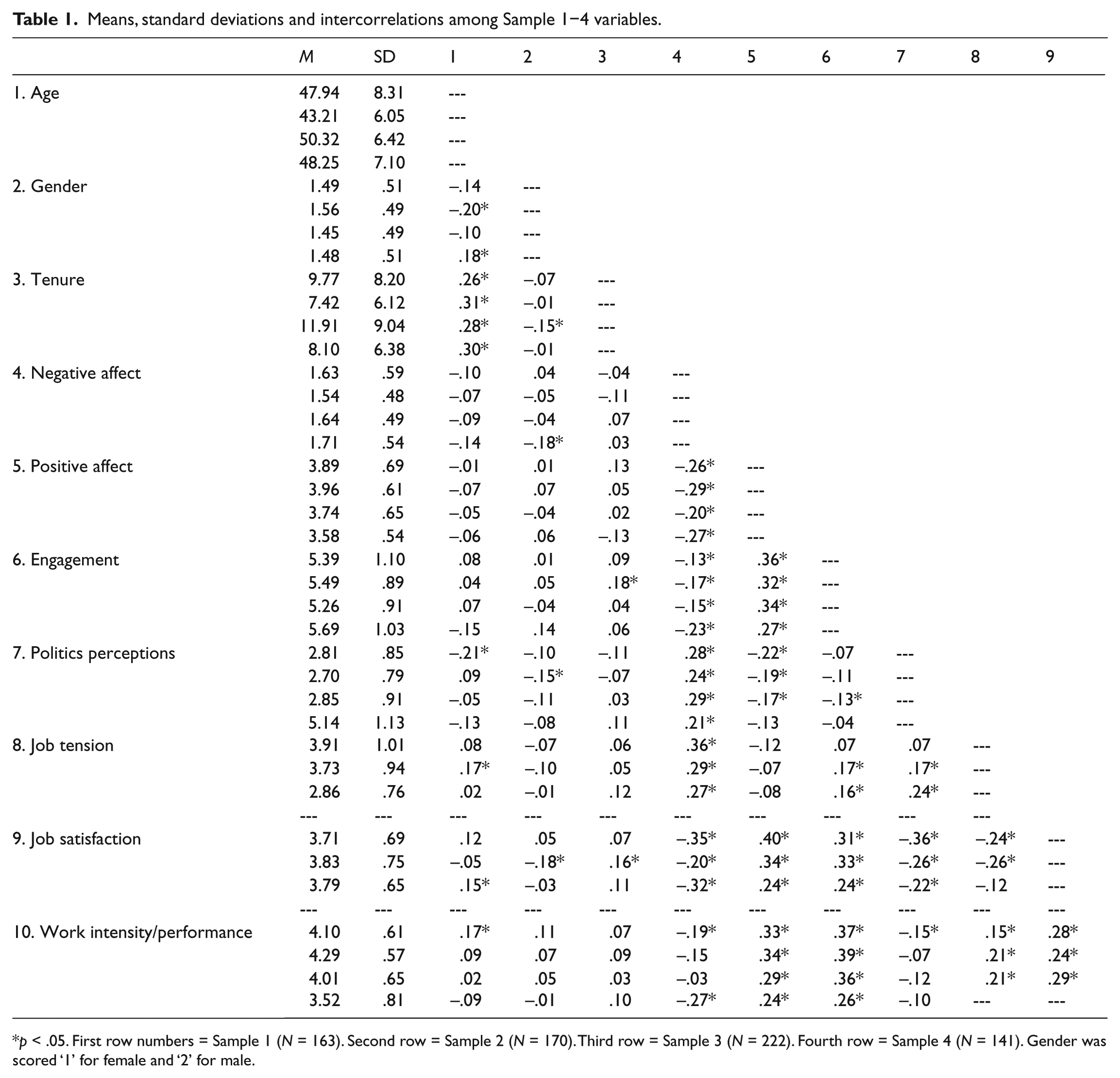
p < .05. First row numbers = Sample 1 (N = 163). Second row = Sample 2 (N = 170). Third row = Sample 3 (N = 222). Fourth row = Sample 4 (N = 141). Gender was scored ‘1’ for female and ‘2’ for male.
Sample 1 results
For Sample 1, regression analyses (Table 2) indicated that work engagement–politics perception interaction term predicted job tension (β = -.09, p < .05, ΔAdjR2 = .02, p < .05), job satisfaction (β = .11, p < .01, ΔAdjR2 = .03, p < .01) and work intensity (β = .12, p < .01, ΔAdjR2 = .04, p < .01) in subsequent final steps. With the highest VIF score being less than 1.7 and the lowest tolerance score in excess of .50, evidence of multicollinearity was minimal.
Hierarchical regression analyses.
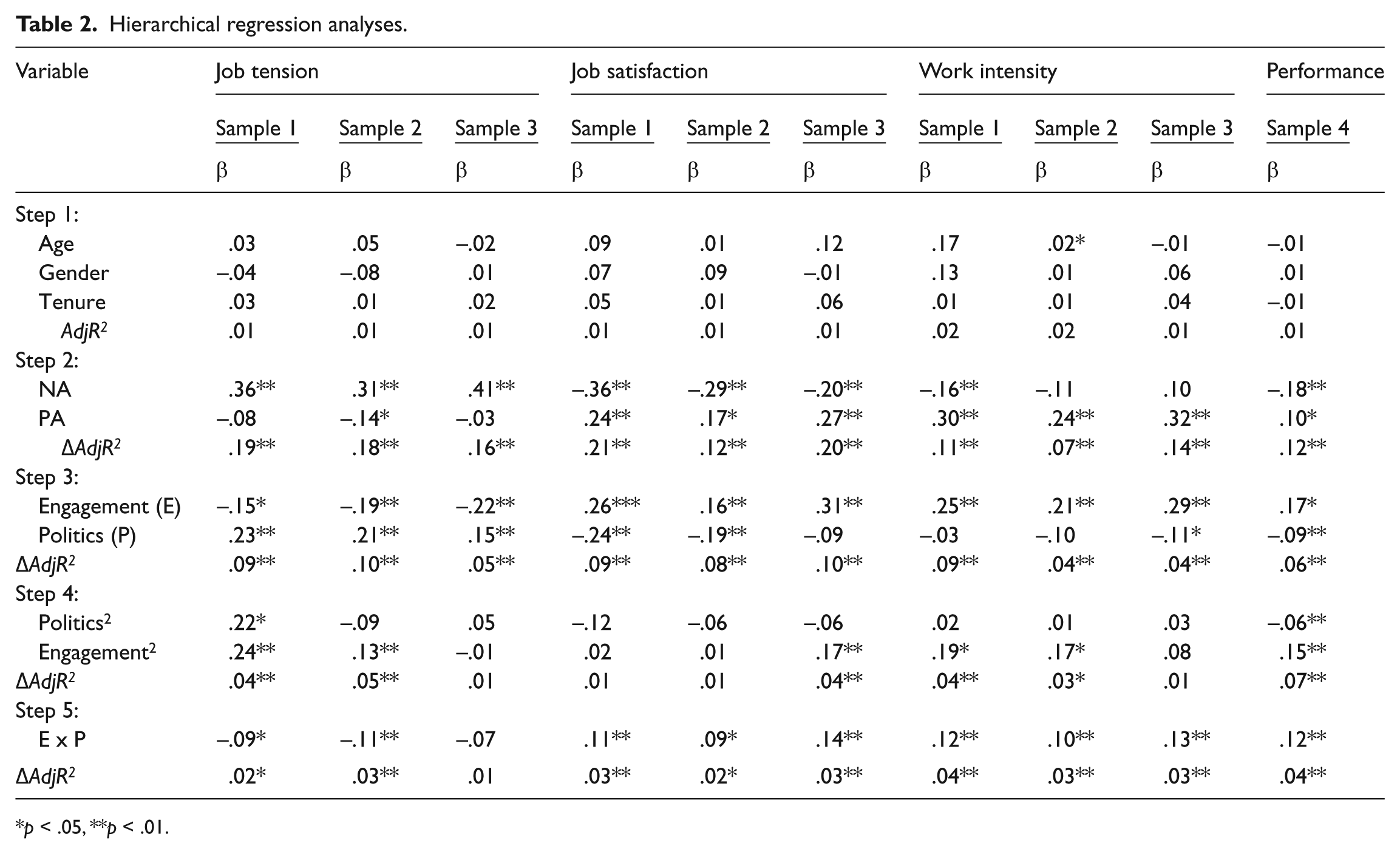
p < .05, **p < .01.
Post-hoc tests
To examine the form of the interaction effects, simple slope tests were conducted (Aiken and West, 1991). Figure 1 illustrates the significant effects on each outcome for Sample 1. At high levels of politics, work engagement favorably predicted job tension (β = -.19, p < .05), job satisfaction (β = .22, p < .01) and work intensity (β = .17, p < .05). Conversely, work engagement showed no significant relationship with any outcome for those reporting low levels of politics (job tension β = -.07, not significant; job satisfaction β = .04, not significant; work intensity β = .09, not significant).
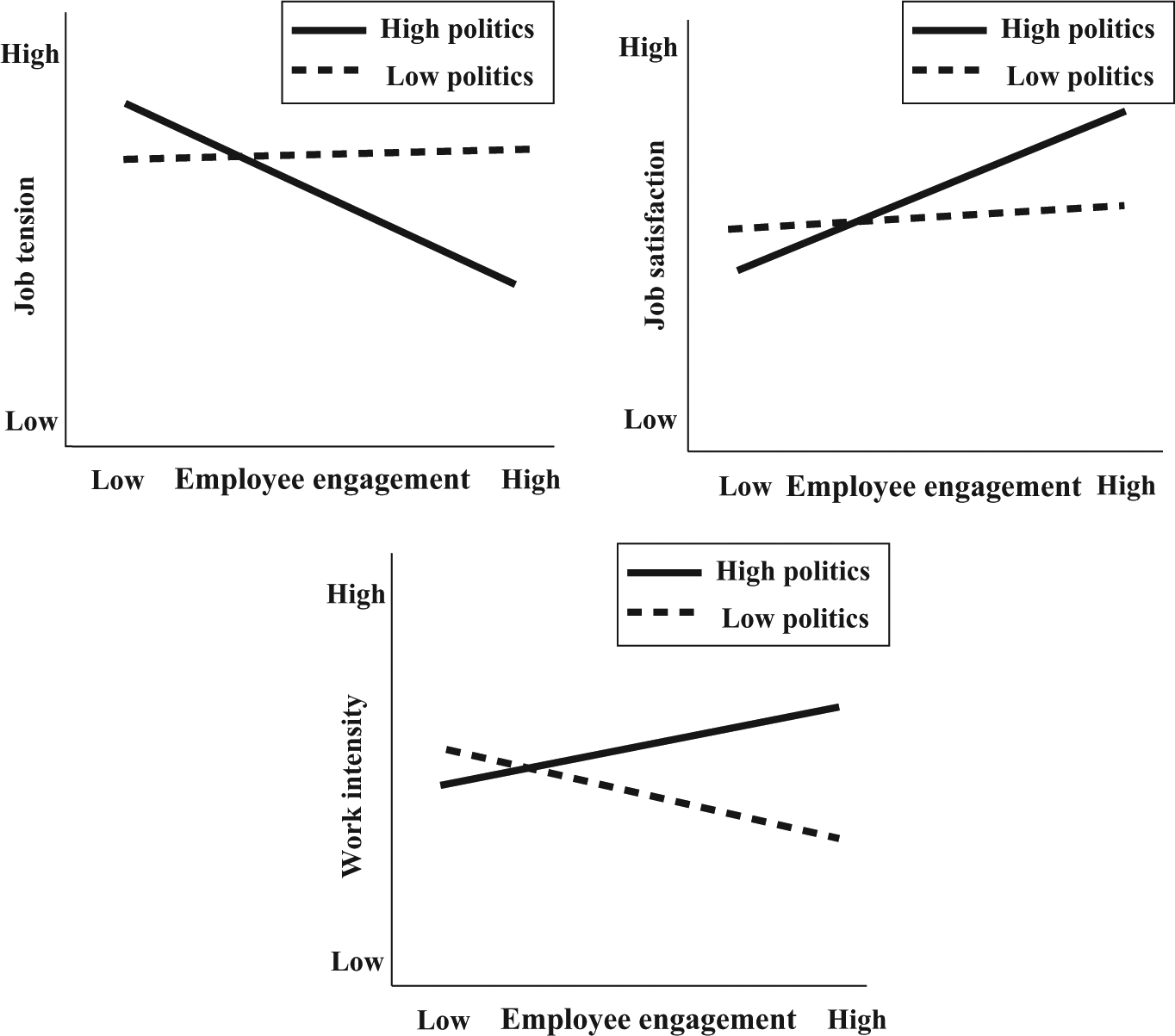
Interactive effects of employee engagement and politics perceptions on workplace outcomes (Sample 1).
Sample 2 results
For Sample 2, regression analyses indicated that the work engagement × politics perceptions interaction term predicted job tension (β = -.11, p < .05, ΔAdjR2 = .02, p < .05), job satisfaction (β = .09, p < .05, ΔAdjR2 = .02, p < .05) and work intensity (β = .10, p < .01, ΔAdjR2 = .03, p < .01) in subsequent final steps. With the highest VIF score being less than 1.9 and the lowest tolerance score in excess of .60, evidence of multicollinearity was minimal.
Post-hoc tests
Slope tests were conducted on the significant interactions shown in Figure 2. Work engagement positively predicted job tension (β = −.21, p < .01), job satisfaction (β = .23, p < .05) and work intensity (β = .17, p < .05) when politics perceptions were high. Alternatively, work engagement negatively influenced job tension (β = .15, p < .05) and job satisfaction (β = −.19 p < .05) for employees reporting low levels of politics. Finally, work engagement was not significantly related to work intensity (β = .04, not significant) when politics were perceived as low.
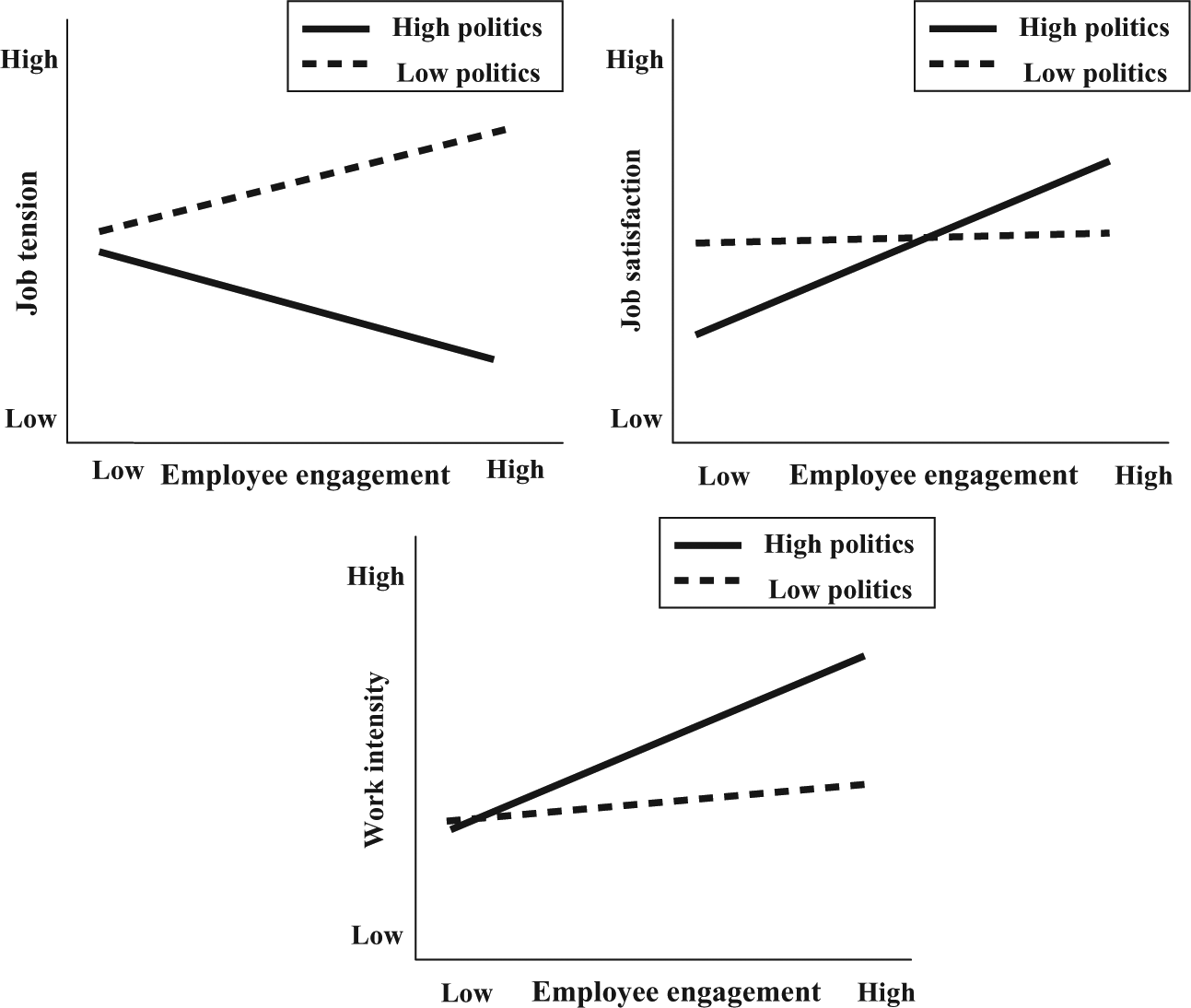
Interactive effects of employee engagement and politics perceptions on work outcomes (Sample 2).
Sample 3 results
For Sample 3, regression analyses indicated that the work engagement × politics perceptions term approached significance in predicting job tension (β = -.09, not significant), and significantly predicted both job satisfaction (β = .14, p < .01, ΔAdjR2 = .03, p < .01) and work intensity (β = .13, p < .01, ΔAdjR2 = .03, p < .01) in subsequent final steps. With the highest VIF score being less than 1.6 and the lowest tolerance score in excess of .80, evidence of multicollinearity was minimal.
Post-hoc tests
Slope tests were conducted on the significant interactions shown in Figure 3. Work engagement positively predicted job tension (β = -.17, p < .05), job satisfaction (β = .24, p < .01) and work intensity (β = .26, p < .01) when politics were perceived as high. In low politics perceptions conditions, work engagement predicted heightened job tension (β = .18, p < .05). Relationships of work engagement with job satisfaction (β = .02, not significant) and work intensity β = .05, not significant) were not significant when politics perceptions were low.

Interactive effects of employee engagement and politics perceptions on work outcomes (Sample 3).
Sample 4 results
Regression analyses indicated that the work engagement × politics perceptions term predicted supervisor-rated performance (β = .12, p < .01, ΔAdjR2 = .04, p < .01). With the highest VIF score being less than 1.8 and the lowest tolerance score in excess of .90, evidence of multicollinearity was minimal.
Post-hoc tests
Figure 4 illustrates the significant interaction. At high levels of politics perceptions, engagement was positively associated with job performance (β = .20, p < .05). At low levels of politics perceptions, the work engagement–performance relationship remained largely unchanged (β = .07, not significant).
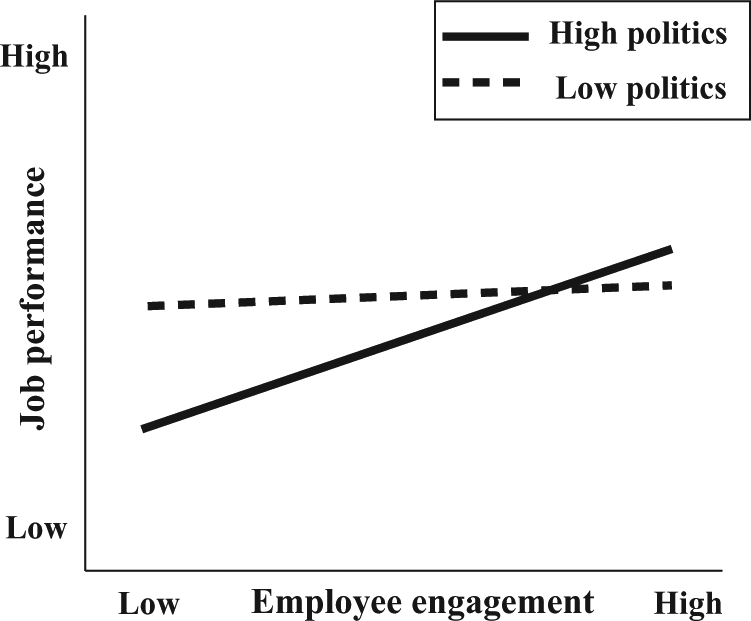
Interactive effects of employee engagement and politics perceptions on job performance (Sample 4).
Discussion
Contributions to theory and research
On the one hand, results from this multi-study investigation found, in general, that when politics perceptions were low, individual work outcomes were consistent across engaged and less-engaged/non-engaged individuals. On the other hand, employees’ attitudes and behaviors of less engaged employees were adversely affected when work environments were perceived as political. Thus, these results suggest that politics perceptions should not be automatically categorized as a hindrance stressor, especially without considering characteristics of the individuals tasked with their appraisal. This is in keeping with the transactional theory of stress (Lazarus and Folkman, 1984), which suggests that individuals’ subjective appraisal is critical in determining whether stressors will be perceived as personally harmful (i.e. hindrances) or personally beneficially (i.e. challenges). Results across four studies confirmed the latter perspective. Specifically, organizational politics represent a challenge stressor for individuals engaged in their jobs.
Further, this research contributes to the growing body of empirical work (e.g. Christian et al., 2011) contributing to the nomological network of work engagement (Rich et al., 2010). Recently, Parker and Griffin (2011) appealed for research examining situations in which desired consequences are not always associated with engagement. Further, Bakker et al. (2011) requested clarity with respect to the moderators of work engagement–job performance relationships, whereas May et al. (2004) questioned whether ambiguous and threatening elements of work would trigger disengagement. Finally, the present research addresses Rosen et al.’s (2009) contention that politics represent a particular boundary condition capable of impacting engagement’s relationship with important outcomes. Each of the aforementioned recommendations and suppositions was addressed in this research to varying degrees.
Moreover, in response to recent appeals (e.g. Ferris and Hochwarter, 2011), this multi-study investigation examined perceptions of politics as a moderator of the relationships between engagement and important work outcomes. Convergent results from four samples demonstrated that perceptions of organizational politics strengthened auspicious work engagement–outcomes relationships. In terms of contributions, these results provide evidence for viewing the challenge and activation properties of organizational politics for individuals engaged in their jobs. In support, Kacmar et al. (in press) argued that goal accomplishment is more accessible for those immersed in political settings.
Documenting the favorable effects of engagement in contexts often described as threatening, unfair and potentially intimidating (Harris et al., 2007; Kipnis et al., 1980) has considerable potential to expand the existing research base. Sensemaking researchers affirm that those immersed in work benefit most in taxing contexts by interpreting potential threat as an opportunity (Fredrickson, 2004). Sonenshein and Dholakia (2012: 4) argue, however, that the favorable construal of threat is far from universal, recognizing that ‘there is variance in the degree to which individuals construct events as positive and relates this to more adaptive outcomes.’ Pending further study, it is plausible that an employee’s level of engagement represents much of the unexplained variance in this regard.
Strengths and limitations
The present investigation has numerous strengths, most notable of which was the consistency of findings across four unique samples that differed in breadth, occupational status and measurement of focal constructs. Confirming equivalent results with varying operationalizations of constructs and settings increases study validity relative to single-study designs. In this regard, we agree with McKinley (2010) who argued that an ‘examination should not be considered complete after the first empirical test – repeated testing and replication should take place to converge on the explanation that has greater empirical validity’ (2010: 63).
Moreover, controlling for NA and PA across studies was necessary given their previously documented overlap with work engagement (Macey and Schneider, 2008) and politics perceptions (Hochwarter et al., 2010). Additionally, the potential for non-linear relationships was considered and results indicated evidence for further exploration. For example, work engagement demonstrated non-linear relationships with job tension (Samples 1 and 2; U-shaped form), job satisfaction (Sample 3; U-shaped form), work intensity (Samples 1 and 2; U-shaped form) and supervisor-rated performance (Sample 4; U-shaped form).
This research also possesses limitations. First, we are unable to determine causality due to the cross-sectional nature of our samples. It is unlikely that the relationships reported in this research are static; thus, charting their evolution would have been helpful. Similarly, a concern regarding common method bias may be raised due to the manner in which much of the data were collected (i.e. self-report survey format). However, for common method bias to be judged an obstacle, a pattern of elevated correlations would be apparent from an examination of the correlation matrix. Bivariate associations offer little evidence of the spuriously inflated relationships associated with method effects.
Further, it has been suggested that controlling for affectivity and temporally staggering the collection of independent and dependent variables, as was done in this research, may circumvent common method bias issues (Podsakoff et al., 2003). Finally, items from substantive constructs were separated by approximately 10 non-scale items (M = 15.22, SD = 6.11) on each survey as recommended (Podsakoff et al., 2012). Lastly, we were unable to determine how the samples in this research differed or were similar. Given that mostly white-collar vocations were included, there is likely some overlap with respect to task expectations and opportunities for interaction. However, we failed to measure these features, as well as a myriad of potentially impactful others.
Directions for future research
It appears that a number of opportunities exist to theoretically and empirically extend this research. Future research should continue to examine boundary conditions capable of increasing or attenuating engagement’s wide-ranging effects. Examining other moderating factors is especially important given recent research documenting the costs of work engagement for both individuals and organizations (Halbesleben et al., 2009). Exploring potential individual and situational factors that predict aversive uses of work engagement would contribute to the existing research base in meaningful ways.
Moreover, work engagement is not a static construct; instead, it is likely to ebb and flow throughout one’s day and throughout the entire course of one’s employment (Culbertson et al., 2012). Therefore, more research is needed to examine how engagement unfolds over time and how politics perceptions influence work engagement’s positive effects over time. It is possible that exposure to excessive amounts of politicking over time is too taxing on an engaged individuals’ resource reservoirs and, therefore, eventually they come to interpret politics as a hindrance. More research is needed to examine the long-term effects of politics perceptions on engaged individuals affective well-being and behaviors at work.
Additionally, future research should examine whether individuals’ perceive politics to occur at different levels of the organization and how these multi-level perceptions differentially predict organizational outcomes. For instance, perhaps if individuals perceive politics at the executive level, they will experience less organizational support and will be less inclined to engage in citizenship behaviors directed at the organization, but their perceptions of supervisory support and willingness to engage in supervisor-directed citizenship behaviors could be essentially unaffected by political behavior perceived at a higher level (i.e. not the direct supervisor level). 3
Further, as results of this investigation indicate, it is seemingly shortsighted to automatically and categorically characterize politics perceptions as a hindrance stressor without regard for the unique characteristics of the individuals appraising them. Politics perceptions, like all forms of stress, are uniquely and subjectively experienced (Gandz and Murray, 1980); therefore, there are likely a number of individual characteristics that influence how politics perceptions are perceived. Future research should examine the characteristics of individuals who appraise organizational politics as a challenge worth pursuing versus a hindrance needing to be minimized.
Along these lines, it would be interesting to examine whether engaged individuals actually engage in more political behavior as a way to capitalize on the opportunities provided by organizational politics. Engaged individuals are known to invest their full selves and energies into the workplace; however, research has not explicitly examined whether they only go about doing so via sanctioned means, or if they also engage in non-sanctioned means as a way to truly engage in all aspects of their work environments and secure all possible opportunities and rewards available to them. Future research should explore this possibility.
Practical implications
Practical implications resulting from the study results are many. First, while there has been an emphasis on identifying and nurturing the positive effects of work engagement, it may be equally important to develop programs aimed at those not fully engaged (or actively disengaged). Specifically, non-engaged individuals reported an inability to effectively cope with political environments due, in large part, to a lack of personal and job resources. In response, practitioners should gauge both the absolute levels and potency of resources available to non-engaged employees to ensure a level playing field. By doing so, leaders are better equipped to manage resource accessibility concerns across all levels of employee engagement.
Finally, managers would benefit by scrutinizing the role of politics in their organization. Despite its documented favorable effects when coupled with work engagement, cultivation of self-serving behaviors and the associated disconnect between perceived contributions and realizable outcomes, is not advocated. Taken in their entirety, these results confirm inauspicious politics perceptions–work outcome relationships. Hence, politics is still considered by many as ‘a bad thing.’ As long as this remains the case, managers should actively develop programs that increase trust, allow employees to uniquely demonstrate impact and provide rewards commensurate with contributions rather than social wrangling.
Conclusion
Employee work engagement is an important component of organizational success. As such, understanding its influence in light of the workplace stressors with which individuals are faced is a daunting, yet significant, challenge. The current four-sample investigation was conducted as a logical step in this regard. Results across the four studies in large part corroborated the ‘politics as a challenge stressor’ perspective, emphasizing the challenge/opportunity properties of politics perceptions for individuals more actively involved (i.e. more engaged) in their jobs. It is our hope that the research presented here increases future scientific inquiry and generates interesting questions that extend the organizational politics and work engagement research domains.
Footnotes
Funding
This research received no specific grant from any funding agency in the public, commercial, or not-for-profit sectors.