



Abstract
The present study addresses employee leisure crafting as the proactive pursuit and enactment of leisure activities targeted at goal setting, human connection, learning and personal development. Study 1 developed a measure for leisure crafting and provided evidence for its reliability and validity. In study 2, we followed 80 employees over the course of three weeks. We hypothesized that weekly leisure crafting would be more likely during weeks of high job strain (i.e. high quantitative job demands and low job autonomy) combined with sufficient autonomy at home, and during weeks of high activity at home (i.e. high quantitative home demands and high home autonomy). Furthermore, we predicted that weekly leisure crafting would relate positively to weekly satisfaction of basic human needs. Results indicated that leisure crafting was pronounced during weeks with high job strain combined with high home autonomy. However, an active home condition (i.e. high home demands and high home autonomy) was unrelated to leisure crafting. Weekly leisure crafting further related positively to weekly satisfaction of relatedness and autonomy (but not competence) needs. We discuss the theoretical and practical implications of our findings for the job crafting and leisure literatures.
When appropriate contextual conditions are present, individuals enact their tendency to develop themselves and fulfil their innate psychological needs (Ryan and Deci, 2000). There are several contexts that can facilitate or hinder the fulfilment of these needs, such as the work and home domains (Milyavskaya et al., 2009). Provided that humans are determined to realize their potential, they may use one domain to fulfil needs they cannot fulfil in another domain (Vallerand, 2000). Consistent with this ‘compensation hypothesis’, individuals use domains with favourable conditions (e.g. non-work) to realize states they cannot achieve in other domains (e.g. work) with unfavourable conditions (Geurts and Demerouti, 2003). For example, employees who do not have opportunities to ‘craft’ (i.e. reshape) their job in such a way as to reflect their needs, passions and values may seek growth experiences during leisure time as a means of compensating for their unattained personal goals at work (Berg et al., 2010).
Previous studies reveal the antecedents and beneficial role of leisure activities (Hubbard and Mannell, 2001; Pearson, 2008) but they use inconsistent conceptualizations of leisure. Is it mere participation in leisure activities or specific elements of leisure that help individuals satisfy their needs? The present article proposes the concept of leisure crafting as the proactive pursuit and enactment of leisure activities targeted at goal setting, human connection, learning and personal development. Such an elaborate conceptualization helps uncover the situational conditions (i.e. when and why?) under which individuals use leisure to fulfil their needs and the specific needs they fulfil. To this end, we propose a research model (Figure 1) to examine whether a high-strain job relates to leisure crafting when there is autonomy at home (i.e. compensation hypothesis), and if an active home condition (i.e. demands coupled with autonomy at home) facilitates leisure crafting. Furthermore, we investigate whether leisure crafting relates to human needs satisfaction.
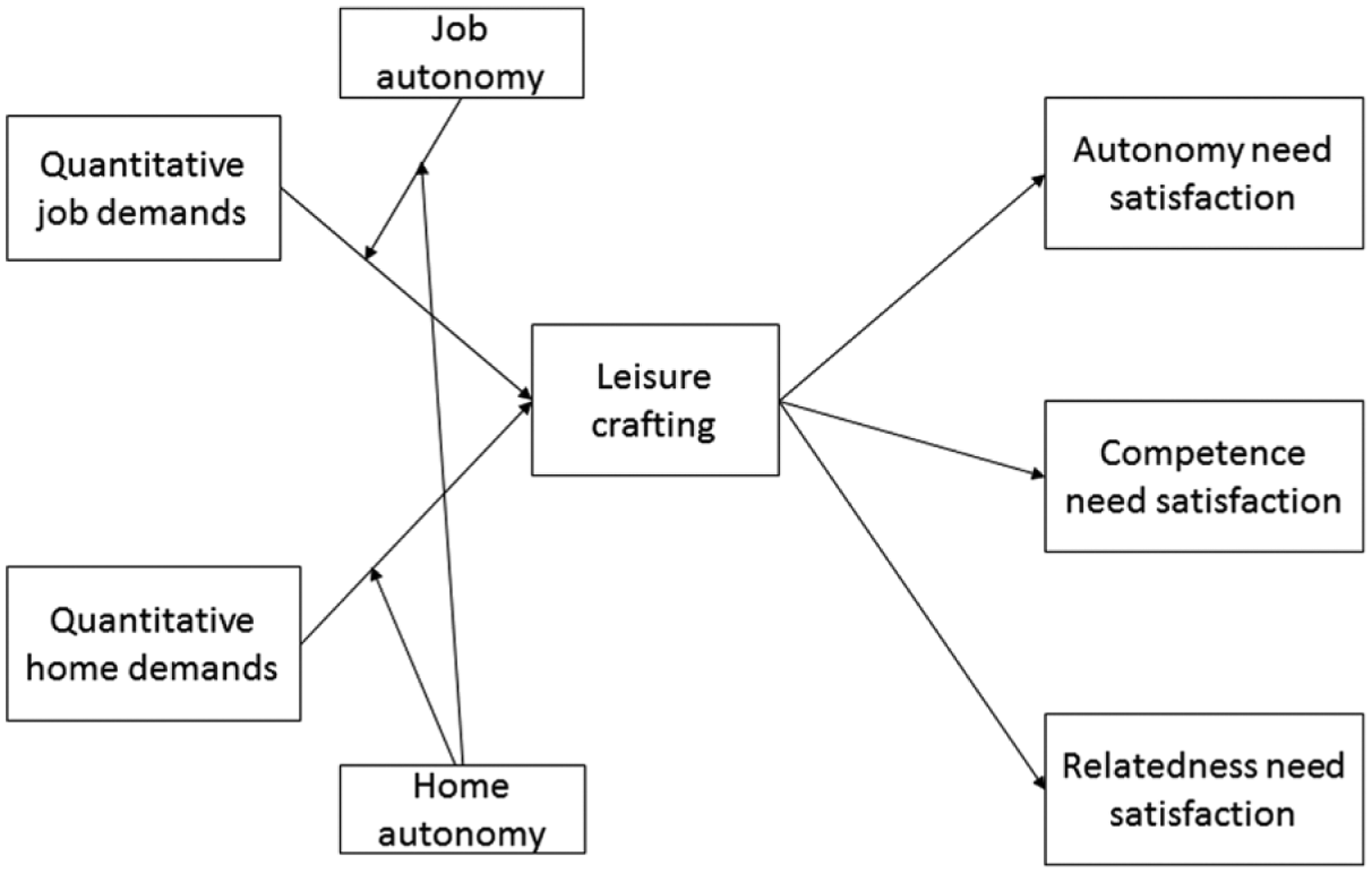
Our hypothesized model.
To achieve these goals, we conducted two studies. Study 1, a cross-sectional survey among employees, develops a leisure crafting measure, because accounts of this concept in the literature are scarce and qualitative (Berg et al., 2010). Study 2, a weekly survey, tests whether weekly reports of job strain combined with home autonomy as well as weekly reports of an active home situation relate to weekly leisure crafting, and whether weekly leisure crafting relates to need satisfaction. We contribute to the literature in three ways. First, we propose an instrument to capture leisure crafting quantitatively. Second, by addressing both work and home conditions as triggers of leisure crafting, we suggest that leisure crafting motivation is diverse and not dependent on a single domain. Instead, leisure crafting may compensate for an unfavourable domain within another favourable domain. Third, we shed light on the positive role of leisure crafting by examining the specific needs it fulfils.
Leisure crafting: Definition
Via leisure crafting, individuals seek fulfilment and shape their leisure activities in a way that addresses their passions and values (Berg et al., 2010), in the same way that job crafters reshape their jobs so that they fit their preferences and values (Wrzesniewski and Dutton, 2001). In the present article, we define leisure crafting as the proactive pursuit of leisure activities targeted at goal setting, human connection, learning and personal development. From this definition, the following elements come forward. First, leisure crafting is not casual but rather proactive, intentional and ‘serious’ (Fritsch et al., 2005; Stebbins, 2001). Second, via leisure crafting, individuals learn new things and develop themselves through challenges that enhance their feelings of mastery (Sonnentag and Fritz, 2007). Finally, leisure crafting experiences involve companionship and the development of interpersonal relations (Snir and Harpaz, 2002). In that sense, as job crafters reshape the task and relational boundaries of their jobs (Wrzesniewski and Dutton, 2001), leisure crafters reshape the task boundaries of their leisure (i.e. by looking for new challenges) or the relational boundaries of their leisure (e.g. by building new and inspiring relationships).
Although leisure crafting may lead to experiences of mastery (Sonnentag and Fritz, 2007), we argue that leisure crafting differs conceptually from mastery experiences because of three additional elements that it entails. First, leisure crafting refers to contact with others and the development of new human relations. Second, leisure crafting entails goal-setting. Therefore, although it may fluctuate over days or weeks on the basis of situational constraints or facilitators, it is overall a behaviour of long-term commitment. Third, leisure crafting refers to the proactive seeking for growth opportunities via leisure, whereas mastery experiences refer more to the actual behaviour than the underlying intention. The intentional component of leisure behaviour becomes important when researchers test the compensation hypothesis. In order to test whether individuals actively compensate for undesired states of one sphere of life via desired states in another sphere of life, we need to look at intentional behaviours that they enact in a planned and purposeful way (Edwards and Rothbard, 2000), such as leisure crafting.
A person who seeks for voluntary activities through which she empowers ill children or someone who is determined to write a novel next to his day job are examples of leisure crafters (Berg et al., 2010). Consider the following example that distinguishes between participation in leisure activities and leisure crafting. Tom plays in an amateur theatre group that prepares a theatre performance. He happily attends the weekly meeting of the group but he is not busy with the group the rest of the week. His reason for attending is the satisfaction he experiences when on stage. Amanda is a member of the same group and one of the members who started up the group. She is constantly busy with the development of the performance during the week. Although immediate satisfaction motivates her too, she is willing to put up with the occasional pains of a group (e.g. conflicts, miscommunication) so as to be rewarded with an end product of an extraordinary performance she has envisioned. Whereas Tom is likely to ‘participate in a leisure activity’, Amanda engages in ‘leisure crafting’.
Working conditions and leisure crafting
Spillover or compensation?
Regarding the way work interferes with leisure, two hypotheses have dominated the literature, namely, the spillover and the compensation hypothesis (Guest, 2002; Snir and Harpaz, 2002). According to spillover, positive experiences within one domain (e.g. work) repeat themselves in the other domain (e.g. leisure). According to compensation, unattained goals or desired states in one domain are achieved via activities in the other domain.
On the one hand, Karasek (1979) was one of the first to hint at a spillover hypothesis on work and leisure. Using his Demands–Control Model, he distinguished between an ‘active job’ (i.e. a job high on demands but also high on control, providing employees with the means to deal with demands) and a ‘high-strain job’ (i.e. a job high on demands and low on control). He predicted that an active job motivates employees to develop new behavioural patterns on the job but also off the job; this has been supported for one’s home (Butler et al., 2005) as well as leisure activities (Karasek, 1981). On the other hand, leisure has the potential to transcend negative life events (Kleiber et al., 2002) and help individuals compensate for undesired states of other life domains. In fact, there is evidence indicating that leisure activities that are not simply relaxing but also demanding relate to less job stress (Iwasaki et al., 2005; Stanton-Rich and Iso-Ahola, 1998) and detachment from work (Mojza et al., 2011). In other words, by enhancing companionship, detachment from stress and positive mood, leisure has considerable coping potential (Iwasaki and Mannell, 2000).
Although existing literature favours the spillover hypothesis somewhat more than the compensation hypothesis (Staines, 1980), this literature views individuals as passive recipients of work or non-work conditions who display unintentional reactions to either domain (Clark, 2000). If we view individuals as active agents who intentionally shape their time, work and non-work seem to be connected in more complex ways (Edwards and Rothbard, 2000). In forming hypotheses about the prevalence of spillover versus compensation, we should be cautious because the two processes may complement each other and can occur within the same individuals at different times or for different reasons (Lambert, 1990; Staines, 1980). Rather than trying to support either spillover or compensation, research should examine the factors that define which of the two phenomena will prevail (Kabanoff and O’Brien, 1980; Lambert, 1990). In the present article, we suggest that situational moderators (e.g. situation at home) in addition to working conditions help us address this question.
The role of home autonomy
Existing research on the interface between work and non-work (e.g. Hecht and Boies, 2009) commonly views one domain as a predictor of behaviour in the other domain. However, that way we miss the complex reality that we can only capture if we look at how both domains together shape behaviour in either domain (Lambert, 1990). The compensation hypothesis (Geurts and Demerouti, 2003; Vallerand, 2000) suggests that employees compensate for undesired states of one domain (e.g. work) in another domain (e.g. leisure). Naturally, this is more likely to happen when the other domain (where one enacts the compensation) provides individuals with the freedom to do so – a freedom that individuals lack in the trigger domain (the domain they compensate for).
A stressful job is by itself not enough to foster leisure crafting, an often demanding behaviour, because it depletes employee resources (Sonnentag and Jelden, 2009). Additionally, individuals should experience opportunities and favourable conditions outside work (Hubbard and Mannell, 2001) that have the potential to enable leisure crafting. Resources available at home help individuals build up their personal resources, such as energy and positive mood (ten Brummelhuis and Bakker, 2012). Although, home resources (e.g. home autonomy) may help individuals undo the negative effects of job stress, ironically, this hypothesis has received surprisingly little attention (Demerouti et al., 2009). In fact, individuals with home autonomy may have more chances to compensate for job stress by displaying enriching behaviours outside work and, thus, attain the personal growth they perhaps miss at work. In other words, we argue that when favourable home conditions are present (i.e. adequate autonomy), individuals become active agents who use leisure crafting as a means of intentional compensation for their high-strain job (i.e. a job with high workload and low autonomy), thus:
Hypothesis 1: Quantitative job demands are positively related to leisure crafting when job autonomy is low (vs high) and home autonomy is high (vs low).
Home situation and leisure crafting: Boundary conditions
Self-determination theory (Deci, 1980) suggests that perceived opportunities for leisure activities (e.g. autonomy) facilitate determination to participate in leisure activities, whereas perceived constraints for leisure participation (e.g. lack of time) impair determination (Losier et al., 1993). Although empirical evidence supports this proposition (Hubbard and Mannell, 2001; Son et al., 2008), constraints do not necessarily impede leisure. Serious leisure requires overcoming obstacles and dealing with incompatible demands from other life domains (Stebbins, 2001). While participating in leisure activities, other demands of one’s life, such as home demands, do not cease to exist. People have to take control and ‘negotiate’ these demands to create the necessary conditions for leisure participation (Little, 2002). For example, by waking up earlier and going to bed later, people use their autonomy at home in order to participate in leisure despite their quantitative home demands (Hubbard and Mannell, 2001). Complete lack of demands at home is associated with boredom and lack of meaning (Martin et al., 2006) and is not expected to be a favourable condition for leisure crafting. This expectation is in line with the original hypothesis of the Demands–Control Model (Karasek, 1979), suggesting that high job demands coupled with high job autonomy to deal with these demands empowers employees to become active and pursue learning experiences. Translating this ‘active learning’ hypothesis to the home domain leads us to the following hypothesis:
Hypothesis 2: Quantitative home demands are positively related to leisure crafting when home autonomy is high.
Leisure crafting and need satisfaction
We have defined leisure crafting as the proactive pursuit and enactment of leisure activities targeted at goal setting, human connection, learning and personal development. From this definition it becomes clear that leisure crafting has the potential to address and satisfy three innate and basic human needs (Deci and Ryan, 2000).
First, leisure crafting is proactive and intentional. Unlike mere leisure participation (Hubbard and Mannell, 2001), which can be unsystematic, it is a purposeful pursuit of behaviours with the potential to enrich individuals (Fritsch et al., 2005). Proactive individuals have a ‘plan’ for their development. Instead of passively accepting situational conditions, they take control by improving them or creating new conditions supporting their plans (Crant, 2000). By changing themselves or the situation, proactive individuals experience the improved future they have envisioned (Parker et al., 2010). In other words, via leisure crafting, individuals can satisfy their basic human need for autonomy – namely, to experience their life as a result of free choices and internal locus of causality (Ryan and Deci, 2000).
Second, ‘challenge’ is a central element within our conceptualization of leisure crafting. Challenge refers to freely chosen activities that sustain one’s motivation to improve themselves (Locke and Latham, 1990) and enhance their self-efficacy (Bandura, 1993). Via leisure activities, individuals learn new things and develop through challenges that enhance feelings of mastery and achievement (Sonnentag and Fritz, 2014). This is a systematic process of goal-setting and self-improvement, enacted even by individuals who already have a challenging job (Delle Fave and Massimini, 2003). Therefore, via leisure crafting, individuals have the potential to fulfil their need for competence – namely, the need to feel responsible for successful behaviour (Deci and Ryan, 2000).
Third, although we conceptualize leisure crafting as an intra-individual strategy of self-improvement, we do suggest that human connection is an additional important element of it. Leisure experiences involve companionship and interpersonal relations (Snir and Harpaz, 2002). Via leisure activities such as dining with friends and family or playing a team sport, individuals sustain meaningful relationships and they secure emotional support, thereby building on their quality of life (Brajša-Žganec et al., 2011; Iwasaki, 2007). In other words, leisure crafters have the potential to fulfil their human need for relatedness – namely, the need for human connection, loving and being loved (Deci and Ryan, 2000).
Based on all the above, we formulate our final hypothesis:
Hypothesis 3: Leisure crafting is positively related to the satisfaction of the need for autonomy (3a), competence (3b) and relatedness (3c).
Study 1
Existing accounts of leisure behaviour encompass a range of conceptualizations, such as mere participation in leisure activities (Hubbard and Mannell, 2001), purposeful leisure behaviour (Stanton-Rich and Iso-Ahola, 1998) and entertaining versus challenging leisure (Stebbins, 2001). Our leisure crafting conceptualization matches with the view of leisure behaviour as purposeful and challenging. However, apart from qualitative accounts (Berg et al., 2010), there is, to the best of our knowledge, no existing measure of leisure crafting. In Study 1, we thus develop and validate an instrument we can use to test our hypotheses.
As we outlined, leisure crafting entails certain attributes: it is proactive and intentional; it is targeted at challenge and goal-setting; and it refers to human connections. Such attributes overlap with each other and it is not easy to make a clear-cut distinction between them in terms of item development. For example, two aspects of leisure crafting – namely, the fact that it is challenging and proactive – overlap with each other in our definition. Individuals often challenge themselves via leisure behaviours that they initiate proactively (e.g. learning a new language). The same holds true for human connection and learning. Via modelling behaviours (Bandura, 1969), human connection fosters learning and development. For example, leisure behaviours that entail interpersonal relations (e.g. spending time with an inspirational sports buddy) can also be a way to learn (e.g. how to turn sports into a way of life). Therefore, we expect that leisure crafting entails one factor (i.e. factorial validity). Because we defined leisure crafting as proactive behaviour, it follows that individuals with proactive personality (Crant, 2000) are likely to engage in leisure crafting. We, thus, expect that proactive personality relates positively to leisure crafting (i.e. construct validity). Finally, via leisure, individuals obtain novel and mentally stimulating experiences (Fritsch et al., 2005). However, leisure crafting is more than that – namely, it is a proactive, intentional and systematic behaviour targeted at achieving goals and connecting with others. Therefore, we expect that leisure crafting is different from novelty-seeking (i.e. discriminant validity).
Scale development
Based on existing literature (e.g. Berg et al., 2010; Iwasaki and Mannell, 2000; Sonnentag and Fritz, 2007; Stanton-Rich and Iso-Ahola, 1998) and our view on leisure crafting, we created a pool of 14 items that measure leisure crafting. For every item, we asked two job crafting experts (i.e. with extensive experience in job crafting research and interventions) to indicate the extent to which (1 = not at all, 5 = very much) it fitted the definition of leisure crafting (i.e. content validity). This pool of items was consequently administered in the form of a survey to respondents, together with additional measures, in order to test the factorial, discriminant and construct validity of our new measure.
Sample and procedures
Respondents were 207 employees from multinational companies based in different countries. They were recruited via network sampling by a student research assistant from an international master’s program. This data collection technique entails students who, based on their contacts or snowball sampling, recruit respondents from the working adults population (Demerouti and Rispens, 2014). Furthermore, respondents were recruited through announcements in social media. Therefore, the overall number of employees that were contacted is not known. The majority of the respondents came from the United Kingdom (30%), China (12%), the Netherlands (8%) and the USA (7%), and they worked in sectors such as accommodation and catering (30%), education (16%), finance and insurance (13%) or healthcare (7%). Their mean age was 33.5 (standard deviation [SD] = 7.5), 142 of them were women (69%) and 65 were men (31%), and they had worked at their company for an average of 5.7 years (SD = 5.5). Participants were invited through email to fill in an online survey.
Instruments
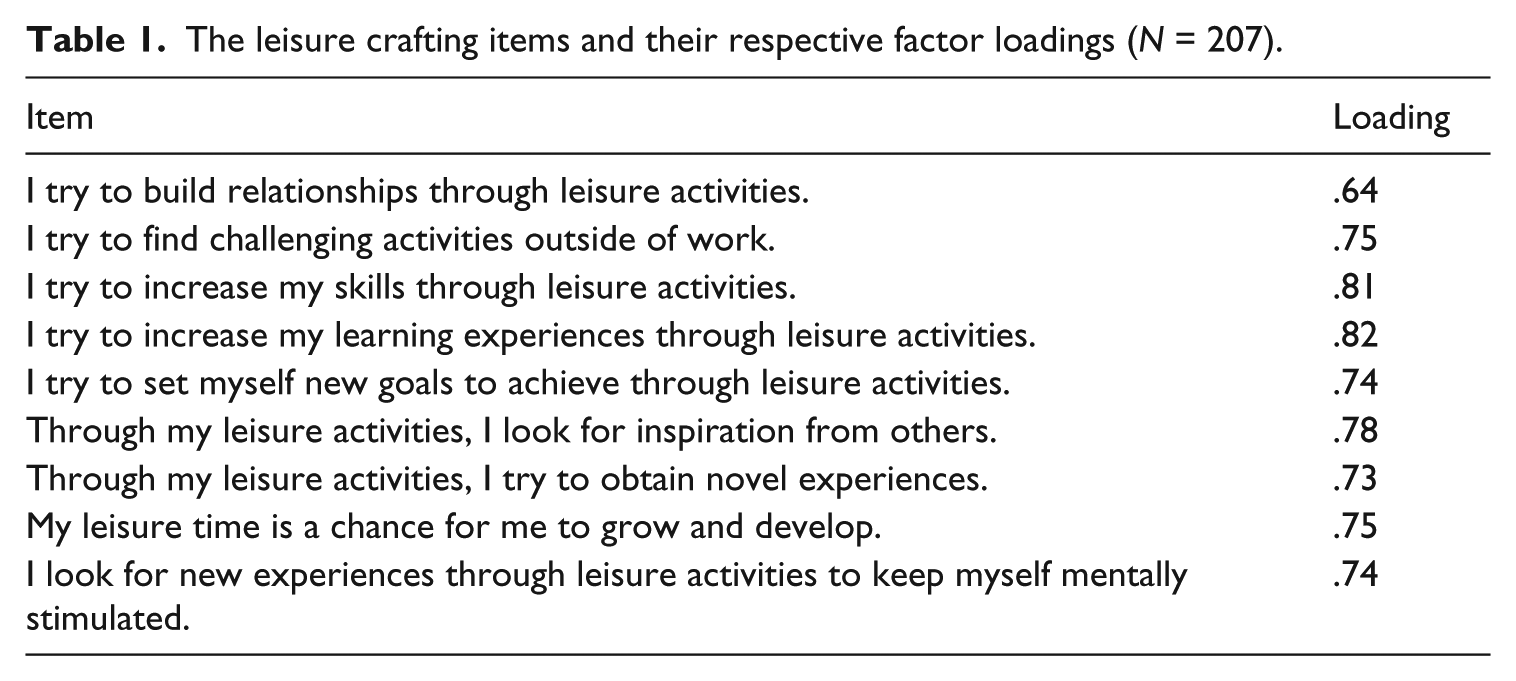
Leisure crafting was measured with the 14 items that we created (for the items that we finally retained, see Table 1). Respondents rated each of the statements using a scale ranging from 1 = not at all to 5 = very much. The internal consistency of the scale with the 14 items was alpha = .93; for the items that we retained it was alpha = .92 (subsequent analyses indicated a one-factor solution; please see next section for details).
The leisure crafting items and their respective factor loadings (N = 207).
Novelty-seeking was measured with the six-item scale by Fritsch et al. (2005). Items (e.g. ‘I look for opportunities to do things that are challenging mentally’; alpha = .87) were rated using a scale ranging from 1 = never to 5 = always.
Proactive personality was measured with a six-item scale by Bateman and Crant (1993). Items (e.g. ‘If I see something I don’t like, I fix it’, alpha = .70) were rated using a scale ranging from 1 = strongly disagree to 7 = strongly agree.
Results and discussion
Exploratory factor analysis conducted in SPSS over the 14 leisure crafting items clearly revealed one factor, based on both the scree plot and the eigenvalues. Creating a one-factor solution for the 14 items in AMOS (Arbuckle, 1997) resulted in a reasonable model fit (χ2 = 175.55, p = .000, d.f. = 77, comparative fit index [CFI] = .937, Tucker Lewis Index [TLI] = .926, goodness-of-fit index [GFI] = .896, standardized root mean square residual [SRMR] = .063). To make sure that our measure had content validity, we inspected the answers that we received from the two experts on the content of the items, and we decided to remove five items for which at least one of the two experts indicated that it fitted our definition with a score lower than 5 = very much. That resulted in nine retained leisure crafting items (see Table 1; alpha = .92). Factor analysis in SPSS with the nine items again clearly resulted in one factor. confirmatory factor analysis [CFA] analysis conducted in AMOS for the one-factor solution with the nine items resulted in good fit indices (χ2 = 62.00, d.f. = 27, p = .000, CFI = .967, TLI = .956, GFI = .938, SRMR = .050).
To establish discriminant validity, we created a two-factor solution in AMOS with the items of leisure crafting and novelty-seeking loading on two separate factors. This two-factor solution had marginal fit to the data (χ2 = 210.29, d.f. = 89, p = .000, CFI = .932, TLI = .920, GFI = .872, SRMR = .073), but significantly and substantially better than a one-factor solution, collapsing the items of leisure crafting and novelty seeking into a single factor (Δχ2 = 341.78, Δd.f. = 1, p < .001). Together with the correlation between leisure crafting and novelty seeking (r = .51, p < .001), these findings reveal that leisure crafting relates to but is different from novelty seeking. Finally, the nine-item leisure crafting scale correlated significantly and positively with proactive personality (r = .24, p < .001), revealing that proactive individuals report more leisure crafting. Similarly, a two-factor CFA in AMOS with items of leisure crafting and proactive personality loading on two different factors (χ2 = 200.79, d.f. = 89, p = .000, CFI = .916, TLI = .901, GFI = .887, SRMR = .116) showed a substantially better fit to the data than a one-factor solution collapsing leisure crafting and proactive personality (Δχ2 = 162.46, Δd.f. = 1, p < .001). Taken together, our findings reveal some first evidence that our new leisure crafting measure has adequate factorial, discriminant and construct validity.
After obtaining evidence for the validity of our measure, we conducted a weekly diary study to test our hypotheses regarding the impact of work and home conditions on leisure crafting and the link between leisure crafting and satisfaction of basic human needs.
Study 2
By conceptualizing proactive behaviours not only as trait-like stable concepts but also as state-like concepts (e.g. with fluctuations over days or weeks), we gain insight into the specific situational factors that trigger proactive behaviours over and above stable individual differences (Fritz and Sonnentag, 2009). Furthermore, individuals cannot craft their leisure activities to the same extent every week, as this will depend on the conditions of that particular week. Therefore, in our weekly survey we measured both the general level (i.e. baseline) and the week level (i.e. state-like conceptualization; see Bakker and Sanz-Vergel, 2013) of leisure crafting, as well as the week level of job and home characteristics and need satisfaction. This way, we can examine whether weekly job and home characteristics relate to weekly leisure crafting, controlling for the habitual (i.e. baseline) levels of one’s leisure crafting. We also test whether weekly variations of leisure crafting further relate to weekly variations in the satisfaction of basic human needs as reported by respondents.
Participants and procedures
Via network sampling by student research assistants (Demerouti and Rispens, 2014) we approached employees from different occupations within Dutch organizations. Out of 149 employees that we contacted, 80 employees (30 men and 50 women) completed all three surveys, forming the final sample for our analyses (response rate = 54%). The mean age of the participants was 41.4 years (SD = 14.0). Men worked a mean of 34.2 hours (SD = 9.5) per week according to their contract, whereas women worked a mean of 27.2 hours (SD = 10.2) per week according to their contract, which is slightly lower than the average working hours of the Dutch working population across gender (Statistics Netherlands, 2014). The majority of the respondents lived alone (36%); 28 percent of them lived with their partner and without kids at home; and 23 percent lived with their partner and with kids at home. Most participants worked in education (18%), healthcare (15%), government (10%), industry and construction (10%), financial services (5%), business administration (5%) or commerce (5%); the other participants were evenly distributed across other sectors, including media, ICT or other services. The majority of the participants (N = 67; 84%) filled in a Dutch version of the survey, whereas 13 of them (16%) indicated that they preferred to fill in an English version of the survey. These were one Italian, one Spanish and nine Greek expatriates and two Dutch employees, all working in Dutch companies.
Upon agreement, participants received an email invitation with the link to the online survey and information introducing the purpose of the study and ensuring confidentiality and voluntary participation. Because several respondents worked two or three days per week, the email was sent every week (on a Wednesday), with clear instructions to the respondents to fill it in on the last working day of their week, whichever that was. Reminders were sent every Friday and at the weekend to participants who had not filled in the survey. At week 1, respondents completed a survey containing demographics and the general-level leisure crafting (i.e. General Survey) as well as a survey containing the week level of leisure crafting, job and home characteristics and need satisfaction (i.e. Weekly Survey). At weeks 2 and 3, they only completed the Weekly Survey.
General survey
General-level leisure crafting was measured with the nine-item leisure crafting scale that we validated in Study 1 (see Table 1 for the items; alpha = .93).
Weekly survey
All the items of the Weekly Survey followed the sentence, ‘During the previous week …’ so as to avoid repetition.
Week-level leisure crafting was measured with the same items adapted to refer to the previous week (e.g. ‘… I have tried to build relationships through leisure activities’; average weekly alpha = .96), and were rated using a scale ranging from 1 = never to 5 = very often.
Week-level quantitative job demands and week-level job autonomy were measured with three items each from Karasek’s (1985) Job Content Questionnaire with an answering scale ranging from 1 = never to 5 = all the time. Sample items are ‘… I had much work to do’ (average weekly alpha = .89) and ‘… I could decide myself how I execute my work’ (average weekly alpha = .82), respectively.
Week-level quantitative home demands were measured with five items from Peeters et al. (2005). A sample item is ‘… I had too many things to do at home’ (average weekly alpha = .88). Week-level home autonomy was measured with three items from Demerouti et al. (2010). A sample item is ‘… I could decide how I do things at home’ (average weekly alpha = .87). All items were rated using a scale from 1 = never to 5 = very often.
Week-level need satisfaction was measured with three scales by Sheldon et al. (2001), comprising three items each. They measured autonomy need satisfaction (e.g. ‘… I felt free to do things on my own way’; average weekly alpha = .79), competence need satisfaction (e.g. ‘…I felt very capable of what I did’; average weekly alpha = .75) and relatedness need satisfaction (e.g. ‘…I felt close and connected with other people who are important to me’; average weekly alpha = .83). Participants could rate each of the items using a scale with answer categories ranging from 1 = totally disagree to 5 = totally agree.
Analytical approach
Data comprised a multilevel structure with weekly measurements nested within individuals. To test our hypotheses, we conducted four multilevel regression analyses with MlwiN, with weekly leisure crafting, autonomy, competence and relatedness need satisfaction as dependent variables, respectively. We calculated the intra-class correlation for our dependent variables, which shows the amount of variance attributed to between-level (between-persons) variation. This was 59 percent in weekly leisure crafting, 44 percent in autonomy need satisfaction, 53 percent in competence need satisfaction and 39 percent in relatedness need satisfaction. Consequently, considerable within-level (within-persons) variation in the dependent variables was left to be explained by weekly fluctuations in independent variables.
Between-level predictors were grand-mean centred, and within-level predictors were group-mean centred (Ohly et al., 2010). We controlled for gender, age, hours of work, marital status, education and language of survey (English vs Dutch) in all analyses. In the regression with leisure crafting as the dependent variable, we controlled for the general-level leisure crafting so as to test the effect of weekly home and job situation to weekly leisure crafting over and above one’s baseline leisure crafting. The first regression is built on the basis of four nested models comprising, respectively, the intercept (step 1), control variables and general-level leisure crafting (step 2), the predictors and moderators at step 3 (i.e. weekly quantitative job demands, job autonomy, quantitative home demands and home autonomy) and finally, at step 4, the hypothesized three-way and two-way interaction terms (job demands by job autonomy by home autonomy, and home demands by home autonomy) along with three two-way interaction terms necessary for the estimation of the three-way interaction effect (job demands by job autonomy, job demands by home autonomy, and job autonomy by home autonomy). Each of the remaining three regression analyses was built on the basis of three nested models comprising, respectively, intercept (step 1), control variables (step 2) and independent variables (step 3).
Results and discussion
Means, standard deviations and intercorrelations for all study variables are presented in Table 2. Intercorrelations for week-level variables have been calculated within each week, and subsequently the highest and the lowest correlations have been reported. Tables 3–6 provide chi-square difference tests and multilevel estimates for all nested models of the four multilevel regression analyses.
Means, standard deviations and intercorrelations for the study variables of the weekly survey (N = 80 employees and N = 240 occasions).

Job demands and home demands refer to quantitative job demands and quantitative home demands, respectively; for week-level variables, the lowest and highest correlations are reported; *p < .05, **p < .01;SD = standard deviation.
Multilevel estimates for models with weekly leisure crafting as dependent variable (N = 80 employees and N = 240 occasions).

Job demands and home demands refer to quantitative job demands and quantitative home demands, respectively; gender is coded with 0 = man, 1 = woman.
Owing to space constraints, the effects of the control variables hours of work per week, type of survey (English vs Dutch), dummy coded education and dummy coded marital status are not shown; *p < .05, **p < .01. SE = standard error; t = t-value.
Multilevel estimates for models with weekly autonomy need satisfaction as dependent variable (N = 80 employees and N = 240 occasions).

Gender is coded with 0 = man, 1 = woman.
Owing to space constraints, the effects of the control variables hours of work per week, type of survey (English vs Dutch), dummy coded education and dummy coded marital status are not shown; *p < .05, **p < .01. SE = standard error; t = t-value.
Multilevel estimates for models with weekly competence need satisfaction as dependent variable (N = 80 employees and 240 occasions).
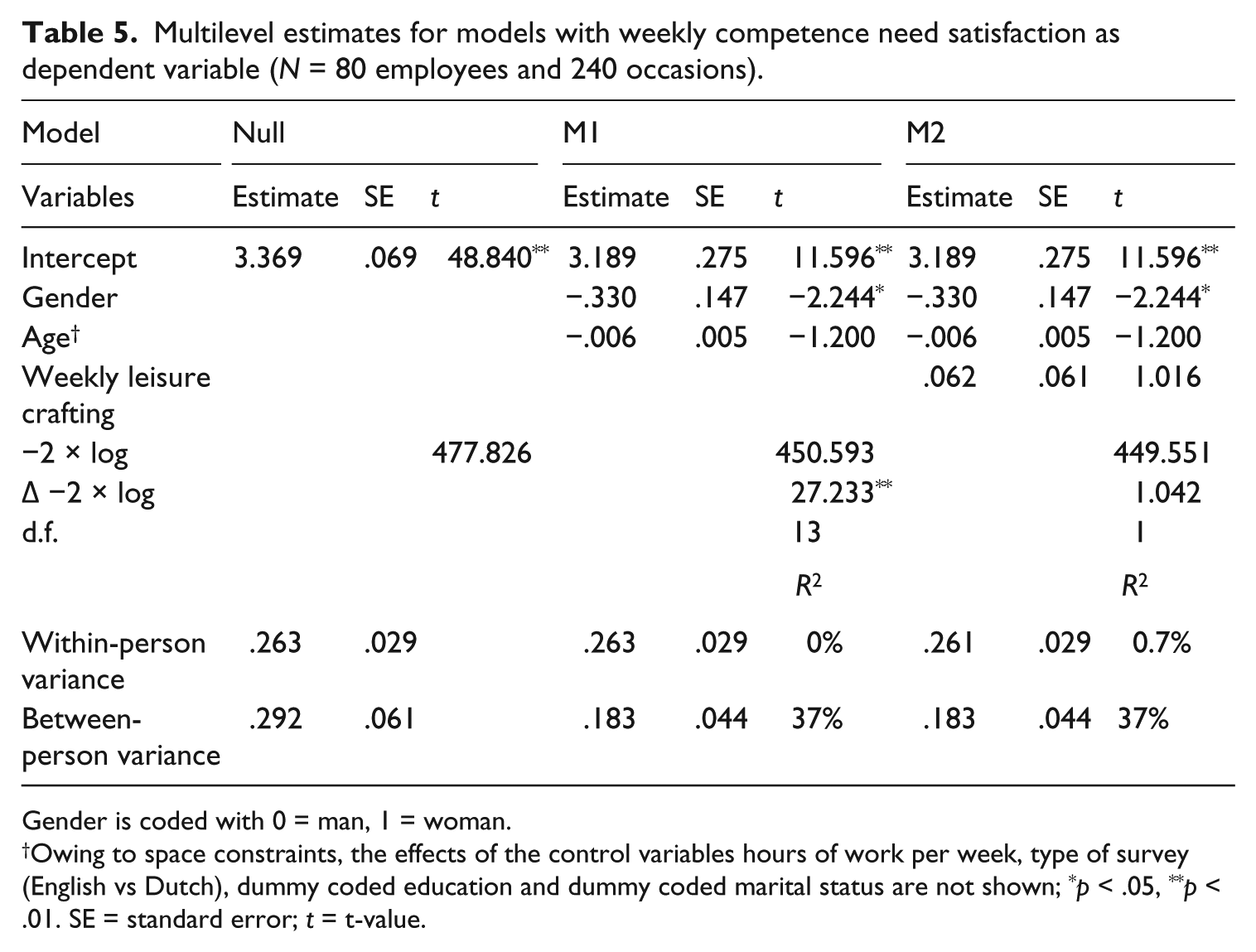
Gender is coded with 0 = man, 1 = woman.
Owing to space constraints, the effects of the control variables hours of work per week, type of survey (English vs Dutch), dummy coded education and dummy coded marital status are not shown; *p < .05, **p < .01. SE = standard error; t = t-value.
Multilevel estimates for models with weekly relatedness need satisfaction as dependent variable (N = 80 employees and 240 occasions).

Gender is coded with 0 = man, 1 = woman.
Owing to space constraints, the effects of the control variables hours of work per week, type of survey (English vs Dutch), dummy coded education and dummy coded marital status are not shown; *p < .05, **p < .01. SE = standard error; t = t-value.
Hypotheses 1–2 hypothesized that weekly working conditions (i.e. high quantitative job demands and low job autonomy, combined with home autonomy) and an active home situation (i.e. high quantitative home demands and high home autonomy) relate to weekly leisure crafting. The three-way interaction between job demands, job autonomy and home autonomy had a significant effect on leisure crafting (estimate = −.99, p < .01). Simple slope tests revealed that weekly job demands positively related to weekly leisure crafting only when weekly job autonomy was 1 SD below the mean and weekly home autonomy was 1 SD above the mean (estimate = .53, standard error [SE] = .19, p < .01; none of the other three slopes was significant; see Figure 2), providing support for Hypothesis 1. The interaction term of weekly home demands and home autonomy was unrelated to weekly leisure crafting, failing to support Hypothesis 2. Unexpectedly, the interaction between weekly job demands and job autonomy negatively related to weekly leisure crafting (estimate = −.50, p < .05). Simple slope tests revealed that weekly job demands positively related to weekly leisure crafting only when job autonomy was 1 SD lower than the mean (estimate = .27, SE = .11, p < .05; see Figure 3).

The link between weekly quantitative job demands and weekly leisure crafting moderated by weekly job autonomy, shown for low (upper part) and high (bottom part) week levels of home autonomy.
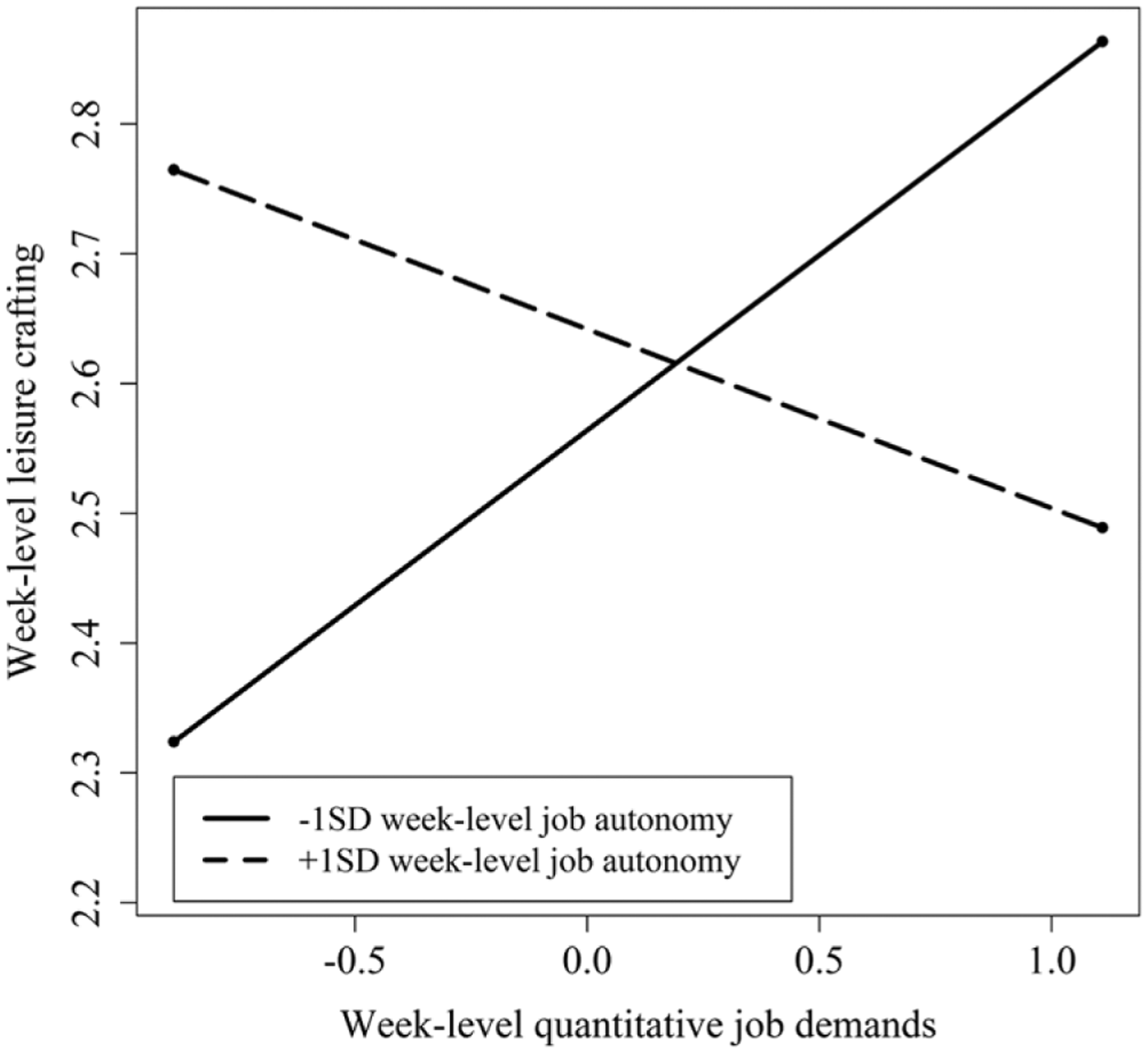
The link between weekly quantitative job demands and weekly leisure crafting moderated by weekly job autonomy.
Finally, leisure crafting was positively related to weekly autonomy need satisfaction (estimate = .21, p < .01) and relatedness need satisfaction (estimate = .25, p < .01), but it was unrelated to weekly competence need satisfaction (estimate = .06, p = .30), providing support to Hypotheses 3a and 3c, respectively, but not to Hypothesis 3b.
All in all, consistent with our hypotheses, weekly leisure crafting was pronounced during weeks with stressful working conditions, especially when this was combined with high home autonomy. However, leisure crafting was not more likely during weeks in which high home demands were combined with high home autonomy. Furthermore, during weeks that individuals reported higher levels of weekly leisure crafting, they also reported more satisfaction of their autonomy and relatedness (but not competence) needs.
Overarching discussion
Our article contributes to the literature in the following ways. First, it addresses an empirical conceptualization of leisure crafting, which is meaningful as a baseline (i.e. general level) and as a fluctuating (i.e. weekly) behaviour. Second, our research sheds light on the conditions that foster leisure crafting by showing that when employees are confronted with stress at work, they are likely to enact leisure crafting if they experience autonomy at home. Third, it illustrates the purpose and motivation of leisure crafting, which is to fulfil basic human needs (in our case, autonomy and relatedness). The new instrument that we developed suggests that it is not simply the participation in leisure activities (Ponde and Santana, 2000) or specific types of leisure activities (Tinsley et al., 1993) that help individuals satisfy their needs, but rather leisure crafting, which we defined as proactive and targeted goal setting, human connection, learning and personal development.
The positive link that we found between a high-strain job condition and leisure crafting under the condition of sufficient home autonomy sheds light on the conditions under which the compensation hypothesis on work–life interface is likely (Guest, 2002). Our results suggest that employees engage in leisure crafting when they experience a stressful job, particularly when their home situation provides them with the freedom to craft their leisure time. In other words, instead of being depleted, individuals proactively compensate for work deficits via interesting leisure activities (Gelber, 1999), for example, by pursuing the growth and development that they perhaps fail to attain at work because of stressful working conditions.
Surprisingly, a high-strain job (high workload combined with low job autonomy) related positively to weekly leisure crafting even irrespective of home autonomy. Although this finding contradicts evidence showing that job stressors have a detrimental effect on employees’ leisure activities (Sonnentag and Jelden, 2009), this may have to do with our recruited participants. Specifically, our respondents seem to be relatively young and they display high overall levels of part-time employment. When employees are not overly involved in their jobs and they have sufficient free time, they are capable of compensating for job stress (Staines, 1980) rather than getting depleted by it. In fact, previous research suggests that, among samples of young or part-time employees, a demanding job does not stop employees from engaging in demanding leisure activities, therefore possibly favouring a compensation hypothesis (Mojza and Sonnentag, 2010; Mojza et al., 2011).
Unexpectedly, weekly home autonomy did not moderate the link between weekly home demands and leisure crafting. In other words, an active home situation was unrelated to leisure crafting. Perhaps, an overly demanding home situation can only lead to leisure crafting if individuals are proactive or if they use inventive and creative strategies to negotiate their home demands (Little, 2002) and turn them into opportunities (Jackson, 2000). For example, rescheduling one’s daily planning or asking support from others could be a way in which individuals use their home autonomy in order to find opportunities for leisure crafting despite their home demands. Not measuring such individual strategies that mediate the link between an active home situation and leisure crafting could have failed to capture the expected effect.
Consistent with our conceptualization of leisure crafting, we found that on weeks when individuals report high leisure crafting they also report high levels of autonomy and relatedness need satisfaction. However, leisure crafting was unrelated to competence need satisfaction. It seems, therefore, that by crafting their leisure activities, individuals manage to experience companionship and intimacy (Tinsley et al., 1993) and to be in control of their lives (Berg et al., 2010), but that does not necessarily mean that leisure crafting will lead to the intended outcomes of learning and competence. A possible interpretation may have to do with today’s overly demanding and uncertain work environment (Kira et al., 2010), which does not allow employees to realize the full potential of leisure crafting. In this context, individuals may engage in leisure crafting, but not in becoming more competent – a process that requires long-term commitment.
Limitations and future research
Our research is not without limitations. First, data were collected based only on one source of information (self-reports). Second, network sampling (especially when involving multiple nationalities, as in Study 1) is not capable of leading to representative samples. However, it can give rise to heterogeneous samples with some ability to generalize to diverse occupational groups (Demerouti and Rispens, 2014). Third, although our analyses capture common patterns in weekly fluctuations of variables, they do not permit us to infer causal relationships. For example, it is technically not possible to know with certainty whether it is home characteristics that shape leisure crafting or whether leisure crafting impacts home characteristics. Furthermore, our weekly survey comprised a limited amount of observations per respondent, thus resulting in a limited overall number of occasions. Finally, our study does not address all the potential antecedents to leisure crafting (e.g. work vs leisure centrality) or the mediating mechanisms that explain the link between leisure crafting and need satisfaction (e.g. learning, contact with others etc.). These limitations notwithstanding, our multiple measurements provide more reliable estimates for the measured variables, and the diversity of nationalities included in Study 1 provides external validity to the concept of leisure crafting.
Instead of setting out to support compensation versus spillover hypotheses, future research should embrace both views as complementing each other and focus on additional factors (e.g. individual differences, employee motivational orientations etc.) that define which of the two phenomena will prevail. Furthermore, we have suggested that the competence component of leisure crafting takes a long time to unfold and requires long-term commitment, which should be tested via longitudinal research.
Implications for practice
Our study reveals that work and leisure influence and interfere with each other instead of being two isolated domains. This is an important point to be made, which is perhaps far more interesting for practitioners than the hypothesis that is favoured by research about the nature of this interface (e.g. compensations vs spillover). Specifically, in the light of the positive implications of leisure crafting for the satisfaction of basic human needs, employees could use their free time in order to engage in leisure crafting and, thus, satisfy their need to be autonomous and connected with others. Managers could assist employees in that process by providing work-site recreation activities, encouraging learning experiences outside work, using flexible work practices that allow employees to be in control of their working and leisure time, and creating a work climate whereby recovery and leisure are acceptable practices. By helping employees satisfy their needs, organizations can create a more healthy, motivated and productive workforce. This is relevant for all organizations today, and especially the ones that have a high risk of developing stressful job conditions.
Footnotes
Acknowledgements
Grateful acknowledgements are owed to our research assistants, Carsten Coles, Selma Meinderts, Maria-Eleni-Ntes Dimakakou and Oana Salcescu, for their help with the recruitment of our participants.
Funding
This research received no specific grant from any funding agency in the public, commercial, or not-for-profit sectors.
 . [Email: