



Abstract
The actions that individuals take to proactively craft their jobs are important to help create more meaningful and personally enriching work experiences. But do these proactive behaviors have implications beyond working life? Inspired by the suggestion that individuals aim for a meaningful life we examine whether on days when individuals craft their jobs, they are more likely to craft non-work activities. It also seems likely that characteristics of the home environment moderate these cross-domain relationships. We suggest that crafting crosses domains particularly when individuals gain resources through high autonomy and high workload at home. We partly supported our model through a daily diary study, in which 139 service sector employees from six European countries (Belgium, Denmark, Germany, Netherlands, Spain, UK) reported their experiences twice a day for five consecutive workdays. Home autonomy and home workload strengthened the positive relationship between seeking resources at work and at home. Moreover, home autonomy strengthened the positive association between seeking challenges at work and at home, and the negative relation between reducing demands at work and at home. These findings suggest that the beneficial implications of job crafting transcend life boundaries thereby providing advice for how individuals can experience greater meaning in their lives.
Nowadays many organizations expect people to shape and manage their own jobs (Grant and Parker, 2009). Behaviors like job crafting, which represents strategies that individuals use to alter the scope and boundaries of their work in order to make it more meaningful (Wrzesniewski and Dutton, 2001), have gained interest both in research and practice. Although we know that proactive behaviors (of which job crafting is an example) occur in multiple life domains (Belschak and Den Hartog, 2017), we know little about whether and when crafting behaviors extend across life domains. Knowing whether crafting behaviors at work extend to the home domain, and understanding the conditions that facilitate this process, may help various stakeholders (e.g., organizations, authorities, therapists, and researchers) to create proactive citizens, and help individuals to lead more meaningful lives.
The goal of this study is to examine whether the use of daily job crafting strategies is linked to the use of crafting strategies at home during non-work time, and whether daily workload and autonomy at home represent contingency factors that moderate the extent to which crafting behavior transcends life domains. To reach this goal we combine extant theory on inter-role relationships (i.e. the mechanisms of spillover and compensation) with literature on proactivity and job crafting to explain how behavior may be transferred from the work to the home domain. Furthermore, to identify when these behaviors will transcend domains we draw on principles from Parker et al.’s (2010) model of proactive motivation, identifying the contextual factors that boost or inhibit job crafting conceptualized within the Job Demands-Resources (JD-R) theory (Bakker and Demerouti, 2017).
In doing so, our study aims to make several contributions. First, we expand the job crafting literature by testing whether crafting behaviors at work are linked to/induce similar crafting behaviors at home on a daily basis. Second, we uncover the situational determinants that can influence the extent to which crafting behaviors transcend the boundaries between work and home, which should then also apply to proactive behaviors in general. Drawing from JD-R theory and the propositions set out by Parker et al. (2010), we focus on home workload and home autonomy as they create the conditions to motivate individuals to craft their environment. These contextual characteristics have both been found to relate to the use of crafting behaviors at work (Petrou et al., 2012) and to represent important characteristics of home life (Peeters et al., 2005). Applying a daily diary design enables us to consider the specific situational context in which crafting behaviors extend across life domains (Ohly et al., 2010).
Finally, we are able to test whether the relationships are generalizable across country contexts, as we collected data from employees living in six European countries covering four of the six European geographic areas (Eurofound, 2012): Anglo-Saxon (UK), Continental (Belgium, Netherlands, Germany), Northern (Denmark) and Southern (Spain). A methodological strength of our study is that we collected data through a diary twice a day, measuring the predictors prior to the outcomes and separating their measurement in time (Sanchez and Viswesvaran, 2002). Advantages of daily diary studies compared to survey studies that ask questions about longer time frames (e.g. last week or month) are the reduction of retrospective bias and the fact that they enable a closer consideration of the situational context (Ohly et al., 2010). These advantages are particularly relevant to our study as we examine behavior and its situational determinants within the context that they occur.
Job crafting
Proactive behaviors involve self-initiated and future-oriented actions, focused on seeking opportunities to improve the status quo, by changing the self or the environment (Parker et al., 2010). Job crafting, in particular, describes the proactive, bottom-up ways in which employees alter the task, cognitive, and relational boundaries of their jobs in order to find more meaning in their job (Wrzesniewski and Dutton, 2001). Wrzesniewski and Dutton (2001) define job crafting as “everyday” behavior. In line with this, some scholars (Petrou et al., 2012; Tims and Bakker, 2010) frame job crafting through the lens of JD–R theory (Bakker and Demerouti, 2017). Specifically, everyday job crafting is conceptualized as the changes that employees make to balance their job demands and job resources with their personal abilities and needs, and to create or restore their person–job fit (Tims and Bakker, 2010). Job demands refer to aspects of the job that require effort and are therefore associated with psychophysiological costs, whereas job resources refer to aspects of the job that facilitate dealing with job demands, goal accomplishment, and growth (Bakker and Demerouti, 2017). Petrou et al. (2012) defined job crafting as proactive employee behavior consisting of seeking resources, seeking challenges, and reducing demands. Whereas Wrzesniewski and Dutton (2001) consider finding meaning as the motive for crafting, Petrou et al. (2012) consider the motive to be person–job fit. Specifically, expansion-oriented job crafting forms are aimed at accumulating external and internal resources that enable employees to grow and find meaning: seeking resources (e.g. performance feedback, maximizing job autonomy) represents a strategy to deal with job demands and to achieve goals, and seeking challenges includes behaviors such as seeking new tasks at work or asking for more responsibilities once assigned tasks have been finished. Reduction-oriented job crafting refers to behaviors that are targeted towards minimizing the emotionally, mentally, or physically demanding aspects of one’s job (i.e. reducing demands). Individuals might seek to reduce job demands as a strategy to protect health from excessively high demands.
Home crafting
Petrou and Bakker (2016) were the first to suggest that individuals not only craft their work but also craft in other life domains. They introduced leisure crafting, defined as the proactive pursuit of leisure activities targeted at goal setting, human connection, learning, and personal development. Leisure crafters reshape the task (i.e. by looking for new challenges) and relational (e.g. by building new and inspiring relationships) boundaries of their leisure time. In their study, proactive personality was positively related to leisure crafting, which was more pronounced during weeks with high job strain combined with high home autonomy. However, Petrou et al. (2017) found that this general leisure crafting was not significantly predicted by expansion-oriented job crafting. While this seems to suggest that proactive behaviors are isolated to individual life domains, it might be explained by the fact that leisure crafting has been conceptualized as a rather broad construct—failing to recognize the specific strategies that people use to craft their environment. Indeed, empirical research by Ironson et al. (1989) shows that facet or specific measures of organizational variables (compared to general measures) are better predictors of behavioral outcomes. Likewise, while leisure crafting focuses on the non-work domain it does not consider the fact that leisure activities are only one part of one’s non-work activities, besides—among others—activities at home. As such, while leisure crafting has been found to have beneficial outcomes, research is needed to examine the specific proactive behaviors that individuals engage in.
Similar to job crafting, we conceptualize home crafting as the changes that employees make to balance their home demands and home resources with their personal abilities and needs, in order to experience meaning and create or restore their person–environment fit (Wrzesniewski and Dutton, 2001). In line with the work of Petrou et al. (2012) on job crafting, we define three types of home crafting: seeking resources (e.g. ask others for feedback/advice, create variety in duties at home), seeking challenges (e.g. make sure to be busy and search for challenging activities next to work), and reducing demands (e.g. make sure that activities after work are mentally/emotionally/physically less intense). Home crafting differs from family performance (Chen et al., 2014) and family engagement (Rothbard, 2001); family performance refers to how well one fulfills family activities, obligations, and expectations, and family engagement means attention to and absorption by family life. On the other hand, home crafting considers the full range of specific proactive behaviors that individuals can engage in in the home domain, not only those connected to these specific facets of the home domain.
The link between job crafting and home crafting
Scholars have proposed several mechanisms to explain the links between experiences and behaviors in the work and home domains (Edwards and Rothbard, 2000). First, work and home experiences may be positively linked as affect, values, skills, or behaviors are transferred from one domain to the other, creating similarities between both domains. For example, Sanz-Vergel et al. (2012) found that daily emotion regulation strategies used at work transfer to the home domain. These links describe spillover processes. Second, work and home experiences may be negatively linked as employees may try to overcome dissatisfaction of their needs in one life domain by increased involvement in particular activities in the other life domain (Edwards and Rothbard, 2000). Hence, undesirable experiences in one domain are redressed when individuals seek contrasting experiences in the other domain. For example, in Evans and Bartolomé’s (1986) study, managers who experienced disappointment at work made up for this by seeking fulfillment at home. These links refer to compensation.
The research prompted by spillover and compensation theories has therefore demonstrated that the work and home domains are interdependent. Champoux (1978) found that spillover and compensation can occur simultaneously within individuals, but it is unclear why individuals choose one reaction over the other. Spillover and compensation theories have been criticized for their limited focus, addressing only emotional linkages (i.e. satisfaction, expressions of frustration), and giving little or no acknowledgment of spatial, temporal, and behavioral connections between work and family; for only treating individuals as being reactive, rather than having the ability to enact or shape their environments (Clark, 2000); and for missing the way that individuals mold the parameters and scope of their activities to create personal meaning (Zedeck, 1992).
The premise of the present study is that daily job crafting is related to home crafting but the nature of this link (spillover vs compensation) depends on the focus of the crafting. Employees should be particularly motivated to extend expansion-oriented job crafting (i.e. seeking resources and challenges) to the home domain (i.e. spillover) and to compensate for reduction-oriented crafting at work (i.e. reducing demands) in the home domain. This echoes the findings of Berg et al. (2010) that participants pursue their unanswered callings (i.e. aspects that are lacking in their work role) outside work by exercising initiative, agency, and proactivity to create opportunities to experience states of enjoyment and meaning. Parker et al. (2010) suggest that people are motivated to be proactive in order to increase challenge, thereby fulfilling their basic psychological needs; a suggestion that has found empirical support (Slemp and Vella- Brodrick, 2014). Moreover, Parker and colleagues (2010) suggest that a reason to set and strive for proactive goals is to fulfill important life goals, or express values that are central to the self and consistent with one’s core values and interests.
On the basis of these arguments, we first suggest that, when individuals expand their resources and challenges (expansion-oriented crafting) at work, they will also do so at home because they will experience meaningfulness—a form of happiness achieved by living virtuously, engaging in meaningful activities, and attaining goals that have intrinsic merit (Albrecht, 2013)—and satisfaction of their needs. Assuming that individuals are successful in their crafting attempts, seeking resources and challenges is likely to result in more job resources and challenges. Job resources have both intrinsic motivational potential, by facilitating learning or personal development, and extrinsic motivational potential, by providing instrumental help or specific information that facilitate goal achievement (Schaufeli and Bakker, 2004). Job challenges increase employee motivation by enhancing positive emotions and problem-solving skills (Podsakoff et al., 2007), and empower employees (Spreitzer et al., 1997). As this expansion-oriented crafting is a positive motivational experience and fulfills their basic psychological needs (Slemp and Vella-Brodrick, 2014), employees may be particularly motivated to strive and sustain this proactive behavior into the home domain through crafting their non-work time.
As suggested by Parker et al. (2010), positive affective states contribute to both initiating and sustaining proactive behaviors. Similarly, demonstrating proactive behaviors in the work domain makes these strategies more salient and accessible in employees’ minds (see Sanz-Vergel et al., 2012). Hence, it may be likely that these behaviors are transferred to the home domain, particularly when there are situational cues that elicit/facilitate the spillover. By the same token, individuals will be less inclined to proactively reduce activities in the non-work domain such that they can preserve a meaningful and engaging non-work life. By assuming this, we agree with Parker et al. (2010) that, to the extent that individuals are motivated to be proactive, they will set and pursue proactive goals, or in our case engage in home crafting behavior. Although a counter-prediction would suggest that (expansion-oriented) job crafting may be resource-depleting as it requires effort (Baumeister et al., 1994), only one diary study has found that seeking challenges was positively related to counterproductive work behavior (Demerouti et al., 2015). These authors found that this was not empirically explained by energy depletion, but as attempts to balance investments and outcomes. More generally, empirical evidence consistently suggests that proactive behavior is positively related to vigor and negatively to exhaustion (e.g. meta-analysis by Rudolph et al., 2017). Therefore, we suggest the following (all predictions refer to day-level relationships):
Hypothesis 1a–c: Seeking resources at work is positively related to (a) seeking resources and (b) seeking challenges at home, and (c) negatively related to reducing demands at home.
Hypothesis 1d–f: Seeking challenges at work is positively related to (d) seeking resources and (e) seeking challenges at home, and (f) negatively related to reducing demands at home.
We further suggest (see Figure 1) that reduction-oriented job crafting behavior will not spillover but will rather be compensated in the home domain. Compensation represents efforts to offset dissatisfaction in one domain by seeking satisfaction in another domain. Compensation is considered as an active process that underscores the agentic role of the self in relation to its environment (Lambert, 1990). Moreover, it is part of the self’s defenses to keep a positive self-concept in the face of negative or detrimental circumstances (Gecas and Seff, 1990) and a wish to seek greater satisfaction from one domain as a result of being dissatisfied with the other (Lambert, 1990). This is generally characterized by heteromorphism (i.e. the dissimilar pattern of behavior at work and home; Lambert, 1990). Inherent in compensation is the shift in time, attention, and importance from the one domain (work) to the other domain (home). This means that when resources are lacking from one domain, they are invested in the other domain in an attempt to enhance role performance and bring rewards and satisfaction in this domain (Edwards and Rothbard, 2000).
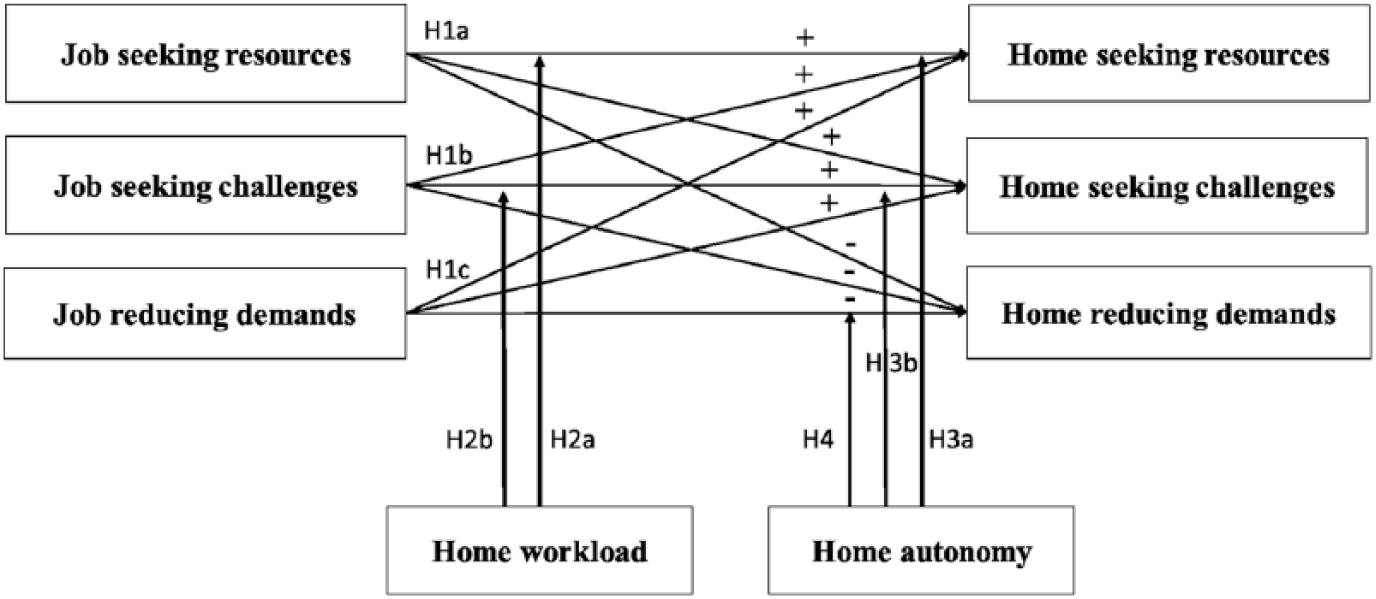
Research model.
Reducing demands indicates attempts of individuals to decrease or repair a straining work situation and includes behaviors targeted towards minimizing the emotionally, mentally, or physically demanding aspects of one’s work (Petrou et al., 2012). Individuals who act to reduce demands at work are less engaged in and less satisfied with their work, are considered less motivated, and experience more strain (Petrou et al., 2012). They will compensate for this narrowing of involvement with increased involvement in the home domain, which may take the form of expansion-oriented home crafting (i.e. seek resources and challenges at home). In this way, they have the chance to improve their functioning and satisfaction in the home domain and make up for the unpleasant situation at work. Thus:
Hypothesis 1g–i: Reducing demands at work is negatively related to (g) reducing demands at home, and positively related to (h) seeking resources and (i) seeking challenges at home.
Contextual determinants
Both the JD-R theory (Bakker and Demerouti, 2017) and Parker et al.’s (2010) model of proactive motivation consider the work context as an important determinant of well-being and (proactive) behaviors. According to the JD-R theory, job demands initiate action because they have to be fulfilled and require effort, whereas job resources facilitate goal achievement (fulfillment of demands) and stimulate personal growth and learning (Bakker and Demerouti, 2017). Moreover, job demands strengthen the motivational effect of job resources (known as the boosting hypothesis). This is consistent with Hobfoll’s (2001) notion that all types of resources gain their motivating potential and become particularly useful when needed. Jobs that combine high demands with high resources (autonomy) are so-called active jobs (see Karasek, 1979) “that challenge employees to learn new things on the job and motivate them to use new behaviors” (Bakker and Demerouti, 2017: 275). Of all of the demands and resources that have received theoretical and empirical attention, workload/work pressure (a demand) and autonomy (a resource) are two of the most often studied within the JD-R literature (and also prior to this, by Karasek [1979]). Moreover, aligned with the boosting hypothesis, the combination of high day-level work pressure and high day-level autonomy (a combination that defines active jobs) has been associated with higher day-level seeking resources and lower day-level reducing demands (Petrou et al., 2012). Thus, crafting behavior is influenced/formed by external factors that highlight the urgency and freedom to exhibit these behaviors.
The literature on proactivity has also recognized that context plays an important role not only in shaping but also in generating proactive behavior (Parker et al., 2010). Next to leadership and team processes, which are less relevant for the home domain, Parker and colleagues identify stressors and autonomy as important contextual determinants of proactive behavior. Stressors like time pressure and workload influence proactive work behavior by prompting greater initiative to improve work methods. Drawing on Carver and Scheier (1998), Parker and colleagues argue that stressors indicate a mismatch between a desired and an actual situation. Employees engage in proactive behavior to decrease the experienced discrepancy. On the contrary, contexts providing high levels of autonomy play a key role in influencing perceptions of control over the environment and thus facilitate the initiation and striving of proactive behavior (Parker et al., 2010). Autonomy allows individuals to affect and change their situation, thus fostering action and growth orientation (e.g. Deci and Ryan, 1987). In the work context, jobs that provide autonomy create conditions under which individuals experience enjoyment and flow and are therefore intrinsically motivated to be proactive in their work (Parker et al., 2010).
Contextual determinants of spillover of job crafting
We already know, therefore, that job crafting is particularly relevant for jobs with high demands because the crafting is deemed an appropriate response to cope with these demands (Demerouti, 2014). Building on our earlier argument for the spillover and compensation of crafting behaviors across life domains, individuals who craft at work are more likely to craft at home when they experience high home workload—for example having lots of chores to do, or demanding childcare responsibilities—in an attempt to restore the match between actual and desired situation, and to reduce stress. On days that individuals are involved in seeking resources and challenges at work these behaviors or strategies are more salient or accessible to employees in the home domain. In other words, the more job crafting behavior provides individuals access to resources and challenges, the more effective employees will be in using home crafting to deal with the high workload in the home domain. This is aligned to Petrou and Bakker’s (2016) suggestion that a demanding home situation is related to more leisure crafting if individuals are already proactive; which is the case when they craft their job on a specific day. Therefore, we suggest that, on a day-to-day level:
Hypothesis 2: The positive relationships between seeking resources and seeking challenges at work and respectively (a) seeking resources and (b) seeking challenges at home is stronger when home workload is high than when it is low.
Individuals might experience autonomy at home when they can choose how to spend their non-work time, who to spend it with, or feel a sense of volition in how they perform tasks that they need to do in their non-work time (Van Hooff and Geurts, 2014), suggesting more freedom to engage in the behavior that they prefer. Having sought more resources and challenges at work might therefore result in expansion-oriented crafting behavior at home on days that people have the opportunity to decide on the ways of accomplishing their home activities. In this way, individuals can continue to experience their activities as intrinsically motivating, meaningful, and fostering growth. In line with this reasoning, Petrou and Bakker (2016) found that leisure crafting was more pronounced during weeks with high job strain being combined with high home autonomy. Therefore:
Hypothesis 3: The positive relationship between seeking resources and seeking challenges at work and respectively (a) seeking resources and (b) seeking challenges at home is stronger when home autonomy is high than when it is low.
Contextual determinant of compensation of job crafting
Inspired by the idea that individuals aim for a meaningful life and do not voluntarily make a life domain less stimulating (Albrecht, 2013), we suggest that having autonomy to spend non-work time as one wishes will make individuals less inclined to transfer reduction-oriented crafting from their work into the home domain. As suggested by Kleiber et al. (2002), individuals will strive for leisure activities that facilitate their positive transformation and growth so this can be seen as a volitional activity. On days that individuals are involved in reducing demands during work hours, they will therefore try to engage rather than disengage in activities in order to experience non-work time as challenging and activating, and to facilitate their positive transformation, if they have the freedom to do so. We therefore expect that:
Hypothesis 4: The negative relationship between reducing demands at work and reducing demands at home is stronger when home autonomy is high than when it is low.
We do not formulate a specific hypothesis about home workload as a boundary condition to this compensation as it could strengthen the negative relationship between job and home reducing demands (i.e. the compensation argument) when the person has high energy resources (after successful demands reducing at work) or may diminish or even turn the negative relationship between job and home reducing demands crafting to positive (i.e., the spillover argument) when the person lacks energy. We therefore leave this question open to explore through our empirical study.
Method
Participants and procedure
Potential participants were recruited through the social and professional networks of the researchers in Belgium, Denmark, Germany, the Netherlands, Spain, and the UK. This strategy was designed to increase the generalizability of our results across multiple countries and to capture a range of cultural perspectives (Hofstede, 2011). Surveys were administered in the dominant language for that country. Scales were translated into the different languages and back translated into English to ensure consistency. Once participants agreed to take part, they were mailed a packet containing a questionnaire collecting demographic information, and a diary booklet. Diaries were completed twice a day (only on days participants worked): (1) at the end of the working day and then (2) before going to bed. This sampling strategy is aligned to the theoretical model, which focuses on the role of context in moderating the daily crafting behaviors across life domains.
After removing participants who completed fewer than three diary entries or both daily entries within 15 minutes of each other, the final sample consisted of 139 respondents with a total of 673 diary days. Participants were employees in service industry jobs from the UK (N = 19), Belgium (N = 27), the Netherlands (N = 24), Spain (N = 17), Denmark (N = 19), and Germany (N = 22) and 11 missing values. Most were employed (87.3%) with some self-employed (7.1%) and 5.6% were both employed and self-employed. Participants primarily worked in healthcare (32.1%), education (13.4%), government (12.8%), and financial or business services (12.1%). The sample included 88 women (69.8%), with a mean age of 39.77 years (SD = 11.49). Most participants lived with a partner and children (32.5%), or partner (32.5%), and 16.7% lived alone. Participants had worked on average 17.11 years (SD = 11.58) since leaving full-time education and 9.36 years (SD = 9.35) on average in their current job. The average weekly working hours were 35 (SD = 9.46).
Measures
The response categories for all scales ranged from “does not apply to me at all” (1) to “totally applies to me” (5).
Day-level job crafting was assessed with the scale developed by Petrou et al. (2012) measuring day-level seeking resources (“Today, I have asked my supervisor for advice,” 5 items; Cronbach’s α ranged from .60 to .72; M = .50), day-level seeking challenges (“Today, I have asked for more responsibilities,” 4 items; Cronbach’s α ranged from .69 to .78; M = .75), and day-level reducing demands (“Today, I have made sure that my work is emotionally less intense,” 4 items; Cronbach’s α ranged from .71 to .82; M = .75).
Day-level home crafting was measured using a scale that we developed for the purpose of this study, which conceptually mirrors the existing scale of job crafting by Petrou et al. (2012). Home seeking resources was operationalized by five items (e.g. “Since I came home from work today I made sure that I could decide myself how I was doing something”; Cronbach’s α ranged from .40 to .56; M = .52). Three items captured home seeking challenges (e.g. “Since I came home from work today, I searched more challenging tasks/activities outside my work”; Cronbach’s α ranged from .74 to .87; M = .79). Home reducing demands was measured with four items (e.g. “Since I came home from work today, I made sure that the activities I did after work were emotionally less intense”; Cronbach’s α ranged from .81 to .87; M = .84).
Day-level home workload was measured with five items developed by Peeters et al. (2005), which conceptually mirror the existing scale by Petrou et al. (2012) (e.g. “Today, I did not have enough time to do what needed to be done”). Cronbach’s α ranged from .59 to .62 (M = .60).
Day-level home autonomy was measured by a scale developed by Peeters et al. (2005), which conceptually mirrored the existing scale of job autonomy by Bakker et al. (2004). Home autonomy was assessed with four items, including “Since I came home from work today, I had control over the way I spent my time”. Cronbach’s α ranged from .84 to .92 (M = .87).
Results
Confirmatory factor analysis
First, we performed a multi-level confirmatory factor analysis to examine the factorial validity of the home crafting dimensions. The analyses were conducted with Mplus (version 7), using two-level complex type of analysis and the maximum likelihood estimator. The model consisted of three latent factors: home seeking challenges (three items), home seeking resources (five items), and home reducing demands (four items). The three-factor model showed a good fit to the data (χ2 (102) = 322.20; Comparative Fit Index (CFI) = .89; Root Mean Square Error of Approximation (RMSEA) = .06; Standardized Root Mean Square Residual (SRMR) within = .05; SRMR between = .16). The factor loadings of the items ranged from .37 to .74. Moreover, the three-factor model was significantly better than the two-factor model collapsing seeking resources and challenges in one factor [Δχ2 (4) = 73.01, p < .001] as well as the one-factor model [Δχ2 (2) = 541.38, p < .001], thereby supporting the factor structure of the home crafting construct.
In order to test whether job and home crafting can be discriminated, we compared a six-factor model (which included the hypothesized three job and home crafting dimensions on the within and between level) with a three-factor model (which included the factors seeking resources, seeking challenges, and reducing demands on the within and between level without discriminating between job and home crafting). The six-factor model was significantly better than the three-factor model [Δχ2 (24) = 945.65, p < .001], which indicates that differentiating between the job and home crafting dimensions is substantial.
Preliminary analysis
Means, standard deviations, and correlations among all the study variables are reported in Table 1. Day-level variables across the five days were averaged to correlate them with measures at the person level. Before testing our hypotheses, we examined the between-person and within-person variance components of the day-level constructs by calculating the intraclass correlation coefficient (ICC). The between-person variance of the home crafting dimensions ranged from 40.94% to 48.80%, and for job crafting dimensions between 49.38% and 59.77%, and was 51.99% and 44.04% respectively for home autonomy and home workload. Thus, our variables varied both within and between persons, warranting an examination of predictor variables at the person and the day level.
Means, standard deviations, and within level (below the diagonal) and between level (above the diagonal) correlations among the study variables, N = 139 participants and N = 673 data points.

p < .05. ** p < .01.
A one-way between-subjects ANOVA was conducted to compare the effect of country on daily job and home crafting dimensions. There was a significant effect of country on job seeking resources [F(5, 615) = 12.96, p < .001], home seeking challenges [F(5, 614) = 4.75, p < .001], job seeking challenges [F(5, 616) = 21.27, p < .001], and job reducing demands [F(5, 616) = 4.03, p < .001], but not on home seeking resources [F(5, 616) = 1.33, NS] nor home reducing demands [F(5, 616) = 2.17, NS]. Post-hoc comparisons using the Bonferroni test are presented in Table 2. Except for the Dutch employees, who scored average on all crafting dimensions, some countries are high on specific dimensions (e.g. Spanish employees on work and home seeking challenges) and some are low (e.g. Danish employees on work and home reducing demands).
Post-hoc comparisons of countries for home and job crafting using the Bonferroni test.

, b, c, d, e, f, Country mean scores with equal superscripts differ significantly from each other on the respective crafting dimension according to the post-hoc comparison using the Bonferroni test.
Hypothesis testing
The MLwiN program (Rasbash et al., 2000) was used to test the hypotheses. Similar to suggested practices (Ohly et al., 2010), all day-level variables were centered around the person-mean. We started with a null model that included the intercept as the only predictor. In Model 1, we controlled for gender, tenure, employment status, country, and the time between the two diary entries, as participants differed in these sociodemographic characteristics and they were related to home crafting. Gender, employment status, and country were included as categorical variables. Moreover, we added the day number to test possible growth of home crafting during the week. In Model 2, we entered the main effects, namely the respective day-level job crafting dimensions (e.g. job seeking resources when home seeking resources was the dependent measure), home workload, and home autonomy. In Model 3, we entered the interaction term between day-level job crafting and day-level home autonomy and home workload. We examined fixed effects and tested the improvement of each model over the previous one by computing the differences of their log likelihood statistic -2*log and subjected this difference to a χ2 significance-test.
Prior to testing our hypotheses, we inspected the effects of the control variables. Multi-level analysis showed that men were more inclined than women to seek challenges at home. In line with the post-hoc comparisons, Belgian participants were less inclined than Dutch, Spanish, and Danish employees to seek challenges at home. Moreover, home seeking resources seems to increase whereas home reducing demands to decrease over the working days of the week.
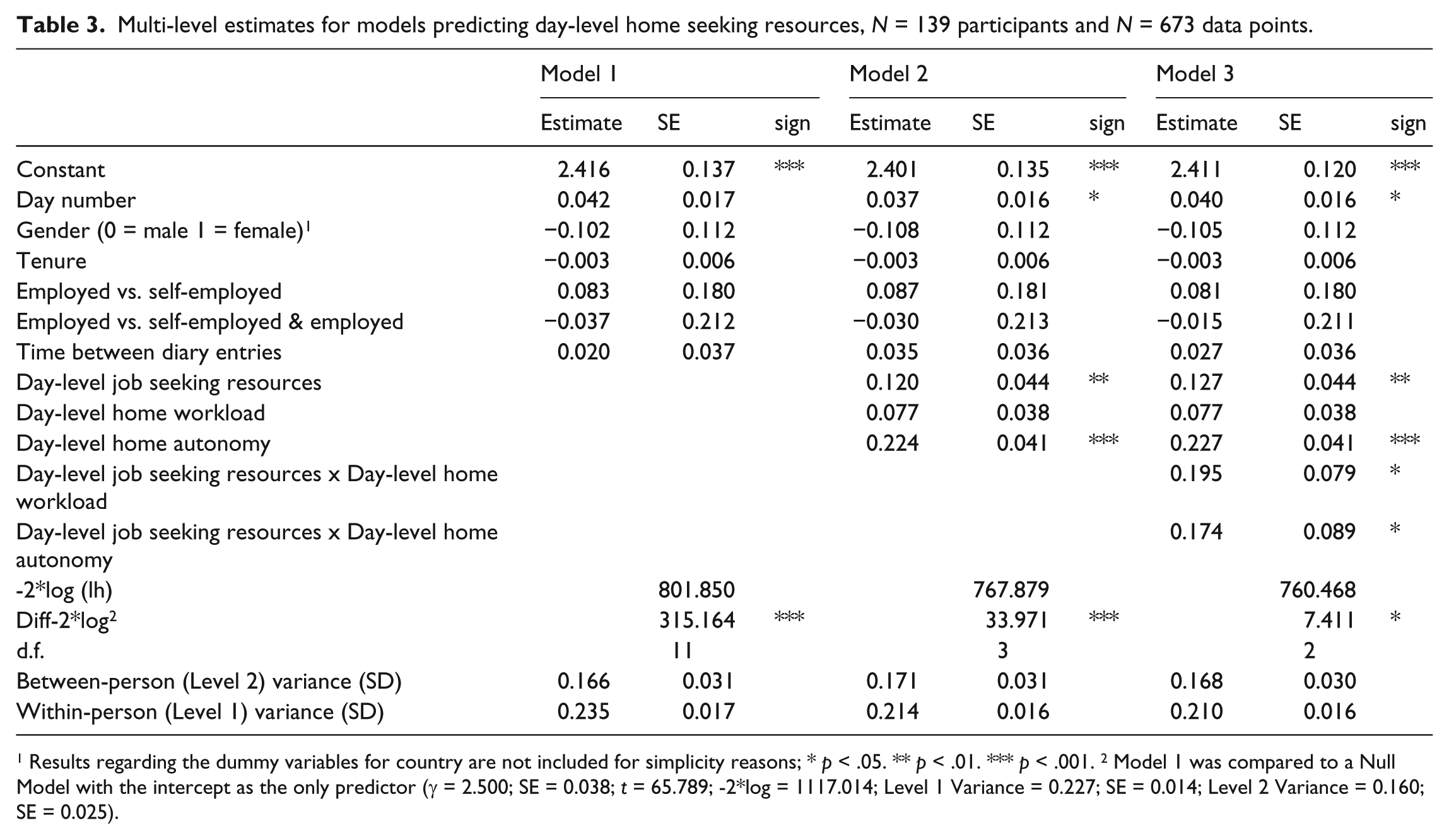
As can be seen in Tables 3–5, job seeking resources and challenges are significantly and positively related to home seeking resources (H1a and d) and challenges (H1b and e) respectively, whereas job reducing demands is unrelated to home reducing demands (H1g). Adding all job crafting dimensions in one analysis (including all controls), we found one additional significant relationship: job seeking challenges was also negatively related to home reducing demands (H1f) (γ =.186, t = 2.384, p < .05). Therefore, results provide full support for the spillover of seeking challenges (H1d–f), partial support for the spillover of seeking resources (H1a), and no support for the compensation of reducing demands (H1g–i).
Multi-level estimates for models predicting day-level home seeking resources, N = 139 participants and N = 673 data points.
Results regarding the dummy variables for country are not included for simplicity reasons; * p < .05. ** p < .01. *** p < .001. 2 Model 1 was compared to a Null Model with the intercept as the only predictor (γ = 2.500; SE = 0.038; t = 65.789; -2*log = 1117.014; Level 1 Variance = 0.227; SE = 0.014; Level 2 Variance = 0.160; SE = 0.025).
Multi-level estimates for models predicting day-level home seeking challenges, N = 139 participants and N = 673 data points.

Results regarding the dummy variables for country are not included for simplicity reasons; * p < .05. ** p < .01. *** p < .001. 2 Model 1 was compared to a Null Model with the intercept as the only predictor (γ = 2.071; SE = 0.056; t = 36.982; -2*log = 1499.014; Level 1 Variance = 0.383; SE = 0.024; Level 2 Variance = 0.365; SE = 0.053).
Multi-level estimates for models predicting day-level home reducing demands, N = 139 participants and N = 673 data points.

Results regarding the dummy variables for country are not included for simplicity reasons; * p < .05. ** p < .01. *** p < .001. 2 Model 1 was compared to a Null Model with the intercept as the only predictor (γ = 2.741; SE = 0.063; t = 43.508; -2*log = 1789.708; Level 1 Variance = 0.618; SE = 0.038; Level 2 Variance = 0.429; SE = 0.067).
Hypothesis 2 and 3 suggest that day-level home workload (H2) and home autonomy (H3) moderate the spillover of expansion-oriented crafting (seeking resources and challenges) from work to home. We found that the interactions between day-level job seeking resources and day-level home workload as well as day-level job seeking resources and day-level home autonomy were significantly related to day-level home seeking resources (Table 3). To examine the significant interactions, we conducted simple slope analysis and modeled the slopes using the values of the moderator at +/-1 SD as recommended by Aiken and West (1991). As expected, day-level seeking resources at work was significantly and positively related to day-level seeking resources at home when the day-level home workload was high (b = .35, t = 3.32, p = .001) but was not significantly related when home workload was low (b = -.04, t = 0.28, p = .68) (Figure 2). Similarly, the relationship between day-level seeking resources at work and at home was significant and positive only when day-level home autonomy was high (b = .24, t = 3.57, p = .001) and was not significantly related when this was low (b = .03, t = .50, p = .61) (Figure 3). These results therefore provide support to Hypotheses 2a and 3a. The interactions between day-level job seeking challenges and day-level workload as well as day-level autonomy were not significant (Table 4), thus Hypothesis 2b and 3b are rejected.
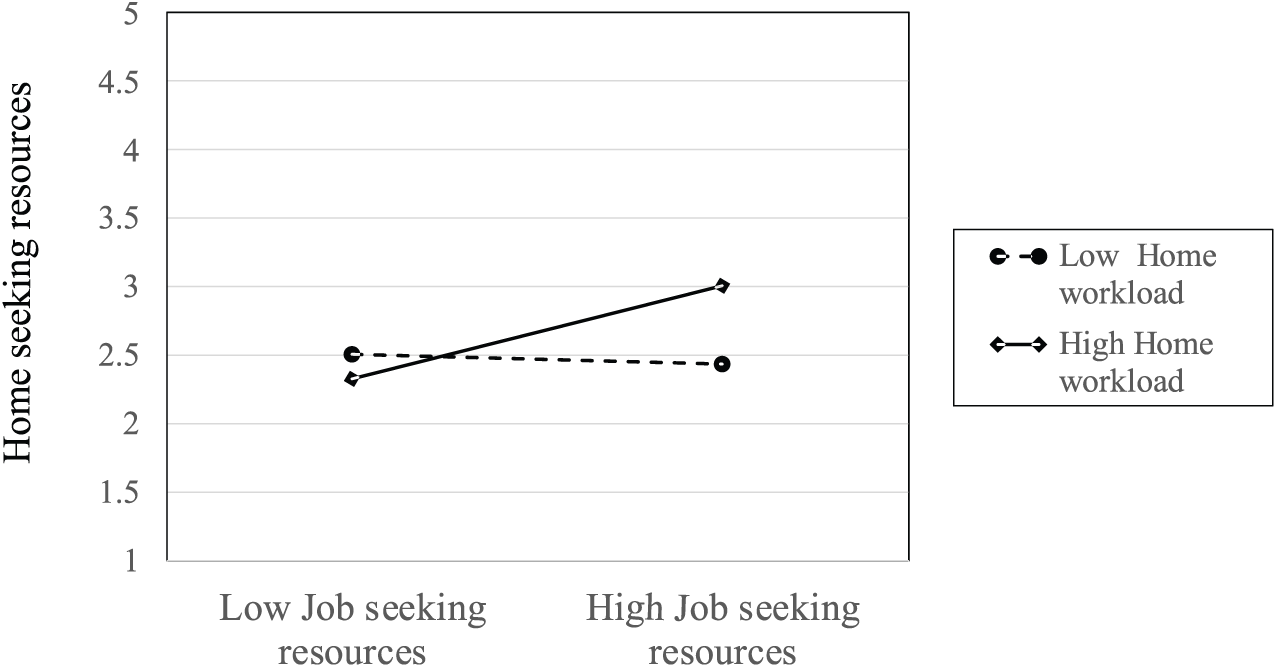
Interaction between home workload and job seeking resources.

Interaction between home autonomy and job seeking resources.
In Hypothesis 4 we suggested that the interaction between day-level job reducing demands and day-level home autonomy predicts home reducing demands. As reported in Table 5, this interaction was significant. The relationship between day-level reducing demands at work and at home was significant and negative when day-level home autonomy was high (b = -.29, t = -2.46, p = .01), but was not significant when day-level home autonomy was low (b = .07, t = .51, p = .61) (Figure 4). As expected (H4), the interaction between day-level job reducing demands and day-level home workload was not significantly related to home reducing demands.
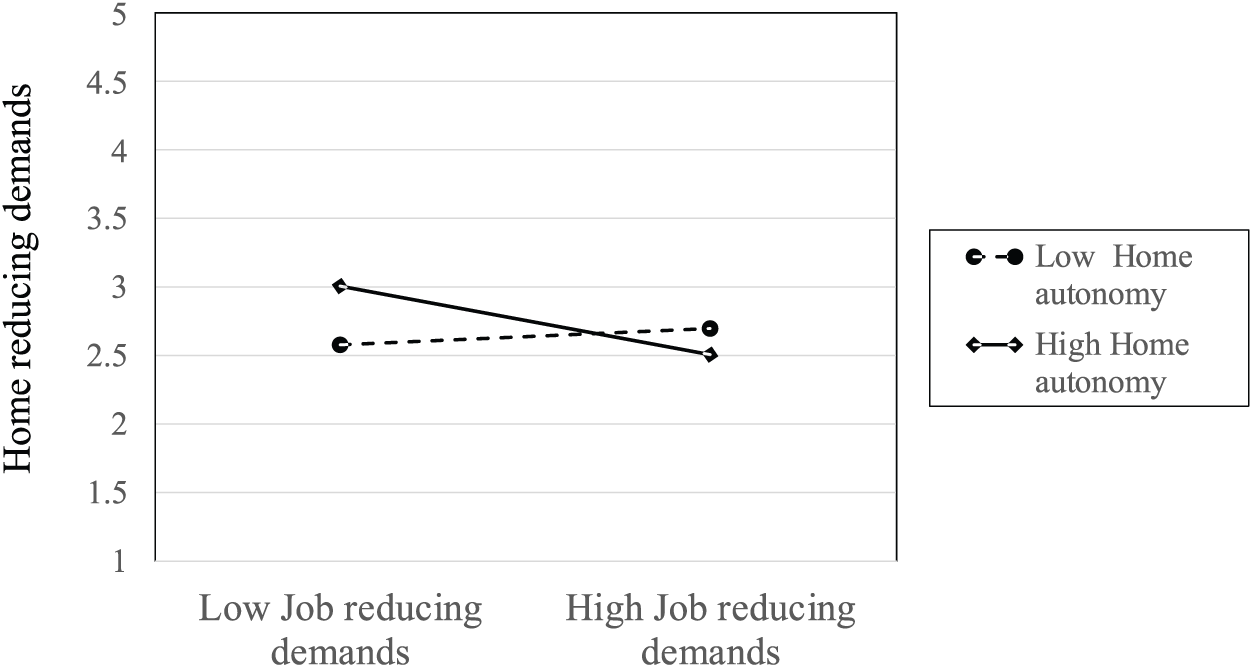
Interaction between home autonomy and job reducing demands.
With regards to the main effects (Tables 3–5); whereas home autonomy was positively related to both home seeking resources and challenges, home workload was positively related to home seeking challenges and negatively related to home reducing demands, as we would expect. We also tested the non-matching interactions (e.g. the effect of day-level job seeking resources x day-level home autonomy/workload on home seeking challenges) and the three-way interactions, (i.e. day-level respective job crafting dimension x day-level home workload x day-level home autonomy) but none of these were significant. Finally, the patterns (significance, direction, and strength) of results were comparable even when control variables were excluded. Hence, we can conclude that results hold whether or not we control for gender, tenure, employment status, country, and time between entries.
Discussion
The goal of this study was to uncover whether proactive job crafting behaviors extend to the home domain, and to examine the contextual conditions under which these processes occur. Through a twice daily diary study among employees of six European countries, we found that on days when individuals engage in expansion-oriented job crafting, they are also likely to do the same in the home domain but we found no evidence for this cross-domain extension of reduction-oriented crafting. Moreover, on days when individuals sought challenges at work, they were more inclined to search for more challenges and resources at home, and less inclined to reduce their home demands. Thus, our findings agree with earlier research that individuals craft their work and home domain (Petrou and Bakker, 2016; Petrou et al., 2017) but furthering this we found that the nature of the cross-domain crafting relationship depends on the focus of the crafting in each domain. Like job crafting, home crafting occurred daily, and 50–60% of its variance varied within days.
The study also revealed that daily workload and autonomy at home facilitated the spillover of seeking resources from the work to the home domain, whereas individuals’ reduction-oriented crafting did not cross domains when individuals experienced low autonomy at home. These contextual factors did not moderate the cross-domain relationship between seeking challenges at work and home, which occurred for all individuals in the same way. Thus, while individuals move daily from the work to the home domain, specific proactive behaviors spill over, and people compensate other behaviors in the home domain under specific conditions, with the aim to have a resourceful and challenging home life. Additionally, across the working week individuals tend to seek more resources but their tendency to reduce home demands decreases. Together, these findings offer insights into the specific context under which proactive behaviors at work extend to proactive behaviors at home.
Theoretical contributions
This study builds on the suggestion that individuals’ behaviors transcend the boundary between work and home (Edwards and Rothbard, 2000), specifically extending job crafting to home crafting, which is the main contribution. Although there is a recent line of research that focuses on the benefits of leisure crafting (e.g. Petrou and Bakker, 2016), our study extends this by examining specific types of non-work crafting, and also recognizing that non-work time is more than simply leisure. This extension is important as we find that specific job crafting behaviors have differential implications for proactivity in the home domain. Specifically, the positive link between seeking challenges at work and seeking resources and challenges at home provides evidence for the spillover effect of expansion-oriented crafting from the work to the non-work domain (see Lambert, 1990; Petrou et al., 2017). Likewise, this study implies that crafting a challenging work life motivates individuals to proactively arrange a challenging and resourceful home life, to maintain motivation and avoid boredom (Csikszentmihalyi and Nakamura, 1989).
Our finding that individuals continue to seek challenges at home even when they are challenged at work emphasizes the important energizing role of work for individuals across their life domains. Contrary to limited resource-based theories (e.g., Baumeister et al., 1994), it suggests that challenging work can energize, rather than deplete, proactive behavior in other life domains. The resulting pattern could mean that on days that employees seek challenges and resources at work, they have lots of energy (to seek new challenges) and thus also have more energy to craft their home life. Similar to previous research (Demerouti and Peeters, 2018), our results did not support a cross-domain extension of reduction-oriented job crafting, as this is not a favorable behavior that people prioritize. Taken together, our results give support to the spillover hypothesis for proactive behavior (Belschak and Den Hartog, 2017) since different life domains—in our case work and home—display similar patterns of activities and this supports the suggestion of Petrou et al. (2017) that research should not treat these domains as mutually exclusive.
Moreover, our study provides support for the premise that the cross-domain relationship between crafting at work and home occurs particularly when home autonomy is high. This builds on the theoretical propositions of Parker et al. (2010) that autonomy is a contextual determinant of the initiation and striving of proactive behavior by enhancing individuals’ sense of impact, and the principles of JD-R theory, which suggest that resources like autonomy facilitate goal achievement and stimulate personal growth and learning (Bakker and Demerouti, 2017). Daily home autonomy not only facilitated the spillover of seeking resources, but also the compensation effect of job reducing demands. In other words, when individuals have the possibility for self-determination, they will expand rather than restrict the scope of their non-work activities in order to facilitate their positive transformation and growth (Kleiber et al., 2002). Berg et al. (2010) also found a similar role for autonomy in their qualitative study (in the work domain) and suggest that this is owing to the fact that greater autonomy highlights weak situations, where individuals have the discretion to choose their own course of action.
Although we also expected that daily home workload would strengthen the extension of job crafting to the home domain—because it represents a stressor for which individuals strive to restore the mismatch between desired and actual situation (Parker et al., 2010) and because being a demand it increases the urgency and usefulness of crafting behavior (see Bakker and Demerouti, 2017)—we only found evidence for this when seeking resources. Seeking resources is an effective strategy that helps people to deal with high work demands (Tims and Bakker, 2010), and makes salient to participants the trade-offs that are necessary to juggle multiple needs (Berg et al., 2010). We did not find such an effect for the spillover of seeking challenges, perhaps because seeking challenges is already demanding enough. This is in line with research by Petrou et al. (2012), who found that individuals did not seek more challenges on days that they perceived their job as demanding while having high job autonomy; on such days they were more inclined to seek for more resources, in line with our results.
Finally, our study is the first to show the prevalence of job and home daily crafting among six European countries. Gordon et al. (2015) found that US and Dutch employees craft their jobs in different ways with seeking resources occurring more often in a feminine culture (Netherlands), and reducing demands in a masculine culture (US). This was supported in our data with a higher prevalence of reducing job demands in masculine cultures (UK, Spain; see Hofstede, 2011). Across all European countries, the lowest mean score of all crafting dimensions was found for job reducing demands whereas the highest for job seeking resources. We therefore conclude that crafting behaviors occur irrespective of context with relation to national policies (regulating organizational life) and social norms (regulating family life).
Limitations and future research
Despite our best efforts to capture these complex daily processes through a multi-wave diary study, the study is not without limitations. First, although we asked participants to record the time and date of diary completion and excluded the diary entries that were recorded on the wrong day, the paper diary method did not allow us to completely verify the compliance of our participants. Using online diaries or devices that register the exact timing of completion can improve the quality of the data in future studies. Second, although we collected data from six European countries, we relied on convenience and snowball sampling, which could compromise the generalizability of the results to the broader population of employees of each country. Indeed, female employees and the health care sector were rather overrepresented in our sample (although we did not find any significant differences in the sample between countries). Future research should thus try to replicate our findings with more representative samples within each country. While doing this, it would be wise to study multinational organizations across countries as Hofstede (2011) did, in order to be able to examine the country instead of the organizational effect. Finally, although home seeking resources was measured with five items, the reliability of the scale was below the acceptable criteria. This may be attributed to the fact that not all statements were experienced on each specific day. As this lowers the inter-item correlation, the value of Cronbach’s alpha coefficient becomes also lower. Unreported analyses showed that items of each day-level scale were more highly correlated with each other than with items of other scales.
Although the study provided several insights into the way that crafting transcends life domains, there are still several unanswered questions. We suggested that meaning and need satisfaction are the motives of spillover and compensation. Although these mechanisms have been supported empirically elsewhere (e.g. Berg et al., 2010; Slemp and Vella- Brodrick, 2014), we were unable to test this empirically in the present study so future research could combine these insights. Drawing on the insights of Parker et al. (2010), we focused on two specific contextual factors as moderators to the cross-domain effects of crafting within-person, but there could be other contextual factors (e.g. supervisors’ and partners’ supportive behavior) or more general motives (e.g. prosocial motivation or impression management) or personality characteristics (e.g. proactive personality) that moderate this phenomenon at the between-person level. Related to this, while we found that job crafting had positive implications for proactive behaviors in the home domain, there might also be circumstances where the opposite is true. An alternative theoretical perspective suggests that individuals have limited resources that might become depleted through the effort of job crafting (Baumeister et al., 1994). It might be, for example, that when individuals feel pressured to job craft it expends rather than expands their resources to do so at home (Grant and Bolino, 2016), which would warrant further exploration.
Practical implications and conclusion
We already know that job crafting can be trained and that it has positive benefits for employees and organizations (Gordon et al., 2018; Van den Heuvel et al., 2015), and job crafting interventions (e.g. the Job Crafting ToolTM; Berg et al., 2013) are available for practitioners with the aim to facilitate and train employees to engage in job crafting behavior. According to our results, creating an active work environment is a good way to foster job crafting among employees. Organizations and practitioners should take into account that fostering job crafting not only has an impact at work but also at home. In other words, employees who have autonomy to craft their jobs (for instance, seeking more challenges) will also engage in similar crafting behavior at home on days when they have more home autonomy. This is of relevance for organizations concerned about the well-being and quality of life of their employees. Organizations should invest in creating a work context that facilitates employees’ crafting behaviors, even beyond the limits of the organizations, and allocating resources (e.g. applying specific conciliation practices such as housework help) to help employees to have autonomy to craft their home.
In this study we find that proactive behaviors designed to create meaning and motivation at work, through seeking resources and challenges, have beneficial implications not only for the work domain but for home life, too. Our results suggest that these learnt behaviors can be extended to the home domain, particularly when individuals have autonomy to proactively shape their home lives. This implies that work can have an energizing effect on home life, in the right circumstances. The implications of this research help us to understand more about how proactive behaviors operate across life domains, and the conditions under which these domains can be positively interactive.
Footnotes
Funding
This research received no specific grant from any funding agency in the public, commercial, or not-for-profit sectors.

Twitter: