



Abstract
A widely-cited proposition in boundary theory states that it is difficult for individuals to transition between roles, especially when these roles are highly segmented. Surprisingly, this hypothesis has not been directly tested. We provide an empirical test of these propositions and draw from the self-regulation literature to expand boundary theory in exploring how episodes of cognitive role transitions impact job performance. We propose that cognitive role transitioning is cognitively demanding, which consumes the limited executive control resources that facilitate effective job performance. In a multilevel study of 619 employees providing 4371 episodes, we observed that work-to-family cognitive role transitioning was negatively related to job performance, and this effect was mediated by self-regulatory depletion. Although individuals with greater role integration were somewhat more likely to experience cognitive role transitions than those with segmented roles, these individuals were also buffered from the self-regulatory depletion that impairs effective job performance. Overall, these findings suggest that integration, rather than segmentation, may be a better long-term boundary management strategy for minimizing self-regulatory depletion and maintaining higher levels of job performance during inevitable work–family role transitions.
Keywords
Advances in communication technologies now enable individuals to engage in various life roles at any time of the day. The availability of these technologies and ease with which they can be used contribute to the regular crossing of the boundaries that separate work and family. Consequently, many employees are now faced with the question of how, rather than if, their personal and professional lives will interact with one another. Most individuals transition between work and family roles on a daily basis, and often, multiple times within a given day. Scholars have utilized boundary theory to explore how individuals create role boundaries and transition between roles (Ashforth et al., 2000), and some empirical evidence indicates that these pervasive instances of inter-role transitioning may have negative consequences. For example, previous research finds that individuals who more frequently transition between work and family roles experience increased work–family conflict (Matthews et al., 2010). As a result, it is crucial for scholars and managers to develop a clear understanding of both the phenomenon of transitioning between these two central life domains, as well as the consequences of these transitions.
In this study, we seek to address two important gaps in the role boundary literature. First, while some qualitative work has contributed to our understanding of how individuals navigate role boundaries (Ashforth et al., 2008), two fundamental and widely-cited propositions of boundary theory have yet to be fully explicated. Ashforth and colleagues (2000) propose that micro-role transitions can be difficult for individuals because disengaging from one role and engaging in another may be a psychologically difficult task. This psychological difficulty and its underlying process, however, have not been sufficiently clarified. Additionally, they propose that role transitions are especially difficult when individuals have segmented rather than integrated roles. These propositions are largely unexamined but warrant attention, because role transition difficulty may be the proximal cause of negative outcomes associated with role transitions.
Second, the majority of extant work–family research focuses on how between-subjects differences in role transition frequency and role integration/segmentation impact employee well-being, while neglecting to examine the consequences for individual job performance. As a result, questions remain about the implications for organizations when employees create segmented or integrated work–family boundaries. Here, we address these related and unresolved issues, which make it difficult for evidence-based practitioners concerned with job performance to recommend whether organizational policies should be designed to encourage segmentation (e.g. prohibiting personal calls) or integration (e.g. telecommuting) of role boundaries.
In addressing these gaps, this study extends research and practice on work–family boundaries in at least four specific and substantive ways. First, we integrate the self-regulation literature (e.g. Muraven and Baumeister, 2000) with boundary theory to clarify the nature and consequences of role transitioning. Specifically, we demonstrate that psychologically transitioning between work and family roles is a cognitively-demanding task that depletes finite cognitive resources. In this way, we illustrate how self-regulatory depletion is a proximal consequence of difficult role transitions. This finding is important to note because it confirms an untested assumption in boundary theory, and sheds light on the theoretical mechanisms underlying the common experience of role transitioning. This contribution also answers calls from Allen et al. (2014) for more research incorporating self-regulatory processes in the work–family literature, and also creates opportunities for future research to leverage this construct in developing our understanding of boundary theory.
Second, we expand boundary theory to explore how episodic role transitions and between-subjects differences in role structure (i.e. integration and segmentation) shape job performance for the first time. By identifying self-regulatory depletion as a potential mediating mechanism in the relationship between role transitioning and job performance, we are able to explore a more nuanced explanation for how and why role transitioning impacts organizational outcomes. Furthermore, this theoretical integration creates opportunities to explore the intuitive, and less intuitive, ways that role integration shapes job performance. This extension is necessary because results from previous research seem to suggest conflicting implications for how role integration may affect performance. While some research suggests that role integration may facilitate job performance by making role transitions less difficult (Ashforth et al., 2000), other research indicates that role integration can reduce performance by increasing the frequency of role transitions and interruptions (Kossek et al., 2006; Matthews et al., 2010). We help reconcile this apparent inconsistency by testing a moderated mediation model derived from our theoretical integration of boundary theory and the limited capacity model of self-regulation (see Figure 1).
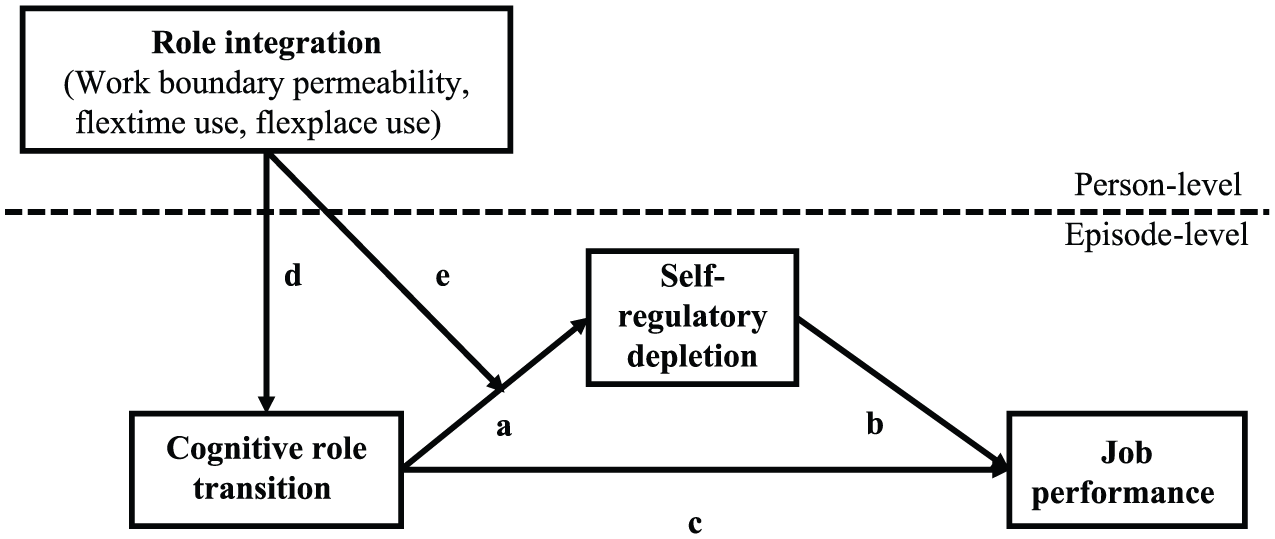
Theoretical model.
Third, we improve upon previous studies in this area with a methodology that enhances the internal validity of our inferences. This research is among only a handful of studies that have answered calls for research implementing episodic methodologies to explore work–family interactions in situ (e.g. Maertz and Boyar, 2011). In fact, the theoretical and empirical gaps identified earlier may be owing, in part, to this methodological shortcoming. A between-subjects approach to measuring inter-role phenomena assumes that such events can be meaningfully and accurately aggregated by respondents. Although this approach has greatly clarified how work and family roles interact with one another, this methodology cannot capture individuals’ experiences during episodes of work–family interaction as they unfold. To address these limitations, we use an episodic sampling approach to conceptualize and measure role transition phenomena with higher fidelity, while avoiding memory and aggregation errors inherent in “levels approaches” (Maertz and Boyar, 2011).
Fourth, our findings shed new light on the practical debate between policies that encourage either segmentation or integration of work–family role boundaries. This topic is critical to examine because most organizational work–family policies act to facilitate either more segmentation (e.g. daycare provided off-site, prohibiting personal calls at work, compressed work weeks) or more integration of work and family role (e.g. telecommuting, on-site child care). Managers and employees have a choice to make between segmenting and integrating work–family boundaries. Yet, the research remains unclear on the question of which approach best alleviates the negative effects of role transitions on job performance. Our findings provide practitioners with more clarity on the relative advantages of integration versus segmentation for managing work–family role transitions and their negative consequences. Together, these contributions both significantly advance our understanding of how the work–family interface shapes cognition and organizational behavior, and assist in developing practical recommendations for effective boundary management strategies.
The role of cognitive role transitions in boundary theory
Boundary theory (Ashforth et al., 2000) and border theory (Clark, 2000) articulate the processes through which individuals engage in role transitions between different domains, such as work and home. Ashforth and colleagues define micro-role transitions as the “psychological and/or physical movement between roles” (2000: 472). Micro-role transitions have been more recently delineated to distinguish physical from cognitive role transitions (Matthews et al., 2010). Whereas a physical role transition is prompted by physically moving between work and family domains, cognitive role transitions may be enacted at any time and any location. Although family-to-work and work-to-family cognitive role transitions can be usefully distinguished, we focus here on work-to-family cognitive role transitions (i.e. mentally enacting family roles during work performance episodes) in order to directly examine how these episodes impact job performance.
We define cognitive role transitions here as discrete episodes in which an individual is currently engaged in one role (i.e. work), and experiences off-topic thoughts regarding a different role (i.e. family). During work-to-family cognitive role transition episodes, family-related thoughts occupy attentional resources and cause disengagement from the work role (Winkel and Clayton, 2010). For example, experiencing the thought “My wife’s birthday is next week and I need to buy a present” while sitting in a team meeting would qualify as an episode of cognitive role transition, because the intrusive thought reflects role responsibilities from one domain (i.e. husband) when a different role is already engaged (i.e. teammate). Although cognitive micro-role transition episodes have not been formally studied in the work–family literature, previous studies have explored the idea that individuals become cognitively occupied with one role (e.g. family), while presently engaged in another (e.g. work; Allen et al., 2014). For example, Williams et al. (1991) described “role juggling” driven by external task demands. Carlson and Frone (2003: 518) described internal interference as “internally generated psychological preoccupation with one domain of life (e.g. work) while within the role boundaries of another domain of life (e.g. family)”. Furthermore, Cardenas et al. (2004) explored the idea of distractions by asking participants to estimate the amount of time thoughts or interruptions from one domain occurred while engaged in a different role. While similar, the ideas of role juggling, internal interference and distractions differ on whether they are prompted by internal versus external sources and whether they are initiated intentionally versus unintentionally. When conceptualized and measured episodically, however, these variations of cognitive interference and cognitive distraction constitute slightly different phenomena that include a common psychological process (i.e. cognitive micro-role transitioning). Consequently, we capture all of these variations, and thus, focus on cognitive micro-role transitioning as the underlying boundary crossing phenomenon discussed by Ashforth and colleagues (2000).
Micro-role transitions and self-regulatory depletion
Ashforth and colleagues (2000: 473) propose that micro-role transitioning is “difficult”, and describe this difficulty as “the effort required to become psychologically and physically disengaged from one role and re-engaged in another role”. Boundary theory, however, is unclear about the exact nature of the psychological difficulty individuals experience during cognitive role transitions. We draw on the limited capacity model of self-regulation (Muraven and Baumeister, 2000) to clarify this theoretical proposition.
Cognitive role transitions fundamentally reflect the experience of alternating attention between different roles. Instances of role transitioning such as these are cognitively demanding and rely on executive control resources (Diamond, 2013). Among many important functions, executive control allows individuals to prioritize and select among alternatives, direct and maintain attention, and initiate and execute tasks. In turn, role transitioning can create mental “fatigue” because such executive control exertions draw on a finite pool of resources and deplete these with use (Muraven and Baumeister, 2000). Psychological research overwhelmingly shows that cognitively demanding tasks (e.g. complex decision-making) deplete cognitive resources (Muraven and Baumeister, 2000). In fact, the same resources depleted by executive control functions have been implicated in many acts of self-regulation (Kaplan and Berman, 2010). Using the analogy of a regulatory “muscle”, the limited capacity model suggests that self-control exertions draw upon a finite amount of resources to successfully regulate responses, and consequently, the capacity to exert self-control deteriorates over time with frequent use (Baumeister et al., 2007).
We propose that micro-role transitioning between work and family roles is a cognitively effortful process accomplished through exercising executive control functions, which subsequently depletes finite cognitive resources and the potential for self-regulation. The extensive empirical literature demonstrating that attention switching and multitasking are cognitively effortful supports the utility of integrating the limited capacity model with boundary theory to hypothesize that role transitioning causes depletion (Hamilton et al., 2011; Leroy, 2009). Previous research also indirectly supports this hypothesis by finding that between-subjects levels of family-to-work interference impairs concentration (Demerouti et al., 2007) and increases workplace cognitive failures, operationalized as lapses in memory, attention and motor function (Lapierre et al., 2012). Additionally, one study found that daily levels of family-to-work conflict reduced daily concentration (Nohe et al., 2014) Based on this evidence, we predict a direct effect of cognitive role transitions on depletion (see Figure 1, path a):
Hypothesis 1: Cognitive role transition episodes will be positively related to self-regulatory depletion.
Self-regulatory depletion impairs performance
Self-regulatory depletion has detrimental effects on task effort and performance. Previous research has extensively demonstrated that a state of self-regulatory depletion is positively related to subjective fatigue (d = .44) and negatively related to effort on a variety of subsequent tasks (d = –.64; Hagger et al., 2010). Self-regulatory depletion has been linked to reduced job performance in applied contexts as well (e.g. Trougakos et al., 2008). To test whether self-regulatory depletion is an underlying driver of performance decrements associated with cognitive role transitioning, we test whether self-regulatory depletion is associated with reduced job performance. Therefore, we predict direct (see Figure 1, path b) and mediated (see Figure 1, path ab) effects:
Hypothesis 2: Self-regulatory depletion will be negatively related to job performance.
Hypothesis 3: Self-regulatory depletion will mediate the relationship between cognitive role transition episodes and job performance.
Micro-role transitions and role integration
Another goal of this study is to determine if cognitive role transition episodes elicit depletion among all employees uniformly, or if boundary conditions might moderate these effects. We argue that individual differences in role structure (i.e. role integration or segmentation) may provide important insights into whether employees will fully experience the negative effects of cognitive role transitions.
Boundary theory and work–family role integration
Employees’ work–life boundaries can be conceptualized on a continuum ranging from segmentation, characterized by low flexibility and permeability, to integration, characterized by high flexibility and permeability (Ashforth et al., 2000; Clark, 2000). Flexibility reflects the extent to which employees are capable and have opportunities to expand or contract role boundaries, while permeability refers to the extent to which boundaries are actually crossed. Further, scholars have distinguished different forms of flexibility; for example, flextime and flexplace. Flextime policies reflect the idea that individuals may flexibly shift hours to accommodate family demands, while flexplace policies allow individuals to work from home, or other places than the traditional work setting (Allen et al., 2013). Additionally, scholars emphasize the difference between policy availability and policy use (Kossek, et al., 2006), given that while policies may be available, not all employees may choose to take advantage of them.
A recent review of boundary theory (Allen et al., 2014) emphasizes how flexibility policy use and boundary permeability contribute toward greater role integration between work and family (e.g. Bulger et al., 2007, Olson-Buchanan and Boswell, 2006). As noted by Kossek and colleagues (2006: 350):
… recent developments in boundary theory (Ashforth et al., 2000), highlight the fact that integrating work and family in time and space, as in flextime and flexplace job designs, means that borders between the two domains are permeable; work may be more interrupted by family influences and vice versa.
Because individuals with highly flexible and permeable boundaries are more likely to actually cross role boundaries regularly, they should be more prone to engaging in cognitive role transitions (see Figure 1, path d):
Hypothesis 4a: Flextime policy use will be positively related to cognitive role transitioning.
Hypothesis 4b: Flexplace policy use will be positively related to cognitive role transitioning.
Hypothesis 4c: Work boundary permeability will be positively related to cognitive role transitioning.
Furthermore, role integration (i.e. as measured here by flextime use, flexplace use and permeability) should also be detrimental to job performance because it increases the likelihood that individuals will transition to family roles at work and experience distracting thoughts (see Figure 1, path cd). Based on this rationale, we make the following predictions:
Hypothesis 5a: Cognitive role transitioning will mediate the relationship between flextime policy use and job performance.
Hypothesis 5b: Cognitive role transitioning will mediate the relationship between flexplace policy use and job performance.
Hypothesis 5c: Cognitive role transitioning will mediate the relationship between work boundary permeability and job performance.
Buffering effects of role integration
While these hypotheses suggest that increased role integration may reduce job performance through more frequent cognitive role transitioning and the depletion these episodes cause, other research suggests that role integration might actually help mitigate the negative effects of cognitive role transitioning on job performance through a different mechanism. According to boundary theory (Ashforth et al., 2000; Shumate and Fulk, 2004), repeatedly engaging in micro-role transitions facilitates the formation of scripts that allow for less difficult transitions. Consistent with the limited capacity model (Muraven and Baumeister, 2000), scripts act to offset depletion effects because they remove the need to apply conscious effort in cognitively-demanding situations (Webb and Sheeran, 2003). Individuals with greater role integration frequently transition between roles and therefore accumulate more practice over time in transitioning between roles (Winkel and Clayton, 2010). As a result, individuals with high role integration should develop more efficient transition scripts that reduce switching costs (Monsell, 2003), thereby making micro-role transitions less cognitively demanding and depleting to self-regulatory resources (see Figure 1, path e*ab):
Hypothesis 6a: Flextime policy use will moderate the mediating effect of self-regulatory depletion in the relationship between cognitive role transitions and job performance, such that individuals who use flextime policies will experience lower levels of depletion during a cognitive role transition episode.
Hypothesis 6b: Flexplace policy use will moderate the mediating effect of self-regulatory depletion in the relationship between cognitive role transitions and job performance, where individuals that use flexplace policies will experience lower levels of depletion during a cognitive role transition episode.
Hypothesis 6c: Work boundary permeability will moderate the mediating effect of self-regulatory depletion in the relationship between cognitive role transitions and job performance, where individuals with a permeable work boundary will experience lower levels of depletion during a cognitive role transition episode.
In sum, segmented, non-permeable work role boundaries should help reduce the frequency of cognitive role transitions which split attention, elicit depletion and reduce job performance. However, when family thoughts at work (perhaps inevitably) occur, employees with highly integrated boundaries could be buffered from self-regulatory depletion because they will have developed efficient role transition scripts reducing the difficulty of these episodes over time.
Alternative explanations
In the Episodic Process Model of job performance, Beal et al. (2005) hypothesize that off-task thoughts in general, whatever their content, will negatively impact attentional resources and job performance. To explore this issue, we test the relationship between general off-task thoughts, defined as thoughts that occur during work performance episodes that are unrelated to work and do not include family-related content, and both self-regulatory depletion and performance. As hypothesized earlier, we expect that individuals with highly segmented work and family roles will experience heightened depletion when switching between these roles, because switching requires more cognitive resources for them than for those with integrated roles. We further hypothesize that while general off-task thoughts will be positively related to self-regulatory depletion, this effect will not be moderated by role integration, because an individual’s role structure should be irrelevant to general non-role-related off-task thoughts. Observing this pattern of findings would suggest cognitive role transition episodes impact performance through qualitatively different mechanisms than general off-task thoughts.
Additionally, it may be the case that flexible work–family policies are confounded with greater levels of general organizational support (Allen et al., 2014). We rule out this alternative explanation by testing several additional policy moderators of the role transition-depletion relationship. We hypothesize that supportive policies unrelated to role integration will not moderate this relationship. If these policies did moderate this relationship, it would suggest that general levels of organizational support may act as a buffering mechanism, rather than role integration.
Method
Sample and procedure
We used data from the Sloan 500 Family Study (Schneider and Waite, 2008) to test our hypotheses. The 500 Family Study targeted middle-class, dual-earner families, including mothers, fathers and children sampled from communities dispersed across the United States. These families were directly recruited via phone, mail and newspaper advertisements, as well as through schools by sending out informational packets. Participants in this study completed both a between-subjects survey dealing with work–family attitudes and behaviors, as well as episodic sampling surveys dealing with what they were currently doing, thinking and feeling at the time. During the entire data collection, participants were signaled eight times per day at random intervals (never less than 30 minutes apart or more than two hours apart) over the course of seven consecutive days. Response rates to the experience sampling methodology (ESM) signals among mothers (78%) and fathers (73%) were acceptable given that some daily activities made responding impossible (e.g. bathing, driving).
Given that our hypotheses focused solely on workplace events, we used four filtering criteria to identify usable responses: (1) participants must have been employed at least part time, (2) responses must have been provided while the participant was physically located at work, (3) we only included episodes that reflected task performance behaviors, and excluded episodes where behavior reflected actual family interactions (e.g. talking to spouse), and (4) we only examined episodes where employees’ thoughts reflected either work-related topics or family-related topics. We chose these filters to ensure that participants were not on a break while reflecting on family content, and so we could measure the effects of cognitive role transitions on performance. Data were filtered with these criteria using survey items. Participants listed their work status in the between-subjects survey, and listed (a) their location, (b) what they were doing, and (c) what they were thinking about in the episodic survey.
After filtering the data with these criteria, 619 employees provided 4371 distinct sampling moments for data analysis. In these sampling moments, every participant was located at work, engaged in a task performance behavior, and thinking about either work- or family-related content. On average, each participant provided 7.1 data points (SD = 4.5). The final reduced sample was 54% female and participants were 46 years old on average (SD = 6.3 years). Participants were predominantly Caucasian (88%) and worked full time (78%). In their current jobs, participants had an average of 8.8 years of job tenure with high variability (SD = 8.5 years). With regard to income, 57% earned a personal annual salary of over $50,000, while only 10% earned $20,000 or less.
Measures
Cognitive role transition episodes
Work-to-family cognitive role transition episodes were measured dichotomously where participants were assigned a 0 if no role transition occurred or a 1 if a role transition episode was present. Recall that in the filtered sample every participant was currently engaged in a task performance episode while physically located at work. At each ESM signaling, participants were asked the open-ended question: “What was on your mind?”. Two authors coded the open-ended responses to classify whether thoughts within episodes reflected work-related, family-related, or general off-task content. These ratings were found to be very reliable (98.5% agreement). The raters discussed all discrepancies until they reached consensus. Cognitive role transition episodes were coded as 1 if a participant was thinking about family-related content. If a participant was thinking about work-related content, the episode received a 0.
General off-task thought episodes
General off-task thought episodes were coded in the same general manner as cognitive role transition episodes. Again, in the filtered sample, every participant was currently engaged in a task performance episode while physically located at work. At each ESM signaling, participants were asked the open-ended question: “What was on your mind?”. General off-task thought episodes were coded as 1 if a participant was thinking about off-task content unrelated to family content. If a participant was thinking about work-related content, the episode received a 0.
Self-regulatory depletion
We measured self-regulatory depletion as the degree to which individuals experienced subjective mental fatigue. It consisted of the following five items: (1) a Likert-type “How well were you concentrating” item (reverse-coded); (2) two semantic differential items measuring how “active-passive” and “strong-weak” participants felt, where passive and weak were positively-keyed; and (3) two Likert-type items measuring “Was this activity interesting?” (reverse-coded) and “Did you wish you were doing something else?”. Internal consistency estimates indicated that this measure had adequate reliability (α = .75). Evidence for the construct and criterion validity of this scale is reported in the Appendix.
Flexibility policy use
Policy use was measured for two separate work–family flexibility policies: flextime and flexplace. First, participants rated on a dichotomous yes (1) or no (0) scale whether or not they took advantage of a company policy that allowed them to work flexible hours. Second, participants rated on a dichotomous yes (1) or no (0) scale to rate if they used a company policy that allowed them to work from home. Given that the current study focuses on policy use, a “yes” response for either item indicates both that the participant’s organization has a formal flexibility policy and that the individual uses the flexibility policy.
Work boundary permeability
Work boundary permeability was measured with two items. Specifically, participants rated “yes or no” to the following items: “Which of the following does your family use to keep in touch when you are at work? (1) cellular or mobile phone and (2) personal visits”. Using these methods of communication reflects role boundary blurring, where work boundaries become permeable and susceptible to family influences. “No” responses were coded 0 as reflecting stronger/segmented work boundaries and “yes” responses were coded 1 as weaker/integrated work boundaries. This scale content matches a previous validated work permeability scale (“My family contacts me while I am at work”; Matthews and Barnes-Farrell, 2010). These items were summed to create a scale score that ranged between 0 and 2, where higher scores reflect more work boundary permeability. Rather than using an ordinal-level scale, scale scores were recoded to create a dichotomous index for ease of presentation. Scores of 1 and 2 were collapsed into a single “1” category, reflecting greater permeability. Results were equivalent for the dichotomous and ordinal type scales. Construct validity evidence for this scale is reported in the Appendix.
Job performance
Performance was measured with a four-item scale (α = .79) that asked respondents to rate the degree to which their task behavior in a work performance episode met a standard for acceptable performance. This measure captured employees’ evaluation of the extent to which he/she made an active attempt to accomplish goals. This construct was measured with four items: “Were you succeeding at what you were doing?”, “Were you living up to your expectations?”, “Were you feeling hardworking?” and “Were you feeling productive?” Ratings were made on a four-point Likert scale (0 = Not at all to 3 = Very much), where higher scores reflect higher levels of self-rated performance.
Control variables
We controlled for time of day, number of hours worked per week and intrinsic motivation. 1 Participants working later in the day may be simultaneously more likely to be in contact with family since they will be seen soon, and perform worse since resources have been depleted throughout the day. Participants working a greater number of hours per week may be simultaneously less likely to be in contact with family given greater work demands and perceive themselves as performing better, given that time put toward work is a prerequisite for effective job performance (Edwards and Rothbard, 2000). Finally, participants with greater intrinsic motivation may be simultaneously less likely to be in contact with family because satisfying work captures their attention, and perform better owing to enjoying the nature of the work. Intrinsic motivation (α = .80) was measured using items from the Alfred P. Sloan Working Families Center and modified items from the General Social Survey (1989), where participants were asked the item stem, “I am currently working in my main job”. Example items include: “because I enjoy the tasks involved in my job” and “because I like being challenged at work”. More detailed information regarding these items in the 500 Family Survey is available in the online codebook (Schneider and Waite, 2008).
Analytic strategy
The data used for this study have a nested structure. Variables were measured at two levels: longitudinal observations (within-subjects) and person-level (between-subjects). Continuous repeated measures variables in our analyses were person-mean centered to remove between-subjects variance so the predictors strictly represent fluctuations about a person’s individual mean (Ilies et al., 2007). Cognitive role transitioning, depletion and performance were all measured as repeated measures variables (see “episode-level” variables in Figures 1, 4). Role integration was measured with between-subjects variables (i.e. flextime, flexplace and permeability; see “person-level” variables in Figures 1, 4). Given that our Level 2 moderators were measured with dichotomous scales, we did not grand-mean center these predictors. To control for autocorrelation (i.e. serial dependency) across time in unbalanced data (i.e. unequal time intervals), the mediation analyses controlled for dependent variable values at time t -1 as well as a time lag variable and an interaction term following the guidelines proposed by Beal and Weiss (2003). Models were fit using maximum-likelihood estimation.
Results
Of the 4371 thought episodes coded while participants were at work, we observed 165 episodes of family-related thoughts (3.8%). The most commonly reported category of thoughts was “Thinking about child(ren)” (N = 70). Other popular examples included “Thinking about family” (N = 25), “Thinking about spouse/partner” (N = 17) and “Picking children up from somewhere” (N = 8). Table 1 presents the between- and within-subjects correlations among the study variables.
Between- and within-individual correlations among study variables.
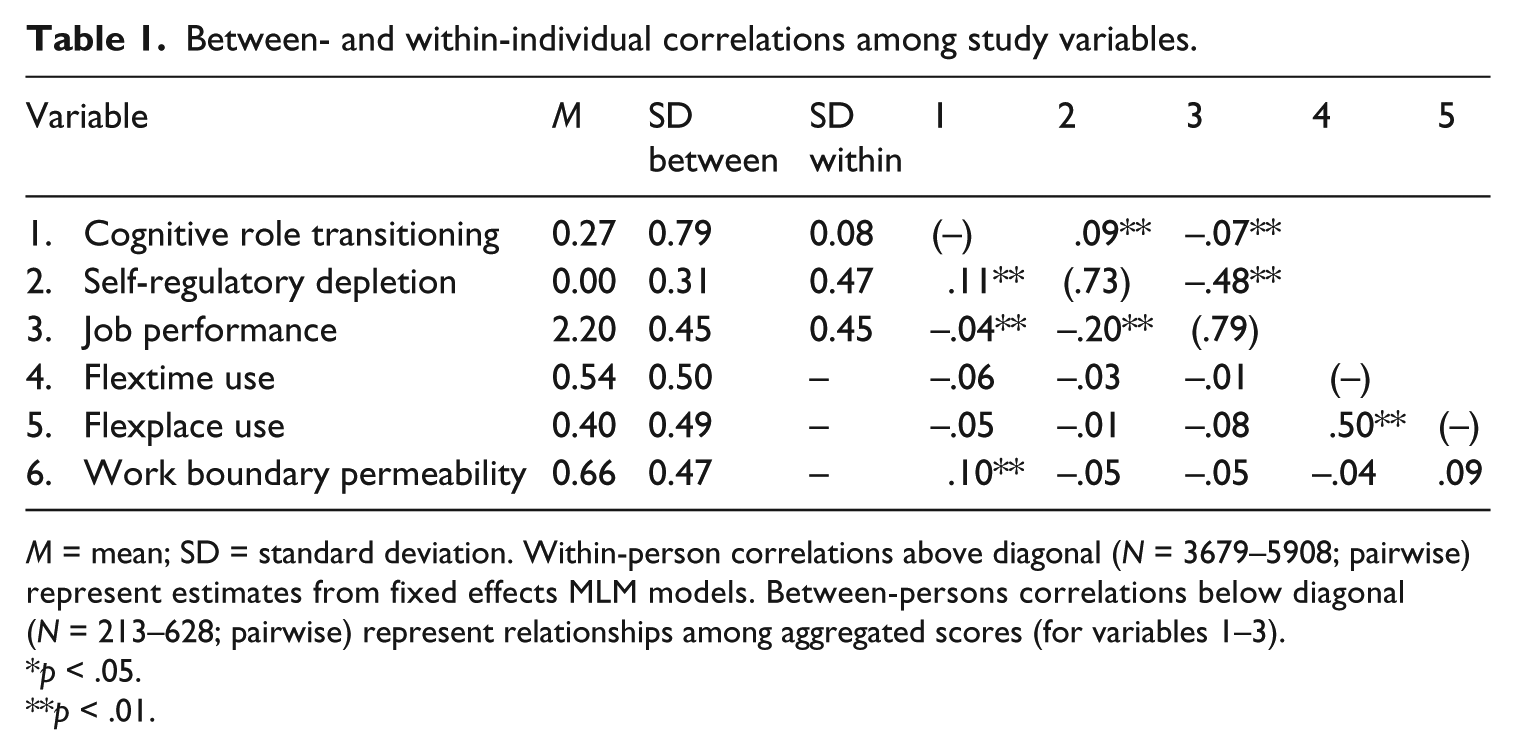
M = mean; SD = standard deviation. Within-person correlations above diagonal (N = 3679–5908; pairwise) represent estimates from fixed effects MLM models. Between-persons correlations below diagonal (N = 213–628; pairwise) represent relationships among aggregated scores (for variables 1–3).
*p < .05.
p < .01.
Multilevel mediation
Intra-class correlations were first calculated with null empty-means models to estimate the proportion of between-subjects variance in the outcome variables. Approximately 30% of the variance in depletion and 37% of the variance in job performance was between-subjects, which indicates dependency in these data and multilevel modeling is appropriate. When testing the hypothesized models, we specified random slopes for the cognitive role transition variable given that we expected variability across persons in the relationship between role transitioning and depletion. Moderated mediation models were tested using STATA 13.
In order to test if depletion mediates the relationship between cognitive role transitioning and performance, depletion was first regressed onto cognitive role transitioning. Cognitive role transitioning was positively related to depletion (γ = .32, p < .001), supporting Hypothesis 1. Next, to test if self-regulatory depletion mediates the relationship between cognitive role transitioning and job performance, we regressed job performance onto both cognitive role transitioning and depletion. As hypothesized, depletion was negatively related to job performance (γ = –.54, p < .001), supporting Hypothesis 2. 2 Supporting Hypothesis 3, bootstrapped estimates found a significant indirect effect of cognitive role transitions on performance through self-regulatory depletion (estimate = –.16, p < .001) as evidenced by a confidence interval excluding 0 (–.21, –.11).
Multilevel moderated mediation analyses.

DV = Dependent variable. Bolded values represent hypothesized relationships. Control variables omitted for ease of presentation.
*p < .05.
p< .01.
Given that cognitive role transitioning is measured dichotomously, we used generalized estimating equations to model within-person dependency and test the conventional wisdom that role integration will increase off-task thoughts among employees at work. Unexpectedly, we did not observe a positive significant effect for flextime use (B = –.29, NS) or flexplace use (B = –.17, NS) on cognitive role transitioning, failing to support Hypotheses 4a and 4b. We did, however, observe a significant effect for boundary permeability on cognitive role transitioning (B = .89, OR = 2.43, p < .05), supporting Hypothesis 4c and simultaneously providing criterion validity evidence for the permeability scale. To test Hypothesis 5c, that boundary permeability reduces performance through cognitive role transitioning episodes, we simultaneously regressed performance onto both permeability and cognitive role transitioning. Controlling for boundary permeability, cognitive role transitioning was significantly negatively related to performance (γ = –.26, p < .001). Furthermore, the confidence interval for the mediating effect of cognitive role transitioning in the relationship between boundary permeability and job performance excluded 0 (estimate = –.006, CI = –.010, –.002), supporting Hypothesis 5c.
To test Hypotheses 6a-c, that role integration moderates the relationship between cognitive role transitions and self-regulatory depletion, we tested cross-level interactions between cognitive role transitioning and three indicators of role integration, (a) flextime use, (b) flexplace use and (c) work boundary permeability, in predicting self-regulatory depletion. Supporting Hypothesis 6a, we observed a significant interaction between cognitive role transitions and flextime policy use in predicting depletion (γ = –.44, p < .01). The simple slopes (see Figure 2) suggest that among employees who do not use flextime policies, cognitive role transitioning is strongly and positively related to depletion (γ = .62, p < .001). However, for employees who do use flextime, cognitive role transitioning was unrelated to depletion (γ = .18, NS). To examine our moderated mediation hypothesis, we constructed 95% bias-corrected confidence intervals for the indirect effects at different levels of the dichotomous policy moderator (Edwards and Lambert, 2007). The confidence interval for the indirect effect of cognitive role transitions on job performance through self-regulatory depletion for employees who do not use flextime excluded 0 (estimate = –.26; CI = –.38, –.15). Since we failed to find a significant relationship between the independent variable and mediator among employees that use flextime arrangements, we did not test for indirect effects of cognitive role transitioning on performance.
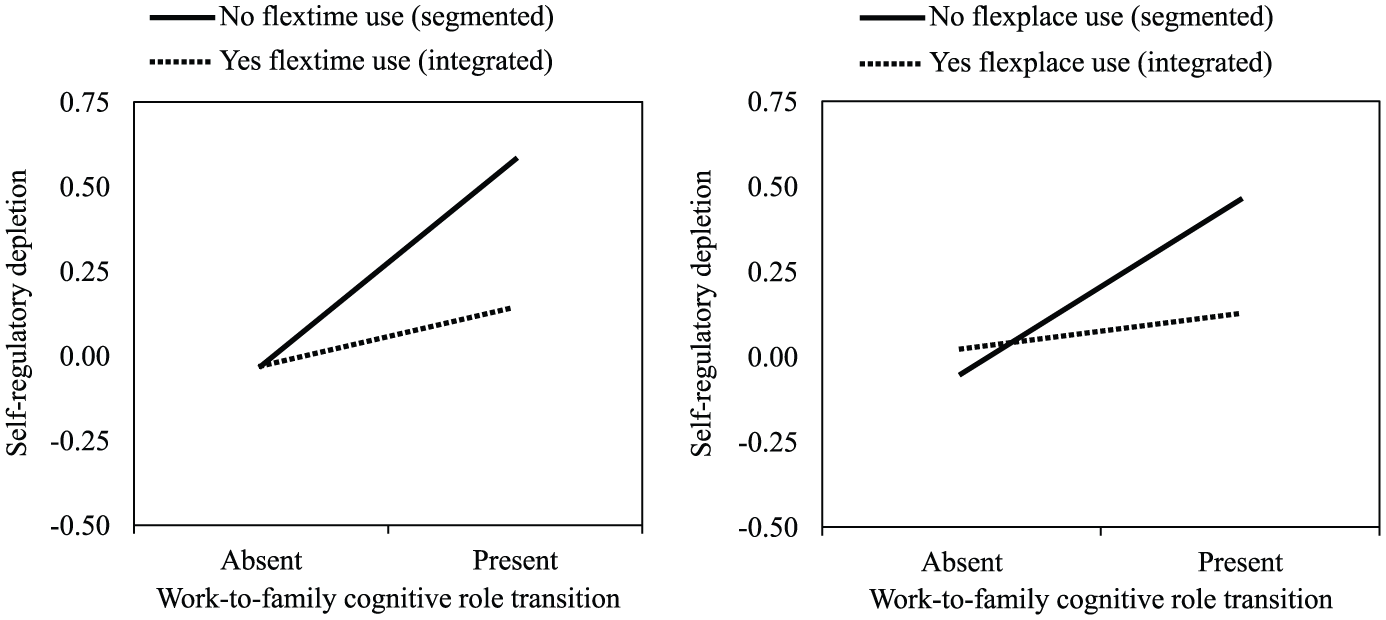
Simple slopes for flextime and flexplace policy use.
Supporting Hypothesis 6b, we observed a significant interaction between cognitive role transitions and flexplace policy use in predicting depletion (γ = –.41, p < .05). The simple slopes (see Figure 2) suggest that among employees that do not use flexplace policies, cognitive role transitioning is strongly and positively related to depletion (γ = .51, p < .001). Furthermore, the confidence interval for the indirect effect of cognitive role transitions on job performance through self-regulatory depletion for these employees excluded 0 (estimate = –.21; CI = –.29, –.13). However, for employees that do use flexplace arrangements, cognitive role transitioning was unrelated to depletion (γ = .10, NS). Since we failed to find a significant relationship between the independent variable and mediator among employees that use flexplace arrangements, we did not test for indirect effects of cognitive role transitioning on performance.
Supporting Hypothesis 6c, we observed a significant interaction between cognitive role transitions and work boundary permeability in predicting depletion (γ = –.34, p < .05). The simple slopes (see Figure 3) suggest that among employees that have impermeable work boundaries, cognitive role transitioning is strongly and positively related to depletion (γ = .58, p < .001). However, when employees had more permeable work boundaries, cognitive role transitioning was less strongly related to depletion (γ = .25,p < .01). Furthermore, the confidence interval for the indirect effect of cognitive role transitions on job performance through self-regulatory depletion for employees with impermeable boundaries excluded 0 (estimate = –.26; CI = –.37, –.15), while, the indirect effect for employees with permeable boundaries was much weaker (estimate = –.12; CI = –.18, –.06). Contrasts found that the indirect effect for low permeability employees was significantly greater than the indirect effect for high permeability employees (difference = -.14, p < .05). Taken together, these results indicate that cognitive role transitioning elicits more depletion from employees with segmented roles than those with integrated roles. It seems when work and family roles are integrated, cognitive role transitions may occur more often, but the attentional demands of switching between work and family roles become less burdensome, and consequently, less detrimental to job performance. A final model including all significant direct effects and interaction effects can be found in Figure 4.
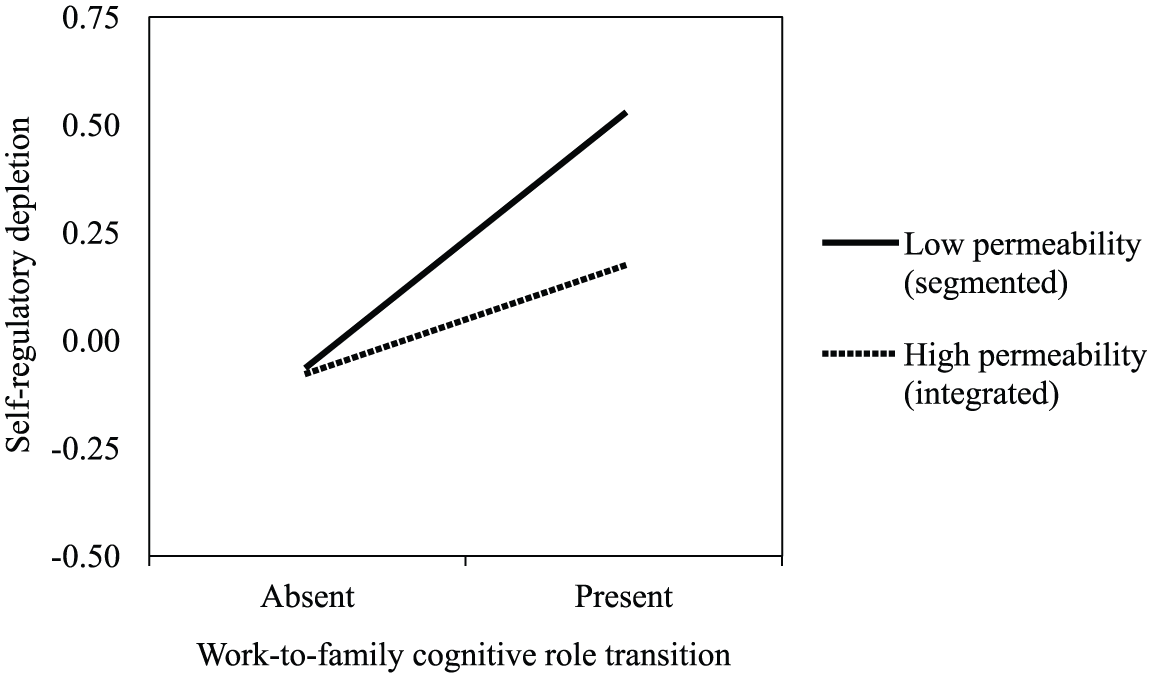
Simple slopes for work boundary permeability.
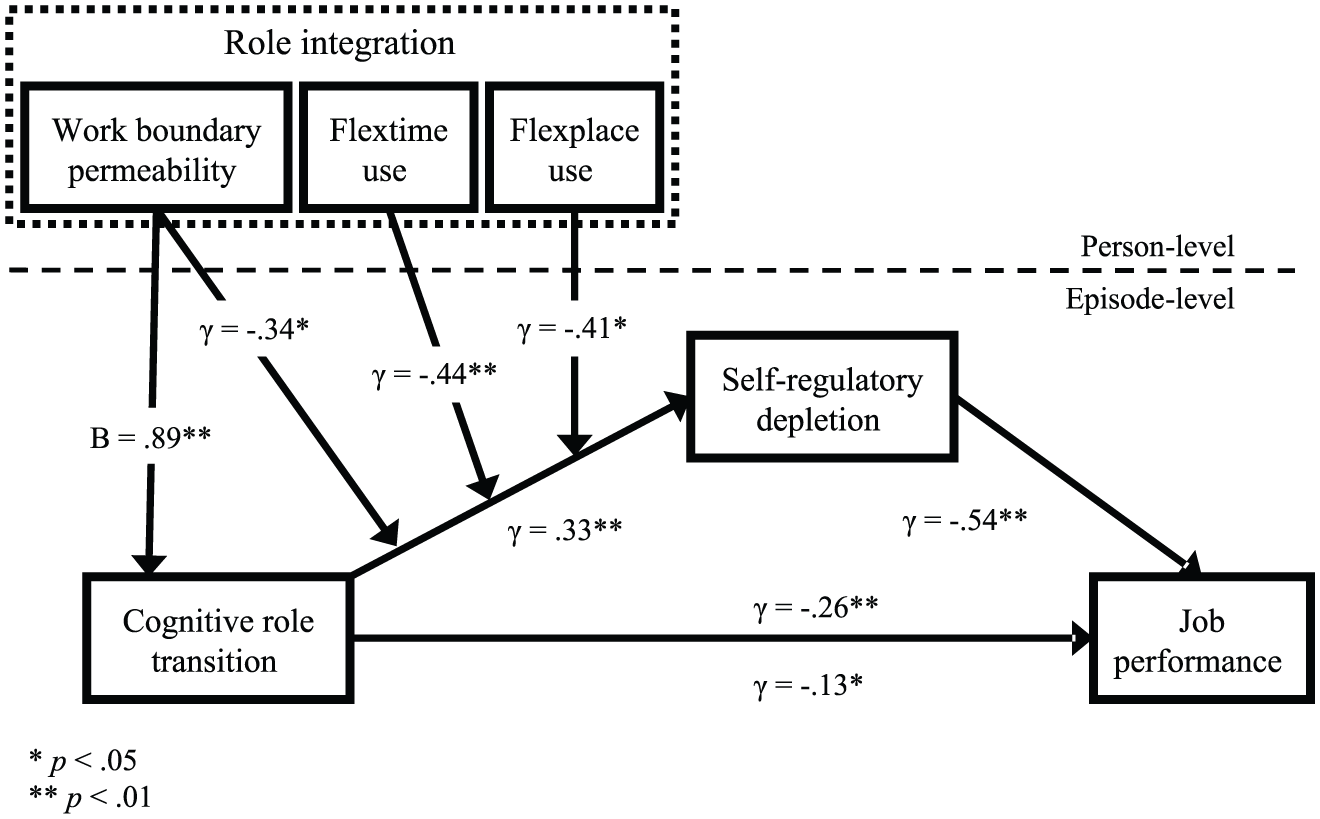
Final model.
To explore whether cognitive role transitioning episodes are distinct from more general off-task thought episodes, we repeated our analyses using the general off-task thoughts variable. As expected, we observed that general off-task thoughts were positively related to self-regulatory depletion (γ = .21, p < .001), consistent with the Episodic Process Model of job performance (Beal et al., 2005). However, flextime use (γ = –.07, NS), flexplace use (γ = –.05, NS) and boundary permeability (γ = –.05, NS) did not moderate the relationship between general off-task thoughts and self-regulatory depletion. If cognitive role transitioning effects were no different from general off-task thought effects, the moderation results from Hypotheses 6a–c should have been replicated here. Additionally, we explored whether the effects of flextime and flexplace use may be confounded with working for a generally supportive organization. We ruled out this possibility by testing the moderating role of other beneficial organizational policies in the relationship between cognitive role transitioning and self-regulatory depletion. Specifically, using policies for taking personal days (γ = –.16, NS), unpaid absences (γ = –.10, NS), subsidized childcare (γ = –.36, NS) and child education funds (γ = .00, NS), failed to moderate this relationship. These results suggest that the increased role integration engendered by using flexible work–family policies account for these effects, rather than simply working for a family-supportive or generally-supportive organization.
Discussion
We sought to expand boundary theory by addressing two questions that explore how role transitioning and role boundary structure shape job performance. The first question is, “Through what theoretical mechanisms do discrete episodes of cognitive role transitioning impact job performance?”. As hypothesized, self-regulatory depletion mediated the relationship between cognitive role transition episodes and job performance. These findings support the idea that switching between roles is cognitively difficult because it is accomplished by drawing on limited executive control resources. These are resources that are not available for other efforts, thereby creating decrements in job performance. It is important to note that self-regulatory depletion did not fully mediate this relationship. Other mediating factors may help explain the relationship between role transitioning and job performance. While we emphasized cognitive mechanisms that reduce performance, family interruptions may also be associated with affective disruptions as well. For example, a role transition prompted by a family problem may reduce performance through feelings of frustration or anger.
The second question is, “Are all employees equally susceptible to the negative performance consequences of cognitive role transitioning or do segmented/integrated role boundaries buffer one from such effects?”. We observed that employees with greater role integration seem to transition between work and home roles more easily, as evidenced by reduced self-regulatory depletion. Although individuals with more permeable boundaries were more likely to experience cognitive role transition episodes overall, they were simultaneously buffered from the self-regulatory depletion that normally accompanies cognitive role transitions, more so than those with segmented roles. These results simultaneously support propositions by Ashforth and colleagues (2000) and suggest that individuals with integrated boundaries who frequently transition between roles likely develop scripts to facilitate these transitions. This study offers several contributions to the work-family literature.
Contributions and implications for future research
We respond to calls from scholars to better incorporate self-regulation theory into boundary theory (Allen et al., 2014) by illustrating the many ways that the limited capacity model of self-regulation (Muraven and Baumeister, 2000) complements boundary theory, and can be utilized to bridge important gaps in our understanding of the psychological processes involved in role transitioning. Our study demonstrates that self-regulatory depletion is a consequence of difficult role transitions, and this contribution is important for two reasons. First, it provides scholars with a theoretically-grounded explanation for why cognitive work–family role transitioning is difficult. As described later, the cognitive mechanisms identified here may be amenable to interventions that facilitate smoother role transitions. Second, this innovation provides work–family scholars with a theoretically-grounded approach to studying difficult role transitions so that future work in boundary theory can continue to explore how role transitions impact the work–life interface. Continuing to explore the extent to which a role transition is difficult will be crucial for work–family researchers, because this difficulty links role transitions to important outcomes.
Our focus in the current study was on work-role performance, however the empirical relationship we observed between cognitive role transitioning and self-regulatory depletion (Hypothesis 1) indicates that it may be possible to link depleting role transitions to a wide array of currently unstudied criteria in the work–family literature. For example, depletion has been linked to reduced helping, increased aggression and even stereotyping (Baumeister et al., 2007). This raises the possibility that role transition episodes that deplete regulatory resources may reduce inhibitions and indirectly increase antisocial behavior among employees. Furthermore, given that power has also been found to reduce inhibitions (Keltner et al., 2003), managers may be even more likely than other employees to lash out at coworkers during role transition episodes. These insights may be leveraged to develop more effective interventions for improving work–family balance and job performance.
This study also contributes to the conversation regarding the implications of adopting segmented versus integrated role boundaries for employee performance (Van Dyne et al., 2007). While previous research has explored how role integration shapes occupational health outcomes, to our knowledge, no studies have answered the call from Ashforth and colleagues (2000) to explore if and how role integration affects individual employee job performance. Two previous studies have found that work–family initiatives are positively related to firm-level performance (Clifton and Shepard, 2004; Stavrou, 2005); however, these findings cannot be generalized from the organizational to the individual level of analysis. Our study explores two untested theoretical paths through which role integration may impact employee performance.
As predicted in Hypotheses 4c and 5c, cognitive role transition episodes mediated the relationship between boundary permeability and episodic performance, although the indirect effect in this relationship was small. These are the first empirical findings to lend direct support to the idea that role integration, in the form of boundary permeability, may reduce performance through more frequent boundary violation episodes. Using flextime and flexplace policies, however, did not increase the likelihood of experiencing such cognitive role transitions at work (contrary to Hypotheses 4a–b). One reason for this may be that these policies increase family boundary permeability more than work boundary permeability. Although using these policies may encourage greater overall role integration, these policies may create asymmetric effects for cognitive role transitions. That is, they may be more likely to increase family-to-work cognitive role transitions, but not vice versa.
Conversely, all three forms of integration buffered individuals from self-regulatory depletion and performance impairments during episodes of cognitive role transitioning (Hypotheses 6a–c). This finding is especially important to consider when compared with previous research that suggests any form of off-task thoughts, regardless of content, will necessarily impair task performance (Beal et al., 2005). Our study converges with these predictions by observing a main effect of cognitive role transitioning on depletion and performance. Our study contrasts with this perspective, however, by observing that when role-related off-task thoughts occur (e.g. “I need to pick up my son from soccer practice today”), the structure of role boundaries (i.e. integration) can buffer the employee against performance decrements.
Observing that employees who use flexible work–family policies were able to more easily transition between work and family roles also complements recent work hypothesizing that flexibility and self-regulatory depletion may be intimately related (Allen et al., 2013). It may be the case that once individuals make an active choice to take advantage of flexible policies, these policies allow them to create flexible routines with contingency plans for reacting to dynamically-changing work and family demands. Consequently, flexibility policies may alleviate self-regulatory depletion by simultaneously removing decision-making demands and allowing individuals to develop scripts for efficiently transitioning between roles. Future research may elaborate on this idea by examining how individuals adapt to using flexible work–family policies over time.
When using flexible policies for the first time, employees may experience increased depletion because they are now faced with a wide variety of new choices and are inexperienced with role transitioning. If employees prefer segmentation over integration, they may be less likely to take advantage of integration policies. Moreover, they may be more likely to abandon the use of this policy after experiencing increased depletion in the short term. This may help to explain why some past research has shown that individuals who prefer segmentation actually have lower job satisfaction and organizational commitment when they have access to integration policies (Rothbard et al., 2005). However, after time passes and scripts are formed, these cognitive demands may decrease for each episode of cognitive role transitions thereafter. Future research could examine how employer-sponsored training could help minimize detrimental effects of these policies by expediting the formation of scripts and buffer against the effects of policy-related depletion as well as how individual differences in preference for segmentation might impact long-term policy utilization.
Future research can also advance boundary theory by drawing on previous work that has illustrated the complex and diverse ways individuals manage boundaries at the work-family interface (Bulger et al., 2007; Kreiner et al., 2009) in order to replicate and expand our findings. For example, do physical segmentation tactics, such as only doing work at the office, moderate the effect of cognitive role transitioning on depletion in the same way as temporal segmentation tactics, such as blocking off specific hours for work time or family time? By examining boundary strategies that employ different segmentation/integration tactics (e.g. behavioral, temporal, physical), future research can develop more precise practical recommendations for helping employees and organizations manage cognitive role transitions while preserving effective performance.
This study also makes important contributions to boundary theory by implementing an episodic sampling approach to the work–family interface. This research is among only a handful of studies that have answered calls from scholars to adopt episodic sampling methodologies in the work–family literature (Maertz and Boyar, 2011). The propositions in boundary theory are inherently episodic because they specify the psychological processes that occur during discrete instances of role transitioning. Consequently, many of these propositions can only be adequately tested with within-subjects designs. Testing and extending the core propositions of boundary theory with episodic measures represents a needed advancement in this theory.
Our episodic methodological approach also illuminates new theoretical questions about cognitive role transitions. In particular, qualitatively different sub-types of cognitive role transition episodes may exist and should be studied further. For example, these could vary on whether they are initiated internally versus externally in the environment (Allen et al., 2014), whether they are carried over by rumination from the previous physical boundary crossing or spontaneously generated (Carlson and Frone, 2003), and whether they are intentional or unintentional transitions. This consideration of theoretically-distinct subtypes suggests many new hypotheses about the psychological nature and differential correlates of each kind of work–family cognitive role transition.
Practical implications
Our study answers multiple calls for research that explains the theoretical mechanisms through which work–family policies impact organizational outcomes (Beauregard and Henry, 2009; Kelly et al., 2008). Conventional wisdom would argue that if practitioners want to minimize the negative impact of family interference, policies that encourage segmentation would be preferred. Our findings suggest otherwise. In contrast to segmented boundaries, adopting permeable boundaries may better reduce the cognitive costs of role transitioning while preserving effective role performance. In the long run, it may be better to allow employees’ minds to wander and take occasional phone calls from home rather than set up policies that establish strict and inflexible boundaries, which could discourage functional script formation. Thus, role integration may be a better boundary management strategy for adapting to dynamic demands from home and work domains while preserving effective role performance, two goals considered by some managers to be mutually exclusive (Leslie et al., 2012; Putnam et al., 2014).
In cases where integration-oriented policies are not feasible, employees may need to adopt specific strategies that can reduce the number of cognitive role transitions they experience and/or strategies that help restore depleted cognitive resources. For cognitive role transitions that occur owing to self-initiated family thoughts (e.g. remembering to buy a gift for a family member), employees may use specific strategies that are known to reduce intrusive thoughts. In fact, recent evidence shows that writing specific goals that include details of when and how a task will be completed helps to reduce thinking about that task when engaging in a different role (Smit, 2015). Thus, we suspect that goal setting can be used to reduce the number of cognitive role transitions an employee experiences throughout the day. When cognitive role transitions occur owing to other-initiated family thoughts (e.g. a phone call from a family member), these role transitions are outside of one’s control. In this situation it would be more beneficial for employees to focus on strategies that can help restore cognitive resources that were depleted during role transitions. Several interventions have been found to be effective in ameliorating self-regulatory depletion. For example, organizational initiatives focused on relaxation and dietary counseling could help to restore regulatory resources through rest (Muraven and Baumeister, 2000) and elevated blood glucose levels (Gailliot et al., 2007). Given research supporting their effectiveness, these interventions could have the advantage of helping employees cope with cognitive role transitioning episodes effectively when work–family integration initiatives (e.g. like working from home) are not available.
Limitations and conclusion
This study is not without its limitations. First, there may be some concerns about potential rating error/distortion in the performance measure. We believe that validity threats here from self-reported performance are minimal because the longitudinal performance data were person-mean centered, which removes any between-subjects variability in the ratings. Thus, even if individuals are differentially prone to rating inflation or deflation, for example, owing to different personality traits, allowing each participant to have his/her own intercept should control for this bias (Ilies et al., 2007). Although supervisor ratings could help alleviate these concerns, employees would likely limit family contact at work during the study period knowing that their supervisor would be periodically rating their performance throughout the day. Consequently, employees would distort their true levels of role transition episodes, which will negatively impact the validity of the findings and further suppress a low base-rate occurrence. Furthermore, simulations with multilevel data demonstrate that cross-level interactions as found here are “extremely unlikely” to be generated by common method variance (Lai et al., 2013).
Second, the items used for our self-regulatory depletion scale were not drawn from published measures. We made every effort, however, to examine and ensure the validity of our index, including a focused effort to proportionally capture item content from an existing self-report depletion scale, conducting a confirmatory factor analysis to support a unidimensional factor structure, collecting new data to empirically examine convergent validity with an existing self-report measure of depletion, and testing theoretically-derived criterion relationships (see the Appendix). Other scholars have used the 500 Family Study archival dataset to measure self-regulatory depletion, and have found similarly supportive validity evidence for measures of depletion (Christian et al., 2014). Our inferences would, however, be strengthened by future research replicating our model with a depletion measure possessing more extensive validation evidence.
Third, given the manner in which we operationalized integration, there are several avenues for future researchers to strengthen and extend these findings. Foremost, permeability was measured using a scale with two indicators (i.e. phone conversations and personal visits). Given the content of this scale, these items are an appropriate representation of the intended construct (D’Abate, 2005). Additionally, previous studies have found that high integrators set fewer communication technology boundaries, which also complements our validity evidence (Olson-Buchanan and Boswell, 2006; Park et al., 2011). Furthermore, this proposition is also supported by the positive correlation between our permeability index and cognitive role transitioning in this study. Lastly, it is important to note that the moderation effect was observed across three different indicators of role integration, which helps to bolster confidence in the validity of our results. Our findings should be replicated using published measures of work boundary permeability (e.g. Kreiner, 2006; Matthews et al., 2010). Although our measures of role integration were not ideal, measuring flexible policy use can be considered a strength of this study. Directly examining how flexible policy use shapes job performance greatly enhances the practical value of our findings.
Fourth, it is important to acknowledge the possibility of reciprocal causality. We conducted this analysis and failed to find evidence that depletion predicted cognitive role transitioning (B = 1.66, NS). Although previous research has found that boring situations elicit off-task thoughts (Kane et al., 2007), there are also an overwhelming number of both lab and field studies that support the idea that split attention causes depletion, and at least one recent experimental study found that switching mindsets directly causes depletion (Hamilton et al., 2011). These results strengthen the inferences drawn from this study and converge with previous research.
Finally, it may be that the negative relationship between cognitive role transitions and performance could be simply attributed to the time employees spent off-task while their attention was diverted away from work tasks (e.g. Beal et al., 2005). This could be especially problematic for the current study since the signal-contingent response methodology essentially diverted participants’ attention from their current work tasks to respond to the survey, but there are at least two reasons that these alternative explanations cannot account for the current findings. Foremost, all cases examined in the current study involved individuals who were (a) signaled to complete the survey while (b) currently engaged in a work tasks. Because the signal and the work-related task were held as constants across all observations, this methodology could not account for the variations observed in either the predictors or outcomes. Additionally, support for our moderation hypotheses help rule out the idea that performance decrements associated with cognitive role transition episodes are purely owing to time-off-task. If cognitive role transitions only influenced performance through the time spent off task, rather than self-regulatory depletion, then role integration could not have emerged as a significant buffer of these effects, because in this alternative explanation nothing can directly compensate for lost time-on-task.
Despite some limitations, this study makes several important contributions to theory and empirical research on the daily management of the work–family interface. We expand boundary theory with the self-regulation literature to explain why micro-role transitions are difficult, and consequently, how and when cognitive role transitioning inhibits performance. We offer researchers and managers an explanation of how work–family integration policies may influence cognitive role transition episodes and their negative effects on job performance, and hope that work–family researchers will build upon these contributions. In sum, individuals make important decisions regarding whether to integrate or segment their work and family roles. Exploring episodic role transitions paints a clearer and more comprehensive picture of the occupational health and performance consequences associated with integrating or segmenting work and family roles.
Footnotes
Appendix: Scale construction and content validity
We created a five-item measure of self-regulatory depletion to assess the degree to which the participants experienced subjective mental fatigue from self-control exertions. Items were selected using a content-matching procedure with a previously developed self-report self-regulatory depletion index (i.e. state self-control capacity scale, SCCS; Twenge et al., 2004) with an emphasis on selecting items that capture the relevance and representativeness of this scale. The SCCS primarily reflects items that capture the extent to which an individual feels exhaustion and is unable to concentrate. For example, “My mind feels unfocused right now”, “I feel sharp and focused (R)”, “I feel mentally exhausted”, “I feel drained”, “I feel worn out”, “I have lots of energy (R)”, and “I wish I could just relax for a while”. To match the content of these items, we used the following three items in our scale: a Likert-type “How well were you concentrating” item along with two semantic differential items measuring how “active-passive” and “strong-weak” participants felt. We note the single concentration item here was used to measure depletion in a previous study, which gathered similarly supportive validity evidence (Christian et al., 2014).
While a majority of the items in the state SCCS reflect mental fatigue, other items reflect a lack of motivation and an inability to suppress impulses. For example, “I want to give up”, “I feel lazy” and “If I were tempted by something right now, it would be difficult to resist”. To ensure our scale captured depletion-specific mental fatigue, rather than fatigue more broadly, we added two items that reflected participants’ evaluations of their current activities: “Was this activity interesting?”, and “Did you wish you were doing something else?”. Given that two defining characteristics of self-regulatory depletion are a lack of motivation and suppressing impulses (Muraven and Baumeister, 2000), we added item content that reflects task interest and an urge to abandon task pursuit. In doing so, we created a more proportionally representative measure that captures elements of motivation and mental fatigue.
Acknowledgements
This work has been presented at the 29th Society for Industrial and Organizational Psychology conference as a poster.
Funding
This study was supported by the Alfred P Sloan Foundation, grant numbers 200-6-14 and 3003-6-20.