



Abstract
Drawing from literature linking organizational politics with effects of challenge or hindrance stressors, this study investigated the effects of the frequency and psychological distance of positive and negative conceptualizations of perceived politics on the impact to the individual. It was hypothesized that the frequency of political behavior would exhibit an inverted-U-function relationship with favorable evaluations of political behavior and that this relationship would be moderated by distance. Two independent samples were used to test the hypotheses. Results for negative conceptualizations of perceived politics indicated a curvilinear frequency–evaluation relationship such that moderate levels of negative or dysfunctional politics are evaluated more favorably than either high or low levels. The distance of the political behavior was further found to moderate this relationship, with distant politics having little effect on the frequency–evaluation relationship, but politics with nearby impact yielding more negative evaluations as frequency increased. For positive conceptualizations of perceived politics, results revealed that respondents evaluated this form of politics more favorably the more it occurred. Further, positive political behavior was reported to be less desirable when its impact was believed to be at a distance rather than being felt by respondents personally. Implications are discussed.
Keywords
Perceptions of politics (POPs) in organizations have important outcomes, such as reduced job satisfaction, increased job anxiety and increased intention to turnover (see Ferris and Hochwarter, 2011; Miller et al., 2008 for reviews). These findings validate many aspects of the Ferris et al. (1989) model, particularly those concerning expected negative outcomes. More recently, research has emerged that highlights a more positive role for political perceptions (Hochwarter, 2012; Landells and Albrecht, 2017). Positive politics research focuses on perceptions of political activity ‘that favorably impacts individuals, groups, and organizations’ (Hochwarter, 2012: 27–28), including job performance and job, coworker and supervisor satisfaction (Eldor, 2016; Fedor et al., 2008). Both views are relevant. Landells and Abrecht (2017) found that individual interpretations of organizational politics ranged from destructive and manipulative, to being a necessary evil as Gandz and Murray (1980) report, to being a useful strategy to get work done, to most positively being central to integrated organizational decision-making and functioning. But despite steps in the direction of understanding the positive role of politics in the workplace, Ferris and Hochwarter (2011: 443) note ‘scholars advertise their studies as inspections of organizational politics when, in fact, the research is limited to confirming the existence and impact of negative politics.’
Hochwarter (2012: 33) contends that the positive politics literature can and should be extended by understanding ‘motives, underlying cognitive processes and contextual factors associated with its inherent use.’ This suggests something important but not always understood – that political perceptions represent a ‘socially constructed reality’ (Ferris and Hochwarter, 2011: 439) subject to individual interpretation. Given this, there is much we need to understand about how individuals evaluate political activity. Such understanding is particularly important insofar as the interpretations and motives of actors engaged in political activity may help determine both the nature of human resource practices (Drory and Vigoda-Gadot, 2010) and the type of shared political climate in the organization (Landells and Albrecht, 2013). In fact, though there are models (e.g. Ferris et al., 1989) and numerous empirical studies that identify various antecedents of perceived politics, research examining the factors that contribute to how politics is actually perceived and evaluated is scarce. Eldor (2016: 238) specifically notes that researchers ‘need to determine the variables that explain when organizational politics is perceived positively or negatively.’ Similarly, Buchanan (2016: 363) suggests that researchers move from the known in politics research (e.g. perceptions of politics as negative) to the positive uses of politics and ‘how organizational members, experience, interpret, and understand political behavior.’ This is not only theoretically important insofar as positive outcomes were not part of early POPs theorizing, but also practically consequential for managerial practice.
Further, the nature of measurement of perceived political activity in organizations is that it has focused almost exclusively on the extent or frequency of occurrence of politics (Ferris and Hochwarter, 2011), but recent work suggests a broader perspective is needed to better understand political perceptions. Landells and Albrecht (2017) found that individuals seemed to differ not only in their perception of how often politics occurred, but also as to its psychological distance, and that these differences affected their responses to it. Indirect evidence from Fedor et al. (2008) suggested that the distance of perceived impact of political activity was related to attitudinal outcomes.
Closely tied to these evaluations is the recognition that the relationship between political perceptions and outcomes may be nonlinear. Recent work (Hochwarter et al., 2010; Kolodinsky et al., 2004; Rosen and Hochwarter, 2014) drawing on theoretical bases such as activation theory, the vitamin model or response styles theory has consistently found that political perceptions–outcomes relationships tend to follow an inverted-U shape, such that the strongest relationship occurs at moderate levels. Even positive qualities in organizations such as political skill can be subject to curvilinear effects in the right circumstances (Harris et al., 2016; Pierce and Aguinis, 2013).
Addressing these research issues, our study has three objectives. First, this research follows the suggestions of Ferris and Hochwarter (2011: 443), who advocate that in order to gain a richer understanding of politics in the workplace as more than a negative event, researchers should opt ‘for a blank slate approach (Buchanan, 2008; Glaser and Strauss, 1967) that allows study respondents to chart the direction and magnitude of the phenomenon.’ Therefore, the first objective of this study is to assess the extent to which organizational politics, framed as either negative or positive, is evaluated negatively or positively based on frequency of occurrence. The second objective in this study is to examine the conditions under which individuals make negative or positive evaluations of political behaviors. To do so, we examine how perceived distance of political activity affects, or more precisely, moderates, the relationship between frequency of occurrence of politics and its evaluation. As a third objective, we test whether the relationship between frequency and evaluation, as moderated by distance of the political activity, is curvilinear for both negative and positive politics.
Our study, therefore, makes several contributions. First, while it is generally accepted that politics can be perceived either positively or negatively, this research offers a direct comparison of the impact of positive and negative conceptualizations of perceived politics and factors that is lacking in the literature. As such, it adds to the literature a sense of the role of each in affecting employees in organizations with different manifestations of political behavior. In doing so, we provide a theoretical description of how employees evaluate organizational politics based on transactional stress theory (Lazarus and Folkman, 1984) and construal level theory (Trope and Liberman, 2010, 2012). In particular, we apply the notion of challenge and hindrance stressors to help understand how individuals make valence appraisals of political activities and behaviors.
Second, we extend and update the work of Gandz and Murray (1980) on how perceived frequency of occurrence relates to perceptions of the positive or negative nature of workplace politics. This seminal study helped foster the realization that subjective perceptions of the occurrence of politics were important to understand workplace outcomes, and that politics is not always perceived negatively. We build on this work by examining how frequency and distance interact to affect how evaluations, whether positive or negative, are made. This provides important clues to help researchers understand the mechanisms underlying these evaluations.
Third, we explain the nonlinear nature of the distance-moderated relationship between frequency and evaluation by integrating core elements of transactional stress theory and construal level theory. This contributes to the literature in two ways. First, it extends the nascent understanding of nonlinear effects of political perceptions from outcomes such as job satisfaction (Hochwarter et al., 2010) to the evaluation of the political behaviors themselves. Second, although stress theories have been an important part of political research for many years, we know little about how stress plays out differentially for positive and negative perceptions of politics. Our theorizing and findings provide signposts for understanding and explaining these differential relations.
Theory and hypothesis development
An important commonality among almost all perceptions of politics research is the assumption that organizational politics usually has negative repercussions for individuals and organizations alike (Chang et al., 2009). This can be readily seen in how scholars have defined organizational politics as a zero-sum game with descriptors like ‘parochial,’ ‘divisive’ and ‘illegitimate’ (Mintzberg, 1983). However, organizational politics can also be beneficial for organizations and their members. Examples include creating positive change in the organization, overcoming unforeseen difficulties not addressable using accepted approaches or lines of authority, bypassing the chain of command to increase the visibility of important new ideas, or engaging in greater creative, adaptive and proactive behavior (Eldor, 2016; Fedor and Maslyn, 2002; Kumar and Thibodeaux, 1990; Madison et al., 1980).
As such, whereas some scholars consider positive forms of organizational politics to be tactics such as networking or referring to super-ordinate goals (Gunn and Chen, 2006) or relying on connectedness and inclusiveness (Gotsis et al., 2010), our distinction between negative and positive politics is tied primarily to the nature of the outcomes associated with the political behavior rather than the behavior itself (Cropanzano and Li, 2006). Thus, the dual nature of organizational politics is such that politics can be perceived as both positive and negative (Landells and Albrecht, 2016) and yields outcomes both good and bad for employees and organizations.
Following these arguments, we propose that employee evaluations of the negative or positive nature of politics stem primarily from their assessment of the extent to which it will affect them negatively or positively. Political behaviors have long been considered a stressor (Ferris and Hochwarter, 2011; Ferris et al., 1989), and models of stress such as transactional stress theory (Lazarus and Folkman, 1984) propose that, when encountering a stressor, individuals appraise the implication of the stressor for their well-being, particularly whether the stressor represents an anticipated threat or, instead, a challenge with the potential for mastery, growth or future gains.
We believe this distinction is key to whether an employee perceives a political event or behavior as negative or positive. For instance, organizational politics may increase perceived uncertainty as to the link between performance and promotion, reducing instrumentality (Meurs and Perrewé, 2011), and thus from this perspective politics can be appraised as a bad thing or, in terms of transactional stress theory, as a hindrance stressor (Cavanaugh et al., 2000). On the other hand, political behavior may also be seen as providing opportunities for development, achievement, or gain (Eldor, 2016; Kane-Frieder et al., 2014). Therefore, although less intuitive, employees may also perceive politics as a challenge stressor (Cavanaugh et al., 2000). Even when political behaviors may not foster mastery or personal growth, they can clearly be associated with future personal gain.
Anticipated personal gain represents a neglected but core aspect of the definition of a challenge stressor according to Lazarus and Folkman (1984), and such anticipation is consistent with recent integrative approaches to organizational stress such as those taken by LePine et al. (2005) and Meurs and Perrewé (2011). Like Lazarus and Folkman (1984), these scholars link the presence of a stressor to cognitive appraisal, but extend this idea with a focus on expectancy value. For instance, Meurs and Perrewé (2011), in their presentation of how cognitive activation theory applies to organizational stress, argue that stress appraisals are essentially determinations of expectancies insofar as individuals make valent evaluations about stressors. From this perspective, political behaviors may be perceived as neutral, or even as positive if they are expected to foster personally positive outcomes, as prior research has suggested (Fedor et al., 2008).
McFarland et al. (2012) note the importance of context in affecting the perception and consequences of political behavior. Similarly, Ferris and Treadway (2012) discuss how the context of political behavior influences perceptions and interpretations about organizational politics. In this study, we consider two relevant manifestations of context that can affect threat–challenge appraisals of politics: the frequency with which political behavior is perceived to occur, and the perceived distance of the impact of organizational politics relative to the individual who perceives it. Both these factors are important in transactional stress theory. Frequency of occurrence is a temporal factor that affects primary stress appraisals (Lazarus and Folkman, 1984), whereas distance of the perceived impact of the stressor references the extent to which an individual has a personal stake in the outcome (Lazarus and Folkman, 1984). Additionally, psychological distance is a key factor determining the nature of construal processes (Trope and Liberman, 2010). Beugre and Liverpool (2006) considered these to be important elements of the scope of politics in organizations in that they would impact employees’ judgments of fairness associated with politics perceptions. For example, managers may buffer their followers from the depth and breadth of political behavior they themselves experience outside the work group or, on the contrary, share such political behavior with followers (Ferris and Hochwarter, 2011). The specific effects of frequency and distance are discussed below.
Evaluative reactions to the frequency of politics
There is general agreement among POPs researchers that the mere perception of a negative political environment raises the level of uncertainty – a key situational factor affecting cognitive appraisals (Lazarus and Folkman, 1984). A more frequent occurrence of hindrance stressors makes them more salient and perceived as more unpredictable (Rafferty and Griffin, 2006). Ferris et al. (1989) suggest that employees who perceive organizational politics occurring more frequently see their work environments as more stressful and ambiguous – a finding supported by subsequent research (Vigoda, 2002) and consistent with transactional stress theory.
Interestingly, the literature has also shown that such effects are nonlinear. Hochwarter et al. (2010) found an inverted-U-shaped relationship between POPs and job satisfaction. It is not surprising that job satisfaction would be negatively affected by perceptions of high levels of negative political activity, but why would low levels be problematic? Hochwarter (2012: 41) asks, ‘What happens when the political landscape is a desert?’. This situation provides fewer cues for behavior (Hochwarter, 2012), but it appears that employees expect some level of politics to be present in the workplace (Mintzberg, 1983) and that when politics is moderate individuals can better determine the motives and merits of others (i.e. politics at a moderate level aids in self-regulation in information acquisition: (Hochwarter, 2012). Similarly, perceptions of negative politics were shown to have an inverted-U-shaped relationship with work effort, depending on the level of rumination about the political behavior. Moderate levels of perceived politics were associated with the highest levels of work effort (Rosen and Hochwarter, 2014). In contrast, very low or very high levels of politics bring about unmanageable stress, uncertainty, and loss of control most often associated with the negative outcomes found for POPs (Chang et al., 2009; Hochwarter et al., 2010; Rosen and Hochwarter, 2014).
In sum, there is a growing recognition that the experience of political behavior is linked specifically with affective reactions, often the result of the uncertainty that such behavior creates. Given research showing the negative effects of POPs and the conditions under which these negative effects are more or less intense, we expect a curvilinear relationship between the perceived frequency of political behavior and the extent to which employees report that such politics is harmful. Specifically, for negative politics we expect that moderate levels will be viewed more positively than either low or high levels:
Hypothesis 1: The relationship between the perceived frequency of negative political behavior and evaluative judgments will be characterized by an inverted-U shape. Specifically, political behaviors with negative outcomes will be judged more favorably when they are perceived to occur with moderate frequency than when they occur with low or high frequency.
Positive politics reflects political behaviors that can help rather than harm employees (Fedor et al., 2008; Hochwarter, 2012). Albrecht (2006) tested the extent to which politics affected employees’ positive affective reactions (e.g. energized, inspired, motivated) and negative affective reactions (e.g. nervous, threatened, uncomfortable) and then examined these in the prediction of cynicism toward organizational change and affective commitment. Among the findings was the independence of the positive and negative affective reactions. Negative affective reactions predicted cynicism, whereas positive affective reactions predicted commitment. These results are similar to those found by Fedor et al. (2008) in that positive and negative views of politics were associated with positive and negative outcomes, respectively. As Fedor et al. (2008: 80) put it, ‘individuals will focus on the different outcome valences associated with positive and negative politics.’
Studies of the effects of the stress of politics and work engagement research have found that employees with high levels of engagement tend to respond to perceptions of politics as a challenge or an opportunity and respond proactively, whereas less engaged employees responded with disengagement to perceived politics (Eldor, 2016; Kane-Frieder et al., 2014). These studies utilized traditionally negative or neutral measures of politics perceptions, and, because challenge stressors are associated with positive emotions (Podsakoff et al., 2007), we would expect that appraisals of positive politics would mirror its constructive nature to an even greater degree.
Based on both theory and empirical evidence, we have argued that an important general factor in determining whether political behavior is appraised as a hindrance or an opportunity is the extent to which it is seen as potentially harmful or beneficial, with beneficial politics seen as an opportunity (Drory and Vigoda-Gadot, 2010; Kane-Frieder et al., 2014). By definition, positive politics offers the opportunities for work-related goal achievement and success, and is reflective of the more mature form of organizational politics where ‘people build relationships to harness the collective power of individuals’ and ‘people need to understand the organizational context in order to get things done’ (Landells and Albrecht, 2016: 311). To the extent that political behaviors have positive implications for employees, organizational politics scholars (e.g. Albrecht and Landells, 2012; Kane-Frieder et al., 2014) have begun to recognize that some forms of politics may be seen as challenge stressors because they provide opportunities for individuals to achieve their goals, depending on what personal resources they bring to the situation.
The research literature on challenge stressors tends to show that such stressors, because they are appraised positively, have beneficial impacts on performance (LePine et al., 2005) and creativity (Sacramento et al., 2013), as well as positive relationships with job satisfaction and organizational commitment and negative relations with turnover intention and turnover (Podsakoff et al., 2007). As such, it seems reasonable to expect that as the frequency of positive political behavior (a challenge stressor) is perceived to increase, appraisals will become more positive. That is, the greater the occurrence of positive politics, the more positive the evaluation.
It is important to understand, though, that threat and challenge are not necessarily mutually exclusive (Lazarus and Folkman, 1984: 33). That is, challenge and hindrance can coexist in people’s appraisals of stressors, as demonstrated by Webster et al. (2011). Further support for this idea comes from Widmer et al. (2012), who found the challenge stressor of time pressure to be associated with both positive and negative well-being.
Thus, although the potential gain associated with positive politics may be seen as a plus, it is not necessarily an unmitigated positive. For instance, a manager may advocate for her work group to peers and higher-ups, but excessive advocacy creates a risk of being seen as overly partial and more focused on the group’s best interests than those of the organization. Thus, at higher levels, positive politics may be seen as both challenge and threat. Based on these arguments, we expect that the positive relationship between perceived frequency of positive political behaviors and evaluation will plateau as frequency increases. This idea is consistent with recent work on the ‘too much of a good thing’ effect (Pierce and Aguinis, 2013), which highlights that, for many putatively positive and linear relationships, at some point they may become curvilinear and asymptotic. For example, Harris et al. (2016) propose that even possessing high political skill can lead to negative outcomes when considered in light of one’s political will and will ultimately reveal a nonlinear form as political will increases. Thus, we expect that, although there will be a positive relationship between how often positive political behavior is perceived to occur and how it is evaluated, the strength of that positive relationship will diminish as frequency of the behaviors increases, as individuals react to its uncertain nature:
Hypothesis 2: The relationship between the perceived frequency of positive political behavior and evaluative judgments will be characterized by an upward-sloping, asymptotic curve. Specifically, political behaviors with positive outcomes will be judged more favorably as they increase in frequency, but the rate of increase will diminish as frequency increases.
Distance of perceived politics moderates the effects of frequency on evaluation
In their study of rumination about perceived politics, Rosen and Hochwarter (2014: 185) found that when employees did not mindfully consider politics, politics had little effect on unfavorable psychological, attitudinal and behavioral outcomes, concluding that ‘employees must thoughtfully consider politics (or be directly impacted by it) for it to matter.’ Consistent with this, we propose that the relationship between frequency of political behavior and evaluative judgment will be moderated by the perceived distance of the impact of political behavior to the individual in terms of how close or distant to oneself.
Drawing on research on psychological distance, we define the distance of perceived impact of political activity as the subjective judgment that the negative or beneficial impacts of political activity are near or far from oneself temporally, spatially, socially or hypothetically (Trope and Liberman, 2010, 2012). Our approach to understanding the joint effects of frequency and distance of perceived impact is based partly on the premise that what does not have much of an effect on the individual will not occupy attentional resources (e.g. Kanfer and Ackerman, 1989), whereas employees actively attend to workplace events or outcomes affecting their sense of dependency and control (Konst et al., 1999). As a result, evaluative judgments (positive or negative) are more likely to be made when a potential threat or opportunity is psychologically salient (Madison et al., 1980; Rosen and Hochwarter, 2014). Therefore, the frequency of the political behavior (i.e. the extent to which it is seen as occurring) and an individual′s distance from it will influence perceptions (Adams et al., 2002), as these things affect the psychological salience of the behavior. The expectation is that actions seen as either infrequent or having little direct impact will have less effect on judgments of political behavior, whether good or bad. However, as Rafferty and Griffin (2006) note, these factors may operate through different mechanisms, raising the question of how distance – perceiving politics as close or distant – will influence the frequency–evaluation relationship.
POPs may have limited effects when they are considered to have little personal or direct impact (Adams et al., 2002) or are physically or psychologically remote (Liu et al., 2006). Beugre and Liverpool (2006) propose a model where the influence of politics was expected to be greater when perceived as closer, such as in one’s own work unit. Similarly, Hochwarter et al. (2003: 2007) note that ‘when individuals perceive politics to be “closer to home,” they are more adversely impacted,’ and Harris et al. (2007) found support for assertions that if an individual’s outcomes are not impacted by politics then the degree of POPs does not adversely affect personal outcomes.
Negative politics is a hindrance stressor, and its anticipation activates cortisol stress reactions (Dickerson and Kemeny, 2004; Meurs and Perrewé, 2011) as a response to perceived social-evaluative threat. Indeed, the negative relationships of perceived negative politics with outcomes such as job satisfaction are at least partly owing to the negative affect associated with the political activity (Rosen et al., 2009). We have predicted that the main effect of frequency of negative politics on evaluation would be an inverted U, such that moderate frequencies of political activity would result in less negative evaluations, and low and high occurrence of politics would be more negatively evaluated. When distance of perceived impact of negative politics is near or close, this relationship should hold, as it is based on affective reactions of uncertainty that will remain salient. However, because high distance results in less emotion-laden construals (Davis et al., 2011; Williams and Bargh, 2008), perceiving politics as more psychologically distant will reduce the emotional intensity associated with it. Thus, we expect that higher frequency of negative politics, when its impact is perceived as distant, will be less negatively evaluated than when high frequency is paired with low distance.
On the other hand, positive politics, as a challenge stressor, tends to be associated with more positive affect than does negative politics (Cavanaugh et al., 2000). Based on this, we have predicted that positive politics would be positively evaluated the more frequent it is, but that this effect would plateau when political activity is frequent as even political activity with positive outcomes carries some risk as both challenge and threat. When impact is perceived as distant, this relationship is not likely to change much because the primary driver of distance’s moderating effect is affect, which will be lower in that case. However, decreased distance to positive political behavior can amplify the emotional salience of self-interest and the positive outcomes as it makes them more concrete and less hypothetical (Trope and Liberman, 2012). We therefore expect increasing frequency and distance of such behavior to result in increasingly positive assessments:
Hypothesis 3: The curvilinear relationship between perceived frequency of political behavior with negative outcomes and evaluative judgments will be moderated by the perceived distance of the behavior, such that distance has an increasingly negative effect on evaluative judgments as frequency increases and distance decreases.
Hypothesis 4: The curvilinear relationship between perceived frequency of political behavior with positive outcomes and evaluative judgments will be moderated by the perceived distance of the behavior, such that distance has an increasingly positive effect on evaluative judgments as frequency increases and distance decreases.
Method
We used three samples to develop measures and test our hypotheses. The first sample (Sample 1) was used to develop measures for positive politics, and is hereafter referred to as the development sample. The next sample (Sample 2) tested our hypotheses using these measures, and the final sample (Sample 3) constructively replicated the positive politics analyses using established positive politics measures from Fedor et al. (2008). Each sample and its measures is described below.
Sample 1 (Development sample)
This sample was used to develop measures for the evaluation, frequency and distance of the perceived impact of positive politics, which were subsequently used in Sample 2 to test our hypotheses. A pilot study was conducted using 168 evening MBA students at a Midwestern university. The average age of respondents was 29.1 years (SD = 5.35), average tenure with the organization was 3.0 years (SD = 2.74), and average full-time work experience was 6.83 years (SD = 5.01). Respondents were 43.5% female and 56% male, with less than 1% not reporting.
Sample 2
Sample 2 consisted of a separate group of MBA students in an evening program at a large Midwestern university. Respondents held a variety of managerial, professional or technical positions (e.g. project engineer, investment analyst, marketing manager, auditor, controller, HR manager, pharmaceutical researcher, attorney, computer programmer, business analyst) across fields such as architecture, telecommunications, chemical research, healthcare, education, manufacturing, sales, law, financial services, government, construction and hospitality.
Participants were asked to participate in a survey about organizational politics and to think about their own personal experiences in their current or a recent workplace. Data were collected by giving participants class time to complete the surveys. One hundred-fifteen MBA students participated; listwise deletion of missing data yielded a final sample size of 96. The average age of the respondents was 31.2 years (SD = 6.73), average tenure with their current organization was 3.98 years (SD = 3.44), and average full-time work experience was 9.1 years (SD = 6.9). Respondents were 33% female and 63.5% male, with 3.5% not reporting.
Sample 3
Following a growing number of studies, we generated our replication sample using Amazon’s Mechanical Turk (MTurk), a widely-used freelancing option in behavioral science data collection. Research has highlighted the advantages of Amazon MTurk as an ‘e-lancing’ option for data collection (Aguinis and Lawal, 2012; Landers and Behrend, 2015) and has supported the psychometric properties of data generated by it as compared to other published studies (Buhrmester et al., 2011). We followed best practice recommendations for MTurk sampling from Cheung et al. (2016) to strengthen validity inferences and ensure quality data. Our study concerns political perceptions, and most of that research comes from studies using US workers. To ensure that we sampled a corresponding population of workers, we used eligibility requirements that a respondent must be between 18 and 65 years old, a resident of the United States, proficient in written English, and have worked in a full-time position (30 or more hours per week) in the United States in the past 12 months.
We took several other steps to ensure data quality. We prevented respondents from answering the survey twice, and verified that they met the sample criteria by asking their age, nationality and number of hours per week they worked in the middle section of the survey. To detect inattentive responding (Cheung et al., 2016), attention check items were placed at several points in the survey. For instance, a typical attention check might state, ‘The sky is blue. If you are paying attention mark “agree” and leave the other columns blank.’ At survey’s end we noted to respondents that surveys are sometimes completed under poor conditions and asked whether we should use their responses to the survey (yes/no), promising compensation regardless of their answer.
MTurk participants were paid $1.50 to complete the survey. After screening out individuals who did not meet the qualification or quality criteria noted above, our final sample was 195 individuals. Average age was 33.54 years (SD = 9.70) with 13.19 years of work experience (SD = 9.84) and 2.60 years with their current supervisor (SD = 2.76). They were 75.5% white, 4.5% African American, 10.5% Hispanic, 2.5% Native American, and 2% other. Frequently reported industries in which they worked included manufacturing, retail trade, information, finance/insurance, professional, scientific, and technical services, educational services, healthcare, social assistance, arts, entertainment, recreation, and accommodation and food services. The most frequently reported job titles highlighted the diversity of their work experiences (e.g. accountant, administrator, analyst, cashier, customer service representative, installation technician, IT administrator, manager, office manager, researcher, sales manager, secretary and technician).
Measures
Perceived positive politics scale development (Sample 1)
Consistent with past research on POPs, we presented participants with a series of event statements that described political behavior in organizations, such as ‘Difficult organizational issues often have to be handled politically (e.g. behind the scenes) to actually get resolved.’ Each statement served as a referent for three sub-items assessing the evaluation, frequency and distance of positive politics. A different five-point response scale was used for each type of sub-item, so for each statement there were three responses. Evaluation, frequency and distance scales were created by taking the mean of responses for the appropriate sub-items. Scale development for statement selection and each type of sub-item is described below.
Evaluation of perceived positive politics (Sample 1)
An initial pool of 44 items were written for this sample based on pilot testing and past measures of positive politics (Fedor and Maslyn, 2002; Fedor et al., 2008). Each item was intended to reflect political behavior consistent with our conceptualizations of positive politics (i.e. similar forms of behavior in the traditional sense but with a focus on positive rather than harmful outcomes). The goal was to confirm a perceived positive nature of the political events described in the items. To capture the evaluative judgments of the political item, we drew on an approach by Mignonac and Herrbach (2004). In their research on affective reactions to workplace events, these scholars presented participants with statements of work events, some deemed positive and some negative (e.g. praise from the supervisor; reduced benefits). Respondents were then asked whether they had experienced these events in the past month and, if so, were asked to rate the impact it had on them, from very negative to very positive on a five-point scale. Similarly, we asked respondents to report the extent to which each of the 44 political behavior statements was seen as negative or positive, using a scale with anchors ranging from 1: ‘I generally see this as a bad thing’ to 5: ‘I generally see this as a good thing.’ Of these 44 items, 24 were retained for further analysis by selecting those items whose mean values were greater than 3.0 on this five-point semantic differential scale, indicating that these items were seen as more good than bad.
Exploratory factor analysis of the 24 items suggested two factors were present in the data (scree plot criterion). Elimination of weakly loaded or cross-loaded items and iteration of the factor analysis (Hinkin, 1998) resulted in a first factor group of seven items which were consistent with our theoretical notion of positive politics – essentially unsanctioned and often self-serving yet yielding a positive work outcome. Varimax-rotation factor analysis of these seven items showed a single factor, with all items loading .59 or higher in the component matrix. Sample items include: ‘Our manager/supervisor has had to be a politician in order to protect or promote our work group,’ ‘I would not be as successful as I am without the use of some political behavior on my part,’ and ‘The political maneuverings of individuals and groups has caused some good things to happen for the organization in total’ (the seven items are included in the Appendix). The internal consistency (alpha) for the seven-item scale constructed from these items was .81.
Scales assessing the extent to which the respondent agreed that positive politics was present in their workplace (frequency), and the extent to which they reported the political event as distant or close, were constructed using the seven previously discussed items to capture the more positive political behaviors. That is described below.
Frequency of perceived positive politics (Sample 1)
Using these seven items, and consistent with the approach used by Kacmar and Carlson (1997), we assessed the extent to which the respondent agreed with the item statement of the occurrence of political behavior in their workplace. Respondents were presented with the following instructions: The following statements refer to things that might, or might not, reflect your experiences in your current or most recent workplace. First, how much do you agree or disagree with this statement? To what extent do you feel it is true for you in your current or most recent job situation?
Respondents were presented with a five-point Likert scale with anchors of strongly disagree to strongly agree. This measurement represented frequency of occurrence, with alpha = .75.
Distance of the impact of perceived positive politics (Sample 1)
Using the same seven items, we assessed respondents’ judgments of the distance of the impact of the political behavior in relation to themselves. Instructions asked: [H]ow would this behavior, action, or outcome affect you? Are its effects indirect or distant, having little impact on your job, your career, or your daily work life? Or are its effects direct or close – greatly affecting your job, your career, or your daily work life?
Each item was presented with the statement, ‘The impact of this on me would usually be …,’ with scale anchors of 1: indirect/distant to 5: direct/close. The internal consistency (coefficient alpha) was .76.
Evaluation, frequency and distance of perceived positive politics (Sample 2)
We used the seven-item scales from the development sample for evaluation, frequency and distance of political behavior. These scales had acceptable alphas: .79 for the positive nature of the behavior, .71 for the extent of the behavior, and .71 for the perceived distance of the impact of the political effect.
Evaluation, frequency and distance of perceived positive politics (Sample 3)
We used the individual five-item positive politics subscale from Fedor et al. (2008), this subscale being the most salient to the individual. We used the same instructions and scale responses as in the prior samples to create evaluation, frequency and distance subscales. Scale alphas were: evaluation–individual: .75; frequency–individual: .70; and distance–individual: .73.
Evaluation, frequency and distance of perceived negative politics (Samples 2 and 3)
To capture perceptions of negative organizational politics we used the 15-item Perceptions of Politics scale (POPs) developed by Kacmar and Carlson (1997) for the referent items. For Sample 2, coefficient alphas for the three scales created from these items were .66 for the evaluation of the behavior, .81 for the frequency of the behavior, and .61 for the distance of the effect of the political behavior. Although two of these alphas were below the typical benchmark of .70 (Nunnally and Bernstein, 1994), the coefficient alphas in Sample 3 were higher; for the evaluation, frequency, and distance subscales internal consistencies were .88, .85 and .81, respectively.
Control variables (Samples 2 and 3)
In both samples, we controlled for age and gender – variables previously linked to perceptions of politics (Fedor et al., 1998; Ferris and Kacmar, 1992; Miller et al., 2008; Parker et al., 1995). Additionally, because perspectives may change as individuals spend time in their organizations (Fedor et al., 1998), we also controlled for organizational tenure in Sample 2 and operationalized this as supervisor tenure in Sample 3.
Results
Scale confirmation and assessment of common method variance
Because the same types of political behavior can be seen as positive or negative depending on a number of factors (Landells and Albrecht, 2016) it was important to test whether our measures, designed to reflect different forms of perceived politics, were not capturing the same constructs. To establish construct validity for these scales, confirmatory factor analysis was conducted comparing the proposed six-factor model (frequency, evaluation and distance scales for both negative and positive political behaviors), a three-factor model combining all frequency, evaluation and distance items, a two-factor negative–positive model and a single-factor model. To improve the sample size to estimator ratio, scale items were randomly combined into three composite parcels for each factor (Hall et al., 1999). Comparisons between the hypothesized and alternative models were conducted using a corrected scaled difference chi-squared test statistic given the presence of multivariate non-normality (Satorra and Bentler, 2001).
In Sample 2, the hypothesized six-factor model showed very good absolute fit (χ2 = 127.23 (114), p = .18, CFI = .97, RMSEA = .03). The three-factor model fitted so poorly that iterations could not converge, and fit statistics could not be calculated owing to a positive definite matrix. The two-factor model had poor absolute model fit (χ2 = 327.13 (132), p < .001, CFI = .54, RMSEA = .12), as did the single-factor model (χ2 = 381.11 (134), p < .001, CFI = .42, RMSEA = .13). Chi-squared difference tests between these nested models indicated a significantly superior fit for the hypothesized model at the .05 level, supporting its discriminant and convergent validity.
In Sample 3, the six-factor model showed modest fit (χ2 = 231.62 (114), p < .001, CFI = .89, RMSEA = .09). The three-factor model had much worse fit (χ2 = 671.05 (130), p < .001, CFI = .44, RMSEA = .17). The two-factor model also had poor absolute model fit (χ2 = 653.82 (132), p < .001, CFI = .46, RMSEA = .16), as did the single-factor model (χ2 = 790.43 (134), p < .001, CFI = .32, RMSEA = .18). Chi-squared difference tests between these nested models also indicated a significantly superior fit for the hypothesized model at the .05 level.
Although measurement properties seem adequate, our data are self-report, raising reasonable concern about common method variance. Conway and Lance (2010) recommend that researchers provide arguments for why self-reports are appropriate, show evidence of construct validity, including lack of overlap in items for different constructs, and proactively consider method bias in their design. Addressing these in order, when asking individuals how often political behaviors occur, whether one thinks they are relatively damaging or relatively helpful, and how close to them they occur, the only realistic source is the self. Additionally, our hypotheses and results involve quadratic and interactive relations. Seminal work by Evans (1985) first established, and a recent study by Siemsen et al. (2010: 456) concluded, that ‘quadratic and interaction effects cannot be artifacts of CMV’ (common method variance). Thus, although we do not dismiss this threat, its effects are likely mitigated in this case as our hypotheses involved nonlinear and/or interactive relations.
However, we did assess effects of method bias in our measurement, such as that from social desirability, using a single method factor approach to the confirmatory factor analysis, adding a first-order factor with each individual measure as an indicator (Podsakoff et al., 2012). We did this for the hypothesized six-factor models for Samples 2 and 3, comparing those models with models with an additional method factor fitted. Results in both samples showed that the less parsimonious model with the general method factor added had worse fit, insofar as its chi-square was larger and its degrees of freedom were fewer (χ2 for the proposed model in Sample 2 = 127.23 (114), whereas χ2 for the same model with a method factor was 170.74 (97)). Similarly, the χ2 for the Sample 3 proposed model = 231.62 (114), whereas χ2 for the same model with a method factor was 236.36 (97)). The significance of factor-item loadings was not affected by the presence of the method factor. Again, although we cannot definitely conclude that method variance does not have a biasing influence in our data, its threat does not seem to be major.
Descriptive statistics and correlations
Table 1 reports descriptive statistics and correlations among variables for Samples 2 and 3. Although separate dimensions per the confirmatory factor analyses, the positive politics scales in both samples were moderately intercorrelated; interrelations were lower among the negative scales. In both samples, seven of the nine cross-correlations between the positive and negative politics scales were not significant. This, combined with results of the confirmatory factor analyses, provides tentative evidence that positive and negative politics represent separate perceptual dimensions as first proposed and demonstrated by Fedor et al. (2008).
Means, standard deviations and correlations of variables for Samples 2 and 3.

SD = standard deviation. Sample 1 mean and SD are above, Sample 2 mean and SD are above; Sample 3 mean and SD are below; Sample 2 correlations below the diagonal; Sample 3 correlations above the diagonal; listwise n for Sample 2 = 96, listwise n for Sample 3 = 186; tenure is organizational for Sample 2 and supervisor for Sample 3.
p < .05, **p < .01.
Sample 2 results
We conducted hierarchical multiple regression analyses for both dependent variables (Table 2). Hypothesis 1 predicted that political behaviors with negative outcomes will be judged more favorably when they are perceived to occur with moderate frequency than when they occur with low or high frequency. In the third step of the analysis, the squared frequency term was significant (β = –.28, p < .01). As frequency had a positive coefficient and its square was negative, the shape of the curve is an inverted U supporting the hypothesis (see Supplementary Figure 1 available in the online data supplement). The more frequently political behavior is perceived, the more positively it is evaluated, but as political behavior becomes very frequent, it is evaluated more negatively. In testing Hypothesis 3’s moderation effect, the interaction of the squared frequency term with distance in step 5 was significant (β = –.29, p < .05). Figure 1 shows that the curvilinear relationship between perceived frequency of negative political behavior and evaluative judgment of that behavior varies as a function of distance to the behavior. As predicted, distance had little effect on the frequency–evaluative judgment relationship when political behaviors occurred infrequently. Supporting Hypothesis 3, as negative political behaviors are perceived to occur more often, being psychologically closer to them is related first to increasingly more positive then to increasingly more negative evaluations of the behavior.
Regression of perceptions of evaluative judgments of politics on frequency and proximity of occurrence.

Beta weights reported at each step; Sample 2 listwise n = 96; Sample 3 listwise n = 195.
p < .05, **p < .01.
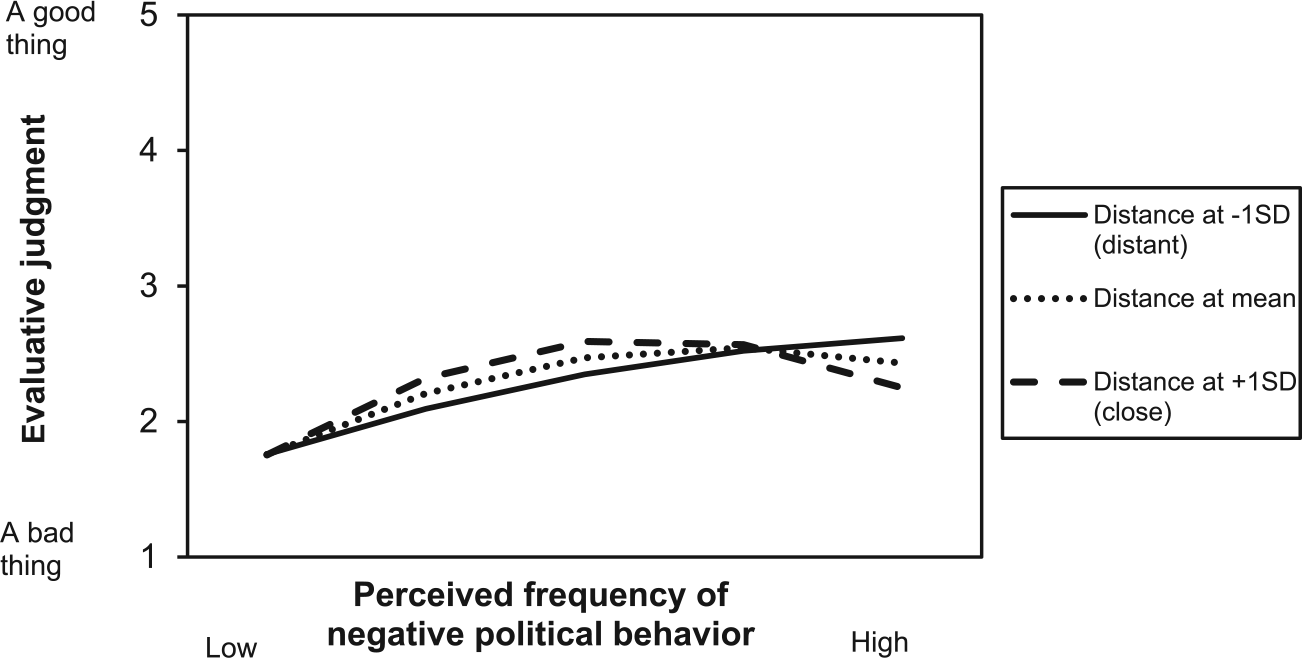
Interaction of perceived frequency and distance of negative political behavior in Sample 2.
For political behavior with positive outcomes, Hypothesis 2 predicted that political behaviors with positive outcomes will be judged more favorably as they increase in frequency, but the rate of increase will diminish as frequency increases. The analysis showed that although there was a significant positive relationship between the frequency and evaluation of positive political behavior, the squared frequency term was not significant in the third step. Thus, Hypothesis 2 did not receive support, and the relationship between evaluation of positive politics and its frequency is linear, not curvilinear. The final step tested the moderation effect of the distance of the perceived politics (Hypothesis 4) by adding the product term for squared frequency with distance. This interaction was significant (β = .32, p < .05), with conditional effects shown in Figure 2. When the behaviors occur infrequently, distance seems to have little effect on evaluative judgments, although in this range the judgments tend to become increasingly positive. As these political behaviors become more frequent, though, distance has marked effects on their evaluation. As the positive behaviors are perceived as becoming more distant, evaluations tend to become more negative, whereas perceptions of low distance are associated with a positive relationship between frequency of occurrence and evaluative judgment. This form is consistent with Hypothesis 4.
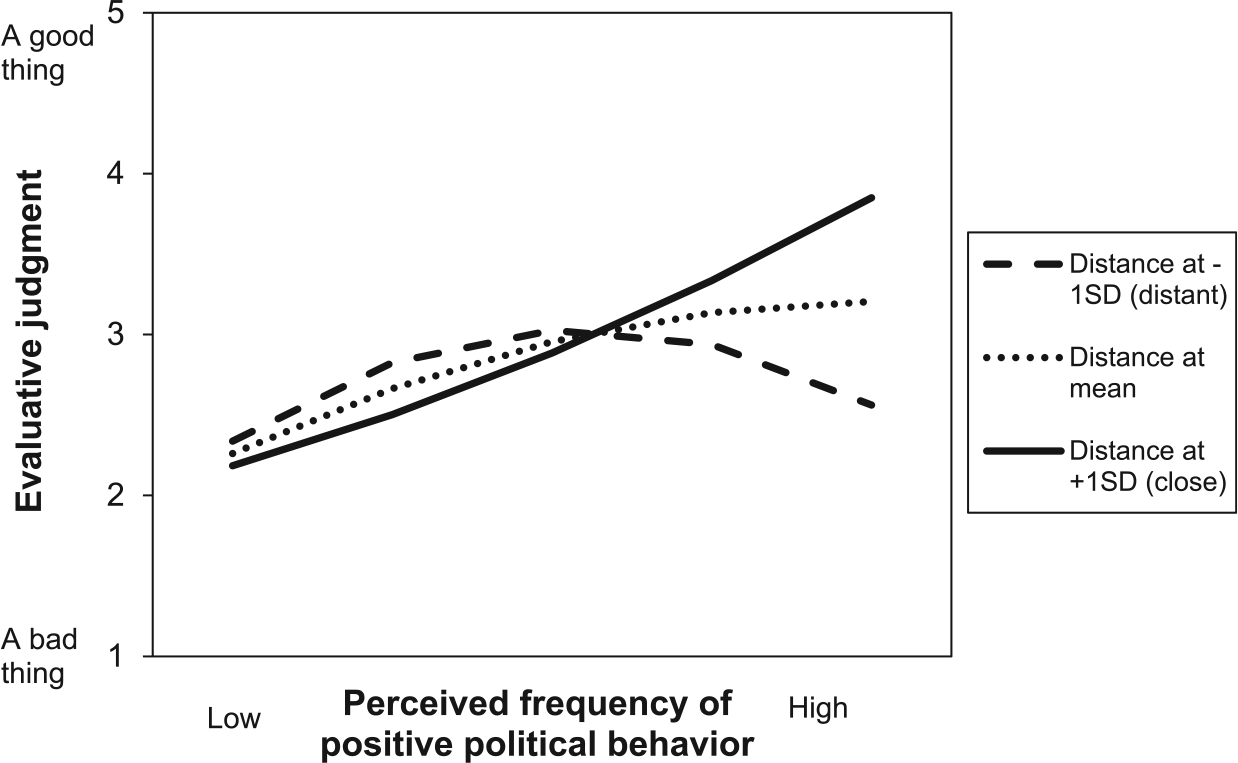
Interaction of perceived frequency and distance of positive political behavior in Sample 2.
Sample 3 results
Table 2 also shows the results for evaluation of negative political behavior for Sample 3. As with Sample 2, the squared frequency term in the third step was significant and negative (β = −.27, p < .01), and the plot in Supplementary Figure 2 (available in the online data supplement) approximates an inverted-U shape, with evaluations becoming slightly more positive as negative political behavior increased through low levels, but becoming markedly negative at moderate to high levels of negative political behavior. This form is consistent with that found in Sample 2, and with Hypothesis 1. In step 5, the curvilinear moderation term between squared frequency and distance was not significant, failing to support Hypothesis 2. However, there was a significant linear frequency × distance interaction in the fourth step (β = −.23, p < .01). Supplementary Figure 3 (available in the online data supplement) shows the plotted interaction. When negative political behavior is perceived to be distant, there is no relationship between frequency of occurrence and evaluation (b = .15, t = .98, p > .05), but when the behavior is seen as close, the relationship between frequency and evaluation is negative (b = −.39, t = −3.94, p < .01); as perceived frequency of the behavior increases, evaluations of the behavior become more negative. Although this interaction is not curvilinear, it is generally consistent with our expectations concerning the relationships between these variables.
For politics with positive outcomes, Table 2 shows the squared frequency term was not significant in step 3, so Hypothesis 2 did not receive support. As with Sample 2, the relationship between evaluation of positive politics and its frequency is simply positive and linear (β = .60, p < .05). The fifth step tested the interaction of squared frequency with distance (Hypothesis 4). The interaction was significant (β = .24, p < .01), and the conditional effects are shown in Supplementary Figure 4 (available in the online data supplement). The graph is almost identical to that of the same interaction found in Sample 2, supporting the hypothesis (see Figure 2).
Supplemental analyses
In light of recent recommendations concerning the proper use of control variables (Becker, 2005), we assessed the robustness of the reported relationships in analyses dropping the non-significant controls from analyses in both samples. We found no changes in the substantive relationships or pattern of hypothesis support. As an additional test, we assessed whether including both frequency scales (negative and positive) in both analyses would alter the pattern of results, but again found no changes in either sample. We conclude that, at least with respect to control variables, our results were robust.
Results summary
Hypothesis 1 for negative political behavior predicted an inverted-U relationship, and this was supported in both samples. Results from Samples 2 and 3 showed no support for a positive curvilinear relationship between frequency of occurrence of positive political behavior and its evaluation (Hypothesis 2); the relationship was significant but simply linear. Hypothesis 3 predicted that distance of the perceived impact of political activity would have no effect on the frequency–evaluation relationship for negative political behavior when the behaviors are infrequent, but an increasingly negative curvilinear effect as frequency increased. This expectation was supported in Sample 2 but not in Sample 3, where we found a linear, though not curvilinear, interaction that conformed to those expectations. Our prediction of curvilinear moderation of the relationship between frequency of positive political behavior and evaluation of the behavior by distance (Hypothesis 4) was fully supported in both samples such that when behaviors were both more frequent and more proximal, they were seen as increasingly positive.
Discussion
This research addressed calls in the perceptions of politics literature regarding the nature of when, or under what conditions, perceptions of politics in organizations are seen as positive as well as negative (Buchanan, 2016; Eldor, 2016). Further, we considered an emerging phenomenon regarding the positive or negative nature of perceived politics, namely, the extent to which outcomes of perceived political behavior have linear or nonlinear effects (Harris et al., 2016; Hochwarter et al., 2010). Specifically, drawing from literature linking organizational politics with effects of challenge or hindrance stressors (e.g. Cavanaugh et al., 2000; Eldor, 2016; Kane-Frieder et al., 2014), we investigated two contextual politics variables (Landells and Albrecht, 2016), namely frequency of occurrence and psychological distance of the impact to the individual. We argued that the frequency of political behavior would exhibit an inverted-U-function relationship with favorable evaluations of the behavior because some level of politics is an expected part of organizational life and can be used to help members determine the motives and merits of others. This relationship would be moderated by distance, however, owing to findings that perceptions of distant or less personally impactful political behavior have less significance to the perceiver (Harris et al., 2007; Johns, 2006; Liu et al., 2006; Rosen and Hochwarter, 2014).
Implications for research
Given the support found for our hypotheses, we can no longer assume that all political behavior is perceived in an unfavorable light. Like many aspects of organizational behavior, understanding the contextual conditions increases our understanding of outcomes associated with organizational events (Johns, 2006; Landells and Albrecht, 2016). Our results for both positive and negative approaches to politics point to the critical importance of what results from the political behavior in organizations in the evaluation of that behavior.
As such, a first implication from this study is that reactions to perceptions of positive or negative politics are not based only on whether or not the workplace behavior is political, but that outcomes of the political behavior may be the root of the positive–negative distinction. This is consistent with predictions from transactional stress theory (Lazarus and Folkman, 1984). Although politics of any sort may be a stressor, the conceptual distinction between challenge stressors as goal-supporting and hindrance stressors as goal-blocking (Webster et al., 2011) can be seen in how individuals differentially evaluated political activity based on the valence of the outcome. For negative politics, this may help explain the inverted-U relation found. Moderate levels of negative politics were judged more favorably than low or high levels, perhaps in part because the perceived benefits of informational cues about the motives of others outweigh the potential negative outcomes. For positive politics, we expected a diminishing but still positive increment in favorability as frequency increased, but instead found a linear increase. This suggests that, contrary to our supposition, high levels of positive politics were not seen as a mixture of challenge and threat, but instead were seen more favorably based simply on the putatively positive outcome perceived. Results here support the applicability of the challenge-stressor framework to political perceptions, but suggest the importance of considering what it is about the political behavior that provides a positive or negative outcome.
A second and related implication concerns how politics engenders stress. There is a growing body of research that suggests that political environments lead to stress and other undesirable outcomes that build over time (e.g. Cropanzano and Li, 2006; Vigoda, 2002). Vigoda (2002) specifically suggests that, regardless of who benefits, so long as there are politics individuals will eventually experience stress. Given our findings for positive politics, however, it may be that, over time, positive politics is less stressful for employees. Indeed, this position would be consistent with how cognitive activation theory (Meurs and Perrewé, 2011) explains stress responses. Our study, based on precepts from transactional stress theory and construal level theory, positions the individual’s cognitive appraisal regarding outcome expectancies of political stressors as a key mechanism explaining differences in evaluations of politics with negative versus positive outcomes. Cognitive activation theory, which seeks to help explain the negative and positive effects of stress, proposes that the duration of the stress response stems from such outcome expectancies, and is thus partly responsible for negative effects of stress when individual outcomes are unfavorable. For both negative and positive politics, our results supported the idea that psychological distance moderated frequency’s effect on outcome expectancies, either for good or ill depending on the valence of the outcome. Future research might integrate ideas from these theoretical approaches and examine the interactive role of the perceived frequency and distance of perceived politics as a mediating mechanism affecting stress episode duration and therefore outcomes such as job satisfaction, performance, and burnout.
A third implication for this study follows from these, concerning the relevance of process and outcome for political behavior. Our findings are consistent with the idea that perceivers are reacting to both the presence of politics and its valence. However, we do not know whether outcomes or processes will, over time, turn out to have greater influence when it comes to the effect of organizational politics on organizational members. One explanation can be found in research of the mutual impact of process and outcomes on affective reactions. If we consider political behavior in organizations to reflect both process (the presence of unsanctioned behavior/uncertainty) and outcome (positive and negative) elements, this study’s findings are in line with past research. For example, Weiss et al. (1999) found that positive reactions (happiness) were influenced only by the outcome, whereas negative emotions (anger, guilt) were influenced by a combination of outcomes and biased procedures. This study adds to the literature by extending those findings to POPs.
Given that valence of one’s personal political outcome is important, above and beyond the presence of the behavior itself, a fourth implication is that traditional negative and positive politics seem to be separate dimensions, not polar opposites. This conclusion is supported by the results of confirmatory factor analyses, the low intercorrelations between the positive and negative scales, and the opposing effects of distance on the frequency–evaluation relationship for negative and positive politics. Because both can occur, what is currently unknown is how the interplay of negative and positive politics affects employee attitudes and other outcomes. Research on this issue is warranted.
Our final implication concerns the nonlinear nature of political perceptions. Our belief that the effects for positive politics would reveal an asymptotic curve function was based on the expectation that perceptions of political behavior as essentially unsanctioned in the organization would ultimately elicit both challenge and hindrance forms of stress that would reach the point of too much of a good thing (Pierce and Aguinis, 2013; Vigoda, 2002). Respondents, however, did not see it this way, calling into question whether unsanctioned behavior is negative at all when the outcomes are directed toward benefiting the individual and the organization. Gandz and Murray (1980) proposed that many employees see themselves as victims of political action; the current results extend their ideas in that perceiving political behavior as frequent and psychologically close may also result in individuals seeing politics in a positive light. Management researchers have recently highlighted the ‘too much of a good thing’ effect, in which effects thought to be monotonically linear and positive actually possess an inverted-U shape (Harris et al., 2016; Pierce and Aguinis, 2013). Our results provide another side to this emerging trend in the management literature by showing there may also be a ‘not enough of a bad thing’ corollary. That is, respondents see even negative politics in the organization as a sometimes functional or perhaps necessary occurrence, but also indicate there is a limit to the acceptability of these behaviors. It seems to be useful to have some negative politics, just not too much.
Even positive political perceptions are subject to a similar effect, but in this case it seems unacceptable for positive politics to be overly benefiting others. It would appear that such political behavior occurring at a distance does not provide the same level of benefits as what is more local. As considered in many definitions of politics, social comparisons may occur where others’ gains from either positive or negative politics are perceived as one’s losses. Such losses may indicate a failing or weakness on the part of employees, perhaps even to the point of hindering future opportunities. Extending these ideas could be an interesting avenue for future research.
Implications for practice
Our findings identify conditions under which there is recognition by employees of a more acceptable and goal-oriented side to organizational politics. This is relevant for managers as political behavior is simply a fact of organizational life. Rather than focusing on rather futile attempts to eliminate political behavior, our results suggest managers ought to focus instead on shaping it toward goals that are beneficial for the organization as well as the individual. In doing so, they need to remain aware of how the political climate of the workplace is perceived by employees, as the positive–negative distinction appears to be important. What is unknown is whether positive politics is less stressful for employees, and so vigilance is recommended. Where political behavior is high, managers may want to consider why employees are resorting to such behavior and, therefore, what systems or procedures are no longer serving the organization or its members.
As such, our findings can help managers predict the extent to which politics in the workplace is likely to have positive or negative effects on employees. Further, this research suggests that managers may wish to manage the distance or awareness of the political behavior in the organization to which they are privy, to help ensure that employees understand and perceive the benefits to the workgroup or organization. Likewise, they may wish to buffer employees when frequency and/or distance are likely to result in negative reactions. Caution is advised, however, because we do not know how such information will interact with the nature of the source of political information and his/her decisions to share or withhold.
Strengths and limitations
As with any study, this one has both strengths and shortcomings. In terms of strengths, the study was conducted in two independent samples of employees using their full-time jobs as reference points – so political behavior is expected to have been a salient issue in their working lives. Although there were some minor differences between our samples’ results, the replication of the majority of the results across samples was a major strength of this study. Further, because the findings are derived from dozens of different organizations they are not confined to any particular type of organization or organizational culture. Finally, this research represents what Ferris and Hochwarter (2011) consider an important step of expanding our view of organizational politics beyond traditional conceptualizations. Recently introduced positive politics scales show good construct validity, with very little overlap with negative politics. Further, the use of a complementary positively-oriented measure of POPs adds a new lens through which to study POPs, and is suggested as an avenue for future research.
A concern is that the data are all self-report. Although the analyses demonstrated it is unlikely that our results were simply owing to same source bias (Siemsen et al., 2010), future research should verify our results using research designs that rely less on self-reported information. Additionally, although the internal consistency of the frequency of politics subscale for traditional measures of perceived politics was acceptable in both study samples, alphas for the distance and the positive–negative evaluation were at the low end of traditional standards in one of the two samples. That the alphas for these two measures in the replication sample were well within acceptable ranges and findings generally replicated across studies suggests that the alpha results for Sample 2 may be sample-specific. Future work in this area with the traditional measures should be conducted to confirm this conclusion. In particular, more scale development and testing may be necessary to identify a more broadly generalizable set of items that reflect distance and evaluation, especially considering the paucity of attention they have received from politics scholars. Finally, although psychological distance may be multi-dimensional (Trope and Liberman, 2010), we assessed distance of the perceived impact of political activity as a single dimension. This is warranted given that these dimensions reflect common meanings that are strongly interrelated and automatically assessed (Trope and Liberman, 2010), but it does not preclude potential differences in effects of potential dimensions (e.g. Aryee et al., 2004, found dyadic distance in the supervisor–subordinate relationship to be positively related to organizational politics). Future research exploring distinctions between conceptualizations of perceived distance of politics would be useful.
Footnotes
Appendix: Perceptions of positive politics scale items
Acknowledgements
The authors wish to thank Associate Editor Samuel Aryee and the three anonymous reviewers for their insightful comments and suggestions that helped guide and enhance this research. We also wish to acknowledge Donald Fedor, our colleague and friend, who inspired this project and whose critiques, comments and support of earlier drafts of this work helped more than he could imagine.
Funding
This research received no specific grant from any funding agency in the public, commercial or not-for-profit sectors.
References
Supplementary Material
Please find the following supplemental material available below.
For Open Access articles published under a Creative Commons License, all supplemental material carries the same license as the article it is associated with.
For non-Open Access articles published, all supplemental material carries a non-exclusive license, and permission requests for re-use of supplemental material or any part of supplemental material shall be sent directly to the copyright owner as specified in the copyright notice associated with the article.
