



Abstract
Scholars typically view employee responses to psychological contract (PC) fulfillment as a form of reciprocity; in exchange for the organization fulfilling its promises, the employee willingly contributes their time and effort toward company goals. In this article, we ask if employee responses are based not on gratitude, but rather on the employee’s desire to maintain the benefits associated with PC fulfillment. Specifically, we argue that PC fulfillment embeds employees in the organization by increasing the costs of leaving (‘sacrifices’), and this in turn motivates their extra-role performance. Furthermore, we expect this effect to be even stronger for employees with strong ties to colleagues or work groups (‘links’) or good fit with job demands or organizational values (‘fit’). Data from 149 employees and their immediate supervisors supported our predictions: PC fulfillment was positively related to organizationally-directed citizenship behaviors and work-role innovation through its positive relation to sacrifices. Furthermore, these indirect effects were stronger for employees with stronger links and better fit. The present findings provide a novel theoretical account of how and when PC fulfillment relates to positive employee behaviors. Theoretical and practical implications for managing employees’ PCs are discussed.
Keywords
Over the years, scholars have conceived numerous models to better understand the employee–organization relationship (e.g. Shore et al., 2004). Among the most widely studied and tested is the psychological contract (PC), defined as beliefs held by employees about the mutual obligations between those employees and the organization (Rousseau, 1990). These beliefs emerge from employees’ perceptions that the organization has promised certain inducements (e.g. competitive wages, promotion opportunities, autonomy) in exchange for their contributions (e.g. time, effort). Such promises may be perceived during organizational entry, but also at any time during the employment relationship through, for example, training, performance appraisals and reward practices (Rousseau, 2001). Much of the existing PC research emphasizes employees’ reactions to PC breach or fulfillment (Zhao et al., 2007), or employees’ beliefs regarding the extent to which the organization has upheld its promises (Morrison and Robinson, 1997). Not surprisingly, employees tend to hold more positive work attitudes (Conway et al., 2011) and exhibit better performance (Turnley et al., 2003) when they believe their PCs have been fulfilled.
Theoretically, researchers have used reciprocity within social exchange as the key mechanism linking PC fulfillment with positive employee responses (Conway and Coyle-Shapiro, 2012; Coyle-Shapiro, 2002; Turnley et al., 2003), assuming mechanisms underlying PC fulfillment’s positive effects are mirror opposites of those underlying PC breach’s negative effects (negative reciprocity). Yet, processes underpinning fulfillment’s positive effects warrant further scrutiny and interpretation. As Conway et al. (2011) noted, employees may not feel compelled to reciprocate PC fulfillment like they do breach, as in the former case the organization simply fulfilled promised obligations (as the employee assumed it would), whereas in the latter the organization unexpectedly failed to fulfill promises, more likely inciting negative reciprocity. From an affective reaction standpoint (e.g. Zhao et al., 2007), whereas breach may give rise to the ‘hot’ negative emotions characterized by violation (e.g. Robinson and Morrison, 2000), fulfillment may generate the more ‘cold’ cognitive processing concerning loss of valued benefits associated with leaving (sacrifices), thus driving behavior. This would be consistent with findings that negative events tend to evoke stronger emotional reactions than positive events, as the former signal that some action is necessary, whereas the latter do not (Taylor, 1991). To be clear, we do not annul social exchange and negative reciprocity as useful explanations for PC fulfillment; rather, other theoretical explanations and mechanisms besides reciprocity might also explain why and when PC fulfillment influences employee behaviors, especially positive behaviors.
In this article, we seek to advance theoretical understanding of PC fulfillment by drawing insights from job embeddedness (JE) theory (Mitchell et al., 2001). The JE perspective allows us to identify and test other mechanisms and conditions relating PC fulfillment to positive employee reactions, thus broadening our theoretical understanding of PC fulfillment’s effects. JE theory proposes three forces that influence employee retention and performance: links are the ‘formal or informal connections between a person and institutions or other people’ (Mitchell et al., 2001: 1104); fit is the ‘perceived compatibility or comfort with an organization’ (Mitchell et al., 2001: 1104); and sacrifices is ‘the perceived cost of material or psychological benefits that may be forfeited by leaving a job’ (Mitchell et al., 2001: 1105).
Scholars originally conceived JE as an ‘anti-withdrawal’ construct, based on March and Simon (1958), and explained its positive performance effects via motivational processes: namely, motivation to stay and perform. Similarly, we use JE theory to argue that PC fulfillment encourages positive employee behaviors by generating a desire in employees to stay while also providing them with resources that enable them to contribute (e.g. Hom et al., 2012). Specifically, fulfillment of the employee’s PC endows the employee with transactional (tuition reimbursement) and/or relational (developmental opportunities) benefits that correspond with the material (transactional) and/or psychological (relational) benefits that would be sacrificed were she to leave. In addition, we theorize a unique role for links and fit in our model connecting PC fulfillment to positive employee behavior. We view links and fit, in part, as resources (e.g. support of colleagues or supervisors, knowledge of what the organization values) that enable better performance. Thus, we disaggregate the embeddedness construct to position sacrifices as the core mediator in our model, and links and fit as moderators, because we construe links and fit as resources that will interact with sacrifices to strengthen sacrifices’ positive performance effects. Hence, we develop and test a moderated-mediation model in which the mediating effect of sacrifices in the positive relation between PC fulfillment and extra-role behaviors is stronger for employees with stronger links and better organizational fit (Figure 1).

Conceptual model.
Research connects PC fulfillment most strongly with behaviors aimed at protecting and improving the organization (Turnley et al., 2003). Thus, we examine PC fulfillment’s effects on two forms of organizationally-directed extra-role behavior: organizational citizenship behaviors toward the organization (OCB-O) and work-role innovation (‘innovation’ hereafter). OCB-O refers to discretionary employee behavior not formally recognized by the reward system, but nevertheless promotes organizational functioning (e.g. attending events, defending the organization; Lee and Allen, 2002). Innovation is discretionary behavior that involves the introduction and implementation of novel ideas to improve current work processes or routines (e.g. coming up with new work methods, establishing new goals; Welbourne et al., 1998).
Our primary contribution is to the PC literature. We provide a novel theoretical explanation of the positive effects of PC fulfillment on employee behavior using JE theory. In contrast to previous theorizing in this area, which relies on negative affect as the primary motivating mechanism, our theoretical approach emphasizes cold cognitive calculations regarding the valued benefits employees would lose were they to leave the organization. Such embedding mechanisms have been overlooked in prior PC fulfillment research, despite delivered promises plausibly enhancing employees’ desire to stay (e.g. Hom et al., 2009). We also contribute to JE theory. We view links and fit as not merely embedding mechanisms, but resources employees can use to enact positive workplace behaviors (e.g. staying abreast of organizational developments or having support to implement improvements). Thus, we position links and fit as moderators enabling higher levels of performance when employees are embedded through sacrifices. This leads us to propose interactive relationships among the conceptually independent dimensions of sacrifices, links, and fit rather than the additive model predominantly proposed in the JE literature. These theoretical innovations together lead to a model integrating PC and JE theories and a deeper understanding of both PC and JE.
Theory and hypotheses
Mitchell et al. (2001: 1104) introduced JE theory as a ‘broad constellation of influences on employee retention,’ comprising connections or attachments to individuals or groups in the organization (links); (b) compatibility with job demands and organizational values (fit); and (c) perceived material or psychological turnover costs (good pay, interesting work, advancement opportunities; sacrifices). Even though delivered PC inducements may enhance all three dimensions of embeddedness (e.g. promoting links by encouraging cross-functional collaborations, or enhancing fit by treating employees with respect), we position sacrifices as the mediator and links and fit as moderators in our theoretical model. There are theoretical and empirical reasons to disaggregate the embeddedness construct into its subcomponents as proposed in our model. Theoretically, PC fulfillment is most directly linked to sacrifices as having promises fulfilled means employees have transactional and/or relational benefits that would be sacrificed if they were to leave. Although links and fit may also provide benefits that motivate employees to stay, they can also be considered resources operating to strengthen sacrifices’ positive performance effects, whereas sacrifices are likely to possess little instrumental value for facilitating work performance, particularly extra-role activities (e.g. Kiazad et al., 2014, 2015). For example, such things as healthcare benefits or opportunities for personal growth may motivate staying and performance, but they are not instrumental for enhancing extra-role activities, such as protecting the organization from problems or implementing workplace improvements. We disentangle the embeddedness construct to capture these theoretical differences among its subcomponents. Empirically, there is evidence that the embeddedness components work differently in models linking PC fulfillment with extra-role behaviors (e.g. Ghosh et al., 2017; Kiazad et al., 2014), suggesting it is meaningful to examine their unique and interactive associations with outcomes. Thus, our conceptual model proposes that PC fulfillment positively relates to OCB-O and innovation through sacrifices, and that this indirect relationship is stronger for employees who possess stronger organizational links or better organizational fit.
Mediating role of sacrifices
PC fulfillment and sacrifices
Because sacrifices can be material (good pay) or psychological (development opportunities) benefits derived from one’s organization (Hom et al., 2009), we propose that PC fulfillment is an important source of perceived sacrifices for employees. In particular, PC and JE theories offer two reasons why PC fulfillment may be a source of sacrifices: first, PC fulfillment involves the transfer of valued (transactional and/or relational) benefits from organizations to employees (e.g. good pay, job security, development opportunities), which are equated with the sacrifices that embed employees (e.g. Hom et al., 2012; Mitchell et al., 2001). Second, PC inducements are likely to become sacrifices as they are often idiosyncratic, firm-specific and non-transferable (Ng and Feldman, 2008). Indeed, as Ng and Feldman (2008) argued, employees are motivated to stay in organizations to hold on to their PC deals (i.e. the deals they were promised and were subsequently fulfilled). Empirically, distributive justice (which shares some conceptual overlap with PC fulfillment) and high-performance HRM practices (i.e. regular performance appraisals, good compensation, job security, autonomy, skill variety [typical PC inducements; e.g. Kickul, 2001]), have been linked to perceived sacrifices (Ghosh et al., 2017; Tian et al., 2016). Overall, PC fulfillments are likely to be a source of perceived sacrifices for employees.
Sacrifices and extra-role behaviors
Sacrifices, in turn, should relate positively to employees’ extra-role performance, because sacrifices induce ‘staying mind-sets’ (Hom et al., 2012), which motivate high performance (including extra-role activities) as a means to achieve desired end states of continued employment or further inflow of valued benefits. For example, sacrifice-embedded employees may feel they have much to lose by underperforming, and thus may exhibit OCBs or innovate as a means to build goodwill within the organization (e.g. Rioux and Penner, 2001), meet current and future work demands, or avoid becoming ‘reluctant leavers’ (Hom et al., 2012). Early JE scholars (Lee et al., 2004; Ng and Feldman, 2010) also declared that sacrifices should elicit better work performance (including innovation) based on motivation to stay and perform. As articulated by Ng and Feldman (2010: 1069), sacrifice-embedded employees ‘have strong incentives to engage in innovation-related behaviors because they want to ensure that their organizations continue to survive and thrive and to enhance their own job security within their present firm.’ In support, there is empirical evidence that sacrifices relate positively to work performance (e.g. Ghosh et al., 2017; Kiazad et al., 2014; Tian et al., 2016).
Taken together, integrating PC and JE theories, we expect PC fulfillment to be positively related to OCB-O and innovation because fulfilled PC inducements become a source of perceived sacrifices for employees, which motivate them to engage in extra-role behaviors in order to retain and continue receiving those benefits:
Hypothesis 1: Sacrifices mediate the positive relationship between psychological contract fulfillment and (a) organizational citizenship behaviors toward the organization and (b) innovation.
Moderating role of links and fit: Moderated mediation
In their proximal withdrawal states theory, Hom et al. (2012) envision different types of stayers, specifying sacrifice-embedded employees who are also embedded via links or fit as ‘embedded engaged stayers’, who are more likely to contribute extra-role services. Along similar lines, we expect links and fit to strengthen sacrifices’ positive performance effects by supplying resources that enable employees to undertake extra-role activities more effectively. Thus, we examine links and fit as second-stage moderators that determine the strength of PC fulfillment’s positive indirect effects on extra-role behaviors via sacrifices, arguing that PC fulfillment’s positive indirect effects through sacrifices will be stronger for employees with stronger links or better fit.
Moderation of sacrifices by links
JE scholars (e.g. Kiazad et al., 2015; Lee et al., 2014) conceptualize links as an embedding resource that can enhance employees’ capability to undertake extra-role activities, such as OCBs and innovation. This is because one’s network of relationships can provide timely access to information, influence and support, thus allowing these individuals to undertake these activities more effectively. From the JE view, sacrifice-embedded employees want to stay and perform because they are motivated to keep their jobs and the associated rewards (Ng and Feldman, 2010). When they are also embedded via close relationships with coworkers, their desire to stay and perform should be elevated because they will also possess the requisite resources to effectively undertake OCB-Os and innovation in the organization. For example, broad-ranging and trusted links permit such activities as keeping up with latest developments, participating in decision making, cooperating with coworkers, and implementing organizational improvements (Janssen, 2005; Lee and Allen, 2002). Thus, sacrifice-embedded employees are more likely to exhibit extra-role behaviors when they have strong connections to others, because their greater connectivity not only boosts their motivation to stay and perform, but also enables them to undertake these activities more effectively.
When sacrifice-embedded employees lack close relationships, however, their motivation and ability to undertake these extra-role activities should be reduced. This is because (a) staying purely to avoid losing good corporate benefits is not a strong driver of extra-role performance (Hom et al., 2012), and (b) these employees may lack the requisite resources to effectively perform these extra-role activities. For instance, sacrifice-embedded employees – who perceive much to lose by leaving – may deem it too risky to divert time and energy towards OCBs or innovation (Yuan and Woodman, 2010) if they lack the support of colleagues or supervisors.
Together, this JE-based theorizing produces a moderated-mediation framework (with second-stage moderation), such that sacrifices mediate the positive effects of PC fulfillment on extra-role performance more strongly for employees with stronger organizational links:
Hypothesis 2: Links moderate the relationships between sacrifices and organizational citizenship behaviors toward the organization and innovation, and thus the strength of psychological contract fulfillment’s indirect effects on employees’ (a) organizational citizenship behaviors toward the organization and (b) innovation via sacrifices, such that these indirect effects will be stronger when employees have stronger links as opposed to weaker links.
Moderation of sacrifices by fit
JE fit should also interact with sacrifices to strengthen sacrifices’ mediating role in the PC fulfillment–performance relationship. In particular, better-fitting employees possess the requisite shared values, knowledge, skills and abilities to effectively undertake OCBs and innovation. For example, high-fit employees are trusted to independently pursue their performance goals, feel compatible with co-workers, and have a better understanding of the organization and what it values (Erdogan and Bauer, 2005). When sacrifice-embedded employees also feel there is sufficient fit, they should be more motivated (Hom et al., 2012) and able to contribute extra-role services. Thus, perceived sacrifices should engender more extra-role contributions for well-fitting employees who want to stay, and may feel more comfortable (and better supported) to perform them.
When sacrifice-embedded employees lack fit, however, the positive performance effects of sacrifices should be weakened, because misfitting one’s organization does not readily facilitate extra-role contributions (Hom et al., 2012). That is, organizational ‘misfits’ whose staying is motivated primarily by sacrifices may refrain from investing too heavily in extra-role activities, as they may lack the instrumental knowledge of which activities are needed or appropriate, and would loathe to become ‘reluctant leavers’. Thus, we expect fit to moderate (at second stage) sacrifices’ mediating role in the PC fulfillment–work-performance link:
Hypothesis 3: Fit moderates the relationships between sacrifices and organizational citizenship behaviors toward the organization and innovation, and thus the strength of psychological contract fulfillment’s indirect effects on employees’ (a) organizational citizenship behaviors toward the organization and (b) innovation via sacrifices, such that these indirect effects will be stronger when employees have more fit as opposed to less fit.
Methods
Participants and procedures
We hired StudyResponse at Syracuse University (Stanton and Weiss, 2002) to collect matched subordinate–supervisor data from a national sample. StudyResponse is a non-profit academic service providing researchers access to samples of participants. Numerous past studies have used StudyResponse (e.g. Piccolo and Colquitt, 2006), or similar online panels (e.g. Courtright et al., 2016), to recruit research participants and administer surveys. Meta-analytic evidence shows that online panel data, including that from StudyResponse, produce similar psychometric properties, effect sizes and criterion validities as conventionally sourced data (Walter et al., 2018). Links to an online survey were sent directly by the research company to 200 subordinates and their supervisors, randomly selected from their pool of voluntary participants. Subordinates and supervisors were paid directly by StudyResponse with a $5 credit to their accounts. Participation reminders were sent to non-respondents, and subordinate and supervisor surveys were matched using identity codes. We received 182 completed employee surveys and 167 supervisor surveys, yielding response rates of 91% and 83.5%, respectively. Our final matched sample comprised 149 supervisor–subordinate dyads with complete data.
Among subordinates, 53.4% were male, the average age was 37 years (SD = 9.26), and average job tenure was 7 years (SD = 6.04). Most (95%) were full-time employees, having on average 13.5 years of professional work experience (SD = 9.08), and working in a wide range of sectors, including professional services and IT (32.2%), manufacturing and construction (22.8%), healthcare and education (14%), trade and distribution (10.5%), retail and hospitality (7.6%), and other (12.9%). Almost all of the participating supervisors (99%) were employed full-time, 40% were female, their average age was 40 years (SD = 8.93), and their average organizational tenure was 9 years (SD = 5.47). Supervisors had, on average, 16.5 years of professional work experience (SD = 8.71) and had worked with their subordinates for 5.5 years (SD = 3.39).
Measures
Except for innovation, all items were measured on a 5-point Likert scale ranging from 1 = strongly disagree to 5 = strongly agree.
PC fulfillment
Employees assessed PC fulfillment with Robinson and Morrison’s (2000) five-item scale. Items include, ‘Almost all the promises made by my employer during recruitment have been kept so far’ and ‘So far my employer has done an excellent job of fulfilling its promises.’
Links
Employees reported on links with three items from the JE scale (Felps et al., 2009): ‘I work closely with my co-workers’; ‘I am a member of an effective work group’; and ‘On the job, I interact frequently with my work group members.’
Fit
Employees reported fit with three items from the JE scale (Felps et al., 2009): ‘I feel like I am a good match for my organization’; ‘My job utilizes my skills and talents well’; and ‘If I stay with my organization, I will be able to achieve most of my goals.’
Sacrifices
Sacrifices were measured with three items from the JE scale (Felps et al., 2009): ‘I would sacrifice a lot if I left this job’; ‘I have a lot of freedom on this job to pursue my goals’; and ‘I believe the prospects for continuing employment with my organization are excellent.’
OCB-O Supervisors rated employees’ organizational citizenship behaviors toward the organization (OCB-O) with eight items from Lee and Allen’s (2002) OCB scale (e.g. ‘Attended functions that are not required but that help the organizational image’ and ‘Defended the organization when other employees criticized it’).
Innovation
Supervisors rated (1 = never, 5 = always) employees’ innovation with four items from the role-based performance scale (Welbourne et al., 1998). Examples include: ‘… found improved ways to do things’ and ‘… created better processes and routines.’
Control variables
We included years of work experience, organizational tenure and sex as controls, because employees with more experience perform better (e.g. Adkins, 1995), employees with more tenure innovate less (e.g. Van Dorenbosch et al., 2005), and women innovate more (e.g. Janssen, 2005). We considered controlling for age, but because it is highly correlated with work experience (r = .84), we excluded it to avoid multicollinearity.
Results
Descriptive statistics are reported in Table 1. We first examined the discriminant validity of the employee-reported measures with a confirmatory factor analysis (CFA) of items measuring PC fulfillment, links, fit and sacrifices. We correlated the error terms of the two reverse-scored PC fulfillment items (‘I have not received everything promised to me in exchange for my contributions’ and ‘My employer has broken many of its promises to me even though I’ve upheld my side of the deal’) to account for method effects associated with reversed items (Brown, 2006). We assessed model fit using the recommended cut-off scores for Comparative Fix Index (CFI > .90), Root Mean Square Error of Approximation (< .10), and Standardized Root Mean Square Residual (< .10) (Hair et al., 1998; Kelloway, 2015). The expected 4-factor CFA provided adequate fit to the data (χ2 = 152.31, d.f. = 70, p < .01; CFI = .94; RMSEA = .08; SRMR = .06), and all items had significant (p < .01) loadings on their hypothesized factor. The 4-factor model fitted significantly better than all possible, nested, 3-factor models (Δχ2 ranged from +27.79 to +56.74, Δd.f. = 1, p < .01), a 2-factor model with embeddedness as a single latent factor and PC fulfillment as the second factor (Δχ2 = +50.12, Δd.f. = 3, p < .01), and a 1-factor model (Δχ2 = +62.99, Δd.f. = 6, p < .01). A 2-factor CFA of the items for supervisor-rated OCB-O and innovation also provided adequate fit to the data (χ2 = 145.99, d.f. = 53, p < .01; CFI = .93; SRMR = .05), and fitted significantly better than a 1-factor model (Δχ2 = +28.56, Δd.f. = 1, p < .01).
Means, standard deviations, reliabilities and intercorrelations of study variables.
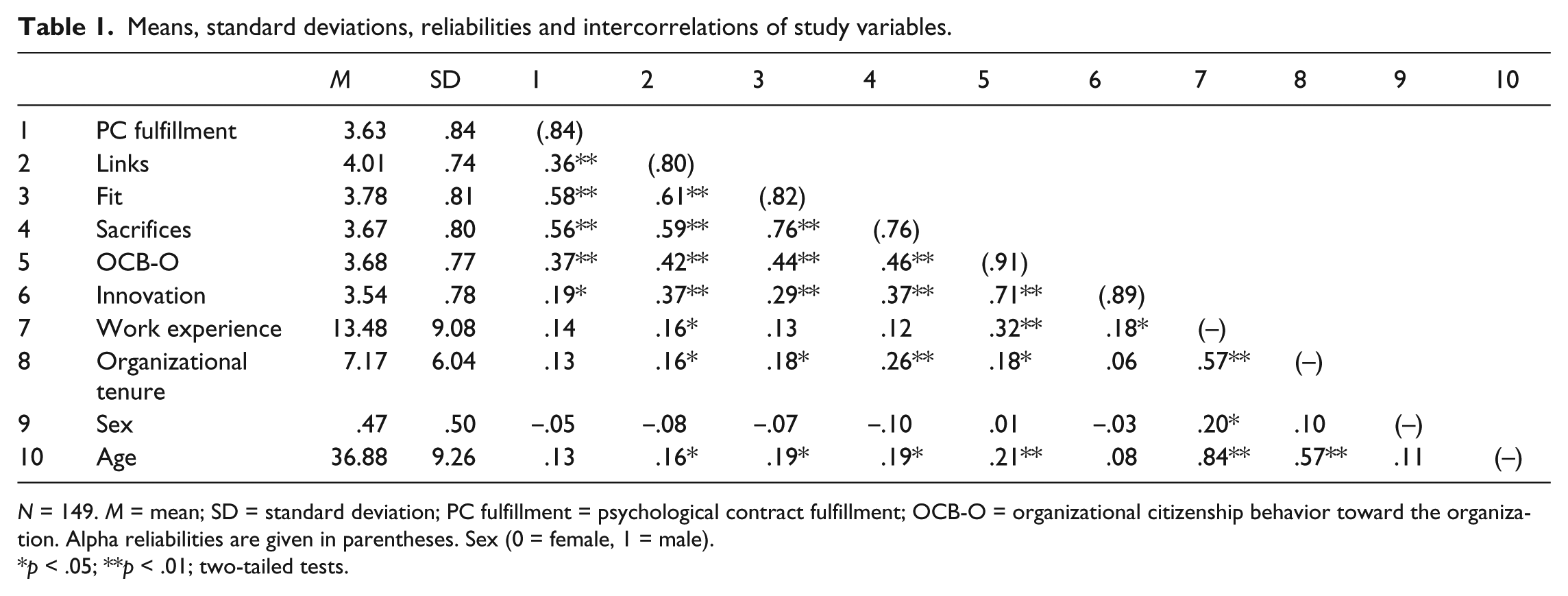
N = 149. M = mean; SD = standard deviation; PC fulfillment = psychological contract fulfillment; OCB-O = organizational citizenship behavior toward the organization. Alpha reliabilities are given in parentheses. Sex (0 = female, 1 = male).
p < .05; **p < .01; two-tailed tests.
Hypothesis testing
Hypothesis 1 proposed that sacrifices mediate the positive relationship between PC fulfillment and (a) OCB-O and (b) innovation. We tested this hypothesis using Model 4 in SPSS PROCESS (v. 2.16). Participants’ sex, tenure and work experience were included as covariates. This hypothesis was supported, as significant indirect effects of PC fulfillment on OCB-O (B = .20; Bootstrap = 5000 CI 95% [.12, .31]), and innovation (B = .20; Bootstrap = 5000 CI 95% [.10, .33]) via sacrifices were observed. Furthermore, the direct effect of PC fulfillment on OCB-O (B = .09; Bootstrap = 5000 CI 95% [‒.06, .24]) and innovation (B = –.08; Bootstrap = 5000 CI 95% [‒.24, .08]) is non-significant, with sacrifices as a mediator in the model.
To test the conditional indirect effect hypotheses (Hypotheses 2a-b and 3a-b), we used Model 14 in SPSS PROCESS (v. 2.16), which models second-stage moderation. The two hypotheses were tested with separate regression equations, one using links as the moderator and one using fit as the moderator. Participants’ sex, organizational tenure and work experience were included as controls. The results of the analyses are summarized in Table 2.
Conditional indirect effects of psychological contract fulfilment on organizational citizenship behaviors toward the organization and innovation through sacrifices.

N = 149. Mediator = Sacrifices; IE = indirect effect (unstandardized); SE = standard error; CI = confidence interval; OCB-O = organizational citizenship behavior toward the organization.
Hypotheses 2a-b proposed that links moderate the strength of PC fulfillment’s indirect effect on employees’ (a) OCB-O and (b) innovation via sacrifices, such that the indirect effects will be stronger for employees with stronger links as opposed to weaker links. The sacrifices × links interaction was significant for both OCB-O (B = .28; Bootstrap = 5000 CI 95% [.15, .42]) and innovation (B = .29; Bootstrap = 5000 CI 95% [.14, .44]). Supporting Hypothesis 2a, Table 2 shows that the indirect effect of PC fulfillment on OCB-O via sacrifices is significant when links are high (B = .23; Bootstrap = 5000 CI 95% [.12, .35]), but not when links are low (B = .02; Bootstrap = 5000 CI 95% [‒.08, .12]). Likewise, in support of Hypothesis 2b, the indirect effect of PC fulfillment on innovation via sacrifices is significant when links are high (B = .21; Bootstrap = 5000 CI 95% [.09, .37]), but not when links are low (B = –.00; Bootstrap = 5000 CI 95% [‒.13, .11]). Thus, Hypotheses 2a and 2b are supported: as links increase, the positive indirect effect of PC fulfillment on OCB-O and innovation via sacrifices becomes stronger.
To determine the form of the significant interactions, we applied conventional methods for plotting simple slopes (Cohen et al., 2003) at high (1 SD above centered mean) and low (1 SD below centered mean) levels of links (see Figure 2 for OCB-O and Figure 3 for innovation). As Figure 2 shows, the interaction between sacrifices and links are consistent with Hypothesis 2a: sacrifices are positively related to supervisor-rated OCB-O when links are high (b = .50, p < .01), but not low (b = .09, ns). Likewise, the relationship between sacrifices and innovation is positive and significant when links are high (b = .39, p < .01), but not low (b = ‒.04, ns) (see Figure 3).
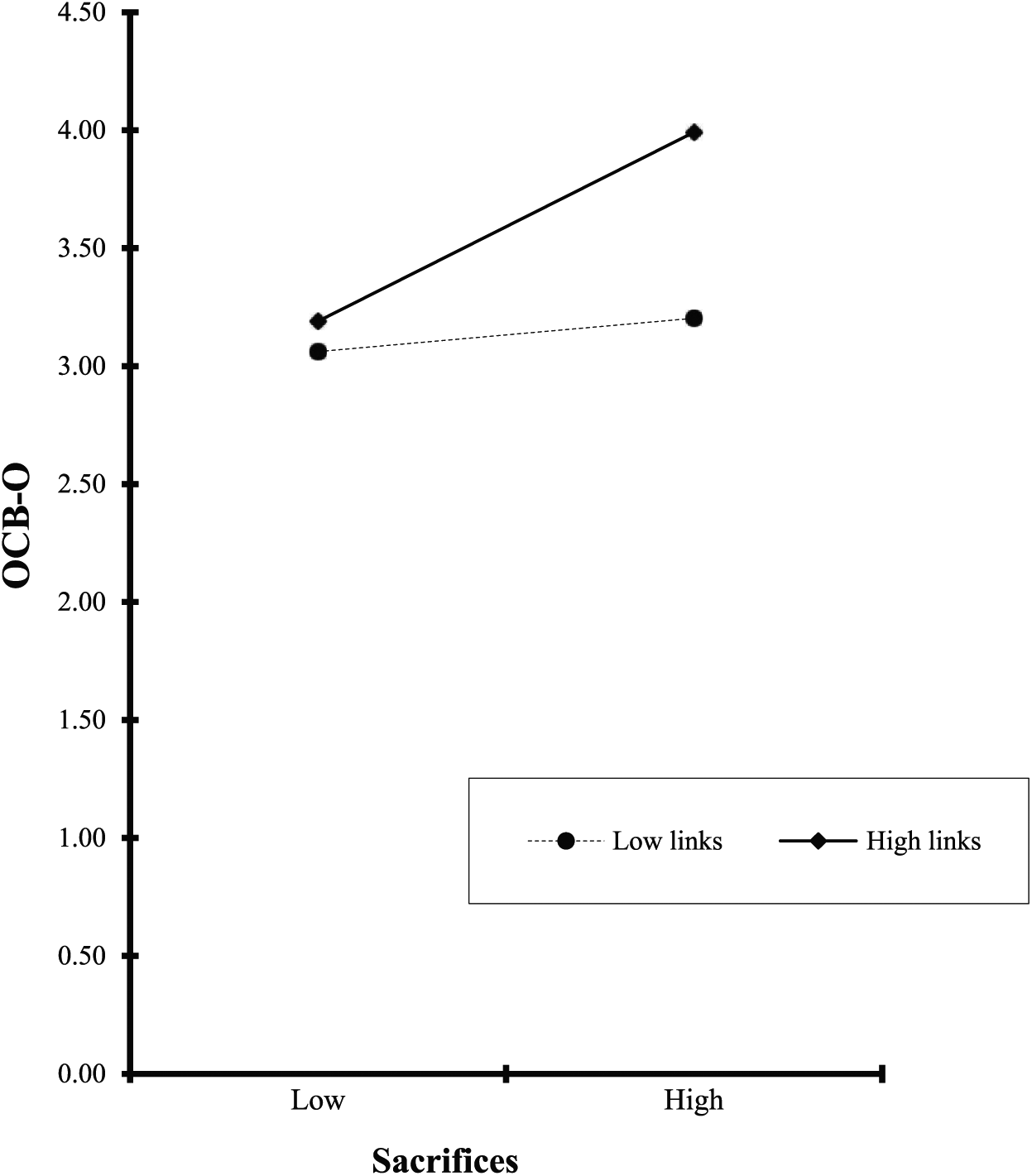
Links as a moderator of the relationship between sacrifices and organizational citizenship behaviors toward the organization.
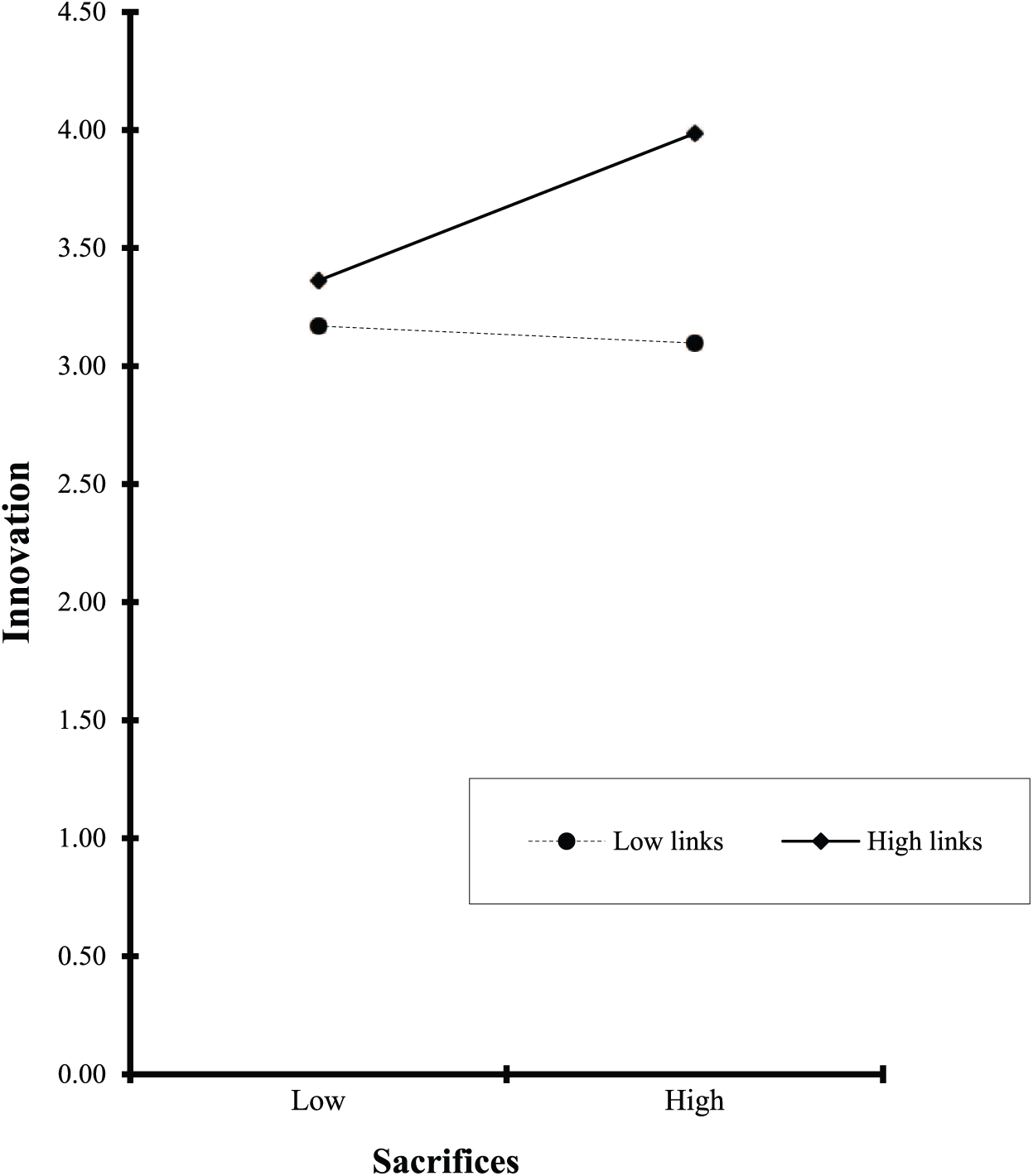
Links as a moderator of the relationship between sacrifices and innovation
Hypotheses 3a-b proposed that fit moderates the strength of PC fulfillment’s indirect effect on employees’ (a) OCB-O and (b) innovation via sacrifices, such that the indirect effects will be stronger when employees have more fit as opposed to less fit. The sacrifices × fit interaction term was significant in predicting both OCB-O (B = .21; Bootstrap = 5000 CI 95% [.09, .32]) and innovation (B = .33; Bootstrap = 5000 CI 95% [.21, .45]). Supporting Hypothesis 3a, Table 2 shows that the conditional indirect effect of PC fulfillment on OCB-O via sacrifices is significant when fit is high (B = .24; Bootstrap = 5000 CI 95% [.13, .38]), but not when fit is low (B = .07; Bootstrap = 5000 CI 95% [‒.03, .20]). Likewise, and consistent with Hypothesis 3b, the indirect effect of PC fulfillment on innovation via sacrifices is significant for high-fit employees (B = .33; Bootstrap = 5000 CI 95% [.19, .52]), but not for low-fit employees (B = .06; Bootstrap = 5000 CI 95% [–.05, .18]). Thus, Hypotheses 3a and 3b are supported: as fit increases, the positive indirect effects of PC fulfillment on OCB-O and innovation via sacrifices become stronger. As Figures 4 and 5 show, the significant interactions are consistent with Hypotheses 3a and 3b: the relationship between sacrifices and OCB-O is positive and significant when fit is high (b = .50, p < .01), but not low (b = .16, ns). Furthermore, sacrifices relate positively to innovation when fit is high (b = .65, p < .01), but not low (b = .10, ns). In sum, sacrifices relay the positive effects of PC fulfillment on OCB-O and innovation more strongly for employees with better organizational fit.
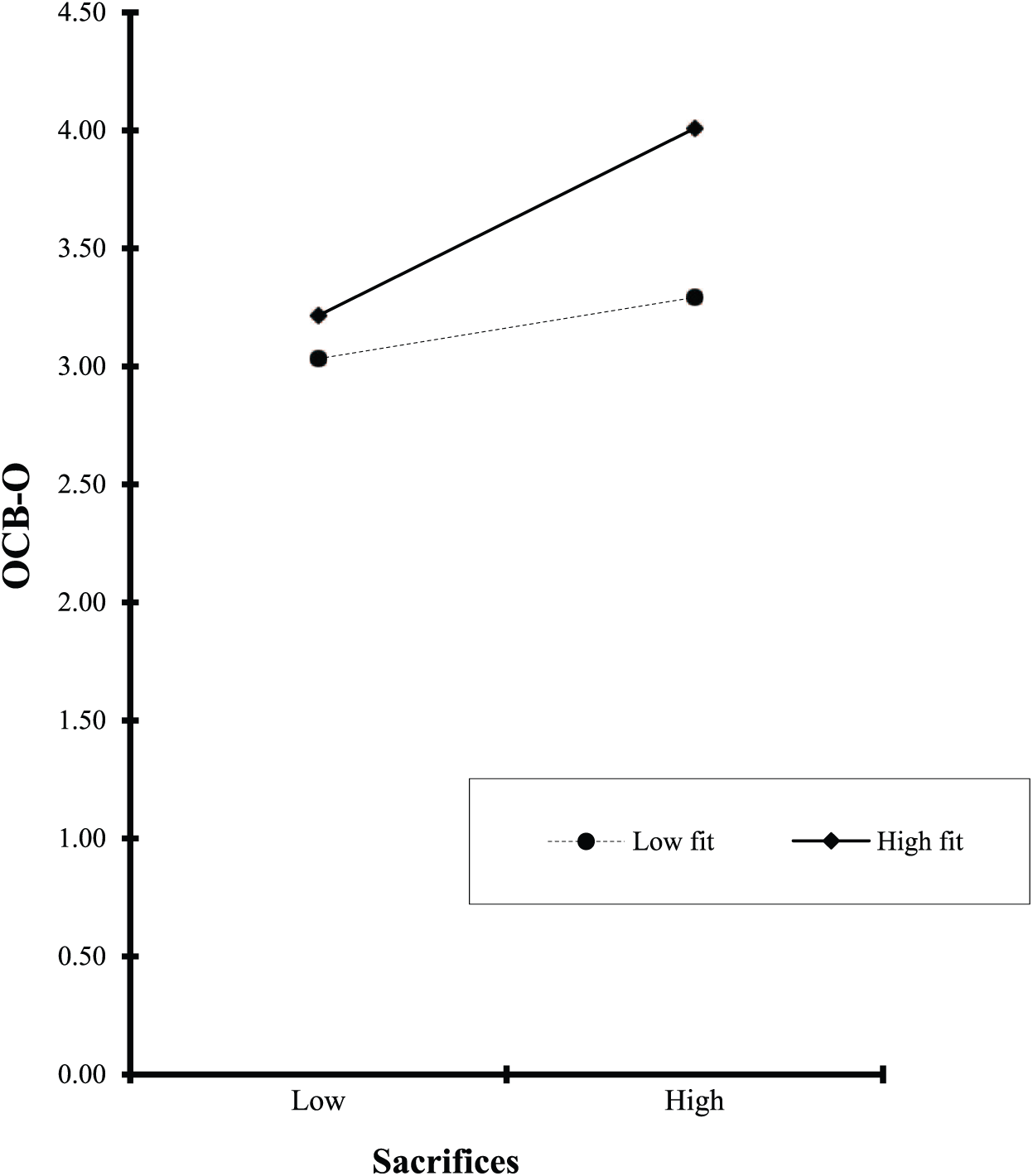
Fit as a moderator of the relationship between sacrifices and organizational citizenship behaviors toward the organization.

Fit as a moderator of the relationship between sacrifices and innovation.
Supplemental analyses
To dismiss the possibility that our results are influenced by the control variables (Spector and Brannick, 2011), we re-ran the analyses with control variables excluded. Here, too, the results remain consistent with our hypotheses. We also probed for the possibility of a 3-way conditional indirect effect using Model 18 in SPSS PROCESS. That is, we tested whether the indirect effect of PC fulfillment on OCB-O and innovation, via sacrifices, would be stronger at high levels of both links and fit. The moderated regression analysis revealed no significant 3-way interactions for OCB-O (B = .02, t = .35, ns) or innovation (B = –.03, t = –.45, ns). Thus, it appears that links and fit do not operate additively to condition PC fulfillment’s indirect effects on extra-role behaviors.
Replication sample
Participants and procedures
We sought to replicate the above findings with another sample to verify that: (i) the theoretical mechanism (sacrifices) and moderators (links and fit) that accounted for the results of the original study operated similarly in the replication study; and (ii) to assess the extent to which the primary study’s findings could be attributed to sampling or measurement error. Participants in this replication sample were 75 alumni of an Australian university recruited as part of a larger study on PCs. 1 Their average age was 29 years (SD = 5.81), average organizational tenure was 3 years (SD = 3.01), and just over half (52%) were female. On average, they had 6 years of professional work experience (SD = 4.79), and represented the following sectors: finance and accounting (32.3%), professional services and IT (29%), government services (10.8%), infrastructure and utilities (10.8%), and other (10.8%). All variables, except OCB-O, were measured on a 5-point Likert scale, via self-report, using the same scales as in the main study. We assessed OCB-O with three items from the loyalty subscale of Van Dyne et al.’s (1994) OCB scale (‘represent your organization favorably to outsiders’; ‘tell outsiders that your organization is a good place to work’; and ‘defend your organization when other employees criticize it’; 1 = never; 5 = always).
Results
Descriptive statistics are reported in Table 3, and the results of the conditional indirect effect tests are summarized in Table 4. We again controlled for participants’ sex, tenure and work experience. We again found support for Hypothesis 1a, as the indirect effect of PC fulfillment on OCB-O (B = .29; Bootstrap = 5000 CI 95% [.10, .50]) via sacrifices is significant in this replication sample (direct effect = .24; Bootstrap = 5000 CI 95% [.01, .48]). However, Hypotheses 2a and 3a were not supported, as the conditional indirect effect of PC fulfillment on OCB-O via sacrifices did not vary at different levels of links (index of moderated mediation = .03; Bootstrap = 5000 CI 95% [‒.06, .32]) or fit (index of moderated mediation = .06; Bootstrap = 5000 CI 95% [‒.03, .25]). Regarding innovation, we failed to find support for Hypothesis 1b, as the indirect effect of PC fulfillment on innovation via sacrifices was not significant (B = .13; Bootstrap = 5000 CI 95% [–.03, .32]; direct effect = –.21; Bootstrap = 5000 CI 95% [–.44, .02]). However, replicating our findings for Hypotheses 2b and 3b in the primary sample, we found the indirect effects of PC fulfillment on innovation via sacrifices are significant at high levels of links (B = .28; Bootstrap = 5000 CI 95% [.09, .49]) and high levels of fit (B = .35; Bootstrap = 5000 CI 95% [.15, .62]), but not at low levels of these moderators (B = –.02; Bootstrap = 5000 CI 95% [–.25, .17] and B = .09; Bootstrap = 5000 CI 95% [–.12, .28], respectively). Thus, the results for innovation from both studies show that the indirect effects of PC fulfillment are significant only for high levels of links or fit. Finally, consistent with the results of our supplementary analysis above, we found no significant 3-way interaction involving sacrifices, links and fit in predicting OCB-O nor innovation.
Replication sample variable means, standard deviations, reliabilities and intercorrelations.
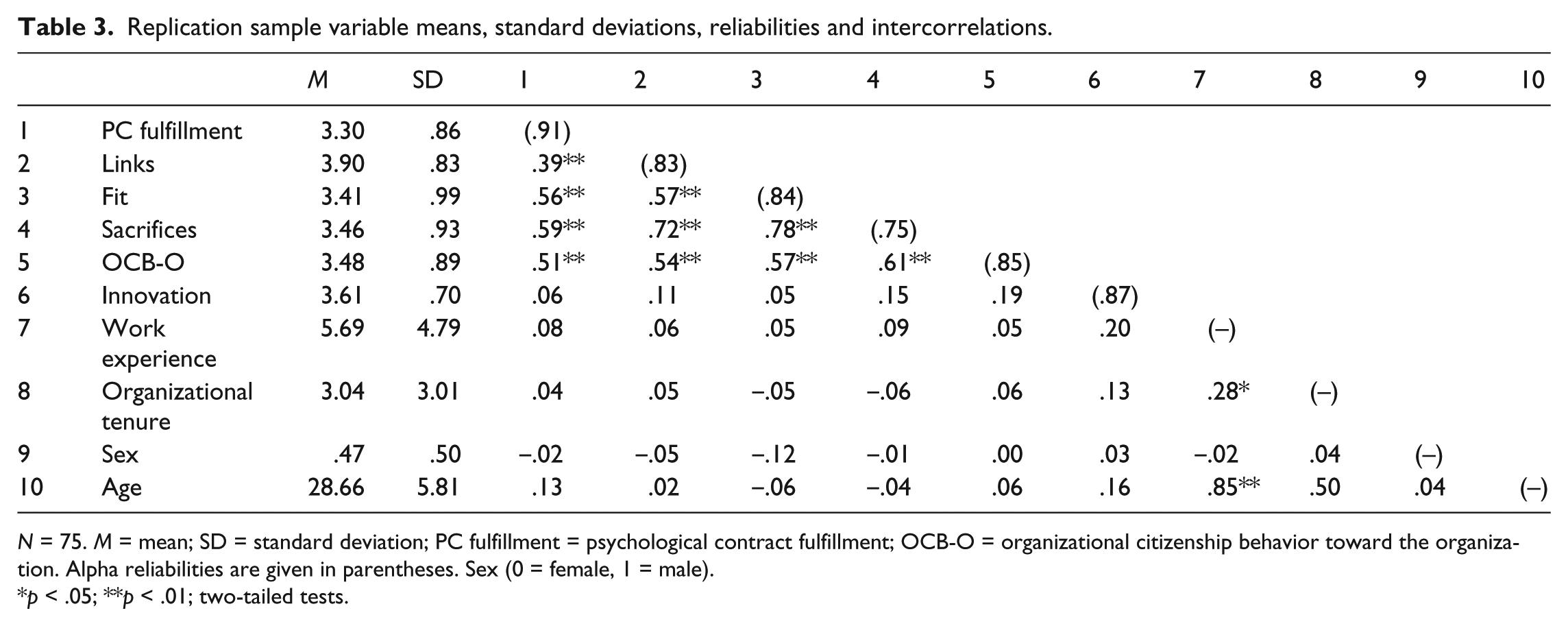
N = 75. M = mean; SD = standard deviation; PC fulfillment = psychological contract fulfillment; OCB-O = organizational citizenship behavior toward the organization. Alpha reliabilities are given in parentheses. Sex (0 = female, 1 = male).
p < .05; **p < .01; two-tailed tests.
Replication sample conditional indirect effects of psychological contract fulfilment on organizationally-directed citizenship behaviors and innovation through sacrifices.

N = 75. Mediator = Sacrifices; IE = indirect effect (unstandardized); SE = standard error; CI = confidence interval; OCB-O = organizational citizenship behaviors toward the organization.
Discussion
We drew from JE theory to provide a novel explanation for why and when PC fulfillment relates to positive employee behaviors. From the JE perspective, employees respond favorably to PC fulfillment because delivered inducements become sacrifices that motivate them to stay and perform. Sacrifice-embedded employees, in turn, display even better performance when they also possess strong workplace links and good organizational fit, as they supply resources that facilitate performance. Overall, the results largely supported these hypothesized relationships: in our main study, sacrifices transmitted the positive effects of PC fulfillment on OCB-Os and innovation, and these indirect effects were stronger for employees with stronger links and better fit. Using a different sample, we replicated our moderated-mediation findings for innovation but found only mediated effects on OCB-O with no evidence for moderation by links nor fit, thus qualifying some of the conclusions we can draw from the main study. We first discuss how our findings expand and enrich understanding of the factors relating PC fulfillment to positive employee behaviors. We then provide some possible explanations for the differences we observed between the two studies and their implications for PC and JE research.
Theoretical contributions
Our primary contribution is to the PC literature and, in particular, our theoretical understanding of PC fulfillment’s positive effects. Social exchange theory has been the preferred framework among PC scholars for explaining effects of both PC breach and fulfillment. Based on JE theory – which we view not as a competing, but rather complementary, framework – we offer a novel theoretical explanation for fulfillment’s positive effects based on the assumption that reactions to breach and fulfillment may be asymmetrical. That is, whereas breach may evoke the ‘hot’ reactions (i.e. violation) shown to precede destructive behaviors (e.g. Bordia et al., 2008), fulfillment may give rise to ‘cooler’ cognitive calculations concerning loss of transactional and/or relational PC benefits (i.e. sacrifices). In this way, the JE perspective differs from the social exchange perspective by suggesting that motivation to stay and perform (or cognitive assessment of what one might lose), rather than obligation to reciprocate, may underpin PC fulfillment’s positive effects. In particular, based on JE theory, we introduced perceived sacrifices as a mechanism linking PC fulfillment to employees’ extra-role behaviors. We argued that PC fulfillment is a source of sacrifices primarily because the types of benefits PC fulfillments deliver equate to the types of benefits that become sacrifices, according to JE theory. Sacrifices, in turn, encourage positive work behaviors because sacrifice-embedded employees want to stay employed and continue receiving benefits.
Our findings for the moderation by links and fit represent another contribution. From the assumption that embedding links and fit represent instrumental resources that facilitate performance (Kiazad et al., 2014, 2015), we argued that both would interact with sacrifices to strengthen PC fulfillment’s indirect effects on employees’ extra-role behaviors. This is presumably because sacrifice-embedded employees (who are reluctant to leave or jeopardize their position in the organization) are better able to perform OCBs or innovate when they have stronger links or better fit, as these embedding forces may enhance their capabilities to undertake these activities more effectively and efficiently. For example, better-fitting employees are trusted to undertake activities beyond prescribed role requirements, and fit is associated with greater support and knowledge of what organizations need and value (Erdogan and Bauer, 2005). Likewise, employees with stronger workplace links (i.e. to teams or committees) may be better enabled or supported to offer ideas to improve the organization or act to protect it (e.g. Janssen, 2005; Seibert et al., 2001). In support, we found that sacrifices mediate PC fulfillment’s positive effects on OCB-O and innovation more strongly when employees have stronger links or better fit in the organization.
We contribute to JE theory by separating the embeddedness dimensions to examine their unique and interactive effects. By and large, previous studies have treated embeddedness as an aggregate of links, fit and sacrifices (e.g. Zhang et al., 2012), assuming the three dimensions operate additively to influence outcomes. Yet, the results of our supplemental analysis imply compensatory (or substitution) effects by links and fit when interacting with sacrifices. Hence, a sacrifice-embedded employee with poor fit might nonetheless exhibit more extra-role activities if she has ample links, or vice versa. Indeed, Mitchell and Lee (2001) alluded to such compensatory effects in their original JE theorizing, but this had not been tested in embeddedness literature. Our finding that links and fit operate similarly to condition PC fulfillment’s indirect effects through sacrifices on OCB-O and innovation provides preliminary evidence for this ‘compensatory effect’ hypothesis. Concurrently, we highlight the distinctiveness of the different embedding forces by showing that certain combinations of embedding forces (i.e. high sacrifices coupled with low links or low fit) might not be beneficial in terms of facilitating high performance. This suits Hom et al.’s (2012) proximal withdrawal states theory, which argues that sacrifices can produce ‘slacker’ (or disengaged, low-performer) mindsets for employees lacking links or fit.
Limitations and future research
Some limitations of our study should be addressed. First, our study was cross-sectional, meaning we cannot draw causal inferences based on our findings. Although the directionality of the relationships we proposed (i.e. PC fulfillment → sacrifices → performance) is relatively clear, better job performance (Conway and Coyle-Shapiro, 2012) and perceived sacrifices could also predict subsequent PC fulfillment. All the same, a major theoretical purpose of our work was to provide an alternative explanation for the relationship of PC fulfillment to discretionary work behaviors. Whereas most theorizing about PC effects is built around social exchange theory, we used JE theory to situate sacrifices as the mediator between PC fulfillment and work behavior in an attempt to explain that the reason PC fulfillment relates to these behaviors is because it increases the feeling that leaving the organization would result in sacrifices. Though precedence in time may be helpful to this argument, the logic of mediation is that fulfillment would not be related to these behaviors if the person did not also perceive sacrifices. By and large, our empirical findings were consistent with this line of reasoning. To strengthen confidence in the validity of our theorizing and mediation logic, future research could explicitly test the ‘asymmetrical reactions to breach and fulfillment’ idea we advanced here. Still, future longitudinal research is needed to demonstrate the causal status of the relationships we found. The nature of our sample also raises questions about the generalizability of our findings. Specifically, our use of StudyResponse limited our control over sampling and data collection, as well as the amount of information we had about respondents and their reasons for participating. Despite this, we replicated our findings for the indirect effect of PC fulfillment on OCB-O, as well as the conditional indirect effects of PC fulfillment on innovation using a non-online sample from another country (Australia). This strengthens confidence in the generalizability of some of our findings (i.e. for Hypotheses 1a, 2b and 3b) from the StudyResponse sample.
Another limitation is that our empirical approach precludes examination of many boundary conditions of our findings. For instance, at the individual level, employees with a more boundaryless career mindset (Briscoe et al., 2006) or greater ‘movement’ capital (Trevor, 2001; i.e. higher qualifications or transferable skills) may perceive fewer sacrifices associated with PC fulfillment (or with leaving the organization), as presumably they are more willing to move or can secure equally or more prestigious PC deals or employment elsewhere. Furthermore, as we sampled employees from one society but different organizations, we cannot determine if our findings differ according to discrete societal or organizational features. For instance, in societies with strong institutional collectivism (House et al., 2004), sacrifices associated with movement might be high, regardless of the degree of PC fulfillment. In terms of organizational features, organizational culture or labor–management relations might matter. In our study, we found that stronger employee links to the team facilitated the translation of sacrifices into more organizationally-directed innovation and OCBs. This may be because, in the organizational contexts we studied, the team might have felt a strong sense of alignment with the goals and interests of management and the larger organization. However, where team members perceive an inherent conflict of interest with the organization, for example in organizational cultures characterized as ‘weak’ or in unionized settings with a history of labor–management conflict, stronger links to the team might not be associated with behavior that benefits or promotes the interests of management and the organization. Finally, macroeconomic conditions might also play a role. For example, weak or ‘downturn’ economies may strengthen PC fulfillment’s positive impact on sacrifices, as inducements become more valuable and employees less willing to leave, given fewer mobility opportunities (Feldman and Ng, 2007). In short, our findings should be interpreted in light of these and other contextual boundary conditions, which may be moderators worthy of examination in future research.
The replication study produced some results that were consistent with those of the primary sample. Although the simple (i.e. unconditional) indirect effect of PC fulfillment on innovation through sacrifices was not significant in the replication sample, the main effect is not particularly meaningful in the presence of moderation (it gives us the effect when the moderator is zero; Hayes, 2016). Examination of the conditional indirect effects shows that, in both samples, PC fulfillment was indirectly related to innovation through sacrifices only when either links or fit were high. On the other hand, the indirect effect of PC fulfillment on OCB-O, which was significant only when fit or links were high in the primary sample, was significant at both low and high levels of fit and links in the replication sample. That is, neither links nor fit enhanced the relation of sacrifices to OCB-O.
The fact that the indirect effect of PC fulfillment on innovation was lower, on average, in the replication sample may be attributable to methodological differences in the nature of the samples. The replication sample was relatively young (29 vs 37 years), less tenured (3 vs 7 years), and less experienced (average work experience = 6 vs 13.5 years) than the primary study participants. As innovation is a challenging–promotive behavior (Van Dyne et al., 1995), the relatively young and inexperienced employees in the replication sample may be less motivated by sacrifices to engage in this behavior, on average. Only in the presence of resources afforded by high levels of links or fit do sacrifices lead to innovation.
Failure to replicate moderating effects of fit and links on the relation of sacrifices to OCB-O may be owing to a number of statistical artifacts known to reduce the power to detect interaction effects in field studies (Aguinis and Stone-Romero, 1997). Indeed, our replication sample was relatively small, and thus may have resulted in a Type II error. One methodological difference that might account for the different result is the fact that we used matched supervisor–subordinate data in the primary study but same-source data in the replication study. Supervisors may be more likely to note a lack of OCBs toward the organization than the employee herself. Another methodological difference across studies was the operationalization of the OCB-O construct. Our operationalization of OCB-O in the primary study captured relatively active and challenging–promotive behaviors (e.g. ‘take action to protect the organization from potential problems’), whereas the measure used in the replication study captured more affiliative or cooperative behaviors (e.g. ‘tell outsiders that your organization is a good place to work’). It may be that the motivational force of sacrifices (desire to stay) alone is enough to motivate the affiliative OCBs measured in the replication study, but the motivational force of sacrifices must be enhanced with resources associated with links or fit to enable the active OCBs measured in the primary study. These population and measurement differences may provide avenues for future research.
Finally, we used the global PC fulfillment measure, instead of the facet-measure where respondents rate breach or fulfillment in relation to specific promises (Kickul, 2001), because our goal was to advance a novel theoretical explanation for how employees’ overall impressions of fulfillment relate to their work performance. A limitation of the global measure is that it fails to capture employees’ own obligations to the organization, as well as any specific promises made by the company. Thus, in our samples, we are unable to rule out the possibility that employees consider performance of OCB-Os and innovation as part of their own obligations, or if good co-worker relations (links) and good person–job/organization fit (fit) were also promises encompassed in their PCs. Also, the global measure of PC fulfillment disallows us to examine whether specific PC dimensions (i.e. transactional and relational) are more strongly related to perceived sacrifices, links, or fit. It would be fruitful for future research to explore differential associations between transactional vs relational PC fulfillment with the different embeddedness components. For example, fulfillment of more transactional obligations – having a narrower focus and involving the provision of mostly extrinsic rewards (Rousseau, 1990) – might induce sacrifices more strongly than relational PC fulfillments, whereas relational-type inducements (e.g. autonomy and flexibility, advancement opportunities) may better predict fit. Exploring such possibilities would enable a more nuanced integration of the PC and JE literatures, or further enrich understanding of the mechanisms and conditions accounting for PC fulfillment’s effects.
Implications for practice
Our findings suggest that delivered PC inducements encourage better performance by embedding employees via sacrifices. Thus, managers can encourage extra-role performance by fulfilling employees’ PCs, and existing literature provides plentiful recommendations to this end: (i) communicating realistic job information during recruitment (Zhao et al., 2007); (ii) soliciting employees’ views and expectations of the employment relationship during job socialization (Lester et al., 2007); (iii) sending clear and mutually reinforcing signals regarding commitments to employees (Dabos and Rousseau, 2004); and (iv) proactively seeking feedback from employees (e.g. during performance review, or regular discussions) to detect any perceived promises, PC changes or potential inducement–outcome discrepancies (Morrison and Robinson, 1997). Of course, owing to the idiosyncratic and subjective nature of PCs, or forces beyond an organization’s control, promises will sometimes go unfulfilled. In this case, organizations should reinforce norms that support apology, reparation and diffusion of appropriate and timely information on the intentionality and foreseeability of the unfulfilled obligations (Chaudhry et al., 2009).
At the same time, our results suggest organizations should supplement management of PCs with ‘high-performance work practices’ (Combs et al., 2006) to boost links and fit, and facilitate the translation of sacrifices into high performance. For example, organizations can expand links by use of mentoring programs (Seibert et al., 2017), incorporating autonomous team-based work systems, or encouraging cross-unit collaborations or greater organizational service contributions (e.g. participation in working parties, quality improvement groups; Combs et al., 2006). They can maximize fit by recruiting candidates whose values match those of the organization (Erdogan and Bauer, 2005), investing in training programs that enhance employees’ skills (Jiang et al., 2012), allowing greater decision-making authority (to satisfy competence and autonomy needs; Gardner et al., 2011), and ‘mold[ing] newcomers to fit their challenging work environment’ (Hom et al., 2009: 281) through extensive socialization practices.
Conclusion
The present research drew from JE theory to advance understanding of why and when PC fulfillment results in positive employee behaviors. From this perspective, fulfilled promises become sacrifices that motivate employees to stay and thus contribute to the organization (e.g. Hom et al., 2012). However, the extent to which PC fulfillment translates into extra-role contributions depends on the presence of other embedding resources: links or fit. In particular, sacrifices relay the effects of PC fulfillment onto extra-role performance more strongly when employees have stronger links or better fit in the organization.
Supplemental Material
hr-2017-0345-File005 – Supplemental material for More than grateful: How employee embeddedness explains the link between psychological contract fulfillment and employee extra-role behavior
Supplemental material, hr-2017-0345-File005 for More than grateful: How employee embeddedness explains the link between psychological contract fulfillment and employee extra-role behavior by Kohyar Kiazad, Maria L Kraimer and Scott E Seibert in Human Relations
Footnotes
Funding
This research received no specific grant from any funding agency in the public, commercial, or not-for-profit sectors.
Notes
References
Supplementary Material
Please find the following supplemental material available below.
For Open Access articles published under a Creative Commons License, all supplemental material carries the same license as the article it is associated with.
For non-Open Access articles published, all supplemental material carries a non-exclusive license, and permission requests for re-use of supplemental material or any part of supplemental material shall be sent directly to the copyright owner as specified in the copyright notice associated with the article.
