




Abstract
Socialization, the transition from newcomer to embedded organizational citizen, is an inevitable feature of organizational life. It is often a painful and traumatic experience, but why this is so, and how its difficulties can be ameliorated, is not well understood. This article addresses this issue by developing a new person-centred model of socialization. We introduce the concept of kin-work, i.e. the replication of one’s first experiences of becoming part of a family, to explain how ‘successful’ socialization is achieved. Drawing on the methodology of memory work and psychoanalytical theories of object relations, we illustrate how entry into new jobs involves the unconscious re-enactment in adult life of the infant’s initiation into the family. On entry as a stranger to a new organization, one’s sense of self is fractured; processes of kin-work knit the pieces back together and one develops a sense of personhood and being at home. However, there is a sting in this tale: the homely contains its uncanny, unhomely opposite, so socialization is always ambivalent – one can never be at home in this place that feels like home.
Introduction
The pain involved in starting a new job is a familiar part of working lives: one finds oneself a stranger in unfamiliar surroundings, not quite knowing what to do in territory that can feel hostile and amongst people who may seem to resent the alien intruder. Over time, if the transition from organizational newcomer to embedded insider is successful, if one becomes ‘successfully socialized’, the trauma recedes. Given that this process will be familiar to many people reading this article, it is perhaps surprising that little is known about how to ameliorate this ordeal. This is despite the fact that a large body of literature focusing on this issue – organizational socialization – asserts the need to find ways of better managing this transition. Researchers argue this can be done through reducing ‘induction crisis’ turnover resulting from the difficulties of navigating this process, thus ensuring that new recruits become proficient workers as quickly as possible (Lewis et al., 2012). Its political focus is on limiting the impact of staff turnover on profits, rather than on ameliorating the distress of being a newcomer. This positivist ontological position understands the self as a pre-given, fully-formed individual perceiving the world through the lens of its specific ‘personality’ – a person who is peculiarly devoid of feelings. There is therefore little understanding of the emotions experienced during the ‘induction crisis’ and how they may influence the transition from stranger to insider. This article adopts an interpretivist, subjective, person-centred approach with the aim of creating a more holistic understanding of this aspect of organizational life. It explores subjective experience, providing ‘thick’ descriptions (Geertz, 1973) of the passage from outsider to insider, with the aim of developing a better understanding of what is for many an emotionally difficult transition.
That is the task of the study we report on here. Its theoretical location is the object relations school of psychoanalytical theory that promises intensive insights into how and why starting a new role can be so difficult. Its empirical data arise from the first author’s experiences as an ethnographer entering a new field, and its methodology uses the principles and methods of memory work (Haug, 2000, 2008; Kuhn, 1995). This analysis suggests a more profound internal process is at play during socialization than is accounted for by extant theorization. We offer a new model of organizational socialization as a psychic process of ‘kin-work’, or making kin. That is, in moving from ‘stranger’ to ‘colleague’ one unconsciously repeats processes of becoming-famil(y)iar that were learned in very early childhood. However, a twist in the data, comprehensible through Freud’s (1919) concept of the unheimlich or uncanny, suggests a certain ambivalence about organizational socialization: one may begin to feel at home in a place where one can never be fully and securely at home.
Socialization: An organizational concept and practice
‘Socialization’, so familiar a part of discourse in management and organization studies (MOS) that it is often undefined (see, for example, Gonzalez and Pérez-Floriano, 2015), has been understood since Van Maanen and Schein’s (1977) foundational article to describe the passage of organizational newcomers from ‘outsider’ to ‘insider’. That article had a profound impact across the social sciences, influencing the development of large bodies of work on socialization in education, health, childhood and the criminal justice system, amongst others. The degree of interest can be seen in there having been 6776 articles on the topic published across the social sciences since 1971, one-third since 2010. In MOS, half as many articles have been published between 2010 and 2018 (136) as in the preceding 39 years (268). These publications tend to be concerned largely with profit-maximization (through reducing costs incurred through staff turnover), and utilize quantitative or model-building methodologies, suggesting that there is space for an alternative mode of studying this phenomenon.
In what follows, we focus solely on organizational socialization, so our analysis is discipline-specific: researchers in other social sciences may have very different bodies of research on which to draw. Attempts in MOS to understand what socialization is remain influenced by Van Maanen and Schein (1977)’s description of it as consisting of a series of stages that must be successfully traversed if newcomers are to transition successfully to insider. The stages are anticipation (before joining the organization), accommodation (entering then learning the job) and adaptation (full membership). Much research since then has focused on embellishing this model. To pick one example, De Vos et al. (2003) identified very similar stages: before-entry (conscious and unconscious anticipation of what is to come), encounter (active sensemaking/revision of earlier expectations) and acquisition (6–12 months after entry, establishment of a stable cognitive schema). (See also, for example, discussions in Adkins, 1995; Haski-Leventhal and Bargal, 2008; Scott and Myers, 2010). The last stage is often defined as one of achievement of ‘embeddedness’ or becoming ‘enmeshed meaningfully in the organization’ (Holtom et al., 2013: 1340), through accumulation over time of social resources such as information (Fang et al., 2011). Socialization into corrupt organizations similarly requires transition through stages: newcomers become co-opted by rewards and incremental introduction to increasingly immoral acts (Anand et al., 2005; Gonzalez and Pérez-Floriano, 2015).
An implicit model underpins much of this contemporary research: change is achieved through offering appropriate stimuli; the manager’s task is to identify relevant inducements. These can be non-material, such as value congruence (in which newcomers are encouraged to conform with organizational values) and person–job fit (Battilana and Dorado, 2010; Carr et al., 2006; Kraimer, 1996). If successful, there is ‘a redefinition of the self and of others in a way which denies the differences among us – which defines us as being essentially the same and having the same motives and the same centre’ (Schwartz, 1987: 330).
Many organizational researchers argue that socialization involves cognitive learning processes, and advocate that managers develop tactics, including structured, formalized learning programmes, to embed employees (Allan, 2006; Cooper-Thomas and Anderson, 2002, 2005; Klein and Weaver, 2000; Mammeyer-Mueller and Wanberg, 2003; Saks and Ashforth, 1997). The importance of management-led initiatives is contested by authors who argue that employee-initiated tactics are more successful. These may include the development of worker–supervisor relationships (Bauer and Green, 1998; Kim et al., 2005), and the formation of friendships, or discussions, interactions and socializing with co-workers (Morrison, 2002; Ostroff and Kozlowski, 1992; Tippmann et al., 2013). Sometimes, however, socialization may be oriented towards the profession rather than the organization (Raz and Fadlon, 2005).
In contrast with other disciplines, studies of organizational socialization are dominated by quantitative research methods. Those using qualitative methods challenge this dominant, psychological approach. Korte and Lin (2013: 422), for example, show that newcomers’ experiences ‘indicated a complex entanglement of social structures, relationships, and shared understanding of the appropriate ways of working that were difficult to separate’, in which ‘emphasis on camaraderie, solidarity, and a sense of belonging was striking’. Thus, ‘newcomers are socialized into the work group – not into the organization’ (Korte and Lin, 2013: 423). Similarly, the focus in many studies on cognitive learning is challenged by arguments that socialization is an emotional, long-term, iterative, unpredictable and non-linear process (Haski-Leventhal and Bargal, 2008) that may favour extraverted, socially confident people (Wanberg and Kammeyer-Mueller, 2000), and may be personalized and thus vary from person to person. There may indeed be different types of socialization: Bearce and Bondanella (2007) distinguish between a shallow process of simply learning to play by the rules and an in-depth taking on of new social selves. In their analysis of conflict at Disneyland, Smith and Eisenberg (1987) highlight how the metaphor of a different context and its characteristics (i.e. that of family) was projected onto another structured experience (i.e. that of working at Disneyland). Over time, such structural metaphors assist employees in infusing their organizational experiences with meaning and achieve a sense of cohesiveness that also allows for a range of individual interpretations.
In summary, an agenda concerned with organization-led, profit-oriented outcomes dominates research into socialization. Understanding is limited by a narrow framing that tends to presuppose what socialization is, that is a series of stages that must be successfully traversed. Defining it by outcomes, notably the production of effective, satisfied, motivated and fully participating insiders (Allan, 2006; Carr et al., 2006; Feldman and Cooper-Thomas, 2005; Taormina, 2004), further inhibits comprehension. Importantly, although it has long been recognized that entry to a new job or role is often experienced as disorienting, disillusioning and accompanied by reality shock (Louis, 1980; Van Maanen and Schein, 1997), there is little exploration of why such pain is experienced nor how to ameliorate it. Studies that use qualitative approaches challenge the dominant perspective of the socializing organizational subject as someone who is a cognitive, information-processing, rational actor who has a ‘personality’ and can learn or fail to learn how to ‘fit in’. The insights from those studies point towards the value of using methodologies designed to provide insights into the subjective experience of becoming an ‘insider’. Insufficiently utilized, such approaches are needed for better insight into the subjective experience of socialization and, importantly, why it can be so distressing. This is the rationale for the study we report on here. It aims to develop new understanding of organizational socialization through seeking answers to the question: what is the subjective experience of socialization? This should give insights into our second aim, which is to understand why socialization is a traumatic experience for many organizational newcomers. Its objectives are, firstly, to apply psychoanalytical theory as a lens for understanding the socializing organizational subject in all her complexity, and secondly to develop a methodology that allows insight into the deeply subjective experiences of starting a new role as a stranger and slowly, although not always certainly, coming to recognize the self as belonging within the group. Through this, the need for ways of ameliorating the trauma of socialization may be developed.
Theoretical location
Psychoanalysis argues that much of human motivation and action is unconsciously driven. It foregrounds unconscious processes in the formation of the self, highlighting the centrality of early experiences on the development of adult mental states (Bateman and Holmes, 1995: 17) and acknowledging the inseparability of this inner mental life and lived experience (Bollas, 2009: 84). Painful and dangerous ideas are consigned to the unconscious through repression and other defensive methods (Antonacopoulou and Gabriel, 2001). Where conscious and credible explanations may be given for a deed or thought, psychoanalysis examines the possibility that unconscious factors are at play. It is thus a highly appropriate theoretical location for an intensive exploration of the subjective experience of socialization.
We locate our study within the object relations school of psychoanalytic thought, drawing on a range of approaches influenced by Donald Woods Winnicott (Winnicott, 1962, 1965, 1988). Our abductive movement between data analysis and theories (see below) led us to his synthesis of the intersubjective and intrapsychic views of the subject and his model of infant development – facilitated by a ‘good enough’ carer – that resonated with our exploration of the unconscious, emotional needs of the subject entering into a new role. Winnicott (1965, 1988) describes how the infant in its first months of life is an unintegrated state – a lack of wholeness with no awareness (Winnicott, 1988: 116). If all is well, out of the unintegrated state come brief periods of integration until, gradually, integration stabilizes and the ‘whole self’ emerges (Winnicott, 1988: 117): the psyche and body having joined and become intimately related, the traversal from unintegrated to integrated state is achieved. Key to the navigation of this process from unintegration to a sense of self is a holding environment and a person or collective of persons (the ‘good enough’ caretaker) that facilitates self-integration. However, integration is tentative and there is always the potential, even throughout adulthood, for disintegration and the return to that psychic state of absolute dependence (Bollas, 1992; Winnicott, 1965). Disintegration, the painful undoing of what has been gained, defends against the unthinkable, archaic anxiety arising from failures of carer holding in the earliest stages of life (Winnicott, 1965: 61). As such, unfamiliar and difficult experiences can trigger a return to this state throughout life (Bollas, 1992; Winnicott, 1965).
Starting a new job involves being ripped out of one’s familiar circumstance into unfamiliar locations where one is a stranger who does not know how to find her way around. Such anxiety-generating experiences can trigger a partial and transformative regression to one’s earliest childhood – one unconsciously re-experiences those early unthinkable and archaic anxieties arising from an absence of carer holding (Bollas, 1992: 241–242; Winnicott, 1962: 61). Repair involves an evocation of unconscious memories of how one survived that foundational isolation through being comforted and held. These provide ‘instructions’ for constructing similar conditions in the traumatic present (Bollas, 1992: 242). That is, the adult seeks to repeat their earliest experiences of developing primary relations, finding ‘generative asylums’ (Bollas, 1992: 246) in family, workplace or social life that recreate that early sense of being held.
Our use of Winnicott is supplemented and extended, firstly, through Christopher Bollas’s extensive work on object relations (Bollas, 1992, 1995, 2009). ‘Objects’ include not only non-sentient entities but also people, and immaterial entities such as sounds, smells, touch. Bollas’s approach is of a self that inhabits a world of objects, many of which have the potential to put it through intense forms of self-experience. Specific objects, once discovered, allow articulation of a sense of who we are. That is, the character of an object has an evocative processual potential (Bollas, 2009: 79) to put us through complex inner experiences, often linked to objects encountered in early childhood that preserve that self-state. When encountered later in life, something of the early self-state stored in that object can arise (Bollas, 1992: 21). These ‘mnemic’ objects may remind us consciously of childhood, such as when we smell the same perfume our mothers wore, but they may also propel us unconsciously into reliving childhood experiences. If so, then unconscious use of mnemic objects (Bollas, 1992) is key to identifying how socialization proceeds, as our findings demonstrate.
We draw, secondly, on the works of feminist object relations theorist Jessica Benjamin. Benjamin (1988, 1995, 1998) emphasizes the importance of intersubjective experiences: a sense of self is dependent upon mutual recognition between self and others. By ‘recognition’ is meant acknowledgement by another of one’s acts, feelings, intentions, existence and independence. Recognition is ‘reflexive: it includes not only the other’s confirming response, but also how we find ourselves in that response’ (Benjamin, 1988: 21). It must be mutual: ‘we have a need to recognize the other as a separate person who is like us yet distinct’ (Benjamin, 1988: 23). Mutual recognition between caretaker and infant as, eventually, I and not-I, inaugurates the subject. It begins from the moment the mother holds her new-born infant and gives it its first feed. Benjamin was inspired by research that challenged the view that babies are passive and showed that the youngest of infants is involved in active exchanges with its caretakers. Caretakers recognize the infant as a separate and distinct ‘I’, facilitating the infant’s recognition of itself as, indeed, a self. ‘We recognize ourselves in the other, and we may even recognize ourselves in inanimate things’ (Benjamin, 1988: 21). That initial inauguration, this recognition of and by another, must continue throughout life if one is to sustain a sense of selfhood. Without it, the self is traumatized (Benjamin, 1988, 1995). When one starts a new job and is surrounded by strangers, recognition cannot be forthcoming because one is not known and does not know the others already in that space. Our data analysis (below) illuminates the pain of absence of recognition in a new job, surrounded by strangers.
In summary, this theoretical location regards the maintenance of a stable sense of self as not guaranteed: throughout life we can disintegrate, that is, be thrown back traumatically into our earliest, problematic experiences of absolute dependency. Entering a new workplace as a stranger may evoke that painful disintegration of the adult self, propelling it into an unconscious reliving of primal experiences of unintegration. Hard work to rebuild a coherent sense of self must follow, requiring a search for mnemic objects that will provide unconscious reminders of how to reintegrate the parts of the self. Before applying this theory to our empirical materials, we describe the methodology that enabled development of a subjective account of socialization.
Methodology
Our research aimed to study the subjective process of socialization through exploring the internal, affective experience of moving from newcomer to insider. This is methodologically difficult, given the problems of tracking and observing subjective immersion in new jobs over an extended period. We found inspiration in the work of leading anthropologist, Marilyn Strathern, who advocates returning to ethnographic studies to discover contents that could only later be brought to consciousness. Strathern regularly re-examines her earlier fieldwork for its intuitions of future inspirations (Strathern, 1999). As Holbraad and Pedersen (2017: 148–149) note, ‘It is almost as if Strathern thinks that the longer the gap between fieldwork and analysis the greater the chance that truly ethnographic insights can be reached’. Strathern’s challenge motivated us to revisit the first author’s extended ethnographic study of an English Premier League (EPL) football club that lasted from late 2003 to mid-2007. The club, at its peak, was regularly in the EPL’s top eight teams and qualified for one of the two European cup competitions. Its manager and sports science department were keen to pursue improvements in performance. We wondered if insights into socialization could be found in her account of the early stages of her fieldwork, from late-2003 to mid-2004, because ethnographers can become immersed in the organizations they study (Brannan, 2011). They often spend long hours with new ‘colleagues’, engaging in similar work, socializing with them at meal times and after work, and becoming members of that community. This immersion can result in academic identity fading, and thoughts of leaving academia to work for the organization being studied arising. Ethnographers can face difficulties in separating from the studied organization after fieldwork is completed (Gilmore and Kenny, 2015), suggesting that their experiences of ethnographic work involved achieving ‘successful socialization’ into the studied organization, and feeling they belong in the social fabric of the studied organization (Wolffram, 2013).
The methodology of memory work
A suitable methodology for taking up Strathern’s recommendation is the interpretivist methodology of memory work. We use two forms of memory work: Haug’s feminist approach (1999, 2000, 2008) and Kuhn’s (1995) pragmatic and democratic approach that emphasizes minimal resources and simple procedures.
Annette Kuhn’s (1995, 2010) method involves moving from reflective, interpretive engagement with one’s memories towards broader meaning through theorizing. This connects with the feminist approach of Frigga Haug and others (Haug, 1987, 2000, 2008), which appreciates links between ontology, epistemology, methodology, theory and method (see also Cunliffe, 2003, concerning these relationships). It focuses primarily on the process whereby individuals ‘construct themselves into existing social relations’ (Haug, 1987: 33) and how persons become selves (Haug, 1992). The underlying theory is of selves socially constructed through reflection – memories. Memories are studied in their own right and are not judged against the ‘real/true’ past event. In this way, meaning does not lie in the experience; rather, experiences become meaningful because of being grasped reflectively (Arnold, 1985, cited in Bain, 1995). Events are (re)composed as they are remembered. As the present changes, so do memories: emotionally-intense memories are those that cannot be forgotten – or those we cannot dare to remember (Fraser and Mitchell, 2015). Following Kuhn (2010) and Misztal (2003), we conceptualize memory as a process, activity, construct and personal act that has social as well as personal resonance.
The first ‘rule’ of memory work is to write at length and in detail about the memories. This free flow of ideas is akin to talk in therapeutic sessions, where through an uninterrupted stream-of-consciousness the unconscious starts to peek through. The first author started writing after revisiting her field diary and notes. She developed a generally logical although loosely structured account. Minor revisions, designed to ensure clarity, were made. These were the conscious intentions that informed the writing process. The unconscious had other motives, as we will see.
Data analysis
We drew an important distinction for the purposes of data analysis: the methodology of memory work required that we analyse not the original study but the memories of it. Data analysis was an iterative and recursive activity using abduction: alternating between theory, literature and empirical data, with each successive stage resulting in a reinterpretation of both theory and data; it is a ‘repeated process of alternating between (empirically-laden) theory and (theory-laden) empirical “facts”’ (Alvesson and Sköldberg, 2009: 5).
The writing and theorizing were similarly iterative and recursive, being carried out by both researchers because the second ‘rule’ of memory work is that the writing must be discussed with a skilled, trusted facilitator (the second author) who asks questions and intervenes if the dynamics of the analysis requires. Discussions involved extended email, face-to-face and Skype conversations. These brought together the unconscious as well as the conscious thoughts of two people, facilitating the emergence of the ‘unthought known’ (Bollas, 1987) – the emergence of the primary repressed unconscious that appears as a mood, the aesthetic of a dream or in the relation to the self as other. Within a psychologically contained setting, it becomes possible to think, at least in part, the unthought: something that has been ‘around’ in the unconscious but not yet given shape or conscious thought.
Data analysis stages
Data analysis, in which this ‘unthought’ emerged, had several, increasingly intense, stages, as follows.
Stage 1. Identifying recurring themes through immersion in the narrative (Miles and Huberman, 1994). Analysis required slowing the pace of analytical thinking and unpacking the incidental and the unnoticed elements of the fieldwork. This brought to the fore ordinary, everyday objects, in this case tables, that appeared repeatedly in the narratives (Gabb and Fink, 2015): these are material objects invested with emotional experiences.
Stage 2. Understanding the place of material objects in the memory work. For this our abductive approach led us to Bollas’s theories of objects. Bollas (1992: 3–4) highlights movements within ‘a field of pregnant objects’ that contribute to the dense psychic textures that constitute self-experience and transformation. The self finds its echo in particular objects selected consciously and unconsciously to portray and contain its subjective experiences and ‘private idiom’. Bollas argues that analysis is deepened by studying the effect of an object’s impact on the self and its different potential transformational effects. The evocative objects in the memory narratives were varieties of tables (meeting tables, work tables, dining tables) that organized the memories.
Stage 3. Dissecting the narratives. We firstly reformed the narratives into gatherings around the various remembered tables. This imposed order upon the account, allowing discernment of progression from stranger to organizational member. This took us, abductively, to Winnicott’s theory of the formation of the self and Benjamin’s positioning of recognition as central to this process. We then developed our psychoanalytical interpretation, leading to the realization that the first author had perhaps been unconsciously aware that in her ethnographic study she had been repeating motifs learned in her early childhood. That is, narratives of ‘family’, contained in what had initially appeared to be casual asides, came to prominence. This led us to explore literature on kinship.
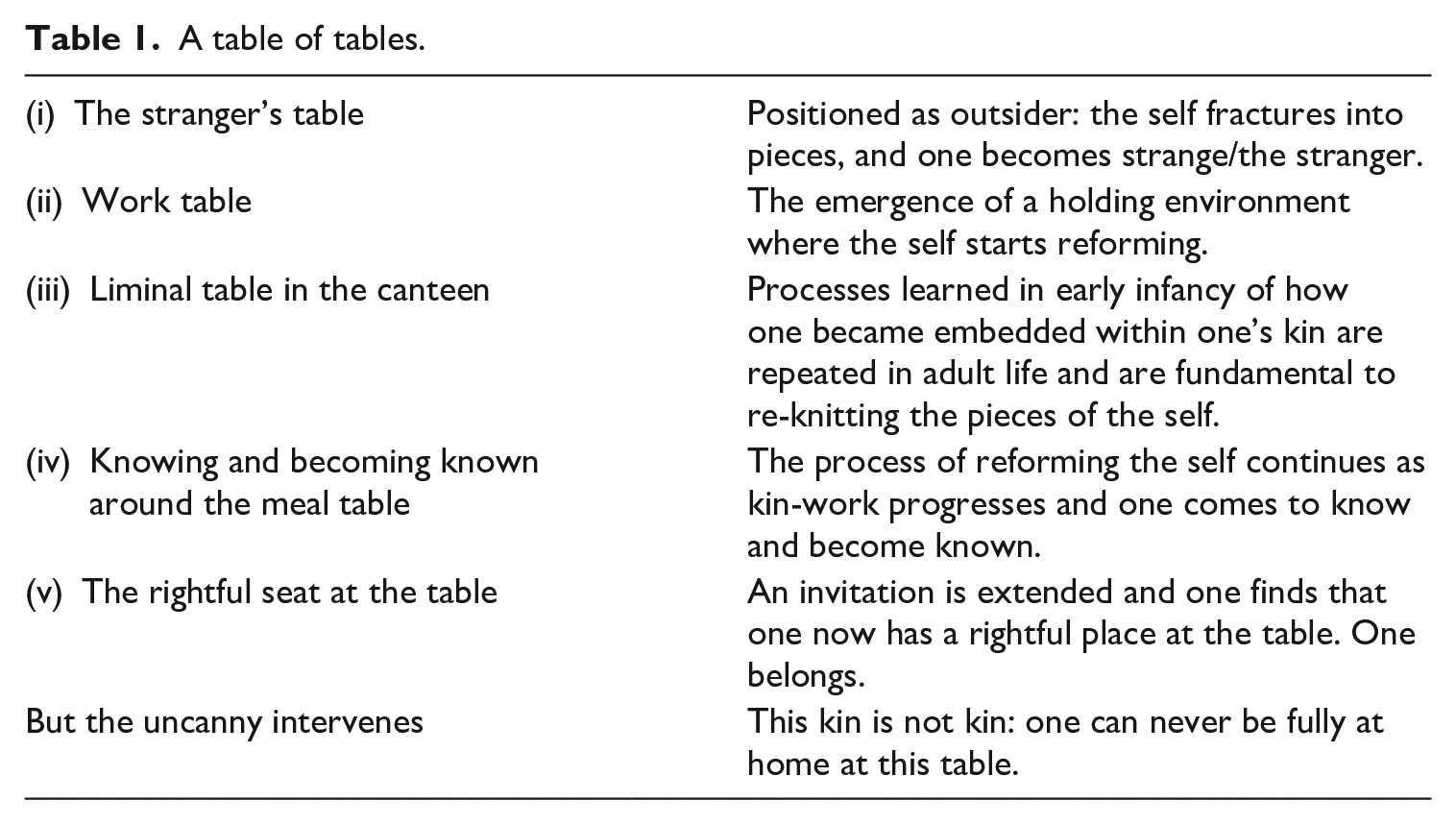
Stage 4. Theory development, involving rereading the narratives about tables and kinship and theories of socialization within and through each other. Like Van Maanen and Schein (1977), we seemed to identify stages in socialization, but the unconscious’s influence means transition through stages is not smooth but fractured and repetitive. The ‘data analysis’ section that follows is structured to show these stages. It is organized around the tables that are not only mnemic objects unique to the ethnographer, but prominent ‘developmental stages’ in her narrative of memories of moving from outsider to accepted insider. Table 1 provides a map of the analysis.
A table of tables.
Data analysis: Moving from outsider to insider via a series of tables
Table (i): Where the stranger sits
The first table remembered was one at which the first author was, literally, a stranger. It positioned her as outsider. Her seat here is tentative: The field work began at the training ground, where the Performance Coach and I joined an on-going staff meeting. The manager offered a warmly laid-back welcome and I shuffled over to a seat at the side of the table where I hoped I could work unobserved and effaced. I was clueless. Initially, my ethnographic work took the form of observing, but I had no idea as to what I should observe or focus on. I felt obtuse so tried to cover this by presenting my professional face, my solemn, unemotional, observing ‘mask’ as a signifier of a competent academic who was experienced and comfortable with this arrangement. So, one of my first challenges was learning how to do non-participant observation in an environment where everyone knew what they were doing and had a clearly defined job – and I didn’t. I took copious notes to mask this sense of not knowing and to look occupied and productive. My note-taking quickly became noticed and was the object of banter by the Assistant Manager, signalling to me that he at least was potentially uncomfortable with an outsider looking and making notes – with no possibility of him accessing what was being written. If I felt a loss of emotional comfort and control, it could be argued that he felt a loss of managerial control in an environment where he was a powerful figure. I was the outsider – an insertion, making the insiders nervous until they adjusted to my presence.
The sense of being a stranger is palpable. The stranger does not know how to behave in a new environment – there is a sense of falling apart, of (temporary) disintegration in the terms described by Winnicott (1965). She feels the need to maintain face, to look as if she knows what she is doing. She draws on a mode of behaviour she defines as ‘professional’. This attempt to conform with professional norms (Scott and Myers, 2005) allows the possibility of recognition/acceptance as ‘a professional’ by those in the room, but not knowing what was required she reverts to the modes she knows ‘work’ elsewhere. This stage is absent from Van Maanen and Schein (1977)’s model, but this unique look behind the facade the ethnographer attempted to maintain exposes the fractured self behind that facade (Tracy and Trethewey, 2005; Winnicott, 1965). That is, one is estranged from the self that one was in one’s old role: the competent, secure academic has disintegrated (De la Garza, 2004). She is foreign to a tightly-knit group where her status as outsider is marked on her body – she is an embodied, visibly sexed woman in a highly male environment (Turner and Norwood, 2013).
This unravelled, insecure self draws on aspects of her old role behaviour to don a mask of competence that echoes or pretends to that former identity. Note how the first author projects her feelings of disruption onto those around her, here the Assistant Manager. In imagining that her presence is alienating to those into whose company she has intruded, she positions herself as a stranger amongst strangers: she is not ‘known’ (Benjamin, 1988). She seeks ‘evidence’ to confirm her stranger-ness; the table at which she sits offers it. She does not walk but ‘shuffles’ to it, hoping to become invisible, a person without a face. She is undone: someone without a secure identity, without an established place, who feels she must remain on the margins, the stranger at the table. However, as we will see, the ethnographer’s memory work brings to conscious awareness, even though through a glass darkly, the unconscious process of reintegration starts and the ‘scattered islands of organized potentials . . . come into being’ (Bollas, 1992: 14–15).
Table (ii): Seeing and being seen
The narrative takes us to the next table at which the ethnographer sat: My work ‘desk’ was a round table in a large open plan office space shared by the performance coach, the chief scout, the Assistant Manager and First Team Coach. It was something of a thoroughfare as it had a door leading to the car park and the changing rooms so staff tended to pass by frequently. I was therefore simultaneously exposed and tucked away. But it gave me opportunities to account for the faces; put names to them; put jobs to them. All the women (apart from two Personal Assistants (PAs) worked in a big shared office at the reception. Where I sat was located behind a secure set of doors with a code. I was the only woman firmly located in a male space – one where you needed to know the code to enter: the PAs flit between offices/worlds with ease, status and freedom. I felt restricted and confined emotionally, physically and intellectually to this almost womb-like space. I noted that the rooms are always warm – in contrast to the winter weather outside and the perpetual rain. It reminded me of places where I did ballet as a child/teenager: balmy spaces to keep the muscles warm and supple.
Note here the finding of a place of safety in ‘a warm, womb-like space’ that, metaphorically, allows birth of a new self. The metaphor of the womb is contradicted by her description of this as a place where she sees and is seen. In memories redolent of Benjamin’s description of the first processes of recognition between caretaker and new-born infant, she starts to recognize others: rather than seeing masks onto which she can project her own fears, she sees identifiable people. At this second table, the process of integration begins, recognition processes start, and the islands of the self start knitting back together. It evokes memories not of the archaic world of early childhood but those of later childhood.
In other words, socialization requires finding a holding environment and people who repeat, without knowing it, the work of the ‘good enough’ caretaker so that the ‘scattered islands’ of the self can reintegrate. The importance in the first author’s narrative of the table as mnemic object, the object that evokes unconscious memories and provides guides to rebuilding the self, becomes clearer now. Tables are traditionally fundamental to the process of integration via the process of family life in industrialized countries (Strathern, 1992, 2005): it is generally around tables that kin gather for meals, children do homework, and at which babies old enough to sit in a high-chair learn how to put food in their own mouths. But although they are arguably inherent to the first, infantile, experiences of socialization, they will not necessarily form mnemic objects for everyone: mnemic objects are personal to the individual, so each person will find their own unique objects upon which are impressed psychic resonances of individual childhoods.
Table (iii): The liminal table
The unconscious work precipitated by the evocative object, the table, appears to prod the first author’s conscious mind into sowing the seeds of a theory that the second author’s detached analysis should detect and return to the first author for processing and further joint exploration: Meal times could be a difficult experience to negotiate. I enjoyed sitting in the canteen either on my own having a cup of tea or with one or two others who I felt comfortable with. Early in the field work it could be difficult because not all the sports scientists were forthcoming or comfortable with me. This dissipated and over time our interactions became warm and interesting. It is odd how one form of table setting can be resonant of home, family, childhood, belonging, nourishment, and warmth yet the other form typifies estrangement. Maybe because both are possible when the meal table stands for family and I can recall times when family meals felt estranged, sad, pressurised and small. The warmth of one simply acts to highlight the familial lack in the other.
This narrative collapses time frames as memories of family emerge while recalling a workplace table. This is the first overt reference to family in the ethnographer’s account. Tables in the western culture where the first author grew up are fundamental in many families to the organization of family life (Ahmed, 2006, 2008). As Ahmed (2006) notes, gatherings (around tables) are not neutral but directive; they require those gathered around them to follow specific lines of behaviour and engagement. One becomes alienated or out of line with an affective community when one does not experience the pleasure of the proximity that comes from gatherings around meal tables (Ahmed, 2008). From Bollas (1992)’s perspective, tables operate as mnemic objects for the first author because they store the self-state she experienced during family gatherings. If, as Ahmed argues, family tables give directions about how to gather around them, then from Bollas we know that those directions remain located in the psyche’s store of earliest experiences, not only unconsciously informing conscious actions in adulthood, but also returning the adult to the emotional state experienced in infancy. The first author, sitting at this work table, re-experienced the emotions of infancy that have been preserved via her association with her family’s tables and the storage of her self-state in meal tables (Bollas, 1992). Such emotions are, as Bollas argues (1992), sustained as recurring moods that may become available for later understanding. Each one of us will have our own mnemic objects that have the power to evoke our earlier self-states. It may be a sound, a smell, a colour or a material object that we unconsciously seek for their power to help reintegrate the shattered parts of the self.
This narrative’s different time frames illuminate how the first author starts to move out of the place as ‘the stranger’ through finding people with whom she can comfortably share a table. The importance of family has been evoked, a first indication of how (as we will argue) socialization involves a process of kin-work: reliving in one’s adult life the very earliest processes of finding security through becoming socialized into a family. The first author’s unconscious, peeking through when roused by memories of meal tables, suggests achievement of another move from outsider to insider from unconscious re-experience of how one first became a member of a kin-group.
Table (iv): Becoming positioned
The first author’s account next enhances understanding of the work of mnemic objects, here tables, and the function of kin-work in socialization. This narrative consciously explores the gathering of family around the table and unconsciously relives becoming famil(y)iar to the other: Meals were also the sites of ‘gaffes’. The first one came early in the research when, over lunch, the Head of Sports Science innocently asked if my parents ‘were still with us’. My response was a truthful one in that they were both dead and had been for some time. The silence around the table was deadly and I rushed in to explain that my parents had had me later in their lives and that they had both lived long lives so I had plenty of time with them; that their passing was something I saw as part of the warp and weft of life and death. The situation was rescued by the manager hooting and declaring that as a child of older parents, I was ‘the product of a good Saturday night’ as he was. The Head of Sports Science then asked if I had brothers and I could feel the sigh of relief when I confirmed that I had older sisters and an older brother – with the latter being a professor of chemistry at a prestigious UK university. Clearly, I had a man to look after me and a scientist, which connected me to them in ‘familial’, shared scientific ways.
We cannot know what the people gathered around that table were thinking, what was behind their questions (we have only the first author’s account), but our interpretation suggests that what is happening is a process of becoming known to others as they become known to the self, in ways described by Benjamin (1988). As Cheney (1983: 147) notes, successful socialization will allow the individual to ‘see’ his or her ‘reflection’ in the social mirror of the collective. Coherence between the parties develops and the interests of individual and organization start overlapping or coinciding more profoundly.
Our analysis highlights two important issues. The first refers to the questions concerning the ethnographer’s family. As Bollas notes (2009: 144–145), Freud’s concept of the ‘epistemophilic drive’, that he sometimes linked to the scopophilic drive or urge to look, explains how the constant asking of questions is an eruption into consciousness of internal unconscious processes experienced in infancy and carried forward into adult selves. For Bollas, the force of questioning resides in the pressure brought to bear on the mind to think unthought knowledge. In this specific incident, the first author’s memories provide an account of being positioned by a group that asks questions of her so that she becomes known – famil(y)iar – to them. The questions position her as someone who is not a stranger but a female member of a normative heterosexual family. Secondly, the ethnographer explores how she became known to those others in order that she might become one of them. That is, the theory condensed in her memories describes a process of getting to know others and becoming known/recognized by them. It is a theory concerning ‘insiders’ desire to better know the stranger in their midst, and achieving this through establishing the stranger’s position within western kin-groups. In demonstrating her similarity to them she becomes famil(y)arized.
The ‘sigh of relief’ is thus an unconscious projection by the first author. Able to state she is like them – the product of heterosexual intercourse, a sibling of siblings – her sigh signifies unconscious knowledge of coming to be known by those others whose recognition, as the discussion of the second table shows, one needs and desires if one is to reknit the scattered parts of the self. Psychoanalytically, this re-experiencing and processing of acts of getting to know others and becoming known by them is redolent of infant experiences through which the ‘pieces’ of the self are put together and one becomes an ‘I’. That is, as an adult, the processes of socialization involve reliving the earliest experiences of being a self-in-pieces and the emergence of the ‘I’, no longer in pieces, through the kin-work of coming to know others and becoming known by them. We now reach the final table, where the first author discovers she has a rightful place. She is fully socialized: not a stranger but kin.
Table (v): Having a rightful seat
There is an away day for all the coaching/playing staff and the sports scientists. A hotel some distance away so another early start. I made to sit away from the horseshoe table so that I could maintain my professional distance and observe. The Head of Sports Science had none of it and loudly stated, ‘you’re one of us now’ and motioned for me to join the table and to join in. This was a turning point and I felt as though I was moving from the remote outside to something that felt like the collective. I relaxed and started engaging in the activities the performance coach set us. In retrospect, this moment seems to be the time when the work worlds started to edge together and the institutions of research/researcher combined with being an institutional worker extending the institution of sports science. We were set a question to answer individually: what’s the top lesson you’ve learned this season? My answer was ‘trust’ which was at odds with my attempts to sense make and to be emotionally ‘level’, but also marked a turning point in terms of being able to trust myself and to trust them.
At this table, the move from outsider to insider is confirmed; the pieces of the self are re-knitted. This transition from tense onlooker to relaxed insider requires interactions between words (the injunction to join) and materialities (the body and the table) that invoke an eruption of ‘trust’ from the unconscious. We suggest all three are fundamental to kin-work and thus to socialization.
The phrase ‘you’re one of us now’ signifies the merging of the individual ‘you’ into a collective ‘us’. However, words are insufficient. If the first author had been left sitting at the periphery, then she would have remained in a liminal space of being with the group but not incorporated into it. The words would have lacked performative effect. It is the demand to sit at the table with everyone else that summons her from the identity of outsider to that of insider. Physical distance gives way to proximity, and to the finding of a holding environment (Winnicott, 1965) through one’s place at the table. We have discussed the table as the first author’s mnemic object: this final table evokes unconscious knowledge of how she earned a rightful place at the family table from the age at which she could sit at it. As the first author moved to take the proffered place at this particular table, her adult body re-enacted the child’s first climb onto a chair similar to those sat upon by her older kin. This is confirmed in the ways in which the first author recalled how her body changed as she moved from external observer to active insider. This engagement cements her relationship as kin.
The transition from onlooker to relaxed participant is speedy: immersed in shared activities, the word ‘trust’ bubbles up. Trust is something that is necessary for the developing ego. Trust, Bollas (1995: 186) writes, is ‘so elemental that it precedes reflective consideration, almost a thoughtless assumption, derived from parental care of a child’. Entry to a new job disintegrates the self; but finding a trustworthy holding environment amongst people one knows and trusts, and by whom one is now known, helps the self to assemble itself anew.
The uncanny twist
But something else emerged from the memory work: the intrusion of the uncanny. After the fieldwork’s end, the first author maintained her relationship with the club, making repeated visits as a consultant and attending key matches. She remembered: The family motif was important to the manager – himself a family man . . . On a cold night in mid-December, I rang a colleague who had introduced me to the club to find out how the game against Manchester City had gone. I was at my nephew’s wedding reception in Edinburgh: cold, not sufficiently drunk and bored. My colleague had been at the stadium for the match which ‘we’ narrowly lost. The manager had asked where I was and had been informed that I was at a family wedding. ‘She should be here’, he responded indignantly, ‘she’s our family now.’
The first author clearly remembers how that statement jolted her, its emotional resonance plummeting her back into her workplace kin-group while with her biological family. A form of doubling seemed to be taking place, involving being a member of two kin-networks simultaneously and thrusting the first author into a liminal state. This doubling is redolent of the uncanny (Freud, 1919): an eerie and disturbing feeling of uncertainty, a point of doubt, that causes a momentary reassessment of our relation to the world and its supposedly natural order (Hook, 2005).
The intrusion of workplace kin into space and time shared with biological kin evokes feelings in the first author of herself as doubled – a sibling/aunt/cousin in two different kin-groups. A feeling of unease emerges when the familiar (i.e. her sense of family – the ‘homely’ in Freud’s terms) has suddenly become strange and unfamiliar (‘unhomely’) – in a setting celebrating family in very familiar, traditional ways. At whose table should she sit, at which one does she belong, which of these two kin-identities is she? Deep within the psyche, the uncanny evokes the terror of not having an identity, of not being a self (Rahimi, 2013: 466). It evokes anxiety because the subject experiences its self as two selves, one of which is out of place. This sense of doubling (there are two people here occupying the same identity when there should be only one, or there are two identities and only one ‘me’ that can occupy them) threatens the integrity of one’s sense of wholeness and belonging (Copjec, 1994: 134) because which one is ‘me’?
The uncanny’s capacity to unsettle is closely related not only to unconscious experience but also to connections to spaces and places, to everyday sites like dining areas and meal tables (Beyes and Steyaert, 2013). The uncanny thereby ‘unsites’ via the affective and spatial doublings witnessed here, and in so doing it destabilizes the self. We have shown how slowly and painfully that sense of self is re-established during organizational socialization, but the intrusion of the uncanny suggests how tentative is that laboriously constructed identity. That is, one works hard to trust that one is at home in a place where one can never be at home. One is simultaneously kin and not-kin, paying for one’s presence rather than being there of right.
Discussion: Socialization as kin-work
It has long been recognized that socialization into organizations is often a painful experience that fails when newly recruited staff do not make it through the process. Studies of socialization in MOS leave unanswered the question of why the process can be so traumatic. We have suggested that the reasons for this gap in knowledge arise from studies that have largely been cast from a particular paradigm. We bring an alternative grounding that expands how we explore the intensely subjective account of becoming socialized. We used the methodology of memory work to explore an ethnographer’s penetrating account of her experience of moving from stranger to insider. We located our analysis in psychoanalytic theories of object relations. These guided our description of how the self fragments on entry into a new job and is slowly rebuilt through what we call ‘kin-work’, that is, the unconscious re-enactment in adult life of the infant’s first initiation into its family and thus into a sense of self.
It remains to emulate psychoanalytical theorists’ methodology of building on the insights from a particular case to develop a theory or model that explains general experience. As Mitchell (2013: 16) advises, the ‘various individual histories are ‘accidental’ in the sense of what happens to fall to one’s lot. Where these varied and specific histories touch down on the general, we have the raw material of what can come to constitute [a theory or model]’. The first author’s account has given us that ‘raw material’ that ‘touches down on the general’, that is a model of socialization as kin-work. Here, kinship is ‘not a form of being but a form of doing’ (Butler, 1997: 58), and kin-work is achieved through that ‘doing’. What emerges through that performative ‘doing’ is a ‘sustaining web of relations [that] makes our lives [and thus selves] possible’ (Butler, 1997: 24). We now move from the specific example of the first author’s experience to develop a more general model of socialization as kin-work. We follow Van Maanen and Schein (1977)’s division of the process into stages, albeit that the stages we describe are very different.
Stage 1: Disintegration of the self
Our analysis shows that newcomers can experience a fragmentation of the self. This may be hidden behind a facade and be undetectable to others, but behind that facade the carefully maintained semblance of a confident adult unconsciously disintegrates and is consciously experienced as traumatic. The newcomer may place herself at the periphery of work groups, occupying a place of the stranger akin to that of very early infancy when she was a newcomer to the circle she eventually comes to recognize as her family. To recall, Winnicott (1988) describes how the infant in its first months of life has no sense of self: it is an unintegrated state. Gradually, over time, integration stabilizes and the ‘I’ emerges, but it is always tentative, and disintegration can (re)occur in adulthood. A new job provides the stimuli that induce disintegration. Not knowing quite what one should do and how everything works causes anxiety that cannot be contained without others’ help, but the only helpers available are strangers; the self crumbles. The newcomer may anxiously assess the situation from the periphery, seeking the comfort offered by a table or other object that offers some form of reassurance. This ‘violent rupture of the self, [this] profound experience of fragmentation and chaos’ (Benjamin, 1988: 61) entails intense psychic pain.
Stage 2: Searching for mnemic objects
Disintegration is followed by gradual integration. In Winnicott’s terms, there is an iterative process that can last into deep old age in which the self can be splintered and returned to self-awareness, from disintegration to integration and personalization (Winnicott, 1962). The ‘directions’ for how to do this are buried deep within the unconscious, where reside archaic memories of how one has done this before, during the foundational experiences of first achieving integration. In Bollas (1992)’s terms, this involves a search for mnemic objects (Bollas, 1992) in which are contained what can best be described as ‘guidelines’ for rebuilding the self. Mnemic objects are those that are unconsciously associated with early experiences and conserved over time. When we use that object, something of that stored self-state will arise (Bollas, 1992: 21), reminding us of how to assemble a coherent sense of self.
For the ethnographer, tables, recurring in different forms throughout her memory work, served as her mnemic objects. Each of us will have our own mnemic objects, although we will consciously know neither what they are nor their significance. We unconsciously seek them out, or we simply encounter them, not knowing that we are doing so. When found, they work upon us, reigniting something of that preserved experience. They stimulate the unconscious work of re-knitting the parts of the self via their association with family. They take us to the next stage of socialization, where kin-work begins.
Stage 3: Kin-work
The mnemic object – through its association with our earliest caretakers and associated experiences of belonging to a family – facilitates a growing sense of belonging in this place, with these people. It guides us in identifying others as kin, that ‘sustaining web of relations’ (Butler, 1997: 24). A sense of self is dependent upon mutual recognition between self and other subjects if one is to become a stable self (Benjamin, 1988, 1995, 1998). By ‘recognition’ is meant acknowledgement by another of one’s acts, feelings, intentions, existence and independence. It must be mutual: ‘we have a need to recognize the other as a separate person who is like us yet distinct’ (Benjamin, 1988: 23). Mutual recognition between caretaker and infant as, eventually, I and not-I, inaugurates the subject. This inauguration, this recognition of and by another, must continue throughout life if one is to sustain a sense of selfhood. Without it, the self is traumatized.
When one starts a new job and is surrounded by strangers, recognition cannot be forthcoming because one is not known and does not know the others already in that space. But mnemic objects facilitate our unconscious use of primary experiences to become known and to know others. We start to get to know our new colleagues, finding some with whom we feel comfortable, repeating, in the conditions of adulthood, the childhood experience of becoming a member of a family, of coming to know one’s kin and becoming known by them.
Each of us will have our own, unique experiences of primary recognition. The adult striving for reintegration and recognition will seek to put together conditions whereby that early experience can be relived in the present. This is why we describe socialization as ‘kin-work’, because it is a reliving and working through the process whereby one’s kin, in recognising us as individuals and as kin, were fundamental to the constitution of a self. We seek similar recognition from new colleagues who do not exactly imitate but rework that first experience. We come to see and be seen by them; we get to know their names and what sort of persons they are, and they get to know us too. Erstwhile strangers become colleagues and friends who do the work of kin. We become socialized.
Stage 4: At home but never at home
There is no truly smooth transition from stranger to dweller: the psyche is not so predictable. For example, the newcomer can evoke in the group she joins that archaic rage of an older sibling displaced by a new baby (Mitchell, 2013), and for some, becoming part of a family might be only partially achieved or not at all. Similarly, the uncanny intervenes, showing that we can never be fully at home in organizations. Our sojourn in them may provide a sense of being settled and happy, but that place is always tentative, always threatened by change, always requiring on-going kin-work. Disruptive, disturbing emotions may battle in the unconscious alongside the more quiescent or sociable ones and may threaten to erupt into conscious behaviours (Benjamin, 1988, 1995). One must trust people without whom one cannot fully exist, but at the same time be anxious about trusting them. Any sense of homeliness is inherently precarious: one cannot return to infant merger with the carer, although that secure space is always desired and sought. Socialization requires that we seek it, but in looking for it in the places that employ us we look in the wrong place. Our new kin-group may be torn apart by managerial whims: mergers, acquisitions, restructurings, redundancies – the numerous vicissitudes of organizational life impress themselves within the unconscious alongside conscious knowledge and expectations (Smith and Eisenberg, 1987). We may thus lose what we have so painfully put together in the process of becoming socialized through kin-work.
Conclusion
This article contributes a new, psychoanalytically-informed, model of socialization. This model echoes the linear progression of discrete stages that has dominated socialization theory since Van Maanen and Schein’s (1977) foundational paper, but these are only echoes. Rather than discrete stages that are smoothly transited, our psychoanalytic model posits a complex, iterative process in which the present is imbricated with the past, as former infant–child states and experiences are unconsciously re-experienced and recreated in the present via kin-work. Rather than ‘fit-and-adapt’, as theory traditionally assumes, we have explored socialization as a much more ambivalent process where the move from ‘stranger’ to ‘dweller’ is never completed, for one can never be fully at home in the organization. Where extant organizational theory implies the newcomer is a cog that can be manipulated towards achieving organizational ends, our model describes how new employees navigate a process that echoes early infant experiences – transitioning through a process of strangeness that causes immense emotional discomfort.
Our second contribution is the methodology we developed. This draws on other disciplines for inspiration to combine memory work with ethnography. Our excursion outside MOS led us into fields where exciting possibilities of doing qualitative research differently are being discussed and developed. Stewart’s influential Ordinary Affects (2007) is changing approaches to anthropology in one’s own place; posthuman and new materialities theories are incorporating non-sentient actors into the fieldwork, displacing the centrality of human actors. These novel methodological approaches may offer new and insightful understanding of organizations and the people who work in them, perspectives that seem more important than ever in an era of substantial change. Anticipating the ‘future of work’, understanding human/technological interactions, plotting how political environments influence working environments, become open to original forms of researching and interpretation. They also allow challenge to, or reinterpretation of, classical dilemmas in MOS, not only socialization but other issues such as ethics, strategy, marketing, and so on. These new methodologies are not limited to specific theoretical perspectives, and lend themselves to possibilities of making new interpretations of other theories, old and new, of organizations and perhaps substantive changes in practices.
In this specific example, our rereading of socialization could and should lead to practices to ameliorate the trauma of socialization. We are not saying it can be eliminated – that would deny the reality of being a human subject – but the insights this study gives into the emotional turmoil of socialization, and how it can be reduced through actions to absorb newcomers into meaningful caretaking groups, could reduce the pain and hasten the process. Amelioration rather than elimination is not a rousing political slogan, but it is a fitting statement with which to close this article.
Footnotes
Acknowledgements
We would like to thank our Associate Editor, Tim Kuhn and the three reviewers for their supportive and insightful comments. Given that the latter elements of the process occurred during a global pandemic, we are additionally grateful.
Funding
The authors received no financial support for the research, authorship and/or publication of this article.
