




Abstract
How do older employees maintain trust and demonstrate value in age-diverse teams where seniority does not confer authority? In flat-structured teams where members hold similar titles, younger employees may question why older colleagues have not advanced, creating status incongruence and lowering trust in their ability. Drawing on status characteristics theory, we argue that older employees’ relational age (i.e. the average age difference from their younger peers) can be negatively associated with co-worker trust and task performance. We further propose that older employees’ voice behavior mitigates the negative effects of relational age. In Study 1, using a round-robin survey design with 199 employees across 56 Taiwanese teams, we find that voice moderates the negative relationship between relational age and co-worker trust, as well as the indirect effect on supervisor-rated performance. In Study 2, a vignette experiment with 177 Australian participants, relational age reduced trust via lower perceived competence (but not warmth), and this effect was eliminated when the older worker displayed voice. Our research shows how age-based status beliefs can be challenged in professional teams, contributing to scholarship on workplace stereotyping, intragroup status hierarchies, and proactive strategies in age-diverse teams, while offering practical guidance for sustaining older employees’ careers.
Keywords
Increasing the economic participation of older workers has been the focus of successive governments in developed economies (Caines et al., 2020), and older workers have been identified as critical to addressing labor and skills shortages to ensure organizational sustainability (Edgell et al., 2020; Henkens, 2022). Particularly in professional work teams where employees are expected to work interdependently and make joint decisions, older team members who hold significant different life interests, education backgrounds, and social networks, enhance group decision-making effectiveness by offering a variety of resources and rich work-related information (Janahi et al., 2023). As such, it is essential for organizations to effectively integrate and manage age-diverse teams to ensure all team members, in particular older members, are able to collectively perform at a high level.
Ideally, an older team member would be valued as an experienced professional with firm-specific skills developed over her/his career. However, research suggests that older employees often face negative stereotypes, portraying them as less trainable, less adaptive, and less competent than younger coworkers (Krings et al., 2011). These stereotypes imply that chronological age equates to inefficiency, making older employees less trusted. As people get older, they are increasingly categorized as lower in competence (Cuddy and Fiske, 2002). While older employees may be seen as warm and approachable, age-related stereotypes can still undermine their credibility, particularly in task-oriented environments where competence is prioritized (Krings et al., 2011). These biases are further reinforced in workplaces with greater age diversity, as simply observing relative age differences can amplify perceptions of incompetence (Sammarra et al., 2021). For instance, a 50-year-old in a team of mostly 25- to 35-year-olds is distinctly perceived as an older colleague, whereas in a team of 40- to 55-year-olds, they are unlikely to be noticed as an older colleague. As multigenerational teams become more common (Caines et al., 2020), negative age stereotypes can seriously affect older employees working in age-diverse groups. In Australia, for instance, employees are considered “mature age” at 45 (Australian Bureau of Statistics, 2004), yet they are expected to work another 22 years before retirement (i.e. 67 years old). If they gradually lose trust from their relatively younger colleagues, they will disengage from work due to their perceived threat from age stereotypes (Kulik et al., 2016), which becomes an unfortunate loss of talent for both their team and the organization.
Negative age stereotypes toward relatively older employees are particularly prevalent in modern professional work teams. These teams handle complex, time-bounded projects requiring members to contribute complementary expertise and work interdependently to meet the customers’ needs (Chiocchio and Essiembre, 2009), and thus members’ competence becomes the primary criterion for evaluating contributions. More importantly, these teams are typically non-hierarchical, with members holding equivalent job titles (e.g. “engineers” or “consultants”). According to status characteristics theory (Wagner and Berger, 1993), individuals often assume that people’s age confers authority and competence (Hidma et al., 2020), but these assumptions are challenged in the flat team structures. When employees’ age misaligns with indicators of career progression, perceptions of status incongruence emerge, leading to negative evaluations from others (Kunze and Menges, 2017). Colleagues may question why an older team member has not progressed to a higher hierarchical position, diminishing their trust in her/his competence. Additionally, because these teams operate under high-pressure conditions requiring continuous learning and problem-solving, members may place greater performance expectations on older colleagues. If these expectations are not met, perceptions of status incongruence may intensify, further eroding their received trust from others.
In this study, we investigate the age–trust relationship by asking: In professional work teams, how can relatively older members counteract negative age stereotypes to retain co-worker trust? Status characteristics theory (Wagner and Berger, 1993) further suggests that perceivers form impressions based on both diffuse status characteristics (e.g. stable traits like age) and specific status characteristics (e.g. demonstrated work capabilities). Perceivers typically rely on diffuse characteristics for competence-related judgments (heuristic-based processing) unless there are sufficient cues signaling specific competence (controlled processing; Kulik and Bainbridge, 2006). Accordingly, we propose that older team members’ voice behavior, defined as promotive actions aimed at improving work environments (Van Dyne and LePine, 1998), serves as a signal of their specific status characteristic that helps mitigate negative age stereotypes. When an older employee frequently voices constructive suggestions, the co-workers gain direct insights into her/his task capabilities, reducing reliance on age-based assumptions. Conversely, if the older employee seldom speaks up, the younger colleagues will have limited access to behavioral cues and default to diffuse characteristics (e.g. age) when forming competence expectations, potentially undermining trust. As a result, younger peers may perceive sharing important work-relevant information with the older employee as too risky (Fulmer and Gelfand, 2012). This limited informational access can hinder the older team member’s ability to fulfill their assigned task role, leading to poor performance evaluations (Costa et al., 2017). Our theoretical model is illustrated in Figure 1.
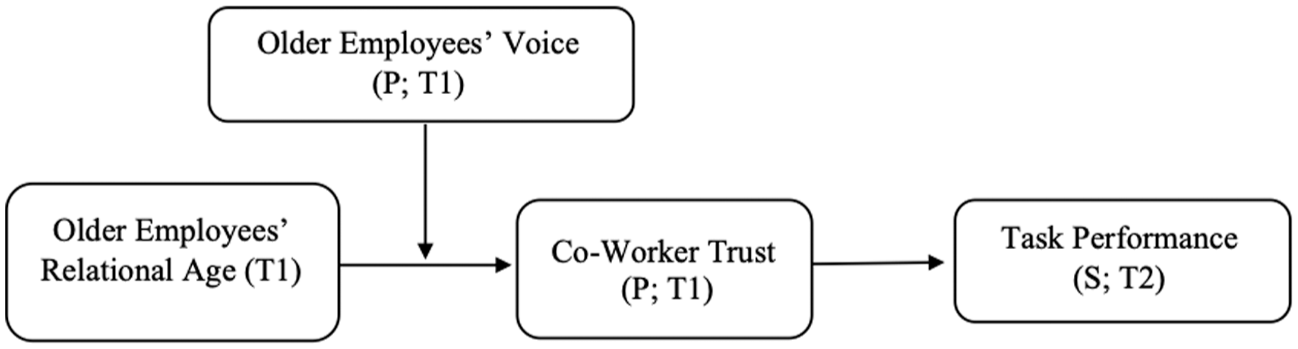
Hypothesized model.
We tested our model and hypotheses through two complementary studies. In Study 1, we examined 199 members from 56 project-based professional teams in Taiwan. Using a relational demographics approach (Kunze and Menges, 2017; Tsui and O’Reilly, 1989), we treat employees’ age as a relational attribute (i.e. the difference between an individual’s age and the average age of their teammates) because such relational differences can shape individuals’ standing and experiences in the group (Chattopadhyay, 1999; Guillaume et al., 2014; Tsui et al., 1992), and analyzed its association with co-worker trust and task performance. To further validate our findings, a supporting Study 2 tested an alternative explanation based on the Stereotype Content Model (Cuddy and Fiske, 2002), which suggests that older individuals could be perceived to as high in warmth elevating their received trust from others. We thus investigated perceived warmth and competence as parallel mechanisms linking relational age to co-worker trust. This study included 177 Australian working adults recruited via Prolific and allowed us to compare how relational age influenced perceived competence and warmth, and subsequently, co-worker trust.
We expect our research to contribute to the literature on age-diverse teams and inform strategies for supporting older employees’ sustainable careers. First, we extend status characteristics theory (Wagner and Berger, 1993) by incorporating relational demography perspectives (Kunze and Menges, 2017; Tsui and O’Reilly, 1989) to theorize how negative age stereotypes, activated by age-based status expectations, can be mitigated through individually enacted behaviors such as voice. Second, while prior team diversity research has primarily focused on how age dispersion affects team-level outcomes (Janahi et al., 2023; Shemla and Wegge, 2019; Van Knippenberg et al., 2011), we complement this work by adopting a relational approach that provides individual-level insights into how older employees navigate age-diversity dynamics. Third, we advance research on stereotype-based disadvantage and mature-aged employee engagement (Kulik et al., 2016) by identifying proactive strategies (e.g. voice behavior) that help older individuals manage and mitigate lower ascribed status, supporting longer and more meaningful participation in the workforce. Finally, our findings offer important implications for older professionals seeking to sustain their careers, as well as for managers aiming to lead inclusive and age-diverse professional teams more effectively.
Theoretical background
Age stereotypes: The social cognition perspective
When discussing the formation of stereotypes in organizations, previous studies commonly rely on the social cognition processes as the explanatory mechanism (Kulik and Bainbridge, 2006). Social cognition theorists suggest that in order to process the encountered information more efficiently, individuals tend to intuitively use their cognitive structures to help them make sense of their contexts. A stereotype represents an established cognitive structure that offers information cues for people to form generalized expectations of members of a particular group, even though these expectations could be seriously inaccurate (Fiske and Taylor, 1991). For instance, when we know a colleague is from Germany, we may automatically assume that this person prefers to strictly obey rules and is quite self-disciplined. These stereotypes are formed based on previous personal experience or existing social norms, and people rely on these stereotypes to make judgments of group members. Unlike other types of cognitive structures such as “schemas” or “prototypes” that simply represent general information categories, stereotypes usually involve general value judgments influencing perceivers’ subsequent attitudes and behaviors toward the target (Kulik and Bainbridge, 2006). In organizations, age stereotypes are one of the most common stereotypes guiding important decision-making outcomes, such as performance appraisals (Finkelstein et al., 1995; Sammarra et al., 2021). Older employees are usually rated as inflexible, unteachable, and incompetent by their younger peers (Krings et al., 2011).
Age stereotypes differ from other demographic stereotypes because they typically result from an interpersonal comparison process. For instance, gender stereotypes, such as the “Think Manager, Think Male” phenomenon, exist primarily due to societal gender norms, and their formation is generally unaffected by the gender of the rater (Ryan et al., 2011). In contrast, the salience of age stereotypes is often reinforced by age-based comparisons between individuals and their peers (Kulik et al., 2016). When an older employee works alongside significantly younger colleagues—such as a 45-year-old engineer collaborating with team members in their 20s—age stereotypes are more likely to be activated. Age differences serve as a salient informational cue for younger coworkers, prompting social comparisons and reinforcing stereotypes as part of social cognition processes. Accordingly, employees’ relational age—defined as an individual’s age relative to others in the workplace (Tsui et al., 1992)—should be recognized as a critical factor that amplifies negative age stereotypes within organizations (Kunze and Menges, 2017; Sammarra et al., 2021). In highly interdependent work environments, such as professional teams, age differences among members can significantly influence social comparisons, shape workplace interactions, and contribute to favoritism toward certain colleagues (Yang and Martz-Costa, 2018).
This raises important questions about the social cognition process underlying age stereotypes: What specific social comparison mechanisms lead individuals to develop negative evaluations of their relatively older colleagues? Furthermore, what strategies can prevent or mitigate the formation of these negative age stereotypes, allowing older employees to gain trust among their coworkers? To address these questions, we draw on status characteristics theory (Wagner and Berger, 1993) and propose that negative age stereotypes can be counterbalanced when relatively older team members demonstrate a high level of voice behavior—proactively expressing ideas, concerns, and suggestions to contribute to team effectiveness.
Status characteristics theory
Status characteristics theory (Wagner and Berger, 1993) suggests that individuals evaluate their peers based on socially recognized status characteristics, such as gender or age, to develop expectations about their work capabilities. These evaluations create performance expectations that systematically advantage individuals with higher-status traits, granting them greater influence, participation, and authority in group interactions, while disadvantaging those with lower-status traits, regardless of their actual abilities. In this context, age serves as a key indicator of social status within a group, shaping perceptions of hierarchical position and competence expectations. There is status congruence when the older members of a team hold the highest hierarchical positions and are seen as having the most expertise (Kunze and Menges, 2017). However, if “age fails to concur with other status indicators,” (e.g. hierarchical position) then the status becomes incongruent” (Kunze and Menges, 2017: 463) potentially encouraging negative reactions from other team members (Lawrence, 2004).
Age-related stereotypes are socially shared, such that older individuals are often perceived as less competent or less adaptable (Fiske et al., 2002). These negative stereotypes are further amplified in professional work teams primarily due to the perceived status incongruence of these older colleagues. As discussed earlier, individuals often assume that age and experience are linked to authority and competence (Hidma et al., 2020). However, in professional teams with relatively flat structures (i.e. where members hold similar job titles like engineer or consultant), these assumptions may be challenged. Younger colleagues will question why an older team member with the same title has not advanced to a higher-ranking role, potentially undermining their perceived competence. Additionally, professional teams often operate under high-pressure conditions that demand continuous learning and adaptability, leading members to place heightened performance expectations on older colleagues. Taken together, while societal stereotypes provide the content of age-based expectations, it is the context of professional teams that makes these expectations psychologically salient and behaviorally consequential. The team context thus becomes the crucible in which these beliefs are enacted, reinforced, or challenged, and where the relative status of older workers is continually negotiated.
Furthermore, the status characteristics theory also suggests that status characteristics fall into two primary categories (Kulik and Bainbridge, 2006). Diffuse status characteristics are stable demographic factors such as age. Observers often rely on heuristic-based processing—a quick but potentially inaccurate approach—when assessing others based on these characteristics, such as using age as a heuristic to infer competence. In contrast, specific status characteristics refer to task-related abilities and competencies. When evaluating others based on these characteristics, observers are more likely to engage in controlled processing, a slower but more deliberate approach. Status characteristics theory further suggests that the choice between these processing paths largely depends on the availability of information about specific status characteristics. When such information is lacking, individuals tend to rely on heuristic-based processing, using diffuse status characteristics to form judgments, often leading to stereotyping. However, when specific status cues—such as behaviors that clearly signal competence—are present, observers are more likely to engage in controlled processing (Kulik and Bainbridge, 2006). For example, when individuals actively contribute constructive suggestions to their teams, this tangible, ability-relevant information can guide controlled processing, reducing reliance on heuristics and mitigating stereotype formation. Taking together, we anticipate that the negative impact of older employees’ relational age could be mitigated if they frequently engage in activities to signal their specific status characteristics.
Hypotheses
Older employees’ relational age, co-workers’ trust, and task performance
Interpersonal trust in work teams is defined as a “psychological state comprising willingness to accept vulnerability based on positive expectations of a specific other or others” (Fulmer and Gelfand, 2012: 1174). Accordingly, we define co-worker trust as the trustor’s (i.e. younger co-workers in our study) behavioral intention to accept a trustee (their older colleague) based on positive expectations of their actions. 1 This conceptualization aligns with prior research on co-worker trust in team settings that employs a social network approach (Chung and Jackson, 2011; Lau and Liden, 2008) and is particularly relevant to our study’s focus on older employees’ relational age, received co-worker trust, and their task performance in team contexts.
In their review of interpersonal trust in work teams, Costa et al. (2017) concluded that interpersonal trust (i.e. co-worker trust) is a crucial mediating mechanism linking observable characteristics of the trustee to their work outcomes. As they point out, individuals rely on unique social characteristics (e.g. relational age or behavioral signals of competence) to assess whether they should trust their peers. Gaining sufficient co-worker trust is essential for individuals’ performance, as it facilitates meaningful interpersonal exchanges among team members. When trusted by their colleagues, employees are more likely to receive timely and critical work-related information that helps them complete their tasks more effectively. This advantage is particularly important in professional work teams (e.g. Research and development (R&D) teams), where occupying a central position in instrumental networks enhances individual work performance due to the highly interdependent nature of tasks (Ahuja et al., 2003). Furthermore, the positive emotions associated with being trusted motivate individuals to exert greater effort and remain committed to team goals (Chung and Jackson, 2011). Thus, co-worker trust reflects not only perceptions of competence but also influences broader relational dynamics that shape collaboration and performance.
We argue that relatively older team members are less likely to be trusted by younger colleagues when their age as a diffuse status characteristic does not align with their actual hierarchical positions. Organizational age norms (Lawrence, 1996, 1997, 2004) make age a salient status marker at work by prescribing when people are expected to enter, progress through, and exit particular roles. As a result, being relatively older than one’s teammates can be experienced as norm-violating and status-disadvantaging in some team contexts (Kunze and Menges, 2017). As discussed earlier, perceived status incongruence may lead younger employees to question their older colleagues’ work capabilities, as their expectations of expertise differ. Importantly, the magnitude of this relational age difference can further intensify such incongruence. As Kunze and Menges (2017) argue, people often use age as an implicit benchmark for expected career progress, assuming that those of similar age should hold comparable positions (Lawrence, 1988). When younger employees encounter significantly older colleagues in equivalent roles, the perceived violation of these career norms becomes more salient as the age gap widens, consistent with evidence that larger deviations from expected benchmarks amplify contrast-based evaluations (Eibach et al., 2003). The heightened salience can intensify the perception of status differences among younger employees and lead to more negative evaluations of their older colleagues.
When an older employee’s competence and expertise are seriously questioned, younger colleagues are less likely to seek assistance from her/him (Rodin and Langer, 1980) and involve them in fewer or less complex tasks (Joshi and Knight, 2015), eroding their trust toward their older colleague. Even when these negative evaluations originate from only a subset of younger peers, they are still impactful in shaping the social status ascribed to the focal individual. Research shows that negative information has disproportionate weight in judgment formation (Baumeister et al., 2001; Labianca and Brass, 2006), and that status within teams must be legitimized through perceived consensus (van Dijk and van Engen, 2013). Thus, shared beliefs in the older member’s (low) competence can reinforce co-workers’ negative responses to the older worker, even when his/her actual capability may be high (Magee and Galinsky, 2008).
Consequently, lacking co-worker trust can lead the older employees to doubt their own abilities, reducing their confidence in fulfilling team roles (cf. Parker et al., 2006) and ultimately harming their task performance. Moreover, when younger peers are reluctant to engage with older colleagues on critical team tasks, these older employees may become marginalized in team communication and collaboration. Instead of occupying a core position in the intra-group network, they may be pushed to the periphery, limiting their access to essential task information and resources. Without these informational and social resources, completing key team tasks becomes increasingly difficult, ultimately impairing their performance (Borgatti, 2005). Thus,
The moderation role of voice behavior
While an older employee’s age serves as a diffuse status characteristic that shapes colleagues’ judgments, we argue that their expressed voice behavior functions as a specific status characteristic, signaling task-related capabilities and prompting controlled processing. Voice behavior is defined as “promotive behavior that emphasizes expression of constructive challenge intended to improve rather than merely criticize” (Van Dyne and LePine, 1998). Thus, voice behavior can help mitigate the impact of negative age stereotypes (i.e. heuristic-based processing) on received co-worker trust and task performance. As a form of proactive and extra-role behavior, voice has distinct characteristics, as it is inherently relational and directly observable by team members (see Morrison, 2011). Voice is relational because it requires active participation and engagement with others, as individuals must verbalize task-relevant solutions, engage in discussions, and even challenge their peers (Morrison, 2011). Additionally, voice behavior involves explicit communication of ideas, concerns, or suggestions (Van Dyne and LePine, 1998), making the employee who uses voice highly visible in a team context and providing a platform to demonstrate specific status characteristics. These features distinguish voice behavior from other proactive behaviors, such as task crafting, which can be performed independently without direct interaction, making it less relational or visible to team members.
When older workers frequently voice their opinions to improve team tasks, they provide specific cues that challenge their colleagues’ stereotype-based attributions (van Dijk et al., 2017). Younger co-workers may interpret this voice behavior as a signal of their coworker’s “ability to make valuable contributions to a group’s tasks” (Magee and Galinsky, 2008: 360). These revised evaluations of competence can enhance younger colleagues’ respect for their older counterparts, increasing opportunities for older employees to contribute meaningfully to team tasks (Magee and Galinsky, 2008). When younger co-workers observe older team members developing plans and making work-related recommendations, they are more likely to perceive them as competent (i.e. engaging in controlled processing) and consequently trust them with workgroup responsibilities. Previous studies also report that demographically dissimilar members (e.g. older colleagues) often adopt visible task-related behaviors to offset potential disadvantages generated by their demographic characteristics (Guillaume et al., 2014; Li et al., 2022). Furthermore, voice behavior often entails social risk, as it challenges the status quo or introduces new ideas to the group (Burris, 2012). Taking such risks aligns with expectations typically placed on individuals with higher social status, thereby helping to mitigate the status incongruence experienced by older employees in teams. Since higher-status individuals are generally trusted more readily (Lount and Pettit, 2012), frequently engaging in voice behavior should reduce status incongruence associated with age differences and enhance co-worker trust.
Conversely, if older members choose to remain quiet at work, the absence of task-specific information will force their co-workers to rely on diffuse characteristics—here, the relational age of their colleague—and make judgments based on negative age stereotypes. Low engagement in voice behavior will thus exaggerate the impact of age stereotypes on receiving co-worker trust, eventually hurting older workers’ task performance in the team, as previously argued. Therefore,
Study 1
Sample and procedure
Our participants were from professional work teams in seven small consulting firms, one large technology company, and one large private university in Taiwan. The main responsibilities of the teams from the consulting firms were to assist their clients in managing public relations (PR). The teams from the technology company were in charge of R&D activities for different product lines. Lastly, participants from the large university were in administrative groups that helped faculty and students host large events such as conferences or job fairs. 2 Based on Chiocchio and Essiembre’s (2009) definition of professional project-based teams, these teams exhibited several distinguishing characteristics. First, they were established to execute complex, time-sensitive projects designed to meet the needs of specific end-users, whether internal or external customers. Successful project completion required team members to work interdependently to satisfy these end-user requirements. Second, team members were selected based on their specialized and complementary expertise, with competence serving as the primary criterion for both selection and contribution. Third, these teams tended to be relatively non-hierarchical, as members generally held equivalent job titles (e.g. “engineers” or “consultants”), reducing status distinctions based solely on title. Lastly, each team reported to a single manager or supervisor who oversaw task progress but did not participate in daily team activities. Thus, apart from the manager, no formal hierarchy existed among team members.
After receiving approval from the top management of these organizations, we mailed the first survey (Time 1) to team members using a round-robin design to capture the assessments of their peers’ voice behavior and co-worker trust. We also collected their demographic information at this stage. About 5 months later (Time 2), right after these organizations completed their annual performance reviews, the managers received the second survey to provide their evaluations of each member’s performance for the year. For the purpose of ensuring equivalence in meaning (Tsui et al., 2007), the first author translated the survey items from English to Chinese first and consulted with a native English-speaking organizational behavior researcher. Subsequently, an independent, bilingual researcher with a PhD in English Literature helped to back-translate from Chinese to English. Finally, the first author discussed the back translation with the independent bilingual researcher and made necessary adjustments.
Managers and members from a total of 89 teams participated in the study. We received completed matched responses from 56 managers (63%) and 199 team members. A series of t-tests revealed that there were no differences in gender, age, or firm tenure between those who completed and did not complete the surveys. About 53% of the participants were females with a mean age of 33.68 (Standard deviation (SD) = 8.15), ranging from 22 to 65 years old. 93% of these participants held a bachelor’s degree or above. Teams in the final sample had an average size of 4.67, ranging from 3 to 9 people. Among these teams, 32% were PR teams, 34% were R&D teams, and another 34% were administrative teams. These teams had an average age of 33.60 (SD = 6.47), and the average team tenure was 5.25 years.
Measures
Older employees’ relational age (Time 1)
We applied the relational demography approach (Tsui and O’Reilly, 1989) to conceptualize older employees’ relational age. Following this framework, we adopted a stepwise procedure to operationalize the construct, as proposed by Kunze and Menges (2017), who utilized a similar conceptualization of relational age. First, within each team, we calculated age difference scores by subtracting each peer’s age from the focal employee’s age. A positive value indicated that the focal employee was older than their colleague. We then averaged these positive values to derive a single relational age score for each individual. Negative age difference scores, which indicated that the focal employee was younger than their peers, were excluded from this calculation but were used as a control variable (see details below). Additionally, we examined whether participants systematically differed in their relational age when they were older than their peers. The intraclass correlation coefficient (ICC) values from a one-way ANOVA (F = 5.59, p < 0.001; ICC1 = 0.32, ICC2 = 0.67) indicated significant between-individual differences in participants’ relational age scores.
Voice (Time 1)
As previously stated, we adopted a round-robin design to capture employees’ voice by asking participants to rate each of their teammates. Prior research has recommended the use of single-item measures to minimize potential respondent fatigue, and the empirical support for the validity and effectiveness of single-item scales has also been reported in multiple studies (Matthews et al., 2022; Steffens et al., 2024). Additionally, the literature offers several practical guidelines for their use. First, the construct should be unidimensional with a clearly defined conceptualization (Matthews et al., 2022). Second, the item should be derived from a well-established and validated multi-item scale (Fisher et al., 2016). Finally, the associated reliability and validity evidence should be reported transparently (Aguinis et al., 2021).
Following these recommendations to measure voice, we selected the item with the highest factor loading from Van Dyne and LePine’s (1998) voice behavior scale, one of the most widely used measures of voice behavior, underscoring its maturity and relevance. The selected item was: “Please rate to what extent this person develops and makes recommendations concerning issues that affect this work team,” rated on a 5-point scale (1 = not at all; 5= to a great extent). This item explicitly captures promotive voice, aligning closely with our study’s conceptualization and theoretical framework. The data also demonstrated satisfactory interrater reliability and agreement (median rwg = 0.83, ICC1 = 0.29, ICC2 = 0.54).
Co-worker trust (Time 1)
We adopted a social network approach to conceptualize and operationalize co-worker trust using an item from Lau and Liden (2008). The selected item was: “To what extent do you talk to this person about confidential work-related matters?” rated on a 5-point scale (1 = not at all; 5 = to a great extent). Consistent with Lau and Liden (2008), we used in-degree normalized centrality to capture co-worker trust, an approach that aligns with prior research on trust in team settings (Chung and Jackson, 2011; Lau and Liden, 2008). The single-item measure we employed has been widely used in social network research and demonstrated strong interrater agreement (median rwg = 0.83) and acceptable reliability (ICC1 = 0.33; ICC2 = 0.59), supporting its validity in our study context.
Task performance (Time 2)
We used the four-item scale of Howell and Hall-Merenda (1999) to measure task performance based on a 5-point scale (1 = Way below your expectation; 5 = greatly exceed your expectation). The team managers were asked to rate each of their team members using the following items for capturing their (1) accomplishment of quantitative objectives (e.g. financial performance or customer satisfaction), (2) accomplishment of qualitative goals (e.g. customer service or learning effectiveness), (3) personal effectiveness (e.g. managing changes or identifying business opportunities, and (4) the overall performance. The Cronbach alpha = 0.93.
Control variables
We controlled for employees’ gender, team tenure, and education level due to their theoretical relevance to trust and performance evaluations. Gender was included because prior research suggests that women are generally perceived to engage more in communal and relational behaviors, which can influence how they are evaluated in terms of interpersonal trust (Bevelander and Page, 2011; Eagly and Karau, 2002). Team tenure served as a proxy for familiarity with task routines and teammates; longer tenure may offer more opportunities to build competence-based trust and shape performance assessments (Harrison et al., 2002). Finally, education level reflects both human capital and perceived competence—core antecedents of trust judgments and performance evaluations in cognitively demanding team-based work settings (Fiske et al., 2007).
We also controlled for several team characteristic variables following the recommendation of previous relational demography literature. We controlled for team age dispersion (measured as the standard deviation of group members’ ages) to distinguish the effects of individual relational demography from team-level age heterogeneity. This ensures that the observed relationships between an older employee’s relational age, co-worker trust, and task performance are not a byproduct of the baseline team-level age dispersion, but rather stem from their relative difference from peers (Tsui et al., 1992). Additionally, following Kunze and Menges’ (2017) recommendations for analyzing relational age, we included several supplementary control variables. First, to account for the effects of relational age when the focal employee was younger, we controlled for the average age difference scores in cases where participants were younger than their peers. To facilitate interpretation, we transformed all negative values into positive ones before aggregating them (Kunze and Menges, 2017). Second, we controlled for the percentage of dyadic relationships per person in which participants were older than their peers. This adjustment allowed us to isolate the effect of relational age differences while accounting for the number of relationships in which participants were older than their peers (Kunze and Menges, 2017).
Analytical approach, data transparency, and openness
We performed regression-based path analysis using Mplus 8.8 to test our hypotheses. In this analysis, all control variables were loaded on both the mediator and the outcome variable. Additionally, given that 199 individuals were rated by 56 team supervisors, we controlled for this cluster effect using the syntax “Cluster = team” in Mplus. We also utilized Monte Carlo simulation with 20,000 repetitions to estimate the indirect and conditional indirect effects (Preacher and Selig, 2012). To plot the interactions, we relied on the Johnson–Neyman (J-N) technique (see Gardner et al., 2017) to identify the regions of significance. 3 The study was not preregistered. Ethical approval was granted by the University of South Australia (Project: Exploring Informal Leadership in Professional Work Teams; Protocol: 200211). Analysis syntax and data are available at https://osf.io/mgws9.
Results
Means, standard deviations, and zero-order correlations are shown in Table 1, and the regression-based path-analysis results are summarized in Table 2. In Hypothesis 1, we anticipated that through lowering co-worker trust, older employees’ relational age was negatively associated with their task performance. As shown in Table 2, employees relational age was significantly and negatively associated with co-worker trust (B = −0.20, standard error (SE) = 0.07, p = 0.01), and co-worker trust was positively associated with task performance (B = 0.26, SE = 0.09, p = 0.002). We further estimated the mediation path with the Monte Carlo simulation (repetition n = 20,000) and obtained a significant indirect effect (−0.05, p = 0.01, 95% CI [−0.09, −0.01]). Thus, we concluded that the results supported our Hypothesis 1.
Means, standard deviations, and correlations—study 1.
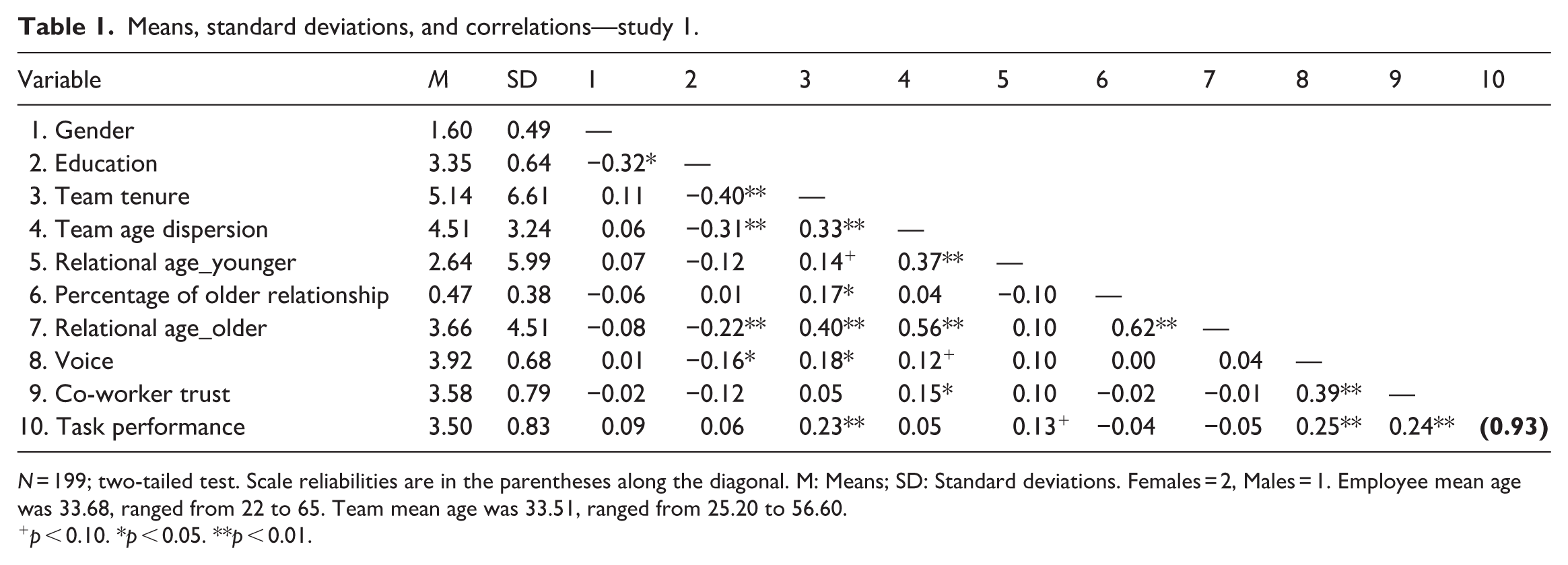
N = 199; two-tailed test. Scale reliabilities are in the parentheses along the diagonal. M: Means; SD: Standard deviations. Females = 2, Males = 1. Employee mean age was 33.68, ranged from 22 to 65. Team mean age was 33.51, ranged from 25.20 to 56.60.
p < 0.10. *p < 0.05. **p < 0.01.
Regression-based path-analysis results—study 1.

N = 199 individuals nested in 56 groups. Unstandardized coefficients (B) and robust standard errors (SE) are reported.
p < 0.10. *p < 0.05. **p < 0.01. ***p < 0.001.
In Hypothesis 2, we argued that the negative relational age-trust association (H2a) and, therefore, the negative indirect effect on task performance (H2b) could be neutralized when employees’ voice behavior is at a high level. As displayed in Table 2, the interaction term of Relational Age × Voice Behavior was significantly associated with co-worker trust (B = 0.04, SE = 0.02, p = 0.01). The J-N test result (see Figure 2) indicates that when any value of employee’s voice behavior was below 2.64 (on a 5-point scale), older employees’ relational age was significantly and negatively associated with co-worker trust. We further estimated the moderated mediation effect using the Monte Carlo simulation and received a significant result (moderated mediation index = 0.01, 95% CI [0.002, 0.02]). As shown in Figure 3, when employees’ voice value was below 2.30 (on a 5-point scale), the indirect effect on task performance through low co-worker trust was significantly negative. Thus, we concluded that both H2a and H2b were supported by these results.
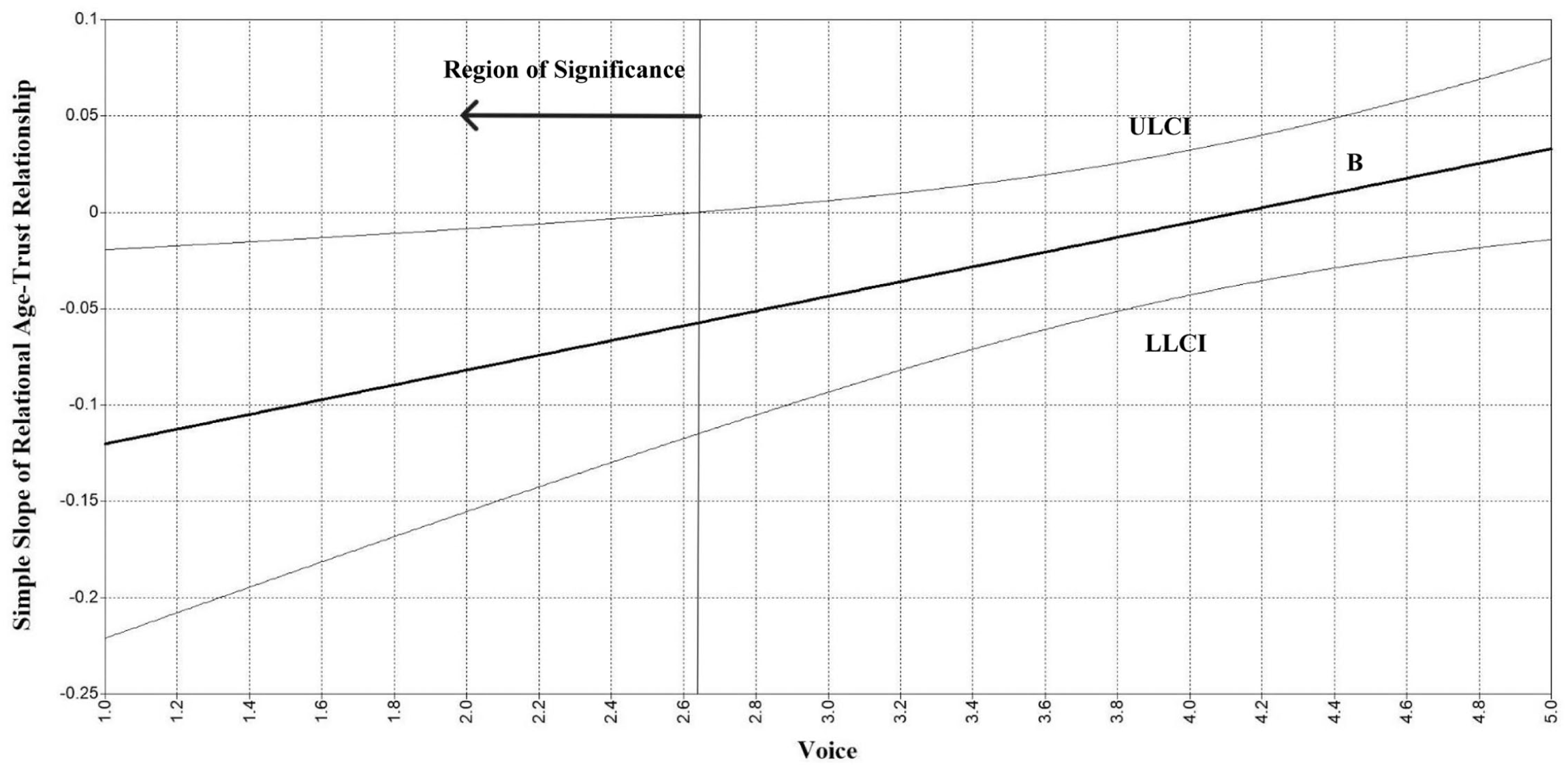
Regions of significance_moderation effect.
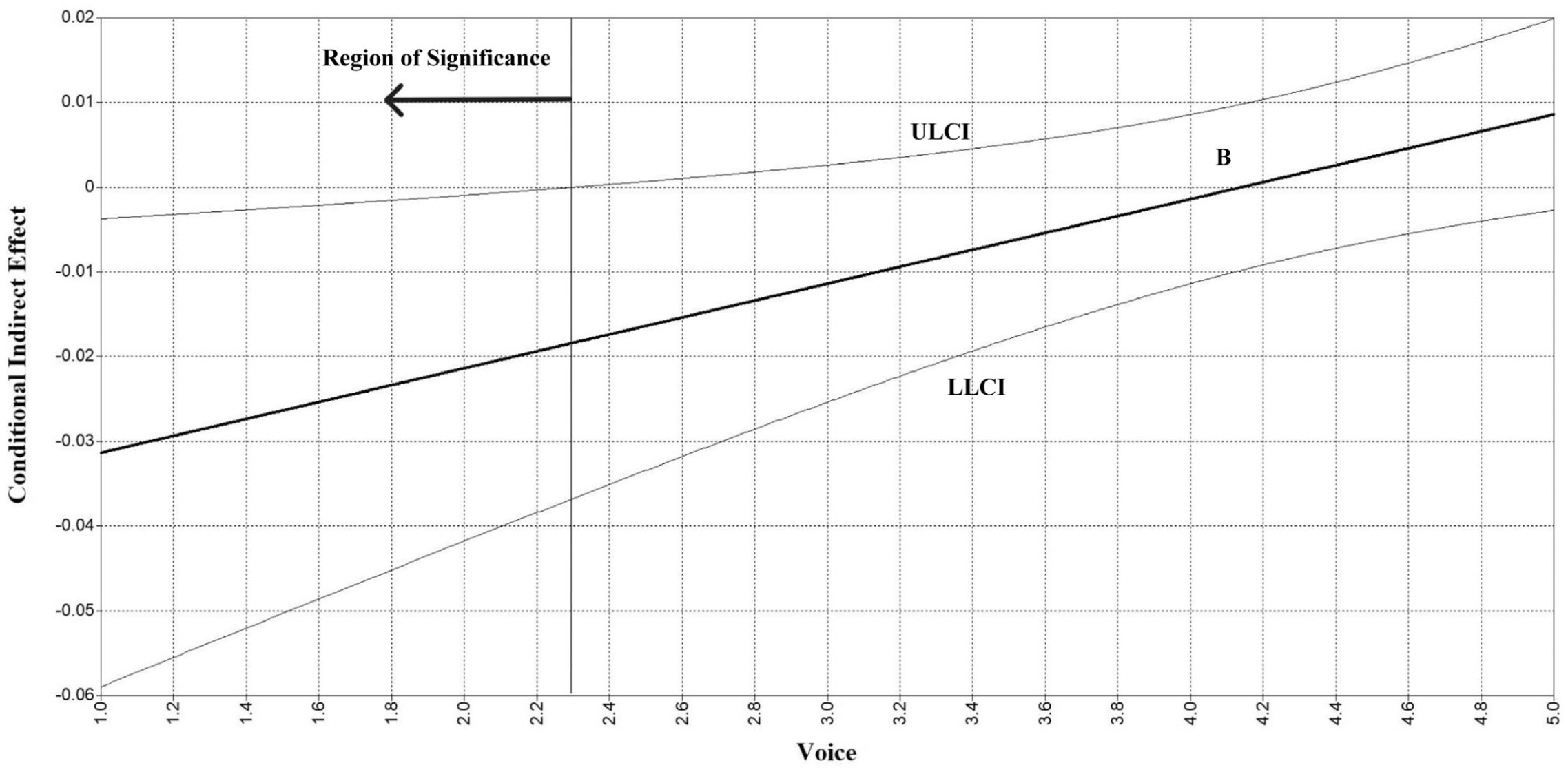
Regions of significance_conditional indirect effect.
Study 2
In our Study 1, we demonstrated that older employees’ age relative to their peers is negatively associated with co-worker trust and that this negative relationship can be mitigated by their voice behavior. We argued that status-incongruent cues influence team members’ perceptions of their older colleagues’ competence, thereby reducing their likelihood of trusting them. However, this perspective does not account for a counterargument regarding the age–trust relationship, which is grounded in the stereotype content model (Cuddy et al., 2005; Cuddy and Fiske, 2002; Fiske et al., 2002). This model suggests that individuals evaluate others—particularly those outside their identity group—based on two primary dimensions: competence and warmth. According to this framework, as people age, they tend to be perceived as high in warmth but low in competence (Cuddy et al., 2005). Research drawing on the stereotype content model (Cuddy et al., 2005, 2009) suggests that similar evaluations transfer to workplaces where they influence age-stereotypes related to older workers (Marcus et al., 2016; Weiss and Weiss, 2025). The stereotype content model further indicates that individuals perceived as warm are generally assumed to be trustworthy and well-intentioned (Cuddy et al., 2008; Fiske, 2015). Thus, older workers’ higher age may also elicit positive evaluations, such as warmth and approachability (Kluge and Krings, 2008; Marcus et al., 2016), which could enhance their trustworthiness in the eyes of their younger peers (Ehrke et al., 2020). To examine this alternative explanation of the relational age–trust relationship, we conducted a supplemental Study 2 to test the perceived competence-trust pathway. Specifically, we aimed to assess the parallel mediation effects of perceived warmth and competence in bridging the indirect effects of employees’ relational age, voice behavior, and the Age × Voice interaction on co-worker trust.
Research design and sample
We recruited participants through Prolific to engage in an online vignette experiment. Existing literature indicates that data collected from professional online platforms demonstrate satisfactory internal and external validity, akin to data gathered through traditional approaches (Berinsky et al., 2012). A recent study has also reported that Prolific provides better data quality compared to other popular online panels (Douglas et al., 2023). We established specific criteria for selecting participants from Prolific’s database. These participants needed to (1) reside in Australia, where all members of the research team were based during the study, (2) be proficient in reading and comprehending English, (3) be at least 18 years old, (4) currently hold full-time employment, and (5) possess a minimum of 1 year of full-time work experience. To account for potential gender effects, we also instructed the system to equally distribute surveys among male and female participants.
We followed Ng et al. (2021) scenario scripts to develop our vignettes. In our scenarios, participants were placed in a professional R&D team for a hypothetical food company. The team faced an urgent situation requiring members to come up with solutions at the upcoming product development meeting. Subsequently, we introduced a fictional co-worker into the scenario. In this scenario, we described the co-worker as a qualified and capable employee to fulfill the assigned team role:
Your team member, Bryan
4
is an engineer, at 55 years old making him relatively older than the average age of the R&D team. However, you noticed that despite the age difference, Bryan fits in well with the team, and there are no negative attitudes towards him in the workplace. You value Bryan’s contributions to the team and see him as a highly competent person who possesses the knowledge, skills, and abilities necessary to perform his work effectively.
We further established two distinct conditions. In the Voice Condition, we depicted Bryan’s active participation in the product development meeting, where he expressed several constructive suggestions on how to address the production issue. In the Quiet/Control Condition, we indicated that Bryan rarely spoke up, responding only when prompted by others.
In addition, because gender is one of the most powerful and consistent predictors of perceived status, as demonstrated in status characteristics theory (Wagner and Berger, 1993) and the Stereotype Content Model (Fiske et al., 2002), we also created different conditions to control for potential gender effects. Half of the participants received surveys featuring a male character named “Bryan,” while the others responded to scenarios with a female character named “Donna.” Accordingly, we employed a 2 (Voice/Quiet) × 2 (Male/Female) between-subject design, randomly assigning subjects to one of these experimental conditions. 5 Each participant received a £1.5 (equivalent to roughly AUD $3.00) reward for completing this brief (less than 10 minutes) survey.
We initially distributed surveys to 200 participants, incorporating two critical attention-check questions: (1) the name (Bryan/Donna) and (2) Bryan’s/Donna’s age. A total of 193 participants successfully passed both attention checks, yielding a robust final sample with a 97% pass rate. Consistent with the approach used in Study 1, we included only responses from participants younger than the hypothetical character (i.e. 55 years old), resulting in a final sample of 177 participants. 6 The mean age of these participants was 32.32 years (SD = 9.09), with ages ranging from 18 to 55. Female participants comprised 53% of the sample, and approximately 70% held a bachelor’s degree or higher. The average work experience was 11.36 years, and participants spent an average of 9 minutes and 58 seconds completing the survey.
Measures
Older employees’ relational age
Similar to the study one, we adopted the relational age approach (Kunze and Menges, 2017) to measure relational age and we subtracted the main character’s age (i.e. 55) from the participants’ age to capture the relational age scores.
Voice
We manipulated the main character’s voice behavior and employed the same one-item scale as in Study 1 as a manipulation check, using a 7-point scale. The results indicated that participants in the Voice Condition (n = 88; coded as “1”; M = 4.55, SD = 0.74) reported significantly higher voice ratings than those in the Quiet/Control Condition (n = 89; coded as “0”; M = 2.40, SD = 1.06; t = 16.02, p < 0.001).
Perceived warmth and competence
We utilized Fiske et al. (2002) scale to assess participants’ perceived warmth and competence. Perceived warmth was gauged by measuring the extent to which participants agreed with statements such as whether Bryan/Donna was “tolerant,” “warm,” “possessed a good nature,” and “sincere” on a 7-point scale (Cronbach alpha = 0.91; 1 = strongly disagree, 7 = strongly agree,). Perceived competence was evaluated based on the extent to which Bryan/Donna was perceived as “competent,” “confident,” “capable,” and “skillful” (reliability alpha = 0.82).
Co-worker trust
Similar to the main study, we also used the one-item measure provided by Lau and Liden (2008) based on a 7-point scale.
Analytical approach, data transparency, and openness
We conducted path analysis using Mplus 8.8 to examine the mediation effects of co-workers’ perceived warmth and competence bridging the target’s relational age and their received co-worker trust, and how these indirect paths could be moderated by different voice conditions. In the path model, perceived warmth and competence were set as two parallel latent mediators, with employees’ relational age, voice behavior, and co-worker trust serving as predictors. To conserve the degrees of freedom in our model, we employed the total aggregation approach with reliability correction, using single indicators to estimate the latent variables of perceived warmth and competence (see Williams and O’Boyle, 2008). Given that the warmth and competence scale used originated from the same social perception scale (Fiske et al., 2002), we correlated and controlled for error terms of these two components. As mentioned earlier, we included the characters’ gender (Donna = 2, Bryan = 1) as a control variable loaded on both mediators and the dependent variable to account for potential effects. The data used in this study have not been utilized in other studies previously. The study design and analysis were not preregistered. This study obtained Human Ethics approval from the University of South Australia (project title: Are Older Colleagues More Trustable; protocol number: 205689). The script for the scenario manipulation (Appendix), analysis syntax, and data are available here: https://osf.io/mgws9.
Results
The descriptive statistics are presented in Table 3, and all path coefficients are reported in Table 4. The model exhibited a good fit to the data (chi-square = 4.01, df = 2, comparative fit index = 0.99, Tucker–Lewis Index = 0.90, root mean square error of approximation = 0.08, standardized root mean square residual = 0.03). As indicated in Table 4, employees’ relational age was significantly and negatively associated with perceived competence (B = −0.04, SE = 0.01, p = 0.008) but not with perceived warmth (B = −0.01, SE = 0.01, p = 0.35). Both perceived warmth (B = 0.72, SE = 0.11, p < 0.001) and competence (B = 0.45, SE = 0.12, p < 0.001) were significantly associated with co-worker trust. Specific indirect effect tests (bootstrapping n = 5000) revealed that the indirect effect through perceived competence was significant (indirect effect = −0.02, 95% CI [−0.03, −0.002]), while the indirect effect through perceived warmth was not (indirect effect = −0.01, 95% CI [−0.03, 0.01]). Moreover, the Age × Voice interaction was significantly associated only with perceived competence (B = 0.04, SE = 0.02, p = 0.01) but not with perceived warmth (B = 0.03, SE = 0.02, p = 0.099). Consequently, the conditional indirect effect was significant only through perceived competence (conditional indirect effect = 0.02, 95% CI [0.002, 0.04]). In the Quiet/Control condition, the indirect effect of employees’ relational age on co-worker trust was significantly negative (indirect effect = −0.02, 95% CI [−0.03, −0.002]), whereas in the Voice condition, the negative indirect effect became neutralized and insignificant (indirect effect = 0.003, 95% CI [−0.006, 0.01]). Thus, these results confirmed our anticipation that perceived competence, rather than perceived warmth, was the primary mechanism linking employees’ relational age, as well as the Age × Voice interaction, to co-worker trust.
Means, standard deviations, and correlations—study 2.
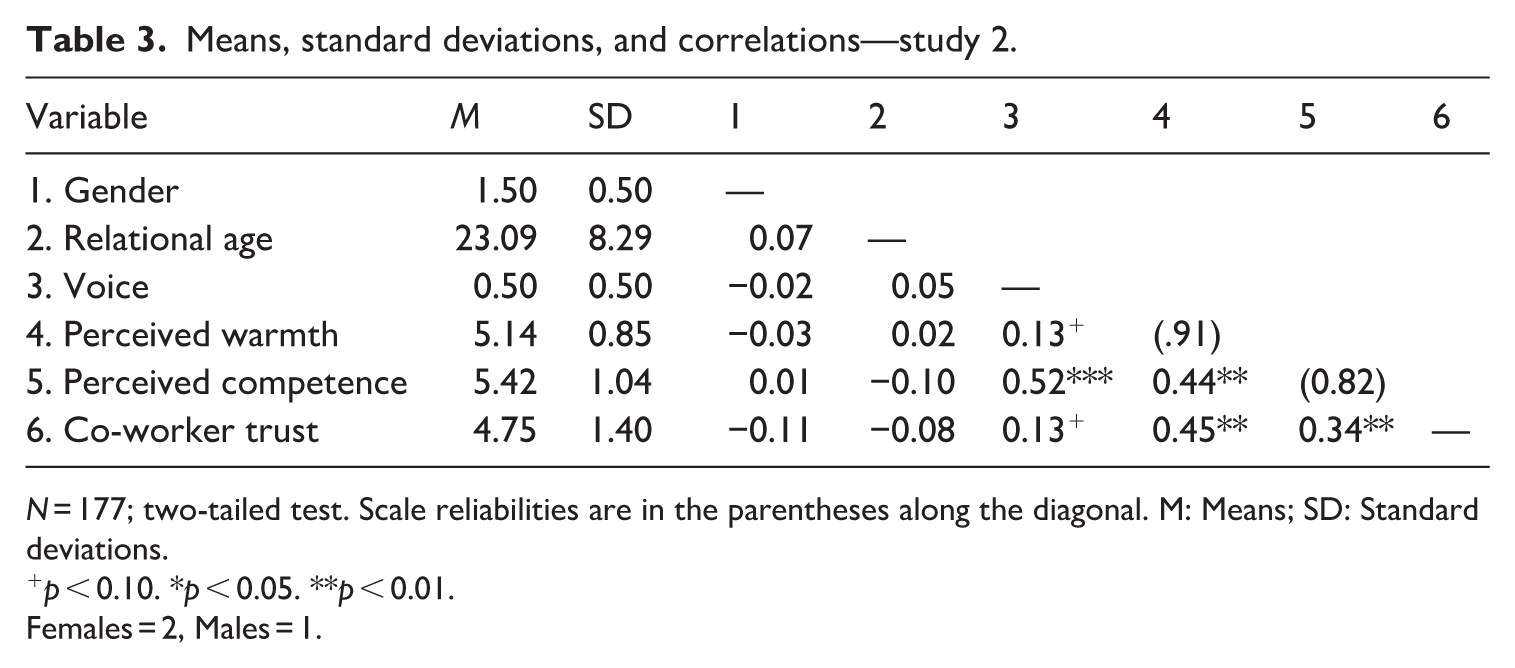
N = 177; two-tailed test. Scale reliabilities are in the parentheses along the diagonal. M: Means; SD: Standard deviations.
p < 0.10. *p < 0.05. **p < 0.01.
Females = 2, Males = 1.
Path-analysis results—study 2.
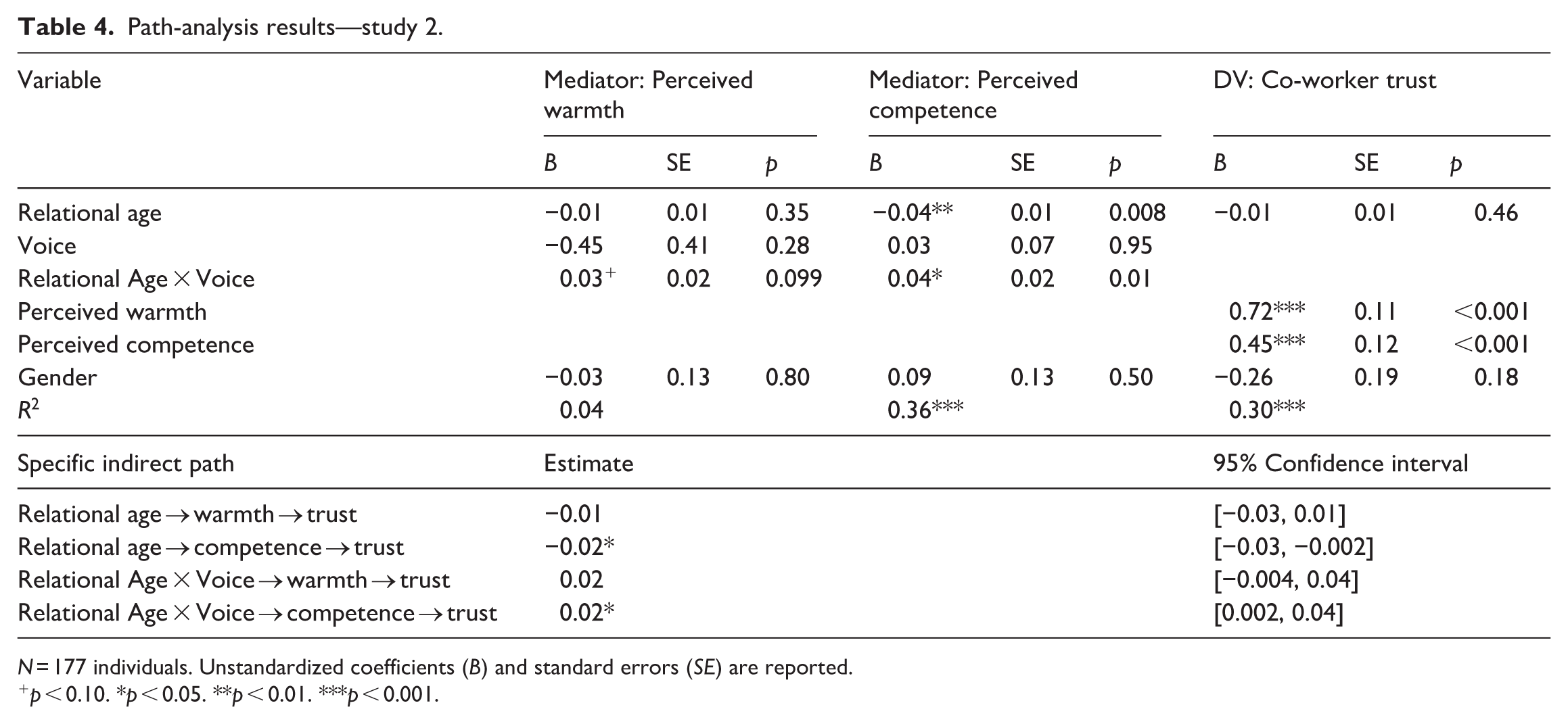
N = 177 individuals. Unstandardized coefficients (B) and standard errors (SE) are reported.
p < 0.10. *p < 0.05. **p < 0.01. ***p < 0.001.
Discussion
In this research, we examine how older employees’ relational age (i.e. the average age difference between an older employee and their co-workers in a team) relates to the trust they receive from co-workers and their supervisor-rated task performance. Additionally, we investigate whether this relationship is moderated by their displayed voice behavior. Our Study 1 reveals that older employees’ relational age is significantly and negatively associated with supervisor-rated performance through an effect mediated by reduced co-worker trust. However, this negative indirect effect of relational age on task performance is mitigated when older employees exhibit a high level of voice behavior. In Study 2, we further test whether the association between relational age and co-worker trust is mediated by perceived competence while controlling for perceived warmth. The results indicate that when both mediators are considered, only perceived competence significantly mediates the relational age–trust relationship. Moreover, this indirect effect is particularly negative when the focal employee remains silent rather than proactively voicing their opinions in a hypothetical team discussion scenario. These findings have important theoretical and practical implications.
Theoretical implications
We expect our research to contribute to the literature on managing age-diverse teams and strategies for supporting older employees’ sustainable careers in several ways.
First, we extend status characteristics theory by integrating relational demography perspectives to explain how age-based status expectations, as well as the negative stereotypes they activate, can be countered through individual behaviors such as voice. Prior research applying status characteristics theory has primarily examined status beliefs in formal decision-making contexts such as hiring or promotion and has focused more extensively on gender than on age (Seo et al., 2017). We build on this work by theorizing how status incongruence can emerge in peer-based teams, where formal hierarchies are often muted and status must be informally negotiated through day-to-day interactions. In such settings, older employees who do not occupy higher organizational ranks may violate implicit expectations that age should correlate with higher-ranked job titles or authority. Drawing on Kunze and Menges (2017), we argue that larger age gaps between older employees and their younger teammates make this mismatch more salient, heightening perceptions of diminished competence and undermining coworker trust. Importantly, we identify voice behavior—the proactive and constructive expression of ideas—as a counter-stereotypical behavior that can signal competence and reaffirm the older employee’s value to the team. In doing so, we contribute to the literature by identifying a behavioral strategy through which older employees can actively contest status-based disadvantage and foster their social standing within age-diverse teams.
Second, our findings extend relational demography research by moving beyond documenting the constraints associated with demographic dissimilarity to showing how lower-status individuals can use behavioral strategies to actively shape how they are perceived by others (Guillaume et al., 2014; Li et al., 2022). Relatively older team members in our study shaped how competent they were perceived to be by engaging in voice behaviors when interacting with their peers. This asymmetry in age, positions certain team members at odds with implicit status beliefs, making them more susceptible to trust erosion and social marginalization. Our approach aligns with Kunze and Menges (2017), who theorize how age norm violations can trigger negative competence evaluations and diminish trust. Our findings thus align with broader theoretical distinctions in the diversity literature (Harrison and Klein, 2007; van Dijk and van Engen, 2013), where relative age differences (e.g. younger vs. older) are identified as particularly relevant for status dynamics. By highlighting how relative age position affects individuals’ standing within teams, we provide a more targeted framework for understanding age-based inequality and highlight new strategies for supporting older employees in peer-based settings.
Third, we contribute to research on stereotype-based disadvantages and mature-age employee engagement (Kulik et al., 2016) by identifying voice as a proactive behavior through which older employees can counteract lower ascribed status and foster team integration. While our findings are grounded in team contexts, they echo broader societal patterns of age-based status stratification. Specifically, even in professional teams that appear formally egalitarian where age-linked seniority is not embedded in formal roles, older employees may continue to face lowered trust and diminished status due to enduring societal stereotypes that associate age with declining competence (Fiske et al., 2002; North and Fiske, 2012). This observation aligns with work on status characteristics theory and expectation states theory, which suggests that team contexts do not escape the influence of widely shared societal status beliefs (Berger et al., 1972; Cuddy et al., 2005). As organizations increasingly flatten hierarchies and shift toward team-based structures, societal biases can reappear in subtle, relational forms—shaping how peers evaluate and engage with older colleagues (Lawrence, 2004). Importantly, our study identifies voice behavior as a positively valenced, stereotype-incongruent act that can help older workers signal competence and rebuild peer trust. Speaking up offers older employees a visible way to challenge assumptions and interrupt the implicit reproduction of societal hierarchies within teams. Thus, we position voice not only as an individual-level strategy for overcoming age-related bias but also as a lever for promoting interactional fairness in age-diverse workplaces.
Practical implications
We expect our research to offer several important practical implications for organizations, leaders of multigenerational teams, and older employees. As the workforce continues to age, career counselors and HR professionals will play a crucial role in supporting older workers in achieving career longevity.
First, career counselors and organizations can assist older employees by providing opportunities and encouragement to develop essential interpersonal skills and engage in promotive voice behavior. This can be facilitated through coaching and training programs focused on communication techniques, assertiveness, and conflict resolution. Additionally, such training may enhance job satisfaction (Visser et al., 2021), increasing motivation to engage in voice behavior, improving job engagement, and helping older workers avoid internalizing age-related meta-stereotypes (Finkelstein et al., 2015). Voice behavior from older employees can also challenge stereotypes that depict them as resistant to change or innovation (Harris et al., 2018).
Second, leaders of multigenerational teams play a crucial role in fostering an environment where voice behavior is encouraged. Older employees may perceive speaking up as risky due to concerns about retribution or being viewed as risk-averse (Peng et al., 2024). Leaders can mitigate these concerns by actively acknowledging and valuing the contributions of older employees who use their promotive voice to drive positive change and innovation. Prior research (Chen and Hou, 2016) has shown that the benefits of voice behavior are amplified in team climates that emphasize innovation and psychological safety. As climate engineers (Ostroff et al., 2012), team leaders shape such environments by fostering openness, inclusivity, and respect. To encourage a voice climate, leaders can model vulnerability by sharing uncertainties or past mistakes, signaling that expressing ideas is safe (Hu et al., 2018). Doing so helps establish structured feedback processes, such as regular reflection meetings, which encourage open dialogue. Furthermore, responding constructively to dissenting opinions reinforces the idea that disagreement drives improvement rather than conflict. By implementing these practices, leaders create a psychologically safe team climate where older employees feel empowered to share their insights, ultimately fostering collaboration, trust, and effectiveness.
Finally, our findings offer direct insights for older workers, highlighting proactive steps they can take to counteract age-related stereotypes. Staying relevant and adaptable—by keeping up with industry trends, technological advancements, and professional developments—can enhance their opportunities to engage in promotive voice behavior. Additionally, understanding the benefits of advocating for their ideas in pursuit of team goals, as well as the risks of disengagement, can help older employees navigate workplace dynamics more effectively. They can also demonstrate voice behavior by leveraging their expertise in mentorship roles, such as guiding younger colleagues or sharing industry insights (Burmeister et al., 2018).
Study limitations and future research directions
We acknowledge several limitations of our study. First, our study focused on professional work teams with less hierarchical structures, where the work environment is relatively flat and egalitarian. In this context, age or seniority was less likely to reflect employees’ hierarchical ranks, allowing competence judgments to be based on either personal characteristics (e.g. age) or task-relevant behaviors (e.g. voice). However, in other types of work teams where seniority and tenure often correspond to individuals’ hierarchical ranks (e.g. resident and attending physicians in a medical team), age may serve as a significant indicator of in-group status and expertise. In such environments, targets’ ages could be confounded with their authority and positional power, shaping observers’ competence and trust judgments and potentially overshadowing the impact of task-relevant behaviors like voice. Our findings may therefore be more pronounced and readily observable in work contexts with relatively flatter structures. Nevertheless, in a post-COVID and increasingly digital era, more organizations are gradually adopting organic structures and seeking to eliminate hierarchical layers (Foss and Klein, 2022). Given this trend, we believe that the conclusions drawn from this study remain applicable to the emerging egalitarian organizational contexts. We encourage future research to examine how older employees’ voice functions and is perceived in more traditional, hierarchical work contexts to assess the extent to which our results generalize across different organizational settings.
Second, because both voice behavior and co-worker trust were measured concurrently via peer ratings in Study 1, our field design does not allow us to make definitive causal claims about the sequence of these variables. It is indeed plausible that coworkers who already trust an older team member may be more likely to perceive and evaluate their voice behavior more favorably. To explore this possibility, we conducted a supplementary analysis testing an alternative mediation pathway (relational age → trust → voice), yet the indirect effect was not statistically significant. In Study 2, we address this reversed causality concern by isolating voice behavior as a manipulated variable, such that participants rated focal employees as more trustworthy, supporting our theorized direction from voice to trust. Nevertheless, workplace relationships are often reciprocal and dynamic, and we suggest that future research employ longitudinal or dyadic panel designs to more clearly disentangle the interplay between trust and voice over time.
Third, in our Study 1, we controlled for older employees’ team tenure, as it reflects their familiarity with other team members, as recommended by previous studies (Kunze and Menges, 2017). However, team tenure alone may not fully capture the actual duration of collaboration between a focal employee and each teammate. Although we did not directly measure relational tenure in our data, we conducted a post-hoc analysis introducing average team tenure difference as a new control variable. Specifically, we calculated this variable by subtracting the focal employee’s team tenure from each teammate’s team tenure and averaging the absolute values of these difference scores. Higher values of average team tenure difference indicate shorter collaboration durations. However, this variable was not significantly related to either co-worker trust or task performance. Meanwhile, team tenure remained significantly associated with task performance, suggesting that it is a critical control variable in our model. Taken together, to preserve the statistical power of our analysis, we retained team tenure as the control variable in this instance. Nevertheless, we acknowledge that relational history may play a crucial role in how older employees’ competence is judged by their co-workers. We encourage future research to further investigate the influence of collective experience and the length of collaboration on these perceptions.
We hope to offer several additional avenues for future research. In this study, we focused on older employees’ voice behavior as a salient, observable, and relational cue that can influence how they are perceived by younger teammates (Morrison, 2011). Voice often entails social risk, as it challenges the status quo and introduces new ideas (Burris, 2012). Because individuals with higher status are more readily trusted (Lount and Pettit, 2012), frequent voice behavior may reduce status incongruence stemming from age differences and foster co-worker trust. However, our study centered on promotive voice—constructive suggestions aimed at improving the team (Van Dyne and LePine, 1998). Future research should consider how other forms of voice, such as prohibitive voice (e.g. speaking out against risky practices), may trigger less favorable reactions, especially when coming from older employees, who risk being perceived as lecturing or overly critical. Similarly, other proactive behaviors like taking charge (Zhang et al., 2021) may help offset negative age stereotypes by signaling competence and initiative.
We also note that our findings across both Taiwanese and Australian samples suggest that negative status effects of relational age may reflect globally shared stereotypes. This finding is consistent with prior research demonstrating cross-cultural consistency in viewing older adults as warm but less competent (Cuddy et al., 2005) and the stability of age-related bias across cultures. Our participants are categorized as older workers rather than elderly individuals, as defined in previous stereotype research (Petery et al., 2020). The strength and content of age-related competence expectations at work likely vary across jobs and sectors; these may be weaker or distinct in work settings where age norms are less rigid (Lawrence, 1996, 1997, 2004; Ng and Feldman, 2012). Taken together, we encourage future studies to engage in cross-contextual comparative research to further assess the boundary conditions of age-based status dynamics in workplaces.
Finally, future research could also examine whether the relationship between relational age and trust depends on the magnitude of the age gap between an older worker and their younger co-workers. While we argue that larger age differences may heighten the salience of status incongruence (Kunze and Menges, 2017), Greenberg et al. (2007) note that social comparison and norm-violation effects at work are often context-dependent and may not follow a strictly linear pattern. For example, in Study 1, we found that team age dispersion was significantly and negatively related to older employees’ received co-worker trust, but not to their task performance. This result aligns with previous team diversity research suggesting that within-group demographic diversity exerts a dual effect on members (Van Knippenberg et al., 2004): While high demographic dispersion triggers social categorization processes that can erode interpersonal trust, it simultaneously provides a rich pool of informational resources that supports task-related outcomes. For an older employee, sufficient accesses to diverse information likely offset the relational costs of reduced trust, enabling them to maintain their individual task performance. Future research could investigate whether an older employee’s professional status or expertise allows them to remain functionally integrated with the team and extract informational value even when the interpersonal climate is compromised by social categorization. Additionally, exploring cross-level interactions between team-level age dispersion and individual relational age could reveal whether a highly diverse climate eventually normalizes “being different,” thereby reducing the relational costs of social categorization over time.
Conclusion
Multigenerational workforces, incorporating a growing cohort of older workers, will remain a prominent feature in most workplaces in the coming decades. In these diverse teams, older workers may hesitate to use their promotive voice due to fears of being misunderstood, perceived as overbearing, or seen as undermining the credibility of the team leader, which can lead to undesirable social consequences (Liang et al., 2012). We hope that our research will assist both researchers and practitioners in better understanding how to effectively harness the expertise of older employees and encourage those who wish to remain in the workforce to continue making significant, positive contributions.
Footnotes
Acknowledgements
We thank the Chief Editor, Professor Smriti Anand, and three anonymous reviewers for their constructive and supportive feedback during the review process. We are also grateful to Professor Cheri Ostroff, Associate Professor Connie Zheng, and Dr Xiao Chu for their insightful comments on earlier versions of this paper.
Funding
The authors received no financial support for the research, authorship, and/or publication of this article.
AI usage declaration
The authors acknowledge that they have followed Human Relations’ AI policy. Accordingly, AI was used only for copy editing or proofing the manuscript.
