



Abstract
Using a panel survey, the authors investigate how the welfare of rural-urban migrant workers in China is affected by trade union presence at the workplace. Controlling for individual fixed effects, they find the following. Relative to workers from workplaces without union presence or with inactive unions, both union-covered non-members and union members in workplaces with active unions earn higher monthly income, are more likely to have a written contract, be covered by social insurances, receive fringe benefits, express work-related grievances through official channels, feel more satisfied with their lives, and are less likely to have mental health problems.
The All-China Federation of Trade Unions (ACFTU) is, and has been for many years, a branch of the Chinese central government. 1 Since 1978, China has gone through an economic reform period that has gradually shifted the economy from a centrally planned to a more decentralized market-oriented system. Non-state, collective-owned enterprises increased from less than 1% of all Chinese firms at the beginning of the economic reform to more than 93% in 2012 (National Bureau of Statistics 2009, 2013a). It is interesting to understand how the institutional features of the Chinese union affect workers’ welfare in a largely privately owned economy.
This shift to a market-oriented system has been accompanied by dramatic industrialization fueled by a strong supply of cheap labor from rural areas. But in this large-scale rural-urban migration, the rights of migrants have not kept pace with those of urban workers because of China’s special institutional setting. During the 1990s and 2000s, issues related to violation of workers’ basic rights became increasingly prevalent (Meng 2012; Gallagher, Giles, Park, and Wang 2013; Li and Freeman 2015; Meng 2017). Consequently, the demand for collective bargaining began to grow. Although in 2008 the new Labour Contract Law established formal legal channels to protect workers’ rights, unfortunately the legal system in China is still weak, and laws and regulations are often not enforced, particularly if they relate to marginalized workers.
Owing to the lack of formal complaint channels, an increasing number of migrant workers take extreme action in response to their poor working conditions. Examples include spontaneous strikes and protests expressing conflict between labor and capital (Traub-Merz 2011). Consequently, there is growing pressure—from both government and society at large—on the ACFTU to fulfill its roles of protecting workers (particularly migrant workers) and institutionalizing conflict resolution. In the years following the introduction of the Labour Contract Law, the ACFTU requested firms and workplaces to set up unions, gradually incorporated more independent, grassroots unions into its system, and learned to work with these grassroots unions. Some firms and workplaces actively responded to the ACFTU’s request, whereas others passively followed orders to form the union but did not organize any activities. The latter case is commonly referred to as setting up “paper unions.” 2
Against this background, our article explores how migrants’ working conditions and welfare are affected by the diverse forms of unionization that China’s once relatively homogeneous system now exhibits. In particular, we investigate if active (or real) unions and paper unions had a differential effect on protecting migrant workers—the major Chinese industrial workforce. Most existing studies use firm-level or provincial-level data while some use cross-sectional individual-level data, and their findings are mixed with regard to union influence. 3 Ours is the first to use a unique, longitudinal, representative survey of migrants (the Rural-Urban Migration in China [RUMiC] survey, conducted by the Australian National University), which has a remarkably rich set of covariates to address the important issues raised above.
Background
Migrants’ Position in China’s Industrialization and Industrial Relations
Industrialization is invariably accompanied by large-scale rural-to-urban migrations. 4 Since the early 1990s, Chinese cheap exports have dominated the world market, and more than 170 million rural workers have migrated to cities (Frijters, Gregory, and Meng 2015; National Bureau of Statistics 2017). Despite the substantial contribution of migrant workers to China’s economic growth (see, for example, Bosworth and Collins 2008; Meng 2012; Hao, Sun, Tombe, and Zhu 2020), they have always been treated as guest-workers in cities (see, for example, Zhao 1999; Meng 2000, 2012). While urban dwellers (individuals with non-agriculture hukou 5 ) are generally covered by social insurance, rural-urban migrants were initially denied social services and social insurance coverage. Their children were not entitled to attend city schools, and neither they or their families were entitled to work-injury protection, unemployment, and health insurance or pensions. Although the Labour Contract Law attempted to change the situation, the law’s enforcement has been very weak for migrant workers. In addition, migrants are discriminated against with regard to type of job, working hours, and hourly earnings (Meng and Zhang 2001; Frijters, Meng, and Resosudarmo 2011) simply because they were born in rural areas. Thus, China’s rural-urban policy divide has put migrant workers into a particularly weak position.
Trade Union in China
The 1995 Labour Law of People’s Republic of China (hereafter, the Labour Law) stipulated that the ACFTU is the only legal trade union in China (see Baker and McKenzie 2013). All unions in China need to register with and follow the ACFTU’s leadership. The ACFTU employs a hierarchical system to manage its sub-branches. At the top of the hierarchy is the national headquarters following the CCP’s leadership. Below national headquarters are 31 provincial unions and 10 industry unions. At the bottom are the firm- or workplace-level unions.
Unlike the other levels of unions, which are formed and act like government branches, the firm- and workplace-level unions are more diverse, and their decision-making is less controlled by local ACFTU. In the majority of cases, unions at firm and workplace level are established by management within a given firm or workplace in response to the local ACFTU’s request. Some firms actively responded to the ACFTU’s request to set up unions, as they clearly saw the benefit of it, whereas others passively followed orders. In the latter case, where firm or workplace management does not care about good labor relations and does not promote any union activities, firm- and workplace-level unions exist only on paper. Hence, as noted in footnote 2, such unions are commonly referred to as paper unions. They normally do not organize activities and may even intentionally hide themselves from workers to avoid putting in effort. However, if the higher-level ACFTU wants to promote collective contracts or perform labor-protection inspection, firms and workplaces with paper unions are likely to cooperate, as the ACFTU local branch is backed up by government administrative power. In 2008, China issued the new Labour Law, which allows any group of workers to establish a union themselves if they register with the ACFTU. In practice, some self-established grassroots unions are successful, but they are very limited. 6 Examples also include attempts by workers to establish their own unions, which were rejected by the ACFTU. 7 Firm- and workplace-level unions are more heterogeneous than unions ranked higher in the hierarchy because of diversity in the ways unions are established, variations in grassroots union decision-making, and weaker connections with the party and the government.
The existence of paper unions is a unique feature of Chinese trade unions, albeit as a union suppression strategy it exists elsewhere (see, for example, Riddell 2001). The inactive paper unions should be less effective in improving workers’ welfare. Further, we expect that union members are more likely to be found in active unions. Given that many paper unions try to avoid being known and do not actively organize activities to attract workers into the “union,” they are likely to have fewer members.
The Role of Firm- or Workplace-Level Unions
Firm- and workplace-level unions are supposed to engage in collective contract negotiation, labor dispute mediation or arbitration, supervision and inspection of labor protection, legal supervision and help, skills training and skill competition, and financial support to employees with difficulties (Metcalf and Li 2006; Ge 2007; Lee 2009; Zhang 2009; Liu 2010). The extent and performance of these activities, however, is unclear. For example, although firm-level unions do represent workers in the negotiation of collective contracts, evidence supports that conditions in collective contracts are copied from minimum legal requirements (see, for example, Metcalf and Li 2006; Liu 2010). In addition to the abovementioned activities, unions often organize entertainment events, although that role has been interpreted as evidence of workplace unions’ nonfeasance in worker protection (Feng 2006).
Activities at firm- and workplace-level unions are expected to help migrant workers improve their welfare. They not only provide grievance channels for illegally treated workers but also raise workers’ awareness of their rights. These factors will certainly increase the cost of labor exploitation and reduce the chance of migrant workers being illegally treated relative to their non-union counterparts.
Some aspects of migrant working life that unions can improve include reducing working hours, increasing hourly pay, and providing social insurance protections. Union activities could be effective in these aspects, both in the sense of achieving minimum legal requirements and improving migrant welfare above the ceiling of legal requirements. In this article, we focus on earnings, hours, and social insurance protections but also look at other benefits and the workers’ ultimate welfare: happiness.
Union Members and Covered Non-members
Although official ACFTU data claim 92% of workers in unionized workplaces are union members, the proportion in our sample is 34% (National Bureau of Statistics 2009). This percentage suggests that two-thirds of unionized migrant workers are covered non-members. Such a large share of covered non-members makes it important to explore the impact of firm- and workplace-level unions on this group of workers. Here, a brief discussion of the “free-rider’ problem is warranted. If a large proportion of workers “free ride” on union membership (that is, workers are non-members but are covered by union benefits), unions cannot exist as successful entities. In the West, such a free-rider problem is often mitigated by providing excludable goods to union members, such as reputation (Booth 1985), physical working conditions, and promotion and/or grievance channels (Freeman and Medoff 1984; Booth 1995). In China, free-riding is mitigated by the union funding system. Theoretically, three sources of funding are available for ACFTU firm and workplace branches. These are 0.5% union dues owed by union members, the 2% payroll tax owed by firms (Ge 2007; Yao and Zhong 2013), and government funding. Government funding is rarely provided to firm or workplace unions. Furthermore, although there are 0.5% union dues, they are payable only by union members, the amount is small, and the collection of dues is imperfectly executed (Metcalf and Li 2006). Hence, the major source of funding for firm-level unions is the targeted 2% payroll tax paid by unionized firms (Ge 2007). As the tax base of 2% payroll tax is for all workers in a unionized firm, it is equivalent to a coerced union charge for all union-covered workers. Operating in this funding system, firm-level unions can exist even without union members.
Therefore, firm-level unions in China are not expected to be concerned about eliminating free-riders. Consequently, firm-level unions should have little incentive to make any of their services exclusive to union members, nor do firm-level unions have incentives to discriminate against covered non-members. Thus we expect little to no welfare differences between covered non-members and union members.
We might, however, still observe a union member welfare premium for the following reasons. First, although firm-level unions may not intend to exclude covered non-members from union activities, such activities may be semi-exclusive to union members, who are more likely to be informed about them. As already noted, these activities may help migrant workers accumulate skills and thus improve their welfare. Second, union members might be more likely to be found in active unions because active unions attract workers to join. At the same time, active unions do a better job in improving workers’ welfare. Therefore, any welfare differences observed in the data between covered non-member and union members may reflect a higher likelihood that members are covered by active unions. Third, union members may be more active within the firm and have more opportunities to be promoted. To the extent that promotions affect remuneration packages, union members would be better off than unionized non-members. Finally, although union funding does not depend on membership, union leaders may have non-financial considerations to treat members differentially. For example, unions with more members may help the union leader gain more political power within ACFTU, which may advance their own career.
Data, Sample, and Summary Statistics
RUMiC Survey and Sample
Our data are from the Rural-Urban Migrant sample of the 2012 to 2016 waves of the Rural-Urban Migration in China (RUMiC) survey, as the trade union questions were added only from 2012. RUMiC is a panel survey, conducted by the Australian National University, that aims to collect data to better understand internal migration in China. There were initially three samples: the Urban Household sample (UHS), the Rural Household sample (RHS), and the Rural-Urban Migrant sample (MHS), but given funding limitations from 2011 onward, only the MHS remained. The MHS continued until 2016, with the initial wave comprising 5,000 randomly selected migrant households from 15 cities in 9 provinces. The provinces were chosen to include both sending and receiving regions. Within each city, the sample was randomly selected from migrant workplaces to avoid the potential bias of residential-based sample selection. Because a large proportion of migrant workers live in factory dormitories or other workplaces (construction sites, restaurant backrooms), residential-based sampling often omits these migrant workers. (Online Appendix A provides further details about the RUMiC survey. For discussion of the RUMiC sampling frame, see Meng, Manning, Shi, Effendi [2010].)
In each subsequent year from 2008, efforts were made to track households surveyed in previous years. Those households successfully tracked form the longitudinal part of RUMiC data. RUMiC added a random sample of new households in each wave to bring the final sample of each wave back to the original number of approximately 5,000 households. Because migrants are mobile, the attrition rate is high for the RUMIC project. The positive side of a high attrition rate is that the new households added in each wave effectively form the representative sample of Chinese migrant households in that year. Thus, in addition to the longitudinal part of the data, RUMiC also has a repeated cross-sectional component.
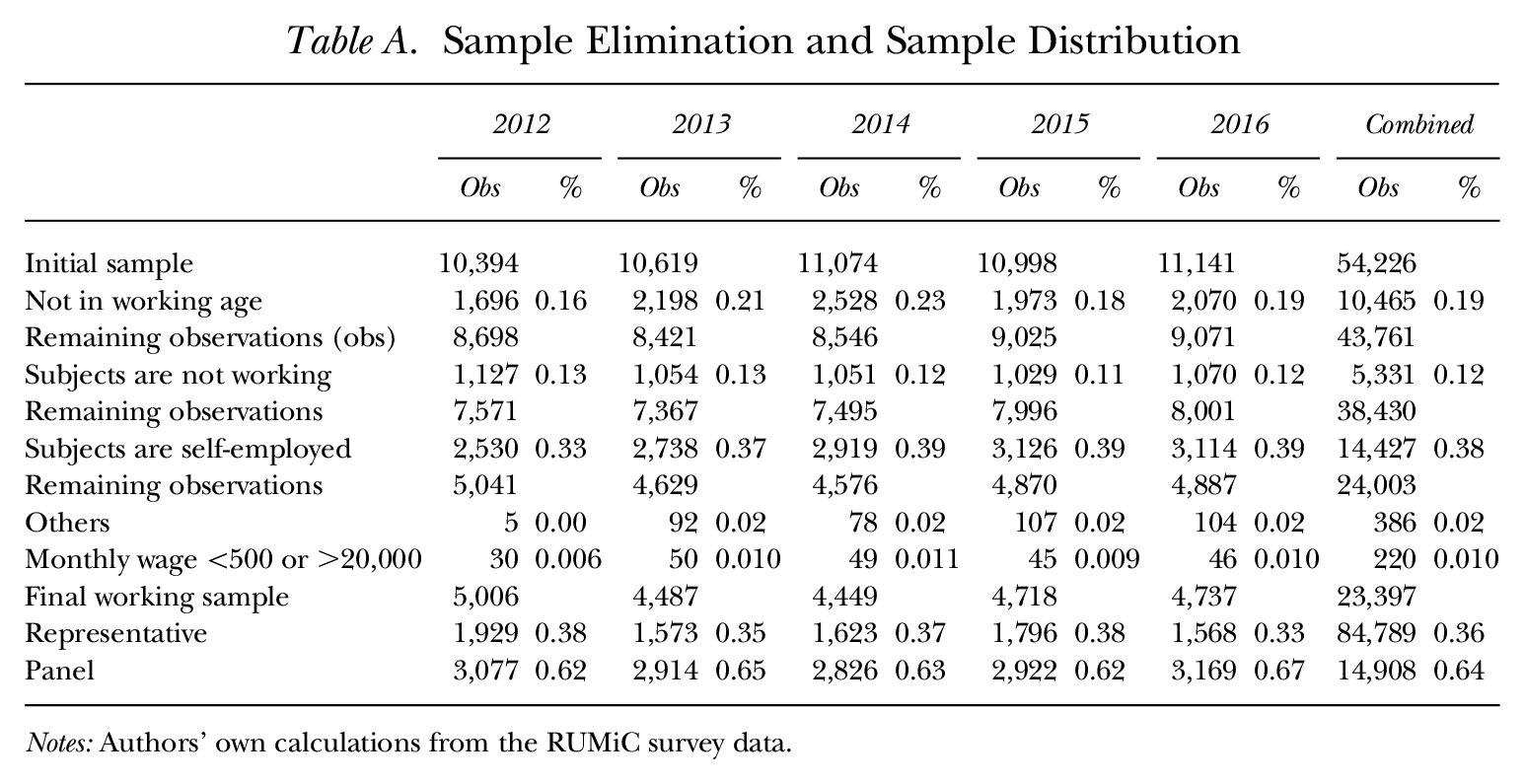
To focus on individuals most likely to be affected by unionization, we limit our sample to working-age (16–60 years) wage-earners from the 2012 to 2016 waves. Detailed information on our sample selection is at the end of this article in Appendix Table A. Our final sample comprises 5,006, 4,487, 4,449, 4,718, and 4,737 observations in each of the five waves, respectively, and the total pooled individual-year observations is 23,397. Approximately 64% of this sample has more than one year of observations, and these constitute the panel sample (total of 15,652 individual-year observations).
Union Coverage, Membership, and Paper Union
From 2012, the RUMiC survey added a set of questions investigating the impact of trade unions on migrant workers’ economic position. Respondents were asked whether their workplace has a trade union and, for those answering “yes,” they were further asked, “Are you a union member?” Based on these two questions, we divide our sample into three groups: those in non-unionized workplaces, those in unionized workplaces but not a union member, and union members in unionized workplaces.
Table 1, panel A, shows the union-coverage rate. Approximately 18% of our sample of wage-earners are in workplaces with trade unions, although only 7% are actually union members. It is difficult to compare these proportions with other studies because of inconsistency in measurement across surveys. The literature reporting union coverage normally uses firm-level data. For example, Ge (2007) used the First Economic Census data conducted by the National Bureau of Statistics (NBS) in 2004 and reported that 17% of firms and 13% of workers in mining–manufacturing–utility industries are unionized. 8 However, as the data used in Ge’s study are not at the individual level, the coverage rate of workers reported is likely to be based on the assumption that all workers in unionized firms are union members, which would be an overestimate of the actual union membership. Yao and Zhong (2013) used a survey of 1,268 large firms (firms with total annual sales exceeding 5 million Chinese yuan) from 12 cities, conducted for International Finance Corporation together with NBS in 2006, and found that 69% of the firms in their sample are unionized. If we use the China Trade Unions Statistical Yearbook information (National Bureau of Statistics 2013b), the proportion of workers working in unionized firms in 2012 is approximately 37.5%.
Union Coverage, Union Membership, and Paper Unions

Notes: Authors’ own calculations from the RUMiC survey data. Memb, members; N-Memb, non-members; Obs, observations.
Our percentages are lower than previously reported union coverage. This discrepancy could be attributable to the following. First, previous studies did not use individual-level survey data reporting personal union membership information. Information based on firm-level coverage is likely to overestimate the coverage rate. Some case studies suggest that workers may not know their workplace is unionized in firms or workplaces covered by inactive unions (Metcalf and Li 2006; Liu 2010). Second, our sample is limited to migrant workers. The concentration of migrant workers in the private sector and in small workplaces may make union coverage lower in our data (76.9% of our migrant workers are in private-sector workplaces, and 51.16% are in workplaces with fewer than 50 employees). To put this into perspective, based on Ge (2007), in 2004, the proportion of union members in firm employees for the state sector was approximately 62% and for the private sector it was around 8%. Finally, our figures should not be compared to Yao and Zhong (2013), who included only large firms that are more likely to be the target of ACFTU for establishing firm-level unions.
A more difficult issue is how to identify a union as being a real or a paper union. In the RUMiC survey, of the respondents answering yes to the question of whether the work unit has a union, we asked the following questions: 1) Does the union in your workplace provide any help to workers? (Yes or No); 2) Do you participate in any union organized activities? (Yes or No); and 3) Who makes the decision on union leadership in your work unit? (1. Leaders from above; 2. Workplace leaders; 3. Workplace leader together with workers; 4. Workers make the decision collectively; 5. Do not know). Panels B, C, and D in Table 1 report the distributions of the answers to the three questions, respectively, by year and by union-covered non-members or members. Of union members, 87% suggest that unions in their workplace help workers, while the ratio for union-covered non-members is 66%. Over time, the proportions are increasing, from 79% to 91% for union members, and from 60% to 71% for union-covered non-members. The proportion of union members participating in union activities has been stable. The participation rate for covered non-members, however, increased significantly between 2012 and 2015 and then declined slightly. The general picture is that union members are more likely than union-covered non-members to participate in union activities, by a large margin. Finally, in Panel D we find that more than 50% of the unions have their leader either appointed by the leaders from above or by their workplace leaders. But the proportion that involve workplace leaders is increasing while the ratio for being appointed from above is decreasing.
Defining a paper union requires some objective choices. Of the three questions, the one on whether individuals participate in union activities depends too much on individuals’ self-selection and hence is unsuitable for our purpose. The decision on union leadership, while objective, does not seem to be directly related to whether unions exist only on paper. However, those respondents with union leaders being appointed from above or those who do not know how their leaders were appointed may suggest a workplace has a paper union. The most likely variable to capture if a union in the workplace is a paper union is whether the union provides any help to workers. In our main analysis below, we define paper unions as those not providing help to workers. In our robustness checks examining the sensitivity of our results to this definition, we also use a definition combining information on whether unions provide help to workers and how union leaders were appointed.
Panel E of Table 1 presents the distribution of our sample between paper unions and real unions among unionized members and non-members. Based on our definition, we calculated for the full sample (see the last two columns of panel E) that among all workers in unionized workplaces (total of 4,307 individuals), approximately 26% are in paper unions and the remainder (74%) are in real unions. Of these, 56% are non-members and 44% are members. Also, of all workers in workplaces with paper unions, the vast majority are non-members (81%).
Summary Statistics
Table 2 presents summary statistics of the variables used. (See Online Appendix A, Table A.1, for definitions of the variables used in this article.) The first three columns report means for workers in non-unionized workplaces, those in unionized workplaces but not union members, and those who are union members. The next four columns compare non-unionized workers and unionized non-members (column (4)); unionized non-members and unionized members (column (5)); then, within unionized non-members and members groups we compare those from paper unions with those from real unions (columns (6) and (7), respectively).
Summary Statistics
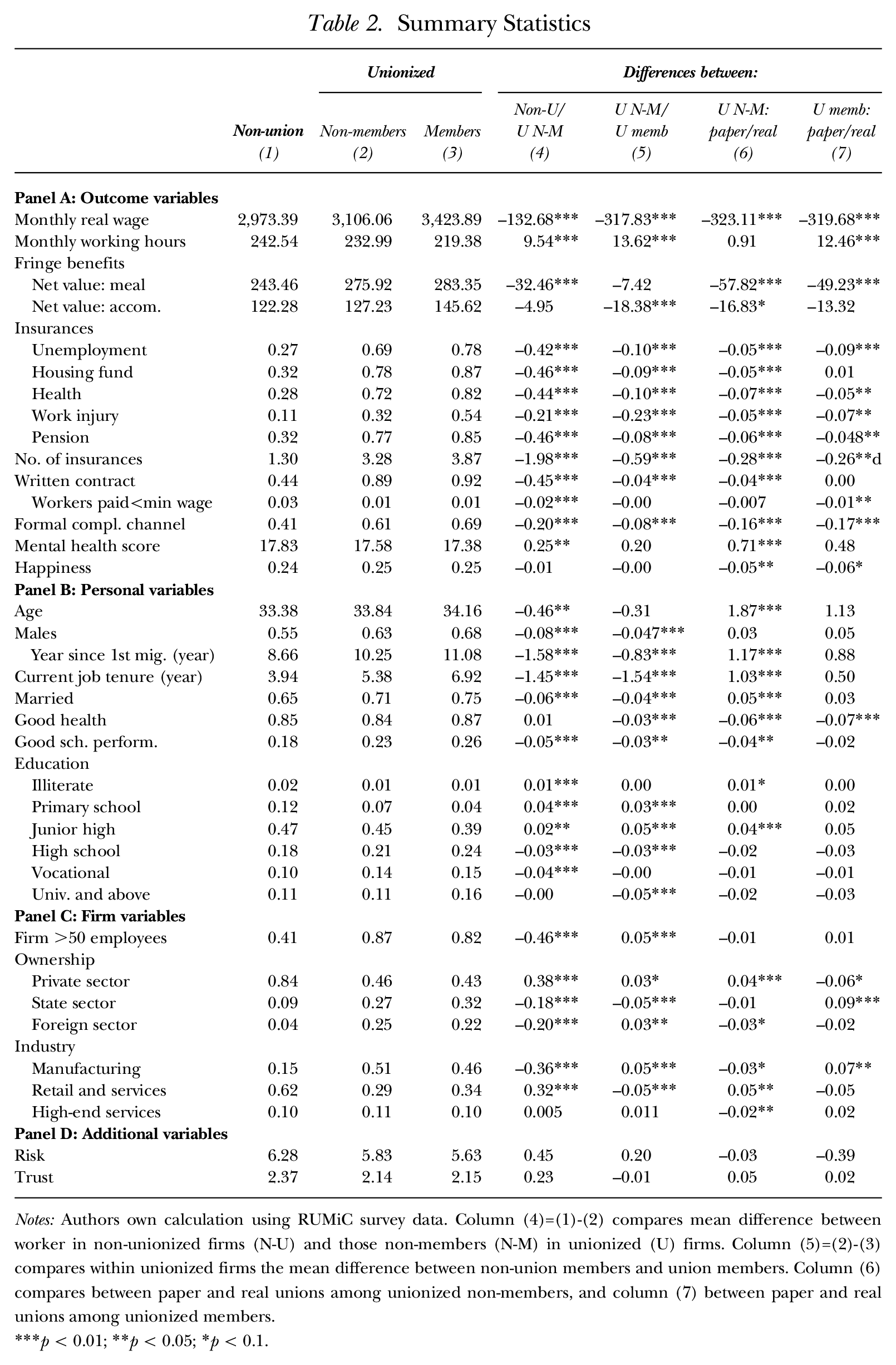
Notes: Authors own calculation using RUMiC survey data. Column (4)=(1)-(2) compares mean difference between worker in non-unionized firms (N-U) and those non-members (N-M) in unionized (U) firms. Column (5)=(2)-(3) compares within unionized firms the mean difference between non-union members and union members. Column (6) compares between paper and real unions among unionized non-members, and column (7) between paper and real unions among unionized members.
p < 0.01; **p < 0.05; *p < 0.1.
Table 2, panel A, reports all outcome variables, including earnings; hours worked; social insurance participation, meals, and accommodation subsidies provided by the workplace (labeled fringe benefits); whether individuals have a written contract; whether they have a formal channel for complaints when they face unfair treatment at work; their mental health scores (the higher the score, the worse the mental health); and whether workers regard themselves as being very happy or not.
From this panel, we observe that 1) union members and non-members in unionized workplaces are doing much better than workers in non-unionized workplaces for almost all outcome variables; 2) unionized members are doing better still than unionized non-members; and further, 3) among unionized workplaces, both members and non-members in workplaces with real unions are doing better than workers in workplaces that have paper unions.
Workers in unionized workplaces earn significantly more real wages per month than their counterparts in non-unionized workplaces, despite the fact that workers in unionized workplaces work fewer hours than those in non-unionized workplaces. Further, the earnings differentials between workers in workplaces with paper unions and real unions are just as large as between non-unionized and unionized workplaces, if not larger.
In terms of social-insurance participation, the table shows that in all five categories of social insurance, workers in non-union workplaces have the lowest coverage rate, followed by those in unionized workplaces who are non-union members, and then, the union members. Among non-unionized workers (accounting for more than 80% of the total migrant workers), 56% have not been provided with a written contract, whereas in unionized workplaces the ratio of written contract coverage is 89% for non-members and 92% for members.
At the bottom of panel A, we compare three subjective outcomes: 1) proportion of people who, when facing unfair treatment at work, would find a formal channel to complain; 2) the mental health scores based on individuals’ own answers to the 12-item General Health Questionnaire (GHQ-12, see Online Appendix Table A.2 for full list of questions); and 3) proportion of people judging themselves to be very happy. Regarding formal complaint channels, we find consistent differences with the highest proportion of people reporting formal complaint channels among union members in real unions. This is followed, in descending order, by non-union members in workplaces with real unions, members in paper unions, non-members in paper unions, and workers in non-unionized workplaces. In terms of mental health score and happiness, workers in paper unions are doing worse than workers in non-unionized workplaces, but workers in real unions are doing much better.
Panel B of Table 2 compares individual characteristics across the five groups of workers. While by and large they are around the same age, workers in union-covered workplaces have 1 to 2 years longer city work and current job work experience. Among members, not many differences are observed on their characteristics. Among unionized non-members, however, people in paper unions are older, have longer work experiences, are more likely to be married, and are less likely to have performed well at school. Migrants in unionized workplaces (both members and non-members) are also more likely to be male relative to their non-unionized counterparts. They are better educated and with better school performance. At the bottom of Table 2 (in panel D) we also present two normally unavailable measures, namely risk-loving and trust. For these two measures we do not find meaningful differences across any comparison groups.
With regard to firm characteristics, we show (see panel C of Table 2) that unionized workplaces are much larger, more likely to be foreign-owned or state-owned, and more likely to be in manufacturing. However, relative to workplaces where unionized non-members work, union members in smaller workplaces are less likely to be in foreign-owned firms, and less likely to be in manufacturing and are instead in retail or services firms. In fact, more than one-third (34%) of union members are in retail-service workplaces.
In Online Appendix B, Figure B.1, we present profiles of unconditional age earnings and year-of-migration earnings. These show that workers in unionized workplaces and those who are union members earn more at all ages and regardless of time since moving to a city. 9
Model and Estimating Strategy
To investigate if trade unions are able to protect the welfare of rural-urban migrants, we estimate the following equation:

where
Ordinary least squares (OLS) estimation of Equation (1) omits estimation of
In addition, there is potential for negative selection. If the ACFTU’s unionization strategy focuses mainly on firms treating workers badly, it is likely that unionized firms for migrant workers are lower-end firms, which hire less-qualified (in terms of both observables and unobservables) workers. This type of negative selection could happen because workers in this type of firm exert more pressure on ACFTU by threatening to organize strikes or to establish unauthorized unions. In this situation it is possible that union status is negatively associated with unobservable characteristics of workers. Considering the case of paper unions formed simply to respond to the request of ACFTU, the firms’ and/or workplaces’ managements have no incentive or need to establish good industrial relations. In fact, firms treating workers poorly may be more likely to establish a paper union if they are compelled to set up a union. This type of firm and its workers could be negatively selected. If so, then OLS estimation of
The literature usually handles the potential endogeneity of union status using either an instrumental variable (IV) approach or a fixed-effects model (FE). Existing studies of Chinese union effects (all of which use either provincial-level or firm-level data) used as instruments the political links between party, union, and firms (Lu et al. 2010; Ge 2014) or the neighboring province union density (Budd et al. 2014). (How well these instruments meet the exclusion restrictions is debatable and beyond the scope of this article.) Our study is the first to examine union benefits using individual-level data for China and for rural-urban migrants. Unfortunately, exogenous variables affecting unionization at the individual level, but not directly affecting benefits received, are hard to come by. We therefore try several ways to gauge the degree to which our OLS estimates of
First, to limit the potential for unobservable characteristics to drive our results on union status premium (
Second, our data have a panel portion in which households were tracked from two to five years. Using these longitudinal data, we estimate the FE model. If we assume that any unobservable characteristics affecting individuals’ union status, earnings, and other benefits are time invariant, then by controlling for
Studies on trade unions commonly accept that FE models might underestimate the true union/non-union wage differential (see, for example, Freeman 1984; Booth 1995; Hirsch 2004; Koevoets 2007). This underestimation is mainly attributable to measurement error being a greater problem in FE calculations than in cross-section comparisons, given that the FE estimation relies on the generally small group of workers who change union status in the survey period (switchers), compared to the large number of union and non-union workers whose status remains unchanged. As Freeman (1984) showed, since measurement error in the union variable creates “false switchers,” a larger proportion of the FE sample than of the cross-section sample are subject to measurement error, which produces an underestimate of the coefficient on the union variable, ceteris paribus. Selection effects are more complicated. Cross-section estimates presumably overestimate the union wage differential because of the tendency for firms with high union wages to hire more able workers. However, FE estimates are likely to underestimate the effect among union-to-non-union switchers, since union workers will presumably move only to non-union firms paying exceptionally high wages rather than to a random non-union firm. Absent measurement error, and with large selection bias in cross-section studies, the FE may provide a more accurate estimate of the true union effect. With measurement error and modest selection bias, FE will underestimate the true union effect. All we know for sure from individual-level data is that FE estimates are invariably lower than cross-section estimates of union effects.
Union Benefits
We address our main question—are unionized workers in China largely protected—by examining earnings, fringe benefits, social welfare, hours worked, whether they have a written contract, and self-reported happiness.
Earnings: OLS and FE
Inactive paper unions often react to ACFTU’s requests by implementing only the minimum amount to protect workers’ benefits. These “minima” are defined by the Labour Law. The level of wages paid, as long as it is above minimum wage level, is something beyond the Labour Law’s stipulation. Thus, we expect very different behavior between paper and real unions for earnings outcome relative to other outcomes stipulated by the Labour Law.
Table 3 presents selected OLS estimates from Equation (1) with log monthly earnings as the dependent variable. (Full results are in Online Appendix E, Table E.1.) Panel A combines paper and real unions to estimate the union premium for unionized non-members and members, while panel B separately estimates the premium for unionized members and non-members in workplaces with paper unions and with real unions.
Selected Results from OLS Estimation of Union Earnings Premium
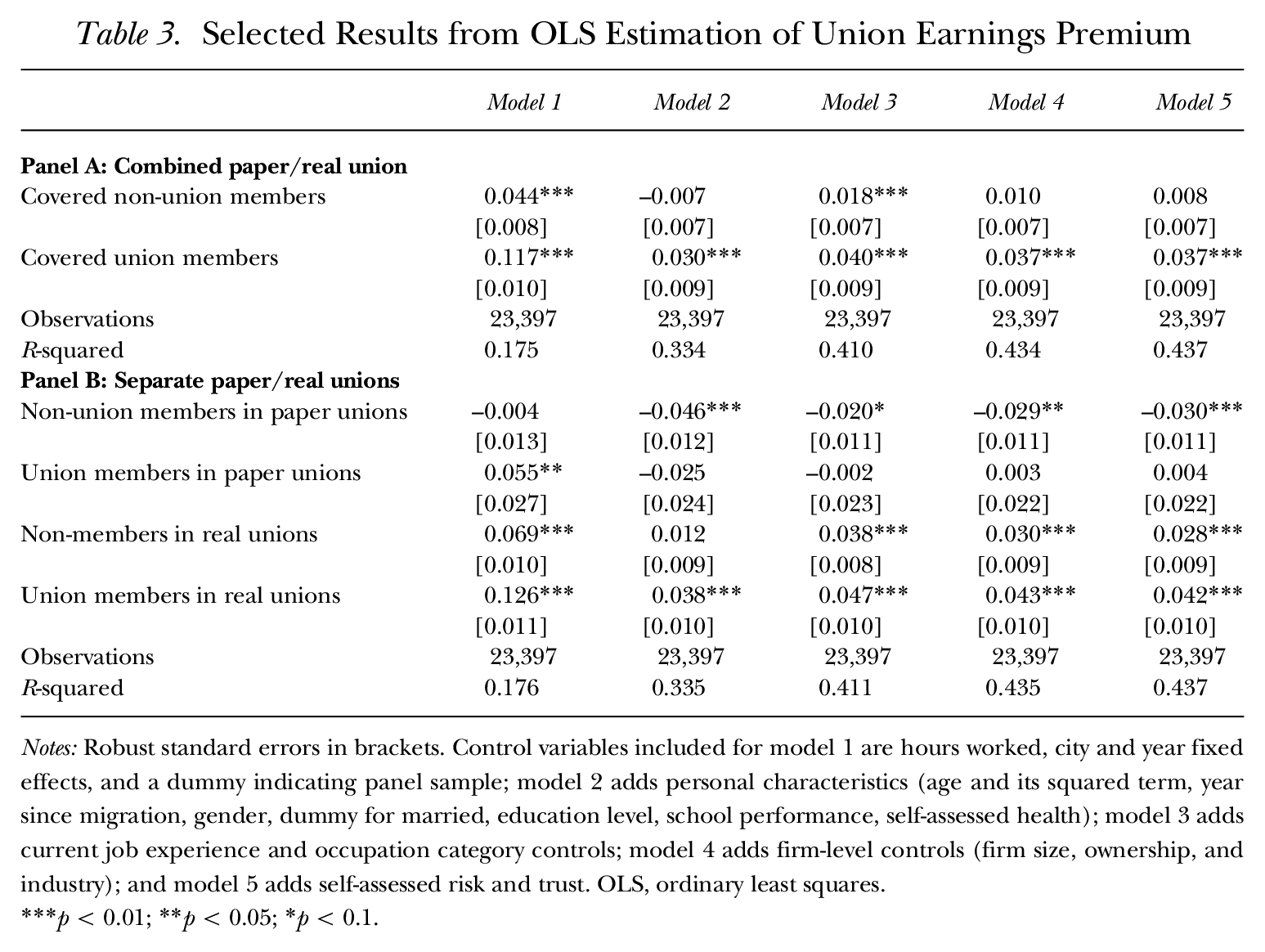
Notes: Robust standard errors in brackets. Control variables included for model 1 are hours worked, city and year fixed effects, and a dummy indicating panel sample; model 2 adds personal characteristics (age and its squared term, year since migration, gender, dummy for married, education level, school performance, self-assessed health); model 3 adds current job experience and occupation category controls; model 4 adds firm-level controls (firm size, ownership, and industry); and model 5 adds self-assessed risk and trust. OLS, ordinary least squares.
p < 0.01; **p < 0.05; *p < 0.1.
Monthly earnings are deflated by the city-level consumer price index (CPI), with 2012 set to 100. All five models control for hours worked, year and city fixed effects, and whether the individual belongs to that survey year’s new sample. Our main estimates of interest in panel A are the coefficients on the dummy variables of union-covered non-members and members. The reference group is workers in non-unionized workplaces. Since we control for hours worked, these coefficients reflect a union effect on the wage rate. Model 1 has no individual-, job-, or firm-level controls. The observed average wage premium for unionized non-members and members relative to non-unionized workers is 4.4% and 12%, respectively. Once additional controls are added, however, the premium for being non-members in unionized workplaces disappears. In particular, in model 2 when we added controls for individual characteristics, the coefficient on unionized non-members turned to 0, suggesting the 4.4% earnings advantage observed in model 1 is related to the better-observed characteristics of these individuals relative to those in the non-unionized workplaces (positive selection). 11 In model 3, as occupation and firm tenure are included in the regression, the coefficient increased to 1.8% and is statistically significant. It implies that these workers may have shorter job tenure, and their occupations are not very well rewarded relative to those in the non-unionized workplaces. But, in model 4, with workplace-level characteristics included, the coefficient drops to 1% and becomes again statistically insignificant. Including additional personality traits in model 5 further reduces the coefficient to near 0. Thus, considering all observable characteristics, being a non-union member in a unionized workplace does not provide earnings benefit. In other words, being in unionized firms does not bring additional earnings, and the unconditional earnings advantages can be explained away by the individual, job, and firm characteristics. The main forces eliminating the unionized non-member premium are individual characteristics and the type of firms individuals choose to work in. These results, however, could be contaminated by negative selection on unobservables of paper unions. Indeed, when we separately estimate unionized non-members in firms with paper and real unions (panel B of Table 3), we find that, relative to workers in non-unionized workplaces, workers in workplaces with paper unions earn 3% less (column (5) in panel B), whereas those in real unions earn 2.8% more. This finding is a clear sign that workplaces with paper unions differ from real unions in terms of earnings.
With regard to union members in unionized workplaces, panel A of Table 3 shows that adding individual characteristics reduces approximately three-quarters of the unconditional earnings advantages relative to the non-unionized workers, from 12% to 3%. But as long as individual characteristics are controlled for, adding job- and workplace-level characteristics or additional personality traits does not further reduce the union membership premium. If anything, it improves it slightly. Model 5 shows that union members are paid a 3.7% premium relative to workers in non-unionized workplaces. Differences also occur between paper and real unions for members: While members in paper unions earn roughly the same as those in non-unionized workplaces, standardizing for individual-, job-, and workplace-level characteristics, union members in real unions earn 4.2% more than workers in non-unionized workplaces (column (5) in panel B).
Our results so far suggest that perhaps there is selection on observable characteristics for both unionized non-members and members. It may also indicate that, if the main selection occurs at the individual level, studies using firm-level or provincial-level data would find it hard to eliminate the selection bias. Indeed, Ge (2007) and Yao and Zhong (2013), using firm-level data, documented 10% and 12.6% average higher wages for unionized firms. (Notwithstanding, their studies are about firm average wages including both urban workers and migrant workers.) We observe this level of premium for union members if we control only for firm characteristics.
To further understand the extent of selection bias affecting our estimates, we turn to the panel sample. Panel data allow us to estimate fixed-effect models that control for time-invariant, unobserved individual characteristics. As only around two-thirds of our sample are tracked over time, we estimate both OLS and FE models for this panel sample to allow for a meaningful comparison. Table 4 presents selected results from our estimation of models 1 and 5 in Table 3. Panel A combines both paper and real union samples, while panel B separately estimates the premia for unionized non-members and members in firms with paper and real unions.
Panel Sample: Selected Results from OLS and FE Wages Equations
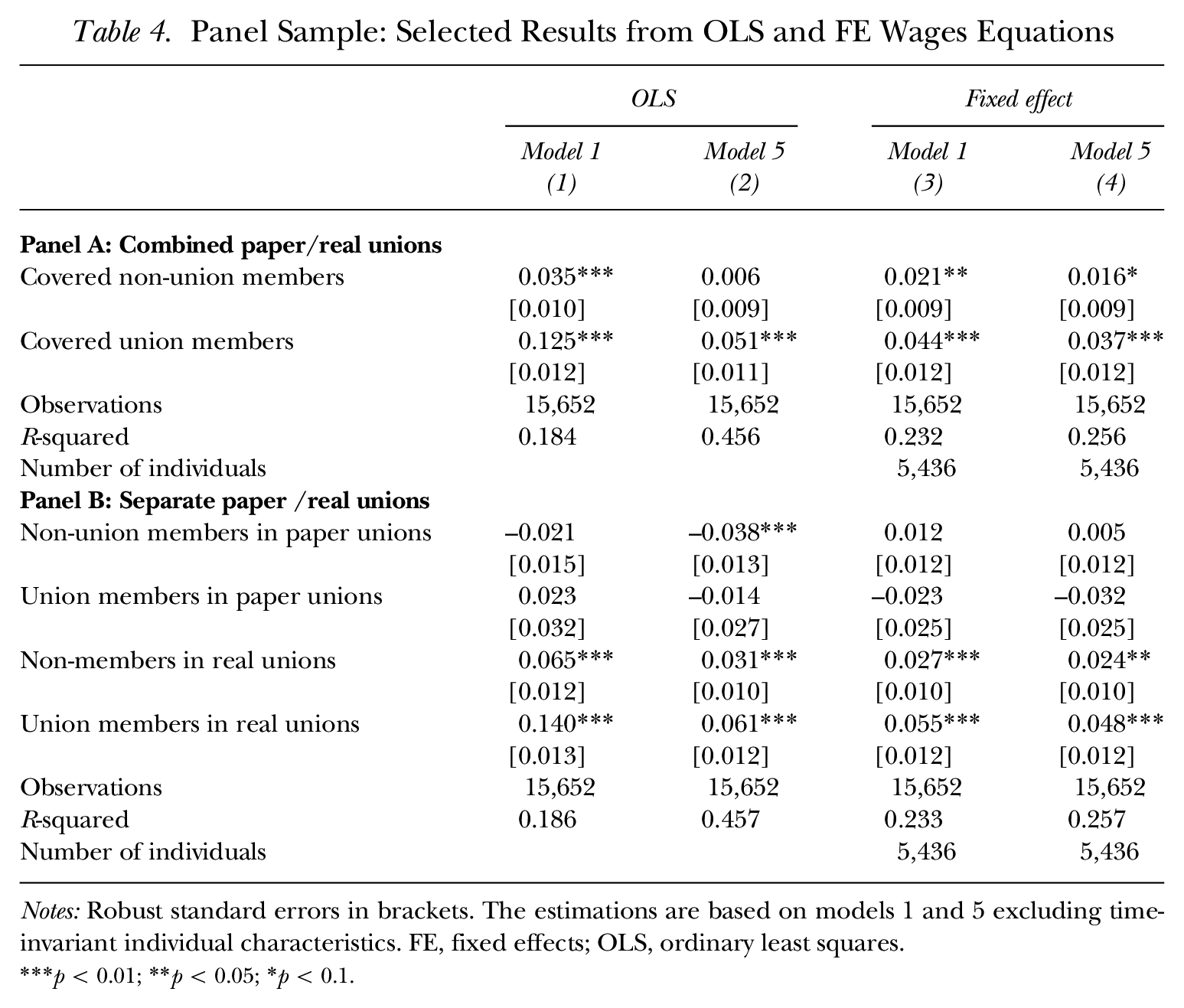
Notes: Robust standard errors in brackets. The estimations are based on models 1 and 5 excluding time-invariant individual characteristics. FE, fixed effects; OLS, ordinary least squares.
p < 0.01; **p < 0.05; *p < 0.1.
For the panel sample, OLS estimates of union premia are larger than those using the full sample. Based on panel B results, workers who are unionized non-members and members in real unions earn a 3.1% and 6.1% premium as opposed to a 2.8% and 4.2% for the total sample, respectively. Controlling for individual fixed effects, the premia for the two groups of workers reduced to 2.4% and 4.8%, respectively, a 15% to 20% reduction, suggesting small positive selections. For non-union members in firms with paper unions, however, fixed-effect model estimates switched a negative 3.8% and significant premium to a near 0 estimate, a clear indication of negative selection. Thus, if we do not separately estimate paper and real union non-member premium, we would barely obtain the positive 1.6% return by controlling for the negative selection. But the separate estimation reveals that the returns to inactive paper union non-members is 0 whereas to real union non-members it is a positive 2.4%.
In addition to the negative selection issue, we have the issue of measurement error discussed in Freeman (1984). In our case, given the existence of the inactive paper unions and the disadvantaged position of migrant workers in Chinese cities, it is very likely that many workers may be unaware of whether their firms have a union. If so, there will be misreporting of union status in our data. According to a separate survey about a unionized firm, only 42% of its workers knew if their firm has a firm-level union. 12 Thus, relative to a normal misreporting problem in any survey, our data may suffer from more of a measurement error problem. Thus, although correcting for negative selection (separately estimating paper and real union premia), FE models have provided us with larger union premium for covered non-members, and these estimates could still be lower bound estimates. The same goes to the covered union members, as explained in Freeman (1984).
Other Benefits: OLS and FE
We now present the results for other benefits, including hours worked, log of total fringe benefit (meal plus housing subsidies), number of firm-paid social insurances, whether the individual has a written contract, the number of hours worked in an average week, having a formal complaints channel when unfairly treated, and whether the individual feels happy taking into account all aspects of his or her life. For simplicity, estimation in this subsection focuses mainly on the panel sample with separate paper and real union status.
Table 5, panels A and B, respectively, present the OLS and FE estimation coefficients on the union status variable from estimating model 5. Some of the outcomes are requirements of firms through the Labour Law, such as social insurance and written contracts; others are not. We expect that for outcomes not stipulated by the Labour Law, larger gaps should be between paper and real unions. By contrast, we expect that for insurance and contract, which are the minimum requirements of the law, the difference in coverage rates between paper and real unions should be smaller. By and large, these results are what we find and present in Table 5.
Selected Results from FE Estimations for Other Benefits

Notes: Robust standard errors in brackets. The estimations are based on model 5 specification. The happiness question was only answered by people who were present at the time of the survey. Hence the sample is smaller than our normal panel sample. FE, fixed effects; OLS ordinary least squares.
p < 0.01; **p < 0.05; *p < 0.1.
Standardizing for all individual-, job-, and workplace-level characteristics, panel A shows that non-members or members in firms with paper unions are on average receiving 30% and 40% more fringe benefits relative to workers in non-unionized workplaces, whereas their counterparts in real unions receive 70% to 100% more fringe benefits. Also, with regard to having access to the formal complaint channel when being unfairly treated and feeling very happy about their life, the advantages are greater being in the real unions as compared to being in paper unions. By contrast, we observed very small gaps in the advantages of the number of social insurance coverages and having a written contract between those in the firms with real unions and those with paper unions. For hours worked, though, the pattern is not very clear.
The FE model (panel B) generally reduced the magnitude of coefficients for most outcome variables, but the general pattern observed from OLS estimation remains. That is, for the legally required provision of benefits, paper and real unions provide a similar level of benefits. For outcomes beyond legal requirements, however, active real unions provide higher levels of benefits. After controlling for individual fixed effects, the difference in hours worked between non-unionized workers and unionized members and non-members largely disappeared.
Another striking result when comparing OLS and FE estimation is the coefficient on happiness. For union members in active real unions, the coefficient almost doubled in size. Thus, relative to workers in firms without union coverage (and everybody else for that matter), union members in real unions are 7% more likely to be very happy when considering all aspects of their life. One interesting finding from comparing OLS and FE results is how FE estimation reduces the advantages of the union-covered members over non-members in every aspect except for happiness. Relative to other outcome variables, happiness is a comprehensive measure regarding how the individual feels about all aspects of life. It may be related to personality. It is possible that union membership is negatively selected on some personalities, which are associated with happiness. For example, a recent psychological study found that extroversion is negatively associated with happiness (Pishva, Ghalehban, Moradi, and Hoseini 2011). Controlling for these personality measures, we observe a positive boost in the effect of union membership on individuals’ happiness. Possibly extroverted people are more likely to join unions and more likely to receive higher earnings. Thus, controlling for personality (FE model) reduces the union earnings premium, but increases the union effect on happiness.
But what is it about the union that makes its members happier? We examined the degree to which each of the above-examined union benefits may diminish the happiness of members in real unions. To do so, we add each benefit variable into the FE happiness equation one at a time and observe how this changes the coefficient of real union membership on happiness. The results are in Online Appendix F, Table F.1. Of the six examined outcome variables, three benefits are positively and significantly associated with happiness: log real earnings, the number of insurances paid by the firm, and the written contract. However, none of them managed to wash away the positive significant effect. Once mental health score (GH12 excluding happiness score) is included, the statistically significant real-union membership effect dropped in magnitude, though it is still quite large and statistically significant. We next add all six benefit variables in the regression in addition to the model 5 specification. This “explains” away 0.7 percentage points of the real union membership effect on happiness. Adding mental health score further “explains” away 0.2 percentage points. Among the seven potential channels, number of insurances, written contract, and mental health are still individually statistically significant. Finally, given that mental health is such an important variable relating to happiness, we relate all the other six benefit variables (in addition to model 5 specification) to mental health. It turns out that, in addition to earnings, the next variable that affects mental health the most is whether individuals have an official channel to complain about being unfairly treated at workplaces. This finding likely reflects the importance of having a voice in the employment relationship.
Sensitivity Test
Our definition of paper union so far is based on whether individuals stated that the union in their workplace does not provide help to workers. This wording may not fully reflect if the workplace union is active. In this subsection, we test the sensitivity of our results by expanding our definition of paper union to incorporate how union leadership is appointed.
Our first alternative definition of what constitutes a real union includes not only workplaces whose unions provide help to workers (our original definition) but also all workplaces whose union leaders were appointed by 1) workplace leaders; 2) workplace leaders together with workers; or 3) by workers themselves, even though they may not be regarded as providing help to workers. In other words, the real union is defined here as unions whose leaders were appointed by people within the workplaces (leader alone, leader and workers jointly, or workers alone) and/or are regarded as providing help to workers. The reason for including this additional group is that they may not be the unions set up only in response to ACFTU’s request.
The second alternative definition excludes all unions whose leaders were appointed by people from above the workplace, including those whose unions are regarded as providing help to workers. In other words, the real union is defined here as unions whose leaders were appointed by people within the workplaces (leader alone, leader and workers jointly, or workers alone).
The FE results for all the outcome variables, with the alternative definitions for paper versus real unions, are presented in Online Appendix G, Table G.1. The results using both alternative definitions are largely consistent with what we observed from using our original definition.
Our results suggest that workers in unionized firms receive not only a sizable premium in most welfare measures but also that union members are paid a premium relative to their non-member counterparts. A question naturally arises as to why we observed union members receiving premia even though unions do not have an incentive to treat members and covered non-members differently. In the background section we hypothesized possible reasons: union activities that are exclusive to members may be welfare-improving; union members might be more prevalent in active unions; union members may have more opportunities to be promoted, and so forth. While some of these hypotheses cannot be tested here owing to lack of information, we can examine whether the observed membership premium is due to earnings variation across workplaces. If union members are more likely to be found in active firms, which in turn appears in our estimation as a membership premium, within-firm estimation should allow us to eliminate this effect. To gauge this possibility, we estimate the same earnings equations using a sample of people who have not changed jobs since 2011 (a year before our panel started) and who stayed in our panel for the third, fourth, and fifth waves. This sample, combined with individual fixed effects, gives us the effect of premium due entirely to people switching their union status within a firm. The results are largely consistent with our full sample findings, suggesting the difference may not be attributable to firm effects. These results are in Online Appendix H, Table H.1.
Conclusion
The past 40 years have seen China becoming the world’s factory. Understanding whether China’s trade unions are able to protect its most vulnerable workers in this world factory is an important industrial relations issue that previous union studies of China have been unable to address owing to data limitations.
Our results, using data from six waves of the RUMiC Survey, indicate that rural-urban migrant workers benefit from working in a union-covered workplace, but only if the union is active. Firms with inactive paper unions do not protect workers beyond what the Labour Law stipulates them to do.
For active real unions, union members and non-members enjoy positive premia on wages, insurances, fringe benefits, and the probability of having a written contract. Given this, workplaces with real unions likely help to pre-empt spontaneous collective action and social unrest. This preventive role is because workers in workplaces with active real unions may be more likely than non-union workers, or workers in firms that only have paper unions, to communicate to the official organization any dissatisfaction with working conditions. For inactive paper unions, union workers do have protections over the minimum legally required benefits, such as social insurance coverage and written contracts. Beyond these, workers in paper unions are treated almost the same as workers in non-unionized firms and workplaces. Our fixed-effect estimations suggest that these results are largely causal.
Unions in China do not have incentives to treat covered non-members and union members dissimilarly because their funding is mainly from governmental subsidy and employer contributions. Also, funding is based on the number of workers in workplaces and firms rather than on the number of union members. Yet we observe consistently larger premia for union members on wages, insurances, and fringe benefits when comparing union members and union-covered non-members. The membership premium is particularly remarkable for wages, for which the advantage for the members is twice as large as for the non-members. Finally, consider happiness and mental health: Migrant union members are not only better paid and have better fringe benefits and other social insurance coverages, they are also happier than migrant workers in non-unionized firms. Moreover, many union-membership benefits contribute to union members being happier than their counterparts in non-unionized firms. Further, having a formal complaint channel is important to workers’ mental health.
Several questions remain. First, might our findings for rural-urban migrant workers apply to all Chinese workers? Clearly our data do not allow us to address this. However, studies using firm-level data from firms employing urban and migrant workers have found similar effects to ours when estimating the impact of unions on earnings, hours worked, and social insurance participation (Yao and Zhong 2013; Ge 2014). Second, are our findings likely to be replicated beyond 2016, the last date for which we have information? The only study we found using more recent data, from 2017, reached the same conclusion as ours: that unions seem to play a positive role in protecting workers’ benefits (Zeng and Chen 2020). We are unable to gauge the union situation beyond 2017. Howell and Pringle (2019) compared Chinese industrial relations before and after 2013 and concluded that no fundamental change had occurred in the policy of urging the ACFTU to represent workers’ interests. While recent work by Kuruvilla (2018) suggested that the environment in China for labor scholars is probably becoming less friendly in recent years, whether this is detrimental to workers’ interests remains to be seen. We hope that future research will address these interesting questions.
Supplemental Material
sj-pdf-1-ilr-10.1177_00197939211004440 – Supplemental material for Trade Unions and the Welfare of Rural-Urban Migrant Workers in China
Supplemental material, sj-pdf-1-ilr-10.1177_00197939211004440 for Trade Unions and the Welfare of Rural-Urban Migrant Workers in China by Alison Booth, Richard Freeman, Xin Meng and Jilu Zhang in ILR Review
Footnotes
Appendix
Sample Elimination and Sample Distribution
| 2012 | 2013 | 2014 | 2015 | 2016 | Combined | |||||||
|---|---|---|---|---|---|---|---|---|---|---|---|---|
| Obs | % | Obs | % | Obs | % | Obs | % | Obs | % | Obs | % | |
| Initial sample | 10,394 | 10,619 | 11,074 | 10,998 | 11,141 | 54,226 | ||||||
| Not in working age | 1,696 | 0.16 | 2,198 | 0.21 | 2,528 | 0.23 | 1,973 | 0.18 | 2,070 | 0.19 | 10,465 | 0.19 |
| Remaining observations (obs) | 8,698 | 8,421 | 8,546 | 9,025 | 9,071 | 43,761 | ||||||
| Subjects are not working | 1,127 | 0.13 | 1,054 | 0.13 | 1,051 | 0.12 | 1,029 | 0.11 | 1,070 | 0.12 | 5,331 | 0.12 |
| Remaining observations | 7,571 | 7,367 | 7,495 | 7,996 | 8,001 | 38,430 | ||||||
| Subjects are self-employed | 2,530 | 0.33 | 2,738 | 0.37 | 2,919 | 0.39 | 3,126 | 0.39 | 3,114 | 0.39 | 14,427 | 0.38 |
| Remaining observations | 5,041 | 4,629 | 4,576 | 4,870 | 4,887 | 24,003 | ||||||
| Others | 5 | 0.00 | 92 | 0.02 | 78 | 0.02 | 107 | 0.02 | 104 | 0.02 | 386 | 0.02 |
| Monthly wage <500 or >20,000 | 30 | 0.006 | 50 | 0.010 | 49 | 0.011 | 45 | 0.009 | 46 | 0.010 | 220 | 0.010 |
| Final working sample | 5,006 | 4,487 | 4,449 | 4,718 | 4,737 | 23,397 | ||||||
| Representative | 1,929 | 0.38 | 1,573 | 0.35 | 1,623 | 0.37 | 1,796 | 0.38 | 1,568 | 0.33 | 84,789 | 0.36 |
| Panel | 3,077 | 0.62 | 2,914 | 0.65 | 2,826 | 0.63 | 2,922 | 0.62 | 3,169 | 0.67 | 14,908 | 0.64 |
Notes: Authors’ own calculations from the RUMiC survey data.
For information regarding the data and/or computer programs used for this study, please address correspondence to
1
The ACFTU, established in the 1920s as part of the communist movement, was made illegal by the Nationalist government in 1927. After the Chinese Communist Party (CCP) came to power in 1949, the state became the owner of all property, and trade unions’ collective-bargaining function was deemed redundant. The ACFTU’s role was reduced to providing day-to-day welfare, such as distributing movie tickets in work units.
2
The earliest report of “paper unions” is here: http://news.sina.com.cn/c/2003-09-04/0905688243s.shtml. Since then, many papers discuss the existence of paper unions and contrast their role in the Chinese labor market relative to that of “real unions” (see, for example, Liu 2010; Liu and Li 2014; Chan, Snape, Luo, and Zhai 2017). Paper unions are those existing only in name. They do not actively help workers by mitigating conflicts, representing workers in industrial relations negotiations, or by providing direct welfare to workers. In this sense, paper unions can be regarded as “failed unions.” However, the difference between Chinese paper unions and failed unions in the West is likely related to how Chinese unions were set up. Chinese unions were often formed at the ACFTU’s request. Firms themselves had no incentive to set up the unions. Failed unions have the undertone that the union organizers wanted to succeed but were unable to. This certainly is not the situation for most paper unions. We will discuss this further later in the article.
3
Relevant studies include Ge 2007, 2014; Lu, Tao, and Wang 2010; Yao and Zhong 2013; Budd, Chi, Wang, and Xie 2014; Anwar and Sun 2015; Gunderson, Lee, and Wang 2016; Song, Yang, and Yang 2016; Hu et al. 2018; Kuruvilla 2018; Wang and Lien 2018; and  .
.
4
5
Hukou is the household registration system used in China, which essentially identifies whether the person was born in an urban or rural area. The type of hukou determines what kind of public services a person is entitled to.
6
7
8
9
We also estimated a multinomial regression to examine the observable factors that affect individuals’ participation in unionized firms, being union members, and the types of unions in their firms (whether real unions or paper unions). The results, along with some brief discussion, are presented in Online Appendix C, Table C.1.
10
Selection into unionized versus non-unionized firms or firms with real or paper unions may be a two-way issue, however, in that not only might workers choose which firm to work for but firms also choose which worker to hire. While our individual-level fixed-effects model can control for the supply side of the selection bias conditional on certain assumptions (discussed above), it does not fully control for firm-/workplace-level unobservables. Since our survey is at the individual level, we are unable to control for firm-level fixed effects. Nevertheless, we control for all the information we have at the firm level.
11
This positive selection can also be confirmed by the multinomial regression results on selection into different categories of unionization (see Online Appendix C).
References
Supplementary Material
Please find the following supplemental material available below.
For Open Access articles published under a Creative Commons License, all supplemental material carries the same license as the article it is associated with.
For non-Open Access articles published, all supplemental material carries a non-exclusive license, and permission requests for re-use of supplemental material or any part of supplemental material shall be sent directly to the copyright owner as specified in the copyright notice associated with the article.
