



Abstract
Existing sociological theories of international relations yield contrasting predictions for their structure that range from an increasingly dense and universally tied network to networks in which ties tend to concentrate within or between certain types of economically, politically or culturally defined blocs. We contribute to this growing body of empirical research by analyzing original data on the complete worldwide network of bilateral investment treaties (BITs) as it has evolved over the course of 50 years since its inception in 1959. We find that the number of BITs increases almost exponentially over time to include nearly all of the world’s countries. However, the density of ties between advanced capitalist and others is stronger than for any other dyadic types. We also find patterns of regional homophily, but only in Asia, East Asia, Postsocialist Europe and Eurasia, and North Africa/Middle East. These findings suggest that existing explanations of globalization are more complementary than contending. Theorizing about any particular global outcome thus requires attention to the simultaneity of material and cultural forces and the interplay of transnational and local socio-historical developments. Our analysis of the structure of the BIT network also helps explain the weak link between foreign direct investment and BITs discovered in previous research.
Introduction
Beginning with the work of Snyder and Kick (1979), sociologists became increasingly interested in understanding both the determinants of international relations and the network structure formed by them (e.g. Beckfield, 2003, 2008, 2010; Clark, 2008, 2010; Lloyd et al., 2009; Mahutga, 2006; Mahutga and Smith, 2011; Smith and White, 1992; van Rossem, 1996; Zhao, 2010). This network turn in macro-comparative sociology also expanded scholarly attention beyond material flows to the structure of networks formed by cultural flows and co-membership in international organizations. The findings of this research point to seemingly contradictory structures of globalization, ranging from arguments about near universal adoption of global cultural scripts (e.g. Meyer et al., 1997), to clustering around culturally homogenous regions (e.g. Beckfield, 2010) to hierarchical structures in which a handful of ‘core’ states occupy positions of high power and status vis-à-vis other actors in the network (e.g. Lloyd et al., 2009). One obvious question raised by this literature is to what extent are structures of international relations impacted by universalistic, culturally homophilous and hierarchical processes simultaneously?
To shed light on this question, this article conducts a structural analysis of globalization by focusing on the evolution of the network of states formed by their dyadic adoption of bilateral investment treaties (BITs) over the course of 50 years, beginning in 1959. Studies of the consequences of foreign direct investment (FDI), widely recognized as one of the principal components of contemporary globalization, are common in sociology (e.g. Alderson and Nielsen, 1999; Beer and Boswell, 2002; Bornschier and Ballmer-Cao, 1979; Bornschier and Chase-Dunn, 1985; Bornschier et al., 1978; Chase-Dunn, 1975; de Soysa and Oneal, 1999; Dixon and Boswell, 1996; Evans and Timberlake, 1980; Firebaugh, 1992; Kentor, 1998, 2001). The wide interest in FDI is understandable given the surge in FDI around the world, with world stock reaching almost $18 billion in 2007. Indeed, in addition to the consequences of FDI, sociologists have also tried to understand its determinants (Alderson, 2004; Bandelj, 2002, 2008; King and Varadi, 2002; London and Ross, 1995; Schofer and Granados, 2006).
Yet, it seems surprising that no sociological study examines the structure of BITs, which provide the institutional infrastructure that accompanies international investment, and are considered ‘the principal international investment agreements’ addressing issues related to foreign investment between signatory countries (Sauvant and Sachs, 2009: 10). The body of non-sociological literature that does examine BITs tends to focus upon the link between BITs and actual flows of foreign investment, and provides some rather surprising results. Despite the fact that BITs are designed to promote dyadic flows of FDI, the empirical literature – studies that typically regress aggregate FDI on BIT counts – finds a weak or even insignificant link between BITs and FDI (Gallagher and Birch, 2006; Peinhardt and Allee, 2012; Yackee, 2008; for summary review, see Sauvant and Sachs, 2009). Thus, an examination of the structure of the BIT network may shed light on this puzzle.
The inconclusive relationship between FDI and BITs is also puzzling because the rise of bilateral investment treaties around the world is as substantial as the rise of FDI flows. The first BIT was signed in 1959 between Germany and Pakistan. By 1969, 71 treaties had been signed, almost exclusively between advanced capitalist countries and African and Middle Eastern developing countries. The 1990s saw a rapid increase in the number of bilateral investment treaties, rising from 386 in 1989 to 1813 in 1999, and reaching 2678 by 2009. Figures 1 and 2 show these extraordinary growth trends in BITs, despite regional economic downturns in the early 2000s and the worldwide economic crisis since the end of 2007, both of which have influenced stagnation or sharp declines in FDI flows. The number of countries involved in bilateral investment treaties also increased to a near universal inclusion: by 2009, 188 sovereign states and the Palestine Authority had signed at least one BIT, out of 192 states recognized by the United Nations.
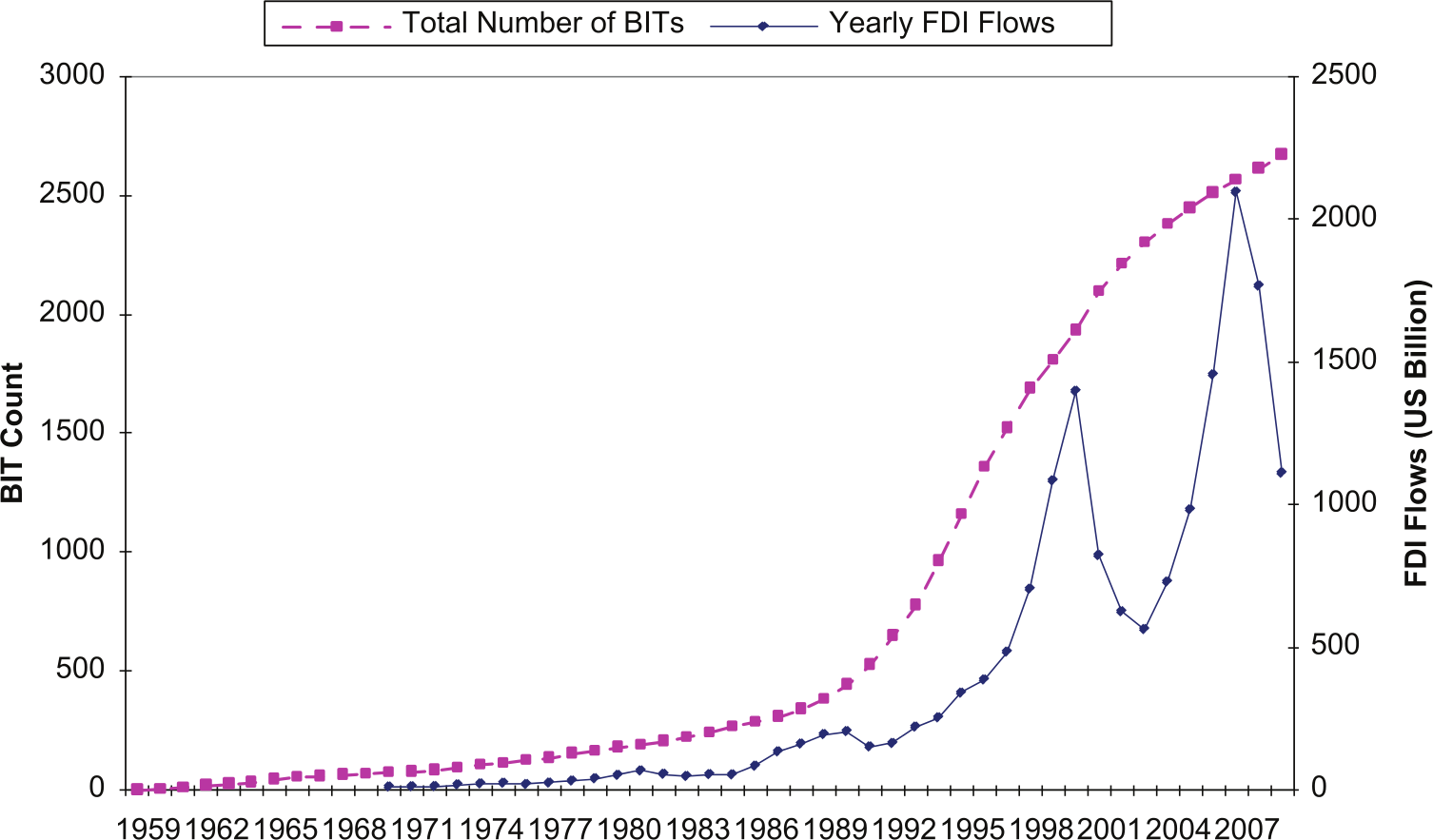
BITs and world FDI inflows per year, 1959–2010.

BITs and world FDI stock per year, 1959–2010.
In addition to explicating the purportedly weak link between FDI flows and BITs, our examination of the BIT network allows us to contribute to sociological research on the structure of international relations in a number of ways. The first is due to the dual nature of BITs. On one hand, BITs define the terms of investment relations among firms in two specific countries and are thereby explicitly not multilateral agreements. In other words, while the discourse surrounding BITs implies they are designed to increase transnational interconnectedness, in practice they are instruments for particularization of state relations. On the other hand, the amazing growth in the bilateral adoption of BITs implies that institutional arrangements that govern international investment have begun to diffuse worldwide.
The dual nature of BITs thus allows for a unique re-examination of some of the findings from previous structural analyses of international relations. Indeed, does the BIT network reflect a trend toward a universal, flat global world (Friedman, 2006)? Or, does it reflect a more regionalized one that very recent examinations of the structure of the world-polity seem to suggest (Beckfield, 2010)? Or, could it be that the BIT network is structured along the North/South divide, with only a few core states occupying centers of gravity? Alternatively, is it possible that globalization reproduces preexisting structural properties while it simultaneously creates new patterns of international relations that are more universalistic or regional, implying that multiple structures of international relations can co-exist in a globalized world? These are the central questions that we attempt to answer in this article.
The governance of foreign direct investment: Bilateral investment treaties
UNCTAD, the principal organization collecting BIT data, defines BITs as follows: Bilateral investment treaties (BITs) are agreements between two countries for the reciprocal encouragement, promotion and protection of investments in each other’s territories by companies based in either country. Treaties typically cover the following areas: scope and definition of investment, admission and establishment, national treatment, most-favoured-nation treatment, fair and equitable treatment, compensation in the event of expropriation or damage to the investment, guarantees of free transfers of funds, and dispute settlement mechanisms, both state–state and investor–state.
In short, BITs are designed both to promote greater flows of investment between countries, but also to establish the terms under which investment takes place and define the rights and responsibilities of both host governments and private investors.
The aims of BITs have stayed remarkable constant over the 50-year period, since the first treaty was signed in 1959. This is made evident if we compare the introductory text of one of the first treaties between Germany and Malaysia (signed in 1960) with that of the BIT between Germany and Jordan (signed in 2009).
‘Agreement Between the Federal Republic of Germany and the Federation of Malaya Concerning the Promotion and Reciprocal Protection of Investments,’ states that ‘The Federal Republic of Germany and the Federation of Malaya, desiring to foster and strengthen economic co-operation between the Federal Republic of Germany and the Federation of Malay, intending to create favourable conditions for investment by nationals and companies of either Contracting Party in the territory of the other Contracting Party, and recognizing that the contractual protection of such investments is likely to promote private business initiative and to increase the prosperity of both nations, have agreed as follows. . .’ (signed in 1960). ‘Agreement between the Federal Republic of Germany and the Hashemite Kingdom of Jordan concerning the Encouragement and Reciprocal Protection of Investments,’ states that ‘The Federal Republic of Germany and the Hashemite Kingdom of Jordan hereinafter referred to as the “Contracting Parties” – desiring to intensify economic co-operation between both States, intending to create favourable conditions for investments by investors of either State in the territory of the other State, and recognizing that encouragement and contractual protection of such investments are apt to stimulate private business initiative and to increase the prosperity of both nations – have agreed as follows. . .’ (signed in 2009).
The almost identical introductory text of the treaty signed between two developing countries from different regions, Guatemala and the Czech Republic in 2001, also attest to the broad uniformity of these treaties, even though they are bilateral as opposed to multilateral agreements.
‘Agreement Between The Republic of Guatemala and the Czech Republic for the Promotion and Reciprocal Protection of Investments,’ states that, ‘The Republic of Guatemala and the Czech Republic, hereinafter referred to as the Contracting Parties, desiring to develop economic cooperation to the mutual benefit of both, the Contracting Parties, intending to create and maintain favourable conditions for investments of investors of one the Contracting Party, in the territory of the other Contracting Party, and conscious that the promotion and reciprocal protection of investments in terms of the present Agreement stimulates the business initiatives in this field, have agreed as follows. . .’ (signed in 2001).
BITs thus fill a substantial void left by the absence of multilateral investment agreements.
The closest set of policies that might constitute a multilateral investment agreement come in the form of the OECD’s ‘Codes of Liberalization’ and ‘Guidelines for Multinational Enterprises’, both of which are significantly different from BITs in form and substance. 1 The most glaring differences arise in the ways the two instruments handle disputes. Nearly all BITs contain language that abdicates some of the sovereignty of host states because individual foreign investors, who feel their rights are violated, can seek international arbitration under the auspices of the International Center for Settlement of Investment disputes, rather than resort to suing in the host country’s national courts (Vandevelde, 2009). Indeed, several recent cases of BIT disputes resulted in significant penalties for host country governments. As Elkins et al. (2006: 824) write, ‘BIT arbitrations have given rise to a number of significant awards, including recent decisions against the governments of the Czech Republic ~$350 million, Lebanon ~$266 million, and Ecuador $70 million.’ Thus, the existence of a BIT between two countries gives private investors the legal wherewithal to address their grievances to a transnational institution, which has the authority to ameliorate the grievance by legislating compensation or other kinds of punitive sanctions.
On the other hand, the provisions on FDI within the OECD’s codes of liberalization are such that ‘[l]egally, individual citizens or enterprises of member countries can not directly invoke rights resulting from the Codes to invest abroad, move funds or provide cross-border services. . .’ (OECD, 2008: 14). Similarly, the provisions under the auspices of the OECD’s Guidelines for Multinational Enterprises are ‘recommendations addressed by governments to multinational enterprises operating in or from adhering countries. They provide non-binding principles and standards for responsible business conduct in a global context. . .’ (OECD, 2011: 4). While BITs offer explicit legal protections to firms in signatory countries, these frameworks do not. An even more striking difference between BITs and this multilateral framework exists with respect of enforcement mechanisms in the former. To the extent that grievances arise, the provisions on FDI within the OECD’s codes of liberalization rely on informal enforcement mechanisms such as ‘peer pressure’ and the ‘possibility of OECD council addressing ‘‘recommendations’’ to offending members’ (OECD, 2007: 133). Indeed, one OECD commentator summarizes the (lack of) enforcement mechanisms by noting that ‘the Code does not explicitly refer to the possibility of countermeasures against a Member which would breach its obligations’, and in practice ‘there have never been such countermeasures’. Instead, enforcement mechanisms are limited to ‘peer pressure, political persuasion and compromise solutions’ (Poret, 1998: 3).
In short, while BITs are legally binding and effectively abdicate a degree of host country national sovereignty by allowing foreign firms to sue nation-states under the terms of the BIT, and by shifting the judicial authority from domestic courts to third party transnational arbitrators, the multilateral framework for investment in the OECD is little more than a set of non-binding shared understandings that evolve over time in concert with multilateral discussions, and lack any real enforcement mechanism.
Theorizing the structure of the bilateral investment treaty network
BITs proliferated rapidly over time. Germany was the first to conclude a BIT in 1959 with Pakistan. Having lost its foreign investment as a result of its defeat in the Second World War, Germany was especially sensitive to the political risks to which foreign investment was exposed (Salacuse and Sullivan, 2005). Other Western European countries quickly followed Germany’s lead, including France, signing BITs with the Central African Republic, Chad, and Congo in 1960, and Switzerland, concluding a BIT with Tunisia in 1961. By the end of the 1980s, however, BITs became increasingly prominent. Indeed, fewer than 400 BITs were concluded in the 30 years from 1959 to 1989, but more than 2000 BITs were signed during the next 20 years. Several important developments contribute to this rapid growth. Indeed, by 2009, almost all of the world’s countries joined the BIT network (188 out of 192 UN member states, plus the Palestine National Authority). How well do current sociological theories on the structure of international relations explain the structure of the BIT network and its evolution over time? In order to address this question, we first review the sociological literature on international relations and globalization.
The world society and universal globalization
A prominent sociological perspective on international relations is the world-polity theory, which suggests that agents of the world polity construct and diffuse a rationalized and universalistic world culture, and thereby create an increasingly similar and interconnected world polity (Boli and Thomas, 1999; Frank et al., 2000; Meyer et al., 1997; see also Beckfield, 2010). According to this perspective, an active and dense network of international governmental (IGOs) and nongovernmental organizations (INGOs) diffuse certain principles of action, such as environmental sustainability or respect for human rights throughout the world-polity (Henisz et al., 2005; Ingram et al., 2005; Smith and Wiest, 2005; Torfason and Ingram, 2010). In the world culture perspective, these principles of action are considered scripts insofar as they are socially constructed by legitimizing institutions and carrier agents rather than intrinsically rational and efficient forms of behavior.
Indeed, a chapter of the United Nations, one of the central organizations in the population of NGOs that shape world-polity, plays a critical role in attempting to both construct and diffuse BITs as a policy script. UNCTAD, the UN’s chapter on trade and development, launched a BIT initiative supported by its Trust Fund on International Investment Agreement (financed by contributions from the European Commission, France, Germany, Japan, the Netherlands, Norway, Switzerland, and the United Kingdom) in the early 1990s. UNCTAD organized meetings at which interested countries could negotiate BITs, which often led to real treaty adoptions. At four meetings organized in 1999 and 2000, for example, 35 BITs were signed (UNCTAD, 2000). UNCTAD’s intervention is a concrete example of a more general process of institutional isomorphism across countries in which world polity actors frame bilateral investment treaties as a key feature of responsible state behavior, and promote their adoption to individual nation-states. In terms of structure of the BIT network, the worldwide diffusion of legitimate policy scripts should lead to an increasingly dense network of BITs, because countries worldwide aspire to sign BITs to align with the principles of desirable economic governance. Thus, the world polity perspective would predict that the BIT network has become increasingly dense (i.e. every state has a tie to every other state), and decentralized (i.e. every state has the same number of total ties) over time.
Materialist globalization and North/South relations
The world-society model of international relations is often framed as either orthogonal to, or in conflict with, explanations for international relations that prioritize the material and/or power differentials as the proximate cause of the structure of international relations. One of the more central perspectives in this vein is the world-systems perspective, which gave birth to the emergence of formal analyses of the structure of international relations as an explicit substantive focus in sociology (e.g. Snyder and Kick, 1979). Indeed, early world-systems scholars argued that the hierarchical division among the world’s countries and the international division of labor should have empirical implications for the structure of international relations (Frank, 1969; Galtung, 1971). In general, networks of international relations should belie an underlying structural divide between countries of the global South and those in the global North in which the former are relationally dependent on the latter (e.g. Babones et al., 2011).
For example, the bulk of the world-systems research on the structure of international relations investigates material flows between countries, such as international trade (Breiger, 1981; Clark, 2010; Mahutga, 2006; Mahutga and Smith, 2011; Nemeth and Smith, 1985; Smith and White, 1992). A defining feature of these investigations is the discovery of a ‘core/periphery’ structure. Core/periphery structures are characterized by a single component to which individual actors are more or less connected. In terms of international trade, the dominant pattern is one in which there is dense interaction between countries in the ‘core’, or global North, intermediate interaction between ‘semi-peripheral’ countries in the middle of the structure, and no interaction between ‘peripheral’ countries. Moreover, core countries tend to form asymmetrical ties (e.g. a trade surplus) with countries in the other two positions. Semiperipheral countries also form ties with the other two positions, but tend to carry a trade deficit with the core, but a surplus with the periphery. Peripheral countries tend to connect primarily with the core, and experience trade deficits. A recent review of this literature suggests that ‘a core/periphery interaction pattern appears to be a fundamental feature of cross-national trade data’ (Lloyd et al., 2009).
Indeed, the historical emergence and evolution of the bilateral investment treaty provides some insight into how the structure of the BIT network may depart from the flat world of universal globalization. The foremost legal expert of BITs, Kenneth Vandevelde (2009), argues that BITs emerged after the Second World War as part of a concerted effort among Northern economies to encourage economic liberalization under the assumption that protectionist policies of the pre-war period, such as the Smoot-Hawley Tariff Act intended to protect American business and farming by substantially raising tariffs on import-sensitive products adopted in the 1930 (Eckes, 1995), exacerbated the economic downturn before the war (Cooper, 1987; Meltzer, 1976). Thus, the US-led coalition of Northern economies signed the Bretton Woods Agreement in 1944, created the IMF and what is known today as the World Bank, and in 1947 established the General Agreement on Tariffs and Trade (GATT), devoted to the reduction of global trade tariffs, and general trade liberalization. During the GATT negotiations, there were also attempts to liberalize foreign investment with a multilateral agreement stipulated in the Havana Charter, but these negotiations failed.
At the same time, the wave of decolonization after the Second World War gave rise to newly sovereign, but economically underdeveloped, countries that were very protective of their independence (Sornarajah, 1994) and resisted foreign control over their productive assets (Gilpin, 1987; Hanink, 1994). In fact, according to Salacuse and Sullivan (2005), many developing countries closed their economies to new foreign investment and began to expropriate existing investments, including the seizure of petroleum assets in Iran (1951) and Libya (1955), and Castro’s expropriation of the private sector in Cuba starting in 1959. One study by the United Nations identified 875 expropriations occurring in 62 countries between 1960 and 1974 (Salacuse and Sullivan, 2005). Several BIT scholars claim that the threat of expropriation was the primary reason that developed countries created the bilateral investment treaty, since effective international law for the protection of foreign investment was lacking (Denza and Brooks, 1987; Dolzer and Stevens, 1995; Vandevelde, 2009).
It was against this backdrop – the failed attempt by Northern economies to institutionalize a multilateral program of investment liberalization that would have secured their outward expansion and the simultaneous wave of decolonization that gave birth to a host of Southern countries in which capital was scarce but anti-imperialist sentiment was high – that the first BIT was signed. That is, BITs emerged when Northern countries wanted to expand by investing abroad, but faced a population of Southern economies that did not share the same understanding of property rights as Western democracies even though their lack of capital might have provided some incentive to attract it. Unsurprisingly, the early pattern of BIT formation reflects this cleavage between the North and the South insofar as the first BIT was between a Northern (Germany) and Southern (Pakistan) economy, with many of the immediately subsequent BITs forming between former colonies and their colonizers.
For scholars who approach the structure of international relations from a materialist perspective, then, the most important organizing principle for the network arises from the higher allocation of capital and desire for economic expansion among Northern countries and their attempts to protect the property rights of their capitalists against state and non-state actors in the global South. In other words, the world-systems perspective would predict that the BIT network conforms to a bipartite network with dense ties between the North and the South but sparse ties within either group. This hypothesis is similar to the core/periphery network in predicting that countries outside of the North, or ‘core’ of the world-system, should occupy centers of gravity in the BIT network and sign BITs with most other countries while those in the South should form the majority of their ties with countries in the North. 2
Relational homophily and regionalization
The third perspective on the global structural form suggests that the world is neither becoming increasingly decentralized nor structuring along the North/South divide. Rather, the world is becoming increasingly regionalized over time as connections within regions become stronger than those between them. Indeed, the ‘regionalization thesis’ increased in popularity beginning in the 1980s (Bhagwati, 1992), during which major regional agreements were created, including the Southern African Development Coordination Conference (SADCC); the Preferential Trade Agreement of Eastern and Southern Africa (since 1981, and continued as Common Market for Eastern and Southern Africa since 1994); South Asian Association for Regional Cooperation (SAARC) founded in 1985; the Canada–US Free Trade Agreement (in 1988, expanding to the North American Free Trade Agreement in 1992); the Asia Pacific Economic Cooperation in 1989; MERCOSUR in 1991, the European Union in 1992 (with its roots in the Treaty of Rome of 1957); and the Greater Arab Free Trade Area (GAFTA) in 1997. Several important regional economic agreements were formulated before 1980, including the OPEC in 1965 and ASEAN in 1967. At its core, the regionalization hypothesis rest on the assumption that bilateral relations cluster along geographical, political and cultural lines so that similar countries are more likely to form bilateral relations than dissimilar ones. This reasoning is consistent with a fundamental premise in network theory, that of homophily, which states that similarity breeds connection (McPherson et al., 2001). While most network research on homophily examines networks of individuals, several scholars extend this reasoning to the level of countries (Bandelj, 2002; Zhou, 2011).
The cultural homophily argument can also be linked to Huntington’s (1996) clash of civilizations hypothesis. For Huntington, ‘peoples and countries with similar cultures are coming together [and] peoples and countries with different cultures are coming apart’ (p. 125), suggesting that the foremost determinant of international relations is cultural/religious similarity. Thus, Huntington imagines a world consolidated into nine distinct regional blocks, or ‘civilizations’ (Western, Latin American, African, Islamic, Sinic [Chinese], Hindu, Orthodox, Buddhist, and Japanese), which roughly correspond to geographical groupings. While Huntington’s essentialist understanding of culture is problematic, the regionalization hypothesis has nevertheless received substantial empirical support. Neil Fligstein, for instance, argues that political-economic integration in Europe is a more salient trend than globalization (Fligstein, 2008; Fligstein and Merand, 2002; Fligstein and Stone Sweet, 2002). Similarly, examining the structure of the world polity using IGO membership data between 1820 and 2000, Beckfield (2010) finds a trend in the world population of IGOs in which intra-regional ties are especially dense among European IGOs. Further, in a study of global trade spanning 1950 to 2000, Zhou (2010, 2011) finds that countries tend to favor their geographically and culturally proximate counterparts as partners in global trade, fostering regionalization, and that this trend increases with time. This is consistent with earlier work by Kim and Shin (2002: 464), whose test of the regionalization thesis using trade data found that ‘intraregional density was greater than interregional density and intraregional ties were stronger than interregional ties’ between 1959 and 1996. But, Kim and Shin (2002: 464) also concluded that ‘regionalization was not an even process’ with some regions showing stronger cohesiveness in trade than others.
Indeed, there are strong reasons to suspect that regionalization would be apparent in the BIT network, and that it would be a more important process in some regions than others. First, based on the previous work by Fligstein and Beckfield, we might expect a strong European network. Second, if the legitimacy of FDI as a development strategy is unevenly distributed worldwide, then some states might be more likely to sign regional BITs to attract FDI than others. For example, Bandelj (2009) argues that attracting FDI was especially important for the Soviet bloc countries where economic liberalization would propel market transformations. Indeed, one report suggests that treaties within the postsocialist European and Eurasian region rose from 10 to 23 percent of the total between 1993 and 1999 (UNCTAD, 2000). Alternatively, Latin American states had mixed experiences in their ability to leverage FDI flows into development outcomes, and therefore might be less inclined to pursue new inflows, and therefore less likely to sign BITs with other states both inside and outside Latin America (e.g. Frank, 1969). In structural terms, then, the regionalization hypothesis implies significantly higher intra-regional than inter-regional density, but we expect that some regional clustering will be stronger than others.
Data
Bilateral investment treaties
The data for these analyses come from the online UNCTAD database on BITs, which is the single most comprehensive source of BITs covering all the world’s countries. We present network statistics (density and centralization) using BIT matrices in every year from 1959 to 2009. We coded each dyad 1 if the two countries signed a BIT on or before the year in question, and zero otherwise. The regressions we describe below examine a subset of these years: 1969, 1979, 1989, 1999 and 2009. The countries on the rows and columns of our matrices represent the full list of sovereign UN nations as identified by the United Nations for the year in question, with the exception of the Palestine Authority. The Palestine Authority was established as an administrative unit, rather than a sovereign nation, in 1994 and is the only non-country that signs BITs.
Country regional and bloc assignments
In order to examine the pattern of investment treaties within and between groups of countries, we created a series of theoretically driven group designations that correspond both to geographical/cultural regions and the North/South divide. In our first analysis, we divide countries into a group of high status ‘Advanced Capitalist’ countries that include the wealthiest 19 members of the Organization for Economic Cooperation and Development (OECD), which together make up the global North, and another group called the global South that includes the rest of the countries. In subsequent analyses, we create two additional classifications. In order to test the regionalization thesis, we begin with regional designations that correspond to the five broad United Nations categories (see Beckfield, 2010): Europe, Africa, the Americas, Asia, and Oceania. However, supplementary analyses suggested that these five regions inadequately captured the underlying pattern of homophily in the BIT network, and that an additional three categories were necessary: Postsocialist Europe and Eurasia, North Africa and the Middle East, and East Asia. 3
Finally, our review of the world-polity, world-systems, and regionalization perspectives presents them as alternative explanations of the structure of globalization, as they have been treated as such in previous research. However, it is not inconceivable that structures of international relations are impacted by universalistic, regionally homophilous, and hierarchical processes simultaneously. Instead of juxtaposing cultural and material factors, theorizing about any particular global outcome may require attention to the simultaneity of material and cultural forces, as well as to the interplay between the transnational and local socio-historical developments. We will therefore also inductively examine the possibility that the structure of the BIT network will exhibit some universalistic, hierarchical and regionalization features simultaneously.
Thus, in order to test whether combining North/South divide and regionalization perspectives may be analytically more powerful than either of the two separately, we created a synthetic ‘treaty-bloc formation model’. We first disaggregated the global South into a series of regional designations: Europe, Africa, Asia, Latin America, Oceania, Postsocialist Europe and Eurasia, North Africa/Middle East, and East Asia and then reintroduced the Advanced Capitalist distinction. These regional designations are identical to those described above, except that Japan, the US, Canada, Western Europe, Australia, and New Zealand are in the Advanced Capitalist group. Tables 1 and 2 display a list of countries by regional and bloc designation, though not all countries are present in all years. The presence or absence of a country corresponds to the date of its proclamation of sovereignty and international recognition as indicated in the CIA Factbook on countries (in the 1959–1989 period) and membership in the United Nations (in the 1990–2009 period, when UN membership becomes synonymous with international recognition).
Country by regional assignments.
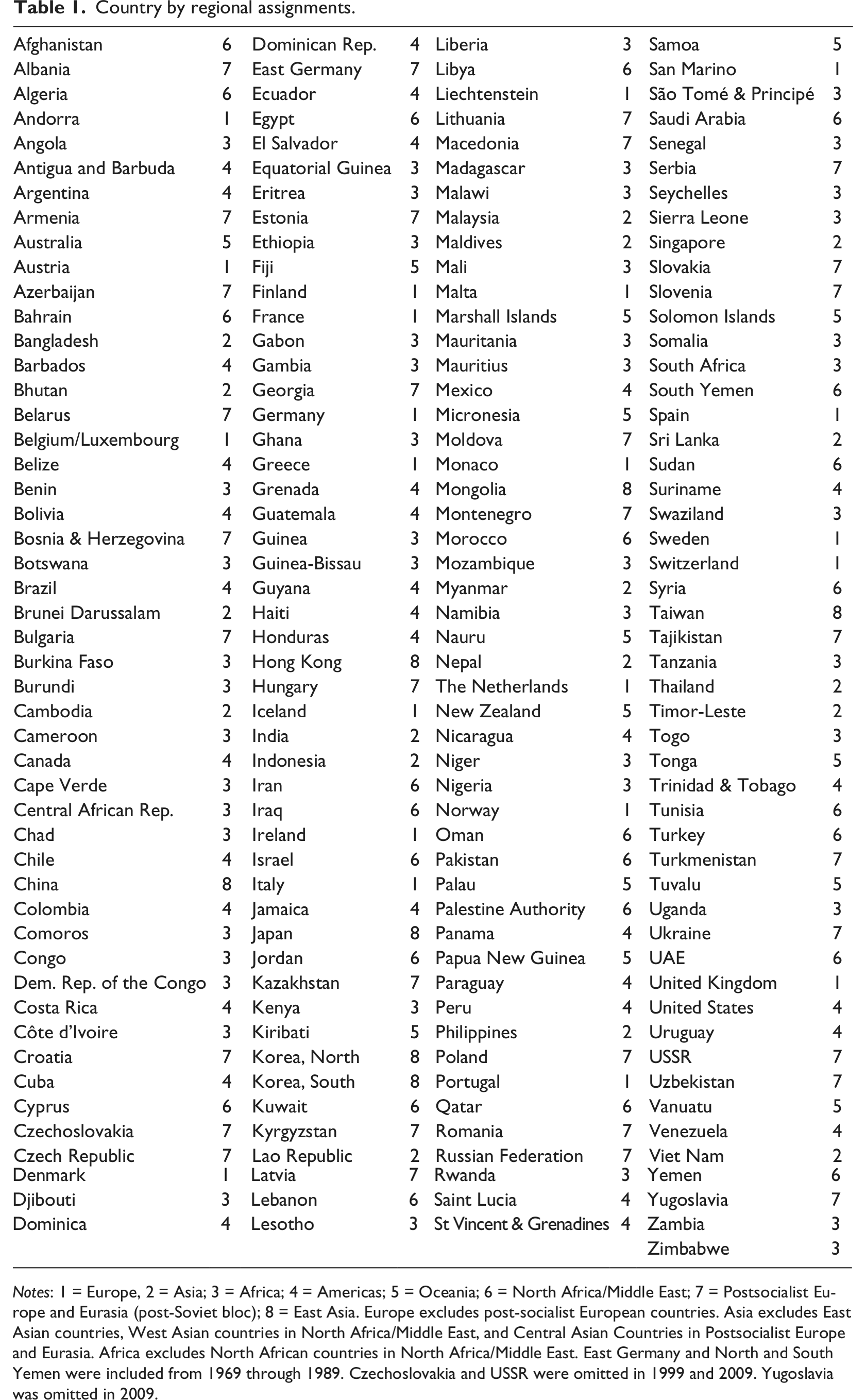
Notes: 1 = Europe, 2 = Asia; 3 = Africa; 4 = Americas; 5 = Oceania; 6 = North Africa/Middle East; 7 = Postsocialist Europe and Eurasia (post-Soviet bloc); 8 = East Asia. Europe excludes post-socialist European countries. Asia excludes East Asian countries, West Asian countries in North Africa/Middle East, and Central Asian Countries in Postsocialist Europe and Eurasia. Africa excludes North African countries in North Africa/Middle East. East Germany and North and South Yemen were included from 1969 through 1989. Czechoslovakia and USSR were omitted in 1999 and 2009. Yugoslavia was omitted in 2009.
Country by bloc assignments.
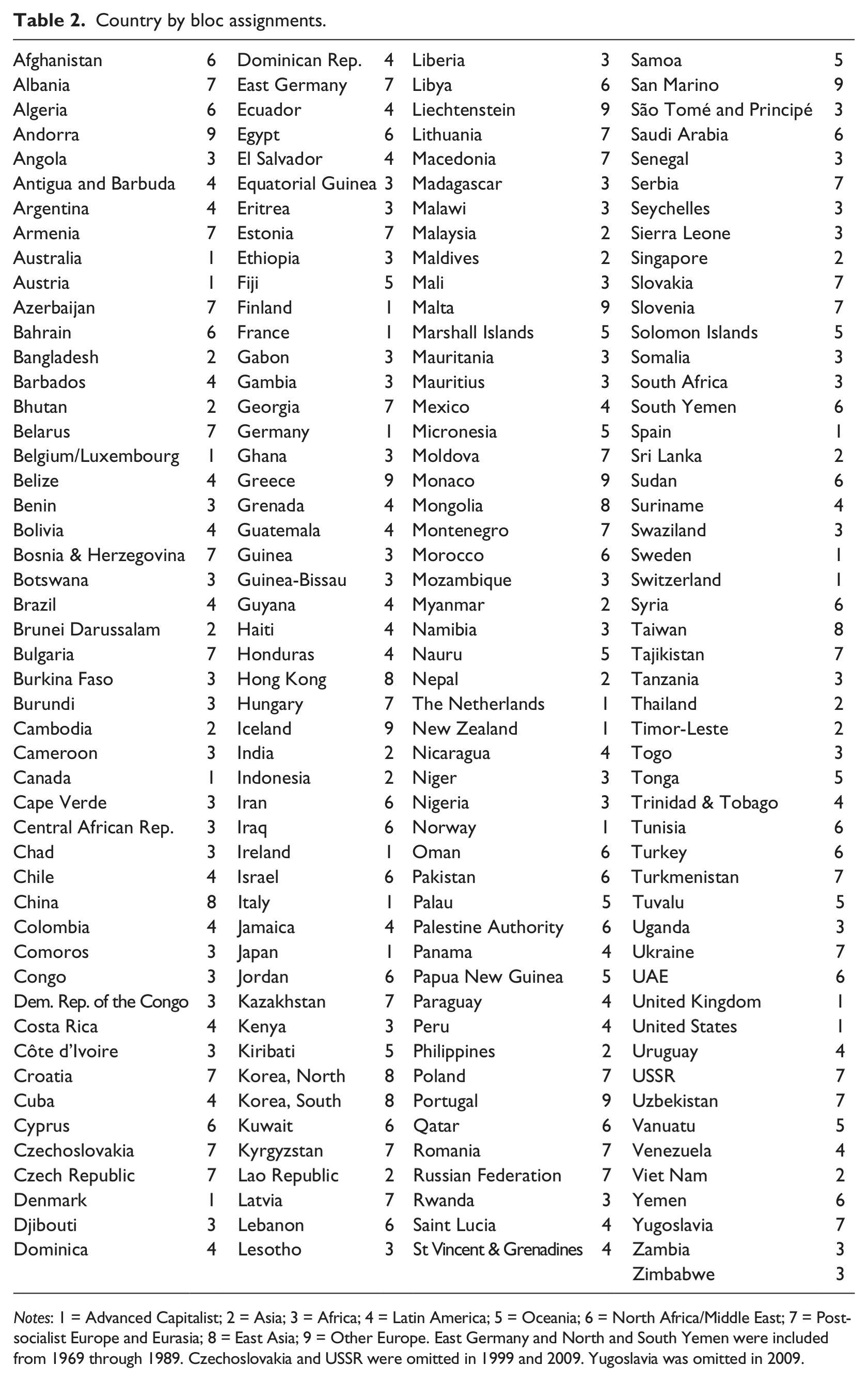
Notes: 1 = Advanced Capitalist; 2 = Asia; 3 = Africa; 4 = Latin America; 5 = Oceania; 6 = North Africa/Middle East; 7 = Postsocialist Europe and Eurasia; 8 = East Asia; 9 = Other Europe. East Germany and North and South Yemen were included from 1969 through 1989. Czechoslovakia and USSR were omitted in 1999 and 2009. Yugoslavia was omitted in 2009.
Methods
Our primary concern here is the assessment of the three explanations for the structure of the BIT network described above. The universalist and regionalization hypotheses offer two distinct types of networks. Universalist explanations suggest that a country’s regional location or membership in either the North or South should not play a significant role in the pattern of BIT ties it signs with other countries. That is, a country’s geographical location or its membership in the global North or South should play a small role in predicting the density of its ties to other countries in the BIT network. Alternatively, the hypothesis derived from the world-systems perspective suggest that the North/South divide structures the pattern of BIT adoption, where BITs should tend to form across the North/South divide but not within the two groups. And, contrary to both these accounts of globalization, the regionalization hypothesis would predict stronger ties within than between geographical regions. In addition, we want to explore whether the existing perspectives on globalization are complementary rather than strictly contending.
In order to test our hypotheses, we implement a block modeling strategy analogous to those pursued in the existing literature on cross-national social networks (e.g. Beckfield, 2008; Kim and Shin, 2002; Mahutga, 2006; Smith and White, 1992; Snyder and Kick, 1979). In doing so, we regress the observed adjacency matrix on the three blocking strategies described above in five discrete years, at 10-year intervals in the 1969 to 2009 period, omitting 1959 as there was only one treaty signed in that year. The first model regresses the dyadic BIT matrix on two dummy matrices – one for the North/North ties and one for the South/South ties. North/South ties constitute the excluded category. The regional homophily model regresses the dyadic BIT matrix on eight dummy matrices, one for each region. The between-region ties constitute the excluded category. Our final analysis estimates a treaty bloc formation model. Here we regress the dyadic BIT matrix on 35 dummy matrices representing all possible undirected combinations of group assignments except the within group density for the Advanced Capitalist group, which is our excluded category.
These network regression models allow us to both assess the overall fit of our three block models, as well as identify whether or not the observed intra or inter-block ties are significantly larger than we might expect by chance. However, classical hypothesis tests are ill-suited for this test because we do not have a random sample and dyadic data violate the independence of observation assumption required for classical hypothesis tests. Thus, we cannot make the necessary assumptions that would allow us to use the distribution of ties within and between groups we observe in our networks to estimate a sampling distribution. We therefore use a quadratic assignment procedure (QAP), or permutation tests, to simulate a sampling distribution to which we compare our observed statistics.
The QAP begins by regressing the adjacency matrix on a series of dummy matrices as described above. Next, we randomly permute the rows and columns of the BIT matrix 5000 times and recalculate the regression statistics with each new permutation. Substantively, these 5000 permutation samples provide the distribution of our statistics under the null hypothesis that the observed inter/intra-group densities are not larger (smaller) than would be the case if we randomly assigned states to groups. Using standard cut off values for significance, then, our observed comparisons are significant if less than 10, 5, 1 or .1 percent of the permutation samples yield a statistic larger (smaller) than the one observed. In each of the models we estimate below, then, the universal globalization model serves as our null hypothesis insofar as it would predict that dyadic ties are orthogonal to the location of countries across the North/South divide or geographic region. All the analyses were carried out in UCINET.
Results
We begin by examining overall trends in network density, which is measured as the number of BITs as a proportion of the total possible BITs. The time-trend in density displayed in Figure 3 suggests that the BIT network became increasingly dense over the period as an increasing number of countries signed BITs. Moreover, the rate of increase turned dramatically upward following the collapse of the Soviet Union, as evinced by the rapid increase in density following 1989. Despite the trend toward increasing density, however, the low overall peak density in 2009 suggests that just less than 15 percent of the possible number of bilateral investment treaties have been signed. Clearly, some countries are more likely to sign BITs than others.
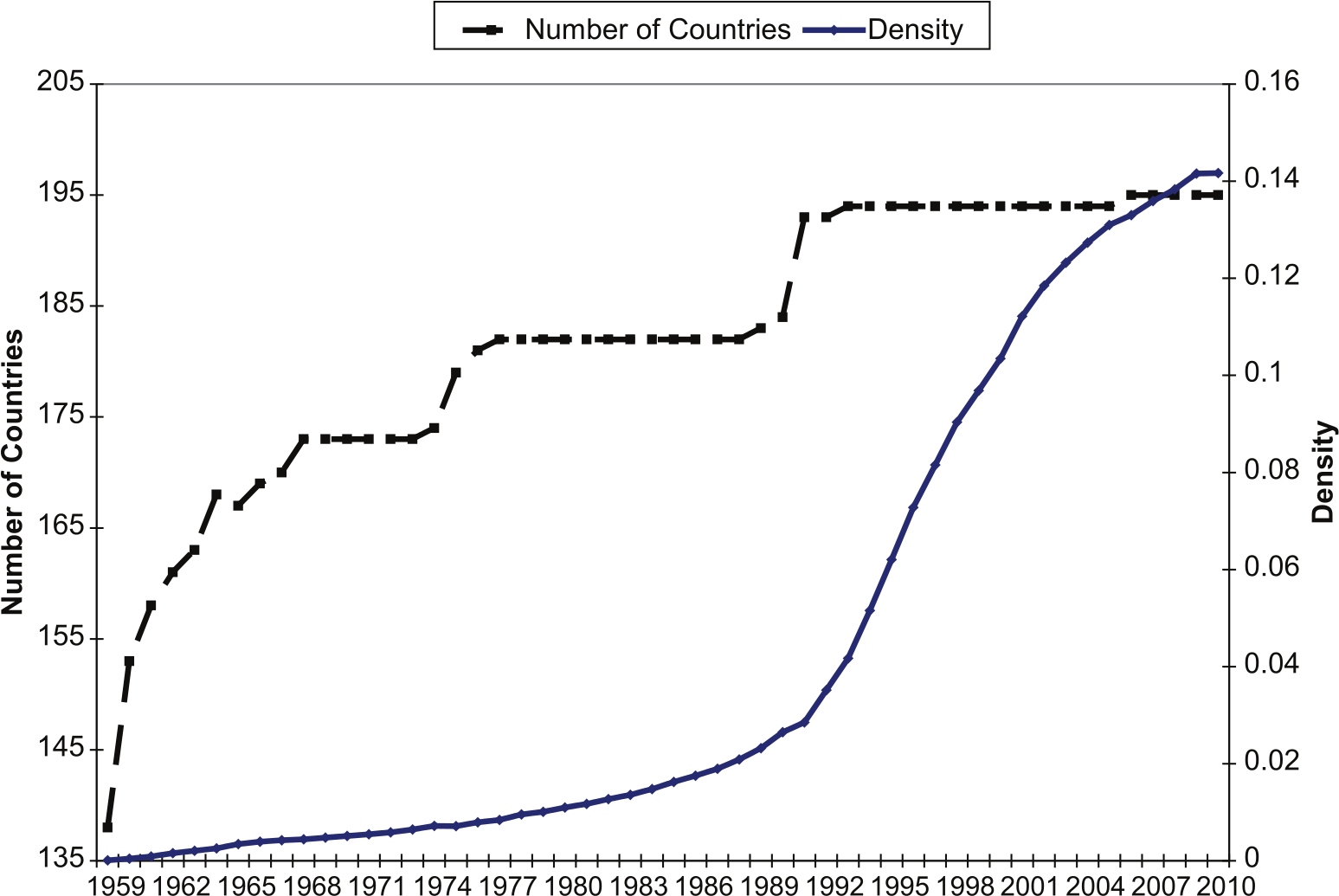
Temporal variation in network density, 1959–2010.
Figure 4 displays the trend in network centralization over time. Network centralization measures how centralized an observed network is relative to a hypothetical network in which one focal actor is tied to all others, who are only tied to the one focal actor (a star network). A value of 0 indicates either an empty or fully connected network, and a value of 1 indicates a star network. The trend in Figure 4 shows the BIT network became increasingly centralized at the same time that it became increasingly dense. However, the rate of increase in centralization slows dramatically after 1994, peaking at a level of graph centralization equaling 57.5 percent of that in an ideal-typical star network.
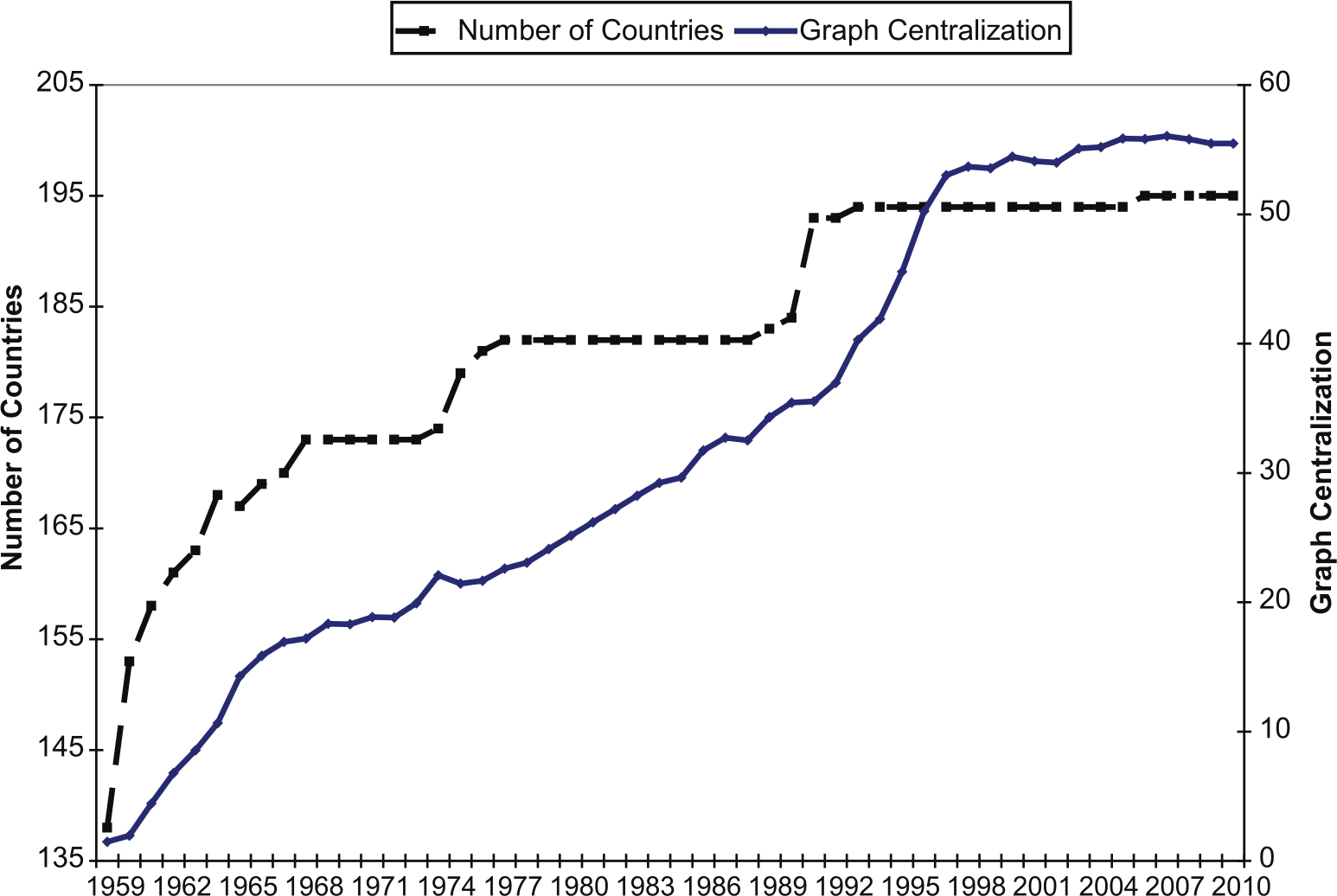
Degree centralization of the BIT network, 1959–2010.
In sum, then, the BIT network is both increasingly dense and increasingly centralized over time. Thus, much of the increase in density must be Frank A G (1969) The sociology of development and the underdevelopment of sociology. Catalyst 3: 20–73. Friedman T (2006) The World Is Flat: A Brief History of the Twenty-First Century. New York: Farrar, Straus & Giroux. explicable by the tendency of a subset of countries to sign a disproportionate number of BITs. Moreover, the slowing trend of rising centralization might indicate either the emergence of new centers of gravity or a trend toward the universal signing of BITs between all countries. We turn now to our network regression results to differentiate between these alternatives.
Table 3 displays the reduced image density matrices when the BIT adjacency matrix is partitioned by assigning countries to either the global North or South. For simplicity, we report only the years 1969, 1989 and 2009. The cells in each matrix report the density within and between the North and South, with within-group densities located on the diagonal and displayed in bold, and between group densities reported in the off-diagonal cells. Because the treaty network is both dichotomous and symmetric by definition (a treaty is either present or absent, and a treaty from i to j implies a treaty from j to i), the off-diagonal entries above and below the diagonals are identical. Consistent with the materialist, world-systems approach to international relations outlined above, the BIT network is almost perfectly bipartite in 1969. Moreover, the North/South density varies from .023 to .255 larger than the largest within-group density over time. However, and contrary to expectations derived from the world-systems perspective, the bipartite structure of the BIT network breaks down over time as the density of BITs within the Southern group increases from virtually zero in 1969 to 9.9 percent of the possible ties in 2009.
North/South density matrices, 1969, 1989, 2009.
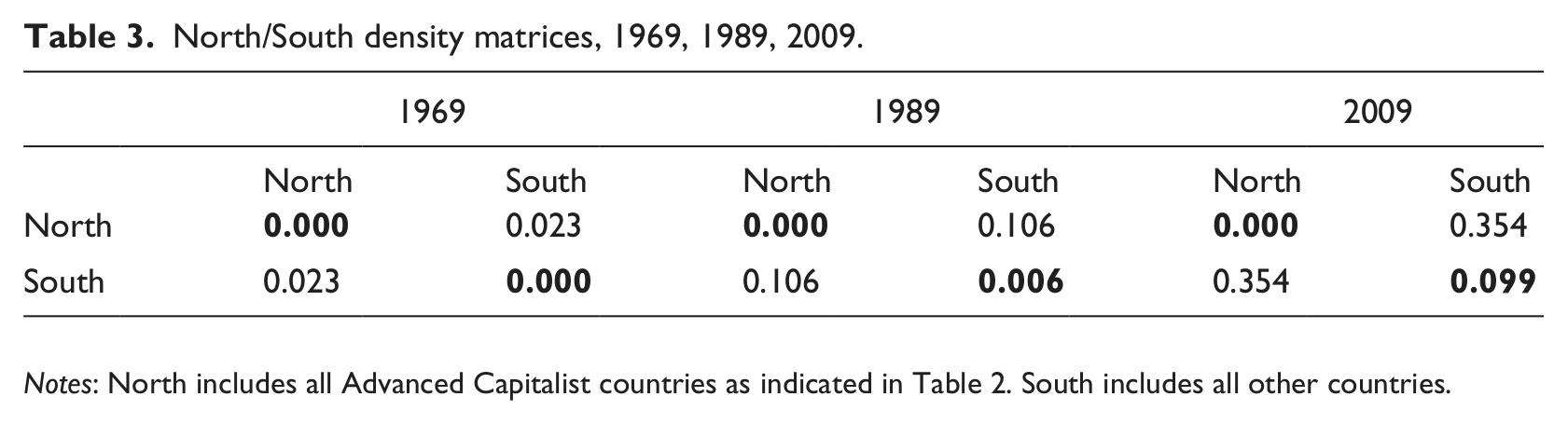
Notes: North includes all Advanced Capitalist countries as indicated in Table 2. South includes all other countries.
While Table 3 does support the materialist, world-systems expectations derived above by highlighting that the bulk of BITs bridge the North and the South, it does not test whether or not the North/South density is significantly larger than the others. Thus, Table 4 reports the results of our network regression model. The coefficients in Table 4 are counterparts to the densities in Table 3 – the significantly negative coefficients on the North–North and South–South groups in 1969 (−.022), for example, are simply the inverse of the density for the North–South density (0 − .022 = −.022).
North/South bipartite models, 1969–2009.
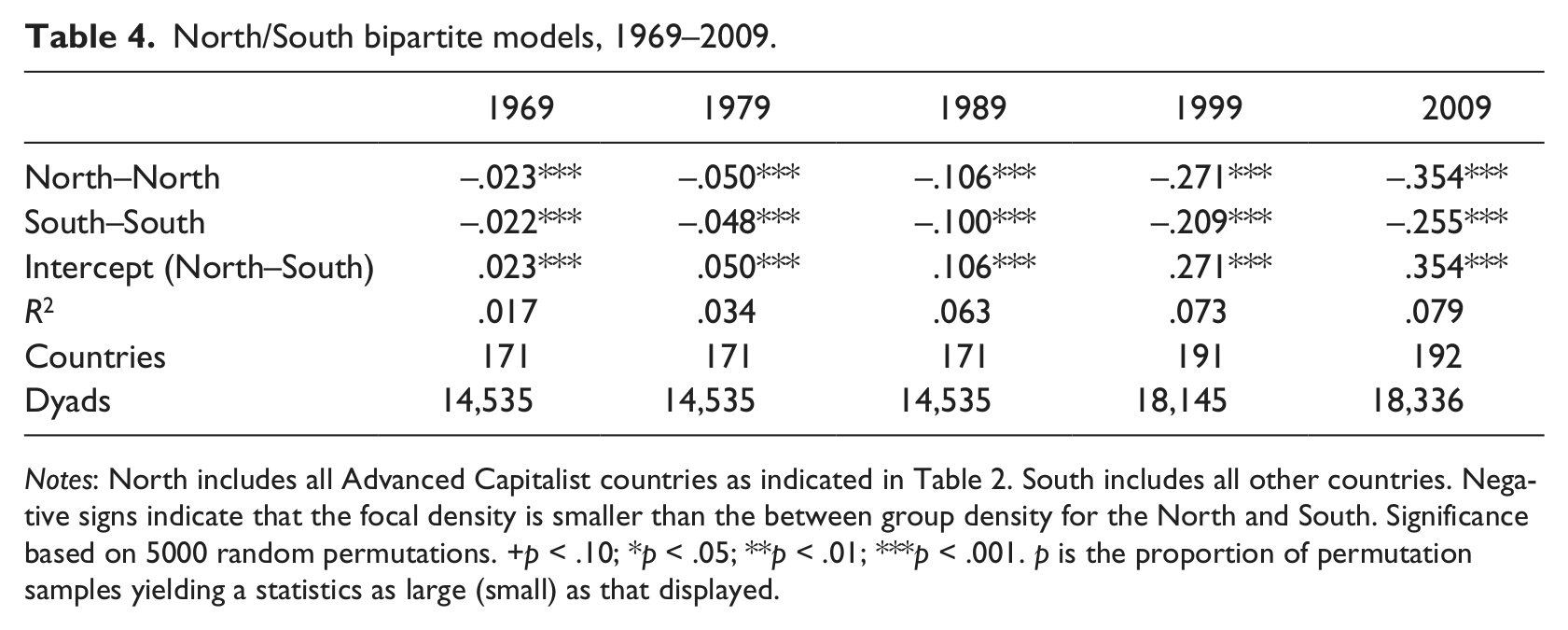
Notes: North includes all Advanced Capitalist countries as indicated in Table 2. South includes all other countries. Negative signs indicate that the focal density is smaller than the between group density for the North and South. Significance based on 5000 random permutations. +p < .10; *p < .05; **p < .01; ***p < .001. p is the proportion of permutation samples yielding a statistics as large (small) as that displayed.
In each year, the coefficient for the North–North density remains both the exact inverse of that for the North–South density, and statistically significant. Similarly, the South–South density remains significantly lower than the North–South density throughout the period, indicating that the density within the South is always significantly smaller than that between the North and the South. However, consistent with Table 3, the coefficient on the South–South density is smaller in absolute size than that on the North–North density because BITs form within the South over time. The increase in the absolute size of the negative coefficient on the South–South coefficient overtime indicates that North–South ties form more quickly over time than do South–South ties. Finally, this model explains a modest but increasing proportion of the dyadic variation in BIT adoptions over time, ranging from 1.7 percent in 1969 to 7.9 percent in 2009. In short, the North/South model provides some evidence in support of the materialist, world-systems expectations for the structure of the BIT network. However, the modest percentage of explained variance and the growing density within the South suggest that a complete explanation must go further. 4 As our early discussion prefigures, much of this could be driven by regionalization, and we now turn to the results of our analysis of regional homophily.
Table 5 reports reduced image density matrices analogous to those in Table 3, except that the adjacency matrices are partitioned according to the regional designations in Table 1. To reiterate, the cells report the proportion of possible BITs within and between regions, and within-region ties are located on the diagonal in bold. The matrices in Table 5 suggest that regionalization may indeed explain part of the rise in density in Figure 3 and the rise in South–South density in Table 3, as evinced by the increasing size of the diagonal elements. For example, all regions but Oceania show an increasing within-regional density over time. However, the increase is more prominent for some than others. In particular, Asia, North Africa and the Middle East, Postsocialist Europe and Eurasia, and East Asia increase from zero within-region ties in 1969 to 33.8, 44.2, 54.5 and 47.6 percent of the possible within-region ties, respectively, in 2009, and the within-group density is largest for only the first three of these. Are these within-region densities significantly greater than we might expect by chance?
Regional homophily density matrices, 1969, 1989, 2009.
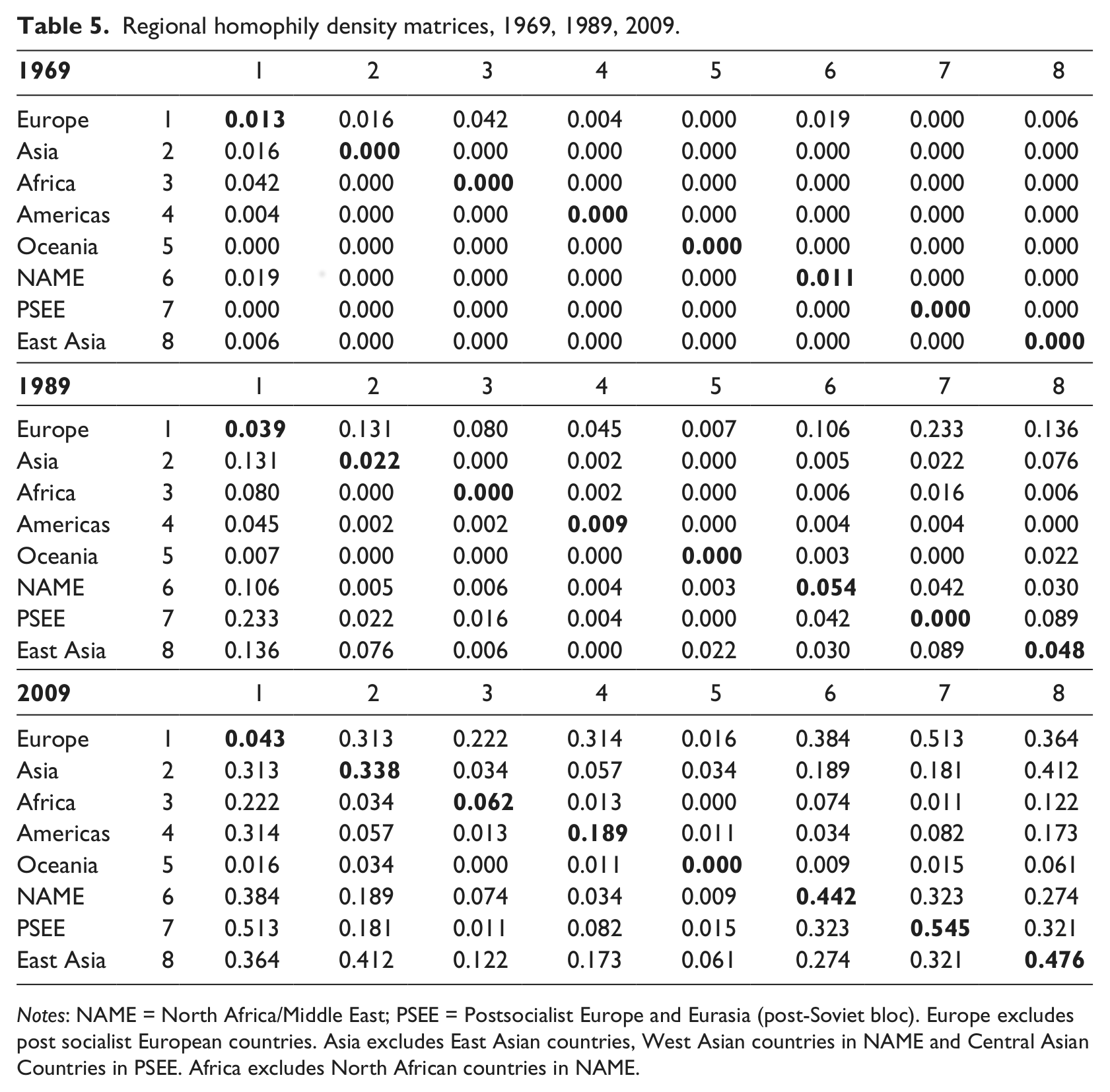
Notes: NAME = North Africa/Middle East; PSEE = Postsocialist Europe and Eurasia (post-Soviet bloc). Europe excludes post socialist European countries. Asia excludes East Asian countries, West Asian countries in NAME and Central Asian Countries in PSEE. Africa excludes North African countries in NAME.
The coefficients reported in Table 6 answer this question by regressing the adjacency matrix on a series of dummy matrices corresponding to the regions outlined above, with the between region ties for the network as a whole serving as the comparison. The trend toward homophily implied by Table 5 is supported here by the increasing size of the explained variance of the homophily model over time, and by the increasingly frequency with which regional homophily is significantly greater than network heterophily in the later periods. However, while all regions except for Oceania show a trend toward homophily in the sense that later periods show higher within-group density than earlier periods, only Asia, North Africa/Middle East, Postsocialist Europe and Eurasia and East Asia show a significant propensity for homophily in any period. The trend in heterophilous ties (the intercept) also increases over time, moving from a density of .005 to .133 over the period. Indeed, three other regions – Europe, Africa and Oceania – show a significant propensity toward heterophily in at least one and the most recent period.
Regional homophily model, 1969–2009.
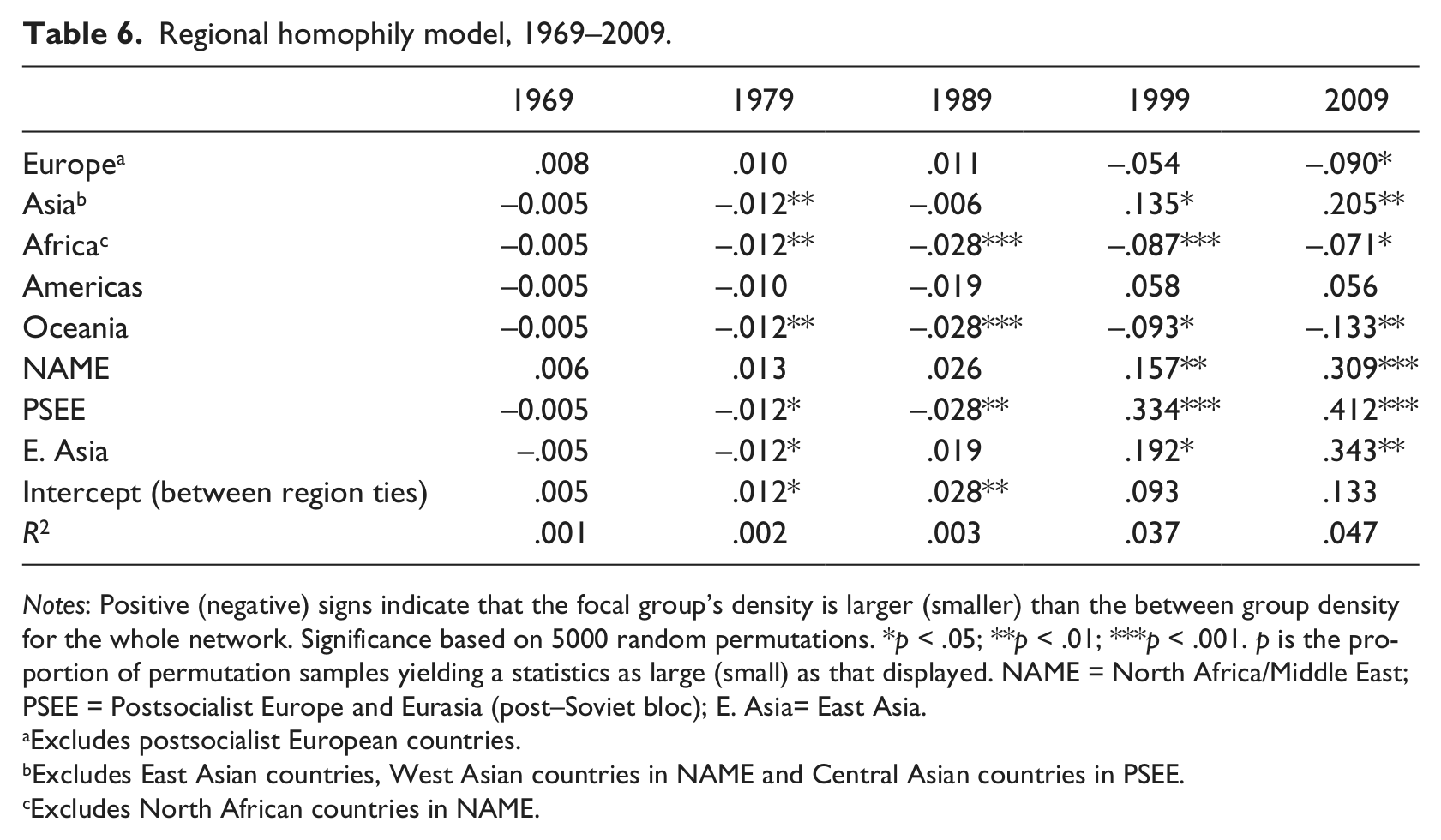
Notes: Positive (negative) signs indicate that the focal group’s density is larger (smaller) than the between group density for the whole network. Significance based on 5000 random permutations. *p < .05; **p < .01; ***p < .001. p is the proportion of permutation samples yielding a statistics as large (small) as that displayed. NAME = North Africa/Middle East; PSEE = Postsocialist Europe and Eurasia (post–Soviet bloc); E. Asia= East Asia.
Excludes postsocialist European countries.
Excludes East Asian countries, West Asian countries in NAME and Central Asian countries in PSEE.
Excludes North African countries in NAME.
In short, the regionalization model uncovers something hidden by the North/South bipartite model insofar as regionalization explains some of the BITs forming within the global South. However, regionalization plays a modest role in the overall structuring of the BIT network, as evinced by the lack of a significant homophilous tendency in the Americas, a significant heterophilous tendency in Oceania and Europe and the modest peak percentage of explained variance (4.7) for the homophily model. More importantly, we must go beyond the regionalization thesis in order to understand the formation of BITs within the global South.
The models presented in Tables 4 and 6 do suggest that the BIT network is structured both by material differentials in the world-system, and by regional similarity, but also that neither are complete accounts of the structure of the BIT network. Thus, Table 7 combines them in a more general model that allows us to observe the pattern of BIT ties within and between the Advanced Capitalist group and each of the eight regions in Table 6 simultaneously. Similar to the pattern of ties observed in the North/South model of Table 3, most of the higher density blocks reside at the intersection of the Advanced Capitalist group and regions from the global South. In 1969 through 1989, the highest density for each region of the global South intersects with the Advanced Capitalist group. However, this trend breaks down in 2009, when only four regions from the global South (Africa, Latin America, Postsocialist Europe and Eurasia, and East Asia) connect most intensely with the Advanced Capitalist group. Europe connects most intensely with Postsocialist Europe and Eurasia, Asia and Oceania with East Asia, and North Africa/Middle East connects most intensely with itself. Thus, Table 7 suggest that the rising density in the BIT network is driven by a combination of increasing North/South ties, homophily and by an increasing tendency toward the emergence of new centers of gravity in the network.
Treaty bloc density matrices, 1969, 1989, 2009.
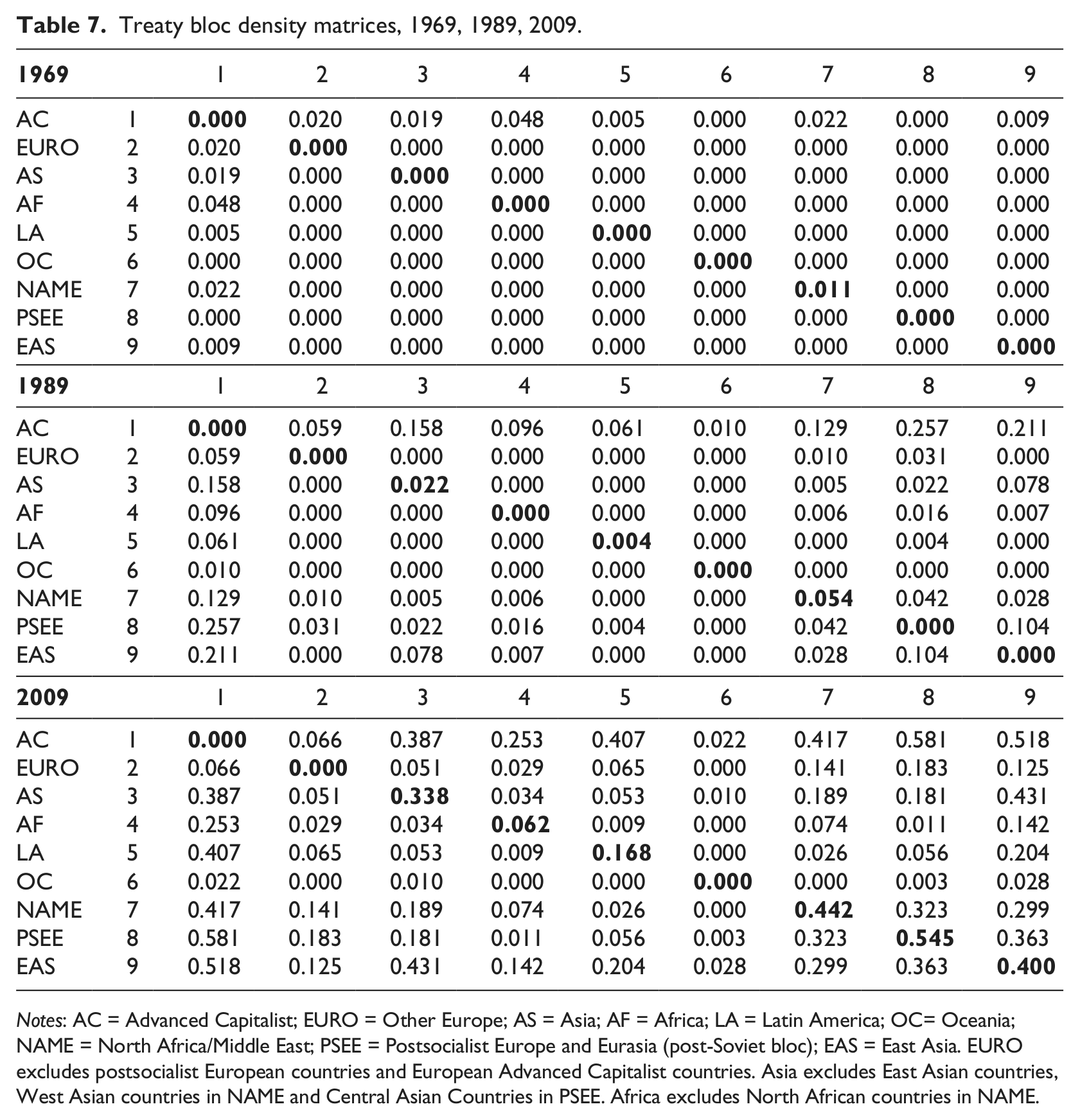
Notes: AC = Advanced Capitalist; EURO = Other Europe; AS = Asia; AF = Africa; LA = Latin America; OC= Oceania; NAME = North Africa/Middle East; PSEE = Postsocialist Europe and Eurasia (post-Soviet bloc); EAS = East Asia. EURO excludes postsocialist European countries and European Advanced Capitalist countries. Asia excludes East Asian countries, West Asian countries in NAME and Central Asian Countries in PSEE. Africa excludes North African countries in NAME.
In order to identify whether or not these tie densities are larger than we might expect by chance, we report our final set of network regression models (Table 8). These models test the null hypothesis that any within- and between-group densities are no larger than we would expect by chance. The top eight rows list the possible treaty blocs connecting the Advanced Capitalist group to Southern regions. Consistent with what we observed in Table 3, nearly all of the bloc densities connecting Southern regions and the Advanced Capitalist group are significantly different from zero. The only region that fails to display a significant treaty bloc with the Advanced Capitalist group in any period is Oceania.
Treaty bloc formation model, 1969–2009.
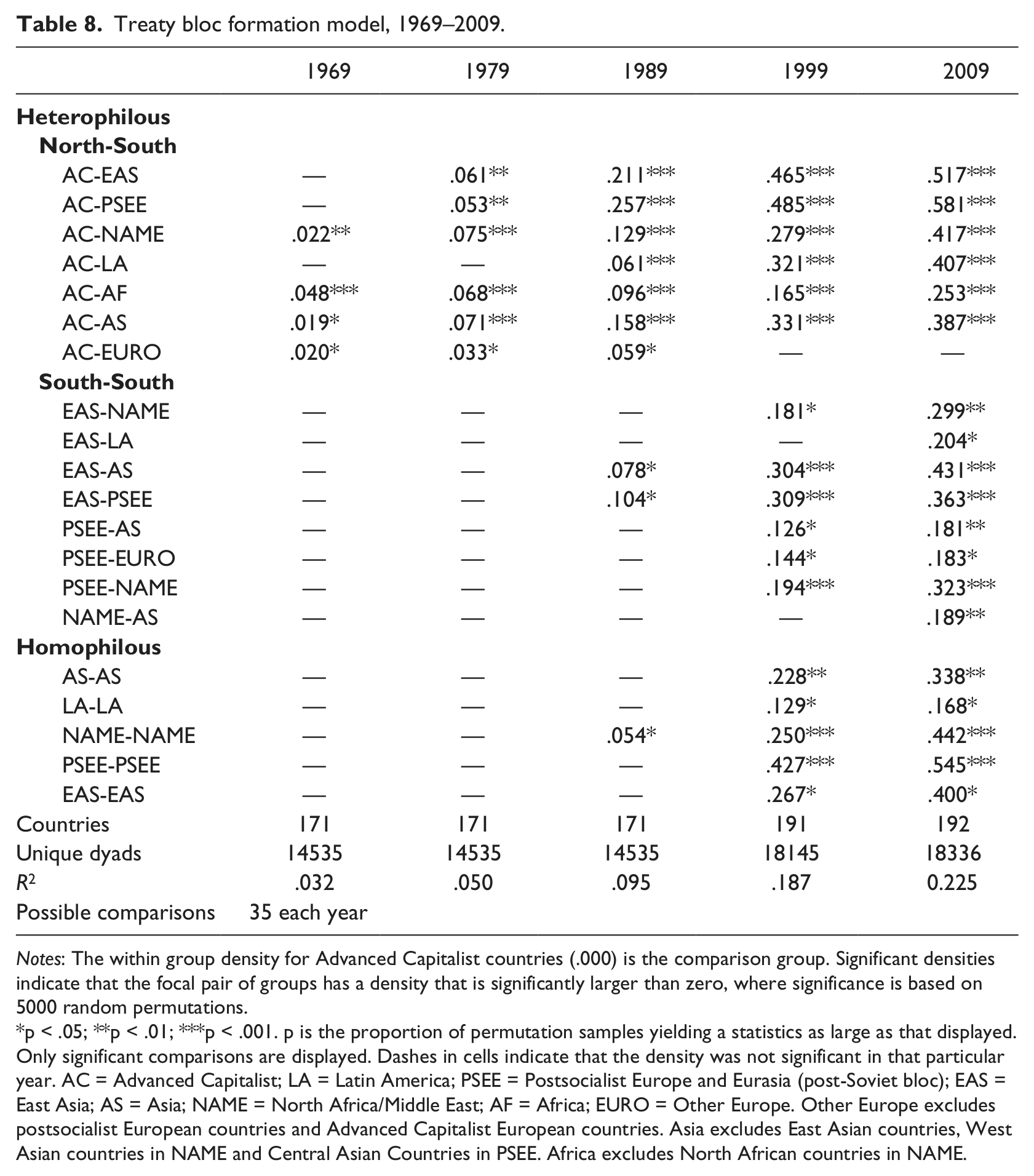
Notes: The within group density for Advanced Capitalist countries (.000) is the comparison group. Significant densities indicate that the focal pair of groups has a density that is significantly larger than zero, where significance is based on 5000 random permutations.
p < .05; **p < .01; ***p < .001. p is the proportion of permutation samples yielding a statistics as large as that displayed. Only significant comparisons are displayed. Dashes in cells indicate that the density was not significant in that particular year. AC = Advanced Capitalist; LA = Latin America; PSEE = Postsocialist Europe and Eurasia (post-Soviet bloc); EAS = East Asia; AS = Asia; NAME = North Africa/Middle East; AF = Africa; EURO = Other Europe. Other Europe excludes postsocialist European countries and Advanced Capitalist European countries. Asia excludes East Asian countries, West Asian countries in NAME and Central Asian Countries in PSEE. Africa excludes North African countries in NAME.
The bottom 13 rows report the significant densities within the global South, of which there are 25. By 2009, five of the seven possible homophilous blocks are significantly different from zero. However, in a surprising departure from each of the three perspectives outlined above, there is a growing tendency toward the formation of significant treaty blocs between Southern regions. Moreover, East Asia and Postsocialist Europe and Eurasia are exceptional in their propensity to forge significant treaty blocs with other Southern regions: 25 percent (4/16) of inter-regional blocs within the South involve East Asia, and an equal percent involve Postsocialist Europe and Eurasia. Roughly 19 percent (3/16) involve North Africa/Middle East, and an equal percent involve Asia. Latin America has only one significant treaty bloc. Moreover, each of these regions also has a significant homophilous density. Oceania and Other Europe play relatively minor roles in the BIT network insofar as Other Europe only connects with one other Southern region (Postsocialist Europe and Eurasia) and neither shows a propensity toward homophily.
The pattern of significant coefficients in Table 8 provide some sense of both the explanatory power and limitations of the three alternative sociological perspectives on international relations outlined in our literature review. Overall, 72.5 percent (29/40) of the possible treaty blocs between Southern regions and the Advanced Capitalist group are significantly different from zero. However, the time trend is curvilinear – increasing from 50 percent (4/8) in 1969 to 87.5 percent in 1989 (7/8) before falling to 75 percent (6/8) in 2009. The curvilinear trend is driven by Other Europe, which doesn’t show a clear trend toward more intense ties with Advanced Capitalist countries over time. Alternatively, 17.9 percent (25/140) of the possible treaty blocs within the South are significantly different from zero. Here the trend increases through time, from 0 percent in 1969 and 1979 to 46.4 percent (13/28) in 2009.
Thus, these models are consistent with the findings reported in Table 4 in that the bulk of BITs still reside between the North and the South. They are also consistent with the findings reported in Table 6 in that there is a tendency toward regionalization in the global South. What emerges from this analysis is a somewhat surprising tendency toward the formation of treaty blocs between Southern regions. The treaty bloc model combining each of these three factors – the persistence of dependent North/South relations, region-specific regionalization and the emergence of new centers of gravity in the global South – explains more variation than any model, and rises from 3.2 to 22.5 percent of the variation over time.
Conclusion
The structure of the contemporary relations between countries, and how this structure evolves over time, is a fundamental question for scholars of globalization. While few would deny that globalization increases connections between countries over time, many disagree over the extent to which these connections reflect either a universal logic of institutional globalization, or rather are patterned by either the distribution of wealth and power across countries (the North–South divide), or by place-bound political and cultural processes (regionalization).
We use primary data on BITs to address these disagreements and allow for the possibility that the universalistic, bipartite, and regional patterns co-exist. Our data have several advantages to those used by other scholars. First, we go beyond the kinds of material relations that are typically of interest to world-systems analysts of international relations. This is important because there are theoretical reasons to expect that structures will vary for substantively different global flows. And, while research using INGO and IGO membership data contributes much to our understanding of the structure of globalization in this respect, those data usually cover only the period to 2000 and exclude many of the world’s countries, especially the poorest African countries or newly established post-communist states. Moreover, these IGO and INGO networks are two-mode networks in which direct relations between states are inferred from common memberships in organizations. This is problematic insofar as there are many states that are co-members of, for example, the United Nations that nevertheless have strained or non-existent bilateral relations (e.g. Lloyd, 2005).
Contrarily, we cover the entire population of the world’s countries over the whole period from 1959 to 2009. We start in 1959, which marked a true beginning for the specific global phenomenon under investigation. Moreover, rather than inferring bilateral international ties from co-membership in universalist organizations, we analyze true dyadic ties between states by focusing on one type of bilateral institution. Finally, BITs are an increasingly important institutional arrangement relevant to one of the defining features of contemporary economic globalization, foreign direct investment, and linked to the spread of neoliberalism. As such, they are simultaneously institutional, political, cultural and economic phenomena that capture the multidimensionality of globalization that some argue is worthy of more research (Bandelj and Sowers, 2010; Guillen, 2001).
Based on the evolution of the BIT network data over the past 50 years since its inception, we find evidence that the supposed contradictory forces of universalism, regionalism and North–South divide can co-exist. Universalistic explanations suggest that the BITs are constructed and propagated in world models of economic governance, and that the network should become increasingly dense and more equal over time, and further that ties should form more or less indiscriminately between nation-states. The evidence in Figure 3 is consistent with the first part of this expectation, while that in Figure 4 belies the second part. The world-systems account of globalization anticipates that, despite the general increase in the worldwide participation in the BIT network, network density should be highest between the capital-rich countries and capital-poor countries rather than within these blocs, creating a bipartite graph connecting the North and the South. We find evidence in support of these claims insofar as the BIT network does emerge as a nearly perfect bipartite graph with dense interaction between the North and South, nearly non-existent ties within the two zones, and an increase in North/South density that outpaces tie formation within the North and South. However, the network departs from an ideal-typical bipartite graph over time because there are an increasing number of ties that form within the global South. At its peak, the ideal-typical North/South bipartite graph explains a modest 7.9 percent of the variance in dyadic BIT adoption.
We also find evidence of regionalization that highlights homophilous political and cultural relations between countries, which should induce countries within particular regional blocs to sign BITs with each other more than others. Indeed, we observe a rising rate of within region density over time Table 5, and a significant trend toward regionalization in Table 6. However, regionalization is more important for some regions than others. We observe no significant propensity in the Americas, and a significant heterophilous propensity in Europe and Oceania. Indeed, Europe’s status as a heterophilous regional block in the BIT network stands in contrast to the strongly homophilous tendency of Postsocialist European countries. In short, regional integration in the BIT network is most pronounced in East Asia, Postsocialist Europe and Eurasia, North Africa, and the Middle East and Asia, and by itself provides a relatively weak explanation for the structure of the BIT.
Our final set of models combines the world-systems and regional homophily perspectives and allows for the discovery of new centers of gravity in the global South. Here we find that Advanced Capitalist countries are the clear center of gravity in the network, in which much of the expansion of the BIT network consists of treaties between this group and others over time. However, while our final set of models explains the largest percentage of the variance in dyadic BIT ties, they also suggest that all three explanations of global structures that we considered must be qualified to a significant degree. First, the universalistic explanation would predict the rising density of the network but cannot account for either the central position occupied by Advanced Capitalist countries, nor the more recent trend toward regionalization that we observe. Second, claims about persistent bipartite hierarchy within the world-system cannot account for the rising prominence of the Postsocialist European and Eurasian, East Asian, or North Africa/Middle East countries in the network. Finally, the regional explanation is insufficient as it does not help us differentiate between those regions that seem to develop regional investment coalitions and act as secondary centers of gravity in a way that other regions – Oceania, Other Europe, Latin America, and Africa – do not.
In short, a nuanced socio-historical analysis that takes into account the interaction of world-historical processes with more localized ones is necessary to make sense of the overall trends in the formation of BITs. Indeed, some research on the postsocialist countries and their strong drive to ‘create demand for FDI’ (Bandelj, 2009: 471) aligns well with our findings for this region here. Moreover, others document a quite similar process in the North Africa/Middle East (NAME) region, where ‘bilateral investment treaties constitute one of the most important international policy tools used by Arab countries to attract foreign direct investment’ (El-Kady, 2006: 49). What is also notable about NAME is that the intra-regional treaties signed often include language by which grievances must be handled by third party arbitrators from within the Arab world, such as the Arab Investment Court and the Regional Center for International Commercial Arbitration in Cairo, rather than international arbitrators (El-Kady, 2006). This may reflect a well-documented resentment by Arab governments toward international community interference in intra-Arab disputes (Rubin, 1991).
Thus, a more satisfying explanation for the evolution of the network of bilateral investment treaties – compared with any of the three dominant perspectives on globalization – must consider the simultaneity of cultural and material processes as well as the interplay between transnational and more local/regional trends. Such a perspective would suggest that universalistic processes operating in the world polity are conditioned by the unequal distribution of capital between countries, as well as the idiosyncratic behavior of some regions vis-à-vis others. BIT trends speak to the rise of near universal economic institutional standards within the world polity, but also the reproduction of a central structural position for core countries, as well as the consolidation of a few regional blocks outside of the core as contending centers of gravity. Overall, our results showcase the multidimensionality of globalization: the formation of a global economic institutional network is influenced simultaneously by political, economic, and cultural processes. Understanding specific global outcomes requires attention to how the global phenomenon under investigation nevertheless evolves through specific local socio-historical developments.
Finally, our analysis of the structure of the BIT network also sheds light on the mixed empirical literature regarding the relationship between BITs and actual flows of FDI. Recall that much of this literature involves regressing aggregate FDI inflows on aggregate counts of BITs, and suggests that increases in BIT ties bear a weak and/or inconclusive partial association to increases in FDI. Our network analysis of BITs suggests instead that analyses should consider who a focal country signs BITs with in addition to how many BITs they sign. In particular, our analysis identified two trends that help explain the weak link between BITs and FDI. The first is the increasing tendency for countries that lack capital to sign BITs with other countries that also lack capital. The second is the absence of BITs among Advanced Capitalist countries despite the fact that the vast majority of actual FDI flows between them (e.g. Alderson and Nielsen, 1999). Both trends suggest that any causal link between BIT adoption and FDI inflows must be a conditional one. In particular, if FDI flows are unlikely between less developed signatories that lack surplus capital, and extremely likely between developed non-signatories with large stocks of surplus capital, then the BIT-FDI link may depend strongly on the absolute difference in the availability of capital between countries. That is, BITs are probably most effective for spurring actual FDI flows when they are adopted between developed and developing countries, where the absolute difference in the capital stock is largest.
This said, our analysis of the structure of the BIT network may also imply that the very purpose of investment agreements is shifting, even if BITs concluded since the 1990s were not much changed in content from the BITs of the postwar era. While they still principally address the traditional problem of investment protection and promotion (see the content of treaties in the beginning of the article), it would seem that BITs were largely intended to protect the property rights of developed countries in the postcolonial era, but are increasingly intended to promote foreign investment flows, or in other words are becoming ‘instruments of globalization’ (Vandevelde, 2009) in the era of neoliberal globalization (Bandelj et al., 2011; Campbell and Pederson, 2001; Prasad, 2006). Indeed, the rising propensity with which capital-poor countries sign BITs with each other makes sense only if countries are just trying to boost their count of BITs, signed for legitimacy reasons, in order to signal their overall desire to attract FDI. This may be another reason for a weak link between BITs and FDI found in previous research. If so, BITs represent an ideal context in which to investigate the determinants of institutional decoupling in which the adoption of institutional principles from world-culture does not lead to the intended outcomes.
Footnotes
Acknowledgements
The authors would like to thank Jason Beckfield, Carl Gershenson, and the other participants of the session on Trade, Foreign Investment and Globalization at the 2011 annual meeting of the American Sociological Association. We also thank the editor and anonymous IJCS reviewers for challenging and exceptionally thorough comments during the review process. Kristen Shorette and Tony Roberts provided excellent research assistance. The authors contributed equally to the article and are listed alphabetically. Please address all correspondence to both authors.
Funding
Funding from the Center for the Study of Democracy at the University of California, Irvine, is gratefully acknowledged.