



Abstract
This article takes a postmodernization perspective on support for the right to euthanasia by treating it as an expression of a process of value change, as a preference for quality over quantity of life. Using the data from the fifth wave of the World Values Survey, this study attempts to answer the question of whether the mass support for the right to euthanasia is an expression of autonomy values rather than just a function of a low religiosity. Multilevel regressions demonstrate that both traditional religiosity and autonomy values have a high impact at the individual level, while at the country level only the effects of traditional religiosity are significant. Autonomy values have stronger association with attitudes to euthanasia in countries with higher levels of postmaterialism. Multilevel path analysis demonstrates that the effect of religiosity is partially and weakly mediated by the values of autonomy at both levels. Although religiosity was found to have a much stronger impact, the independent effect of autonomy values suggests that mass support for the right to euthanasia is a value-driven preference for quality over quantity of life. We conclude by suggesting that the fall in traditional religiosity might emphasize the role of values in moral attitudes regulation.
Introduction
The development of medical technologies has resulted in extension of human lives throughout the world. Life expectancy has shown enormous growth during recent decades, and it keeps growing (World Health Organization (WHO), 2015). Unfortunately, life expectancy is increasing faster than healthy life expectancy, contributing to the number of people who live longer, but with less comfort (Jagger, 2015). At the same time, the growing bureaucratization of dying (Blauner, 1966) provides patients and society with the institutional tools and procedures to control physicians and the medical system in end-of-life care. In several Western European countries as well as in some US states, this increased confidence in the medical system to such a degree that they legalized various forms of assisted dying, starting in 1997. 1 However, the majority of countries have not considered legalization. Moreover, the debate surrounding the legalization as well as the moral justifiability of euthanasia is still highly relevant, even in countries where euthanasia is legal (Rietjens et al., 2009).
Why is this so? We argue that the moral ambiguity of assisted dying may be explained from the general perspective of postmodernization theory (Inglehart, 1997). The theory states that due to the increased levels of existential security during recent decades, there is a growing emphasis on the values of autonomy and personal well-being. In times when physical survival was not guaranteed, a longer life was the ideal; under conditions of existential security, it is not so much the “quantity” of life as its “quality” that bears a growing importance to people. Longer life expectancy for older and terminally ill people, together with the suffering that it can bring, pushes people to make a choice between quality and quantity of life. Quality of life, rooted in autonomy and personal well-being, can be seen as a postmodern value, whereas preservation of life at all costs can be seen as an expression of “modern” values. Therefore, the question of whether euthanasia or other forms of assisted dying should be legalized appears on the forefront of the value shift toward postmodern values. Surprisingly, however, the role of values in attitudes to euthanasia is rarely addressed in the literature, being reduced either to moral relativism (Verbakel and Jaspers, 2010), overall permissiveness (Cohen et al., 2014), or a generalized individualism–collectivism dimension 2 (Kemmelmeier et al., 2002). Instead, studies of mass attitudes toward euthanasia are focused on the role of religiosity (Burdette et al., 2005; Cohen et al., 2006; Halman and Van Ingen, 2015), despite the fact that traditional religiosity was decreasing across the world (Inglehart and Norris, 2007). It is still questionable whether values have an impact on attitudes toward euthanasia independent of religiosity. More generally, the puzzle is whether, with the rise of postmodernization, the role of traditional religiosity as the sole regulator of moral attitudes and subjective norms is undermined and substituted by values or whether religiosity still dominates as a regulator. The goal of this article is to address this question with regard to attitudes to euthanasia. It tests associations between mass support for the right to euthanasia, traditional religiosity, and expressions of postmodernization as represented by values of personal autonomy. We overcome the limitations of previous studies by directly contrasting the effects of the values of autonomy with those of traditional religiosity and placing them in a cross-national context. Furthermore, since the actual relations between values and religiosity are open to different interpretations (Saroglou et al., 2004), we take the further step of inquiring whether effects of traditional religiosity are mediated by autonomy values.
This article is organized as follows. First, we describe the theoretical background and existing findings on factors associated with mass support for the right to euthanasia and formulate our hypotheses on the impact of values and religiosity. Next, we present the data and measurement of the variables of interest, followed by the results of a series of multilevel regressions to test the hypotheses. Finally, we conduct a multilevel path analysis to test the mediated effect of religion on attitudes toward justifiability of euthanasia via the autonomy values. In the conclusion, we summarize our findings and discuss the possible implications of our results.
Background and hypotheses
This study relies on the theory of modernization and postmodernization (Inglehart, 1997; Inglehart and Baker, 2000). Its central argument states that modernization leads to a transition from religious values to “secular-rational” ones. As a result of this transition, religious norms and authorities are replaced by secular ones. Modernization shift often coincides with industrialization, which leads to a growth of wealth and fulfillment of basic needs (such as food and shelter). It creates the grounds for the subsequent postmodernization value shift with its emphasis on values of self-expression, personal well-being, freedom of choice, and tolerance.
In the process of modernization, the normative role of morality imposed by traditional religiosity (i.e. in its historical/canonical forms) decreases for individuals and societies, and statements based on traditional religious beliefs become more vulnerable to criticism, contributing, in particular, to the discourse on the right to euthanasia. 3 Indeed, many studies demonstrate that religiosity is negatively associated with permissive attitudes toward various moral issues (e.g. Finke and Adamczyk, 2008; Stack and Kposowa, 2011; Storm, 2016). In addition to its association with overall permissiveness, attitudes toward end-of-life issues have a specific link to religiosity: monotheistic religions strive to be the exclusive regulators of life and death issues, explicitly prohibiting interference in the natural and/or sacred processes of birth and death (Hendry et al., 2013). A decrease in traditional religiosity and the corresponding increase in secular-rational values are characteristic of the first value shift. Therefore, in modernized societies, the regulation of moral attitudes based on traditional religiosity may have been replaced by secular-rational regulation.
The second value shift is toward self-expression values. These values promote individual autonomy in decisions and personal well-being. Consequently, moral issues increasingly become a subject of personal choice rather than being mandated by religious or secular authorities. At the same time, medical developments begin to provide life extension even at the expense of quality of life, so people more often have to face the prospect of a longer but less enjoyable life (Jagger, 2015). The lack of enjoyment, however, contradicts the postmodern preference for well-being and personal choice. It creates good grounds for considering various options at the end of life, such as euthanasia, assisted suicide, or intensive palliative care. From the self-expression perspective, the termination of life is considered morally justifiable when it is aimed at relieving suffering and when it is the result of a person’s own independent and sane decision. In addition, the values of autonomy provide the basis for the idea of dying with dignity (Macklin, 2003; Van Der Graaf and Van Delden, 2009). As assisted dying is not intended to harm anyone, it is regarded as conceptually and morally different from suicide and homicide.
Although the two value shifts are very different, both lead to increasingly positive attitudes toward euthanasia because the first shift is related to decline in traditional religiosity and the second to the growth of self-expression values. We suggest that this commonality between the two value shifts is due to a shared increase in values of autonomy, which, in our understanding, include an emphasis on individual autonomy, independence of thoughts and feelings, and personal well-being.
Sometimes, values of autonomy are interpreted as mere opposition to religiosity. For example, Inglehart (1997) directly contrasts traditional values (most of which are based on the importance of God) with secular-rational values (some components of which are autonomy and independence values). The first value shift decreases religiosity, whereas the second shift is found to be related to a revival of religiosity; values of autonomy meanwhile keep growing during both value shifts (Inglehart and Baker, 2000). Therefore, the relationship between religiosity and the values of autonomy is quite ambiguous, and it would be a mistake to equate autonomy values with simple opposition to religiosity.
Very few studies directly address the impact of values on end-of-life issues. Hendry et al. (2013) did not find qualitative studies focusing on the impact of values. Among quantitative studies, we did not find many such studies as well. As a rare example, Kemmelmeier et al. (2002) demonstrate that positive attitudes toward euthanasia were promoted by individualistic values. Their respondents in more individualistic US states showed a higher degree of acceptance of euthanasia, whereas in more collectivistic states, life and death issues were seen through the lenses of restrictive religious norms. In these kinds of communities, support for the right to euthanasia was impeded. In a European sample, Köneke (2014) revealed a positive association of attitudes toward euthanasia with values of independence at the individual level and with postmaterialism at the country level. Therefore, it is reasonable to generalize these findings with the following hypothesis: values of autonomy have a positive impact on support for the right to euthanasia at the individual level, independent of religiosity (H1).
Unlike that of values, the contribution of religiosity to attitudes toward euthanasia at both the individual and country levels has been repeatedly demonstrated (see, for example, Burdette et al., 2005; Cohen et al., 2006, 2014; Verbakel and Jaspers, 2010). A rarely mentioned detail is that these findings apply only to traditional religiosity, characterized by the presence of a spiritual authority and submission to it. The newer kinds of individualized religiosity (see, for example, Aupers and Houtman, 2006) have the opposite (positive) impact on attitudes to euthanasia (Siegers et al., in press). This makes sense, because the two kinds of religiosity are related to the two different value shifts. Another important detail is that these findings relate to the largest monotheistic religions (Christianity, Islam, and Judaism), in which life is considered a sacred gift that can only be taken back by God, but such a belief is not necessarily present in Buddhism or other religions. Indeed, it is plausible that people who consider themselves religious in the traditional monotheistic religions are more likely to demonstrate a higher degree of opposition to the right to euthanasia because the traditional religious view on the termination of life is negative. Our second hypothesis states that traditional religiosity is strongly and negatively associated with support for the right to euthanasia at the individual level (H2).
As mentioned above, many societies in recent decades experienced a rapid change toward stronger self-expression values, raising the importance of personal well-being and tolerance (Inglehart, 1997; Tormos, 2015; Welzel, 2013), while others have experienced little or no change in the strength of these values. Countries with higher self-expression values are more likely to create institutions focusing on personal well-being and promote personal choice over traditional norms. This forms a normative environment which is more susceptible to support for the right to euthanasia. Thus, our next hypothesis states that at the societal level, the importance of autonomy has a positive association with support for the right to euthanasia (H3a). Likewise, more religious countries are less likely to develop permissive ideologies compared to more secular ones (Caprara et al., 2018). Religious institutions have greater authority in the religious societies, and given that the religious institutions often speak out openly and strictly against euthanasia (e.g. John Paul II, 1995: 65), it is reasonable to expect that more religious societies have lower rates of support for the right to euthanasia, that is, traditional religiosity has a negative association with support for the right to euthanasia at the societal level (H3b).
Obviously, not all members of a particular society follow the same values, nor share the same level of religiosity; there is large individual variance within each society. For example, although postmodernized societies include large pro-euthanasia groups, there are some individuals with purely negative attitudes toward euthanasia. However, all members of society experience normative pressure, that is, they are aware of the values and norms of the society they live in and expect social benefits for conforming to these norms and sanction for not doing so. This knowledge interacts with their personal values and religiosity and influences their attitudes and behaviors (e.g. Boer and Fischer, 2013; Roccas and Sagiv, 2010). The straightforward interaction between individual-level religiosity and autonomy values with their aggregates at the country level implies either reinforcement or impeding of expressions of personal values and religiosity in support for the right to euthanasia. For example, in more traditionally religious countries, expressions of personal religiosity as well as low autonomy values (through anti-euthanasia views) are encouraged and socially rewarded, while expressions of low religiosity and high autonomy values (through pro-euthanasia views) are not welcome and may sometimes even be sanctioned. Following this logic, we expect that the negative effects of traditional religiosity on attitudes toward euthanasia are stronger in more religious countries and countries with lower autonomy values (H4a); likewise, the positive effects of autonomy values are stronger in countries with more pronounced autonomy values and lower religiosity (H4b).
As we noted above, there are interrelations between values and traditional religiosity, so their association with euthanasia attitudes might have a variety of patterns. Religiosity and values may form a causal relationship in which religiosity causes a decrease in values of autonomy (Saroglou et al., 2004; Schwartz and Huismans, 1995). Indeed, apart from a direct prohibition of life termination, religiosity may also affect euthanasia attitudes indirectly by promoting conservative values and suppressing values of autonomy. In other words, values may mediate the effect of religiosity. Knafo and Schwartz (2009) show that compared to non-religious values, religiosity is more effectively transmitted from parents to children. It may follow that religiosity precedes values in chronological sequence, which fulfills one of the requirements of causality and makes the reverse direction of causal relations less likely. Given all its complexity, religiosity can be expected to have stronger causal impact on values than the other way around. Therefore, religiosity is more likely to have both direct and mediated effects on attitudes toward euthanasia, while it is less likely that the effect of values is mediated by religiosity.
At the country level, religiosity and autonomy values may form causal relations as well (e.g. Schwartz, 2008). As mentioned above, Inglehart (1990, 1997) linked change in traditional religiosity and postmaterialist values to the two consecutive societal shifts: modernization and postmodernization. The ensured material security of the population leads in many ways to an erosion of rigid religious norms (Inglehart, 1990: 177–181), next, the focus of values moves from group prosperity and interdependence to personal well-being and individual autonomy. This suggests that changes in religiosity precede changes in non-religious values; hence, the effects of religiosity are more likely to be mediated by values than the other way around. Summarizing these ideas, we formulate the following hypothesis: Autonomy values partially mediate the effect of traditional religiosity, both at societal and individual levels (H5).
In addition to the imperatives imposed by traditional religiosity and the permissive effects of the values of autonomy, there are other reasons why some might not support the right to euthanasia. Most of these reasons are linked to the perceived threat of euthanasia abuse and lack of oversight of physicians, the healthcare system as a whole, and third parties, such as relatives. Keown (2002) developed a “slippery slope” hypothesis according to which the legalization of euthanasia can lead to undesirable consequences, namely, the abuse of this practice against the will of patients. Rephrasing this in terms of individual characteristics, people who are more vulnerable due to a lack of resources, knowledge, and social ties as means of control over end-of-life procedures, and those from countries with less developed healthcare systems, are more likely to believe in the possibility of abuse. Therefore, they would be less likely to support the right to euthanasia regardless of their religiosity and values. As these issues are not the focus of this article, we set them aside here and continue to use the relevant variables only as controls for testing the hypotheses of interest.
This study goes beyond a similar paper by Verbakel and Jaspers (2010) in several ways. First, instead of discussing autonomy as a matter of fact, we emphasize the role of values of autonomy. Second, we treat the idea of death with dignity as an expression of the values of autonomy. Although it is an issue still discussed in bioethics (Van Der Graaf and Van Delden, 2009), in the context of a third party’s right to euthanasia, respect for their dignity logically follows from the person’s own values of autonomy, because values guide evaluation of behavior and events (Schwartz, 1992: 4; see also Macklin, 2003). Therefore, belief in the importance of autonomy leads to respect for others’ choices, including terminal ones. Third, as mentioned above, the religiosity hypotheses are limited to traditional monotheistic religions, as other types of religiosity may have other conceptions of the end of life. And finally, we consider differences in the effects of traditional religiosity and autonomy values across countries, as well as formulate and test the hypotheses on the mediating role of autonomy values in relations between religiosity and support for the right to euthanasia.
Previous studies of determinants of attitudes toward euthanasia have had a number of limitations. Some were limited to European countries (Köneke, 2014; Verbakel and Jaspers, 2010). Effects of individualism and authoritarianism were studied within a single country (Kemmelmeier et al., 2002). Measurement of values and religiosity used questionable indicators. For example, Verbakel and Jaspers (2010) equated “value autonomy” with faith in the existence of absolute good and evil, and the importance of dignity was oddly measured by the question of whether a respondent was widowed. Cohen et al. (2006) used potentially biased measures of religiosity and studied the effect of confessions only on a small subsample of countries and with bivariate tests. This article overcomes these limitations through careful selection of measures and use of cross-national data originating both from within and outside Europe.
Data and method
Data
The data from the fifth wave of the World Values Survey (WVS), collected in 2005–2006, are used as the empirical material of the current research (Inglehart et al., 2014). The data on euthanasia justifiability from the more recent WVS Wave 6 are available for only 23 countries, so we opted to analyze earlier data that provide broader coverage. 4
Since the WVS wave 5 data had many missing values, we reduced the sample size. Several countries were excluded due to the lack of data on individual values as measured by the modified Schwartz value scale or other missing data. Serbia was excluded due to ambiguity in the coding of the justifiability response scale (in the original questionnaire, the ends of the scale were not labeled). In addition, we excluded predominantly Buddhist countries, and only Christian, Muslim, and non-affiliated respondents were left in the data. The final sample included 37 countries, distributed around the world and representing the different cultural zones identified by Inglehart and Baker (2000). For a full list of countries and the distribution of opinions on the justifiability of euthanasia among them, see Figure A1 and Table A1 in Supplementary Material. After removing 4066 respondents who did not answer the question on euthanasia (8% of the total) and the other key questions, the resulting sample consisted of 41,600 individual responses. The removal of these missing cases slightly increased the mean of our dependent variable (from 3.98 to 4.01) but left the standard deviation exactly the same (3.25); the sociodemographic composition of the sample also did not change significantly.
Measures
The dependent variable is an indicator of the support for the right to euthanasia, and it was measured by the following question: “Please tell me for each of the following actions whether you think it can always be justified, never be justified, or something in between (Inglehart et al., 2014).” One of the 11 assessed issues was euthanasia, defined as “ending of the life of the incurable sick,” which offered 10 responses from “Always justifiable” to “Never justifiable.”
There are many modalities in the discussion of euthanasia related to acceptance, permissiveness, approval, and so forth. In this article, we focus on the support for the right to euthanasia, which is measured exactly by this WVS question. The question’s wording means that respondents evaluated an abstract situation expressing a general attitude toward euthanasia or the support for a third party’s right to euthanasia. It would be misleading to link the answers to this question to approval or acceptance, which would imply the readiness of respondents to be involved in euthanasia themselves. Instead, the answers to this question are more related to justifiability, or tolerance in regard to the third party, that is, the support for their right.
The first group of independent variables in our analysis represents the values of autonomy. As we adopted a broad definition of autonomy values, we were able to take advantage of the variety of measures available in the WVS dataset. The WVS includes 10 shortened and modified items from Schwartz’s Portrait Value Questionnaire (Schwartz et al., 2001). Respondents were asked to rate their similarity to each of the 10 value portraits. We used three of them, namely, self-direction (“important … to think up new ideas and be creative; to do things one’s own way,”) stimulation (“adventure and taking risks are important … to have an exciting life,”) and hedonism (“important … to have a good time; to ‘spoil’ oneself,”) since they are the most indicative of the values of autonomy, that is, they emphasize the importance of personal choice and motivation for personal well-being. Stimulation and hedonism are also close to quality-of-life values and have been shown to have similar content to an overall autonomy index (Dobewall and Rudnev, 2014).
Another indicator of autonomy values, a 12-item index of materialism/postmaterialism, was taken from Inglehart’s (1990) studies. This index is based on four questions, in which respondents have to choose the most important and second most important goals for their country (see the Open Science directory for details at https://osf.io/u47jf/files/). In some works, Inglehart (1990, 1997) used the autonomy index, which indicated the respondent’s preference for qualities in children such as “independence” and “unselfishness” over “obedience” and “religiosity.” The only direct measure of the values of autonomy included in this index was the “independence” item, which signifies the importance of freedom of choice, and so, we included it in our analyses.
These indicators seem to reflect different aspects of autonomy values, but we do not assume they cover all of those values’ content. These aspects may also operate differently across countries, which is why we did not merge them into a single index. The main purpose of including several indicators is to ensure that the results are independent of the specific indicator of autonomy values.
At the country level, due to the small size of the sample, it was only possible to include one indicator of autonomy values, so we opted for the country average of Inglehart’s postmaterialism index. Country-level postmaterialism characterizes the normative environment, which places independent choice in the foremost position, and therefore may regulate the average level of support for the right to euthanasia.
The level of religiosity was measured through its manifestation as the importance of God in the life of the respondent, where higher scores correspond to greater importance. Likewise, religiosity at the country level was introduced as the average importance of God for the population of the country. The other measures of religiosity were found to have lower validity, and the importance of God seems to be the best available indicator, especially given that our sample excludes those affiliated with non-monotheistic religions. 5 Means, standard deviations, and intercorrelations of all the key variables are listed in Supplementary Material (Tables A1 and A2). The religious affiliation includes non-affiliated, Muslims, and Christians split into Catholics, Protestants, Orthodox, and other Christians. This categorization was made in order to make every category have sufficient number of respondents.
In order to summarize various control variables, we group them by their potential to weaken individuals’ “slippery slope expectations”; that is, we interpret them as the different kinds of material and non-material resources that can create a feeling of control and decrease the perceived threat of euthanasia abuse. These include interpersonal trust, locus of control, education, and subjective physical health (Keown, 2002; Verbakel and Jaspers, 2010). The level of support for the right to euthanasia was also demonstrated to increase with social status (Cohen et al., 2006). Generalized interpersonal trust was measured as a belief in the fairness of the people; internal locus of control was measured by a question on the degree of freedom possessed by the respondent; state of health was measured by the subjective evaluation of the respondent’s health on a 4-point scale; education was measured on a 3-point scale (primary, secondary, and tertiary); and the social status was limited to activity in the labor market because the income variable had too many missing values. Additional controls included gender and age.
At the country level, control variables included an overall indicator of wealth and resources, namely, gross domestic product as purchasing parity power per capita in 2006 in US dollars (GDP per capita), because it is shown to be related to both religiosity and the values of autonomy (Schwartz, 2008; Schwartz and Huismans, 1995). As the control for relevance of the problem for a country, we included the characteristic of the society’s aging, that is, life expectancy in years (World Bank, 2017). Finally, two indicators of the quality of the healthcare system were included: the number of doctors per 1000 inhabitants and the proportion of GDP spent on healthcare (World Bank, 2017). The number of doctors had many missing values for the year 2006, so we substituted the missing values with the ones for the closest year available.
Analytic approach
Given the hierarchical structure of WVS data, with a combination of individual and country levels, multilevel models were employed. Multilevel regressions and path analysis allow for an unbiased estimation of the effects at each level (Hox, 2010). The first three hypotheses relating to the independent impact of religiosity and values of autonomy, as well as their interactions, were tested using multilevel linear regressions with maximum likelihood estimation. These models were fitted with an R package lme4, version 1.1 (Bates et al., 2015).
The testing of the fourth hypothesis on the mediated effects at the two levels requires multilevel structural equation modeling. Due to the small number of countries (37), with far below the recommended sample sizes (at least 60 groups are needed to detect large effects, see Meuleman and Billiet, 2009), the estimation of parameters using maximum likelihood was problematic, so we turned to a more flexible Bayesian estimation. The Bayesian method uses prior distributions of parameters so that it is easier for a computer to come to reliable estimates with fewer observations. Parameters estimated with Bayesian methods are interpreted differently from those of the frequentist approach: they directly represent the population’s parameters instead of the parameters in the other samples from the same population (as is the case with frequentist estimation). The model was fitted with Mplus 7.3 software (Muthén and Muthén, 1998–2017). The minimum number of iterations was set to 10,000, and five chains and a Gibbs sampler were used. Trace plots were scanned for convergence of the five chains visually, and all of them were satisfactory. The details of data preparation, question wordings, analyses, and additional calculations are available in the study’s Open Science directory at https://osf.io/u47jf/files/.
Results
Direct effects of religiosity and values
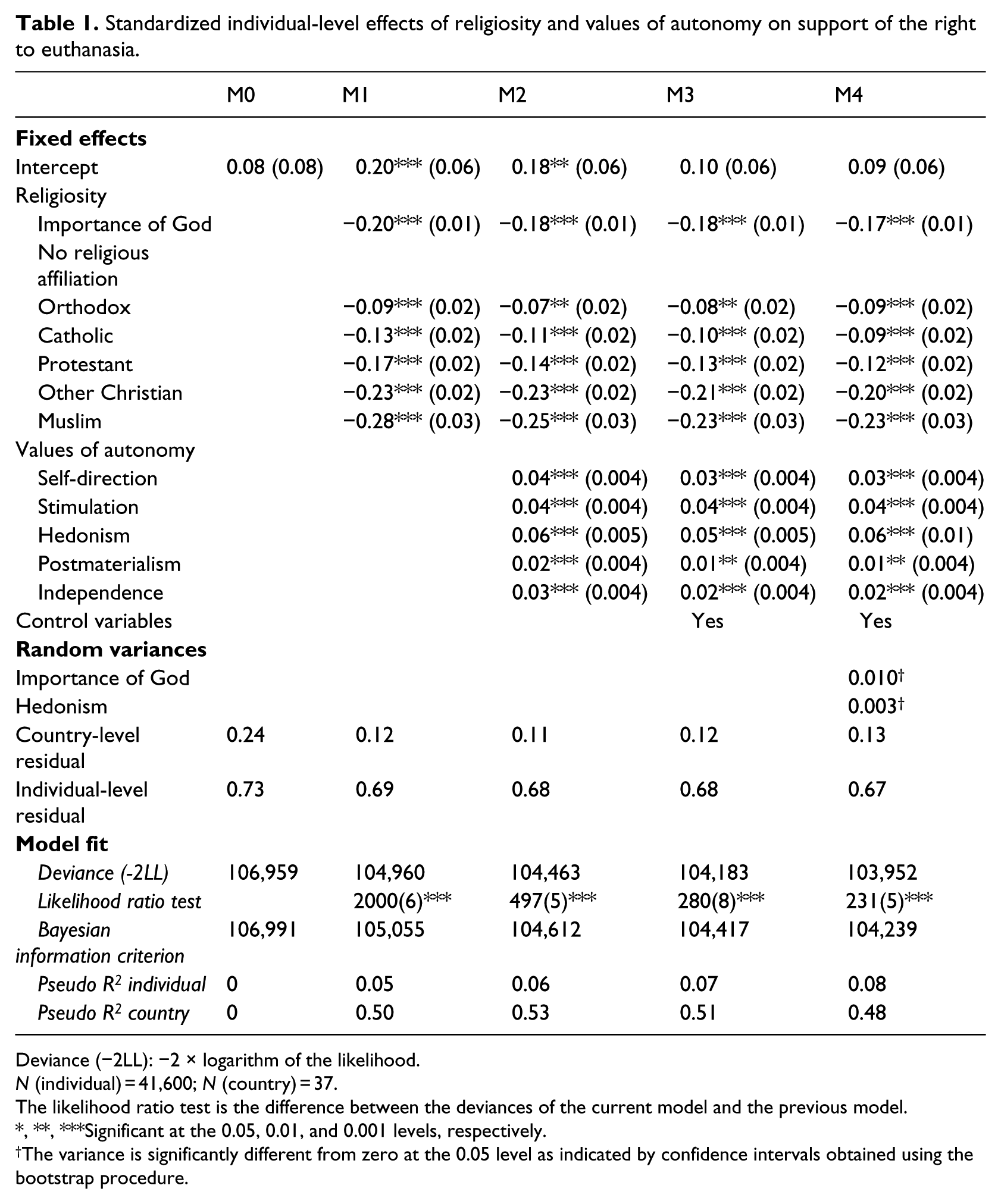
The intraclass correlation across 37 countries is 25 percent, which means that a quarter of all differences in euthanasia justifiability are between-country differences, and the remaining 75 percent of variance is at the individual level. Table 1 presents the results of several models, including predictors at the individual level only and adding the values of autonomy, control variables, and random effects step by step.
Standardized individual-level effects of religiosity and values of autonomy on support of the right to euthanasia.
Deviance (−2LL): −2 × logarithm of the likelihood.
N (individual) = 41,600; N (country) = 37.
The likelihood ratio test is the difference between the deviances of the current model and the previous model.
, **, ***Significant at the 0.05, 0.01, and 0.001 levels, respectively.
The variance is significantly different from zero at the 0.05 level as indicated by confidence intervals obtained using the bootstrap procedure.
Model M1 includes the importance of God and religious affiliation. Importance of God in this and all the other models is significantly associated with a less positive attitude toward the right to euthanasia. This finding is consistent with most previous studies and our hypothesis H2. Religiosity has a strong negative impact, as do the different religious affiliations (as compared to no affiliation). Protestant, Roman Catholic, and Orthodox Christians are significantly less permissive than non-affiliated respondents in regard to the right to euthanasia; Muslim affiliation (together with other Christian ones) demonstrates a significantly higher negative effect on support for the right to euthanasia.
In addition to religiosity and religious affiliation, Model M2 includes the different indicators of autonomy values. As expected, all of these indicators demonstrate positive and significant effects. Adding the control variables in model M3 does not change the previous result. Likelihood ratio tests support these findings as well: every subsequent model is better than the previous one. Summing up, these results show that (1) the autonomy values have an impact independent of religiosity and (2) the use of different aspects of autonomy values is reasonable, as each of these indicators has a significant impact on the justifiability of euthanasia. Thus, our hypotheses H1 and H2 are fully supported. With respect to the effect sizes, the impact of importance of God is −0.18 standardized units which is much larger than the impact of values, each of which has a standardized effect not higher than 0.06. However, the effects of different aspects of autonomy values taken together are comparable to the impact of importance of God.
Next, we tested the random effects of importance of God and all the autonomy values, and only effects of religiosity and hedonism showed a small variance of effects across countries. Model M4 summarizes these results by including these two random effects. The predicted country-specific effects are listed in Figure A2 in Supplementary Material. The effect of religiosity varies from highly negative in Mexico to near zero in Mali, while the effect of hedonism varies from highly positive in Norway to near zero in Bulgaria; in Ethiopia and Morocco, it has even negative effects. This finding demonstrates that it is reasonable to append the model with cross-level interactions explaining these variances of slopes across countries. At the next stage, these substantial variations of intercepts and slopes were explained with hypothesized country-level variables.
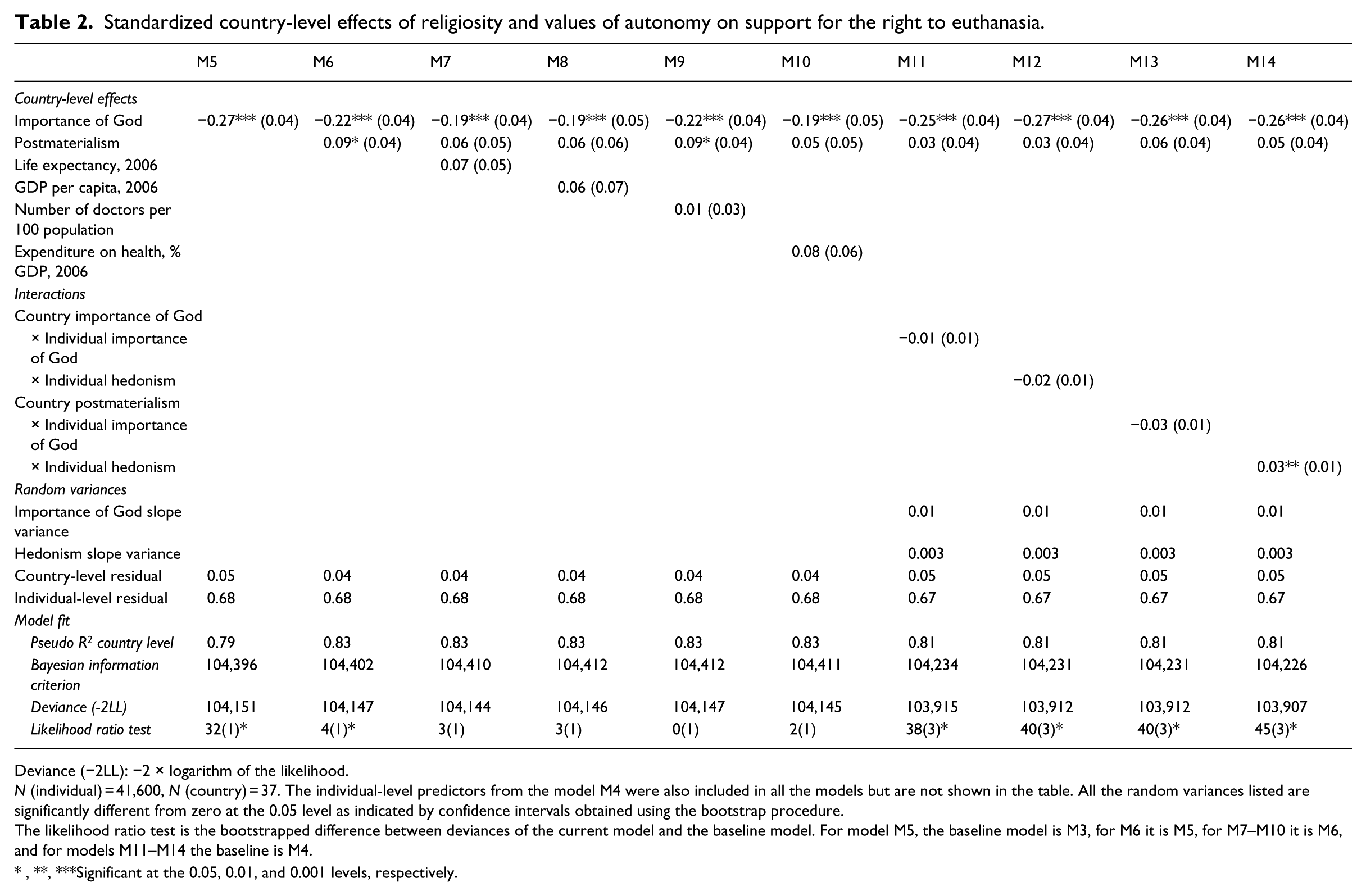
Table 2 presents the country-level effects. M5 includes country-level religiosity and supports hypothesis H3b; it has a strong negative effect on a country’s support for the right to euthanasia. Model M6 shows a weak but significant independent effect of country-level postmaterialism. Models M7–M10 include, one-by-one, the four country-level control variables due to the small sample of countries. Estimated effects demonstrate that country-level postmaterialism loses its significance in three models after controlling for independently measured life expectancy, GDP per capita, and healthcare expenditure. However, these controls are not significant either, probably because of the correlations with country postmaterialism. Overall, we find limited support for hypothesis H3a on an independent impact of autonomy values at a country level.
Standardized country-level effects of religiosity and values of autonomy on support for the right to euthanasia.
Deviance (−2LL): −2 × logarithm of the likelihood.
N (individual) = 41,600, N (country) = 37. The individual-level predictors from the model M4 were also included in all the models but are not shown in the table. All the random variances listed are significantly different from zero at the 0.05 level as indicated by confidence intervals obtained using the bootstrap procedure.
The likelihood ratio test is the bootstrapped difference between deviances of the current model and the baseline model. For model M5, the baseline model is M3, for M6 it is M5, for M7–M10 it is M6, and for models M11–M14 the baseline is M4.
, **, ***Significant at the 0.05, 0.01, and 0.001 levels, respectively.
Models M11–M14 test the cross-level interactions, explaining the variance of individual slopes of religiosity and hedonism with country-level postmaterialism values as well as country-level religiosity. Only the interaction between individual hedonism and country postmaterialism is significant. As the interaction is positive, country postmaterialism strengthens the effect of individual hedonism values, that is, in countries with higher postmaterialism, individual hedonism has a stronger impact on support for the right to euthanasia.
Summing up the interaction effects, country-level religiosity was found to be an insignificant moderator for random effects of individual religiosity and hedonism values, whereas a country’s level of postmaterialism strengthened the positive individual-level effects of hedonism. This finding leads us to reject the hypothesis H4a and partly support H4b. Overall, the model explained about 8 percent of the variance of the support for the right to euthanasia at the individual level and about 80 percent at the country level.
Indirect effects of religiosity mediated by values
This part of the analysis tests hypothesis H5 on the indirect effects of religiosity mediated by the values of autonomy in addition to the direct effect of religiosity. It was tested with a multilevel path analysis; an overall path diagram is shown in Figure 1.
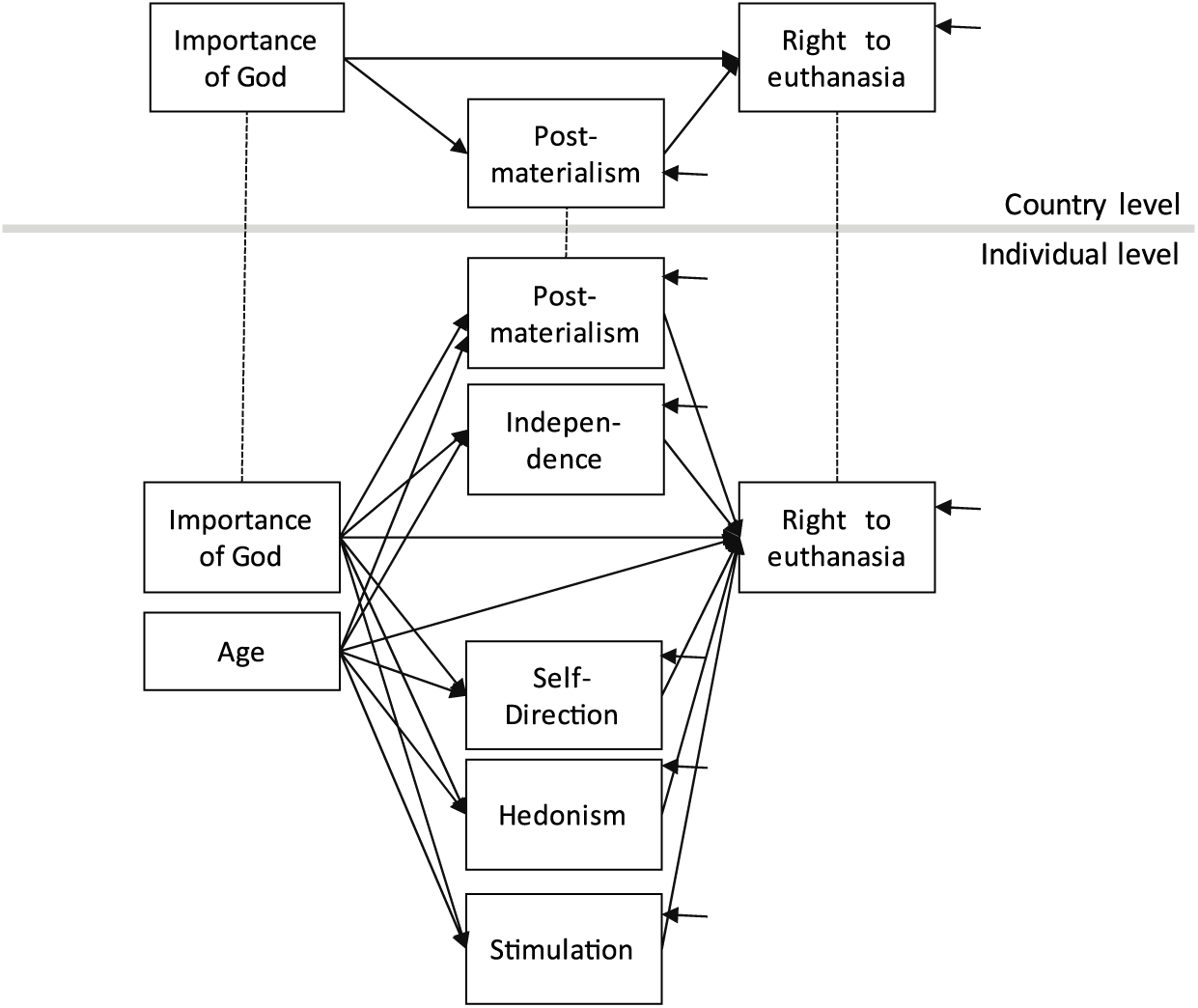
Multilevel path model.
At the individual level, the importance of God has direct and indirect effects mediated by the five autonomy-related values. The inclusion of each extra variable increased the number of parameters exponentially. Therefore, for simplicity, only one control variable was left, namely, age, which is highly correlated with both values and religiosity. Similarly to all the previous models, the outcome variable is support for the right to euthanasia. At the country level, the exogenous variable was the importance of God, and its effect was mediated by postmaterialism.
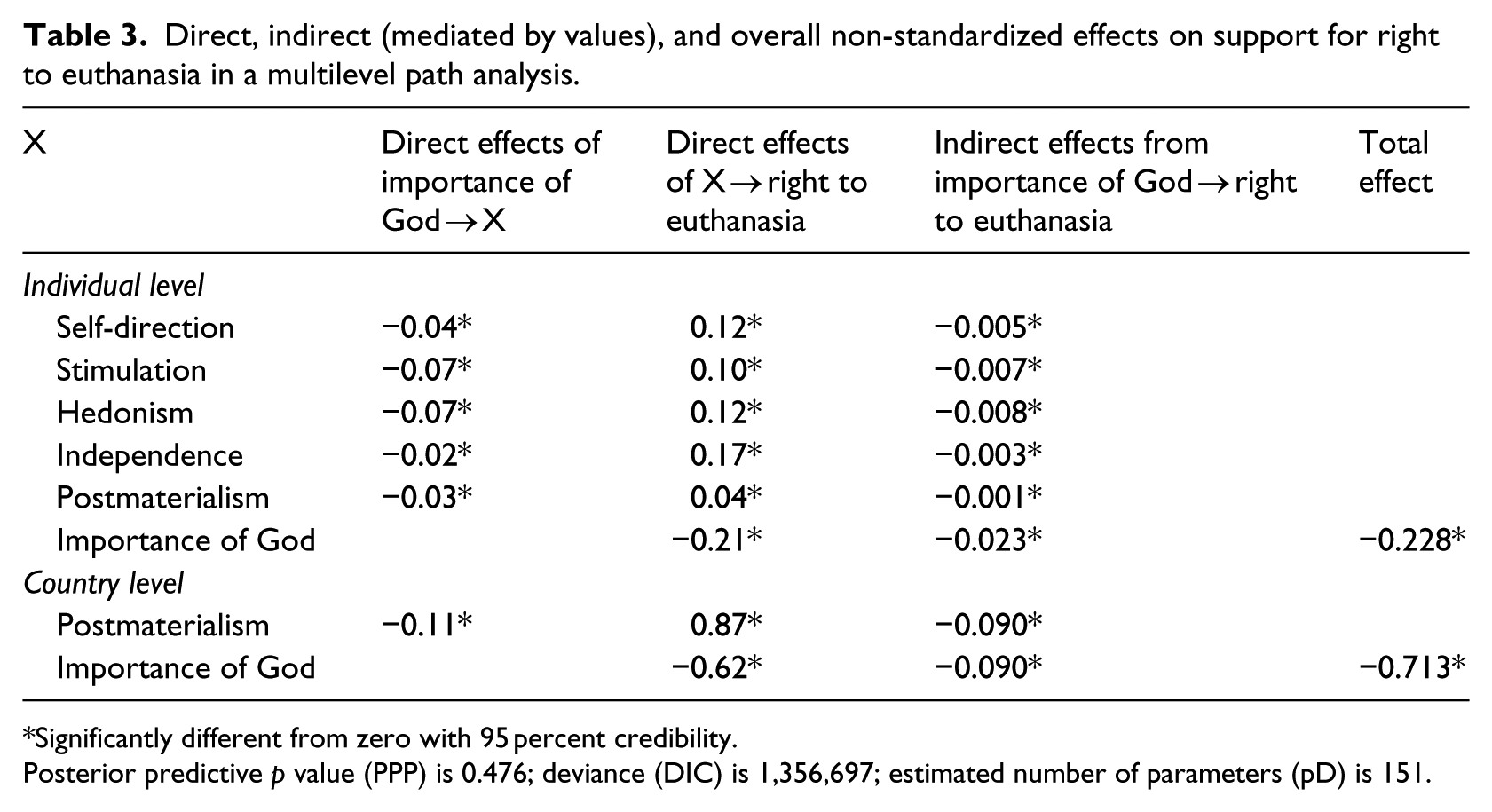
The main indicator of the model’s quality, posterior predictive p value (PPP), is 0.476 in this model, which is higher than the minimum of 0.05 and approaches a desirable value of 0.5 (Muthén and Asparouhov, 2012). This indicates that the model is effective at revealing the population’s parameters. Direct and indirect effects are listed in Table 3.
Direct, indirect (mediated by values), and overall non-standardized effects on support for right to euthanasia in a multilevel path analysis.
Significantly different from zero with 95 percent credibility.
Posterior predictive p value (PPP) is 0.476; deviance (DIC) is 1,356,697; estimated number of parameters (pD) is 151.
The significance of effects of religiosity and values of autonomy remained the same as those found with the multilevel regression described above. Both the values of autonomy and religiosity have significant independent direct effects on support for the right to euthanasia at the individual and country levels. Unlike the regression model, in the path analysis, the effect of postmaterialism at the country level was significant. The indirect effects of religiosity mediated by different values of autonomy were significant at both levels. At the individual level, importance of God has a significant and negative indirect effect via self-direction, stimulation, hedonism, independence, and postmaterialism. Likewise, at the country level, the negative effect of religiosity was weakly but significantly mediated by postmaterialism. All the indirect effects of religiosity were negative; they enhanced the negative direct effect. At the individual level, only −0.023 units of indirect effect are added to the direct effect of religiosity, which is −0.21; at the country level, the direct effect of −0.62 is increased by only −0.09 units of indirect effect. It follows that the indirect effects of religiosity are only small parts of its total effect, both at the individual and country levels, though these are statistically significant. We may conclude that apart from the independent effects of religiosity and values of autonomy, there is a small mediation effect of values at the individual and at the country level. Therefore, hypothesis H5 is supported at the individual and country levels.
Discussion and conclusion
In this study, we investigated the roles of traditional religiosity and autonomy values in support for the right to euthanasia across nations. More generally, we sought to check whether attitudes toward euthanasia are embedded in postmodernization by emphasizing either quantity (duration) or quality (independence and enjoyability) of life. We examined the views on euthanasia across 37 national samples with monotheistic traditional religiosity and five facets of autonomy values.
The results of multilevel regression analyses demonstrated, at the individual level, the independent contributions of traditional religiosity and all the studied aspects of the autonomy values to attitudes to euthanasia. These effects remained significant after controlling for other relevant variables. The individual-level effects of both religiosity and autonomy values were consistent across countries and did not depend on country-level religiosity nor postmaterialism. The only exclusion was the hedonism values that had a significantly stronger effect in countries with higher societal postmaterialism.
Supporting our hypotheses, multilevel path analysis demonstrated that, at both levels, values of autonomy mediated the effect of religiosity, strengthening its negative effect on support for the right to euthanasia. However, the added value of this mediation to the total effect of religiosity was very small, so we conclude that the most important effects came directly from religiosity and autonomy values. Therefore, we found only a weak evidence that autonomy values are mediators of traditional religiosity in relation to the support for the right to euthanasia. Rather, they seem to have independent direct effects. The specific direct effects of each of the studied aspects of autonomy values were relatively small; however, if we sum them up, they are comparable to the effect size of religiosity.
These findings support a close association between the modernization and postmodernization shifts and the conflict between the quality and quantity of life, which in turn is expressed in attitudes to euthanasia. Lower importance of God (as an expression of modernization tendencies) and higher importance of autonomy values (postmodernization) for individuals are associated with greater support of the right to euthanasia. It is important to note that these two effects are independent and barely involved in the mediation and moderation relations. This indicates that modernization and postmodernization affect individual attitudes quite independently of each other.
The results suggest that religion is not an exclusive source of personal attitudes toward euthanasia: values present an additional source of regulation. Having said that, we note that traditional religiosity is still a powerful predictor; it has a greater impact on support for the right to euthanasia than any specific aspect of the autonomy values. From this, we can infer that the second value shift, emphasizing personal well-being, is still in progress in many developing and even advanced countries. Around the world, traditional religiosity remains the main force leading people to oppose the right to opt for quality of life over its quantity. Indeed, a value shift does not happen once and forever; there are always groups sharing very different values. This persistent heterogeneity of values and associated attitudes might explain the lively discussion on the justifiability of euthanasia and other end-of-life issues even in advanced and secular societies with trustworthy healthcare systems. Given the small number of countries that have legalized assistance in terminal decisions, it seems that the groups sharing lower traditional religiosity and high on autonomy values are large enough to promote discussion about euthanasia but not influential enough to put this right into law.
At the country level, however, the effect of autonomy values was less pronounced, whereas traditional religiosity almost exhaustively explained the national differences in support for the right to euthanasia. The results were somewhat ambiguous, showing insignificant effects in a regression that controlled for the composition of populations, but significant in the less-controlled path analysis.
The difference between the individual- and country-level effects of autonomy values is interesting: while people within a given country are divided in their support for the right to euthanasia by both their values and religiosity, differences between countries predominantly depend on religiosity. This highlights the fundamental differences in the nature of country-level religiosity and autonomy values. First, as mentioned above, traditional religiosity is more thoroughly institutionalized than autonomy values. Compared to personal non-institutionalized values, institutions have more ways to affect both policies and public opinion in regard to euthanasia. Second, the level of traditional religiosity in a country plays a prescriptive role; that is, it promotes norms that lead people to deny the right to euthanasia, whereas a level of autonomy values in a country promotes individual choices, thus delegating the choice between support and rejection to the individual level. More specifically, country-level autonomy values do not generate strong normative pressure on attitudes toward euthanasia, instead encouraging individuals to shape their views in line with their own personal religiosity and values. This distinction is reflected in the ethical literature as an opposition between “neutralists” who claim that the state (or group or culture) should not prescribe anything, leaving people completely free in their choices, and “perfectionists” who claim that the state (or group or culture) should frame individuals’ morals (see Gorsuch, 2009: 87–90). Although it is unlikely that only one of these extreme positions completely determines public attitudes, the results of our study suggest that the “perfectionist” role of traditional religiosity prevails over “neutralist” autonomy values in its effects on attitudes to euthanasia. In a long run, it may be that the “neutralist” position of autonomy, although very attractive to individuals, has fewer chances to determine public normative views on euthanasia than “perfectionist” traditional religiosity. That is, the role of restrictive ideologies is likely to persist in determining country differences in attitudes to euthanasia. At the same time, at the individual level, we found support for the thesis that human values have an independent and robust impact on normative judgments related to end-of-life issues. Extrapolating these results to a time series, we may also speculate that the ongoing decrease in traditional religiosity across the world (Hayward and Krause, 2015; Inglehart and Norris, 2007) leads to its substitution as an individual regulator of normative views by “religion-free” autonomy values.
Our results show that attitudes to euthanasia are indicative of a value change, capturing the shift from quantity-of-life ideology to quality of life. The prevalence of this shift may lead to many important consequences that go beyond legalization of euthanasia. For example, it might reshape the choices and lifestyles of seniors, enabling them to opt for more satisfying but less safe behaviors. It may also modify the entire debate surrounding end-of-life issues into a discussion of ways to fulfill autonomy values, completely displacing “sanctity of life” argument. Gorsuch (2009) even suggests that the development of the autonomy principles in ethics might lead to the appearance of various forms of “consensual homicide.”
This article contributes to the literature in several ways. First, we explicate a link between postmodernization theory and the preference for quality versus quantity of life. Second, we demonstrate that values of autonomy have an effect on support for the right to euthanasia at the individual level. Third, we show that this effect is predominantly direct and independent of traditional religiosity, being included only in weak or no moderation and mediation routes. Fourth, we demonstrate that the effects of traditional religiosity still prevail at the individual level and dominate at the country level. Fifth, we show that traditional religiosity and autonomy values are useful and sufficiently precise constructs for studying normative views. And finally, we propose a mechanism that allows traditional religiosity as well as autonomy values to regulate people’s normative views. We do not put forward direct policy implications, but rather suggest a new look at the regulation of normative views as being a complex function of both traditional religiosity and autonomy values.
This study has several limitations. The first, and the most common to comparative studies, is a non-representative sample of countries, such that our conclusions are limited to the 37 countries featured in the study. This makes it somewhat questionable whether this article’s conclusions can be generalized to the whole world population. Second, the measure of support for the right to euthanasia used in the WVS is prone to bias as it is a part of a larger battery of questions, and translations differ across countries. Third, we focused only on monotheistic religiosity and autonomy values, whereas other religiosities and values might have an important role in support for the right to euthanasia. And, finally, the study is correlational by nature of the data used, so the causal claims in this article are suggestions and may need a proper longitudinal or experimental assessment.
Future research might look in detail at the change of the role of traditional religion in regulation of moral attitudes; we would expect the effects of religiosity on moral attitudes to decrease and the impact of non-religious values to increase over the recent decades. Another direction for future research could involve religiosities other than the monotheistic ones (such as Buddhism), examining the way in which these frame attitudes toward support for the right to euthanasia.
Supplemental Material
Supplemental_Material_COS787582 – Supplemental material for Public support for the right to euthanasia: Impact of traditional religiosity and autonomy values across 37 nations
Supplemental material, Supplemental_Material_COS787582 for Public support for the right to euthanasia: Impact of traditional religiosity and autonomy values across 37 nations by Maksim Rudnev and Aleksandra Savelkaeva in International Journal of Comparative Sociology
Footnotes
Acknowledgements
The authors are grateful to members of the “Beginning and End of Life” scientific network coordinated by Tilo Beckers and Pascal Siegers, as well as to Vladimir Magun, Anna Shirokanova, and anonymous reviewers for their comments on the earlier versions of this paper.
Funding
Work of the first author was supported by the Basic Research Program at the National Research University Higher School of Economics.
Notes

References
Supplementary Material
Please find the following supplemental material available below.
For Open Access articles published under a Creative Commons License, all supplemental material carries the same license as the article it is associated with.
For non-Open Access articles published, all supplemental material carries a non-exclusive license, and permission requests for re-use of supplemental material or any part of supplemental material shall be sent directly to the copyright owner as specified in the copyright notice associated with the article.
