



Abstract
Background and aims:
Epidemiological and community-based surveys consistently report gender differences in mental health. This study examines gender differences in psychological distress by analyzing the relevance of stress, coping styles, social support and the time use.
Methods:
Psychological tests were administered to a convenience sample of 1,337 men and 1,251 women from the Spanish general population, aged between 18 and 65 and with different socio-demographic characteristics, although both the women and men groups had similar age and educational levels.
Results:
Women had more psychological distress than men. Although psychological distress in the women and men groups have some common correlates such as more stress, more emotional and less rational coping and less social support, we find some gender differences. Work role dissatisfaction was more associated with distress in the men than in the women group. In addition, women’s distress was associated with more daily time devoted to childcare and less to activities they enjoy, and men’s distress was associated with more time devoted to housework and less to physical exercise.
Conclusions:
Social roles traditionally attributed to women and men – and the differences in the use of time that such roles entail – are relevant in gender differences in psychological distress.
Background
Epidemiological and community-based surveys consistently report the existence of gender differences in mental health. Generally, women showed higher rates of anxiety and mood disorders than men, whereas men showed higher rates of impulse-control and substance use disorders than women (Eaton et al., 2012; Kessler et al., 2005; Seedat et al., 2009). A number of biologic, psychosocial and gender-role hypothesis has been proposed to account for these differences but results had been inconclusive.
Depression and anxiety symptoms are the most frequent indicators of psychological distress (Cassidy, O’Connor, Howe, & Warden, 2004; Drapeau et al., 2010). They are two of the most prevalent mental health problems and they frequently co-occur (Brown, Harris, & Eales, 1996; Eaton et al., 2012). Other symptoms commonly included for the measure of psychological distress are insomnia and somatic symptoms (Kessler et al., 2002; Talala, Huurre, Aro, Martelin, & Prättälä, 2008). Psychological distress is a common indicator of mental health and psychopathology either in clinical and research settings and in public health (Drapeau et al., 2010) and often primary care patients present distress symptoms (Simms, Prisciandaro, Krueger, & Goldberg, 2012). Since distress symptoms indicate the need for health care services, distress prevention may lead to a reduction in health care cost, plus a reduction of subjective suffering (Gadalla, 2009).
Population surveys and epidemiological studies carried out in several countries indicate that women report a higher mean level of psychological distress than men (Cleary & Mechanic, 1983; Doherty & Kartalova-O’Doherty, 2010; Drapeau et al., 2010; Marchand, Drapeau, & Beaulieu-Prévost, 2011; Mirowsky & Ross, 1995; Nurullah, 2010; Roberts, Abbott, & Mckee, 2010). But gender differences in distress decrease or eventually disappear in case of a high occupational grade (Marchand et al., 2011) and when women and men have similar socioeconomic conditions (Beasley, Thompson, & Davidson, 2003; Emslie, Hunt, & Macintyre, 1999). Also, gender differences in distress may vary according to the particular context, the historical period or socio-cultural setting (Emslie et al., 2002). Thus, in a recent study with Chinese young adults, Kong, Zhao and You (2012) did not find statistical gender differences in mental distress as evaluated by a Chinese version of the 12-item General Health Questionnaire (GHQ).
Several studies have found out the relation between social inequalities and psychological distress, people with lower educational and social status showing a higher number of symptoms (e.g. Byles, Gallienne, Blyth, & Banks, 2012; Myer, Stein, Grimsrud, Seedat, & Williams, 2008; Talala et al., 2008). Moreover, gender inequality in the domestic area seems to be an important determinant of psychological distress, both in women and men (Harryson, Novo, & Hammarström, 2012). Research carried out in several countries has revealed that women perform most of the unpaid household labor (Goñi-Legaz, Ollo-López, & Bayo-Morione, 2010; Hagqvist, Gådin, & Nordenmark, 2012; Harryson, Strandh, & Hammarström, 2012; Lachance-Grzela & Bouchard, 2010; Sullivan, 2000). While time spent on household chores has been associated with women’s psychological distress, evidence is inconclusive as some studies have found that other factors, such as the perception of housework-related stress, perceived fairness, assumption of responsibilities or the inequality in the division of domestic labor, appear to be more relevant drivers of distress than the amount of domestic labor (Bird, 1999; Claffey & Mickelson, 2009; Hagqvist et al., 2012; Harryson et al., 2012; Hughes & Galinsky, 1994).
Psychological distress was also associated with stress (Bancila, Mittelmark, & Hetland, 2006; Heyman, Brennan, & Colarossi, 2010; Marchand et al., 2011). The link between stress and psychological dysfunction has been well established; however, the extent to which adversity has a direct influence on health is still in debate (Beasley et al., 2003). Coping is an important factor in the relation between stressful events and psychological symptoms (e.g. Folkman, Lazarus, Gruen, & DeLongis, 1986). Traditionally, coping is conceptualized ‘as a response or a reaction to stress that has occurred or is threatened’ (Folkman, 2008, p. 73). It includes various behaviors and strategies that have two major functions: dealing with the problem that is causing the distress, which is called problem-focusing coping, and regulating the emotional response to the stressor, referred as emotion-focused coping (Lazarus & Folkman, 1984). The existing literature generally shows that women report more stress than men (Nurullah, 2010), although gender differences in stress depend on the type of stressors considered (Hamaideh, 2010; Matud, 2004). Also, research in gender differences in coping has not been conclusive. In some, studies have been found that women used social support and emotion-focused coping more than men (Eaton & Bradley, 2008; González-Morales, Peiró, Rodríguez, & Greenglass, 2006; Matud, 2004; Watson & Sinha, 2008). However, Folkman and Lazarus (1980) found that women use less problem-focused coping than men but there were no gender differences in emotion-focused coping. Nevertheless, Tamres, Janicki and Helgeson (2002) found, in a meta-analysis, that women were more likely than men to engage in most types of coping strategies, including the search for emotional support.
When we analyze the relationship between stress and health, it is also important to recognize the existence of the hormonal stress response. The so-called stress hormones – norepinephrine, epinephrine and cortisol – have effects on various bodily systems and functions (such as the cardiovascular system, cell metabolism, fat distribution or the immune system) and are important for survival (Lundberg, 2005). As this author notes, achieving a balance between active life and resting periods (both short-term, such as an evening rest or a lunch break, and longer periods, such as vacation or weekends) is beneficial to health. Thus, in order to identify the relevant factors that explain the gender differences in distress, it is important to analyze both the psychosocial factors behind the individuals’ stress and coping styles and their use of time. The previous literature, however, has not combined both types of variables in the same analysis.
Objective
To examine gender differences in psychological distress in the Spanish general population by analyzing the relevance of stress, coping styles, social support and the use of time in women’s and men’s psychological distress.
Material and methods
Participants
Study participants were 2,588 people from the Spanish general population (1,337 men and 1,251 women) aged between 18 and 65 and with similar educational levels for both women and men. The mean age for men was 30.8 (standard deviation (SD) = 11.1) and for women it was 31.8 (SD = 11.4). The 64.8% lived in urban areas and 35.2% lived in rural ones. In Table 1, we present the principal social-demographic characteristics of both groups. As it can be observed, although there are not statistically significant differences in education, we find some gender differences in occupation, marital status and number of children.
Demographic characteristics of the male and female groups.

p < .001.
Measures
Participants’ psychological distress was assessed by using the subscales of severe depression, anxiety and insomnia and somatic symptoms of the Scaled Version of the GHQ (GHQ-28, Goldberg & Hillier, 1979). Items were scored according to the Likert-type scale that assigns a weight to each score, from 0 (less than usual) to 3 (much more than usual). The 21 items were grouped in a factor whose Cronbach’ alpha was .92 for the current sample. To assess stress, we made use of three measures:
Chronic Stress Questionnaire
This is an open-response questionnaire in which participants provide information about the relatively long-lasting problems, conflicts and threats that they currently face in their lives (Matud, 1998a). Each answer was ranked on how much bother the situation caused, in accordance with a 3-point scale from 1 (little importance) to 3 (very important). The total score is obtained by adding the answers provided to each demand or situation considered.
Life Events Questionnaire
It is made up of 27 items indicating life events and changes experienced in the work, economic, family, couple and health areas (Matud, 2008). Participants indicated whether they had experienced any of the 27 events in the preceding 12 months.
Work Role Satisfaction Inventory
This is an open-response inventory in which there are five questions about the extent to which a person is satisfied with his or her current job (or with her role as homemaker, if she does not work outside; or with study, if there are any students), whether he or she chose this role, whether he or she would like to change it, and to what extent this role produces a sense of fulfillment and self-satisfaction (Matud, 1998a). Factor analysis of the answers scored according to a Likert-type answer scale with a range of 0–3 yielded a monofactorial solution that measures dissatisfaction with the work role. For the current sample, the Cronbach’s alpha coefficient for the factor was .76.
Coping Styles Questionnaire (CSQ)
It comprises of 44 items rated on a 4-point Likert-type scale ranging from 0 (never) to 3 (always), and it measures four factors: rational coping, which comprises of 14 items; emotional coping, which comprises of 13 items; detached coping, which comprises of 11 items; and avoidance coping, which comprises of 6 items (Roger, Jarvis, & Najarian, 1993). For the current sample, the Cronbach’s alpha coefficient was .84 for rational, .85 for emotional, .74 for detached and .64 for avoidance coping.
Social Support Scale (AS)
The scale consisted of 12 items rated on a 4-point Likert-type scale ranging from 0 (never) to 3 (always), which gathers information about emotional and instrumental support (Matud, 1998b). These areas are grouped in a second-order factor whose Cronbach’s alpha was .90 in the current sample.
Time use was assessed according to a survey of General Information and Time Use (Matud, 2008). This survey includes data about the principal social-demographic variables (age, marital status, education, occupation, number of children) and information about the time daily devoted to housework, childcare, sleep and to activities the subject really likes and enjoys (thenceforth referred as ‘enjoy time’), and the time dedicated to weekly physical exercise.
Procedure
Participants were recruited from educational, work and community association centers. They were volunteers and no monetary compensation was given. After informed consent was obtained, the questionnaires were filled out individually, in some cases self-administered, and in the case of participants with low educational levels, or those who preferred to be interviewed, the questionnaire was completed during the course of an interview carried out by trained psychology students. Data for the present study were collected as part of a larger investigation on gender and well-being. We have complied with American Psychological Association (APA) ethical standards in the treatment of the sample and the study was approved by the University of La Laguna Research Ethics Committee.
Data analyses
Cronbach’s alpha coefficient was used to assess the reliability of the distress, work role dissatisfaction, coping styles and social support factors. Pearson’s correlation coefficients were calculated so as to know the bivariate association between distress, stress, coping, social support and time use variables for the women and the men groups. Hierarchical multiple regression was used to determine if addition of information regarding coping styles, social support and time use improved prediction of women’s and men’s distress beyond that afforded by differences in stress. The first block (Model 1) incorporated the three stress measures: chronic stress, number of life events over the preceding year and work role dissatisfaction; the coping styles and the social support were added in the second block (Model 2) and the five measures of time use in the third block (Model 3). All analyses were performed using the PASW Statistical Package for Social Sciences (SPSS) version 18.0.
Results
Females scored higher than males in distress, chronic stress, work role dissatisfaction, emotional and avoidance coping styles, social support and the daily time spent in housework, childcare and sleep at night. And males scored higher than females in rational and detachment coping styles, daily enjoy time and weekly exercise (see Table 2).
Means and standard deviations for males and females, comparisons and effect-size for the study variables.

p < .05; **p < .01; ***p < .001.
Table 3 presents bivariate correlations for the study measures calculated separately for the women and the men groups. Although in both groups the three stress measures correlated significantly, the strength of the association was low, thus indicating the assessment of different stressors. It is worth noting that it is only in the women group that work role dissatisfaction correlated significantly with daily time spent on housework and childcare, and both variables correlated negatively with social support and time devoted to sleep at night.
Pearson correlations among study variables for the men and the women groups.
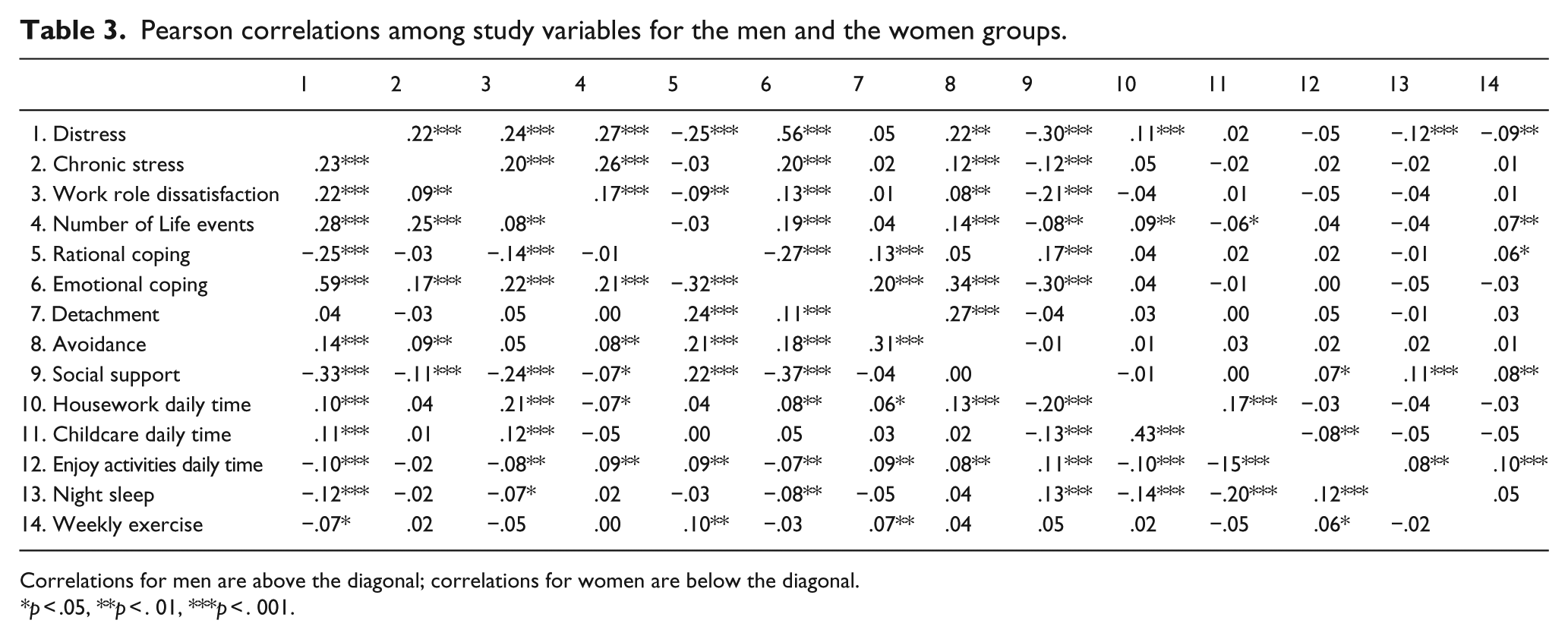
Correlations for men are above the diagonal; correlations for women are below the diagonal.
p < .05, **p < . 01, ***p < . 001.
Table 4 shows results of hierarchical multiple regression for the men group and Table 5 for the women group. Rs for regression were in both groups significantly different from zero in each model. Both tables show that the stress variables entered into Step 1 explained 12% of the variance in distress scores in the men group and 14% in the women group. This model shows that each of the stress variables contributes significantly to distress. Therefore, distress in women and men is associated with the number of life events experienced over the preceding year, with work role dissatisfaction and also with chronic stress. The coping styles and the social support factors entered into the equation in Step 2 were found to explain an additional 26% of the distress variance in each group. Although these measures do make a significant contribution, thus indicating the relevance of stress coping styles and social support in people’s distress, it is worth noting the high Beta value in both groups for emotional coping, suggesting that women and men with more emotional coping style have more distress. However, we should not underplay the relevance of less social support, less rational coping and more avoidance in predicting distress in both genders. In Step 3, time use variables entered into equation explained an additional 2% of the distress variance.
Summary of the hierarchical regression with the distress factor as the dependent measure for the men group.
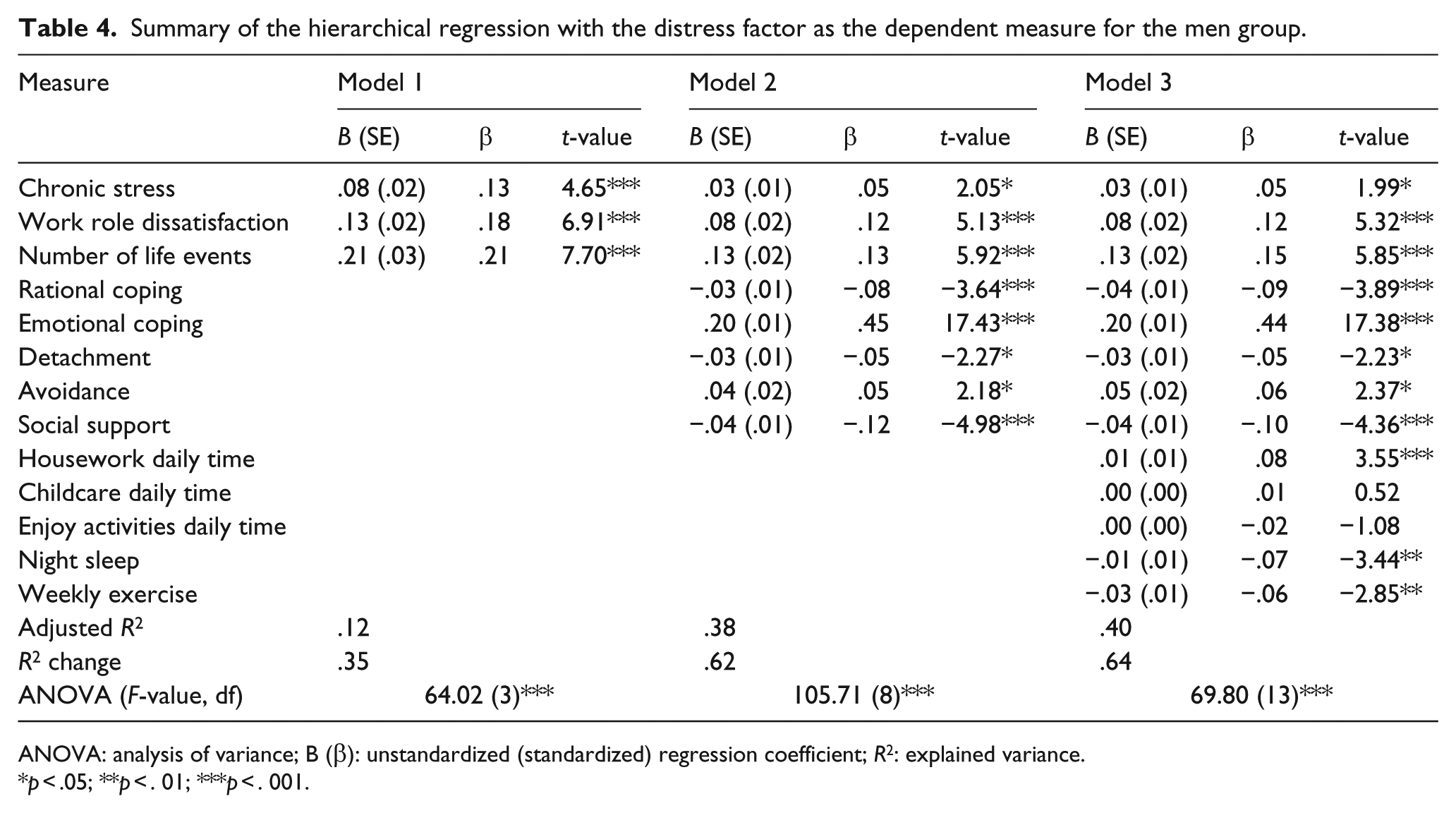
ANOVA: analysis of variance; B (β): unstandardized (standardized) regression coefficient; R2: explained variance.
p < .05; **p < . 01; ***p < . 001.
Summary of the hierarchical regression with the distress factor as the dependent measure for the women group.

ANOVA: analysis of variance; B (β): unstandardized (standardized) regression coefficient; R2: explained variance.
p < .05, **p < . 01, ***p < . 001.
The final model accounted for a total of 40% of distress variance in men and of 42% in women. Beta values showed that emotional coping style is the variable most associated with distress for both genders. The second most relevant variable in both groups was the number of live events experienced during the preceding year. It is worth noting that work role dissatisfaction was the third most relevant variable in the men group, whereas in the women group it was chronic stress and low social support. The importance of rational coping was similar for both genders and it indicated that rational coping is associated with less distress; however, detachment coping style was also associated with less distress yet in the men group only. Tables 3 and 4 show that more time devoted to sleep at night was associated with less distress in both genders. But Beta values for other time uses are different in the women and men groups, thus indicating that women with more distress devoted more time a day to childcare and less to activities they really enjoy. On the other hand, men with more distress devoted more time to housework and less to physical exercise.
Discussion
The major goal of the present research was to examine gender differences in psychological distress in the Spanish general population by analyzing the relevance of stress, coping styles, social support and the time use in women’s and men’s distress. Although women and men had achieved similar educational levels and similar age, women experienced more psychological distress than men. And both genders presented some common correlates of psychological distress – more emotion-focused coping, raised stress levels, less social support and less problem-focused coping – we find some gender differences related with work role and time use.
Results on gender differences in distress agree with studies carried out in other countries (e.g. Cockerham, Hinote, & Abbot, 2006; Doherty & Kartalova-O’Doherty, 2010; Mundt et al., 2014; Roberts, Abbott, & Mckee, 2012). In addition, other studies indicate that emotion-focused coping was positively associated with psychological distress and psychopathology, whereas problem-focused coping was negatively associated with distress (Ben-Zur, 2005; Chandler, Kennedy, & Sandhu, 2007; Watson & Sinha, 2008). And although in this study, the association applied to both genders, women manifested more emotion-focused coping and less problem-focused coping styles, which indicate an increased risk of distress in women with respect to men.
This study also proves that women devote more time a day to childcare and less to ‘enjoy activities’, which was shown to be a relevant factor in raising women’s distress. On the contrary, men’s distress is related to more time spent on housework and less on physical exercise. Few studies have explored the association between use of time and distress levels in women and men while also considering stress and coping variables. This study showed that there is indeed a gender-differentiating factor in the generation of psychological distress.
Work role dissatisfaction was more associated with chronic stress in the men group than in the women group, thus indicating that Spanish society – despite progress of women over the last decades in education and employment (Díaz & Sellami, 2014) – is still built upon persisting patterns of traditional gender socialization, which attribute more importance to occupational factors in men than in women. In addition, while work role dissatisfaction was associated in women with more time devoted to housework and childcare, in the men group dissatisfaction with work role was independent of time use. And although social support was related with less time devoted to housework and childcare in the women group, these time uses were independent of social support in the men group. This reveals that Spanish people still believe that household chores and the care of children are primarily women’s responsibilities.
Daily time spent on childcare is associated just with women’s distress. Although the reason for this is not known, it might be because women spend, on average, almost three times more time than men in daily childcare. And it may also be relevant that the time devoted to the care of children is associated with less night sleep in women, which does not apply to men. And both women and men who sleep longer at night present less psychological distress.
Limitations
There are some limitations in this study, such as the cross-sectional design. And we used a convenience sample. Another limitation to consider is that all the participants lived in Spain, which can restrict the generalization of results with respect to other countries.
Conclusion and implications
The main findings of this study reveal that the women’s style to cope with stress was found to be less healthy than men and they dedicate more time to housework tasks and childcare, at the expense of leisure activities and physical exercise. Despite the male and female respondents being of similar age and educational level, women experienced more psychological distress than men.
Higher levels of psychological distress are generally observed in individuals with more stress and less social support, as well as those with an emotional, rather than rational, coping style. However, we found some gender differences in relation to work roles and use of time. Despite study’s limitations, our results further support the idea that social roles traditionally attributed to women and men – and the differences in the use of time that such roles entail – are relevant in considering gender differences in distress.
These results provide relevant guidance for the elaboration of policies aimed at reducing psychological distress and improving public health. The design and implementation of programs that promote rational coping strategies is recommended. In addition, it is also advisable to promote a more equitable distribution of housework and childcare duties between men and women, in such a way that allows all individuals to have the opportunity to undertake leisure activities and physical exercise behavior.
Footnotes
Funding
This research was supported by the Ministry of Economy and Competitiveness of Spain (Reference: FEM2012-34632).