



Abstract
Background:
Research remains mixed on whether racial-ethnic self-designation impacts psychological health and well-being among Americans of African descent. Existing studies mainly use non-representative samples to address this question. Some scholars argue that Black people who express an African-centered identity should experience improved mental health because it enhances one’s sense of self. However, what role self-designation may have on depression, one of the most common forms of disability, is largely unknown among African Americans. There is also limited evidence on whether one’s self-concept can help us understand the relationship between self-designation and mental health among African Americans.
Methods:
Using data from a national probability sample of African American adults (n = 3,329), I examined whether self-designation as African American, Afro-American, Negro, Black American, or some other label versus Black was associated with self-esteem, mastery, and major depressive episodes.
Results:
Using OLS models, I found that respondents who preferred the terms African American or Afro-American exhibited higher mastery levels compared to individuals who preferred the label Black, the most common term used among respondents. African American identifying respondents also exhibited significantly higher levels of self-esteem compared to Black identifying individuals. Using logistic regression models, I found that only African American identifying respondents were significantly less likely than Black identifying respondents to meet the criteria for major depressive episodes in the past-year. Higher levels of mastery and self-esteem helped to explain such differences.
Conclusion:
In sum, among Americans of African descent, identification as African American rather than Black may help fight depressive episodes because such self-designation may enhance one’s self-concept. Further research is necessary to explore other possible psychological implications of self-designation among the African American/Black population.
Introduction
According to Speight et al. (1996), “racial self-designation refers to one’s preferred self-referent; the name with which one prefers to label oneself” (p. 38). Among the many racial-ethnic categories and labels in the United States, the Black/African American category encompasses individuals from various backgrounds, such as African American, Jamaican, Nigerian, Somali, and other groups with origins in Africa. There are many labels that an individual of Black/African descent in the United States can choose from to describe their racial-ethnic identity, such as more popular terms, like Black or African American, and less popular or more outdated terms, like Negro, Colored, or Afro-American (Brown, 1999; Martin, 1991; Thornton et al., 2000). These labels are borne out of long historical and ongoing processes of re-naming via both governmental ascription (e.g., Black, Negro) and group self-definition (e.g., African American, Afro-American) (T. W. Smith, 1992; Trietler, 2013).
Different from their Black immigrant and second-generation counterparts who often self-identify as Black or with their specific ethnic origins such as “Nigerian American” (Boatswain & Lalonde, 2000; C. W. Smith, 2014), self-designation has often been much more complex for African Americans, a group which generally refers to individuals who descend from enslaved Africans in the United States (Greer, 2013, C. W. Smith, 2014). African Americans often use different labels to define themselves, frequently switching between Black, Black American, or African American, depending on the social setting or their feelings of connectedness to African versus American culture (C. W. Smith, 2014). Studies have shown that terms like African American versus Black influence in-group attitudes, interpersonal relations, communications, class/status perception, perceived criminality differences, political affairs, and even labor market opportunities and outcomes (Anglin & Whaley, 2006; Fairchild, 1985; Hall et al., 2015, 2021; Hecht & Ribeau, 1987; Sigelman et al., 2005; D. N. J. Zilber, 2000; J. Zilber & Niven, 1995). As many African Americans do not know their specific ancestral lineage in Africa due the horrific enslavement of their ancestors, they are largely seen as “just Black”, and most African Americans simply identify as Black (Greer, 2013; C. W. Smith, 2014). The conflation of the terms Black and African American has sparked debate over whether or not they should be used interchangeably. Due to the growing diversity within the U.S. Black population, a growing number of African Americans are choosing the term Black because it is inclusive of all Black people across the African diaspora and it represents Black power and unity. Thus, self-designation among African Americans clearly is a continuous and complicated process, which has implications for their sense of self-concept.
Self-designation is a major aspect of the self and one’s sense of personhood. For Americans of African descent, particularly those with ancestry in sub-Saharan Africa and whose lineage ties back to enslaved Africans in the United States, self-designation heavily influences their sense of belonging with other in-group members, their sense of connection to African versus American culture, and intergroup attitudes and relationships (C. W. Smith, 2014). The self-concept is a key psychological trait (Gecas, 1982) that refers to “the totality of an individual’s thoughts and feelings having reference to himself as an object” (Rosenberg, 1979, p. 7). It also includes “a person’s knowledge on who or what he or she is (i.e. one’s self-rated beliefs) and a person’s evaluation on how to feel about oneself; an evaluation in which people link valence to their self-beliefs (i.e. form positive or negative self-evaluations)” (Wehrle et al., 2019, p. 2). Two aspects of the self-concept are self-esteem and mastery (Falci, 2011). Self-esteem refers to one’s sense of self-worth and one’s general opinion of oneself. Mastery refers to one’s perception of control over the things that happen to them. Both self-esteem and mastery are tightly linked with various mental health outcomes, including depression (Battle, 1978; Turner et al., 1999).
Only a few studies have explicitly examined the relationship between racial self-designation, self-concept, and mental health among African Americans, and most of this research was conducted over several decades ago (G. G. Jackson & Kirschner, 1973), with most using community-based samples. For example, using a sample of 263 African Americans involved in various community and campus organizations in a southwestern city, Larkey et al. (1993) found that respondents who preferred the label Black did so because it provided a sense of unity and acceptability, whereas those who preferred the label African American did so because it allowed them to gain a sense of ethnic identity and blended heritage between America and Africa. Among a sample of African Americans taken from a northwestern university and an African American protestant church, Speight et al. (1996) uncovered no meaningful differences in self-esteem between those identifying as African American versus Black. Using a sample of 156 African American psychiatric patients, Whaley (2005) found that respondents who identified as Black rather than African American have comparable, and sometimes better, mental health in terms of their scores on subjective and objective measures of psychological health (e.g. affective, schizophrenia, and schizoaffective). Whaley also found no significant differences in levels of self-esteem across respondents who preferred the terms Negro, Black, or African American. Finally, a study by Broman et al. (2010) used the National Survey of American Life (NSAL) and found that physical and mental health disorders varied based upon whether the African American respondent identified as “Black/Black American or African/Afro- American” versus some other label. The overall sum of this evidence, which remains quite limited, has at best shown mixed results on the effects of self-designation on indicators of psychological well-being and mental health among African Americans. Even more concerning, little is known about whether self-designation impacts self-concept and depression among the general African American adult population.
In this study, I focus on the relationships between racial-ethnic self-designation, self-concept, and major depression among African American adults. This study extends previous research in several ways. First, different from previous studies which primarily rely on community-based samples to explore similar issues, I use a national sample of African American adults, permitting an expanded analysis of the influence of self-designation on self-concept and mental health among African Americans. Second, this study adds to the growing literature on the links between racial-ethnic identity and mental health, by alternatively focusing on self-designation with a particular racial-ethnic label, rather than in-group attitudes and perceived closeness toward in-group members (Hughes et al., 2015; James, 2017). Third, this study considers the explanatory roles of two measures of the self-concept – self-esteem and mastery – on the association between racial-ethnic self-designation and major depression. Finally, this study focuses on one of the most common mental health conditions in the United States: major depression (Center for Behavioral Health Statistics and Quality [CBHSQ], 2021). Recent data shows that an estimated 21 million (8.4%) American adults aged 18 and older had at least one major depressive episode in the past-year (CBHSQ, 2021). The findings of this study will aid in the provision of additional and much-needed evidence on how self-designation and psychosocial resources affect this common mental health condition among a national sample of African Americans.
The word “black” in the English language has long been associated with many negative connotations, such as “evil”, “dirty”, “being without light”, and “sadness”. The term has also been connected to many popular phrases referencing negative things or events, such as the “black plague” and “black death” (Ghee, 1990). The word “black” was not viewed in a positive way before the 1960s Black Power Movement, which admirably aimed to transform the negative images and stereotypes of blackness into positive messages such as “black is beautiful” (Ghee, 1990). “Afro-American” also surfaced as a popular label created by African Americans during the 1960s to reflect national unity among Black people and greater cultural unification with Africa (Ghee, 1990). In attempts to distance Black people away from racial stigma, assert an ethnic identification, and foster cultural unity with Africa, Jesse Jackson’s 1988 speech to a group of Black leaders argued that Black people should identify as “African Americans” when he stated that:
“Just as we were called colored, but were not that, and then Negro, but not that, to be called black is just as baseless. . .To be called African Americans has cultural integrity. . . It puts us in our proper historical context. Every ethnic group in this country has a reference to some land base, some historical cultural base. African-Americans have hit that level of cultural maturity.”
Although Jackson’s speech helped to popularize the term African American in the American lexicon (T. W. Smith, 1992), the majority of Black people continued to identify as Black, largely because of the salience of skin color in their day-to-day lives, their belief that the term encompasses all Black people, and the disconnect between themselves and their African origins. Ghee (1990) argued that despite the attempts by Black people to reverse the negative connotations of the word “black”, given the ongoing stigma of blackness around the word and the historical etymology of “black”, it continues to lack positive associations.
Ghee (1990) discussed the importance of the self-concept and why only an African self-identification provides African Americans with the ability to develop their true sense of self. He writes that: “Only the African self-ideal is sufficiently grounded in a history of custom, heritage, and world/human/evolutionary contributions for meaningful self-reference. Because of the relative newness of the term, the term Black does not adequately contribute to a positive self-concept because it cannot provide the self with a necessary reference point for self-actualization” (Ghee, 1990, p. 90). Ghee (1990) argued that a name change to “African American” from “Black” would prove to be psychologically beneficial for Americans of African descent. Ghee held this view for several reasons. First, Ghee believed that if one chooses the term African American over Black, they are likely to sense a greater understanding of their history and connection to their cultural and ancestral heritage in Africa. Second, Ghee asserted that adopting an African American label preference would then enhance one’s sense of self and pride, as using the African American label would allow them to become more integrated with their true identity as an African descended person. Third, Ghee argued that an African American rather than Black identification would increase feelings of self-determination, as they are taking on a name created for themselves rather than an ascribed name. Ghee’s arguments are seen among Afrocentric scholars who make similar claims about the psychological benefits of self-naming. For example, Asante (1988) argued that many African Americans are experiencing psychological and mental health problems because they have been “dislocated” from their African heritage and culture. He posited that seeing oneself as African allows for the recentering of oneself, gaining a sense of agency and a greater sense of self-respect. This sense of connectedness to one’s Africanness would then foster a positive psychological state of mind and improved mental health. Thus, if the arguments put forth by Ghee and Afrocentric scholars hold, we would then expect that those identifying as African American or Afro-American (i.e., two labels created by Black people in the United States to promote cultural unity with Africa) rather than Black (i.e., an ascribed term), would have higher levels of self-esteem and mastery and be less likely to experience depression. In line with their arguments, I make the following hypotheses for this study:
H1: Self-designation as African American or Afro-American rather than Black will be associated with significantly higher levels of self-esteem and mastery.
H2: Self-designation as African American or Afro-American rather than Black will be associated with significantly lower odds of depression.
H3: Higher levels of mastery and self-esteem will explain the relationship between self-designation and depression.
Data and methods
In this study, I used data from the 2001 to 2003 National Survey of American Life (NSAL). The NSAL is the most widely used national multistage probability sample of African Americans and Black Caribbeans in the United States (Jackson, Torres, et al., 2004). The NSAL contains survey information on mental health disorders among the Black population in the United States. A total of 3,570 African American respondents were included in the NSAL. African Americans were defined as individuals who identified as Black or African American and did not report Caribbean ancestry. Additional information about the NSAL, such as the response rates and survey design can be found elsewhere (Jackson, Neighbors, et al., 2004).
Depression (dependent variable)
I used diagnoses of past-year major depressive episodes (MDE) as a measure of mental health (did not meet criteria = 0 and 1 = met criteria). Major depression is one of the most common and debilitating mental health conditions in the United States, making it important to consider how self-designation and self-concept affect MDE. In the NSAL, the occurrence of MDE was based on the World Mental Health Survey Initiative version of the World Health Organization’s (WHO) Composite International Diagnostic Interview (WHM-CIDI), which is an instrument utilized to evaluate the presence of various mental health conditions. The WHM-CIDI used methods of evaluation set forth by the Diagnostic and Statistical Manual of Mental Disorders, 4th Edition (DSM-IV). According to the DSM-IV, an individual is deemed to have a MDE if they experience depressed mood or loss of interest/pleasure and significant distress or impairment as a result of their symptoms as well as a total of five of the following symptoms for two or more weeks: significant weight loss or weight gain, insomnia or hypersomnia, psychomotor retardation, fatigue or loss of energy, feelings of worthlessness or excessive or inappropriate guilt, diminished ability to think, concentrate, or make decisions, recurrent thoughts of death, or suicidal ideation, plans, or attempts (American Psychiatric Association, 1994).
Racial-Ethnic Self-Designation
Racial-ethnic self-designation was based on the following survey question: “People use different words to refer to people whose original ancestors came from Africa. What word best describes what you like to be called?” Responses included: Black, Black American, Negro, African American, Afro-American, Colored, “Nigga”, respondent’s name, human/person, African/Black African, American, Hispanic, Brother/Sister, mixed, specific Caribbean country, no preference, and other. Focusing on African American respondents, I allowed Black (n = 1,475), Black American (n = 474), Negro (n = 73), African American (n = 1,058), and Afro-American (n = 194) to be separate categories of self-designation. Due to smaller sample sizes for other less common labels, African American respondents who identified as Colored (n = 54), “Nigga” (n = 5), their own name (n = 36), human/person (n = 31), African/Black African (n = 24), American (n = 27), Brother/Sister (n = 6), mixed (n = 8), no preference (n = 9), and other (n = 42) were treated as Others. African American respondents who preferred Hispanic (n = 1) and Caribbean country of origin (n = 1) labels were excluded from this study. Black was the reference category for this variable because the Black is most common racial-ethnic label used by Americans of Black African descent.
Self-concept
I used two measures of self-concept in this study. The measure of self-esteem was based on the Rosenberg (1979) 10-item scale. Sample item statements included “I am a failure”, “I am satisfied with myself”, and “I want more self-respect”. Items were reverse coded as necessary; the scale was then summed and divided by 10 (alpha = .77). The second measure of self-concept was mastery. This measure was based on the Pearlin Mastery 7-item scale (Pearlin & Schooler, 1978). Sample item statements included “I have little control over things that happen to me”, “sometimes I feel that I’m being pushed around in life”, and “what happens to me in the future depends on me”. Similar to the self-esteem measure, the items were reverse coded, when necessary, then summed and divided by 7 (alpha = .73). For both measures, higher scores indicated higher levels of self-esteem and mastery.
Controls
I utilized several relevant control variables in this analysis. The control variables included the following: gender, age, poverty status, arrest history, region, marital status, employment status, health insurance status, and educational attainment.
Analytical strategy
I ran OLS and logistic regressions to examine the relationships between self-designation, self-concept, and major depression, controlling for the aforementioned control variables. In a series of models, the OLS regressions tested the relationship between self-designation and the two measures of self-concept (self-esteem and mastery). The logistic regression models examined the association between self-designation and major depression. I followed the Baron and Kenny (1986) method to determine whether self-esteem and mastery were possible explanatory variables of the relationship between self-designation and major depression. Thus, the following was necessary for self-esteem and mastery to be considered explanatory variables: (1) self-designation had to significantly predict self-concept; (2) self-designation had to significantly predict major depression; (3) self-concept had to significantly predict major depression; and (4) self-concept had to eliminate the significant relationship between self-designation and major depression. I reported odds ratios for the logistic regression tests and used a 95% confidence interval to determine statistical significance. After handling missing data through listwise deletion, the final sample size consisted of 3,329 respondents.
Results
Table 1 contains the weighted descriptive statistics for the sample of African American adults. In terms of self-designation, approximately 41% identified as Black, 13% as Black American, 2% as Negro, 31% as African American, 6% as Afro-American, and 7% as Other. Approximately 7% of respondents had a MDE in the past-year. The mean for mastery, which ranged from 1 to 4, was 3.34. For self-esteem, which ranged from 1 to 4, the mean was 3.48. For other characteristics of the sample, see Table 1.
Descriptive statistics.
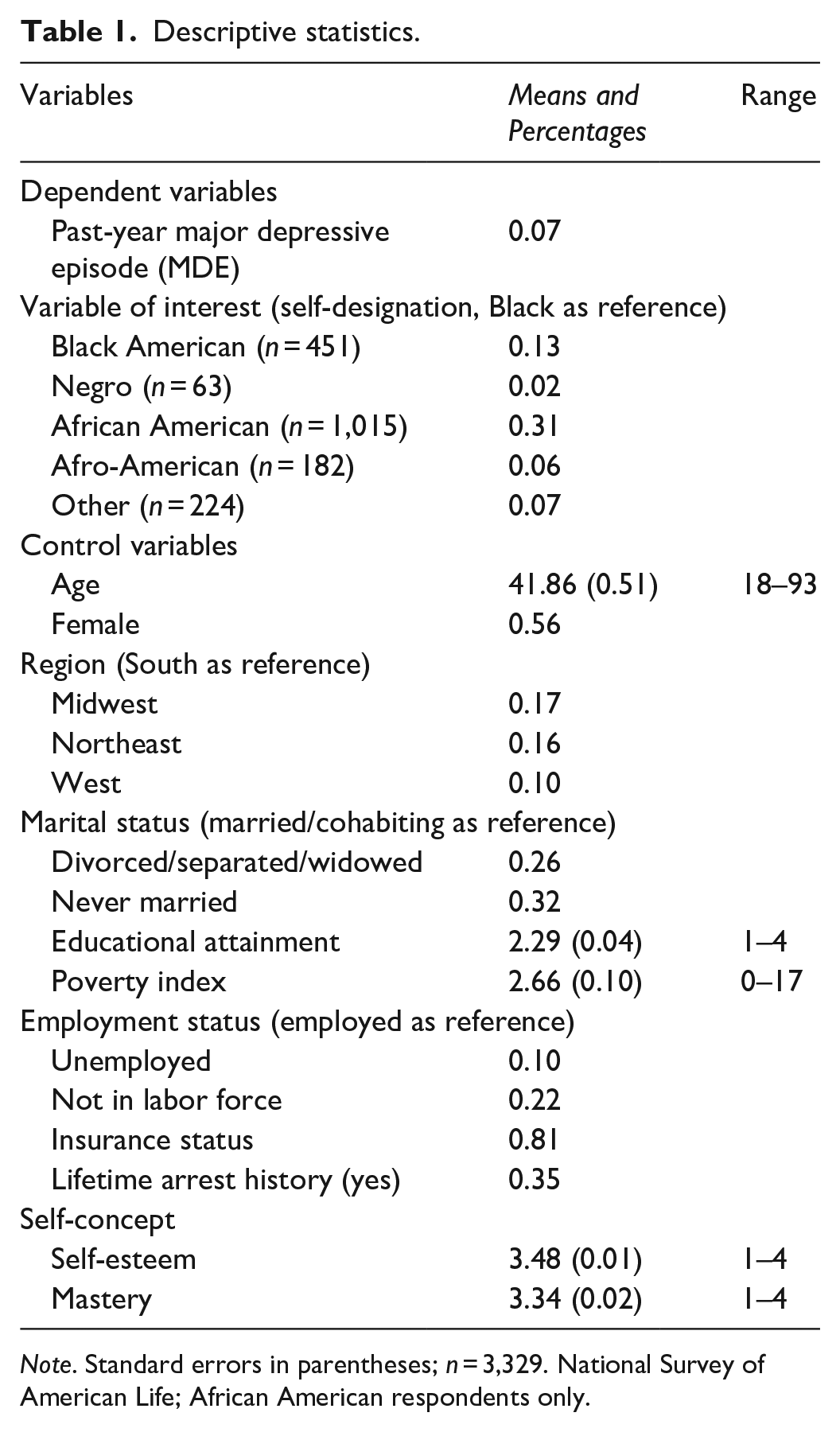
Note. Standard errors in parentheses; n = 3,329. National Survey of American Life; African American respondents only.
Table 2 displays the results of the OLS regressions of the relationship between self-designation and the two measures of self-concept: mastery and self-esteem. Several of the findings were consistent with my hypotheses. The first of my initial hypotheses concerned psychological well-being, specifically self-esteem and mastery, which stated that African American or Afro-American self-designation would enhance one’s sense of self-respect and feelings of control. Respondents who identified as African American or Afro-American instead of Black had significantly higher levels of mastery, controlling for the aforementioned control variables. However, only African American self-designation was associated with significantly higher levels of self-esteem compared to individuals who identified as Black.
Racial-ethnic self-designation, mastery, and self-esteem.
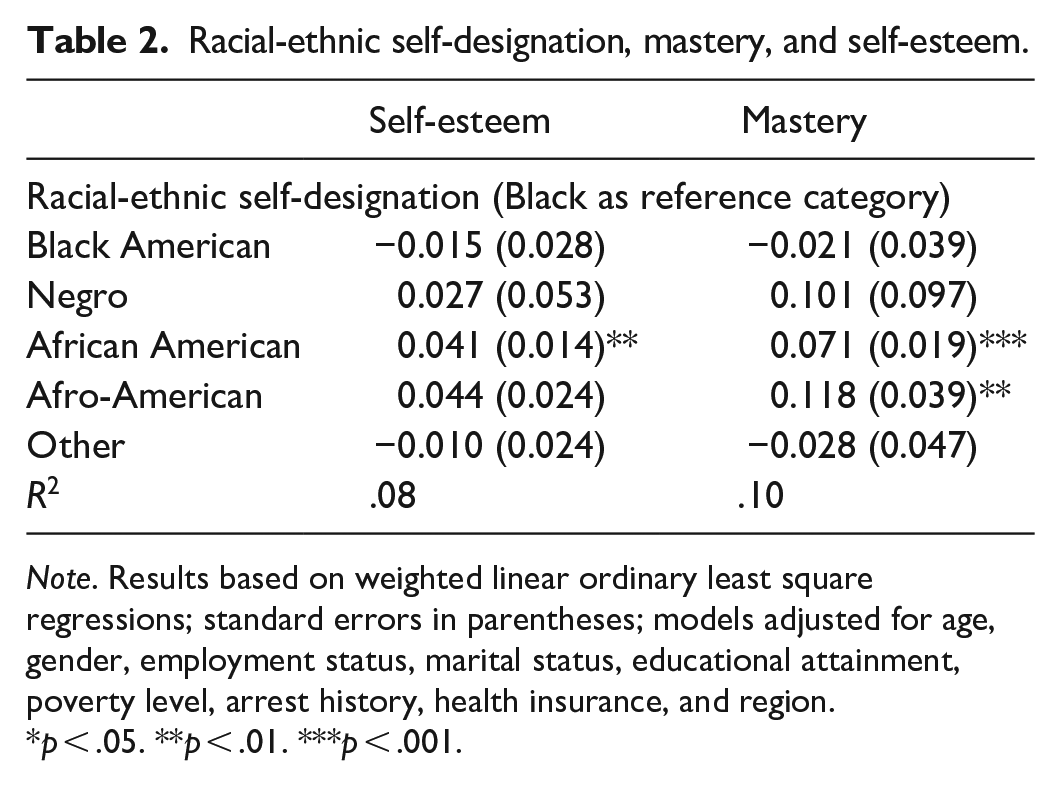
Note. Results based on weighted linear ordinary least square regressions; standard errors in parentheses; models adjusted for age, gender, employment status, marital status, educational attainment, poverty level, arrest history, health insurance, and region.
p < .05. **p < .01. ***p < .001.
Table 3 highlights the results of the logistic regression analyses examining the relationship between self-designation and MDE, and the role of mastery and self-esteem. The findings were also largely consistent with my original hypotheses. Results in Model 1 showed that compared to respondents who preferred the term Black, those who labeled themselves as African American were 38% less likely to meet the criteria for MDE in the past-year, controlling for the aforementioned covariates. After introducing self-esteem into the regression model in Model 2, the significant relationship between self-designation and past-year MDE became insignificant, suggesting that self-esteem explained the differences in the likelihood of being diagnosed with MDE in the past-year between Black identifying respondents and African American identifying respondents. Self-esteem was also associated with significantly lower odds of past-year MDE. A similar explanatory effect was found for mastery after it was introduced into the analysis in Model 3, and mastery was associated with lower odds of past-year MDE. In the full model (Model 4), which considered the influence of both measures of self-concept, self-designation was also no longer significantly linked to past-year MDE. As expected, higher levels of mastery and self-esteem significantly decreased the odds of past-year MDE.
Racial-ethnic self-designation and major depressive episodes.
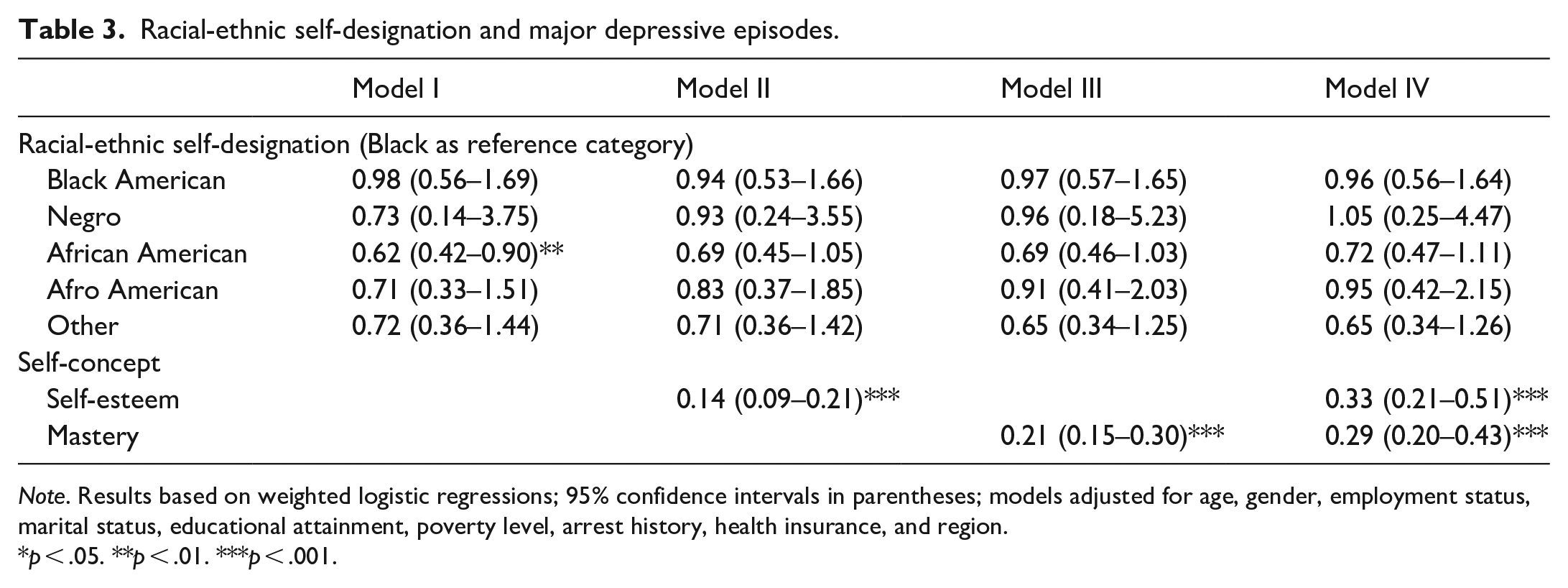
Note. Results based on weighted logistic regressions; 95% confidence intervals in parentheses; models adjusted for age, gender, employment status, marital status, educational attainment, poverty level, arrest history, health insurance, and region.
p < .05. **p < .01. ***p < .001.
Discussion and conclusion
This study explored the relationships between racial-ethnic self-designation, self-concept, and major depression among a national, household probability sample of African American adults. More specifically, I had four major objectives in this analysis. First, I tested whether self-designation as Black American, African American, Afro-American, Negro, or Other versus Black influenced one’s self-concept measured by self-esteem and mastery. Second, I examined whether such self-designation influenced the odds of being diagnosed with a MDE in the past-year. Third, I investigated whether self-esteem and mastery could explain the relationship between self-designation and past-year MDE. Lastly, this study attempted to provide a fuller understanding of the mental health consequences of self-designation among African Americans using a national source of data. Previous scholars have argued that identification with Africa is a primary step toward improving one’s self-concept and that moving away from the label “Black” would be beneficial for the psychological well-being and mental health of Americans of African descent (Asante, 1988; Ghee, 1990). Results of this study differed from previous research examining the effects of self-designation on African American self-concept and mental health. My findings demonstrated support for the notion that an African American self-designation may have positive benefits for one’s self-concept and risk of depression.
As expected, the most common label used among respondents was Black, followed by African American, Black American, Other, Afro-American, and Negro. Contrary to Speight et al. (1996) who did not find any significant correlations between self-designation as African American or Black and self-esteem among a sample of 233 African Americans at a midwestern university and an African American Protestant church, I found that respondents who identified as African American had significantly higher levels of self-esteem and mastery compared to those who preferred the label Black. Despite this difference with Speight et al. (1996), my findings may be indicative of the fact that they found that 57 out of 83 of the African American identifying respondents did so because they believed the label African American was reflective of their cultural heritage and ancestors. In contrast, Speight et al. (1996) found that a large number of Black identifying respondents chose this label because they felt it was externally imposed or for no meaningful reason at all. My findings also differed from those of Whaley (2005) who showed that among a sample of 156 African American psychiatric patients, there were no meaningful differences in mental health disorders (e.g. affective, schizophrenia, and schizoaffective) and self-esteem between patients identifying as Black, Negro, or African American. While my findings showed that self-esteem and mastery levels were significantly higher among African American and Afro-American identifying individuals, which diverged from past research, the current study tested the impact of self-designation using a national sample of African American adults rather than community-based samples seen in many prior studies. Only Broman et al. (2010), whose research used a national sample taken from the NSAL and did not distinguish between distinct self-designations, found that “Black/Black American or African/Afro-American” label preferences were associated with variable effects on mental and physical health among African Americans. The current study may have also differed from past studies because it focused on MDE rather than other mental health conditions. Overall, the findings of the current study demonstrated the possible implications that self-designation as African American rather than Black may have on one’s self-concept and one’s sense of cultural connection to their ancestral heritage (Asante, 1988; Ghee, 1990). They may also be suggestive of the negative connotations associated with the term “black”, which could influence an individual’s perception of the self and, in turn, their risk for depression. However, additional research is needed to expand upon the findings of this study.
There are important limitations of this study that must be addressed. First, the data used for this study are cross-sectional, meaning none of the relationships can be interpreted as causal. Second, as the NSAL was taken over a decade ago, the findings of this study should be viewed with caution. This is especially true given the rise of the Black Lives Matter Movement and the growing unification among and identification with Black people across the African diaspora. It may be that the rise of the Black Lives Matter Movement driven by police violence against Black Americans may contribute to a positive self-concept among individuals who identify as Black, thus improving their mental health. However, recent research shows that such shared sense of oppression among Black people is associated with poorer mental health (Monk, 2020). Future research should collect data to discern whether the findings presented in the current study persist with updated data sources given recent social, cultural, and political movements in the United States. Third, this study focused solely on one measure of mental health, that is, MDE. While using MDE as a measure of mental health is practical considering that it affects millions of Black people in the United States, it could be that self-designation as African American versus Black may not be protective of other common mental health conditions such as anxiety and bipolar disorder.
In conclusion, while the results do not suggest that self-designation as African American versus Black is protective of all mental health outcomes or that one label should be preferred over the other, my findings showed that African American identification was positively associated with one’s self-concept and negatively associated with major depression, one of the most common mental health conditions in the United States. As stated earlier, the overwhelming majority of African Americans identify as Black, often times to signal solidarity with all members of the African diaspora and to promote Black positivity. However, some who identify as “just Black” or “Black” choose to do so because they sense a greater connection to their Black American origins and culture rather than their African ancestry (Greer, 2013, C. W. Smith, 2014). Although African American self-designation may be protective of major depression via self-esteem and mastery, it is important for future research to explore whether Black label preferences have protective benefits for other measures of psychological well-being and mental health. It is also crucial for mental health clinicians to consider how one’s perceived racial-ethnic category may not correspond to one’s personal racial-ethnic self-designation, which then may influence an individual’s sense of self and mental health.
