




Abstract
Corruption often spreads because of ignorance and lack of adequate knowledge about the subject as well as how to correct and contain it. On the other side, corrupt legal, political, bureaucratic, and other social system(s) help corruption swell further. The current article sets out to discuss the question: Is there is a relation between perceived grand corruption and petty corruption? In Iran, too, these two types of corruption have recently become debatable issues. And as in Iran, corruption has become the most challenging issue in many developing countries. With respect to the above relationship, while the theoretical literature makes ambiguous predictions, empiricists, too, have focused little on this subject. The present article tries to examine this issue systematically and, hence, suggests that the perceived grand corruption is significantly associated with the petty corruption. Similar results persist even when grand corruption originates in a country’s legal system. In a nutshell, the article identifies a positive correlation between perceived grand corruption and petty corruption.
Introduction
One of the most famous Iranian poets, Saadi, writes in his book Gulistan: ‘if a king takes and carries away an apple of someone, his soldiers will root out the apple trees’. Borrowing from this statement, it can be said that if citizens perceive their statesmen to be corrupt (perceived grand corruption), they would certainly become corrupt (petty corruption).
This article systematically examines and develops a model in order to explain the relationship between ‘perceived grand corruption’ and ‘petty corruption’. It must be remembered that there is limited literature on the proposed topic.
Corruption
Broadly, corruption is an abuse of public office for private gain. Although corruption takes place in both public and private domains, the current research primarily focuses on the public kind. Corruption encompasses unilateral abuses by government officials such as embezzlement and nepotism, as well as abuses linking both public and private actors such as bribery, extortion, influence peddling, and fraud. The most perennial definition of corruption, however, makes it very neat and simple i.e. the abuse of public office for ‘private economic gain’ (Rose-Ackerman, 1999). This is the definition preferred by the World Bank (1997), although it has been criticized for considering corruption in the public sector alone. The other definitions of corruption are more or less the same. Ariane defined it roughly as the abuse of public office for private gain (Ariane et al., 2007). And, according to the Encyclopaedia Britannica, the word corruption means ‘Improper and usually unlawful conduct intended to secure a benefit for oneself or another’.
Almost all surveys use definitions similar to the one used by Transparency International (1998), i.e. the misuse of public power for private benefit.
Corruption is a malady affecting both affluent and poor nations. While affluent nations do not exhibit much evidence of petty corruption, poor nations are subject to the effects of both grand and petty corruption from within their own borders as well as the ensuing effects of the grand corruption by the affluent; and Iran is no exception to this.
Klitgaard (1988: 75) notes that the basic ingredients of corruption are, first, Government monopoly; second, discretion in interpreting ‘laws’, in deciding who is eligible for benefits, and what constitutes proper documentation and procedure; and third lack of direct accountability.
Considering the above discussion, the monopoly in the Iranian government will help petty corruption spread among citizens.
Types of corruption
Corruption takes many forms such as: acceptance of money and other rewards for awarding contracts, violation of procedures to advance personal interests, kickbacks from developmental programmes or multi-national corporations, pay-offs for legislative support, diversion of public resources for private use, overlooking illegal activities, intervening in the judicial process, nepotism, common theft, overpricing, establishing non-existing projects, and tax collection and tax assessment frauds (United Nations, 1990). Furthermore, corruption arises from both political and bureaucratic offices; hence, it can be categorized as petty or grand, organized or unorganized. Grand corruption involves the highest public offices whereas petty corruption involves exchange of smaller amounts of money and favors by those holding minor positions.
A buyer and a seller are two actors required in the corruption process. In petty corruption, these two actors are well known, but they are often unidentified in grand corruption where nobody can see a buyer or a seller despite corruption being institutionalized. In other words, grand corruption does not depend on individuals; rather, the system itself is corrupt. Here, even a virtuous (clean) person is compelled to be corrupt in order to remain in the system otherwise he/she will be at risk of being thrown out.
Corruption can be foreign-sponsored, institutionalized, the outcome of political scandals and administrative malfeasance (Caiden, 1988). In foreign-sponsored corruption, the main actors include public officials, politicians, and representatives of donor and recipient countries.
The Swedish International Development Cooperation (Sida) (2007) described three degrees of corruption: ‘petty corruption (bureaucratic corruption), grand corruption (political corruption), and state capture (corruption which affects the entire state apparatus)’.
Langseth (2000) argued that corruption materializes in different forms such as bribery, embezzlement, fraud, extortion, abuse of discretion, exploiting a conflict of interest/insider trading, receiving an unlawful gratuity, favor, or illegal commission, favoritism, nepotism, and illegal contributions.
Since the current study does not intend to include the wider spectrum of corruption, the above-mentioned types have not been touched upon. These many varieties can be categorized further in terms of their nature.
Corruption has been differentiated into collusive, coercive, and non-conjunctive types. In collusive corruption, the corrupted are willing, active participants in the process and the use of corruption as an instrument for inducing wrong action or inaction on the part of the authorities, deriving benefit greater than the costs of corruption on their part. In the coercive type, the corruption is forced upon the corruptee by those in power and authority. In the non-conjunctive type, the corruption benefits are obtained at someone else’s expense and victims are unaware of their victimization (Arora, 1993).
Grand and petty corruptions
One of the most famous typologies of corruption analyzed in this research is that of grand and petty corruption. The term ‘petty corruption’ is used in the context of relatively smaller bribes. In typical examples of petty corruption, ‘private’ citizens (often owners of businesses or managers of firms) are engaged in dealing with low-level government bureaucrats regarding transactions involving the filing of appropriate tax returns, payment of important duties, clearance of regulatory or licensing requirements, application for government benefits (loans from state-owned banks, subsidies, jobs, etc.) or approval of specific privileges (driver’s license, passport, registration of a new firm as a legitimate business activity that complies with the laws on minimum wages, workers’ safety, safe construction standards, environmental hazards, etc.) (Ariane et al., 2007: 352).
According to Kochanek (1993), petty corruption takes many forms. ‘Payments are required simply to obtain an application form or a signature, to secure a copy of an approved sanction, to ensure proper services and billing from telephone, natural gas, electric power and water employees. Project corruption permeates both public and private sector contracting.’
Grand corruption takes place confidentiality at top-level negotiations, unknown to the general public. Occasionally, an inquisitive reporter gets an insight into what has happened and puts it in the media. Unfortunately, media resources, time, and expertise are so limited that they cannot pursue a single case to completion, particularly in the face of threats and opposition. The reason for classifying this case as grand corruption is that managers and supervisors would not take proper action to solve the problem and, hence, disclosure of the grand corruption would be difficult.
The petty corruption of a clerk who does not process one’s papers properly must be seen in the scenario of grand corruption. Going to a superior does not help because he cannot and will not take action against his subordinates who are his aides. Since the one in charge is unwilling or unable to act, corruption breeds uninterruptedly and, hence, delays, poor service, shoddy goods, low productivity, and a host of other evils become particularly evident in undeveloped economies.
Typology of corruption

The following are some of the ingredients of grand and petty corruptions highlighted in the aforementioned table.
Public/private
The corruption will be grand if it takes place in the public sector, usually in one of two forms: the first between two or more actors (organizations or persons); and the second between one or more actors in the public or private sectors. Illegal acts by private persons or corporations with no direct involvement with government are called petty corruption. In the public sector, powers and facilities belong to all, and if corruption occurs, everybody has to pay the costs; but in the private sector, the case is the reverse. The abuse of powers on the part of government officials for their illegitimate personal gain is called grand corruption. But the misuse by private sector officials for their illegitimate personal gain is petty corruption.
Often, public and private types of corruption are referred to as political and technical corruption, respectively. Technical corruption is when people commit it due to the fact that they lack information, skills, expertise, and ability; but if people commit corruption despite having complete information, skills, expertise, and the ability to do their jobs, it is political corruption. The discriminating factor here is the will of the person. Consequently, if people have the will to carry out corruption and they do so, it is grand corruption because we expect them to repeat the same behavior. At the same time, if people do not have the will to commit corruption and they do so, it is petty corruption because we do not expect them to repeat it. The repeatability of corruption is the other factor that describes the differences between grand and petty corruption.
In practice, what has emerged in the Third World is the ascendancy of the political apparatus over state bureaucracy. Political leaders are able to use the political apparatus and the state machinery to foster personalization of political power. At the same time, they use the political apparatus for mobilizing the state machinery to give legitimacy to their actions. The effect of these trends has been to create a bureaucratic elite which is dependent for its position on its access to political power and which acts to sustain the prevailing political order. This pattern of structuring administrative institutions fully reflects an elite bias and indicates that greater coordination at the systemic level would be resisted by the vested interests (Kempe, 1985: 2).
Organized/unorganized
This type of corruption occurs once actors/factors that are engaged in corrupt behaviors take action based on planning. Highly organized corruption comes into this category. In other words, organized corruption is the same as grand corruption; and unorganized corruption is the petty kind.
Law-making/law enforcement
Grand corruption is related to law-making (how laws are made); and the focus is on the law-making process. But petty corruption is about how laws are enforced; so the focus is on the law enforcement process. We can imagine grand corruption as an umbrella that dominates all activities and all people. So, the law-making plays the role of an umbrella that has impact on all aspects of affairs.
Statesmen/citizens
Corruption committed by statesmen/employees in the public sector is referred to as grand corruption because it involves corrupting the money (rights) of all people or many people. Further, we know that statesmen are more familiar with regulations and have mechanisms to hand to commit corrupt behaviors; so we place it in the grand corruption category. But, citizens have limited and little information and mechanisms (especially in Iran) to commit corrupt behaviors. Unlike citizens, statesmen know the system’s weaknesses as well as how to take advantage of them for their personal gain. In other words, bureaucratic elites, politicians, business people, and middlemen are responsible for political scandals. Consequently, corruption becomes institutionalized with support provided by bureaucratic elites, politicians, business people, and white-collar workers. In administrative malfeasance, petty officials and interested individuals play a major role.
Managers/employees
There is a debate on corruption among those in power (grand corruption) and corruption among the underclass (petty corruption). In a given organization/ministry/department, corruption at the top level is oriented toward grand corruption, both in public and private organizations. Since corruption at the top level often affects all or many of the employees, we have put it in the category of grand corruption. But corruption at lower levels affects some of the employees; hence, it is placed in the category of petty corruption. Let us suppose that the top-level officials in public organizations commit corrupt behaviors; this is called the worst type. This is because of the fact that in Third World countries, the public/governmental organizations have a monopoly in their affairs; and considering that top-level authorities in public organizations have monopolistic power, we can conclude that corrupt behaviors will never be disclosed. We may call this type of monopoly a ‘double monopoly’ that results in ‘double corruption’, which in other words could lead to absolute corruption, not the relative kind. As such, corruption by statesmen and managers is the one we must be worried about.
Large size/small size
If the corrupt behavior has extensive effects on a society (money, economic, social, etc.), it will be grand corruption not the petty kind. Scott notes that the ‘pettiness of corruption refers only to the size of each transaction and not to its total impact on government income or policy’ (Scott, 1972: 66).
Habit/satisfaction of physiological needs
The corruption is petty when people commit it to satisfy their physiological needs. In other words, the need will be satisfied and eventually the corrupt behavior will cease. But we put corruption in the grand category when one is used to committing corrupt behaviors and it is endless.
Outcomes for many or all/outcomes for some
When corrupt behavior has outcomes for all or many, it is grand corruption. And if it has outcomes for some, it is petty corruption. In fact, government, statesmen, and managers at top levels of organizations and lawmakers have an impact on all or most of the people.
Includes national and/or international aspects/includes regional and/or local aspects
When corruption affects small geographical areas it is petty, and when it affects a wider area it is called the grand kind. Petty corruption involves local officials while grand corruption involves national/international officials.
Capacity or no capacity for competition
Unlike grand corruption, there is competition in the case of petty corruption. If different parties are involved in policymaking and its implementation, we expect corrupt behaviors to become less because different or competing parties check each other (checks and balance strategy). However, it seems that the presence of grand corruption leads people to appeal against petty corruption. In other words, people believe that they have no chance of competing with giants (statesmen) involved in grand corruption but they think fair competition allows appeal against petty corruption in order to survive (stay alive).
Pope has argued that: corruption at the highest levels distorts competition, so denies the public access to the competitive marketplace. It induces wrong decisions resulting in wrong projects, wrong prices, and wrong contractors, substandard delivery to recoup overpricing, promotes corruption at lower levels, and erodes public confidence to leaders. At lower levels, petty corruptions are damaging because they increase transaction costs, exclude those who cannot pay, foster contempt for public servants amongst public, and erode capacity for revenue collection. (1996: 23)
Relationship between grand and petty corruption
‘Corruption can be rooted out only when the politicians choose to root it out’ (Kempe, 1985: 6). However, senior officials might be in a position to interfere with investigations. Consequently, disclosing grand corruption becomes almost impossible because those responsible for fighting corruption are corrupted themselves. In other words, this resembles a scenario in which you expect a thief to arrest himself/herself. Further, grand corruptors may undertake some activities to disclose petty corruption in order to divert public attention. There is a famous (Iranian) proverb that says, ‘a thief cried “arrest the thief”’.
With respect to grand corruption, there is the possibility that high-level officials might be corrupt. And therefore, the question may be asked, Who has the responsibility to fight corrupt behaviors? The answer lies with ‘high-level officials’.
Taking into account the above facts, disclosing the corrupt behaviors of high-level officials seems unlikely. Here, I would like to repeat again the proverb: ‘a thief cried “arrest the thief”’.
Allegations that senior officials are corrupt may also be extremely damaging in personal and political terms, once this becomes public but later turns out to be unsubstantiated or false. In cases of grand corruption, transnational movements are more likely to increase. Senior officials have recognized that they lack domestic shelters once they are out of power. As a matter of fact, they often transfer large sums of assets abroad, keeping in mind the time when they will lose all power and authority.
Although not as important as grand corruption, petty corruption and system leakage help provide a favorable environment for grand corruption. From public service users’ point of view, inefficiencies and inequities in public services are a misuse of power. In other words, public officials ‘leak’ public resources and exploit them, instead of using them for public purposes. Petty corruption and system leakage pass the costs of services to the public, and increasing costs without increasing – and often decreasing – efficacy. In the meantime, stakeholders keep waiting, going through a number of gatekeepers who live off providing these services, paying additional user fees, and receiving inferior and ineffective services. In a way, reducing system leakage seems fruitful because it not only makes more resources available; rather, it also improves the quality of services and strengthens an ethos of accountability as well as service to the public. But, at the same time, a more efficient system of service provision could help create an environment hostile to grand corruption. In other words, this leakage results in an environment propitious for grand corruption, diverting already scarce public service resources hence; it ‘double taxes’ the public (Stapenhurst and Kpundeh, 1999).
Actual corruption data are lacking in Iran because of the absence of empirical studies on this issue (especially grand corruption and its effects on petty corruption). However, there are some official data that are being kept secret.
Methodology
Measures, population, and sample
Since the current study aims to measure grand and petty corruption, the proposed hypothesis was: ‘The greater the perceived grand corruption, the higher the level of petty corruption.’
The data were collected through questionnaires and semi-structured interviews. Table 1 shows the typology of corruption, and the questionnaire consisted of 30 questions according to this typology (see the Appendix).
Perceived grand corruption means the perception of citizens about the amount of grand corruption among statesmen. In Iran, statesmen include all officials dealing with public offices/organizations. Petty corruption is defined as the desire of citizens to act upon corrupt behaviors (on the heels of perceived grand corruption). To measure the amount of perceived grand and petty corruption in Iran, the current study used the scale of Transparency International’s Corruption Perceptions Index or CPI. Transparency International’s CPI is a composite of various corruption indicators that ranks countries on a 0 to 10 scale, with a score of zero representing very high corruption (Thompson and Shah, 2005: 3). In this research, the scale has been applied otherwise, i.e. 0 represents highly clean and 10 highly corrupt.
In each case, data were gathered from employees at ministries and public organizations in Tehran (the capital of Iran). Samples were drawn from those data. Data from 21 ministries and five public organizations were collected during 2008–10. Based on stratified random sampling, 2400 sample elements were selected. This means that some 2400 questionnaires were distributed among employees. Of these, 2312 questionnaires were returned and 2290 questionnaires were analyzed. In addition, semi-structured interviews were conducted as a supplementary instrument to complete the data. A total of 112 employees were interviewed (five employees from each ministry and organization).
In fact, corruption is difficult to measure due to the secrecy necessarily surrounding the corrupt transactions, especially in Iran. The current study has used employees’ attitude to measure corruption.
The study has also encountered some limitations, gathering of data being the most important one. As Kim notes, corruption is a phenomenon that is difficult to investigate because it involves secrecy and deceit, and because there is the possibility of informants being punished when exposed. Anti-corruption projects always meet with resistance, hence studies on them are performed reluctantly (Kim et al., 2009: 44).
Analysis
The relationship between predictor and outcome variables can be tested using correlation and regression analyses. The most common coefficient is Pearson’s r which is calculated for data measured on either an interval or a ratio scale (Goodwin, 2005: 286). In this research, the data were gathered on an interval scale and then analyzed using Pearson’s r coefficient. The strength of a correlation is indicated by the size of a statistic known as the ‘correlation coefficient’, which ranges from −1.00 for a perfect negative correlation, through 0.00 for no relationship, to +1.00 for a perfect positive correlation.
Analysis of data model summary
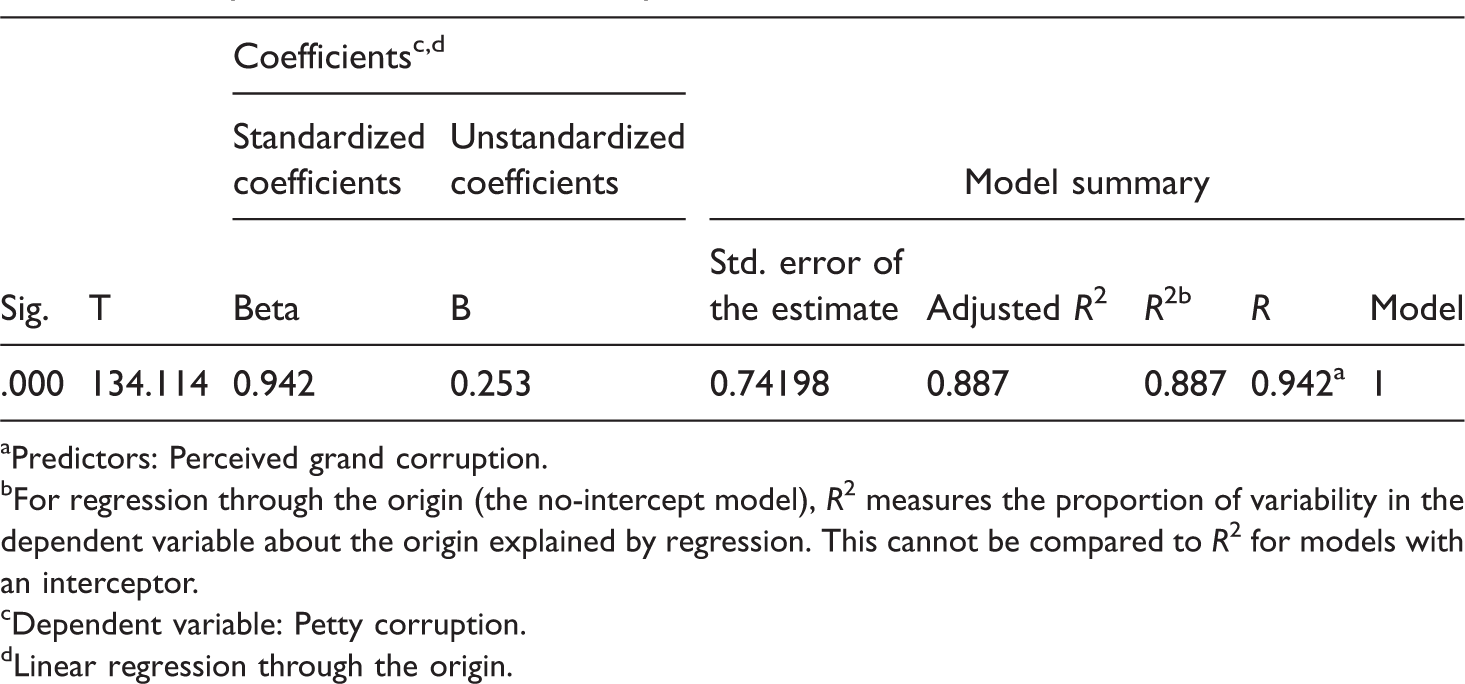
Predictors: Perceived grand corruption.
For regression through the origin (the no-intercept model), R2 measures the proportion of variability in the dependent variable about the origin explained by regression. This cannot be compared to R2 for models with an interceptor.
Dependent variable: Petty corruption.
Linear regression through the origin.
Conclusion
Table 2 shows the correlations of the variables examined in the current study.
As indicated in Table 2 and the subsequent regression analysis, the relationship between perceived grand corruption and petty corruption is significant (β = 0.942, t = 134.114, p < .001). The data in a way confirm the given hypothesis, i.e. the higher the perceived grand corruption in a country (Iran), the higher the petty corruption.
The results of this study indicate that adjusted R2 is 0.887. Here, a significant relationship was found between the independent (perceived grand corruption) and the dependent (petty corruption) variables. In addition, a regression analysis of the outcome variable on the independent variable seems noteworthy.
This article intended primarily to test a model that integrates perceived grand corruption related to petty corruption especially in Iran. The analysis found to support the proposed hypothesis, i.e. perceived grand corruption and petty corruption have significant relationships. As the data revealed, an increase in petty corruption was positively related to perceived grand corruption.
Perhaps the decentralization of government has an effect on the relationship between perceived grand corruption and petty corruption, which deserves further research. Also, it is likely that the media have a strong role in reducing or augmenting perceived grand corruption and eventually reducing petty corruption.
Examining how perceived grand corruption is correlated with the petty kind, the article draws up the following conclusions:
Grand corruption is spreading amid continued exploitation of special position, power, or wealth by officials at the top level for their personal gain. This is also because there is a lack of adequate means and mechanisms to correct or control it. People believing in the infallibility of legal, political, bureaucratic, and other social systems are the real victims of exploiters who know the systems’ weaknesses and how to take advantage of them for their personal gain. All this indicates that when grand corruption is high, perceived grand corruption is also high. As the research reveals, the mean of perceived grand corruption is 8.1394 out of 10 and the intercept is 0. It is therefore concluded that the perceived grand corruption has a direct effect on petty corruption. In other words, if all other determinants of petty corruption are removed, the perceived grand corruption would still have a significant effect on petty corruption.
Meanwhile, three ingredients noted by Klitgaard are present in the status quo of Iran. All these ‘basic ingredients’ are aspects of grand corruption that the authorities resist changing. It must be remembered that all dictatorial desires are due to a lack of accountability as well as the desire to monopolize the interpretation of laws.
In the Third World, bureaucratic corruption often accompanies the politicization of bureaucracy. However, the actual foundation of such corruption is being laid down by political corruption. In fact, bureaucratic corruption is the utilization of official positions for personal gain. In such a process, bureaucrats have nothing to do with politics but they are aided and abetted by corrupt politicians or a corrupted political system. Such corruption is much easier to perpetrate in Third World nations, where state activity has largely extended into economic ownership, management, and control (Kempe, 1985: 3).
The nature of grand corruption is unilateral, which means that there is not a buyer and a seller to act upon an agreement. There is only one actor that can behave with absolute discretion, without responsibility; especially in developing countries such as Iran. When we have two actors (seller and buyer), we expect them to check each other. But, in the case of grand corruption, the check factor is absent. Further, the media (especially television, radio, and newspapers) are absolutely restricted, hence making it impossible to check the behavior of corrupt statesmen. In other words, there is a lack of means to control the behavior of statesmen. It is also because of the fact that the mechanism disclosing the information is actually controlled by statesmen, who themselves are corrupted. As such, corruption at the top levels of government and organizations would never expect to be disclosed. It is worth mentioning that the disclosure of corruption is only possible when statesmen are no longer in power.
On the other hand, citizens will lose hope in the battle against corruption once they find that statesmen who are responsible for fighting corruption engage in corrupt behaviors themselves. The worst scenario comes when citizens’ desire increases to also engage in the corrupt behaviors. There is a spoil system that if you want to live in it, you must become like it.
With respect to Iran, it can be said that corruption is a malady without a cure in this country because neither statesmen nor citizens are interested in fighting the menace. In other words, statesmen are interested (with big interests) in corruption and citizens lack the motivation or hope to battle against it.
The results show that all organs get spoiled in a body once the head gets corrupted. The head symbolizes top-level officials and the organs are the masses, at least in developing-dictatorial countries. Here, we can quote Olowu who says: no lasting solution can be proposed for corruption without focusing on the quality of political leadership. In a situation of general malaise of indiscipline and very low national consciousness, change must be initiated through a strong, responsible, knowledgeable, and dedicated leadership (Olowu, 1983: 294).