



Abstract
As issuers, local authorities have credit ratings that are used in the search for direct funding from the capital markets. However, some local officials also use their ratings as instruments of local public reporting. Does this function creep affect the public values of local authorities? In line with the theory of publicness (Bozeman, 2007), a measurement of this publicness and the detection of public values (Jorgensen and Bozeman, 2002, 2007) are proposed both for the authorities that expressly mention their rating and those that make no mention of it. A textual analysis of their respective discourses reveals a function creep that conveys a lesser degree of publicness and ‘market’-oriented public values, but also generates one public value: transparency.
Points for practitioners
There is nothing neutral about using a financial rating for purposes of political communication, whether on the part of the local communicator or those who are locally elected. This function creep conveys more public values, but with a greater economic and market bent. It thus shapes the content of public values. The function creep is also revealing: it tends to be used by politicians recently elected, as if the first years of mandate focused on management, while the following years are coloured by politics and public values with a high degree of publicness. It raises the question of the restriction of re-election.
Keywords
What determines the value of a value is what we are willing to risk for it. (François Ewald, 1998)
In early 2012, the loss of France’s AAA rating became a hot topic during the presidential election, and raised the question of the influence of rating agencies on budget policies. States are rated for their sovereign debt; local authorities for their sub-sovereign issues.
‘Equated to a certification and financial reporting operation allowing a local authority to access international financial markets’ (Raimbourg, 2000: 59), the rating delivers summary information, 1 setting out to reduce the spread of rate paid by the issuer. The objective aims to be direct when issuing debt instruments or more indirect when aimed at greater bargaining power with banks. However, using the financial rating as an instrument of political communication and to promote public policy equates to ‘function creep’.
Does this function creep affect the public values of France’s local authorities?
We thus propose to study the representation of these values in the discourse of local public communication. The theoretical basis is that of publicness and of public values, which we then compare with the practice of a credit rating. The methodological choices of the empirical application are then expounded: the principle of textual analysis and the material analysed. Drawing on the literature in this field, the results show how function creep contributes to shaping the degree of publicness and the content of public values.
Regional public communication: how can public values be reconciled with the credit rating?
After discussing local communication, its production of public values and publicness, we compare it with the credit rating of local authorities.
Local communication and public values
Local authority communication, in the modern sense of the term, dates from the institutional upheaval of decentralization. The 1970s saw only occasional and modest initiatives. 2 The laws of 1982 indeed brought their share of communicative injunctions: birth of the Region, highlighting of the three territorial levels, promotion of the territory and building a ‘sense of identity’ (Megard and Deljarrie, 2009: 21). The latter has evolved over the years into local communication (promoting the local public services on offer according to a managerial logic) and into participatory communication (via the universality and interaction fostered by Information and Communication Technology).
Local public communication is linked to generic communication practices, in terms of their technologies and supports. It is, however, far removed from them in terms of the issues at stake: the public prism supposes public interest and democracy. By definition funded by public money, public communication must serve citizens: it ‘tends towards the exchange and sharing of information of public utility and the nurturing of social ties’ (Zemor, 2008: 5). Its aim is twofold: communication of the policies pursued (arbitrations or constraints) and the search for public support on the occasion of debates and consultations. Public communication finds its legitimacy in a ‘pedagogy of action’ (Megard, 2012: 22). While the local exercise of democracy takes place through representation, elections are too limited to inform citizens of the public choices made and to create dialogue around the local project. Mature communication is a guarantee of efficient local management.
The financial reporting of the local authorities is a case in point. The ATR 3 law of 6 February 1992 provided a decisive impulse. While the financial information of listed companies reports on profitability and management to shareholders, the financial reporting of municipalities, départements and regions charts the budgetary orientation debate, positions the entity among authorities of the same stratum and looks at the risks resulting from commitments made in ‘satellite’ organizations. This reporting is fully integrated into local financial management, it allows transparency or proximity and lends legitimacy to elected representatives. Local reporting serves public policy as an exercise that explains certain decisions (fiscal in particular), and serves as an expected guarantee of democracy. By extension, the financial information provided contributes to the ‘economic’ image of the authority: for the attention of partners and lenders, but also for the attention of companies on the lookout for new sites. A form of competition between authorities emerges, and the ability to promote the territory is required from the communicator as a logical consequence of the economic competencies assigned by decentralization.
Local communication therefore transmits a set of values. Our modern democracies answer to the population that is divided into an electoral population (that votes), a social people (that answers surveys or that demonstrates) and finally, a ‘principle people’ that exists through certain values (Megard, 2012). It is the same for any conviction, anxious to advocate commitment and responsibility, aspiring to influence behaviour: sustainable development can be a strong symbol.
Local communication concerns the public sphere and falls within the vast field of political science. In the first sense, it embodies reporting relating to the government of the ancient city and, by extension, that of the governance of any administrative level. Described as ‘political’, it carries within it the embryo of all discussions around the term ‘publicness’.
Public values and publicness
According to the theory of publicness (Bozeman, 2007), any organization is constrained by two authorities – one political, the other economic – in which it will find the resources it needs to exist. The challenge then is to determine their respective proportions. This is the ‘dimensional publicness’ (Bozeman, 2007) that is useful to describe organizations as ‘public’ or ‘private’ in their operation and governance. Indeed, the legal status of an entity or the identity of its owners has become a partial element of a more complex reality, combining the two authorities in proportions which allow them to be measured.
This measurement of publicness offers an assessment of the political influence and the influence of the market, a balancing between ‘political’ values and ‘private’ values. The latter are voluntarily apprehended only through the economic values that constrain policy choices.
This raises the question of the link between the theory of publicness and the study of public values that are defined as the ‘rights, advantages and prerogatives to which citizens should (and should not) be entitled; the obligations of citizens towards society, the State and others; and the principles on which governments and policies must be based’ (Bozeman, 2007: 189). Carried by elected representatives, civil servants and citizens, these public values are the cornerstone of the administration and public policy. They are difficult to perceive compared to their private counterparts: they are intrinsic, and they require aggregation and legitimation (whereas everyone owns so-called private values).
The respective weight of the political and the economic directs and shapes public values; ‘we need to understand the mix of the political and economic authority of institutions and policies if we are to understand their potential to achieve public values and to work towards public interest ideals’ (Bozeman, 2007: 186). Thus, understanding the evolution of publicness is to understand the positioning of these values.
These public values are mapped out on the basis of the literature on public administration and the theory of organizations, at the national and local levels (Jorgensen and Bozeman, 2007). 4 ‘The inventory’ thus established is based on an approach that brings out the different spheres affected by the value, from the point of view of public administration: the public sector’s contribution to society; the transformation of interests to decisions; the relationship between public administrators and politicians; relationship between public administrators and their environment; intraorganizational aspects of public administration; the behaviour of public sector employees; and the relationship between the public administration and citizens.
Our goal here is to identify the public values of the French local authorities. Our field of research is their communication. The issue is approached from an empirical perspective: the representation of the public action and policies carried out. This approach is justified insofar as public debate and political discourse demonstrate public values, but also contribute directly to their production (Jorgensen and Bozeman, 2007).
Hence, this reading of the reporting of the local authorities through the prism of public values and the measurement of publicness is a kind of confrontation with a ‘market logic’, a real challenge for these public values (Jorgensen and Bozeman, 2007). Indeed, the constraints related to financial markets are very apparent in issues of local public finance or debt management and raise the question of the role of the rating agencies in the reality of the policies carried out and beyond, in the construction of public values.
Local authorities and the credit rating
Credit rating, or rating, consists of assigning a score (in the form of a letter or letters to issuers of debt securities, or directly to these debt instruments). This score assesses the risk of default, i.e. the probability of default of the borrower (default on principal or interest), which would generate, if any, a loss or opportunity cost to the lender.
It is useful information for investors (in bonds or in Negotiable Debt Obligation) that is published in the prospectuses of the Autorité des Marchés Financiers (Financial Markets Authority) when bonds are issued, in line with the financial reporting provided to shareholders in listed companies.
Criticized in recent years, rating agencies have provoked debate because of scoring criteria, industry consolidation, 5 payment methods, and the failure to predict the crisis. Moreover, this crisis is constricting government budgets and increasing the need for external financing. This can take the form of direct market financing and repositions the rating agencies as key market participants. They are delegated the task of risk assessment (taken or to be taken) as they have been able to acquire a ‘reputational capital’, according to the criteria of independence and credibility (Raimbourg, 1990). Now taken on board by investors, the opinions of the agencies build or at least shape the market. In this sense, they have become key players.
Described as ‘sub-sovereign’, 6 the credit rating of local authorities first appeared back in 1918 (Gaillard, 2010). It incorporates elements of both a quantitative and qualitative nature. It allows one to be read in the light of the other and a certain weighting of the criteria. The purpose of the rating is certainly to assess the default risk of the entity being rated, but it is largely influenced by the legislative and institutional framework, including the degree of centralization or decentralization. ‘The institutional criteria are by far the most important because they form the matrix of the other elements’ (Paget-Blanc and Painvin, 2007: 194).
Technically, the scoring criteria are divided into institutional constraints (legal framework, privileges and resources, governance and control of the rated entity), socioeconomic factors (local GDP, population, employment, determining the income and expenses of the entity) and financial information (budget of the authority and off-budget risks, via ‘satellites’ and external management 7 ) (Paget-Blanc and Painvin, 2007). To summarize, the methodology of the rating agencies contains two main dimensions, one political, the other economic and financial, which are reflected in their analysis reports. They therefore lend themselves to the measurement of publicness.
Financial reporting is now practised by a majority of French local authorities, through their websites (Michel-Clupot and Rouot, 2013) where some of them refer directly to their score. It is in this case a ‘function creep’, hijacking the score from its original purpose, which inevitably changes the political discourse and shapes the local public values presented.
The financial rating is hijacked from its first use from such time as, in a report to the citizens of the territory, it implicitly or very explicitly becomes a score endorsing a given management, rather than an expression of the quality of the signature of a borrower. However, in local public organizations, credit management is not synonymous with local public management, even for the ‘international movement to reform public administration, New Public Management’ (Huteau, 2008: 185) that implements the convergence of private and public methods (Hood, 1998), initiated in Anglo-Saxon countries in the 1970s. A model of public performance cannot be reduced to financial performance. 8
Reporting intentionally on these analysis reports is tantamount to reporting on the extent of the economic constraint. This raises the question of whether this choice of reporting is only dictated by the interests of transparency in respect of public values (Jorgensen and Bozeman, 2002) or whether it pursues a political objective (Gourmel-Rouger, 2000). Weighing heavily on public policy, economic and financial constraints (revealed by the reports of the rating agencies) are likely to shape a number of public values.
Measuring publicness and detection of local public values: which tool and which material?
The explanation of the methodology will be followed by a presentation of the principles of textual analysis, and then of the documents processed.
The approach: measuring publicness and detecting public values
The aim of the research is twofold:
The first aim is to produce three measures of publicness: that of the discourse of the local authorities that mention their financial rating in their reporting, that of the discourse of the local authorities that make no mention of their rating in their reporting and that of the discourse of the rating agencies in their opinions. The vocabulary that makes up these three discourses gives them a more ‘political’ or a more ‘economic’ bent. We thus create a ‘publicness rating’ estimating the weight of the political authority (according to Bozeman, 2007) conveyed by the reporting of the local authorities and the reports of the agencies rating them. On the other hand, the second aim is to identify the public values by comparing the words that make up the three discourses with a representation of public values (Jorgensen and Bozeman, 2007). The objective is to detect values in the respective reports, and also their comparison and interpretation.
The principle of textual analysis
Textual analysis software traditionally falls into two groups: that whose goal is to synthesize large amounts of data to extract key themes and that, from the European work of linguists and the French statistical analysis current, which allows a thorough analysis of a corpus (Gavard-Perret et al., 2008). To detect public values in the reports of rating agencies and the financial reporting of local authorities, we have chosen to use Alceste (Analyse des Lexèmes Cooccurents dans un Ensemble de Segments de Texte – Analysis of Lexemes co-occurring in a set of text segments), which is software that belongs to the second category developed by the Centre National pour la Recherche Scientifique (National Centre for Scientific Research). The analysis of textual data sets out to uncover the essential information contained in a text known as a corpus (Gavard-Perret et al., 2008). It is today commonly used in management sciences such as in finance in the context of financial reporting (Chahine and Mathieu, 2003; Chekkar and Onnee, 2006; Michel-Clupot and Rouot, 2012; Negre and Martinez, 2013).
‘The goal is to quantify a text to extract the most important signifying structures.’ 9 Its principle is based on a breakdown of the corpus into a sequence of text segments, termed the Elementary Context Units (rated ECU), which show the distribution of words, repetitions and collocations (proximity of some words to others) (Reinert, 2007).
This novel method is derived from the factorial analysis of the correspondences and characteristics of Alceste, that does not classify words but ECU. On the ECU, full words are detected allowing classes to be defined by comparison.
The software performs a descending hierarchical classification and thus calculates the breakdown of the corpus into different classes; 10 the measurement of the intensity of the link between the form chosen and the class is performed using a chi-square test. 11 After processing, the corpus is thus ‘stored’ in different classes and the researcher’s work is then to define and name these classes based on their vocabulary.
The material of textual analysis: the report supporting material of the local authorities rated and reports of the rating agencies
The local authorities rated in June 2012
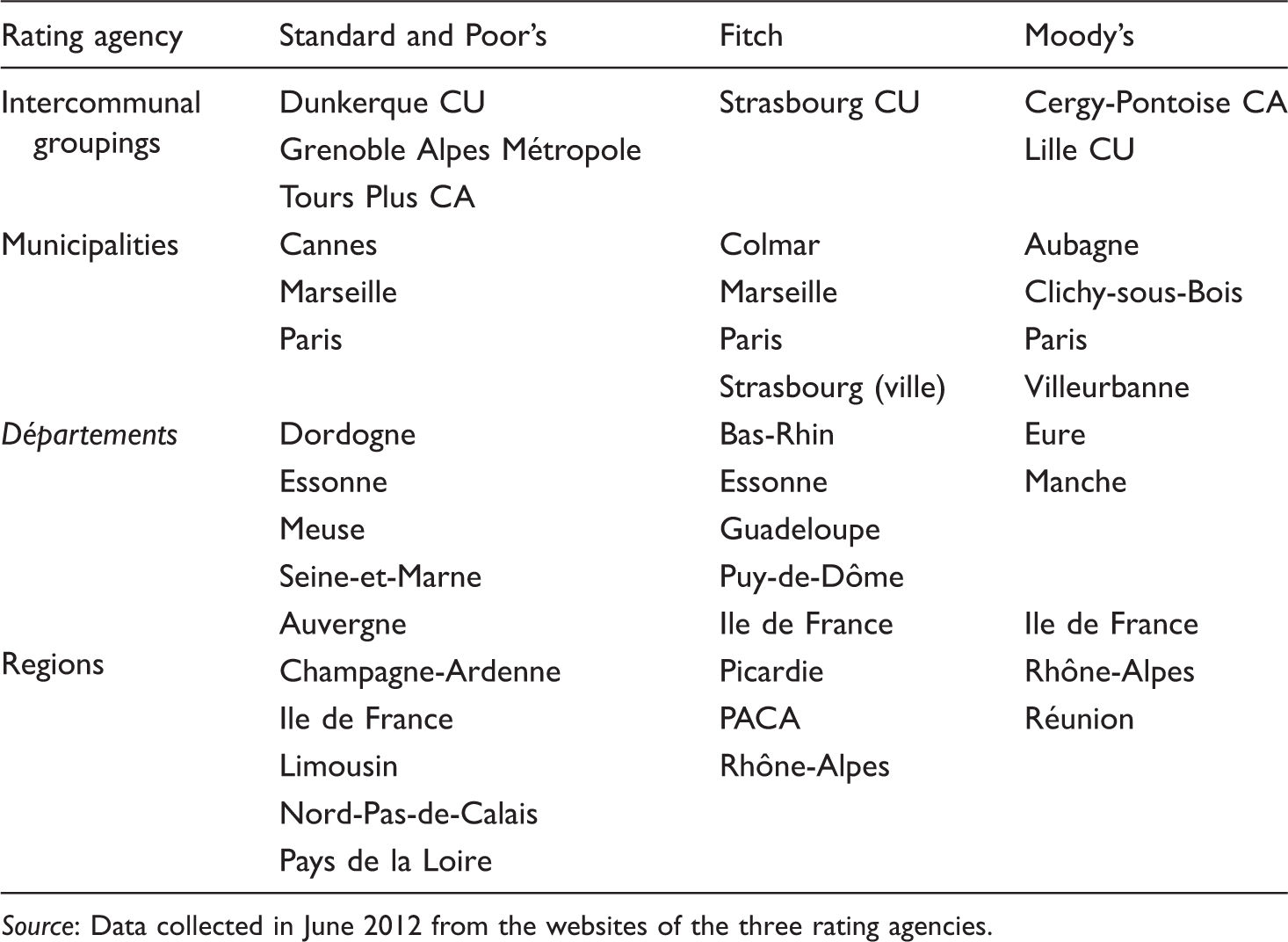
Source: Data collected in June 2012 from the websites of the three rating agencies.
The agencies draw up an analysis report within the framework of a rating process initiated by their clients. These written materials are perfectly suited to textual analysis.
The websites of the agencies Fitch Rating and Standard and Poor’s allow immediate download of some reports. In addition, some local authorities rated provide access to the reports of these two agencies on their own websites or collective hosted sites. Moody’s is the only exception, as it does not publish any of its opinions.
Availability of the rating reports.
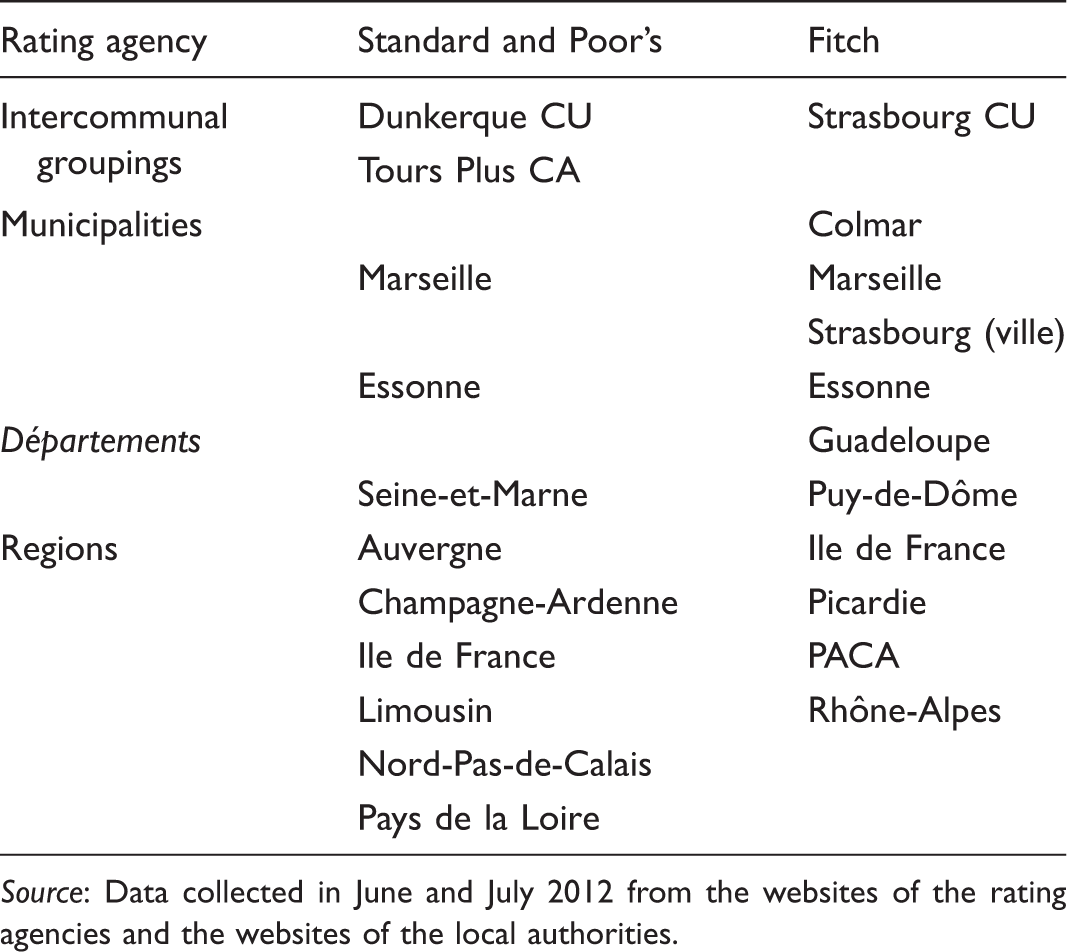
Source: Data collected in June and July 2012 from the websites of the rating agencies and the websites of the local authorities.
At the same time a second type of analysis focuses on the content of the discourse of the local authorities that have been the subject of a rating, which requires access to new written supporting material. They have a great many financial reporting records. The empirical analysis of the discourse requires a non-standardized document, written by the local authority. The desired supporting material must be a communication and not an information document in the traditional sense of an exchange between the issuer and the receiver. We offer three lines of inquiry.
First, the reporting of the local authorities took on a more formalized character with the publication of the first annual report in 1992 (Angotti and Laurent, 2000). This goes beyond the traditional framework of the budgetary procedure, and is a true activity report, reviewing the competencies and achievements of the local authority. In addition, the Code Général des Collectivités Locales (General Local Authorities Code) provides for the drafting of an activity report by the services. 13 Initially conceived for internal use, the document is frequently made public (on demand or for download).
Second, the Budget Orientation Debate (BOD) 14 significantly strengthens representative democracy through the dissemination of information and the establishment of an exchange within the deliberative assembly. The findings are discussed and priorities are established. The BOD has a strong educational dimension. An oral exercise by nature, it generally results in a summary document, often freely available on the website of the local authority.
Third, most authorities now have a web page presenting their budget, often supplemented by a review by the executive, reflecting their ‘political’ vision of the budgetary procedure.
The local authorities and their reference to the rating
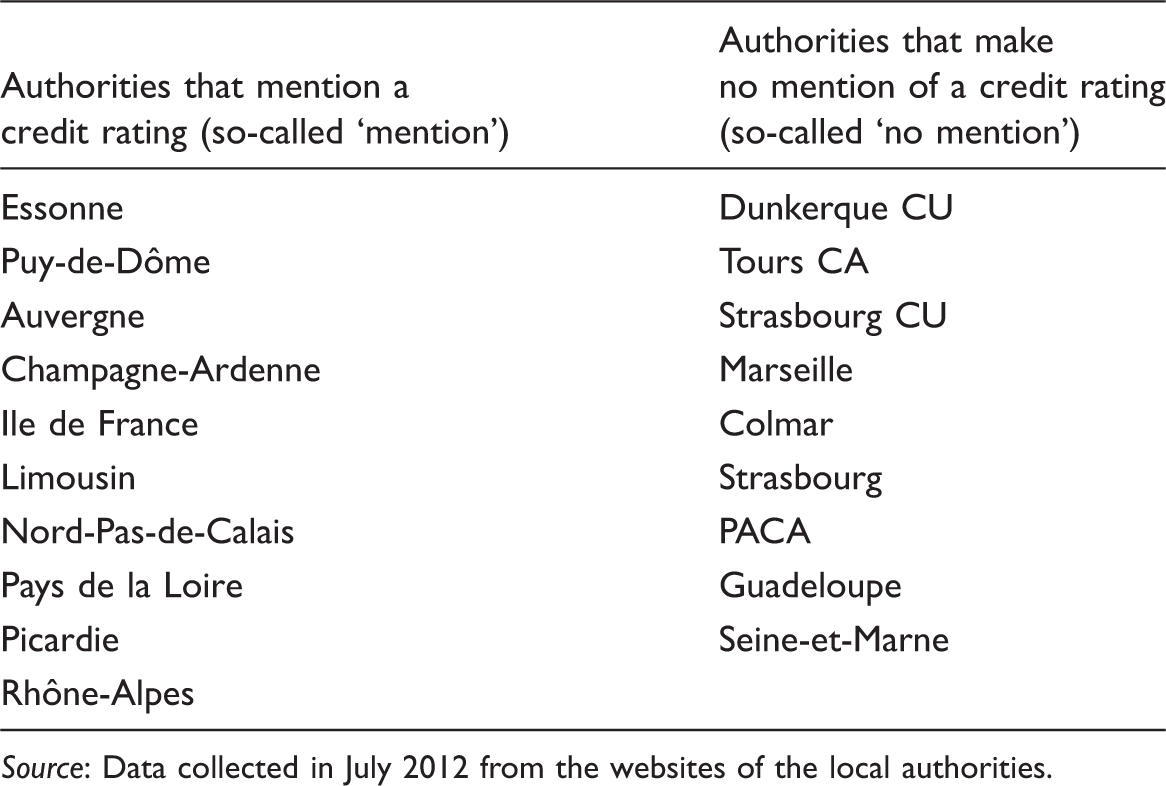
Source: Data collected in July 2012 from the websites of the local authorities.
A third textual analysis is conducted on a corpus composed of reports of rating agencies. The overall methodological approach is shown schematically in Figure 1.
Summary of the methodological approach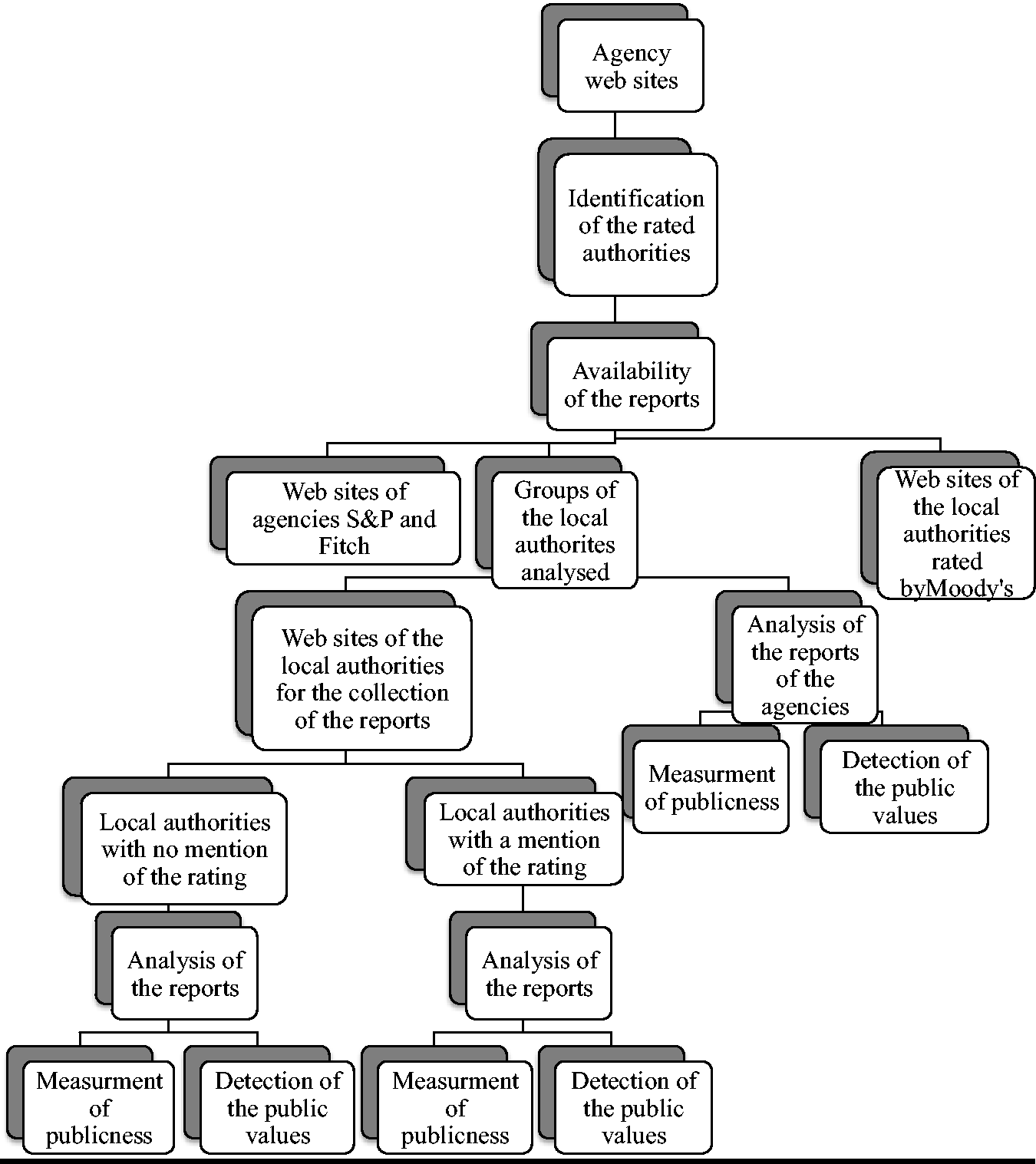
Function creep of the credit rating: what impact on publicness and local public values?
In light of the theoretical framework, we examine the results of the analysis conducted on both the reporting of the local authorities and the reports of the rating agencies. They show the production of public values through function creep.
The function creep of the financial rating: a lesser degree of publicness and public values gained by the market
To understand the implications of function creep of the rating, we compare the publicness ratings of the authorities that make a mention of their rating and those that make no mention of it. Figures 2 and 3 summarize the word classes determined using Alceste, the nature of the vocabulary, the ‘economic’ or ‘political’ identification of the content and the establishment of a publicness rating.
15
Measuring publicness in the discourse of the authorities that ‘mention’ their rating Measuring publicness in the discourse of the authorities that make ‘no mention’ of the rating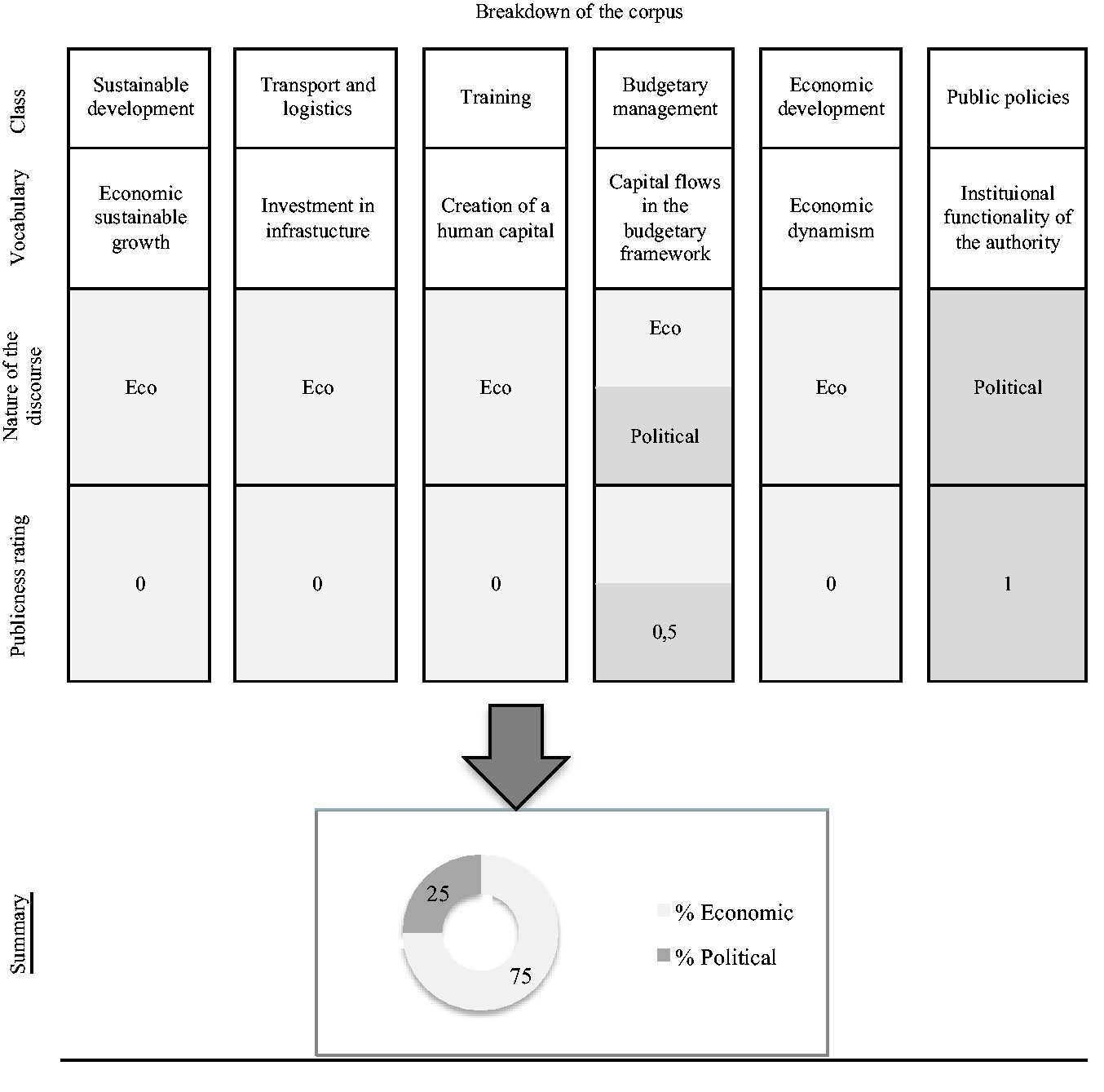

Taking all the authorities into consideration, the first observation made is a measurement of mainly economic publicness: local public organizations express more the constraint of an economic rather than a political authority. The weight of the economic and financial reality is clearly perceptible in the discourse of local authorities.
More precisely and comparatively, the publicness rating of the authorities who report on their rating is lower than that of authorities that make no mention of their rating process. In other words, authorities that make a ‘mention’ offer a representation that is even more constrained by the economic authority (75 percent) than the authorities that make ‘no mention’ (against 57 percent). The first focus on strong issues of economic development, through investment or training; politics gives above all a framework, whether fiscal or institutional. The latter, without neglecting the issue of economic growth, depict themselves more as a local power, through social action, economic interventionism, redistribution mechanisms or policies of sustainable development.
This result could be expected; however, it is not attributable solely to the presence of the rating process in the content, as from a methodological point of view, the corpus of the authorities that make a ‘mention’ does not include in any case the reports of rating agencies. However, it seemed essential to verify this empirically. Indeed, in an electoral perspective (of the utilitarian type arising from Public Choice), we could not exclude a priori that a high grade score is brandished as a marketing argument (rather superficial but the simplicity of the letters 16 should appeal to the general public), without influencing the nature of the discourse.
The publicness ratings must also be compared with public values revealed by the contents of the reporting. In Figures 4 and 5, we compare the words significantly present in the corpuses and their proximities to the perspective of Jorgensen and Bozeman (2007).
Detection of public values in the discourses of the ‘mention’ authorities Detection of public values in the discourses of the ‘no mention’ authorities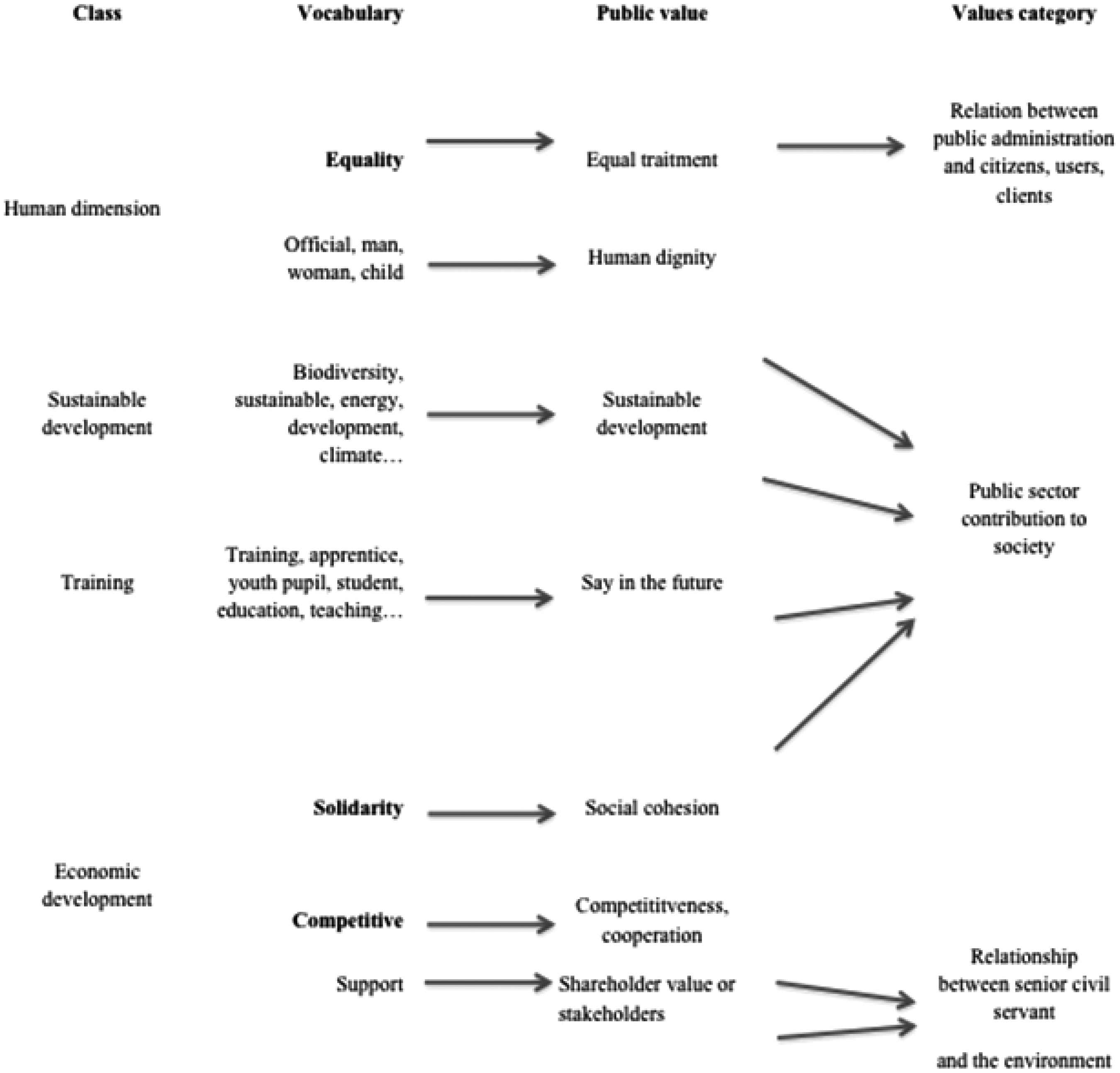

While they contain a lesser degree of publicness, reports that refer to a credit rating do not, however, have fewer public values than the discourses deliberately ignoring this mention. On the contrary, they express a broader spectrum, which takes on a specific character.
Indeed, a unifying base of public values can be highlighted around human dignity, social cohesion, a say in the future and sustainable development, pointing to commonly shared fundamentals. In contrast, so-called ‘mention’ authorities generally adopt a ‘market’ approach in their discourse: the public values development incorporating quite clearly mechanisms recognized as market mechanisms. Thus, among the additional values are consideration for competitiveness and cooperation, creation of shareholder value or stakeholder value. 17
Those referred to as ‘mention’ authorities also show a particular value which attracts attention: equality, a founding value of the French Republic, which can also be compared to the condition of atomicity 18 in the market configuration of pure and perfect competition of the microeconomic models (egalitarian vision and lack of dominance). Also, surprisingly, the value of democracy appears explicitly only in the discourse of authorities that do not mention their rating. However, it is the public value that, by definition, conditions the very existence of the French local authorities.
The categories of values (Jorgensen and Bozeman, 2007) support the hypothesis of a market culture for authorities that hijack the use of the rating. All of the authorities carry a majority of public values associated with ‘public sector contribution to society’. Entities that make no mention of their rating develop, in a complementary manner, the value of democracy, through the sphere of transformation of interests into decisions, thus reflecting the political concerns of publicness. While the authorities that advertise their rating are influenced by market value, value categories that differentiate them relate to relations between the administration and citizens-users-customers, on the one hand, and the relationship between civil servants and the environment, on the other hand. These are commercial and corporate considerations, just as a company is concerned with customer satisfaction and just as any strategic approach must understand its environment, a source of threats and opportunities. The question of cultural representation of the market is raised for so-called ‘mention’ communities, which consider the market as ‘a cold and impartial judge that applies to all its law’ (Le Velly, 2012).
The analysis reports of the rating agencies: vehicles of publicness and public values
The content of the reports of agencies is the subject of textual analysis, summarized in Figure 6. This study is an indispensable complement to the preceding, as their content is likely to influence the financial reporting of authorities from such time as there is ‘function creep’ (as defined above).
Measuring publicness in the reports of the rating agencies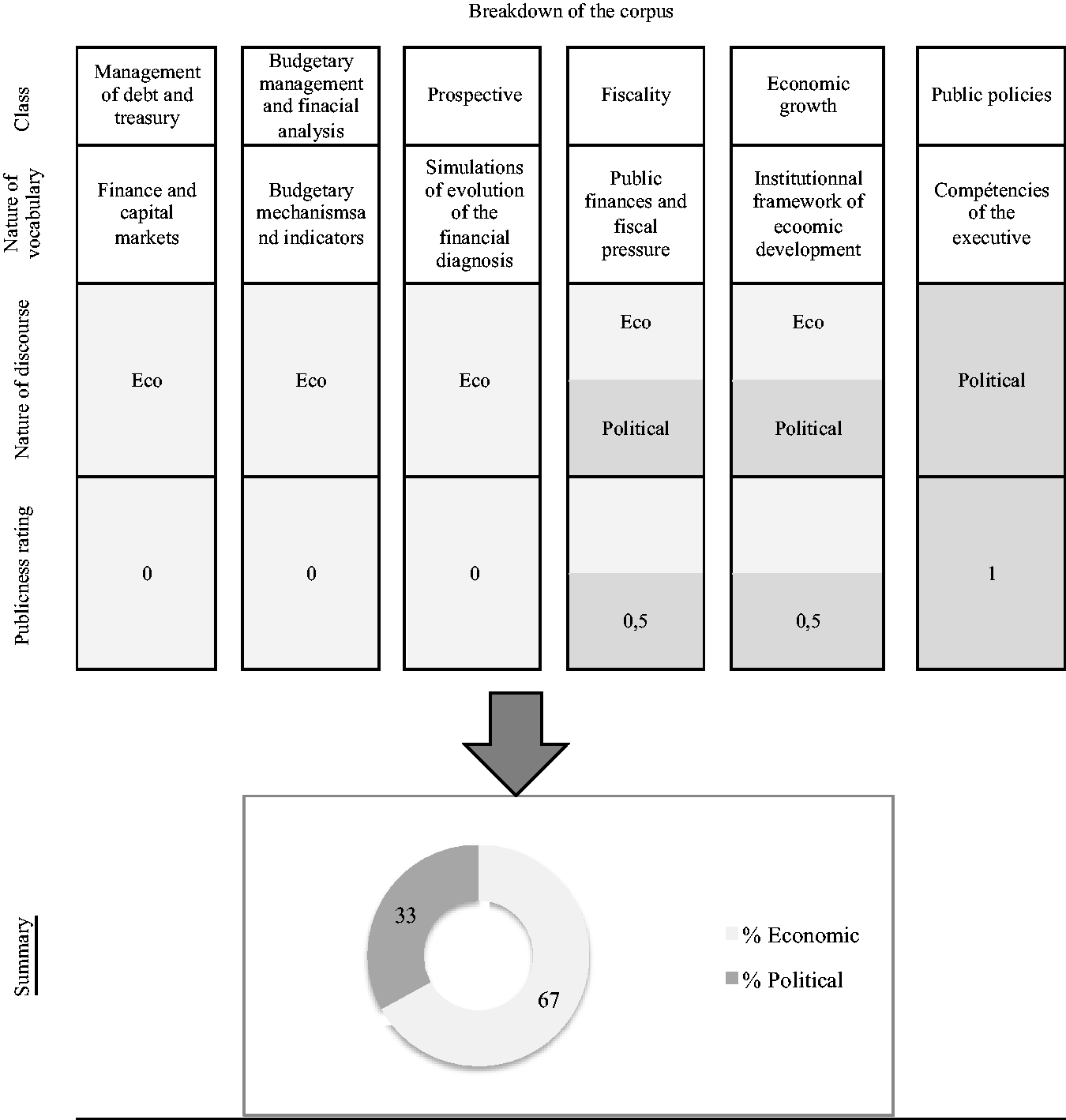
The discourse of the rating agencies in their reports is assigned a positive publicness rating by the study. Standard and Poor’s and Fitch therefore express a constraint with a political dimension and not just an economic dimension. We also find a breakdown that corresponds exactly to the criteria shown by the agencies in determining a rating: institutional framework, economic data, financial information, namely 33 percent political content against 67 percent economic content. Textual analysis reveals perfectly these proportions. Beyond the level of trust granted to a rating agency, we observe a discourse faithfully conveying the elements of the methodology displayed.
Moreover, the publicness rating of the agencies should be compared to that of the authorities that mention the rating. Against all the odds, these have an even lower publicness: they grant more importance to economic and financial constraints than the rating agencies themselves.
Beyond the publicness rating, textual analysis reveals public values already detected in the supporting materials of authorities that do not refer to their rating, such as social cohesion, human dignity, democracy (see Figure 7).
Detection of public values in the discourse of the rating agencies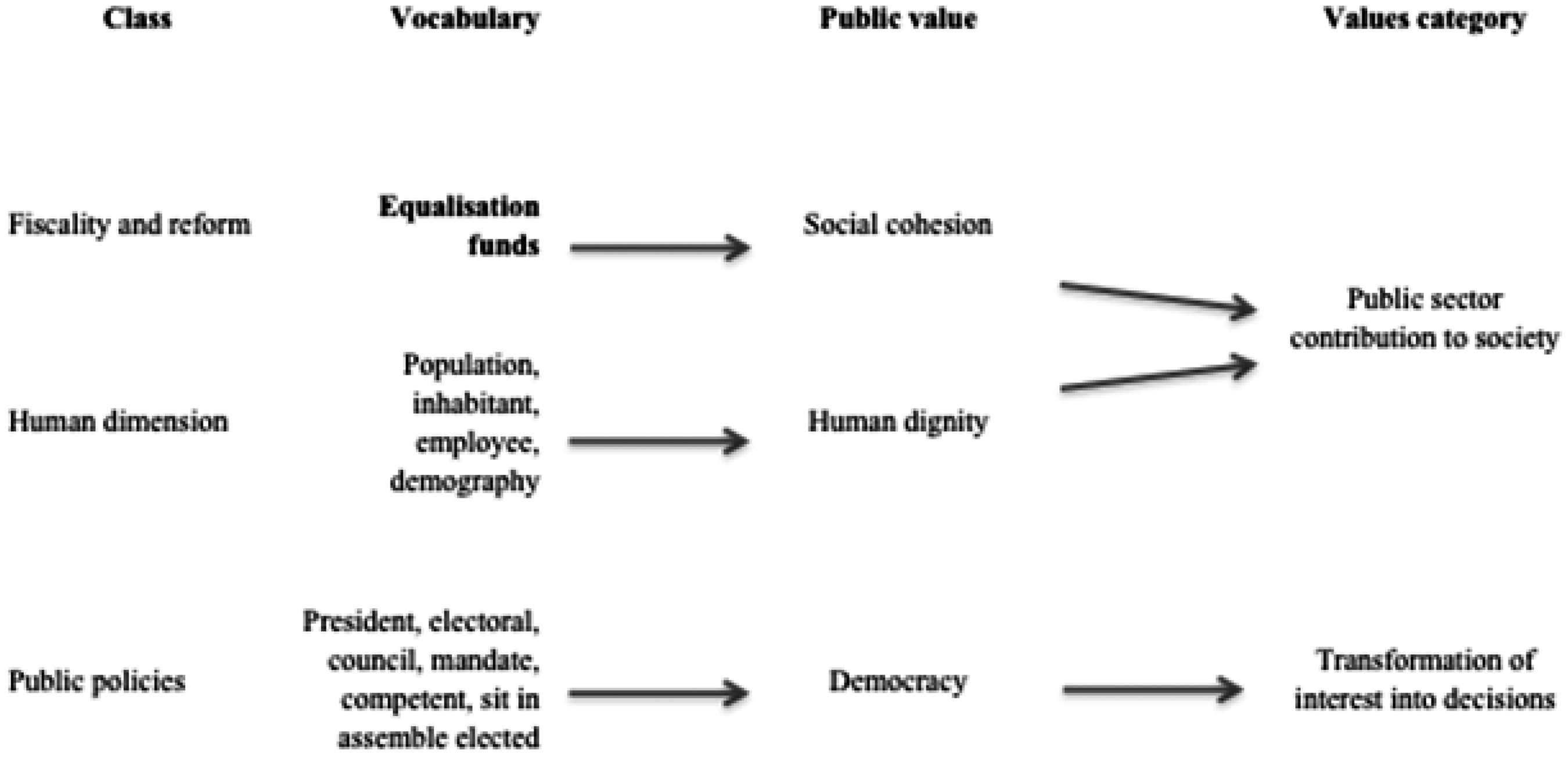
In this sense, while the intrusion of the discourse of the agencies into local public reporting can be interpreted as a loss of sovereignty, we demonstrate that it also carries public values. The rating agencies are not intended to convey public values. However, the detection of these values in their discourse (values consistent with the theoretical framework of Jorgensen and Bozeman, 2002, 2007) confirms that the rating of sub-sovereign entities largely incorporates the institutional context of decentralization and the links with the central power (whose political stability and respect for democracy are examined).
In addition, when the vocabulary underlining these values is considered (see Figure 6) as in the ‘economic growth’ class where the human dimension predominates (population, inhabitant, employee, demographics), it also highlights a predominance of the central government (national, metropolitan, France). Thus, local authorities that offer a forum for rating agencies place great emphasis on the central power.
Function creep of the rating producing public value
Beyond an enumeration of public values, the function creep of the rating by the authorities that give it a ‘mention’ is itself a creator of a public value: transparency. Communication on an evaluation by an external entity that is competent in this field helps to reduce the asymmetry of information between the local authority and the stakeholders, first and foremost, the citizens. Beyond ‘mere’ accountability, this reduction of informational asymmetry produces public value.
However, the publicness rating of the authorities that give it a ‘mention’ appears significantly lower than that of the authorities that give it ‘no mention’.
19
Indeed, the public values listed by Jorgensen and Bozeman (2002, 2007) are values of both a political nature and of an economic nature. Thus, the presence of economic values reduces the publicness rating (measuring the degree of ‘politics’ in the discourse) attributed. Conversely, the presence of political values increases the rating. The detection of public values and their impact in terms of publicness in function creep are summarized in Figure 8.
Summary of the public values, publicness and function creep
The challenge then lies in the characterization of the authorities that are advertising their rating. Two options seem to be open to us: economic/financial or political.
Economic and financial considerations were abandoned as they were deemed to be insufficiently discriminating. The very purpose of the rating is to summarize them. However, it appeared that the ratings are very close or identical for most authorities. Moreover, political considerations via the partisan colours of the majorities in place are too uniform in France in 2012 to offer an explanatory parameter.
The distinguishing criterion highlighted is then that of the number of years at the head of a local executive: authorities that do not give a mention to their rating tend to have exercised the longest terms. The individual history of the local authorities and their longevity in power seem to transcend political parties when it comes to influencing the contents of the financial reporting of local authorities.
While local officials are by definition deeply rooted in their territory, they also position themselves in time. This is the question of decisional electoral temporalities: ‘the question of the relation to time is then used to clarify the relationship between public action and political activity’ (Marrel and Payre, 2006: 82), both carriers of public values and publicness. The Public Choice School traditionally sees the elected official as a clientelist or a utilitarian with a short-term approach. However, the authority ‘[also] carries values, is custodian of an identity, has a political culture’ and ‘proposals are necessary … that are politically defensible in terms of values and that are consistent with the partisan political identity’ (Sine, 2005: 23). We put forward the following hypothesis: building public values takes time. We therefore compare it to the number of years of power exercised in 2012 by the executive in place (cf. the frequency histogram in Figure 9).
Comparison of the number of years of office of the executive in the ‘mention’ and ‘no mention’ authorities
The graph reveals a strong visual trend: authorities not mentioning their rating correspond to the longest terms in office. Bringing rating agencies into local public communication is not so much a surrender of sovereignty, but reveals that ownership of that sovereignty takes time. The first years in office are those of management, those of economic and financial constraint. The following years are those of politics, as if a certain amount of time was necessary for public values with high publicness to take shape. Thus, any rule prohibiting or restricting re-election could lower publicness and promote the development of economic values (at the expense of political values).
The function creep of the credit rating appears to not only reveal public values but proves to be the creator of a public value. Local authorities making their rating a communication tool reveal ‘market’-oriented values and, correspondingly, a lesser degree of publicness in the discourse. In addition, the communication around the financial rating creates a public value: transparency.
Indeed, while the rating agencies exist for and by the markets, they contribute to reducing the ‘local authorities–citizens’ information asymmetry, but above all prove to be stakeholders in changing public values. Far from clichés, capital markets are not so antagonistic to public values. Ultimately, the political colour therefore seems to have less influence on the content of financial reporting than the term of office. However, it remains to verify this finding in a context with a true diversity of political majorities at the head of the local executive.
The President of the Conseil Général of the Meuse recognizes the function creep of its rating process: ‘There was no financial goal. The situation of the département is difficult …. I took drastic measures …. So it was a challenge to demonstrate the merits of our decisions’ (Christian Namy, August 2011 20 ). It paves the way for wider use of the rating, likely to not only steer communication on the policies rolled out but, beyond that, the public action itself.
Footnotes
Notes
The authors have jointly published ‘La communication financière des collectivités territoriales: nouveaux usages de l’Internet pour un système de financement en mutation’ (The financial reporting of local authorities: New uses of the Internet for a changing financing system), Politiques et Management Public 30(2): 159–180, 2013; ‘Paradoxe du discours sur les risques financiers entre les collectivités locales et les banques’ (Paradox of the discourse on financial risks between local authorities and banks), La Revue du Financier 198: 70–89, 2012.