




Abstract
With regard to the increasing use of social media channels in public administrations, this study investigates antecedents and consequences of public administration’s social media website attractiveness, focusing on the local government level. We derive a model based on the Uses and Gratifications Theory and apply a structural equation modeling approach by testing our model based on a survey data of 164 citizens in Germany using social media websites in the context of public administration. As a result, we find that Social Motivation, User-Generated Content and Public Administrator-Generated Content have a significant positive influence on Attractiveness. Moreover, Attractiveness positively affects both Intention to Use and Word-of-Mouth (WoM) Intention.
Points for practitioners
The attractiveness of public institutions’ social media websites such as Facebook depends on three factors: (1) users wish to get connected to other users and (2) the appeal of its content generated by the public institution as well as (3) by other users. Empirical data suggest that the increase in attractiveness of respective social media pages will make users use the social site more often and will also make users recommend the page to others. Against this background, social media page managers of public administration websites will focus on providing an open platform for citizens to exchange information and provide appealing and citizen-oriented content.
Introduction
Ongoing globalization and the dissemination of constantly developing information and communication technologies have led to a diverse offer and usage of online services, both on the provider and user side (Ma and Agarwal, 2007). More recent developments in this regard involve the rise of the Web 2.0 and social media at the beginning of the twenty-first century (Kaplan and Haenlein, 2010).
Considering social media’s increasing importance in society, athe scientific discourse concerning this matter also constantly evolves (Wirtz and Langer, 2017). However, while large parts of the literature deal with the significance of social media (SM) in the private sector (Khang et al., 2012), researchers seem to pay less attention to the application and acceptance of SM regarding public administration and citizens (e.g. Bertot et al., 2010; Bonsón et al., 2012; Bryer, 2011; Jaeger et al., 2012).
However, ‘Social media has the potential to change a wide variety of management practices in […] public organizations’ (Campbell et al., 2014: 655). In light of this finding, research by the United Nations indicates that social networks have become everyday business for many citizens and have thus become highly relevant for political and governmental communication (United Nations, 2014).
Accordingly, there are also calls in the academic literature for more research on SM in public administration (Wirtz and Daiser, 2018). For instance, Bonsón et al. (2017: 323) state: ‘Despite the growing discussion about SM technologies (whether they have the potential to enhance citizen engagement), there is still little evidence on SM adoption and usage’. Since Facebook pages of municipalities have been found to be one of the most promising tools for engaging and interacting with citizens (Bonsón et al., 2012, 2015, 2017; Kaplan and Haenlein, 2010), we derive and test a model that explains the attractiveness of Facebook pages of municipalities. Such a model can then be used as a basis for the work of public managers that aims to increase the attractiveness of their Facebook pages.
Our study first derives the antecedents of the perceived attractiveness of the city Facebook pages. Second, we explore the relationship between this attractiveness and the users’ intention to use these local community Facebook pages. Lastly, we include the users’ WoM intention regarding the pages in our study and observe in particular how both attractiveness and Intention to Use affect this WoM intention. In this way, we also propose that intention to use mediates the relationship between attractiveness and users’ word-of-mouth intention regarding the city Facebook pages.
Research overview
To present the relevant research environment and identify connecting factors for our work, we illustrate several of the hitherto existing empirical studies of the field in the following. Some studies use publicly available data on public institutions’ SM pages to draw conclusions about their attractiveness. The studies of Bonsón et al. (2012, 2015, 2016, 2017), for instance, provide an overview of the SM usage of 75 cities in 15 countries of the European Union and an analysis of the SM posts and the number of fans and followers. The studies show that a majority of the observed cities use Facebook pages or groups (33.3 percent), whereas slightly less use Twitter (32 percent). In terms of user or citizen acceptance, Bonsón et al. (2012, 2015, 2016) and Haro-de-Rosario et al. (2018) use the number of fans or followers as an indicator for acceptance. We can summarize that the named studies largely focus on accumulating hard figures and descriptive results concerning the SM application of public institutions (in terms of percentages) and the approval of citizens (in terms of fans or followers). While this appears adequate for generating a more general picture of the performance and the acceptance of the particular SM websites, such approach does not allow us to identify the drivers of the acceptance.
To the best of our knowledge, the academic literature lacks research that explicitly examines the perceived attractiveness or acceptance of public institutions’ SM websites and related antecedents or consequences by conducting surveys with citizens. Apart from that, a particular focus of this research has been the effect on WoM in the context of public social media channels, since it has been found to be one of the major success drivers of e-government services (Layne and Lee, 2001; Wang and Doong, 2010; Warkentin et al., 2002).
The contributions of the literature also show that public administrations across national borders and continents still largely use Facebook most frequently as an SM platform to approach citizens. Given the recommendations for action regarding this particular social network and the diverse specifics of different applications and platforms in the SM field, this study explicitly focuses on city Facebook pages and aims to contribute empirical findings by conducting a corresponding user survey about citizens’ perceived attractiveness and potential acceptance of these pages.
Conceptual framework
The Uses and Gratifications Theory (UGT) constitutes a general approach for understanding why and for what reasons people opt for certain media to satisfy specific needs (McQuail, 2010). Research has applied the UGT to observe drivers of media use like radio, television, cellphones, and the Internet in general as well as SM in particular (Chen, 2011; Smock et al., 2011). Many studies support causal relations based on the UGT and stress its applicability for investigating SM-related phenomena: ‘Based on UG theory, recent studies have explored motivations for using SNSs [Social Networking Sites] in general and reported that […] the key motivators for traditional media usage […] remain applicable to social media’ (Tsai and Men, 2013: 79).
Concerning these SM users’ motivations, researchers frequently mention hedonistically oriented motivations like an escape from routine or problems, diversion and relaxation, excitement or enjoyment. A second group are the rather functionally oriented motivations such as information and education, guidance and advice, obtaining information or learning about a specific content. The third group are social motivations such as personal relationships, enhancing connections with family and friends, and social interaction and connection with others (McQuail, 2010; West and Turner, 2014).
To conduct a complex empirical study, we initially develop a heuristic frame of reference as our conceptual model, which is based on the aforementioned UGT. We used relevant literature on SM and public administration and studies dealing with the attractiveness or acceptance of private enterprises’ SM websites (Park et al., 2016). On this basis, we identify Social Motivation, Public Administrator-Generated Content, User-Generated Content and User Centricity as relevant antecedents of the Attractiveness of public authorities’ SM websites, while Intention to Use and WoM intention represent appropriate constructs in terms of positive acceptance-related consequences.
Social motivation
The first construct identified is social motivation, which we define as the motivation to have social interaction within the respective SM page. As mentioned earlier, social motivation constitutes one of the three drivers of the attractiveness of media according to the UGT (McQuail, 2010; West and Turner, 2014). Such a construct has also been found to be a driver of attractiveness in similar contexts often with different names but similar meaning: The study of Park et al. (2016), for instance, calls the factor ‘Social Value’ (p. 8), as an antecedent of ‘[…] satisfaction with the service provided by government social media’ (p. 5) within their research model.
Moreover, Warren et al. (2014: 292) point out the importance of a citizens’ social motivation antecedent to their perceived attractiveness of a particular SM website in terms of ‘Group incentives’. While these authors can prove positive influences of this construct on ‘Online Civic Engagement Behavior’ (p. 297), it largely represents the need or motivation for engaging in social issues and thus contributing to the community.
Following up on the aforementioned findings, it stands to reason to assume that if SM is made for users and their communication, interaction and exchange (Kaplan and Haenlein, 2010), then some sort of social motivation is likely to influence the usage and, prior to that, also the attractiveness of public administration’s SM websites, in our context city Facebook pages. Therefore, in Hypothesis 1, we propose Social Motivation as the first antecedent of these pages’ attractiveness as perceived by citizens:
User-generated content
SM depends on user contributions and the exchange of content. The construct of User-Generated Content plays a meaningful role in the SM literature related to this study’s research endeavor and relates to the group of rather functionally oriented motivations of the UGT (McQuail, 2010; West and Turner, 2014).
The importance of this construct is reflected in the most prominent SM definition of Kaplan and Haenlein (2010: 61): ‘Social Media is a group of Internet-based applications … that allow the creation and exchange of User Generated Content.’
Accordingly, also regarding SM and public administration, there are scientific studies dealing with User-Generated Content and its relationships to other constructs. In this regard, Chun et al. (2010: 6) state, for example, that the ‘[…] main idea behind government 2.0 is participation by citizens’, and in this context suggest that ‘user-generated metadata’ (2010: 6) in online communities can greatly contribute to the fulfillment of public duties.
Given these hints from previous literature regarding the benefits of User-Generated Content for the SM websites of public institutions as well as their overall performance, we also assume it to be relevant for our research context of antecedents of city Facebook pages’ attractiveness. Thus, we hypothesize:
Public administrator-generated content
In addition to the role of User-Generated Content, one should not neglect Public Administrator-Generated Content, that is content which the respective cities’ SM managers post on the particular Facebook pages. This construct also relates to the group of functionally oriented motivations of the UGT (McQuail, 2010; West and Turner, 2014).
Concerning this matter, researchers have already dealt with the topic of Public Administrator-Generated Content in the field of public authorities’ SM websites before. For instance, Jaeger et al. (2012: 12) point out that SM have ‘[…] become a primary tool to disseminate government information’, which is also largely expected by members of the public and, most importantly, citizens (Jaeger et al., 2012).
In light of these previous results regarding the beneficial outcomes of Public Administrator-Generated Content for the particular SM websites and the responsible public institutions, we also hypothesize the following for our research context of city Facebook pages’ attractiveness as perceived by citizens:
User centricity
Concerning a last antecedent of city Facebook pages’ attractiveness, we consider the construct of User Centricity, which relates to functional and social motivations of the UGT (McQuail, 2010; West and Turner, 2014). We define User Centricity as a concept describing ‘a structured approach to produce interactive systems by involving users or potential users and addressing their needs at every stage’ of the SM service (Kotamraju and van der Geest, 2012: 261).
Given the importance of user centricity in e-government, researchers have also more specifically adopted the concept to public administration by advocating a ‘citizen-centric approach’ to e-government or the delivery of ‘citizen-centric local public services’ (King and Cotterill, 2007: 333) by means of information technology.
Given these results from previous literature regarding the potential of User Centricity in e-government and related SM usage as well as its importance for companies’ SM performance, we also hypothesize for our case:
Attractiveness of public Facebook pages
Having illustrated the antecedents of city Facebook pages’ attractiveness in the preliminary sections, we now introduce the construct of Attractiveness as the first dependent variable of our research model. The selection of attractiveness as an antecedent to intention to use was derived from the UGT. In this context attractiveness of a technology or media originates from the expectation of gratification of using this technology or media (Galloway, 1981), which can also be a social media channel. For its conceptualization, we consult the existing related research on SM and more conventional web applications in both public administration and the private economy.
In this regard, Sutcliffe (2002), for example, examines the attractiveness of websites based on a case study of three airlines. Concerning his understanding of the construct, suitable for our research context of the antecedents of SM website attractiveness illustrated before, Sutcliffe (2002: 138) states that: ‘Attractiveness may be considered to be the result of matching the user’s motivations and requirements with the design features on a website.’
Furthermore, Wirtz et al. (2013) empirically investigate determinants of SM website attractiveness, which they define as the ‘Perceived individual preference to use social media offers’ (p. 23). In contrast, Park et al. (2016), for example, choose an alternative approach by not conceptualizing the attractiveness of government’s SM service itself, but instead focusing on citizens’ perceptions of the ‘Alternative attractiveness’ (p. 298) of existing conventional e-government services, which more generally can be ‘conceptualized as the client’s estimate of the likely satisfaction available from an alternative relationship’ (2016: 298).
After having considered these earlier observations of website attractiveness in different research contexts, we follow the subsequent SM-specific conceptualization for the construct of Attractiveness in our study. Initially, we include citizens’ perceptions of how attractive it is for them to get in contact, interact and build a network with both representatives of the city and other citizens on the cities’ Facebook pages.
Yet, also inspired by Park et al.’s (2016) conceptualization, we also subsume under the construct of attractiveness in our study to which degree citizens perceive the city Facebook page as more attractive than conventional city websites. In this way, we present a conceptualization of Attractiveness focusing on the core elements of the city Facebook pages that is the exchange between the involved parties on the SM websites, without neglecting the important consideration of potentially attractive alternatives.
Effects on Intention to Use and WoM Intention
The additional dependent variables in our research model involve citizens’ Intention to Use and their WoM Intention regarding the observed city Facebook pages. More specifically, we suggest the relationships between citizens’ perceptions of Attractiveness and the two mentioned constructs.
Previous studies have focused on comparable constructs, but seem to have neglected the consideration of more explicit and well-tried acceptance and usage-related constructs as consequences of SM website attractiveness, particularly in the field of public administration. Thus, Hong (2013), for example, finds ‘Public Trust in Government’ as a consequence of citizens’ experiences with governmental SM channels. Park et al. (2016) already go a step further by proving the influence of citizens’ satisfaction with government’s SM service on their ‘Intention to Patronage’. However, within the study mentioned, the latter construct remains quite fuzzy and ambiguous as it mixes continuance and WoM intentions.
The effects of SM website attractiveness on both citizens’ Intention to Use and WoM Intention remain under-researched in the scientific literature. We therefore empirically examine the influence of perceived Attractiveness on citizens’ Intention to Use and their WoM Intention regarding the observed city Facebook pages, as illustrated in Hypotheses 5 and 6. In addition, in Hypothesis 7 we suggest that citizens’ Intention to Use mediates the relationship between Attractiveness and WoM Intention. Figure 1 illustrates all the proposed hypotheses of our study within a conceptual model.

Conceptual model.
Structural model.
Data and methods
We conduct structural equation modeling, which has been considered an appropriate method for analyzing complicated model structures including latent variables in social and economic research (Hair et al., 2010; Kline, 2011; Steenkamp and Baumgartner, 2000).
Researchers apply both variance- and covariance-based structural analyses, which both have certain benefits and drawbacks. Thus, before deciding on either, one should cautiously check which approach best suits the respective research endeavor (Chin and Newsted, 1999). In this regard, it is important to know that covariance-based structural analysis aims to explain empirical data structures, whereas variance-based analysis has the goal of reproducing actual data structures and is used, in particular, for prognosis or forecasting (Fornell and Larcker, 1981). Therefore, we chose the covariance-based approach for structural analysis to examine the conceptual model of this study, which has a predominantly confirmatory and hypothesis-testing character. The estimation of the measurement models was done with the software AMOS 22.0.
Sampling and data collection
We conducted a user survey to gather primary data from citizens using German city Facebook pages for this study. We chose Germany since the research team is based in Germany and has extensive knowledge of the German-speaking area, which was necessary as the survey was conducted in cooperation with public managers in German cities. According to the European Commission’s Digital Economy and Society Index (DESI) 2017, Germany is slightly above the EU average on the development stage of its digital public services, which also incorporates the use of social media in providing public services. The studies of Bonsón et al. (2015, 2016, 2017) and the eGovernment MONITOR (2017) show that German cities have a well-established and professional usage of SM, compared with other cities in Europe. German cities are therefore a suitable object of investigation to find antecedents and consequences of public SM channels.
Since there is no known population of potential users of the Facebook pages of cities, we have to apply a ‘convenience sample’ (Bhattacherjee, 2012), which is considered the standard procedure in such cases, according to methodical literature (Bhattacherjee, 2012; Burns and Bush, 2014; Christensen et al., 2015; Zikmund et al., 2013).
To generate such a sample, we initially chose 113 German cities on the basis of their number of inhabitants in descending order and contacted them via email. Within the standardized emails, we asked the cities’ representatives to post the survey link on both the cities’ Facebook pages and their conventional online city portals. In this way, the survey should reach as many users of the Facebook pages as possible. In addition, we sent reminder emails and asked by phone whether the cities would be interested in posting the survey. Altogether, 15 cities participated in posting the survey. Moreover, we invited users of the city Facebook pages to participate in the survey directly on the social network via personal messages. In this way, we generated a total sample of 164 valid returns of city Facebook page users. Altogether, 47.60 percent of the survey participants were male, while 52.40 percent were female. The age of the participants averaged 41.78 years. Further, we requested that they indicate their general Facebook usage, which revealed that 28.70 percent of the participants used Facebook less than three hours per week, whereas the majority of 46.30 percent indicated a weekly usage of three to 10 hours. Twenty-five percent used Facebook more than 10 hours a week. Data collection took place between October and December 2015.
The single items of the standardized questionnaire were largely tested by applying 7-point Likert scales. We preferred a digital standardized survey, since it enables a higher number of returns compared to an oral interview (Christensen et al., 2015; Zikmund et al., 2013).
Survey research has been subject to criticism in academia for many years, due to potential common source bias (Groves, 2004). According to Chang et al. (2011), the survey design is an important factor contributing to potential common source bias. In order to avoid such bias, we used different sources for the operationalization of the exogenous and the endogenous variables. Moreover, we followed further recommendations from the methodical literature and ensured anonymity of the participants and the confidential treatment of their data within the analysis on the starting page of the survey. This helps to avoid a potential common method bias due to possible socially desirable answers from the participants. Furthermore, we stated that the survey was being used for an independent scientific research endeavor, so the truthful contribution of every single participant was of great importance (Salkind, 2010).
Apart from the design, we analyzed the data with the Harman-one-factor test and calculated the Guttmann-split-half coefficient. The Harman-one-factor test requests the analysis of all indicators of the study via an exploratory factor analysis with varimax rotation. Our analysis extracts 18 factors in total, of which seven show a value of above 1. Since the factor that explains the highest variance was 39.14 percent and no factor was above 50 percent of the variance of all indicators, it can be assumed that common method bias or variance does not contest the validity of this data (McFarlin and Sweeney, 1992; Podsakoff and Organ, 1986).
The second test was based on the Guttman-split-half-reliability. Two halves of the study results are compared by means of their correlation with one another. The methodical literature indicates a lower limit of 0.6 for proving the respective reliability (Crocker and Algina, 2006). The value of 0.837 for this study lies well above the demanded threshold, which again indicates that the study does not have a major problem with the common method bias. According to the findings, common source bias does not seem to be a major challenge to this study. Researchers predominantly discuss this methodical problem and appropriate remedies with regard to key informant designs and the related organizational research (Podsakoff and Organ, 1986; Podsakoff et al., 2003) in companies or other organizations and usually not for user surveys and the related perceptional constructs of individuals, such as in the study at hand.
Variables and measures
The survey was carried out following the recommendations of DeVellis (2003) for the adjustments of items to ensure the study’s clarity, comprehensibility, and feasibility (Anderson and Gerbing, 1991; Radermacher and Sattelberger, 2009).
Starting with the independent variables, we first operationalized Social Motivation based on Lin and Lu (2011), Gummerus et al. (2012) and Tsai and Men (2013). In addition, we includde one self-developed item for the construct within the questionnaire.
Second, we measured User-Generated Content on the basis of Wirtz et al. (2013) and Tsai and Men (2013); we thirdly operationalized Public Administrator-Generated Content based on Porter and Donthu (2008) as well as Porter et al. (2012). Yet, for the latter construct, we further self-developed one item. Concerning the last independent variable of our study, we fourthly derived the scale items, which we used to measure User Centricity from Saxe and Weitz (1982), Deshpandé et al. (1993) and Swenson and Herche (1994). Regarding the dependent variables of our research model, we first operationalized Attractiveness based on Park et al. (2016). Second, we measured Intention to Use on the basis of the classic work of Venkatesh et al. (2003). Lastly, we based the measurement of WoM Intention on Durukan and Bozaci (2012) and Durukan et al. (2012).
Analysis and results
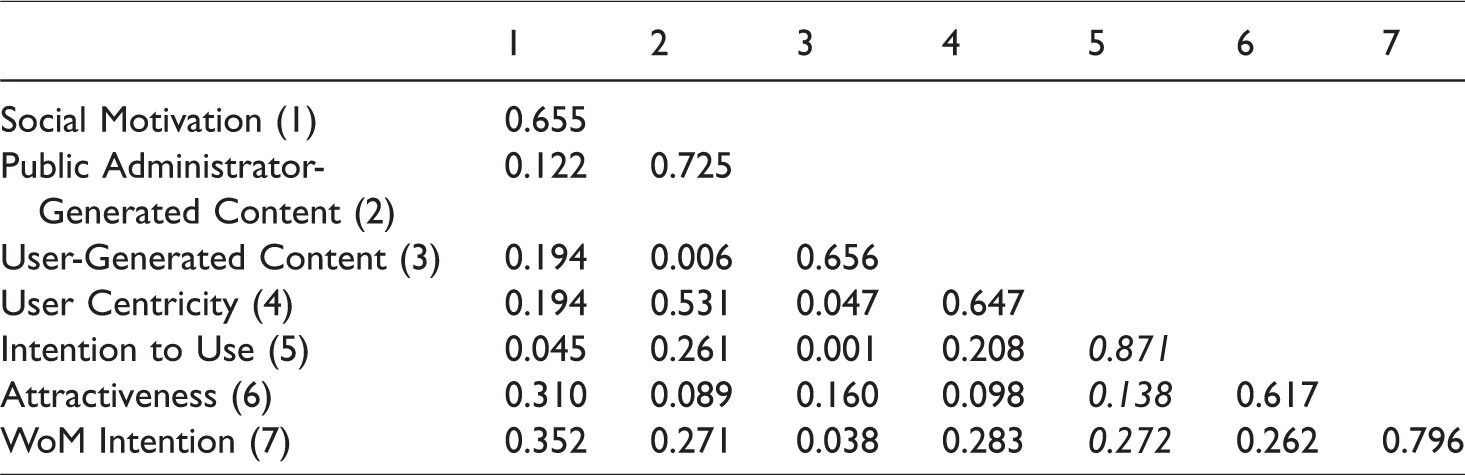
All variables fulfill the recommended first generation criteria: item-to-total correlation, Cronbach’s alpha, explained variance and factors extracted (for details see Tables 3 and 4 in the Appendix and Anderson and Gerbing, 1988, Bagozzi and Yi, 1988; Hair et al., 2010). To further evaluate the measurement models, we performed complementary tests: First, we conducted an exploratory factor analysis with the 19 remaining items of the four independent variables, and subsequently, with the residual 13 items of the three dependent variables. As a result, both analyses identify the suggested structures. In addition, we carried out a first-order confirmatory factor analysis of all independent variables, which additionally confirms that the data reflect the items’ assignment to the various constructs (Bagozzi and Yi, 1988). Furthermore, we applied the Fornell and Larcker (1981) criterion to assess the discriminant validity, which compares the particular squared correlations with the average variances extracted. As is apparent from Table 1, in which we present the average variances extracted in bold, the results show that none of the squared correlations exceed the recorded average variances.
Fornell/Larcker criterion.
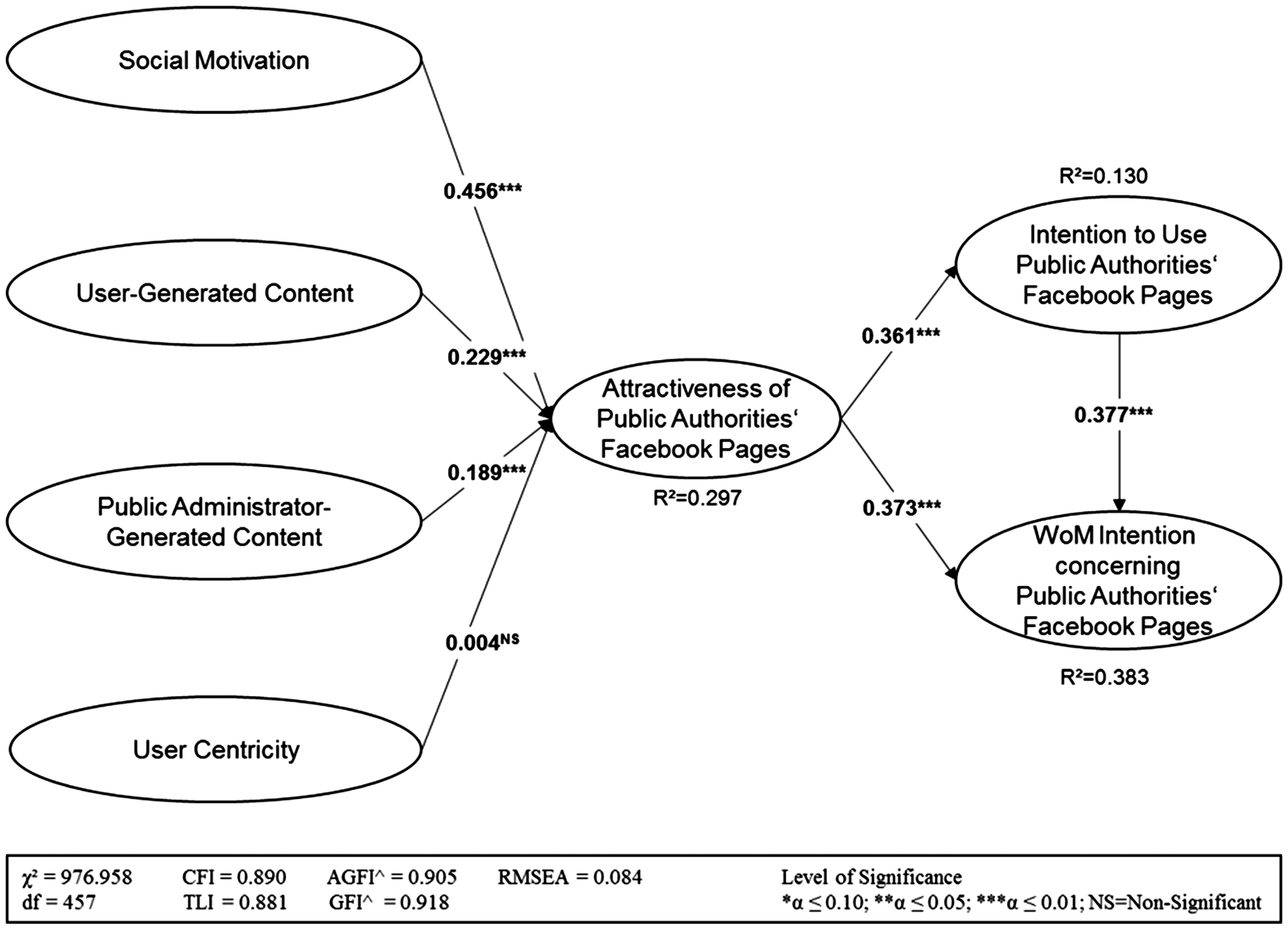
Based on distinguished methodological literature, both the values of the local and the global fit measures largely indicate a good overall model fit (Christensen et al., 2015; Hair et al., 2010). Initially, the model shows that there are three significant antecedents and two significant consequences of the construct of Attractiveness in our study (as indicated in Figure 2). Social Motivation has the highest positive effect (0.456) on Attractiveness, followed by User-Generated Content (0.298) and Public Administrator-Generated Content (0.189). As indicated in Table 2, of the four exogenous factors, only User Centricity does not show a significant effect on Attractiveness of Public Authorities’ Facebook pages.
Results.
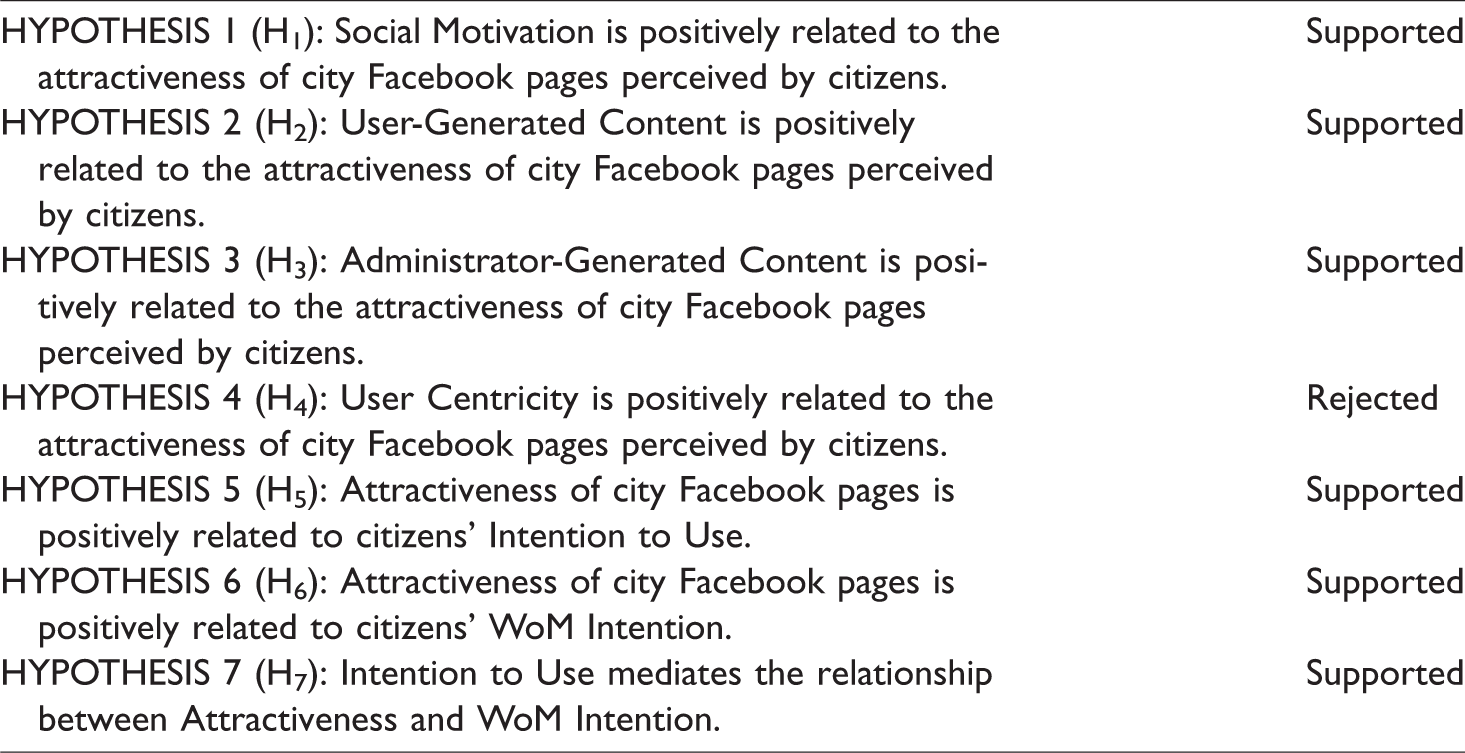
Altogether, the antecedents explain more than 29 percent of the variance of the dependent variable Attractiveness, which based on the relevant methodical literature is a satisfactory result (Chin, 1998). Moreover, we find a positive significant effect of Attractiveness on both Intention to Use (0.361) and WoM Intention (0.373), while Intention to Use also positively influences WoM Intention on a significant level (0.377). In light of these results, we only have to reject Hypothesis 4 (H4) of our research model.
Discussion and conclusion
The purpose of this study was the examination of relevant antecedents and consequences of the attractiveness of public authorities’ SM websites as perceived by citizens. Consulting the relevant literature, we initially developed a conceptual framework constituted by the antecedents Social Motivation, User-Generated Content, Public Administrator-Generated Content and User Centricity, the construct of Attractiveness, as well as its consequences Intention to Use and WoM Intention in the particular context of city Facebook pages.
Based on our empirical study, three out of four antecedents show a significant positive effect on Attractiveness, and Social Motivation shows the strongest influence. This finding shows that the main reason for citizens to engage with public authorities’ SM is their interest in communication, interaction and exchange with other citizens. The importance of this social aspect for citizens’ perceived attractiveness is understandable, for example, if the Facebook page of a city attracts citizens that want to get to know new people or seek help concerning everyday issues such as dealing with particular public authorities. This finding substantiates earlier studies that examine comparable constructs like ‘Social Value’ (Park et al. 2016) or ‘Group Incentives’ (Warren et al. 2014) as antecedents of dependent variables like satisfaction with government’s SM service or civic engagement on Facebook (Park et al., 2016; Warren et al., 2014).
In addition, User-Generated Content shows the second highest path coefficient on Attractiveness in our study. More specifically, not only are the connections and relationships between SM users themselves attractive but also the resulting content, which citizens create, consume and share within SM and the Web 2.0 (cf. Chun et al., 2010; Craglia et al., 2012).
The importance of User-Generated Content appears plausible. Especially when it comes to information about social, political, cultural or religious activities, there might be citizen needs which the municipality’s Facebook page managers cannot fulfill in the interests of the citizens, and for which other users of the same age, and with the same interests and cultural or religious background, are much better suited.
Our results also indicate that Public Administrator-Generated Content plays a notable role for citizens’ perceptions of the related SM websites’ attractiveness. This is also understandable since there may be questions that other citizens are not able to answer but necessitate the input of the cities’ representatives (e.g. public administration employees can support citizens on an integrative and interactive level and thus approach and foster the e-government–citizen trust relationship mentioned by Morgeson et al. (2011), without relying solely on a classical one-sided sender–receiver model of communication).
After all, regarding the last proposed antecedent of city Facebook page attractiveness as perceived by citizens, we interpret the rejected hypothesis related to User Centricity as follows: In spite of the fact that citizens and their input lie at the heart of SM, as is also apparent from the confirmed antecedents of Social Motivation and User-Generated Content, it appears that citizen centricity or even customer orientation on the part of the public authorities is not sufficiently pronounced. Thus, it does not significantly positively influence citizens’ perceptions of the city Facebook pages’ attractiveness. This is remarkable since SM websites such as the city Facebook pages observed in this study offer unique potential for interaction between public administration and citizens and thus provide the opportunity to introduce important political concerns or moderate public discussions like the refugee crisis and its consequences for the respective cities.
Accordingly, public administration should exploit and reap the benefits of Web 2.0 and SM even more intensely in the future and thus fully ‘migrate from a mere sender-receiver model of communication towards one of interaction’ (Halpin et al., 2013: 358). Admittedly, the public administration literature already deals with the strategic importance of user or citizen centricity for public decision makers (e.g. European Commission, 2015; Rabaiah and Vandijck, 2009; van Velsen et al., 2009). However, concerning its appropriate implementation by means of SM, there is a great potential for future research, particularly quantitative empirical studies.
As an interim conclusion, practitioners in public administration should consider the confirmed antecedents of Social Motivation, User-Generated Content and Public Administrator-Generated Content at large and apply them systematically as a whole to assess the achievement of city Facebook page attractiveness. The model shows that in this context attractiveness then leads to citizens’ intention to use and further recommendation of these pages to other citizens, as also confirmed through our study’s further results regarding the significant positive effect relationships between city Facebook page attractiveness and the two further dependent variables.
In addition, the finding that intention to use mediates the relationship between city Facebook page attractiveness and WoM intention is of further interest. To put it concisely, even though there is a significant direct effect of attractiveness on WoM intention, it also seems important for citizens to develop a usage intention concerning the Facebook pages themselves before further recommending them to other citizens, thus yielding the large citizen reach and network desirable for the cities concerned.
Despite the cautious conceptual and methodical development of the study, it also entails several limitations. First, since we have only surveyed users of German city Facebook pages in our study, future research should extend the examination to other countries, cultural backgrounds and nationalities. Second, as our study investigates only a particular period, we encourage researchers to conduct perennial and replication studies to approach a generalization of our results. Third, while researchers should further observe Facebook as a platform for public authorities, one should also extend the investigation to other SMs such as microblogs, for instance.
Footnotes
 .
.