



Abstract
How to promote ethical conduct in the public sector has been discussed extensively in the public administration literature, yet empirical studies that employ comprehensive datasets are rare. This study proposes a hybrid model to explain ethical performance in local governments. Results of our study point to the importance of leadership in creating ethical organizations. Analysis of comprehensive survey data collected from local governments supports our hypothesis that organizational leadership not only promotes ethical behavior directly but also indirectly through reinforcing ethics culture in local governments. This paper discusses the practical implications of our findings and advances some recommendations to enhance ethical conduct in the public sector.
Keywords
Introduction
The ethical character of organizations is an important consideration in public administration because it affects citizen trust in government. Since public service is more about “idealism” than “careerism,” (Frederickson, 1996) ethical content of administration carries significant weight in determining the quality of government. The costly consequences of ethics violations further erode government management capacity and worsen already-declining trust in the public sector (Lee & Liu, 2022). Corruption has forced governments to renew their emphasis on and take action to promote ethical conduct in public organizations (Beeri et al., 2013). Despite such increasing awareness of ethics, the public sector still suffers from serious ethical infractions (Hassan et al., 2014).
How to promote ethical conduct in the public sector has been discussed extensively in the public administration literature, yet empirical studies that employ comprehensive datasets are rare (Beeri et al., 2013). The significance of organizational leadership as a factor in building and supporting ethical organizations has received considerable attention in scholarly works (Trice & Beyer, 1991). For example, a meta-analytic review of published research found ethical leadership as a very important factor covered in the literature (Bedi et al., 2016). Another aspect seen as consequential in the literature is ethical culture, understood as the norms, values, and behaviors shared by an organization's members. Culture is a conduit that carries ethical perspectives. Ethical behavior is inherently complex and depends on a wide range of factors. From cognitive-developmental theories of moral judgment to psychoanalytic theories of motivational processes as well as social learning theories of moral behaviors and inhibitions (Wren, 1982), a broad spectrum of theoretical approaches, including structural and normative, are available to understand ethical behavior (Gilman & Lewis, 1996). Each approach promotes a certain set of variables to be used in empirical studies. Leadership and ethical culture, however, stand out as the two important elements in the literature to potentially explain the ethical performance of organizations, more particularly the ethical cognition and behaviors of lower-level employees (Carlson & Perrewe, 1995; Schaubroeck et al., 2012; Toor & Ofori, 2009). Also, in public administration literature, leadership and rules are often presented as alternatives for exploring ethical behavior (Downe et al., 2016). Considering the lack of empirical studies in public administration ethics and the need for a parsimonious research design, this paper focuses on organizational leadership, culture, and their interaction to develop a testable public sector ethics model.
By developing a conceptualization of ethical performance and subjecting it to a rigorous empirical test, this study aims to make a cumulative contribution to our understanding of the underlying causes of ethical behavior in public organizations. To do so, this paper builds a hybrid model using the two streams of scholarship on organizational leadership and culture to empirically explore their interactions with each other and their association with ethical performance in organizations. The model borrows heavily from both social learning and social exchange theories. Data were collected through self-administered surveys specifically for this study from a large sample of local government organizations in the United States and are utilized to build and test a middle-range theoretical model.
The significance of leadership in building and supporting ethical organizations has received a great deal of attention in scholarly works (Cheng et al., 2019; Hassan et al., 2023; Kaptein, 2019; Trice & Beyer, 1991). Practically, the position of leaders provides them with the resources and power to achieve meaningful change. They are visible, legitimate holders of their positions, and classic literature in organizational studies is replete with case studies of exemplary leaders that built strong and lasting cultures or managed to transform their organizations from declining to outstanding performance. Leaders shape employee attitudes through incentives and sanctions, set the moral tone for the organization as role models (Brown & Treviño, 2014; Bussmann & Niemeczek, 2019), and motivate followers toward desirable ethical behaviors through commitment, advocacy, and communication (Brown & Mitchell, 2010).
A somewhat different line of research focused on organizational culture and examined its effect on employee behavior (Key, 1999; Schaubroeck et al., 2012; Warren et al., 2014). Culture is a term commonly used to indicate widely shared norms, values, and behaviors among members of an organization. Working as a glue that bonds the members and expresses their common identity, strong cultures create a felt obligation for desirable behaviors, socialize new members into shared understandings, and encourage employees to voluntarily abide by organizational norms and avoid deviant behaviors (Bussmann & Niemeczek, 2019).
This study seeks to answer two research questions: (1) “Do organizational leadership and culture contribute to ethical conduct in public organizations?” (2) “Does organizational leadership contribute to ethical conduct in public organizations indirectly by reinforcing ethical culture?” To explore these questions, the paper is organized into three sections. In the following section, we summarize the literature and elaborate on the empirical studies that were instrumental in specifying our theoretical model. Section two focuses on data analysis and reports the major results of the statistical analysis. In the third section, we discuss the theoretical and practical implications of our findings and offer some recommendations for promoting ethical performance in local government organizations.
Literature Review
Ethical Leadership and Ethical Performance
Studies on ethical leadership in the literature address several questions, including the antecedents of ethical leadership (Mayer et al., 2012; Steinbauer et al., 2014) and its dimensions, processes, and outcomes. But what is ethical leadership? Put simply, ethical leadership is treating others with dignity, fully respecting their rights, and using power in socially responsible ways (Eisenbeiss & Knippenberg, 2015). In one of the most widely cited definitions, ethical leadership is treated as the “demonstration of normatively appropriate conduct through personal actions and interpersonal relationships, and promotion of such conduct to followers through two-way communication, reinforcements, and decision making (Brown et al., 2005, p. 120). Leaders do not just develop ethics rules and documents for their organizations but also influence follower behavior through role modeling, decisions, and actions. Research confirms that when top managers are strongly committed to ethics, their organizational ethics programs are more comprehensive, have stronger aspirational orientations, and are more fully integrated into everyday organizational practices (Brown & Treviño, 2014; Demirtas & Akdogan, 2015; Palmer, 2009).
Ethical leaders set the moral tone in their organizations by being moral persons and moral managers. As moral persons, they demonstrate honesty and integrity in their daily lives. As moral managers, they use a transactional approach, applying rewards and sanctions, and promoting ethical standards to influence follower behavior (Toor & Ofori, 2009). This is somewhat different from transformational approach that relies on leaders’ vision and values that aim at dramatic changes in organizational culture and strategies (Carlson & Perrewe, 1995). Transformational leaders engage in ethical decision-making and role modeling and they show genuine concern for the well-being of their subordinates (Bedi et al., 2016). The literature emphasizes leaders’ integrity as a factor in promoting overall ethical behavior (Lawton & Paez, 2015). Integrity distinguishes ethical from unethical leaders. Lacking integrity, the latter condone the unethical behavior of employees who get results in order to accomplish organizational goals. Even if the leaders themselves do not engage in unethical behavior, they foster unethical conduct within their organizations by condoning non-conformers (Brown & Mitchell, 2010; Hassan et al., 2023).
Research shows that leadership affects several employee outcomes, including followers’ job satisfaction, commitment, and the perception of an ethical climate (Neubert et al., 2009). In a study of managers from a large government agency, Hassan et al. (2014) found that ethical leadership increases subordinates’ willingness to report ethical problems. This is an important finding, the authors argue, because employee willingness to report ethical concerns is instrumental to establishing an ethical climate in public sector organizations.
Ethical leaders have an internalized moral perspective that allows them to manage morality. Similarly, ethical leaders point out examples by endorsing exemplary behavior, denouncing improper conduct, and using rhetoric to influence others (Downe et al., 2016). This perspective on ethical leadership relies heavily on notions drawn from Social Learning Theory (SLT). SLT explains behavior in terms of learning (Bandura, 1977). Agents learn moral behaviors by imitating others. According to this theory, individual learning occurs in a social context and is influenced by social norms. Imitation is a function of successful modeling, and through successful modeling, individuals quickly reproduce the desirable behaviors exhibited by the leaders. Modeling is effective when subordinates can apply the modeled behavior to a situation (O’Fallon & Butterfield, 2012). Leaders can influence employee moral conduct through exemplary behavior and by creating an environment suitable for ethical behavior. For example, leadership can create an open, safe, and transparent culture where discussing and reporting ethical issues is rewarded or even demanded (Hannah et al., 2011).
The literature focuses on communication processes, performance management systems, and social exchanges as primary mechanisms through which leaders communicate and reinforce proper conduct within their organizations (Groves & LaRocca, 2011). While ethical leaders may use extrinsic rewards to influence follower behavior they also address employee ethical development by increasing employee's interest in the subject. Intrinsic motivation is formed by attraction to the work itself (Goodsell, 2011) This is done through training. Ethical development through training enables employees to learn needed skills and enhance their confidence to make ethical decisions (Tu & Lu, 2016). Perceived knowledge about ethics topics influences perceptions of ethical climate as well as advice-seeking behavior in a positive way (Raile, 2013). Empirical research shows that employees become more ethically sensitive when they are introduced to ethics knowledge (Menzel, 1997).
In a qualitative study of ethical leadership, Frisch & Huppenbauer (2014) found that ethics documents such as codes of conduct are not useful unless leaders provide accompanying measures such as training employees in ethical competence or allow them to actively participate in an organization's ethical development. More recently, Huang (2018) added transparency to the employee ethical judgment model and found that increased transparency buffers the impact of the opportunity factor on individuals’ acceptance of ethically questionable practices.
Ethical leaders treat their followers fairly. According to Steinbauer et al. (2014), the moral manager openly and explicitly talks about ethics and empowers followers to be just and seek justice, and collectively holds employees accountable for their decisions. Their research found that ethical leadership improves the perceived accountability of followers, which leads to followers’ self-leadership focused on ethics. Social exchange theory suggests that employees feel obligated to demonstrate the right behaviors and comply with ethical norms when their leaders treat them fairly and care for their well-being (Blau, 1964). Ethical leadership creates a felt obligation to reciprocate in kind.
When it comes to followers’ learning ethical behavior, leaders play a key role as educators. According to Beeri et al. (2013), one of the key functions of ethical leadership is educating employees. This is done by identifying ethical dilemmas, choosing appropriate tools to deal with ethical issues, and developing independent and critical ethical thinking (p. 61). Leaders also serve as informational guides for acceptable behaviors (Bedi et al., 2016). SLT suggests that when leaders set high moral standards for themselves and others, and show honesty and integrity in their daily lives, employees are more likely to emulate and internalize leaders’ value-driven behavior (Brown & Treviño, 2006).
When social learning and exchange theories are applied to organizational ethics, the implications of ethical leadership become clear. Leaders are expected to project an ethical character in their words and deeds and use resources at their disposal to communicate and reinforce desirable ethical conduct. Leaders, therefore, play multiple roles, including educator, communicator, informer, facilitator, role model, and advocate to incentivize the right behaviors. Whether followers respond to the leader's role modeling is contingent on how each one receives and processes the critical information conveyed by the leadership. Eisenbeiss & Knippenberg (2015) offer follower mindfulness as a mediating variable in explaining leadership's impact on discretionary employee work behaviors. More recent research also links ethical leadership to subordinates’ learning through moral identity and leader identification of followers (Wang et al., 2021).
Ethical Organizational Culture and Ethical Performance
The notion of organizational culture has its roots in anthropology, which defines it as patterns of thinking, feeling, and reacting. Organizational culture is those patterns that are influenced by organizational members (Key, 1999). Organizational culture is the accumulated shared learning, the patterns of beliefs, values, and norms that define the organization (Asencio, 2022). As a result of shared organizational culture, individuals may be encouraged to act in manners consistent with pre-existing ethical norms. Ethical culture consists of a formal code of ethics, training, reward systems, and ethical norms as well as the actual procedures and practices for complying with the laws and the professional standards for following rules and procedures (Grosenick & Gibson, 2019; Svara, 2014). Organizational culture emphasizes the role of values and beliefs as part of ethics in the organization. These values and beliefs include those about the importance of organizational performance and the development of quality. Weak organizational cultures that have not developed strong values and beliefs may lack ethical behavior (Carlson & Perrewe, 1995). Studying a large sample of managers in Germany, Bussmann & Niemeczek (2019) found that integrity-promoting cultures reduce the risk of corruption. Similarly, Jannat et al. (2022) found that control elements of ethics programs including monitoring, internal reporting, ethics support service, and ethics training significantly influence employees’ cognitive appraisal processes.
Schein (1985) proposed three levels of understanding for organizational culture. These are artifacts (tangible, identifiable elements in an organization grounded in values and assumptions), espoused values (the organization's stated values, goals, and standards), and assumptions (shared basic assumptions). These three levels must be in alignment for organizations to function effectively and leaders are responsible for educating their employees through socialization, role modeling, and reinforcements. When the beliefs and thoughts of leaders are taught to employees and validated by organizational success, they become assumptions.
Public service ethics is unique in that it is shaped by the social and political context rather than just professional standards. Public servants must react to environmental constraints and set standards that accord with them (Kyarimpa & Garcia-Zamor, 2006). Cultural, political, and social environments are crucial for understanding ethical conduct in the public sector. On the one hand, public servants encounter bureaucratic discretion in performing their roles and serving the public interest. On the other hand, public scrutiny requires a high degree of accountability and responsiveness to the citizenry and elected officials. Accordingly, public service organizations have elaborate bureaucratic processes to keep workers on an ethical path. This is why compliance has been a focus of many efforts to raise awareness of ethics in the public sector.
Farazmand (2002) argues that reform to combat corruption provides the impetus for professionalism in government. Professionalism in public service changes the organizational culture and acts as a safeguard against corruption. Kernaghan (1994) argues that in the Canadian public service, there is an interaction between the particular shared values of organizational culture and more universal ethical values such as integrity, honesty, fairness, respect for others, excellence, and responsible citizenship. There is a congruence among organizational culture, traditional public service values, and ethical values as shown in an analysis of the compliance and control measures used to combat corruption within the government in the former countries of the Soviet Union (Stevulak & Brown, 2011). In the study of these transitional countries, doing the right thing required individuals to have an inward strength of character (ethical values) and a supportive government (public service values). Successful cases featured governments with coaching, mentoring, and training programs that helped build self-reflection, discovery, and action.
Research shows that organizational ethical success might involve more than just the refinement of organizational structures such as roles, rules, procedures, hierarchies, divisions, and departments but also strengthening the organizational culture, that is the system of core values, symbols, and rituals, around which there are shared values (Jurkiewicz & Giacolone, 2004; Theobald, 1997). A survey of the U.S. Army shows the relationship between ethical leadership and ethical culture (Schaubroeck et al., 2012). Ethical leadership has a cascading effect on the ethical culture of the U.S. Army. A longitudinal study by Huhtala et al. (2022) found that leaders in strong ethical cultures report the lowest level of ethical dilemmas.
The organizational culture of government ethics programs is dictated by their emphasis on compliance-based ethics or integrity-focused ethics (Roberts, 2009). Embodied in the well-known Friedrich–Finer debate, earlier research in public administration weighed competing frameworks of external political controls and public service professionalism in ensuring administrative responsibility (Plant, 2018; Tremblay et al., 2017). The compliance approach to ethics management focuses on external controls on the behavior of public servants, while the integrity approach focuses on internal controls or self-control exercised by individual public servants (Maesschalck, 2004). Compliance approach focuses on their hewing to the detailed rules and procedures that public servants need to follow. Compliance mechanisms include ethical codes, rules, and procedures. Remisova et al. (2019) found that ethics codes and training are the most effective ethics program components for managerial ethical behavior. Cooper (2004) argues that public organizations must be designed in a way that provides ethical concerns to be heard and supported by organizations. Conversely, the integrity approach focuses on internal self-control exercised by the individual public servant. It aims at the internalization of the norms, behaviors, and expectations of the government which is organizational culture. An integrity approach would feature values workshops, training, and coaching. Taken together, the integrity and compliance approaches to ethics management are complementary ways to build ethical organizational culture.
Because it is more cut and dried, direct and to the point, and can be accomplished in the short-term, compliance-based ethics is more widely employed in building ethical organizational culture. It relies on easily identifiable rules and regulations that employees are to follow. Integrity-based ethics is more difficult and expensive to implement since it requires a longer-term project to change the organizational culture and is more difficult to measure. Compliance strategies encourage employees to report possible instances of illegal conduct, such as through a whistleblower program. The Watergate scandal and the aftermath in the 1970s created the whistleblower laws to provide employees with protection against retaliation for reporting ethical lapses. The rise of the digital economy further showed the importance of increased transparency within public services. A study of whistleblowing in federal government agencies, demonstrating the compliance focus, suggests that individual and organizational characteristics predicted whistleblowing (Lavena, 2016). If an employee works in an organizational culture characterized by perceived respect and openness, they are more likely to report wrongdoing or blow the whistle. O’Leary (2010), in her study of what she coined “guerilla employees,” suggests nurturing those employees who act against the wishes of their superiors, when the morality of the situation calls for it. Further, organizations may have tendencies for facilitating immoral behavior, therefore employees who can think independently and critically can be an asset for building ethical cultures (Adams & Balfour, 1998). These findings corroborate the importance of reinforcing professional values and ethical decision-making skills in government.
Mission valence is the attractiveness of the stated and actual organizational mission to employees. Effective organizations have higher mission valence. The higher the mission valence of an organization, the more effective it will be (Craft, 2018; Rainey & Steinbauer, 1999). The more attractive the mission is to the individuals in the organization, the more engaged employees will be in the organizational culture that supports that mission. Members that have mission motivation are more highly motivated to contribute to the achievement of the mission. For example, NASA members join NASA because they deeply believe in the mission of the organization and are excited about the mission. This mission motivation instills an organizational culture and thus impacts ethics within the organization. Similarly, Goodsell (2011) offers the concept of mission mystique, meaning positive institutional charisma derived from the nature of its mission and how well it is carried out, which fosters a personal commitment to the advancement of the mission. Mission, as Goodsell (2011) argues, is central to the formation and maintenance of an organization's belief system.
There is empirical research that examines organizational culture and ethics. In a survey research that sampled leaders in municipalities and counties in the U.S., Asencio (2022) found that leaders’ commitment to behaving ethically and creating an organizational culture is key to building ethical culture in public organizations (Asencio, 2022). In an analysis of state ethics commissions, the enforcement of rules was viewed as important for the effective administration of the commissions. The focus of the commission was on enforcement which ultimately determined the effectiveness of these commissions (Bradbury, 2007).
A survey-based analysis of auditors of large international accounting firms found that perceived organizational culture is indirectly related to ethical judgments (Douglas et al., 2001). An ethical culture affects individual values such as idealism, and this impacts judgments. The attributes of culture tested were a professional code of conduct, an emphasis on workplace rules versus individual judgment, and training. The authors argue that socialization theory is supported by their findings on creating an ethical culture. Using SEM research shows that in the healthcare sector in South Korea a well-functioning organizational culture motivates employees to better quality performance, collaboration, and ethical work behavior (Lee, 2020). The results reinforce the importance of maintaining the highest ethical standards to improve organizational performance.
Ethical Leadership and Ethical Organizational Culture
The relationship between leadership and organizational culture has received attention in the extant literature. Founding leaders create and shape the cultures of an organization, but the top administrators that succeed them are responsible for managing its evolution. This includes modifying both the organization's basic assumptions and culture to adapt it to the changing demands of the external environment (Berson et al., 2008). Trice & Beyer (1991) separate leadership for culture change from other instrumental consequences of leadership. They maintain that cultural leadership employs nine elements such as the use of cultural forms, traditions, administrative actions, specific leader behaviors, vision, and mission which have cultural consequences for the entire organization.
Leaders fulfill key roles in creating and reinforcing organizational cultures that support ethical behavior. Either as transactional leaders or transformational leaders, managers influence how employees think, and how they understand and solve problems. Schein (1985) argued that leaders strive to embed their beliefs, values, and assumptions into members’ understanding, by using a range of primary and secondary mechanisms. Primary embedding mechanisms include the way that leaders monitor, measure, and control behaviors, as well as deliberate role modeling, teaching, and coaching. These also include the allocation of rewards and status through processes like selecting and promoting. Secondary embedding mechanisms are the more indirect, subsidiary means employed by leaders like stories, workflow designs, procedures, and formal statements. Schaubroeck et al. (2012) maintain that leader behavior both embodies the organizational culture at higher levels and communicates and reinforces organizational culture at lower hierarchical levels. They found that the influence of senior leaders on ethics outcomes may be indirect, transmitted through their influence on the culture at their own, superior levels, which then cascades to lower levels (Schaubroeck et al., 2012, p. 1073). Toor & Ofori (2009) reported similar results supporting the role of transformational leaders in promoting ethical cultures. Ethics-related outcomes of transformational leadership include major changes in the organization's mission and its strategies. Leaders with a strong vision can generate employee understanding and strong core values contributing to the institutionalization of organizational ethics (Carlson & Perrewe, 1995).
Ethical leadership may have a direct effect on the general organizational culture. Pasricha et al. (2018) found that ethical leadership favors the development of clan-like organic organizational cultures which place a premium on internal maintenance and flexibility. Shared values and goals and a sense of synergy permeate clan-like organizations (p. 944). Leaders play a critical role in the values-education of employees and influence organizational culture through the use of organizational learning. Organizational learning is the formalization of practices into routines. Organizational learning supports the translation of shared understandings and collective action into new products, procedures, systems, structures, and strategies across the organization (Vera & Crossan, 2004, p. 230).
Van der Wal & Demircioglu (2020) studied the relationship between ethical culture and ethical leadership by analyzing a large dataset on the implementation of innovations by Australian Public Service Commission members. They found that ethical culture and ethical leadership mattered in realizing innovation in the public service. The results indicated that senior managers who promote ethical values have an impact on the broader culture of the public service organization.
Not only does leadership affect organizational culture, but culture can enable or inhibit leadership. In his analysis of case studies of leadership and ethics in Enron, WorldCom, and Solomon Brothers, Thoms (2008) found that the integrity of the leaders was the most important ethical leadership trait. He argues that organizational culture is critical to successfully realizing ethical leadership. The leader must have the proactive ability to understand the organization's culture, eliminate conflicts in ethical standards, and communicate explicit behavior to be followed. Furthermore, ethical leadership was associated with personality traits such as trustworthiness, honesty, fairness, and principled decision-making which need to be selected in the organizational culture. Top management plays a critical role in shaping ethical culture and instilling values that show that ethics is important. The key is that top management must be able to clearly articulate the importance of ethics for the organization and its employees.
In another case study analysis, Kakabadse et al. (2003) looked at the Australian, Canadian, and British governments’ responses to ethical leadership challenges and ethics and organizational culture. Their research suggests that management ethics cannot be treated in isolation from other influential variables, such as organizational culture. The clarity of organizational values serves as a point of reference for ethical conduct. Leaders have a major role in influencing these organizational-wide values. To enable culture building there needs to be an organizational emphasis on people-oriented management.
In an analysis of local governments in the U.K., researchers have shown that leaders can be important in promoting good conduct and fostering an ethical culture (Downe et al., 2016). This is done by leaders who model proper behavior and act in ways that reinforce high standards of conduct throughout the organization. Likewise, leaders who model poor conduct negatively affect organizational values. In other words, organizational leaders are human agents of culture transmission (George et al., 1999).
The relationship between leadership and culture may not always be direct. In a study of the U.S. Army, ethical leadership had a moderating impact on ethical culture (Schaubroeck et al., 2012). While another study on the rating of managers in the corporate sector found that ethical leadership had a mediating role in the relationship between organizational culture and employee outcomes (Toor & Ofori, 2009). Analysis of personnel records and two separate surveys of a large state agency in the Midwestern United States showed that ethical leadership encouraged beneficial employee attitudes that are a mediating variable for culture (Hassan et al., 2014).
Research Design
Theoretical Model and Hypotheses
In its early development in the public administration literature, the study of ethics emphasized the short-term liability concerns of public organizations. It focused on achieving organizational compliance with legal and professional norms and approached ethics from a legalistic, reactive, and punitive perspective (Bowman & Knox, 2008). More recent studies, however, have a broader scope. While they too seek to realize employee obedience to ethical standards, they also emphasize leadership, learning and development, and collective accountability to improve an organization's ethical performance.
The research reported here explores the relationship of organizational leadership and organizational culture in enhancing ethical behavior in organizations and ultimately the organization's ethical performance (Figure 1). The ethical performance of organizations involves measures of both short-term (outputs, or objective-achievement) and long-term (outcomes, or goal-attainment). In the short term, organizations aim to avoid costly legal consequences of ethical misconduct, such as lawsuits, investigations, and disciplinary action. To avoid legal liability, organizations focus on external controls and monitoring to flag and punish violations and enforce compliance with norms. In the long run, however, effective organizations aim to create voluntary employee compliance with ethical rules and create an environment where employees support and promote ethical conduct.
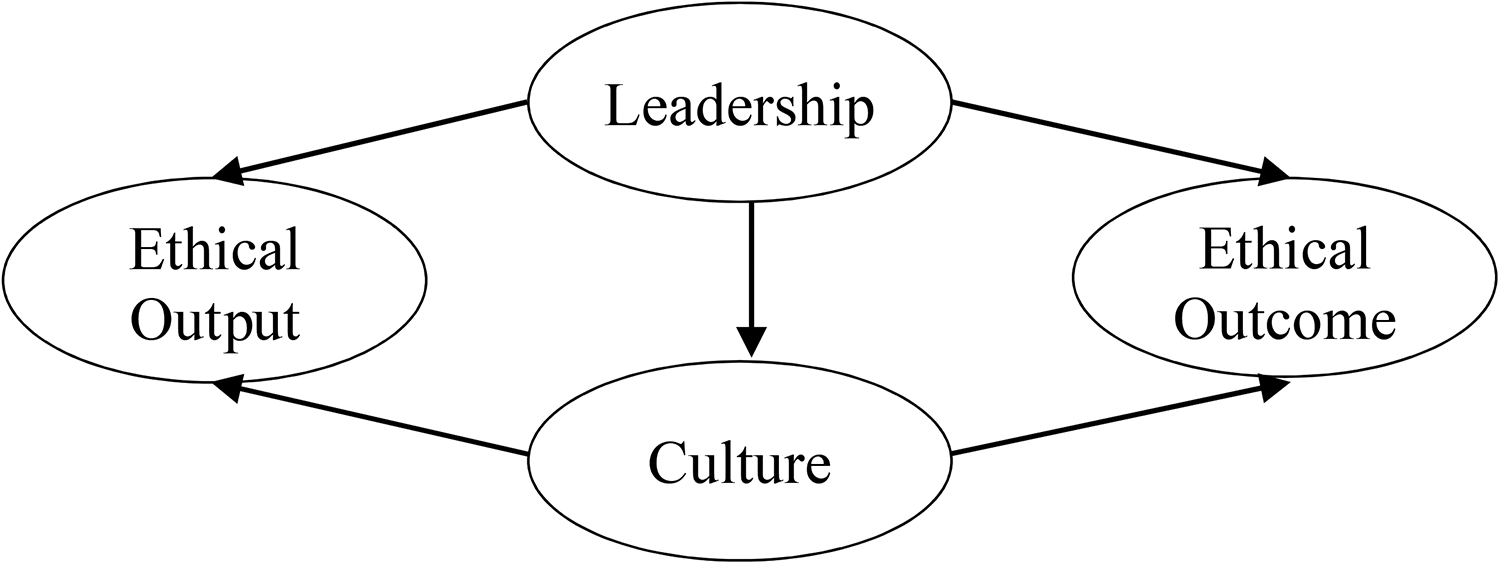
Organizational leadership, ethics culture and ethical performance model.
This research hypothesizes that organizational leadership and culture together affect ethical performance measures (output and outcome). Because organizational culture is the context in which organizational leadership and the realization of ethical outcomes take place this paper further hypothesizes that organizational culture plays the role of a mediating variable. Ethical organizational culture is the context, in some cases, the available technology, that may dampen or enhance the influence of leadership in the overall ethical performance of an organization. Thus, this paper asks, “what direct or indirect impact does organizational leadership have on ethical performance operating through ethical organizational culture?” Using Structural Equation Modeling (SEM) and employing a large dataset of top local government administrators, the research tests the impact of organizational leadership on long-term and short-term ethical measures.
Sample, Survey, and Data Collection
The 2022 local government ethics survey was conducted to determine the views of practicing local government managers on ethical processes, leadership, and culture. The survey was open to respondents for one month, from February 28 to March 28. Four rounds of reminders were sent to increase the response rate. The Chief Administrative Officers (CAO) of 3,218 local governments were surveyed. There were 724 completed surveys, representing a response rate of 22.5%.
Table 1 details the characteristics of both the local governments surveyed and the respondents by location (geographic division), governance (form of government), and size (population). It presents a picture of how well respondents represent the overall population for each category. For example, in the category of geographic region, all areas have around a 20% response rate, with only one, Middle Atlantic, falling below 20% and the highest being 25% from the Mountain region.
Responses to the Local Government Ethics Survey.
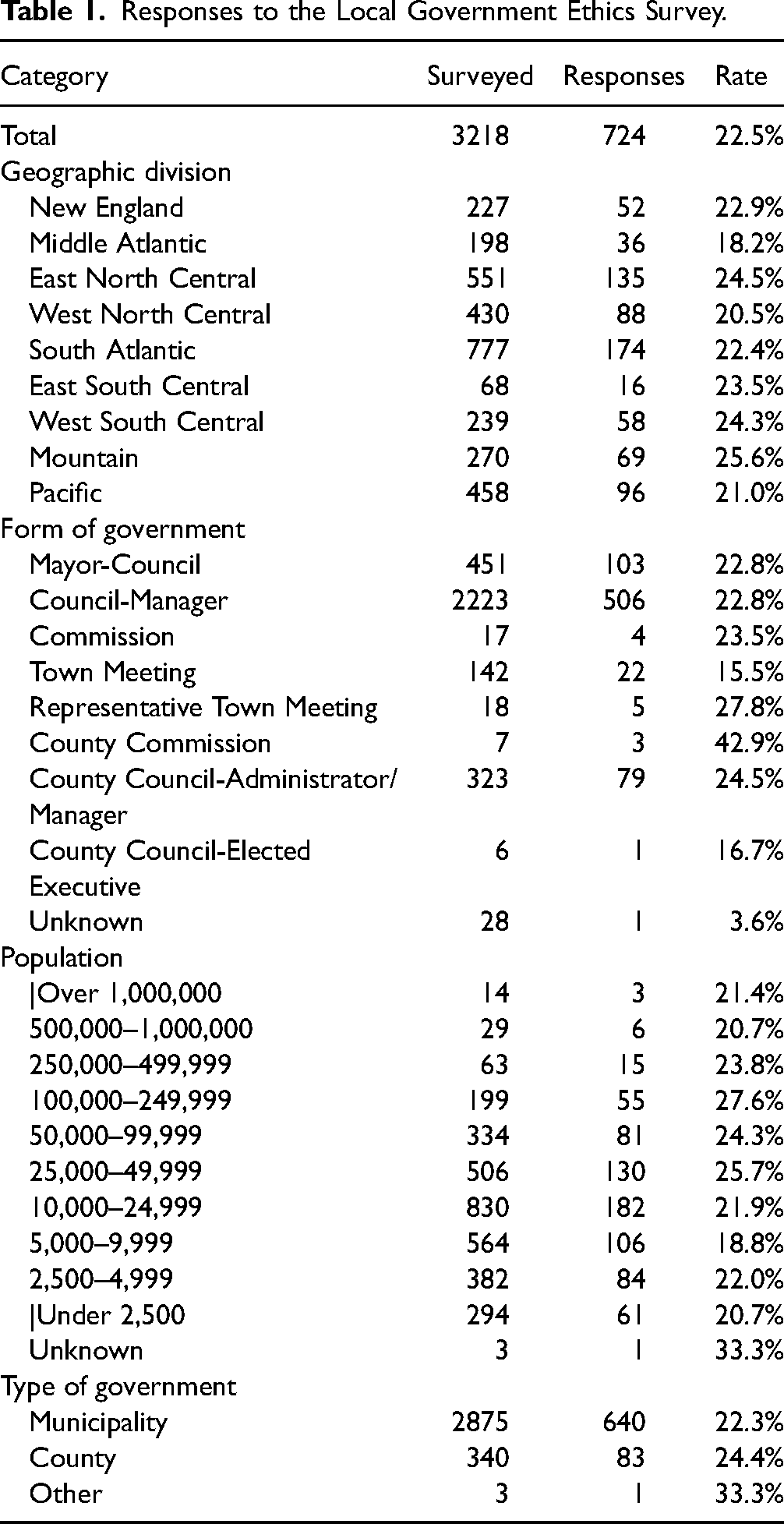
Similarly, as shown in Table 1, response rates from mayor-council (22.8%), council-manager (22.8), and county council-administrator/manager (24.5%) forms of government are all close to 20%, with the latter one nearing a 25% response rate. Although other government forms greatly exceed or fall short of this response rate, they have too few respondents to be considered in depth. For example, given the small number surveyed (7) but the high number of responses (3), the survey over-represents county commissions at 42.9%. The response rates of jurisdictions by the size of the population also cluster around 20%. These range from an 18.8% response rate for local governments with populations of 5,000–9,999 to a 27.6% response rate for local governments with populations of 100,000–249,999. The jurisdictions surveyed appear to be representative of the different population sizes served by local government.
Table 1 indicates that both municipal and county types of government have similar response rates near 20%, with the former at 22.3% and the latter at 24.4%. Municipal governments make up a greater number of all respondents to the survey (640) than county governments (83), but this reflects the relative number of municipal and county governments in the U.S.
From our analysis of respondent data in Table 1, we conclude that the responses by category of respondent effectively mirror the overall response rate of this survey at 22.5%. In addition, we think that the overall sample of respondents to the survey is broadly representative of local governments in the U.S.
Survey and Operationalization of Model Variables
In light of the literature and in collaboration with ICMA survey staff, an instrument to assess the attitudes of top local government managers and administrators was developed. As indicated above there were 724 complete responses. Survey statements were measured on a 5-point Likert scale, from 1 (strongly disagree) to 5 (strongly agree) and 1 (significant increase) to 5 (significant decrease) for ethical output statements.
Table 2 presents how the theoretical constructs were operationalized with survey statements. Because it is so complex, the construct for culture has four summative variables, each with four survey items. Culture is a broader concept than leadership and covers some organizational aspects that go beyond management and administration. These include several items that aim at tapping aspects such as value-like statements, emphasis of aims, symbolism, and shared worldviews of employees.
Theoretical Model Constructs and Survey Statements.

Methodology
Structural Equation Modeling
SEM employs a confirmatory approach and is particularly useful to evaluate theoretical models with multiple relationships. Reported fit indices are assessed to determine the extent to which a specified model fits empirical data. Since the theoretical model used in this research deals with fairly broad concepts, SEM is especially suitable in that it allows using multiple indicators to capture abstract concepts more accurately. SEM has certain advantages, especially when testing mediational effects. Hierarchical regression models for mediational analysis are subject to measurement errors. When variables are measured with errors, the significance of the mediation effect is likely to be underestimated because measurement errors bias parameter estimates. SEM controls for measurement errors when parameters are estimated (Cheung & Lau, 2008; MacKinnon & Dwyer, 1993).
SEM programs generate a broad number of fit indices. There is no consensus in the literature on which ones should be used to assess the goodness of the model fit. Kline (2015) suggests reporting at least four fit indices. Hooper et al. (2008) suggested reporting Root Mean Square Error of Approximation (RMSEA), Standardized Root Mean Square Residual (SRMR), Comparative Fit Index (CFI), and one parsimony index such as Parsimony Normed Fit Index (PNFI). Hu & Bentler (1999) propose a two-index format.
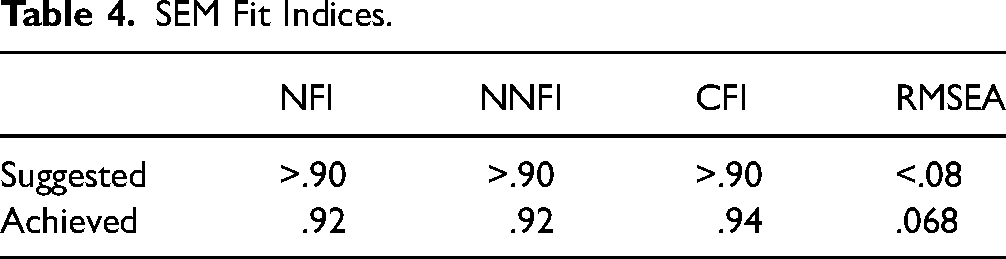
We used CFI, Non-Normed Fit Index (NNFI), Normed Fit Index (NFI), and RMSEA to assess model fit because they are least affected by the sample size (Fan et al., 1999). The values of comparative fit indices such as CFI and NNFI indicate the proportion of the improvement of the overall fit of the researcher's model relative to a null model. The typical null model is an independence model in which the observed variables are assumed to be uncorrelated. For example, a value of 0.90 for NNFI is interpreted to suggest that the relative overall fit of the researcher's model is 90 percent better than that of the null model estimated with the same sample data (Kline, 2015, p. 129). The values of CFI, NFI, and NNFI should be at least .90 to suggest an adequate model fit. RMSEA tells how well the model, with unknown but optimally chosen parameter estimates, would fit the population covariance matrix. Values of RMSEA lower than 0.08 have long been taken to suggest an adequate model fit (MacCallum et al., 1996).
Theoretical Model
Our theoretical model hypothesizes that leadership and culture play a key role in promoting ethical behavior. Ethical behavior, seen as performance in the model, has both short-term and long-term measures. We specified paths from leadership and culture to each ethical performance measure, to represent the hypothesized relationship between leadership, culture and ethical output and ethical outcome. To operationalize leadership, consistent with the literature, we developed statements to capture ethical content in leadership. These statements emphasize openness, integrity, role modeling, participation, decision-making, allocation of rewards based on ethical behavior, and information support. The scale reliability was adequate for our leadership construct. For tapping culture's ethical content, we constructed assertions that aim at tapping aspects such as value-like statements, emphasis of aims, symbolism, and shared worldviews of employees. Factor analysis and scale reliability scores showed that these numerous statements can collapse into four categories, and for model parsimony purposes, we have decided to create four summative variables. Each of these four summative variables was used in the SEM model as indicator variables of the culture latent construct. For tapping short-term and long-term ethical performance, we developed several other statements.
In the model, we have also specified an indirect association between ethical leadership and ethical performance measures through culture. A one-directional arrow from leadership to culture represents the hypothesis that leadership reinforces ethics culture and indirectly promotes ethical performance in organizations. As we argued in the preceding parts of the paper, leaders have an amplifying impact on the ethical content of employee behavior not only in their capacity as moral leaders but also in their capacity as reinforcers of organizational cultures.
Results
Scale Reliability
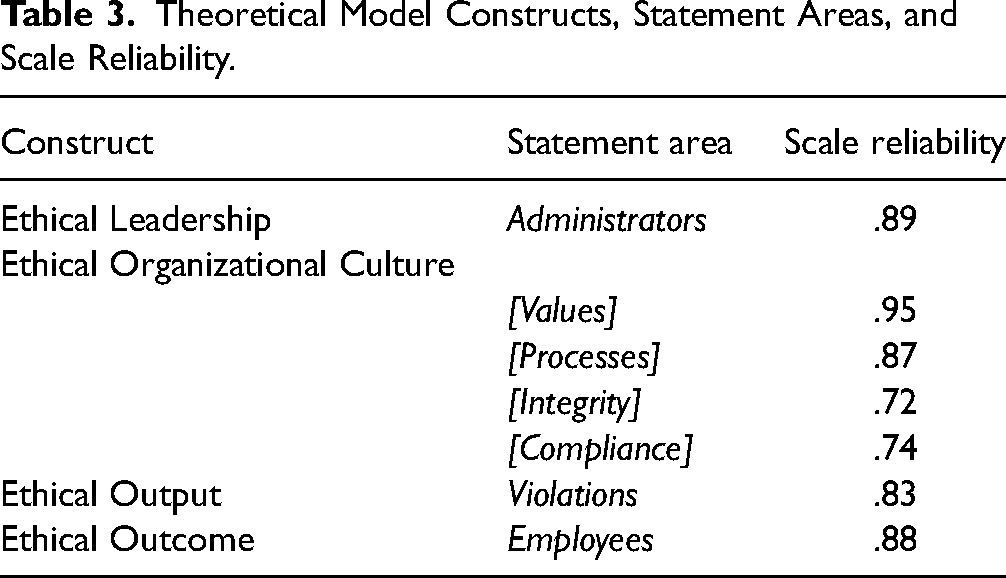
We have ensured the scale reliability of the statements used in our survey instrument. As Table 3 indicates, the indices were based on adequate Cronbach's alpha values which suggested the uni-dimensionality of their respective scales. Coefficients greater than 0.7 are taken to suggest acceptable internal consistency (Nunnaly, 1978). Since we had a good number of statements to capture organizational culture, we decided to use summative variables to have a more parsimonious model. Values, processes, integrity, and compliance represent dimensions of organizational culture. Four summative variables were created to make up the ethics culture latent construct. As Table 3 reports, variables that make up each culture summative variable had adequate Cronbach's alpha values that justified our choices.
Theoretical Model Constructs, Statement Areas, and Scale Reliability.
We have tested our theoretical model using the Maximum Likelihood estimation method in Amos. The specified model converged after nine iterations. Table 4 reports fit indices. Comparative Fit Index and Non-Normed Fit Index values are adequate, and the Root Mean Square Error of Approximation (RMSEA) is less than .08. These values satisfy the recommended thresholds discussed in the SEM literature, and therefore we consider that our model fits the data.
SEM Fit Indices.
Discussion and Conclusions
The results of SEM analysis (see Figure 2) support our hypothesis that leadership is key to increasing ethical performance in local government. We found that ethical leadership promoted long-term ethical results, but also through culture, as a mediating variable, impacts the short-term compliance of employees. Ethics culture positively impacts both ethical outputs (p < .01) and ethical outcomes (p < .001). Both ethical leadership and ethics culture are important in promoting ethical behavior in organizations. This research finds that leadership has a direct impact on long-term ethical measures but only an indirect impact on short-term measures through ethical organizational culture. Ethical organizational culture serves as a mediating variable that helps explain the amplified influence of leadership on the overall ethical performance of public organizations.
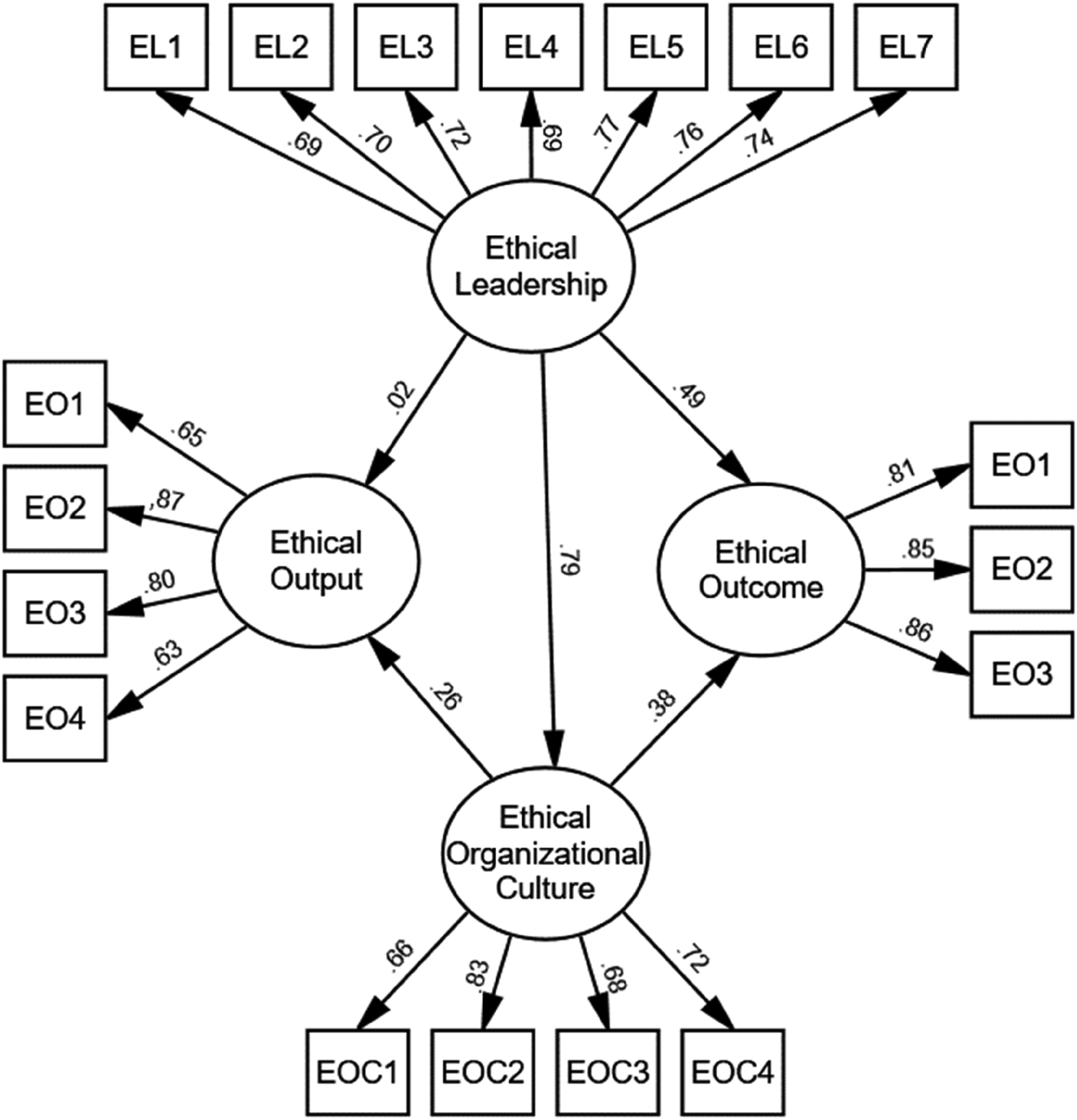
SEM results, path coefficients and factor loadings.
Although literature often dichotomized rules against leadership, our test results demonstrate that both rules and leadership behavior promote ethical behavior. Leadership is as important as compliance in creating ethical organizations. Our model shows that leaders play a key role in reinforcing their organizations’ culture. The path coefficient between leadership and culture is .79 (p < .001). Leadership as an exogenous variable explains 63 percent of the variance in ethics culture.
The implications of our study are clear. Leadership matters. Although the ethics literature in the public sector may have emphasized one more than the other, test results show that leadership and culture are important. Leaders not just embody their organizational cultures but also reinforce them. This finding suggests how important it is for local governments to prepare those in leadership positions for ethical leadership behaviors. Recruitment, hiring, promotion, and development of top-level administrators should incorporate ethical leadership behavior as a criterion. Recruitment, hiring, and promotion practices should assess candidates’ abilities to identify ethical issues, analyze value trade-offs, and balance the needs of multiple stakeholders. Some recent research finds that the personality dimension of conscientiousness as well as decision-making autonomy are related to ethical leadership (Babalola et al., 2019).
Previous research found that leaders embed their moral values into the framework of their organizations by surrounding themselves with like-minded individuals (Brown & Mitchell, 2010). Further, their decision-making, communication, social exchanges, and performance management mold followers into particular modes of thinking (Toor & Ofori, 2009). Public sector managers often deal with perplexing ethical issues, multiple stakeholders, and conflicting pressures. They face value trade-offs in their daily tasks. Equipping public administrators with skills to help them deal with ethical dilemmas will amplify their influence in the long run because they will become more helpful for employees as informational guides. Groves & LaRocca (2011) propose that organizations should encourage a more formal assessment of their ethical leaders and develop a safe feedback mechanism to enhance manager self-awareness of key antecedents to effective leadership (p. 525). This, of course, requires going beyond compliance training, which is often focused on laws, and reactive and punitive in approach. Empowering leaders with the distribution of rewards based on ethical employee behavior is also a key asset that can help leaders promote ethical conduct. As Babalola et al. (2019) research supports, when managers have decision-making autonomy, this enhances their reflexiveness and encourages ethical thinking. Creating the right environment not just for subordinates but also for high-ranking administrators is needed.
Perceptive managers pay attention to future ethical risks, not just current ethical culture. An organization's current ethical culture may withstand new pressures, but even if strong it may need support or adjustment to continue thriving. Organizational environments are changing rapidly both politically and economically and tomorrow's ethical context may be very different from today's situation. This is why Bowen & Power (1993) advocate for a communicative ethics process to help leaders consider a greater variety of opinions, check self-serving biases, obtain feedback, and cooperate with others involved in the decision process. This is important, as recent research shows that a leader's ethical conviction affects how employees feel about their own influence and discretionary behaviors. Babalola et al. (2019) argue that when leaders hold strong convictions, they signal to subordinates that their ethical opinion is absolute and therefore not open for debate. This discourages desirable employee behaviors such as organizational citizenship behavior. As Argyris & Schon (1978) state, authentic leaders examine and question ethical norms not only against decision information but also for the continuing appropriateness of the moral norms themselves. This is called a double-loop learning process. Otherwise, the ethical process becomes just compliance with regulations and substitutes more important ethical reasoning (Verbos et al., 2007). The unique context of public administration prompted Rohr (1998) to emphasize the importance of a much broader Constitution-centered ethics training targeting public managers. Supreme Court rulings with majority and minority opinions, according to Rohr, can assist public managers in dealing with ethical dilemmas they face in their jobs. All this research shows the importance of open-mindedness in leaders.
Some important recommendations should be mentioned from our findings. It is important for an organization to explicitly state ethical values in the mission statement and ethics principles and ethical practices. Research supports the importance of mission valence in public sector organizations (Goodsell, 2011; Rainey & Steinbauer, 1999). The mission should set out explicit ethical goals and processes for the organization. Making the mission visible within the local government can help to improve awareness of the mission. In addition, periodically revisiting the mission with key stakeholders can further awareness and buy-in among local governments. SLT supports that employees are likelier to adopt ethical standards if they are easily available for reference in day-to-day organizational life (Fritz et al., 1999).
Another recommendation is for managers not to be complacent about their organization's ethics culture. They should think about what can go wrong or be improved for their ethical outcomes in the short term. Self-reflection is something that public managers can adopt to learn more about how ethics impact them and their organization. Fostering an organizational culture that values openness and ethical dialogue should be encouraged in local governments.
Also, managers need to promote integrity as much as they enforce compliance because they are two sides of the same coin: rewards stimulate ethical behavior at least as much as penalties reduce unethical behavior, and they cost less (Downe et al., 2016; Hassan et al., 2014). Performance-driven public managers understand that ethical organizations don’t just formulate rules and standards and impose their observance but administer a complete ethics program by promoting ethical behavior as well as punishing unethical conduct.
To help achieve this, managers who want to be ethical leaders can use training to coach not just to instruct ethical behavior. Basic knowledge and skills are necessary groundwork for an ethical organization, but employees need to be shown, taught, and corrected as well as told. When managers attend ethics sessions with employees it can be an opening to develop common concepts, vocabulary, and understanding. Similarly, asking employees to present to other employees what they have learned in ethics training can serve the same purpose. Ethics training that builds culture serves multiple purposes in both employee and organizational development (Grosenick & Gibson, 2019).
Some limitations of this research should be noted. One limitation is the use of perceptions of city managers on ethics. These are not actual outcomes which would be very hard to measure. A second limitation is the context of the U.S. local governments and perceptions of ethical culture and performance. A third limitation is that data for both exogenous and endogenous variables came from the same source. To address this limitation, we examined common source bias with both the Common Latent Factor technique and Harman's single factor test and they did not suggest any issues. From these limitations, future research could do case studies of different countries and their systems to determine ethics and culture. In addition, the research could examine outcomes of ethical violations and measure them against the structural factors of the cities such as budget size, demographics, and so forth. As mentioned earlier, ethical behavior is inherently complex, and more empirical studies are needed to explore the impact of more variables related to situational characteristics and individual factors. More importantly, the interaction effects of these situational characteristics and individual factors should be incorporated into theoretical models to gain deeper insights. Despite these limitations, we believe this study is an empirical attempt to look at organizational culture and leadership in the context of ethics in local government management. Considering the lack of data-based theory testing in public sector ethics, this research makes a cumulative contribution to our understanding of what factors enhance ethical behavior in government. We encourage more research to be conducted, as ethics violations impact not just the reputation of public service and citizens’ trust in government but also management capacity.
Footnotes
Acknowledgments
The authors want to gratefully acknowledge the International City/County Management Association and their survey staff for their collaboration in collecting the data for this research.
Declaration of Conflicting Interests
The author(s) declared no potential conflicts of interest with respect to the research, authorship, and/or publication of this article.
Funding
The author(s) received no financial support for the research, authorship, and/or publication of this article.
