




Abstract
This article conceptualizes a “politically embedded knowledge regime” in which political power is deeply embedded in administrative and personal networks between bureaucratic decision-makers and their professional consultants. To demonstrate the features of the politically embedded knowledge regime, I evaluate the effects of the revolving door on Chinese think tanks. I empirically find that the revolving door has a negligible contribution to the influence and revenue of think tanks in China. Moreover, the revolving door has significantly negatively effects on the personal social network building of think-tankers. Heterogeneous analysis and propensity score matching are conducted to present the robustness of regression results.
Points for practitioners
The “revolving door” has always been regarded as an essential factor for the prosperity of American think tanks. It has now become the prevailing recruitment strategy for global think tanks. In particular, the Chinese government and academia are embracing the revolving door mechanism for the development of Chinese think tanks. Nevertheless, no systematic empirical research has been conducted to evaluate the exact effects of the revolving door on Chinese think tanks. My empirical findings reveal that the developmental experiences of American think tanks may not be as effective when applied to other countries with different knowledge regimes.
Introduction
The past few decades have witnessed the rapid emergence of think tanks in shaping the production of political knowledge across continents (McGann, 2010; Stone, 2015; Stone et al., 1998). Academia has agreed that the various knowledge regimes in which think tanks influence policymaking using their expertise are essentially determinant for think-tank development (Campbell and Pedersen, 2014; Köllner et al., 2018; Maslow, 2018). However, apart from the prevailing Anglo-Saxon tradition characterized by an intensive competitive space for the marketplace of ideas in liberalized democracies, we know little about the other end of the spectrum of knowledge regimes.
In this article, I conceptualize a “politically embedded knowledge regime,” a distinctive policymaking and consultation system in which political power is deeply embedded in administrative and personal networks between bureaucratic decision-makers and their professional consultants. Moreover, no mature marketplace of ideas exists in a politically embedded knowledge regime because influencing policies through public debate is unnecessary. Think tanks cultivated in such a knowledge regime both benefit and suffer from politically embedded networks. On the one hand, think tanks are able to simply rely on their direct or indirect administrative linkages and personal networks of decision-makers rather than on public debate to achieve influence. On the other hand, think-tankers who move from government agencies or other sectors fail to significantly contribute to their organizational influence and revenue because they have already lost political power in their previous agencies.
To demonstrate the distinct features of the politically embedded knowledge regime, with a unique nationwide think-tank survey and interview data, this article evaluates the effects of the revolving door on Chinese think tanks in terms of influence, organizational revenue, and personal social network building. Chinese think tanks serve as the “external brains” of the government, and they can generally be defined as stable and autonomous organizations that investigate policy issues to influence the policy process (Zhu and Xue, 2007: 453). Chinese think tanks are cultivated in a typical politically embedded knowledge regime in which the traditional Chinese Confucian culture and “bureaucracy-oriented tradition” (Guanbenwei) shape their behaviors. I argue that the revolving door’s contribution to the influence and revenue of think tanks in China is negligible. Moreover, after losing political power, think-tankers experiencing the revolving door have significant disadvantages in building their personal social networks. Heterogeneous analysis and propensity score matching (PSM) are conducted to present the robustness of the regression results.
Evaluating the importance of the revolving door for think tanks in China is particularly critical. Since 2013, the Chinese top leadership has officially begun to promote the establishment of “New-Type Think Tanks with Chinese Characteristics” (NTTTCC). In this context, many discussions and suggestions have been proposed for China to embrace a revolving door mechanism (Li, 2009, 2017; Wang, 2011). More importantly, the “Opinion on Strengthening the Establishment of New-Type Think Tanks with Chinese Characteristics,” which was recently released by the Chinese Communist Party Central Committee and the State Council in 2015, has a stipulation to “promote talent mobility between government agencies and think tanks.” Nevertheless, so far, no systematic empirical research has been conducted to evaluate the exact effects of the revolving door on Chinese think tanks.
Politically embedded knowledge regime
“Knowledge regimes” can be defined as the organizational and institutional machinery that generates data, research, policy recommendations, and other ideas that influence public debate and policymaking (Campbell and Pedersen, 2014). In knowledge regimes, think tanks produce professional consultation to influence decision-making through personal ties or in the marketplace of ideas (Medvetz, 2012; Smith, 1991). John L. Campbell and Ove K. Pedersen (2010) originally explored two dimensions of knowledge regimes: “production regimes” with liberal or coordinated market economies; and “policy regimes” with centralized and closed, or decentralized and open, policy processes. Accordingly, they classified two-by-two ideal types: market-oriented (case of the US), consensus-oriented (case of the UK), politically tempered (case of Germany), and statist-technocratic knowledge regimes (case of France). Previous literature has applied this typology to fit Chinese think tanks in a politically tempered knowledge regime, characterized by an environment that is increasingly open to new knowledge agents and ideas, but where ideational agency is tempered by a centralized policy process (Nachiappan, 2013).
I applaud the insightfulness of the knowledge regime typology and its application to the Chinese knowledge regime. However, such a typology is somewhat theoretically and empirically problematic. Campbell and Pedersen (2010) only considered typical knowledge regimes in developed capitalist polities where market economies are largely independent from political processes. However, asserting that the market and politics are consistently orthogonal in other countries worldwide may not be true. Moreover, few people may agree that knowledge regimes in Germany and in China are homogeneous empirically. Therefore, aside from the four developed knowledge regime types, I propose a new type of “politically embedded knowledge regime” to distinguish a scenario where market economies and societies are strongly embedded in political processes.
The proposed “politically embedded knowledge regime” emphasizes a specific type of knowledge regime with “political embeddedness.” The previous conceptualization of “political embeddedness” usually refers to broad political forces that shape economic institutions (Fligstein, 1990; Zukin and DiMaggio, 1990). However, as the importance of the close ties between think-tankers and politicians for transmitting policy ideas to the decision-making system has long been established, the conceptualized political embeddedness refers to the knowledge regimes wherein political power is deeply embedded in the administrative and personal networks between bureaucratic decision-makers and their professional consultants.
A politically embedded knowledge regime encompasses several political and societal elements. First, unlike their counterparts in the US, think tanks in such a knowledge regime are largely affiliated with their respective political parties or are organizationally connected with the government. Such politically embedded think tanks commonly exist in China, Singapore, and a few other Asian, Eastern European, and Latin American countries (McGann and Johnson, 2005; Stone et al., 1998). Second, personal ties in such a knowledge regime largely depend on the administrative status of the people in the society in which orderly hierarchy is deeply embedded by political power. As administrative affiliations and politically embedded personal ties play essential roles in the process of the proposal and adoption of policy ideas rather than expertise provided by consultants (Michelson, 2007), establishing a highly competitive marketplace of ideas is unnecessary in the knowledge regime (Huang and Economy, 2015).
Consequently, think tanks cultivated in such a knowledge regime both benefit and suffer from political embeddedness. On the one hand, think tanks are able to simply rely on their administrative linkages and personal networks to decision-makers and other social elites rather than on public debate in the marketplace of ideas to achieve influence. On the other hand, the revolving door of think-tankers who have moved careers from different sectors fails to positively contribute to their organizational influence and revenue because think-tankers without political power in their previous agencies do not bring cross-sectoral resources with them. Moreover, after losing previous political power, think-tankers experiencing revolving doors have significant disadvantages in building their personal social networks, which indirectly prevents them from achieving influence.
China has a typical politically embedded knowledge regime wherein the Confucian culture and “bureaucracy-oriented” tradition deeply affects the behavior of intellectual and political elites. First, within a one-party-dominated political structure, Chinese think tanks, even those regarded as non-governmental ones, inevitably have more or less administrative affiliations with political organs (Menegazzi, 2017). Moreover, their connections with political authorities not only shape the organizational structure of Chinese think tanks (Zhu and Xue, 2007), but also determine their behavioral strategies to influence policies (Zhu, 2009). Second, Chinese think-tankers still prefer direct influence on authorities through administrative channels than resorting to public opinion because of the long tradition of the Confucian spirit of “scholar-bureaucrat” (Shidafu) (Noakes, 2014; Wang, 2008; Zhu, 2016). Third, the traditional Chinese Confucian culture, characterized by loyalty, guanxi, and pao (debt of gratitude), fundamentally discourages the career mobility of intellectuals and political elites (Wong et al., 2001). Moreover, in the Chinese society, where an existing “bureaucracy-oriented tradition” prioritizes an orderly hierarchy in which political power is heavily concentrated in society (Li and Cheng, 2012: 138), the former officials who have vacated their positions will lose their political power and social status. Therefore, Chinese intellectual and political elites are usually reluctant to leave their work organizations.
Chinese think tanks have gradually become important and active policy actors deeply embedded in political and administrative networks (Keyser, 2003; Tanner, 2002; Zhu, 2013). Chinese think tanks can generally be classified into government-sponsored semi-official think tanks and non-governmental think tanks according to their affiliations with the authorities. Semi-official think tanks are legally registered as public institutions (shiye danwei) that are founded and sponsored by the government, and that have well-defined administrative linkages with the government. By contrast, non-governmental think tanks include policy research institutes that are registered as affiliated institutes under universities, civilian non-profit institutions (minban feiqiye danwei), or enterprises (qiye). Non-governmental think tanks have less administrative affiliation than the government-nominated ones, although non-governmental think tanks have their supervising units (guakao danwei), some of which are also government agencies.
Connections to political power are the most important factors for Chinese think tanks to achieve success in exerting influence. Empirical evidence with case studies has demonstrated the different mechanisms for Chinese think tanks to exert influence through connections with the authorities (Abb, 2015; Keyser, 2003; Zhu and Xue, 2007). Moreover, quantitative analyses illustrate that administrative linkages more significantly contribute to the influence of governmental-sponsored think tanks on policies because those think tanks are closely administratively affiliated with political organs, whereas non-governmental think tanks rely more on the personal social networks of think-tank leaders with decision-makers to influence policies (Zhu, 2009, 2011).
The revolving door of think tanks in China
To demonstrate the distinctiveness of the politically embedded knowledge regime, I evaluate the effects of the revolving door on Chinese think tanks. The “revolving door” has always been regarded as an essential factor for the prosperity of American think tanks. A large number of publications on American think tanks have argued that the revolving door—that is, the career mobility of former politicians, scholars, lobbyists, or journalists from different sectors, such as government, Congress, university, industry, and media, to policy research institutes, or vice versa—builds one of the most effective transmission belts for ideas to travel from American think tanks to the government (Abelson, 2009, 2014; Drezner, 2017; Stone, 1996).
Two mainstream views regarding the importance of the revolving door exist in the literature. The first view argues that those who have prior experience in government agencies or other types of organizations have high expertise that helps think-tankers achieve influence (Burger, 2006; Diermeier et al., 2005; Esterling, 2004; Salisbury et al., 1989). The second contends that the revolving door enhances connections to key decision-makers in the White House and Capitol Hill (Revolving Door Working Group, 2005; Vidal et al., 2012) and consequently helps obtain influence and revenue (Bertrand et al., 2014). Although there is debate on which mechanism is more important between “what you know” (expertise) or “whom you know” (connections) for think tanks who are willing to influence policymaking (Stone, 2007), one consensus seems to have been reached that the revolving door is a contributive factor in promoting the achievements of think tanks. Although the present recruitment strategy for global think tanks seems to prevail (Stone, 2013), the revolving door does not incur salient effects for think tanks in other countries worldwide, even in major democracies such as the UK, France, and Germany (Campbell and Pedersen, 2014: 147; Denham and Garnett, 1998; McGann and Sabatini, 2011: 37). Therefore, whether the revolving door matters for think tanks in knowledge regimes outside America should be further investigated. In particular, previous studies have largely ignored the effects of career mobility on Chinese think-tank performance in terms of their organizational influence and revenue, as well as individual social networks.
In the Chinese knowledge regime, a think-tanker that has revolved from government agencies or from other sectors will gradually lose the personal connections that they have previously accumulated. Interviews with a large number of Chinese think-tankers conducted by the author provide evidence on why think-tank leaders are rotated from different sectors. Given that some think-tankers may refuse to fully acknowledge the organizational value of, or have loose interpersonal network connections in, their original organizations, they tend to leave their original establishment sectors and establish a private or non-governmental think tank. Similar cases occur when some officials lose their potential to be promoted in the establishment further or are about to retire. These officials then sought to, or were arranged to be revolved into, think tanks. Therefore, I argue that the revolving door has neither positive nor even negative effects for Chinese think-tankers to build their social networks, which is a key determining factor for think-tank influence and revenue.
Survey and variables
This empirical research analyzes the relations among revolving door, influence, revenue, and social networks of think tanks in the Chinese politically embedded knowledge regime. The China Think Tank Survey (CTTS) was conducted by mailing questionnaires to think-tank leaders throughout China. Based on the registered official information in 2003 from the Division of Soft Science at the Ministry of Science and Technology of China (MOST), 1 1124 qualified think tanks in various policy fields were interviewed in 2004, and 288 valid government-sponsored and university-affiliated think-tank samples from 25 provinces (municipalities and autonomous regions) carefully responded to the survey, with a 25.6% response rate. 2 I validated the high representativeness of the sample by comparing the survey data with official ones from the MOST (for further details on the test of representativeness, see online Appendix A). Online Appendix A further shows that all of the reasons why some think tanks did not respond to the survey are accidental ones without systematic response bias.
Table 1 presents the descriptive statistics of the surveyed think-tank samples. A total of 161 government-sponsored think tanks and 127 university-affiliated think tanks were included in the survey sample. Panel A shows that government-sponsored think tanks are bigger, richer, and older than the university-affiliated ones. Panel A also shows that over half of government-sponsored think tanks rely dominantly on government appropriation, whereas more university-affiliated think tanks regard contract research projects as their dominant funding source than do government-sponsored think tanks. Panel B reports the personal characteristics of think-tank leaders. First, university-affiliated think-tank leaders have a significantly stronger educational background than their peers in government-sponsored think tanks. Second, the samples have spent an average of 9.67 years working in think tanks, which reflects their research experiences as another measurement of expert knowledge of the think-tank leaders. Third, the questionnaires asked the samples about their administrative levels, which can be regarded either as the personal characteristics of the think-tank leaders or the think tanks’ administrative linkages to the authority. Finally, I investigate the energy (or time) that these think-tank leaders input (or invest) into social activity using four scales.
Descriptive statistics of survey samples.
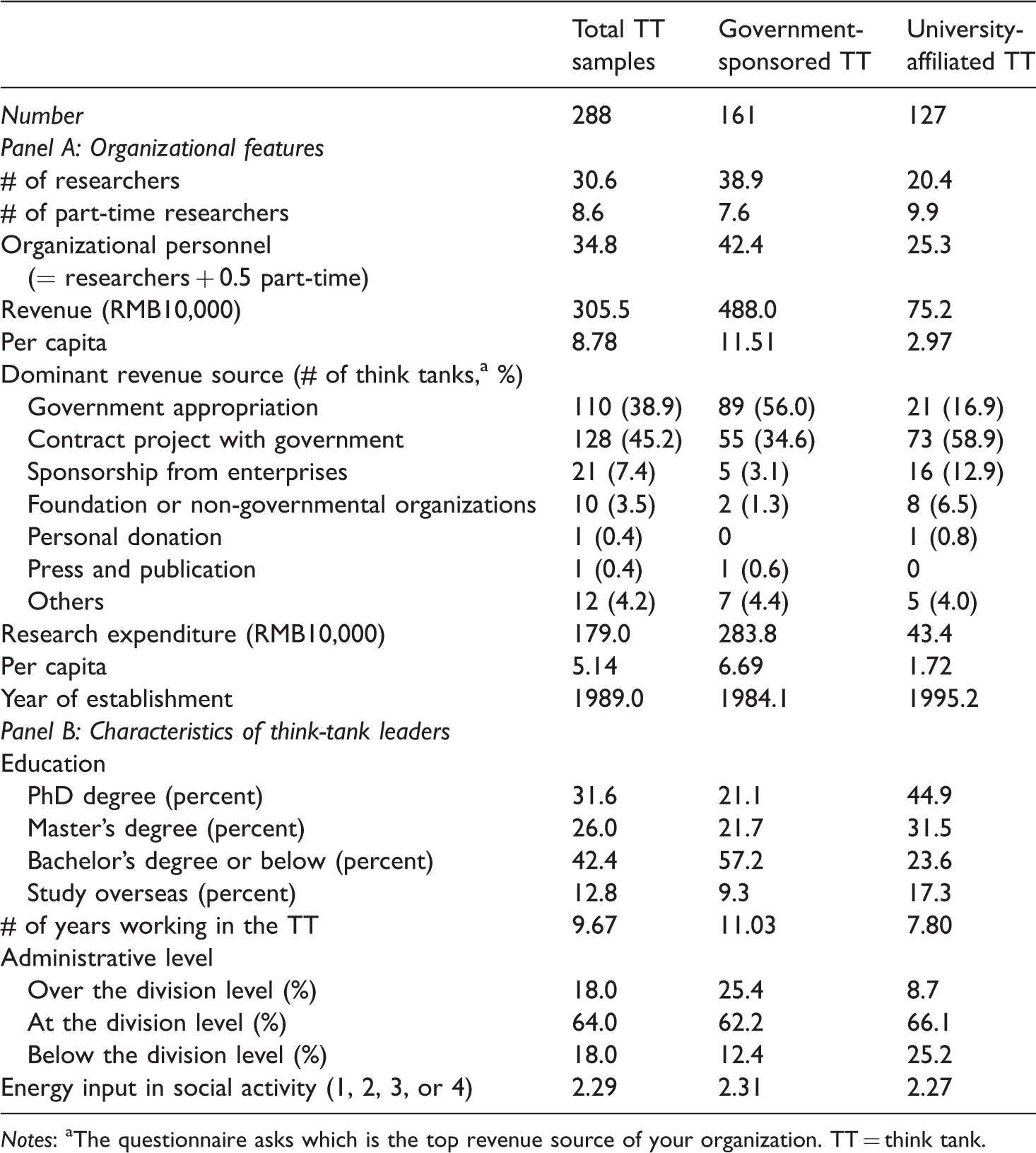
Notes: aThe questionnaire asks which is the top revenue source of your organization. TT = think tank.
Measuring the revolving door
As the key independent variable, the revolving door is measured as the career mobility of think-tank leaders who have moved from different types of organization to their current think tanks. The questionnaire specifically asked the think-tank leaders about their immediately previous jobs, with five options, namely, government agency, university, government-sponsored research institute, media, and others. Given that only a few respondents selected “media,” “others,” or “missing,” I combine these respondents under the category “non-governmental or media sectors.” I then identify 4 × 2 types of career mobility for all think-tank leaders. as shown in Table 2.
Measuring revolving door.
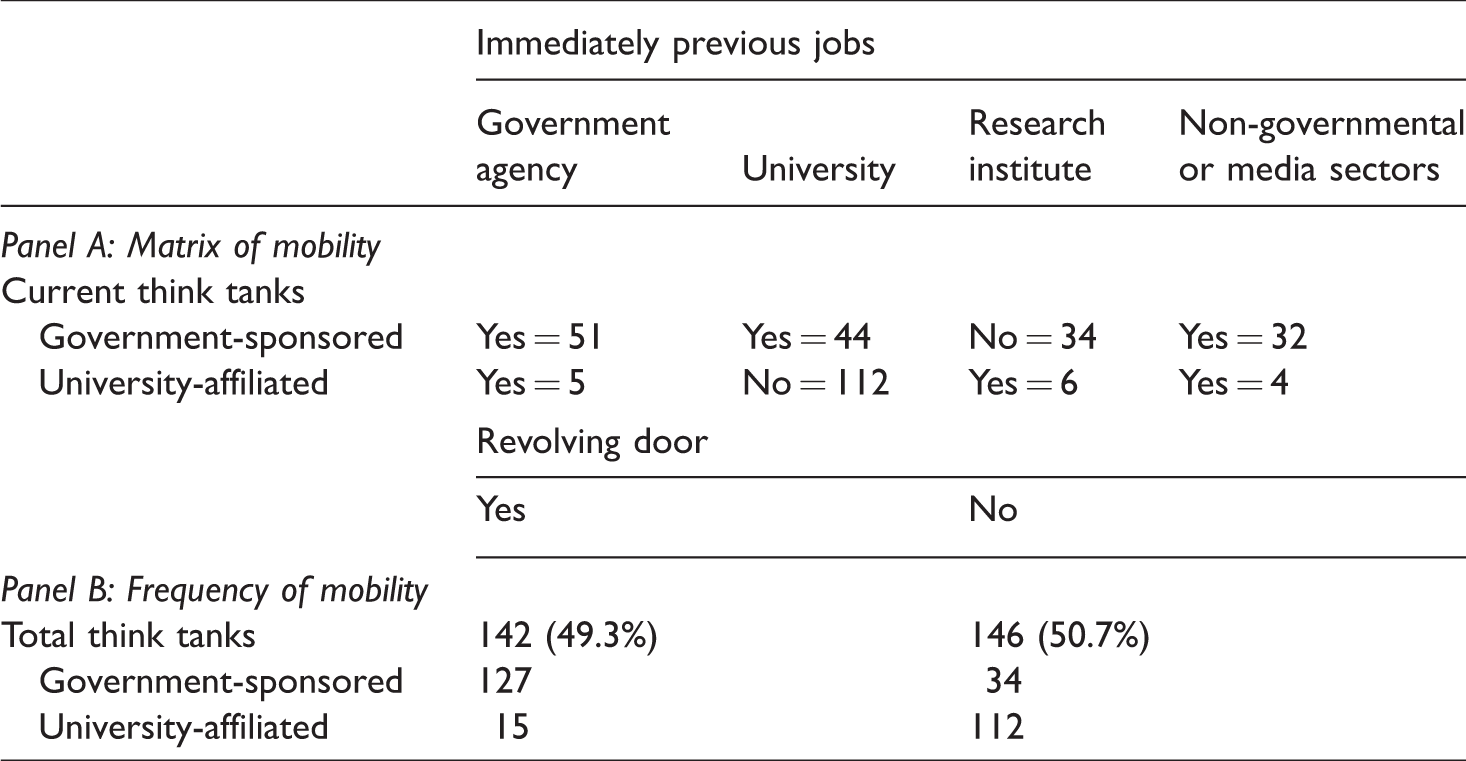
Panel A in Table 2 shows that a leader in a government-sponsored think tank has not experienced the revolving door (= 0) if his/her immediately previous job was at a “research institute,” and a leader in a university-affiliated think tank has not experienced the revolving door (= 0) if his/her immediate previous job was at a “university.” The think-tank leaders in other cases have experienced the revolving door (= 1). Three directions of the revolving door are defined for either type of think tank. Therefore, 49.3% of the think-tank samples in Panel B have leaders experiencing the revolving door.
Measuring influence
Three levels of sub-influences, namely, “decision-maker influence,” “academic influence,” and “public media influence,” are observed, and two indexes of results for influential activities, such as “literal” (A) and “non-literal” (B) activities, are selected in each level (the same indicator of Zhu, 2009, 2011). Panel A in Table 3 provides the 3 × 2 indicator matrices for the influence of China’s think tanks. I then merge the six influence indexes in two steps, employ the factor analysis method to define the three levels of sub-influences, and obtain the total influence factors of each institute. Results are shown in Panel B in Table 3.
Think-tank influence and social networks.

Notes: aThe commentaries (pishi), written comments, and remarks that Chinese government leaders place on a report indicate that these leaders consider such reports as fairly important and worthy to be attended to, circulated, or adopted. Therefore, the number of these comments may indicate the decision-maker influence of think tanks in China. bThe academic journals listed in the “China Core Journal” (Zhongguo hexin qikan, see: http://localsev.lib.pku.edu.cn/cjc/) satisfy a comprehensive indexed standard based on seven indicators of influence. I coded the number of articles that each think tank published in the China Core Journal between 2002 and 2003 by searching the China National Knowledge Infrastructure database (see: https://www-cnki-net.web.bisu.edu.cn). cI employed principal component analysis on the influence variables. dI employed principal component analysis on the social network variables.
Measuring personal social networks
I measure the size of the personal networks of think-tank leaders. In the questionnaire, personal networks are divided into four sub-networks: (1) “officials at or above the provincial/ministerial level”; (2) “officials at the bureau level”; (3) “other ordinary officials and leaders of other sectors”; and (4) “persons from the press and media units” with which think-tankers are acquainted. The lowest requirement, “be acquainted with,” indicates that a government official can talk to an acquaintance in their second meeting.
The experts in China’s think tanks often hold several part-time memberships in other social organizations and may serve as part-time professors, honorary members of the directorate of enterprises, members of the editorial board of academic journals, or members of social intellectual organizations. The questionnaire measures the numbers of “social or academic part-time positions” and “social organization memberships” of think-tank leaders. In Panel C in Table 3, I divided personal network indexes into the network size of social ties and social organization memberships, and then conducted factor analyses that ultimately coalesced into one factor of the personal social networks of think-tank leaders.
Empirical results
Effects of the revolving door on think-tank influence
Table 4 reports the estimates of think-tank influence using ordinary least square regression models. Statistical results of the control variables confirm previous empirical findings that expert knowledge (measured by educational background), administrative linkage (measured by the administrative levels), and personal networks (measured by network size, social organization, and activity) are key factors in determining the influence of think tanks on the Chinese policy process (Zhu, 2009, 2011).
Effects of the revolving door on think-tank influence.

Notes: The robust standard errors are enclosed in parentheses. *p < 0.1; **p < 0.05; ***p < 0.01. TT = think tank.
The regression models in Table 4 show that the revolving door has a negligible contribution to each index of influence of think tanks. In particular, the revolving door from non-governmental sectors to government-sponsored think tanks negatively affects think-tank influence. Therefore, the classic theoretical prediction that the revolving door helps enhance the influence of think tanks cannot be confirmed in China.
Effects of the revolving door on think-tank revenue
Does the revolving door help think tanks obtain revenue? Table 5 reports the effects of the revolving door on think-tank revenue. Our empirical results in Table 5 cannot confirm the traditional belief that the revolving door has positive effects on the revenue of think tanks.
Effects of the revolving door on think-tank revenue.
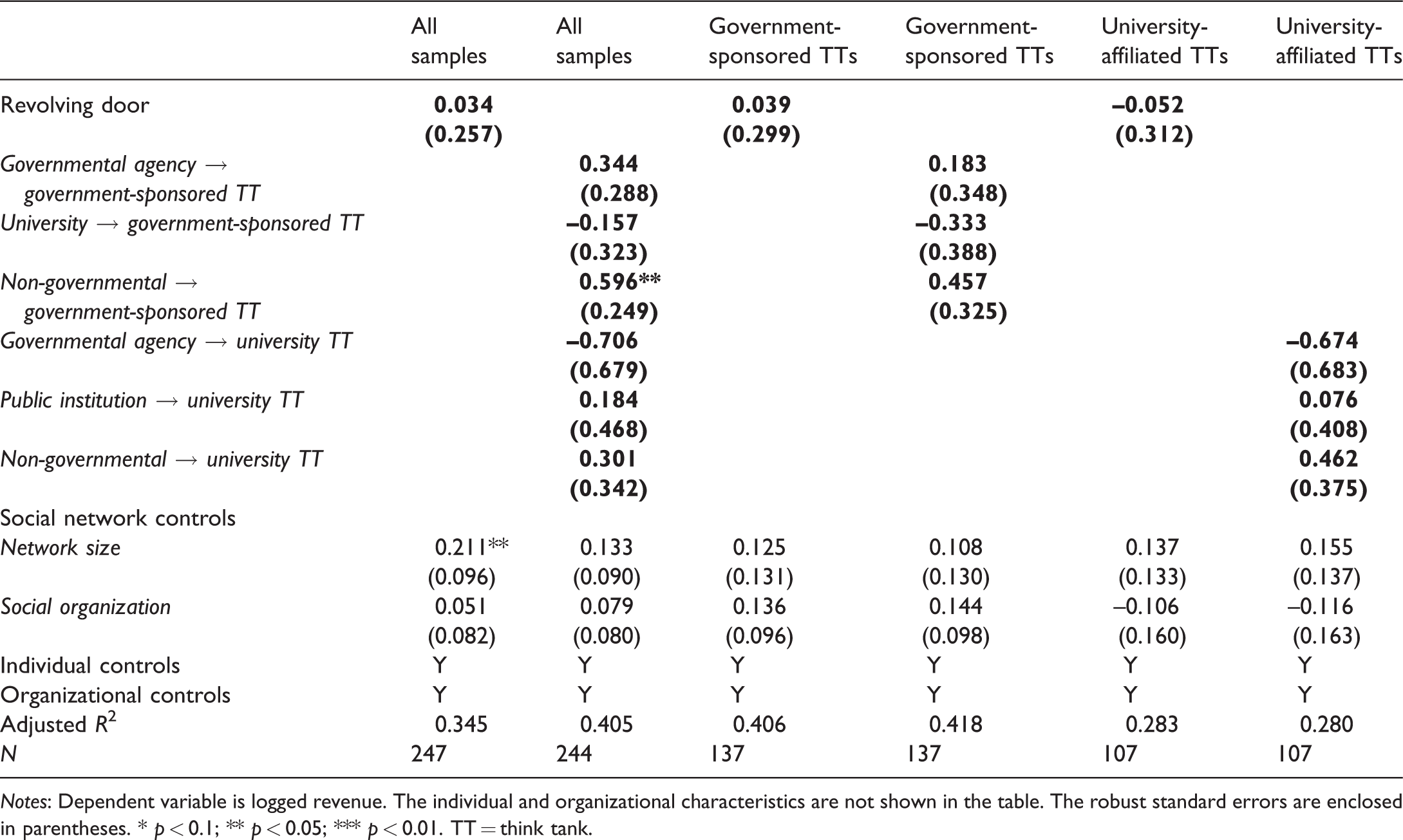
Notes: Dependent variable is logged revenue. The individual and organizational characteristics are not shown in the table. The robust standard errors are enclosed in parentheses. * p < 0.1; ** p < 0.05; *** p < 0.01. TT = think tank.
Effects of the revolving door on personal social networks
I further test the effects of the revolving door on the individual-level social networks of think-tankers. Table 6 shows that the revolving door significantly negatively affects the personal social networks of think-tank leaders. By exploring the effects of each revolving door direction on the personal social networks of think-tank leaders, I determine that almost all directions (significantly or insignificantly) negatively contribute to all three dependent variables. Therefore, contrary to the traditional predictions of organizational theories, I find that the revolving door of think-tank leaders has significantly negative effects on their establishment of personal social networks.
Effects of the revolving door on personal social networks.
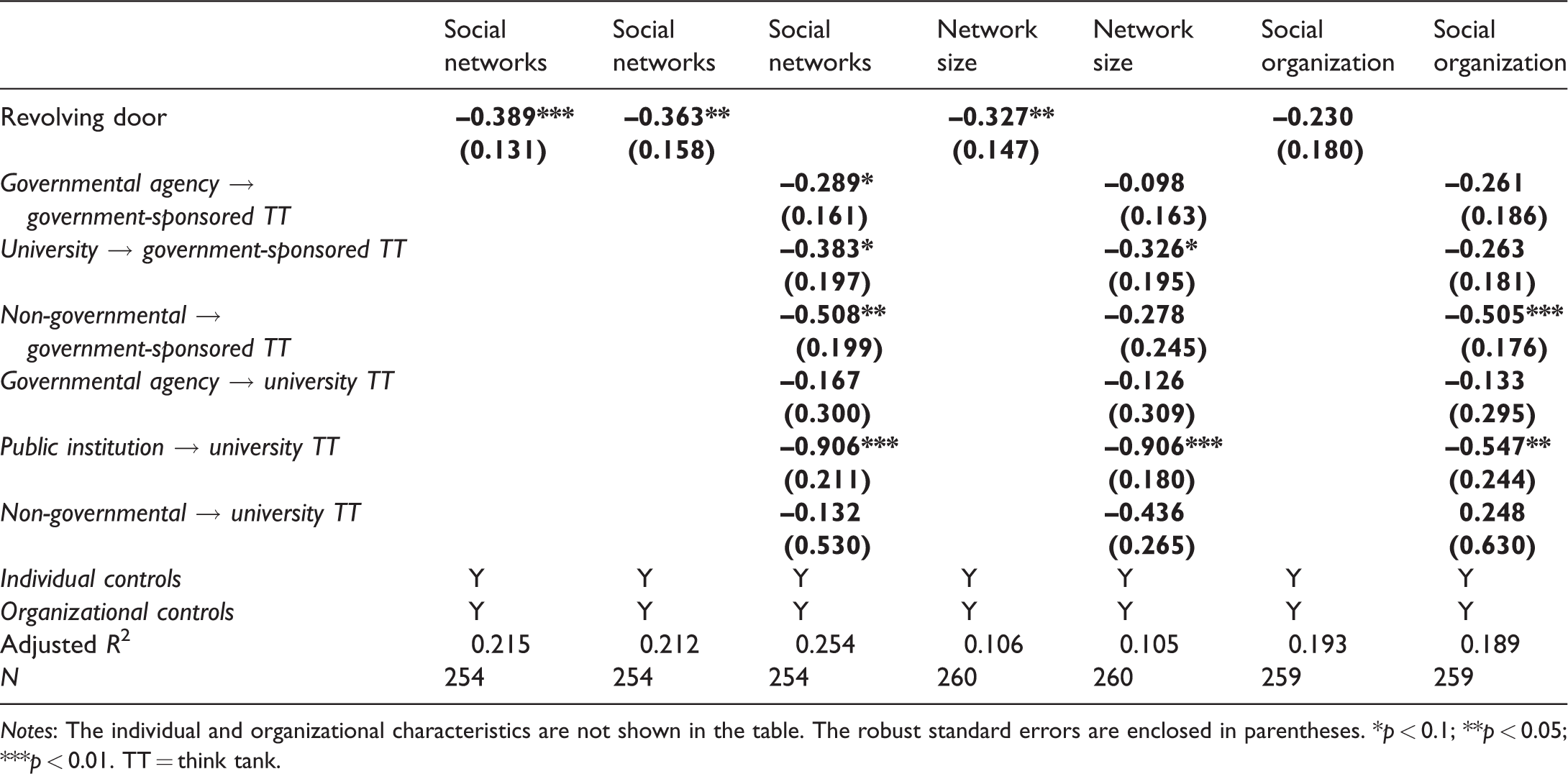
Notes: The individual and organizational characteristics are not shown in the table. The robust standard errors are enclosed in parentheses. *p < 0.1; **p < 0.05; ***p < 0.01. TT = think tank.
Heterogeneous effects of the revolving door
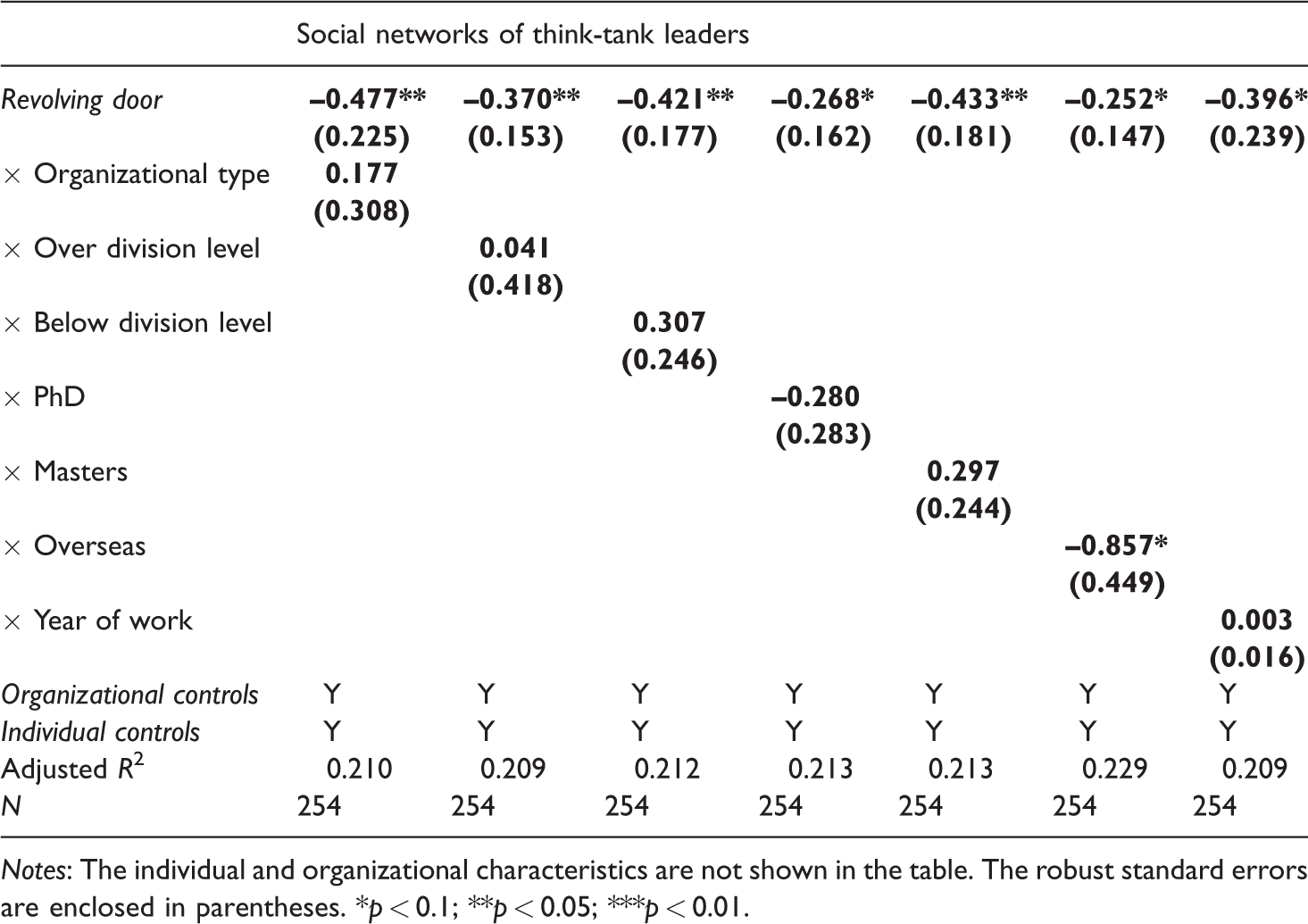
Table 7 presents the estimated potential heterogeneous effects of the revolving door on personal social networks, with additional interaction terms between the revolving door and seven individual and organizational features. The heterogeneous analyses confirm that regardless of the organizational type, administrative level, educational background, and research experience of think-tankers, the revolving door has homogeneous negative effects on personal social networks. The only exception is overseas educational background, with a negative moderate effect on social network building, indicating that overseas returnees will have poorer social network resources after experiencing the revolving door than those who never studied overseas.
Heterogeneous effects of the revolving door on social networks.
Notes: The individual and organizational characteristics are not shown in the table. The robust standard errors are enclosed in parentheses. *p < 0.1; **p < 0.05; ***p < 0.01.
Identification after reducing selection bias
Whether a think-tank leader has experienced the revolving door may result from self-selection. I conduct PSM to draw highly effective causal inferences and to overcome the selection bias (Rosenbaum, 2002; Stuart, 2010). Table B in online Appendix B presents the first step of propensity score estimation with logistic regression, which predicts the probability for a think-tank leader to be selected into the treatment group (the revolving door). In the second step, the cases are matched through kernel matching, which is among the most widely employed matching methods (Heckman et al., 1998; Smith and Todd, 2005). Figure 1 shows that the covariate bias of the pre-intervention variables has been significantly reduced after matching.

Covariate balance pre- and post-matching (PSM kernel estimation).
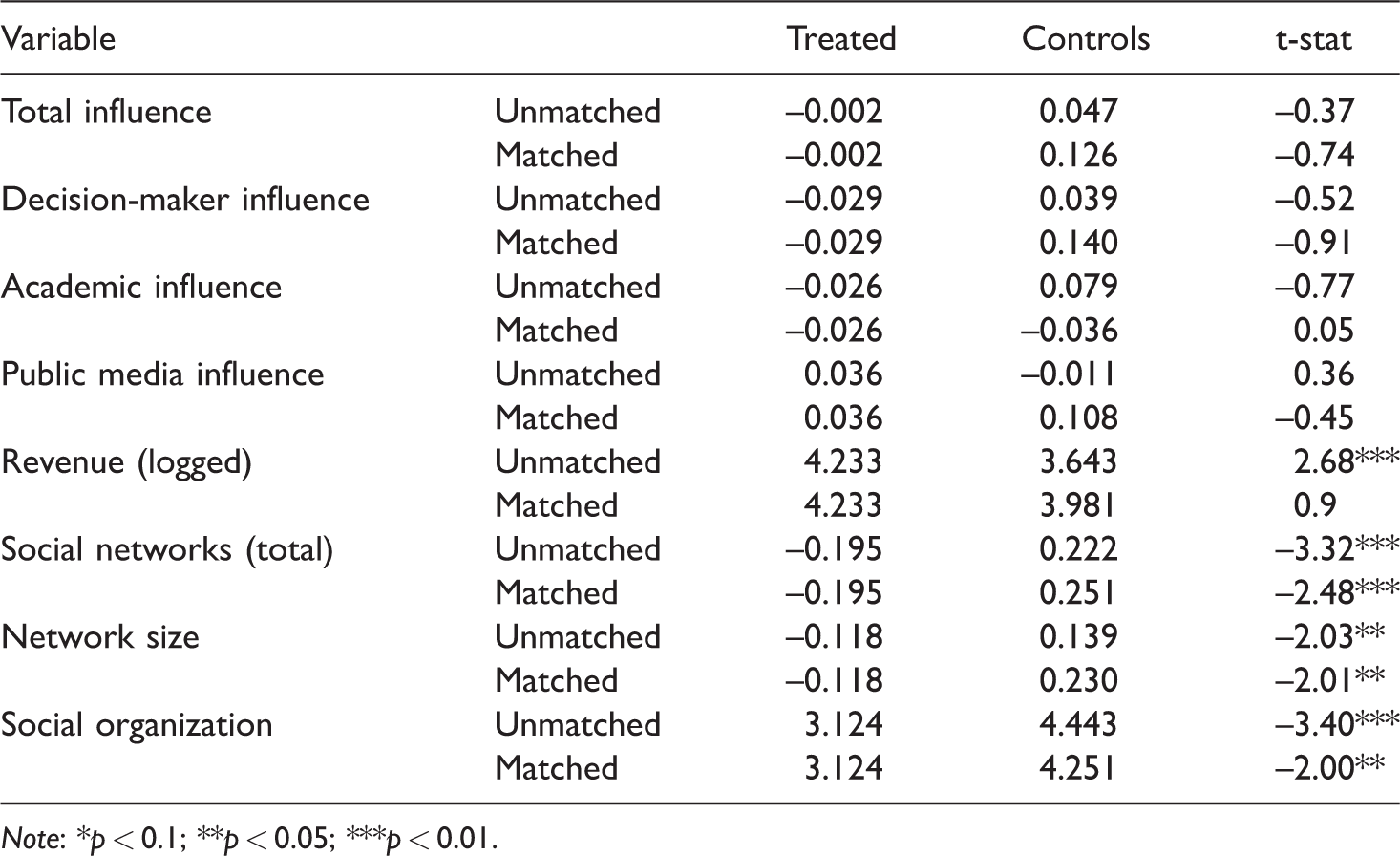
Table 8 reports the estimated average treatment effect (ATE) of the revolving door of think-tank leaders on all dependent variables. First, the treatment of the revolving door confirms no significant effects on the indicators of think-tank influence regardless of whether the samples have been matched. Second, before matching, the revolving door has significant advantages in obtaining revenue. However, after matching, the difference between the treatment and control groups disappears. The results demonstrate that the observation that the revolving door can help think tanks obtain additional revenue is probably merely because richer think tanks are more attractive to social elites who were previously working in different sectors. In fact, the revolving door does not bring additional financial resources. Third, Table 8 confirms the previous results that the revolving door has significantly negative effects on all factors of social networks even when selection bias is addressed after matching.
Average treatment effects of the revolving door (PSM kernel estimation).
Note: *p < 0.1; **p < 0.05; ***p < 0.01.
Conclusion
The article conceptualizes the politically embedded knowledge regime to visualize a distinctive policymaking and consultation system in which political power is deeply embedded in the administrative and personal networks between bureaucratic decision-makers and their professional consultants. Chinese think tanks are typically cultivated in the politically embedded knowledge regime, in which the traditional Chinese Confucian culture and the “bureaucracy-oriented tradition” shape their behaviors.
In the politically embedded knowledge regime, Chinese think tanks tend to majorly rely on the administrative linkages and personal networks of decision-makers and other social elites rather than on public debate to achieve influence. However, with the revolving door, think-tankers fail to significantly contribute to their organizational influence and revenue. Moreover, after losing political power, think-tankers who experience the revolving door have significant disadvantages in building their personal social networks. Therefore, the traditional belief regarding American think tanks may not be as effective when applied to other countries with different knowledge regimes.
A series of research can further deepen our understanding on the effect of the revolving door on think tanks based on this article. First, the past decade has witnessed the rapid development of the think-tank community in China, especially since 2013, when the Chinese top leadership officially promoted the establishment of NTTTCC. Therefore, new systematic data on Chinese think tanks need to be collected. Second, this research does not consider the regional variations and differences among policy fields, which can be further explored. Third, the current article has simplified the research, focusing only on the revolving door of think-tank leaders. However, many think-tank experts who are not organizational leaders have also experienced cross-sectoral career mobility. Therefore, the effects of the revolving door can be further scrutinized.
Supplemental Material
Supplemental material for Think tanks in politically embedded knowledge regimes: Does the “revolving door” matter in China?
Supplemental material for Think tanks in politically embedded knowledge regimes: Does the “revolving door” matter in China? by Xufeng Zhu in International Review of Administrative Sciences
Footnotes
Acknowledgements
An earlier version of this article was presented at several international workshops and seminars in Beijing, Shanghai, Hong Kong, and Singapore. I would like to thank Cheng Siwei, Xue Lan, Zhao Gang, Chen Jidong, Meng Tianguang, and other experts and interviewees during the survey and fieldwork that the author conducted.
Declaration of conflicting interests
The author(s) declared no potential conflicts of interest with respect to the research, authorship, and/or publication of this article.
Funding
The author(s) disclosed receipt of the following financial support for the research, authorship and/or publication of this article: The author would like to thank the National Science Fund for Distinguished Young Scholars of China (71625006) and the Innovative Research Group Project of the National Natural Science Foundation of China (71721002) for the sponsorships.
Supplementary material
Supplementary material can be found online at journals-sagepub-com.web.bisu.edu.cn/home/ras.
Notes
References
Supplementary Material
Please find the following supplemental material available below.
For Open Access articles published under a Creative Commons License, all supplemental material carries the same license as the article it is associated with.
For non-Open Access articles published, all supplemental material carries a non-exclusive license, and permission requests for re-use of supplemental material or any part of supplemental material shall be sent directly to the copyright owner as specified in the copyright notice associated with the article.
