



Abstract
This article, building on governmental financial resilience literature, and using data from a survey of over 600 local governments in Germany, Italy and the UK, looks at the role that external shocks, anticipatory capacities and associated perceived vulnerabilities play in determining different organizational response strategies (i.e. ‘bouncing back’ versus ‘bouncing forward’ strategies) at times of crisis. In the face of shocks, higher perceived vulnerabilities will especially be associated with bouncing back strategies, whereas the presence of anticipatory capacity will be associated with bouncing forward strategies.
Points for practitioners
The present study reveals the crucial role of perceived vulnerabilities and anticipatory capacities for local governments that face shocks and crises. While organizational responses in the sense of bouncing back (e.g. retrenchment, buffering, downsizing, cutbacks) are strongly linked to the associated vulnerabilities, the implementation of bouncing forward strategies (e.g. transformation, repositioning, reorientation) turns out to mainly be dependent on anticipatory capacities, which enable organizations to better recognize potential shocks before they arise. This emphasizes the importance of developing wider anticipatory capacities within local governments as a key element to cope effectively under difficult conditions, as well as to build and nurture a financial resilience culture.
Keywords
Introduction
In recent years, governments have faced a combination of multiple environmental shocks that have resulted in direct and/or indirect financial consequences. The relevance of these phenomena is reflected in an emerging body of research that has focused on how governments respond to crises and shocks. Most contributions in this area have described, classified and explored types of governmental responses (e.g. Kickert, 2012; Kickert and Ysa, 2014; Overmans and Noordegraaf, 2014). However, there is a relative paucity of research into the processes taking place at the micro-organizational level, that is, of the organizational capacities, structures and systems that are (put) in place to face shocks, as well as the role played by organizational actors’ perceptions in affecting responses (Weick and Sutcliffe, 2001). Similarly, whereas in the past, general management and organization literature has pointed to the importance of perceptions, sense-making and anticipation in coping with shocks (Somers, 2009; Weick et al., 2005), they appear to have attracted less attention in current public sector literature. 1
This article contributes to this literature by looking specifically at how governments’ responses to shocks are shaped by organizational perceptions of financial vulnerabilities and the presence of anticipatory capacities, that is, capacities that enable organizations to better recognize potential (financial) shocks before they arise (Boin et al., 2010; Lee et al., 2013; Lengnick-Hall and Beck, 2005; Linnenluecke and Griffiths, 2013; McManus et al., 2007; Weick and Sutcliffe, 2001; Whitman et al., 2013). In exploring the relationships among these variables, resilience may prove a particularly useful conceptual lens, as shown by recent studies analysing how governments deal with the shocks and disturbances that affect their financial condition (see Barbera et al., 2015, 2017; Davoudi, 2012; Linnenlucke and Griffiths, 2010; Mamouni-Limnios et al., 2014; Shaw, 2012; Steccolini et al., 2017; Sutcliffe and Vogus, 2003). Resilience is a multifaceted concept, yet two main features have been highlighted as defining it. On the one hand, it refers to the capacity to react to crises, bouncing back to an original state (Boin et al., 2010: 8; Linnenluecke, 2017: 6; Meyer, 1982); on the other hand, it refers to the capacity to anticipate and cope with the unexpected, bouncing forward through the enhancement of, or development of new, capabilities (Meyer, 1982; Somers, 2009).
This article draws on the conceptual framework of governmental financial resilience developed by Barbera et al. (2017) and is based on multiple case studies in three country contexts, further consolidated through the analysis of about 30 additional cases across eight countries worldwide (Steccolini et al., 2017). This framework explains how different patterns of financial resilience result from the deployment and development of internal anticipatory and coping capacities, as well as their combinations and interactions with environmental conditions and perceived financial vulnerabilities.
Building on these previous qualitative findings, which identified the important role that the presence (or absence) of anticipatory capacities and perceptions of financial vulnerabilities have in shaping organizational responses to shocks, the present article adopts a quantitative approach to explore in more depth the roles of anticipatory capacities and perceptions about financial vulnerability. More specifically, it explores the roles played by such factors in driving and explaining different governmental responses to shocks, as well as how responses are affected by the types of shocks themselves.
The research is based on a survey of German, Italian and UK local governments (LGs), the governmental level nearest to citizens, which provide an array of ‘tangible’ services and thus directly affect the quality of life of those they serve. LGs have been significantly impacted by recent shocks affecting their finances. The results show that in the face of shocks, higher perceived vulnerabilities will especially be associated with bouncing back strategies, whereas the presence of anticipatory capacity will be associated with bouncing forward strategies.
The article is structured as follows. The next section briefly reviews the extant literature and presents the conceptual framework and underlying hypotheses. The third section describes the methods and the fourth section presents the results. Finally, the fifth section discusses them and draws conclusions, also highlighting implications for practice and research.
Conceptual framework and hypotheses development
Our study draws on the concept of governmental financial resilience, whereby governments’ ability to anticipate, absorb and react to shocks affecting their finances is the result of the interaction of environmental conditions, as well as organizational dimensions (Barbera et al., 2015, 2017; Davoudi et al., 2013; Lengnick-Hall and Beck, 2005; Linnenluecke, 2017; Linnenluecke and Griffiths, 2013; Nelson et al., 2007; Somers, 2009; Steccolini et al., 2017; Sutcliffe and Vogus, 2003). Such conditions and dimensions are discussed further in the following subsections, where hypotheses are advanced and the conceptual framework is presented.
Responses to shocks (dependent variable)
Prior empirical research has shown that organizations pursue a variety of strategies when coping with shocks and crises affecting their finances (see Beeri, 2012; Boyne, 2004, 2006; Hofer, 1980; Robbins and Pearce, 1992; Schendel et al., 1976). While such strategies have been described and classified in various ways, they can be traced back to two main approaches. Organizations may embrace bouncing back (e.g. retrenchment, buffering, downsizing, cutback) strategies, including increasing taxes and fees, deferring investments, reducing the costs, scope or size of the organization, and selling assets (Barbera et al., 2017; Steccolini et al., 2017). Other organizations may embrace bouncing forward strategies (e.g. transformation, repositioning, reorientation). The latter emphasize self-sufficiency, entrepreneurship and innovation by redefining the modes of service delivery and core activities, as well as improving existing services or supplying new services either to current or to new clients (Barbera et al., 2017; Steccolini et al., 2017). This article sets out to explore the respective roles of such factors in explaining the types of responses of LGs to recent shocks and crises (see Figure 1).
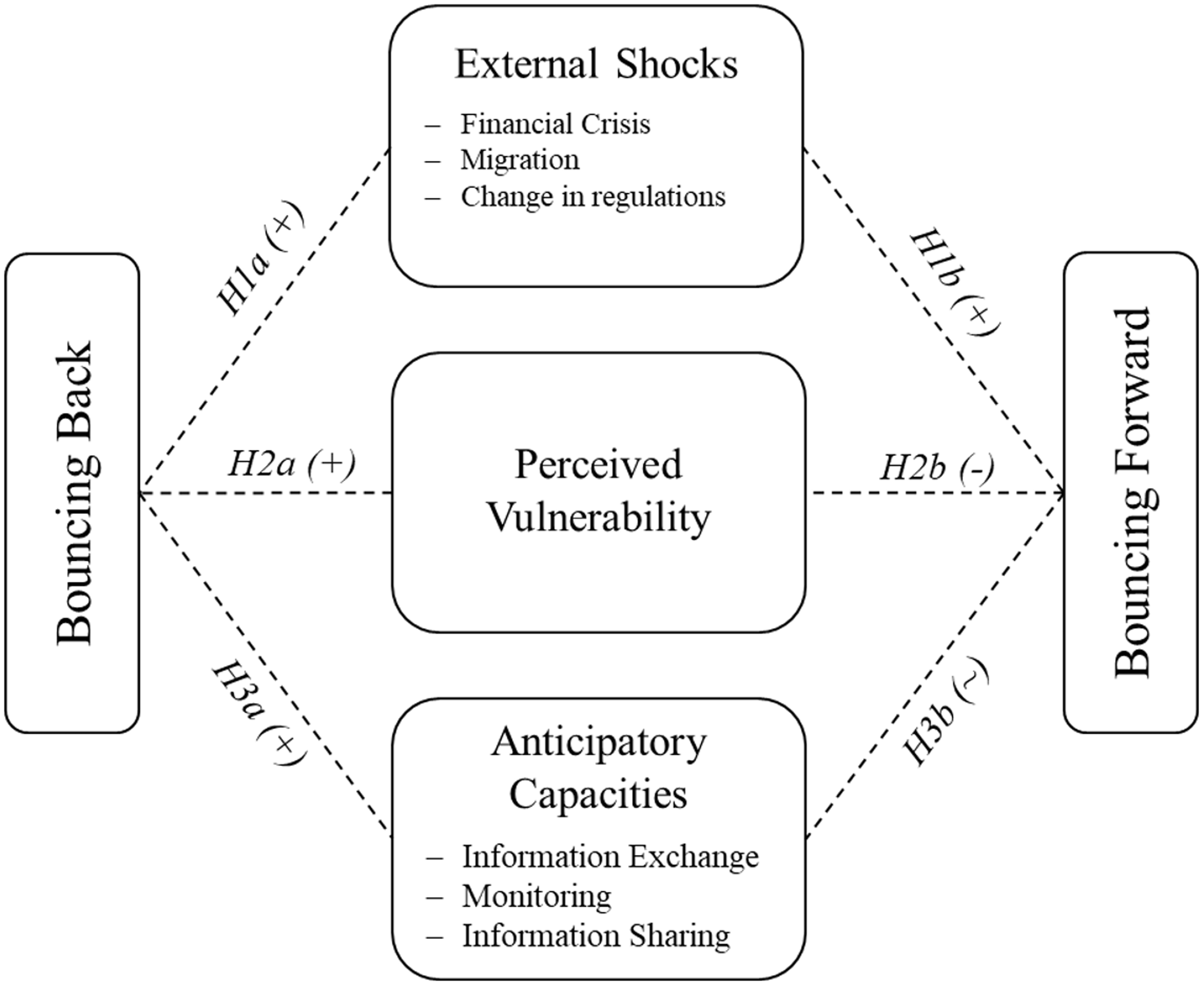
Analytical framework.
Perceived shocks
External shocks are events that have a significant impact on organizations, sometimes even materializing the threat of organizational failure. The impact can be direct, such as eroding tax bases, or indirect, for example, due to natural disasters or changes in government policy (see Jones et al., 2017). Although the question of whether there exist objective criteria that define when an event can be perceived as a ‘triggering’ event in terms of a crisis or shock, or whether the existence of a crisis or shock is determined by individual perceptions, still seems to be open for debate (see Drennan et al., 2014: 14ff.) as several scholars highlight the key role that perceptions play in dealing with crisis and shock. In particular, they argue that individual perceptions, as well as the managerial interpretation of events, determine how much attention is dedicated to an event or potential shock and which actions the organization takes in responding to a shock or crisis (e.g. Billings et al., 1980; Pauchant and Mitroff, 1992; Pearson and Clair, 1998; see also Daft and Weick, 1984; Dutton and Jackson, 1987; Weick, 1979). Much of the literature that has explored governmental responses to the global financial crisis shows that governments across the globe have been hit to varying degrees by the financial crisis, and that some have responded with only incremental, yet others with more fundamental, measures (see Kickert, 2012; Kickert et al., 2015; Peters, 2011). In addition, case studies of LGs in Germany, Italy and the UK have highlighted that changes in regulations, such as taxation limitations and the devolvement of tasks, or cuts to public expenditure (Barbera et al., 2017; Jones, 2017; Papenfuß et al., 2017) can have unexpected and long-lasting effects on the LGs’ finances, and impact on public managers’ perceptions and elaboration of ensuing response strategies. In line with these findings, it may be expected that when public managers perceive a stronger intensity of external shocks, this will translate into stronger responses, both in terms of incremental adaptation and buffering (bouncing back), and of more radical transformations and repositioning (bouncing forward): H1: Higher perceptions of external shocks are associated with higher reliance on both bouncing back (H1a) and bouncing forward (H1b) strategies.
Vulnerability
Vulnerability represents the level of exposure to shocks (McManus et al., 2007). Being the result of both external and internal sources, it lies at the interface between the environment and the organization (see Figure 1). Qualitative analyses of LGs’ financial resilience have shown that it is the sense of being able to control the vulnerability and/or influence its sources that affects the way in which shocks are interpreted and subsequently tackled (Barbera et al., 2017; Jimenez, 2012; Maher and Deller, 2011), something that is also evident in other, more general, studies (see also Boin et al., 2010; Lengnick-Hall and Beck, 2005; Linnenluecke and Griffiths, 2013; McManus et al., 2007; Somers, 2009). Prior qualitative studies showed that high levels of vulnerability were associated with coping strategies that built mainly on buffering, including efforts at managing internal resources through reducing expenditure and downsizing. LGs where the sources of financial vulnerability were regarded as at arm’s length and thus manageable, in contrast, exerted a more proactive behaviour to shocks and an increased ability to proactively manage or offset the impact of environmental conditions (Barbera et al., 2017; Steccolini et al., 2017). The level of perceived vulnerability will thus be expected to have a different effect on LGs’ responses, with higher perceived vulnerability being more likely to encourage defensive and risk-averse approaches aimed at bouncing back, and lower perceptions of vulnerability leaving leeway for more transformative, innovative and entrepreneurial approaches. From this follows: H2: A higher level of financial vulnerability is positively associated with bouncing back strategies (H2a), and negatively associated with bouncing forward strategies (H2b).
Anticipatory capacities
Anticipatory capacities are the tools and capabilities that enable LGs to better identify and manage their vulnerabilities and recognize potential shocks before they arise. As such, they are not limited to forms of planning, monitoring or risk assessment, but are also related to the cognitive aspects of situation awareness and sense-making (e.g. Boin et al., 2010; Lengnick-Hall and Beck, 2005; Linnenluecke and Griffiths, 2013; McManus et al., 2007; Somers, 2009). In this context, some scholars have argued that the availability or improvement of anticipatory capacities, that is, the tools and capabilities that enable LGs to anticipate shocks and crises and better identify and manage their vulnerabilities, also assist them in (proactively) coping with shocks and crises (Lengnick-Hall and Beck, 2005; Somers, 2009). Anticipation allows organizations to prepare in advance for coping with shocks, exploring possible routes, including the repositioning and rethinking of services and activities, and setting in place more comprehensive strategies to respond to them. Thus, a stronger presence of anticipatory capacities is expected to facilitate the adoption of bouncing forward strategies, but not necessarily to predict the adoption of bouncing back ones. From this follows: H3: A higher level of anticipatory capacities (i.e. monitoring, information exchange, information sharing) is positively associated with bouncing forward (H3b) but not bouncing back (H3a) strategies.
Methods
The research builds on a survey of LGs in Germany, Italy and the UK, complemented by an analysis of archival data covering financial and socio-demographic aspects.
The unit of analysis: LGs in Germany, Italy and the UK
All three selected countries are large economies with LGs being responsible for a wide array of similar services, including, among others, social protection, education, economic affairs, housing and community amenities, public order, and safety and health. However, they represent different administrative traditions and the number of LGs varies. This is mainly due to the relative size of the populations served by LGs in each country. In order to provide a meaningful basis for comparison, LGs included in the survey were identified based on a stratified sampling approach. The reference population in Italy and Germany is given by all the LGs with more than 5000 inhabitants. The reference population in Italy therefore includes 2411 units while the reference population in Germany includes 2880 units. Given the different distribution of LGs across dimensional classes, larger LGs are less represented than smaller ones in the whole population. As a consequence, to ensure the satisfactory representation of both dimensional classes and efficiency, all LGs with a population above 15,000 were included in the sample, that is, 961 LGs in Germany and 737 in Italy. For LGs with a population between 5000 and 15,000, we selected 50% of local governments (960 LGs for Germany and 837 for Italy) considering their geographical distribution (differentiated between East and West in Germany, and North and South in Italy). Based on lists that include all LGs between 5000 and 15,000 per region, we randomly selected local governments from each region. Information on the regional distribution of the sample, as well as the responses, can be found in Appendix 1a and 1b. In the UK, successive structural change dating back to the 1970s has seen a reduction in the number of LG institutions servicing ever-larger populations (with a current average population of around 150,000). Except for two, all LGs exceed population figures of 15,000 and we therefore decided to include all LGs from three of the four regions 2 (a total of 406) in the survey. The questionnaire was administered online and respondents were asked to answer for their organization as a whole rather than subunits within it. The questionnaire was sent to LGs’ chief executive officers, chief financial officers and service managers (in order to ensure that a variety of comparable public services, social services, public works, culture and leisure were taken into consideration). In general terms, this level of seniority of the respondents was chosen as it is more likely to have the required departmental/organizational-wide view. The email addresses were collected from the governmental websites as they are publicly available. To ensure the highest possible response rate, at least two reminders were sent in each country. 3 The usable responses received for the analysis come from 295 LGs (15.4%) in Germany, 268 (16.80%) in Italy and 64 (15.2%) in the UK.
Non-response bias was assessed by comparing the responses in the questionnaires between the first and last wave (i.e. responses generated by a stimulus; see Armstrong and Overton, 1977: 397) for each country. We used an extrapolation method where non-respondents are considered to respond similar to late responders (see Lindner et al., 2001). Late respondents are defined as those who responded in the last wave of responses, that is, in response to the last stimulus. We compare them with early respondents, that is, those who responded to the first stimulus. Due to the lower number of responses in the UK in total (64), we were not able to identify the recommended minimum of 30 respondents based on the first stimulus (see Lindner et al., 2001). We therefore compared the last wave of responses (32) to the first 50% of responses (32). We additionally applied the same procedure for Italy and Germany, and compared the first 50% and last 50% of responses. All t-tests yielded no significant differences between the included variables.
Operationalization of variables
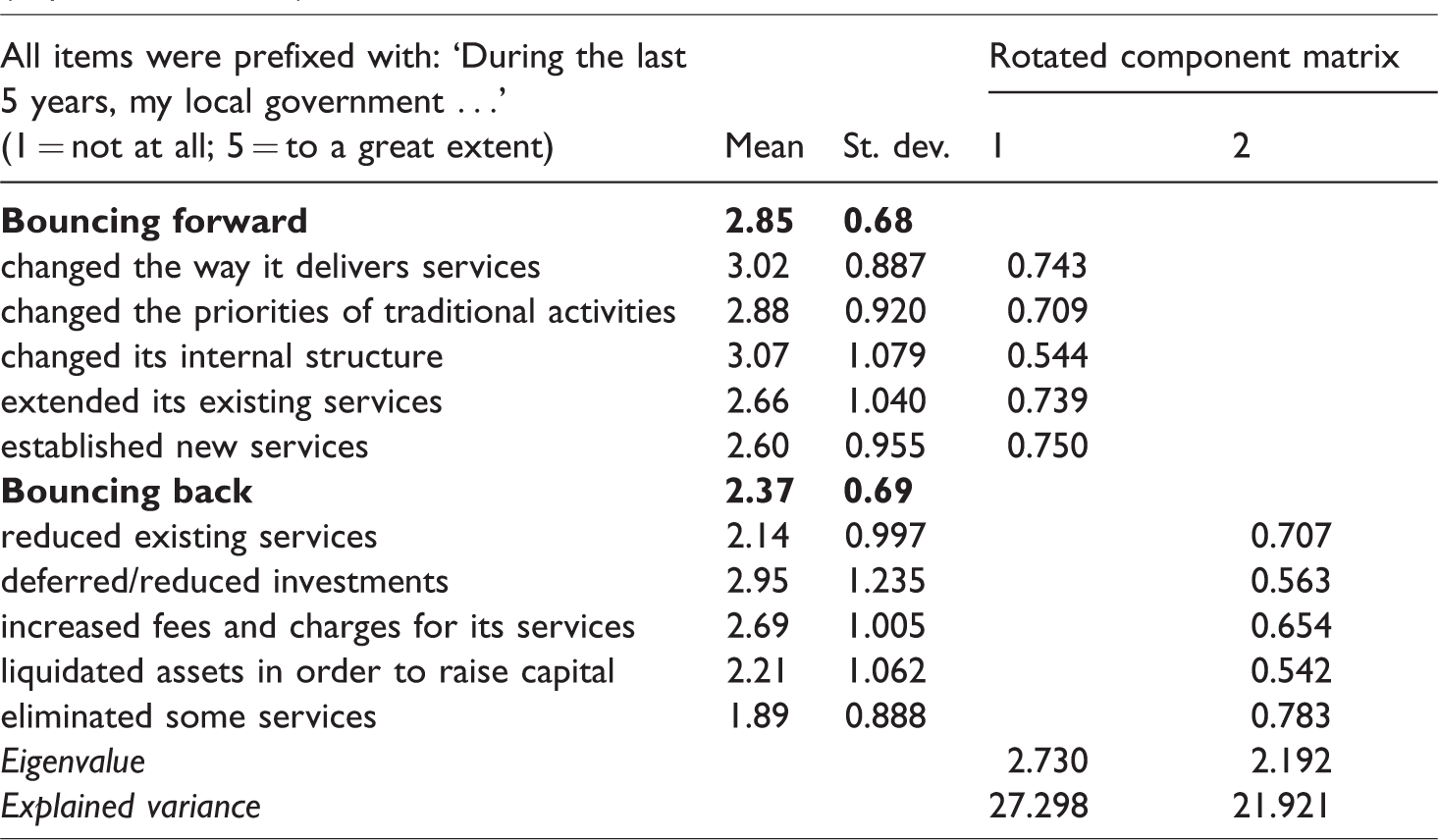
The variables discussed earlier and presented in Figure 1 were operationalized by drawing on the literature on resilience, organizational capacities and governmental financial management, as well as the qualitative groundwork put forward by Steccolini et al. (2017). The questionnaire was developed and translated to ensure fit in the respective country contexts while preserving comparability. Appendix 2 shows how the resilience dimensions were operationalized, and Tables 1 and 2 provide detailed information on the items that were used to measure each dimension.
Exploratory factor analysis response strategies – bouncing forward, bouncing back (dependent variable).
Vulnerability and anticipatory capacities, descriptives and factor analysis.
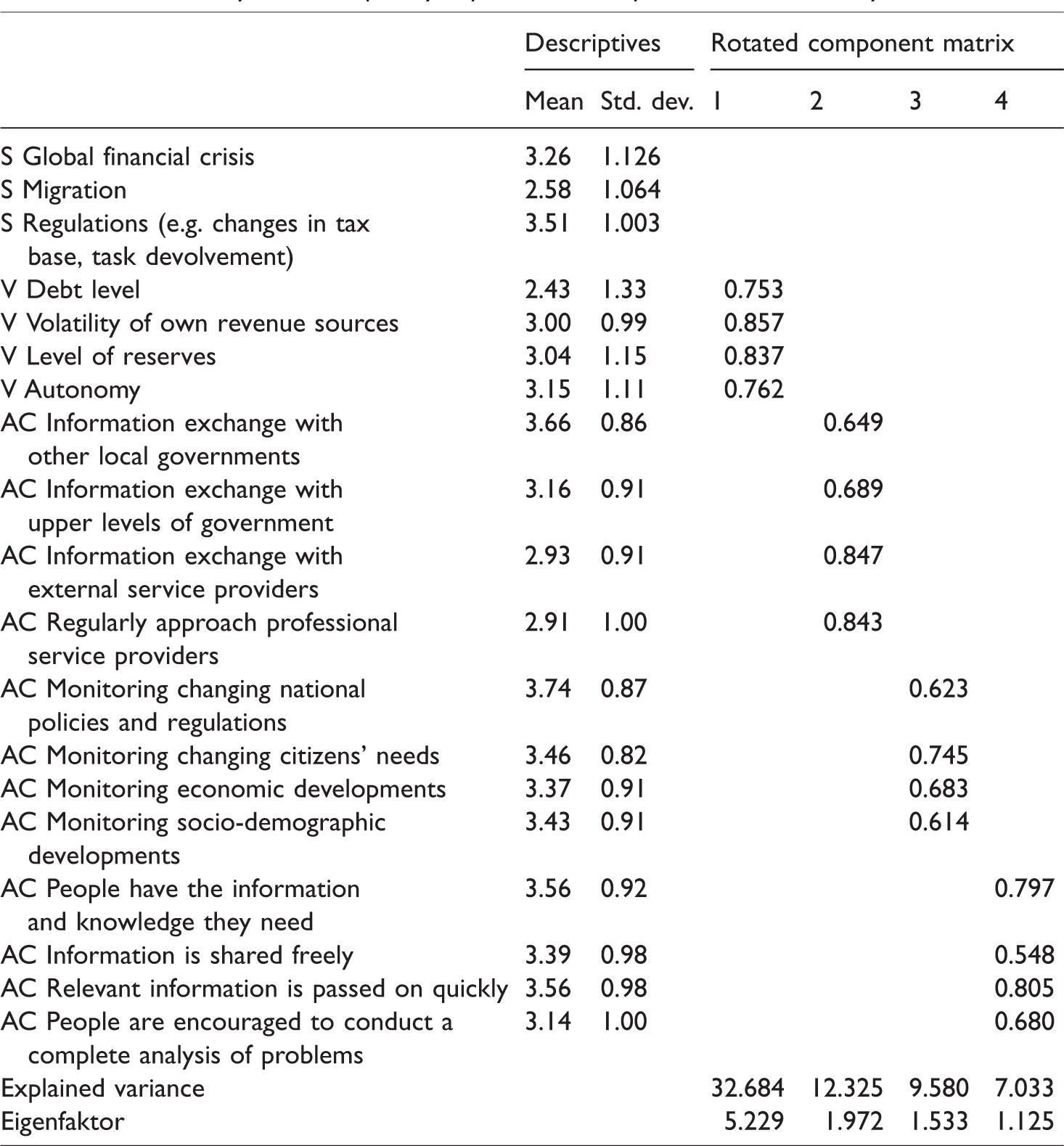
With specific reference to shocks, the present study looks at three different shocks, which have been mentioned across LGs in 11 countries (Steccolini et al., 2017): the global financial crisis, migration 4 and (change of) regulations. With regard to financial vulnerabilities, four key issues were assessed to analyse if LGs are in control of both external and internal financial vulnerability sources: financial autonomy, abundance of financial resources (fiscal slack), level of indebtedness and volatility of own revenue resources (Hendrick, 2011; McManus et al., 2007; Maher and Deller, 2011). A set of questions regarding the perceived presence of anticipatory capacities in LGs was derived from the literature (for more details, see Appendix 2 and Table 2). Responses load onto the expected three subcategories for anticipatory capacities, consisting of: (1) exchange of information with external actors (e.g. upper government levels, service providers); (2) monitoring activities (e.g. national policies and regulations, citizen’s needs, economic and socio-demographic developments); and (3) providing staff with sufficient information and fostering an organizational setting that encourages problem analysis and information sharing (see Table 2). The summative variables for each subcategory reported acceptable alphas, reaching Cronbach alphas higher than .7 in all cases.
In addition to the survey data, archival financial data and published reports were used as sources for the analysis (see Appendix 2). We included three financial indicators – average debt level, investment ratio and current ratio – covering a 10-year period (2006–2015), as well as size, as control variables. The data were analysed by means of descriptive statistics and factor analysis. In a further step, ordinary least square regression is chosen as the statistical method to test the developed hypotheses.
Results
The results of factor analyses as well as descriptive statistics are presented in Tables 1 and 2. The following subsection discusses the results of the test of hypotheses, based on the regression analysis.
The factor analysis (see Table 1) reveals that responses load onto two different types of strategies (i.e. bouncing back and bouncing forward), which were adopted by LGs during the last five years. A summative variable of each strategy reported acceptable Cronbach alphas (0.7). As shown in Table 1, LGs appear to rely more on bouncing forward than on bouncing back strategies.
Respondents generally gave different weights to different types of shocks (see Table 2), with changing regulations being perceived as the most important external shock followed by the global financial crisis. Migration, in contrast, seems to have affected LGs only to a relatively minor extent.
The subsequent section explores whether and to what extent governmental responses are driven by different types of shocks and crises, financial vulnerabilities, and/or internal capacities that enable organizations to better recognize potential financial shocks before they arise. Table 3 presents the multiple regression models for the antecedents of the two types of strategies described earlier, that is, bouncing back and bouncing forward. To determine whether Ordinary Least Square was appropriate, data were examined for heteroscedasticity and multicollinearity, both returning satisfying results. All models achieve good rates for multicollinearity, and no Variance Inflation Factor (VIF) higher than 1.75 was reported in the models. The models offered reasonable fit for a cross-sectional design. The explained variance ranges between .20 (bouncing forward model) and .29 (bouncing back model).
Results of regression analysis for response strategies.

Note: *p < 0.1, **p < 0.05 and ***p < 0.01 levels, respectively.
Table 3 shows that bouncing back and bouncing forward strategies were driven by different antecedents. While it turned out that all types of shocks show a positive association with both types of strategies, therefore supporting the hypothesis (H1) that higher perceptions of shocks are related with higher reliance on response strategies, their significance varies. Migration shows the strongest effect in the bouncing forward model while regulation shows the strongest effect in the bouncing back model. Although being significant, the effect of the global financial crisis turned out to be comparatively low in both models, barely reaching significance in the bouncing back model.
The main enablers of bouncing back responses are the various sources of financial vulnerability, therefore supporting the hypothesis (H2a) that higher perceived financial vulnerability will bring about bouncing back strategies. The results also show that, as hypothesized (H2b), perceived financial vulnerability has a negative association with bouncing forward strategies, but its effect is much weaker.
Moreover, the different dimensions of anticipatory capacities show a positive association with the bouncing forward strategies of LGs (H3b). However, the impacts vary, with information exchange showing the highest and information sharing showing the lowest, but still significant, effect. The association disappears when looking at their relationship with bouncing back strategies (H3a). The controls suggest that both strategies were negatively associated with a positive current ratio covering a 10-year period, while the three other controls turned out to be non-significant.
Discussion and conclusions
Looking at LGs across Germany, Italy and the UK, this study explored the roles of perceptions of shocks and financial vulnerability, as well as anticipatory capacities, in explaining the type of strategies adopted to respond to shocks. The analysis shows that the perceptions of the most important recent shocks, as well as the capacities for anticipating them, and financial vulnerabilities appear to be relevant in explaining LGs’ strategies in the face of shocks.
In exploring the links between external shocks, internal conditions and responses to shocks, the analysis shows that the reliance upon bouncing back and bouncing forward strategies is explained by different factors. Bouncing back strategies (e.g. deferring investments, increasing fees) are likely to be found in the presence of high levels of perceived financial vulnerability. Conversely, the adoption of bouncing forward strategies (e.g. changing service delivery, establishing new services) appears to be positively associated with the presence of strong anticipatory capacities (especially information exchange) and to be hindered by high levels of financial vulnerability. In looking at these results, it is worth noticing that the global financial crisis appears to have less explanatory power than other shocks, probably because, while still remaining relevant, its effect may now be fading away in the face of the emergence of new shocks. The association between migration and bouncing forward seems to be in line with views that the former will require an overall reconfiguration of public services, whereas the association between changes in regulations with bouncing back appears to suggest that such changes are seen as less wide-ranging and requiring less incisive interventions, or interventions that do not put into question the configuration of public services.
Most importantly, the results highlight that perceptions of high financial vulnerability are especially central in explaining reliance on bouncing back strategies. Hence, LGs perceiving their financial conditions as being difficult will be less likely to embark on bouncing forward actions. Moreover, and conversely, they show the important role played by anticipatory capacities in explaining the adoption of bouncing forward strategies, whereas they do not appear to play a relevant role in explaining bouncing back strategies. The analysis supports previous qualitative findings as anticipatory capacities appear to co-occur with adaptive, and transformative, behaviour (i.e. bouncing forward), also reducing perceived financial vulnerability, while heavy exploitation of buffering capacities may crowd out the development of other capacities needed to bounce forward, resulting in higher levels of vulnerability over time (Barbera et al., 2017; Davoudi et al., 2013; Meier and O’Toole, 2009; Wildavsky, 1988).
The study has relevant implications for managers and policymakers as the results reveal the relationship between different anticipatory capacities and perceptions of financial vulnerabilities and the strategies adopted by LGs to face shocks. While bouncing back is strongly linked to the associated vulnerabilities, the implementation of bouncing forward strategies when facing difficult times turns out to mainly be dependent on the capacities identified earlier. This emphasizes that whenever willing to adopt a bouncing forward approach, it is important to develop wider anticipatory capacities within LGs as a key element to cope effectively under difficult conditions, as well as to build and nurture a financial resilience culture.
The present study contributes to further developing and operationalizing the dimensions of financial resilience, more specifically, anticipatory capacities and perceived financial vulnerability, and understanding their relevance for LG response strategies. However, the results are based on a cross-sectional research design and thus present associations. The adoption of a longitudinal perspective in future studies may offer additional insights into causal links, as well as how strategies evolve over time and under which conditions. The dimensions identified in the framework also offer LG actors the potential to better reflect on their own sources and levels of vulnerabilities, and to understand what anticipatory and coping capacities they need to assess, nurture and develop in order to anticipate, absorb and react to shocks affecting their finances over time. Finally, as smaller local governments were not taken into consideration in this study, further analyses may focus on them to further explore the role of anticipatory capacities in smaller organizations.
Supplemental material
Please see online Appendices at http://journals.sagepub.com/home/ras
Supplemental Material
Supplemental material for Local government strategies in the face of shocks and crises: the role of anticipatory capacities and financial vulnerability
Supplemental Material for Local government strategies in the face of shocks and crises: the role of anticipatory capacities and financial vulnerability by Carmela Barbera University of Bergamo, Italy Martin Jones Nottingham Business School, UK Sanja Korac Alpen-Adria-Universitaet Klagenfurt, Austria Iris Saliterer Albert-Ludwigs-Universitaet Freiburg, Germany Ileana Steccolini in International Review of Administrative Sciences
Footnotes
Declaration of conflicting interests
The author(s) declared no potential conflicts of interest with respect to the research, authorship, and/or publication of this article.
Funding
The author(s) received no financial support for the research, authorship, and/or publication of this article.
Supplemental material
Supplemental appendices for this article are available online at http://journals.sagepub.com/ home/ras
Notes
References
Supplementary Material
Please find the following supplemental material available below.
For Open Access articles published under a Creative Commons License, all supplemental material carries the same license as the article it is associated with.
For non-Open Access articles published, all supplemental material carries a non-exclusive license, and permission requests for re-use of supplemental material or any part of supplemental material shall be sent directly to the copyright owner as specified in the copyright notice associated with the article.

.png)